Compassionate Care

In my last column I shared how I had been drafted into service as my wife’s nurse.

The duties are not onerous, in part because she’s become quite ambulatory with her crutches . . . but even more, due to the fact that I truly love her. To care for those you love is a natural thing, and it would be the opposite path—to ignore the suffering of those about whom you care—that would be contrary to human nature.

This is why we are also so deeply stunned when we see spouses doing harm to one another, or (far worse) injuring children in their care. These are inhuman acts contrary even to that universal Natural Law which governs even those who take no notice of religious codes.

But, returning to my nursing experience . . . I am not a total stranger to such matters. My first assignment as an Air Force chaplain was in a “Contingency Hospital” which was part of the Reserve. As part of my active duty tours I frequently included hospital visitation and service.

In fact, years ago during a five week Joint military exercise in Thailand, I served for a season as the chaplain of a Mobile Army Surgical Hospital. (Yes, I was an honest to goodness M*A*S*H chaplain!)

Returning to my initial point, caring for my wife is not burdensome. I readily confess I would hardly bring the same enthusiasm and selflessness to caring for a stranger.

But that’s not the man, the disciple of Jesus, I desire to be. And so, I pray for greater compassion, exercise and “stretch” my concern for others, seek forgiveness for my failings . . . and repeat the cycle.

C.S. Lewis writes brilliantly about the great significance of each and every human life. In The Weight of Glory he reminds us that we have the potential to influence their lives either positively or negatively, and assisting them to follow the path to “glory” is central to our reason for being.

It is hardly possible for [us] to think too often or too deeply about [the future destiny] of [our] neighbor. The load, or weight, or burden of my neighbour’s glory should be laid on my back, a load so heavy that only humility can carry it, and the backs of the proud will be broken. . . .

All day long we are, in some degree, helping each other to one or the other of these destinations [glorified resurrection in the presence of our Creator or eternal corruption apart from God].  It is in the light of these overwhelming possibilities, it is with the awe and the circumspection proper to them, that we should conduct all our dealings with one another, all friendships, all loves, all play, all politics. There are no ordinary people. You have never met a mere mortal. Nations, cultures, arts, civilizations—these are mortal, and their life is to ours as the life of a gnat.  But it is immortals whom we joke with, work with, marry, snub, and exploit—immortal horrors or everlasting splendours.

One of my favorite books was written by Calvin Miller. He’s the author of numerous classics, and I most recently enjoyed his The Path of Celtic Prayer. However, because of my interest in the early church, and my affection for keenly wielded wit, it is The Philippian Fragment which ranks in my personal “top ten.” (And, great news, despite being out of print for some time, it’s now available in a Kindle edition!)

The following quotation is from one of the epistles gathered in pseudepigraphical Philippian Fragment. The letters are written by a pastor named Eusebius of Philippi to another shepherd, “Clement, pastor of Coos.” It illustrates precisely the spirit we should have within us. If we were all like Eusebius, this world would be a far more wonderful place.

I am not sure that I can survive the new hostility I have engendered by missing church merely to pray for a dying man. I was foolish to assume that the church would see the glory of my ministry to Publius and excuse the absence of my sermon. Through pain I have learned that it is still wrong to heal on the sabbath—at least during the eleventh hour. . . . Is the yet-paralyzed Publius worth the cancellation of my morning sermon? I have betrayed a tradition to furnish forth a single act of compassion. Oh, the institutional cankers that do fester when traditions are unserved! . . . It is time for the evening vigil now, and I have just received word that one of the lepers is at death’s door and has called for me to come. Shall I go to tend the dying, or shall I go to church and keep my place?

I had planned to talk tonight about how we must minister to our world before we seek each other’s consolations. I am still unforgiven by most for healing the paralytic. Now I must go to the leper and seal my fate. 26. Grief is seldom convenient to our scheduled worship.

I had a dear mentor, Constantinus, who was shepherd of the congregation in Antioch. His church’s meeting house was near a busy road. One day, five minutes before his well-packed service was to begin, a Roman chariot ran over a beggar and left him dying before the church house. How grieved was the pastor that most of his members stepped over the bleeding man to carry their prayer scrolls on into the sanctuary. Constantinus was a gentle pastor and full of the love of Christ. He scooped up the emaciated old man and carried him to his grieving widow.

In the process of his ministry to this victim of Roman traffic, his hands and togas were fouled with blood. There was no time to go home and change clothes, so he entered his pulpit besmirched by the gore of his own compassion. 31. Clement, many in that congregation never forgave Constantinus his bloody toga. Ministry must ever be willing to face tradition. Somewhere a leper is dying. Tonight I shall act out a sermon. I can preach next week when human suffering is more remote. (Calvin Miller, The Philippian Fragment).

Nursing Those We Love

This week I became a nurse. No, I didn’t complete a degreed or certificated program, I simply assumed the duties of being my wife’s post-surgical caregiver.

She had very serious knee surgery, which will require her to place no weight at all on her right leg for at least a month and a half. This first week she’s required an escort and assistance for virtually everything. And I’ve offered this service gladly, and lovingly . . . even when it’s interrupted my sleep apnea crippled rest.

Obviously, over three and a half decades of marriage, she has needed modest nursing in the past. But this is more serious. It is sustained. She has seen me through a number of serious illnesses and surgeries, but then she (like so many other women I’ve been privileged to know) is a natural nurse and caregiver.

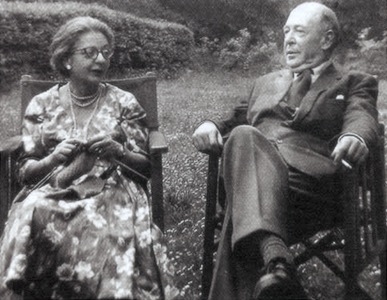
C.S. Lewis was a man not vastly different from me. He was not terribly comfortable when placed in such a role . . . yet he too discovered great meaning in caring for the needs of his wife during her illness. His precious Joy was dying, so the intensity of his labors, and their corresponding emotional investment dwarf my own. And yet the “framework” of our circumstances bears a marked similarity.

In his wonderful book Lenten Lands, Lewis’ son Douglas Gresham relates how Lewis and his brother Warnie provided exceptional care to his mother during her illness. He writes:

[Lewis] spent most of each day with [Joy] at the hospital, but they both agreed Mother should be brought home to The Kilns to die—in Jack’s home—her husband’s home—with him at her side. The “common room” was converted to a hospital ward, complete with a system of bells by which Mother would summon a nurse, or later Jack, if she needed help, as she often did.

I’ll make a confession. Although most men can adequately perform familial nursing duties when there is no alternative caregiver, most of us are quite content to step aside and let our wives or sisters attend to whatever nursing procedures are called for. Actually, I was quite gifted at removing slivers, but when it comes to bodily discharges, I’m no sexist to admit I and most of my gender display a serious weakness.

And yet, even in these cases, when changing the soiled diaper of an infant (or someone old enough to feel shame for having such needs) . . . even such unpleasant acts are possible for us to do for those we love. So the key to being able to care for others is not to pinch our nose and do it as quickly as humanly possible. The key, instead, is to learn to love those placed in our care.

In our grandparents day, it wasn’t uncommon for an elderly great-grandparent to reside with the family of one of their children. My father, for example, grew up with his blind grandfather as a member of their household. Similarly, my mother enjoyed the daily presence of her grandmother in her own home throughout her life. Not only was it expected that children would “take in” their elderly parents, it was natural. After all, they were family.

But, how does one transfer this familial affection to the stranger? After all, as Jesus said, “If you love those who love you, what benefit is that to you? For even sinners love those who love them. And if you do good to those who do good to you, what benefit is that to you? For even sinners do the same” (John 6).

Mother Teresa and the many thousands of saints throughout history who have cared for the leper, the outcasts, and the dying know this truth. They do everything as though they were caring for the Lord himself, just as he asked his disciples to do. Medicines are not their only balms—nor their most important. Their compassionate touch and tender encouragements are often far more healing.

When I compare myself to these caregivers, I realize just how inadequate a nurse I am. As a pastor, a core aspect of my vocation has been to bind the injuries of the sheep entrusted to my care. But I do this in a “spiritual” manner, and it has been rare to ever help one of them replace a bloodied bandage. Spiritual, emotional and social wounds are those that most pastors feel comfortable treating. Providing for the “baser” physical needs of the diseased is quite another matter.

And this brings us to the end of today’s reflection. When next I write, I’ll carry this final thought a bit farther forward.

Charting Our Life Course

In our last conversation we considered the fact that life is a journey. And during this journey which encompasses our very existence, we follow a variety of paths.

Not all of the paths lead to “happy endings.” I almost wrote “fairy tale endings,” but then I recalled that some old folk tales conclude in a rather grim fashion.

Signposts stand as sentinels at the junctions. “Take this path to self-fulfillment.” “Follow this lane to explore forbidden pleasures.” “This way leads to power.” They offer promises aplenty, but their veracity is not guaranteed. In fact, the more outlandish the claims, the more suspect they become to the wise.

Speaking of wisdom, some of the most powerful words in the Book of Proverbs relate to this notion of choosing paths cautiously. Wisdom and Folly are personified as two women. One offers life-enriching knowledge and insight. The other proffers more carnal and transitory wares.

My son, keep my words


    and treasure up my commandments with you . . .

Say to wisdom, “You are my sister,”


    and call insight your intimate friend,

to keep you from the forbidden woman,


    from the adulteress with her smooth words.

. . . and I have seen among the simple,


    I have perceived among the youths,


    a young man lacking sense,

passing along the street near her corner,


    taking the road to her house . . .

And behold, the woman meets him,


     dressed as a prostitute, wily of heart.

She is loud and wayward;


     her feet do not stay at home;

now in the street, now in the market,


    and at every corner she lies in wait. . . .

I have spread my couch with coverings,


    colored linens from Egyptian linen;

I have perfumed my bed with myrrh,


    aloes, and cinnamon.

Come, let us take our fill of love till morning;


    let us delight ourselves with love.

For my husband is not at home;


    he has gone on a long journey . . .

With much seductive speech she persuades him;


    with her smooth talk she compels him.

All at once he follows her,


    as an ox goes to the slaughter,

or as a stag is caught fast

    till an arrow pierces its liver;

as a bird rushes into a snare;


    he does not know that it will cost him his life.

And now, O sons, listen to me,


    and be attentive to the words of my mouth.

Let not your heart turn aside to her ways;


    do not stray into her paths,

for many a victim has she laid low,


    and all her slain are a mighty throng.

Her house is the way to Sheol,


    going down to the chambers of death.

The power of this proverb is in its truth. I have actually known the seductresses (and seducers) described in these verses. Well, I’ve been acquainted with emanations of both female and male versions of Folly, since they are legion.

Despite the Lies, There is Still Hope

The key to journeying through life with the fewest deadly detours is to rely on a trustworthy guide. A compass, so to speak. A map or handbook that soundly advises which paths to take, and what precipices to avoid.

Of course, if we would rather take the risk, we can rely on human ignorance (is West to my right or my left?) . . . or worldly counsel (let us take our fill . . .).

The Bible lays out the safe and proven path. What’s more, our Savior—who calls himself “The Way,”—promises to accompany us on the journey itself.

One of C.S. Lewis’ least read books is entitled The Pilgrim’s Regress. It is modeled on the classic Pilgrim’s Progress, written by John Bunyan in 1678. The Pilgrim’s Regress was Lewis’ first published work of prose fiction. His protagonist goes through a period of disbelief, mirroring Lewis’ own. It is well worth the read, although, perhaps, it is best preceded by a reading of Bunyan’s original work.

Toward the end of his allegory, Lewis brilliantly describes the course of travel for many who sojourn for a season in foreign (unbelieving) realms. The traveler learns that all who earnestly seek the Truth ultimately find it in a single Source. I offer the following passage not as a “spoiler,” but to illustrate the importance of following the right path—and to entice you to consider reading The Pilgrim’s Regress.

“What do you see?” said the Guide.

“They are the very same shape as that summit of the Eastern Mountain which we called the Landlord’s castle when we saw it from Puritania.”

“They are not only the same shape. They are the same.”

“How can that be?” said John with a sinking heart, “for those mountains were in the extreme East, and we have been travelling West ever since we left home.”

“But the world is round,” said the Guide, “and you have come nearly round it. The Island is the Mountains: or, if you will, the Island is the other side of the Mountains, and not, in truth, an Island at all.”

“And how do we go on from here?”

The Guide looked at him as a merciful man looks on an animal he must hurt.

“The way to go on,” he said at last, “is to go back. There are no ships. The only way is to go East again and cross the brook.”

“What must be must be,” said John. “I deserve no better. You meant that I have been wasting my labour all my life, and I have gone half-round the world to reach what Uncle George reached in a mile or so.”

“Who knows what your uncle has reached, except the Landlord? Who knows what you would have reached if you had crossed the brook without ever leaving home? You may be sure the Landlord has brought you the shortest way: though I confess it would look an odd journey on a map.”

Is there a Place for Shame?

I had a disturbing conversation today. He was from Texas, a state my family resided in during my first Air Force tour. What troubled me was a recent experience he had that revealed even “down south,” where courtesies long forgotten by most on the west coast still prevail, rudeness is on the rise.

The man I was talking to is a crippled veteran, a Marine in fact. We were discussing the number of people who don’t think twice about “stealing” clearly marked disabled parking spaces from those who genuinely need them.

He related that as he returned to his car recently, there was a young man just getting out of his own vehicle in the adjacent, reserved space. There was no indication on the vehicle that it was authorized to use the space, and neither the man nor his passenger evidenced any disability.

The veteran said, “maybe you didn’t realize it, but that’s a handicapped space you just parked in.”

His words elicited an emotional backlash as the driver (in his twenties) unleashed a barrage of vulgarity and curses at this stranger who had dared to point out his discourteous act.

After his rant, the trash-talker’s father interjected, “hey, it’s none of your business where my son parks, anyway, what do you expect us to do?”

The Marine stood his ground and said, “someone who needs that spot won’t be able to use it if you’re there. If you don’t want to move it now, perhaps the police can persuade you to do it when they arrive.”

As he pulled his phone out of his pocket, the grumbling older man persuaded his fuming son to move the car before the call could go through.

As disgusting as this scene was, I’m sure it’s reenacted across the globe in hundreds of locales every day.

I shared with my new friend the first thought that entered my mind when I heard the question: “what do you expect us to do?”

I told him I would have been tempted to shout: “What I expect is for you, as a father, to feel some modicum of shame for the disgusting way your son is acting.”

What used to be universally regarded as inappropriate conduct now appears to have become the norm. This decline has been in progress for some time. C.S. Lewis referred to the slide in public mores in a 1945 essay.

“We have lost the invaluable faculty of being shocked—a faculty which has hitherto almost distinguished the Man or Woman from the beast or child.” (“After Priggery—What?”)

If I had been there to voice the words that leapt to my mind—and if the foul-mouthed individual didn’t beat me into deaf unconsciousness—I would be curious to see if my statement elicited the slightest glimmer of shame in either father or the son.

There is an irony interwoven into this tale, as is true in so much of life. Although I don’t hijack disabled parking spaces . . . there is much in my life for which I should be—and am—ashamed. As I consider my own selfishness and sin, I am reminded that I am no more deserving of God’s grace than either of the men I am so quick to condemn.

Here too C.S. Lewis offers wise insight. In The Problem of Pain he describes how it is only in sincere, naked self-examination and confession that we can see ourselves as we truly are. “Unless Christianity is wholly false, the perception of ourselves which we have in moments of shame must be the only true one.”

Shame is part of the life of the Christian. And, I would suggest, in the life of every healthy person. I’m not talking about debilitating shame that leads to despair or self-loathing. I’m referring to that shame that is itself a divine gift. The shame that reminds me I should strive to be a better person today than the man I was yesterday.

A shame that drives me to my knees in prayer and moves me to echo the prayers of millions of believers before me and this very day alongside me . . . “forgive me my trespasses, as I forgive those who trespass against me.”

One Positive Consequence of Disasters

I spent this morning participating in Major Disaster Response Training at a nearby United States Naval installation. It is connected to the national readiness programs coordinated by FEMA (the Federal Emergency Management Agency).

Thankfully, these plans and preparations have improved dramatically since the tragic events surrounding Hurricane Katrina.

Our “local” exercises will continue tomorrow, with extended brainstorming about a number of scenario variations. They will all be based upon an inevitable 9.0 magnitude megathrust earthquake destined to occur just off the coast of Washington and Oregon states.

The last mega-earthquake in the Cascadia Subduction Zone took place in 1700, and pressure between the earth’s drifting plates continues to build, day by day. When that pent up energy next breaks free, it is likely to affect the volcanoes which run in a fevered band from Alaska to northern California.

The potential for damage and loss of life is great, and barring the return of Christ before the event . . . as I said above, it is inevitable. Geological evidence reveals that these massive upheavals have taken place every 300 to 600 years, for the past three and a half millennia.

Advance planning can help reduce the casualties. More specifically, it enables governmental agencies and other groups to prepare before the event to respond to the crisis as effectively as possible. Better coordination results in less overlap and fewer gaps, especially during the first critical hours when trapped people can be rescued alive from the rubble.

As I sat in the meeting I thought for a while about the other members of the clergy who were in attendance. They earnestly want to learn how to help prepare their congregations for such events, so their church members can recover quickly—and then, in turn, be able to aid everyone else in the community. Everyone attending the meetings here is a volunteer. It’s not their “job” to provide assistance and care to others . . . it’s their calling.

The title for this column mentions a “positive” aspect of disasters. It is this: they provide an opportunity for the very best and most heroic attributes of men and women to be revealed. In the worst of times, the best qualities of humanity shine most clearly.

C.S. Lewis took note of this truth. In his Screwtape Letters, wherein a senior devil provides temptation advice to a junior demon, Lewis addresses this great irony. In horrible circumstances, great good may be manifested.

Now this is a ticklish business. We have made men proud of most vices, but not of cowardice. Whenever we have almost succeeded in doing so, the Enemy permits a war or an earthquake or some other calamity, and at once courage becomes so obviously lovely and important even in human eyes that all our work is undone, and there is still at least one vice of which they feel genuine shame. The danger of inducing cowardice in our patients, therefore, is lest we produce real self-knowledge and self-loathing with consequent repentance and humility. And in fact, in the last war, thousands of humans, by discovering their own cowardice, discovered the whole moral world for the first time.

In peace we can make many of them ignore good and evil entirely; in danger, the issue is forced upon them in a guise to which even we cannot blind them. There is here a cruel dilemma before us. If we promoted justice and charity among men, we should be playing directly into the Enemy’s hands; but if we guide them to the opposite behaviour, this sooner or later produces (for He permits it to produce) a war or a revolution, and the undisguisable issue of cowardice or courage awakes thousands of men from moral stupor.

God forbid that natural disasters occur. However, when they do, we can praise him for his acts of benevolence, mercy and healing . . . which are frequently offered through the courageous actions of his children.

May you and I prepare ourselves—physically, mentally, emotionally and spiritually—to be instruments of his grace and peace whenever the need arises.

The Dearest of Deer

Thank you, Lord, for allowing us to live in a home surrounded by a forest!

When I was driving home this afternoon I was stunned by the majestic flight of a dozen bald eagles as they danced in the sky above our small community of Seabeck, Washington. I pulled to the side of the road and enjoyed their ballet for some time before deciding that I would blog about eagles when I returned home.

Then I saw something even more precious. Just outside the window of my study a doe and her two (very) young fawns walked past. I grabbed my camera and snapped no fewer than fifty photos as they grazed on the nearby lawn. (I decided as they wandered on down another trail that the post on the eagles would wait.)

The fawns were so tiny I don’t think they could have been fourteen inches tall. (Sorry, we older Americans are still metric-impaired.) They stood as though they were still getting the feel of their tiny legs. It was a glorious scene.

C.S. Lewis graced the land of Narnia with a stunning array of creatures. Some are not found in this world, apart from myths. Unicorns and centaurs would be of that ilk.

I happen to find the others even more fascinating. The horses, dogs and bears that are familiar to us, but different. Different because they have been gifted with speech, and with it, the ability to know and follow their Maker.

As he wrote in his description of Narnia’s creation in The Magician’s Nephew:

And now, for the first time, the Lion [Aslan] was quite silent. He was going to and fro among the animals. And every now and then he would go up to two of them (always two at a time) and touch their noses with his. He would touch two beavers among all the beavers, two leopards among all the leopards, one stag and one deer among all the deer, and leave the rest. . . . The creatures whom he had touched came and stood in a wide circle around him. . . .

The Lion, whose eyes never blinked, stared at the animals as hard as if he was going to burn them up with his mere stare. And gradually a change came over them. The smaller ones—the rabbits, moles, and such-like—grew a good deal larger. The very big ones—you noticed it most with the elephants—grew a little smaller. Many animals sat up on their hind legs. Most put their heads on one side as if they were trying very hard to understand. The Lion opened his mouth, but no sound came from it; he was breathing out, a long, warm breath; it seemed to sway all the beasts as the wind sways a line of trees.

Far overhead from beyond the veil of blue sky which hid them the stars sang again; a pure, cold, difficult music. Then there came a swift flash like fire (but it burnt nobody) either from the sky or from the Lion itself, and every drop of blood tingled in the children’s bodies, and the deepest, wildest voice they had ever heard was saying: “Narnia, Narnia, Narnia, awake. Love. Think. Speak. Be walking trees. Be talking beasts. Be divine waters.”

The scene I was privileged to observe today reminded me of the innocence of nature, prior to humanity’s disobedience. It also reminded me of the Messianic promises that restored “nature” will enable lions to lie in harmony beside sheep.

In his book Miracles, Lewis discusses this from the perspective of redemption, as contrasted with simply understanding it as a consequence of a “new” creation.

The doctrine of a universal redemption spreading outwards from the redemption of Man, mythological as it will seem to modern minds, is in reality far more philosophical than any theory which holds that God, having once entered Nature, should leave her, and leave her substantially unchanged, or that the glorification of one creature [humanity] could be realised without the glorification of the whole system.

God never undoes anything but evil, never does good to undo it again. The union between God and Nature in the Person of Christ admits no divorce. He will not go out of Nature again and she must be glorified in all ways which this miraculous union demands. When spring comes it “leaves no corner of the land untouched;” even a pebble dropped in a pond sends circles to the margin.

I said a prayer this evening that the Lord would bless that lovely doe and her precious offspring with long, healthy, safe, peaceful, and even, happy lives.

Avoiding Bad Influences

In our last conversation, we considered the importance of friendship. It is truly a precious treasure. And it soothes the loneliness that scars our souls as a result of humanity’s fall.

Choosing to live our own lives, apart from our heavenly Father, has damaged every other relationship we experience. Our bonds with other human beings, even our own families, are twisted and stretched . . . sometimes beyond the breaking point. Even our relationship with nature has suffered, but that’s a subject for consideration some other day.

One of the temptations that arises from our desire for companionship, is that we settle for having it on the wrong terms, with the wrong people. As C.S. Lewis says in Mere Christianity, “vices may sometimes bring people together: you may find good fellowship and jokes and friendliness among drunken people or unchaste people.”

In such circumstances, it seems to me you experience the trappings of “friendship,” without touching its essence. It’s hollow. For the moment, it may appear and sound similar to the real thing, but when the alcohol wears off and the consequences of our poor choices cascade upon us, it becomes evident this version of friendship was merely a façade.

Simply put, we are wise to avoid bad “friendships.”

It dawned on me when I was teaching at the USAF Chaplain School just how much other people influence my behavior. No one who knows me would call me weak or pliable. And anyone attempting to manipulate me would likely fail. (Aside from my grandchildren, of course.)

Yet, when I spend lots of time around people with worldly values and behaviors, it very subtlety influences my own actions. I recognize it most clearly when it comes to language. As a military veteran who used to work in construction, my tongue knows how to utter a worldly phrase or two. Normally, it’s reined in fairly well in that regard, but if I’m immersed for very long in an “earthy” environment, some of those words unconsciously slip back into my own conversation.

I realize that “cussing” or cursing may seem a small sin to some, but let’s consider a more substantial example. When someone is delivered from addiction to drugs—a process that frequently requires lengthy treatment—one of the critical ways to protect them from returning to the slavery of addiction, is by keeping them away from their so-called friends who remain captive to drugs.

If they restore those destructive bonds, they are like apostates, who have known the truth but later denied their Savior. As the Apostle Peter says, “it would have been better for them never to have known the way of righteousness than after knowing it to turn back from the holy commandment delivered to them. What the true proverb says has happened to them: “The dog returns to its own vomit, and the sow, after washing herself, returns to wallow in the mire.” (2 Peter 2:21-22, ESV).

When I realized how susceptible I was to the behavior of others, I determined to seek out people who were better than me. Men and women who would bring out the best in me. People, especially, who excelled in virtues and traits in which I was conscious of my own shortcomings.

This is a principle I wholeheartedly recommend to everyone. Choose as friends those who are noble, virtuous, selfless, loving, and godly. You will never regret it.

Lewis provides for us an insightful description of how our friendships or overall community of relationships influence us. He is discussing here our universal tendency to justify bad behavior because “everyone is doing it.”

We must guard against the feeling that there is “safety in numbers.” It is natural to feel that if all men are as bad as the Christians say, then badness must be very excusable. If all the boys plough [fail] in the examination, surely the papers must have been too hard? And so the masters at that school feel till they learn that there are other schools where ninety per cent of the boys passed on the same papers. Then they begin to suspect that the fault did not lie with the examiners. Again, many of us have had the experience of living in some local pocket of human society—some particular school, college, regiment or profession where the tone was bad. And inside that pocket certain actions were regarded as merely normal (“Everyone does it”) and certain others as impracticably virtuous and Quixotic [chivalrous].

But when we emerged from that bad society we made the horrible discovery that in the outer world our “normal” was the kind of thing that no decent person ever dreamed of doing, and our “Quixotic” was taken for granted as the minimum standard of decency. What had seemed to us morbid and fantastic scruples so long as we were in the “pocket” now turned out to be the only moments of sanity we there enjoyed. It is wise to face the possibility that the whole human race (being a small thing in the universe) is, in fact, just such a local pocket of evil—an isolated bad school or regiment inside which minimum decency passes for heroic virtue and utter corruption for pardonable imperfection. (C.S. Lewis, The Problem of Pain).

Here is an interesting and valuable exercise: pause and conduct a mental and spiritual survey of the influences your individual friends exert on you. If you find they help you grow in ways that are positive, you are fortunate. If they influence you in ways that are unhealthy, maybe it’s time for some relationship pruning.

All of this discussion leaves unconsidered the role we play in bringing out the best (or worst) in our friends. Then again, if they truly are our friends, there is nothing else we could ever wish for them than the very, very best.

Life With Few Friends

Human beings were not created to live solitary lives. From the very outset, God recognized “it is not good that [Adam] is alone,” and he created for him the perfect companion, Eve. She was, of course, his bride, but more than that, she was his intimate friend.

The power and joy derived from true friendship are awe inspiring. And, the absence of friendship strips life of those same blessings. We are weaker, when we stand alone—the strength of our friends empowers us to live courageously. We know more sorrow when we are alone—the pleasant company of friends dispels many discouragements and we all know the comfort that comes from a warm shoulder to cry on.

As a “military brat,” moving every year or two, I experienced the challenge of constantly needing to make new friends. When I raised my own children in that same context, I was acutely aware of the hardship this presents to kids (especially during their teens).

C.S. Lewis, in describing just how precious friendship is, emphasizes the value of proximity to those who support and encourage you. In a 1935 letter to Arthur Greeves he writes:

Friendship is the greatest of worldly goods. Certainly to me it is the chief happiness of life. If I had to give a piece of advice to a young man about a place to live, I think I should say, “sacrifice almost everything to live where you can be near your friends.” I know I am very fortunate in that respect.

Over the years I talked with many other military parents about the price paid by our family members as we serve. Certainly there are benefits as well. After all, most military families see parts of the world that their peers can only dream of. But, they do make great sacrifices. The careers of military spouses, for example, are often severely disrupted by family moves. There are other costs, but the one we’re considering here is the price paid in friendships.

Some of my friends have argued that frequent moves taught their children to quickly make many new friends. I disagree with that. This contention is frequently voiced, it seems to me, as a subconscious means of expiating the veteran for the hardships their children suffered. Giving them the benefit of the doubt, I prefer to attribute the statement to a very shallow understanding of what friendship truly is. This definition is terribly distant from Lewis’ “greatest of worldly goods.”

My response to these claims is that frequent military moves have a detrimental effect on friendships but they do indeed train our children to be adaptable. The lesson most of them learn is how to quickly establish interpersonal relationships. These “friendships,” I argue, are more accurately described as acquaintances.

Their lack of depth is seldom a conscious choice. Imminent moves mean the relationships lack the time necessary to mature. Sort of like a vintner pulling the cork out of a bottle of grape juice that was pressed only a week before, and expecting it to already be wine. If the vintage of a relationship is a mere three months, it’s rare for it to have “fermented” into a profound friendship.

There are certainly exceptions, of course, as in the case of my sister. She and one of her girlfriends from junior high school still visit each other each year, as they have for four decades. But such bonds are as rare as they are precious.

While I’m sharply attuned to the circumstances of military families, I’ve been thinking recently about the lack of roots experienced by many people living in contemporary Western society. Modern families move much more frequently than their parents did. So it dawns on me that this instability has probably exerted a detrimental effect on many more individuals than I had previously considered.

All it takes is the pain from the abrupt termination of a few budding friendships, to teach many children it’s not worth the effort to make real friends. We long for friendship, we truly do, but most relationships don’t survive geographic separations for very long. And the natural grace of God, friendship, becomes distorted as we begin to withhold ourselves, because we know that we’ll be moving away soon anyway.

Friendships deceased. Friendships aborted. Friendships deferred. Deceased as we move apart and they wither. Aborted as we bid farewell before they’ve been fully born. And deferred as we consciously wait until we imagine we’ll be somewhere long enough to make the effort worth it.

It strikes me that the itinerancy of this age is fostering an explosion of acquaintances (for example, the hordes of Facebook “friends” it’s so easy to accumulate) . . . with a corresponding decrease in the number of people we genuinely trust to care about our wellbeing.

Lewis described this shift in an academic context. In The Weight of Glory he described the exchange of numbers for depth.

When I first went to Oxford the typical undergraduate society consisted of a dozen men, who knew one another intimately, hearing a paper by one of their own number in a small sitting-room and hammering out their problem till one or two in the morning. Before the war the typical undergraduate society had come to be a mixed audience of one or two hundred students assembled in a public hall to hear a lecture from some visiting celebrity. Even on those rare occasions when a modern undergraduate is not attending some such society he is seldom engaged in those solitary walks, or walks with a single companion, which built the minds of the previous generations. He lives in a crowd; caucus has replaced friendship.

The benefits of having numerous acquaintances is real. We rightly appreciate them. But we cannot forego our innate need for friends and still maintain our humanity. We need others who know the true “us,” as contrasted with our public masks, and still care about us.

I’ve read that we only know several truly intimate friends during the course of our entire life. And many of those who marry are blessed to genuinely know their spouse is the best friend (even though it usually sounds trite when they say it). Still, I doubt that there’s a living human being who would not benefit from having another genuine friend. And that, my “friends,” is my hope and prayer for each of you—that even though we all live within a crowd, you may be able to single out those wonderful few who can become and remain your lifelong friends.

On Death’s Specter

Death is an unpleasant subject. And the knowledge that each of us is destined to face our own, has the potential to overshadow the countless joys this life offers.

Virtually everyone reading this has lost a loved one to death . . . and some reading this may have been informed by doctors that their own days may be limited. If you find yourself counting down in years, months, or weeks, may God strengthen you and pour upon you an overflowing portion of his divine peace. The Scriptures refer to God’s peace in circumstances of great personal trial as a “peace which passes understanding.” And that is precisely what I pray he provides for you.

Those of us who are Christians find ourselves in a bit of a tension. We believe in Jesus’ resurrection, and his promise to raise us to new life as well. So, in that sense death is a defeated “enemy.” It no longer has the final word. In fact, passing through the portal of death actually allows us to enter into the presence of the Lord! Nevertheless, we dread the prospect of dying. Too seldom do people pass peacefully in their sleep.

C.S. Lewis experienced an illness which brought him near to death. Yet he recovered . . . with mixed feelings. Five weeks before his death he wrote to his friend Arthur Greeves:

Tho’ I am by no means unhappy I can’t help feeling it was rather a pity I did revive in July. I mean, having been glided so painlessly up to the Gate it seems hard to have it shut in one’s face and know that the whole process must some day be gone thro’ again, and perhaps far less pleasantly! Poor Lazarus! But God knows best.

The reason we should no longer fear death is because it has no power over those whose sins have been borne by the Messiah. Those who have not experienced this grace may rightfully fear the day of accounting that awaits humanity. Jesus invites all people—even the most sinful and vile people we can imagine—to yield to him and trade their inheritance of death for his righteousness and the gift of eternal life.

That means there is nothing that you have done that is so evil God cannot forgive it. Simply ask him to.

One way this experience of salvation is described in the Bible is as a resurrection. Jesus said to one of his disciples, “I am the resurrection and the life ‘Whoever believes in me, though he die, yet shall he live, and everyone who lives and believes in me shall never die.’” (John 11:25). Jesus is distinguishing between the two deaths. Physical, where this finite body fails . . . and spiritual death, where those who have ignored God’s mercy spend eternity separated from it.

Another aspect of this transformation is found in the fact that through conversion we die to the power of sin over us, and participate (even in this physical life) in Christ’s resurrected life. (Baptism is a “sign” of this, as the immersion is “burial” and rising from the waters is rebirth.) As Paul of Tarsus assures believers: “For if we live, we live to the Lord, and if we die, we die to the Lord. So then, whether we live or whether we die, we are the Lord’s.” (Romans 14:8).

C.S. Lewis bluntly put it this way: “Die before you die. There is no chance after that.” (Till We Have Faces).

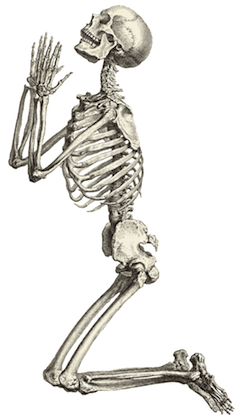
Which brings us to the peculiar image above. It comes from some classical text and whenever I’ve encountered it over the years, I’ve always considered it rather odd that the illustrator decided to portray this skeleton in the posture of prayer. It’s actually a bit disconcerting, since death and decay have nothing to do with our Lord who is the way, the truth and the life.

If we haven’t said our prayers in this mortal life, as Lewis reminds us, we will lack the voice and opportunity to do so in the next.

Besides, knowing Christ is not something with benefits only in the next life. Walking through life in his light makes our days here all the more pleasant and joyful. As I look back on my own life I recognize numerous ways in which his hand directed my path. Had I lived for my own selfish appetites the person I would be today would little resemble the Christian me. Thank God that he delivered me from becoming that man.

Agnostic or Atheist: Does It Matter?

I haven’t forgotten. Well, I have forgotten far too many things in recent years, but I didn’t forget my recent “promise” to address the challenging subject of the distinction between agnosticism and atheism. Last week I wrote: “I suspect that the intimately personal nature of God’s love for us is one of the things that moves some people from agnosticism to atheism.”

It’s not my desire to offend anyone with the discussion which follows. After all, God loves the “lost” just as much as he loves those who have surrendered their lives to him. In fact, there’s an amazing passage that hints at how the rescue of one of those who has “strayed” is even more exciting to the hosts of heaven than the faithfulness of his dedicated disciples. (Check out verses 12-14 in chapter 18 of the Gospel according to Matthew . . . and remember what I have said in the past about how eager any of your Christian acquaintances will be to provide you with a copy of the Bible if you don’t already have one.)

Every soul is precious to God. And yet, many don’t recognize that fact. Many worship false gods (religious and secular). Among those who deny the existence of supernatural deities, there are essentially two camps. Agnostics who (technically) do not deny God’s existence, but merely profess that it is unknowable. Thus they personally remain unpersuaded. Atheists, on the alternative hand, are more adamant about denying God’s existence. Some, in fact, make a living by stridently refuting God himself and all things holy.

Intuitively, most people assume agnostics are not quite as distant from faith as are atheists. After all, agnostics are generally more polite and respectful toward those of us who naively cling to such superstitions . . . right? Atheists, by contrast, tend to ridicule those who would worship a God who laid down his very life, and died a human death.

Take, for example, what is arguably the earliest surviving illustration of Christ’s crucifixion. The illustration above was carved on an ancient plaster wall near Palatine Hill.

It’s a bit difficult to discern, but historical consensus sees the graffito as a pagan insult directed towards a Greek Christian. The scribbled inscription reads: “Alexamenos worships [his] god.” The crucified figure on the cross clearly bears the head of a donkey. The Church Father Tertullian wrote in the second century of slanders alleging Christians followed just such a deity.

Would something like this be likelier to come from the mind of an agnostic, or an atheist?

Agnostics would rarely summon the energy to rail against God like this. However, atheists sometimes feel so imposed upon by God’s children that they lash out with invectives.

So, as I noted above, the gut feeling of most observers would be to say vocal atheists are farther from God than their kindred disbelievers. However—I am convinced that is not the case!

Ironically, it is the tepid individual who lacks any serious conviction who is in greater danger of perishing without seeing God. This is due to the fact that agnostics have, as a rule, come to grips with the fact that there may or may not be a God . . . but they are content to proceed through life without caring much either way. To them the issue is rather trivial, in a sense, since they rarely lose sleep over it.

This is not true of the atheist, who recognizes that the matter is of the utmost importance; that’s why he is not content to simply ignore it. If God truly exists—they comprehend in the core of their being—nothing could be of greater significance.

Agnostics typically have an unreasoned impression that if there is a God, he is probably benevolent, and most likely more concerned with other elements of the universe he created than their small life. They echo the thinking of liberal “Deists” who imagined God as a distant “watchmaker” who set creation in motion and then left it forgotten on the shelf. This Great Watchmaker is not threatening. He isn’t angry at us, because he doesn’t even deign to notice us. He remains oblivious to humanity, just as we presumably live out our lives anonymous to him.

Atheists don’t want to believe in God, because of their overwhelming doubt. Simultaneously, they recognize that the stakes of the gamble are enormous. Eternal, in fact. And they resent God for placing them in this difficult predicament. Why can’t he just make his existence undeniably evident? Faith is the leap they are unwilling to take. But, by the same rational premise, the wise among them realize that in opting against theism, they are actually placing their faith in an equally unprovable tenet. And this has a tendency to make some of them mildly cranky.

Which brings us back to my suspicion that “the intimately personal nature of God’s love for us is one of the things that moves some people from agnosticism to atheism.” You see, when someone deeply ponders the mystery of whether there is a Creator, they understand he would never have created a sentient being with this yearning to cleave to him, without possessing a compassion for them in return.

Agnostics walk about like spiritual zombies, pursuing their various interests. Atheists, though, are tormented by the nagging “fear” that a loving God just may exist. Certainly, they do whatever they can to exorcize the notion, and they publicly celebrate their liberation from ancient and medieval superstitions, but unlike their unaffected agnostic relations, they have recognized the enormity of their choice. Oh to be a blissfully ignorant agnostic, the more thoughtful might muse.

Sadly (from their present perspective), the lot of the atheist is to be closer to God than the agnostic. Atheists may rail against their Maker, but the agnostic’s spiritual indifference causes them to drift farther and farther from the Truth.

The Scriptures offer a parallel to this distinction in the description of one of the early Christian churches. Apparently the believer in Laodicea had grown lackadaisical about their faith and lived lives that differed little from their pagan and agnostic neighbors. The Lord’s judgment of them begins: “I know your works: you are neither cold nor hot. Would that you were either cold or hot! So, because you are lukewarm, and neither hot nor cold, I will spit you out of my mouth.”

Strange, it seems to us, that God might prefer a militant atheistic mindset to an aimless agnostic worldview. But the amazing truth is that, in most cases, atheists are closer to the kingdom of God than their disinterested peers.

In Surprised by Joy, C.S. Lewis describes his own pre-Christian disposition. The grandson of an Anglican priest, he had consciously rejected the faith. Yet, as the possibility of its truth grew more real to him as an adult, he reacted against it. He clearly describes his condition as differing from that of the lukewarm agnostics I’ve described above.

Amiable agnostics will talk cheerfully about “man’s search for God.” To me, as I was then, they might as well have talked about the mouse’s search for the cat.

In the same volume he elaborates on the sentiments I’ve been describing.

I was at this time living, like so many Atheists or Antitheists, in a whirl of contradictions. I maintained that God did not exist. I was also very angry with God for not existing. I was equally angry with Him for creating a world.

So, if you consider yourself “angry with God for not existing,” you may be closer to meeting him than you ever imagined. If you do follow C.S. Lewis’ example, heaven will host a more resounding celebration for you than it does for the ninety-nine who have always remained part of his flock. And, if you’re a dispassionate agnostic who is weakly amused by this thought . . . my sincere prayer is that you, my friend, would become either hot or cold!