Echoes of Narnia

garrelsI just met an amazing new artist. Well, not literally.

I met him, figuratively speaking, through his innovative music. And, although he is “new” to me, he’s been recording for more than a decade. His name is Josh Garrels, and in a moment, I’ll introduce you to two examples of his lyrical poetry.

The reason I first checked out his work was because I received word that he is giving away his music! Amazing, isn’t it? Right now you can download any of his albums for free. However . . . oh, there’s a string attached, you’re thinking . . . he is requesting that you make a donation to aid the suffering in the war-ravaged Democratic Republic of the Congo. So there’s really no string at all, since it’s merely a suggestion, and the gift would be tax deductible anyway. The albums are free. Garrels doesn’t want a penny from us. But he does want us to consider aiding the 70 million struggling people of the Congo.

Despite the Congo being the eleventh largest country in the world, few Westerners follow the terrible news flowing from the wounded nation. For the next two weeks, one hundred percent of the “tips” received for Garrels’ albums will go to World Relief—for their work saving precious lives and bringing peace to the hopeless.

In listening to some of Garrels’ music, I was reminded of the versatility of C.S. Lewis, who wrote so skillfully in so many different genres. I’m not sure how to describe Garrels’ songs; perhaps they defy categorization. It’s not the music I typically listen to . . . but the depth of his lyrics have won me over. Consider the following two songs. I’ll share the lyrics here, and then offer links to each of them below. I encourage you to read the words first and then listen to the music.

“Slip Away”

Hold on, before I slip away

The flames gone dark, I am afraid

How strong is flesh and blood

I cannot can take back what I’ve done

To you, my sweetest friend

I betrayed you, I walked away again

Hold on, before I slip away

The flame’s gone dark, I am afraid

How strong is flesh and blood

I cannot take back what I’ve done

To you, my sweetest friend

I betrayed you, I walked away again

Now all that’s left, is what might have been

Please forgive me, before we reach the end

Please forgive me, before we reach the end

And—for a delightful tale composed in the spirit of Narnia, be sure to listen to “Rabbit and the Bear.” Much of its imagery is shared with the homeland of the Chronicles of Narnia, but it’s clearly the Bible that provides both “composers” with their strongest inspiration.

“Rabbit & the Bear”

Run, run so fast

Over fields and grass

At last, at last

We escaped from the trap

With the rabbit and the bear

And the sparrows of the air

Come one, come all

The hunter is gone

And this is our chance

To crawl under the wire

Through the darkest wood

On up to the mountain of fire

Where everything is free

In the light of the sun

Where every creature sings

Oh Lord, you rescued us all

Don’t listen to the snake

For he lies and he takes

Your hope, your faith

Away from you

But when the lion comes around

With his claw and his crown

Follow, follow

His every move

After you’ve listened to these two pieces, I encourage you to visit this site and download his albums—for free. And, if you feel so inclined, I add my voice to Garrels’ in encouraging you to support World Vision’s vital work in the Congo.
Translating the Word

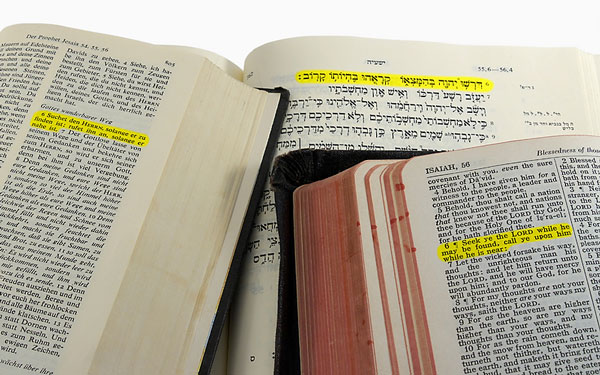
translationsThe science of translation is only partially scientific. It is also an art—with the insight into intuiting the intent of the original author a critical dimension of good translating.

First, of course, the translator must possess a sound grasp of the original language. Second, he or she must know the language into which they are translating the work equally well. With this knowledge, the translator can do an adequate job.

Only with that indefinable intuition mentioned above, is a translator empowered to do justice to a writer’s work when recreating it in a different language.

All translation work is demanding, but those entrusted with transferring documents of faith into new languages face an additional burden. The adherents of various religions typically regard this literature as “inspired,” and therefore to be approached with only the most serious and respectful of intentions.

This is certainly true for Christianity. Transferring the Scriptures from Hebrew, Aramaic and Greek into Latin, German and English involved devout theologians who approached the task with reverence as well as skill.

That balance remains a constant these many centuries after the earliest translation efforts. Today the Christian Bible is still being translated into languages where it has never been available before. The Wycliffe Bible Translators community is the largest organization working toward this end, although there are many others, such as the Lutheran Bible Translators, who are laboring in noncompetitive venues.

Wycliffe estimates that 350 million people do not yet have the Bible available in their native language. They have been instrumental in putting God’s Word into 700 different tongues, and with various other organizations are committed to continuing their vital work.

Some of the targeted language groups actually speak dialects of more common tongues. For example, De Nyew Testament is now available for speakers of Gullah. Spoken by the descendants of slaves residing in the South Carolina and Georgia coastlines. It is an English-based creole language featuring numerous African contributions. A comparison of a sample verse will illustrate the differences. The first verse of the Gospel according to John reads:

Fo God mek de wol, de Wod been dey. De Wod been dey wid God, an de Wod been God. Fo God mek de wol, de Wod been dey wid God. Shru dat Wod, God mek ebryting. Ain nottin een de whole wol wa God mek dat been done dout de Wod. (Gullah New Testament).

In the beginning was the Word, and the Word was with God, and the Word was God. The same was in the beginning with God. All things were made by him; and without him was not any thing made that was made. (King James Version).

At the beginning God expressed himself. That personal expression, that word, was with God, and was God, and he existed with God from the beginning. All creation took place through him, and none took place without him. (J.B. Phillips’ New Testament).

Why, you may wonder, have I included the relatively unknown translation by Phillips? Because none other than the brilliant and devout scholar, C.S. Lewis, regarded it highly. Lewis recognized that the archaic usage of the Authorized (King James) Version impeded its use by many people. In fact, in a 1961 letter he wrote: “A modern translation is for most purposes far more useful than the Authorised Version.”

Lewis was one of the readers of Phillips’ initial translation of the Pauline epistles who encouraged him to proceed with the task of translating the entire New Testament. Lewis, in fact, was key in encouraging Geoffrey Bies to publish the new version. Technically, though, calling this text a “translation” is a bit misleading; in many ways it is more honestly labeled a “paraphrase.” Still, it did make the Scriptures more accessible to many younger readers.

Phillips’ New Testament in Modern English is available online at the Christian Classics Library.

C.S. Lewis wrote an entire essay on the subject of translating God’s revelation. It is entitled “Modern Translations of the Bible,” and included in the God in the Dock collection. The following wisdom comes from that source.

The only kind of sanctity that Scripture can lose (or, at least, New Testament scripture) by being modernized is an accidental kind which it never had for its writers or its earliest readers. The New Testament in the original Greek is not a work of literary art: it is not written in a solemn, ecclesiastical language, it is written in the sort of Greek which was spoken over the Eastern Mediterranean after Greek had become an international language and therefore lost its real beauty and subtlety. In it we see Greek used by people who have no real feeling for Greek words because Greek words are not the words they spoke when they were children. It is a sort of “basic” Greek; a language without roots in the soil, a utilitarian, commercial and administrative language.

Does this shock us? It ought not to, except as the Incarnation itself ought to shock us. The same divine humility which decreed that God should become a baby at a peasant-woman’s breast, and later an arrested field-preacher in the hands of the Roman police, decreed also that He should be preached in a vulgar, prosaic and unliterary language. If you can stomach the one, you can stomach the other. The Incarnation is in that sense an irreverent doctrine: Christianity, in that sense, an incurably irreverent religion.

Grasping for Immortality

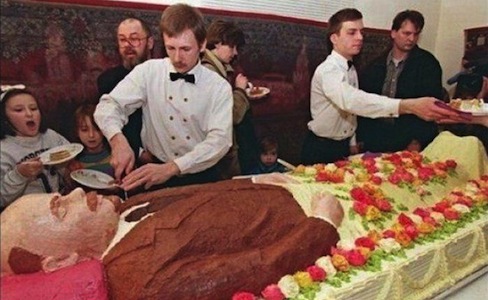
memorial cakeToday’s news carried a truly bizarre story. Yesterday, Venezuela’s dictator died after a lengthy illness. Today we learned that his body is due to be preserved for future generations to venerate. Like his forebear Lenin, he’ll be on call in a glass casket in case someone needs to gaze at him to have their socialist energies reinvigorated.

And that was only half of the surprising news report about Chavez’s demise.

The head of the presidential guard, a general close to the leader, related his final words. He was at his bedside and reported that he was too weak to verbalize the words, but clearly mouthed the plea “I don’t want to die; please don’t let me die.”

It’s shocking that General Ornella would divulge this fact about Chavez, particularly during the actual process of his divinization. The general attributes Chavez’s reluctance to receive his “eternal reward” to his love of country and desire to remain here to lead his nation for ever.

I, on the other hand, would attribute his reluctance to die to other sentiments.

The article that related the morbid plans for the display of Chavez’s body cited the familiar example of Lenin, which I mentioned above. It also noted two other former rulers whose bodies have also been preserved for an adoring posterity: Mao Zedong and Ho Chi Minh. Preparing this post I found that Kim Il-sun and his son Kim Jong-Il share a mausoleum. Likewise, Lenin’s successor Stalin would still be on display, had it not been for eventually falling out of political favor.

Now, there’s something obvious that all of these men have in common. They were leaders of oppressive communist regimes—which oppressed their own citizens because of their atheistic worldview.

Having rejected God and knowing no hope of resurrection or eternal life, they feebly grasped for immortality the only way they knew. They sought to leave a monumental mark on history, in order to be long remembered. And, considering a monument and a statue insufficient mnemonic devices . . . well, enough about that.

A Far Better Way

We who know the Creator of all life have much to be grateful for. Not least of which, his gracious gift of eternal life. Christians believe we will trade in this weak and worn body for a new one. So, while we treat the bodies of those who have died with dignity, we feel absolutely no impulse to venerate them. On the contrary, “ashes to ashes and dust to dust.”

C.S. Lewis wrote something in Mere Christianity which relates directly to this sharp contrast in worldviews.

Immortality makes this other difference between totalitarianism and democracy. If individuals live only seventy years, then a state, or a nation, or a civilisation, which may last for a thousand years, is more important than an individual. But if Christianity is true, then the individual is not only more important but incomparably more important, for he is everlasting and the life of a state or a civilisation, compared with his, is only a moment.

That, dear friends, is quite a paradigm shift. To regard each human life as more precious than any abstract government or institution created by humanity’s hand. Having that perspective is akin to seeing with God’s own eyes.

I hope the people of Venezuela soon recognize the futility of the shrine that is being built. Infinitely better to seek “immortality” (eternal life) in the one place where it may truly be found.

Malapropistic Entertainment

marshianWhenever I have an appointment with a doctor, I try to remember to bring along my own magazine or (better yet) the current writing project with which I’m wrestling. Unfortunately, I’m often in a hurry, and sometimes forget . . . which means I need to rely on that odd potpourri of dated magazines that typically migrate to medical waiting rooms.

This week found me in precisely this precarious predicament. I arrived rather early in my dentist’s office, and it turned out that he was slightly behind schedule. Not the best of circumstances. I approached the magazine rack with trepidation.

To my delight I saw a Reader’s Digest with a cover article about “Fifty Dumb Boss Stories.” Having worked for my share of dullards, I thought this should be entertaining. The fact that it included comments from Dwight Schrute of The Office made it just that much more promising.

I wasn’t disappointed. Among the many silly acts recorded in the article were a collection of malaprops voiced by witless bosses. Here are a few:

The Greek pyramids weren’t built in a day.

Spurt me out an email.

Let’s not put the horse before the cart.

We’re not preparing the report because it would be an exercise in fertility.

And my personal favorite, the elegantly mixed metaphor: “It’s not rocket surgery!” Nor is it, I suspect, brain science.

Most of us appreciate humor—even when it’s unintended. C.S. Lewis, in Reflections on the Psalms, wrote: “A little comic relief in a discussion does no harm, however serious the topic may be. (In my own experience the funniest things have occurred in the gravest and most sincere conversations.)”

Now, before ending this post, I need to point out one more truth. Dimwitted bosses aren’t the only people who stumble over words and meld images better left autonomous. Every one of us has occasionally experienced the proverbial “slip of the tongue,” and sometimes with quite entertaining results. Jokes—whether intentional or accidental—can all be appreciated. As the newly created Talking Animals of Narnia are told by Aslan:

“Laugh and fear not, creatures. Now that you are no longer dumb and witless, you need not always be grave. For jokes as well as justice come in with speech.” (The Magician’s Nephew).

On Burying One’s Father

marine flagI just buried my father yesterday. Well, not literally, since the service was held in a chapel at the cemetery, but my family and I said goodbye to him in a traditional Christian service. Because he was a combat veteran Marine Corps sergeant major, he received also very impressive military honors at graveside.

It was quite nice. Although he had passed rather quickly, and completely unexpectedly, he had lived a long and full life. That sounds cliché, but during his 84 years he had a successful career in the Corps, enjoyed a long and peaceful retirement, was blessed with a loving and faithful wife, and found great joy in his three children, nine grandchildren and ten great-grandchildren.

Best of all, though, after what some would call a rather misspent youth, he became a good man . . . and ended his days with faith in Christ and with virtues such as repentance, forgiveness and charity evident in his life.

As the day of the funeral was approaching, I recalled one of Jesus’ conversations with several prospective disciples.

As they were going along the road, someone said to [Jesus], “I will follow you wherever you go.” And Jesus said to him, “Foxes have holes, and birds of the air have nests, but the Son of Man has nowhere to lay his head.” To another [Jesus] said, “Follow me.” But he said, “Lord, let me first go and bury my father.” And Jesus said to him, “Leave the dead to bury their own dead. But as for you, go and proclaim the kingdom of God.” (Luke 9:57-60, ESV).

To some, Jesus’ words here sound harsh. However, the Messiah was not encouraging people to cease honoring their parents. After all, that would be in direct disobedience to the Commandments God delivered to us through Moses. No, Jesus affirmed our call to respect and care for our parents. What he was condemning was the excuses we make to delay accepting his invitation to follow him.

While we might offer a truly important reason for our procrastination, we often push back the spiritual “season” of our life with far more lame reasoning. “I’ll settle down after I get married, but right now I just need some time to “enjoy” life.” or “I’ll start going to church once I have kids and they can benefit from it.”

On Sundays we rarely think twice about disobeying another of the Commandments by ignoring the Sabbath and not preserving it’s holiness. Years ago Keith Green wrote a song “Asleep in the Light,” which featured the convicting lyrics:

How can you be so dead

When you’ve been so well fed

Jesus rose from the grave

And you, you can’t even get out of bed.

Most of us live long enough to suffer the loss of a parent. It’s something, perhaps, that you don’t really understand until you experience it yourself. Even then it’s difficult to console others by saying we’ve shared their loss. After all, every relationship is unique, and each human being processes grief in a unique manner.

C.S. Lewis knew well what it was like to lose his parents. His beloved mother died when he was quite young. In Surprised by Joy, he describes the pain. With my mother’s death all settled happiness, all that was tranquil and reliable, disappeared from my life. There was to be much fun, many pleasures, many stabs of Joy; but no more of the old security. It was sea and islands now; the great continent had sunk like Atlantis.

Alas, Lewis does not describe his father’s passing in his too-brief autobiography. What he does say, reminds me of my own father’s vast reservoir of humor and encouragement as his health waned. Lewis simply writes: “My father’s death, with all the fortitude (even playfulness) which he displayed in his last illness, does not really come into the story I am telling.”

Many of you who have lost your parents can empathize with me, and with the journey I am facing as I adjust to life without either of my parents. Because I loved them, I miss them. And the love makes the pain worth it. Besides, as Paul reminded young Christians in his first letter to the Church in Thessalonica, we “do not grieve as other do who have no hope.” Our hope is secure, resting in the very One who said, “I am the resurrection and the life.”

Skillful Turns of Phrase

frank burnsEveryone loves an exquisite turn of phrase. Those of us who dabble in writing are particularly susceptible to their numinous power.

I’ve been doing some research on the Father Mulcahy character from M*A*S*H. William Christopher transformed the fictional character from a caricature of military chaplaincy, into a compassionate and respected representative of the Holy. During my research, I’ve been reviewing episodes of the series in which he was featured.

In “Alcoholics Unanimous,” which originally aired in 1974, Mulcahy has been tasked with delivering a lecture on temperance. In an interesting twist he wears full clerical garb and prepares what is essentially a sermon. Since the lecture is a “mandatory formation,” the mess tent (which doubles as the chapel) is filled to capacity.

Sitting in the front row are the hypocritical Majors Burns and Houlihan. (For those unfamiliar with the show, they constantly call for the most rigid of military standards, even as they are all the while breaking the military’s Uniform Code that prohibits adultery.) Major Houlihan’s nickname, in fact, is “Hotlips.”

In the aforementioned episode they have a delightful little exchange that illustrates through its witty banter the skill of the Hollywood writers at their best. As the hospital’s temporary commander, Burns has banned all alcohol and mandated attendance at the lecture. The tent is filled to its limits as Houlihan turns adoring towards her paramour and says:

Houlihan: Frank, what a turnout!

Burns: Lemmings must be directed to the sea.

Houlihan: You’re magic with a phrase!

It requires skill to create a well-crafted turn of phrase. Well, even a fool like Frank Burns can stumble across a clever phrase, but only a master can repeatedly coax them from their ethereal realms.

C.S. Lewis was just such a master. His works abound with profound and captivating language. And he recognized it in the works of others. In “Dante’s Similes,” in Studies in Medieval and Renaissance Literature, he wrote:

[Dante] is the most translatable of the poets—not, probably, that he entrusts less wealth than others to the music of the words and the nuance of the phrase but that he entrusts more than others to the “plain sense.”

In The Four Loves, Lewis reveals just how impoverished much of our language is . . . even when it relates to the most inspiring of matters. Describing the difference between carnal “love” and genuine love, he shows that even impoverished phrases can begin to grasp the truth behind the dynamics of affection and commitment.

We must do the works of Eros when Eros is not present. This all good lovers know, though those who are not reflective or articulate must be able to express it only in a few conventional phrases about “taking the rough along with the smooth,” not “expecting too much,” having “a little common sense,” and the like. And all good Christian lovers know that this programme, modest as it sounds, will not be carried out except by humility, charity and divine grace; that it is indeed the whole Christian life seen from one particular angle.

Surely those who are more articulate can more expressively communicate our love for our spouse. Yet, even in so-called matters of the heart, we frequently utter phrases that are utterly mundane.

The History of the Phrase “Turn of Phrase”

One online dictionary uses these definitions:

a turn of phrase

1. a way of saying something “Significant other,” meaning “partner,” now that’s an interesting turn of phrase.

2. the ability to express yourself well She has a nice turn of phrase which should serve her well in journalism.

The Phrase Finder website provides excellent information about numerous phrases. And, in discussing this idiomatic phrase about phrases, they do not disappoint.

So, a phrase was a style of speaking or writing, and style meant beauty of expression. We can now interpret a fine “turn of phrase” as analogous to a skillfully crafted piece of wood turned on a lathe. John Dryden referred to the “turning” of words in this sense in The Satires of Decimus Junius Juvenalis, 1693: “Had I time, I cou’d enlarge on the Beautiful Turns of Words and Thoughts; which are as requisite in this, as in Heroique Poetry.”

Check out their entire article about turns of phrase at the link above. And, may your own writing be filled with impressive verbal ballets, replete with inspiring leaps and unforgettable pirouettes.

It’s Still Christmas

nativity iconMerry Christmas!

One of the sad things about living in a secular nation is that people understand very little about the real meaning of Christmas. For example, many people take their trees down on 26 December, mistakenly thinking Christmas is “over.” In reality, the Christian celebration of the Nativity of Jesus only begins on Christmas Day!

The commercial world celebrates the season of Advent and deceptively calls it “Christmas.” These weeks, which should mark a spiritual preparation akin to Lent, are instead transformed into a frantic race to accumulate the perfect gifts to show others just how much we value each of them. And, since we love our family and close friends, there is a constant temptation to be far more extravagant in our gift giving than we can afford.

Returning to the season of Christmas, in which we find ourselves this day . . . we discover a brief occasion to focus our spiritual reflections on the singular Christmas miracle, the Incarnation. God becoming a human being. The Word through whom all things were created, becoming a mortal like the sons of Adam and daughters of Eve fashioned in his own likeness.

Christmas is, indeed, a glorious season.

C.S. Lewis had many insights into the Incarnation miracle. It is most certainly worthy of our serious attention. If it did not actually happen, Jesus should be dismissed altogether, for he claimed to be one with our heavenly Father. However, as Lewis declared in Miracles, “If the thing happened, it was the central event in the history of the Earth.”

One of the great literary treasures of the world is a precious book written before the year Anno Domini 318. Athanasius of Alexandria wrote a treatise called “On the Incarnation,” which makes great reading and is readily available online. A fairly modern translation was written by Sister Penelope Lawson, an Anglican nun.

Sister Penelope prevailed upon C.S. Lewis to write an introduction to her translation, in which he said, “This is a good translation of a very great book.” The full volume, complete with Lewis’ outstanding preface, is available. Here is just one of his gems:

Every age has its own outlook. It is specially good at seeing certain truths and specially liable to make certain mistakes. We all, therefore, need the books that will correct the characteristic mistakes of our own period. And that means the old books. All contemporary writers share to some extent the contemporary outlook—even those, like myself, who seem most opposed to it. Nothing strikes me more when I read the controversies of past ages than the fact that both sides were usually assuming without question a good deal which we should now absolutely deny. They thought that they were as completely opposed as two sides could be, but in fact they were all the time secretly united—united with each other and against earlier and later ages—by a great mass of common assumptions.

Still, as wonderful as Lewis’ introductory comments are, the greatest treasures here are the bishop’s teachings about Jesus. To whet your appetite, taste the following wisdom from Athanasius’ own introduction to his work:

You must understand why it is that the Word of the Father, so great and so high, has been made manifest in bodily form. He has not assumed a body as proper to His own nature, far from it, for as the Word He is without body. He has been manifested in a human body for this reason only, out of the love and goodness of His Father, for the salvation of us men. We will begin, then, with the creation of the world and with God its Maker, for the first fact that you must grasp is this: the renewal of creation has been wrought by the Self-same Word Who made it in the beginning. There is thus no inconsistency between creation and salvation for the One Father has employed the same Agent for both works, effecting the salvation of the world through the same Word Who made it in the beginning.

You can read the entire work at this site. Have a blessed Christmas season!

Give Yourself a Holiday Gift

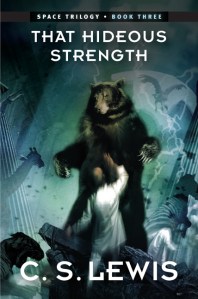
space trilogyChristmas is the season of giving, and as a grandfather I can truly say it’s more wonderful to give than to receive. Those little smiles and squeals of joy are precious indeed.

Sadly, many children (and adults) will be forgotten this season. Worthwhile programs to reach out to the overlooked are sponsored by countless churches and communities. One of the most highly regarded, Angel Tree, provides gifts to the children of men and women who are incarcerated. These innocent children are already suffering due to the poor choices of adults; God alone knows how special the most modest Christmas gift might be to these little ones.

That is one end of the spectrum—those who have little. Equally sadly, many children (and adults) will overindulge this season. They will bury themselves under piles of soon-to-be-forgotten presents. Most will also bury themselves further under mounds of debt.

C.S. Lewis colorfully captured this quandary in “Xmas and Christmas.”

And they buy as gifts for one another such things as no man ever bought for himself. For the sellers, understanding the custom, put forth all kinds of trumpery, and whatever, being useless and ridiculous, they have been unable to sell throughout the year they now sell as an Exmas gift. And though the Niatirbians [British] profess themselves to lack sufficient necessary things, such as metal, leather, wood and paper, yet an incredible quantity of these things is wasted every year, being made into the gifts.

Striving for balance in gift exchanging is important. For years now my father has said it’s unnecessary to give him Christmas or birthday gifts. It’s true. He’s able to purchase whatever he wants, and even the most thoughtful gifts are either redundant or undesired. He’s grateful, of course, but only out of courtesy. Last month, for his birthday, I took him up on his words. Instead of spending money on a gift, we made a special donation to the Gideons in his honor. He was delighted. I’ve known others who made the same request, that gifts intended for them be diverted to the benefit of others. It’s a grand custom.

After the homily on selflessness above, it may sound strange to hear that there is a Christmas gift I would like to suggest you consider giving to yourself. Actually, I’d advise a friend or loved one to purchase it for you, but since you probably haven’t encouraged them to subscribe to Mere Inkling (yet), I must satisfy myself with advising you to check out this special offer.

During the holiday season, HarperOne is running a special on C.S. Lewis’ Cosmic Trilogy (often referred to as the Space Trilogy). You can get them in various digital editions for only $1.99 each. Quite a bargain. And it leaves you plenty of resources to practice the truth that it’s better to give than receive.

Out of the Silent Planet, the first of these science fiction works, was the first Lewis book I read. A friend in a college fellowship group suggested it, and it introduced me to one of the greatest mentors a person could ever have! The books are available through this link: Cosmic Trilogy.

Oh, and if the Cosmic Trilogy is already in your library, or not your cup of tea, they are also discounting an illustrated edition of The Screwtape Letters.

The Trilogy is suitable for Christian and secular readers alike. It’s not overtly “religious.” In fact, in his C.S. Lewis: Companion and Guide, Walter Hooper says many of the intial reviewers of the title were rather confused about its intended meaning. (This despite offering positive reviews.) One person who did comprehend its significance was an Anglican theologian named Eric Mascall. In a 1939 issue of Theology he wrote:

This is an altogether satisfactory story, in which fiction and theology are so skillfully blended that the non-Christian will not realize that he is being instructed until it is too late. It is excellent propaganda and first-rate entertainment.

I’m certain he meant “propaganda” in the most positive, pre-war sense. Actually, one does not need to be a follower of Jesus of Nazareth to appreciate the series. If you’ve never read it before—and you don’t have a 100% aversion to the science fiction genre—the two dollar price means you’ll rarely have a better opportunity.

Greek Mythology & Modern Humanity

narcissusThere is a very important mental health tome that describes psychological disorders in detail. It’s called The Diagnostic and Statistical Manual of Mental Disorders (DSM).

Since the American Psychiatric Association is constantly discovering new mental ailments—and they occasionally recognize that previously unhealthy mindsets and behaviors have become so pervasive they can no longer be considered aberrations—the DSM requires periodic revision.

The current authoritative version is DSM-IV-TR, or DSM, fourth edition, text revision. That means that if you were diagnosed with a defect according to the third edition standards, you may now have a clean bill of health. And, for those of you whose diagnosis is still included in DSM IV, don’t despair; they are currently consulting about version five, and who knows what psychoses may soon become “normal.”

I had to study these things during my seminary training, for my counseling work as a chaplain and civilian pastor. I was thinking about the manual recently as I pondered the spirit of Narcissus that seems to hold sway in our age. Like C.S. Lewis, I understand there is value in studying Greek and Roman myths, as many contain seeds of Truth. (Lewis’ appreciation for myth is most evident in Till We Have Faces, which is a reworking of one ancient Greek tale.)

Narcissus, of course, is the mythological Greek who was so consumed by his own handsomeness that he perished because he was unable to tear himself away from gazing at his own likeness. (The image above was painted by Michelangelo Caravaggio in the sixteenth century.)

Narcissism, which echoes his name, describes the unbridled vanity and self-concern (i.e. selfishness) that motivates growing numbers in our individualistic and hedonistic world. Since narcissism has become so rampant, the DSM now concerns itself only with “pathological narcissism.” That distinction will probably remain, even if Narcissistic Personality Disorder (NPD) is eliminated from the fifth edition as a distinct illness, as many have recommended.

God Save Us from the Narcissists

Pathological narcissists are terrible indeed. Their characteristic arrogance, envy, sense of entitlement and lack of empathy make them unhealthy members of society. In fact, large numbers of sociopaths and psychopaths are also narcissists.

But here’s the problem. At the rotten core of the disorder we find a putrid seed that negatively affects many of us who appear otherwise to be so normal. The source of the corruption is, in part, sinful pride.

Let’s take a look at the “diagnostic criteria” for NPD which confronted me when I first studied DSM III. (Perhaps you may wish to skip this section, since modest hints of some of these traits may strike close to home.) I’ve added my own introspective comments in italics.

Diagnostic criteria for 301.81, Narcissistic Personality Disorder:

A pervasive pattern of grandiosity (in fantasy or behavior) hypersensitivity to the evaluation of others, beginning by early adulthood and present in a variety of contexts, as indicated by at least five of the following:

(1) Reacts to criticism with feelings of rage, shame, or humiliation (even if not expressed).

— I’ve never “raged,” but it’s embarrassing to be criticized in public

(2) Is interpersonally exploitive: takes advantage of others to achieve his or her own ends.

— Never. I won’t tolerate manipulation–either as the manipulator or the manipulatee.

(3) Has a grandiose sense of self-importance, e.g., exaggerates achievements and talents, expects to be noticed as “special” without appropriate achievement.

— Have I told you lately about being Thespian of the Year when I graduated from high school . . ?

(4) Believes that his or her problems are unique and can be understood only by other special people.

— Not this trait, I’m aware everyone in this fallen world is faced with challenges . . . many of them worse than my own.

(5) Is preoccupied with fantasies of unlimited success, power, beauty, or ideal love.

— I do daydream about accomplishing special goals, although I never lusted after power and I accepted the facts about “beauty” long ago. I have, however, found ideal love, and we’ve been married 37 years!

(6) Has a sense of entitlement: unreasonable expectations of especially favorable treatment, e.g., assumes that he or she does not have to wait in line when others must do so.

— I’m the opposite. I always pick the longest and slowest line to stand in.

(7) Requires constant attention and admiration, e.g., keeps fishing for compliments.

— If people weren’t so frugal with compliments, I wouldn’t need to.

(8) Lack of empathy: inability to recognize and experience how others feel, e.g., annoyance and surprise when a friend who is seriously ill cancels a date.

— Nope. I really do care about others. That’s the reason good clergy and caregivers often suffer compassion fatigue.

(9) Is preoccupied with feelings of envy.

— Well, what about those cases where the person doesn’t deserve the honors they’ve received . . ?

There, I feel much better, having made a public confession of my almost-narcissistic human self-centeredness.

In his essay “Christianity and Culture,” C.S. Lewis warns that “A man is never so proud as when striking an attitude of humility.”

When we admit, instead, that there remains much in our soul that is base and prideful, we’re on the proper path. The course that leads to a rejection of Narcissus-in-us, and the embracing of what is precious in our neighbors and our world, is the road that leads to contentment.

Avoid Living in Fear

nuclear blast

Nuclear war. It’s an extremely unpleasant subject, and its grim specter still haunts the world. Oddly, though—even as we anticipate the day when Iran’s lunatic Mullah’s develop them and North Korea’s deranged generals learn how to deliver them—the world is in a sort of “nuclear hiatus” at this very moment.

The Mutual Assured Destruction apparently worked, as the former Soviet Union and the United States decided against nuclear suicide. At the present moment the three world powers show little appetite for total war, so today’s children don’t have to learn the Civil Defense precautions that kept an earlier generation safe.

I was one of those young Americans indoctrinated in the sophisticated “duck and cover” method of nuclear blast survival. This video provides a nostalgic look at the paramilitary training we received. (A link to the full training film appears below.)

C.S. Lewis lived during the height of nuclear paranoia. Yet he retained his composed Northern Irish demeanor as he reflected on the threat. In an essay entitled “On Living in an Atomic Age” he wisely advised:

If we are all going to be destroyed by an atomic bomb, let that bomb when it comes find us doing sensible and human things—praying, working, teaching, reading, listening to music, bathing the children, playing tennis, chatting to our friends over a pint and a game of darts—not huddled together like frightened sheep and thinking about bombs. They may break our bodies (any microbe can do that) but they need not dominate our minds.

In his essay “Is Progress Possible,” Lewis addresses those who used the uncertainty of the future as an excuse for making irresponsible life choices. His words ring just as true today, when so many youth turn to nihilism and self-destructive behaviors.

As a Christian I take it for granted that human history will some day end; and I am offering Omniscience no advice as to the best date for that consummation. I am more concerned by what the Bomb is doing already. One meets young people who make the threat of it a reason for poisoning every pleasure and evading every duty in the present. Didn’t they know that, Bomb or no Bomb, all men die (many in horrible ways)? There’s no good moping and sulking about it.

If only remaining safe in this fallen world was as simple as dropping to the ground and sheltering one’s head. It isn’t, of course, but we need not live our lives under the shadow of fear.

Returning to “On Living in an Atomic Age,” Lewis adroitly places the entire menace—and all perils to human life—in their proper perspective. It may not be the most comforting words we will ever read, but they are certainly true.

In one way we think a great deal too much of the atomic bomb. “How are we to live in an atomic age?” I am tempted to reply: “Why, as you would have lived in the sixteenth century when the plague visited London almost every year, or as you would have lived in a Viking age when raiders from Scandinavia might land and cut your throat any night; or indeed, as you are already living in an age of cancer, an age of syphilis, an age of paralysis, an age of air raids, an age of railway accidents, an age of motor accidents.”

In other words, do not let us begin by exaggerating the novelty of our situation. Believe me, dear sir or madam, you and all whom you love were already sentenced to death before the atomic bomb was invented: and quite a high percentage of us were going to die in unpleasant ways. We had, indeed, one very great advantage over our ancestors—anaesthetics; but we have that still. It is perfectly ridiculous to go about whimpering and drawing long faces because the scientists have added one more chance of painful and premature death to a world which already bristled with such chances and in which death itself was not a chance at all, but a certainty.

_____

You can watch the entire “Stop and Drop” Civil Defense Video here.