
Rational Fears

men at lunchFear comes in many forms. It also comes at many heights. This famous 1932 photograph shows eleven men—without safety harnesses—taking a lunch break during construction of the Rockefeller Center in New York City.

Simply looking at the picture of them leaning in various poses as they casually converse with one another is enough to send shivers up the spine of someone suffering from acrophobia.

I don’t personally have an “irrational fear of heights.” After all, I’ve enjoyed forays into the sky via the Eiffel Tower, the Tokyo Tower and the Space Needle in nearby Seattle. Still, I must confess that when I stand high above the earth on a piece of clear glass or acrylic that I do find it a bit disconcerting. It’s not as if I doubt the building is secure . . . but precisely what clear substance like that is worth trusting our lives to?

cracksIn fact, not long ago, a group of people were standing on just such a viewing panel when it began to crack. Two facts, it was new (opened in 2009) and it was on the 103rd floor of the Chicago building. The quaintly named “Ledge” was certified to 10,000 pounds, and it’s difficult to imagine the family standing on it, when it fractured, as exceeding that weight.

Let’s return for a moment to 1932. There’s a lesser known photo, taken the same day as the renowned image. It is even more disturbing. Check this out.

restThis shot was taken after the men had staged the lunch picture for the press. They were simply resting after eating, before returning to work.

Now, I appreciate rest as much as anyone, and far more than most. But, if I was on that steel girder, 840 feet above the pavement, I would be so hyper vigilant a tranquilizer dart couldn’t put me down.

That picture, frankly, scares me.

Fortunately, C.S. Lewis reminds us that there is nothing wrong with fear. Beyond sometimes protecting us from foolish risk-taking, the fear itself does not determine our reaction to it. In other words, a soldier can rightly be afraid on the battlefield, yet overcome that fear and do something heroic. Common men and women often surprise themselves when they overcome fear they might have thought would cripple them.

C.S. Lewis says it this way. “The act of cowardice is all that matters; the emotion of fear is, in itself, no sin” (The Screwtape Letters).

I’ve learned through the years that there is wisdom in learning about one’s own fears. Sometimes what we learn diminishes the fear. At other times, understanding our fears can prevent us from misattributing our emotions to another source.

For example, you might think you dislike a person who frequently invites you to share your thoughts with a group. When, in actuality, it might merely be your fear of public speaking, or your fear of having your ideas rejected that troubles you. Upon recognizing this, you might even grow to like the other person, seeing how they are confident that you have something of value to offer to the discussion.

Like every other fallen human being, I’m riddled with fears and buried under worries. It is beyond comprehension how God has manifested his love for us in his only begotten Son . . . truly we can cast all of our burdens onto his compassionate and willing shoulders.

In fact, it is during our darkest hours when, assailed by our personal terrors, we lean most upon his strength. Without a doubt, if severe unemployment has forced me to be one of those construction workers nearly a century ago, I would most definitely have been one praying man!

_____

P.S. – Oh, and if anyone is curious about the flask held by the construction worker on the right, I’m sure it only contained water and not some useless form of “liquid courage.”


Lemming Legends

lemmingThe closest camaraderie I ever experienced in my life, was on the staff of the USAF Chaplain School. A sign of our esprit de corps was seen in the nicknames we gave one another. Mine was Lemming. (Not too dashing, I know, but read on and you’ll see why it was bestowed with affection and respect.)

Those of us who worked on “Air Staff” projects (for the Chief of Chaplains) were in the Resource Division. Probably because we were always rushing (scurrying?) around responding to emergencies, the other chaplains called us the “Resource Rats.” We were close indeed, and our energies and creativity was magnified by our synergy . . . just like the Inklings.

We embraced the label, and before we knew it each of us had been identified as a particular member of the rodent family. We had a rabbit, hamster, beaver, squirrel and fudged a bit with a ferret and a weasel. Among assorted other “rats,” I was nicknamed—you didn’t choose your identity, your friends awarded it to you—Lemming.

They called me Lemming because I had a unique duty on the team. One of my duties was to do a little bit of “ghostwriting” for the Chief of Chaplains. Some would consider it an honor, but trust me, due to the general for whom I wrote the first year, it was anything but.

Why a Lemming? Well, because whenever a tasking came down I would dutifully march off in obedience . . . even if it meant marching right off of a cliff. Like the humble Lemming, I accepted my fate, and made the best of it.

We all know their tragic story. When the Lemming burrows become overcrowded, a large number of them will sacrificially gather together and march to the sea. There, those who did not perish in catastrophic falls, nobly swim out to sea so that their relatives back in the warren can once again devote themselves to overpopulating their habitat.

I was proud of the appellation. I wore the name (literally, on the shirt logo pictured above) as a badge of honor. Until . . . until I discovered it was all based on a lie.

Lemmings, we have learned, do not suffer from periodic mass suicidal impulses. The common myth is based on an insidious 1958 “nature film” made by Disney. I have no idea why they would compromise their flawless reputation for scientific accuracy in their naturalist media, but in White Wilderness, they cast all integrity aside. (And now I know why C.S. Lewis and J.R.R. Tolkien were wary of the machinations and shadowy motives of Walt Disney Studios.)

With utter disregard to the reputation of these clever arctic creatures, the film showed (supposed) members of the Scandinavian clans eagerly casting themselves to their deaths. However, their bizarre behavior was manipulated by cinematic chicanery.

It turns out that not only did Disney pull the lemmings out of their normal habitat for filming—since they were too intelligent to voluntarily leap to their death, they were thrown off of the cliff from a modified turntable! Ghastly.

Learning that lemmings will not march knowingly (and stupidly) to their own demise has actually made me a bit prouder to bear the title. I mean, it’s one thing as a member of the armed forces to risk your life in the defense of your nation. It’s quite another to commit suicide because a general thought one of your commas was in the wrong place. But that’s a story for another day.

C.S. Lewis’ Bilingualism

csl bilingualHow many extremely intelligent and well educated people do you know . . . who can actually communicate with those of us possessing normal human intelligence?

That talent is a rarity.

And it is precisely what makes C.S. Lewis such an unusual man. He was brilliant. Yet he could communicate with the common person—even the child—just as easily as he conversed with his fellow university dons.

Lewis, of course, could comprehend a number of languages, so he was more than merely “bilingual.” But that is not exactly the sense in which I am using the word today. I mean it in the sense of my opening paragraphs. It is the ability to communicate (even with the same “language”) to distinctly different groups who would normally not be able to readily understand one another.

In an interview that appeared in Christianity Today, Detroit pastor Christopher Brooks was asked about the challenges of urban ministry.

How have you included both righteousness and justice in your setting?

I think about C.S. Lewis, who had the challenge of building the bridge between the culture of Oxford and Cambridge and the culture of the church. These cultures were worlds apart by his time, but he was bilingual, in a sense: able to speak the language of Oxford to the church and the language of the church to the intellectuals and naturalists.

One of the titles for ancient Roman priests that was adopted by their Christian successors is “pontifex.” It means “bridge-maker.” The Pontifex Maximus was, of course, referred to the greatest of these offices.

In light of Brooks’ words about Lewis as building bridges between elite academia and Christianity, I have added that dimension to my view of him. C.S. Lewis, Pontifex Maximus. (I doubt it would make him happy, so I’ll keep it under wraps . . . and probably never mention it again.) But I am genuinely happy about his skill in building these bridges of understanding.

Before signing off, a special treat. If you call someone who speaks two languages “bilingual,” and someone who speaks three “trilingual,” what do you call someone who only speaks one language? Why, an American, of course.

That joke would not be as funny if it were not so sadly true. While the rest of the world almost assumes that people know at least two languages, most Americans stumble their way through the study of a second language for two or three years and never develop a comfort level with it. But that’s a story for another day.

Titles You Don’t Want


eyechartThe world’s oldest man just died—and I’m not looking forward to ever becoming one of his successors. I mean, I understand the sentiments of non-Christians who quip that any day on this side of the grass is a good one, but I would only be interested in staying around here that long if I still had a keen mind and good health.


I’m not sure most of the people who eventually earn those titles have either. This gentleman was 111, and in the picture of him receiving his Guinness certificate, he actually looks like he had already expired. I mean, no offense, just a statement of simple fact.

As for his state of mind, I’m a bit more optimistic. Apparently when asked a while ago how he had lived so long, he responded, “because I haven’t died yet.” Assuming that was tongue in cheek (I recognize that is merely an assumption), he had retained his sense of humor. A good sign.

I don’t think ultra-long longevity is all it’s cracked up to be. I remember my 92 year old grandmother (my only relative who lived to be “elderly”) telling me that she was ready to go to heaven. She was in a nursing home, but not in pain, and still witty.

She said, “Robbie, I’ll miss you and everyone who is still here, but if you live long enough, more of the people you love are already in heaven than remaining here.” She had been widowed for three decades. And, unbeknownst to us at the time, three of her four children would follow her within three years of her own passing.

I am not eager to die, of course. And, unlike Polycarp, the bishop of second-century Smyrna, I’m certainly not zealous about the possibility of someday being martyred.

Still, God-willing, when I’ve come to the end of my appointed days I will make that transition peacefully, as is appropriate for a child of God who has been blessed with a full life.

When death is seen as a dark end—a soundless void—it’s understandable that many would resist it to the “bitter” end. That theme has been common in literature and cinema.

In a comic light, a character on Parks and Recreation exhibits the desire to live as long as humanly possible. He exercises without pause and takes every vitamin that exists in horse-pill doses. Soon after Chris Traeger was introduced to the show, he shared his view of life:

I take care of my body above all else. Diet, exercise, supplements, positive thinking. Scientists believe that the first human being who will live 150 years has already been born. I believe I am that human being.

Humorous. And, a respectable goal perhaps, if not driven by deep fear.

I don’t share Traeger’s goal of being the first human to reach 150. Nor, as we considered at the outset of our discussion, do I long to gain the title of World’s Oldest Man.

And I take comfort that I find myself, once again, in the comfortable camp of C.S. Lewis. In his essay “Is Progress Possible?” Lewis wrote:

Progress means movement in a desired direction, and we do not all desire the same things for our species. In “Possible Worlds” Professor Haldane pictured a future in which Man, foreseeing that Earth would soon be uninhabitable, adapted himself for migration to Venus by drastically modifying his physiology and abandoning justice, pity and happiness.

The desire here is for mere survival. Now I care far more how humanity lives than how long. Progress, for me, means increasing goodness and happiness of individual lives. For the species, as for each man, mere longevity seems to me a contemptible ideal.

More important, we believe, is the quality than the quantity, of our lives.

Harry Potter in the Bible

potterSo much for the effectiveness of “state churches.” The European ones appear to have become abject failures. There is ample evidence that the “establishment” of religions has rarely served either church or state very well.

Here’s the latest proof from the United Kingdom. The BBC recently reported a study that shows three in ten teenaged Brits don’t know the Nativity of Jesus came from the Bible. Similar numbers had never heard about the Crucifixion or Adam and Eve.

I imagine they’ll consider the new Noah film just another work of Hollywood fiction. (Actually, half of them didn’t know that very story comes from the Bible.)

What’s more—their parents are nearly as ignorant.

Many of the teens did, however, think that the plotlines from the Harry Potter series were based on Bible stories.

As a person who was genuinely inspired by England’s magnificent cathedrals while I lived there, it is painful to contemplate the terrible loss. The great-great-grandchildren of saints who suffered and sacrificed for the Gospel have disregarded the good news.

And, lest any readers think I’m pointing fingers as a “self-righteous” American, let me assure you I take no pride in my own nation’s slide into apostasy. The words of Micah’s prophecy seem closer to fulfillment each day. “The faithful have been swept from the land; not one upright person remains.”

C.S. Lewis saw this coming. Consider the following from his 1950 essay, “The Literary Impact of the Authorised Version.”

It may be asked whether now, when only a minority of Englishmen regard the Bible as a sacred book, we may anticipate an increase of its literary influence. I think we might if it continued to be widely read. But this is not very likely. Our age has, indeed, coined the expression “the Bible as literature.” It is very generally implied that those who have rejected its theological pretensions nevertheless continue to enjoy it as a treasure house of English prose.

It may be so. There may be people who, not having been forced upon familiarity with it by believing parents, have yet been drawn to it by its literary charms and remained as constant readers. But I never happen to meet them. Perhaps it is because I live in the provinces. But I cannot help suspecting, if I may make an Irish bull, that those who read the Bible as literature do not read the Bible.

Speaking of reading the Bible “as literature,” that’s not a bad thing. It informs so much Western literature, that an ignorance of the Scriptures is tantamount to possessing an inadequate education. An excellent online resource for exploring this truth can be found at the Bible Literacy Project.

The site includes a copy of a comprehensive 2006 study of English professors from America’s top-rated schools, including Yale, Harvard, Princeton, Stanford, Texas A&M, UC-Berkeley and others. In the study, not a single professor disagreed with the statement that: “Regardless of a person’s faith, an educated person needs to know the Bible.”

If some people could get past their prejudices against the Bible, they would recognize the truth of this statement. Everyone should be reading the Bible, even if only as a significant literary work.

Perhaps, if this widespread study comes to pass, one day people will be able to recognize the difference between the Scriptures and Harry Potter.

Married, or Not?

unificationShould a wedding ceremony during which the bride forgets the groom’s name be considered valid? That question may sound slightly preposterous, but I just witnessed it happening.

One of the network news programs just did a story on the latest “Holy Marriage Blessing Service” conducted by the Unification Church. This is the religion founded by Sun Myung Moon, whose disciples believe to be the second coming of Jesus. (Moon died in 2012, but his wife continues to lead the religion, and officiate at these regular ceremonies.)

Many of the couples who marry in these ceremonies are matched by their parents or, if they are determined to be especially blessed, they are “randomly” matched by the church leader (presently the widow of their messiah). Reportedly, each match takes about thirty seconds as the prophets place the hands of men and women together in divinely appointed relationships.

Officially, a person can decline their match after they’ve had a little time to talk with their future spouse, but it’s evident that contradicting the action of one’s savior would require immense courage.

That said, I have no doubt that—due to the earnest commitment and efforts of both parties—many of these marriages end up happy. After all, as C.S. Lewis wrote in Mere Christianity:

Knowledge can last, principles can last, habits can last; but feelings come and go… But, of course, ceasing to be “in love” need not mean ceasing to love. Love in this second sense — love as distinct from “being in love”—is not merely a feeling. It is a deep unity, maintained by the will and deliberately strengthened by habit; reinforced by (in Christian marriage) the grace which both partners ask, and receive, from God. . . . “Being in love” first moved them to promise fidelity: this quieter love enables them to keep the promise. It is on this love that the engine of marriage is run: being in love was the explosion that started it.

In the case of Unification Church members, even if the relationship lacked an emotional stage of “being in love,” it doesn’t mean that it is destined to fail. Far from it, since, as Lewis wisely points out, true love isn’t about feelings.

In the aforementioned case, the bride was from a French-speaking African nation. The husband, I believe, was from Japan. Her English was quite good, but his was poor. They were essentially unable to communicate. Then, when the interviewers revisited them immediately before the ceremony was to begin, they asked the beautifully-gowned bride what her husband’s name was. And she had forgotten.

Another peculiar thing about Unification marriage practices is that, following the wedding, there is a 40+ “separation period,” during which they are required to refrain from intimate relations. While Christians are called to practice premarital chastity, I’m unfamiliar with any other group that requires a post-wedding purification.

One last comment about the Unification marriage blessings. As if they could not be more bizarre. In 1997 the Moons presided over a ceremony in Washington, D.C. While only 2,000 of the 30,000 couples were actually being married, among the other 28,000 couples having their marriage “blessed” by the Unification messiah included a prominent American political figure—none other than Al Sharpton.

At least he and his wife, Katherine, probably knew each other’s names.

_____

The picture above comes from one of the group weddings. This young bride has to be content with the photograph of her absent groom. One wonders if the two have yet to meet.

Undue Honor

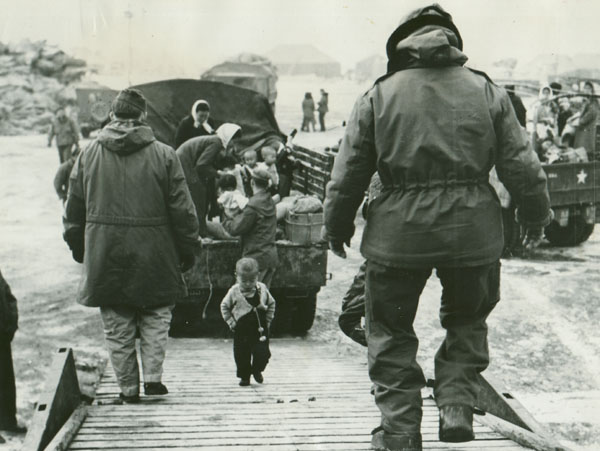
orphan flightHow should we respond when someone else receives all of the praise and accolades for something we actually accomplished? I confess my natural, human reaction is to resent them for it. The example of one outstanding Korean War chaplain, however, clearly reveals how it is much more noble to simply reject resentment and move forward in life.

This column continues a story introduced in my last post, so if you missed it, you may find it helpful to pause and read that piece before continuing. It’s available here.

In discussing the plight of the orphans during the Korean War, I mentioned the name of Chaplain Russell Blaisdell. He and his ministry partner, Staff Sergeant Mike Strang, saved nearly a thousand orphans during a single heroic action in December of 1950.

The full story of the Kiddy Car Airlift can be found on the website of the Korean War Children’s Memorial.

Here are the highlights. For months Chaplain Blaisdell and Sergeant Strang had been rescuing homeless children from the streets of Seoul. Due to the rapid advance of Communist forces, the fall of the capital city became imminent.

The military was rapidly attempting to redeploy its assets, to minimize the resources which were destined to fall into the hands of the enemy. Transporting noncombatants to safety fell far down the long list of urgent missions. The children were nonessential. To everyone, that is, except these two men.

The details of their heroic effort are the stuff of movies. And a movie that included this great escape was indeed made. The only problem is that it did not reflect the true story, and neither of the true heroes received their due.

The story of this injustice is related online here. Briefly, another Air Force officer, a pilot who assisted Blaisdell with finding quarters for the refugees behind friendly lines, received the credit due to the ministry team. So, exactly how did this travesty come about?

Colonel Dean Hess wrote a book, entitled Battle Hymn. It sold well, and included many significant actions in which the author had presumably been directly involved. However, the most significant event, in which he was involved only indirectly, was a focal point of book and its subsequent film (starring Rock Hudson, no less).

Only in very recent years, and unfortunately after Strang had died, has the story been set straight. Blaisdell has received overdue recognition from the Air Force and the Republic of Korea. Strang’s recognition has necessarily been posthumous.

Dr. George Drake wrote an article on this unfortunate tale, and although he entitles it “Hess: Fraudulent Hero,” he does offer a less critical rationale for how misperceptions may have been carried so far.

Once the movie was released it seemed impossible for Hess to say “This is not a true portrayal of what happened.” Hess had become a captive of his own earlier mis-statement of the facts of the rescue. Recently Hess has privately, but not publicly, stated that he was upset with the way the movie distorted the story of the rescue but the truth of the matter is that his concern for that distortion of the facts did not prevent him from accepting the honors due someone else.

Drake reproduces correspondence between Strang and Blaisdell related to the matter. In 1957, Strang wrote his friend about having dinner with Hess in California, in the hopes that he might get a role in the film. “I went out there and he met me one night for dinner and asked me a few questions about what happened on Kiddy Car Operation and I never heard from him after that, as a matter of fact I called him any number of times and he never even had the courtesy to return my call or even leave a message for me.”

Blaisdell’s response brings us back to the question with which I began this column. Based on how the two of them had been overlooked, and especially in light of Strang’s disappointment at failing to get a break in a hoped for civilian career, what should the two of them do? Blaisdell took the high ground and wrote to his comrade in arms:

In regard to doing anything about it, I have decided in the negative. Although I agree with you in principle, the goal of our efforts, in regard to the orphans and also in the evacuation of the Koreans by convoy, was the saving of lives, which would otherwise have been lost. That was accomplished.

In a sense, Mike, well-doing has its own reward, which is not measured in dollars, prestige, or good will . . . This does not mean that I would not be willing to state the facts as they existed to anyone who might properly request them to substantiate your story.

Strang joined his chaplain on the high moral ground, and did not create a scandal. I hope that, had I been in their combat boots, I would have joined them there.

There is something quite alluring about fame. Not everyone is vulnerable to it—we all have our own weak links in our personal armor—but many are. Writers, I suspect are particularly susceptible to the wounds pride and renown can inflict. After all, who among us who writes does not desire a large audience? (Or at least a small but clearly “devoted” one.)

Even C.S. Lewis was not impervious to the assault of fame. In a letter to his friend Don Giovanni Calabria, Lewis describes how personal concerns prevented him from doing much writing at the time. With great personal insight and wisdom, he adds that this may not be such a bad thing.

As for my own work, I would not wish to deceive you with vain hope. I am now in my fiftieth year. I feel my zeal for writing, and whatever talent I originally possessed, to be decreasing; nor (I believe) do I please my readers as I used to. I labour under many difficulties. . . .

These things I write not as complaints but lest you should believe I am writing books. If it shall please God that I write more books, blessed be He. If it shall please Him not, again, blessed be He. Perhaps it will be the most wholesome thing for my soul that I lose both fame and skill lest I were to fall into that evil disease, vainglory.

Like Lewis, we are well served when we ponder the effects of fleeting fame and worldly success on our lives and souls. And, like Strang and Blaisdell, we should carefully weigh our own motivations whenever we desire to seize the recognition we believe we deserve.

orphan airliftAfter all, in the end what is untrue will be dispelled like the morning mists . . . and when that bright Light shines upon us all, only what is true and selfless will glow with the reflection of God’s own glory.

Rescuing Orphans

orphansWar is a terrible thing. It should be avoided at (nearly) all costs. As C.S. Lewis wrote during Hitler’s atrocities, “If war is ever lawful, then peace is sometimes sinful” (“The Conditions for a Just War”).

I was writing this weekend about one of the sad consequences of war—the creation of orphans. As an adopted child of God, I possess deep compassion for children without parents in this world. Over a decade ago I was privileged to represent the United States Air Force at the dedication of the Korean War Children’s Memorial.

When I contacted the coordinator of that event, Dr. George Drake, he provided me with the photograph above, which shows the speakers that day. Drake appears to the left, and yours truly is in uniform, to the right. The primary speaker was Chaplain Russell Blaisdell, center, who saved the lives of at least a thousand Korean orphans during the war, delivering them from almost certain death as Seoul fell to the Communists. (My next post will reflect on his heroism and humility.)

The war in Korea was horrific. The frontlines swept across the peninsula, leaving desolation and tragedy in their wake. The number of orphans created by the violence was legion. In the cruel ebb and flow of the conflict, many perished. Still, even in the crimson terror there were expressions of mercy and grace.

Chaplains often led the way in reaching out to the children, but their efforts would have accomplished little if the compassion of the common Soldier, Marine, Sailor and Airman had not moved them as well to make sacrifices to care for the children.

Chaplains who serve in Korea today have maintained the strong bonds of support for orphanages that was so vital to the wartime chaplains represented by Blaisdell.

During my year in Taegu (Daegu), I coordinated the ministry of the airmen at Taegu Air Base in partnership with Love and Hope Orphanage. Love and Hope has a unique role, caring for the least of the least . . . children with serious physical and/or mental handicaps. There is little room for them in most societies, and Korea is no exception.

Orphans are made not by war alone, of course, but by a variety of tragic confluences of suffering. Some lose parents to accident or disease. Today, we find the greatest number of orphaned children in various parts of Africa where AIDS has devastated local adult populations. Similarly, following natural disasters such as major earthquakes and tsunamis, many orphans are left alone in the rubble or receding waters.

Some children flee abusive homes, or are rescued from dangerous environments; in one sense these were orphans even before their legal bonds with cruel predators were severed.

Many causes account for the existence of orphans. And, as long as we live in this fallen world, orphans will be among us. This is why we must never forget that, “Religion that is pure and undefiled before God, the Father, is this: to visit orphans and widows in their affliction, and to keep oneself unstained from the world” (James 1:27, ESV).

C.S. Lewis was well acquainted with the sorrow of wartime violence and the shattering of families. A veteran of World War I, he saw many friends perish just as they were embarking on adulthood. After World War II, one of his many correspondents was Don Giovanni Calabria, who operated an orphanage in devastated Italy

In 1951, Lewis sent his friend a newly translated copy of the first book in his Chronicles of Narnia. He invited the priest (who would be canonized by the Roman Catholic Church less than fifty years later) to pass the book on to one of the orphans in his care.

I am sending you my tale recently translated into Italian in which, frankly, I have rather played than worked. I have given my imagination free rein yet not, I hope, without regard for edification—for building up both my neighbour and myself. I do not know whether you will like this kind of trifle. But if you do not, perhaps some boy or girl will like it from among your “good children.”

While I imagine the volume remained close to the future “saint,” I trust that Lewis’ powerful tale delighted many of the young children in his care.

As Chaplain Blaisdell says about caring for innocent children, the act itself provides more than sufficient reward. Formal recognition is not required, and may in fact detract from the intrinsic satisfaction that accompanies the giving of oneself in service. Ninety-nine percent of those who sacrifice for the widow and orphan remain essentially anonymous to all but God, and this is just fine. (You can read more about the Kiddy Car Airlift and who received credit for it here.)

Words of Death

joseyOne of the cinema’s most powerful scenes occurs in a film many might disregard due to its genre. In “The Outlaw Josey Wales,” a man trying to rebuild his war-shattered life, rides out to face a Comanche chieftain.

Josey: You be Ten Bears?

Ten Bears: I am Ten Bears.

Josey: I’m Josey Wales.

Ten Bears: I have heard. You’re the Gray Rider. You would not make peace with the Blue Coats. You may go in peace.

Josey: I reckon not. Got nowhere to go.

Ten Bears: Then you will die.

Josey: I came here to die with you. Or, live with you. Dying ain’t so hard for men like you and me, it’s living that’s hard; when all you ever cared about has been butchered or raped. Governments don’t live together, people live together. With governments you don’t always get a fair word or a fair fight. Well I’ve come here to give you either one, or get either one from you. I came here like this so you’ll know my word of death is true. And that my word of life is then true. The bear lives here, the wolf, the antelope, the Comanche. And so will we. Now, we’ll only hunt what we need to live on, same as the Comanche does. And every spring when the grass turns green and the Comanche moves north, he can rest here in peace, butcher some of our cattle and jerk beef for the journey. The sign of the Comanche, that will be on our lodge. That’s my word of life.

Ten Bears: And your word of death?

Josey: It’s here in my pistols, there in your rifles . . . I’m here for either one.

Ten Bears: These things you say we will have, we already have.

Josey: That’s true. I ain’t promising you nothing extra. I’m just giving you life and you’re giving me life. And I’m saying that men can live together without butchering one another.

Ten Bears: It’s sad that governments are chiefed by the double-tongues. There is iron in your word of death for all Comanche to see. And so there is iron in your word of life. No signed paper can hold the iron, it must come from men. The word of Ten Bears carries the same iron of life and death. It is good that warriors such as we meet in the struggle of life . . . or death. It shall be life.

This conversation has always caused me to stop and think—even as I typed it out now. It contains many profound thoughts about honesty, commitment, respect and even peace. Most captivating to my thoughts, though, is the contrast between words of death and words of life.

“There is iron in your word of death . . . And so, there is iron in your word of life.”

People say all sorts of things, often without much regard as to whether or not they are true. They often speak without thinking about the words before they leave their lips. Most daily conversation is superficial, and immediately forgotten.

That changes, when we speak of death. Sure, comedians joke about it, but when people discuss actual death—often in the wake of someone’s passing—our words become more measured, our tempo slows, and we more consciously ponder what we are saying.

I recall a conversation with a fellow chaplain who described his father’s dying. He contracted a terminal disease, which would take some time to extinguish his life, and he told his children: “As you have grown up, I’ve done my best to teach you how to live. Now I will do my best to teach you how to die.”

It doesn’t require faith in God to die with dignity, but those of us who know the resurrected Jesus, face death with a confidence that death does not have the final word.

The truly wise live all of their days in the knowledge that we all will someday (barring the parousia) experience physical death. In light of that, our words should not be careless, or even frivolous. That’s true for our life words, as well as our death words.

By this I do not mean that we should not play with language or engage in humor. After all, humor is inarguably one of God’s most precious gifts to us. Nor should we allow the cloud of death that hangs over all mortal flesh rob us of the many joys life brings.

C.S. Lewis would have understood the essence of the conversation quoted above. (The movie was made thirteen years after his own death.) When grieving the death of his wife, Lewis wrote:

You never know how much you really believe anything until its truth or falsehood becomes a matter of life and death to you. It is easy to say you believe a rope to be strong and sound as long as you are merely using it to cord a box. But suppose you had to hang by that rope over a precipice. Wouldn’t you then first discover how much you really trusted it? . . . Only a real risk tests the reality of a belief. (A Grief Observed).

What I am trying to capture is more than simply the notion that our words of life, our day to day conversations, should be just as sincere and thoughtful as our words of death. It’s more in line with what Lewis was referring to. That our words, thoughts, and hopes have been tested and proven true . . . because they are based not on the fancy of the moment, but on the final, concluding whole of the testimony of our lives.

In other words, it is precisely because one’s word of death (ultimate, naked honesty) is true, that you can trust their word of life.

That’s a message that echoes both the sound of a hammer driving nails on a Judean hill, and a heavy stone rolling away from the entrance to a sealed tomb, two days later.

Who Should We Trust?

staffordshire cross“You can trust me, I’m a pastor.” When I was ordained thirty-three years ago, that might have been sufficient to persuade many people to give me the benefit of the doubt. Not so today.

The latest Gallup poll records the continuing decline of our trust in “clergy.” Relentless negative press (much of it recording genuinely criminal and repellent behaviors) has taken its toll. Today only 47% of Americans trust ministers (of all faiths).

The good news, if you can consider it that, is that clergy still rank as the seventh most trusted group (out of twenty-two vocations considered).

But it remains quite pitiful. And quite understandable. Even being a pastor, there are many people considered clergy who I would not trust. First of all, anyone who purchased their “ordination” over the internet, and has the audacity to pretend to be a minister. I see a credibility gap there. (I would not include those who buy one of the fake diplomas as a “joke” to be untrustworthy . . . only those who pass themselves off as a “real minister.”)

I could go on, but my purpose here is not to trash clergy, since more than enough people already devote themselves to that purpose.

I am curious just who, in our increasingly uncertain and selfish world, we should trust.

I personally am in a rather envious position. I don’t have to rely on hoping people will trust me because I’m a pastor. I am also a sworn officer of the law. Albeit, I merely serve as a volunteer chaplain with my local county Sheriff’s Office, but we honestly do swear an oath to uphold the law, and we proudly wear regular uniforms, complete with our own chaplain badges (stars).

The thing about being in law enforcement is that I can benefit from the fact that it is the sixth most respected institution. So that carries me across the halfway mark all the way to the 54% trustworthiness milestone. I guess that’s fair, since I too place a higher trust in the integrity and professionalism of the average deputy or officer than I do in the average minister.

But, as I already said, I’m in a rather unique position, in that I also qualify for an even more respected category, that of a military officer. The 69% level of trust for military officers ties that of doctors and is only 1% below grade school teachers and pharmacists. So, I guess that if I want to instill confidence in my integrity, I’d best tell people that I’m a (retired) Air Force officer, and not that I am a member of the First Estate.

Trust is important. It’s a key commodity in any relationship, and absolutely essential for intimate relationships such as those shared within a family. Trust takes a great deal of time to build, and it can be shattered in just a moment. Its fragility is the primary reason why it must be treasured and guarded.

Trusted are those who never give others a cause to doubt them. My wife and I made a promise to our children that we would never lie to them. Never. We explained there would be times when we could not tell them something, or where we could only reveal a portion of the facts about a matter . . . but we promised them that whatever we did tell them would be the absolute truth insofar as we were aware.

Because of our honesty with them, our children (all adults now, of course), have been amazingly honest with us the whole of their lives. They trust us. We trust them. And none of us take that amazing gift for granted.

In Surprised by Joy, C.S. Lewis describes his introduction to J.R.R. Tolkien. Although the two would become lifelong friends, there were obstacles that needed to be overcome. One, described by Lewis, was that Tolkien belonged to not one, but two, categories of people who Lewis had been taught to regard as suspect. He was an atheist at the time, but it wasn’t simply Tolkien’s deep faith in Christ that gave him pause.

When I began teaching for the English Faculty, I made two other friends, both Christians (these queer people seemed now to pop up on every side) who were later to give me much help in getting over the last stile. They were H.V.V. Dyson (then of Reading) and J.R.R. Tolkien.

Friendship with the latter marked the breakdown of two old prejudices. At my first coming into the world I had been (implicitly) warned never to trust a Papist, and at my first coming into the English Faculty (explicitly) never to trust a philologist. Tolkien was both.

I’m not sure where philologists ranked on Gallup’s recent poll, but I am quite sure they did not include questions about different denominations or faith groups. Before ending these thoughts I suppose I should share with you the most trusted group in the survey—nurses. Eighty-two percent of Americans trust nurses. And I too would agree with that.

The matter of who we can safely trust is of great importance. In fact, it could be argued that it is the most important question in our lives.

Ultimately, even when we assure one another we will only speak the truth . . . even then we disappoint one another. Being human, we are finite, imperfect. We cannot always be there, even for those we love. Sometimes we fail to live up to our own standards and our promises dispel like a vapor in the wind.

Johnny Cash recorded a powerful song before he died. He had lived a rough and tumble life, and had found peace in a relationship with Christ. That peace, however, did not cure all of the ills or heal all of the scars he had experienced, and his profound familiarity with this world inspired the gritty lyrics of “Hurt.”

I wear this crown of thorns

Upon my liar’s chair

Full of broken thoughts

I cannot repair

Beneath the stains of time

The feelings disappear

You are someone else

I am still right here

What have I become

My sweetest friend

Everyone I know goes away

In the end

And you could have it all

My empire of dirt

I will let you down

I will make you hurt

In a moment, I’ll share a link to his performance of this moving song. But first, the answer to the question with which we began.

Who, exactly, should we trust? Johnny Cash learned the answer to that question, and so did C.S. Lewis. I trust the same Person that they did—someone who will never disappoint. Someone who cannot lie, since he himself is the Truth. As Paul wrote in 2 Timothy 2:

Remember Jesus Christ, risen from the dead, the offspring of David . . . I endure everything for the sake of the elect, that they also may obtain the salvation that is in Christ Jesus with eternal glory. The saying is trustworthy, for:

If we have died with him, we will also live with him;

if we endure, we will also reign with him . . .

if we are faithless, he remains faithful—

for he cannot deny himself.

_____

If you wish to watch the video of Johnny Cash’s musical epitaph, you can see it here.

The pectoral cross show above is part of the Staffordshire Hoard, which is the largest collection of Anglo-Saxon metalwork ever found. It dates from the 7th or 8th century.