Unintentional Acrostics

letterSome writers sweat to find precisely the right word, the one that expresses the unique meaning and tone we seek to convey. We often fail, as the reference to perspiration in my first sentence readily reveals. A recent observation from the executive editor of First Things  provides me with another crippling concern.

“This for those interested in how magazines work. My son Christopher pointed out that the initial capital letters on a two-page spread . . . spelled “a wit.” Which was kind of nice. Accidental, but nice. And then I thought: Suppose some day we accidentally spelled out a rude four-letter word? Now, after the magazine is laid out, one of the junior fellows reads through the magazine to make sure we haven’t accidentally made a word that will embarrass us. It’s a small thing, and probably paranoid, but here paranoia equals prudence.”

Unless each writer maintains constant vigilance, since most of us don’t have “junior fellows” to assign the duty, it’s quite possible for unintentional acrostics to slip into our work. Like the seamen in the crow’s nest of the Titanic—I just watched a new documentary on the subject last night—we can easily miss the veiled iceberg which threatens to sink our best effort.

Prone as we are to playing with the depths of individual words, we are normally sensitive to the fact more than 90% of a word’s value in a particular context may lie beneath the surface. That does not mean, however, that we always see the larger picture.

It is not uncommon for a writer to become almost paralyzed while composing something, when the ideal word continues to elude us. It is almost “literally” painful to have to settle for a substitute, when we suspect the perfect word is floating somewhere just beyond our reach.

Dodging mundane words is not easy. They are common, in part at least, because they are so simple and easy to plug into sentences. And so, we “go” to the store, when we might just as easily “drive,” “walk,” “ride,” or even “hitchhike.” A movie is described as “good,” when readers would value a vivid word, such as, “suspenseful,” “hilarious,” “complex,” “moving,” or even “groundbreaking.”

Reflections on the Psalms, one of C.S. Lewis’ gems, explores the beauty of the Bible’s hymnal. “The Psalms,” he notes, “are poems, and poems intended to be sung: not doctrinal treatises, nor even sermons.” Because of this, they have nourished the worship lives of Jew and Christian alike, for thousands of years.

Even without a theological education, Lewis offers great insight into the Psalms. “I am no Hebraist, no higher critic, no ancient historian, no archaeologist.” He candidly discusses passages he initially found difficult to embrace, as well as those which soar to spiritual and poetic heights. The following comes from his discussion of Psalm 119, which is skillfully composed around an alphabetic acrostic.

“As everyone knows, the Psalm specially devoted to the Law is 119, the longest in the whole collection. And everyone has probably noticed that from the literary or technical point of view, it is the most formal and elaborate of them all. The technique consists in taking a series of words which are all, for purposes of this poem, more or less synonyms (word, statutes, commandments, testimonies, etc.), and ringing the changes on them through each of its eight-verse sections—which themselves correspond to the letters of the alphabet. . . . this poem is not, and does not pretend to be, a sudden outpouring of the heart like, say, Psalm 18. It is a pattern, a thing done like embroidery, stitch by stitch, through long, quiet hours, for love of the subject and for the delight in leisurely, disciplined craftsmanship.”

“Done like embroidery, stitch by stitch.” Many writers, I suspect, will appreciate that description. While we are sometimes forced to throw something together in a rush, the patchwork results offend our sensitivities.

Even when writing rather pedestrian things like much of our email correspondence, most writers seek to employ lively verbiage. It’s a valuable exercise, after all, to consider the pace of all of our work, and not simply those words we hope to see “published.” And, having written something worth reading, there is one more consideration.

Reviewing what we have written is well worth the time required. And, as Editor David Mills suggested in First Things, our examination should include any unintentional acrostics we may have created. After all, no respectable writer would ever wish to, even accidentally, offend their readers.
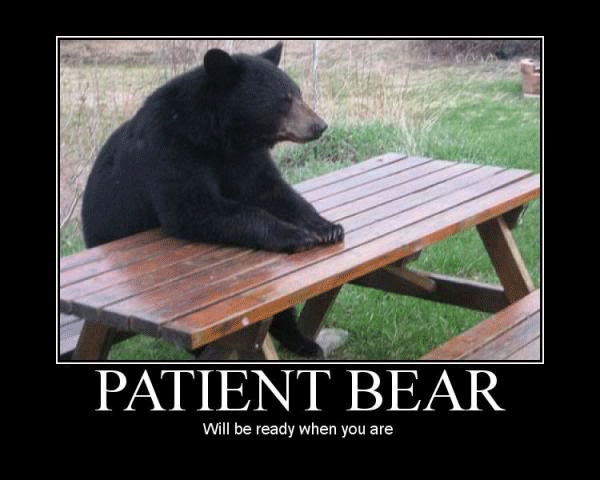

Choosing Patience

patient bearI got up very early this morning to attend a meeting that had been rescheduled from its regular monthly date. I was happy with myself for remembering the change in date, as I drove to the sunrise gathering of a group of fellow chaplains.

I felt great—until I learned after arriving that our rescheduled meeting had been rescheduled. There I was, all alone . . . and primed for a bit of unseemly disappointment with having risen more than two hours earlier my normal routine, for an aborted purpose.

Because that sort of reaction is not foreign to my nature, I was pleasantly surprised when I didn’t feel that way. Oh, for the briefest of moments (literally, less than a half a minute) I experienced what some might consider a mild case of “upset,” but it immediately gave way to my thoughts of how I could most constructively use the “extra hours” I had received.

The most amazing part of all is that I did not even have to consciously think, how can I put the best construction on this? It just happened.

Now, I’m uncertain whether this positive response was due to my increasing age, or to my growing sanctification. I suspect it’s a combination of the two. It’s such a calm and healthy way to respond to unwelcome events that I wish everyone was able to enjoy it as their norm. Thank you, Lord, for gracing me with this gift for the fall and winter decades of my life.

Being able to see the good in a seeming disappointment, is akin to possessing the virtue of patience. I once made the mistake of praying for “patience.” It was during my college days, and learning to be more patient proved quite painful; it was primarily taught to me by being deluged with a near-infinite number of things which demanded my patience. Quite painful.

In a letter C.S. Lewis wrote to Don Giovanni Calabria in 1948, he says, “We ought to give thanks for all fortune: if it is ‘good,’ because it is good, if ‘bad’ because it works in us patience, humility and the contempt of this world and the hope of our eternal country.”

This is precisely the attitude I wish to experience in my own life.

And, sometimes its fruit is easy to recognize. For example, the cancellation of today’s meeting gifted me with the time required to compose this post itself. And, for that, I am genuinely grateful.

Jews Following Jesus

interfaithJewish poetry is breathtaking. The Psalms have nourished people of faith, as well as secularists, for millennia. C.S. Lewis wrote this about the providence of God in using the Jewish people as his conduit for blessing the world.

My enjoyment of the Psalms has been greatly increased lately. The point has been made before, but let me make it again: what an admirable thing it is in the divine economy that the sacred literature of the world should have been entrusted to a people whose poetry, depending largely on parallelism, should remain poetry in any language you translate it into.

He alluded to this in a letter to Sister Penelope, an Anglican nun and writer. In 1941 she sent him a copy of her new book, Windows on Jerusalem: A Study in the Mystery of Redemption. Lewis responded with gratitude. (Contemporary authors will find the detail of Lewis’ informal critique of her book illustrative of what he brought to the meetings of the Inklings.)

Thank you very much for the book. It has given me real help. What I particularly enjoy in all your work, specially this, is the avoidance of that curious drabness which characterises so many ‘little books on religion.’ Partly it is due to your Hebraic background which I envy you: partly, no doubt, to deeper causes.

Things that particularly pleased me were the true meanings of Beloved (p. 8) and Son (p. 9), the whole account of the Transfiguration (pp. 16 et seq), the passage on Sacrifice (p. 32), the passage ‘This was a shock’ (on p. 35), on our inability to understand sin (41 and 47), the very important bit about Hebrew & Roman ideas of ransom (52, 53): the really splendid account of how God can’t help deceiving the devil (56) and the allegorical close. There are, in fact, a good many Gifford Lectures and other such weighty tomes out of which I’ve got less meat (and indeed less efficient cookery!).

Judaism & Christianity

Jews and Christians have a complex relationship. This is even more true for Jewish people who come to accept Jesus as the promised Messiah. For most Jews, this automatically results in their expulsion from the Jewish community. However, for a growing number, there is a more gracious attitude developing.

A recent survey conducted by the Pew Research Center revealed some interesting statistics. Note the percentage of United States Jews considering the following to be essential:

Remembering the Holocaust – 73%

Leading an Ethical & Moral Life – 69%

Caring about Israel – 43%

Having a Good Sense of Humor – 42%

Observing Jewish Law – 19%

Here is the most surprising part of the survey. Thirty-four percent of American Jews consider believing Jesus is the Messiah, is compatible with being Jewish.

Let me repeat that . . . 34% of Jews in the United States (35% of the ultra-Orthodox Jews) believe that “Messianic Jews” remain Jewish.

I find that amazing. I also find it encouraging, since it’s consistent with the understanding of the Jews in first century Judea who worshipped beside the followers of Jesus in Jerusalem until its fall.

Some years ago I heard a lecture by a prominent Jewish theologian who described how historical Judaism rarely rejected those who considered any particular rabbi to be the Messiah. Apparently this remains true today, as some modern Jews, for example, consider  Menachem Mendel Schneerson (1902-1994) to be the Messiah.

Returning to the case of Jesus of Nazareth, the improving attitude is encouraging to see. In part, because most Messianic Jews say accepting Jesus as the Messiah has made them more Jewish. By that, most mean that they now practice the traditions of their Jewish heritage more faithfully than they previously did.

Following his conversion, C.S. Lewis grew in his positive consideration of the Jewish faith and people. In 1933, as Hitler’s hatred for Judaism became more evident, he wrote in a letter:

I might agree that the Allies are partly to blame, but nothing can fully excuse the iniquity of Hitler’s persecution of the Jews, or the absurdity of his theoretical position. Did you see that he said “The Jews have made no contribution to human culture and in crushing them I am doing the will of the Lord.”

Now as the whole idea of the “Will of the Lord” is precisely what the world owes to the Jews, the blaspheming tyrant has just fixed his absurdity for all to see in a single sentence, and shown that he is as contemptible for his stupidity as he is detestable for his cruelty. For the German people as a whole we ought to have charity: but for dictators, “Nordic” tyrants and so on . . .

All of the civilized people of the world share Lewis’ revulsion with Hitler and his agenda. In that we definitely agree with the vast majority of Jews who regard “Remembering the Holocaust” as something essential.

Postscript:

As positive a sign as the 34% support of Messianic Jews remaining Jewish is, the survey includes a more sobering corollary. Exactly twice that number, 68%, agreed that you can remain Jewish even if you don’t believe in the existence of God. Shocking. But that’s a subject for another day.

A New Motorcycle Memory

sidecarI witnessed the ending of a life last night. It wasn’t stolen by disease. Nor did it gently surrender to the passage of many decades.

A healthy man, in the prime of his life, died tragically in a traffic accident. The vehicles involved did not appear to have been traveling particularly fast . . . but one was a truck, and the other a motorcycle.

I have many friends who absolutely love their bikes. That includes the fine deputy who I was riding with last night as we responded to the crash. My friends are all smart enough to wear helmets, just as the victim in this case was doing.

I have never personally longed to experience the freedom of riding a motorcycle on the open road. That doesn’t mean I think less of those who do. On the contrary, many of the people whose company I most enjoy consider riding bikes a blast.

I only hope that my grandchildren don’t.

I have no desire to rob my grandkids of any of the joy that life can offer—I’m just cautious and protective by nature.

Several of my friends have been in serous motorcycle accidents. Fortunately, all survived. And they have one more thing in common—none of the incidents was their fault.

As I looked at the bike, crushed beneath the front of the truck, I said a prayer for the rider whose family will never see him again. And as I gazed toward the driver of the truck, I prayed for him too, knowing that his own life would never be the same.

Like money, which is not the root of all evil (the love of money is) . . . so too, it is not motorcycles themselves that are intrinsically dangerous. They just happen to leave their riders so terribly vulnerable when the drivers of more massive vehicles fail to see them.

C.S. Lewis rode in motorcycles. I say “in,” because he was accustomed to riding in the sidecar of his brother Warnie’s cycle. The familiar account of his final conversion from theism to Christianity involves one such ride, to the Whipsnade Zoo. As Lewis wrote, “When we set out I did not believe that Jesus is the Son of God, and when we reached the zoo I did.”

The following diary entries from April 1924 relate to enjoying rides while on holiday. The shorthand “W” stands for his brother, Warnie. The “D” for Mrs. Jane King Moore, the mother of a close friend who died in WWI. The passage illustrates how at home Lewis was when traversing the countryside with his brother.

In the afternoon W generally read: I often went out to get something, or else read and wrote. After tea all three of us went for a most excellent ride in divine weather. We rode through Yatton and Wrington into the Mendips, passing within sight of D’s well beloved Winscombe—a steeple on a hillside seen for a moment in the heart of a beautiful long ridged wooded crooked country. After that we ran through a small gorge out on to the barer southern slope of the Mendips and down into the narrow little streets and beetling houses of Axbridge—glory! what a town and how placed!

Thence on to Cheddar by a road that skirts the hills. Here I saw many fields and trees quite white with blossom and daisies. At Cheddar we caught sight of the gorge up to our left quite unexpectedly: and then while I was still in a confused impression—the speed of a motor cycle is sometimes a great aesthetic advantage—W suddenly turned and ran up it. I lay back in the side car and watched the huge coloured cliffs pushing up further round us and closer till it seemed like going into a tunnel. I was quite unprepared for anything of the sort. It was a great moment.

We turned on our tracks and went on to Wells. Just before reaching it we turned off left at a signpost “To Wookey Hole” to find some quiet pub where we cd. eat our lunch. The lane wound on so long that we began to fear that Wookey Hole was a natural feature, a devil’s punch bowl or the like, and not a village. A village however it turned out to be, with a pub where we sat on a curiously comfortless bench and ate our sandwiches and drank cider.

We then went back and into Wells where W was charged 6d. for leaving the bike in Wells Square by the town authorities, who however “took no responsibility of any sort” for it. W was delighted with the outside of the Cathedral but less pleased with the interior. I think I agreed with him. I also agreed with his view that King’s Chapel, Cambridge, is the perfect building. We then strolled all round the Palace talking of all things that arose therefrom—Barchester, abbots, mediaeval siege tactics. Our ease and freedom and pleasant chat made this visit to Wells far better than my first when I came here on the motor tour with my father and the Hamiltons. In many ways W is the ideal person to go for a jaunt with . . .

On Saturday 26th we all came back to Oxford. It had been arranged that I shd. travel in the sidecar. It was obvious that one of us shd. do so to save fares and D, of course, refused to be that one. I therefore trained with her to Yatton and saw her into a through train to Bristol with the luggage, and W, Pat and I got aboard the bike. As we were making all snug outside Yatton station, a hamper, wh. had just been taken out of the train, was suddenly opened just beside us to release a cloud of pigeons that filled the air with an amazing noise before we knew what was forward. It was a curious experience for I had not suspected the hamper of containing anything live.

It was raining when we started but soon cleared up. We got into the main road shortly before Wrington and entered Bristol by Bedminster… From Faringdon we came along at a very good speed thro’ Bickland, Kingston Bagpuize, Fyfield, Bessels, Leigh, Cumnor and Botley to Oxford. It is a tame, well combed, cheerful country of tidy well growing woods, white gates, dark tarred roads, comfortable cottages, sometimes exceedingly beautiful, green hedges and flat blue distances. The speed, the sunlight, and the sense of coming home put me into an unusually prolonged fit of “joy.”

As Lewis says, “the speed [and] the sunlight” of a motorcycle trip can surely be exhilarating. Likewise, “the speed of a motor cycle is sometimes a great aesthetic advantage.” Clearly, C.S. Lewis enjoyed motorcycles greatly.

But I still hope my grandchildren are not seduced by motorcycles’ allures.

Poet-olatry: Poetry Misperceived

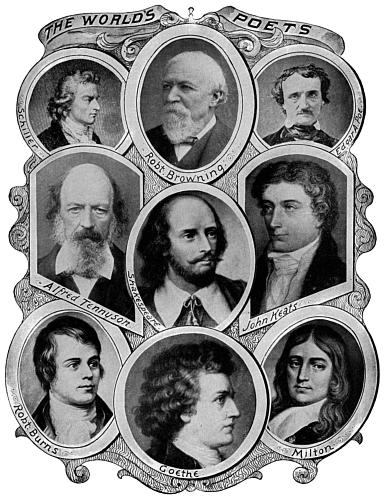
poetsWhen does our appreciation of a particular writer border on literary idolatry? Well, not idolatry proper, since even shrines like Poet’s Corner at Westminster Abbey don’t endorse “worship.”

We naturally appreciate the memory of those whose work has contributed to our lives. And that’s fine. But when we begin to focus more on them, than on the real, breathing people around us, our priorities are skewed.

In 1989, Hollywood released a film entitled “Dead Poet’s Society.” It was nominated for an Oscar for Best Picture, and ironically won the Oscar for Best Writing. In the movie, an English teacher awakens his moribund students to literature, and the more reflective aspects of life.

At last week’s writers meeting, we were introducing ourselves to a visitor, and as part of that process, mentioned the type of writing each of us pursues. I listed several genres and concluded with the words “but I’m not a poet.”

A member of the group immediately “corrected” me, since I have, in fact, written several poems during the past couple of years. Well, I guess I should get used to saying something like, “I don’t consider myself a poet.”

Poetry, some poets insinuate, carries a more artistic air than other, pedestrian genres. Fiction, of course, has its own advocates, and they too occasionally look down on folks like me who typically muddle around in the nonfiction worlds history and religion.*

In the following paragraphs, C.S. Lewis offers some provocative thoughts about how we should rightly feel toward departed writers. His argument is really about how we must not neglect our duty to living humanity by focusing on those who are “gone.”

A special treat in the selection is his coining of the word which inspires the title of this post.

There is a reaction at present going on against the excessive love of pet animals. We have been taught to despise the rich, barren woman who loves her lap dog too much and her neighbor too little.

It may be that when once the true impulse is inhibited, a dead poet is a nobler substitute than a live Peke, but this is by no means obvious. You can do something for the Peke, and it can make some response to you. It is at least sentient; but most poetolaters hold that a dead man has no consciousness, and few indeed suppose that he has any which we are likely to modify.

Unless you hold beliefs which enable you to obey the colophons of the old books by praying for the authors’ souls, there is nothing that you can do for a dead poet: and certainly he will do nothing for you.

He did all he could for you while he lived: nothing more will ever come. I do not say that a personal emotion towards the author will not sometimes arise spontaneously while we read; but if it does we should let it pass swiftly over the mind like a ripple that leaves no trace.

If we retain it we are cosseting with substitutes an emotion whose true object is our neighbour. Hence it is not surprising that those who most amuse themselves with personality after this ghostly fashion often show little respect for it in their parents, their servants, or their wives. (The Personal Heresy).**

Lewis alleges our emotional “bonds” with departed writers are fruitless, imaginary, and perhaps even detrimental. I agree that when they displace our connections with living people, it is tragic.

While I rarely disagree with the Magister Lewis, I will in this case. I would make an exception to his argument—in a single sense. For Christians, our filial affection for a departed Christian writer, is a unique case. The distinction being the fact, that in light of the resurrection, and the gift of eternal life, we are not talking about others who are permanently severed from a genuine relationship with us.

On the contrary, there are many other disciples of Jesus living today who feel a powerful connection to writers like Lewis himself. And, with all eternity ahead, there should be ample time for each of us to enjoy his company, and thank him for the blessing he bequeathed to us through his work.

Postscript:

I recognize that it may be in questionable taste, but the subject of departed artists reminds me of a humorous song from Monty Python’s Flying Circus. It’s called “Decomposing Composers,” and the modestly disconcerting lyrics are rendered in a somber, classical manner. If interested, you can listen to it here.

_____

* I intentionally refer to “religion” as nonfiction, since I regard it to be just that. (And also because I know that pushes some people’s buttons.)

** Last year I approached this same passage by Lewis from a different perspective. If you would like to read some thoughts related to pet fads, check them out here.

Exhibitionist Civilization

realitytvWe live in an exhibitionist era. It’s evident everywhere, but reaches a revolting crescendo in some of the extreme “reality tv” that’s become a standard feature of what passes for “entertainment” in a decadent society.

Not all reality programming is inherently vulgar. Some is potentially beneficial. For example:

Cops

Provides reinforcement for staying on the straight and narrow.

Deadliest Catch

Teaches us that whatever we’re doing, there are some jobs we could have that are even worse.

American Idol

I don’t watch it, but my impression is it basically revolves around decent entertainment and at least one prima donna judge.

The Apprentice

Teaches us the worst boss we ever had may not have been quite as bad as we recall.

So You Think You Can Dance

I don’t watch this either, but understand it’s pretty innocuous, aside from occasional humiliation.

Survivorman

Learn how to survive in the wilderness, from a guy with a fantastic surname: Les Stroud.

Among the many programs I would never watch, even if you paid me: Jersey Shore, Here Comes Honey Boo Boo, Keeping Up with the Kardashians.

A show I’m curious about—but not interested enough to waste any time investigating—is Pastors of LA. Apparently, one of the featured ministers, who committed adultery and fathered a child while still married, proclaimed: “I have not preached on any platform in any church for one year! I’ve paid my penalty for my sin!” Not quite sure where he found that equation in the scriptures, but perhaps pastors of Los Angeles megachurches determine their own penances.

I can’t understand the allure of exhibitionism. Stripping down to one’s most embarrassing and offensive qualities, and parading those before an anonymous audience, is nowhere on my bucket list.

Even stranger to me than the willingness of a minority to invite public mockery and derision is the desire of relatively significant audiences to view some of these misbegotten concepts.

C.S. Lewis helps me understand the problem. In an article entitled “After Priggery—What?” he says:

We have lost the invaluable faculty of being shocked—a faculty which has hitherto almost distinguished the Man or Woman from the beast or the child.

Lewis begins the essay by condemning “priggery,” the judging of what is bad that infers the “prig” is morally superior. He also raises the question of whether or not our failure to condemn publically demeaning or destructive behaviors results in more damage to society than does the act of making moral judgments.

The illustration he uses is that of a “wicked journalist, a man who disseminates for money falsehoods calculated to produce envy, hatred, suspicion and confusion.” (There seems no shortage of such people in our world.)

Lewis says that our toleration of these malevolent influences is a terrible mistake. The following passage criticizes the fact that we actually enable such conduct by supporting it.

If we must find out what bad men are Writing, and must therefore buy their papers, and therefore enable their papers to exist, who does not see that this supposed necessity of observing the evil is just what maintains the evil? It may in general be dangerous to ignore an evil; but not if the evil is one that perishes by being ignored.*

I find Lewis’ argument applicable to the existence of all sorts of reprehensible material, beginning perhaps, with pornography. To a lesser degree, one might even consider it to apply to exhibitionist entertainment. After all, it is not profitable to viewers and it is rarely (if ever) beneficial to the participants themselves.

And thus, culture declines. Dribble by dribble. I just heard on a newscast today, literally while I was writing this post, that a major cable channel is offering a new reality program entitled “Naked Dating.” Guess what it is about. Precisely what it says. I’m sure that the voyeurs are eagerly awaiting its debut.

In a more enlightened age, society would have ostracized those who flaunted their promiscuous, antisocial, humiliating or debauched lifestyles. Today the people who receive public disapproval seem to be those who question those very behaviors.

As for me, I’m renewing my commitment to the principle suggested by C.S. Lewis. I will do my best to consistently avoid supporting the things contributing to the erosion of modesty, respect, goodness and virtue. I suspect that means I won’t be spending an undue amount of time watching these “reality” programs that too often reflect the seamier aspects of human nature.

____

* If you would like to read the entire essay, it is available here.

Vampire Poetry

vpoetryI was afraid to read it. I had just listened to the poem during an online newscast, and it included it so many jarring and disturbing images that I thought I must have misheard it.

Then again, it was written by a successful Hollywood star, so it certainly must be worthy of publication.

So, motivated by two impulses, I sought out the text. My first reason was that I did not wish to misjudge the writer, based on my shallow initial impression. The second was that I really did want to discover if it was as odd as I perceived it to be.

It is from the heart and pen of Kristen Stewart, who played the leading role in the Twilight series. It is described as a “love poem,” which is helpful to know in advance . . . since that might not be how one might inadvisably approach it.

I reared digital moonlight

You read its clock, scrawled neon across that black

Kismetly . . . ubiquitously crest fallen

Thrown down to strafe your foothills

. . . I’ll suck the bones pretty.

Your nature perforated the abrasive organ pumps

Spray painted everything known to man,

Stream rushed through and all out into

Something Whilst the crackling stare down sun snuck

Through our windows boarded up

He hit your flint face and it sparked.

And I bellowed and you parked

We reached Marfa.

One honest day up on this freedom pole

Devils not done digging

He’s speaking in tongues all along the pan handle

And this pining erosion is getting dust in

My eyes

And I’m drunk on your morsels

And so I look down the line

Your every twitch hand drum salute

Salutes mine . . .

Overwhelming. I was actually tempted to use the word “pretentious,” until I read the following note about the magazine interview during which she shared the verse.

Before reading the poem, Kristen told the mag, “I don’t want to sound so f—ing utterly pretentious…but after I write something, I go, ‘Holy f—, that’s crazy.’ It’s the same thing with acting: If I do a good scene, I’m always like, ‘Whoa, that’s really dope.’”

After seeing that comment, with its sadly limited vocabulary, I can picture her composing her poetry dictionary and thesaurus in hand.

The poem’s significance takes a moment to sink into one’s mind . . . even if our brains are not clouded by being drunk on someone’s morsels. The poem is, in fact, so rich in meaning that it required two distinct titles: “Freedom Pole” and “My Heart is a Wiffle Ball.”

I dabble in poetry, but don’t consider myself a poet. So, I’m probably not the one to judge.

I would be curious to know what the newest addition to the Poet’s Corner at Westminster Abbey would think of Stewart’s work. C.S. Lewis wrote poetry himself, of course, although he is much better known for his other literary contributions.

In English Literature in the Sixteenth Century, Lewis describes the poetry of Samuel Daniel. “Though Daniel’s poetry is often uninspired, sometimes obscure, and not seldom simply bad, he has two strong claims on our respect.” I wonder if Lewis’ gracious nature might lead him to discern two strengths in Stewart’s poetic corpus.

In contrast to the previous evaluation, Lewis considered the poetry of Dante Alighieri to be masterful. In Studies in Medieval and Renaissance Literature, Lewis writes:

I think Dante’s poetry, on the whole, the greatest of all the poetry I have read: yet when it is at its highest pitch of excellence, I hardly feel that Dante has very much to do. . . . I draw the conclusion that the highest reach of the whole poetic art turns out to be a kind of abdication, and is attained when the whole image of the world the poet sees has entered so deeply into his mind that henceforth he has only to get himself out of the way, to let the seas roll and the mountains shake their leaves or the light shine and the spheres revolve, and all this will be poetry, not things you write poetry about.

Dare I confess that after Dante even Shakespeare seems to me a little factitious? It almost sounds as if he were “just making it up.” But one cannot feel that about Dante even when one has stopped reading him.

That’s the sort of verse that poets should always strive for—“the highest reach of the whole poetic art [which] turns out to be a kind of abdication.” Word dabblers such as myself are unlikely to ever attain such a lofty goal.

It may be that Stewart has kismetly attained these heights. But then again, perhaps she still has a little farther to travel before she reaches Marfa.

The Lion’s Command

crowned lionI recently had a few free moments while waiting for a flight, and I decided to revisit that enjoyable childhood treasure, Aesop’s Fables. It had been many years since I explored them, and I found the following tale particularly entertaining.

Aesop may have been a fable himself. Aristotle refers to him as an historical figure, but since Aesop supposedly lived three centuries before the philosopher’s day, he had already transformed into a legend.

Plutarch describes Aesop’s death as occurring when he was thrown from a cliff during a failed diplomatic mission. Presumably after insulting the city of Delphi, they accused him of stealing some temple items. (Perhaps he tried to be too witty for his own good.)

Whether he was an actual person or not, the anecdotes that have accreted around his name have entertained countless generations. On now to the story that captured my imagination.

The Kingdom of the Lion

The beasts of the field and forest had a Lion as their king. He was neither wrathful, cruel, nor tyrannical, but just and gentle as a king could be. During his reign he made a royal proclamation for a general assembly of all the birds and beasts, and drew up conditions for a universal league, in which the Wolf and the Lamb, the Panther and the Kid, the Tiger and the Stag, the Dog and the Hare, should live together in perfect peace and amity.

The Hare said, “Oh, how I have longed to see this day, in which the weak shall take their place with impunity by the side of the strong.” And after the Hare said this, he ran for his life.

The Moral: Saying something does not make it so. (Aesop’s Fables).

Although Aesop’s Lion bears a resemblance to C.S. Lewis’ own vision, he is no Aslan. Both are the kings of their respective domains. Both dictate that there be peace among their subjects.

Aslan alone, though, can make this pacific vision reality. And, because sin had entered Narnia, he had to do it by creating a new Narnia. The amazing story of the conclusion of the temporary and inauguration of the eternal is told in The Last Battle. The original plan, recorded in The Magician’s Nephew, was that the creatures live in divine harmony.

The chosen beasts who remained were now utterly silent, all with their eyes fixed intently upon the Lion. The cat-like ones gave an occasional twitch of the tail but otherwise all were still. For the first time that day there was complete silence . . .

The Lion, whose eyes never blinked, stared at the animals as hard as if he was going to burn them up with his mere stare. And gradually a change came over them. The smaller ones— the rabbits, moles, and such-like— grew a good deal larger. The very big ones— you noticed it most with the elephants— grew a little smaller. Many animals sat up on their hind legs. Most put their heads on one side as if they were trying very hard to understand.

The Lion opened his mouth, but no sound came from it; he was breathing out, a long, warm breath; it seemed to sway all the beasts as the wind sways a line of trees. Far overhead from beyond the veil of blue sky which hid them the stars sang again; a pure, cold, difficult music. Then there came a swift flash like fire (but it burnt nobody) either from the sky or from the Lion itself, and every drop of blood tingled in the children’s bodies, and the deepest, wildest voice they had ever heard was saying:

“Narnia, Narnia, Narnia, awake. Love. Think. Speak. Be walking trees. Be talking beasts.”

Such love and harmony would not last. Just as in our own world, selfishness and idolatry came to reign. Lewis recognized sin’s corruption cannot be bandaged. It needs to be excised. A broken vessel can be repaired, but it can never regain the purity of its origin without miraculous intervention.

That’s why Christians—who believe in the “resurrection of the (physical) body”—know that these restored bodies will be new.

There are heavenly bodies and earthly bodies, but the glory of the heavenly is of one kind, and the glory of the earthly is of another. There is one glory of the sun, and another glory of the moon, and another glory of the stars; for star differs from star in glory.

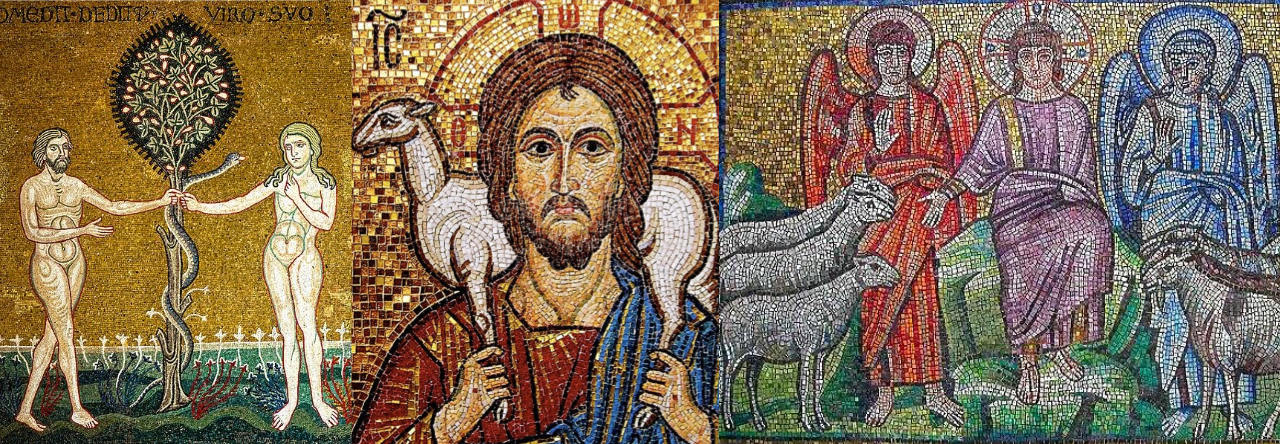
So is it with the resurrection of the dead. What is sown is perishable; what is raised is imperishable. It is sown in dishonor; it is raised in glory. It is sown in weakness; it is raised in power. It is sown a natural body; it is raised a spiritual body. . . . The first man [Adam] was from the earth, a man of dust; the second man [Christ] is from heaven.

As was the man of dust, so also are those who are of the dust, and as is the man of heaven, so also are those who are of heaven. Just as we have borne the image of the man of dust, we shall also bear the image of the man of heaven. (First Corinthians 15:40f).

Just as Aesop’s lion commanded, and Lewis’ Aslan ordained, the Messianic age will one day arrive. And when it does, “The wolf and the lamb shall graze together; the lion shall eat straw like the ox, and dust shall be the serpent’s food” (Isaiah 65:25).

The Moral: When God says something, that does make it so.

Trusting Serpents

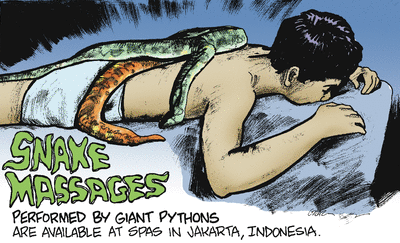
snake massageI try very hard not to be overly critical of foreign practices that initially strike me as rather odd. Instead, I attempt to understand what these activities mean in the culture where they are practiced.

Yet, for the life of me (as my mother would say), I can’t fathom why Indonesians want to have snakes give them “massages.” And, even though only a fraction of their people submit to this peculiar activity, there are apparently enough candidates for spas to offer the serpentine service.

I imagine that the snakes do indeed rub, flex and squeeze their clients, since pythons are “constrictors,” and it’s in their nature to want to circle—suffocate—crush—and devour their prey.

Ironically, this fact, compliments of Ripley’s Believe It or Not, follows in the wake of a recent news report about another man who thought he would be fine getting a shoulder massage from an apparently “undomesticated” python.

BALI, Indonesia (AP) — A python strangled a security guard near a luxury hotel on Indonesia’s resort island of Bali on Friday, and then escaped into nearby bushes following the deadly attack, police and a hotel employee who witnessed the incident said. The incident happened around 3 a.m. as the 15-foot-long python was slithering across a road near the Bali Hyatt hotel . . .

The victim, Ambar Arianto Mulyo, was a 59-year-old security guard at a nearby restaurant. He had offered to help capture the snake, which had apparently been spotted several times before near the hotel . . . Mulyo managed to secure the snake’s head and tail and put it on his shoulders, but the python wrapped itself around his body and strangled him . . .

People watching the incident were unable or unwilling to help and called the police, who came but failed to save the man. The python escaped into nearby bushes, and police were still searching for it.

The Associated Press story ends with the lame attempt to calm those who are inclined to suffer from ophidiophobia. “Deadly attacks on adult humans by pythons are rare, but have been documented before.”

Pardon me, but that’s not quite sufficient reassurance for even those of us without a snake phobia. I remember hearing from my wife about my young daughter’s class being introduced to a sizeable serpent some years ago during a fieldtrip. As everyone watched the handler manipulating its head and frontal coils, it was surreptitiously beginning to caress my little girl with its tail!*

If the Indonesian practice of python-massage crosses the Pacific, you won’t find me visiting the spa for a back rub. I understand they probably only employ well-fed, six-foot-long “baby” pythons, but I still choose to pass.

C.S. Lewis has a wonderful comment about trust. He says the true test of how deeply we believe something is the magnitude of the risk we are willing to take related to our trust in it.

You never know how much you really believe anything until its truth or falsehood becomes a matter of life and death to you. It is easy to believe a rope to be strong and sound as long as you are merely using it to cord a box. But suppose that you had to hang by that rope over a precipice. Wouldn’t you then first discover how much you really trusted it? . . . Only a real risk tests the reality of a belief. (A Grief Observed).

I don’t care how many herpetologists or masseuses assure that pythons can safely massage my bared body . . . I’m learning from the example of that poor Balinese guard who fell for the python’s trick, thinking that he held the upper hand.

_____

* Yes, snakes actually do have tails. It’s only one of their slithering secrets.

Coffee or Tea for C.S. Lewis and Me

Screenshot 2014-02-03 22.27.31The older I grow, the more important coffee becomes. Spending the last past two weekends ensconced in the doctoral program of a Midwestern seminary near the polar vortex has merely reinforced that fact.

Coffee versus tea. It is the perennial international battle between caffeinated beverages. C.S. Lewis, famously, weighed in on the side of tea. (That’s no surprise, given the historic hold Camellia sinensis’ on British taste buds.)

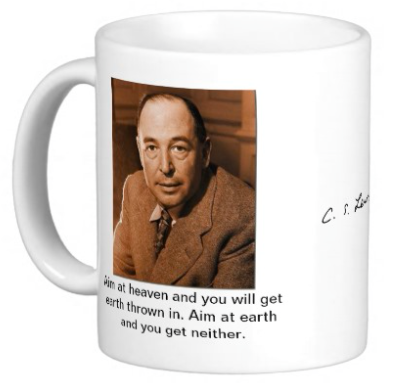
One of Lewis’ most frequently quoted aphorisms is, after all: “You can never get a cup of tea large enough or a book long enough to suit me.”

In Studies in Medieval and Renaissance Literature Lewis alludes to this cultural preference. In a passage discussing different ways of experiencing foreign customs, he describes the quintessential “bad tourist.”

One man carries his Englishry abroad with him and brings it home unchanged. Wherever he goes he consorts with the other English tourists. By a good hotel he means one that is like an English hotel. He complains of the bad tea where he might have had excellent coffee.

Despite their preference for tea, as the quotation above reveals that many Brits enjoy a good cup of coffee. Lewis himself loved a good cup at appropriate moments. In a 1939 letter to his brother Warnie, he mentions his need for a caffeine jolt prior to proctoring examinations.

My colleague Bone asked me to lunch with him at St John’s prior to an afternoon’s invigilation. I’ve known him quite good company: on this occasion, however, he spoke in almost a whisper and very seldom, and while other people were eating all round us (this was in John’s) nothing arrived for us till I was ‘nearly sick’ with hunger and embarrassment.

When at last we’d had some chicken another pause ensued, during which, almost in desperation for something to say, I asked him for the cheese, only to be told in sepulchral tones that there was a sweet coming. It came. Another pause.

Desperate for my coffee, I said presently that I supposed I’d better be getting along: my host, after pondering this for a minute or two, replied yes, he supposed I had. On our way out he stopped at the other end of the table and introduced me to a jolly old man as his father Sir Muirhead Bone. Now can it be that the mere paternal presence explains the whole business? One can imagine such things! Anyway I went off to my 3 hours’ invigilating without any coffee.

While we’re considering the role of coffee in the life of the Oxford don, I thought it might be an interesting exercise to search the Chronicles of Narnia to see if the drink is mentioned there. I uncovered several, the last of which is particularly delightful.

From The Horse and His Boy.

By the time Shasta had finished his porridge, the Dwarf’s two brothers (whose names were Rogin and Bricklethumb) were putting the dish of bacon and eggs and mushrooms, and the coffee pot and the hot milk, and the toast, on the table. It was all new and wonderful to Shasta for Calormene food is quite different. He didn’t even know what the slices of brown stuff were, for he had never seen toast before. He didn’t know what the yellow soft thing they smeared on the toast was, because in Calormen you nearly always get oil instead of butter.

And the house itself was quite different from the dark, frowsty, fish-smelling hut of Arsheesh and from the pillared and carpeted halls in the palaces of Tashbaan. The roof was very low, and everything was made of wood, and there was a cuckoo-clock and a red-and -white checked tablecloth and a bowl of wild flowers and little curtains on the thick-paned windows. It was also rather troublesome having to use dwarf cups and plates and knives and forks.

This meant that helpings were very small, but then there were a great many helpings, so that Shasta’s plate or cup was being filled every moment, and every moment the Dwarfs themselves were saying, “Butter please ,” or “Another cup of coffee ,” or “I’d like a few more mushrooms,” or “What about frying another egg or so?” And when at last they had all eaten as much as they possibly could the three Dwarfs drew lots for who would do the washing-up, and Rogin was the unlucky one.

From Prince Caspian.

They breakfasted at last in another of the dark cellars of Aslan’s How. It was not such a breakfast as they would have chosen, for Caspian and Cornelius were thinking of venison pasties, and Peter and Edmund of buttered eggs and hot coffee, but what everyone got was a little bit of cold bear-meat (out of the boys’ pockets), a lump of hard cheese, an onion, and a mug of water. But, from the way they fell to, anyone would have supposed it was delicious.

From The Silver Chair.

Breakfast was scrambled eggs and toast and Eustace tackled it just as if he had not had a very large supper in the middle of the night. “I say, Son of Adam,” said the Faun, looking with a certain awe at Eustace’s mouthfuls. “There’s no need to hurry quite so dreadfully as that. I don’t think the Centaurs have quite finished their breakfasts yet.”

“Then they must have got up very late,” said Eustace. “I bet it’s after ten o’clock.”

“Oh no,” said Orruns. “They got up before it was light.”

“Then they must have waited the dickens of a time for breakfast,” said Eustace.

“No, they didn’t,” said Orruns. “They began eating the minute they awoke.”

“Golly!” said Eustace. “Do they eat a very big breakfast?”

“Why, Son of Adam, don’t you understand? A Centaur has a man-stomach and a horse-stomach . And of course both want breakfast. So first of all he has porridge and pavenders and kidneys and bacon and omelette and cold ham and toast and marmalade and coffee and beer.

“And after that he attends to the horse part of himself by grazing for an hour or so and finishing up with a hot mash, some oats, and a bag of sugar. That’s why it’s such a serious thing to ask a Centaur to stay for the weekend. A very serious thing indeed.”

I occasionally wonder what it would have been like to have shared a pint with Lewis at the Eagle and Child. Magnificent, to be sure.

But perhaps better still would have been to share a conversation in his study or home over a simple cup of coffee (or tea). After all, just as a good meal establishes the mood for jovial discussion, so too can a soothing warm “brew” whet one’s desire to share an intimate conversation.