Pharisaical Cats

catsCats or dogs? Which makes the best companion? This is one of the few topics guaranteed to arouse arguments as intense as political debates.

The fact is, the first three words already elicited a visceral reaction from most readers. “Cats or dogs” might as well read “cats versus dogs.”

Even though many of our homes welcome both species as residents, we all know they are drastically different. Many dogs eagerly solicit feline playful attention, while most cats choose to remain aloof from them, barely tolerating their canine presence.

The humans who share the habitation may genuinely loves both types of animals, but in the deep recesses of their hearts everyone possesses a (sometimes secret) preference for one or the other.

Of course, if we’re a “cat person” we wouldn’t want our dogs to know that; it would hurt their feelings. And, if we’re a “dog person” we wouldn’t want our cats to know, lest they treat us with even greater disdain than they already do.

C.S. Lewis was an animal lover. He had both dogs and cats during his lifetime. And he recognized well their differences. In a 1955 letter to an American correspondent, he wrote:

We were talking about Cats & Dogs the other day & decided that both have consciences but the dog, being an honest, humble person, always has a bad one, but the Cat is a Pharisee and always has a good one. When he sits and stares you out of countenance he is thanking God that he is not as these dogs, or these humans, or even as these other Cats!

I love Lewis’ comparison of their temperaments. I don’t think I’ve ever met a cat who was not at least a little bit self-righteous. As for canines . . . even disobedient rascals (like our yet-to-be-sufficiently-trained adolescent border collie) are quite aware of the fact that they are being “bad.” Some are even grow remorseful.

In a 1961 missive Lewis addresses the psychoanalysis of a cat. He is responding to a correspondent’s announcement that her veterinarian had diagnosed her cat with some behavioral problem.

I hope your vet is not a charlatan? Psychological diagnoses even about human patients seem to me pretty phoney. They must be even phonier when applied to animals.

You can’t put a cat on a couch and make it tell you its dreams or produce words by ‘free association’. Also—I have a great respect for cats—they are very shrewd people and would probably see through the analyst a good deal better than he’d see through them.

Lewis is quite likely correct in this observation. Our cats obviously see through all of their human “family.” They are not only astute, they act disinterested, but actively observe us all day long. (Well, at least during the ninety-four minutes when they are not napping each day.)

I have written about C.S. Lewis’ dogs in the past. I’ll close now with a passing reference Lewis made in a 1962 letter to a fellow cat-lover.

We [you and I] are also both ruled by cats. Joy’s Siamese—my ‘step-cat’ as I call her—is the most terribly conversational animal I ever knew. She talks all the time and wants doors and windows to be opened for her 1000 times an hour.

So it goes with our pharisaical felines. With majestic posture, they patiently wait for us to fulfill their commands.



Pet Names

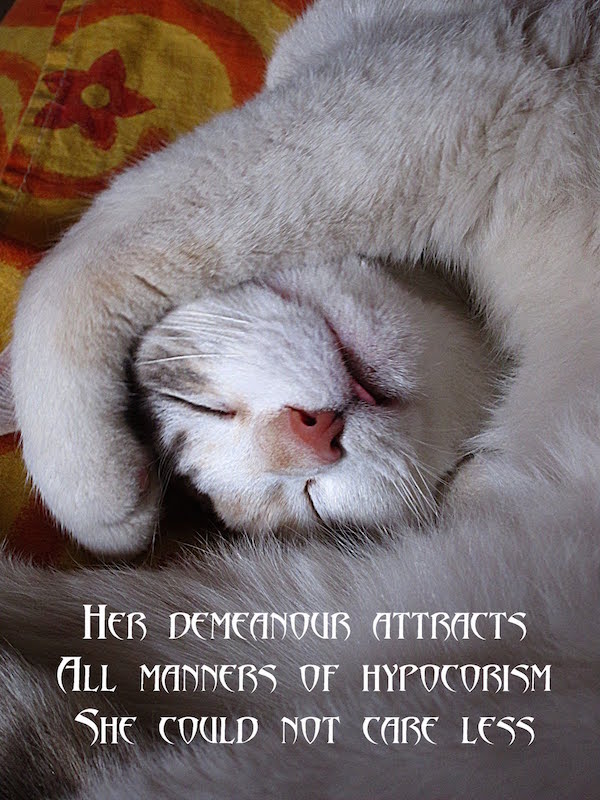
hypocorismHow many hypocorisms do you have? Which of them are your favorites? Are there any you would sooner never hear again?

I subscribe to one of those “word of the day” emails sent by services such as dictionary.com or thefreedictionary.com.

The truth is, more often than not I’m already familiar with the word they choose to define each day. However, when something hits me out of the proverbial blue—I am amazed and pause to ponder its meaning, history, and reasons why I may never have crossed its path before. (I imagine this behavior is widely replicated among word lovers.)

“Hypocorism” is one of those surprises. It had no place in my lexicon, although the concept of “pet names that are bestowed with affection” is something my family and I have always practiced.

I grew up being called Robbie, and as a young adolescent told my family I preferred to go by Rob. Rob is probably verbal shorthand for Robert, but Robbie is definitely hypocoristic. It is amusing to me that my beloved grandmother never ceased to call me Robbie—even though every precious letter I received from her while serving in the military far from home began, “Dear Robert.”

We’ve already noted the key aspect of a hypocorism. It is a name expressing endearment, not disrespect. That doesn’t mean, of course, that it is not embarrassing. Many people bestow pet names on their loved ones that are best shared only with family.

Some pet names are simply silly. Two of my granddaughters often call me “Bumpa.” That is not a reference to any lumpiness on my part, but to the way the eldest of them began pronouncing “Grandpa” when she was oh so tiny. It was cute, special, and passed on to her younger sister, at first through aural osmosis . . . and later through conscious affection.

C.S. Lewis’ family members were enthusiastic practitioners of hypocorism.

One of the things that new students of Lewis often find confusing is his own name. The fact that he was known to family and friends as “Jack” begs the question of the source of that name. The story, though oft told, remains quite entertaining.

The initial version of Lewis’ adopted name was Jacksie. Lewis loved dogs, and his stepson Douglas Gresham writes that Jacksie was one of these childhood animals.

When he was a small boy, he didn’t like the name [Clive] and soon changed it to “Jacksie” by simply refusing to answer to anything else. It was actually because of a small dog that he was fond of that he picked the name Jacksie, which was what the dog was called. It was run over (probably by a horse and cart as there were almost no cars at the time and place where he was a child), and Jack, as he later became known, just took the name for himself. (Jack’s Life)

I have shared in the past how Lewis’ brother Warnie [Warren] related the event.

Then, in the course of one holiday, my brother made the momentous decision to change his name. Disliking “Clive”, and feeling his various baby-names to be beneath his dignity, he marched up to my mother, put a forefinger on his chest, and announced “He is Jacksie.”

He stuck to this next day and thereafter, refusing to answer to any other name: Jacksie it had to be, a name contracted to Jacks and then to Jack. So to his family and his intimate friends, he was Jack for life: and Jack he will be for the rest of this book.

Lewis’ life was filled with other hypocorisms. One of the most curious was the nick name “Minto,” given to Janie Moore. Mrs. Moore and her daughter were supported in his home by Lewis after her son Paddy had been killed in WWI. The two men had pledged that if only one survived, he would care for the other’s widowed parent. Lewis kept that promise.

As you reflect on the pet names that you share with those you love, you are in good company. An affectionate hypocorism is a truly precious gift.

Dogs are Better than Kids

dressed dogAt least that appears to be the thinking in Seattle. A recent census of the city’s population found that the preference isn’t even close.

While Seattle boasts 107,178 children it is home to about 153,000 dogs.

As a dog-loving Washingtonian, I’m not surprised by this statistic. But I don’t support the odd excesses of some pet owners. These include a woman who uses a baby stroller to keep her Chihuahua safe. “She also owns a basket full of dog clothes, including a few dog necklaces and wigs…”

Seattle Magazine notes the city is becoming a top destination for canine travelers.

Seattle’s dog-mecca status is starting to get noticed nationally; it’s considered one of the top 20 destinations in the United States for people who want to travel with their dogs, according to Melissa Halliburton, the founder of Bring Fido, a dog-focused travel agency out of South Carolina. “Seattle has 45 pet-friendly hotels, 38 [pet-friendly] attractions—including the dog-friendly Fremont Sunday Ice Cream Cruise…”

As delightful as an Ice Cream Cruise for dogs sounds, I’d prefer to invest in my children’s educations and take our Border Collies for a brisk walk. I’m sure they’d enjoy the frozen treat, but they will appreciate the exercise even more.

Why Dogs Instead of Kids?

Obviously, simultaneously enjoying human offspring and doggie kids is possible. They aren’t mutually exclusive. And most of the parents I know understand how having a dog in the family helps children grow up healthier (allergies aside).

The article asks this question and offers insightful thoughts.

Why are we so dog crazy? It could be that the 41 percent of us who are single appreciate the companionship. Maybe our outdoorsy pursuits are more fun with dogs. Or maybe dogs just make us feel good.

I heartily concur with the second and third points. And I find the first suggestion (highlighted in the original article) to be quite provocative.

God created us to desire companionship. “Then the Lord God said, ‘It is not good that the man [or woman] should be alone…”

This companionship need not be restricted to marriage. Some people have the gift of celibacy and can live chastely without marrying. C.S. Lewis would be a good example of this. He found his needs for deep friendships met by a handful of intimate friends. The profound joy he experienced when he married caught him totally off guard.

Unfortunately though, there are many who long to find their life companion and have yet to find that prayer answered. Then there are those tragic cases where illness, accident or war have stolen a spouse far too early. The Christian Church has always possessed an intense compassion for widows.

In either of these cases, the companionship of a dog provides a responsive outlet for our affection. Here too C.S. Lewis provides an example. I’ve written here in the past about his love of dogs.

However, it is not only the still-waiting and the bereaved who find themselves reluctantly single.

Another case that is far more common arises when people have made themselves vulnerable and opened their hearts to another… only to be betrayed.* This betrayal may have been physical, emotional, or psychological. Often it is all of these.

In these cases, replacing our unfaithful partner with a dog is especially apropos. There could be no more faithful and forgiving a friend than a dog. A dog who welcomes you every time you come through the door with passionate enthusiasm and happiness impossible to fake.

The truth is that as special as they are, dogs aren’t better than kids… even in Seattle. But, that said, life is sure a lot more fun with them in the mix.

_____

* Just as most of us know the pain of betrayal, many of us recognize we too may have been betrayers. There have been times—perhaps many—when we have disappointed or wounded those who trusted and loved us. However, it does not need to end here, with us mired in guilt.

If you find yourself in this situation, seek reconciliation or forgiveness from the person(s) you have wronged. Confess what you have done as the sin it is, and receive his promised forgiveness. And finally, as Jesus himself said, “Neither do I condemn you; go, and from now on sin no more.”

Crying for Attention

abcxyzAre you driven by the unquenchable thirst to be the center of everyone’s attention. Or, would you be more content to live out your life appreciated by a small cadre of friends?

A woman in South America recently displayed an extreme case of the former impulse. She had grown tired of her name because it was too mundane. Apparently she garnered insufficient attention as Ladyzunga Cyborg.

So now her name, legally changed, is ABCDEFGHIJKLMNOPQRSTUVWXYZ.

My first thought when reading this was not that I didn’t believe it. In our foolish world, where people use symbols that aren’t even words for their names, I just shook my head. And . . . I thought “how fortunate for her that she’s not Chinese,” with its 46,964 characters as recorded in the Kangxi Dictionary.

This is not the sort of publicity Columbia needs. She’s acting bizarrely enough to be a mistaken for a Californian.

Of course, people at the opposite extreme—those who cannot bear the presence of other human beings—are also troubled. As with so many aspects of the human personality, people at either of the extreme poles are frequently deemed mentally ill.

This fetish for exhibitionism is alien to me. I would much prefer downing a pint with friends at the Eagle and Child to standing on some stage in front of “adoring crowds.”

My “introvert” quotient appears to be eclipsing my “extravert” qualities.

C.S. Lewis never sought the limelight either. He did not find his experience with notoriety pleasant. And yet, he accepted its burden graciously.

It is commonly known that some days he would spends hours (literally) corresponding with some of the thousands of readers who wrote to him as the creator of Narnia.

It was exhausting.

I assume people like Ms. Abcdefghijklmnopqrstuvwxyz seek attention because they feel insignificant or unnoticed.

I find that tragic. Tragic because their name, their true name, is known by the most important and amazing person in the universe. The God who created them.

Each and every person, including you, is unique, precious and loved.

Knowing this provides profound peace. It also delivers us from the constant compulsion to seek attention.

Jesus described the profound value of each person by contrasting God’s love for us with the attention he devotes even to a single sparrow . . . “Not one of them will fall to the ground outside your Father’s care.”

And you, that’s you, are far more precious than these.

Imitating Animals

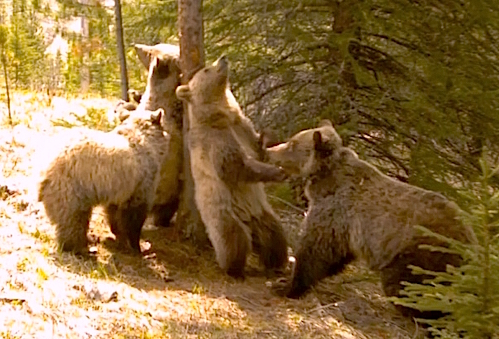
bearsHave you ever imitated a bear? Perhaps not intentionally. Still, if you are typical, you may do so routinely.

And it’s all because of your acnestis.

When I first saw the word, I thought it might be some recently coined term to address a semi-serious subject. But, the word is neither new, nor is the dilemma it describes exaggerated.

From the 1828 edition of Webster’s Dictionary.

ACNESTIS, n.

That part of the spine in quadrupeds which extends from the metaphrenon, between the shoulder blades, to the loins; which the animal cannot reach to scratch.*

While most human beings may not replicate bears’ behavior with trees, it is not uncommon to seek relief from a handy doorjamb.

Scratching that unreachable epicenter of that infernal itch has motivated the creation of a variety of tools. Yet none of these instruments can match the sheer relief offered by a sturdy doorway. I doubt I am alone, or excessively ursine, for believing that.

It could be worse, of course. At least people (most of them) don’t follow the example of dogs. We’ve all seen how they use the excuse of scratching their backs, to justify picking up unsavory scents while they wriggle around on the ground.

Descending to Subhuman Levels

Emulating animals has implications extending far beyond physical considerations. It is one thing to share a mutual appreciation for scratching one’s acnestis. Quite another to echo their baser natures.

In one of his letters, the Apostle Peter considers the fate of false prophets. After describing the damnation of fallen angels, he writes about those who teach deceitful doctrines. “But these, like irrational animals, creatures of instinct, born to be caught and destroyed, blaspheming about matters of which they are ignorant, will also be destroyed . . .” (2 Peter 2:12, ESV).

The following passage from the Psalms reveals how even the righteous are not immune to behaving like animals. “When my soul was embittered, when I was pricked in heart, I was brutish and ignorant; I was like a beast toward you [God]. Nevertheless, I am continually with you; you hold my right hand. . . . My flesh and my heart may fail, but God is the strength of my heart and my portion forever” (Psalm 73:21-23, 26, ESV).

God’s word is filled with allusions to bestial behaviors. One of the most literal is found in the example of the humiliation of the great King Nebuchadnezzar. You can read it here, from the fourth chapter of the Book of Daniel.

What Distinguishes Us from the Beasts?

C.S. Lewis describes how being a true human being differentiates us from animals. We share physical natures and numerous biological similarities. But we are far more. Lewis explores this in The Abolition of Man, which begins with the chapter “Men Without Chests.”

This image of lacking a “chest” actually refers to a classical reference for the part of a person where our character or virtue resides.

The excerpt below addresses how the enlightened or morally educated individual is capable of transcending the slavery of animals to their fleshly nature.

Without the aid of trained emotions the intellect is powerless against the animal organism. I had sooner play cards against a man who was quite sceptical about ethics, but bred to believe that ‘a gentleman does not cheat,’ than against an irreproachable moral philosopher who had been brought up among sharpers.

In battle it is not syllogisms that will keep the reluctant nerves and muscles to their post in the third hour of the bombardment. The crudest sentimentalism . . . about a flag or a country or a regiment will be of more use.

We were told it all long ago by Plato. As the king governs by his executive, so Reason in man must rule the mere appetites by means of the ‘spirited element.’

The head rules the belly through the chest—the seat, as Alanus tells us, of Magnanimity, of emotions organized by trained habit into stable sentiments.

The Chest-Magnanimity-Sentiment—these are the indispensable liaison officers between cerebral man and visceral man. It may even be said that it is by this middle element that man is man: for by his intellect he is mere spirit and by his appetite mere animal.

It is wise, I believe, for every man and woman to devote themselves to the health and of their own heart and purpose—that which makes us human.

In doing so, we will still share some of the basic behaviors of the animal world about us, such as being plagued by our acnestis . . . but the choices that direct the course of our lives will no longer be dictated solely by carnal instincts.

And such growth, my friends, will make us each day, a little bit more human.

_____

* I realize Noah Webster limited his definition to quadrupeds, but today it has been expanded to aptly apply to all of us who suffer from this curse.

Food that Bites

Guardians_of_the_Galaxy_Rocket_movie_posterMany peculiar delights are eaten in Los Angeles County, but diners might want to reconsider the fare offered at The Metro Supermarket. While it’s apparently not illegal to sell raccoons for consumption, it could become dangerous when the Guardians of the Galaxy learn of the practice.

In one of the year’s most successful blockbusters, Guardians of the Galaxy, we were introduced to Rocket Raccoon. Rocket is a genetically altered Procyon lotor designed to be a deadly fighting machine. Not only is he a brilliant tactician, the genetic manipulations have left him with one bad attitude.

Which makes it all the more important for the customers who purchase the ten-dollar-a-pound frozen raccoon carcasses to be cautious.

On a more serious note, the question of what we eat is not merely academic.

I’m not referring to modern insights into healthy diets. I’m talking about international, and potentially intergalactic, relations!

World travelers are often introduced to foods that seem, to put it gracefully, exotic. On such occasions, some respond enthusiastically—eager to sample alien delights. Others are somewhat more wary—reluctant to place in their mouths things they cannot quite identify.

Back in the 1980s I resided for a year in the Republic of Korea. I declined to eat gaegogi, not because I assumed dog meat would be unpalatable, but because I could not imagine contributing in any way to the slaughter of dogs for their flesh.

Another time that year, a sergeant who worked at our chapel purchased a paper cone full of toasted rice during an outing. When he was done with the rice (burned, he thought, rather than “toasted”), his Korean girlfriend clarified that he had just devoured a cup of rice beetles.

Military members stationed abroad are encouraged to be respectful of the cultures they encounter. And those cultures included different foods.

We need not travel to other nations to experience this diversity. I grew up in a family which considered processed “fish sticks” to be seafood. Combined with canned tuna fish and an occasional canned salmon “patty” it constituted the whole of my exposure to the abundance of the sea.

While I have since that time expanded my tastes to include many types of fresh fish, I must admit that crustaceans are not among my favorite foods. And, well, let’s not even talk about those creatures that have tentacles . . .

Not that I’m a culinary snob. In Texas I sampled rattlesnake. In South Carolina I ate alligator. (I preferred the rattlesnake, but I don’t reserve a regular spot for reptiles on my menu.)

To Eat, Or Not to Eat

Showing respect to others by dining as they do, is not a new concept. The early Christians were advised to eat without reluctance food that may have been sacrificed in a pagan temple, without questioning their hosts as to its source. “If one of the unbelievers invites you to dinner and you are disposed to go, eat whatever is set before you without raising any question on the ground of conscience” (1 Corinthians 10:25, ESV).

C.S. Lewis enjoyed a good meal. And he wrote many times about eating. Here are two of his insights on the subject.

For eating and reading are two pleasures that combine admirably. Of course not all books are suitable for mealtime reading. It would be a kind of blasphemy to read poetry at table. What one wants is a gossipy, formless book which can be opened anywhere. (Surprised by Joy).

Contrasting humility and pride, he wrote:

A man who is eating or lying with his wife or preparing to go to sleep in humility, thankfulness and temperance, is, by Christian standards, in an infinitely higher state than one who is listening to Bach or reading Plato in a state of pride. (Letters of C.S. Lewis).

Those interested in learning more about how Lewis approached the subject of meals in his fiction should download a copy of a doctoral thesis on the subject. Lower Sacraments: Theological Eating in the Fiction of C.S. Lewis is available for free here.

We’ll close with the following words from the newly minted “doctor’s” abstract to his dissertation, citing some of the subjects he explores.

For years, critics and fans of C. S. Lewis have noted his curious attentiveness to descriptions of food and scenes of eating. Some attempts have been made to interpret Lewis‘s use of food, but never in a manner comprehensively unifying Lewis‘s culinary expressions with his own thought and beliefs.

My study seeks to fill this void [proposing] ecclesiastical themes appear whenever Lewis’s protagonists eat together. The ritualized meal progression, evangelistic discourse, and biographical menus create a unity that points to parallels between Lewis’s body of protagonists and the church. . . .

Lewis’s meals which are eaten in the presence of the novel’s Christ figure or which include bread and wine in the menu reliably align with the Anglo-Catholic doctrine of the Eucharist. . . . sinful eating affects the spiritual states of Lewis’s characters.

The author ends his introduction with a particularly intriguing thesis that makes sense with my own reading of Lewis. He argues “Lewis’s culinary language draws from Edenic sources, resonating with a very gastronomic Fall of Humanity, then examines how the progressively sinful eating of certain characters signifies a gradual alienation from the Divine. . . . Lewis’s portrayal of culinary desire and pleasure ultimately points to an eschatological theme”

I love that phrase, “gastronomic Fall of Humanity.” I’m not sure I can work it into a sermon someday, but only time will tell.

Until then, I have to be content to regard the eating of dogs—and probably raccoons as well—as consequences of humanity’s Fall. And I will look forward to the new creation when all such things will have passed away.

Fleeting Fame

fameIt’s likely that the names of 98.6% of authors who top the bestseller charts today will be unremembered a century from now.

This weekend I posted the latest issue of Curtana: Sword of Mercy, a journal I edit about military chaplains. (If you are interested in checking it out, you can download a free copy here.)

The current issue includes an interesting article about two chaplains from Vermont who served during the War of 1812. (For international readers, that was the war following the winning of America’s independence when they British got their revenge—they captured our national capital and burned the capitol.)

In the biographical portion of the article, the author included a final summary of the life of one of the chaplains. Solomon Aiken (1758-1833) left his civilian pulpit to serve soldiers and sailors.

Aiken was quite prominent in his day. Not only was he a well known preacher and writer, he actually served as a member of Vermont’s legislature. Yet, I doubt that even Vermonters would recognize his name today.

Here is the quotation from a nineteenth century tribute published after his passing.

Mr. Aiken enjoyed uncommon health and vigor. He never took a particle of medicine, or lost a relish for food, until his final and brief sickness—a pleurisy fever. He possessed peculiar power as a logician, and was very popular as a preacher. He was kind-hearted and benevolent, almost to a fault. But it is chiefly as a political writer that Mr. Aiken is remembered. He was sent as a representative for two years, by the town of Dracut. He published several sermons and pamphlets, chiefly upon political themes, which excited much attention in their season.

The words that seized my attention were the conclusion, “. . . which excited much attention in their season.”

“In their season . . .” That season must have been brief, since the history was written just twenty years after Aiken’s death. By then his works had either withered or, more optimistically, gone to seed. In either case, their day was passed.

Translating that to our modern era, where things become obsolete almost as soon as they are envisioned, it would imply that our “season” of fame or reputation will last little more than a handful of months. And that, of course, assumes that a person actually achieves some level of renown.

Fame is fleeting. It has always been so, and the good Reverend Aiken is simply another example of that truth.

Thank God (literally) that there is more to life than notoriety.

C.S. Lewis is one of the 1.4% whose fame lasts. His has not diminished; it continues to grow. Just a year ago, on the fiftieth anniversary of his death, he was honored by having a plaque dedicated in Poet’s Corner in Westminster Abbey.

Lewis never sought fame, as the following discussion from his essay “The Weight of Glory” clearly reveals.

I turn next to the idea of glory. There is no getting away from the fact that this idea is very prominent in the New Testament and in early Christian writings. Salvation is constantly associated with palms, crowns, white robes, thrones, and splendour like the sun and stars. All this makes no immediate appeal to me at all, and in that respect I fancy I am a typical modern.

Glory suggests two ideas to me, of which one seems wicked and the other ridiculous. Either glory means to me fame, or it means luminosity. As for the first, since to be famous means to be better known than other people, the desire for fame appears to me as a competitive passion and therefore of hell rather than heaven. As for the second, who wishes to become a kind of living electric light bulb?

When I began to look into this matter I was stocked to find such different Christians as Milton, Johnson and Thomas Aquinas taking heavenly glory quite frankly in the sense of fame or good report. But not fame conferred by our fellow creatures—fame with God, approval or (I might say) “appreciation’ by God.

And then, when I had thought it over, I saw that this view was scriptural; nothing can eliminate from the parable the divine accolade, “Well done, thou good and faithful servant.” With that, a good deal of what I had been thinking all my life fell down like a house of cards.

This exceptional work merits consideration not only by people of faith. It invites all honest readers to gaze within themselves at their deepest yearnings.

Another passage from C.S. Lewis that relates strongly to the subject at hand comes from The Great Divorce. You can read the entire passage here, but the heart of it is this. Lewis views a simple woman, presently in heaven, receiving magnificent praise and celebration. He naturally assumes she must have been some well known saint.

He is, however, informed that she lived an obscure life, despite the fact that she touched countless nondescript people and animals with her compassion. Lewis’ heavenly guide is rather surprised that the Oxford professor has overlooked a simple truth:

Fame in heaven “and fame on Earth are two quite different things.”

Only the second will last.

Parachute Optional

c141Under what circumstances would you tell an airman that pulling their rip cord if they exit the plane is optional? I never knew of any until I read an article about resupply missions to the South Pole.

The current issue of Air Force Magazine includes a fascinating article about resupplying McMurdo Station and a second temporary site at the Pole itself. Because of the extreme cold, 100 degrees below zero Fahrenheit (that’s -73.333 degrees Celsius), any airman who accidentally fell from the plane as the pallets were dropped, could not expect to be rescued before freezing to death.

Parachute-laden crewmen standing near open doors of a C-141B Starlifter during a midwinter Antarctic airdrop in 1983 were told they could pull the D-ring ripcord if they fell overboard—or just not bother. The chance of being safely recovered in the darkness and [bone-freezing] temperatures was practically nonexistent.

Putting things in historical perspective, we can consider the fate of WWI pilots in Germany. Theirs was the first nation to provide standard parachutes, and during the first 70 bail outs, a third of the pilots perished. With those statistics, one wonders how many airmen followed the “just not bother” course of action and chose to remain with their plunging aircraft.

C.S. Lewis had a friend named Leo Baker who had served in France as a pilot of the 80th Squadron of the Royal Air Force. The two combat veterans hit it off because of shared interests, including their mutual love of poetry. Here is how Lewis initially described Baker to his lifelong friend, Arthur Greeves, in 1920.

You ask about Baker, and I hardly know how to describe him. He was at a mixed school of a very modern type, where everyone seems to have written, painted and composed. He is so clairvoyant that in childhood “he was afraid to look round the room for fear of what he might see.” He got a decoration in France for doing some work in an aeroplane over the lines under very deadly fire: but he maintains that he did nothing, for he was “out of his body” and could see his own machine with “someone” in it, “roaring with laughter.” He has a bad heart.

He was a conscientious objector, but went to the war “because this degradation and sin might be just the very sacrifice which was demanded of him.” He maintains that everything in Algernon Blackwood [writer of ghost stories] is quite possible: and though the particular cases may be fictitious, “things of that sort” are quite common. He is engaged to be married.

In appearance, he is about my height, with very fair hair, glasses, remarkable eyes and according to the Minto [Janie Moore], rather like you. I like and admire him very much, though at times I have doubts on his sanity.

Like Lewis, Baker had been seriously wounded during the war. He was awarded the Distinguished Flying Cross. Fortunately, it appears he did not have to rely on a primitive parachute. Or, if he did, he was one of the fortunate survivors.

Returning to Antarctica for just a moment, it seems that South Pole mission would have been an exciting adventure in which to share. Terrifying too, perhaps. Fortunately, like Lewis and Baker (and Tolkien, as well), all of the service members returned home safely, mission accomplished.

_____

The picture above is a military photograph of a pair of Emperor penguins observing an American C-141 resupply mission during the summer months.

Oxymoronic Misunderstanding

guardian angelOxymoron is a great word. Too bad so few people understand what it means.

In America, at least, nine times out of ten you will hear it misused. Most folks seem to think it means a “contradiction in terms.”

One common example is “military intelligence.” Perhaps I am sensitive to it, being a veteran, but I would enjoy never again hearing people guffaw at that term.

In actuality, the oxymoron is a much more sophisticated rhetorical device.

An oxymoron is the combination of two incongruous words or images to create a unique effect. Often it hints of irony. For example, “she was a poor little rich girl.”

Further examples suggest complex circumstances. “Cruel kindness” and “making haste slowly,” are quite intriguing. The context would provide greater illumination, but these phrases suggest a painful treatment given in love . . . and urgency, tempered by caution.

Another example, apropos for an age in which zombies have become so popular, is the phrase “living death.” Reanimated corpses aside, this oxymoron is extremely powerful.

It evokes the sense of a person’s life having become deathlike in some way. Perhaps it is physical, emotional, psychological or spiritual. In any case, drawing together life and death in this epigram is provocative.

In his most vulnerable work, A Grief Observed, C.S. Lewis describes humanity itself as an oxymoron. Most certainly, he uses the word appropriately.

Sometimes, Lord, one is tempted to say that if you wanted us to behave like the lilies of the field you might have given us an organization more like theirs. But that, I suppose, is just your grand experiment. Or no; not an experiment, for you have no need to find things out. Rather, your grand enterprise. To make an organism which is also a spirit; to make that terrible oxymoron, a ‘spiritual animal.’

Lewis’ point is well taken. That the Creator of the cosmos would make flesh bound human beings with a spiritual nature that allows him to describe as made in his own image, is incomprehensible.

Animals are animals. That is what modern secularists argue that we are. Yet it is evident to the vast majority of humans throughout all times and cultures, that we are unlike beasts. For we possess a spirit. And we are, accordingly, that unique thing among all beings—a spiritual animal.

So peculiar are we in the universe that even the angels themselves—spirits, never “animals”—are curious about the nature of our redemption. As Peter writes in his first epistle:

Concerning this salvation, the prophets who prophesied about the grace that was to be yours searched and inquired carefully, inquiring what person or time the Spirit of Christ in them was indicating when he predicted the sufferings of Christ and the subsequent glories.

It was revealed to them that they were serving not themselves but you, in the things that have now been announced to you through those who preached the good news to you by the Holy Spirit sent from heaven, things into which angels long to look.

From one oxymoron to another, I hope that this new year brings you many blessings. Most especially, I pray that if you have not already experienced this wondrous miracle which amazes even the angels of heaven . . . that you would come to know God’s love.

Adopting a Puppy

calliI recently described Henri III’s torture of puppies during his reign. The clown actually wore them, as an adornment!

In that same column, I mentioned that we were adopting a new puppy . . . and she has arrived in our home!

Getting a puppy marks a departure from our normal pattern. Our last three border collies (including the mature lady who still graces our manse) were all “rescues.”

However, we did not feel that Foxy was up to adjusting to another mature dog, since she lost Lyric last winter and her other (long-lived) sister, Tanner.

In my post about Henri III, I shared comments from two letters that C.S. Lewis wrote a century ago to one of his closest friends. Arthur Greeves had gotten a puppy, and Lewis reminded him of the responsibilities of the human member of that relationship.

Lewis wrote that it was cruel, “Unless you are a person with plenty of spare time and real knowledge, it is a mistake to keep dogs . . .”

In a subsequent letter, Lewis advised Greeves on how to choose a name for his puppy.

How’s the poor, miserable, ill-fated, star-crossed, hapless, lonely, neglected, misunderstood puppy getting along? What are you going to call him, or rather, to speak properly, how hight he? Don’t give him any commonplace name, and above all let it suit his character & appearance. Something like Sigurd, Pelleas or Mars if he is brisk and warlike, or Mime, Bickernocker or Knutt if he is ugly and quaint.

We had already chosen the name for our puppy before I found this quotation. But I think Lewis would have approved.

We named our new little girl after one of the Greek Muses, who inspired literature and the arts. Her name is Calli.

If you’re knowledgeable in mythological matters, you will recognize that it’s our nickname for Calliope, the Muse of epic poetry.

Being more of a historian than a poet, I wanted to use the name Clio, who is the Muse of History. Calli fits her better though.

Calliope is a wonderful, musical name though, since she was the chief Muse, and her name literally means “beautiful-voiced.” What a lovely name. I hope Calli learns to sing, like our first border collie, Lady. Lady would accompany my wife as she played the piano. It was quite entertaining.

If you have read this far, you too are likely a pet lover. If you have a dog, cat, rabbit, lemur or whatever, of your own, may the Lord bless it with a long and healthy life . . . just as we pray for our own little Calli.