Learning Languages

C.S. Lewis possessed a gift for languages. Although he was not a philologist like his friend J.R.R. Tolkien, Lewis was well educated and read and spoke a variety of languages.

In fact, when he and his wife played Scrabble, they allowed for the use of words from any language! For the record, though, he does confess to a German professor that his grasp of that tongue is “wretched.”

The only bona fide genius I’ve known was a classmate at the University of Washington. While I was struggling with classical Greek, in preparation for seminary, at the age of 23 Bruce already possessed four master’s degrees and was closing in on his PhD in Linguistics. He spoke fifteen languages, but could read nineteen.

Of course, that is still a small portion of the 7,168 languages Ethnologue tells us are in use today.

This enormous number – which doesn’t include unknown languages spoken among untouched people groups – accounts for the fact that thousands of Christians are laboring now in groups such as Lutheran Bible Translators to make the Scriptures available to all people.

Sometimes this involves creating a written language itself, where only an oral version exists. The largest such organization, Wycliffe Global Alliance, reports that “Bible translation is currently happening in 2,846 languages in 157 countries.”

While the Bible’s translation is certainly of utmost importance, it is wonderful to know that other valuable literature is also made available to readers who could not decipher the language in which it was originally composed. 

Lewis, in fact, was a translator in his own right. Beyond the literal translation of works from one tongue to another, Lewis also functioned as a “translator” of complex concepts and eternal truths. I once described this as C.S. Lewis’ bilingualism.

How many extremely intelligent and well educated people do you know . . . who can actually communicate with those of us possessing normal human intelligence? That talent is a rarity.

And it is precisely what makes C.S. Lewis such an unusual man. He was brilliant. Yet he could communicate with the common person – even the child – just as easily as he conversed with his fellow university dons.

C.S. Lewis mastered a number of modern languages, but it was his study of historic languages that especially inspired him. Icelandic, with its similarity to Old Norse, is one example about which I have written. 

. . . J.R.R. Tolkien and his friend C.S. Lewis established a group called Kolbitár which was devoted to reading Icelandic and Norse sagas. The word itself means “coal biter” and refers to those in a harsh environment drawing so close to the fire’s warmth they can almost bite the coals.

Another example is Old English. Along with Middle English, birthed by the Norman Conquest, these were essential elements of his training as one of the preeminent English scholars of Oxford and Cambridge. And these languages were not merely dusty relics. I encourage the curious to read “C.S. Lewis’s Unpublished Letter in Old English,” which appeared in the journal VII.

In 1926 C.S. Lewis wrote his friend Nevill Coghill a letter in Old English, a language also known as Anglo-Saxon. Unreadable for most current readers of Lewis, it understandably does not appear in his three-volume Collected Letters.

In the essay, George Musacchio provides an illuminating outline of Lewis’ diverse expertise with languages, both “foreign and domestic.” Lewis began the letter to his friend with the following salutation.

“Leowis ceorl hateð gretan Coghill eoorl luflice ond freondlice.”
Which translates as: “Lewis the churl bids to greet Coghill the earl.”

Is English Really that Difficult to Learn?

English is reputed to be one of the most challenging languages to learn. (More on this in a moment.) For example, the simple sentence which follows consists of a mere seven words, but holds seven different meanings, dependent upon which word is emphasized.

“I never said she stole my money.”

This example comes from an article entitled “English is Hard, But Can Be Understood Through Tough Thorough Thought Though.”

Rosetta Stone answers the question of how hard it is to learn English by saying “it depends on your first language.” 

In addition to the fact that “spelling is a poor indicator of pronunciation,” English possesses numerous “specific rules,” and complements this burden with the fact that “some rules have lots of exceptions.” The complexity is due to the language’s history, which also gave rise to its mammoth vocabulary.

English has a lot of words—Webster’s English Dictionary includes approximately 470,000 entries, and it’s estimated that the broader English vocabulary may include around a million words. . . .

English has such a broad vocabulary because it’s a blend of several different root languages. While English is a West Germanic language in its sounds and grammar, much of the vocabulary also stems from Romance languages, such as Latin, Italian, Spanish, and Portuguese.

One result of combining these various root languages is that the English vocabulary includes a ton of synonyms . . . And unfortunately, most of these synonyms aren’t fully interchangeable, so the exact word you choose does have an impact on the overall meaning.

It turns out English doesn’t even rank in the top three most difficult languages for the speakers of the five largest language groups. The ranked listings do include, however, Arabic, Japanese, Russian, and Mandarin.

So, let’s reverse the question for a moment. Which languages are the most difficult for a native English speaker to learn? Unbabel lists ten. Fortunately, only one of them is on my wish list.

Babbel Magazine has an article approaching that question from the opposite end. Which language is easiest for English speakers to learn.

This may come as a surprise, but we have ranked Norwegian as the easiest language to learn for English speakers. Norwegian is a member of the Germanic family of languages — just like English! This means the languages share quite a bit of vocabulary, such as the seasons vinter and sommer (we’ll let you figure out those translations).

Another selling point for Norwegian: the grammar is pretty straightforward, with only one form of each verb per tense. And the word order closely mimics English. For example, “Can you help me?” translates to Kan du hjelpe meg? — the words are in the same order in both languages, so mastering sentence structure is a breeze!

Finally, you’ll have a lot more leeway with pronunciation when learning Norwegian. That’s because there are a vast array of different accents in Norway and, therefore, more than one “correct way” to pronounce words.

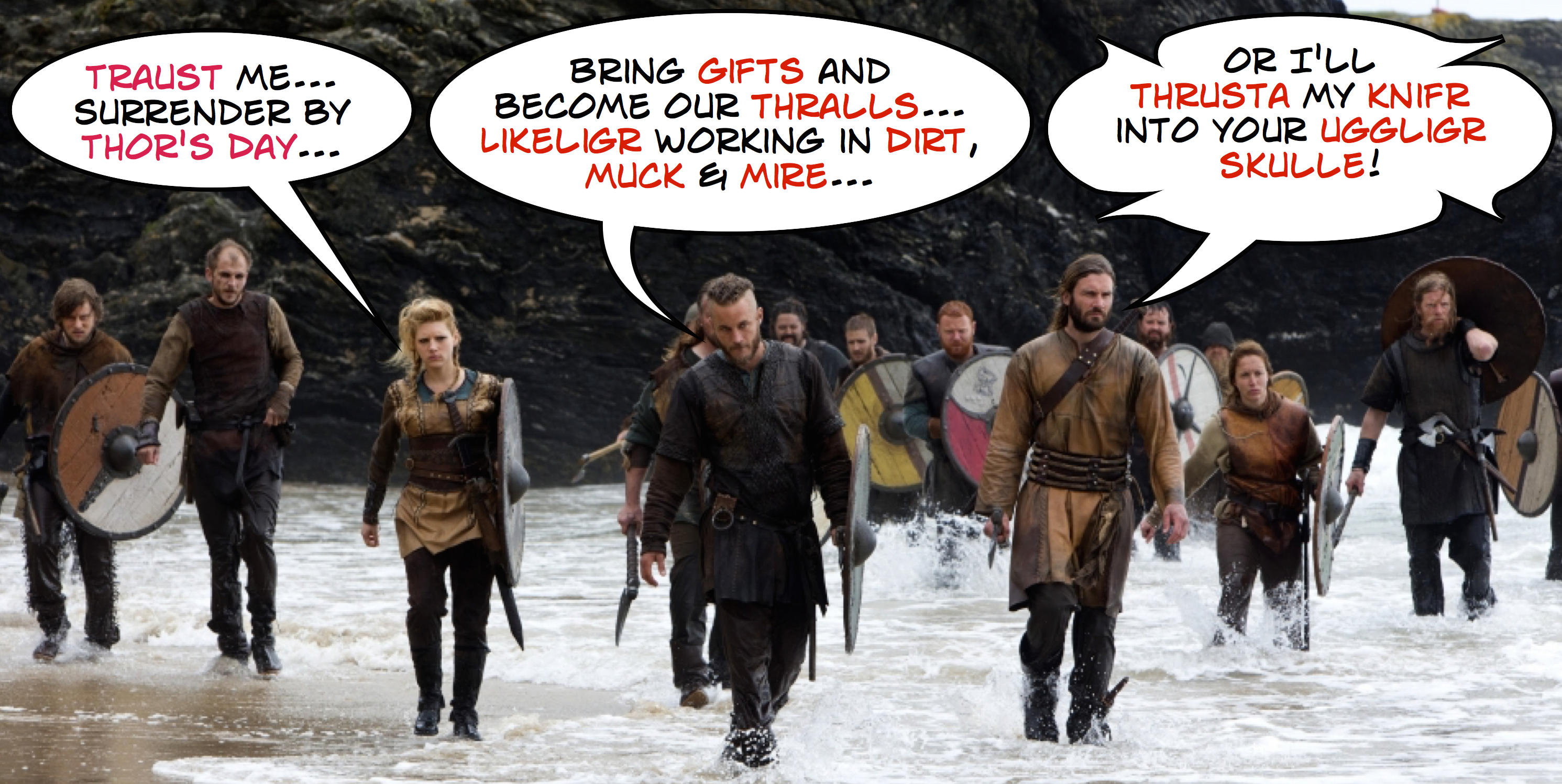
An article I wrote seven years ago hints at that same conclusion. I made this informative, and mildly threatening, illustration for “Norse Linguistic Invasion.”
Oxford Royale Academy lists several reasons why English is especially challenging to new students. The following issue of “irregularities” also plagues countless native speakers.

One of the hardest things about English is that although there are rules, there are lots of exceptions to those rules – so just when you think you’ve got to [come to] grips with a rule, something comes along to shatter what you thought you knew by contradicting it.

A good example is the rule for remembering whether a word is spelt “ie” or “ei:” “I before E except after C.” Thus “believe” and “receipt.”

But this is English – it’s not as simple as that. What about “science?” Or “weird?” Or “seize?”

There are loads of irregular verbs, too, such as “fought”, which is the past tense of “fight”, while the past tense of “light” is “lit.” So learning English isn’t just a question of learning the rules – it’s about learning the many exceptions to the rules.

The numerous exceptions make it difficult to apply existing knowledge and use the same principle with a new word, so it’s harder to make quick progress.

And even some of the normative “rules” are difficult to grasp. One example is that there’s a very specific order that adjectives must be listed ahead of a noun. According to Rosetta Stone,

The adjective order is: quantity, opinion, size, age, shape, color, origin/material, qualifier, and then noun. For example, “I love my big old yellow dog.” Saying these adjectives in any other order, like “I love my yellow old big dog,” will sound wrong, even when otherwise the sentences are exactly the same and communicate the same thing. Keeping rules like this in mind can be tricky, and it takes a lot of practice to get it right.

Adjective order is seldom considered, in part because it’s not considered good writing to string too many such words together. But apparently there are right and wrong ways to organize any such list.

Royal Order of Adjectives

Most students aren’t taught about adjective order in school and instead learn it through listening and reading. In English, the rules regarding adjective order are more specific than they are in other languages; that is why saying adjectives in a specific order sounds “right,” and deviating from that order makes a statement sound “wrong,” even if it’s otherwise grammatically perfect.

And, since we’re talking about English, even this Royal Order of Adjectives rule has exceptions

The hierarchy is not absolute, and there is some wiggle room among the “fact” categories – size, age, and so on – in the middle.

Native speakers are often delighted when they learn about this law and discover how flawlessly they apply it. It even went viral in 2016 . . . The tweet attached a paragraph by etymologist Mark Forsyth . . . giving an example that uses all the categories according to the OSASCOMP hierarchy: “a lovely little old rectangular green French silver whittling knife.”

I do not ever recall being taught (or reading on my own) about the “Royal Order of Adjectives.” Nevertheless, I don’t feel too embarrassed at acknowledging my previous ignorance, since even Lewis himself was comfortable in expressing gratitude for being introduced to new words. For example, when he thanked Dorothy Sayers for enlarging his vocabulary with her work on Dante.

So, is English all that challenging? Well, C.S. Lewis did his part to make it less daunting, joining a public debate in Britain, with an unexpected argument. Discussing English’s previously noted problem with inconsistencies and confusion in spelling, the don offered a simple solution.

In a column on Lewis and the history of words, I included an extended passage from a letter Lewis wrote challenging a contemporary British effort to “reform” spelling. Surprisingly, he argued against the necessity for uniformity in spelling. After explaining why our language functions as it does, he advocates:

As things are, surely Liberty is the simple and inexpensive ‘Reform’ we need? This would save children and teachers thousands of hours’ work.

Surely all but the most diehard grammarians would be sympathetic to his argument.

Next week I plan to write about another linguistic matter closely associated with the Inklings – the creation of new words and languages.
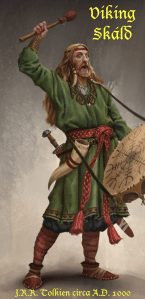
The Viking Explanation for Lame Poetry

During the middle ages, Scandinavia’s skálds were poets, storytellers and even musicians. They were the equivalent of bards in medieval British and Gaelic culture. They were oral historians, committed to memorizing their paeans verbatim, which was simpler since they were in poetic form. Not all skálds possessed the talents to create their own memorable epics. These lesser poets, so to speak, could still memorize and recite the classic or popular songs.

A graphic explanation for the difference in the talents of the first tier skálds and their inferiors is found in the Prose Edda which was written by Snorri Sturluson (1179-1241). Sturluson compiled Norse myths in his Edda, and the sagas of her kings in Heimskringla.

The second part of the Prose Edda is entitled Skáldskaparmál, which means the language of poetry. One of the myths it contains describes the Mead of Poetry. Mead, of course, is the rich Viking beverage created by fermenting honey.

As for poetry, I’ve written about it fairly often. (Most recently in respect to my “winning” entry in a Terrible Poetry Contest.) I’ve even offered genuine, albeit feeble, attempts at the art myself. Alas, if I were a classical Greek I would say my Muse is Clio (the Muse of History), rather than Thalia or Erato, Muses of various genres of poetry.

It is well known that C.S. Lewis himself was a frustrated poet. While his literary criticism and historical work was highly respected—and his Christian works are still revered—his poetry never received a warm reception. The Poetry Foundation offers a useful article on the subject here.

My personal opinion is that I am thankful Lewis’ energies were devoted to more profitable fields of writing.

Back to the Vikings

C.S. Lewis and several other Inklings were enamored with Northern sagas. I have touched on this in the past, and discussed the amazing fellowship gathered by J.R.R. Tolkien, as a sort of precursor to the Inklings.

Tolkien named the group Kolbítar, which denoted “Coalbiters,” or Norse storytellers who gathered close to the fire as they discussed the stories of their ancestors. This exploration of Icelandic literature was connected to Tolkien’s conviction, as a professor of Anglo-Saxon, that these works belonged within the study of the English canon.* Old Norse definitely left a mark on English, as I’ve discussed here at Mere Inkling.

In Song of the Vikings: Snorri and the Making of Norse Myths, Nancy Marie Brown gleans some insights about Kolbítar from Lewis correspondence. They gathered to read the literature aloud.

They began with Snorri’s Edda. Reading it in Icelandic was slow going but addictive, Lewis recalls: “Hammered my way through a couple of pages in about an hour, but I am making some headway. It is an exciting experience.” Lewis . . . had also been smitten as a boy by “pure ‘Northernness’” [and] popular versions of Snorri’s tales had inspired Lewis to write an adolescent tragedy about the Norse gods, “Loki Bound.”

There is no record of what the members of the Kolbítars thought of the myth of the Mead of Poetry, but I would imagine that they found its crass distinction between gifted and stumbling poets quite—Norse. To set the stage for the following passage, one should know: (1) the Aesir were the Old Norse gods, (2) Suttung was a Jötunn (belonging to a race of giants at war with the Aesir), (3) Suttung was in possession of the magical mead of poetry, which Odin stole through cunning but immoral means, swallowing all of it, (4) Odin changed into an eagle to effect his escape, and Suttung followed him in the same form, and (5) the Aesir prepared large vessels to receive the disgorged magical mead. Now, from the Edda itself:

When the Æsir saw Odin flying, they placed their vats in the courtyard, and when Odin entered Asgard he spat the mead into the vats. It was such a close call, with Suttung almost catching him, that he blew some of the mead out of his rear. No one paid attention to this part, and whoever wanted it took it; we call this the bad poets’ portion. Odin gave Suttung’s mead to the Æsir and to those men who know how to make poetry. For this reason we call poetry Odin’s catch, find, drink or gift, as well as the drink of the Æsir.

No one said the Norse were above using crass humor. Still, it does offer a quite imaginative explanation for the differences between exceptional and mediocre poets, doesn’t it?


* Tolkien “loved the cold, crisp, unsentimental language of the sagas, their bare, straightforward tone like wind keening over ice. Reading Snorri and his peers was more important than reading Shakespeare, Tolkien argued, because their books were more central to our language and our modern world” (Song of the Vikings).

Civilized Savages

civilization-and-savageryWhat are the proper criteria for determining who is civilized? If you asked a score of people, you would probably end up with twenty different opinions.

In continuing my research about America’s first woman chaplain, I encountered an early American teaching resource that offered great insight into education during the early nineteenth century.

Some of it was quaint—“goats were made as profitable to the farmer as sheep.”

Some of it was insightful—“In America the Grecian architecture is prevailing, as it is better adapted than the Gothic to small buildings, and does not require splendid edifices to display its beauty.”

The text, Peter Parley’s Universal History, on the Basis of Geography, was used in schools and homes.

After finding confirmation of the point I was researching, I couldn’t resist skimming through the volume. Out of its myriad lessons, the one that got me thinking most seriously was a discussion of relative levels of civilization.

At the end of each lesson, several questions are posed. In this case:

Questions: What would you observe in traveling through other countries? What of people in a savage state? What of people in the barbarous state? What of people in the civilized state? What of people in the highest state of civilization?

Preceding these questions is the lesson proper, from which I now quote passages that correspond to the questions just listed.

In some countries the people live in huts built of mud or sticks, and subsist by hunting with bow and arrow. These are said to be in the savage state . . .

In some countries the people live in houses partly of stone and mud. They have few books, no churches or meeting-houses, and worship idols. . . . These are said to be in the barbarous state . . .

In some countries the inhabitants live in tolerable houses, and the rich have fine palaces. The people have many ingenious arts, but the schools are poor, and but a small portion are taught to read and write. . . . which may be called a civilized state.

In many parts of Europe, and in the United States, the people live in good houses; they have good furniture, many books, good schools, churches, meeting-houses, steamboats and railroads. These are in the highest state of civilization.

It appears that Peter Parley (the pseudonym of Samuel Griswold Goodrich) considered two factors to be the clearest measures of civilization—the quality of a society’s domiciles, and the access to learning and increase in literacy.

These are not inappropriate measures, although the latter dwarfs the former in significance.

I realize these lessons are intended for elementary education, so I don’t fault Goodrich for failing to address the subject from a more philosophical or mature angle. Nevertheless, I could not help wondering whether the societies that have attained the “highest state of civilization” are truly the least barbaric.

In some ways, the societies that have attained the loftiest technological levels might also be considered among the most savage.

I don’t have the time or inclination to pursue this thought any further in Mere Inkling, but I offer it to you. Some readers will agree that it merits reflections and others will consider it absurd.

Before moving on the Inklings, though, I wish to share a pertinent bit of wisdom from economist Thomas Sowell. “Each new generation born is in effect an invasion of civilization by little barbarians, who must be civilized before it is too late.”

C.S. Lewis thought, and wrote, a great deal about civilization. In English Literature in the Sixteenth Century there is a delightful remark, made in passing, that it is possible to retreat from civilization, once attained.

From the varied excellence of the fourteenth century to the work of the early sixteenth it is a history of decay; so that in turning from the Scotch poetry of the age to the English we pass from civilization to barbarism.

I end with a longer citation from C.S. Lewis which connects uniquely with the mindset with which Goodrich penned his textbook. Lewis also affirms true education, and the advancement of humanity towards that for which it was created, as the genuine mark of civilization.

One of the most dangerous errors instilled into us by nineteenth-century progressive optimism is the idea that civilization is automatically bound to increase and spread. The lesson of history is the opposite; civilization is a rarity, attained with difficulty and easily lost. The normal state of humanity is barbarism, just as the normal surface of our planet is salt water. Land looms large in our imagination of the planet and civilization in our history books, only because sea and savagery are, to us, less interesting.

And if you press to know what I mean by civilization, I reply “Humanity,” by which I do not mean kindness so much as the realization of the human idea. Human life means to me the life of beings for whom the leisured activities of thought, art, literature, conversation are the end, and the preservation and propagation of life merely the means. That is why education seems to me so important: it actualizes that potentiality for leisure, if you like for amateurishness, which is man’s prerogative.

You have noticed, I hope, that man is the only amateur animal; all the others are professionals. They have no leisure and do not desire it. When the cow has finished eating she chews the cud; when she has finished chewing she sleeps; when she has finished sleeping she eats again. She is a machine for turning grass into calves and milk—in other words, for producing more cows. The lion cannot stop hunting, nor the beaver building dams, nor the bee making honey. When God made the beasts dumb He saved the world from infinite boredom, for if they could speak they would all of them, all day, talk nothing but shop. (“Our English Syllabus”).

_____

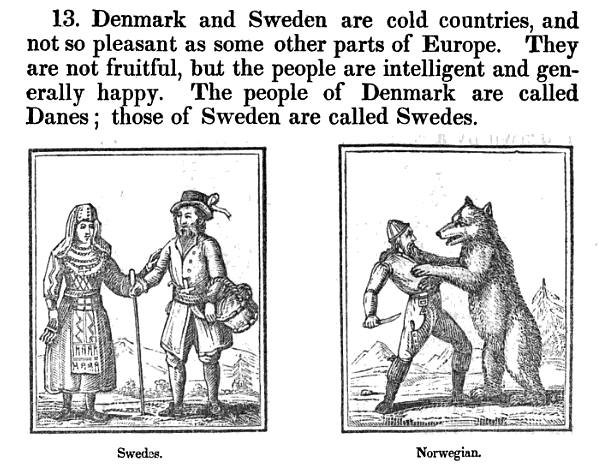
An illustration from the book, which taught generations of Americans that the heirs of the Vikings were still a picturesque and virile people.

scandinavians

Avoid Living in Fear

nuclear blast

Nuclear war. It’s an extremely unpleasant subject, and its grim specter still haunts the world. Oddly, though—even as we anticipate the day when Iran’s lunatic Mullah’s develop them and North Korea’s deranged generals learn how to deliver them—the world is in a sort of “nuclear hiatus” at this very moment.

The Mutual Assured Destruction apparently worked, as the former Soviet Union and the United States decided against nuclear suicide. At the present moment the three world powers show little appetite for total war, so today’s children don’t have to learn the Civil Defense precautions that kept an earlier generation safe.

I was one of those young Americans indoctrinated in the sophisticated “duck and cover” method of nuclear blast survival. This video provides a nostalgic look at the paramilitary training we received. (A link to the full training film appears below.)

C.S. Lewis lived during the height of nuclear paranoia. Yet he retained his composed Northern Irish demeanor as he reflected on the threat. In an essay entitled “On Living in an Atomic Age” he wisely advised:

If we are all going to be destroyed by an atomic bomb, let that bomb when it comes find us doing sensible and human things—praying, working, teaching, reading, listening to music, bathing the children, playing tennis, chatting to our friends over a pint and a game of darts—not huddled together like frightened sheep and thinking about bombs. They may break our bodies (any microbe can do that) but they need not dominate our minds.

In his essay “Is Progress Possible,” Lewis addresses those who used the uncertainty of the future as an excuse for making irresponsible life choices. His words ring just as true today, when so many youth turn to nihilism and self-destructive behaviors.

As a Christian I take it for granted that human history will some day end; and I am offering Omniscience no advice as to the best date for that consummation. I am more concerned by what the Bomb is doing already. One meets young people who make the threat of it a reason for poisoning every pleasure and evading every duty in the present. Didn’t they know that, Bomb or no Bomb, all men die (many in horrible ways)? There’s no good moping and sulking about it.

If only remaining safe in this fallen world was as simple as dropping to the ground and sheltering one’s head. It isn’t, of course, but we need not live our lives under the shadow of fear.

Returning to “On Living in an Atomic Age,” Lewis adroitly places the entire menace—and all perils to human life—in their proper perspective. It may not be the most comforting words we will ever read, but they are certainly true.

In one way we think a great deal too much of the atomic bomb. “How are we to live in an atomic age?” I am tempted to reply: “Why, as you would have lived in the sixteenth century when the plague visited London almost every year, or as you would have lived in a Viking age when raiders from Scandinavia might land and cut your throat any night; or indeed, as you are already living in an age of cancer, an age of syphilis, an age of paralysis, an age of air raids, an age of railway accidents, an age of motor accidents.”

In other words, do not let us begin by exaggerating the novelty of our situation. Believe me, dear sir or madam, you and all whom you love were already sentenced to death before the atomic bomb was invented: and quite a high percentage of us were going to die in unpleasant ways. We had, indeed, one very great advantage over our ancestors—anaesthetics; but we have that still. It is perfectly ridiculous to go about whimpering and drawing long faces because the scientists have added one more chance of painful and premature death to a world which already bristled with such chances and in which death itself was not a chance at all, but a certainty.

_____

You can watch the entire “Stop and Drop” Civil Defense Video here.