C.S. Lewis & Gluttony

Gluttony. If you were guilty of committing this sin, would you admit it? How, in fact, can we determine whether we (much less someone else) is a glutton? 

And, even if we do fit the description of a glutton, is it all that bad? I mean, it’s not like it is nearly as bad as any of the other so-called “seven deadly sins,” right?

Perhaps C.S. Lewis can offer some illumination on this subject? Our investigation could lead us to a curious, yet edifying, discovery. Just as it enlightened the author of “Ok Google, Who’s Fatter, Me or C.S. Lewis?

Like many of us, in his prime C.S. Lewis did not consider himself beset with the problem of gluttony. Historically, people have been more physically active when they are young – at least that was true before “addiction” to screens, keyboards and game controls became endemic.

Even a quarter century ago this trend was being seriously studied, as in “Computer Use and Physical Inactivity in Young Adults: Public Health Perils and Potentials of New Information Technologies,” which appeared in the Annals of Behavioral Medicine.

As the capacities of the new information technologies for delivering targeted, tailored health behavior change programs are developed, the issues for physical activity promotion will become particularly salient.

The emerging paradox is that this new behavior setting for physical activity program delivery is also a setting that strongly promotes long periods of sedentariness.

C.S. Lewis, obviously, lived prior to the ravages of this plague. Yet, he was not immune to the temptations of the Seven Eight Deadly Sins, as identified by the Desert Father Evagrius Ponticus.

As already mentioned, C.S. Lewis did not consider himself particularly vulnerable to gluttony. This is illustrated by a witty (and fascinating) postscript to a letter written to his lifelong friend Arthur Greeves in 1930.

P.S. When I said that your besetting sin was Indolence and mine Pride I was thinking of the old classification of the seven deadly sins: They are Gula (Gluttony), Luxuria (Unchastity), Accidia (Indolence), Ira (Anger), Superbia (Pride), Invidia (Envy), Avaricia (Avarice).

Accidia, which is sometimes called Tristicia (despondence) is the kind of indolence which comes from indifference to the good – the mood in which though it tries to play on us we have no string to respond.

Pride, on the other hand, is the mother of all sins, and the original sin of Lucifer – so you are rather better off than I am. You at your worst are an instrument unstrung: I am an instrument strung but preferring to play itself because it thinks it knows the tune better than the Musician.

GULA – J.A.G.
LUXURIA – J.A.G., C.S.L.
ACCIDIA – J.A.G.
IRA – C.S.L.
SUPERBIA – C.S.L.
INVIDIA – C.S.L.
AVARICIA – (neither, I hope)

Two decades later, C.S. Lewis would make a related observation in a letter to his friend Don Giovanni Calabria. Apologizing for the delay of his correspondence, Lewis wrote:

Nothing else was responsible for it except the perpetual labour of writing and (lest I should seem to exonerate myself too much) a certain Accidia [sloth], an evil disease and, I believe, of the Seven Deadly Sins that one which in me is the strongest – though few believe this of me.

Gluttony is Not Synonymous with Being Overweight

I meet few people who do not wish that they weighed a few pounds less than they do. That would include the elder C.S. Lewis. Listen to his self-description in a letter to a young admirer in 1954.

Self-effacing, as always, he said he was nothing special to behold: “I’m tall, fat, rather bald, red-faced, double-chinned, black-haired, have a deep voice, and wear glasses for reading . . .” (I hope this is not the only dimension of Lewis that I come to resemble more as the years pass by.)

The United Kingdom and Ireland have an historically odd manner of assessing a person’s weight. I suspect there is a bit of intentional obfuscation involved when they use the archaic measurement of “stone” rather than pounds or kilograms. 

As Britannica says, “the stone is still commonly used in Britain to designate the weights of people and large animals.” Ironically, babies are not weighed this way, presumably because few of them weigh a full stone – fourteen pounds – at birth.

In the military it was important to remain below your maximum allowable weight. This becomes a problem for a fair number of folks (a dilemma with which I’m personally familiar).

Due to the aforementioned problem with sedentary activities, meeting these height and weight guidelines has become a serious issue for many young recruits.

Still, gluttony is not synonymous with weighing more than is healthy for us. Not so, according to a great column at Intellectual Takeout.

It’s typical to associate gluttony with overconsumption, or, an excess of food or drink. But according to C.S. Lewis, that’s only one form the vice takes. The broader definition of gluttony is any inordinate desire related to food or drink. That includes overconsumption, but it also includes overselectivity regarding the type or quality of food and drink.

Derek Rishmawy discusses this Lewisian distinction as well. 

I have to admit that I struggle with gluttony. Yet those who know me probably wouldn’t suspect it. Indeed, I’m tempted to deny it myself because I don’t tend to have a weight issue . . . All the same, this is a sin I’m beginning to realize I need to be increasingly watchful against.

Of course, that confession only makes sense when you understand that there’s more than one way of being a glutton. I’ll let C.S. Lewis explain what I mean.

He cites Screwtape’s letter to his demonic protégé reveling in one of the seldom noticed “victories” of humanity’s Enemy.

One of the great achievements of the last hundred years has been to deaden the human conscience on that subject, so that by now you will hardly find a sermon preached or a conscience troubled about it in the whole length and breadth of Europe.

This has largely been effected by concentrating all our efforts on gluttony of Delicacy, not gluttony of Excess. Your patient’s mother . . . She would be astonished . . . to learn that her whole life is enslaved to this kind of sensuality, which is quite concealed from her by the fact that the quantities involved are small.

But what do quantities matter, provided we can use a human belly and palate to produce querulousness, impatience, uncharitableness, and self-concern? (The Screwtape Letters)

Now, there is something for us to examine in our own lives.

As for those troubled by their physical weight (be it higher or lower than they would like), I discovered an entertaining site where you can find out how much you would weigh on any of the other planets in our solar system.

Exploratorium lifted my spirits by informing me that on Mars I would weigh a mere 96.1 pounds! And best of all, that’s less than seven stone!


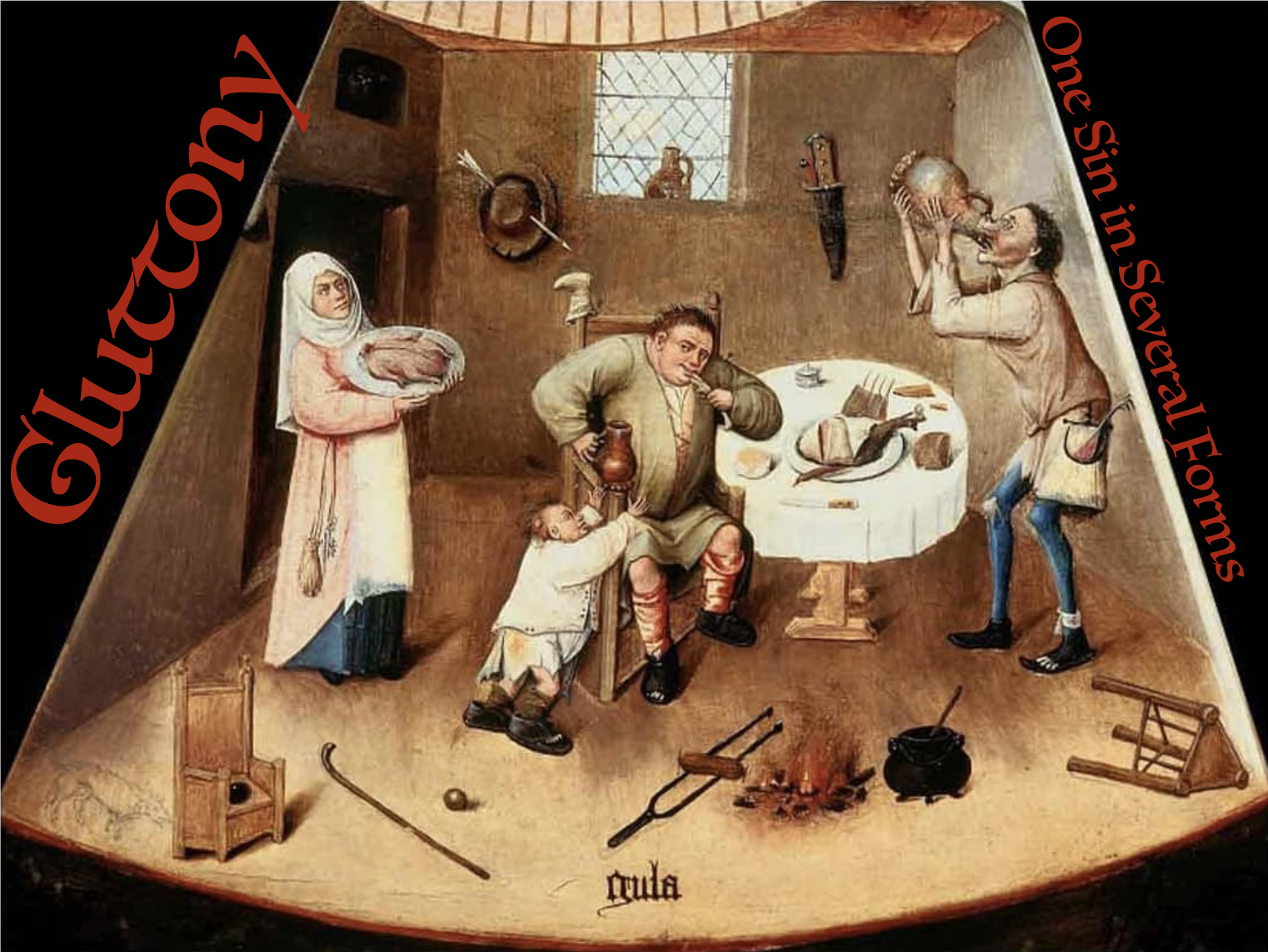
The illustration above is based on a detail from The Seven Deadly Sins and the Four Last Things painted c. 1500 by Hieronymus Bosch.
Can We Ignore Modern Slavery?

I can’t answer this question for you, but I know how I want to be able to answer when I stand before our Creator. 

Many Christians include corporate confession and absolution (forgiveness) as part of their regular worship. We often ask forgiveness our sins of commission and omission – the wrongs we do, and the wrongs we are responsible for when we fail to do what we should.

God forbid that any of us would actively support slavery, but . . . how little most of us do to reduce it or free people from its deadly grasp.

In Britain, the National Society for the Prevention of Cruelty to Children, founded in 1884, recognizes modern slavery as one of the world’s greatest challenges. As they say: “Any child is at risk of child trafficking.”

Save the Children states that “children account for 27% of all the human trafficking victims worldwide, and two out of every three child victims are girls.”

Sometimes sold by a family member or an acquaintance, sometimes lured by false promises of education and a “better” life – the reality is that these trafficked and exploited children are held in slave-like conditions without enough food, shelter or clothing, and are often severely abused and cut off from all contact with their families.

The children’s condition is not “slave-like;” these precious victims literally are slaves, in every cruel sense of the word. While no unenslaved person would be so ignorant as to presume they understand slavery, C.S. Lewis mentioned in a 1939 letter several torments it inflicts. At the break of the Second World War, he was reflecting on his experiences in the First.

My memories of the last war haunted my dreams for years. Military service, to be plain, includes the threat of every temporal evil; pain and death which is what we fear from sickness; isolation from those we love which is what we fear from exile: toil under arbitrary masters, injustice, humiliation, which is what we fear from slavery: hunger, thirst and exposure which is what we fear from poverty.

The most shocking part of this description from Save the Children, is the acknowledgment that the children are “sometimes sold by a family member . . .” I discussed this grim truth in my 2014 post, “Loving Prostitutes.”

In that article I express a sentiment I hope you share: “I love prostitutes because God has granted me the vision to see them as he does.”

What You & I Can Do Today

Obviously, if this subject is new to you, you can become informed. The links I’ve provided offer a good starting point.

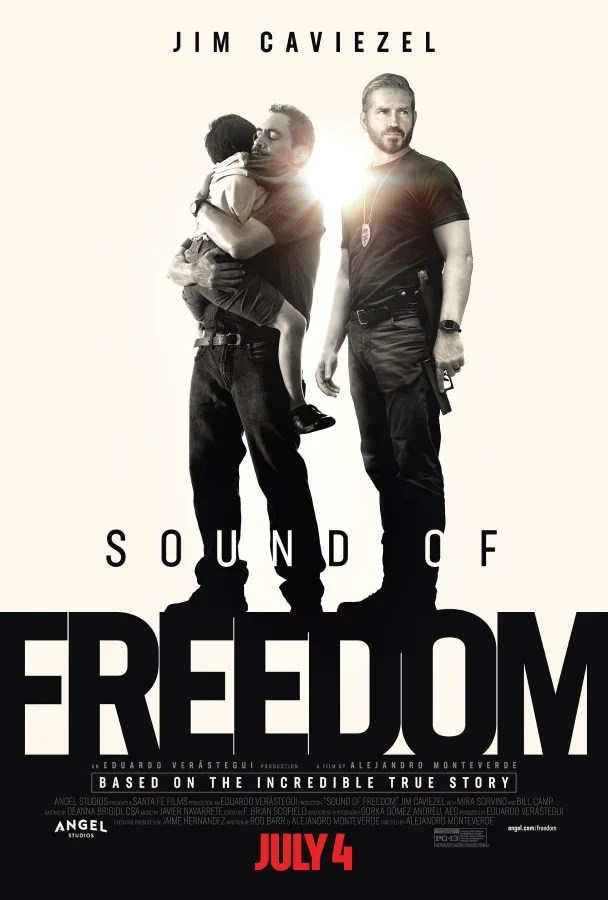
At the present moment we have a truly unique opportunity to make a contribution toward addressing this massive horror. We can support a superb, first-class film that is currently showing in hundreds of cinemas. 

Sound of Freedom is a true story with a superb cast and excellent cinematography. Despite its serious subject, the film is well worth viewing while it is still in theaters. Simply by attending, and even more by encouraging family and friends to join you, we can raise the awareness of this tragedy.

Together, you and I truly can help rescue people from this fate, and promoting this message of hope and deliverance is a small step in that journey. 

When faced with ugly things, the timid response is to turn away and pretend it doesn’t exist. In cases like this, particularly involving children, a cowardly response in ignoring the evil constitutes nothing less than a sin of omission. 

Check with your local theaters today, and reserve a seat at a showing of Sound of Freedom. (And, for those who see this suggestion months or years after the film’s 2023 release, check it out soon on a streaming service.)

Postscript & Resources:

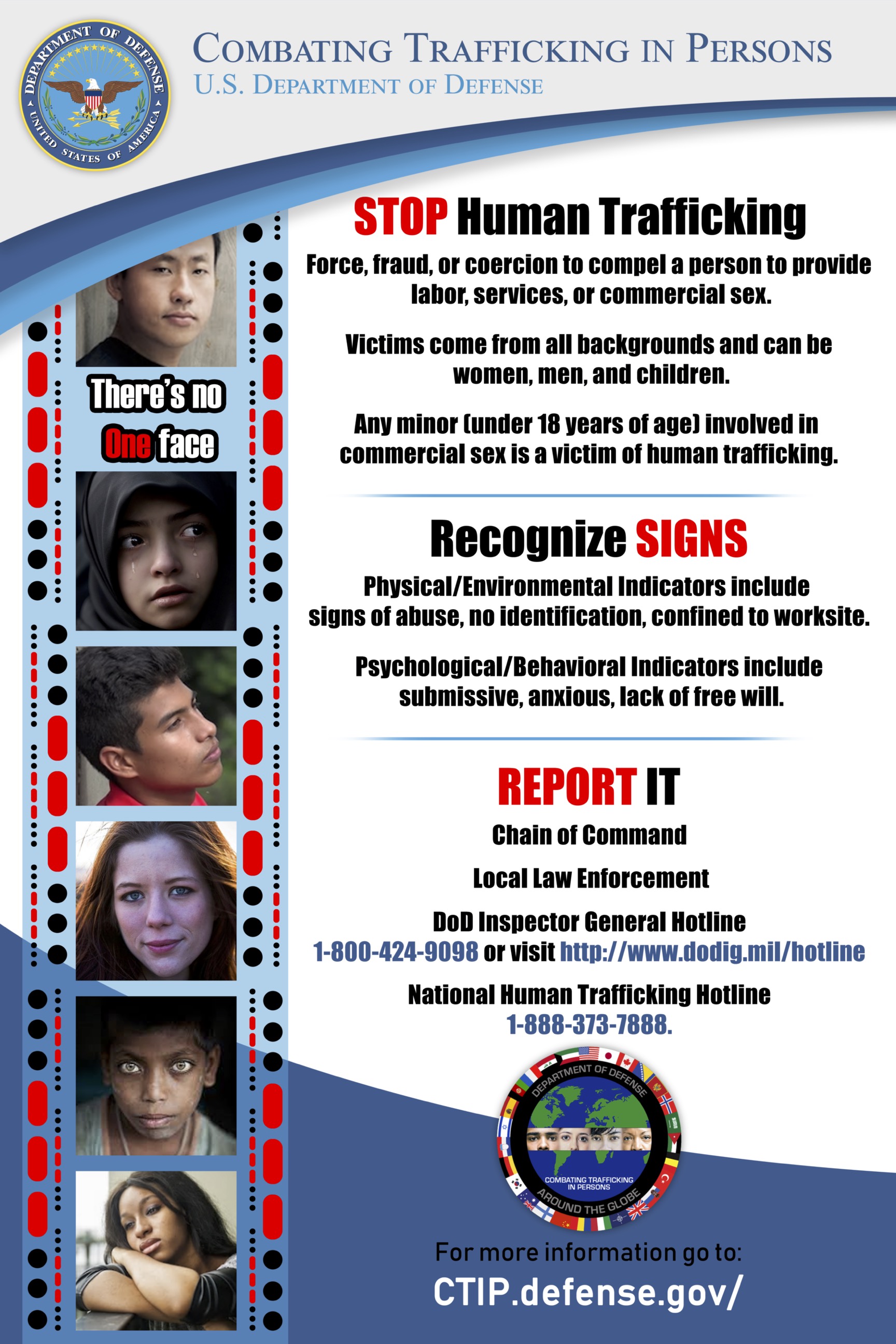
While I was still on active duty, the United States Department of Defense initiated a long-overdue program. In recognition that military members are literally on the “front lines” of encountering modern slavery, Combating Trafficking in Persons is an official program established to confront the crime.

The program includes provisions requiring training for all DoD personnel, civilian as well as uniformed. This site describes the various levels of training required. To actually “take” the training and testing requires login privileges. However, various resources – including some very informative videos – are available to the public.

Similarly, agencies such as INTERPOL restrict their courses to members. Nevertheless, they offer a variety of educational resources and updates on current efforts to battle this crime around the globe.

While I haven’t personally vetted the following, a number of public and governmental organizations offer free training for interested individuals. Among them are: 

the U.S. Department of Homeland Security, and the Office for Victims of Crime. The U.S. Institute Against Human Trafficking lists six free classes, several of which offer certificates of completion.

The Home Office in the United Kingdom hosts a site with a number of related resources. One is “A typology of modern slavery offences in the UK” which breaks “down the broad categories of modern slavery into 17 distinct types of offences identified in the UK.” No doubt, most other enlightened nations promote similar materials.

In a 1943 essay entitled “Equality,” C.S. Lewis discusses the subject of the nature of Democracy, as a form of government. His argument includes the clearest possible reason why slavery never has been, and never could be a good, or morally neutral, thing.

I am a democrat because I believe in the Fall of Man. I think most people are democrats for the opposite reason. A great deal of democratic enthusiasm descends from the ideas of people like Rousseau, who believed in democracy because they thought mankind so wise and good that everyone deserved a share in the government.

The danger of defending democracy on those grounds is that they’re not true. . . . I find that they’re not true without looking further than myself. I don’t deserve a share in governing a hen-roost, much less a nation. . . .

The real reason for democracy is . . . Mankind is so fallen that no man can be trusted with unchecked power over his fellows. Aristotle said that some people were only fit to be slaves. I do not contradict him. But I reject slavery because I see no men fit to be masters.

I know that C.S. Lewis would add his “amen” to my challenge today that each of us might look for ways to help eradicate this plague of slavery, which has cursed humanity for millennia.

Good & Bad Memories

We humans are fascinating creatures. Our capacity to remember both the good and the ill from our past, exerts a powerful influence on the course of our future.

I’ve been reflecting on this contrast since our lectionary readings from worship this past Sunday. (I’ll note the particular passage that triggered my thoughts in a moment.)

The question I’ve pondered is whether good memories are more powerful than bad memories. By bad, I’m not referring to horrific experiences which our minds sometimes actively suppress or bury.

I’m thinking of unpleasant, disappointing memories. Things that we regret having happened, either to us, or because of us.

When I use the word “powerful” in my question, I’m referring to the ability of a given memory to continue actively impacting our lives.

In too many lives, it seems the joy and light emanating from positive recollections is often shaded or eclipsed by the clouds of painful memories.

Perhaps our lives would be happier if we consciously spent time recalling good experiences, and taught ourselves to reject – rather than dwell upon – negative thoughts when they force their way onto the stage?

C.S. Lewis provides a curious insight into the nature of memories. Their overarching essence often seem to magnify as time passes. Listen to his words, penned after a vacation in 1921, in which he describes how the joyful memories will grow ever sharper as they are recalled in the future.

I still feel that the real value of such a holiday is still to come, in the images and ideas which we have put down to mature in the cellarage of our brains, thence to come up with a continually improving bouquet.

Already the hills are getting higher, the grass greener, and the sea bluer than they really were; and thanks to the deceptive working of happy memory our poorest stopping places will become haunts of impossible pleasure and Epicurean repast.

Sadly, though, even glorious memories can sometimes fade away. This is the grimmest tragedy of many forms of dementia.

Memory in the Chronicles

C.S. Lewis does some curious things with memory in his Chronicles of Narnia. While the Pevensie children grow to adulthood reigning over Narnia, they end up forgetting about their earlier lives. Only when they stumble upon the Lamp-post, do they recall the land of their birth.

“By the Lion’s Mane, a strange device,” said King Peter, “to set a lantern here where the trees cluster so thick about it and so high above it that if it were lit it should give light to no man!”

So these Kings and Queens entered the thicket, and before they had gone a score of paces they all remembered that the thing they had seen was called a lamp-post, and before they had gone twenty more they noticed that they were making their way not through branches but through coats.

And next moment they all came tumbling out of a wardrobe door into the empty room, and they were no longer Kings and Queens in their hunting array but just Peter, Susan, Edmund and Lucy in their old clothes.

It was the same day and the same hour of the day on which they had all gone into the wardrobe to hide. Mrs. Macready and the visitors were still talking . . . (The Lion, the Witch and the Wardrobe).

In Prince Caspian, a wise advisor, Doctor Cornelius, secretly informs the heir to the Narnian throne that the old stories were not simply myths. The evil Telmarines had actively labored to erase all memory of Narnia’s true nature.

“Listen,” said the Doctor. “All you have heard about Old Narnia is true. It is not the land of Men. It is the country of Aslan, the country of the Waking Trees and Visible Naiads, of Fauns and Satyrs, of Dwarfs and Giants, of the gods and the Centaurs, of Talking Beasts. It was against these that the first Caspian fought.

It is you Telmarines who silenced the beasts and the trees and the fountains, and who killed and drove away the Dwarfs and Fauns, and are now trying to cover up even the memory of them. The King does not allow them to be spoken of.”

I find the following description of a renewed memory particularly picturesque. It takes place after the Pevensie children return to Narnia years after their initial visit.

Everyone except Lucy went to sleep at once. Lucy, being far less tired, found it hard to get comfortable. Also, she had forgotten till now that all Dwarfs snore. She knew that one of the best ways of getting to sleep is to stop trying, so she opened her eyes.

Through a gap in the bracken and branches she could just see a patch of water in the Creek and the sky above it. Then, with a thrill of memory, she saw again, after all those years, the bright Narnian stars. She had once known them better than the stars of our own world, because as a Queen in Narnia she had gone to bed much later than as a child in England.

And there they were – at least, three of the summer constellations could be seen from where she lay: the Ship, the Hammer, and the Leopard. “Dear old Leopard,” she murmured happily to herself (Prince Caspian)

Forgetting the Past

Every one of us has made mistakes. And far too often we allow those poor decisions and choices to haunt us the rest of our lives. That delights the Devil, one of whose titles is Accuser.

He wants us mired in the past, thinking there is no way we could ever earn God’s love.

The simple fact is that we don’t earn our Creator’s love. It’s a free gift. It is pure grace, and utterly unmerited.

Once we have confessed our sins, God washes them away and cleanses us from all unrighteousness.

To emphasize how God no longer holds our past sins against us, consider some of the ways he expresses his capacity to permanently forgive our confessed sins.

He does not deal with us according to our sins, nor repay us according to our iniquities… so great is his steadfast love toward those who fear him; as far as the east is from the west, so far does he remove our transgressions from us (Psalm 103).

Who is a God like you, pardoning iniquity and passing over transgression..? You will cast all our sins into the depths of the sea. (Micah 7:18-19).

And now, for the verse which inspired my thoughts. It struck me as particularly helpful for our Christian lives, given the fact that God does not keep a permanent record of our sins. Wouldn’t our lives be better if we followed the Lord’s example?

Not that I… am already perfect, but I press on to make it my own, because Christ Jesus has made me his own… one thing I do: forgetting what lies behind and straining forward to what lies ahead, I press on toward the goal for the prize of the upward call of God in Christ Jesus (Philippians 3:12-14).

“Forgetting what lies behind,” our past failings which have been forgiven, liberates us to live the life to which God calls us.

That’s seldom easy to do, but knowing how “far [God] removes our transgressions from us,” makes that possibility much more likely. Let us press on.

C.S. Lewis, Puritanism & Prudes

Puritans often get a bad rap from people who don’t know their true history. Reading C.S. Lewis can help correct that error.

Digital History describes the problem in the following way.

Few people, however, have been as frequently subjected to caricature and ridicule. The journalist H.L. Mencken defined Puritanism as “the haunting fear that someone, somewhere, might be happy.”

In truth, Puritans enjoyed having a good time as much as anyone. They only objected to sinful activities. Drinking, fine. Drunkenness, sinful. Sexual intimacy in marriage, wonderful. Fornication and promiscuity, iniquitous. As C.S. Lewis writes in his essay “Tasso,” the Puritans were not about eliminating pleasure.

Asceticism is far more characteristic of Catholicism than of the Puritans. Celibacy and the praise of virginity are Catholic: the honour of the marriage bed is Puritan. (Studies in Medieval and Renaissance Literature)

In English Literature in the Sixteenth Century, C.S. Lewis includes Puritans in his description of the broader Protestant Reformation landscape.

Nearly every association which now clings to the word puritan has to be eliminated when we are thinking of the early Protestants. Whatever they were, they were not sour, gloomy, or severe; nor did their enemies bring any such charge against them. . . .

For [Thomas] More, a Protestant was one “dronke of the new must of lewd lightnes of minde and vayne gladnesse of harte.” Luther, he said, had made converts precisely because “he spiced al the poison” with “libertee.” Protestantism was not too grim, but too glad, to be true. . . . Protestants are not ascetics but sensualists.

Within the contemporary American Christian community, Puritanism has many defenders. This is due, I believe, to the prominence of Reformed theology within Protestant churches, something traceable to the nation’s beginnings.

Contrary to common understanding, the Puritans were not “separatists” who rejected the established church. In contrast, they remained members of the Church of England throughout the late sixteenth century. They did, however, believe that the Anglican Church retained too many extrabiblical Roman Catholic Church elements and ceremonies.

Much confusion derives from failing to distinguish between the Pilgrims and Puritans.

The main difference between the Pilgrims and the Puritans is that the Puritans did not consider themselves separatists. They called themselves “nonseparating congregationalists,” by which they meant that they had not repudiated the Church of England as a false church.

But in practice they acted – from the point of view of Episcopalians and even Presbyterians at home – exactly as the separatists were acting (History.com).

While the far more numerous Puritans began arriving in the colonies in the 1630s, the Pilgrims (who referred to themselves as “Saints,” not “Pilgrims”) arrived on the Mayflower a decade earlier. The previously quoted article describes the denigration of the Puritan theology, in the following manner.

As they gained strength, Puritans were portrayed by their enemies as hairsplitters who slavishly followed their Bibles as guides to daily life or hypocrites who cheated the very neighbors they judged inadequate Christians.

Sadly, nowadays any serious Christian – anyone who honestly reads the Bible and tries to live according to God’s teachings – is regarded with similar disdain. This sad fact was recognized by C.S. Lewis long ago.

To be sure, there are standards by which the early Protestants could be called “puritanical;” they held adultery, fornication, and perversion for deadly sins. But then so did the Pope. If that is puritanism, all Christendom was then puritanical together (English Literature in the Sixteenth Century).

So From Where Does the Puritan Label Come?

C.S. Lewis answers this question in an essay, “Edmund Spenser, 1552–99.”

By purity the Elizabethan Puritan meant not chastity but “pure” theology and, still more, “pure” church discipline (Studies in Medieval and Renaissance Studies).

In “Donne and Love Poetry” he elaborates on Puritan focus on ecclesiastical, rather than moral, matters.

We have come to use the word “Puritan” to mean what should rather be called “rigorist” or “ascetic,” and we tend to assume that the sixteenth-century Puritans were “puritanical” in this sense. Calvin’s rigorist theocracy at Geneva lends colour to the error.

But there is no understanding the period of the Reformation in England until we have grasped the fact that the quarrel between the Puritans and the Papists was not primarily a quarrel between rigorism and indulgence, and that, in so far as it was, the rigorism was on the Roman side (Selected Literary Essays).

Returning to the essay on Edmund Spencer, we see Lewis elaborating on the ecclesiastical hopes of the Puritans.

We must picture these Puritans as the very opposite of those who bear that name today: as young, fierce, progressive intellectuals, very fashionable and up-to-date. They were not teetotallers; bishops, not beer, were their special aversion. . . .


There was no necessary enmity between Puritans and humanists. They were often the same people, and nearly always the same sort of people: the young men “in the Movement,” the impatient progressives demanding a “clean sweep.” And they were united by a common (and usually ignorant) hatred for everything medieval . . . (Studies in Medieval and Renaissance Studies).

Some readers may be surprised to see Lewis, an Anglican, speak so favorably of Puritans. To those of us who are interested in genuine history, his words are illuminating. And, his warning – which is applicable to many other historical movements – is appreciated.

I must immediately guard against a possible misunderstanding. Both words have so changed their sense that puritan now means little more than ‘rigorist’ or ‘ascetic’ and humanist little more than ‘the opposite of puritan.’

The more completely we can banish these modern senses from our minds while studying the sixteenth century the better we shall understand it.

That is sound advice for every circumstance. Accurately understanding what we are discussing is a necessity. Just think how much disagreement could be dispelled in our polarized world, if we only followed C.S. Lewis’ example.

Gambling, Sin & C.S. Lewis

Gambling has become pervasive in modern society. It is so endemic that people rarely spend a moment wondering whether it is morally good, bad or indifferent.

This past week numerous articles appeared about multi-million dollar bets and the stunning amount waged on the final game of the NFL season. And, a day after the game is played, the odds for next season’s winner are already online.

The Super Bowl is traditionally the biggest annual sports betting event in the United States. But it’s only one of many events where the legally gambled totals are stunning.

It is estimated that Americans wager over $150 billion dollars per year on sporting events, and even more is bet on legally [on events] around the world.

Naturally, the World Cup – with its global audience – trumps the sum gambled on American football.

In the United States, opportunists created state-sponsored lotteries, presumably to fund worthy causes like education. Today most of these are taken for granted as a stable revenue stream (not always for their promised purpose).

And we haven’t even factored in the casual or unsanctioned gambling that takes place.

In many gambling situations, wagers are made between friends, for minor amounts. In such cases there seems to be little reason for concern. Perhaps it is about willpower and moderation.

However, there are some cases where people wager large amounts – far beyond what they can “afford” to lose. And in such cases, something dangerous is afoot. In the worst cases, people can lose everything they own. Even worse, innocent members of their families frequently suffer.

These are the people for whom Gamblers Anonymous exists. The organization “is a fellowship of men and women who share their experience, strength and hope with each other that they may solve their common problem and help others to recover from a gambling problem.”

Recent brain research has confirmed a genetic element and that “gambling addiction triggers the same brain areas as drug and alcohol cravings.”

The grim truth, you see, is that gaming businesses are not the fun, innocent entertainment industry they claim to be. Gambling enterprises don’t rely on casual bettors for their profits. It’s the people who cannot resist making just one more bet, who fund their rich coffers.

And, while technology may make some gambling more appealing, it’s dangers were recognized centuries ago.

By the time George II came to the throne in 1727, Britain was a nation addicted to gaming. The capital was fit to burst with gaming houses, where play continued round the clock . . . A game named Hazard was one of the most popular games, and also one of the most aptly named, since there were hazards aplenty in playing.

Squeezed around a large, circular table, a player could easily win or lose an entire fortune in a single night, since large stakes were wagered on each throw of the dice, and four-figure losses were not uncommon. No amount of skill could improve the odds of winning at Hazard, either. . .

It was a highly addictive game too; payouts and losses came quickly, and so the atmosphere around the table was always one of fevered anticipation.

But is Gambling a Sin?

The fact that gambling can destroy families and lives suggest that it is not morally ambiguous. But, is it a matter of degree, rather than a right or wrong?

To answer that question, people of Christian faith look first to the Scriptures. The Bible speaks a great deal about money, but very little that relates directly to gambling. Most people are well acquainted with the biblical warnings that “the love of money is a root of all kinds of evils.” The rest of that verse describes the troubled state of people who have surrendered to its power.

It is through this craving that some have wandered away from the faith and pierced themselves with many pangs (1 Timothy 6:10).

Beyond the cautions about being tempted by money, gambling is not expressly addressed. Nevertheless, this essay offers a thorough discussion of the subject, and is worth reading.

What did C.S. Lewis Think?

C.S. Lewis had an excellent hermeneutic, or approach to interpreting the Scriptures. He believed that Jesus’ disciples should do what God’s Word tells us to do, and avoid what it instructs us to avoid. Pretty simple, right? Too bad we find that model so challenging to follow.

Because the Bible is essentially silent on the practice, Lewis applied his reason, and his personal experience to the matter when he was asked about it. In a collection entitled “Answers to Questions on Christianity,” he offered a very practical response.

Gambling ought never to be an important part of a man’s life. If it is a way in which large sums of money are transferred from person to person without doing any good (e.g., producing employment, goodwill, etc.) then it is a bad thing.

If it is carried out on a small scale, I am not sure that it is bad. I don’t know much about it, because it is about the only vice to which I have no temptation at all, and I think it is a risk to talk about things which are not in my own make-up, because I don’t understand them.

If anyone comes to me asking to play bridge for money, I just say: `How much do you hope to win? Take it and go away.’ (God in the Dock).

An Inkling Postscript

J.R.R. Tolkien’s estate faced an ethical challenge when Warner Brothers, one of their licensees, abused their rights and created “online games, slot machines and other gambling-related merchandise based on the author’s books The Hobbit and The Lord Of The Rings.”

Tolkien’s estate had accused the defendants of violating a 1969 agreement allowing the sale of “tangible” merchandise, by associating the books with the “morally-questionable (and decidedly non-literary) world of online and casino gambling”.

It said this “outraged Tolkien’s devoted fan base” and irreparably harmed the legacy of the English author, who died in 1973 at the age of 81.

Since the Chronicles of Narnia were written for children, they are less susceptible to such abuses. But, wherever a dollar can be made (or won) the possibility exists they could also be misused to that end.

Create a Word Today

What could possibly be more fun than making up a witty new word?

Well, to be honest, lots of things. But inventing words is still an enjoyable creative exercise. I made up several in less than an hour this evening, while half-watching an old movie. A few may be lame, but I hope you will discover one or two you enjoy.

I’ve touched on the subject of inventing words in the past. But this approach involves a different process.

This article from The Guardian asks, “English speakers already have over a million words at our disposal – so why are we adding 1,000 new ones a year to the lexicon?” That’s certainly a fair question. However, it doesn’t pertain to my thoughts here. I’m not attempting to birth any neologisms. These are simply humorous tweaks to existing words. A form of wordplay.

I got the idea when I read a short article, “The Best Made Up Words Ever,” by Bill Bouldin.* He admits to including a number of words from an online site I won’t name here (due to its preponderance of vulgar terms). While Bouldin doesn’t indicate which examples are his own contributions, and which are reproduced, I found a couple of the words quite entertaining.

The first of these reminded me of many group meetings where we consider all sorts of opportunities and possibilities.
Blamestorming – The act of attempting to identify the person who is most at fault for a plan’s failure.

As a pastor I couldn’t resist modifying this gem.
Sinergy – When performing two bad acts make you feel as guilty as if you had committed three.

This one struck home since it’s a play on one of the words in the title of the Narnian classic, The Lion, the Witch and the Wardrobe.
Chairdrobe – A chair on which one piles clothes that belong in the closet. Not to be confused with a floordrobe.

The final example will resonate with everyone who enjoys reading and writing.
“Illiteration – The mistaken impression that you know more about rhetorical devices than you really do.

At the risk of revealing myself to be an illiterator, I’ve included below some of the words I conjured up during an idle hour. I don’t claim any are masterpieces, but you may find one or two that bring a smile to your face. And, who doesn’t need an extra smile during these trying times?

My Initial Experiment

Caution: Before proceeding, keep in mind these are not real words. As genuine and utilitarian as they may appear, I advise you not to use them in conversation or composition. They are offered by Mere Inkling purely for entertainment purposes. Feel free to add some of your own in a comment.

Miscellaneous Vocabulary

Subbatical: the period when some temp like you is hired to fill in for some privileged person who has a job that has sent him or her off for an extended paid vacation.

Dippididude: Confused men who use hair gel designed for young girls and women.

Cemetarry: The unwillingness of some people to ponder the reality of their own mortality.

Mannekin: A boring, sedentary relative, who rarely rises from the couch.

Candlelablouse: The name for candlesticks with multiple arms in the homes of prudes.

Carnivirus: Individuals who strive to draw blood from those who view the coronavirus and its implications differently than they do.

Brigadeer: A domineering deer who tries to order all the other members of its herd around (antlers optional).

Altruistick: Actions that appear on the surface to be selfless, but include a hidden agenda.

Monumentill: Descriptor for someone of little worth who builds a significant reputation with the sole purpose of lining their pockets.

Blasphemee: An individual’s personal inability to consistently observe the Second Commandment.

Concupiscents: Hollywood’s obsession with including graphic sexual themes in all of their productions, resulting in the selling of their souls for pennies on the dollar.

Cathedroll: A large church led by a senior minister given to quaint and unintentionally comic humor.

Cadaversary, pl., cadaversaries: A member of the endless hordes of the undead during a zombie apocalypse.

Writing Vocabulary

Literasee: The capacity of one’s imagination to visualize what you are reading.

Bloggrr: An essentially angry person, given to writing unbridled tirades on various digital formats.

Gerdprocessing: When whatever you are typing just doesn’t work, and causes you severe heartburn instead.

Manuskipped: The sad condition when the article or book into which you poured your blood, sweat and tears has been tossed into a slush pile to lie forgotten.

Editteen: The maturity level of the editor who did not recognize the merits of your manuscript and rejected it without comment.

Subliminil: When the word you are reading or writing possesses no hidden or subconscious message.

Proofreaper: Someone you invited to read your manuscript for misspellings who advises you to delete entire sections of your precious creation.

Skulldigory: Misbehavior by the English professor, Digory Kirke, who, as a child, introduced evil into Narnia.

I will close now with two words that cat-lovers may find objectionable. If you are a devoted feline-fancier, you are advised to cease reading now.

Lucifur: The anonymous leader of that faction of felines devoted to serving evil.

Purrification: The activity of forgiveness and restoration that occurs when any cat makes a sincere confession of its sins.


* This columnist cites various words from the Bouldin’s piece, and others from a book entitled The Emotionary: a Dictionary of Words That Don’t Exist for Feelings That Do.

Glorifying the Evil One

One perplexing behavior of humanity, is seen in the inclination of some to glorify our greatest enemy. Some people sincerely adore a being who desires nothing more than humanity’s suffering and eternal separation from our loving Creator.

I once heard the difference between God and Satan put this way: even when you hate him, God still loves you, and even when you love him, Lucifer still hates you.

Yet some still idealize this fallen angel who has earned many corrupt titles, including Tempter and Father of Lies.

In literature and other media you can readily find positive treatments of the Devil. John Milton’s Paradise Lost presents Lucifer as the classic tragic figure. Even his arrogance and vanity about his beauty are presented in a sympathetic fashion. In “Why Satan’s Character in Paradise Lost is the Original Antihero,” Lisa Ampleman says “at the 350th anniversary of its publication, Milton’s masterpiece seems ever more relevant.”

The Romantic poet William Blake even said that Milton was “of the Devil’s party without knowing it.” For the first few books, the charismatic demon’s concerns are front and center, and God seems authoritarian and legalistic.

Fortunately, Milton does not leave us with this sympathetic portrayal of Lucifer. As the article’s author writes, Satan “is not the absolute evil we may have expected, and a sympathetic devil is a dangerous devil.” In Book IX, the Devil even confesses his grim obsession.

But neither here seek I, no nor in Heaven
To dwell, unless by mastering Heaven’s Supreme;
Nor hope to be myself less miserable
By what I seek, but others to make such
As I, though thereby worse to me redound:

For only in destroying I find ease
To my relentless thoughts; and, him destroyed,
Or won to what may work his utter loss,
For whom all this was made, all this will soon
Follow, as to him linked in weal or woe;

In woe then; that destruction wide may range:
To me shall be the glory sole among
The infernal Powers, in one day to have marred
What he, Almighty styled, six nights and days
Continued making . . .

In his Preface to Paradise Lost, C.S. Lewis astutely describes Milton’s depiction of the Devil’s eternal dilemma.

What we see in Satan is the horrible co-existence of a subtle and incessant intellectual activity with an incapacity to understand anything. This doom he has brought upon himself; in order to avoid seeing one thing he has, almost voluntarily, incapacitated himself from seeing at all.

And thus, throughout the poem, all his torments come, in a sense, at his own bidding, and the Divine judgement might have been expressed in the words “thy will be done.” He says “Evil be thou my good” (which includes “Nonsense be thou my sense”) and his prayer is granted.

Turning to one of America’s most renowned authors, we encounter in Mark Twain an unabashedly positive portrayal of Lucifer. In Letters from the Earth (which was too controversial for publication during his lifetime), Satan remains a trusted member of God’s Grand Council. It is left to Satan to question God’s arbitrary creation of violent and flawed creatures.

After a long time and many questions, Satan said, “The spider kills the fly, and eats it; the bird kills the spider and eats it; the wildcat kills the goose; the — well, they all kill each other. It is murder all along the line. Here are countless multitudes of creatures, and they all kill, kill, kill, they are all murderers. And they are not to blame, Divine One?”

“They are not to blame. It is the law of their nature. And always the law of nature is the Law of God. Now – observe – behold! A new creature – and the masterpiece – Man!”

Far from humanity being created in the Divine image, Twain’s twisted version of the Creator has God throwing together all of the positive, and negative, traits he had bestowed on the imperfect animals.

“Put into each individual, in differing shades and degrees, all the various Moral Qualities, in mass, that have been distributed, a single distinguishing characteristic at a time, among the nonspeaking animal world – courage, cowardice, ferocity, gentleness, fairness, justice, cunning, treachery, magnanimity, cruelty, malice, malignity, lust, mercy, pity, purity, selfishness, sweetness, honor, love, hate, baseness, nobility, loyalty, falsity, veracity, untruthfulness – each human being shall have all of these in him, and they will constitute his nature.

“In some, there will be high and fine characteristics which will submerge the evil ones, and those will be called good men; in others the evil characteristics will have dominion, and those will be called bad men.”

Satan later offered some sarcastic compliments about creation and is exiled briefly to Earth. There, Twain’s hero pens a number of letters to archangels sympathetic to his views. A single passage is adequate to illustrate the whole.

Man is a marvelous curiosity. When he is at his very very best he is a sort of low grade nickel-plated angel; at his worst he is unspeakable, unimaginable; and first and last and all the time he is a sarcasm. Yet he blandly and in all sincerity calls himself the “noblest work of God. . . .”

Moreover – if I may put another strain upon you – he thinks he is the Creator’s pet. He believes the Creator is proud of him; he even believes the Creator loves him; has a passion for him; sits up nights to admire him; yes, and watch over him and keep him out of trouble. He prays to Him, and thinks He listens. Isn’t it a quaint idea?

For an accurate illustration of Satan’s activities and purposes, one need look no further than C.S. Lewis’ Screwtape Letters. In one letter, Screwtape highlights the progress Satan’s minions have made in desensitizing humanity to what was recognized as provocative in an earlier age.

We have engineered a great increase in the licence which society allows to the representation of the apparent nude (not the real nude) in art, and its exhibition on the stage or the bathing beach. It is all a fake, of course; the figures in the popular art are falsely drawn; the real women in bathing suits or tights are actually pinched in and propped up to make them appear firmer and more slender and more boyish than nature allows a full-grown woman to be.

Yet at the same time, the modern world is taught to believe that it is being ‘frank’ and ‘healthy’ and getting back to nature. As a result we are more and more directing the desires of men to something which does not exist – making the rôle of the eye in sexuality more and more important and at the same time making its demands more and more impossible. What follows you can easily forecast!

Artistic Presentations of a Sympathetic Devil

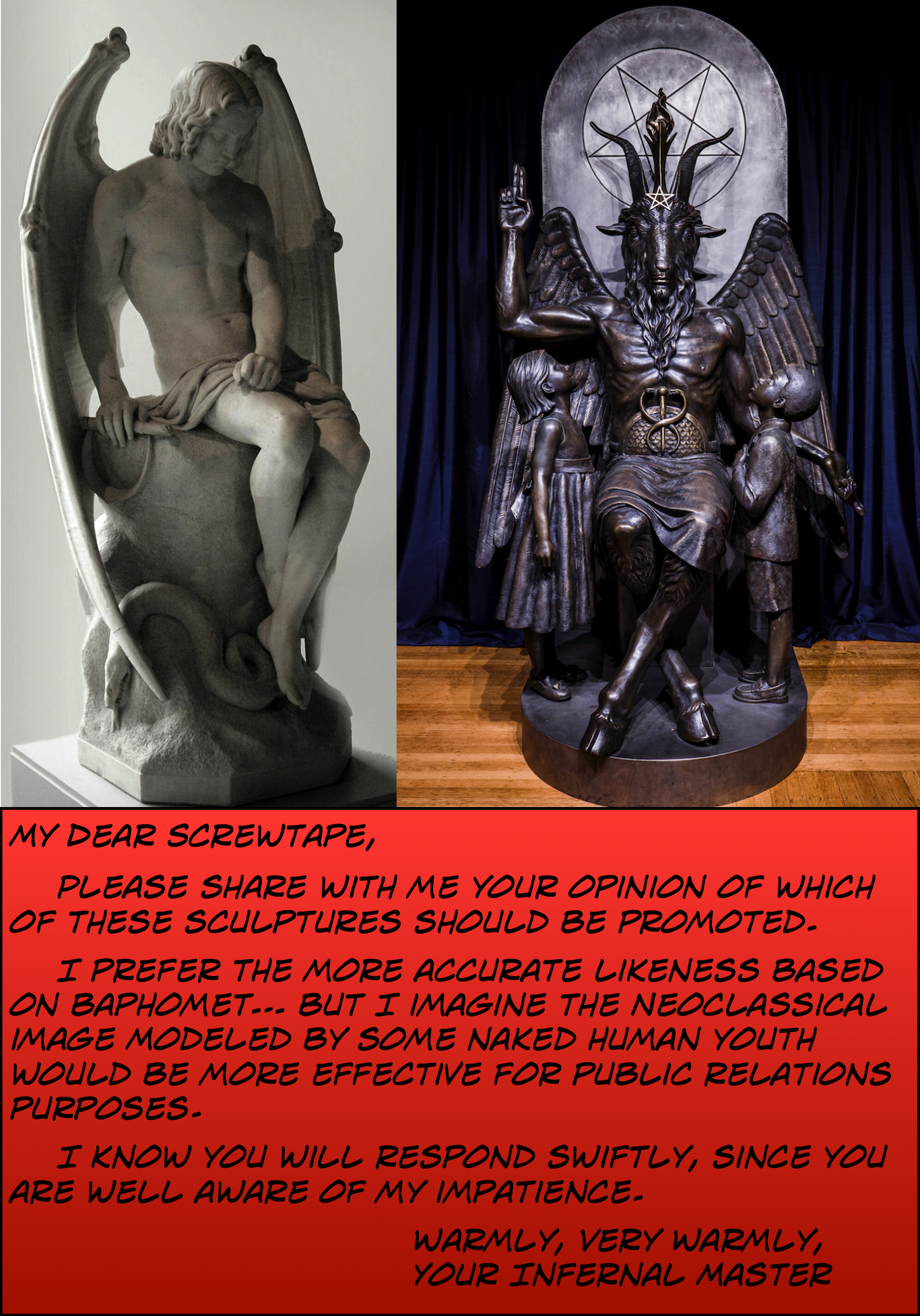
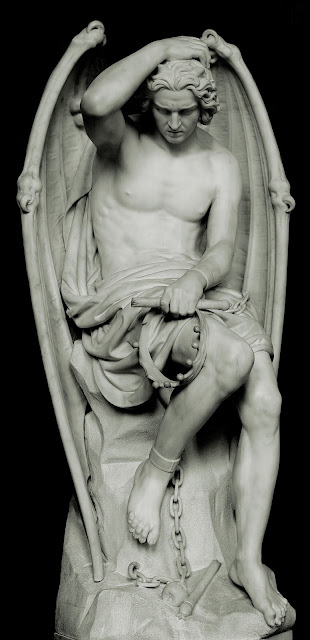
It was actually a nineteenth century Belgian sculpture of Lucifer which is part of the elaborate pulpit of St. Paul’s Cathedral in Liège which inspired today’s reflections. Guillaume Geefs was commissioned to create the piece as part of a general theme of the triumph of religion over evil. The Devil as he portrayed the rebel angel, is rather too appealing for those acquainted with his actual biblical portrait.

Even though his wings have devolved to appear more like those of a bat than a bird, and his foot is chained, the sculpture’s physique is attractive. His apparent regret, evident in his expression and the presence of a tear, invite sympathy. It is regarded as an outstanding example of Romanticism. In a word, it serves as an attractive personification of a vile and malignant being. And this presents a dangerously misleading view of the very real spiritual warfare raging about us.

Curiously, Guillaume’s nude (with a robe safely draped over his lap) was actually a more modest and religious alternative to the image originally intended for the space. Ironically, it was the artist’s younger brother, Joseph, who originally received the commission. Joseph’s sculpture was regarded as even more titillating, and it was replaced. The Royal Museums of Fine Arts of Belgium admits “Joseph created one of the most disturbing works of the period.”

When it was revealed, the initial version of “Le Génie du Mal” (The Genius of Evil) raised questions about its positive portrayal. One publication reported the cathedral’s administrators determined “this devil is too sublime.”

The last thing imperfect human beings living in a fallen world need are sublime and alluring depictions of evil. In the words of C.S. Lewis,

To admire Satan, then, is to give one’s vote not only for a world of misery, but also for a world of lies and propaganda, of wishful thinking, of incessant autobiography. Yet the choice is possible. Hardly a day passes without some slight movement towards it in each one of us.

That is what makes Paradise Lost so serious a poem. The thing is possible, and the exposure of it is resented. Where Paradise Lost is not loved, it is deeply hated. (A Preface to “Paradise Lost”).

Replacement Sculpture by Guillaume Geefs.

C.S. Lewis, Writing and Lust

We’re accustomed to hearing the word “lust” used in a positive manner, such as “she has a lust for life.”

You might even see this in the context of writing. C.S. Lewis himself did this. In 1948, in a letter to an American pastor, he apparently answers a query about what inspires him to write. “The ‘incentive’ for my books has always been the usual one—an idea and then an itch or lust to write.”

I resonate with Lewis’ response. Some idea dawns on me—usually arising from something I’m reading—and then I get the desire to put my own twist on it and share the original idea with others.

This post is no different. I have been working on the military chaplaincy journal that I edit, and I was reading the poetry of a British chaplain from the First World War. Rev. G.A. Studdert Kennedy (1883-1929) was an Anglican priest. He was awarded the Military Cross due to his “disregard for his own safety in attending to the wounded under heavy fire.” The award also noted his Gospel contribution to the harsh life of WWI trenches. “He searched shell holes for our own and enemy wounded, assisting them to the dressing station, and his cheerfulness and endurance had a splendid effect upon all ranks in the front line trenches, which he constantly visited.”

You can read many of his poems in past issues of Curtana: Sword of Mercy, which is available for free download here.

After reading some of his poetry, I turned for the first time to one of his postwar books. It was entitled “Lies!” and addresses a litany of deceptions that plague the world. Included among these deceits is “the lie of lust.”

In the following excerpt, he refers to writing prurient literature which can guarantee a market. It is echoed by a later comment I read from a writer who said she had to write erotic novels to supplement her preferred titles, just so she could make a living. She used a pen name, of course, for the smut.

You can follow Chaplain Kennedy’s argument in the excerpt which follows. Since it is rather lengthy, I will highlight the reference to writing by using a boldface font. Kennedy contrasts in this passage the conflict between humanity’s sinfulness and our call to holiness, the struggle the Apostle Paul describes so succinctly in the seventh chapter of Romans.

“For I do not do the good I want, but the evil I do not want is what I keep on doing. Now if I do what I do not want, it is no longer I who do it, but sin that dwells within me.”

Here is Kennedy’s argument:

But lust in a man is obscene and filthy because it is unnatural. It becomes cruel and debased. It does not proceed to the making of children naturally and cleanly; it descends to unmentionable and disgusting things. The report on the German atrocities in Belgium* provides a kind of horror-chamber in which we can see what lust can bring men to. As one reads that awful document a kind of hot shame comes over one, and makes one sweat for sorrow over sin.

The sting of that shame lies in the fact that one is dreadfully conscious that the root of that disgusting horror is there in one’s own soul. Have you never felt a ghastly doubt rising up in your mind when you read such things? Now what am I reading this for? Is it purely because I want to hate it . . ?

Write a book about the cruelties and debaucheries of a Nero or a Rasputin, and it will sell. There is an appeal in it which thousands, nay, which all men feel, which all men would answer, if the other force within them failed. But the horror of it, the shame for it, is, thank God, as real, more real, than the appeal. There is human history: the war between the appeal and the repulsion of sin: the war between the monkey and the man.

There are thousands of writers, artists, playwrights, musicians, who are making their fortunes out of the appeal to the animal in man. It is the best paying business in the world. Yet, if there is anything that human experience makes certain, it is that there is no end to the journey a man makes in answer to that appeal except damnation, the utter loss of all that makes life good. Lust cannot satisfy a man, because he needs Love. Lust is unnatural in man, it leaves one side of his nature out, and sooner or later that neglected side has its revenge, and turns life’s sweetness bitter to his taste. Then in his despair he will descend in search of new sensations to things which men cannot mention, or even think of without shame. That is the way of it with all men if the great force fail that leads them upward from the animal to the human and divine (Lies! published in 1919).⁑

C.S. Lewis on Carnality

As noted, Lewis was able to use the word “lust” in its muted, nonliteral sense. He was also able to address it literally, and to challenge the hold it exerts on so many lives. In “Religion: Reality or Substitute?” C.S. Lewis vividly described how lust is an enemy.

If we wish to be rational, not now and then, but constantly, we must pray for the gift of Faith, for the power to go on believing not in the teeth of reason but in the teeth of lust and terror and jealousy and boredom and indifference that which reason, authority, or experience, or all three, have once delivered to us for truth.

In a more metaphorical manner, in the Great Divorce Lewis uses the surprising image of a foreboding ruddy lizard to portray the sinister nature of lust.  

I saw coming towards us a Ghost who carried something on his shoulder. Like all the Ghosts, he was unsubstantial, but they differed from one another as smokes differ. Some had been whitish; this one was dark and oily. What sat on his shoulder was a little red lizard, and it was twitching its tail like a whip and whispering things in his ear. As we caught sight of him he turned his head to the reptile with a snarl of impatience. “Shut up, I tell you!” he said. It wagged its tail and continued to whisper to him. He ceased snarling, and presently began to smile.

The encounter which follows is amazing. I won’t spoil it by describing how it ends, but I will once again encourage you to read what is one of my favorite novels. The Great Divorce is about the separation between Heaven and Hell, and explains how a loving God could allow some of his creation to choose a path away from him.

And a Bonus Insight from Dorothy Sayers

Lewis and Sayers were friends, and they deeply respected one another’s work. In 1943, Lewis wrote to Sayers congratulating her on her recently published The Other Six Deadly Sins. He said, “it is one of the few things which I find, within its limits, perfect—i.e. there is nothing one would wish added or removed or altered.” High praise.

Sayers brilliantly strips away some of the euphemisms that mask and confuse candid discussions about sin. This is how she begins what was originally delivered as a public address:

Perhaps the bitterest commentary on the way in which Christian doctrine has been taught in the last few centuries is the fact that to the majority of people the word “immorality” has come to mean one thing and one thing only. The name of an association like yours is generally held to imply that you are concerned to correct only one sin out of those seven which the Church recognizes as capital.

By a hideous irony, our shrinking reprobation of that sin has made us too delicate so much as to name it, so that we have come to use for it the words which were made to cover the whole range of human corruption. A man may be greedy and selfish; spiteful, cruel, jealous, and unjust; violent and brutal; grasping, unscrupulous, and a liar; stubborn and arrogant; stupid, morose, and dead to every noble instinct—and still we are ready to say of him that he is not an immoral man. I am reminded of a young man who once said to me with perfect simplicity: “I did not know there were seven deadly sins: please tell me the names of the other six.”

About the sin called Luxuria or Lust, I shall therefore say . . . that it is a sin, and that it ought to be called plainly by its own name, and neither huddled away under a generic term like immorality, nor confused with love.

The book sounds like it’s well worth reading. It has been out of print for eighty years⁂ but it appears to have been reproduced in toto by this website. (I plan to read the essay as soon as I get this post uploaded!)


* Over 800 civilians were killed by German troops as they advanced through neutral Belgium in 1914. A short describing of these events can be found at this British Library site.

⁑ You can download free copies of Chaplain Kennedy’s books at Internet Archive: Lies! or a collection of his poetry in Rough Rhymes of a Padre.

⁂ A single used copy is currently available via amazon, for the modest price of $287.36, with the comforting notation that the shipping is free.

C.S. Lewis & Anodyne Writing

Do you practice anodyne writing? Or, perhaps you enjoy reading anodyne literature?

Talk about a phrase with two different meanings!

I must not be reading the right publications, because until recently I was only aware of the medical sense of the word. Apparently I’m not alone in having forgotten the second usage (if I ever knew it). One “publication coach” writes:

I always welcome the chance to learn new words—or to cement the knowledge of words I should know already. Anodyne falls into this latter camp. I probably confer with my dictionary at least once a year to determine the meaning of this word and yet, despite the frequent checking, I can’t seem to hold the definition in my brain.

Like so many words, anodyne enters English, via Latin, from Greek. It’s literal meaning is “without pain.” Thus, it typically refers (as a noun) to medicines or medical treatments devoted to eliminating pain.

By extension, anodyne is also applied (as an adjective) to other things, such as writing. In this context it would refer to writing where the purpose is to comfort, or to alleviate pain. This is the good sense of the word.

An example of this use appears in “L.M. Montgomery’s The Watchman and Other Poems, a Review.” There, Brenton Dickieson expertly describes the value good-but-not-great poetry by affirming its reassuring essence in its historical context. “Any one of these poems is quite nice on its own and an anodyne to the negative poetry of many of the WWI poets.” A positive, and astute, assessment.

There is, however, a second sense in which anodyne is applied to literature.* It may mean something so inoffensive, so innocuous, that it becomes boring.

At one university writing center they describe this evolution of the word.

[An anodyne word] lets a disturbing idea be described in a soothing manner. . . .

The OED Online lists several definitions, all about a procedure or medicine that eases pain, the oldest dating from the 16th Century. Only more recently has the word come to include anything that may avoid a strong response. It can mean something so inoffensive as to be bland, the cafeteria pudding of language.

So, as for anodynic writing, it is admirable when it relieves pain and suffering. If its primary goal is to be innocuous, that’s another matter. Essentially, comfort—good, pablum—not so much.

Lewis’ Use of Anodyne

Unsurprisingly, C.S. Lewis uses this word in its positive sense of alleviating discomfort. Two occurrences in The Screwtape Letters will illustrate. (Remember, these words of the counsel of one demonic tempter to another.)

But hatred is best combined with Fear. Cowardice, alone of all the vices, is purely painful—horrible to anticipate, horrible to feel, horrible to remember; Hatred has its pleasures. It is therefore often the compensation by which a frightened man reimburses himself for the miseries of Fear.

The more he fears, the more he will hate. And Hatred is also a great anodyne for shame. To make a deep wound in his charity, you should therefore first defeat his courage.

Not only do the demons seek to foster hatred in their human targets, they encourage us to seek counterfeit solace in destructive places.

In the first place I have always found that the trough periods of the human undulation provide excellent opportunity for all sensual temptations, particularly those of sex. This may surprise you, because, of course, there is more physical energy, and therefore more potential appetite, at the peak periods; but you must remember that the powers of resistance are then also at their highest.

The health and spirits which you want to use in producing lust can also, alas, be very easily used for work or play or thought or innocuous merriment. The attack has a much better chance of success when the man’s whole inner world is drab and cold and empty. . . .

It is the same with other desires of the flesh. You are much more likely to make your man a sound drunkard by pressing drink on him as an anodyne when he is dull and weary than by encouraging him to use it as a means of merriment among his friends when he is happy and expansive.

Never forget that when we are dealing with any pleasure in its healthy and normal and satisfying form, we are, in a sense, on the Enemy’s [God’s] ground. I know we have won many a soul through pleasure. All the same, it is [God’s]  invention, not ours. He made the pleasures: all our research so far has not enabled us to produce one. All we can do is to encourage the humans to take the pleasures which our Enemy has produced, at times, or in ways, or in degrees, which He has forbidden.

Having read the majority of what C.S. Lewis published, I assert with certitude that his writing is anodyne—it is healing. Some of it may be discomforting (for a moment), and much of it may be demanding (in the sense of requiring our mental and spiritual focus to understand it), but it was all written to edify.

Postscript, Star Date 73890.7

There is one more use of the word anodyne which I did not include above, due to its fictional source. In the Star Trek universe, the starships rely on a massive number elements, including the ubiquitous “anodyne relay.”

The circuits invariably appear to be perfectly reliable during routine missions. However, they are prone to malfunctioning at critical moments and threatening the lives of everyone aboard.


* Anodyne is also applied—in both its positive and negative senses—to music and other activities.

C.S. Lewis & Humanity’s Tragic Flaw

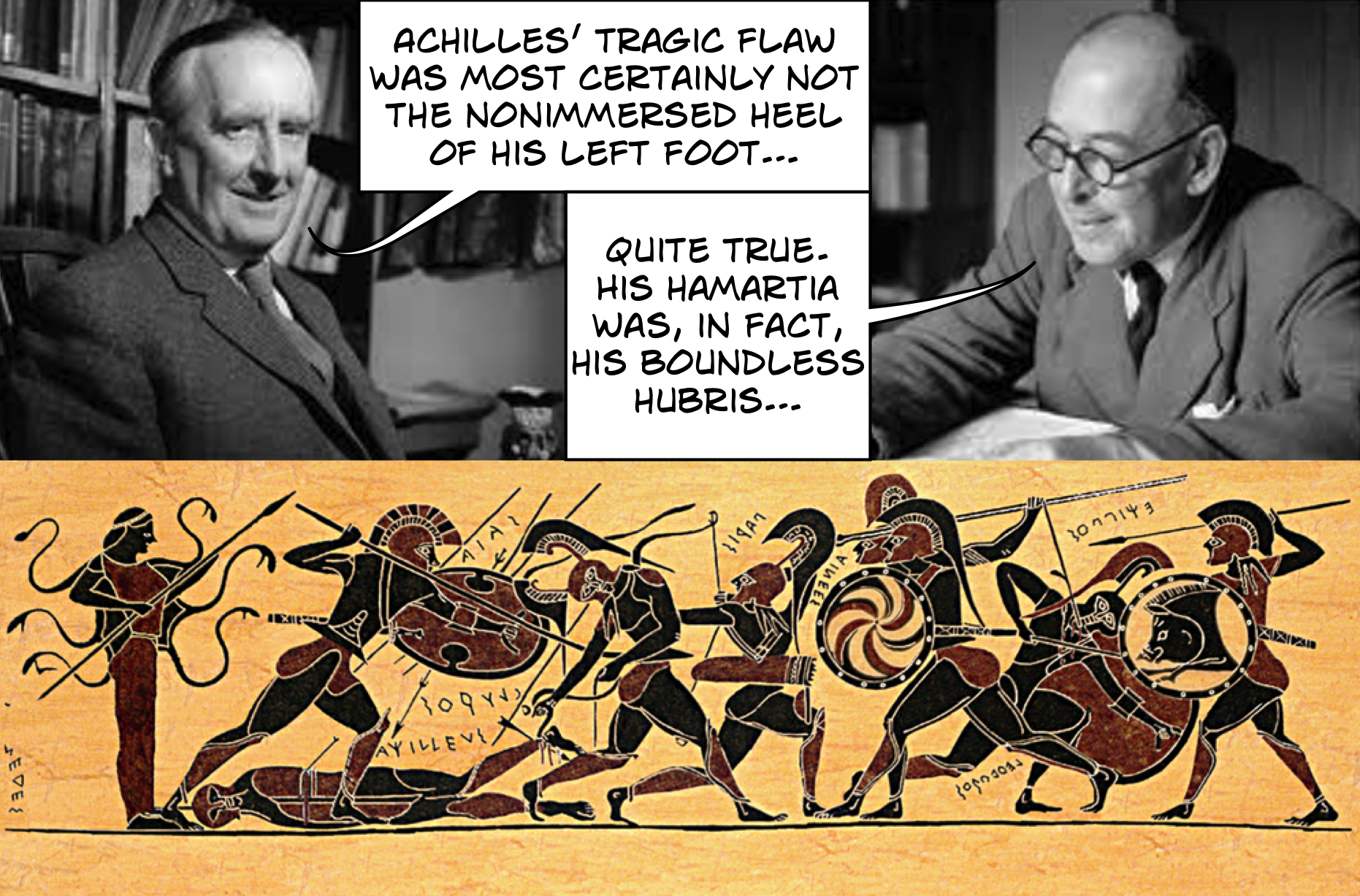
achilles

If you don’t know the meaning of “hamartia,” you’re not alone. But it’s a very important word, for more than one reason, so read on.

Hamartia describes a feature many writers of fiction or drama instill in their most memorable characters. It simply means “tragic flaw.” The deep character defect which cannot be overcome by sincere intention or persistent effort.

Merriam-Webster describes it this way.

Aristotle introduced the term in the Poetics to describe the error of judgment which ultimately brings about the tragic hero’s downfall. As you can imagine, the word is most often found in literary criticism.

However, news writers occasionally employ the word when discussing the unexplainable misfortune or missteps of übercelebrities regarded as immortal gods and goddesses before being felled by their own shortcomings.

Despite being a thespian in high school, I never formally studied drama. So I didn’t encounter the word there.

Likewise, I have written consistently since earning a Journalism degree four decades ago. However, since I have a 37:1 nonfiction to fiction ratio, I did not know this Greek word had found its way into the English lexicon.

I was surprised to discover its English meaning in my usually-familiar word of the day email (from The Free Dictionary).

While I was unfamiliar with its English usage, I already knew the word. I originally met hamartia (ἁμαρτία) while studying the New Testament in Greek. Hamartia literally refers to “missing the mark,” and it is the primary biblical Greek word for sin.

The first usage of the word in the sense of being an inner quality, occurs in Aristotle’s Poetics.  Aristotle writing as a pre-Christian philosopher, naturally perceived the literary device in a pagan manner.

The Greek word hamartia translates pretty directly as “error” or “shortcoming” without any necessary overtones of guilt or moral failure. Our modern conception of tragedy and the “tragic flaw” of the hero usually involves the concept of hubris, or overweening pride, that leads to disaster.

Macbeth, for instance, has the arrogance to think he can overstep the laws of God and state, and ultimately pays dearly for this arrogance. Macbeth is a tragic hero with a clear tragic flaw: his downfall results from a moral failing and can be seen as divine retribution proportional to his guilt. But Macbeth also contains heavy Christian overtones that would of course be found nowhere in Greek tragedy.

An understanding of Aristotle’s concept of hamartia—and indeed an understanding of Greek tragedy in general—relies on an understanding of the ethics and cosmology of the ancient Greeks. . . . Greek ethics are based more on the notion of virtue than obligation.

What of the Consequences?

In a 2014 article entitled “C.S. Lewis: The Anti-Platonic Platonist,” Grace Tiffany skillfully explores the Platonic echoes in Lewis’ writings. In discussing his literary examples of human failings, she writes:

There are of course Biblical models justifying Lewis’ “negatively capable” presentations of misguided characters . . . An older philosophical source, if not a Platonic one, also justifies mimetic representations of evil by the argument that these are morally purgative.

Imitations of hamartia, or tragic error, produce “fear and pity” (Aristotle, Poetics 1453b)—compassion for the character elicited by a skilled simulation of his psychology, naturally accompanied by a healthy fear of ourselves making similar mistakes. What ensures the fear is, of course, the dramatization of the horrible end to which hamartia has led . . . (Christianity and Literature 63.3).

In 1953, C.S. Lewis wrote to a correspondent that sin was more than merely making a mistake. In doing so, he alludes to the change in the meaning of the word ἁμαρτία.

No. I don’t think sin is completely accounted for by faulty reasoning nor that it can be completely cured by re-education. That view has, indeed, been put forward: by Socrates and, in the early 19th Century, by Godwin.

But I think it overlooked the (to me) obviously central fact that our will is not necessarily determined by our reason. If it were, then, as you say, what are called ‘sins’ would not be sins at all but only mistakes, and would require not repentances but merely correction.

Returning to the literary or dramatic definition of hamartia as a tragic flaw, it seems to me that this term offers a fitting parallel to the word sin.

Ever since humanity’s fall, we suffer the curse of bearing original sin, a tragic flaw. It is a scar that no medical or psychological treatment can cure and no amount of determination can repair. This tragic flaw will be our doom. Unless, that is, there is One who is capable and desirous of restoring us to our original health and purity. One, perhaps, in whose own image you and I were created . . .

This wonder is something well worth pondering—and perhaps one day, writing about.