Education and the Human Mind

Learning is fun. Education can be enjoyable too. But obviously, they are not the same. 

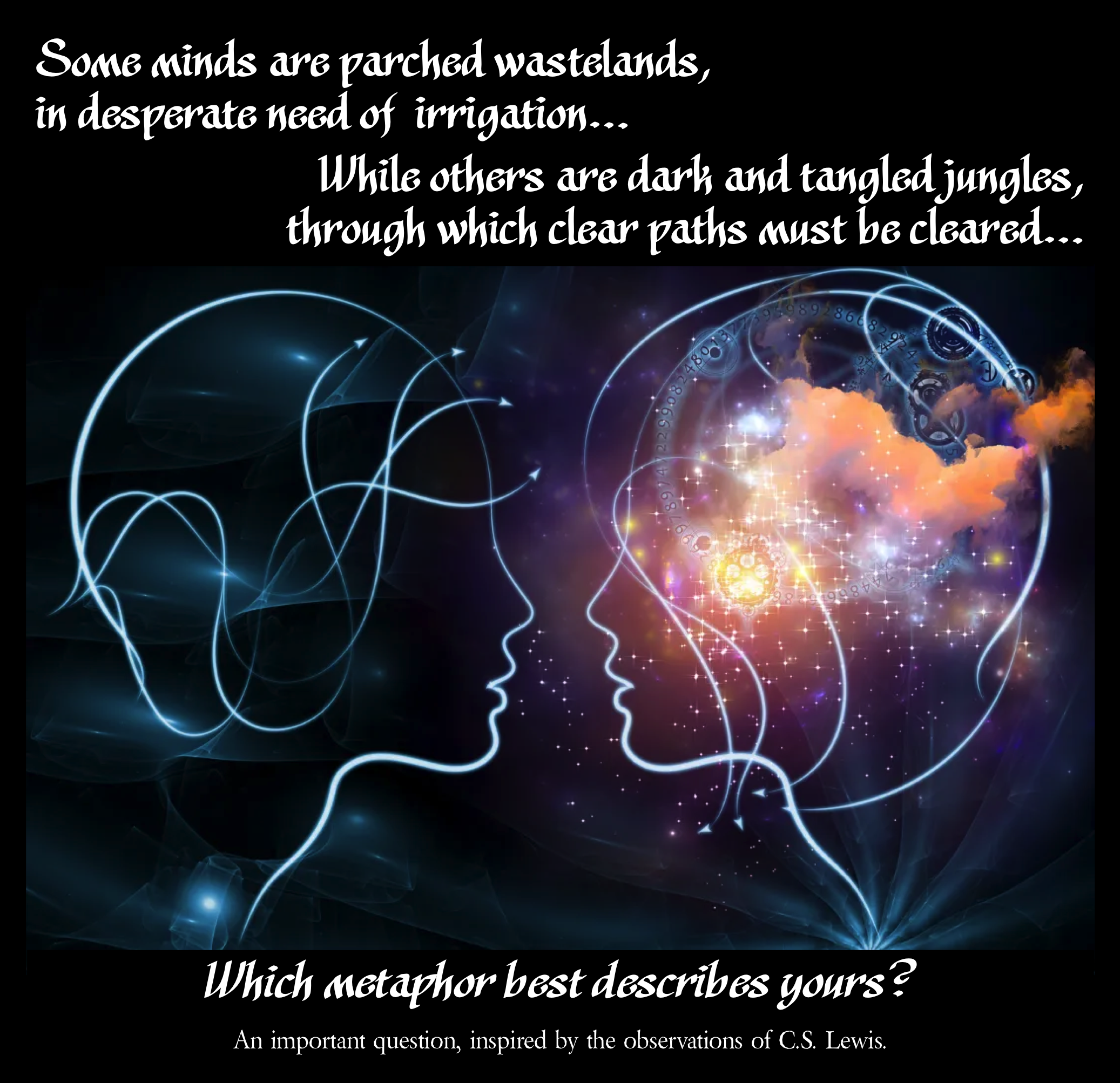
C.S. Lewis wrote a great deal about learning. A master of metaphors, he brilliantly described two distinct challenges faced by educators. In The Abolition of Man, he stated “the task of the modern educator is not to cut down jungles but to irrigate deserts.” 

Wheaton professor, Robert McKenzie, offers a concise explanation of Lewis’ keen observation.

‘Cutting down jungles,’ as I understand that phrase, means helping students with passionate convictions to evaluate critically their world views, to examine what lies beneath the personal beliefs they profess.

‘Irrigating deserts,’ conversely, involves nurturing in apathetic or cynical students the hope that there is meaning and purpose in human existence.

Quite true, and I believe Lewis’ insight is more timely today than it was during the past century.

Classical Versus Modern Education

Today I read a passage that reminded me just how dramatically contemporary curricula deviate from the traditional educational materials used before the modern era. 

While conducting research for a book about imperial Rome, which I hope to complete this year, I came upon the following passage. 

It would have been easy to swell this little volume to a very considerable bulk, by appending notes filled with quotations; but to a learned reader such notes are not necessary; for an unlearned reader they would have little interest; and the judgment passed both by the learned and by the unlearned on a work of the imagination will always depend much more on the general character and spirit of such a work than on minute details.

It appears in Lays of Ancient Rome by Thomas Babington Macaulay, which is available for free download at Internet Archive.

Macaulay (1834-59) was a prominent British historian and politician. His histories were thoroughly researched and widely respected, especially by those on the (liberal) Whig* end of the political spectrum.

A contemporary of Macaulay described his preparation for writing in poetic fashion. According to novelist William Makepeace Thackeray (1811-63), “he reads twenty books to write a sentence; he travels one hundred miles to make a line of description.”

It appears that, like C.S. Lewis, Macaulay possessed a lasting recollection of all he read. 

Returning to our beginning dichotomy – jungles versus deserts – both writers were a product of wide and critical literary study. Their minds were, in a sense, like a “rain forest.” Albeit, with C.S. Lewis it was certainly an orderly, well-tended forest. For some less stably grounded and more scatterbrained, the result is a jungle which requires radical clearing.

Alas, today’s more common problem, the unceasing pursuit of entertainment and distraction, leaves many with barren mental landscapes. In consequence, our calling as parents, educators, and friends, becomes one of irrigating the sparse flora and planting healthy new seeds in the hope that they will one day bloom.


* There is an interesting Mythlore article about C.S. Lewis’ view of history you can read here. In it, the author notes that “Lewis rejected a Whig history of unidirectional progress…” For a succinct article on the dangers of Whiggishness, I recommend “Evangelicals and Whig History” at First Things.

⁑ The brain truly can resemble a jungle, as a “digital reconstruction” reproduced on BrainFacts illustrates.

Immediately recognizable by its intricate folds and grooves, the cerebral cortex is the wrinkly, outer layer of the brain responsible for awareness, perception, and thought. Its interconnected neurons are arranged in six layers, a bit like the layers of tropical rainforests. . . . The findings may bring scientists closer to understanding how the complex jungle of cortical neurons interpret sensory information.

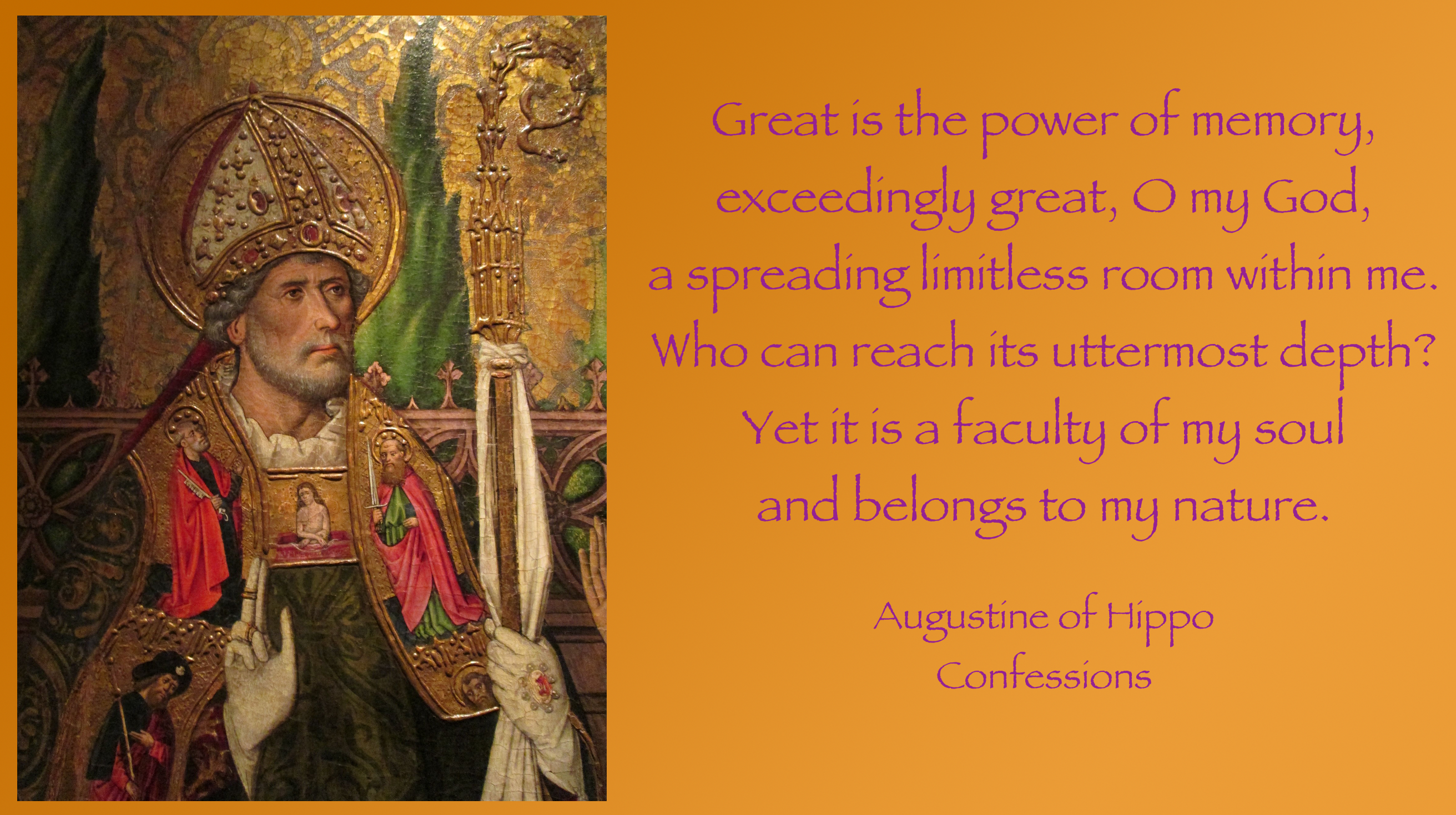
How Precious, Is Memory

What would you do if tomorrow you awoke never again able to remember the births of your three children? Never to remember your marriage or your college years? How would you rebuild your life with children and a husband you no longer knew?

In Out of the Silent Planet, C.S. Lewis described a fundamental expectation we possess – “Every day in a life fills the whole life with expectation and memory.” this makes the fragility of the human brain and mind all the more sad.

The question above sounds like the plot to some novel or film, but this was a real life experience for Marcy Gregg. She has written a detailed account of the amazing story in Blank Canvas, and an account of the experience is available online at Focus on the Family

Before you rush to read it, though, I would like to share a few thoughts about memory. Today, increasing life expectancies make senility and dementia far too familiar to families. Dismissing such disorders related to causes such as brain injuries or drug abuse, we still hear of so many cases of Alzheimer’s and other neurodegenerative diseases. Many of us have been touched by this pain, as it has destroyed the lives of people we love. 

Happily, there are growing options for residences equipped with skilled nursing care trained especially for “memory care.” The problem, of course, is not just the availability, but also the significant cost. AARP reported that in 2021, “the average memory care monthly rent is $6,935 in the U.S.”

That’s significantly more than assisted living, which averages $5,380 a month, but a lot less than the $10,562 average monthly cost of a nursing home.

Since we identify our personhood so heavily with our minds, we do not like to think about things like the multiple types of amnesia. Some are terrible, and one is nearly universal. WebMD includes six in their list. The woman above experienced anterograde amnesia which they describe as the loss of “your ability to recall events that happened just before the event that caused your amnesia.” Fortunately, though not the case for Marcy, they add, “usually this affects recently made memories, not those from years ago.‌”

One form of amnesia listed by WebMD may come as a surprise to you, as it did to me. It is referred to as infantile or childhood amnesia. It describes how our young brains were not yet developed well enough to consolidate and store memories for retrieval. Many of us lack early memories, and rely on stories and media to fill in that long gap in our lives.‌

A brief article from the University of Queensland describes how “memories aren’t stored in just one part of the brain.” Differing types are stored “across different, interconnected brain regions.”

Cedars-Sinai has “discovered two types of brain cells that play a key role in creating memories.”

“One of the reasons we can’t offer significant help for somebody who suffers from a memory disorder is that we don’t know enough about how the memory system works,” said [a] senior author of the study, adding that memory is foundational to us as human beings.

Human experience is continuous, but psychologists believe, based on observations of people’s behavior, that memories are divided by the brain into distinct events, a concept known as event segmentation.

Forgetfulness is, for most who live long enough, an unavoidable aspect of aging. But it may not be quite so bad as it appears to us, as C.S. Lewis related in a letter written several years before his death.

About forgetting things. Dr. Johnson* said “If, on leaving the company, a young man cannot remember where he has left his hat, it is nothing. But when an old man forgets, everyone says, Ah, his memory is going.”

So with ourselves. We have always been forgetting things: but now, when we do so, we attribute it to our age.

Why, it was years ago that, on finishing my work before lunch, I stopped myself only just in time from putting my cigarette-end into my spectacle case and throwing my spectacles into the fire!

Forgetfulness is a common part of human experience, but clinical amnesia is something altogether different.

Tragically, some suffer from anterograde amnesia. One of the saintly matrons at our church carries this cross, assisted by her loving daughter and son-in-law. This cruel disease prevents the retention of new memories. While it is often linked with geriatric considerations, and can affect all of one’s memories, this article from the National Library of Medicine describes a particularly tragic case in which a child “had an abrupt onset of amnesia due to a respiratory arrest at the age of 8 years.”

Cases such as this move Christians to prayer, and many others to despair. While miracles do happen, they are rarer than we desire. Ultimately the Christian hope is in a Lord who keeps his promises, and one of these is that he will come again and will take us to himself, so that where he is, we may be also (John 14). And, in heaven, we will receive a new body like Christ’s resurrection body (Philippians 3).


* Samuel Johnson (1709-1784), a prolific and influential English writer, was often referred to simply as “Dr. Johnson.” Many volumes of the good doctor’s writings are available as free downloads from Internet Archive. For example, volume 7 of the 1810 collection, includes the following essay discussing human shallowness. He begins by contemplating the ability of animals to remember and to anticipate the future.

The Idler
Numb. 24. Saturday, September 30, 1758.

When man sees one of the inferiour creatures perched upon a tree, or basking in the sunshine, without any apparent endeavour or pursuit, he often asks himself or his companion, On what that animal can be supposed to be thinking?

Of this question, since neither bird nor beast can answer it, we must be content to live without the resolution. We know not how much the brutes recollect of the past, or anticipate of the future; what power they have of comparing and preferring; or whether their faculties may not rest in motionless indifference, till they are moved by the presence of their proper object, or stimulated to act by corporal sensations.

I am the less inclined to these superfluous inquiries, because I have always been able to find sufficient matter for curiosity in my own species. It is useless to go far in quest of that which may be found at home; a very narrow circle of observation will supply a sufficient number of men and women, who might be asked, with equal propriety, On what they can be thinking?

It is reasonable to believe, that thought, like every thing else, has its causes and effects; that, it must proceed from something known, done, or suffered; and must produce some action or event. Yet how great is the number of those in whose minds no source of thought has ever been opened, in whose life no consequence of thought is ever discovered; who have learned nothing upon which they can reflect; who have neither seen nor felt any thing which could leave its traces on the memory; who neither foresee nor desire any change of their condition, and have therefore neither fear, hope, nor design, and yet are supposed to be thinking beings.

To every act a subject is required. He that thinks must think upon something. But tell me, ye that pierce deepest into nature, ye that take the widest surveys of life, inform me, kind shades of Malbranche [Nicolas Malebranche] and of [John] Locke, what that something can be, which excites and continues thoughts in maiden aunts with small fortunes; in younger brothers that live upon annuities; in traders retired from business; in soldiers absent from their regiments; or in widows, that have no children?

Life is commonly considered as either active or contemplative; but surely this division, how long soever it has been received, is inadequate and fallacious. There are mortals whose life is certainly not active, for they do neither good nor evil; and whose life cannot be properly called contemplative, for they never attend either to the conduct of men, or the works of nature, but rise in the morning, look round them till night: in careless stupidity, go to bed and sleep, and rise again in the morning.

Johnson’s essay continues with a discussion of the soul and its distinction from the mental processes themselves. Obviously, he is not considering the subject of amnesia, but he reminds us never to become too doctrinaire, since that “supposes what cannot be proved, that the nature of mind is properly defined.” 

His purpose in the essay is not to discuss the abilities of the brain but, at least in part, to critique those who choose to be unthinking. Those who spend not a moment in reflection or contemplation.

I encourage you to read the entire essay, as it demonstrates Johnson’s brilliance. I close this extended “footnote” with a passage in his concluding section which keenly describes our common human experience with memory.

We every day do something which we forget when it is done, and know to have been done only by consequence. The waking hours are not denied to have been passed in thought; yet he that shall endeavour to recollect on one day the ideas of the former, will only turn the eye of reflection upon vacancy; he will find, that the greater part is irrevocably vanished, and wonder how the moments could come and go, and leave so little behind them.

Good & Bad Memories

We humans are fascinating creatures. Our capacity to remember both the good and the ill from our past, exerts a powerful influence on the course of our future.

I’ve been reflecting on this contrast since our lectionary readings from worship this past Sunday. (I’ll note the particular passage that triggered my thoughts in a moment.)

The question I’ve pondered is whether good memories are more powerful than bad memories. By bad, I’m not referring to horrific experiences which our minds sometimes actively suppress or bury.

I’m thinking of unpleasant, disappointing memories. Things that we regret having happened, either to us, or because of us.

When I use the word “powerful” in my question, I’m referring to the ability of a given memory to continue actively impacting our lives.

In too many lives, it seems the joy and light emanating from positive recollections is often shaded or eclipsed by the clouds of painful memories.

Perhaps our lives would be happier if we consciously spent time recalling good experiences, and taught ourselves to reject – rather than dwell upon – negative thoughts when they force their way onto the stage?

C.S. Lewis provides a curious insight into the nature of memories. Their overarching essence often seem to magnify as time passes. Listen to his words, penned after a vacation in 1921, in which he describes how the joyful memories will grow ever sharper as they are recalled in the future.

I still feel that the real value of such a holiday is still to come, in the images and ideas which we have put down to mature in the cellarage of our brains, thence to come up with a continually improving bouquet.

Already the hills are getting higher, the grass greener, and the sea bluer than they really were; and thanks to the deceptive working of happy memory our poorest stopping places will become haunts of impossible pleasure and Epicurean repast.

Sadly, though, even glorious memories can sometimes fade away. This is the grimmest tragedy of many forms of dementia.

Memory in the Chronicles

C.S. Lewis does some curious things with memory in his Chronicles of Narnia. While the Pevensie children grow to adulthood reigning over Narnia, they end up forgetting about their earlier lives. Only when they stumble upon the Lamp-post, do they recall the land of their birth.

“By the Lion’s Mane, a strange device,” said King Peter, “to set a lantern here where the trees cluster so thick about it and so high above it that if it were lit it should give light to no man!”

So these Kings and Queens entered the thicket, and before they had gone a score of paces they all remembered that the thing they had seen was called a lamp-post, and before they had gone twenty more they noticed that they were making their way not through branches but through coats.

And next moment they all came tumbling out of a wardrobe door into the empty room, and they were no longer Kings and Queens in their hunting array but just Peter, Susan, Edmund and Lucy in their old clothes.

It was the same day and the same hour of the day on which they had all gone into the wardrobe to hide. Mrs. Macready and the visitors were still talking . . . (The Lion, the Witch and the Wardrobe).

In Prince Caspian, a wise advisor, Doctor Cornelius, secretly informs the heir to the Narnian throne that the old stories were not simply myths. The evil Telmarines had actively labored to erase all memory of Narnia’s true nature.

“Listen,” said the Doctor. “All you have heard about Old Narnia is true. It is not the land of Men. It is the country of Aslan, the country of the Waking Trees and Visible Naiads, of Fauns and Satyrs, of Dwarfs and Giants, of the gods and the Centaurs, of Talking Beasts. It was against these that the first Caspian fought.

It is you Telmarines who silenced the beasts and the trees and the fountains, and who killed and drove away the Dwarfs and Fauns, and are now trying to cover up even the memory of them. The King does not allow them to be spoken of.”

I find the following description of a renewed memory particularly picturesque. It takes place after the Pevensie children return to Narnia years after their initial visit.

Everyone except Lucy went to sleep at once. Lucy, being far less tired, found it hard to get comfortable. Also, she had forgotten till now that all Dwarfs snore. She knew that one of the best ways of getting to sleep is to stop trying, so she opened her eyes.

Through a gap in the bracken and branches she could just see a patch of water in the Creek and the sky above it. Then, with a thrill of memory, she saw again, after all those years, the bright Narnian stars. She had once known them better than the stars of our own world, because as a Queen in Narnia she had gone to bed much later than as a child in England.

And there they were – at least, three of the summer constellations could be seen from where she lay: the Ship, the Hammer, and the Leopard. “Dear old Leopard,” she murmured happily to herself (Prince Caspian)

Forgetting the Past

Every one of us has made mistakes. And far too often we allow those poor decisions and choices to haunt us the rest of our lives. That delights the Devil, one of whose titles is Accuser.

He wants us mired in the past, thinking there is no way we could ever earn God’s love.

The simple fact is that we don’t earn our Creator’s love. It’s a free gift. It is pure grace, and utterly unmerited.

Once we have confessed our sins, God washes them away and cleanses us from all unrighteousness.

To emphasize how God no longer holds our past sins against us, consider some of the ways he expresses his capacity to permanently forgive our confessed sins.

He does not deal with us according to our sins, nor repay us according to our iniquities… so great is his steadfast love toward those who fear him; as far as the east is from the west, so far does he remove our transgressions from us (Psalm 103).

Who is a God like you, pardoning iniquity and passing over transgression..? You will cast all our sins into the depths of the sea. (Micah 7:18-19).

And now, for the verse which inspired my thoughts. It struck me as particularly helpful for our Christian lives, given the fact that God does not keep a permanent record of our sins. Wouldn’t our lives be better if we followed the Lord’s example?

Not that I… am already perfect, but I press on to make it my own, because Christ Jesus has made me his own… one thing I do: forgetting what lies behind and straining forward to what lies ahead, I press on toward the goal for the prize of the upward call of God in Christ Jesus (Philippians 3:12-14).

“Forgetting what lies behind,” our past failings which have been forgiven, liberates us to live the life to which God calls us.

That’s seldom easy to do, but knowing how “far [God] removes our transgressions from us,” makes that possibility much more likely. Let us press on.

Recalling Information Like C.S. Lewis

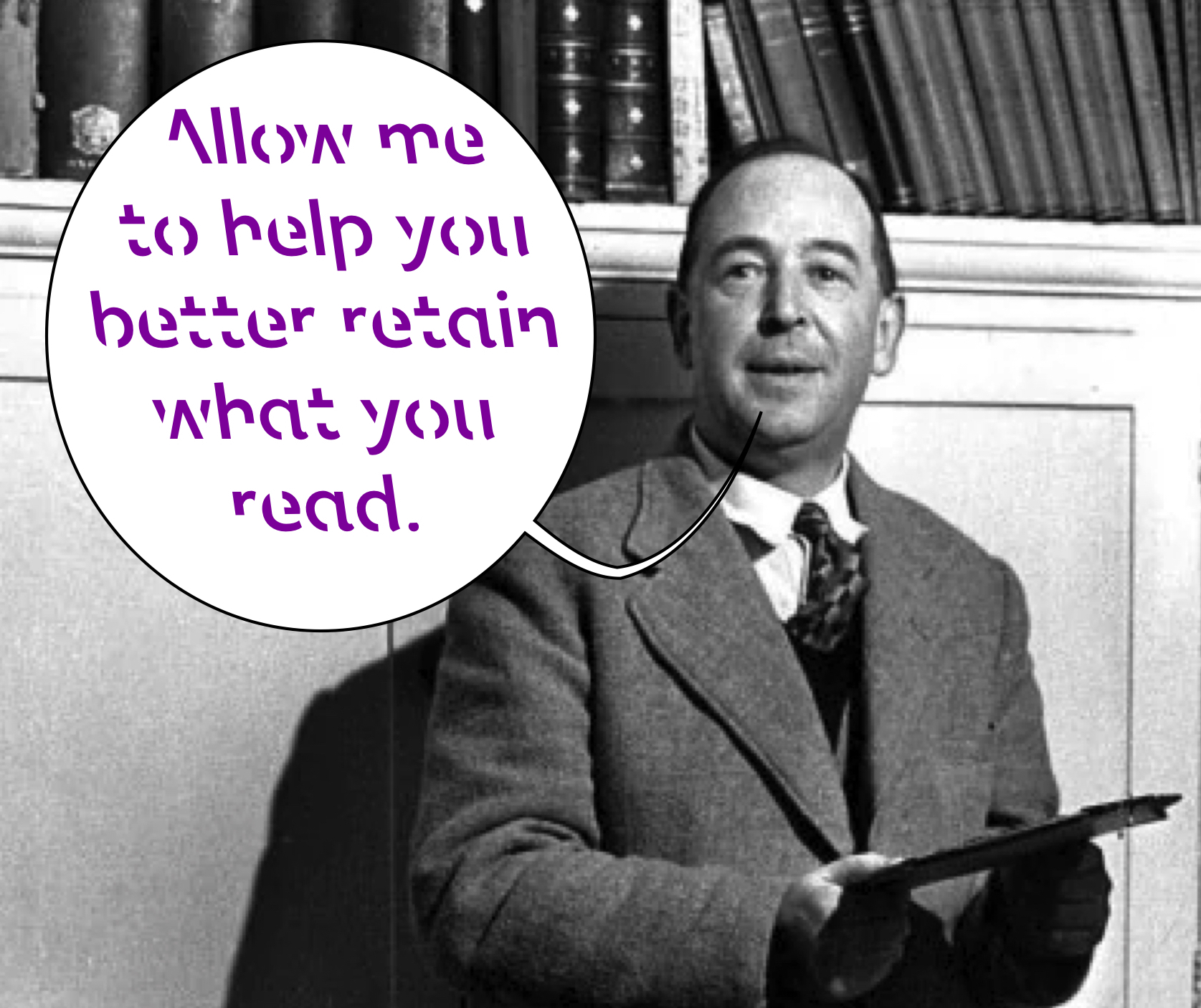
csl forgetica

Do you have trouble remembering what you read? Read on for a solution to your problem.

C.S. Lewis possessed an amazing memory of what he had read. While eidetic memory remains theoretical, many attributed a “photographic memory” to the Oxford don. Owen Barfield, Lewis’ close friend, described this gift.

He had that very pictorial imagination. I know when we used to go on walks, I used to envy him that. . . . He had what I think is called by some people an “eidetic memory,” when your imaginative pictures are almost photographic. (Owen Barfield on C.S. Lewis edited by G.B. Tennyson)

Describing Lewis’ earnest patience with others, however “ignorant or naïve” (Barfield’s opinion) the person, Barfield describes how readily Lewis recalled pertinent facts.

First he would speak as one simple man exchanging experiences with another, and only afterward (if the occasion seemed to call for it and always without the least nuance of didacticism) would he bring to bear, out of his wide reading and phenomenal memory, some pithy utterance—it might be from Aristotle’s Ethics, it might be from an Icelandic saga, it might be from George MacDonald—that contained the very substance of what the two of them had just discovered they had in common.

There appears to be hope on the horizon for those of us who are not blessed with Lewis’ talent for recalling what we read. RMIT University (formerly the Royal Melbourne Institute of Technology) has devised a new font that uses a psychological principle called “desirable difficulty” to help readers retain more.

Take a look at Sans Forgetica in its own font. forgetica


The “difficult” part is evident in the lacunae that force one’s mind to fill in the gaps and make sense of each letter and word. The “desirability” comes with the way that our brains are able to decipher with just enough effort to imprint the material more deeply in our minds.

This principle reminded me of something written by Richard Foster, author of Celebration of Discipline. He describes the importance of concentration on our spiritual growth, as we seriously examine and process whatever is worthy of thinking upon. (Philippians 4:8)

I have mentioned the disciplines of service and worship. There are many others. Inward disciplines, like meditation, prayer, fasting, and study, cultivate our heart and mind toward the way of Christ. Meditation is the ability to hear God’s voice and obey his word.

Prayer is ongoing dialogue with the Father about what God and we are doing together. Fasting is the voluntary denial of an otherwise normal function for the sake of intense spiritual activity.

Study is the process through which we bring the mind to conform to the order of whatever we are concentrating upon. (Becoming Like Christ)

On the Elegance of Fonts

Longtime readers of Mere Inkling are well aware of my personal fascination with fonts. This link will reveal posts I’ve tagged with the subject. It reveals that different fonts exist for more than aesthetic reasons.

While some are simply created for decorative or mood-setting purposes—such as typefaces that mimic monastic scripts or the text created for the first Narnia film—others are devised for more practical purposes. The latter collection includes one created to aid those who suffer from dyslexia (Dyslexie). The intentionally useful category will now include Sans Forgetica.

Sans Forgetica is available for free. As evidence of either its merit or the promotional skills of its creators, they have already created an extension for the Chrome browser. It allows users to convert internet text on their screens to the memorable font.

I would suggest that such an application be used sparingly. Most of what we read on the internet is not worth recalling, much less clogging our brains with trivia and worse. Still, if applied selectively, it could be useful. After all, if it only moves us a centimeter in the direction of retaining information like C.S. Lewis, that’s a move in the right direction!


Fleeting Fame

fameIt’s likely that the names of 98.6% of authors who top the bestseller charts today will be unremembered a century from now.

This weekend I posted the latest issue of Curtana: Sword of Mercy, a journal I edit about military chaplains. (If you are interested in checking it out, you can download a free copy here.)

The current issue includes an interesting article about two chaplains from Vermont who served during the War of 1812. (For international readers, that was the war following the winning of America’s independence when they British got their revenge—they captured our national capital and burned the capitol.)

In the biographical portion of the article, the author included a final summary of the life of one of the chaplains. Solomon Aiken (1758-1833) left his civilian pulpit to serve soldiers and sailors.

Aiken was quite prominent in his day. Not only was he a well known preacher and writer, he actually served as a member of Vermont’s legislature. Yet, I doubt that even Vermonters would recognize his name today.

Here is the quotation from a nineteenth century tribute published after his passing.

Mr. Aiken enjoyed uncommon health and vigor. He never took a particle of medicine, or lost a relish for food, until his final and brief sickness—a pleurisy fever. He possessed peculiar power as a logician, and was very popular as a preacher. He was kind-hearted and benevolent, almost to a fault. But it is chiefly as a political writer that Mr. Aiken is remembered. He was sent as a representative for two years, by the town of Dracut. He published several sermons and pamphlets, chiefly upon political themes, which excited much attention in their season.

The words that seized my attention were the conclusion, “. . . which excited much attention in their season.”

“In their season . . .” That season must have been brief, since the history was written just twenty years after Aiken’s death. By then his works had either withered or, more optimistically, gone to seed. In either case, their day was passed.

Translating that to our modern era, where things become obsolete almost as soon as they are envisioned, it would imply that our “season” of fame or reputation will last little more than a handful of months. And that, of course, assumes that a person actually achieves some level of renown.

Fame is fleeting. It has always been so, and the good Reverend Aiken is simply another example of that truth.

Thank God (literally) that there is more to life than notoriety.

C.S. Lewis is one of the 1.4% whose fame lasts. His has not diminished; it continues to grow. Just a year ago, on the fiftieth anniversary of his death, he was honored by having a plaque dedicated in Poet’s Corner in Westminster Abbey.

Lewis never sought fame, as the following discussion from his essay “The Weight of Glory” clearly reveals.

I turn next to the idea of glory. There is no getting away from the fact that this idea is very prominent in the New Testament and in early Christian writings. Salvation is constantly associated with palms, crowns, white robes, thrones, and splendour like the sun and stars. All this makes no immediate appeal to me at all, and in that respect I fancy I am a typical modern.

Glory suggests two ideas to me, of which one seems wicked and the other ridiculous. Either glory means to me fame, or it means luminosity. As for the first, since to be famous means to be better known than other people, the desire for fame appears to me as a competitive passion and therefore of hell rather than heaven. As for the second, who wishes to become a kind of living electric light bulb?

When I began to look into this matter I was stocked to find such different Christians as Milton, Johnson and Thomas Aquinas taking heavenly glory quite frankly in the sense of fame or good report. But not fame conferred by our fellow creatures—fame with God, approval or (I might say) “appreciation’ by God.

And then, when I had thought it over, I saw that this view was scriptural; nothing can eliminate from the parable the divine accolade, “Well done, thou good and faithful servant.” With that, a good deal of what I had been thinking all my life fell down like a house of cards.

This exceptional work merits consideration not only by people of faith. It invites all honest readers to gaze within themselves at their deepest yearnings.

Another passage from C.S. Lewis that relates strongly to the subject at hand comes from The Great Divorce. You can read the entire passage here, but the heart of it is this. Lewis views a simple woman, presently in heaven, receiving magnificent praise and celebration. He naturally assumes she must have been some well known saint.

He is, however, informed that she lived an obscure life, despite the fact that she touched countless nondescript people and animals with her compassion. Lewis’ heavenly guide is rather surprised that the Oxford professor has overlooked a simple truth:

Fame in heaven “and fame on Earth are two quite different things.”

Only the second will last.