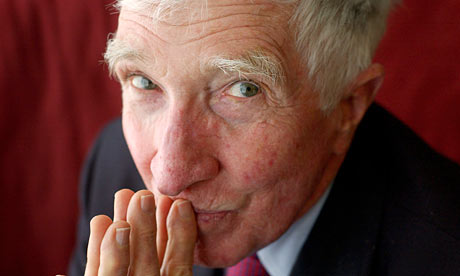
Easter, Updike & Lewis

updikeHappy Easter Monday. Even if you do not believe Jesus has risen from the dead, I sincerely hope you are experiencing a special season of hope and peace.

For Christians, however, the bodily resurrection of Jesus is not an optional doctrine.

The Scriptures affirm the truth that, “. . . if Christ has not been raised, then our preaching is in vain and your faith is in vain. . . . if Christ has not been raised, your faith is futile and you are still in your sins. Then those also who have fallen asleep in Christ have perished. If in Christ we have hope in this life only, we are of all people most to be pitied” (1 Corinthians 15:14-19, ESV).

John Updike (1932-2009) recognized this truth and wrote an oft-quoted poem about it.*

“Seven Stanzas at Easter”

Make no mistake: if he rose at all

It was as His body;

If the cell’s dissolution did not reverse, the molecule reknit,

The amino acids rekindle,

The Church will fall.

It was not as the flowers,

Each soft spring recurrent;

It was not as His Spirit in the mouths and fuddled eyes of the

Eleven apostles;

It was as His flesh; ours.

The same hinged thumbs and toes

The same valved heart

That—pierced—died, withered, paused, and then regathered

Out of enduring Might

New strength to enclose.

Let us not mock God with metaphor,

Analogy, sidestepping, transcendence,

Making of the event a parable, a sign painted in the faded

Credulity of earlier ages:

Let us walk through the door.

The stone is rolled back, not papier-mache,

Not a stone in a story,

But the vast rock of materiality that in the slow grinding of

Time will eclipse for each of us

The wide light of day.

And if we have an angel at the tomb,

Make it a real angel,

Weighty with Max Planck’s quanta, vivid with hair, opaque in

The dawn light, robed in real linen

Spun on a definite loom.

Let us not seek to make it less monstrous,

For our own convenience, our own sense of beauty,

Lest, awakened in one unthinkable hour, we are embarrassed

By the miracle,

And crushed by remonstrance.

Updike & Lewis

Poetry and faith were not the only interests shared by Updike and C.S. Lewis. Both men were literary critics, as well as authors in their own right. Updike’s description of his approach to criticism echoes many of the same principles displayed by Lewis.

1. Try to understand what the author wished to do, and do not blame him for not achieving what he did not attempt.

2. Give enough direct quotation—at least one extended passage—of the book’s prose so the review’s reader can form his own impression, can get his own taste.

3. Confirm your description of the book with quotation from the book, if only phrase-long, rather than proceeding by fuzzy précis.

4. Go easy on plot summary, and do not give away the ending.

5. If the book is judged deficient, cite a successful example along the same lines, from the author’s œuvre or elsewhere. Try to understand the failure. Sure it’s his and not yours?**

Updike wrote, “I read C.S. Lewis for comfort and pleasure,” praise that has been included in advertising campaigns. A fuller account of his appreciation for Lewis’ work comes in the following passage, from Conversations with John Updike.

The provableness of God is a subject Updike may have mused upon during the many Sunday mornings he has spent in church. Updike is a lifelong churchgoer. He was raised a Lutheran, became a Congregationalist during his first marriage, and has recently joined the Episcopal church.

“I don’t see anything else around really addressing, for me, one’s basic sense of dread and strangeness other than the Christian church,” he said. “I’ve written maybe all too much about religion here and there. But there have been times when I read a lot of theology. The year I spent in England [after graduation from Harvard] I was very nervous and frightened, standing more or less on the threshold of my adult life and career, if any.

“One of the ways I assuaged my anxiety was to read a lot of G.K. Chesterton and C.S. Lewis, some Kierkegaard, and when I moved to New England, I read a lot of Karl Barth. My intensive theology reading extends from about the age of 22 to, say, 30. I get great pleasure out of reading theology.”

Reading Theology

Updike was correct. Contemplating holy matters can certainly be pleasurable. That is true even when we are chewing on complex subjects, difficult to digest. After all, “everyone who lives on milk is unskilled in the word of righteousness, since he is a child. But solid food is for the mature, for those who have their powers of discernment trained by constant practice to distinguish good from evil” Hebrews 5:13-14, ESV).

The resurrection of Jesus may be one of these truths not simple for all to believe. I pray for those who find this a challenge. But, God forbid that any of us should reject the most significant event in human history, “Lest, awakened in one unthinkable hour, we are embarrassed by the miracle, and crushed by remonstrance.”

_____

* For the interesting story of how this poem won first place in a competition at his church, you can read his pastor’s recollections here.

** Updike’s list concludes with these words: “To these concrete five might be added a vaguer sixth, having to do with maintaining a chemical purity in the reaction between product and appraiser. Do not accept for review a book you are predisposed to dislike, or committed by friendship to like. Do not imagine yourself a caretaker of any tradition, an enforcer of any party standards, a warrior in any ideological battle, a corrections officer of any kind. Never, never . . . try to put the author ‘in his place,’ making of him a pawn in a contest with other reviewers. Review the book, not the reputation. Submit to whatever spell, weak or strong, is being cast. Better to praise and share than blame and ban. The communion between reviewer and his public is based upon the presumption of certain possible joys of reading, and all our discriminations should curve toward that end.”

Avoiding Gadzookeries

gadzookeryWriting quality historical fiction is challenging. This is especially true if one wishes to avoid the common crutch that a talented writer of the last century first labeled “gadzookery.”

And just what is this faux pas we should avoid when writing about the past? Well, it relates most directly to the dialog placed on the lips of historical figures. The offensive technique involves the overuse of archaic expressions or phrases. (Some would argue it includes any use of any archaisms.)

If the word gadzookery sounds a tad, how shall I put it, “goofy” to you, you may prefer using another word that means the same thing: “tushery.” Tushery was coined by Robert Louis Stevenson. Way back in the nineteenth century.

Gadzookery is a newer version, insulting the same lazy writing technique. I believe it may have been coined by Rosemary Sutcliff (1920-1992). Sutcliff’s historical influence has exerted a literary influence on my life second only to C.S. Lewis.*

The article about Sutcliff in The Oxford Encyclopedia of Children’s Literature praises her work, saying, “She carefully creates dialogue in her novels that recollects the speech of a bygone era without falling into what she termed ‘gadzookery.’”

Having tested the waters of historical fiction myself, I know this to be far more difficult that it may sound.

Sutcliff had several things in common with C.S. Lewis. Both wrote for adults and for children. (It was her young adult series about the decline of Roman influence in Britain that sparked my own lifelong interest in Rome.)

Both authors also received the Carnegie Medal for their work. When Lewis was awarded his, he received a congratulatory letter from Pauline Baynes, who had illustrated several of his books. He responded quite graciously.

Dear Miss Baynes, Very nice to hear from you again, and thanks for sending on the book, which I have returned to Lane. Thanks for your congratulations on the Carnegie, but is it not rather ‘our’ Medal? I’m sure the illustrations were taken into consideration as well as the text. I am well, and as happy as a man can be whose wife is desperately ill.

Although C.S. Lewis had married, quite late in life, the two authors were alike in spending most of their life single. Sutcliff, in fact, lived with her parents during most of her life, having suffered crippling arthritis as a child. She did not resent remaining unmarried. In a 1992 interview she said,

Beatrix Potter wrote all her gorgeous stories when she was very lonely and not very happy—after she married, she never wrote another thing. Nothing worth reading, anyway.

Another similarity between the two was that they both fell under the powerful sway of myth during their childhoods. They used their familiarity with its rich echoes to imbue their own work with themes that flowed far beyond the familiar channels travelled by other writers.

Each of them took their readers seriously, and refused to speak down to them. That is why they share one more quality I wish to mention in closing—their high standards. Neither Lewis nor Sutcliff could tolerate poor writing. And their finely tuned skills meant neither ever needed to resort to gadzookery.

______

* Excepting, of course, the Bible itself, which is literature of an entirely different sort. I don’t consider it fair to compare mortal writers, no matter how inspired, to a volume I regard as God’s written word.

Introducing Anatole France

papeThere’s always a new author to meet. Some are more worth meeting than others.

I was introduced to Anatole France (1844-1924) when I saw him listed on the “must read” list of F. Scott Fitzgerald.

I’m not a big Fitzgerald fan, but as an amateur literary historian, I was curious about how this particular list was recovered. Apparently, he had dictated it to one of his nurses, several years before his death. However, the list only turned up last year, having lain unnoticed in the nurse’s effects.

The France title that Fitzgerald deemed essential was The Revolt of the Angels. Its importance to him is highlighted by the fact that this relatively short list only included twenty-two titles. And one of that mere score of selections was The Revolt of the Angels.

The angelic dimension of the work is what intrigued me. Angels, of course, are real beings. They’re distinct from people (contrary to the pervasive contemporary notion that when people die they “become” angels).

There actually was an angelic revolt, and there are several references to it in the Scriptures. “How you are fallen from heaven,
O Day Star, son of Dawn!” (Isaiah 14:12).

I was curious whether France was writing about this ancient event. I was also intrigued by Fitzgerald’s interest in the volume, given its subject.

I was disappointed.

It turns out that, like Mark Twain, France was sympathetic to the Devil. I’m sure he thought himself quite the wit when he wrote, in reference to the Bible, “We have never heard the devil’s side of the story, God wrote the whole book.”

I don’t have time to read texts like this—when there is more than enough good literature to keep me occupied for several lifetimes. However, it appears to be based on Gnostic concepts with God (the Creator of this world) viewed as an imperfect demiurge. His incompetence, it seems, justifies the heavenly revolt.

Suffice it to say, the book is commended for reading by the Freedom From Religion Foundation. That sort of endorsement speaks volumes.

Here, however, is a random paragraph. It may be illustrative of the tone of the work, even though pulled from its context. The speaker is, I believe, one of the positive characters in the book. While France himself was an atheist, his sympathetic character summarizes a pagan cosmology quite elegantly.

Young Maurice’s guardian angel [said] “I argue, like you, in the language of human beings. And what is human language but the cry of the beasts of the forests or the mountains, complicated and corrupted by arrogant anthropoids. How then . . . can one be expected to argue well with a collection of angry or plaintive sounds like that?

Angels do not reason at all; men, being superior to the angels, reason imperfectly. I will not mention the professors who think to define the absolute with the aid of cries that they have inherited from the pithecanthropoid monkeys, marsupials, and reptiles, their ancestors! It is a colossal joke! How it would amuse the demiurge, if he had any brains!”

That is actually a rather provocative quote, and I’m sure it may lead some to explore the text even further. I certainly don’t object to that, and would be curious to hear back from anyone familiar with the book. I would especially like to see the reaction of Christians to The Revolt of the Angels.

If you are interested in a more creative fictional treatment of fallen angels, be sure to read C.S. Lewis’ The Screwtape Letters. While the presentation is truly groundbreaking, Lewis’ take on the motives and nature of these defeated beings is actually based on reality. Cast from the heavens they are consumed with rage and hatred of God.

A positive note about Anatole France

Whatever I think about the writer’s theology, I did read several wise quotations attributed to him. I’d like to close with these, as they may be more edifying than our discussion of Gnostic cosmology.

“Nine tenths of education is encouragement.”

“Some succeed because they are destined to; most succeed because they are determined to.”

“If 50 million people say a foolish thing, it is still a foolish thing.”

“When a thing has been said and well said, have no scruple; take it and copy it.”

And my favorite:

“Until one has loved an animal, a part of one’s soul remains unawakened.”

_____

The illustration above is the work of Frank C. Papé (1874-1972) an English book illustrator. It comes from another of France’s “religious” works.

Corrupted Poetry

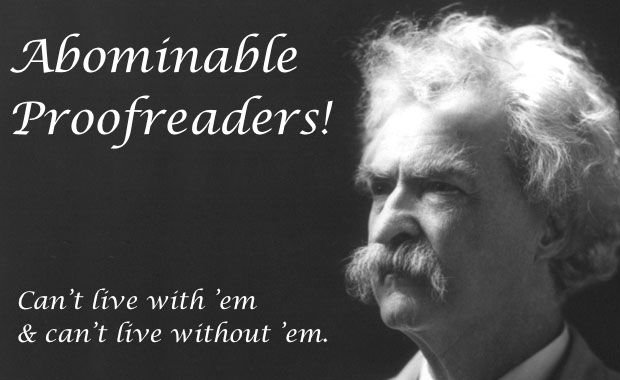
proofreadersA sloppy proofreader can ruin the most praiseworthy writing. (Just ask Mark Twain.)

If you’ve ever seen something you wrote poorly edited—or including introduced errors—you know personally just how criminal this is.

My choice of adjectives reveals that these tragedies are nearly always mistakes, and not malevolent. Despite that fact, they disrupt the flow and impugn the skill of truly good writers.

I was thinking about this subject today after running across the following passage during my research of the American Civil War. An 1861 newspaper lifted the following from an issue of the Boston Courier.

The Errors of the Press—“Really,” said a printer, in conversing with a literary man about errors of the press, “gentlemen should not place such unlimited confidence in the eyesight of our hard worked and half-blinded reader of proofs; for I am ashamed to say that we utterly ruined one poet through a ludicrous misprint.”

“Indeed! and what was the unhappy line?”

“Why, sir, the poet intended to say:

     ‘See the pale martyr in a sheet of fire;’

instead of which we made him say:

     ‘See the pale martyr with his shirt on fire.’”

The critics were down fierce on the poet; but we don’t see why. A man “with his shirt on fire” must be a highly poetical object, as his life would be in imminent danger.—Boston Courier.

I can easily picture the exhausted proofreader unintentionally substituting a burning garment for a consuming inferno. It made sense to him. And, since he was unlikely to have an ear tuned to poetic imagery, the practical reference to ignited clothing must be what the poet actually meant.

This reminds me that it’s impossible to have too many eyes cast upon the final draft of a work before it goes to print. Take care of your friends and family who offer you the gift of proofreading; their talents deserve to be appreciated and rewarded.

Mark Twain’s Thoughts on the Subject

Samuel Clemens got his own start in the newspaper business and knew firsthand how challenging proofreading was. However, that did not prevent him from venting about the poor proofreading of his novel More Tramps Abroad.

The following was written to his publishers in regard to the printer’s shortcomings. The 1897 letter clearly reveals Twain’s colorful (and occasionally vulgar) writing.

I give it up. These printers pay no attention to my punctuation. Nine-tenths of the labor & vexation put upon me by [them] consists in annihilating their ignorant & purposeless punctuation & restoring my own.

This latest batch [also has] my punctuation ignored & their insanities substituted for it. I have read two pages of it—I can’t stand any more. If they will restore my punctuation themselves & then send the purified pages to me I will read it for errors of grammar & construction—that is enough to require of another who writes as legible a hand as I do, & who knows more about punctuation in two minutes than any damned bastard of a proof-reader can learn in two centuries.

Conceive of this tumble-bug interesting himself in my punctuation—which is none of his business & with which he has nothing to do—& then instead of correcting mis-spelling, which is in his degraded line, striking a mark under the word & silently confessing that he doesn’t know what the hell to do with it!

The following year he wrote a mellower review of the work of the proofreader. Not in the heat of correcting a muddled manuscript, he was able to comment on the benefits afforded by good proofreading.

You think you are reading proof, whereas you are merely reading your own mind; your statement of the thing is full of holes & vacancies but you don’t know it, because you are filling them from your mind as you go along.

Sometimes—but not often enough—the printer’s proof-reader saves you–& offends you—with this cold sign in the margin: (?) & you search the passage & find that the insulter is right—it doesn’t say what you thought it did: the gas-fixtures are there, but you didn’t light the jets.

I must say that I have been rescued by my proofreaders far more frequently than I have been abused by them. May God grant you the same blessing.

Harry Potter in the Bible

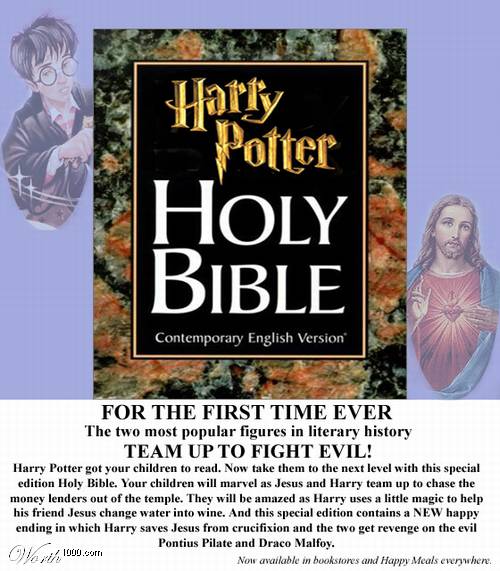
potterSo much for the effectiveness of “state churches.” The European ones appear to have become abject failures. There is ample evidence that the “establishment” of religions has rarely served either church or state very well.

Here’s the latest proof from the United Kingdom. The BBC recently reported a study that shows three in ten teenaged Brits don’t know the Nativity of Jesus came from the Bible. Similar numbers had never heard about the Crucifixion or Adam and Eve.

I imagine they’ll consider the new Noah film just another work of Hollywood fiction. (Actually, half of them didn’t know that very story comes from the Bible.)

What’s more—their parents are nearly as ignorant.

Many of the teens did, however, think that the plotlines from the Harry Potter series were based on Bible stories.

As a person who was genuinely inspired by England’s magnificent cathedrals while I lived there, it is painful to contemplate the terrible loss. The great-great-grandchildren of saints who suffered and sacrificed for the Gospel have disregarded the good news.

And, lest any readers think I’m pointing fingers as a “self-righteous” American, let me assure you I take no pride in my own nation’s slide into apostasy. The words of Micah’s prophecy seem closer to fulfillment each day. “The faithful have been swept from the land; not one upright person remains.”

C.S. Lewis saw this coming. Consider the following from his 1950 essay, “The Literary Impact of the Authorised Version.”

It may be asked whether now, when only a minority of Englishmen regard the Bible as a sacred book, we may anticipate an increase of its literary influence. I think we might if it continued to be widely read. But this is not very likely. Our age has, indeed, coined the expression “the Bible as literature.” It is very generally implied that those who have rejected its theological pretensions nevertheless continue to enjoy it as a treasure house of English prose.

It may be so. There may be people who, not having been forced upon familiarity with it by believing parents, have yet been drawn to it by its literary charms and remained as constant readers. But I never happen to meet them. Perhaps it is because I live in the provinces. But I cannot help suspecting, if I may make an Irish bull, that those who read the Bible as literature do not read the Bible.

Speaking of reading the Bible “as literature,” that’s not a bad thing. It informs so much Western literature, that an ignorance of the Scriptures is tantamount to possessing an inadequate education. An excellent online resource for exploring this truth can be found at the Bible Literacy Project.

The site includes a copy of a comprehensive 2006 study of English professors from America’s top-rated schools, including Yale, Harvard, Princeton, Stanford, Texas A&M, UC-Berkeley and others. In the study, not a single professor disagreed with the statement that: “Regardless of a person’s faith, an educated person needs to know the Bible.”

If some people could get past their prejudices against the Bible, they would recognize the truth of this statement. Everyone should be reading the Bible, even if only as a significant literary work.

Perhaps, if this widespread study comes to pass, one day people will be able to recognize the difference between the Scriptures and Harry Potter.

Shut Up He Explained

LardnerMy wife and I love that phrase, and we often recall it when we encounter particularly over-strained (or “broken”) grammar. When I encountered it as the title of a book, I was unaware of its original source.

This is where I reveal that I wasn’t an American Lit major in college. (Well, regular readers probably figured that out long ago.)

I had never heard of Ring Lardner until today. (If you don’t recognize his name either, you needn’t feel embarrassed . . . he died eighty years ago.)

Lardner was a well regarded humorist who considered himself a sports writer. One of his satires was entitled The Young Immigrunts. It was a parody of a popular English book, The Young Visitors, which was allegedly written by a young girl.

The Young Immigrunts is fictitiously ascribed to Lardner’s son, Ringgold Wilmer Lardner, Jr. His son was only four, at the time. Later he would become a successful screenwriter, winning an Academy Award for the film M*A*S*H. He also wrote prolifically for the television series.

Perhaps Lardner Junior is best remembered as one of the Communist writers blacklisted in Hollywood. But we need not go into that, since his father was merely using his young son as a surrogate author for the work.

The book takes the form of the ramblings of a child, and its quaintness will appeal to many readers. You can download a copy of it here.

It’s not my own preferred genre, so I won’t be reading it in its entirety, but in small doses, I find it rather entertaining.

A little later who should come out on the porch and set themselfs ner us but the bride and glum [pictured above].

Oh I said to myself I hope they will talk so as I can hear them as I have always wandered what newlyweds talk about on their way to Niagara Falls and soon my wishs was realized.

Some night said the young glum are you warm enough.

I am perfectly comfertible replid the fare bride tho her looks belid her words what time do we arrive in Buffalo.

9 oclock said the lordly glum are you warm enough.

I am perfectly comfertible replid the fare bride what time do we arive in Buffalo.

9 oclock said the lordly glum I am afrade it is too cold for you out here.

Well maybe it is replid the fare bride and without farther adieu they went in the spacius parlers.

I wander will he be arsking her 8 years from now is she warm enough said my mother with a faint grimace.

The weather may change before then replid my father.

Are you warm enough said my father after a slite pause.

No was my mothers catchy reply.

And now the phrase that always makes me smile.

The lease said about my and my fathers trip from the Bureau of Manhattan to our new home the soonest mended. In some way ether I or he got balled up on the grand concorpse and next thing you know we was thretning to swoop down on Pittsfield.

Are you lost daddy I arsked tenderly.

Shut up he explained.

I am curious as to whether or not C.S. Lewis was acquainted with Lardner’s work. It doesn’t quite conform to his literary tastes, but Lewis was so widely read that I think it’s possible he was at least acquainted with who he was.

My research on the matter did produce an interesting juxtaposition between the two authors. I discovered it in a book by Sherwood Wirt, perhaps the last reporter to interview C.S. Lewis (for Decision magazine, of which he was editor). I was privileged to know “Woody,” so I enjoyed finding that he mentioned both men in his book I Don’t Know what Old is, But Old is Older than Me.

With twentieth century fiction we have to be quite selective. In limiting my comments to the American scene, I will pass by many of the great names of fiction — Henry James, Stephen Crane, Edith Wharton, Jack London, Theodore Dreiser, Ring Lardner, William Faulkner, Sherwood Anderson, Sinclair Lewis, Scott Fitzgerald, Ernest Hemingway, James Baldwin, John Steinbeck, Vladimir Nabokov, Norman Mailer, and Truman Capote.

While most of these are excellent writers, I doubt whether they have much to say to today’s older readers that would make life more pleasant, more interesting, or more fruitful in the closing stretches of life’s journey. Nor do I think that these authors have anything worthwhile to say about what lies beyond death. We might better spend our reading hours riding off into the sunset with Louis L’Amour or Zane Grey, rather than punish ourselves with a ghastly tale like In Cold Blood.

We old boys and girls have been around a long time. We know what the world is like. We know sleaze when we see it, and we don’t need contemporary authors to embellish it or explain it to us.

The reading tastes of the American public have been corrupted almost beyond redemption by blasphemy, vulgarity, and scatology, all for the sake of increased book sales to prurient minds. There are, however, many twentieth-century American novels worth reading, such as Margaret Mitchell’s Gone With the Wind, Thornton Wilder’s The Bridge of San Luis Rey, Harper Lee’s To Kill a Mockingbird, Tom Clancy’s The Hunt for Red October, the Savannah quartet of Eugenia Price, and the Sebastian series of James L. Johnson, to name only a few.

Earlier in the century the Christian novels of Lloyd C. Douglas—The Magnificent Obsession, The Robe, and The Big Fisherman—inspired thousands of readers young and old, but no American has since matched his popular appeal.

The demand for detective fiction continues unabated, and no one needs my advice to read Agatha Christie. I would, therefore, limit my remarks to a reference to two British creations, G.K. Chesterton’s Father Brown and Dorothy Sayers’ Lord Peter Wimsey, since both are written from Christian backgrounds. My two favorite Wimsey stories are Busman’s Honeymoon and The Nine Tailors.

In contrast there is a wealth of devotional literature that makes wonderful reading for older people. One can start with the sermons of D.L. Moody, Charles Spurgeon, Samuel P. Jones, Joseph Parker, and T. DeWitt Talmage of the nineteenth century. The early twentieth century gave us Andrew Murray, Ole Hallesby, P.T. Forsyth, and Oswald Chambers, whose writings are hard to surpass. Amy Carmichael’s poetry and prose written in India, have blessed millions of readers. More contemporary are the writings of C.S. Lewis and A.W. Tozer, which carry seeds of greatness.

The passage above comes from the book’s chapter on “Reading.” If you would like to see more, the entire book (although published as recently as 1992) is legally available for your review online.

“Shut up he explained” may not be proper English, but literature doesn’t need to be proper to be entertaining. And even though Lardner is no longer a familiar name, perhaps his writings are worth visiting.

For the moment, knowing the context of this delightful phrase makes the words all the more entertaining to me. After all, like many others, my dad often “explained” the same thing to me!

A Narnian Madlib

EVO-WWI-064-01060I got to savor one of the joys of being a grandpa today, watching over two of my five lovely granddaughters while their parents traveled to an important business meeting.

Naturally, we had fun playing, drawing, tossing a ball for their German shepherd, building things, cleaning up their room (not quite so “fun”) and—since it’s summer—playing with water balloons (extremely fun, even though I got drenched).

We also did a madlib, one of those “phrasal templates” popularized by Roger Price and Leonard Stern in the 1950s. These simple word games are entertaining and educational. And, even for novice writers, they’re not too challenging to compose. After all, the stories themselves are by nature brief and rather superficial.

Today I even set my granddaughters in front of an episode of The Powerpuff Girls so I could write a short scene from Narnia for them. You’ll find it below.

I had forgotten how much fun we had with madlibs when our own children were young. We made many up on the spur of the moment, and laughed at the silly combinations of word that resulted. The process, as most readers know, involves randomly selecting a series of words for inclusion in the narrative. With a lack of imagination, the readings can fall a bit flat, but typically you end up with some (accidentally) witty wordplay.

One of the benefits of madlibs is how they can be used more than once. While the outline of the story remains the same, of course, the choices made by readers generate amazing diversity.

Most madlibs are admittedly rather juvenile. That’s because they are written for juveniles. They rely on providing specific types of words, such as nouns or adjectives. Theoretically, you could devise a madlib as complex or sophisticated as you desire. For example, an entertaining tale certainly could doubtless be woven by including random selections for the following word choices.

____________ prime number

____________ copular verb

____________ Napoleonic regimental commander

____________ homograph

____________ life stage of a butterfly (other than larva or pupa)

____________ ditransitive verb

____________ type of psychosis

____________ infielder for 1874 Chicago White Stockings

____________ gerund

____________ rare earth mineral

____________ monotransitive verb

____________ early kabbalist (other than Bahye ben Asher ibn Halawa)

____________ type of arachnid with blue coloration

____________ free predictive

____________ reciprocal pronoun

____________ chemical process (other than esterification)

Unfortunately, I don’t have time to write the story accompanying this worthy list, but if you should write it, I’d love to read it.

There are a number of fan sites online that generate madlibs. I won’t recommend any since the ones I’ve glanced at today are merely advertising collections for sale. (I also found the examples I experimented with to be rather feeble . . . even weaker than the story I wrote today in a single hour.)

You will search in vain if you’re seeking a C.S. Lewis reference to madlibs. However, he was a master wordsmith, who recognized well their power, and greatly loved humor. The following passage, from “Prudery and Philology,”
refers to the versatility and weight of language, and includes a valuable caution.

We are sometimes told that everything in the world can come into literature. This is perhaps true in some sense. But it is a dangerous truth unless we balance it with the statement that nothing can go into literature except words, or (if you prefer) that nothing can go in except by becoming words. And words, like every other medium, have their own
proper powers and limitations.

The brief tale below is not pretentious, so you need not fear it exceeding its limitation. It simply is what it is . . . one grandfather’s passing literary adventure with his grandchildren.

It you like “Sharpbeak’s Narnian Adventure,” you’re welcome to download a PDF copy of the story I’ve appended to the end of the column. It’s 100% free, and I’m not trying to sell a collection of madlibs after hooking you. Besides, if I was trying to make a profit off of anything including the word “Narnian,” I have no doubt lawyers would be descending upon me in droves.

The Words You Will Need

____________ adjective

____________ animal

____________ adjective

____________ adjective

____________ something  you drink

____________ color

____________ adverb

____________ adjective

____________ adjective

____________ meal time

____________ adjective

____________ adjective

____________ adjective

____________ adjective

____________ plural noun

____________ plural noun

____________ adjective

____________ adjective

____________ adjective

____________ animal

____________ adjective

____________ food

____________ food

____________ food

____________ place

____________ adverb

____________ adjective

____________ place

____________ number

____________ plural relative

____________ verb

____________ adjective

____________ plural monster

The Story Into Which You Insert Your Words

Once upon a time, when Narnia was still young, a/an ____________, young eagle named Sharpbeak decided to set out for an adventure. A wise ____________ climbed his ____________ tree to talk to him before he left. He crawled into the eagle’s ____________ nest and said, “That was a long climb. I’m thirsty. May I have a cup of ____________?”

As the two friends watched the sun set over the ____________ mountains, the eagle said ____________, “I wonder what’s on the other side of those mountains?”

His ____________ companion warned him, “Beware of the ____________ giants in the north. They like nothing better than to eat us Talking Animals for ____________ or even for a snack. Sharpbeak promised he would avoid the giants.

Then his friend said, “Don’t forget that there are also ____________ dragons living on some of the mountaintops. They don’t appreciate ____________ visitors. If you surprise them, they may blast you with a ____________ burst of their ___________ flames. And definitely don’t disturb their treasure of ____________ and ____________.”

The eagle said, “I’ll be sure to watch out for dragons when I go on my ____________ adventure.”

“Oh,” added Sharpbeak’s friend, “I wouldn’t advise you to fly over the ____________ ocean either. What if you flew as far as you could, and you didn’t find a/an ____________ island where you could land?” The eagle looked worried. His wise friend added, “If you ever find yourself in dangerous circumstances, remember that you can call on Aslan to protect you. I heard that once he once allowed a timid ____________ to walk safely across a stormy lake without sinking.”

“My,” said Sharpbeak, “that would be a terrible thing.” He looked up at the ____________ stars, twinkling in the sky. The two friends had spoken long into the night. “I didn’t realize it was so late,” he said. All I have to offer you to eat is ____________ and ____________.”

“That would be nice,” said his friend. He reached into his pocket and said, “and we could have this ____________ for dessert. But, after we eat I had better scurry home to my ____________, since I can’t imagine sleeping in a tree. I mean, if a storm comes up, you have the wind blowing ____________ and ___________ rain pouring down in torrents. I’m much happier living in a ____________ with my ____________ ____________. While you go on your journey, I will stay home and ____________.”

The two friends gave each other a big hug. The eagle’s feathers tickled his friend, who said, “May Aslan watch over you during your travels.”

The next morning the ____________ eagle soared off to begin his adventure. Sharpbeak would be sure to avoid all of the giants, dragons and ____________ along the way. But that’s a story for another day.

Epilogue

Those of you curious about how my granddaughters’ story turned out, should read on.

Once upon a time, when Narnia was still young, a big, young eagle decided to go off for an adventure. A wise deer climbed his pink tree to talk to him before he left. He crawled into the eagle’s fuzzy nest and said, “That was a long climb. I’m thirsty. May I have a cup of juice?

As the two friends watched the sun set over the blue mountains, the eagle said roughly, “I wonder what’s on the other side of those mountains?”

His wide companion warned him, “Beware of the cold giants in the north. They like nothing better than to eat us Talking Animals for breakfast or even for a snack.” Sharpbeak promised he would avoid the giants.

Then his friend said, “Don’t forget that there are also hairy dragons living on some of the mountaintops. They don’t appreciate old visitors. If you surprise them, they may blast you with a soft burst of their speedy flames. And definitely don’t disturb their treasure of trash cans and flowers.”

The eagle said, “I’ll be sure to watch out for dragons when I go on my fun adventure.”

“Oh,” added his friend, “and I wouldn’t advise you to fly out over the heavy ocean either. What if you flew as far as you could, and you didn’t find a dark island where you could land?” The eagle looked worried. His wise friend added, “If you ever find yourself in dangerous circumstances, remember that you can call on Aslan to protect you. I heard that once he once allowed a timid bunny to walk safely across a stormy lake without sinking.”

“My,” said the eagle, “that would be a terrible thing.” He looked up at the watery stars, twinkling in the sky. The two friends had spoken long into the night. “I didn’t realize it was so late,” he said. “All I have to offer you to eat is noodles and cheese.”

“That would be nice,” said his friend. He reached into his pocket and said, “and we could have this snack bar for dessert. But, after we eat I had better scurry home to my fairgrounds, since I can’t imagine sleeping in a tree. I mean, if a storm comes up, you have the wind blowing bravely and messy rain pouring down in torrents. I’m much happier living in a playground with my ten sisters. While you go on your journey, I will stay home and dance.”

The two friends gave each other a big hug. The eagle’s feathers tickled his friend, who said, “May Aslan watch over you during your travels.”

The next morning the brown eagle soared off to begin his adventure. He would be sure to avoid all of the giants, dragons and dinosaurs along the way. But that’s a story for another day.

Downloadable Version

Here’s the story. On the PDF, it is preceded by a list of the type of words required to fill in the various blanks.

Narnian Madlib

Literary Recycling

cecilialevy cupOur last column on providing new homes for neglected books got me thinking about the notion of “recycling” in its broader contexts.

And, even though C.S. Lewis died before the modern concept of environmentalism reached its full bloom, I wondered if he had written anything on related concerns. As prolific as Lewis was, if one is diligent there is a good chance they can find something with a (sometimes admittedly tenuous) correlation to nearly any subject.

Before proceeding, I have to provide the source of the amazing illustration on this page. It is a graphic example of the creative recycling of literature. This teacup comes from the artistic vision of a Swedish artist, Cecilia Levy. You can view other examples of her artistry at her website here, and if you wish to reproduce them elsewhere, be sure to request permission (just as I did).

Returning to the concept of environmentalism, I wish to avoid political implications here. In general terms, however, I think it is fair to say the Scriptures teach that humanity is a “steward” of creation, which belongs not to us, but to its Maker. As stewards, we have been entrusted to be responsible in our management (use) of nature’s abundance. Wanton destruction should be called what it is—sin.

Now, this general principle manifests itself in a wide spectrum of responses, and attitudes are always subject to change. I vividly recall the very first Earth Day celebrated in the United States. I’m sure that being a high school student in a huge southern California school reinforced the indelible nature of the memory.

My wife and I have been diligent recyclers for many years . . . and that extends far beyond newspapers and aluminum cans. We have used countless items until their usefulness has ended. (Long past when they should have been replaced, in the opinion of our children.) I attribute much of our thriftiness to growing up in low income families where luxuries were few. But it arises not from that background alone. We also have a sense of responsibility to others, and dispatching items that are still usable to landfills just seems wrong.

I imagine Lewis possessed somewhat similar sentiments. He didn’t manifest much of a flair for extravagance. I don’t think he devoted that much thought to material possessions. I once read (but can’t find the source) that his brother and roommate Warnie was a bit frustrated by Lewis’ lack of concern for maintaining articles that were still in decent condition. Major Lewis, being a military man, focused on utilitarian considerations. The specific items of concern in the incident were some dishes or “crockery” that Warnie deemed to still be fit for service.

Both men were seasoned veterans of rationing, of course. Their skills at stretching things to go as far as possible were conditioned by years of deprivation. Americans are typically shocked to learn that rationing persisted in Europe after the end of the war. In an era characterized by excess and waste it’s difficult for us to put ourselves in their mindset.

Ironically, my hunt for a Lewisian passage on ecological concerns had nothing to do with rationing. It was rewarded when I looked at his essay “Willing Slaves of the Welfare State.” (The work is included in the delightful collection, God in the Dock.)

In this essay, Lewis is describing scientific advances as morally neutral. It is the application we choose to put our knowledge to, that determines its rightness. One of his illustrations alludes to care of the world in which we live.

The first is the advance, and increasing application, of science. As a means to the ends I care for, this is neutral. We shall grow able to cure, and to produce, more diseases—bacterial war, not bombs, might ring down the curtain—to alleviate, and to inflict, more pains, to husband, or to waste, the resources of the planet more extensively. We can become either more beneficent or more mischievous. My guess is we shall do both; mending one thing and marring another, removing old miseries and producing new ones, safeguarding ourselves here and endangering ourselves there.

Brilliant. And utterly true.

I also want to pass on an interesting observation made several years ago in another blog. The author references Lewis’ mention of the related concept of “plentitude.” You can read Tim Hagen’s full post here.

Since I’ve been reading a lot of C.S. Lewis lately, I figured I could use (and abuse?) a couple quotes from him in suggesting a philosophy of responsible waste management.  The Discarded Image is a piece that brings to light our modern misconceptions about the “Dark Ages.”  A testimony of medieval literature, for example, is how systematized their view of the universe was.  This organization grew out of classical authors such as Apuleius of Numidia, from whom Lewis draws two principles: the Triad (the idea that two entities – such as soul and body – can only meet each other through a third medium – in this case, the spirit) and Plentitude.  Lewis summarizes Plentitude in stating: “The universe must be fully exploited.  Nothing must go to waste.”  In other words, if something had the capacity to be useful, the medieval mind found a use for it.

The concept of plentitude as described here reminds me of the way people living in harsh environments cannot afford to waste anything. Eskimos, for example, are said to use every part of the seals they harvest . . . meat, blubber, bone, sinew. None of it is cast aside.

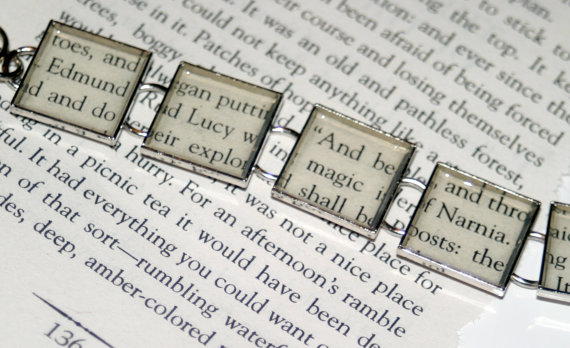
Let’s end these thoughts with another example of artistic creativity. This image shows how pages of a recycled copy of the Chronicles of Narnia can be recycled into jewelry. It comes from this commercial website which offers “one of a kind” items for sale. I don’t know whether this particular piece remains available, but I bet they would be willing to make you one of your very own if you’re interested. Then the cash from your wallet can be recycled into theirs. In exchange you’ll own a unique treasure that may become a wonderful conversation starter for many years to come.

narnia bracelet

Avoid them Like the Plague

cliche bookAvoiding clichés in one’s writing is such oft-repeated advice it’s nearly become a cliché itself.

Many do not make much sense to people approaching a language from a literal perspective. For example, those new to American English may require a bit of explanation to understand that “hit the books” refers to studying rather than literary pugilism.

Some clichés are easily deciphered, especially when read in context. As an admonition to stop obstructing a view, we can understand why someone would say, “You make a better door than a window.”

“Don’t rain on my parade” adequately warns the hearer to avoid dampening the speaker’s special plans or activities.

Folksy adages are common where clichés are concerned. Take “The acorn doesn’t fall far from the tree.” We all know it references a child who shares numerous traits with a parent.

And we have interchangeable versions of the same notion, in case a lazy writer wishes to alternate your redundancies. He/she is a “chip off the old block” means essentially the same thing. And there’s always the classic “like father, like son,” and its corollary “like mother, like daughter.”

“As snug as a bug in a rug” used to be a favorite of my mother, ever applicable as she tucked little ones into their beds. Today, however, with bedbugs plaguing humanity in epidemic proportions, that cuddly image may have lost a touch of its appeal.

Some clichés have clearly outlived any usefulness they may once have possessed. “Too many chiefs, and not enough Indians,” clearly refers to a situation in which everyone is in charge and there no one is able or willing to actually carry out the project. However, few writers would tempt incurring the wrath of readers by using such a dated and rather prejudiced saying.

A cliché, of course, is a typically trite phrase that has lost its element of ingenuity due to overuse. It is something serious writers strive to avoid at all costs. But the final phrase in my previous sentence reveals how difficult it can be to purge these worn out words from our writing. Whenever used, they should be included consciously; writers might utilize them to establish, for example, a comic tone.

Even the gifted C.S. Lewis recognized the threat of clichés worming their way into one’s work. In a 1922 entry in his diary he wrote:

Tried to work at Dymer [his narrative poem] and covered some paper: but I am very dispirited about my work at present—especially as I find it impossible to invent a new opening for the Wild Hunt. The old one is full of clichés and will never do. I have learned too much on the idea of being able to write poetry and if this is a frost I shall be rather stranded . . .

The word cliché itself originated in France, where it was a printing plate or stereotype cast from an original composed of movable type. (The casting freed the movable type for new projects while maintaining the lettering for possible future printings.) The word came to be applied to ready-made phrases. However, the casting of printing plates is one thing. Recycling exhausted phrases ad nauseum is quite another.

Clichés are generally limited to a particular country or culture. Some are restricted to given regions. When outsiders hear or read these phrases, they often make little sense.

Some gain international esteem. More than a century ago Lord Acton described a universal truth of politics that resonates across boundaries. We have all witnessed the truth that “absolute power corrupts absolutely,” but those wise words are not something we should typically parrot in our own writings.

Not knowing the original source of a cliché is common. It is rather tragic, though, when it comes to texts that should be familiar to writers. For example:

“All’s well that ends well” is one of Shakespeare’s best loved maxims. If most Americans were asked whether it came from the pen of the Bard or Benjamin Franklin, we might be sadly disappointed with the results.

“The writing is on the wall” infers the outcome is already determined. But too few recognize this as a reference to a miracle recorded in the Book of Daniel. (If you’re not familiar with it, you can read the story here.)

Some clichés that relate to the art of writing would include the following [with my modest illustrations attached]:

“You can’t judge a book by its cover.”

     Appearances may be misleading.

Someone who appears wonderful when you first meet them may be just like an ebook with a professionally designed cover that contains a poorly scanned reprint replete with typos.

“It’s nothing to write home about.”

     Something that’s boring and not worth retelling.

While the freedom of POD technology has created democracy within the publishing industry, it’s also led to millions of meandering “books” that should “never have seen the light of day.”

A person is “an open book.”

     Someone who readily reveals their personality through word and action.

The type of character skilled authors will wish to introduce in limited quantities, especially if they are writing mysteries.

“Throw the book at him.”

     Give him the maximum possible judicial punishment.

The well-deserved fate of best-selling authors who rest on their laurels and start “phoning in” their sequels.

We turn now to a non-literary but colorful example of an American colloquialism that has spread far from its origins in the swine-breeding communities where it undoubtedly originated. It’s one of my favorite clichés, and it just may have a few good uses left in it, so feel free to include it in your next column or book . . . and no need to cite me as your source:

“You can’t make a silk purse out of a sow’s ear.”

     A task is impossible, given what you have to work with.

The echoing refrain of editors whose clients expect them to transform a few dusty lumps of coal into diamonds.

Possible Valid Uses for Clichés

While it’s safest for writers to avoid them altogether, there are a handful of occasions where they are not utterly inappropriate.

One suitable place for “chesnuts” like these to appear is in dialogue—especially when it’s written for a character a writer desires to portray as rather shallow-thinking.

It’s incorrect to suggest good writers never use clichés in conversation or composition. They do. The difference is that when they do include such tired phrases in their normally witty banter, they do it with a sense of irony.

C.S. Lewis, master of wordplay that he was, illustrated how we can creatively re-imagine or reword a cliché to reinvigorate it. Only the very best minds are up to this task. Yet, when it’s successfully accomplished, it can prove quite entertaining. The following comes from an informal conversation that was recorded before his retirement, preserved in the collection On Stories. Lewis refers in passing to an overly detailed passage in literature that nearly obscured the storyline.

The only trouble is that Golding writes so well. In one of his other novels, The Inheritors, the detail of every sensuous impression, the light on the leaves and so on, was so good that you couldn’t find out what was happening. I’d say it was almost too well done. All these little details you only notice in real life if you’ve got a high temperature. You couldn’t see the wood for the leaves.

Skillful Turns of Phrase

frank burnsEveryone loves an exquisite turn of phrase. Those of us who dabble in writing are particularly susceptible to their numinous power.

I’ve been doing some research on the Father Mulcahy character from M*A*S*H. William Christopher transformed the fictional character from a caricature of military chaplaincy, into a compassionate and respected representative of the Holy. During my research, I’ve been reviewing episodes of the series in which he was featured.

In “Alcoholics Unanimous,” which originally aired in 1974, Mulcahy has been tasked with delivering a lecture on temperance. In an interesting twist he wears full clerical garb and prepares what is essentially a sermon. Since the lecture is a “mandatory formation,” the mess tent (which doubles as the chapel) is filled to capacity.

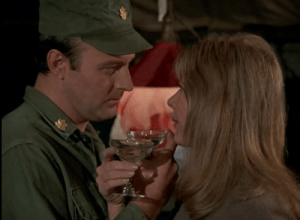
Sitting in the front row are the hypocritical Majors Burns and Houlihan. (For those unfamiliar with the show, they constantly call for the most rigid of military standards, even as they are all the while breaking the military’s Uniform Code that prohibits adultery.) Major Houlihan’s nickname, in fact, is “Hotlips.”

In the aforementioned episode they have a delightful little exchange that illustrates through its witty banter the skill of the Hollywood writers at their best. As the hospital’s temporary commander, Burns has banned all alcohol and mandated attendance at the lecture. The tent is filled to its limits as Houlihan turns adoring towards her paramour and says:

Houlihan: Frank, what a turnout!

Burns: Lemmings must be directed to the sea.

Houlihan: You’re magic with a phrase!

It requires skill to create a well-crafted turn of phrase. Well, even a fool like Frank Burns can stumble across a clever phrase, but only a master can repeatedly coax them from their ethereal realms.

C.S. Lewis was just such a master. His works abound with profound and captivating language. And he recognized it in the works of others. In “Dante’s Similes,” in Studies in Medieval and Renaissance Literature, he wrote:

[Dante] is the most translatable of the poets—not, probably, that he entrusts less wealth than others to the music of the words and the nuance of the phrase but that he entrusts more than others to the “plain sense.”

In The Four Loves, Lewis reveals just how impoverished much of our language is . . . even when it relates to the most inspiring of matters. Describing the difference between carnal “love” and genuine love, he shows that even impoverished phrases can begin to grasp the truth behind the dynamics of affection and commitment.

We must do the works of Eros when Eros is not present. This all good lovers know, though those who are not reflective or articulate must be able to express it only in a few conventional phrases about “taking the rough along with the smooth,” not “expecting too much,” having “a little common sense,” and the like. And all good Christian lovers know that this programme, modest as it sounds, will not be carried out except by humility, charity and divine grace; that it is indeed the whole Christian life seen from one particular angle.

Surely those who are more articulate can more expressively communicate our love for our spouse. Yet, even in so-called matters of the heart, we frequently utter phrases that are utterly mundane.

The History of the Phrase “Turn of Phrase”

One online dictionary uses these definitions:

a turn of phrase

1. a way of saying something “Significant other,” meaning “partner,” now that’s an interesting turn of phrase.

2. the ability to express yourself well She has a nice turn of phrase which should serve her well in journalism.

The Phrase Finder website provides excellent information about numerous phrases. And, in discussing this idiomatic phrase about phrases, they do not disappoint.

So, a phrase was a style of speaking or writing, and style meant beauty of expression. We can now interpret a fine “turn of phrase” as analogous to a skillfully crafted piece of wood turned on a lathe. John Dryden referred to the “turning” of words in this sense in The Satires of Decimus Junius Juvenalis, 1693: “Had I time, I cou’d enlarge on the Beautiful Turns of Words and Thoughts; which are as requisite in this, as in Heroique Poetry.”

Check out their entire article about turns of phrase at the link above. And, may your own writing be filled with impressive verbal ballets, replete with inspiring leaps and unforgettable pirouettes.