Meandering Words

Sometimes we read for business. Other times we read for pleasure. Few people are so fortunate as to have these two purposes overlap.

When the goal is the former – the necessity of reading a particular document, our desire is usually to simply “get it done.” We want to arrive quickly at the point, so we can move on to some other project. In this context, digressions are definitely something to be avoided.

This is how military writers are taught to do their job. Deliver the goods immediately, with zero interest in the prose. (Well, apart from proper grammar and spelling.) This principle is frequently described with the acronym BLUF – bottom line up front. This approach makes sense, when lives can literally be on the line and the need to make sound decisions swiftly is urgent.

The Harvard Business Review puts it bluntly: “In the military, a poorly formatted email may be the difference between mission accomplished and mission failure.” Being the HBR, they naturally translate this concept for application in the business world.

If you are curious, you can freely download some of the military writing manuals available online. Warning: these manuals tend to include lots of tedious details that ironically appear to violate the BLUF principle itself!

Army Regulation 25–50 Preparing and Managing Correspondence

DOD Manual 5110.04, Correspondence Management

Canadian Armed Forces Junior Officer Development Programme

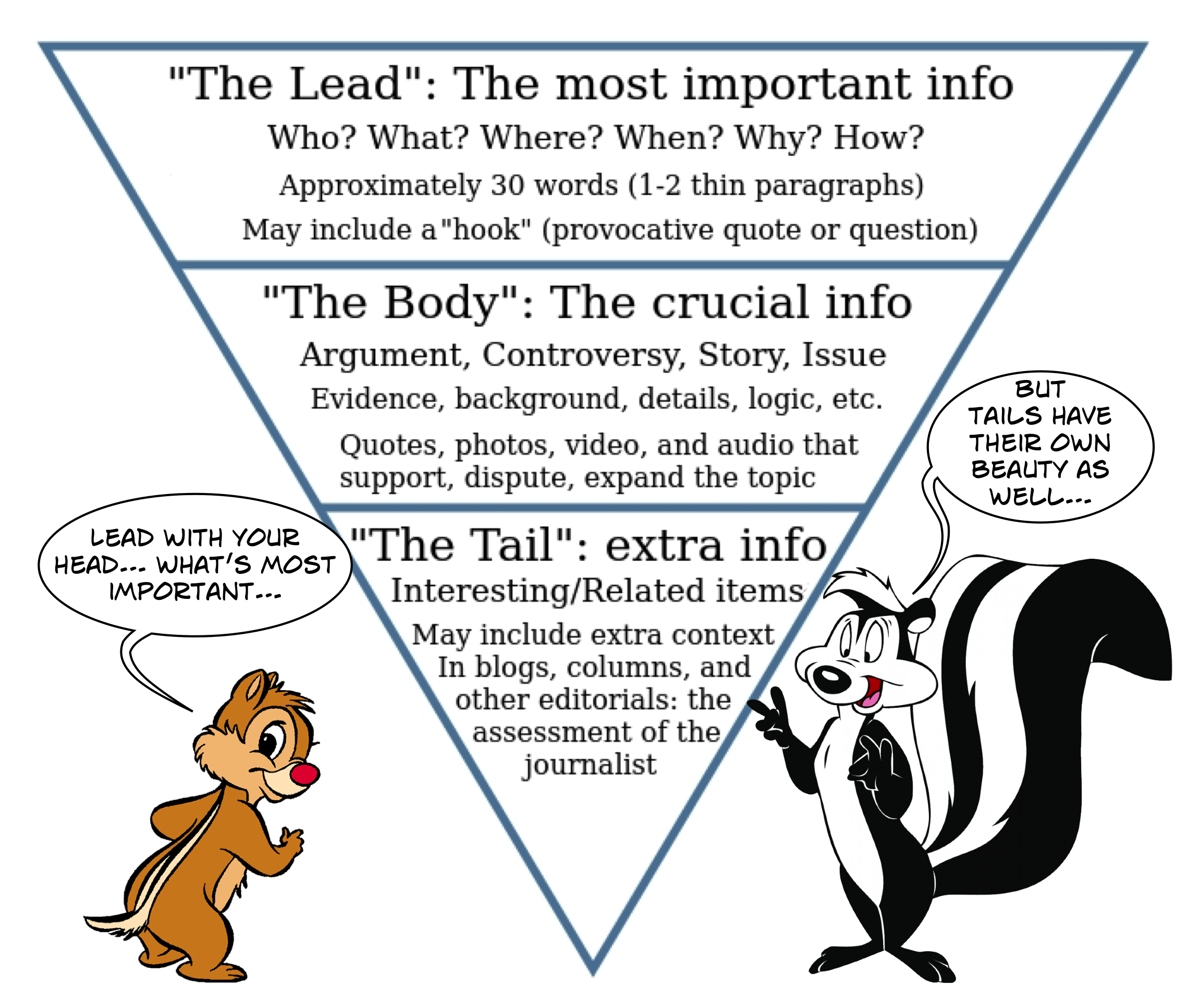
Similar to the military approach, we have the civilian version, which remains common in traditional journalism. (Even though printed newspapers continue to vanish, this approach is still found in many digital outlets.) This technique is referred to as the Inverted Pyramid Structure. Here is one concise definition:

The inverted pyramid is the model for news writing. It simply means that the heaviest or most important information should be at the top – the beginning – of your story, and the least important information should go at the bottom. And as you move from top to bottom, the information presented should gradually become less important.

The benefit of this strategy is that readers immediately learn the primary “news.” Only when they desire to supplement that information do they need to continue reading. Presumably the material follows in descending significance until they either finish the piece or it descends into minutiae of no interest to that particular reader.

The previously linked article notes one extremely important aspect of the inverted pyramid [emphasis added].

The inverted pyramid format turns traditional storytelling on its head. In a short story or novel, the most important moment – the climax – typically comes about two-thirds of the way through, closer to the end. But in news writing, the most important moment is right at the start of the lede.

And it is this traditional sort of storytelling to which we most often turn when we read for pleasure rather than as an obligation.

Reading for Enjoyment

Pleasurable reading is not, by definition, expeditious. It takes its time to tell a story, rather than rushing into a rapid information dump. In fact, when the narrative is savaged by unloading too much background or too many facts, it becomes hard to enjoy even when we want to like it.

Literature, even brief poetry, takes us on a journey. We go somewhere. We are transformed, albeit usually in an unmeasurable way. While the change may be small, it is quite distinct from the difference made by simply learning new facts.

While the journey itself may appear straightforward, in most cases there are often subtle alterations in its course. You might say a story intentionally tends to meander, which is why I titled this post as I have. Meander itself is a curious word.

Like so many words, meander has a literal and a figurative application. In a moment we will see each of these meanings entertainingly illustrated in C.S. Lewis’ correspondence.

I began thinking about this intriguing word when I recently read about its source. It begins with an ancient kingdom in Asia Minor (modern day Türkiye). Lydia was independent for half a millennia before its king, Croesus, was defeated by Cyrus of Persia. One of Lydia’s lasting contributions to civilization came in the form of the minting of coinage.

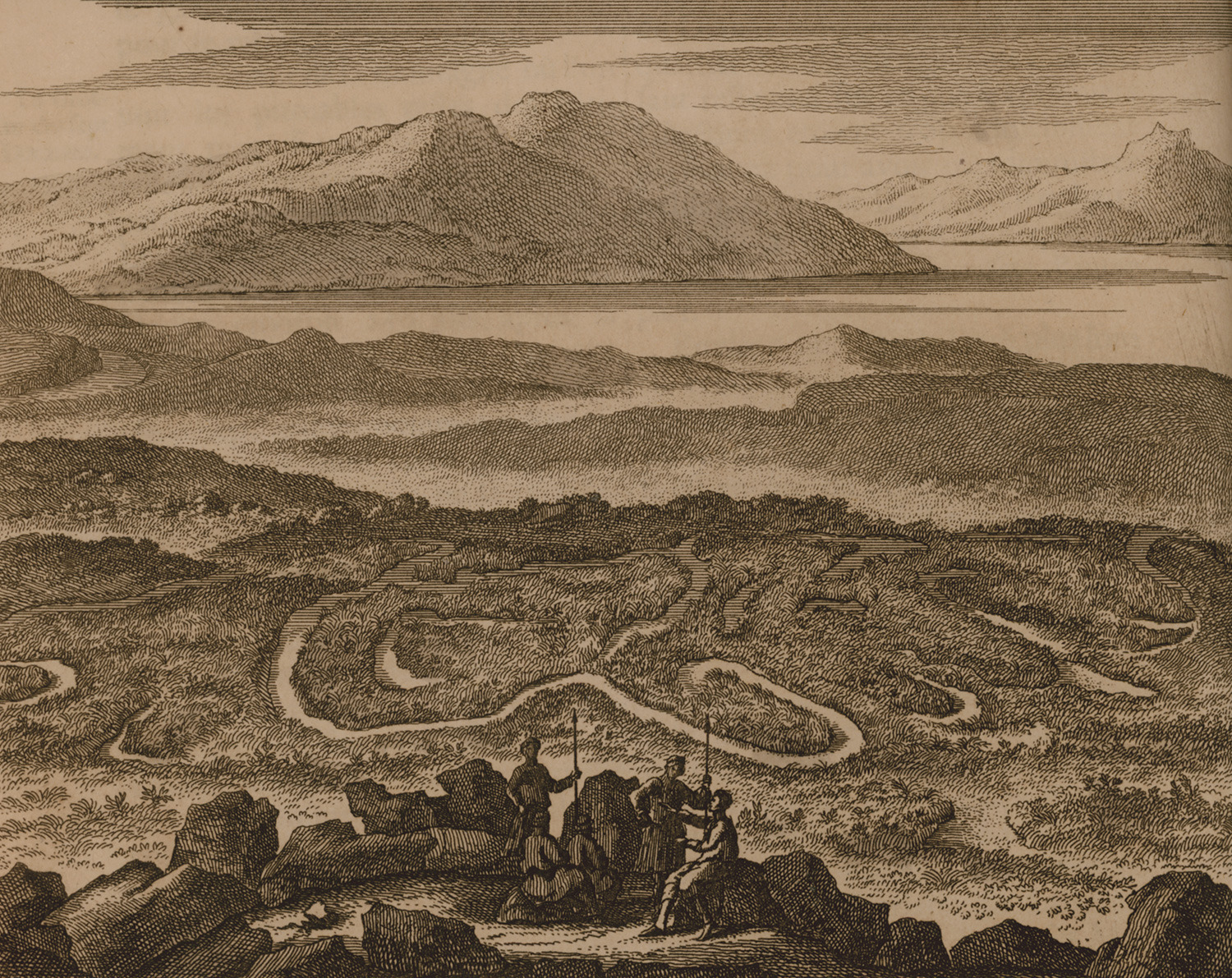
Herodotus tells us they were the first to do so. This is, of course, a captivating story in its own right.One of the images used on one of their early coins was of the Maeander River, which meandered through their kingdom. The picture above, View of Maeander Valley, was published by Flemish artist Cornelis de Bruyn in 1714.

Did C.S. Lewis Meander?

Searching through Lewis’ writings, I did not find any examples of his use of this winding word. (Let me know if you’re aware of one.)

However, here are two enjoyable examples of his informal use of “meander” in his correspondence. The first, in a 1920 letter to his father, uses the word in its figurative sense.

I have two tutors now that I am doing ‘Greats,’ one for history and one for philosophy. . . . We go to the philosophy one in pairs: then one of us reads an essay and all three discuss it. . . . it is very amusing.

Luckily I find that my previous dabbling in the subject stands me in good stead and for some time I shall have only to go over more carefully ground through which I have already meandered on my own.

In the second occurrence, we find C.S. Lewis writing to his Brother Warnie in 1932. He describes, at some humorous length, the condition of the pond on their property. You can visit this same setting today in the C.S. Lewis Nature Reserve.

I have included the full discussion below. Suburbanites (and even more so, city-dwellers) may not be able to appreciate this story the way that people who have lived in the country can. Still, those with a minute to read the entire passage will likely enjoy the way Lewis meanders through his description of events. Oh, and lest you suffer unnecessary shock, be forewarned that Lewis uses the word “bathe” here not to refer to a “bath,” but to a plunge in the pond.

You will gather from this that summer has arrived: in fact last Sunday (it is Tuesday to day) I had my first bathe. You will be displeased to hear that in spite of my constant warnings the draining of the swamp has not been carried out without a fall in the level of the pond.

I repeatedly told both [the workmen] that the depth of water in the pond was sacrosanct: that nothing which might have even the remotest tendency to interfere with that must be attempted: that I would rather have the swamp as swampy as ever than lose an inch of pond.

But of course I might have known that it is quite vain ever to get anything you want carried out: and the pond is lower. However, don’t be too alarmed. I don’t think it can get any lower than it is now.

I don’t know how much of the draining operations Minto [Janie Moore] has described to you nor whether you understood them. In fact, remembering what a mechanical process described by Minto is like I may assume that the more she has said the less you know about it.

The scheme was a series of deep holes filled with rubble and covered over with earth. Into each of these a number of trenches drain: and from each of these pipes lead into the main pipe now occupying the old ditch between the garden and the swamp, which in its turn, by pipes under the lawn, drains into the ditch beside the avenue.

It was however useless to do all this as long as the overflow outlet from the pond (you know – the tiny runnel with the tiny bridge over near the Philips end of the pond) was meandering – as it did – over all the lower parts of the swampy bit. Nor was it possible to stop this up and deny the pond any outlet, as it would then have been stagnant and stinking in summer, and overflowing in winter.

It was therefore decided to substitute a pipe outlet for the mere channel outlet – which pipe could carry the overflow from the pond, through the swampy bit without wetting it, to the rest of the drainage system. When they first laid this pipe I said that its mouth (i.e. at the pond end) was too low and that it would therefore carry off more water than the old channel and so lower the pond.

The workmen shortly denied this but I stuck to my point and actually made them raise it. Even after they had raised it I was still not sure that it wasn’t taking off more water than the old channel did: so I have now had a stopper made which is in the mouth of the pipe at this moment. I have also given the spring-tap up beyond the small pond a night turned on, and I trust that by thus controlling in-flow and outflow of water I can soon nurse the pond back to its old level.

At any rate I don’t see how it can sink as long as its escape is bunged up. As to the degree of loss at present, as there are no perpendicular banks anywhere it is hard to gauge. I should think that the most pessimistic episode could hardly be more than ¾ of a foot: i.e. a difference one is unconscious of in bathing. Still I grudge every inch.

By the way, it has just occurred to me that the sinking may not be due to the draining at all: for the old ‘channel’ escape, when I looked at it just before the operations began, had certainly widened itself extremely from what I first remembered, and must have been letting out more than it ought. In that case the new pipe may have arrested rather than created a wastage.

One criticism some short-attention-span readers levy against Tolkien’s masterpiece, Lord of the Rings, is that too much time is spent traveling. Such critics overlook the reasons the author presented his saga in the manner he did. Well, for those desiring to simply jump from battle to battle, we now have graphic novels. All of the journeying in LOR has a purpose; it is far from mere “meandering.”

Tolkien detailed the travails of the Fellowship during their quest, and his maps allow students of the mythos to discern “Frodo and Sam traveled over a thousand miles from the Shire to Mount Doom in the Lord of the Rings trilogy, over multiple landscapes and terrains.” One of the colorful words created by Tolkien, that rolls off the tongue like a babbling brook, is the name of a river that crosses the Old Forest: Withywindle. (A withy is an Old English word for a willow, or slender twigs or branches.) Its course may not have been especially winding, but it definitely sounds like it should have been.

No one can deny the influence of J.R.R. Tolkien on fantasy literature. But the aforementioned shortening attention spans do deter some readers. Make no mistake about it, however, the traveling in the writings of the Inklings is not without purpose. Nor does it disrupt the story. Still, the less skilled among us should be cautious about mimicking their techniques. One author describes this hazard in the following way.

Ultimately, when you write, your goal should be to make sure that everything you write doesn’t meander, or in other words, moves in some way towards the conclusion of your story. Be that taking care of a subplot, a character arc . . . whatever, it needs to hit a step, or move towards it, on the path to the ultimate ending of your story.

Remember both pacing and the up and down of rising and falling tension. A meandering story stretches out a low point and breaks the pacing. You always want to keep your plot on a straight line to the ending. The characters, they can wander, as long as the plot doesn’t.

Thanks for meandering with Mere Inkling today. Isn’t it wonderful that God allows us these carefree moments, and life isn’t all about “getting things done?”
Choosing a Career

Do you remember when you were making decisions about your future career? C.S. Lewis’ comment on the subject of careers remains quite valuable in today’s rapidly changing world.

Toward the end of high school, I recall filling out some educational assessments that projected how successful I might be in a number of different pursuits. Employability appeared to be the primary focus for the assessments. 

Not taken into much account at that time (a half century ago), was what sort of job satisfaction one might anticipate following those various pursuits. 

This “graduation” life milestone is on my mind, since several of my grandchildren are presently finishing their own high school years. None have yet “chosen” a career – they are approaching their futures with open minds. However, we have chatted about the major options before them: college, vocational training, directly entering the workplace, the military, or burying themselves in social media and living off of their parents for the next decade or two.

Most lean towards college, without specific programs in mind. Still, I have encouraged them to consider the marketability of various studies. As most are aware, AI is a growing threat. In “ChatGPT May be Coming for Our Jobs,” you can see ten particularly vulnerable fields.

Goldman Sachs estimates “300 million full-time jobs globally” could well be automated.

A Pair of Options

I’ve been thinking about two career fields at opposite ends of the spectrum, in regard to the viability of their futures: Newspaper Reporters (that’s not the positive example) and Security (and not just cyber-security).

The United States Department of Labor enthusiastically declares “the cybersecurity field is booming.”

As of August 2022, there were over 700,000 open roles in cybersecurity in the United States and, according to Bureau of Labor Statistics projections, jobs for information security analysts are expected to grow 32% from 2022 to 2032. It’s clear that cyber talent is in demand.

Compare that to opportunities for newspaper reporters. Just last week the Los Angeles Times (established in 1881) and the Baltimore Sun (1837) announced (additional) major job cuts for their editorial staffs. Whether these two “venerable” publications will exist in print form a decade or two from now is a valid question. And they are simply part of an unrelenting media transformation.

My undergrad degree in editorial journalism has served me well, but would I recommend a similar path to my grandkids? Hardly. I believe the Georgetown University Center on Education and the Workforce is overly optimistic in stating “journalism employment is projected to decrease about 3 percent from 2022 to 2031.” But even with that minor drop, “it will have decreased by 35 percent since 2002.”

Now, many people may say, “of course cyber-security is expanding, but I am not computer literate enough to pursue that.” Well, that is not the only type of security opportunity that’s exploding.

It turns out that the U.S. is not the only place where criminals often roam the streets with little fear of a defanged judicial system. Here, the ill-advised “defund the police” movement has given rise to the need for many more private security firms. Private security is an established norm in many countries. Their expansion in Western nations is more recent.

In one American city, at least, the police welcome the addition of security guards to the safety mix.

Detroit Police’s top brass do not view the growth in private security as any sort of affront or threat to officers’ jobs. In fact, Chief James Craig has encouraged officers to work off-duty security as a way to earn extra cash.

Your Job is not You

Fortunately, as C.S. Lewis reminds us, our job does not define who we are. Nor does it affect the attitudes of those who regard us as friends. In The Four Loves, Lewis reveals how little such considerations mean among “true friends” (and who needs any more of the other, pretend, variety?).

In a circle of true Friends each man is simply what he is: stands for nothing but himself. No one cares twopence about any one else’s family, profession, class, income, race, or previous history. . . .

That is the kingliness of Friendship. We meet like sovereign princes of independent states, abroad, on neutral ground, freed from our contexts. This love (essentially) ignores not only our physical bodies but that whole embodiment which consists of our family, job, past and connections.

In Perelandra, a work of fiction, C.S. Lewis includes a sobering insight for those of us who may be tempted to think that our profession or job makes us “better” than someone else. If you ever begin to feel like your position marks you as someone who is uniquely special, remember these words:

One never can see, or not till long afterwards, why any one was selected for any job. And when one does, it is usually some reason that leaves no room for vanity.

I am sympathetic to young people today as they seek the right path for their life. The future appears more uncertain and convoluted than ever before. One piece of advice that I can confidently offer to those who are Christian, is to pray and seek God’s leading in your quest. And know that whatever vocation the Lord leads you to, will be the ideal one for you. 

History in Retrospect

This title, “History in Retrospect,” is of course redundant. There is no other way to consider history than by looking back at the past – from our current vantage point.

That is why it’s impossible to view history completely objectively. Since each of us measures things from our personal worldview, the same event means vastly dissimilar things to different people.

When people are hyper-partisan, they are incapable of reasoning with others who view events differently. The history of the United States is currently the subject of intense (too often extremist) debate by its citizens. Balanced people, the type I prefer talking to, admit the shortcomings in our history, and praise the accomplishments.

There are those, sadly, who believe their nation can have done no wrong. There are others who relish condemning the country’s imperfections. Those in the latter camp remind me of the prejudice exhibited by Nathanael, one of Jesus’ future disciples, when he dismissed his brother’s enthusiasm about the Messiah with the words “can anything good come out of Nazareth?” (John 1).

C.S. Lewis was a gifted writer and academic. He was also a historian, especially an expert in literary history. His volume in the Oxford History of English Literature reflects that fact quite clearly.

Lewis was not only brilliant, in many ways he revealed great wisdom. Listen to these remarks about history from a letter he wrote to one of his casual correspondents in 1952.

You are not the kind of correspondent who is a ‘nuisance:’ if you were you would not be now thinking you are one – That kind never does.

But don’t send me any newspaper cuttings. I never believe a word said in the papers.

The real history of a period (as we always discover a few years later) has very little to do with all that, and private people like you and me are never allowed to know it while it is going on.

Educated originally as a “journalist,” I’m forced to agree completely with Lewis. Every word in print today is suspect. Those who do not read critically are on dangerous ground. And, of course, it’s not just newspapers and journals that demand caution. Digital media are even worse.

For that reason, we should never pretend any publication is 100% reliable. However, one magazine that I believe honestly strives toward that goal, is World Magazine. I appreciate the fact that it approaches subjects from my own theistic (Christian) worldview. By default, that makes it makes it untrustworthy to those who possess an anti-Christian worldview.

The open-minded individuals I referred to above, ever a minority, are willing (even eager) to read articles written by people from a range of perspectives. And it is for you, the honest and inquisitive people, that I suggest you consider adding World to your reading list.

Andrée Seu Peterson, recently wrote a provocative article discussing a recurrent historical phenomenon. It is entitled “A gathering in Switzerland: Little-known meetings can have massive outcomes.”

Down through history there have been little conferences attended by small numbers of elites that have quietly changed the world while the rest of mankind was going about its mundane business unawares. . . .

In June of 1494 King Ferdinand II of Aragon, Queen Isabella I of Castille, and King John II of Portugal drew a demarcation line like a vertical knife edge running from North to South poles, trampling established communities as it divided the Western world between Spain and Portugal.

People falling on one side of the line would henceforth speak Spanish and people on the other side would speak Portuguese.

Echoes of C.S. Lewis’ cautions about the “inner ring!”

Considering the “End of History”

History is defined in a variety of ways. To avoid politically charged definitions, let’s turn to a source in that most-neutral nation, Switzerland. In the description of their doctoral program in the field, the Universität Basel says “history examines past events, processes and structures [and] is both a cultural studies and a social sciences discipline.”

The point being that history relates to humanity, rather than our planet as an entirety. Thus, history won’t end with death of our solar system “in about 5 billion years [when] the sun will run out of hydrogen.” Even the most optimistic advocates of a starfaring future for humanity would likely admit history will end long before that.

Christians, on the other hand, foresee a future history without end. Yes, this earth will pass away, but our Creator has promised a new heaven and a new earth that will not echo the perishable nature of our fallen world.

In light of this conviction, Peterson includes a sobering observation in her essay about history.

People living in the Stone Age didn’t know they were living in the Stone Age. People alive at the time the monks in Ireland furiously copied Greek and Latin Bible manuscripts as fast as the Huns and Visigoths could torch the libraries of Europe didn’t know they were living through the near destruction of Western civilization. Such things are clear only in hindsight.

No Christian pretends to know the day of Christ’s return. In fact, Jesus expressly said “concerning that day and hour no one knows, not even the angels of heaven . . . Therefore you also must be ready, for the Son of Man is coming at an hour you do not expect” (Matthew 24).

Speculation about the Day of the Lord has rarely been beneficial. Suffice it to know that we should remain, at every possible moment, “ready.”

C.S. Lewis wrote another letter in 1952 which addresses this principle. His friend Don Giovanni Calabria (1873-1954), who was canonized by John Paul II in 1999, had written to Lewis sharing his impression that the day of the Lord’s return was drawing nearer.

Lewis reminded the priest of something Calabria already knew quite well. And it’s something well worth being reminded of today.

The times we live in are, as you say, grave: whether ‘graver than all others in history’ I do not know. But the evil that is closest always seems to be the most serious: for as with the eye so with the heart, it is a matter of one’s own perspective.

However, if our times are indeed the worst, if That Day is indeed now approaching, what remains but that we should rejoice because our redemption is now nearer and say with St John: ‘Amen; come quickly, Lord Jesus.’

Meanwhile our only security is that The Day may find us working each one in his own station and especially (giving up dissensions) fulfilling that supreme command that we love one another.

Lewis closes his letter with an affectionate prayer and promise, worthy of emulation in our own lives. “Let us ever pray for each other.” A sentiment I share with you.

Degrees of Importance

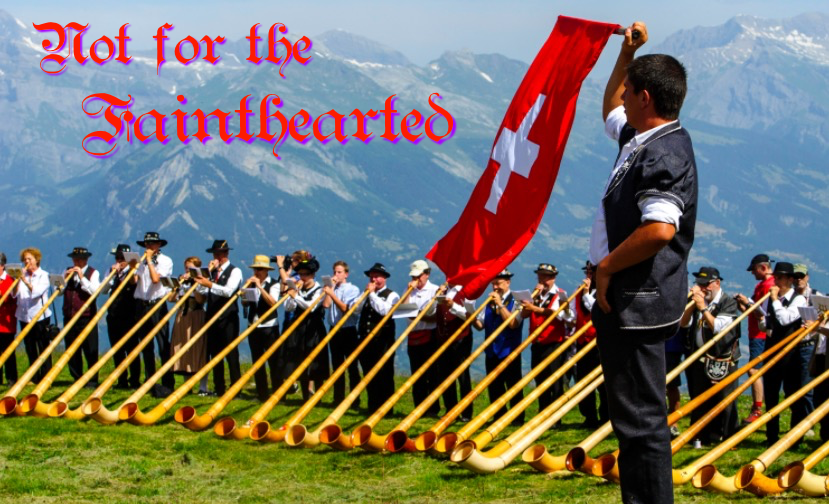
swiss horn

Not all college degrees are created equal. Some are “marketable,” and lead to well compensated careers. Others do not necessarily make one “employable,” but offer intrinsic satisfaction.

Engineering degrees would probably be in the first category. Creative writing degrees typically fall into the latter.

If I had the good fortune to study at Oxford when C.S. Lewis and J.R.R. Tolkien taught there, I would have savored the opportunity to sit in their presence and explore the wonders of Medieval Literature or Old English. (In America, at least, both of those degrees would fall into the second category identified above.)

As it was, my initial degree was in journalism. It seemed that every quarter our professors at the University of Washington would remind us that five years after graduation, no more than five percent of us would be working in that particular field. (I referred to those sessions as de-motivational chats.)

Still, learning how to write is a skill that serves one well in nearly any field.

Learning to yodel, on the other hand, probably possesses far fewer applications.

This year the Lucerne University of Applied Sciences and Arts will introduce a course on alpine “singing.” The University has expressed hope they will inspire enough Swiss yodelers to establish a degree program. If their efforts really pay off, they dream of offering a graduate degree in the rarified field.

The BBC reports “Yodelling is enjoying something of a resurgence in Switzerland, even featuring on successful chart albums last year.” I guess that answers the question about what the Swiss do beyond banking and making confectioneries.

If you have led a life so sheltered that you are uncertain exactly what yodeling is, the BBC describes it as “a form of singing which involves wobbling the voice up and down in a rapid change of pitch.”

An online dictionary defines yodel as a verb meaning “to sing with frequent changes from the ordinary voice to falsetto and back again, in the manner of Swiss and Tyrolean mountaineers.”

While most of us prefer our falsetto music in small doses, yodeling capitalizes on the full range of the human larynx, and then some.

The course will be taught by a famous yodeler, Nadja Räss. I’ve linked to one of her performances below.

I was curious as to what Lewis and Tolkien would have thought about this subject’s suitability for academic study. I suspect it would have provided the Inklings a chuckle, but they would affirm the value of studying one’s unique cultural heritage.

I did find one curious encounter Lewis had with a Swiss traveler in 1927. It has nothing to do with yodeling, and only tangentially touches on the university, but it is rather interesting. In a letter to his brother he mentions that Minto (Janie Moore) who lived with him, was being visited by an acquaintance.

You will be surprised to hear that while I write this, Minto is out to dinner. This results from the chief event since you left—the arrival of ‘un ami’ of Florence de Forest—not staying here, thank heavens.

He is a little Swiss commercial traveller, ‘Villie Goût,’ as smart as a bandbox, and very polite. Beyond making horrible noises in clearing his ‘pipes . . .’ and being intensely ugly, he is really quite harmless, tho’ of course very vulgar. He and Florence absolutely insisted on Minto’s dining with them at the Eastgate tonight, and won the day.

They know how to move their monde, as you will see from this fact and also when I tell you that they made me take them up Magdalen Tower this morning—as well as round the College. When I showed them the deer he made one of those extremely simple French jokes with which Maurice and M. Zée have familiarised us.

I had explained that these deer were descendants of a herd wh. had been there before the College was founded (that is quite true by the by, or as true as a College tradition need be), and I added ‘So you may say they are the oldest members of the College’.

‘And ze most intelligent?’ returned M. Goût.

I am confident that Mr. Goût and his companion enjoyed their visit to Oxford. Perhaps he returned home to Switzerland hoping that someday their universities would rival those of Britain.

Lucerne University of Applied Sciences and Arts was not founded until 1997, but their bold academic vision would have made Goût proud.

_____

You can enjoy a sample of Nadja Räss’ singing here.


Style Books, Capitonyms & C.S. Lewis

capital key

Today’s lesson will be . . . wait a second, we don’t post “lessons” here at Mere Inkling. We hope many of our columns are thought-provoking, and it would be nice to think a moderate share of them are entertaining.

However, if there’s any learning to be done, it’s incidental.

This post, though, verges on being educational. It addresses a subject readers and writers encounter every day. A subject about which there is frequent disagreement.

The question of which words should be capitalized is a major inspiration for writing Style Guides. (Oh no, I probably shouldn’t have capitalized that genre title.)

I am not alluding here to the style guides that major companies invest big bucks in designing to present their preferred image to the world. You can see some stunning examples of those here.

I’m interested in literary style guides. If you’ve ever written for publication, you’re likely familiar with the type of single sheet guidelines magazines create for prospective writers. The last thing you want, after wetting the manuscript’s pages with sweat and tears, is to have it discarded without review because you violated some editor’s pet peeves.

A standard stylebook that was required knowledge back in my college Journalism* days is the AP Stylebook. AP, of course, stands for “Associated Press.” And, where would the world of Academia be without the Chicago Manual of Style?

An even older stylebook that continues to play an important role is The Elements of Style written by William Strunk, Jr. Modern editions are attributed to “Strunk and White,” since it was revised and enlarged in 1959 by E.B. White. (Yes, that E.B. White, who authored Charlotte’s Web and other children’s classics.)

You can download a free copy of The Elements of Style at the Internet Archives, but it might be a tad risky to rely on the style described in Strunk’s first edition, since it was penned during the First World War.

It should be noted that not everyone is quite as enamored with the book as Mr. and Mrs. William Strunk, Sr. probably were. The author of one particularly haughty essay alleges that “the book’s contempt for its own grammatical dictates seems almost willful, as if the authors were flaunting the fact that the rules don’t apply to them.”

Christians & Capitalization

Religious writers vary in their capitalization of particular words. This variation crosses faith boundaries and is sometimes referred to as “reverential capitalization.”

The most obvious example in English literature is the question of whether or not the divine pronoun should be capitalized. This issue is encountered when a pronoun refers to God. The New American Standard Bible translation, for example, follows the traditional practice.

Seek the Lord and His strength; Seek His face continually. Remember His wonders which He has done, His marvels and the judgments uttered by His mouth . . . (Psalm 105:4-5)

My own practice of not capitalizing divine pronouns has occasionally scandalized members of critique groups to which I have belonged.*** A very few appear incapable of recognizing it’s a grammatical consideration, rather than a spiritual one. (Sadly, this sort of reaction often presages an individual’s departure from the writing support community, even when they are precisely the type of person who could best benefit from joining in.)

It should come as no surprise to learn that C.S. Lewis capitalized divine pronouns. Typical of his writing is this profound excerpt from Weight of Glory.

I read in a periodical the other day that the fundamental thing is how we think of God. By God Himself, it is not! How God thinks of us is not only more important, but infinitely more important.

Indeed, how we think of Him is of no importance except insofar as it is related to how He thinks of us. It is written that we shall “stand before” Him, shall appear, shall be inspected. The promise of glory is the promise, almost incredible and only possible by the work of Christ, that some of us, that any of us who really chooses, shall actually survive that examination, shall find approval, shall please God.

To please God… to be a real ingredient in the divine happiness… to be loved by God, not merely pitied, but delighted in as an artist delights in his work or a son—it seems impossible, a weight or burden of glory which our thoughts can hardly sustain. But so it is.

The Christian Writer’s Manual of Style acknowledges that “The capitalization of pronouns referring to persons of the Trinity has been a matter of debate for many decades.” They go so far as to state that doing so can impede our ability to communicate with “modern readers.”

Because capitalizing the deity pronoun, as well as a vast number of other religious terms, was the predominant style in the late nineteenth- and early twentieth-century publishing, it gives a book, at best, a dated, Victorian feel, and at worst, an aura of complete irrelevance to modern readers.

Capitonyms are a subgroup of homonyms. Their meaning changes on the basis of whether or not they are capitalized. A simple example would be distinguishing between a farmer’s concern for the quality of the earth in his fields and his regard for the planet on which he resides. Speaking of the Earth, we talk about the moons circling Jupiter, but all recognize that the Moon is the satellite that orbits 1.28 light-seconds above the surface of our planet.

In some Christian traditions, certain doctrines and events are capitalized while the very same words are not capitalized in a different sense. For example, many Christians would consider the following sentence correct.

It was the Resurrection of the only begotten Son of God that prepares the way for the resurrection of all those who take up their own cross and follow him.

The obvious difference is that the first use of the word refers to the singular miraculous event that transpired on Easter, while the latter points to its generalized definition.

In my most recent post I referred to the Gospels, as a genre unique to the writings about the life and significance of Jesus of Nazareth. As literary works, individually or collectively, the Gospels are capitalized, even when they do not include their full title [e.g. the Gospel According to Luke]. Most writers do not, however, capitalize gospel when used in a general sense, such as “every modern-day guru claims to possess a gospel of their own.” Just to make matters more interesting, some traditions capitalize Gospel when it refers to God’s love as embodied in the sacrificial death of Christ for the forgiveness of humanity’s sin.

One witty blogger chides the Church*** for over-capitalization.

I may just be cynical, and I’m definitely a literary snob, but it seems sometimes as though American Christians capitalize words related to Christianity just to make them seem holier.

For example, hymns and worship songs never refer to God and his mercy. It’s evidently more holy to capitalize the divine pronoun and refer to God and His mercy.

And if we capitalize mercy, which is a divine attribute, it makes the hymn or worship song even holier. I mean, God and His Mercy is clearly holier than God and his mercy, isn’t it?

So sermons are full of Grace, Goodness, Predestination, Prophecy, Agape, Apostles, Epistles, Pre-Millennialism, Mid-Millennialism, Post-Millennialism and the Millennium Falcon. All right, maybe not that last one.

Additional Insights from Lewis

One online writer offers a curious contrast between Lewis and e.e. cummings.

The writers who taught me the exponential value of capitalization: C.S Lewis and e.e. cummings. You know the rules of capitalization . . . Lewis and Cummings allow the capital letter to go deeper in its responsibility in communicating to the reader. . . .

For Lewis, capitalization often serves as a signpost of spiritual realities. He uses it to name a reality [as in The Screwtape Letters:] “We of course see the connecting link, which is Hatred.”

The most disorienting example of capitalization by Screwtape is his reference to God as the “Enemy.” It is a startling reversal of the true enemy, whose various names are commonly capitalized: Lucifer, Satan, Adversary, the Beast, Father of Lies and Evil One. Not to mention devils, which is sometimes used to refer to evil spirits (also known as demons or fallen angels), in contrast to the Devil himself who is also known by the aforementioned titles.

With so many alternatives when it comes to capitalization, the key is to follow the example of C.S. Lewis. It’s two-fold. First, have a reason why you select the option you do. Then, be consistent. Most readers readily adapt to different usages. What they can’t forgive, is inconsistency and literary chaos.

_____

* “Journalism” is capitalized here because it refers specifically to an academic college and degree program in many universities.

** The conservative Lutheran denomination to which I belong includes in its Stylebook for Authors and Editors the following guidance.

Gospel   Uppercase when referring to the Gospel message of salvation in Jesus Christ. Also uppercase when referring to one of the four New Testament Gospels.

The second rule indicates that one would use lowercase to refer to pseudepigraphical or heretical gospels. However, if the entire title of the text is used—precisely because it is a text, it would be capitalized (e.g. the Gospel of Thomas).

*** My wife occasionally finds time in her hectic schedule to proofread my posts before publication. (These would be the ones that appear without mistakes.) Well, Delores kindly pointed out just now that she too is scandalized by my irreverent failure to capitalize divine pronouns. After forty years of mostly-blissful marriage you would think she might have overlooked saying that… but, then again, when they’re truly scandalized how could someone be expected to remain silent?

**** I prefer to capitalize “Church” when it refers to the whole Body of Christ, but not when it references a congregation, denomination or a building . . . unless it’s part of a formal name such as the Church of the Nativity, in Bethlehem.

C.S. Lewis and Punditry

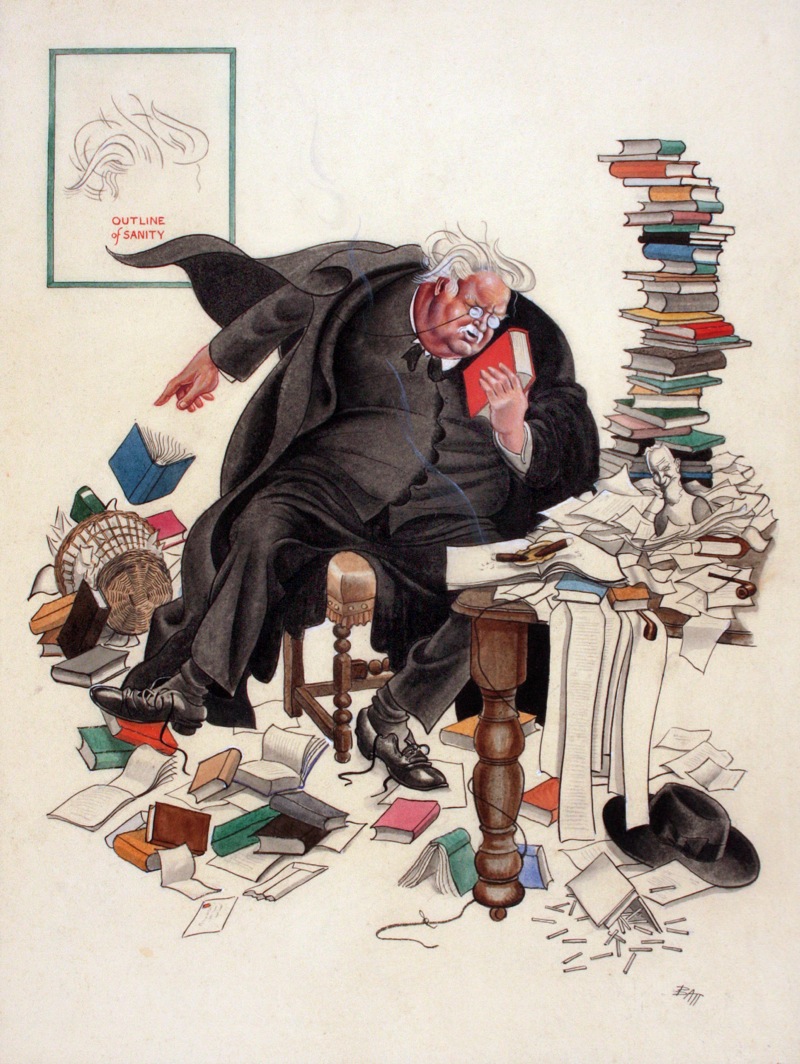
chesterton-sanity

Odds are that you, kind reader of Mere Inkling, are a pundit. While the overpaid professionals who overpopulate the media would like for us to think being a pundit requires possessing special knowledge or expertise, that’s simply not true.

Any of us who make comments or pass judgments in an authoritative manner can rightly be deemed a pundit. If you are simply a commonplace critic, you probably qualify for the title. All the more so if you publish your thoughts.

If the recent elections proved anything, they revealed there may well be more pundits per cubic acre in the modern world, than there are bees.

Recently I came across a peculiar essay, written by a writer with whom I’m totally unfamiliar. David Harsanyi is a senior editor of The Federalist, although this article appeared in National Review. Presumably he is a conservative, but of the atheist variety. (No wonder I haven’t read any of his work.)

At any rate, he’s a journalist who describes his “line of work” as “punditry.” Punditry as we have noted, has become all the rage in our modern era. I’m debating though whether adding it to one’s resume would be beneficial. It appears that receiving the validation of a punditry paycheck is the best gauge for making that determination.

As soon as people had the leisure time to develop their senses of humor, the seeds of punditry were planted, and many a silver tongued cynic has reaped the harvest. The past has known people who offered social criticism with a dash of wit (typically of the sarcastic variety).

An admirable example of such was G.K. Chesterton (1874-1936). Chesterton differed from Harsanyi in that he was also a philosopher and poet, not merely a journalist. Most notably, Chesterton was also a Christian.

C.S. Lewis held Chesterton in very high regard, and included his book The Everlasting Man among the top ten titles which had influenced his professional and philosophical thought. You can download an audio copy of that text here.

There is a great essay here that explores the influence of Chesterton’s essay “Ethics of Elfland” on the Inklings.

Jerk Logic

Returning to the article with which I began, “Jerk Logic” is the title of Bersanyi’s essay. He began with a question that more people should probably ask themselves.

Am I a jerk? You may find this an odd question for a person to ask himself. But when you’re in my line of work—which, broadly speaking, is called punditry—complete strangers on social media have little compunction about pointing out all your disagreeable character traits.

I found his article interesting for several reasons. He’s candid about some of the booby traps that endanger those who dare to write about controversial subjects. He offers a confession about just how soul-scarring the past election has been for some who have followed its permutations closely.

The 2016 election, I’m afraid, has convinced me that the joke is definitely on me. But after taking meticulous inventory of my actions over the past year or so, I am forced to acknowledge that perhaps, on occasion, some of my behavior might be construed as wantonly unpleasant. Long story short, I am a jerk . . . with an explanation.

Another thing I enjoyed in the brief piece is how he turned to a personality inventory (similar to the Myers Briggs Type Indicator) to assess his potential jerk quotient.

As I learned more about my personality type, I began feeling sorry for everyone in my almost certainly beleaguered family. While we pride ourselves on “inventiveness and creativity” and “unique perspective and vigorous intellect,” Logicians can also be “insensitive,” “absent-minded,” and “condescending.”

The essay concludes with a justification for a modest amount of jerkiness when living the life of a journalist, and especially a pundit.

As a writer, it’s incumbent on me to be clinically unpleasant and prickly when focusing on self-aggrandizing do-gooders or abusers of power or those who pollute our culture with garbage. One can make arguments in good faith while still being downright disagreeable. So I make no apologies for being disliked. There’s nothing wrong with being hated by the right people.

There are, in fact, far too many journalists overly concerned about being shunned. As a young critic writing his first reviews for a wire agency, I sometimes wrestled with an existential question: “Who am I to say these horrible things about people who are far more successful and powerful than I am?” Nowadays I ask myself: “How exactly can I say more horrible things about these people who shouldn’t be more successful or powerful than any of us?”

A skeptical and contrarian disposition is not only useful if you want to be a decent pundit, but indispensable if you want to be a good journalist on any beat.

I wonder whether Chesterton would think of this as an indispensable journalistic trait. He did, after all, have an honest view of the overall profession. “Journalism largely consists in saying ‘Lord Jones is dead’ to people who never knew Lord Jones was alive.” (The Wisdom of Father Brown)

I did find a fascinating description of the press provided by Chesterton in “The Boy.” It was published in 1909 in All Things Considered . . . and echoes true a century later.

But the whole modern world, or at any rate the whole modern Press, has a perpetual and consuming terror of plain morals. Men always attempt to avoid condemning a thing upon merely moral grounds.

If I beat my grandmother to death to-morrow in the middle of Battersea Park, you may be perfectly certain that people will say everything about it except the simple and fairly obvious fact that it is wrong.

Some will call it insane; that is, will accuse it of a deficiency of intelligence. This is not necessarily true at all. You could not tell whether the act was unintelligent or not unless you knew my grandmother. Some will call it vulgar, disgusting, and the rest of it; that is, they will accuse it of a lack of manners. Perhaps it does show a lack of manners; but this is scarcely its most serious disadvantage.

Others will talk about the loathsome spectacle and the revolting scene; that is, they will accuse it of a deficiency of art, or æsthetic beauty. This again depends on the circumstances: in order to be quite certain that the appearance of the old lady has definitely deteriorated under the process of being beaten to death, it is necessary for the philosophical critic to be quite certain how ugly she was before.

Another school of thinkers will say that the action is lacking in efficiency: that it is an uneconomic waste of a good grandmother. But that could only depend on the value, which is again an individual matter.

The only real point that is worth mentioning is that the action is wicked, because your grandmother has a right not to be beaten to death. But of this simple moral explanation modern journalism has, as I say, a standing fear. It will call the action anything else—mad, bestial, vulgar, idiotic, rather than call it sinful.

Amen. Evil acts today are nearly always attributed to some shortcoming or flaw such as insanity (e.g. individual acts) or delusional indoctrination (e.g. jihadism). While these are sometimes contributing factors, Chesterton rightly assessed the base cause.

Sadly, by affirming that fact, I expect that I too will be going on some people’s “jerk” list. They may consider me contrarian, but I’m simply striving to be honest.


Literary Martial Arts

nonficOne of the lowest moments in my writing life occurred when a creative writing professor advised me to “stick with nonfiction.” Oh, she said it gently, but it still struck me with the power of a mixed martial arts (MMA) hammerfist.

I was majoring in editorial journalism at the University of Washington. Attempting to expand my scope, I took a short story writing course. It was a mistake.

I thought I had done adequately during the course. I was even moderately pleased with a couple of my stories. The instructor, on the other hand, well let’s just say she was not impressed with my effort.

She was right. At the time, my ear for good fiction was quite immature. I do not claim that it’s particularly well developed today, but I have written a story about a medieval pilgrimage that I hope to unveil in a year or two.

I was reminded of my literature professor’s grim assessment as I recently read an interview with a pastor, who is also a lawyer, and happens to be a writer as well. His name is Randy Singer.

Singer describes the similarity of his professions by saying “They all require skills in persuasion, in telling stories to illustrate things.” I guess he’s right.

The difference being that pastors tell true stories, authors of fiction write imaginary stories, and attorneys weave tales that lie somewhere in between.

The part of the interview, which appeared in World Magazine, that I found particularly insightful was this:

When your only desire is to tell the story so people don’t even notice the wording, at that point you’ve become a fiction author.

Singer’s description struck me with the force of an MMA ridge hand (a reverse knife-hand). When I came to, I finally knew why composing fiction does not come naturally to me.

I love words too much. Too much to sacrifice them simply for the sake of the story. Oh, I value the message also, but getting there is half the fun.

Although I don’t love words to the degree many poets lust after them, I still possess an affection that does not allow me to view them through purely utilitarian lenses.

To add insult to his literary injury, Singer adds the following, in response to the question of what he learned while writing several successful novels.

Third, to be less verbose and let the action carry the story instead of thinking, “What are some really flowery and cool phrases and words that I can weave into this?”

That’s enough, friend. You made your point. I would have responded a bit more colorfully and fragrantly, but I hear you.

Singer doesn’t cite C.S. Lewis in the interview, but his counsel is consistent with that of the Oxford don. Lewis advised using clear and concrete language, “so as to make quite clear what you mean and make sure your sentence couldn’t mean anything else.” (Personal Correspondence, 1956).

Similarly, Lewis would always argue for the words not to draw attention to themselves. Essentially, they need to get out of the way so the message can come through. “Don’t use adjectives which merely tell us how you want us to feel about the things you are describing. I mean, instead of telling us a thing was “terrible,” describe it so that we’ll be terrified.”

It’s wisdom like that which causes us to recognize C.S. Lewis as the brilliant, gifted, creative, versatile and anointed writer that he was.

As for Singer, perhaps I’ll have to check out one of his legal thrillers. The latest is set in antiquity, with a Roman jurist defending Paul before Nero. Should be quite interesting. Not so good as a nonfiction account of such a trial would be . . . but probably worth reading.

Deadly Jobs

bad newsIt’s bad enough not liking your job . . . but being allergic to your chosen profession? That’s absolutely miserable.

And that’s what happened to one American journalist. Despite the myriads of new avenues for journalism, newspaper writing remains a primary context for the skill.

I actually earned my first degree in journalism. Editorial Journalism, via the University of Washington’s School of Communication. But I was never cut out to be a member of the Fourth Estate. (Ironically, I ended up belonging to the First Estate, but that’s another story.)

Journalism is a vocation important to the wellbeing of society. Good journalists are vital to society’s health. Those who spew vitriol, not so much.

Apparently a reporter for a Baltimore newspaper recently discovered—after thirty-eight years in the business, that he’s allergic to newspapers. Not their content, their composition. Specifically, he is allergic to pine resin which is used to make newsprint ink.

I assume he’s making a “quality of life” transition now to digital news sources.

Journalism is a broader field than many realize. Our first thought usually turns to newspaper “reporters.” We have often considered them to be objective relaters of events. Of course, complete objectivity is something that is beyond human grasp. Everyone approaches the “news” with their own biases and a worldview that shapes their perception of “facts.”

C.S. Lewis has a fun essay which touches on this. It’s called “Private Bates.”

We must get rid of our arrogant assumption that it is the masses who can be led by the nose. As far as I can make out, the shoe is on the other foot. The only people who are really the dupes of their favourite newspapers are the intelligentsia. It is they who read leading articles: the poor read the sporting news, which is mostly true.

I recall some debates back in my college days when others attempted to persuade me that objectivity was not only possible, it was the standard practice of reporters. That myth has long been exposed, and I try to be content with those who strive to be as fair as they can.

In a 1955 letter, C.S. Lewis is even more blunt than in the previously cited essay. He tells one of his regular correspondents, “I never read the papers. Why does anyone? They’re nearly all lies, and one has to wade thru’ such reams of verbiage and ‘write up’ to find out even what they’re saying.”

One reason journalism receives so little respect today is because people confuse reporting with editorializing. Reporting, of course, is just the facts. (Admittedly, even these are subjectively perceived.) Editorializing, on the other hand, is offering one’s unbridled opinion.

For the latter to masquerade as the former is criminal. But to accept the fact that honestly offered “opinion” is just that, is fine.

After all, one reason you’ve taken the time to read this post is because you appreciate reading gems from C.S. Lewis . . . and you don’t mind wading through the “opinionated” verbiage of this humble columnist to find it.

A Pair of Brilliant Writers

csl & chesterton

Sadly, politics are by definition nearly always polarizing. In the linguistic battleground of political warfare, we seem to more and more frequently encounter a “take no prisoners” attitude. It’s ominous.

I recently read the following words which describe, quite well I think, the positions of the two main rivals in virtually all political campaigns. (And, in this sentence, I’m referring to the military definition of “campaign.”)

“The whole modern world has divided itself into Conservatives and Progressives. The business of Progressives is to go on making mistakes. The business of the Conservatives is to prevent the mistakes from being corrected.”

Some things never change. This cutting critique appeared nearly a century ago (in the 19 April 1924 issue of the Illustrated London News). It was penned by G.K. Chesterton, a British writer who was admired by many of his contemporaries, from a number of different perspectives. George Bernard Shaw, a Socialist, considered the conservative journalist a “man of colossal genius.”

Chesterton was one of the Christian writers whose faith made a significant impression on the unbelieving C.S. Lewis. Before encountering Jesus, the atheist Lewis resented the “intrusions” of Christian references into the writings of authors he otherwise enjoyed. He describes this conundrum delightfully in Surprised by Joy.

All the books were beginning to turn against me. Indeed, I must have been as blind as a bat not to have seen, long before, the ludicrous contradiction between my theory of life and my actual experiences as a reader. George MacDonald had done more to me than any other writer; of course it was a pity he had that bee in his bonnet about Christianity. He was good in spite of it.

Chesterton had more sense than all the other moderns put together; bating, of course, his Christianity. Johnson was one of the few authors whom I felt I could trust utterly; curiously enough, he had the same kink. Spenser and Milton by a strange coincidence had it too.

Even among ancient authors the same paradox was to be found. The most religious (Plato, Aeschylus, Virgil) were clearly those on whom I could really feed.

On the other hand, those writers who did not suffer from religion and with whom in theory my sympathy ought to have been complete—Shaw and Wells and Mill and Gibbon and Voltaire—all seemed a little thin; what as boys we called “tinny.” It wasn’t that I didn’t like them. They were all (especially Gibbon) entertaining; but hardly more. There seemed to be no depth in them. They were too simple. The roughness and density of life did not appear in their books. . . .

The upshot of it all could nearly be expressed in a perversion of Roland’s great line in the Chanson—Christians are wrong, but all the rest are bores. The natural step would have been to inquire a little more closely whether the Christians were, after all, wrong.

And C.S. Lewis, to his eternal joy, did just that. He inquired more deeply into the faith held by the writers he so respected. This included, of course, Chesterton. Echoes of Chesterton’s masterful expressions of Christian faith recur in the work of Lewis. For example, in his essay “Membership,” Lewis writes:

Equality is a quantitative term and therefore love often knows nothing of it. . . . Even in the life of the affections, much more in the body of Christ, we step outside that world which says “I am as good as you.” . . . We become, as Chesterton said, taller when we bow; we become lowlier when we instruct.

Similarly, in A Preface to Paradise Lost, Lewis describes how best to savor the historical work of writers from different eras. Although the reference to Chesterton here is given in passing, I will reproduce the larger passage in light of its insight into how best to benefit from what we read.

The things which separate one age from another are superficial. Just as, if we stripped the armour off a medieval knight or the lace off a Caroline courtier, we should find beneath them an anatomy identical with our own, so, it is held, if we strip off from Virgil his Roman imperialism, from Sidney his code of honour, from Lucretius his Epicurean philosophy, and from all who have it their religion, we shall find the Unchanging Human Heart, and on this we are to concentrate.

I held this theory myself for many years, but I have now abandoned it. I continue, of course, to admit that if you remove from people the things that make them different, what is left must be the same, and that the Human Heart will certainly appear as Unchanging if you ignore its changes. . . .

Instead of stripping the knight of his armour you can try to put his armour on yourself; instead of seeing how the courtier would look without his lace, you can try to see how you would feel with his lace; that is, with his honour, his wit, his royalism, and his gallantries out of the Grand Cyrus. I had much rather know what I should feel like if I adopted the beliefs of Lucretius than how Lucretius would have felt if he had never entertained them. The possible Lucretius in myself interests me more than the possible C.S. Lewis in Lucretius.

There is in G.K. Chesterton’s Avowals and Denials a wholly admirable essay called “On Man: Heir of All the Ages.” An heir is one who inherits and “any man who is cut off from the past . . . is a man most unjustly disinherited.” . . .

You must, so far as in you lies, become an Achaean chief while reading Homer, a medieval knight while reading Malory, and an eighteenth century Londoner while reading Johnson. Only thus will you be able to judge the work “in the same spirit that its author writ” and to avoid chimerical criticism.

G.K. Chesterton is well worth reading, and most fans of Lewis will appreciate his prodigious work. The best thing about Chesterton, is that since he entered the presence of his Lord in 1936, nearly everything he wrote is in the public domain. His essays, poetry, apologetic works—and even the tales of his fictional detective Father Brown—are readily accessible online.

For a friendly introduction to the relationship between Lewis and Chesterton, I recommend “Chesterton and Lewis, Side by Side.” In an issue devoted entirely to comparing the two pillars of Twentieth Century Christian apologetics, the St. Austin Review, we read:

In 1946, ten years after Chesterton died, Lewis wrote a short article defending Chesterton against the two charges with which he is still attacked—or dismissed—by most academicians: one, that he was popular, and two, that he was dated. Of course, Lewis is attacked for the same two reasons.

The entire article is available here. Those interested in one of the areas where Chesterton’s writing overlapped with that of Lewis and his good friend, J.R.R. Tolkien, will also enjoy “G.K. Chesterton: Fairy Tale Philosopher,” which is available here.

Journalism that Respects God

“I believe that the journalism which succeeds best—and best deserves success—fears God and honors Man.” (from “The Journalist’s Creed”)

These words were written more than a century ago by Walter Williams, founder of one of the world’s best-respected schools of journalism. How times have changed! Today the majority of journalists are not only ignorant of matters related to faith . . . they are hostile towards it.

Thirty-five years ago, when I earned a degree in the field, there was more of an apathy towards religion at my secular university. (Sadly, I hear about a similar listless mood on some Christian campuses today.)

Ironically, while Williams might anticipate the danger of a subjective sympathy for Christianity in the West, he would be surprised. Many journalists seem to despise Christianity even more strongly than they question other faiths. And they wear their derision on their proverbial sleeves.

The simple fact is that everyone possesses a worldview. And, strive as a person might, they cannot attain the abstract precipice of utter objectivity. Most, of course, don’t strive at all. They surrender to their disdain for God and all religious institutions. And it is evident in their writing.

If writers today followed this element of the Journalist’s Creed more conscientiously, we would enjoy a far more civil and informed dialog in our society.

Addendum: 

Don’t forget that as disciples of Jesus, we too need to remain civil and respectful. Never forget that God chose to make humanity in his own holy image.