
Father Christmas & Crackers

J.R.R. Tolkien wrote, for his children’s enjoyment, an entertaining little story about Father Christmas’ stash of explosives. Read on to see what a mischievous polar bear did with them.

Merry Christmas. No, I’m not late in wishing you a blessed celebration of Christ’s Nativity. The church calendar recognizes Christmas is too big to celebrate just for a single day. The Inklings knew it – Christmas is a season.

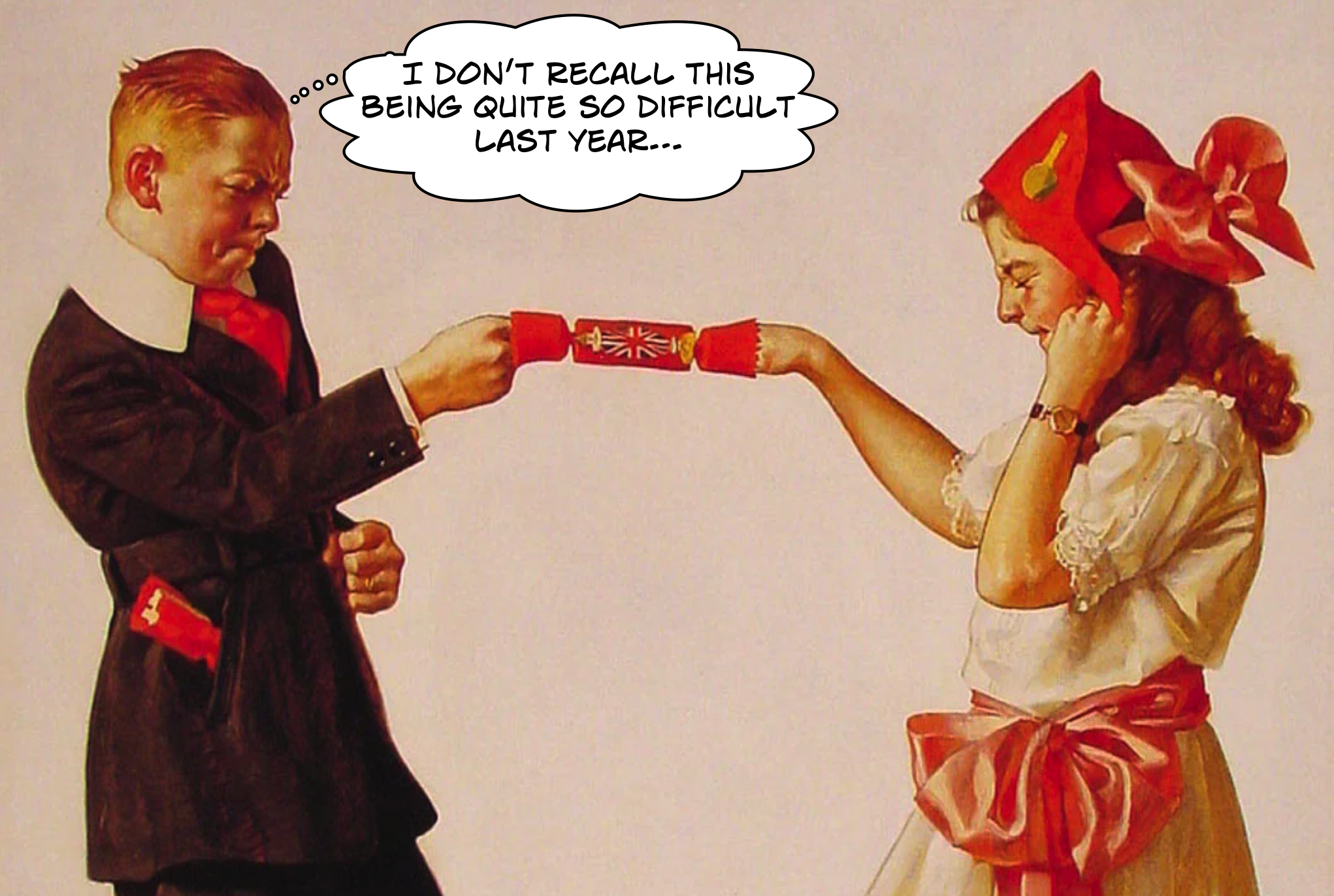
One nineteenth century invention has become a part of many families’ celebration of the season. They’re called “Christmas crackers,” and although birthed in Britain, they’ve found a home in many other countries. We adopted them as an annual tradition after living in England for several years.

Their beginning was modest. While many now lack edible treats, they were conceived as a means for selling confectionaries. Their inventor wanted to increase sales of a French treat.

For seven years he worked to develop the bon-bon into something more exciting, but it was not until he sat one evening in front of his fireplace that his great idea came to him. Watching the logs crackle, he imagined a bon-bon with a pop.

He made a coloured paper wrapper and put in it another strip of paper impregnated with chemicals which, when rubbed, created enough friction to produce a noise. He knew that bangs excited children (and were said to frighten evil spirits) – and the mottoes and poems he inserted inside the crackers amused adults (BBC).

Sadly, many of the crackers marketed today have been neutered. To improve their safety (and, no doubt, save production costs), some crackers no longer crack. They contain no “chemicals” to produce the customary bang. Seems like a misnomer to call these variants crackers, at all.

Tolkien’s Father Christmas Letters

Tolkien and his wife were blessed with four children, and they were doting parents. Each Christmas between 1920 and 1943, the famed author wrote and illustrated a pseudonymous letter to his kids. In 1976 they were posthumously published, and facsimiles of the correspondence appears in some editions of the letters.

They offer an intimate insight into the secular side of a Christian family’s celebration of the holiday (holy day). In fact, on Christmas Eve this very year, a selection from the letters was part of the Royal Carol Service, celebrated at Westminster Abbey.

The Christmas story was told in readings from Luke 2 given by The Prince of Wales and by Michael Ward. Jim Broadbent read from JRR Tolkien’s The Father Christmas Letters, and Leonie Elliot read Growing Tomorrow, a poem by Children’s Laureate Joseph Coelho commissioned specially for the service.

The following excerpt from the 1931 letter comes from the pen of Father Christmas himself. (It also features a fun notation from North Pole Bear.)

I should hardly feel it was Christmas if [the North Polar Bear] didn’t do something ridiculous. You will never guess what he did this time! I sent him down into one of my cellars – the Cracker-hole we call it – where I keep thousands of boxes of crackers (you would like to see them, rows upon rows, all with their lids off to show the kinds of colours.)

Well, I wanted 20 boxes, and was busy sorting soldiers and farm things, so I sent him; and he was so lazy he took his two Snowboys (who aren’t allowed down there) to help him. 

They started pulling crackers out of boxes, and he tried to box them (the boys’ ears I mean), and they dodged and he fell over, and let his candle fall right POOF! into my firework crackers and boxes of sparklers.

I could hear the noise, and smell the smell in the hall and when I rushed down I saw nothing but smoke and fizzing stars, and old Polar Bear was rolling over on the floor with sparks sizzling in his coat: he has quite a bare patch burnt on his back.

[NPB] It looked fine! That’s where Father Christmas spilled the gravy on my back at dinner!

The Snowboys roared with laughter and then ran away. They said it was a splendid sight – but they won’t come to my party on St. Stephen’s Day; they have had more than their share already.

The story goes on, relating the troublesome exploits of “two of the Polar Bear’s nephews” who have been visiting. However, the passage above suffices to illustrate the humor resident in the Tolkien household.

And, in light of this vignette, we just may have uncovered why modern manufacturers are forgoing the more explosive elements of Christmas crackers. No “pop,” no “poof.”

And, if you have a creative bent, consider making your own for next year!
Writing a Biography

What kind of writer are you? A poet, journalist, essayist or, perhaps, a minimalist? (By “minimalist” I mean someone who writes the bare minimum they have to.)

Many readers of Mere Inkling are, in fact, writers in their own right. Even ignoring the profusion of texts ricocheting around the globe (which are, in fact, literary creations), a fair number of Mere Inkling subscribers have blogs of their own.

The preeminent position of physical letters as the medium for correspondence has been usurped by email. People still write to one another, but – to the woe of the struggling United States Postal Service – they do it digitally.

More serious writers gravitate toward a varieties of genres. Often we try our hands at the sort of literature we prefer reading. That’s why I seldom write poetry. (And, when I do, it’s usually because I’m consciously stretching myself.)

My poetic skills may be limited – you can decide for yourself – but I don’t experience any of the disappointment that befell C.S. Lewis when his poetic dreams were dashed.

Poets are fine. Until they become snobs. If they treat other genres with respect, they stand on an equal footing with everyone else. But when they claim primacy for their preference, they lose me. Consider “William Faulkner Makes Us Wonder: What’s So Great About Poetry, Anyhow?

There’s a reason I can call poetry the highest form of artistic expression without thinking twice about it. And even though most Americans today don’t acknowledge the art form all that much, you’d be hard-pressed to find a sensible person who doesn’t respect or – if only from a distance – admire the magic in it.*

I guess I am one of the Americans who doesn’t possess a special reverence for poetry. And, as for “admiring the magic in it,” please. Wait, I don’t desire to offend you poets out there. Unless, of course, you consider yourself better than everyone else. In that case, consider my words a gentle rebuke (and encouragement to consider the virtue of humility).  

I hope that everyone will read on, and forgive me for maligning “the highest form of artistic expression.”

A Less Honored Literary Genre

I write nonfiction, unsurprising for someone who is basically a historian. Theologically, I neglect the conjecture of systematic theological considerations and focus on what’s usually called “practical theology.” It too, is unpretentious, and intended to make sense to “regular” people.

Recent years have found me dabbling in the memoir, or versions of autobiography, as I consider the potential value of such documents to my descendants.

One arena I’ve never really considered is biography. I suspect it would be a comfortable literary form, for a historian. I mean, you’re simply telling the story of a single life, relating facts and explaining the context of various events. That doesn’t sound too challenging, does it?

I suppose almost anyone could write a biography. The question is, could we write a good one?

Writing a Biography

I have been thinking about this subject ever since my research for my previous post introduced me to the work of David Cecil,⁑ one of the Oxford Inklings who shared the company of C.S. Lewis and J.R.R. Tolkien.

Cecil wrote several biographies. At Internet Archives you can read his lives of William Cowper, Charles Lamb, or Max Beerbohm, or his two-volume biography of Lord Melbourne (1 and 2).

If those individuals don’t tickle your proverbial fancy, you might want to look at the book that piqued my interest: An Anthology of Modern Biography. In it, Cecil explores the work of sixteen biographers. One of the chapters is his own portrayal of the evangelical Anglican cleric, John Newton (an extract from his biography of Cowper).

What intrigues me most about the volume is not the biographical material itself. Rather, it is Cecil’s very informative introduction. Here is his opening, which may whet the interest of future biographers . . . one of whom could be you?

Biography is not an important form of literary art. But it has a special interest to the student of modern literature. For it is the only new form. We can talk of modern poetry and modern novels, but these are only new variations on old forms. . . . Not so biography.

Art is primarily the expression of the artist’s creative powers; he writes to express his personal vision; he chooses as his subject that which he thinks will best exhibit his particular talent.

Now this is not true of the biographer of the past. His aim was not artistic, it was useful; he wanted to give people information. If he was a man of literary talent . . . his book was a work of art. But even if it had not been, it would not have failed. For its primary purpose had been, not to give an artistic impression, but to tell the truth.

This desire for the truth over ostentation resonates with me. But, mind you, he is referring to biographers “of the past.” Now (the book was published in 1936), other influences are at work.

But for the typical modern biographer literature comes first. Mr. Lytton Strachey writes about Queen Victoria, not in order to give us information about her, but because he thinks her life an excellent subject for a work of art. . . .

He does not set out his facts . . . complete with reference and proof, he weaves them into a story, grouping them in order and proportion that will make his picture as vivid and entertaining as possible.

Cecil’s explanation for this transformation is fascinating, and I encourage you to read it yourself, whether or not you are interested in writing a biography yourself. The book is available here, and thanks to the Public Library of India, you can download a complete copy for free.

In a 1932 letter to Arthur Greeves, C.S. Lewis contrasts biographies with the evidence from people’s daily lives. He shares with his lifelong friend a question this raises in his own minid.

It is a very consoling fact that so many books about real lives – biographies, autobiographies, letters etc. – give one such an impression of happiness, in spite of the tragedies they all contain. What could be more tragic than the main outlines of Lamb’s or Cowper’s lives?

But as soon as you open the letters of either, and see what they were writing from day to day and what a relish they got out of it, you almost begin to envy them.

Perhaps the tragedies of real life contain more consolation and fun and gusto than the comedies of literature?

Biography. Considering trying it. And, Poetry, it’s not that bad, either.


* The article does include interesting information about Faulkner. It appears his disappointed poetic dream shifted him to more productive fields. This parallels C.S. Lewis’ literary career.

For all of [Faulkner’s] achievements, his Nobel Prize for Literature, his Pulitzers and National Book Awards, his mug on a 22-cent postage stamp – the man still fell short. And it wasn’t that he dropped out of high school and did only a few semesters of college, or that he was once fired by an employer for reading on the job.

These were small missteps and shortcomings that were basically inconsequential in the long run. The larger issue is that, in his own view, William Faulkner was a failed poet. Failed.

“Maybe every novelist wants to write poetry first,” he told The Paris Review in 1956, “finds he can’t, and then tries the short story, which is the most demanding form after poetry. And, failing at that, only then does he take up novel writing.”

What you may not know is that before his first novel, Soldier’s Pay, Faulkner had written two books of poetry, Vision in Spring in 1921 and The Marble Faun in 1924. While he’d long dreamed of being taken seriously as a poet, the verse was always second-rate and not particularly significant. Eventually he abandoned his efforts as a poet to focus solely on his fiction.

⁑ In the spirit of most colonials who shook off the reigns of monarchial rule, I tend to respect the Queen as a head of state, and disregard the affectations of an aristocracy they once “lorded” it over. Thus, I can take or leave Cecil’s normative citation as “Lord David Cecil.

Worshiping Thor

thorI have a confession to make. One that is particularly awkward for a pastor.

The current success of the recent films about the Norse god of thunder have reminded me of one of the “errors” of my youth.

As a young boy I discovered great delight in reading comic books. And among all of the countless Marvel and DC titles I read during my youth, none was more precious to me than Thor. I never really “worshiped” him, of course, but I was enraptured by his saga.

I loved the comic, and it was difficult to wait each long, long month for the next issue to be published. I followed Thor’s adventures with intense devotion. An intense loyalty that was probably inappropriate since it was directed towards a pagan deity.

To make matters worse, the part of the magazine that appealed most to me was not the contemporary escapades of the otherworldly hero. The feature that most captivated my imagination was a smaller story included in each issue and entitled “Tales of Asgard.”

These stories were terribly brief, only five short pages, and didn’t introduce contemporary terrestrial or interstellar villains. Instead, they recounted the historic tales of Norse myth and religion. Their very earthiness—their historical authenticity—impressed me far more profoundly than did the 1960s superhero fare so commonplace during that era.

In fact, in Thor’s two cinematic blockbusters, I find the same to hold true. I find the mythological elements, the portions of the story set in Asgard far more captivating than the familiar, run of the mill heroic landscape of Midgard (Earth).*

I doubt  I am alone in my appreciation of the mythical over the scientific or magical elements. In the preface to The Pilgrim’s Regress, C.S. Lewis wrote, “When allegory is at its best, it approaches myth, which must be grasped with the imagination, not with the intellect.”

C.S. Lewis wrote a great deal about the power of myth. Like his close friend, J.R.R. Tolkien, author of Lord of the Rings, Lewis brought myth to life in The Chronicles of Narnia. In 1944, Lewis wrote an essay entitled “Myth Became Fact.” In it he explores the notion that in a sense Christianity too, is a myth—with one distinction from all of the rest.

Now as myth transcends thought, Incarnation transcends myth. The heart of Christianity is a myth which is also a fact. The old myth of the Dying God, without ceasing to be myth comes down from the heaven of legend and imagination to the earth of history. It happens—at a particular date, in a particular place, followed by definable historical consequences.

We pass from a Balder or an Osiris, dying nobody knows when or where, to a historical Person crucified (it is all in order) under Pontius Pilate. By becoming fact it does not cease to be myth: that is the miracle.

I began by saying I was making a confession of sorts. In truth, fascination with myth is nothing to be ashamed of. Lewis describes how it was precisely his own interest in such matters that played a primary role in his conversion to Christianity. In a 1931 letter to his friend Arthur Greeves, he describes the incipient process. These words foreshadow the message of the essay referred to above.

Now what [Hugo] Dyson and Tolkien showed me was this: that if I met the idea of sacrifice in a Pagan story I didn’t mind it at all: again, that if I met the idea of a god sacrificing himself to himself . . . I liked it very much and was mysteriously moved by it: again, that the idea of the dying and reviving god (Balder, Adonis, Bacchus) similarly moved me provided I met it anywhere except in the Gospels.

The reason was that in Pagan stories I was prepared to feel the myth as profound and suggestive of meanings beyond my grasp even tho’ I could not say in cold prose “what it meant.” Now the story of Christ is simply a true myth: a myth working on us in the same way as the others, but with this tremendous difference that it really happened: and one must be content to accept it in the same way, remembering that it is God’s myth where the others are men’s myths: i.e. the Pagan stories are God expressing Himself through the minds of poets, using such images as He found there, while Christianity is God expressing Himself through what we call “real things.”

Therefore it is true, not in the sense of being a “description” of God (that no finite mind could take in) but in the sense of being the way in which God chooses to (or can) appear to our faculties. The “doctrines” we get out of the true myth are of course less true: they are translations into our concepts and ideas of that which God has already expressed in a language more adequate, namely the actual incarnation, crucifixion, and resurrection.

Does this amount to a belief in Christianity? At any rate I am now certain (a) That this Christian story is to be approached, in a sense, as I approach the other myths. (b) That it is the most important and full of meaning. I am also nearly certain that it really happened.

The awareness that a mind so brilliant (and sanctified) as Lewis’ recognized the value of myth comforts me. I guess, in retrospect, that my youth was not entirely misspent reading those amazing stories. Thor still occupies a special place in my life journey, albeit not in a pantheon.

_____

* There are nine worlds in Norse cosmology. Midgard lies between the noble worlds of Asgard, Vanaheim and Alfheim . . . and Jotunheim, home of the frost giants, Svartalfheim, realm of the Dark Elves, and Muspelheim, abode of the Fire Giants and demons.