Explosive Clergy

What’s with pastors? As one, I probably know more than the typical person does about them – and all too often, they disappoint.

That’s a bit harsh. Most pastors are pretty selfless. That’s fairly evident in their salaries (if they even receive one). And, trust me, trying to be a faithful leader and peacemaker in any group comprised of human beings, is no easy task.

My sainted grandmother, born at the end of the nineteenth century, was the daughter of Norwegian immigrants. She was an authentic follower of Jesus, and when she was young the sermons at Fordefjord Lutheran Church* were preached in the immigrants’ tongue. We occasionally talked about how scandalized she was when one of the ministers serving the congregation pronounced “helvete vil være fullt av pastorer” (hell will be full of pastors).

Well, not “full” perhaps, but in principle he was right. And, sadly, his warning is not at all shocking to us today. We read regularly about clergy who are arrested for violating the trust of the most vulnerable. Likewise, we hear about the outrageous wealth of some ministers (including, it seems, nearly every televangelist). Even pastors in small enclaves with little access to the temptation offered by easily accessible cash, can too often succumb to the sirens of pride and power, twisting their pastoral authority into a weapon to abuse others. (It’s the opposite of the messianic promise found in Isaiah 2:4.)

It’s almost enough to drive a person from the Lord’s house. But that is not the answer, of course. Finding a truly Christian church, with a pastor earnestly (albeit imperfectly) pursuing his holy vocation, is the best course.

The Scriptures say many things about ministry, and Jesus himself provides the perfect example of willingness to lay down one’s life for the sheep.

The letter of James cautions those considering a life of “ministry” that they will face a stricter judgment than the laity (which comes from λαός which refers to the people at large).

Personally, I especially appreciate being reminded of God’s warning to religious leaders from the lips of Jeremiah. (I also appreciate the ironic tone of God’s judgment.)

“Woe to the shepherds who destroy and scatter the sheep of my pasture!” declares the Lord. Therefore thus says the Lord, the God of Israel, concerning the shepherds who care for my people: “You have scattered my flock and have driven them away, and you have not attended to them. Behold, I will attend to you for your evil deeds,” declares the Lord.

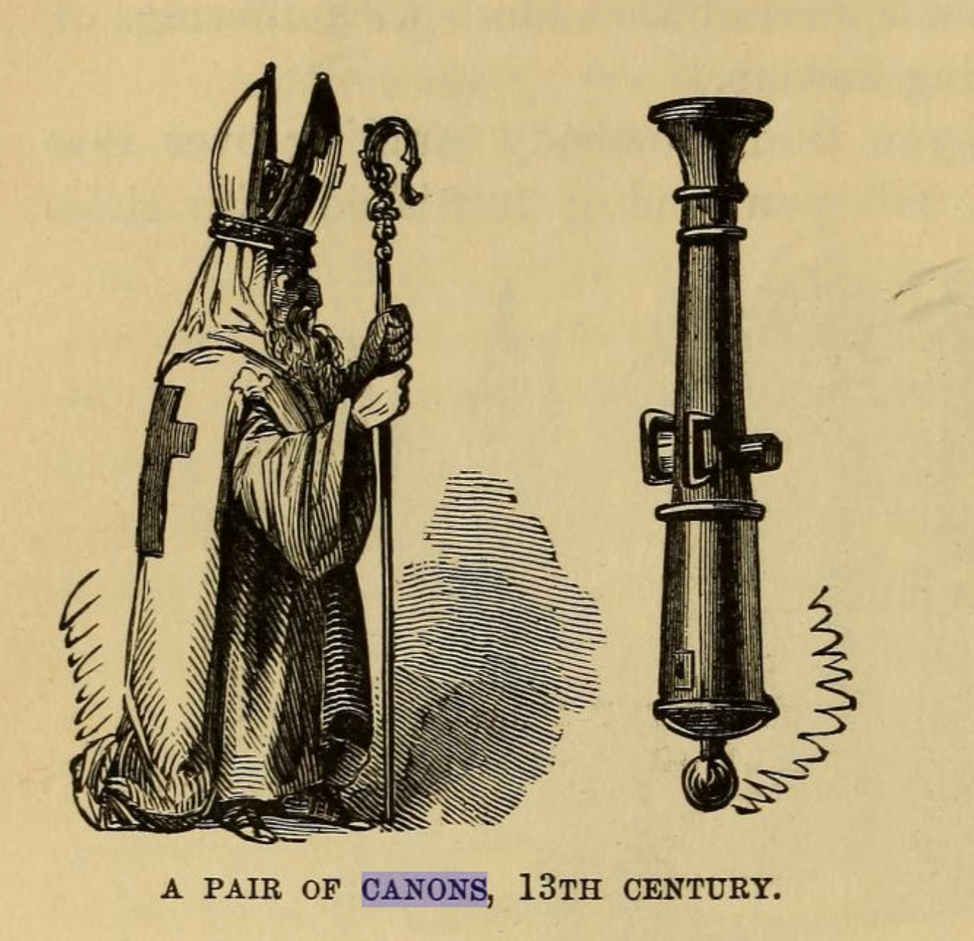
The picture at the top of this column comes from one of Mark Twain’s travelogues. It illustrates the vindictive priest Fulbert, in Twain’s retelling of the story of Abelard and Héloïse, 12th century lovers. More about that momentarily. Abelard was a prominent philosopher who tangled for several years with Saint Bernard of Clairvaux, a significant dispute ably discussed here.

Abelard and the Inklings

Abelard (c. 1079-1142) was a philosopher who, as was common during the Middle Ages, was also a theologian. Among his contributions to religion was revising the Roman Catholic doctrine of limbus infantium (Limbo for unbaptized infants).

In popular culture, Abelard’s love affair with his eventual “wife” is more prominent than his religious pursuits. Although Abelard was a famous figure during the medieval period, he did not feature significantly in C.S. Lewis’ thought. He did, however, exert a prominent influence on Charles Williams’ Place of the Lion, a volume Lewis praised.

In “Friendship in The Place of the Lion,” Dan Hamilton provides a very accessible synopsis of Williams’ book. He describes the experience of a primary character, who is writing her dissertation on “Pythagorean Influences on Abelard.” As she struggles with the appearance of supernatural phenomena, “she encounters the specter of Abelard, a major subject of her studies. But he is dead, and powerless to give her any aid, not even a meaningful word.” The “archetypes” in the story, by contrast, possess genuine power. It is a very unique book.

Returning to Mark Twain’s retelling of the popular medieval tale, we leave the realm of platonic philosophy, and enter the world of sordid human activities. Twain, you see, was not sympathetic to Abelard’s wooing of a young student and his eventual repentance. In his account, Twain desired “to show the public that they have been wasting a good deal of marketable sentiment very unnecessarily.” If you are curious as to his perspective on the events, continue reading.

Twain’s Take on Abelard and Héloïse
(not brief, but well worth reading)

In his own words, Twain’s “faithful” version of their story – but first, he begins with a description of their shared gravesite.

But among the thousands and thousands of tombs in Père la Chaise [cemetery] there is one that no man, no woman, no youth of either sex, ever passes by without stopping to examine. Every visitor has a sort of indistinct idea of the history of its dead, and comprehends that homage is due there, but not one in twenty thousand clearly remembers the story of that tomb and its romantic occupants. This is the grave of Abelard and Heloise – a grave which has been more revered, more widely known, more written and sung about and wept over, for seven hundred years, than any other in Christendom, save only that of the Saviour.

All visitors linger pensively about it; all young people capture and carry away keepsakes and mementoes of it; all Parisian youths and maidens who are disappointed in love come there to bail out when they are full of tears; yea, many stricken lovers make pilgrimages to this shrine from distant provinces to weep and wail and “grit” their teeth over their heavy sorrows, and to purchase the sympathies of the chastened spirits of that tomb with offerings of immortelles and budding flowers.

Go when you will, you find somebody snuffling over that tomb. Go when you will, you find it furnished with those bouquets and immortelles. Go when you will, you find a gravel-train from Marseilles arriving to supply the deficiencies caused by memento-cabbaging vandals whose affections have miscarried.

Yet who really knows the story of Abelard and Heloise? Precious few people. The names are perfectly familiar to every body, and that is about all. With infinite pains I have acquired a knowledge of that history, and I propose to narrate it here, [italics added] partly for the honest information of the public and partly to show that public that they have been wasting a good deal of marketable sentiment very unnecessarily.

Heloise was born seven hundred and sixty-six years ago. She may have had parents. There is no telling. She lived with her uncle Fulbert, a canon of the cathedral of Paris. I do not know what a canon of a cathedral is, but that is what he was. He was nothing more than a sort of a mountain howitzer, likely, because they had no heavy artillery in those days. Suffice it, then, that Heloise lived with her uncle the howitzer, and was happy.

She spent the most of her childhood in the convent of Argenteuil – never heard of Argenteuil before, but suppose there was really such a place. She then returned to her uncle, the old gun, or son of a gun, as the case may be, and he taught her to write and speak Latin, which was the language of literature and polite society at that period.

Just at this time, Pierre Abelard, who had already made himself widely famous as a rhetorician, came to found a school of rhetoric in Paris. The originality of his principles, his eloquence, and his great physical strength and beauty created a profound sensation. He saw Heloise, and was captivated by her blooming youth, her beauty and her charming disposition. He wrote to her; she answered. He wrote again, she answered again. He was now in love. He longed to know her – to speak to her face to face.

His school was near Fulbert’s house. He asked Fulbert to allow him to call. The good old swivel saw here a rare opportunity: his niece, whom he so much loved, would absorb knowledge from this man, and it would not cost him a cent. Such was Fulbert – penurious . . . He asked Abelard to teach her.

Abelard was glad enough of the opportunity. He came often and staid long. A letter of his shows in its very first sentence that he came under that friendly roof like a cold-hearted villain as he was, with the deliberate intention of debauching a confiding, innocent girl. This is the letter :

“I can not cease to be astonished at the simplicity of Fulbert; I was as much surprised as if he had placed a lamb in the power of a hungry wolf. Heloise and I, under pretext of study, gave ourselves up wholly to love, and the solitude that love seeks our studies procured for us. Books were open before us, but we spoke oftener of love than philosophy, and kisses came more readily from our lips than words.”

And so, exulting over an honorable confidence which to his degraded instinct was a ludicrous “simplicity,” this unmanly Abelard seduced the niece of the man whose guest he was. Paris found it out. Fulbert was told of it – told often – but refused to believe it. He could not comprehend how a man could be so depraved as to use the sacred protection and security of hospitality as a means for the commission of such a crime as that. But when he heard the rowdies in the streets singing the love-songs of Abelard to Heloise, the case was too plain – love-songs come not properly within the teachings of rhetoric and philosophy.

He drove Abelard from his house. Abelard returned secretly and carried Heloise away to Palais, in Brittany, his native country. Here, shortly afterward, she bore a son, who, from his rare beauty, was surnamed Astrolabe. . . . The girl’s flight enraged Fulbert, and he longed for vengeance, but feared to strike lest retaliation visit Heloise – for he still loved her tenderly. At length Abelard offered to marry Heloise – but on a shameful condition: that the marriage should be kept secret from the world, to the end that (while her good name remained a wreck, as before) his priestly reputation might be kept untarnished. It was like that miscreant.

Fulbert saw his opportunity and consented. He would see the parties married, and then violate the confidence of the man who had taught him that trick; he would divulge the secret and so remove somewhat of the obloquy that attached to his niece’s fame. But the niece suspected his scheme. She refused the marriage, at first; she said Fulbert would betray the secret to save her, and besides, she did not wish to drag down a lover who was so gifted, so honored by the world, and who had such a splendid career before him. It was noble, self-sacrificing love, and characteristic of the pure-souled Heloise, but it was not good sense.

But she was overruled, and the private marriage took place. Now for Fulbert! The heart so wounded should be healed at last; the proud spirit so tortured should find rest again; the humbled head should be lifted up once more. He proclaimed the marriage in the high places of the city, and rejoiced that dishonor had departed from his house. But lo! Abelard denied the marriage! Heloise denied it! The people, knowing the former circumstances, might have believed Fulbert, had only Abelard denied it, but when the person chiefly interested – the girl herself – denied it, they laughed despairing Fulbert to scorn.

The poor canon of the cathedral of Paris was spiked again. The last hope of repairing the wrong that had been done his house was gone. What next? Human nature suggested revenge. He compassed it. The historian says: “Ruffians, hired by Fulbert, fell upon Abelard by night, and inflicted upon him a terrible and nameless mutilation.”

I am seeking the last resting-place of those “ruffians.” When I find it I shall shed some tears on it, and stack up some bouquets and immortelles, and cart away from it some gravel whereby to remember that howsoever blotted by crime their lives may have been, these ruffians did one just deed, at any rate, albeit it was not warranted by the strict letter of the law.

Heloise entered a convent and gave good-bye to the world and its pleasures for all time. For twelve years she never heard of Abelard – never even heard his name mentioned. She had become prioress of Argenteuil, and led a life of complete seclusion. She happened one day to see a letter written by him, in which he narrated his own history. She cried over it, and wrote him. He answered, addressing her as his “sister in Christ.”

They continued to correspond, she in the un-weighed language of unwavering affection, he in the chilly phraseology of the polished rhetorician. She poured out her heart in passionate, disjointed sentences; he replied with finished essays, divided deliberately into heads and sub-heads, premises and argument. She showered upon him the tenderest epithets that love could devise, he addressed her from the North Pole of his frozen heart as the “Spouse of Christ!” The abandoned villain!

On account of her too easy government of her nuns, some disreputable irregularities were discovered among them, and the Abbot of St. Denis broke up her establishment. Abelard was the official head of the monastery of St. Grildas de Ruys, at that time, and when he heard of her homeless condition a sentiment of pity was aroused in his breast (it is a wonder the unfamiliar emotion did not blow his head off), and he placed her and her troop in the little oratory of the Paraclete, a religious establishment which he had founded.

She had many privations and sufferings to undergo at first, but her worth and her gentle disposition won influential friends for her, and she built up a wealthy and flourishing nunnery. She became a great favorite with the heads of the church, and also the people, though she seldom appeared in public. She rapidly advanced in esteem, in good report and in usefulness, and Abelard as rapidly lost ground. The Pope so honored her that he made her the head of her order.

Abelard, a man of splendid talents, and ranking as the first debater of his time, became timid, irresolute, and distrustful of his powers. He only needed a great misfortune to topple him from the high position he held in the world of intellectual excellence, and it came. Urged by kings and princes to meet the subtle St. Bernard in debate and crush him, he stood up in the presence of a royal and illustrious assemblage, and when his antagonist had finished he looked about him, and stammered a commencement; but his courage failed him, the cunning of his tongue was gone: with his speech unspoken, he trembled and gat down, a disgraced and vanquished champion.

He died a nobody, and was buried at Cluny, A.D., 1144. They removed his body to the Paraclete afterward, and when Heloise died, twenty years later, they buried her with him, in accordance with her last wish. He died at the ripe age of 64, and she at 63. After the bodies had remained entombed three hundred years, they were removed once more. They were removed again in 1800, and finally, seventeen years afterward, they were taken up and transferred to Pere la Chaise, where they will remain in peace and quiet until it comes time for them to get up and move again.

History is silent concerning the last acts of the mountain howitzer. Let the world say what it will about him, I, at least, shall always respect the memory and sorrow for the abused trust, and the broken heart, and the troubled spirit of the old smooth-bore. Rest and repose be his!

Such is the story of Abelard and Heloise. (Innocents Abroad).


* Later Fordefjord was unimaginatively renamed “First Lutheran Church.”

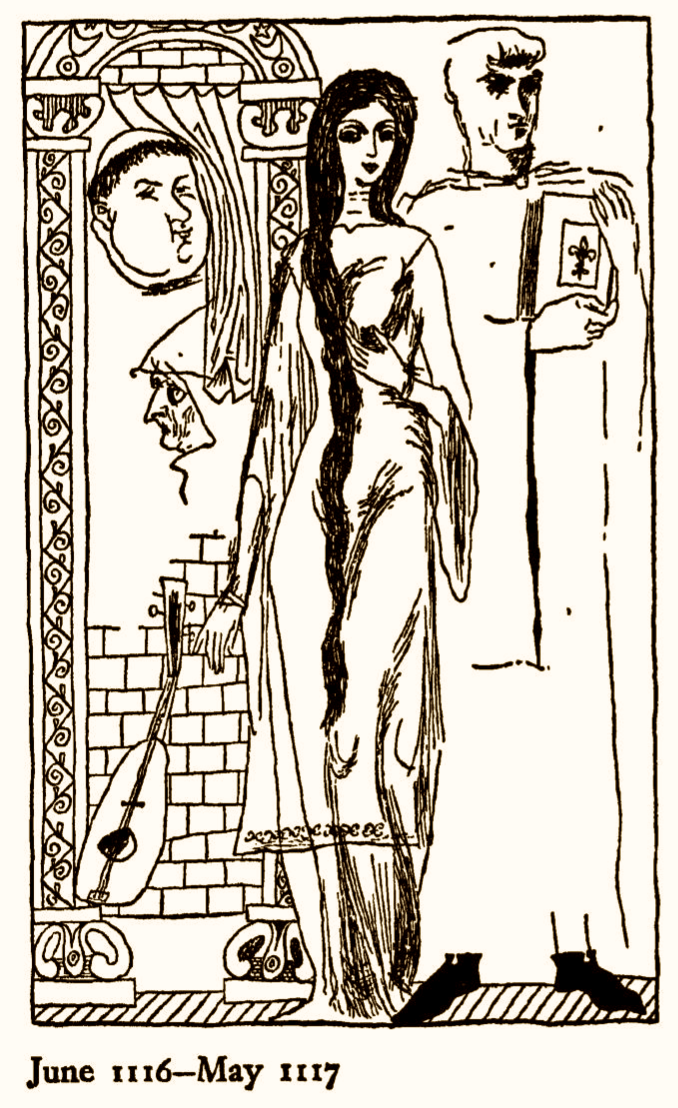
A novel entitled Peter Abelard was published in 1933 by Helen Waddell. It is available at Internet Archive for those who prefer their history via the medium of historical fiction. The illustration below, apparently imitating a fading fresco, comes from that volume.

Satirical Scottish Birds

C.S. Lewis has introduced me to many fascinating writers. Authors I never would have learned about without Lewis’ reference to them.

Sometimes Lewis praises their work. At other times, being an honest literary critic, he is compelled to provide a less flattering appraisal. He typically offers the latter evaluation with a novel flair.

In my previous post I shared the sad tale of a blackbird tapping at our window. I promised to discuss today some other curious birds. These creatures, in contrast to the forlorn blackbird, arise from the imagination of a Scottish poet named Sir David Lyndsay* of the Mount. He lived around 1490 to 1555.

Lyndsay rose to the ceremonial rank of “The Right Honourable the Lord Lyon King of Arms,” which sounds quite impressive. In that capacity, he compiled 400 Scottish coats of arms, which was quite an achievement. You can download a rare facsimile of that document for your personal library from Internet Archive. The central shield may belong to my wife’s ancestors, “Jhonstoun of that ilke.”

Sir Lyndsay was a tutor to James V and served in his Court after his ascendancy to Scotland’s throne. However, it is for his poetry that David Lyndsay is remembered. Which is precisely why C.S. Lewis included him in the volume he wrote for the Oxford History of English Literature. English Literature in the Sixteenth Century Excluding Drama was published in 1944. While this authoritative volume is certainly not casual reading, it is extremely interesting. Just listen to how Lewis introduces Scottish writers of the “close of the Middle Ages.”

Sir David Lyndsay’s Legacy

This academic work is the place our favorite Inkling introduced me to “the last major poet of the old Scotch tradition.” I was on a quest for something interesting about birds, and I learned of a delightful piece of satire written by this Renaissance “Lion King.”

His works are a beautiful example of the ‘single talent well employed.’ The Satyre of the Thrie Estaitis, which holds an important place among our scanty materials for a history of the allegorical drama in Scotland, will be dealt with in another volume of this series . . . stands apart from the rest of Lyndsay’s output by the looseness of the metre and the general popularity of the style, and that it is rich in pathos and low humour.

In his remaining works he everywhere keeps well within the lines marked out for him by his great predecessors, there is no novelty in them . . . But what there is of him is good all through.

I am quite receptive to satire that skewers hypocritical clergy. That’s why the “episcopal ghost”⁑ in The Great Divorce is my favorite example of someone who has rejected the Truth.

This is what appealed to me about Lyndsay’s satire The Testament and Complaynt of our Soverane Lordis Papyngo.

The Complaynt [an earlier work] records, in a brisk, mocking fashion . . . the marked improvement in social order and general well-being throughout the kingdom, except as regards the “spiritualitie.” On the doings of the ecclesiastics he advises [the young king] to keep a watchful eye, and see that they preach with “unfeyneit intentis,” use the sacraments as Christ intended and leave such vain traditions as superstitious pilgrimages and praying to images. . . .

In The Testament and Complaynt of our Soverane Lordis Papyngo (parrot) he exposed more particularly the corruptions and worldliness of the spirituality, and this in a more comprehensive and scathing fashion than in his two previous pieces . . . (Cambridge History of English and American Literature).

And here are the ecclesiastical nemeses of the poem, “religious men, of gret devotioun.”

Here, also, all is pure satire—much of it of a very clever and trenchant character . . . the wise bird [the king’s parrot] with its “holy executors,” who appear in the form of a pyot [magpie] (representing a canon regular), a raven (a black monk) and a gled or hawk (a holy friar). The disposition and aims of these ghostly counsellors are sufficiently manifest; and they act entirely in keeping with their reputed character.

The poor parrot would have much preferred to have, at her death-bed, attendants of a less grovelling type of character, such as the nightingale, the jay, the mavis [song thrush], the goldfinch, the lark, etc.; but, since none of them has come, she has to be content with the disreputable birds who have offered her their services.

After a piquant discussion with them on the growth of ecclesiastical sensuality and greed, she thereupon proceeds to dispose of her personality—her “galbarte of grene” to the owl, her eyes to the bat, her beak to the pelican, her music to the cuckoo, her “toung rhetoricall” to the goose and her bones to the phoenix.

Her heart she bequeaths to the king; and she leaves merely her entrails, including her liver and lungs, to her executors who, however, immediately on her death, proceed to devour her whole body, after which the ged flies away with her heart, pursued by the two other birds of prey.

I can picture the assembled clergy in their avian forms offering their pseudo-comfort to the dying parrot. In English Literature in the Sixteenth Century, C.S. Lewis describes the misbegotten flock in the following manner.

[The parrot’s] testament is made in the unwelcome presence of certain birds of prey who turn out to be monks and friars of the feathered world. The dying parrot inveighs against their hypocrisy and avarice . . . while they vigorously defend themselves by throwing the blame on the secular clergy.

So far, the satire has been ordinary enough; but we find real satiric invention, and even a strange beauty, when the popinjay, having provided for the poor by leaving her gay coat to the owl, her eyes to the bat, and her voice to the cuckoo, and for herself by committing her spirit to the Quene of Farie, is torn in pieces by her carrion executors the moment the breath is out of her body—hir angell fedderis fleying in the air.

It is not without reason an article in Studies in Scottish Literature opens with this praise:

Lindsay’s concern for morality and truthfulness, in an age when political and religious institutions were notoriously corrupt, earned him a considerable reputation in his lifetime. Indeed for later generations of Scottish readers, Lindsay’s name became a byword for reliability and truthfulness, at times even rivalling divine Scripture.

You can read the original poem, along with all of Lyndsay’s other poetic works, in this 1871 collection.


* Just a caution for those looking for more information about Lyndsay: be aware that his surname is also spelled Lindsay, Lindesay and Lyndesay. Also, he should not be confused with Robert Lindsay of Pitscottie, a roughly contemporary author who compiled The Historie and Chronicles of Scotland. (Robert’s family name is also spelled with similar variants.)

⁑ Lewis’ use of the word “episcopal” here does not refer to a denomination. It suggests a churchly, or more accurately, a high-churchly theologian.

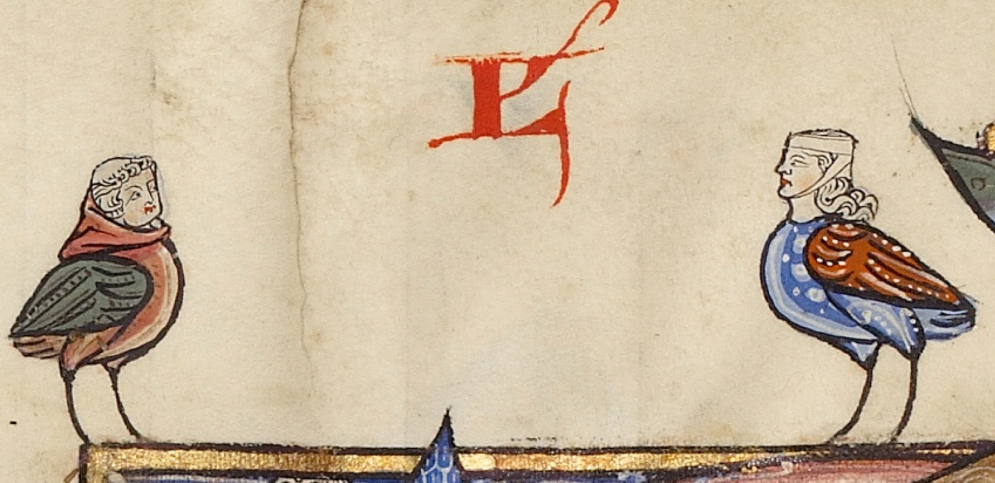
Noble Birds of Aragon, circa AD 1290

C.S. Lewis’ Hypocrisy

hypocrite

If you think the title of this column indicates what follows will be an attack on C.S. Lewis, you are wrong.

On the contrary, the incident described below actually emphasizes the integrity which guided Lewis’ life.

Hypocrisy afflicts us all. It’s hold is strongest, it seems to me, on those who claim they are completely free of the flaw. To paraphrase Jesus’ words recorded in John’s Gospel, “Let he who is without hypocrisy among you cast the first stone.”

It’s quite possible for our own flaws to be invisible to us. However, one of the requirements of being a moral individual is self-examination. The more honestly we can explore and assess our own actions and nature, the healthier we will be.

Some hypocrisy seems rather innocuous. For example in All My Road Before Me, Lewis describes a day in 1922 spent canoeing with his close friend Arthur, and Veronica FitzGerald Hinckley. Veronica was a recent graduate of Oxford.

In light of Lewis’ eventual life’s work, this diary entry is rather ironic:

[Veronica] made one good remark—that an educational career is a school of hypocrisy in which you spend your life teaching others observances which you have rejected yourself.

While academia does host its share of hypocrites, this vice also flourishes elsewhere. Tragically, of all the myriad contexts for hypocrisy, religious hypocrisy is the most ill-begotten.

Naturally, we would assume that basically “good” people are relatively free of hypocrisy. This is true. However, the key to uprooting these sinful influences begins with recognizing them.

In his autobiography, Surprised by Joy, Lewis acknowledges one of his most shameful acts. That it happened before his conversion to Christianity doesn’t lessen for him the wrongness of what he did.

And what was this great crime? It was on the occasion of his confirmation in the Anglican Church. Confirmation is a religious rite in which young people (particularly those in denominations which practice infant baptism) publicly profess, or confirm, their Christian faith. The problem arose because Lewis’ childhood faith had already been extinguished.

My [strained] relations to my father help to explain (I am not suggesting that they excuse) one of the worst acts of my life.

I allowed myself to be prepared for confirmation, and confirmed, and to make my first Communion, in total disbelief, acting a part, eating and drinking my own condemnation.

As Johnson points out, where courage is not, no other virtue can survive except by accident. Cowardice drove me into hypocrisy and hypocrisy into blasphemy.*

It is true that I did not and could not then know the real nature of the thing I was doing: but I knew very well that I was acting a lie with the greatest possible solemnity.

It seemed to me impossible to tell my father my real views. Not that he would have stormed and thundered like the traditional orthodox parent. On the contrary, he would (at first) have responded with the greatest kindness. “Let’s talk the whole thing over,” he would have said. But it would have been quite impossible to drive into his head my real position.

Lewis is sharing with us a sad episode of his life, to encourage us to confess our own transgressions and find forgiveness. After all, the last thing that God desires is people who just go through the motions—hypocrites who are “lovers of pleasure rather than lovers of God, having the appearance of godliness, but denying its power.” (1 Timothy 3:4-5)

A Final Warning

In The Screwtape Letters, we find the mature (and Christian) C.S. Lewis describing the sort of religious hypocrisy to which we fallen creatures are prone. Screwtape, the devil, is here advising his understudy on fostering hypocrisy in his “patient.” He has been telling Wormwood that he should nurture a sense of superiority in the person he has been assigned to tempt.

I have been writing hitherto on the assumption that the people in the next pew afford no rational ground for disappointment. Of course if they do—if the patient knows that the woman with the absurd hat is a fanatical bridge-player or the man with squeaky boots a miser and an extortioner—then your task is so much the easier.

All you then have to do is to keep out of his mind the question ‘If I, being what I am, can consider that I am in some sense a Christian, why should the different vices of those people in the next pew prove that their religion is mere hypocrisy and convention?’

You may ask whether it is possible to keep such an obvious thought from occurring even to a human mind. It is, Wormwood, it is! Handle him properly and it simply won’t come into his head.

He has not been anything like long enough with the Enemy [i.e. God] to have any real humility yet. What he says, even on his knees, about his own sinfulness is all parrot talk. At bottom, he still believes he has run up a very favourable credit-balance in the Enemy’s ledger by allowing himself to be converted, and thinks that he is showing great humility and condescension in going to church with these ‘smug,’ commonplace neighbours at all. Keep him in that state of mind as long as you can . . .

Hypocrisy is a powerful foe. But once it is recognized as the damning lie it is, hypocrisy loses its control over us. We are freed to rebuke it, repent of it, and be healed.

—-

* “For I received from the Lord what I also delivered to you, that the Lord Jesus on the night when he was betrayed took bread, and when he had given thanks, he broke it, and said, “This is my body, which is for you. Do this in remembrance of me.” In the same way also he took the cup, after supper, saying, “This cup is the new covenant in my blood. Do this, as often as you drink it, in remembrance of me.” For as often as you eat this bread and drink the cup, you proclaim the Lord’s death until he comes.

“Whoever, therefore, eats the bread or drinks the cup of the Lord in an unworthy manner will be guilty concerning the body and blood of the Lord. Let a person examine himself, then, and so eat of the bread and drink of the cup. For anyone who eats and drinks without discerning the body eats and drinks judgment on himself. That is why many of you are weak and ill, and some have died. But if we judged ourselves truly, we would not be judged.” (1 Corinthians 11:23-31)

Unimpressive Clergy

sheeps clothingI recently read something alarming. Apparently pastors merit little respect nowadays.

I guess that didn’t surprise me, but it did sadden me, that the once respected “profession” of the ministry has fallen so far in the public’s esteem.

Christianity Today, a fine magazine, reported a Pew Research poll that inquired as to whether people believed that “pastors contribute ‘a lot’ to the well-being of society.”

37% of adults agreed

52% of weekly churchgoers agreed

I’m not surprised only a third of the general American population agrees with that notion . . . but I’m amazed that only half of the people who actually attend religious services concur with the statement.

Only half of the people who go to church think pastors do anything worthwhile!

Perhaps they’re like most people who think so little of members of Congress. They like their own representatives and senators (readily reelecting them), but hold the rest of Congress in disdain.

Students of poll-taking recognize the results depend on a wide range of factors. Most significant is precisely how the question is posed. I suppose the phrasing “a lot” to rate magnitude of the clergy’s contribution could account for some of the negative responses.

Still, it’s logical that most of the people who disagreed with the premise, really do possess a low opinion of clergy. In the wake of child abuse scandals and those infrequent but well publicized cases where ministers commit outrageous crimes, it should come as no surprise.

I suppose it wouldn’t bother me quite so much that clergy were held in low regard, if I wasn’t a pastor myself.

But, as I was ruminating over this gloomy fact, it dawned on me that I actually share the less than glowing opinion of many of the poll’s respondents. I too don’t think that highly of many of the so-called ministers out there either. Especially the self-ordained ones or those pseudo-clergy who just buy a diploma off the internet. (The latter group really irritates me, since I belong to a denomination that requires four full years of seminary education prior to ordination.)

Not that education is all that significant in evaluating ministries. Many highly dedicated and productive ministers never attended seminary at all. And, on the reverse side of the coin, many people who have highly advanced theological degrees are self-aggrandizing hypocrites.

I’m reminded of one of my favorite passages from C.S. Lewis’ allegory about the separation between heaven and hell. In The Great Divorce he relates a conversation involving a lost soul who was a highly regarded theologian while he was alive.

Lewis calls him the “episcopal ghost,” but that’s not a reference to his denomination, merely his ostentatious persona and the fact that he attained the lofty office of “bishop.” Unfortunately, I’ve met more than one person during my life who greatly resembles the misguided theologian in the story.

I enjoy this particular literary encounter so much that I wrote an article about it for a C.S. Lewis journal some years ago.*

If you’ve never read The Great Divorce, you’re missing out on a real gem. It is one of the very few books I have ever read in a single sitting. Once I began it, I couldn’t put it down. (I know that’s a cliche, but in this case it’s literally true.)

The passage I find so provocative appears below. (I didn’t have the heart to edit it, since some readers will want to follow the entire conversation.) After rereading it, I’m beginning to wonder why anyone in Pew’s poll considered clergy praiseworthy.

To understand the dialog, allow me to set the stage. In this fictional work, various “ghosts” (insubstantial souls of those who died without a relationship to Christ) are met at the outskirts of heaven by “bright people” (redeemed, truly real human beings) with whom they were acquainted during their mortal lives. The redeemed individuals attempt to persuade the lost to desire in some small way to draw close to God, so that they might continue a journey drawing closer to his grace.

In this scenario, the two men were both liberal theologians, but one of them, before he died, came to believe that what the Scriptures teach was actually true.

_____

* “Confused Clerics,” The Lamp-Post 18.1 (March 1994): 15-22.

One Sad Pastor

‘My dear boy, I’m delighted to see you,’ [the Ghost] was saying to the Spirit, who was naked and almost blindingly white.** ‘I was talking to your poor father the other day and wondering where you were.’

‘You didn’t bring him?’ said the other.

‘Well, no. He lives a long way from the bus, and, to be quite frank, he’s been getting a little eccentric lately. A little difficult. Losing his grip. He never was prepared to make any great efforts, you know. If you remember, he used to go to sleep when you and I got talking seriously! Ah, Dick, I shall never forget some of our talks. I expect you’ve changed your views a bit since then. You became rather narrow-minded towards the end of your life: but no doubt you’ve broadened out again.’

‘How do you mean?’

‘Well, it’s obvious by now, isn’t it, that you weren’t quite right. Why, my dear boy, you were coming to believe in a literal Heaven and Hell!’

‘But wasn’t I right?’

‘Oh, in a spiritual sense, to be sure. I still believe in them in that way. I am still, my dear boy, looking for the Kingdom. But nothing superstitious or mythological…’

‘Excuse me. Where do you imagine you’ve been?’

‘Ah, I see. You mean that the grey town with its continual hope of morning (we must all live by hope, must we not?), with its field for indefinite progress, is, in a sense, Heaven, if only we have eyes to see it? That is a beautiful idea.’

‘I didn’t mean that at all. Is it possible you don’t know where you’ve been?’

‘Now that you mention it, I don’t think we ever do give it a name. What do you call it?’

‘We call it Hell.’

‘There is no need to be profane, my dear boy. I may not be very orthodox, in your sense of that word, but I do feel that these matters ought to be discussed simply, and seriously, and reverently.’

‘Discuss Hell reverently? I meant what I said. You have been in Hell: though if you don’t go back you may call it Purgatory.’

‘Go on, my dear boy, go on. That is so like you. No doubt you’ll tell me why, on your view, I was sent there. I’m not angry.’

‘But don’t you know? You went there because you are an apostate.’

‘Are you serious, Dick?’

‘Perfectly.’

‘This is worse than I expected. Do you really think people are penalised for their honest opinions? Even assuming, for the sake of argument, that those opinions were mistaken.’

‘Do you really think there are no sins of intellect?’

‘There are indeed, Dick. There is hide-bound prejudice, and intellectual dishonesty, and timidity, and stagnation. But honest opinions fearlessly followed—they are not sins.’

‘I know we used to talk that way. I did it too until the end of my life when I became what you call narrow. It all turns on what are honest opinions.’

‘Mine certainly were. They were not only honest but heroic. I asserted them fearlessly. When the doctrine of the Resurrection ceased to commend itself to the critical faculties which God had given me, I openly rejected it. I preached my famous sermon. I defied the whole chapter. I took every risk.’

‘What risk? What was at all likely to come of it except what actually came—popularity, sales for your books, invitations, and finally a bishopric?’

‘Dick, this is unworthy of you. What are you suggesting?’

‘Friend, I am not suggesting at all. You see, I know now. Let us be frank. Our opinions were not honestly come by. We simply found ourselves in contact with a certain current of ideas and plunged into it because it seemed modern and successful. At College, you know, we just started automatically writing the kind of essays that got good marks and saying the kind of things that won applause. When, in our whole lives, did we honestly face, in solitude, the one question on which all turned: whether after all the Supernatural might not in fact occur? When did we put up one moment’s real resistance to the loss of our faith?’

‘If this is meant to be a sketch of the genesis of liberal theology in general, I reply that it is a mere libel. Do you suggest that men like…’

‘I have nothing to do with any generality. Nor with any man but you and me. Oh, as you love your own soul, remember. You know that you and I were playing with loaded dice. We didn’t want the other to be true. We were afraid of crude salvationism, afraid of a breach with the spirit of
the age, afraid of ridicule, afraid (above all) of real spiritual fears and hopes.’

‘I’m far from denying that young men may make mistakes. They may well be influenced by current fashions of thought. But it’s not a question of how the opinions are formed. The point is that they were my honest opinions, sincerely expressed.’

‘Of course. Having allowed oneself to drift, unresisting, unpraying, accepting every half-conscious solicitation from our desires, we reached a point where we no longer believed the Faith. Just in the same way, a jealous man, drifting and unresisting, reaches a point at which he believes lies about his best friend: a drunkard reaches a point at which (for the moment) he actually believes that another glass will do him no harm. The beliefs are sincere in the sense that they do occur as psychological events in the man’s mind. If that’s what you mean by sincerity they are sincere, and so were ours. But errors which are sincere in that sense are not innocent.’

‘You’ll be justifying the Inquisition in a moment!’

‘Why? Because the Middle Ages erred in one direction, does it follow that there is no error in the opposite direction?’

‘Well, this is extremely interesting,’ said the Episcopal Ghost. ‘It’s a point of view. Certainly, it’s a point of view. In the meantime…’

‘There is no meantime,’ replied the other. ‘All that is over. We are not playing now. I have been talking of the past (your past and mine) only in order that you may turn from it forever. One wrench and the tooth will be out. You can begin as if nothing had ever gone wrong. White as snow. It’s all true, you know. He is in me, for you, with that power. And—I have come a long journey to meet you. You have seen Hell: you are in sight of Heaven. Will you, even now, repent and believe?’

‘I’m not sure that I’ve got the exact point you are trying to make,’ said the Ghost.

‘I am not trying to make any point,’ said the Spirit. ‘I am telling you to repent and believe.’

‘But my dear boy, I believe already. We may
not be perfectly agreed, but you have completely misjudged me if you do not realise that my religion is a very real and a very precious thing to me.’

‘Very well,’ said the other, as if changing his plan. ‘Will you believe in me?’

‘In what sense?’

‘Will you come with me to the mountains? It will hurt at first, until your feet are hardened. Reality is harsh to the feet of shadows. But will you come?’

‘Well, that is a plan. I am perfectly ready to consider it. Of course I should require some assurances…I should want a guarantee that you are taking me to a place where I shall find a wider sphere of usefulness—and scope for the talents that God has given me—and an atmosphere of free inquiry—in short, all that one means by civilisation and—er—the spiritual life.’

‘No,’ said the other. ‘I can promise you none of these things. No sphere of usefulness: you are not needed there at all. No scope for your talents: only forgiveness for having perverted them. No atmosphere of inquiry, for I will bring you to the land not of questions but of answers, and you shall see the face of God.’

‘Ah, but we must all interpret those beautiful words in our own way! For me there is no such thing as a final answer. The free wind of inquiry must always continue to blow through the mind, must it not? “Prove all things”…to travel hopefully is better than to arrive.’

‘If that were true, and known to be true, how could anyone travel hopefully? There would be nothing to hope for.’

‘But you must feel yourself that there is something stifling about the idea of finality? Stagnation, my dear boy, what is more soul-destroying than stagnation?’

‘You think that, because hitherto you have experienced truth only with the abstract intellect. I will bring you where you can taste it like honey and be embraced by it as by a bridegroom. Your thirst shall be quenched.’

‘Well, really, you know, I am not aware of a thirst for some ready-made truth which puts an end to intellectual activity in the way you seem to be describing. Will it leave me the free play of Mind, Dick? I must insist on that, you know.’

‘Free, as a man is free to drink while he is drinking. He is not free still to be dry.’

The Ghost seemed to think for a moment. ‘I can make nothing of that idea,’ it said.

‘Listen!’ said the White Spirit. ‘Once you were a child. Once you knew what inquiry was for. There was a time when you asked questions because you wanted answers, and were glad when you had found them. Become that child again: even now.’

‘Ah, but when I became a man I put away childish things.’

‘You have gone far wrong. Thirst was made for water; inquiry for truth. What you now call the free play of inquiry has neither more nor less to do with the ends for which intelligence was given you than masturbation has to do with marriage.’

‘If we cannot be reverent, there is at least no need to be obscene. The suggestion that I should return at my age to the mere factual inquisitiveness of boyhood strikes me as preposterous. In any case, that question-and-answer conception of thought only applies to matters of fact. Religious and speculative questions are surely on a different level.’

‘We know nothing of religion here: we think only of Christ. We know nothing of speculation. Come and see. I will bring you to Eternal Fact, the Father of all other fact-hood.’

‘I should object very strongly to describing God as a “fact”. The Supreme Value would surely be a less inadequate description. It is hardly…’

‘Do you not even believe that He exists?’

‘Exists? What does Existence mean? You will keep on implying some sort of static, ready-made reality which is, so to speak, “there”, and to which our minds have simply to conform. These great mysteries cannot be approached in that way. If there were such a thing (there is no need to interrupt, my dear boy) quite frankly, I should not be interested in it. It would be of no religious significance. God, for me, is something purely spiritual. The spirit of sweetness and light and tolerance—and, er, service, Dick, service. We mustn’t forget that, you know.’

‘If the thirst of the Reason is really dead…,’ said the Spirit, and then stopped as though pondering. Then suddenly he said, ‘Can you, at least, still desire happiness?’

‘Happiness, my dear Dick,’ said the Ghost placidly, ‘happiness, as you will come to see when you are older, lies in the path of duty. Which reminds me…Bless my soul, I’d nearly forgotten. Of course I can’t come with you. I have to be back next Friday to read a paper. We have a little Theological Society down there. Oh yes! there is plenty of intellectual life. Not of a very high quality, perhaps. One notices a certain lack of grip—a certain confusion of mind. That is where I can be of some use to them. There are even regrettable jealousies…I don’t know why, but tempers seem less controlled than they used to be. Still, one mustn’t expect too much of human nature. I feel I can do a great work among them. But you’ve never asked me what my paper is about! I’m taking the text about growing up to the measure of the stature of Christ and working out an idea which I feel sure you’ll be interested in. I’m going to point out how people always forget that Jesus (here the Ghost bowed) was a comparatively young man when he died. He would have outgrown some of his earlier views, you know, if he’d lived. As he might have done, with a little more tact and patience. I am going to ask my audience to consider what his mature views would have been. A profoundly interesting question. What a different Christianity we might have had if only the Founder had reached his full stature! I shall end up by pointing out how this deepens the significance of the Crucifixion. One feels for the first time what a disaster it was: what a tragic waste… so much promise cut short. Oh, must you be going? Well, so must I. Goodbye, my dear boy. It has been a great pleasure. Most stimulating and provocative. Goodbye, goodbye, goodbye.’

The Ghost nodded its head and beamed on the Spirit with a bright clerical smile—or with the best approach to it which such unsubstantial lips could manage—and then turned away humming softly to itself ‘City of God, how broad and far.’

_____

** Lewis’ use of the nakedness metaphor here is obviously an allusion to the creation of Adam and Eve who, while in a sinless state, required no clothing. It is in no way lewd. Rather, it is an image of purity.