C.S. Lewis & Gluttony

Gluttony. If you were guilty of committing this sin, would you admit it? How, in fact, can we determine whether we (much less someone else) is a glutton? 

And, even if we do fit the description of a glutton, is it all that bad? I mean, it’s not like it is nearly as bad as any of the other so-called “seven deadly sins,” right?

Perhaps C.S. Lewis can offer some illumination on this subject? Our investigation could lead us to a curious, yet edifying, discovery. Just as it enlightened the author of “Ok Google, Who’s Fatter, Me or C.S. Lewis?

Like many of us, in his prime C.S. Lewis did not consider himself beset with the problem of gluttony. Historically, people have been more physically active when they are young – at least that was true before “addiction” to screens, keyboards and game controls became endemic.

Even a quarter century ago this trend was being seriously studied, as in “Computer Use and Physical Inactivity in Young Adults: Public Health Perils and Potentials of New Information Technologies,” which appeared in the Annals of Behavioral Medicine.

As the capacities of the new information technologies for delivering targeted, tailored health behavior change programs are developed, the issues for physical activity promotion will become particularly salient.

The emerging paradox is that this new behavior setting for physical activity program delivery is also a setting that strongly promotes long periods of sedentariness.

C.S. Lewis, obviously, lived prior to the ravages of this plague. Yet, he was not immune to the temptations of the Seven Eight Deadly Sins, as identified by the Desert Father Evagrius Ponticus.

As already mentioned, C.S. Lewis did not consider himself particularly vulnerable to gluttony. This is illustrated by a witty (and fascinating) postscript to a letter written to his lifelong friend Arthur Greeves in 1930.

P.S. When I said that your besetting sin was Indolence and mine Pride I was thinking of the old classification of the seven deadly sins: They are Gula (Gluttony), Luxuria (Unchastity), Accidia (Indolence), Ira (Anger), Superbia (Pride), Invidia (Envy), Avaricia (Avarice).

Accidia, which is sometimes called Tristicia (despondence) is the kind of indolence which comes from indifference to the good – the mood in which though it tries to play on us we have no string to respond.

Pride, on the other hand, is the mother of all sins, and the original sin of Lucifer – so you are rather better off than I am. You at your worst are an instrument unstrung: I am an instrument strung but preferring to play itself because it thinks it knows the tune better than the Musician.

GULA – J.A.G.
LUXURIA – J.A.G., C.S.L.
ACCIDIA – J.A.G.
IRA – C.S.L.
SUPERBIA – C.S.L.
INVIDIA – C.S.L.
AVARICIA – (neither, I hope)

Two decades later, C.S. Lewis would make a related observation in a letter to his friend Don Giovanni Calabria. Apologizing for the delay of his correspondence, Lewis wrote:

Nothing else was responsible for it except the perpetual labour of writing and (lest I should seem to exonerate myself too much) a certain Accidia [sloth], an evil disease and, I believe, of the Seven Deadly Sins that one which in me is the strongest – though few believe this of me.

Gluttony is Not Synonymous with Being Overweight

I meet few people who do not wish that they weighed a few pounds less than they do. That would include the elder C.S. Lewis. Listen to his self-description in a letter to a young admirer in 1954.

Self-effacing, as always, he said he was nothing special to behold: “I’m tall, fat, rather bald, red-faced, double-chinned, black-haired, have a deep voice, and wear glasses for reading . . .” (I hope this is not the only dimension of Lewis that I come to resemble more as the years pass by.)

The United Kingdom and Ireland have an historically odd manner of assessing a person’s weight. I suspect there is a bit of intentional obfuscation involved when they use the archaic measurement of “stone” rather than pounds or kilograms. 

As Britannica says, “the stone is still commonly used in Britain to designate the weights of people and large animals.” Ironically, babies are not weighed this way, presumably because few of them weigh a full stone – fourteen pounds – at birth.

In the military it was important to remain below your maximum allowable weight. This becomes a problem for a fair number of folks (a dilemma with which I’m personally familiar).

Due to the aforementioned problem with sedentary activities, meeting these height and weight guidelines has become a serious issue for many young recruits.

Still, gluttony is not synonymous with weighing more than is healthy for us. Not so, according to a great column at Intellectual Takeout.

It’s typical to associate gluttony with overconsumption, or, an excess of food or drink. But according to C.S. Lewis, that’s only one form the vice takes. The broader definition of gluttony is any inordinate desire related to food or drink. That includes overconsumption, but it also includes overselectivity regarding the type or quality of food and drink.

Derek Rishmawy discusses this Lewisian distinction as well. 

I have to admit that I struggle with gluttony. Yet those who know me probably wouldn’t suspect it. Indeed, I’m tempted to deny it myself because I don’t tend to have a weight issue . . . All the same, this is a sin I’m beginning to realize I need to be increasingly watchful against.

Of course, that confession only makes sense when you understand that there’s more than one way of being a glutton. I’ll let C.S. Lewis explain what I mean.

He cites Screwtape’s letter to his demonic protégé reveling in one of the seldom noticed “victories” of humanity’s Enemy.

One of the great achievements of the last hundred years has been to deaden the human conscience on that subject, so that by now you will hardly find a sermon preached or a conscience troubled about it in the whole length and breadth of Europe.

This has largely been effected by concentrating all our efforts on gluttony of Delicacy, not gluttony of Excess. Your patient’s mother . . . She would be astonished . . . to learn that her whole life is enslaved to this kind of sensuality, which is quite concealed from her by the fact that the quantities involved are small.

But what do quantities matter, provided we can use a human belly and palate to produce querulousness, impatience, uncharitableness, and self-concern? (The Screwtape Letters)

Now, there is something for us to examine in our own lives.

As for those troubled by their physical weight (be it higher or lower than they would like), I discovered an entertaining site where you can find out how much you would weigh on any of the other planets in our solar system.

Exploratorium lifted my spirits by informing me that on Mars I would weigh a mere 96.1 pounds! And best of all, that’s less than seven stone!


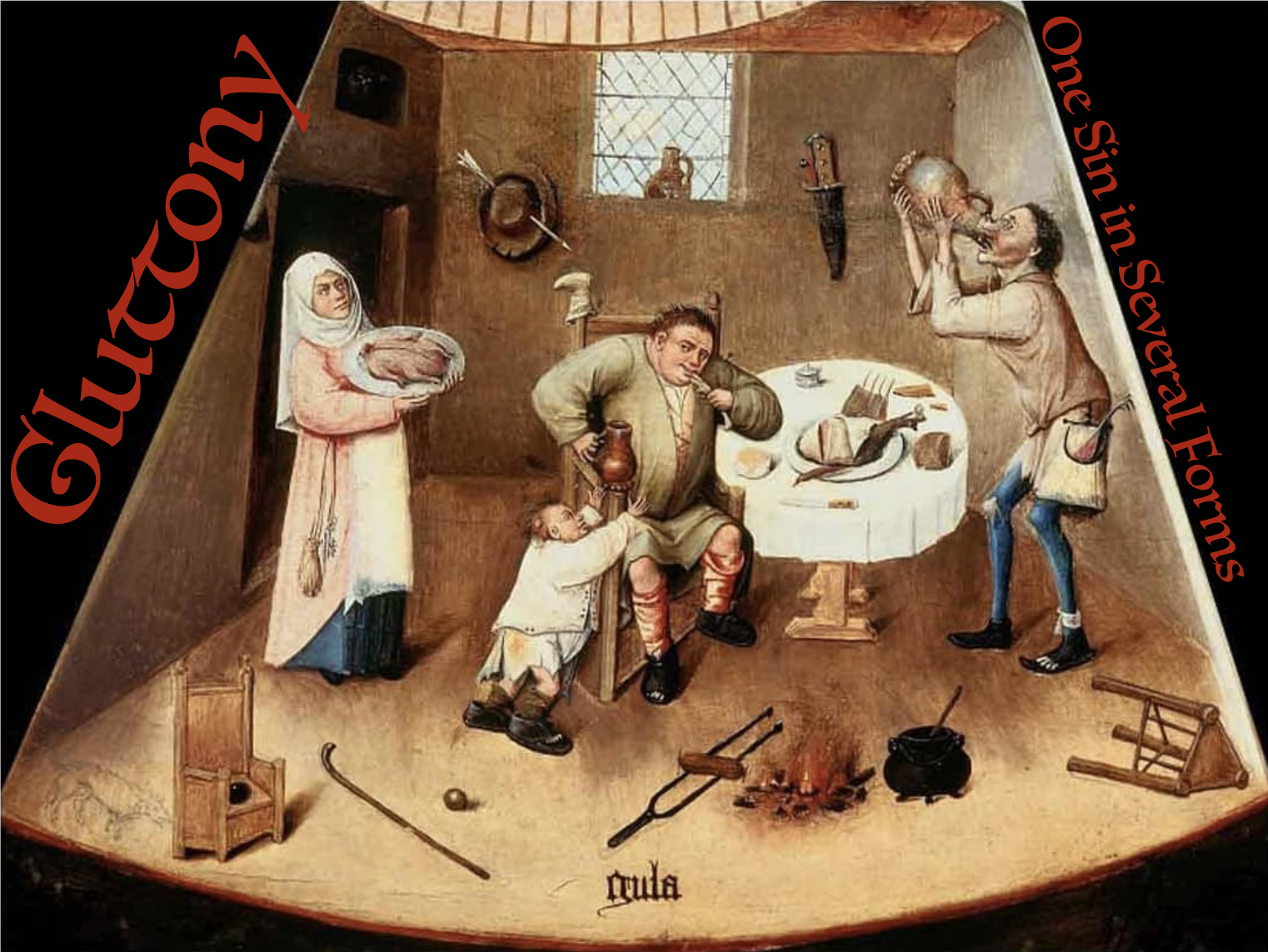
The illustration above is based on a detail from The Seven Deadly Sins and the Four Last Things painted c. 1500 by Hieronymus Bosch.

God as the Author of Creation

Satan is powerless versus Christians, especially those who know he exists. Yet, vis-à-vis unbelievers, he “prowls around like [an invisible] lion, seeking someone to devour” (1 Peter 5). Christian “immunity” to Lucifer’s power, if not his temptations, is due to the indwelling presence of God’s Holy Spirit.

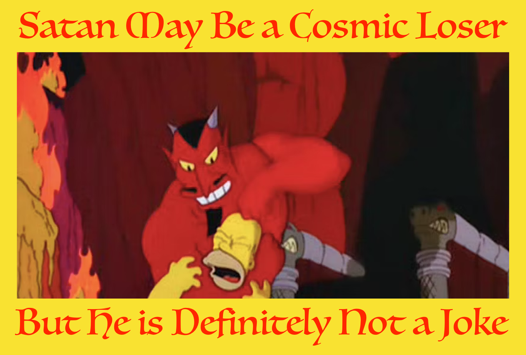
Still, for every human being, whatever their personal belief, the Devil is no mere cartoon, with whom to be trifled. I discussed this briefly in my previous post, “Only God Can Create,” which you might want to read before continuing here.

As for humanity’s vulnerability to the Devil’s influence, the consensus in paradoxically-labeled “enlightened” cultures is that he doesn’t even exist. Sadly, this cosmic lie even tricks self-described “Christians.”

This illusion plays directly into his purposes, as C.S. Lewis described in The Screwtape Letters. Screwtape, a senior demon, instructs his protégée Wormwood in the preferred method of dispelling human wariness about Evil.

The fact that “devils” are predominantly comic figures in the modern imagination will help you. If any faint suspicion of your existence begins to arise in his mind, suggest to him a picture of something in red tights, and persuade him that since he cannot believe in that (it is an old textbook method of confusing them) he therefore cannot believe in you.

Ironically, the populations of less Westernized cultures possess some immunity to this deception. Even in their traditional religions, there is a keen awareness of the existence of evil presences. In the words of The African Study Bible, “we Africans understand instinctively the stories of angelic visitations, spiritual warfare, and demonic oppression that are in the Bible.”

Christians believe in God, not the Devil. While the Scriptures attest to the personal identity of this fallen angel, acknowledgment of his existence is not salvific (i.e. it is not essential to salvation). Thus, C.S. Lewis is correct in his 1944 essay “Answers to Questions on Christianity” when he writes:

No reference to the Devil or devils is included in any Christian Creeds, and it is quite possible to be a Christian without believing in them. I do believe such beings exist, but that is my own affair.

Supposing there to be such beings, the degree to which humans were conscious of their presence would presumably vary very much. I mean, the more a man was in the Devil’s power, the less he would be aware of it, on the principle that a man is still fairly sober as long as he knows he’s drunk. It is the people who are fully awake and trying hard to be good who would be most aware of the Devil. It is when you start arming against Hitler that you first realize your country is full of Nazi agents.

Of course, they don’t want you to believe in the Devil. If devils exist, their first aim is to give you an anaesthetic – to put you off your guard. Only if that fails, do you become aware of them.

On the Matter of Creative Power

Only God can create. That was the core message of our previous discussion. C.S. Lewis recognized, as do biblically-grounded believers, that Satan is merely a sinful, fallen being, little different from humanity in that regard. This truth shatters the pagan philosophy of dualism, or the misguided notion that two equal and opposite forces (e.g. good and evil) exist in some sort of equilibrium. 

In “The Seeing Eye,” C.S. Lewis described the way in which God is beyond his creation. 

Looking for God – or Heaven – by exploring space is like reading or seeing all Shakespeare’s plays in the hope that you will find Shakespeare as one of the characters . . . Shakespeare is in one sense present at every moment in every play. But he is never present in the same way as Falstaff or Lady Macbeth. . . .

If there were an idiot who thought plays existed on their own, without an author . . . our belief in Shakespeare would not be much affected by his saying, quite truly, that he had studied all the plays and never found Shakespeare in them. . . .

My point is that, if God does exist, He is related to the universe more as an author is related to a play than as one object in the universe is related to another. If God created the universe, He created space-time, which is to the universe as the metre is to a poem or the key is to music.

To look for Him as one item within the framework which He Himself invented is nonsensical. If God – such a God as any adult religion believes in – exists, mere movement in space will never bring you any nearer to Him or any farther from Him than you are at this very moment. You can neither reach Him nor avoid Him by travelling to Alpha Centauri or even to other galaxies.

Mark Twain’s Divinized Satan

I had intended to mention Samuel Clemens in my previous article, as one who advanced the assertion that Satan possesses creative ability. Whether Twain regarded the Devil as an actual entity is certainly debatable. What is undeniable, however, is his devoted defense of Lucifer.

As Twain famously wrote in his autobiographical writings, “But who prays for Satan? Who, in eighteen centuries, has had the common humanity to pray for the one sinner that needed it most?” 

Mark Twain was (in)famous for his atheism, or his agnostic antipathy of the Christian understanding of our Creator. Not content to disbelieve, Samuel Clemens actively worked to undermine Christian faith. One of his books, Letters from the Earth, had to be printed posthumously, due its irreverent (or blasphemous) nature.

It bears a superficial resemblance to C.S. Lewis’ amazing Screwtape Letters – insofar as both fictional works present themselves as demonic correspondence. 

The similarity ends there. While Lewis provides keen insight into Evil’s tactics in wreaking havoc in human lives, Twain’s letters present Satan in a positive, even noble, light.

Letters from the Earth is only one of Mark Twain’s anti-Christian works. The Mysterious Stranger is one of his most bizarre. It evidences his long-term preoccupation with Satan, in that it was composed (in various versions) between 1897 and 1908.

The first serious rendition, The Chronicle of Young Satan, was completed in 1900. I mention it here because there is a scene in which the Devil “creates” a miniature world. Obviously it errs in attributing to Lucifer the power to create life – but to its credit, it does reveal Satan as a capricious, vain, cruel, and compassionless lord.

In 1985 a claymation film was released titled The Adventures of Mark Twain. It features the mock scene from Chronicle of Young Satan. It is quite disturbing. However, if one is curious about the subject, and wishes to be forearmed regarding such deceptions, you can view the excerpt here.

Especially for those who do choose to view Twain’s portrayal of the Devil in his fictional “youth,” I desire to end our current discussion on a positive note.

Claymation was also the medium for a long-lived Christian television series. Davey & Goliath, the story of a regular kid and his dog, ran between 1964 and 1975. Many of the episodes can be seen here.

And finally (and forever), we can celebrate with C.S. Lewis the wonder that this world we currently inhabit will not be God’s sole creation. In fact, because of Jesus’ redemptive sacrifice, we can look forward to a new cosmos, untainted by sin.

The New Testament writers speak as if Christ’s achievement in rising from the dead was the first event of its kind in the whole history of the universe. He is the “first fruits”, the “pioneer of life”.

He has forced open a door that has been locked since the death of the first man. He has met, fought, and beaten the King of Death. Everything is different because He has done so. This is the beginning of the New Creation: a new chapter in cosmic history has opened (Miracles).

Only God Can Create

Satan has many disciples in this world. Some know him by other names, or worship him in spirit without recognizing his actual existence (e.g. Mammon). The irony, of course, is that the Devil is simply a posturer, or in modern parlance, a poser. And the presence of the Holy Spirit makes any single Christian more than his match.

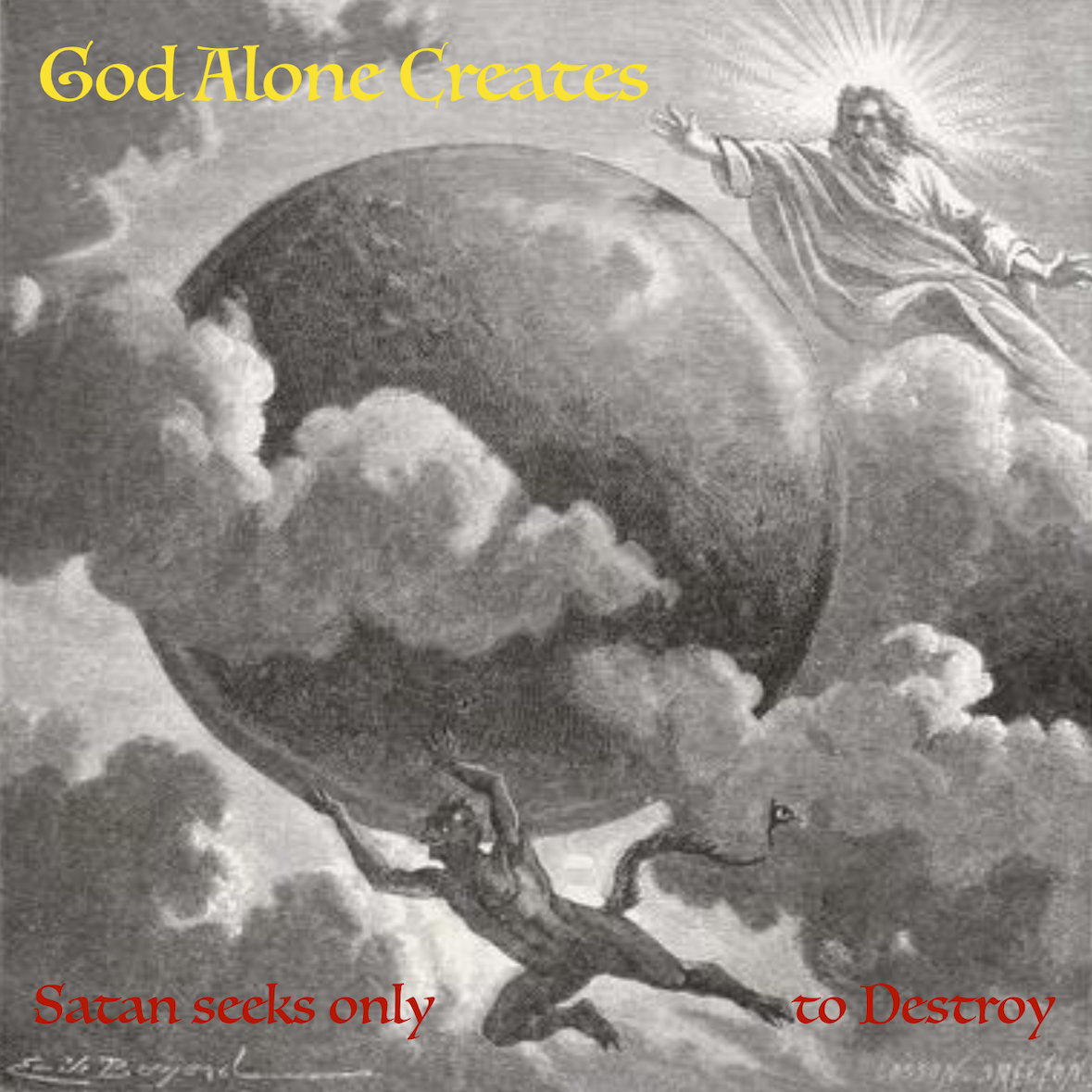
A prime evidence of Satan’s weakness is that he is a mere created being, without any creative powers of his own. Although some would grant the Adversary a glory he does not own, the truth is that since his expulsion from Heaven, he has devolved into the Great Pretender.

C.S. Lewis never pretended to be a theologian (for whatever authority that debatable title might convey). Instead, he was a brilliant disciple of Jesus with a sincere desire to follow the teachings of the Scriptures. Lewis certainly wasn’t infallible (and he has many critics who delight in pointing out that obvious fact).

Nevertheless, Lewis’ private insights on the subject of Lucifer’s noncreative limitation are right on the biblical target. Responding to a question posed by a reader, Lewis offered his opinion. 

Dear Mrs [Belle] Allen, I think it would be dangerous to suppose that Satan had created all the creatures that are disagreeable or dangerous to us for (a) those creatures, if they could think, would have just the same reason for thinking that we were created by Satan. (b) I don’t think evil, in the strict sense, can create.

It can spoil something that Another has created. Satan may have corrupted other creatures as well as us. Part of the corruption in us might be the unreasoning horror and disgust we feel at some creatures quite apart from any harm they can do us. (I can’t abide a spider myself.) (correspondence, 11 January 1954).

No, God alone creates . . . and redeems. The impotent Devil can never create, or rescue. His utter corruption results in an admittedly powerful spiritual being (a fallen angel) who is devoted to twisting, breaking, tainting, warping, spoiling, corrupting, rotting, perverting, and ruining all that God loves.

Granted, in our fallen world, Satan can fashion an abomination from some preexisting thing he corrupts – for example, Ophiocordyceps unilateralis the parasitic fungus that turns ants into zombies – but he can never create something out of nothing. These poor abominations are an excellent example of what Lewis referred to when he described the “horror and disgust we feel at some creatures . . .”

Meanwhile, Human Beings Can Create

Well, not exactly “create” on the creatio ex nihilo (created out of nothing) sense. Only God can do that, as he did when he spoke all things into existence. Just as Aslan echoed, when he sang Narnia into being in Lewis’ Chronicles.

“And God said, ‘Let there be light,’ and there was light” (Genesis 1).

“In the beginning was the Word [Logos], and the Word was with God, and the Word was God. . . . All things were made through him . . .” (John 1)

The Lion was pacing to and fro about empty land and singing his new song. It was softer and more lilting than the song by which he had called up the stars and the sun; a gentle, rippling music. And as he walked and sang the valley grew green with grass. It spread out from the Lion like a pool. It ran up the sides of the little hills like a wave” (The Magician’s Nephew)

As for humans like you and me being able to create, that is one of God’s most precious gifts to us. In truth, we use elements already created by the Lord: clay and stone to sculpt, pigments to paint, quill and ink to write.

The Inklings understood this creative impulse quite well. They not only understood it; they lived it. 

Like Christians before and since, they recognized that our creative capacity is based in the fact that we are created imago Dei, in the image of God.

Many people mistakenly believe J.R.R. Tolkien coined the word subcreation (or sub-creation, for the hyphen-infatuated). He certainly applied it for the first time to the intentional creation of what the Oxford English Dictionary calls “the action or process of creating a fully realized and internally consistent imaginary (or ‘secondary’) world.” 

Subcreation may be considered a form of “creation by a created being.” But even the most talented of writers and artists should remember this truth, stated by a Canadian astrophysicist: “God did not grant to the devil or any of his creatures the power to create.”

There is much more to consider on this subject, but Mere Inkling readers will need to wait until my next post, when we will conclude our discussion of this fascinating matter. 

There are two equal and opposite errors into which our race can fall about the devils. One is to disbelieve in their existence. The other is to believe, and to feel an excessive and unhealthy interest in them.

They themselves are equally pleased by both errors, and hail a materialist or a magician with the same delight. (The Screwtape Letters).


The image above is based on the work of Émile Bayard (1837-1891), a French illustrator who was born in Cairo, Egypt.

C.S. Lewis & Karl Marx

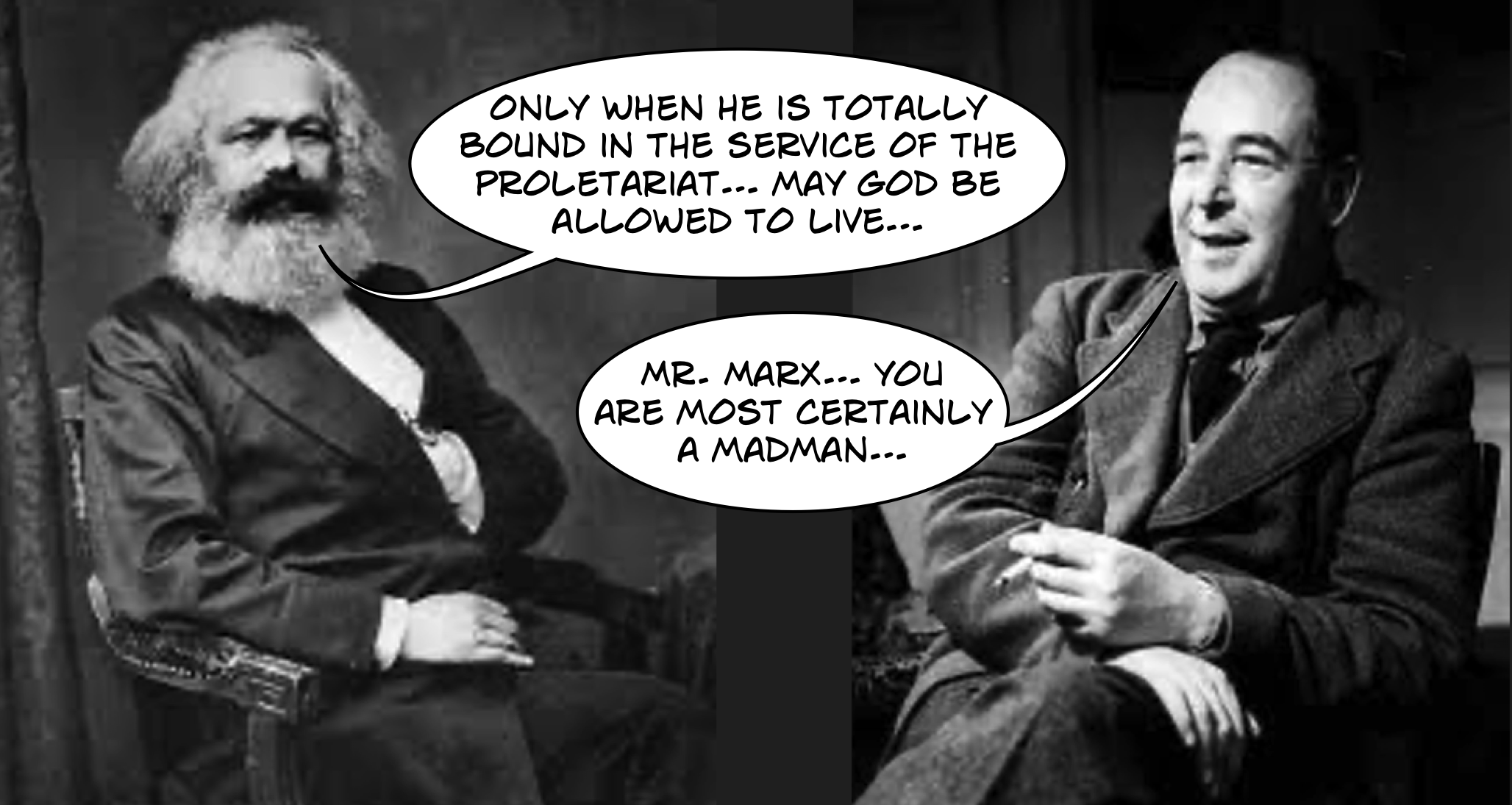
C.S. Lewis recognized quite early how Karl Marx’s philosophy, a “potent evil,” would justify terrible crimes.

The greatest threats to humanity’s future are the two major Communist powers. We see Russia’s brazen criminal ambitions currently on display in Ukraine.

Communist China’s malevolent intentions are more insidious and far more dangerous.

Aside from its nuclear arsenal, we now recognize how vastly overrated Russia’s military has been. China, by contrast, possesses an army and navy that grow deadlier each day.

C.S. Lewis understood the evil at the core of Marxism. Communists and, to a lesser degree, Socialists, seek to strip away individual rights for the illusory betterment of the whole.

But, because human beings are sinful and self-centered, even true Marxist idealists invariably end up devolving into fascist totalitarians. That’s why every one of these so-called “people’s republics” reflect nothing of republican or democratic values.

They invariably become corrupt oligarchies, typically led by ironfisted dictators. In addition to the aforementioned regimes, consider Cuba and Venezuela. When was the last time any of these four beacons of Socialism held free elections?

Karl Marx was a very troubled man. This essay in a recent publication addresses not only his insane economic theories, but his extensive personal failures as well.

The sufferings of the Marx family, and especially of poor faithful Jenny, are difficult to describe. Though they did have a housekeeper and though Friedrich Engels spent in the course of the years at least 4000 Pounds on Karl Marx, they lived in abject misery.

The death of one child, a boy, is directly attributable to poverty and neglect. Family life must have been absolutely terrible, but Marx could not be moved – neither by entreaties, nor by tears, nor by cries of despair. . . .

Yet it would be a mistake to think that Marx suffered silently and proudly. By no means! In his letters and in his conversations he never failed to complain and to lament. He had a colossal amount not only of self-hatred, but also of self-pity, but no human feelings for others, least of all for his wife whose health he had ruined completely.

In a 1946 essay entitled “Modern Man and His Categories of Thought,” C.S. Lewis discussed the atheistic core of Communism. He noted that its advocates can use “religion” as a puppet to bolster their power. Read here about the official position of the Russian Orthodox Church, and the sad fact that “Patriarch Kirill is a staunch ally of Mr. Putin.”

Such is the fruit of the Marxist mind. Here is C.S. Lewis’ description.

Proletarianism, in its various forms ranging from strict Marxism to vague “democracy” . . . [is] self-satisfied to a degree perhaps beyond the self-satisfaction of any recorded aristocracy.

They are convinced that whatever may be wrong with the world it cannot be themselves. Someone else must be to blame for every evil.

Hence, when the existence of God is discussed, they by no means think of Him as their Judge. On the contrary, they are His judges. If He puts up a reasonable defence they will consider it and perhaps acquit Him. They have no feelings of fear, guilt, or awe.

They think, from the very outset, of God’s duties to them, not their duties to Him. And God’s duties to them are conceived not in terms of salvation but in purely secular terms – social security, prevention of war, a higher standard of life. “Religion” is judged exclusively by its contribution to these ends (“Modern Man and His Categories of Thought”).

As destructive as Marxism is wearing its true, secular garb, it becomes far more calamitous when it infiltrates the Christian Church. As C.S. Lewis observed, Marxism can use and abuse the Church, but that is done from an external position.

When actual members of the Church are deceived to the degree they adopt this error, it is beyond tragic. In 1940 Lewis warned of this danger in a letter to a Roman Catholic priest with whom he corresponded.

Fascism and Communism, like all other evils, are potent because of the good they contain or imitate. Diabolus simius Dei.* And, of course, their occasion is the failure of those who left humanity starved of that particular good.

This does not for me alter the conviction that they are very bad indeed. One of the things we must guard against is the penetration of both into Christianity-availing themselves of that very truth you have suggested and I have admitted.

Mark my words: you will presently see both a Leftist and a Rightist pseudo-theology developing – the abomination will stand where it ought not.

C.S. Lewis was an honest man, who was capable of acknowledging his own shortcomings. Thirteen years after the previous letter, he wrote to another priest in the wake of massive suppression of Christianity in China.

After lamenting the persecution, he acknowledges the failure of the Church to live according to its calling. To this failure he attributes the rise of “other evils” such as Communism.

At last, dearest Father, there has come to hand that copy of . . . your article on that Chinese disaster. I used myself to entertain many hopes for that nation, since the missionaries have served there for many years not unsuccessfully: now it is clear, as you write, that all is on the ebb.

Many have reported to me too, in letters on this subject, many atrocities, nor was this misery absent from our thoughts and prayers.

But it did not happen, however, without sins on our part: for that justice and that care for the poor which (most mendaciously) the Communists advertise, we in reality ought to have brought about ages ago. But far from it: we Westerners preached Christ with our lips, with our actions we brought the slavery of Mammon.

We are more guilty than the infidels: for to those that know the will of God and do it not, the greater the punishment. Now the only refuge lies in contrition and prayer. Long have we erred.

In reading the history of Europe, its destructive succession of wars, of avarice, of fratricidal persecutions of Christians by Christians, of luxury, of gluttony, of pride, who could detect any but the rarest traces of the Holy Spirit?

Christians, I encourage you to join me in repenting of our failures. We must still challenge the lies, such as those of Karl Marx. But, we should never do so without remaining conscious of our own failures which too often provide fertile soil for such deceptions.


* Diabolus simius Dei means “the Devil is the ape of God.” This refers to Satan’s attempts to imitate or counterfeit divine actions and principles. The observation was first made by Tertullian, and echoed by Augustine and others.

Climbing Ladders of Faith

One of the pivotal events in the history of God’s grace is found in the Torah account of a dream. Jacob was the heir of Abraham, through whom the Lord promised to redeem the world. But Jacob was far from noble.

Nevertheless, because of the Lord’s mercy (the same mercy he offers to us), he forgave Jacob and promised to bless his descendants. In his dream, Jacob saw a ladder extending from earth all the way to heaven. “And behold, the angels of God were ascending and descending on it!” (Genesis 28).

This dynamic connection between heaven and earth reveals God’s constant concern for his creation. Some, such as Martin Luther, have seen in the dream a foreshadowing of the Incarnation itself.

This ladder or stairway can be interpreted in a variety of ways. One thing it is not, however, is a guide to human ascent from our fallen world to the presence of our Creator. (The Lord is the one who comes to us.)

Having acknowledged that the dream’s purpose is not to model sanctification or individual spiritual ascent, it is easy to see why the metaphor of ladders, and the action of climbing, give way to other applications.

The most vivid contemporary example comes in the form of a Christian spiritual entitled “We are Climbing Jacob’s Ladder.” A number of versions of the lyrics exist. This is quite unsurprising since it began as part of an oral tradition. According to one website devoted to spirituals, the following lyrics are typical.*

We are climbing Jacob’s ladder
Soldier of the Cross

Ev’ry round goes higher ‘n’ higher
Soldier of the Cross

Brother do you love my Jesus
Soldier of the Cross

If you love him why not serve him
Soldier of the Cross

While there are longer versions, this one aptly illustrates how the metaphor of the ladder—in this case, explicitly Jacob’s ladder—offered a powerful image of deliverance. Climbing the ladder with Jesus, was tantamount to experiencing deliverance from the ills of this world.

America’s Library of Congress offers a useful page which describes “African American Gospel music [as] a form of euphoric, rhythmic, spiritual music rooted in the solo and responsive church singing of the African American South.” They add that “its development coincided with—and is germane to—the development of rhythm and blues.” The site offers links to four 1943 recordings of spirituals. None of these, however, is the hymn we are discussing.

“We are Climbing Jacob’s Ladder” was one of the earliest spirituals to be widely adopted by the interracial faith community. It is familiar in many denominations, and was recently sung in my own Lutheran congregation. Hymnary.org states the song has been “published in 79 hymnals.” Even those who consider themselves unfamiliar with the hymn often recognize its rousing refrain: “Rise and shine and give God the glory, glory, Soldiers of the Cross.”

The talented Paul Robeson recorded the hymn on a number of his albums. The inspiring rendition by scholar Bernice Johnson Reagon was included in Ken Burn’s documentary, The Civil War.

C.S. Lewis and the Spiritual Ladder

The ladder offers such a convenient analogy for growth or spiritual maturation that others have also applied it in this manner. The ladders inspired by Jacob’s dream include the following two which continue to influence Christian disciples today, even though they were written many centuries ago. The second of these was considered by C.S. Lewis to be one of the works of faith influential in his life.

John Climacus (579-649) was a Christian teenager when he entered the monastic life at the foot of Mount Sinai. He soon earned the respect of his elders in that barren land. In the words of Fathers of the Desert, “in this ascetic seclusion he became ripe for the designs of God.”

The abbot of a monastery on the Red Sea requested guidance on the ascetic life to use with his monks. John responded with The Ladder of Divine Ascent. You can download a modern translation of this priceless work here. While the treatise was written specifically to guide monastics in their spiritual growth, many other Christians have also found its wisdom helpful in their own, non-monastic settings.

John introduces the virtue of obedience with two vivid images used by the Apostle Paul, the athlete in training and the armor of God.

Our treatise now appropriately touches upon warriors and athletes of Christ [and the manner in which] the holy soul steadily ascends to heaven as upon golden wings. And perhaps it was about this that he who had received the Holy Spirit sang: Who will give me wings like a dove? And I will fly by activity, and be at rest by contemplation and humility.

But let us not fail, if you agree, to describe clearly in our treatise the weapons of these brave warriors: how they hold the shield of faith in God and their trainer, and with it they ward off, so to speak, every thought of unbelief and vacillation; how they constantly raise the drawn sword of the Spirit and slay every wish of their own that approaches them; how, clad in the iron armour of meekness and patience, they avert every insult and injury and missile.

And for a helmet of salvation they have their superior’s protection through prayer. And they do not stand with their feet together, for one is stretched out in service and the other is immovable in prayer.

The following passage will be of particular interest to Christian writers. John advises those drawing closer to God to maintain a journal of their progress and insights. I offer it within its wise context.

Let all of us who wish to fear the Lord struggle with our whole might, so that in the school of virtue we do not acquire for ourselves malice and vice, cunning and craftiness, curiosity and anger. For it does happen, and no wonder!

As long as a man is a private individual, or a seaman, or a tiller of the soil, the King’s enemies do not war so much against him. But when they see him taking the King’s colours, and the shield, and the dagger, and the sword, and the bow, and clad in soldier’s garb, then they gnash at him with their teeth, and do all in their power to destroy him. And so, let us not slumber.

I have seen innocent and most beautiful children come to school for the sake of wisdom, education and profit, but through contact with the other pupils they learn there nothing but cunning and vice. The intelligent will understand this.

It is impossible for those who learn a craft whole-heartedly not to make daily advance in it. But some know their progress, while others by divine providence are ignorant of it. A good banker never fails in the evening to reckon the day’s profit or loss. But he cannot know this clearly unless he enters it every hour in his notebook. For the hourly account brings to light the daily account.

In the fourteenth century, an Augustinian mystic in England wrote a book called The Scale [Ladder] of Perfection.” Walter Hilton (c. 1340-1396) provides spiritual exercises requested by a woman adopting life as an anchoress.⁑ You can download a free copy of Evelyn Underhill’s 1923 edition of Hilton’s counsel at Internet Archive.

In 1940, C.S. Lewis wrote to Roman Catholic monk Bede Griffiths in response to the latter’s question about his familiarity with Hilton’s work. “Yes, I’ve read the Scale of Perfection with much admiration. I think of sending the anonymous translator a list of passages that he might reconsider for the next edition.” That same decade Lewis’ collected correspondence reveals he recommended the title to at least two individuals.

Of greatest interest to students of C.S. Lewis will be his mention of the medieval treatise in his autobiography, Surprised by Joy. Here the great author describes his worldly understanding of prayer served as a terrible stumbling block to his faith.

To these nagging suggestions my reaction was, on the whole, the most foolish I could have adopted. I set myself a standard. No clause of my prayer was to be allowed to pass muster unless it was accompanied by what I called a “realization,” by which I meant a certain vividness of the imagination and the affections.

My nightly task was to produce by sheer will power a phenomenon which will power could never produce, which was so ill-defined that I could never say with absolute confidence whether it had occurred, and which, even when it did occur, was of very mediocre spiritual value.

If only someone had read to me old Walter Hilton’s warning that we must never in prayer strive to extort “by maistry” what God does not give! But no one did; and night after night, dizzy with desire for sleep and often in a kind of despair, I endeavored to pump up my “realizations.” The thing threatened to become an infinite regress.

One began of course by praying for good “realizations.” But had that preliminary prayer itself been “realized”? This question I think I still had enough sense to dismiss; otherwise it might have been as difficult to begin my prayers as to end them.

How it all comes back! The cold oilcloth, the quarters chiming, the night slipping past, the sickening, hopeless weariness. This was the burden from which I longed with soul and body to escape. It had already brought me to such a pass that the nightly torment projected its gloom over the whole evening, and I dreaded bedtime as if I were a chronic sufferer from insomnia. Had I pursued the same road much further I think I should have gone mad.

This ludicrous burden of false duties in prayer provided, of course, an unconscious motive for wishing to shuffle off the Christian faith; but about the same time, or a little later, conscious causes of doubt arose.

David Downing, co-director of the Wade Center wrote an excellent essay entitled “Into the Region of Awe: Mysticism in C.S. Lewis” which describes in the broader context what C.S. Lewis wrote in Surprised by Joy.

Note for example a passage in Surprised by Joy in which Lewis discusses the loss of his childhood faith while at Wynyard School in England. He explains that his schoolboy faith did not provide him with assurance or comfort, but created rather self-condemnation.

He fell into an internalized legalism, such that his private prayers never seemed good enough. He felt his lips were saying the right things, but his mind and heart were not in the words. Lewis adds “if only someone had read me old Walter Hilton’s warning that we must never in prayer strive to extort ‘by maistry’ [mastery] what God does not give.”

This is one of those casual references in Lewis which reveals a whole other side to him which may surprise those who think of him mainly as a Christian rationalist. “Old Walter Hilton” is the fourteenth-century author of a manual for contemplatives called The Scale of Perfection. This book is sometimes called The Ladder of Perfection, as it presents the image of a ladder upon which one’s soul may ascend to a place of perfect unity and rest in the Spirit of God . . . [passage continued in footnotes]. ⁂

We’ve considered four separate ladders today. Despite their differences, they all share a common trait—they are meaningful to those who are earnest about growing in the faith. Whether slave or free, wise or simple, or hermit or cosmopolitan—each of these ladders affirms eternal truths.

Underhill described Hilton’s motivation for writing in this way: “It is for those who crave for this deeper consciousness of reality, and feel this impulse to a complete consecration, that Hilton writes.” I believe this is true for the authors of each of these four treasures.


* The following, simpler version appears to follow an earlier tradition. A musical accompaniment for this example can be found in The Books of American Negro Spirituals. The author, James Weldon Johnson (1876-1938), provides a rich and earnest introduction to the book, originally published in two volumes. He expresses his hope that collection “will further endear these sons to those who love Spirituals, and will awaken an interest in many others.”

We am clim’in’ Jacob’s ladder
Soldiers of the cross

O

Ev’ry roun’ goes higher, higher
Soldiers of the cross

⁑ An anchoress (or anchorite) was a religious woman (or man) who would often be walled off in their monastic cell near a church, to foster their life of prayer by freeing them from interruption.

⁂ Downing’s discussion of C.S. Lewis’ reference to Walter Hinton’s insights on prayer is so valuable that I am compelled to offer the rest of it here. You can read the entire essay via the link on the article’s title.

The passage about “maistry” Lewis wished he’d known as a boy comes early in The Scale of Perfection, a section about different kinds of prayer, including liturgical prayers, spontaneous prayers, and “prayers in the heart alone” which do not use words.

Hilton’s advice for people “who are troubled by vain thoughts in their prayer” is not to feel alone. He notes it is very common to be distracted in prayer by thoughts of what “you have done or will do, other people’s actions, or matters hindering or vexing you.”

Hilton goes on to explain that no one can keep fully the Lord’s command to love the Lord your God with all your heart, soul, strength, and mind. The best you can do is humbly acknowledge your weakness and ask for mercy. However badly one’s first resolve fades, says Hilton, you should not get “too fearful, too angry with yourself, or impatient with God for not giving you savor and spiritual sweetness in devotion.”

Instead of feeling wretched, it is better to leave off and go do some other good or useful work, resolving to do better next time. Hilton concludes that even if you fail in prayer a hundred times, or a thousand, God in his charity will reward you for your labor. Walter Hilton was the canon of a priory in the Midlands of England and an experienced spiritual director of those who had taken monastic vows. His book is full of mellow wisdom about spiritual growth, and Lewis considered it one of “great Christian books” that is too often neglected by modern believers.

Hilton’s recurring theme—do what you know to be right and don’t worry about your feelings—is one that appears often in Lewis’s own Christian meditations. But, alas, Lewis as a boy did not have the benefit of Hilton’s advice.

In those boyhood years at Wynyard, he was trapped in a religion of guilt, not grace. More and more he came to associate Christianity with condemnation of others, as in Northern Ireland, or condemnation of oneself, for not living up to God’s standards.


A Note on the Illustration

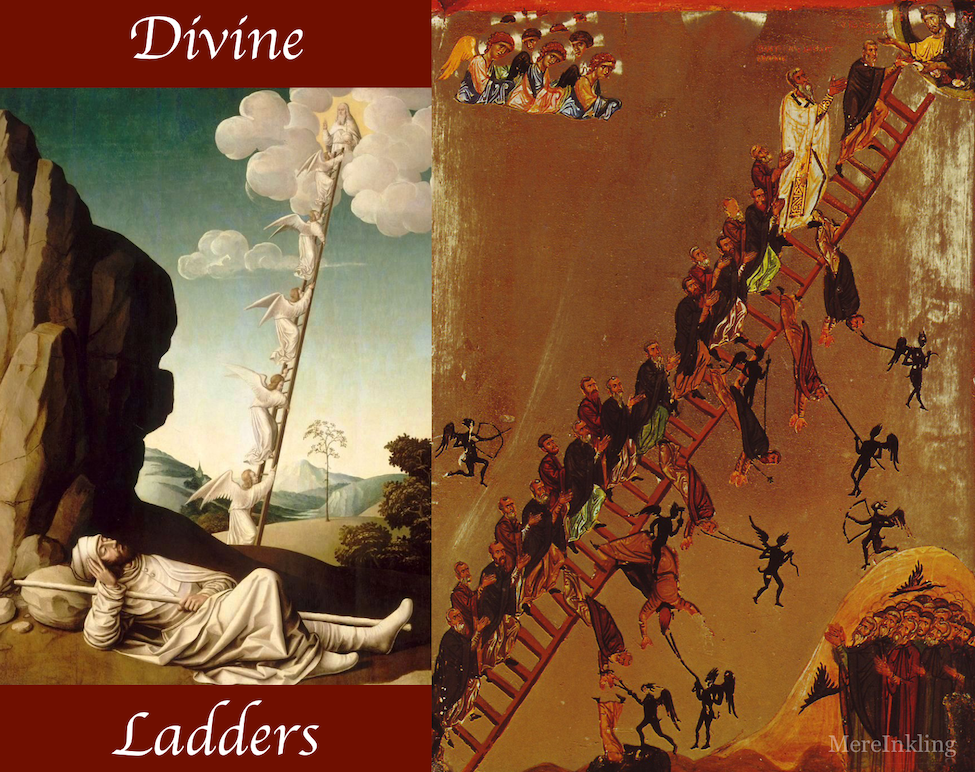
Nicolas Dipre was a French early Renaissance painter, who flourished 1495-1532. His painting of Jacob’s Ladder portrays the biblical account of the Jewish patriarch’s dream. The icon Ladder of Divine Ascent was painted four centuries earlier by an anonymous iconographer. It is from Saint Catherine’s Monastery beside Mount Sinai, and portrays the ascent of saints in the pursuit of holiness. While fallen angels (devils) seek to drag them from the path, John Climacus leads other in the path to heaven.

C.S. Lewis & Humanity’s Tragic Flaw

achilles

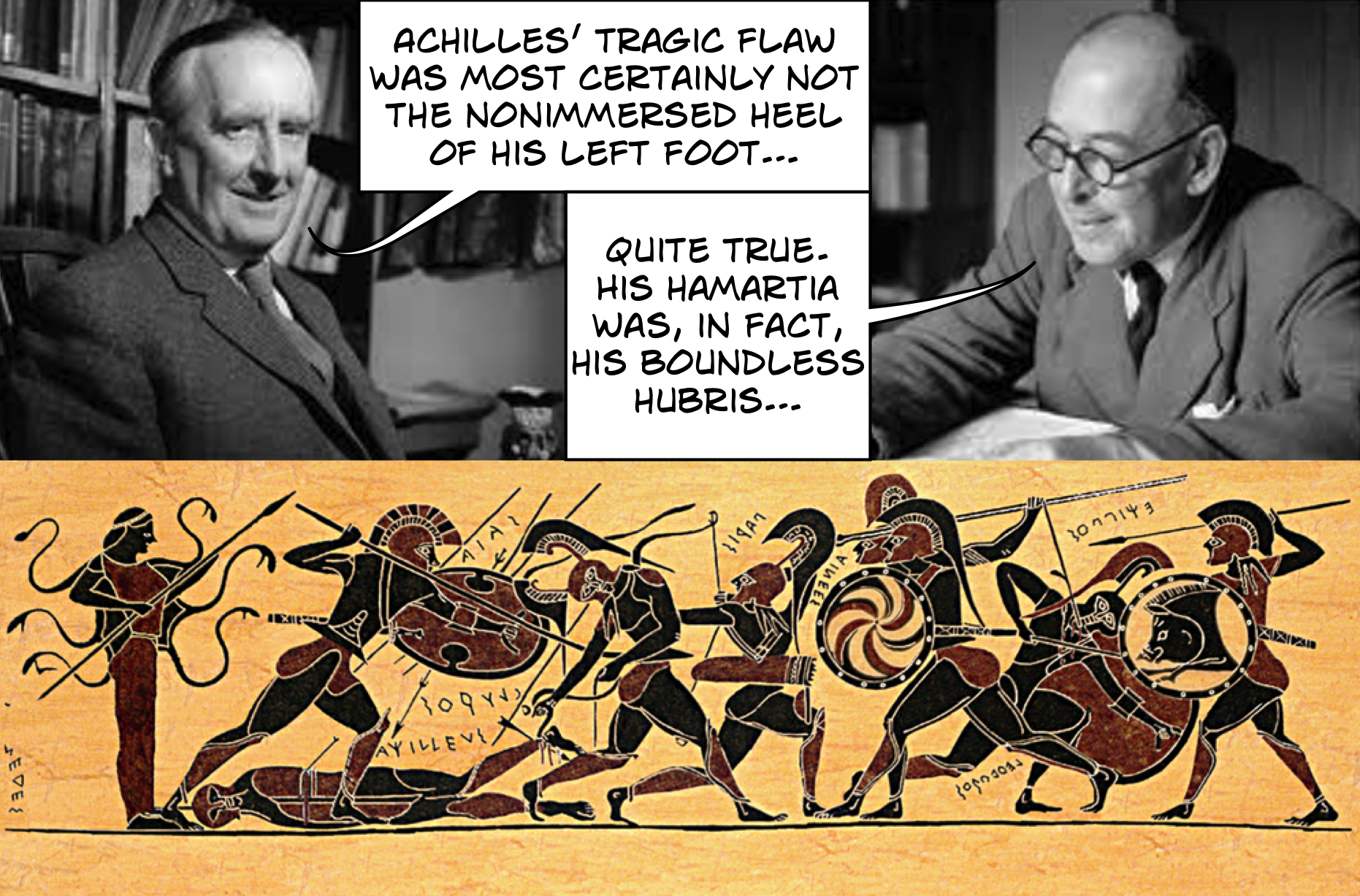
If you don’t know the meaning of “hamartia,” you’re not alone. But it’s a very important word, for more than one reason, so read on.

Hamartia describes a feature many writers of fiction or drama instill in their most memorable characters. It simply means “tragic flaw.” The deep character defect which cannot be overcome by sincere intention or persistent effort.

Merriam-Webster describes it this way.

Aristotle introduced the term in the Poetics to describe the error of judgment which ultimately brings about the tragic hero’s downfall. As you can imagine, the word is most often found in literary criticism.

However, news writers occasionally employ the word when discussing the unexplainable misfortune or missteps of übercelebrities regarded as immortal gods and goddesses before being felled by their own shortcomings.

Despite being a thespian in high school, I never formally studied drama. So I didn’t encounter the word there.

Likewise, I have written consistently since earning a Journalism degree four decades ago. However, since I have a 37:1 nonfiction to fiction ratio, I did not know this Greek word had found its way into the English lexicon.

I was surprised to discover its English meaning in my usually-familiar word of the day email (from The Free Dictionary).

While I was unfamiliar with its English usage, I already knew the word. I originally met hamartia (ἁμαρτία) while studying the New Testament in Greek. Hamartia literally refers to “missing the mark,” and it is the primary biblical Greek word for sin.

The first usage of the word in the sense of being an inner quality, occurs in Aristotle’s Poetics.  Aristotle writing as a pre-Christian philosopher, naturally perceived the literary device in a pagan manner.

The Greek word hamartia translates pretty directly as “error” or “shortcoming” without any necessary overtones of guilt or moral failure. Our modern conception of tragedy and the “tragic flaw” of the hero usually involves the concept of hubris, or overweening pride, that leads to disaster.

Macbeth, for instance, has the arrogance to think he can overstep the laws of God and state, and ultimately pays dearly for this arrogance. Macbeth is a tragic hero with a clear tragic flaw: his downfall results from a moral failing and can be seen as divine retribution proportional to his guilt. But Macbeth also contains heavy Christian overtones that would of course be found nowhere in Greek tragedy.

An understanding of Aristotle’s concept of hamartia—and indeed an understanding of Greek tragedy in general—relies on an understanding of the ethics and cosmology of the ancient Greeks. . . . Greek ethics are based more on the notion of virtue than obligation.

What of the Consequences?

In a 2014 article entitled “C.S. Lewis: The Anti-Platonic Platonist,” Grace Tiffany skillfully explores the Platonic echoes in Lewis’ writings. In discussing his literary examples of human failings, she writes:

There are of course Biblical models justifying Lewis’ “negatively capable” presentations of misguided characters . . . An older philosophical source, if not a Platonic one, also justifies mimetic representations of evil by the argument that these are morally purgative.

Imitations of hamartia, or tragic error, produce “fear and pity” (Aristotle, Poetics 1453b)—compassion for the character elicited by a skilled simulation of his psychology, naturally accompanied by a healthy fear of ourselves making similar mistakes. What ensures the fear is, of course, the dramatization of the horrible end to which hamartia has led . . . (Christianity and Literature 63.3).

In 1953, C.S. Lewis wrote to a correspondent that sin was more than merely making a mistake. In doing so, he alludes to the change in the meaning of the word ἁμαρτία.

No. I don’t think sin is completely accounted for by faulty reasoning nor that it can be completely cured by re-education. That view has, indeed, been put forward: by Socrates and, in the early 19th Century, by Godwin.

But I think it overlooked the (to me) obviously central fact that our will is not necessarily determined by our reason. If it were, then, as you say, what are called ‘sins’ would not be sins at all but only mistakes, and would require not repentances but merely correction.

Returning to the literary or dramatic definition of hamartia as a tragic flaw, it seems to me that this term offers a fitting parallel to the word sin.

Ever since humanity’s fall, we suffer the curse of bearing original sin, a tragic flaw. It is a scar that no medical or psychological treatment can cure and no amount of determination can repair. This tragic flaw will be our doom. Unless, that is, there is One who is capable and desirous of restoring us to our original health and purity. One, perhaps, in whose own image you and I were created . . .

This wonder is something well worth pondering—and perhaps one day, writing about.

Medical Science and God

regenerator.png

In his essay entitled “Miracles,” C.S. Lewis described during World War II the Christian viewpoint that God is the author of healing. After discussing the natural order of creation, he argues that God is at work in restoring the health of the those who are ailing.

The miracles of healing [are] sometimes obscured for us by the somewhat magical view we tend to take of ordinary medicine. The doctors themselves do not take this view. The magic is not in the medicine but in the patient’s body.

What the doctor does is to stimulate Nature’s functions in the body, or to remove hindrances. In a sense, though we speak for convenience of healing a cut, every cut heals itself; no dressing will make skin grow over a cut on a corpse.

That same mysterious energy which we call gravitational when it steers the planets and biochemical when it heals a body is the efficient cause of all recoveries, and if God exists, that energy, directly or indirectly, is His. All who are cured are cured by Him . . .

No veteran of World War I trenches would have been unacquainted with the horrors of grievous wounds. Much less a soldier, like C.S. Lewis, who was wounded by an artillery shell that killed a friend standing next to him.

That is why every combat veteran can stand in joyful awe at a science fiction healing tool that is being created a century after the war to end all wars. (Peter Jackson, of Middle Earth fame, just released a moving film about the war. You can listen to Michael Medved’s review of “They Shall Not Grow Old.”.)

The Healing of a Cut

I recently learned about an amazing wave of research related to the relatively new concept of 3D Printing. Even as new applications for these three-dimensional printers are exploding (they even make prostheses!), a variation of the technology is being developed to heal living skin.

Now, this is not like a medicine or bandage of some type. The process actually involves “printing” new skin by laying down layer after layer of one’s own cells over a wound.

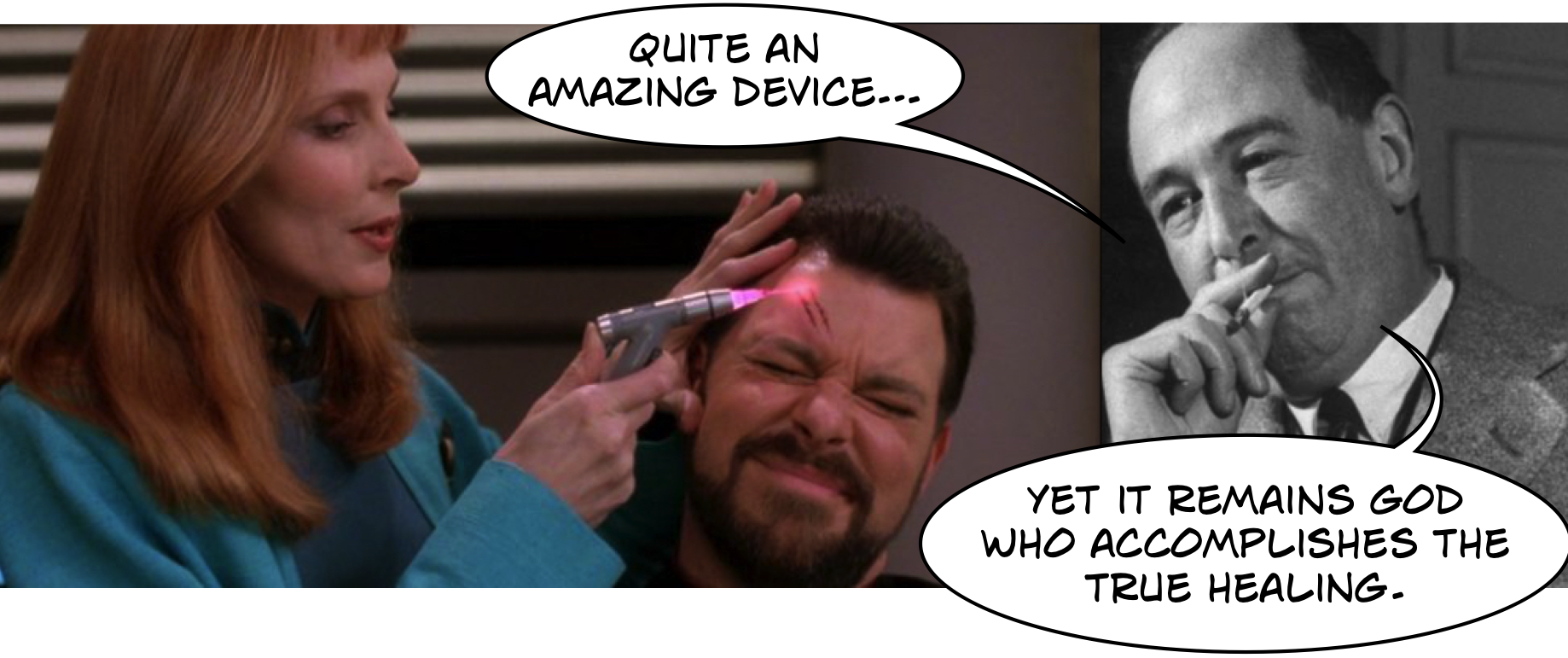
Sounds like science fiction, doesn’t it? In fact, my first thought upon reading about it, went to the most elementary of Star Trek healing devices—the dermal regenerator. And, apparently, I wasn’t alone.

In the Star Trek universe, dermal regenerators are so commonplace that no one has a second thought as gaping wounds are closed in the blink of an eye—by merely pointing a high-tech tool at the injury. (You may be thinking it sounds a bit like a magic wand . . . because fantasy and science fiction are close cousins.)

You can read a description of the scientific report in Nature magazine.

In contrast to manual cell seeding or cell spraying, bioprinting has the capability to deliver cells to specific target sites using layer-by-layer freeform fabrication, and it has been applied in numerous applications.

If you’ve ever known someone who suffered from severe burns, you will be pleased to learn “this technology has a wide application, and its application will be expanded to not only treat full-thickness wounds, but also for other types of wounds such as burns and ulcers, and even for deep tissue injuries.”

The Power of Science

Science is a precious gift from God, so long as it “uses its powers for good.” When people begin to look to science for answers it cannot provide, they can devolve into the sort of “scientism” that C.S. Lewis decried.

Science, however, in its purest and most true form, is a wondrous thing. In English Literature in the Sixteenth Century, Lewis discusses the work of Richard Hooker (1554-1600). It’s clear they share this same sentiment.

All good things, reason as well as revelation, nature as well as Grace, the commonwealth as well as the Church, are equally though diversely, “of God.” . . . All kinds of knowledge, all good arts, sciences, and disciplines come from the Father of lights and are “as so many sparkles resembling the bright fountain from which they rise”

In that spirit, I invite you to include in your prayers not only medical personnel and caregivers, but all of those brilliant minds and skilled hands devoted to using science to heal and to support God’s gift of life.

A Suggestion for Your Personal Library

prayer

I just added a rare C.S. Lewis book to my library for a very reasonable price, and you can too. But you might want to hurry, since this volume will probably never be reprinted.

The small book is entitled Beyond the Bright Blur. It’s contents will be familiar to you if you have read Lewis’ final book, Letters to Malcolm: Chiefly on Prayer. That is because the former is a prepublication printing of chapters fifteen through seventeen from Letters to Malcolm.

It was published under unique circumstances, and it is thought that only 350 copies were printed in 1963 by Harcourt, Brace & World.

The title of Beyond the Bright Blur is taken from what would appear as letter fifteen in the complete volume. The “bright blur” to which Lewis refers is our imperfect, abstract and remote impression of “God.” He argues that to engage in genuine conversation with our Creator, we must dispel this fabrication.

What happens to me if I try to [approach prayer] “simply,” is the juxtaposition of two “representations” or ideas or phantoms. One is the bright blur in the mind which stands for God. The other is the idea I call “me.”

But I can’t leave it at that, because I know—and it’s useless to pretend I don’t know—that they are both phantasmal. The real I has created them both—or, rather, built them up in the vaguest way from all sorts of psychological odds and ends.

Very often, paradoxically, the first step [in genuine prayer] is to banish the “bright blur”—or, in statelier language, to break the idol.

Lewis’ candid sharing about his personal pilgrimage in prayer is just part of the treasure that is Letters to Malcolm. It is must reading. But, its priceless message is not the subject of this post.

Beyond the Bright Blur, this modest yet sturdy (hardback) tome, stands complete as it is. And it was expressly designed for a small audience. As the flyleaf states, “This limited edition is published as a New Year’s greeting to friends of the author and his publisher.”

The complete book would not be published until 1964, after Lewis had joined his wife Joy in the presence of our Lord. It is quite fitting that the final pages describe the author’s thoughts about the nature of heaven. It concludes with his final glorious epiphany that “Joy is the serious business of Heaven.”

Consider Adding this Gem to Your Own Library

I know that most readers of Mere Inkling share my affection for literature . . . along with my own affection for literature incarnated in its own natural state, physical books.

The wonderful thing is that adding this particular treasure to your personal collection is within your reach. While the price varies due to the respective booksellers and the condition of each copy, AbeBooks.com often include copies for less than forty dollars.

Occasionally an inscribed volume appears on the market, with a corresponding surcharge in the price. As I write this, the copy presented to the poet John Ciardi (1916-86) is available for purchase. While he’s most famous for his translation of The Divine Comedy, he also co-authored a collection of limericks with Isaac Asimov!

The posting says the volume includes his signature on the front end paper and “a paragraph [underlined] in the text in red ink.” Still, a truly unique volume such as this is quite a bargain at less than two hundred dollars—especially if you are a fan of Ciardi.

I suspect Ciardi received his copy as a gift from the publisher. I haven’t found any evidence that he and C.S. Lewis were acquainted. I did, however, uncover one utterly trivial connection between the two. It appears the two shared an illustrator for some of their American editions. Roger Hane, the cover illustrator for the 1970 Collier-Macmillan edition of the Chronicles of Narnia, also illustrated Ciardi’s undated The Morality of Poetry.


What We Worship

worshipping squirrel

It’s curious to consider the varieties of deities worshipped throughout history and around the globe. And it is important that we understand the god we choose to follow, as well as the nature of “faith” allows us.

This picture came from a nearby garden. The squirrel effects the pose of a worshipper, but it’s motivated by the nuts the gardener has rested in the Buddha’s lap. It’s not intended to be irreverent, and one assumes that Siddhārtha Gautama would not be offended.

The image is provocative. If you were to put yourself in the squirrel’s place, it would be of no surprise that you would be devoted to the “Provider of Nuts,” especially if you did not make the connection between the gentleman who filled and the statue that actually offers them to you.

Whether we are adherents of one of the so-called monotheistic religions, or pantheists who see the presence of god in all of universal nature, our “religion” directly affects our worldview and life choices.

And then there are the “no religious preferences,” who embrace or reject labels like “agnostic.” Some of them long to believe, but demand proof, where God calls for faith. Others opt for lives of hedonism, gambling that their notion there is no Creator is right. Many of these individuals actively hope that there is no God, and not a few of them have a nagging fear that he may just exist, and call them to account one day for their selfish lives.

C.S. Lewis was in the latter category. Before he became a Christian, Lewis entertained no desire to seek Christ out. “Amiable agnostics,” he wrote, “will talk cheerfully about ‘man’s search for God.’ To me, as I then was, they might as well have talked about the mouse’s search for the cat” (Surprised by Joy).

About the Nature of Faith

God chooses to call us into a restored relationship with himself through the mechanism of faith. If that word troubles you, think of it as “trust.” Faith is necessary, for an obvious reason. In the New Testament, we read, “without faith it is impossible to please him, for whoever would draw near to God must believe that he exists and that he rewards those who seek him” (Hebrews 11:6).

That faith is necessary may sound intimidating. However, the good news is that what God demands, he himself provides . . . even to the most reluctant of converts such as Saul of Tarsus or C.S. Lewis of Oxford.

For by grace you have been saved through faith. And this is not your own doing; it is the gift of God, not a result of works, so that no one may boast. (Ephesians 2:8-9)

In Mere Christianity, C.S. Lewis discusses the nature of faith at great length. He provides a number of helpful images. In the book he clearly distinguishes between faith (trust) and feelings or moods. I enjoy the way that the final sentence of this passage is evocative of the worshipping squirrel which inspired these reflections.

Faith, in the sense in which I am here using the word, is the art of holding on to things your reason has once accepted, in spite of your changing moods. For moods will change, whatever view your reason takes. I know that by experience.

Now that I am a Christian I do have moods in which the whole thing looks very improbable: but when I was an atheist I had moods in which Christianity looked terribly probable. This rebellion of your moods against your real self is going to come anyway.

That is why Faith is such a necessary virtue: unless you teach your moods “where they get off,” you can never be either a sound Christian or even a sound atheist, but just a creature dithering to and fro, with its beliefs really dependent on the weather and the state of its digestion.

Dithering to and fro, indeed.

A Surrealistic Postscript

I had been thinking about writing on this subject ever since I saw the photo, some months ago. I was spurred to compose it now, by a fact that recently appeared in Ripley’s Believe It or Not. It speaks for itself.

A Brazilian grandmother believed she was praying to a figurine of Saint Anthony for years, only to discover that it was an action figure of the Elf Lord Elrond from the “Lord of the Rings” films!

Timing the Reformation

wristwatch

I had an entrepreneurial epiphany on how to get rich during the 500th anniversary of the Reformation, and since I’m not an entrepreneur, I’m passing the idea on gratis, to readers of Mere Inkling.

Inspired by the shocking success of the Playmobil Martin Luther—their fastest-selling item ever—I wondered what other commemorative items might result in a windfall for investors.

The insight struck like the lightning bolt that dropped Luther to his knees and sent him off to the monastery.

Since this celebration hearkens back to the beginning of the Reformation . . . back to the day when the 95 Theses were nailed to the door of the Castle Church in Wittenberg . . . it dawned on me that we so indebted to what happened that moment that we are, in a true sense, living on Wittenberg time.

What better item to remind us of the significance of this than to turn to expert horologists* and design a Wittenberg Watch? Ideally it would be permanently linked to Wittenberg time. The wearer would also benefit from learning more about time zones and mathematics, trying to sort out the local time, especially when traveling.

More about the details in a moment.

C.S. Lewis and the Importance of Time

The nature and passage of time was of great importance to C.S. Lewis. He devoted an entire chapter to the subject in Mere Christianity. In “Time and Beyond Time,” he explores how God acts within history, but is not subject to time’s constraints.

If you picture Time as a straight line along which we have to travel, then you must picture God as the whole page on which the line is drawn. We come to the parts of the line one by one: we have to leave A behind before we get to B, and cannot reach C until we leave B behind. God, from above or outside or all round, contains the whole line, and sees it all.

Lewis then proceeds to explain his understanding by saying this “idea has helped me a good deal. If it does not help you, leave it alone. It is a ‘Christian idea’ in the sense that great and wise Christians have held it and there is nothing in it contrary to Christianity. But it is not in the Bible or any of the creeds. You can be a perfectly good Christian without accepting it, or indeed without thinking of the matter at all.”

Another difficulty we get if we believe God to be in time is this. Everyone who believes in God at all believes that He knows what you and I are going to do tomorrow. But if He knows I am going to do so-and-so, how can I be free to do otherwise?

Well, here once again, the difficulty comes from thinking that God is progressing along the Time-line like us: the only difference being that He can see ahead and we cannot. Well, if that were true, if God foresaw our acts, it would be very hard to understand how we could be free not to do them.

But suppose God is outside and above the Time-line. In that case, what we call “tomorrow” is visible to Him in just the same way as what we call “today.” All the days are “Now” for Him. He does not remember you doing things yesterday; He simply sees you doing them, because, though you have lost yesterday, He has not. He does not “foresee” you doing things tomorrow; He simply sees you doing them: because, though tomorrow is not yet there for you, it is for Him.

You never supposed that your actions at this moment were any less free because God knows what you are doing. Well, He knows your tomorrow’s actions in just the same way—because He is already in tomorrow and can simply watch you.

In a sense, He does not know your action till you have done it: but then the moment at which you have done it is already “Now” for Him.

Since God was/is witness to that day in Wittenberg, just as he knows our tomorrows today, we see his placing of creation within the linear progression of history is intentional. It does not restrict our Lord in any way, but it enables us to comprehend our existence. And thus, we are compelled to mark the passage of time.

What Might the Wittenberg Watch be Like?

Something elegant and tasteful, yet modest and unobtrusive. A watch like the one pictured above. It’s produced by Swisstime and has the added benefit that it is part of their “Rebellion” line, which means that Roman Catholics shouldn’t be excluded from the market. The only minor drawback is the price, $930,000.

It seems to me that a wise businessperson could undercut that by thirty or forty thousand, and only need to sell two or three watches to retire in comfort.

An alternative to this timepiece, for the less prosperous, would be to get a regular Timex or Casio and just set the time to that of Wittenberg! That’s the key anyway—the Wittenberg Watch measures the hour based on the time there in hallowed birthplace of the Reformation. (For those who like details, that would be the Central European Time Zone, UTC/GMT +1.)

An astute investor will recognize that the Wittenberg Watch concept easily translates for an ecumenical audience. One easily imagines other editions for various denominations.

Aldersgate Watch for Methodists (Greenwich Mean, GMT)

Azuza Street Timepiece for Pentecostals (Pacific Standard, UTC/GMT -9)

Canterbury Timepiece for Anglicans (Greenwich Mean, GMT)

Geneva Timepiece for Calvinists (Central European, UTC/GMT +1)

Edinburgh Edition for Presbyterians (Greenwich Mean, GMT)

Hollywood Timepiece for Televangelists** (Pacific Standard, UTC/GMT -9)

London Chronometer for Quakers (Greenwich Mean, GMT)

Münster Timepiece for Anabaptists (Central European, UTC/GMT +1)

Rome Timepiece for Roman Catholics (Central European, UTC/GMT +1)

Anyone who desires can feel free to run with this idea. I relinquish all rights to the concept of religious timepieces.

As for now, I’ve been rethinking the idea altogether. I’ve decided it’s best for me to reset my own watch to Jerusalem time.

_____

* Horology relates to the science of measuring time and making timepieces. (Yes, I had to look it up also, even though I remembered enough Latin to know hora means hour.)

** It’s quite possible that televangelists already own the Rebellion Reb 5 Diamond timepiece pictured above, however, the members of their digital congregations may be in the market for something more modest.