Do Titles Matter?

cbeThere are many sorts of titles one may accumulate, and some people pursue them with great passion. There are familial titles like “Grandmother,” military titles such as “Ensign,” academic titles like “Associate Professor,” and ecclesiastical titles as in “Archimandrite.”

And that’s only the tip of the titular iceberg. Titles are prominent in many fields, such as medicine, politics and the judiciary. And appellations such as “Coach,” are precious to multi-millionaire athletic leaders and folks working with preschoolers in the gym or on the field alike.

The best way to tell how important a person’s titles are to them, is to witness how they respond to the “misuse” of one. My wife and I have a joke when I show my identification card when we enter a military installation. If the guard courteously says, “have a good day, colonel,” after I roll up the window and proceed, I will sometimes say (for Delores’ benefit) “that’s lieutenant colonel!”

If you’re unfamiliar with the armed forces, there’s a good chance you miss the joke. A lieutenant colonel is junior in grade to a “full” colonel, although addressing one simply as “colonel” is allowed. In fact, in a sense it’s an added courtesy or sign of respect. (I should mention that it’s not uncommon for some of the civilian guards to follow up such a greeting with a glance towards my wife and the words, “and a good day to you, general.”)

I have mixed feelings about titles, a trait I believe I share with C.S. Lewis.

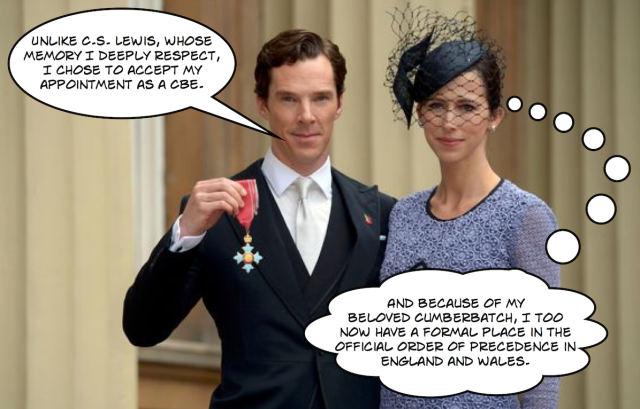
In 1952, Lewis declined appointment as a Commander (CBE) in the Order of the British Empire. He did so to avoid entangling his Christian witness with political considerations. But by declining he forsook the opportunity to be known as “Sir Lewis,” although, I doubt he lost sleep over his decision. (In fact, in his humility, Lewis never revealed the matter for public scrutiny.)

A 1959 letter to Lance Sieveking, the BBC producer who wrote the radio script for The Lion, the Witch and the Wardrobe, offers an interesting insight into Lewis’ attitude about titles. He begins with this greeting:

Dear Sieveking

(Why do you ‘Dr.’ me? Had we not dropped the honorifics?)

Volume three of Lewis’ letters reveals this was representative of his thinking. Once he had established a rapport with some correspondents, he requested that they drop the use of titles. A typical example reads, “We may both drop the honorific now, mayn’t we?.” In one case he writes in the imperative, “Dear Hooton (Do drop the honorifics!).”

So, Do Titles Matter?

My grandchildren surprised me the other day by addressing me as “Doctor Grandpa.” They proudly shared in my joy (read “relief”) at having completed my Doctor of Ministry degree.

I responded to their adulation with “actually, kids, it’s ‘Reverend Doctor Grandpa.’” This led to a fun discussion about titles during which I was able to explain to them how my pastoral title was of greater significance to me than the doctoral honorific. After which I reminded them the matter was moot because all I want them to call me is grandpa. I explained how only eight people in the entire world can call me that, and it made that title extremely precious to me.

Ultimately, the most valuable title any human being could have is to be addressed as son or daughter, by God. As Jesus’ disciple John wrote:

See what kind of love the Father has given to us, that we should be called children of God; and so we are. (1 John 3:1).

On this, I have no doubt C.S. Lewis would agree.

Despite this, there are cases where titles are critical. The military, with its “chain of command” sometimes being a life or death matter, is a prime example.

In other settings, the honorifics are less significant. I addressed all my instructors in college as “Professor,” regardless of whether they were full/associate/assistant/whatever.

I doubt that many of Lewis’ very fortunate students thought less of his lectures because of Oxford’s politics which withheld from him the full “professorship” he had certainly earned. (It would be left to the wiser University of Cambridge to rectify this oversight.)

This suggests to me that titles mean less to most people than the way others think of them. If people respect you as someone with integrity . . . if they call you “friend . . .” how much more fortunate could you be?

A Dire Norwegian Crime

pulpitrockActually, the title may be slightly misleading, since we don’t know the nationality of the people who risked their child’s life over a 2,000 foot cliff . . . but the scene of their crime was one of Norway’s amazing natural wonders.

Preikestolen, is known in English as Pulpit Rock. It is a rare geological feature, a pillar of rock thrusting 1,982 feet from the ground, with three sides a sheer drop to the rocks. It stands majestic, adjacent to a picturesque fjord.

It’s lovely to behold. But only a fool would want to walk out on it, right?

I mean, just look at it. Doesn’t anyone else notice the huge fissure that splits the pulpit right in half? As I look at it, I can just imagine it splitting down the middle with the exposed side crashing down like an enormously oversized and exponentially elongated domino . . . but a domino made out of granite exposed for eons to the frigid Nordic winters so when it strikes the earth it will shatter into a million and a half fragments like a sheet of ice. Well, that’s what I see when I look at the pictures.

What I don’t see is a tourist site where I would like to prance out and pose for a photo beside the edge, or pretend to have accidentally fallen off the side.

Nope, not by a long shot.

As one visitor said, “It’s a straight drop. You don’t want to go too close because it’s pretty scary. You’d be pretty much dead if you fall down there.”

Yes, “pretty much.’

Nevertheless, scores of thousands of people every year prove how few cautionary genes they and I share by doing just that. Of course, I do share with C.S. Lewis the conviction that courage is utterly necessary for living a Christian life in an anti-Christian world. Even Screwtape understands that!

Courage is not simply one of the virtues, but the form of every virtue at the testing point, which means, at the point of highest reality. A chastity or honesty or mercy which yields to danger will be chaste or honest or merciful only on conditions. Pilate was merciful till it became risky. (The Screwtape Letters).

But this sort of courage does not necessarily translate into foolhardy risking of one’s fragile body.

Back to Scandinavia

Apparently, Preikestolen is quite a popular spot.

I offer links below to a several videos of crazy stunts people have pulled on the small bluff. Some people apparently also like to go there for picnics. That reminded me of a column I posted about “Rational Fears” related to another frightening dining experience.

Tragically, in 2013 a tourist fell from the precipice while shooting photos. But here is the amazing part of that story: “Local sheriff Odd-Bjørn Næss said it was the first time anyone had accidentally fallen over the edge of Preikestolen.”

Up until I read the sheriff’s statement I had always taken pride in my 50% Norse lineage. One reason was because I considered my ancestors sturdy and honest folk. Yes, I see the sheriff’s “accidentally” disclaimer, and I suspect they do experience a number of suicides . . . but I believe that with all of the foolish behavior transpiring at Preikestolen there must be more fatal accidents . . .

The Crime With Which We Began

Accidents, of course, are not crimes. But this, most certainly is. Some adults, presumably the baby’s parents, put their small child at terrible risk by posing her or him beside the edge of the cliff simply to take some shocking photographs.

Yes, you read that right.

They set their little child, who was crawling at the time, on the brink of a 2,000 foot drop!

cliffchildIf you’re familiar with precious little ones, you know that babies do not always crawl in a straight line. Nor do they always continue moving in the direction you plan for them. Not only that, but they are prone to taking occasional tumbles–perhaps even rolling over onto their side or back. And on this rugged pillar top, mind you, the baby was on an extremely uneven, and possibly slippery, surface.

Simply put, these parents are criminals. In every civilized country I’m aware of, “child endangerment” is a crime. You can read the story about their foolhardy action here, and see the frightening photo from which this small image is cropped. (You can see the original picture and the the accompanying article here.)

Unfortunately, they pixilated the adults’ faces, so they can’t be recognized. Seems to me that they should have allowed them to be identified . . . if not for trial, for public shaming so they would be forced to reflect on the responsibilities one assumes as a parent.

Epilogue

trolltonguePreikestolen is not the only deadly sightseeing destination in Norway. Another goes by the more foreboding name of Trolltunga, Troll’s Tongue. It too has claimed at least one life, and from the photo of the small spit of rock, I can’t imagine why anyone would want to walk out on it.


As promised:

A Base Jumper Who Nearly Dies

Free Hanging Off of the Cliff

Insane Italians Slack Lining

There are more examples of the craziness evoked by the image of Preikestolen, but these are representative. I thank God I don’t feel the slightest envy as I watch people base jumping, free hanging, or slack lining.

I’m content to get my adrenaline rushes from reading a great book.

Echoes of Christmas

Rosary Basilica LourdesI love greeting people with “Merry Christmas” after the day itself has passed.

Most people are surprised—probably thinking that I slept through the celebration. Many Christians, however, respond with their own best wishes, in recognition that the celebration of Jesus’ nativity marks the beginning of a season of wonder.

The celebration of the Incarnation miracle is far too wondrous to be confined to a single day.

People often ask “how was your Christmas?” By that, most are inquiring as to whether it was enjoyable.

It is a profound question, if one truly reflects upon it.

As a child, I must confess that the quality of my “Christmas” was probably determined to large extent by the presents I received. I don’t remember many of the particular gifts—these many years later—but I do recall the anticipation I felt as we awaited Christmas Day and the glorious unwrapping.

As a parish pastor my perceptions of a “good” Christmas were determined in large part by the number and enthusiasm of the individuals attending the season’s special worship services. (I am not proud, of course, to confess this.)

In later, semi-retired days, I gauge the joy of each Christmas by the time spent with family. To have all the kids and grandkids near is magnificent. To be able to connect with our “extended family” is icing on the cake.

Obviously, I’m not alone in measuring the quality of my “Christmas experience” by the presence of family.

At the close of the First World War, as C.S. Lewis had finished recuperating from his wounds, he longed to be able to return home to Ireland to celebrate with his father and brother. The Armistice had been signed a month earlier, but delays prevented his arrival by December 25th. Nevertheless, he did manage to arrive for the Christmas season, as Warnie recorded in his diary two days later.

A red letter day. We were sitting in the study about eleven o’clock this morning when we saw a cab coming up the avenue. It was Jack! He had been demobilized, thank God. Needless to say there were great doings. He is looking pretty fit . . . In the evening there was bubbly for dinner in honour of the event: the first time I have ever had champagne at home.

Family can be a wonderful thing, although there seem to be an increasing number of people in our day who are a scourge to their families. My heart goes out to those who have lost their loved ones, or who have never experienced familial love in the first place.

These holiday seasons—filled with laughter and champagne for most—can be a barren emotional wasteland for many.

It is good for us all to remember that fact, and remain vigilant to draw the lonely into the light of our family campfires.

The Deep Joy of Christmas

I have said that as a child, I relished the anticipation of my gifts. Later in life I have focused on other matters in assessing whether or not my Christmas has been an exceptional one.

The fact is that the foundation for all of my happiness comes from an awareness of Christmas’ true meaning.

In a word, Emmanuel. God with us.

For me and my family, it simply would not be Christmas if we were not able to gather with our sisters and brothers in Christ to celebrate Jesus’ birth. That said, for believers in some Islamic and Buddhist nations where Christians are not free, the miracle of Christmas rings no less true.

The presence of the Holy Spirit, and the constancy of Christ’s grace are such an indivisible part of my life, that I often take them for granted. And so it is during Christmas.

The gift-giving and family can occupy the forefront of my thoughts. However, it is only because of the life-giving sacrifice of that innocent Child that events in this life possess the potential to have eternal significance.

Jesus came in humility. He came to serve. He came to suffer. He came to offer his own pure life to redeem our imperfect and corrupt lives.

That’s what Christmas is about, and that is why it is too wondrous for its celebration to be relegated to one brief day.

Great Grandparent or Great-Grandparent?

ggfI have never been more glad to have a birthday than I was this year. After all, at a mere sixty, I would have been far too young to become a great-grandfather. Now, at sixty-one, I feel adequately prepared for the momentous event which transpired just under an hour ago.

Tobin (meaning “God is Good”) is the child of my grandson and his wife, who currently reside in Texas where dad handles munitions for B-1 bombers.

Age and offspring do not always line up the way that we ourselves would plan. Yet every precious child is a miraculous gift from God.

Our grandson was born to our precious daughter-in-law while she was in high school. We didn’t get to meet him until he was ten, but we’ve done our best to make up for lost time. Our grandson, early on began calling us his “great grandparents.” That didn’t make us feel old, just special.

When my wife worked in a residential care facility for severely handicapped children, one of the aides arrived one morning with joyous news. “I’m a great-grandmother!”

Because the woman seemed too young, Delores responded, “Congratulations, you look so young for being a grandmother.”

The lady laughed and said, “No, a great-grandmother!” It turns out she was not yet forty . . . having been 13 when she had a daughter who was 13 when she had her own daughter who now had birthed her own baby. (I don’t recall the gender of the child.)

As I wrote this, it dawned on me that this all took place thirty-seven years ago, so it’s quite possible there are now several more generations in that particular family tree.

Some people will scoff at the thought of celebrating such early and assumedly unintended pregnancies. But, that caregiver knew the truth—every young life is a gift from God.

As an imperfect parent and grandparent, I recognize all too well that I won’t be the great-grandfather Tobin should have. I do pray, though, that God would grant that my mistakes with him would be few, and the memories forged during this life will help this little one grow into the finest man that he can become.

Most importantly, I pray that he will see Christ in my life and recognize the value of faith. Only the Lord knows what the future will bring, and I will not be here to share too many decades of life with my grandchildren and great-grandchildren. But my hope is that the time we do have will leave a lasting legacy of encouragement, faith, and compassion.

The letters of C.S. Lewis provide insights into the influence of his grandparents on his young life.

In a 1905 letter to his brother Warnie, he describes family festivities on Halloween. They even persuaded his grandfather to join in.

On Halow-een we had great fun and had fireworks; rockets, and Catherine wheels, squbes, and a kind of thing that you lit and twirled and then they made stars. We hung up an apple and bit at it. We got [his paternal] Grandfather down to watch and he tried to bite.

In a 1916 letter to his father, he refers to his grandmother’s declining health. (She died two weeks after he wrote.) Lewis refers to the common sentiment that we should have tried harder to spend time with family while they were with us. “I am sorry to hear what you say about [Lewis’ maternal] Grandmother: I feel that we ought to have seen more of her, but it was not easy.”

I should dearly love to get away for a bit, but, as you say, for so short a time, the expense and the interruption of work is hardly worth it. The Colonel must have had an unpleasant journey: I wish he would keep a diary which we could compare with that of Grandfather Hamilton in the same waters. Two generations of sub-tropical Atlantic and Hamilton temperament would be worth studying!

The diaries left by C.S. Lewis’ grandfather, and by his brother Warnie, provide a reminder to us that a written legacy will outlast our voices. If we have something important to say to our descendants, perhaps that is something we should keep in mind.

Distant Fathers

miceChildren don’t get to choose their parents. They aren’t able to select loving parents in contrast to abusers. They can’t  express any preference about being in a home with a mom and a dad committed to them, and to one another.

But the home into which children are born matters a great deal in the direction and shape of their entire life.

It doesn’t take a genius to acknowledge that some settings are healthier than others. The ideal context (which very few of us are blessed to experience) is a home where mom and dad keep their vows to one another, and devote themselves to placing their children in the forefront of their concerns.

Those of us who are people of faith recognize a third pillar to this structure. There is spousal love, parental love, and love of God. When you have all three, you are fortunate indeed.

Sadly, for many, one or both parents are absent. They may be physically present (as my own alcoholic father was) but they are disengaged . . . unconnected . . . absent. I believe that when they are physically present but not really there, they often teach their children worse lessons than they would have learned if they were literally gone. But that’s a conversation for another day.

A study some months ago reveals that the absence of fathers during childhood can actually affect the brain of the child. Yes, you read that right—it can physically affect their brains.

In the study Dr. Gobbi and her colleagues compared social activity and brain anatomy between the two groups . . . the first, raised with both parents, and the second,  that had been raised only by their mothers. The results showed that mice raised without a father demonstrated abnormal social interactions.

This group of subjects also showed more aggressive patterns of behavior in comparison with their counterparts raised with both parents. In addition, these effects were stronger for female offspring. Interestingly females raised without fathers also had a greater sensitivity to the stimulant drug–amphetamine.*

Before continuing, it’s important to note that these experiments were conducted on animals . . . mice, to be precise. While we don’t normally think of mice as paternalistic creatures, neuroscientists assure us that these results are significant.

“Although we used mice, the findings are extremely relevant to humans,” claims Dr. Gabriella Gobbi, a researcher of the Mental Illness and Addiction Axis at the RI-MUHC, senior author and an associate professor at the Faculty of Medicine at McGill University. “We used California mice which, like in some human populations, are monogamous and raise their offspring together.”

California mice? Monogamous? Who would have thought!

Whether you place much stock in this scientific research or not, most honest individuals acknowledge the significance our father and mother share in our early formation.

C.S. Lewis’ loss of his mother and the great distance between himself and his father greatly impacted the development of his personality. Lewis goes so far as to make this confession in Surprised by Joy: “With the cruelty of youth I allowed myself to be irritated by traits in my father which, in other elderly men, I have since regarded as lovable foibles.”

Elsewhere, Lewis writes longingly of the intimate relationship he longed to have had with his own father. Describing the source of author George MacDonald’s guiding inspiration in life, he writes:

An almost perfect relationship with his father was the earthly root of all his wisdom. From his own father, he said, he first learned that Fatherhood must be at the core of the universe. He was thus prepared in an unusual way to teach that religion in which the relation of Father and Son is of all relations the most central. (George MacDonald: An Anthology).

I did not have that sort of relationship with my own father. I strove to give it as a gift to my children though. And today, while I continue to be their dad, I am acutely aware of the kind of grandfather I am.

Whether it truly affects those developing minds or not, I am committed to caring for each of them as well as is humanly possible.

_____

* You can read the quoted article in The Neuropsychotherapist here. The abstract for the original research is available here.


Misnaming Kids

baby namesWhy do they do it? I’m sure they considered it witty. They may have laughed as they inscribed his name on the birth certificate of their newborn son. (I doubt he shared the humor of the moment.)

Let’s think about this for just a moment. If your family name was Lemon, a totally respectable and not uncommon name, would you give your child a first name that is also a citrus?

That’s what I encountered as I completed the current issue of the military chaplaincy journal that I edit. One of the American Civil War chaplains I mentioned in the current issue of Curtana: Sword of Mercy bore the striking name “Orange V. Lemon.”

Really? Yes, really.

It reminded me of a quaint Canadian television series that my dad used to enjoy, The Red Green Show. His parents should have known that one color in a person’s name is sufficient.

Still, the temptation to be silly is irresistible to some people. Years ago I knew an attorney whose last name was Cain. Her parents had named her Candy, of course. Peculiar names are so common today, of course, that there are myriads of internet repositories for them.

Names are more important than many of us realize. I’ve written in the past about how my wife and I followed the biblical example of choosing our children’s names based on their meanings.

Even if that approach doesn’t appeal to a parents, there are an almost unlimited number of options that would not subject their children to unwanted attention.

Fortunately, when we get older, we have some control over what we are called. I was “Robbie” in my childhood, and graduated to “Rob” as soon as I could. “Robert’s” always been fine with me, since it’s my given name and what I expect someone I’ve never met to call me. “Bob,” however, is not okay. There’s nothing wrong with “Bob,” except that I’ve never been one. And when someone greets me as such it projects a very false familiarity.

Curiously, I recall reading in the Oxford dictionary of names that more primitive nicknames for Robert included Hob, Dob and Nob. So I suppose I should count my blessings when addressed as Bob.

C.S. Lewis chose his own name. Many people are surprised when they learn that he went by the name of Jack. How, they wonder, could one get “Jack” out of “Clive Staples?” Good question.

Lewis was not enamored with the name Clive. When he was only four, he decided to use the name of a pet dog that had been killed by an early motorist. The pet’s name was a human-friend designation, “Jacksie.” His brother Warren relates the event thusly, in his 1966 collection of Lewis’ letters.

Then, in the course of one holiday, my brother made the momentous decision to change his name. Disliking “Clive”, and feeling his various baby-names to be beneath his dignity, he marched up to my mother, put a forefinger on his chest, and announced “He is Jacksie.” He stuck to this next day and thereafter, refusing to answer to any other name: Jacksie it had to be, a name contracted to Jacks and then to Jack. So to his family and his intimate friends, he was Jack for life: and Jack he will be for the rest of this book.

It’s fascinating that Lewis’ family acquiesced to his demand, but it took. One small consequence, of course, is that this gifted writer is known today as “C.S.” rather than by his full names.

As for faithful Orange, I don’t know if he adopted any other name during his lifetime. He may have been quite content. It certainly did not prevent him from enjoying a meaningful life. He became a Methodist pastor and served as chaplain with the 36th Indiana Infantry.

Volcano Hurricane

volcanoVolcano hurricane. An epic disaster film! No sharks, but copious amounts of lava flung by gale force winds across the globe. And all from the mind of a six year old boy.

Imaginations are great. They are one of the most precious gifts of God (which makes it all the more tragic when the human imagination is diverted towards carnal ends).

The minds of young boys, thankfully, have yet to turn to such lamentable matters. Their innocence shields them from the worst of human corruption. They, instead, are consumed with thoughts of spiders and other things that creep out girls . . . and especially their moms.

Our almost-seven-year-old grandson was here for the weekend with his family. We had a wonderful time. We had actually found the ideal book to include as part of his birthday celebration: How to Convince Your Parents You Can Care for a Pet Tarantula. Perfect.

Young male imaginations seem to revolve around things that shock—and also things that gross others out.

Our kids have trained their own children well. For example, they always excuse themselves when they experience flatulence. It’s a natural experience, of course, and as we mature, adults learn to ignore potentially embarrassing moments related to it. That’s part of becoming “civilized.”

Six year olds . . . not so much. Our grandson properly excuses himself, but he typically does so in the midst of enthusiastic laughter. It’s as though he relishes just how uncultured the moment seems.

During this particular visit, he leaped into my lap in a semi-ninja attack. As we wrestled, there was a minor explosion. Not quite volcanic, but close enough. He apologized, amidst great hilarity. “Sorry about my little gas,” he added.

And here’s where I made the mistake. I reinforced his innate boyhood grossness by saying, “little! . . . that sounded like it was a buffalo!”

Not quite the right thing to say, since it simply encouraged the precocious guy. But what I can say . . . time may change a boy into a man, but in most of us . . . somewhere deep in the recesses of our psyches . . . that boyhood irreverence lingers.

Not that I enjoy the crass “body humor” that pervades so much comedy (on tv and film). I steadfastly avoid it. It insults my mind and viewing it constitutes a total waste of time. Still, with my grandson wrapped in my arms, laughing away, it all seemed so genuine and innocently funny.

Of course, I recognize one needed to be there—and probably to also be related by bloodline to the participants—to find any humor in the moment. But it certainly seemed funny to us.

C.S. Lewis and Children

I was thinking about that moment as I sat down to write this post. I intended to focus on the amazing imaginations of children, and my grandson’s current preoccupation with gigantic volcanoes.

But whim or muse redirected the column. In the end, it turns out to be a reflection on the simple pleasure that we adults experience when we interact with kids. Especially when they are children who are precious to us.

I wish that C.S. Lewis had been able to experience that joy. He wasn’t. His awkwardness with children is well known. Most attribute it to the early passing of his mother, and the emotional distance his father maintained from his sons.

In a 1935 letter he wrote to a close friend, “I theoretically hold that one ought to like children, but am shy with them in practice.”

In The Abolition of Man he was even more forthcoming, sharing that, “I myself do not enjoy the society of small children: . . . I recognize this as a defect in myself.”

So, Lewis recognized his discomfort with children as a shortcoming. It was something he wished could be dispelled. Unfortunately, we can’t simply wish (or pray) away our ingrained personality traits. We’re lucky if we can tame them or reshape them.

We work hard to strengthen our positive traits and the wise deny nourishment to their weaker qualities. People often use the analogy of wearing off one’s rough edges, and that’s an apt image.

Lewis’ reticence with children makes his creation of Narnia all the more wondrous. The Chronicles of Narnia have captivated the hearts and imaginations of innumerable children, and adults alike. Certainly Lewis was correct when he wrote the following in “On Stories.”

No book is really worth reading at the age of ten which is not equally (and often far more) worth reading at the age of fifty—except, of course, books of information. The only imaginative works we ought to grow out of are those which it would have been better not to have read at all.

With his marriage, late in life, Lewis became a step-father. He did the very best he could, but was conscious of just how ill-equipped he was to raise Douglas and David. Both became successful men. Doug shares his parents’ love of Christ, and helps direct the course of various Lewisian projects today.

Allow me to close with another evidence of the greatness of C.S. Lewis. He was able to rise far above his innate uneasiness with children. In fact, his fabled correspondence included many children who had written to him seeking his attention. In 1951 he wrote to one of them, saying:

I am glad you all liked The Lion. A number of mothers, and still more, schoolmistresses, have decided that it is likely to frighten children, so it is not selling very well. But the real children like it, and I am astonished how some very young ones seem to understand it. I think it frightens some adults, but v[ery] few children.

Lewis did not disappoint the many children who wrote to him during those terribly busy years. Nor do his writings disappoint us today. Unlike the transience of youthful volcano hurricanes, Lewis’ legacy will forever remain alive in the imaginations of child and adult alike.

Face to Face with God

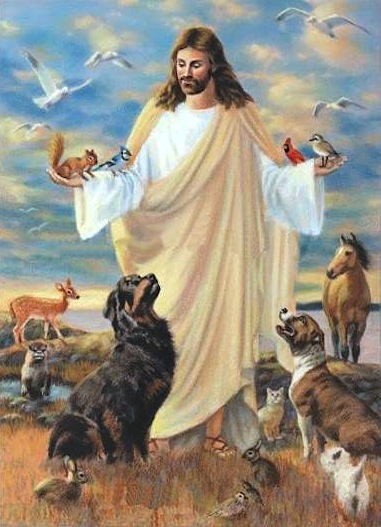
Jesus with animalsA recent letter to the editor of Lutheran Witness includes a delightful example of the wondrous glory of childhood simplicity.

When our four-year-old son . . . saw a bird outside the window, he commented “I wish I were a bird with wings so I could fly up to heaven and talk to Jesus.” [His parents] asked what he would say to Jesus if he were a bird. His simple reply . . . “Tweet, tweet.”

How gloriously innocent. So unpretentious and joyously pure. I think this captures the essence of what Jesus was referring to when he said “Truly, I say to you, unless you turn and become like children, you will never enter the kingdom of heaven. Whoever humbles himself like this child is the greatest in the kingdom of heaven” (Matthew 18:3-4, ESV).

C.S. Lewis discussed the innocence of children in his essay “The Abolition of Man.” He is discussing the monolithic power of society, or government, in reshaping what it means to be human. God preserve us from those who would redefine and eradicate the very qualities of humanity Jesus praised.

Human nature will be the last part of Nature to surrender to Man. The battle will then be won. . . . But who, precisely, will have won it? For the power of Man to make himself what he pleases means, as we have seen, the power of some men to make other men what they please. . . .

Hitherto the plans of educationalists have achieved very little of what they attempted and indeed, when we read them—how Plato would have every infant “a bastard nursed in a bureau,” and Elyot would have the boy see no men before the age of seven and, after that, no women, and how Locke wants children to have leaky shoes and no turn for poetry—we may well thank the beneficent obstinacy of real mothers, real nurses, and (above all) real children for preserving the human race in such sanity as it still possesses.

But the man-moulders of the new age will be armed with the powers of an omnicompetent state and an irresistible scientific technique: we shall get at last a race of conditioners who really can cut out all posterity in what shape they please.

When you and I stand in the presence of God, our adult words will vary. We’ll all drop to our knees—some in adoration, others perhaps in fear—but what will we say?

I can imagine some of the words that will come to our lips.

“Thank you.”

“Why did you allow . . ?”

“I love you.”

“I despise you because . . ?”

“Hallelujah.”

Or, perhaps, “Why did you delay so long?”*

I suspect we will probably be speechless. Certainly, at first. There’s a song that captures well the mystery that awaits us when we find ourselves face to face with our Creator. It’s more in spirit with the response of the young child who simply tweeted out his greeting to God.

Surrounded by Your Glory, what will my heart feel?

Will I dance for you, Jesus? Or in awe of You, be still?

Will I stand in Your presence, or to my knees will I fall?

Will I sing ‘Hallelujah!’? Will I be able to speak at all?

I can only imagine! I can only imagine!

We used to sing this song at chapel services in southwest Asia. I have often thought it would be very meaningful to record this song in my own voice, to be played at my own funeral (should the Lord tarry).

That’s not nearly as morbid as some might think. It’s a song of praise, awe and wonder, in my rendition I would end it with the words “I no longer imagine,” for my faith in God will have given way to sight.

_____
* The answer to that question is actually found in the Scriptures. From the third chapter of Peter’s second epistle:

This is now the second letter that I am writing to you, beloved. In both of them I am stirring up your sincere mind by way of reminder, that you should remember the predictions of the holy prophets and the commandment of the Lord and Savior through your apostles, knowing this first of all, that scoffers will come in the last days with scoffing, following their own sinful desires. They will say, “Where is the promise of his coming? For ever since the fathers fell asleep, all things are continuing as they were from the beginning of creation.” For they deliberately overlook this fact, that the heavens existed long ago, and the earth was formed out of water and through water by the word of God, and that by means of these the world that then existed was deluged with water and perished. But by the same word the heavens and earth that now exist are stored up for fire, being kept until the day of judgment and destruction of the ungodly.

But do not overlook this one fact, beloved, that with the Lord one day is as a thousand years, and a thousand years as one day. The Lord is not slow to fulfill his promise as some count slowness, but is patient toward you, not wishing that any should perish, but that all should reach repentance. But the day of the Lord will come like a thief, and then the heavens will pass away with a roar, and the heavenly bodies will be burned up and dissolved, and the earth and the works that are done on it will be exposed.

Since all these things are thus to be dissolved, what sort of people ought you to be in lives of holiness and godliness, waiting for and hastening the coming of the day of God, because of which the heavens will be set on fire and dissolved, and the heavenly bodies will melt as they burn! But according to his promise we are waiting for new heavens and a new earth in which righteousness dwells.

Writing Life Scripts

ben hurI was shaped by the heroic religious films of the 1950s and 60s. The powerful messages of epic movies like Ben Hur, Quo Vadis and The Robe planted within my young Christian heart an awareness of nobility and radical self-sacrifice.

About twenty years ago, I spent a year doing graduate work in education. One of my Educational Psychology classes was taught by a professor who was a devotee of Transactional Analysis. I don’t recall too much about TA, aside from one of its principles that resonated with me.

It’s a concept called Life Scripts. Without going into great detail, it is an often subconscious notion of how we “think” our lives will or should play out. It’s adjusted throughout our lives, but the basic theme is established when we are quite young.*

A recent article says “script is broadly understood as a series of decisions, formed as coping strategies in childhood, which continue to shape the life course outside of awareness.”**

It was only as an adult that I realized just how significant an impression these virtuous stories made on me. I recalled the countless times I lay in bed at night rehearsing the story of The Robe. I was the unbelieving Roman soldier, converted by the gentle witness of the wrongfully persecuted Christians.*** Ultimately, I took my stand with them, defending them and voluntarily laying down my life for Christ.

That same plot line still echoes through my mind and soul.

I consider myself blessed to have been exposed to such positive influences while my self identity was being shaped. And I pray for children today whose parents allow them to be exposed (at terribly vulnerable ages!) to violent, fearful and morally ambiguous influences.

Those precious minds and hearts are scarred by the vulgarity and immorality that are endemic in modern cinema, television and music. May God have mercy on them.

C.S. Lewis lived during the era when the virtuous dramas such as those named above were at the peak of their influence.

In a diary entry from the mid-1920s, he mentions Quo Vadis in passing. He is describing his weekend schedule.

Saturday 22 April: Got up about 6.30 and did the same jobs as yesterday. Was settled to work by 9.5 o’clock and put in an excellent morning . . . Sheila Gonner—jolly child—came to tea. Dorothy is to come back tomorrow: so we shall no longer be servantless. At her request I lent her my crib to Tacitus’ History for her sister Rose— I wonder what makes her imagine that she would like it? Possibly early Christian novels of the Quo Vadis type. Worked again after tea, and from supper till ten o’clock, finishing Herodotus. The last few pages of the IXth Book I now read for the first time, having got tired of it on my first reading . . .

I find this diary passage intriguing, in the way that Lewis posits a reader’s potential interest in classical literature as arising from their exposure to ancient Rome via contemporary novels. That’s precisely where my own lifelong fascination with the Roman empire was born.

If you’ve never seen these three movies, I commend them to you. I would also encourage you to consider reading one or all of the novels. They are available for free download in various digital formats.

Quo Vadis

Ben Hur

The Robe

_____

* I’m a pastor and historian, not a psychologist, so I don’t pretend to understand all of the implications. Because of that, I don’t endorse TA as a fully valid theory. What’s more, in our fallen world it’s obvious that many early “life scripts” can be based on wounds inflicted on neglected or abused children. In such cases, particularly where the scripts are destructive, we are not “destined” to live out a tragedy. By the grace of God, even the saddest of stories can be redeemed and “rewritten” into tales of hope and wonder.

** From “Script or Scripture?” by Jo Stuthridge in Life Scripts edited by Richard Erskine (Karnac Books, 2010).

*** It didn’t hurt that the main Christian disciple in the film was the lovely and chaste Diana, played by the British actress Jean Simmons. But that’s another story, and it’s important to note that these life scripts are pre-pubescent creations, so they are motivated by much deeper impulses than hormones. As the previously footnoted quotation referred to them, they are fundamentally “coping strategies” for survival in the calm (or frequently turbulent) world in which children find themselves.

Autistic Considerations

Bill & Barbara ChristopherMost of us have a friend, loved one, or acquaintance affected by autism. I’m not sure if this would have been accurate a generation ago.

And I’m not merely referring to the lack of proper diagnosis of the problem. There are numerous reports that its frequency is increasing.

Autism is not necessarily debilitating. In minor cases it’s barely noticeable. Like many problems, its severity is manifested across a wide spectrum.

I have autism on my mind now, as the new school year approaches and my wife sets up her special education classroom. She’s excited about the return of her precious kids. It’s wonderful how so many of them make amazing process both in academics and social abilities.

The return of school, however, is not the primary reason for my current thoughts. I’m writing an article I hope to submit to an Autism magazine, inspired by a recent interview I conducted.

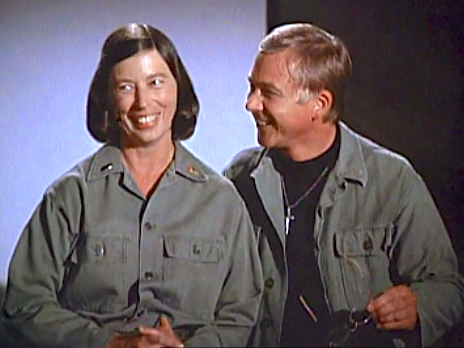
I was privileged to speak at length with the father of a severely autistic son who will be known to many readers of Mere Inkling. William Christopher, who played Father Mulcahy on M*A*S*H, has been a prominent spokesman for autism concerns for many years. (A link to the article appears below.)

Along with his wife Barbara, Christopher wrote a book entitled Mixed Blessings. It recounted their early struggles providing Ned with everything he needed to make his life as full as it could possibly be. Due to their diligence and deep love for their son, Ned continues to enjoy his active life today.

They embody the noble type of earnest love C.S. Lewis describes in The Four Loves. There he says that true love is gift-love, not seeking increased dependence on itself, but liberating the beloved to become as independent as they possibly can.

The maternal instinct . . . is a Gift-love, but one that needs to give; therefore needs to be needed. But the proper aim of giving is to put the recipient in a state where he no longer needs our gift. We feed children in order that they may soon be able to feed themselves; we teach them in order that they may soon not need our teaching.

Thus a heavy task is laid upon this Gift-love. It must work towards its own abdication. We must aim at making ourselves superfluous. The hour when we can say “They need me no longer” should be our reward. But the instinct, simply in its own nature, has no power to fulfil this law.

The instinct desires the good of its object, but not simply; only the good it can itself give. A much higher love—a love which desires the good of the object as such, from whatever source that good comes—must step in and help or tame the instinct before it can make the abdication.

This despite the counsel of one early specialist who advised them that since Ned was adopted they should just take him and trade him in for a child who wasn’t defective. Yes, someone really said that to them.

If I end up publishing the article, I’ll mention it again for those who might be interested in reading it. In the meantime, the extensive interview appears in the current issue of a journal I edit for military chaplains, called Curtana: Sword of Mercy.

When we look at a list of autistic traits, it’s normal to recognize some of them in ourselves. That shouldn’t surprise us, since most of these traits are completely “normal” in various degrees.

It is a commonplace practice to perform posthumous diagnoses of well known figures, based upon detailed descriptions of their behaviors. In that vein, I found online lists that included the following personages as possibly autistic: Thomas Jefferson, Albert Einstein, James Joyce, Stanley Kubrick, Lewis Carroll, and Hans Christian Andersen.

Oh, and there’s another name I discovered in one article. The writer suggested that C.S. Lewis’ social preferences suggest that he too suffered the mild version of autism, typically called “Asperger’s Syndrome.”

I don’t intend to discuss that now, but I wanted to share a fascinating concept I encountered while researching for this column. In Autism, Art and Children: The Stories We Draw, I read the following about imaginary worlds like Narnia and Middle Earth:

It is this element of world building that forms a bridge between the impersonal character of research and clinical observations and the individual young artists with autism in whom our interest especially lies.

Sacks (1995) points out the importance of fantasy worlds to some individuals with autism . . . this predilection for alternate worlds is frequently encountered in many high-functioning people with autism . . . such high-functioning individuals with autism “describe a great fondness for, almost an addiction to, alternative worlds, imaginary worlds such as those of C.S. Lewis and Tolkien, or worlds they imagine themselves.”

Illustrating such world-building activities by an entire family (two parents and their son), all of whom have autism, Sacks remarks, “They have spent years constructing an imaginary world with its own landscapes and geography (endlessly mapped and drawn), its own languages, currency, laws, and customs—a world in which fantasy and rigidity play equal parts.”

This creative activity is of particular interest, for many of the children we have met have individual fantasies in alternative worlds that play major roles in their lives and activities.

I find this analysis captivating. I am utterly fascinated by the construction of imaginary settings. That’s one reason I love the alternate history genre, as it combines the familiar with elements that have transformed them into something inherently different.

I must confess I’ve occupied many an idle hour imaging new worlds. I’ve even invested a fair amount of time in world-building myself—for an alternative history for which I still compile notes and ideas, despite the fact it’s unlikely to ever be written. I don’t attribute this to autism, but it serves as another example of just how much all of us have in common.

The fact is none of us is perfectly healthy—physically, emotionally, psychologically, or spiritually. We are who we are. We can strive to improve many aspects of our lives (and the wellbeing of others), but attaining perfection is impossible in this life.

In the meantime, we can be grateful for wonderful people like Barbara and Bill Christopher, who have courageously shared their own journey to aid us in ours. Their willingness to forsake their rightful shield of privacy and step out into the glare of the public—for our benefit—reveals both their love for their children and their generosity towards strangers.

_____

The wonderful photograph at the top of the column features Bill and Barbara Christopher. Barbara had a guest role as a nurse in “Dear Mildred,” during which the two of them sang a duet.

The interview with Bill Christopher can be downloaded for free in the current issue of Curtana: Sword of Mercy, which is available here.