
Some Fresh Words

Here at Mere Inkling our admiration for C.S. Lewis moves us to emulate some of his practices. Thus, we are avid readers and we also enjoy learning new words.

Some of us even enjoy inventing new words. No, we’re not so presumptuous as to desire to wend our ways into the dictionary. We just find this creative game to be both fun and useful for promoting mental health.

The challenge is providing rational definitions for our neologisms. These meanings can be serious or absurd; that doesn’t matter. Here are four I recently devised. (More, from years past, are available in the links I have included above.)

: Zambaloney : noun

A succulent cut of meat served only in skating rinks while the ice is being resurfaced during formal sporting competitions.

: Teguchigulper : noun

The indigenous name for the Honduran species of Chupacabra.

: Belladonut : noun

The presentation of poison derived from the perennial Atropa belladonna in appealing confectionaries. See also, doughnut. 

: Sinderella : noun

The Brothers Grimm story about a beneficent stepmother who learns her two biological daughters are being terrorized by their physically beautiful yet wicked stepsister.

We’re Not Alone

If you have tried your hand at this, or at least think it’s curious, you might be surprised to learn there are online “word generators” that perform at least part of this function. Let me mention a couple before sharing some more of my own inventions.

Unfortunately, some only toss out made up words, in literary isolation. This is the case of Random Word Generator, which did, however, suggest the intriguing word “picneted.”

Nonsense Word Generator “generates nonsense words based on a frequency list of phonemes as they occur in legitimate English words.” They claim “an actual word may slip through occasionally but it should mostly generate pronounceable gibberish.”

Since gibberish isn’t what I’m after, and I haven’t yet found an artificial intelligence website offering what I seek, it’s up to human beings to fill the gap. I hope you enjoy at least one or two of my other neologisms which follow.

New Words & Apropos Definitions 

: Dramadairy : noun

A business offering various products created from camelid milk. Suspense is generated by the uncertainty as to the particular species from the genus Camelus that provided the day’s primary ingredient.

: Sir Mize : proper noun

A minor noble of the Carolingian dynasty noted for his skill at accurately assessing situations despite lacking clear evidence for his hypotheses.

: Fleedom : verb

The attempt to escape restrictions imposed by an autocratic government.

: Califate : noun

The final destiny awaiting those who seek to impose their religion on others by means of violence rather than through thoughtful conversation and compassionate service.

: Hippocampus : noun

Commonly considered a region of the brain, the word originally referred to the special academies where priestesses of Taweret schooled Egypt’s hippopotami to serve Pharaoh.

: Integreation : verb

The process through which individuals or different groups are incorporated into a common whole, resulting in a truly synergistic benefit to all.

: Sinergy : noun

The crippling illusion that one should embrace diverse expressions of evil simply because they have become a standard practice under a decadent worldview.

: Laboratorinthine : adjective

Applied to extremely complex, often inescapable, research and medical facilities hosting arcane experiments on human subjects. See also, “science fiction and horror tropes.”

: Confort : noun, verb

noun : The false sense of security felt by a vulnerable individual who is being successfully deceived by a criminal. See conforter.

verb : The act of pretending to render aid or support to someone in need while laying the groundwork for a malevolent action toward them.

: Pintacostal : noun

Members of an ecstatic religious sect who allege that their ancestors arrived in America in the fifteenth century aboard one of Christopher Columbus’ smaller caravels.

: Calumknee : noun

Defamatory statements, especially directed toward athletes, related to the largest joint in a particular person’s anatomy.

: Commaraderie : noun

The collegiality felt by writers who advocate the use of the Oxford comma in lists of three or more items.

: Peripathetic : adjective

Traveling from place to place and job to job without ever finding the right fit.

: Lyberry : noun

A fruit concoction comprised of berries cleansed with minute amounts of lye water, which can be fatal if mismeasured. Not to be confused with the tragic mispronunciation of “library.”

: Indogtrination : noun

The process of training people to uncritically embrace a canine belief system and obedience to arbitrary and sometimes self-injurious commands. Antonym of catechesis.

: Banalgesic : noun

A drug designed to reduce the pain induced by participating in a banal conversation.

: Farmageddon : noun

Subterranean postapocalyptic nutrient harvesting plants specializing in either edible algae or plant-based meat alternatives (derived from algae).

: Olympipad : noun

Special edition of Apple’s iPad scheduled for release in conjunction with Olympiad XXXIV in Los Angeles in 2028.

And, as a final tribute to that great writers and saints, C.S. Lewis and J.R.R. Tolkien:

: Nearnia : noun

A fantastical world which does not require a Wardrobe to discover, but is as close as one’s own inspired imagination. See also, “Median Earth.”
On the Nature of Digressions

It’s nearly impossible to avoid digressions – those temporary departures from the current subject of conversation. While many digressions are interesting in the own right, they occasionally cause the speaker (or writer) to lose track of the actual point they are attempting to establish.

It’s like when I would be reading something the Emperor Constantine the Great, and at the mention of the Persian Empire, I would put the current article on hold while I explored the subject of just how the current regime in Iran reflects the religious fundamentalism of Zoroastrianism as it resisted during the Abbasid Caliphate. Ah, but forgive me, I digress.

The reason I am thinking about digressions today is because I recently encountered a massive one in one of Mark Twain’s works. But before we look at it, let’s consider a more recent example, in an article about C.S. Lewis.

In “The Uses of Ignorance,” literary critic Alan Jacobs explores a number of themes, including the way Lewis’ presentation of Christianity’s core resonates with believers from diverse theological backgrounds.

One lesson to be learned . . . is just how carefully Lewis articulated his “mere Christianity” so that it seemed “mere” indeed – recognizable to Christians from many different traditions as the faith they understood and practiced. But we also see . . . “that the lasting appeal of Mere Christianity is not based so much on Lewis’s genius as on his ability to point readers to the luminosity of the gospel message itself.” Which, I might add, is a kind of genius in itself.

The article is well worth reading, but the specific reason I mention it now, is because the author includes a lengthy (315 word) departure from his main theme which he brackets with the words “A digression:” and “End of digression”.) It’s rare to see something this straightforward.

C.S. Lewis as a Digresser

If the average woman or man is prone to digression, it seems apparent a genius – with voluminous knowledge on diverse subjects – would occasionally succumb to the same temptation. For someone like C.S. Lewis this is not a major problem, as he would never lose his place in the original conversation. On the contrary, Lewis’ digressions would invariably enrich the discussion, as they illuminated his points.

One of the only books written by C.S. Lewis which has entered the public domain is Spirits in Bondage. When it was published in 1919 (while he was an atheist), Lewis wrote to a friend: “The sub-title ‘A cycle of lyrical poems’ was not given without a reason: the reason is that the book is not a collection of really independent pieces, but the working out, loosely of course and with digressions, of a general idea.” (You can download a free copy of Spirits in Bondage at Project Gutenberg.)

Mark Twain’s Masterful Digression

I’ve written about Mark Twain in the past. In one column I shared his humorous reflections on the nature of editors. Writers will find the post particularly entertaining.

Editors played a major (usually unwelcome) role in Twain’s existence. Thus, it is unsurprising that a major digression in “How to Make History Dates Stick” involves these denizens of the publishing world.

One book I was reading this week includes an extensive and, of course, intentional example of digression. Although he doesn’t bracket it with the word “digression,” it is probably one of the best examples in existence. (We would expect nothing less from Samuel Clemens!)

In his novel Roughing It, Twain describes a pervasive blight to the western frontier, sagebrush.

I do not remember where we first came across “sage-brush,” but as I have been speaking of it I may as well describe it. This is easily done, for if the reader can imagine a gnarled and venerable live oak tree reduced to a little shrub two feet high, with its rough bark, its foliage, its twisted boughs, all complete, he can picture the “sage-brush” exactly.

Often, on lazy afternoons in the mountains I have lain on the ground with my face under a sage-bush, and entertained myself with fancying that the gnats among its foliage were Lilliputian birds, and that the ants marching and countermarching about its base were Lilliputian flocks and herds, and myself some vast loafer from Brobdingnag waiting to catch a little citizen and eat him.

Twain’s description of his daydreaming about sagebrush is entertaining, but this is not the quintessential digression I wish to share. After this brief digression, Twain writes a page and a half about the plant’s actual physical attributes and utility (e.g. for fires and tea). But then, when the reader least expects it, Twain goes off on another extended ramble.

Sage-brush is very fair fuel, but as a vegetable it is a distinguished failure. Nothing can abide the taste of it but the jackass and his illegitimate child, the mule. But their testimony to its nutritiousness is worth nothing, for they will eat pine knots, or anthracite coal, or brass filings, or lead pipe, or old bottles, or anything that comes handy, and then go off looking as grateful as if they had had oysters for dinner. Mules and donkeys and camels have appetites that anything will relieve temporarily, but nothing satisfy.

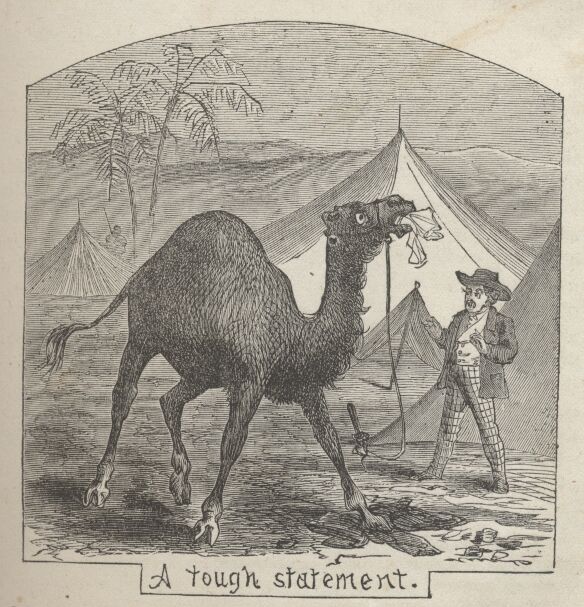
In Syria, once, at the head-waters of the Jordan, a camel took charge of my overcoat while the tents were being pitched, and examined it with a critical eye, all over, with as much interest as if he had an idea of getting one made like it; and then, after he was done figuring on it as an article of apparel, he began to contemplate it as an article of diet. He put his foot on it, and lifted one of the sleeves out with his teeth, and chewed and chewed at it, gradually taking it in, and all the while opening and closing his eyes in a kind of religious ecstasy, as if he had never tasted anything as good as an overcoat before in his life.

Then he smacked his lips once or twice, and reached after the other sleeve. Next he tried the velvet collar, and smiled a smile of such contentment that it was plain to see that he regarded that as the daintiest thing about an overcoat. The tails went next, along with some percussion caps and cough candy, and some fig-paste from Constantinople.

And then my newspaper correspondence dropped out, and he took a chance in that – manuscript letters written for the home papers. But he was treading on dangerous ground, now. He began to come across solid wisdom in those documents that was rather weighty on his stomach; and occasionally he would take a joke that would shake him up till it loosened his teeth; it was getting to be perilous times with him, but he held his grip with good courage and hopefully, till at last he began to stumble on statements that not even a camel could swallow with impunity.

He began to gag and gasp, and his eyes to stand out, and his forelegs to spread, and in about a quarter of a minute he fell over as stiff as a carpenter’s work-bench, and died a death of indescribable agony. I went and pulled the manuscript out of his mouth, and found that the sensitive creature had choked to death on one of the mildest and gentlest statements of fact that I ever laid before a trusting public.

At that point, the writer pretends to realize he has digressed and concludes the chapter in the persona of the naturalist he has earlier assumed.

I was about to say, when diverted from my subject that occasionally one finds sage-bushes five or six feet high, and with a spread of branch and foliage in proportion, but two or two and a half feet is the usual height.

Well, that’s probably more than enough of a diversion from your day’s responsibilities. I hope you enjoyed reading these words, and that your own skills as a digresser will be correspondingly enhanced.