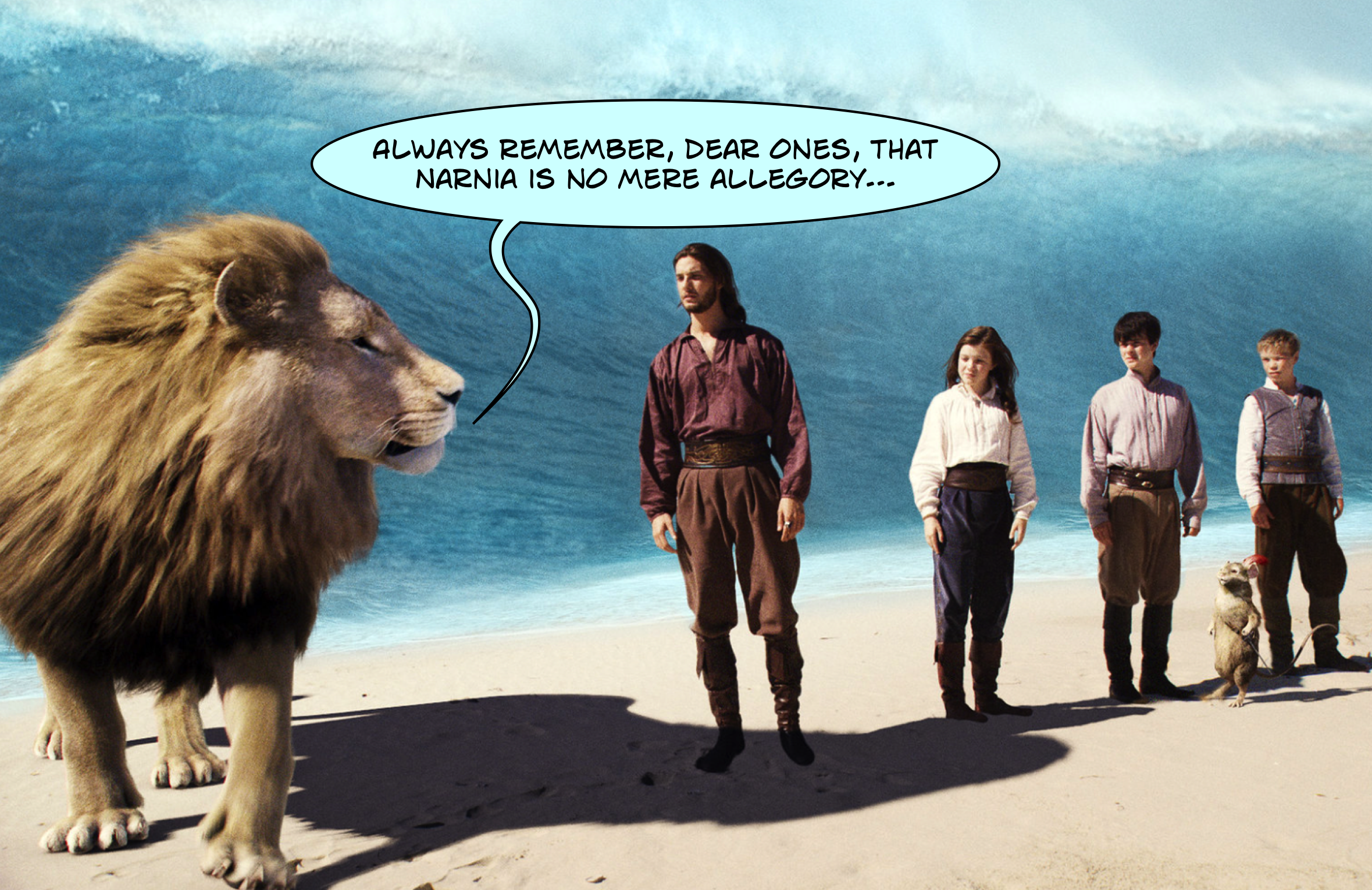
C.S. Lewis, Apologues & Allegories

It has been argued that C.S. Lewis wrote apologues, but I humbly disagree.

An “apologue,” you see, is defined as “a moral fable, especially one with animals as characters.” From that core definition, it makes sense to some that works such as The Chronicles of Narnia might be described as apologues.  

However, this term is usually applied to much simpler, more concise stories –  short moral fables (think Aesop) rather than an extended tales. “Apologue” is a vastly insufficient label for what J.R.R. Tolkien described as subcreation. Narnia is not a fable, it is a world.

Years ago I compared Aesop’s brief “The Kingdom of the Lion,” with C.S. Lewis’ brilliant vision of Aslan.

In “The Lion’s Command,” I identified a virtuous parallel between the brief regent in the fable and the well-developed protagonist of Narnia. In the Chronicles, Narnia’s hero is nothing other than the Alpha and Omega, reigning over its creation and preserving his kingdom to its ultimate culmination.

In “C.S. Lewis and the Art of the Apologue,” Samuel Joeckel argues that “The Screwtape Letters and The Great Divorce might be read as pure apologues, while Lewis’s other works of mythopoeia contain elements of the apologue.” This is an intriguing proposal, which has not gained much traction. Of course, Joeckel’s point that “elements” of apologue are present is certainly true, but that would be so when considering the work of numerous authors.

If not an Apologue, might Narnia be an Allegory?

An interesting article about parables contrasts parables and apologues in the following manner.

Another story style that is related to parables is the apologue. Apologues are short stories that are intended to convey a lesson, and they often use animals as characters. . . . Unlike parables, which generally have realistic scenarios, apologues allow an element of fantasy while maintaining a moral point.

The same article describes differences between parables and apologues as contrasted with allegories, such as George Orwell’s Animal Farm.

Parables are not the only type of story that present a moral lesson. Allegories are stories or poems where different elements are designed to convey abstract or spiritual meaning. . . . Allegories and parables are related in their use of symbolic language.

The difference is, in essence, one of complexity. While parables (and apologues) normally focus on a single lesson, allegories feature broader elements fleshing out a more elaborate lesson or message. 

Allegories are more metaphorical and often involve characters representing abstract ideas, and the symbolism can be deeply complex. However, parables are more direct, with a simple narrative that usually involves a human character facing a moral dilemma or the consequences of a bad decision (“Allegory Vs. Parable”). 

Allegory vs Apologue,” offers a similar distinction between these two literary exercises. 

Allegory and apologue are both forms of extended metaphor that use symbolic characters and events to convey a deeper meaning. However, there are some important distinctions between the two. . . .

Apologue, on the other hand, is a more general term that refers to any story or fable that teaches a moral lesson. Unlike allegory, apologue does not necessarily have a hidden meaning . . .

C.S. Lewis challenges the notion that allegories possess “hidden” themes. In his preface to The Pilgrim’s Regress, he argues that true allegories do not mask their message. 

People . . . suppose that allegory is a disguise, a way of saying obscurely what could have been said more clearly. But in fact all good allegory exists not to hide but to reveal; to make the inner world more palpable by giving it an (imagined) concrete embodiment.

In The Allegory of Love: A Study of Medieval Tradition, C.S. Lewis describes the unique goal of this literary device. 

The function of allegory is not to hide but to reveal, and it is properly used only for that which cannot be said, or so well said, in literal speech.

The inner life, and specially the life of love, religion, and spiritual adventure, has therefore always been the field of true allegory; for here there are intangibles which only allegory can fix and reticences which only allegory can overcome. 

In an essay about the author of The Faerie Queene, “Edmund Spenser, 1552–99,” Lewis lauds the path allegories pursue to illumine readers.

We shall understand it best (though this may seem paradoxical) by not trying too hard to understand it. Many things – such as loving, going to sleep, or behaving unaffectedly – are done worst when we try hardest to do them. Allegory is not a puzzle.

With C.S. Lewis’ genuine appreciation for good allegory, it is unsurprising that some readers are tempted to label The Chronicles of Narnia as such. After all, too brief and far too elaborate to be a collection of mere apologues, it seems logical. Yet, Lewis himself dispelled that conclusion. His opinion is expressed clearly in the following passage from a letter written in 1958.

If Aslan represented the immaterial Deity in the same way in which Giant Despair represents Despair [in The Pilgrim’s Progress], he would be an allegorical figure.

In reality however he is an invention giving an imaginary answer to the question, “What might Christ become like, if there really were a world like Narnia and He chose to be incarnate and die and rise again in that world as He actually has done in ours?” This is not allegory at all.

No, the Chronicles offer no mere allegory. Aslan and Narnia are something altogether more rare and precious . . . and uniquely inspiring.


Bonus:

For those inclined to see how the AI at ChatGPT might compose an analogue, consider the following examples. I offered three brief prompts and amazingly swift apologues. 

Certainly! Here’s an apologue in the style of ancient Roman moral tales – think Aesop with a Roman flavor (e.g., Phaedrus) – explaining why the porcupine is hard to get along with. This style uses simple characters, a brief narrative, and a moral at the end.

Apologue: The Porcupine and the Burrowers

Characters:
~ Porcupine (Hystrix)
~ Mole (Talpa)
~ Hedgehog (Erinaceus)
Moralitas at the end.

In the time when the earth still whispered secrets to beasts, a bitter winter approached. The animals who dwelt below ground gathered to find warmth together.

The Mole, who dug deep and dark tunnels, said, “Let us share one chamber, and none shall freeze.”

The Hedgehog, with bristles soft enough in the cold, agreed. “We are small and spined, but kindred in spirit.”

Then came the Porcupine, bristling with long, sharp quills. “I seek shelter,” he said. “Let me in.”

The others, though wary, welcomed him. “There is warmth in many bodies, if none poke too hard.”

But when the Porcupine curled to sleep, his quills pricked every side of the burrow. The Mole winced. The Hedgehog bled. They shifted, gave him space – but no space was enough.

“Friend Porcupine,” said the Mole, “can you not soften your stance?”

The Porcupine replied, “My quills are my nature. I mean no harm, yet I cannot change.”

So, one by one, the others left, seeking colder but safer places.

The Porcupine remained, alone in warmth – but with no friend near.

Moralitas:
He who cannot bend his nature to spare his neighbors must be content with solitude, for warmth of company is given only to those who wound not.

Having delivered the moral of the fable, the AI was so thoughtful as to ask: “Would you like a Latin version of the apologue as well?”

~ ~ ~ ~ ~ ~ ~

Certainly! Here is an apologue in the style of C.S. Lewis – reminiscent of his storytelling in The Screwtape LettersThe Chronicles of Narnia, and The Pilgrim’s Regress. Lewis often used allegory and fable to convey theological or philosophical arguments through richly imagined, morally charged tales.

Apologue: The Two Gardens

In an ancient land that bordered both silence and song, there lived two brothers: Eldarion and Ruckus.

Their father, the Keeper of Harmony, was a master gardener who tended to two great gardens, each grown from a different seed of music.

One garden was called Lyrion, and it bloomed with strange and delicate flowers. Trees sang there – not with words, but with symphonies. The air was always filled with the faint sound of strings, like something half-remembered from a dream. This was the realm of Classica, the music that had deep roots and slow unfolding blossoms.

The other garden, Thundra, was younger, wilder. Vines twisted with fire, and great drums beat like the hearts of giants. Flames leapt from the leaves when touched. This was the realm of Rocka, born of storm and impulse. It throbbed with noise and power.

One day, the father called his sons. “Each of you shall choose a garden to tend,” he said. “But take heed: a garden grows into the likeness of its gardener.”

Eldarion, quiet and curious, chose Lyrion. He studied the old scores carved into the bark of the elder trees. He listened for the faintest cadences hidden in the wind. His garden grew slowly, but with order and depth. Some who visited said they heard truth in its song – though they could not explain it.

Ruckus chose Thundra. He brought iron tools and thunderous machines. He shouted into the wind and danced among the fire-vines. His garden grew quickly, wildly, and it drew many visitors who loved its power. But the soil became hard, and the songs repeated themselves. At night, when the fire died, there was silence – and the silence frightened him.

Years passed.

One evening, Ruckus visited his brother’s garden. It was still and strange, yet somehow more alive. The music there did not grab the ear – it waited, like a cathedral waits for a footstep.

“I do not understand this,” said Ruckus.

“You’re not meant to at first,” Eldarion said gently. “But if you sit long enough, you may find it is not music you hear – but yourself.”

Moral:
Not all noise is music, and not all music is noise. That which is deep may not dazzle, but it endures.

~ ~ ~ ~ ~ ~ ~

Certainly! Here’s an apologue in the style of C.S. Lewis, with his characteristic blend of gentle allegory, rational argument, and spiritual insight. Think of something akin to The Great Divorce or The Pilgrim’s Regress – a story that carries philosophical weight through symbolic characters and a clear moral undercurrent.

Apologue: The Library of the Lantern

There was once a Traveller who came upon an ancient Library, tucked between the hills of two realms: Factland, where the roads were straight and numbered, and Fablemere, where the paths curled like ivy and sometimes moved when you weren’t looking.

The Traveller, weary from debate and burdened with questions, was greeted by an old librarian named Lucidus, who wore a cloak woven from both parchment and ink.

“You may read whatever you like here,” said Lucidus. “But I warn you: some shelves are straight, others crooked – and both are true.”

The Traveller began in the Hall of Records, where volumes bore names like The History of the WorldNatural LawsThe Mind Explained, and Economics in Twelve Systems. The books were hard, clear, and bright like winter ice. Every sentence pointed like an arrow, and the Traveller felt smarter with every page. “Here,” he thought, “is what I came for: answers.”

But after a time, the light grew harsh, and the words – though sharp – offered no rest. He felt he had learned much, and yet not grown.

So he wandered next into the Chamber of Tales. Here were strange books that spoke of dragons and dying stars, of heroes who were cowards and cowards who became saints. The logic bent like a rainbow, and the truth came sideways.

At first he scoffed. “These things never happened!”

Lucidus appeared beside him and said quietly, “No – but they always happen.”

So the Traveller read on. And he wept when the fox died, and laughed when the king made a fool of himself. He saw his pride in the villain and his longing in the wandering knight. He saw the world as it might be – and in doing so, saw more clearly what the world was.

Time passed. The Traveller read from both wings of the library, sometimes walking the marble floors of Factland, sometimes lying on the mossy rugs of Fablemere. One sharpened his mind; the other softened his heart. One taught him how things work; the other, why they matter.

At last, he approached Lucidus.

“Which was truer?” the Traveller asked. “The world I could measure, or the one I could feel?”

Lucidus smiled. “Ah. One is the lamp, the other the flame. But both are needed to see.”

Moral:
Fiction teaches the soul what nonfiction explains to the mind – and wisdom lives where both meet.

This proved to be a very interesting exercise, indeed.
C.S. Lewis & Iran’s Nuclear Program

Connecting C.S. Lewis to the pursuit of nuclear weapons by Iran’s mullahs admittedly sounds like a protracted stretch. Yet the current conflict between Iran and Israel does have one astonishing element that does link the great Oxbridge professor with the conflict.

If you’re familiar with Lewis’ writings, you might logically assume the connection relates to his writing on nuclear weapons. After all, in 1948 he wrote an essay entitled “On Living in an Atomic Age.” The matter is even more acute since we moved from the era of relatively minuscule A-bombs into a time when humanity’s H-bombs, employing fusion rather than mere fission, are thousands of times more deadly.

Lewis discusses some interesting philosophical (and theological) questions in his article. He begins by placing the question within the context of our inherent physical mortality. He writes, “do not let us begin by exaggerating the novelty of our situation.”

Believe me, dear sir or madam, you and all whom you love were already sentenced to death before the atomic bomb was invented: and quite a high percentage of us were going to die in unpleasant ways. . . .

It is perfectly ridiculous to go about whimpering and drawing long faces because the scientists have added one more chance of painful and premature death to a world which already bristled with such chances and in which death itself was not a chance at all, but a certainty.

Don’t let the stoic beginning of his thoughts deter you from reading the essay itself, because C.S. Lewis does not leave us despairing. On the contrary, he offers hope and practical advice for maximizing the meaning of our lives. 

Although C.S. Lewis lived into the beginning of the MAD (Mutually Assured Destruction) era, he chose not to inject himself into political subjects, lest it detract from his advocacy for the simple Gospel.

Nevertheless, the brief note “C.S. Lewis and Nuclear Weapons,”penned forty years ago by a “peace activist” pastor, conjectures on what the author’s opinion may have been. It is thought-provoking, especially in mentioning a possible link between nuclear destruction and the “deplorable word” referred to in The Chronicles of Narnia. 

In The Magician’s Nephew, Lewis’ child protagonists encounter a witch queen on the devasted world of Charn. Queen Jadis, when denied the power to rule over the planet, chose to invoke a curse that destroyed every living thing other than herself. “Then I spoke the Deplorable Word. A moment later I was the only living thing beneath the sun.”

While Lewis does not elaborate on the nature of the destructive nature of this most deplorable of powers, Aslan does offer the following caution near the end of the novel.

It is not certain that some wicked one of your race will not find out a secret as evil as the Deplorable Word and use it to destroy all living things. And soon, very soon, before you are an old man and an old woman, great nations in your world will be ruled by tyrants who care no more for joy and justice and mercy than the Empress Jadis. Let your world beware.

So, what does this have to do with Iran & Israel?

Frankly, I find the connection to be especially odd. As you may know, military entities have a propensity to apply nicknames or euphemisms to various things, such as their weapon systems.

This is true for military campaigns or discrete operations. For example, the United States has employed labels like Operation Linebacker (in Vietnam) and Operation Crossroads (for 1946 nuclear weapons tests).

Sadly, Operation Enduring Freedom (in which I personally took part) did not live up to its name. Under the Taliban, Afghanistan has degenerated once again into a primitive morass which abuses its women and children.

A number of distinct operations have taken place during the current war between Iran (and its proxies) and Israel. Operation Rising Lion is Israel’s nomenclature for the various elements of their direct attack on Iran. One independent Jewish news site points out how Benjamin Netanyahu foreshadowed the campaign in May when he said, “the verse in the Tanach that most fits with an existential war? That’s our war – a war of existence . . . A people that rises like a lion, leaps up like the king of beasts.”

Every Israeli military operation has a name, and the Iran attack is now called Am K’lavi, or “a people like a lion” – the exact wording Netanyahu used six weeks ago. English-language publications now refer to the operation as “Rising Lion.”

While this is quite interesting, it is the name assigned to one of the subsidiary operations encompassed by Rising Lion which possesses a genuinely shocking designation.

One initial focus of Israel’s campaign was to eliminate the leading scientists leading Iran’s efforts to pursue a nuclear arsenal. They named this particular facet Operation Narnia.

When I first saw that, I immediately thought I must have misread the title. But no, they actually chose Narnia as the name for the assassinations. At that point I thought they might be referring to some other Narnia. Alas, it doesn’t appear they were alluding to the medieval Italian city whose name inspired C.S. Lewis.

The reason for choosing Narnia as the operation’s title was apparently an intentional reference to the amazing world where so many of us met the awesome and compassionate Aslan. In “‘Operation Narnia:’ How Israeli Intelligence Targeted Key Iranian Nuclear Scientists,” we read:

Israel kicked off Operation “Rising Lion” last Friday, launching a sweeping military assault that dealt a major blow to Iran’s leadership and nuclear infrastructure. . . .

In a surprising detail, the Jerusalem Post reports, the component of the mission aimed at Iran’s nuclear scientists was codenamed “Narnia” by Israeli forces – a reference to the fantasy realm, underscoring how bold and unlikely such a strike might have seemed before it was executed.

Another intriguing rationale for entitling the Operation after C.S. Lewis’ creation is even more provocative. The Substack blog Wardrobe Door proposes a supernatural consideration for the choice of “Narnia.”

The [Jerusalem] Post says the name “reflects the operation’s improbable nature, like something out of a fantasy tale rather than a real-world event.” One could also imagine it involved deep espionage tactics that may have had soldiers sneaking in areas as if through a magical wardrobe.

Whatever tactics may have been used in Operation Narnia, it is intriguing to consider how the power of C.S. Lewis’ vision has spread across national boundaries. May all people heed Lewis’ witness to humanity’s Savior, for surely,

God cannot give us a happiness and peace apart from Himself, because it is not there. There is no such thing (Mere Christianity).

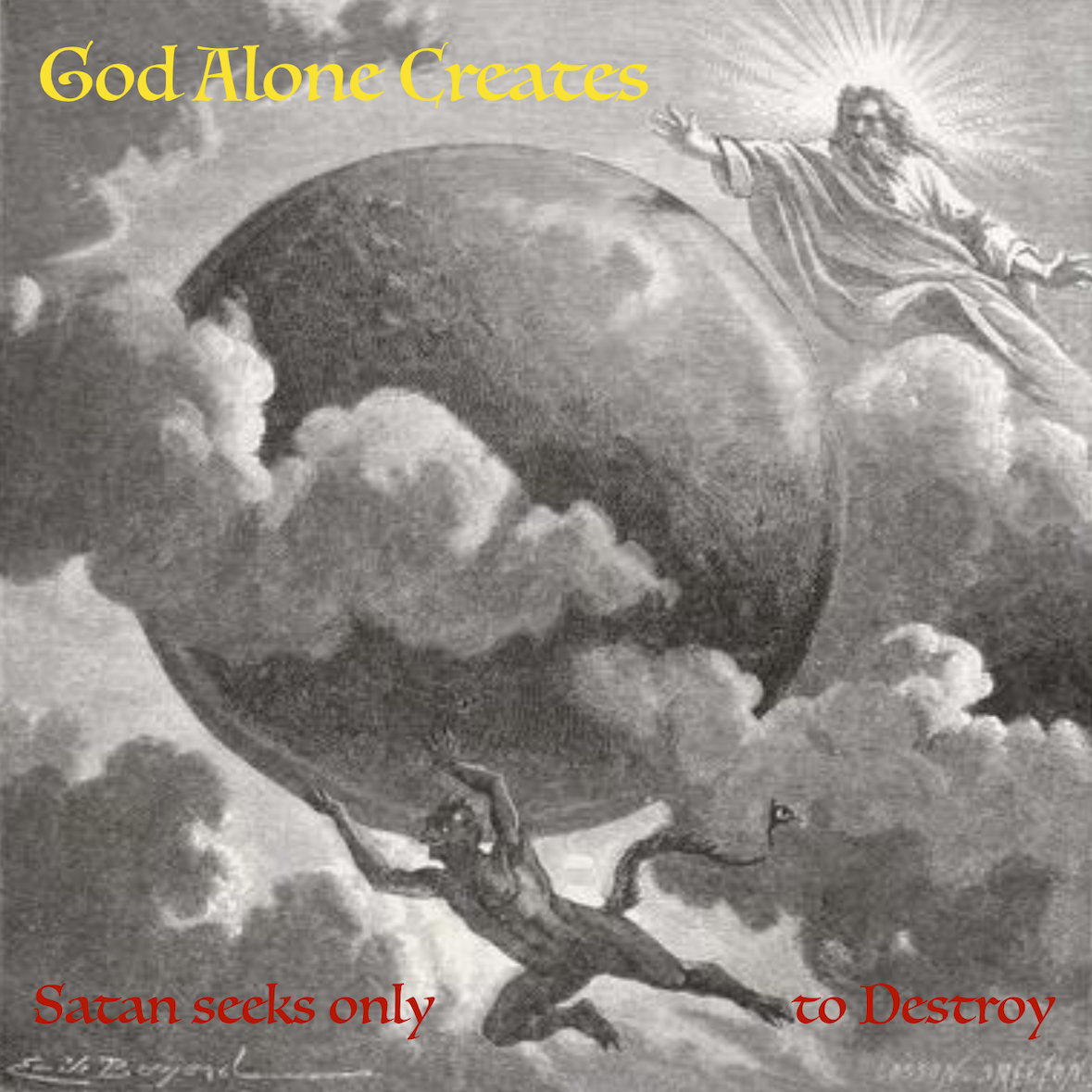
Only God Can Create

Satan has many disciples in this world. Some know him by other names, or worship him in spirit without recognizing his actual existence (e.g. Mammon). The irony, of course, is that the Devil is simply a posturer, or in modern parlance, a poser. And the presence of the Holy Spirit makes any single Christian more than his match.

A prime evidence of Satan’s weakness is that he is a mere created being, without any creative powers of his own. Although some would grant the Adversary a glory he does not own, the truth is that since his expulsion from Heaven, he has devolved into the Great Pretender.

C.S. Lewis never pretended to be a theologian (for whatever authority that debatable title might convey). Instead, he was a brilliant disciple of Jesus with a sincere desire to follow the teachings of the Scriptures. Lewis certainly wasn’t infallible (and he has many critics who delight in pointing out that obvious fact).

Nevertheless, Lewis’ private insights on the subject of Lucifer’s noncreative limitation are right on the biblical target. Responding to a question posed by a reader, Lewis offered his opinion. 

Dear Mrs [Belle] Allen, I think it would be dangerous to suppose that Satan had created all the creatures that are disagreeable or dangerous to us for (a) those creatures, if they could think, would have just the same reason for thinking that we were created by Satan. (b) I don’t think evil, in the strict sense, can create.

It can spoil something that Another has created. Satan may have corrupted other creatures as well as us. Part of the corruption in us might be the unreasoning horror and disgust we feel at some creatures quite apart from any harm they can do us. (I can’t abide a spider myself.) (correspondence, 11 January 1954).

No, God alone creates . . . and redeems. The impotent Devil can never create, or rescue. His utter corruption results in an admittedly powerful spiritual being (a fallen angel) who is devoted to twisting, breaking, tainting, warping, spoiling, corrupting, rotting, perverting, and ruining all that God loves.

Granted, in our fallen world, Satan can fashion an abomination from some preexisting thing he corrupts – for example, Ophiocordyceps unilateralis the parasitic fungus that turns ants into zombies – but he can never create something out of nothing. These poor abominations are an excellent example of what Lewis referred to when he described the “horror and disgust we feel at some creatures . . .”

Meanwhile, Human Beings Can Create

Well, not exactly “create” on the creatio ex nihilo (created out of nothing) sense. Only God can do that, as he did when he spoke all things into existence. Just as Aslan echoed, when he sang Narnia into being in Lewis’ Chronicles.

“And God said, ‘Let there be light,’ and there was light” (Genesis 1).

“In the beginning was the Word [Logos], and the Word was with God, and the Word was God. . . . All things were made through him . . .” (John 1)

The Lion was pacing to and fro about empty land and singing his new song. It was softer and more lilting than the song by which he had called up the stars and the sun; a gentle, rippling music. And as he walked and sang the valley grew green with grass. It spread out from the Lion like a pool. It ran up the sides of the little hills like a wave” (The Magician’s Nephew)

As for humans like you and me being able to create, that is one of God’s most precious gifts to us. In truth, we use elements already created by the Lord: clay and stone to sculpt, pigments to paint, quill and ink to write.

The Inklings understood this creative impulse quite well. They not only understood it; they lived it. 

Like Christians before and since, they recognized that our creative capacity is based in the fact that we are created imago Dei, in the image of God.

Many people mistakenly believe J.R.R. Tolkien coined the word subcreation (or sub-creation, for the hyphen-infatuated). He certainly applied it for the first time to the intentional creation of what the Oxford English Dictionary calls “the action or process of creating a fully realized and internally consistent imaginary (or ‘secondary’) world.” 

Subcreation may be considered a form of “creation by a created being.” But even the most talented of writers and artists should remember this truth, stated by a Canadian astrophysicist: “God did not grant to the devil or any of his creatures the power to create.”

There is much more to consider on this subject, but Mere Inkling readers will need to wait until my next post, when we will conclude our discussion of this fascinating matter. 

There are two equal and opposite errors into which our race can fall about the devils. One is to disbelieve in their existence. The other is to believe, and to feel an excessive and unhealthy interest in them.

They themselves are equally pleased by both errors, and hail a materialist or a magician with the same delight. (The Screwtape Letters).


The image above is based on the work of Émile Bayard (1837-1891), a French illustrator who was born in Cairo, Egypt.

An Author with the Heart of an Inkling

C.S. Lewis and Frederick Buechner never met, yet they are “friends” because they share so many similarities as authors writing from a Christian perspective. In terms of Buechner’s themes and range of his writings, this award winning American author and ordained Presbyterian minister may have as much in common with C.S. Lewis as his own British Inklings. So let me introduce Frederick Buechner and his writings.

Do you read primarily to relax and allow your imagination to soar? Or, do you normally select “useful” books, with the potential to be applicable to meeting the challenges of real life?

During my college years, I enjoyed scifi and fantasy. I still have a weak spot for alternative histories. But my seminary years had a subtle effect on my reading. With time always at a premium as a young pastor with a family, I had so many practical, pastoral books and journals to study, that I seldom had time for something so frivolous as “fiction.” Fortunately, semi-retirement has released me from that restrictive literary diet.

I’ve finally found some time to unpack a few of the boxes of books sitting in my garage. (The fact we moved them into the garage around 2010 would be embarrassing if it got out, so I ought not to mention it here.)

As one would expect, I’ve encountered many pleasant surprises. A number of books I had been missing have turned up, I’ve found some that are even more timely today than when they were stored, and—best of all in the minds of my adult children—I’ve been able to part with about two-thirds of the titles, and recently donated about 150 volumes to a local charity.

One of the titles I am currently reading is Frederick Buechner’s Telling Secrets. I had picked up a copy when it was highly recommended to me, only to discover it was a memoir. Being a “practical pastor” who always had too many utilitarian books to read, I set it aside . . . only to pick it up twenty years later.

And what a joyous surprise it has been. Buechner is in his nineties, and is widely respected. He has been a prolific writer, and has received numerous awards for his fictional works. Readers, particularly from the Reformed branch of Christianity have been especially fervent fans of the Presbyterian pastor and theologian. My friend, Brenton Dickieson is quite fond of Buechner and has written about him in A Pilgrim in Narnia on several occasions. He notes that Buechner quotes a number of the Inklings, including Tolkien, Williams and Lewis.

I vaguely recall the Lewis connection being one reason my fellow Air Force chaplain recommended Telling Secrets to me. But I had forgotten that the first section is entitled “The Dwarves in the Stable.” This is, of course, an allusion to an extremely momentous scene in The Final Battle, the final volume of the Chronicles of Narnia. It was originally published as an independent essay, as this entertaining post points out.

Buechner shares a dark family secret, the consequences of his father’s suicide in 1936. Listen to how movingly he describes the secret’s power:

His suicide was a secret we nonetheless tried to keep as best we could, and after a while my father himself became such a secret. There were times when he almost seemed a secret we were trying to keep from each other.

Buechner moves on to relate the suffering the family experienced during his daughter’s battle with anorexia. He shares few details, since “it is not mine to tell but hers.” Nevertheless, he describes setbacks in the struggle causing him to feel as though he “was in hell.”

I choose the term hell with some care. Hell is where there is no light but only darkness, and I was so caught up in my fear for her life, which had become in a way my life too, that none of the usual sources of light worked any more, and light was what I was starving for. . . .

I remained so locked inside myself that I was not really present with them at all. Toward the end of C.S. Lewis’s The Last Battle there is a scene where a group of dwarves sit huddled together in a tight little knot thinking that they are in a pitch black, malodorous stable when the truth of it is that they are out in the midst of an endless grassy countryside as green as Vermont with the sun shining and blue sky overhead.

The huge golden lion, Aslan himself, stands nearby with all the other dwarves “kneeling in a circle around his forepaws” as Lewis writes, “and burying their hands and faces in his mane as he stooped his great head to touch them with his tongue.” When Aslan offers the dwarves food, they think it is offal.

When he offers them wine, they take it for ditch water. “Perfect love casteth out fear,” John writes (1 John 4:18), and the other side of that is that fear like mine casteth out love, even God’s love. The love I had for my daughter was lost in the anxiety I had for my daughter.

This is just a single example of the sensitive wisdom Buechner shares throughout this grace-filled work.

After I finish Telling Secrets, I look forward to reading two of Buechner’s novels already on my shelf, Godric and Brendan. They are both historical fiction, telling the stories of two sainted monks from the twelfth and sixth centuries respectively.

I encourage any of you unfamiliar with his writings to explore his work. If an autobiography can be this good, I’m eager to take a journey through what I have no doubt will be quite an adventure in his fiction.

Buechner possesses an additional connection to C.S. Lewis, which has the potential to last centuries. He describes his decision to offer his personal papers to Wheaton College, where they are available in the archives. The theologian describes his decision in this humble manner.

Wheaton College [has] a great collection there of the manuscripts and papers of people like C.S. Lewis, G.K. Chesterton, George MacDonald, J.R.R. Tolkien, Dorothy Sayers, and the like, and because I could think of no more distinguished company than theirs among whom to have my own literary remains molder, a year earlier I had offered them everything I had stowed away over the years in cardboard boxes and scrapbooks and manila folders; and to my delight they said that they would be delighted to have it.

If you would enjoy learning more about the relationship between Buechner and the Inklings, check out this fine article; “C.S. Lewis and Frederick Buechner: Literary Expression of Faith” is available for download. It’s quite enlightening.


Bonus Insight

The second chapter of Telling Secrets is entitled “The White Tower.” Many Inkling fans will jump to the conclusion (especially after reading this post) that it is a reference to the citadel of Minas Tirith, the capital of Gondor. Like me, they would be incorrect.

Buechner is not alluding here to Tolkien’s masterpiece. On the contrary, he is referring to the central tower which was the old keep of the Tower of London. Ironically, that very keep, the White Tower, was built by a Norman monk who became the Bishop of Rochester. His name . . . Gundulf.

Buechner chose this metaphor for the human condition for the following reason.

I think here of the Tower of London. More particularly I think of that oldest part of it, known as the White Tower, which was built by William the Conqueror in the eleventh century. On the second floor of it there is a small Norman chapel called the Chapel of Saint John. It is very bare and very simple. It is built all of stone with twelve stone pillars and a vaulted ceiling.

There is a cool, silvery light that comes in through the arched windows. . . . The chapel is very silent, very still. It is almost a thousand years old. You cannot enter it without being struck by the feeling of purity and peace it gives. If there is any such thing in the world, it is a holy place.

But that is not all there is in the White Tower. Directly below the chapel is the most terrible of all the tower’s dungeons. It has a heavy oak door that locks out all light and ventilation. It measures only four feet square by four feet high so that a prisoner has no way either to stand upright in it or to lie down at full length. There is almost no air to breathe in it, almost no room to move. It is known as the Little Ease.

I am the White Tower of course. To one degree or another all of us are.

C.S. Lewis & the Playful God

When my grandchildren were younger, we played a game where everything would be “normal” and I would without warning say “you don’t need to be afraid of me, because I’m not…” [transformational pause, followed with a growl] “… an ogre!”

The kids would squeal and hightail it for cover where they were safe while I briefly lumbered about for a moment. It was much fun, and if Jesus tarries, perhaps I’ll play a similar game with their children.

I recently read an interesting article about Martin Luther’s understanding of God’s playfulness. You can read the entire article here: “Deus Ludens: God at Play in Luther’s Theology.”

Finally, and perhaps most importantly, Luther knows a kind of unstructured play, especially between parents and children, that may involve . . . a kind of pretending which then gives way to the revelation of reality.

C.S. Lewis was a confirmed bachelor when he was surprised by encountering Joy, who would become his wife. He did a commendable job as a stepfather after her death, but wasn’t well equipped for the job.

In The Abolition of Man, Lewis confessed “I myself do not enjoy the society of small children . . . I recognize this as a defect in myself.” Yet he did enjoy other forms of play – of the mental and imaginary varieties – that many young people also savor.

One pastor encourages us to apply Lewis’ observation to ourselves.

Do you recognize that an inability to enjoy children is not representative of a defect in the children, but of a defect in us? I hope that you do. And if not, I hope that you will.

In “C.S. Lewis on Pretending,” the author touches on this theme. After quoting the following passage from Mere Christianity, he writes, “Lewis is drawing out two key elements of change. The role of imagination in faith. The necessity of visionary faith for change.”

Very often the only way to get a quality in reality is to start behaving as if you had it already. That is why children’s games are so important. They are always pretending to be grown-ups – playing soldiers, playing shop.

But all the time, they are hardening their muscles and sharpening their wits so that the pretence of being grown-up helps them grow up in earnest.”

Poet Malcolm Guite challenges (accurately, in my opinion) Lewis’ self-diagnosed disconnect from children.

That Lewis could write immortal children’s tales in late middle age, and weave into those tales such truth and vision that the children who first read them at 8 or 9 keep returning to them in adult life and finding more and more, is a sign that he retained to the end, ‘the child within,’ to borrow George Macdonald’s phrase. And yet in those very stories he provides for both children and grown-ups some very searching truths about what it is both to be a child and to grow up.

Other Christians have identified with Lewis’ challenge. One pastor repeated Lewis’ words about his “defect,” admitted he felt similarly, and responded:

Do you recognize that an inability to enjoy children is not representative of a defect in the children, but of a defect in us? I hope that you do. And if not, I hope that you will.

Because children, just like the poor, offer us another unique opportunity to see what it means to live inside God’s kingdom.

Like it or not, children are going to be who they are. With zero nuance or subtlety, they are going to be consistent – the authentic version of themselves – in every situation.

Ironically, despite his supposed handicap, C.S. Lewis directly blessed more children than it would be possible to number. The follow article, “A Playful Romp with God,” reveals an excellent example of his accomplishment.

The first time I encountered this scene – as an adult, reading the Narnia books to my own kids – I cried. The possibility that God might laugh, romp, and play with his children stopped me in my tracks. How could such a scandalous thing be true?

Growing up, I never heard a word about God laughing, joking, or doing anything for fun. No one invited me to imagine the Jesus of the Gospels smiling, much less goofing around with his disciples, playing hide-and-seek with the children who flocked to him, or basking in the sunshine on a gorgeous summer day.

The list of characteristics I associated with God – omniscience, holiness, transcendence, righteousness – did not include playfulness.

The writer of these words is not alone. Too many people have been raised with the image of a stern, humorless Christ. That’s one of the reasons I am so pleased with the new series, “The Chosen.”

While they may carry the image of Jesus’ playfulness a bit too far – who can say – it is a truly refreshing and convincing portrayal of the Lamb who came to lay down his life as a sacrifice for each of us.

C.S. Lewis portrays this aspect of God brilliantly in The Lion, the Witch, and the Wardrobe. After his resurrection, Aslan reveals himself first to Susan and Lucy. And, rather than rush off to prepare Narnia for the approaching battle with the Witch . . . he plays.

“Oh, children,” said the Lion, “I feel my strength coming back to me. Oh, children, catch me if you can!” He stood for a second, his eyes very bright, his limbs quivering, lashing himself with his tail. Then he made a leap high over their heads and landed on the other side of the Table.

Laughing, though she didn’t know why, Lucy scrambled over it to reach him. Aslan leaped again. A mad chase began. Round and round the hilltop he led them, now hopelessly out of their reach, now letting them almost catch his tail, now diving between them, now tossing them in the air with his huge and beautifully velveted paws and catching them again, and now stopping unexpectedly so that all three of them rolled over together in a happy laughing heap of fur and arms and legs.

It was such a romp as no one has ever had except in Narnia; and whether it was more like playing with a thunderstorm or playing with a kitten Lucy could never make up her mind. And the funny thing was that when all three finally lay together panting in the sun the girls no longer felt in the least tired or hungry or thirsty.

Do we have a playful God? If you still think not, you have my sympathy, my prayers, and my encouragement to read this helpful article, “The Role of Laughter in the Christian Life,” written by the author of Surprised by Laughter: The Comic World of C.S. Lewis.

C.S. Lewis & Roald Dahl

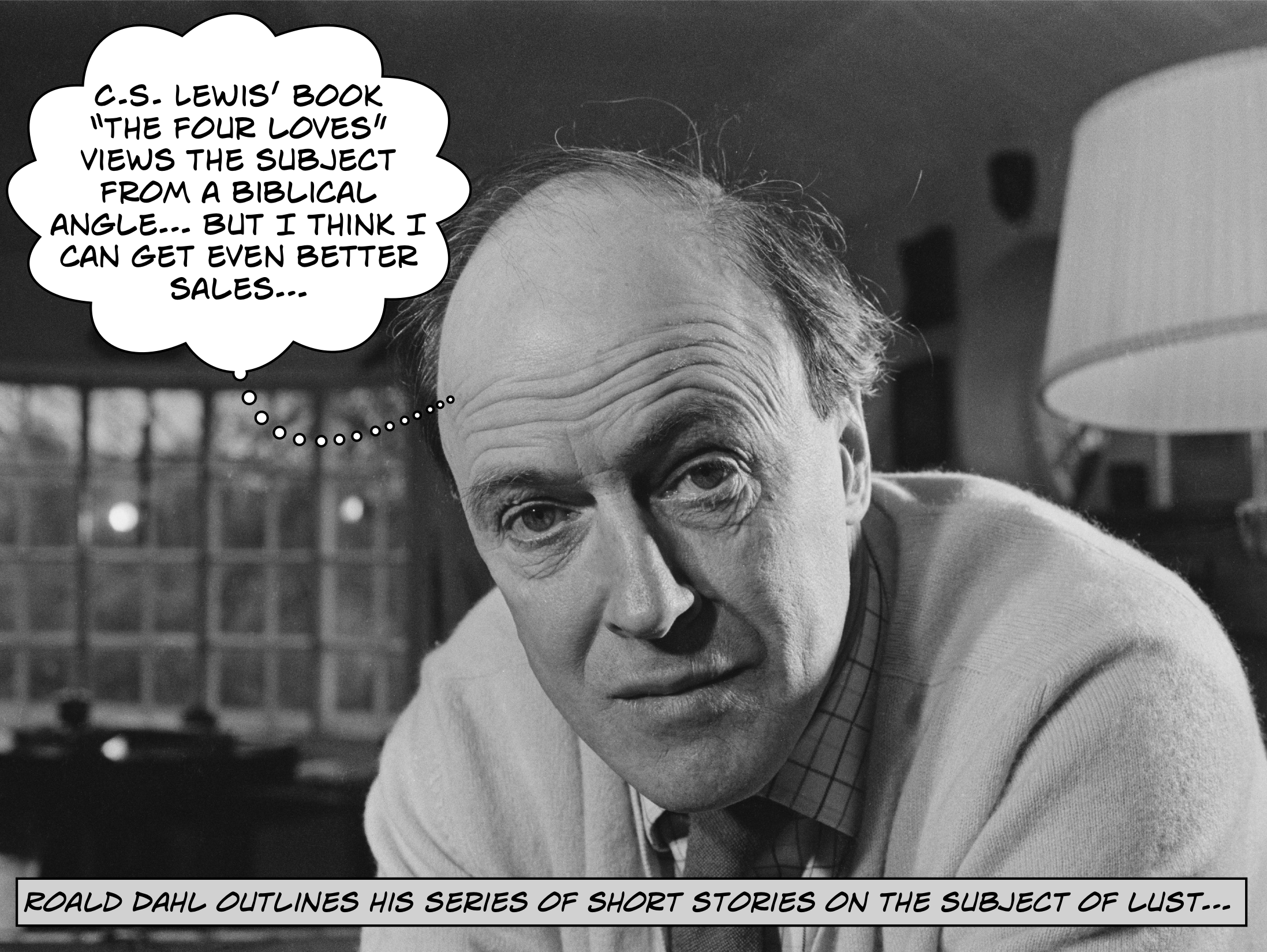
Do C.S. Lewis (1898-1963) and Roald Dahl (1916-1990) have anything in common, besides authoring books enjoyed by children?

Looking back, I must have been deprived of opportunities to read common children’s books. I recall my mom having many of Dr. Seuss’ classics, but don’t remember more advanced works such as those of Beatrix Potter or E.B. White.

I suppose that is why Roald Dahl’s name means little to me. By the time I was aware of his popular works, I was too old to appreciate them. Added to that was my intense dislike for the cinematic presentation of his Chocolate Factory, which has permanently (and probably unfairly) soured my impression of the poor man.

In Matilda, published in 1988, Dahl offers a rather curious homage to the Inklings. The young protagonist offers to her teacher the following observations.

“I like The Lion, the Witch and the Wardrobe,” Matilda said. “I think Mr. C.S. Lewis is a very good writer. But he has one failing. There are no funny bits in his books.”

“You are right there,” Miss Honey said.

“There aren’t many funny bits in Mr. Tolkien either,” Matilda said.

If you are intrigued by this brief interchange, you would probably enjoy reading “Disagreeing with Matilda on Lewis and Tolkien.”

Curiously, a number of people have offered their evaluations of Lewis and Dahl, vis-à-vis one another. Author Grudge Match: Roald Dahl vs. C.S. Lewis invited diverse contributions to the debate eight years ago on LibraryThing.

A Christian blogger offers a faith-based appraisal on an entertaining website called “Like but better.” It’s entitled “How C.S Lewis is like Roald Dahl, but better (and Aslan is like Willy Wonka, but better).”

C.S Lewis is serious about what Dahl jokes about; even as both want us to pursue a childlike wonder and joy. For Lewis these enchanted stories and our sense of wonder are small stories reflecting on the big story — the ‘myth that became history’ — the death and resurrection of Jesus.

A BBC Culture article is quite critical of Dahl, despite his popularity. The introduction to “The Dark Side of Roald Dahl” aptly describes the essay.

Roald Dahl was an unpleasant man who wrote macabre books – and yet children around the world adore them. Perhaps this shouldn’t surprise us, writes Hephzibah Anderson.

An article by a Jewish journalist refers to both of the authors discussed here. It describes his bitter introduction to the major flaws of an author whose work he enjoyed as a child. “Why I Hope My Kids Never Read Roald Dahl” is, for me, most valuable for the way in which the journalist regards the faith which underlies the tales of Narnia.

As a nerdy Jewish kid in Indiana and Tennessee in the late 1970s and 1980s, I had far better relationships with books than I did with other kids. If I liked a book, I read it again, and again and again.

And so it was with Roald Dahls “Charlie and the Chocolate Factory.” Dahl’s protagonists Charlie and later James (of the “Giant Peach”) both provided early models for how to find a better way through a hostile world where I always felt like an outsider.

Given that personal history, the announcement that Netflix has acquired Dahl’s entire catalog and plans a robust lineup of multimedia adaptations ought to feel like good news. . . .

Seeing his work still celebrated fills me with sadness, leaving me caught between attachment to something that mattered to me as a boy and commitment to the principles that, I hope, make me the man I am today.

Because I know that Roald Dahl hated Jewish people like me.

There are cases where it’s complicated to ascribe modern values to figures from the past and as a reader, my feelings, my emotions, are just not going to be consistent. I don’t share C.S. Lewis’ religious views . . . J.R.R. Tolkien’s “Lord of the Rings” trilogy is, I’m sad to say, bound up in long histories of racism.But my childhood copies of their books still occupy my shelves, some missing covers and pages, and I bought new copies for my kids and tried – with mixed success – to share my love of those stories with them. It’s hardly new for readers of one generation to struggle with the views of authors from another.But Dahl is different. He passed away in 1990, only 31 years ago. And we know he was an anti-Semite because he said so.

While I would challenge Perry’s modest critiques of the Inklings, I am delighted he is able to look beyond his adult disappointment with their imperfections to commend them to his own children. As for Dahl . . . this article reinforces my lack of regret in being unfamiliar with his work.

Enough, now, of their differences. I promised readers a surprising similarity between the two British authors.

And What Is Their Unusual Commonality?

In 1951, C.S. Lewis was approached by Prime Minister Churchill’s office to accept an honor occasionally bestowed upon renowned literary figures. He was invited to become a Commander of the Most Excellent Order of the British Empire. Lewis declined, because he felt the political implications might overshadow the nonpartisan spirit of his writings. He was, however, honored to have been offered the honour.

This decision brings us to the peculiar similarity between the two writers. It turns out that Roald Dahl also passed up the invitation to join this chivalric order.

And the two were not alone. In 2012 a list of deceased individuals who had declined related honors between 1951 and 1999 was published.

Literary names were prominent amongst those to have said no to CBEs, OBEs and knighthoods in the annual New Year or Birthday Honours list, with Dahl, Lewis, and Huxley . . . joined by fellow naysayers Eleanor Farjeon, the children’s author, the poets Philip Larkin and Robert Graves, who said no to both a CBE and a CH (Order of the Companions honour), literary critic F.R. Leavis, Booker [Prize] winner Stanley Middleton and the authors J.B. Priestley and Evelyn Waugh.

An aspiring literary historian might do well to research whether and why successful writers might be more inclined to dismiss such an honor than other British citizens. I wonder if that inclination would carry over to other nationalities or cultures.

Ultimately, I assume most writers care less about receiving honors, than having their work read. And, perchance, having their literary efforts improve the lives of one or two others along the way. [This statement inspired vigorous debate when I shared this draft with members of my critique group.]

That desire – to enrich lives – is what motivates me. I believe it is also what inspired C.S. Lewis. And I know we are not alone.

Free Books Offered Monthly

Would you like to receive free books for the simple exchange of a short, honest review of them? If so, join me at LibraryThing. Best of all, they offer additional benefits for readers (and writers).

You may already have a free account there, since they offer a book cataloging system connecting you to fellow readers, which appeals to many book lovers.

They also offer TinyCat, which is a sophisticated cataloging system designed for small libraries. And it is free for personal use! I don’t have the time to input my own library, despite all of their tools for making that easy, but it could well work for you. [Warning: if your library includes more than 20,000 items, it may be a tad too large.]

Requesting a book for review is simple. Each month they list a bunch of new, mostly self-published titles that are available. You express your interest and they distribute the quantity that are available. You can see current offerings here: LibraryThing Early Reviewers.

The truth is that I rarely request a title. The vast majority are fiction, while my tastes strongly lean toward nonfiction. Even there, available time restricts my interests to a handful of topics. Still, I wrote a review about a book I received entitled  A Curmudgeon’s Guide to Postmodern Times: Aphorisms. (I am a sucker for thought-provoking maxims, especially if they are witty.) More on my review in a moment.

In the past I’ve written book reviews for military and theological journals. Most publications offer specific guidelines as to what they desire in a review. If you opt to ignore these, you are wasting everyone’s time. Most online sites are more tolerant.

Writing Book Reviews

Writing effective reviews is an art in itself. To do it well requires some conscious effort. To simply describe something as “good” or “boring” is basically not worth the effort. You need to think about what you, as a potential reader, are interested in knowing about a title before you invest your time and money in procuring it.

It appears there are hundreds of online sites describing the process. This one from Grammarly is a quick, clear read. One piece of their advice relates directly to my latest review.

Remember that you’re reviewing a book that another human poured their heart and soul into to write. Express your honest opinion, but don’t be nasty about it.

That sentiment is similar to one I just read in an old magazine I was perusing.

Concerning satire, I’ve always followed the rule laid down by an old college professor: “I only pick on those I love.” If I have trouble loving someone, it’s better if I refrain from jokes, satire, and teasing.

C.S. Lewis & the Art of Reviewing Books

If one were to tally all the reviews that have been written about the works of C.S. Lewis, their number might rival the grains of sand spread around the world’s beaches.*

It is unsurprising that Lewis, being a professor of English literature, wrote a significant number of book reviews himself. Some of the most notable are gathered in Image and Imagination. While the volume includes a number of valuable essays, it is the collection of his published book reviews which are of interest to us today.

You see, in Image and Imagination we encounter ten of his reviews written about books authored by his fellow Inklings. These include Owen Barfield, J.R.R. Tolkien and Charles Williams. The volume is edited by Walter Hooper, who ably introduces each of the reviews, and provides unique insight. For example, he notes C.S. Lewis’ ongoing debate with Owen Barfield about anthroposophy.

Barfield’s conversion to Anthroposophy . . . marked the beginning of . . . the ‘Great War’ between [the two friends]. . . . While the ‘Great War’ had ended years before, the problem Lewis faced in reviewing Romanticism Comes of Age is that it contains in the Introduction and other places Barfield’s ‘case’ for Anthroposophy (“Who Gaf Me Drink?”).

Lewis’ review of the culmination of the Lord of the Rings is worth the full price of the collection. Doesn’t the following ring true?

The other excellence is that no individual, and no species, seems to exist only for the sake of the plot. All exist in their own right and would have been worth creating for their mere flavour even if they had been irrelevant.

Treebeard would have served any other author (if any other could have conceived him) for a whole book. His eyes are ‘filled up with ages of memory and long, slow, steady thinking.’

Through those ages his name has grown with him, so that he cannot now tell it; it would, by now, take too long to pronounce. When he learns that the thing they are standing on is a hill, he complains that this is but ‘a hasty word’ for that which has so much history in it (“The Dethronement of Power”).

On My Review of the Curmudgeon’s Concerns

My recent review (to which I referred above) was not easy to write. What made it difficult was my mixed opinion of the aphorisms chosen for the publication. Most were quite interesting, and a few were downright brilliant. The problem was the strong bias of the author when he addressed two “controversial” topics – politics and religion.

Unlike Mark Twain, to whom I refer in the review, this author forsakes humor when he deplores subjects with which he disagrees. Twain made it clear how he stood, but usually in a manner that left even his opponents entertained. This particular book is much more “curmudgeonly,” in that some of it is delivered in an ill-tempered, alienating manner.

If you are curious in seeing how I threaded the needle of honestly reviewing a book with problematic material, you can read it here. While praising many aspects of the book, I did make one critical observation related to an aphorism related to The Chronicles of Narnia.

Greene even invokes my favorite author to mischaracterize Christianity. “C.S. Lewis depicted God as a lion. The lion, of course, is a predator.” So much for agnus dei and Aslan’s manifestation as a lamb.

A Final Encouragement

If you are a writer, or an aspiring writer, consider writing some book reviews. It can provide a more welcoming entrée into the publishing world than other features. Write it in a style similar to the reviews they normally run, and be sure to read any guidelines they provide for contributions. As with other submissions, it’s best to query first. Best of luck!


* The World Atlas estimate of 2.5 to 10 sextillions may suggest this estimate of Lewisian reviews may be hyperbole. But at least I did not refer to the number of stars, which is estimated at 10 to 200 sextillion.

Intentional Mispronunciations

Don’t you find it slightly irritating when people intentionally mispronounce words? Sometimes it isn’t merely a silly affectation. What bothers me are cases where people consciously reject the accurate version and flaunt their personal (inaccurate) alternative. It comes across to me like they are magnifying their ignorance with a sizeable dose of obnoxious stubbornness.

Anyone, of course, can accidentally mispronounce a word. Well, anyone aside from C.S. Lewis and J.R.R. Tolkien, that is.

I don’t enjoy (but don’t object to) simple silliness. In a 1932 American Speech article entitled “Intentional Mispronunciations,” the author says, “the custom is an old one, and in our age of light-hearted youth it is unusually widespread.” She immediately notes one danger.

The use of mispronunciations sometimes becomes habit, and it is often difficult to speak correctly when one is in sophisticated company.

The humble person, when advised on the proper enunciation of a particular word, thanks their friend (only friends should dare to sensitively point out such a slip). After expressing that appreciation, they go forward with the commitment to being a bastion of proper usage of the word in question.

However, there are those obstinate ignoramuses (OIs) who defiantly insist on perpetuating their sins.  

Let us consider a common error. One that is quite easily corrected, unless the OI insists on actively rejecting knowledge. The word is “nuclear,” and you already know what the all too common mistake is. How can anyone, much less a graduate of Yale, entrusted with the Gold Codes, accompanied at all times by a military aide ready to hand them the “nuclear football,” continue to use the non-word nu-cu-lar? I have no idea how common this atrocity is outside the United States, but here in the States, it is far from rare.

A good friend of mine, who does public speaking, insists on pronouncing “recognize” without its “g.” I understand he must have learned it that way, but I will never get used to a person with advanced degrees saying “rec-a-nize.” My father was a curmudgeon, and this conscious affront reinforced his chosen image. He loved to push my buttons by adding an “r” to the state I call home. Warshington doesn’t exist on any map, but it certainly did in his mind.

Why Pronunciations Err

People are prone to mispronunciation when they’ve only read a word, and never heard it pronounced before. This was especially perilous before the existence of online dictionaries.

There is another hazard which can mislead someone in pronouncing a word incorrectly—and it was to this that I succumbed my first year at seminary. This is the case where a word is spelled in a manner that makes the errant pronunciation possible, and you have only heard it pronounced in the wrong way. This is the story of my shame.

I was taking a consortium course on ministry and media, which was taught by professors from four or five different seminaries. In my first “radio” presentation, I cited a passage from one of the Psalms. Everyone said it was well done—until the Roman Catholic professor (with nary a hint of affirmation) declared, ex cathedra: “it’s ‘sahm;’ you don’t pronounce the ‘l.’”

I was so embarrassed that I remained silent and soon as I got home I pulled out my dictionary, and darned if he wasn’t right. I have pronounced it correctly ever since, even in the face of a world that now considers me to be wrong.

My aversion to the intentional-mispronunciators does not extend to people who say “salm.” After all, that’s how the word should be pronounced.* But those people who insist on saying “re-la-ter” when the profession is clearly spelled “re-al-tor,” are begging for some sort of aversion therapy.

There is one additional case I wish to note here. That is when there are two (or more?) legitimate ways to pronounce a word. I’m not referring to homographs, like wind (wĭnd) and wind (wīnd).

C.S. Lewis also discusses pronunciation at great length in his essay “The Alliterative Metre,” where he notes,

In modern English many words, chiefly monosyllables, which end in a single consonant are pronounced differently according to their position in the sentence. If they come at the end of a sentence or other speech-group—that is, if there is a pause after them—the final consonant is so dwelled upon that the syllable becomes long.

If the reader listens carefully he will find that the syllable man is short in ‘Manifold and great mercies’ or ‘The man of property,’ but long in ‘The Invisible Man’ or ‘The Descent of Man.’

Words with multiple formally accepted pronunciations are fair game—as long as a person’s choice is from the list. Here’s one where pronouncing the “l” is optional: almond. Apricot can begin with either the sound “app” or “ape.”

A Playful Game Using Homographs

The following example uses a name, but the principle would be the same for any word with more than one authentic pronunciation. It comes from a book I read many years ago, which has retained a fond place in my memory. Robert McAfee Brown (1920-2001) was a Presbyterian theologian. The title of the volume suggests its satirical bent: The Collect’d Writings of St. Hereticus.

One of the appendices in the book is called “Theological Gamesmanship.” One of the games he features is “How to Win a Theological Discussion Without Knowing Anything.” The following gambit is called “Help from St. Augustine.”

A quiet yet forceful way of demonstrating superiority when Augustine is under discussion is to pronounce his name in contrary fashion to the pronunciation of the Opponent.⁑ Make a point of emphasizing the contrast, so that it will be apparent that you know you are right, and not even for politeness’ sake will you pronounce the name incorrectly as Opponent is doing. Either,

Opponent: . . . leading ideas in Augustine (Ogg-us-teen).
Self: Augustine (uh-Gust’n)may have said that on one or two occasions, but . . .
Or,
Opponent (usually an Anglican in this case): . . . leading ideas in Augustine.
Self: Augustine may have said that on one or two occasions, but the whole Augustinian tradition, following, as I believe, the essential Augustine himself . . .

In this second gambit, it is advisable to maneuver the conversation into a discussion of “the Augustinian tradition” as indicated, so that when Opponent refers to it, as he must, without pronouncing it “the Augustinian tradition,” you can smile deprecatingly, to indicate that your point has been made.

[Brown adds a footnote that reads:] With sensitive Anglicans, it will often be enough simply to raise, ever so slightly, (a) both eyebrows, and (b) the second, third, and fourth fingers of the left hand.

Naturally, I’m not seriously suggesting that one-upmanship is something in which one should engage. On the contrary, Brown (and I) are holding up this sort of petty behavior as beneath the dignity of good people.

I’m sure that some would argue that correcting someone’s pronunciation in even the most glaring examples of verbal atrocities, constitutes bad manners. I, however, appreciate being privately corrected, so that I might not continue making the same mistake. Thus, I consider it the act of a friend.

C.S. Lewis was a patient and gracious man. He was quite tolerant of variation in pronunciation, even when it came to his own creations. In 1952 he responded to a correspondent inquiring how to properly pronounce the name of Aslan. I would guess the most common American version would be “æzˌlæn” opting to pronounce the “s” as a “z.” Here is Lewis’ response:

It is a pleasure to answer your question. I found the name in the notes to Lane’s Arabian Nights: it is the Turkish for Lion. I pronounce it Ass-lan [æsˌlæn] myself. And of course I meant the Lion of Judah. I am so glad you liked the book.

I loved the book, and I affirm its readers, whichever way they pronounce the name of the Great Lion. Well, as long as they don’t intentionally mispronounce it, including an invisible “r.” After all, there is most certainly no beloved image of Christ named Arslan!


* This waiver does not extend, however, to what may be the most common biblical mistake. The Book of Revelation does not have an “s.” Yet, how often do you hear it cited as Revelations?

⁑ This brazen technique is equally effective, no matter which pronunciation the person you seek to upstage has used.

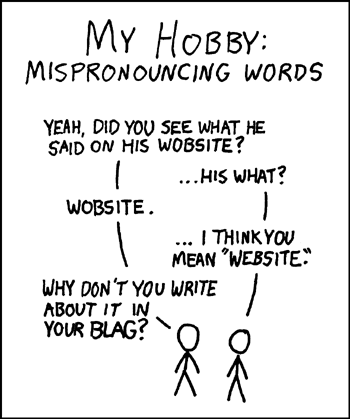
The cartoon at the top of this post is used with the permission of xkcd.

The Good, Bad & Ugly of Dendroglyphs

Have you ever carved your initials, or some other pictograph (perhaps a heart?) in the bark of a tree? I never thought much about such things until I learned about the key role played by their bark in a tree’s health. Now I tend to consider this arboreal graffiti* as unfortunate.

I haven’t found any reference in C.S. Lewis to such carvings. However, I suspect that due to his love of nature and hiking, he would discourage the wounding of trees in this way. And there is another reason I believe the Inklings would be wary of this practice. More on that in a moment.

Tree carvings can actually record history for preliterate peoples. I even learned a new word, the meaning of which is easy to decipher from its parts—dendroglyphs. Not all tree scars are considered dendroglyphs. Just those, as Brittanica says, “the dendroglyph [is] an engraving on a living tree trunk. Carved in the usual geometric style, dendroglyphs featured clan designs or made references to local myths. They were used to mark the graves of notable men or to indicate the perimeters of ceremonial grounds.”⁑

One unique people group living “at the edge of the world” faced the fate of most pacifists who are not protected by a benign power. The Moriori lost their island home to the Māori people to whom they were related. Some of their stories survive, partly due to their dendroglyphs.

An academic article on the subject of dendroglyphs is available here.

Dendroglyphs are distinct from scarred trees, the former being decorative marks cut into the bark or heartwood of living trees, while the latter result from resource use, such as bark removal for making implements, obtaining native honey or hunting. A further distinction can be made between two types of dendroglyphs: Indigenous dendroglyphs and dendrograffiti.

Indigenous dendroglyphs are a form of visual expression that reflects affiliation with the land and special cultural association with the landscape and its resources. Dendrograffiti are carvings made by land users, such as shepherds and pastoralists, and often display names, dates, symbols and images that mark boundaries, communications and light entertainment.”

The image above comes from an ancient Australian tree. You can read more about it here, but this is the myth it portrays:

The tale behind the tree has been passed on for generations. It’s the story of two Western Yalanji men who have gone over into Eastern Yalanji country and tried to get a woman. . . . The family of the girl they were trying to take pursued the men.

The Western Yalanji men were chased and speared. One of the men that got speared . . . became a lizard, crawled up the tree and became that carving.

History aside, cutting bark should be avoided in general. And, should you visit a national forest in the United States, be forewarned—“carving into trees is illegal in all national forests!” As the National Park Service pleads: “please respect the law, the trees, and your fellow public land users by not carving words, initials, or anything into tree bark!”

Other Places Where Dendroglyphs are Dangerous

The United States isn’t the only place where a person desiring to mark a tree with a blade should be cautious. This activity is generally inadvisable in both Narnia and Middle Earth.

At Narnia’s very creation, Aslan bestowed sentience on some of the trees of that blessed land. “After Aslan gave certain animals the gift to speech, he declared to the Narnian creatures; “Be walking trees. Be talking beasts. Be divine waters.”

And their creator loved their company. Later we read: “Aslan stood in the center of a crowd of creatures who had grouped themselves round him in the shape of a half-moon. There were Tree-Women there and Well-Women (Dryads and Naiads as they used to be called in our world) who had stringed instruments . . .”

Yet, as gentle as these dryads were, the Witch was able to deceive some of their number. As Tumnus warns the children, “the woods are full of her spies, even some of the trees are on her side.” Still, most continued to follow Aslan, and some of these dryads were among the stone statues restored to life by their lord.

In one of The Last Battle’s saddest scenes, King Tirian is addressed by a tree nymph who warns that Aslan’s imposter is cutting down the forest.

King Tirian and the two Beasts knew at once that she was the nymph of a beech tree. “Justice, Lord King!” she cried. “Come to our aid. Protect your people. They are felling us in Lantern Waste. Forty great trunks of my brothers and sisters are already on the ground.”

“What, Lady! Felling Lantern Waste? Murdering the talking trees?” cried the King, leaping to his feet and drawing his sword. “How dare they? And who dares it? Now by the Mane of Aslan—”

“A-a-a-h,” gasped the Dryad, shuddering as if in pain—shuddering time after time as if under repeated blows. Then all at once she fell sideways as suddenly as if both her feet had been cut from under her. For a second they saw her lying dead on the grass and then she vanished. They knew what had happened. Her tree, miles away, had been cut down.

Narnia is not the only land where trees are damaged at one’s risk. J.R.R. Tolkien populated Middle Earth with amazing creatures. Among these were the Ents.

Ents are not actual trees. They are ancient “shepherds of the trees,” who care for the forests. (The Entwives preferred to care for smaller plants, such as gardens.)

When the hobbits awake Treebeard, he mistakes them for little orcs and is prepared to crush them. Orcs, after all, are destructive by nature and always deserving of a good stomping. When they explain their quest and inform the ancient Ent of Saruman’s burning of their forests near Isengard, he calls on his brethren who respond to the threat.

Treebeard is pleased and says, “Indeed I have not seen them roused like this for many an age. We Ents do not like being roused; and we never are roused unless it is clear to us that our trees and our lives are in great danger.”

I can almost hear Treebeard calling out now, “the Ents are going to war.”

We’ll close now with the marching song of the Ents, and let these words provide a sharp warning to those among us who might contemplate violating trees in the future.

Though Isengard be strong and hard, as cold as stone and bare as bone,
We go, we go, we go to war, to hew the stone and break the door;
For bole and bough are burning now, the furnace roars—we go to war!
To land of gloom with tramp of doom,
with roll of drum, we come, we come;
To Isengard with doom we come!


* I came up with the term “arboreal graffiti” myself, but was pleased to find that other creative minds have also used it online. This post on the subject offers an interesting twist, and is well worth the quick read.

⁑ This quotation is taken from their article on Australian aboriginal art.

C.S. Lewis the Irishman

irish aslan

Contrary to the common assumption that C.S. Lewis was English, he was actually an Irishman. He was born in Belfast, and those who know him attested to how his Irish-ness lasted the whole of his life.

Lewis was proud of his roots, and celebrated them. When he first journeyed to England, he experienced a culture shock. “No Englishman will be able to understand my first impressions of England,” he wrote in Surprised by Joy.

Lewis always loved Ireland. He vacationed there regularly, and chose the island for his honeymoon, late in life. One of his Irish students, David Bleakley, related that the transplant professor declared, “Heaven is Oxford lifted and placed in the middle of County Down.” (C.S. Lewis at home in Ireland)

Several years ago, David Clare of the University of Limerick wrote “C.S. Lewis: An Irish Writer.” It appeared in Irish Studies Review, and the abstract is illuminating.

This article examines the effect of C.S. Lewis’s Irish background on his work. It attempts to contradict the assumption that this Belfast-born writer should be included in the English and not the Irish canon. It emphasises that Lewis saw himself as Irish, was seen by others as Irish, and that his Irish background, contrary to what some have written, was important to him throughout his lifetime.

It goes on to demonstrate the ways in which his work was influenced by his youth in Ireland and by the Irish mythology that he loved. Furthermore, this article maintains that, as a child of pre-partition Ireland with roots throughout the island, Lewis was influenced by the country as a whole, not just his native Ulster. Finally, it attempts to understand why Lewis, a proud Irishman, did not do more to promote himself as an Irish writer.

Clare’s argument is necessary because of Irish political correctness. In Surprised by C.S. Lewis, Alister McGrath describes the prejudice.

So why is Lewis not celebrated as one of the greatest Irish writers of all time? Why is there no entry for “Lewis, C.S.” in the 1,472 pages of the supposedly definitive Dictionary of Irish Literature (1996)? The real issue is that Lewis does not fit—and, indeed, must be said partly to have chosen not to fit—the template of Irish identity that has dominated the late twentieth century.

In some ways, Lewis represents precisely the forces and influences which the advocates of a stereotypical Irish literary identity wished to reject. One of the reasons why Ireland has largely chosen to forget about Lewis is that he was the wrong kind of Irishman. . . .

Lewis may have chosen to rise above the provinciality of Irish literature; he nevertheless remains one of its most luminous and famous representatives.

It should be noted, of course, that countless Irish men and women are proud of Lewis, and count him as one of their own.

There’s No Other Place Quite Like Ireland

On a less serious note, and at the risk of contributing to a stereotype, I want to share with you an incident that occurred in Dublin.

First some context. Some people suggest that people in Ireland have a particular affinity for alcohol. This may be a bit of an exaggeration, since they are only ranked twenty-first in the world (for alcohol consumption).

The 1875 tragedy goes by several names, but one is the “Dublin Whiskey Fire.” A malt house and a whiskey warehouse caught fire, and as thousands of gallons of their contents poured down the street in a fiery channel, the blaze spread to many homes and businesses.

Miraculously, the fire did not take any lives. That does not mean, however, that there were not a number of fatalities. A dozen people died from alcohol poisoning. Tempted by unrestricted access to the alcohol, many Dubliners cupped their hands or used their boots to gather up the liquid and drink themselves into oblivion.

You can read an account of the bizarre occurrence in The Irish Times.

I wonder what Lewis thought about this revolting event, since he was surely aware of it. The deranged consumption of filthy and burning alcohol would be condemned by any sane person.

Among teetotalers, however, even a sip of alcohol is objectionable. Many attribute their aversion to their faith. While the Christian Scriptures strongly condemn drunkenness, some verses tacitly affirm the drinking of wine in moderation.*

C.S. Lewis and Drink

C.S. Lewis was among the majority of Christians who accept drinking while avoiding drunkenness. I have written on this subject at length.

In Mere Christianity, Lewis says,

Temperance is, unfortunately, one of those words that has changed its meaning. It now usually means teetotalism. But in the days when the second Cardinal virtue was christened ‘Temperance,’ it meant nothing of the sort. Temperance referred not specially to drink, but to all pleasures; and it meant not abstaining, but going the right length and no further.

It is a mistake to think that Christians ought all to be teetotallers . . . Of course it may be the duty of a particular Christian, or of any Christian, at a particular time, to abstain from strong drink, either because he is the sort of man who cannot drink at all without drinking too much, or because he is with people who are inclined to drunkenness and must not encourage them by drinking himself.

But the whole point is that he is abstaining, for a good reason, from something which he does not condemn and which he likes to see other people enjoying. One of the marks of a certain type of bad man is that he cannot give up a thing himself without wanting every one else to give it up. That is not the Christian way.

An individual Christian may see fit to give up all sorts of things for special reasons—marriage, or meat, or beer, or the cinema; but the moment he starts saying the things are bad in themselves, or looking down his nose at other people who do use them, he has taken the wrong turning.

This is wise counsel. Recapturing the original meaning of temperance—and living as temperate people—results in happier lives and a more peaceful world.


* For those who God expressly commands not to drink, should avoid it completely. For example, an angel told Zechariah that John the Baptist, “must not drink wine or strong drink, and he will be filled with the Holy Spirit, even from his mother’s womb.” (Luke 1:15). John’s cousin Jesus, on the other hand, miraculously created wine for a wedding party, and offered the Passover wine to his disciples with the words “this cup that is poured out for you is the new covenant in my blood.” (Luke 22:20)