Thesaurus Club

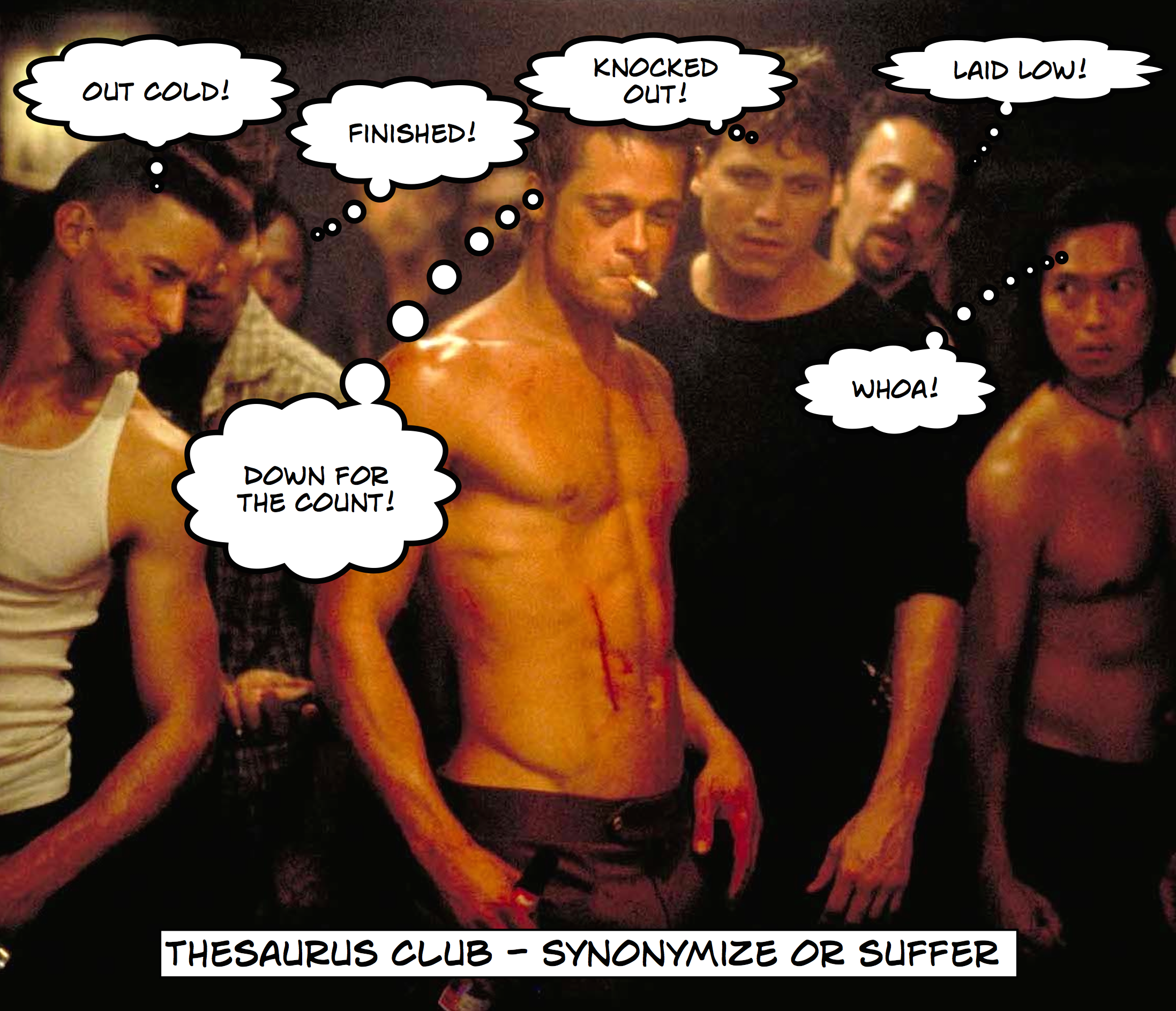
thesaurus club“The first rule is: If this is your first night at Thesaurus Club, you have to synonymize!”

“The second rule of Thesaurus Club is: You don’t talk about, mention, comment on, allude to, speak of, discuss, converse about, whisper of, gossip about, or chat or chinwag about Thesaurus Club!”

Only a true logophile (word lover) could enjoy the scene described above . . . but if you’re as captivated as I am by wordplay, you may appreciate the creativity. Of course, understanding the reference to the film Fight Club reveals more clearly its wit.

Words are fun to play with.

Although we tend to think of cartoonists as artists, the fact is they are usually just as skillful in their artistry with words. (The successful ones, at least.)

Not long ago I saw a single panel cartoon showing a seated man in a suit addressing a secretary, steno pad in hand. Nothing funny about the picture, of course, but the caption said, “One more thing: Remember to introduce me as a lawyer, not a liar.” Nice.

Even funnier if you think about synonyms. (No offense intended to Mere Inkling’s readers who are attorneys.)

Words are powerful. But they are also finite. C.S. Lewis noted their limits in an essay entitled “Prudery and Philology.”

We are sometimes told that everything in the world can come into literature. This is perhaps true in some sense. But it is a dangerous truth unless we balance it with the statement that nothing can go into literature except words, or (if you prefer) that nothing can go in except by becoming words. And words, like every other medium, have their own proper powers and limitations.

Lewis was quite sensitive to the abuse of language. It doesn’t require a graduate degree to know what he would think of today’s word processing programs with their built in thesauri.

No doubt these fingertip resources have contributed immensely to the modern proclivity of many writers to write artificial prose. I’m confident Lewis would have mourned their creation.

That’s precisely why joining the Thesaurus Club would be so daunting. There you stand, stripped of your ever-present literary crutches, proving just what you’re made of. Will you find victory (triumph, success) or will you taste defeat (downfall, failure)?

_____

I wish I could take credit for the concept at the top of this page, but I stumbled upon the notion elsewhere and modified it for Mere Inkling. (I did make the graphic, though.)

Married, or Not?

unificationShould a wedding ceremony during which the bride forgets the groom’s name be considered valid? That question may sound slightly preposterous, but I just witnessed it happening.

One of the network news programs just did a story on the latest “Holy Marriage Blessing Service” conducted by the Unification Church. This is the religion founded by Sun Myung Moon, whose disciples believe to be the second coming of Jesus. (Moon died in 2012, but his wife continues to lead the religion, and officiate at these regular ceremonies.)

Many of the couples who marry in these ceremonies are matched by their parents or, if they are determined to be especially blessed, they are “randomly” matched by the church leader (presently the widow of their messiah). Reportedly, each match takes about thirty seconds as the prophets place the hands of men and women together in divinely appointed relationships.

Officially, a person can decline their match after they’ve had a little time to talk with their future spouse, but it’s evident that contradicting the action of one’s savior would require immense courage.

That said, I have no doubt that—due to the earnest commitment and efforts of both parties—many of these marriages end up happy. After all, as C.S. Lewis wrote in Mere Christianity:

Knowledge can last, principles can last, habits can last; but feelings come and go… But, of course, ceasing to be “in love” need not mean ceasing to love. Love in this second sense — love as distinct from “being in love”—is not merely a feeling. It is a deep unity, maintained by the will and deliberately strengthened by habit; reinforced by (in Christian marriage) the grace which both partners ask, and receive, from God. . . . “Being in love” first moved them to promise fidelity: this quieter love enables them to keep the promise. It is on this love that the engine of marriage is run: being in love was the explosion that started it.

In the case of Unification Church members, even if the relationship lacked an emotional stage of “being in love,” it doesn’t mean that it is destined to fail. Far from it, since, as Lewis wisely points out, true love isn’t about feelings.

In the aforementioned case, the bride was from a French-speaking African nation. The husband, I believe, was from Japan. Her English was quite good, but his was poor. They were essentially unable to communicate. Then, when the interviewers revisited them immediately before the ceremony was to begin, they asked the beautifully-gowned bride what her husband’s name was. And she had forgotten.

Another peculiar thing about Unification marriage practices is that, following the wedding, there is a 40+ “separation period,” during which they are required to refrain from intimate relations. While Christians are called to practice premarital chastity, I’m unfamiliar with any other group that requires a post-wedding purification.

One last comment about the Unification marriage blessings. As if they could not be more bizarre. In 1997 the Moons presided over a ceremony in Washington, D.C. While only 2,000 of the 30,000 couples were actually being married, among the other 28,000 couples having their marriage “blessed” by the Unification messiah included a prominent American political figure—none other than Al Sharpton.

At least he and his wife, Katherine, probably knew each other’s names.

_____

The picture above comes from one of the group weddings. This young bride has to be content with the photograph of her absent groom. One wonders if the two have yet to meet.

Undue Honor

orphan flightHow should we respond when someone else receives all of the praise and accolades for something we actually accomplished? I confess my natural, human reaction is to resent them for it. The example of one outstanding Korean War chaplain, however, clearly reveals how it is much more noble to simply reject resentment and move forward in life.

This column continues a story introduced in my last post, so if you missed it, you may find it helpful to pause and read that piece before continuing. It’s available here.

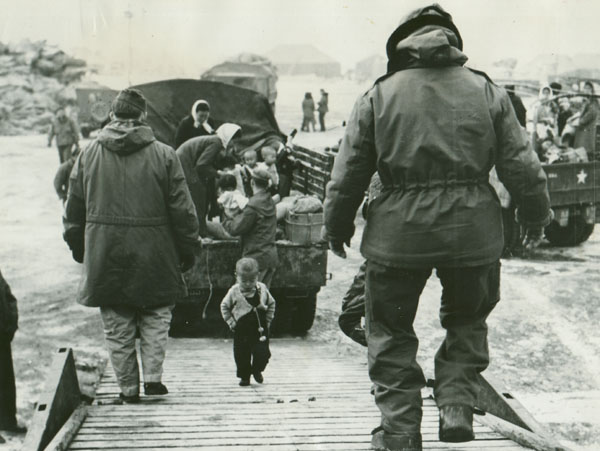
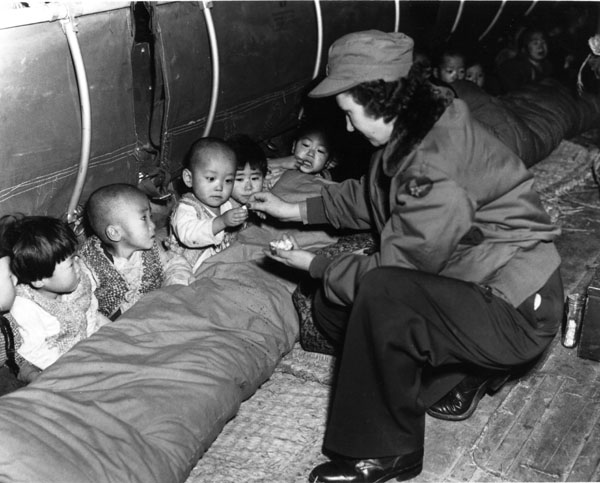
In discussing the plight of the orphans during the Korean War, I mentioned the name of Chaplain Russell Blaisdell. He and his ministry partner, Staff Sergeant Mike Strang, saved nearly a thousand orphans during a single heroic action in December of 1950.

The full story of the Kiddy Car Airlift can be found on the website of the Korean War Children’s Memorial.

Here are the highlights. For months Chaplain Blaisdell and Sergeant Strang had been rescuing homeless children from the streets of Seoul. Due to the rapid advance of Communist forces, the fall of the capital city became imminent.

The military was rapidly attempting to redeploy its assets, to minimize the resources which were destined to fall into the hands of the enemy. Transporting noncombatants to safety fell far down the long list of urgent missions. The children were nonessential. To everyone, that is, except these two men.

The details of their heroic effort are the stuff of movies. And a movie that included this great escape was indeed made. The only problem is that it did not reflect the true story, and neither of the true heroes received their due.

The story of this injustice is related online here. Briefly, another Air Force officer, a pilot who assisted Blaisdell with finding quarters for the refugees behind friendly lines, received the credit due to the ministry team. So, exactly how did this travesty come about?

Colonel Dean Hess wrote a book, entitled Battle Hymn. It sold well, and included many significant actions in which the author had presumably been directly involved. However, the most significant event, in which he was involved only indirectly, was a focal point of book and its subsequent film (starring Rock Hudson, no less).

Only in very recent years, and unfortunately after Strang had died, has the story been set straight. Blaisdell has received overdue recognition from the Air Force and the Republic of Korea. Strang’s recognition has necessarily been posthumous.

Dr. George Drake wrote an article on this unfortunate tale, and although he entitles it “Hess: Fraudulent Hero,” he does offer a less critical rationale for how misperceptions may have been carried so far.

Once the movie was released it seemed impossible for Hess to say “This is not a true portrayal of what happened.” Hess had become a captive of his own earlier mis-statement of the facts of the rescue. Recently Hess has privately, but not publicly, stated that he was upset with the way the movie distorted the story of the rescue but the truth of the matter is that his concern for that distortion of the facts did not prevent him from accepting the honors due someone else.

Drake reproduces correspondence between Strang and Blaisdell related to the matter. In 1957, Strang wrote his friend about having dinner with Hess in California, in the hopes that he might get a role in the film. “I went out there and he met me one night for dinner and asked me a few questions about what happened on Kiddy Car Operation and I never heard from him after that, as a matter of fact I called him any number of times and he never even had the courtesy to return my call or even leave a message for me.”

Blaisdell’s response brings us back to the question with which I began this column. Based on how the two of them had been overlooked, and especially in light of Strang’s disappointment at failing to get a break in a hoped for civilian career, what should the two of them do? Blaisdell took the high ground and wrote to his comrade in arms:

In regard to doing anything about it, I have decided in the negative. Although I agree with you in principle, the goal of our efforts, in regard to the orphans and also in the evacuation of the Koreans by convoy, was the saving of lives, which would otherwise have been lost. That was accomplished.

In a sense, Mike, well-doing has its own reward, which is not measured in dollars, prestige, or good will . . . This does not mean that I would not be willing to state the facts as they existed to anyone who might properly request them to substantiate your story.

Strang joined his chaplain on the high moral ground, and did not create a scandal. I hope that, had I been in their combat boots, I would have joined them there.

There is something quite alluring about fame. Not everyone is vulnerable to it—we all have our own weak links in our personal armor—but many are. Writers, I suspect are particularly susceptible to the wounds pride and renown can inflict. After all, who among us who writes does not desire a large audience? (Or at least a small but clearly “devoted” one.)

Even C.S. Lewis was not impervious to the assault of fame. In a letter to his friend Don Giovanni Calabria, Lewis describes how personal concerns prevented him from doing much writing at the time. With great personal insight and wisdom, he adds that this may not be such a bad thing.

As for my own work, I would not wish to deceive you with vain hope. I am now in my fiftieth year. I feel my zeal for writing, and whatever talent I originally possessed, to be decreasing; nor (I believe) do I please my readers as I used to. I labour under many difficulties. . . .

These things I write not as complaints but lest you should believe I am writing books. If it shall please God that I write more books, blessed be He. If it shall please Him not, again, blessed be He. Perhaps it will be the most wholesome thing for my soul that I lose both fame and skill lest I were to fall into that evil disease, vainglory.

Like Lewis, we are well served when we ponder the effects of fleeting fame and worldly success on our lives and souls. And, like Strang and Blaisdell, we should carefully weigh our own motivations whenever we desire to seize the recognition we believe we deserve.

orphan airliftAfter all, in the end what is untrue will be dispelled like the morning mists . . . and when that bright Light shines upon us all, only what is true and selfless will glow with the reflection of God’s own glory.

Rescuing Orphans

orphansWar is a terrible thing. It should be avoided at (nearly) all costs. As C.S. Lewis wrote during Hitler’s atrocities, “If war is ever lawful, then peace is sometimes sinful” (“The Conditions for a Just War”).

I was writing this weekend about one of the sad consequences of war—the creation of orphans. As an adopted child of God, I possess deep compassion for children without parents in this world. Over a decade ago I was privileged to represent the United States Air Force at the dedication of the Korean War Children’s Memorial.

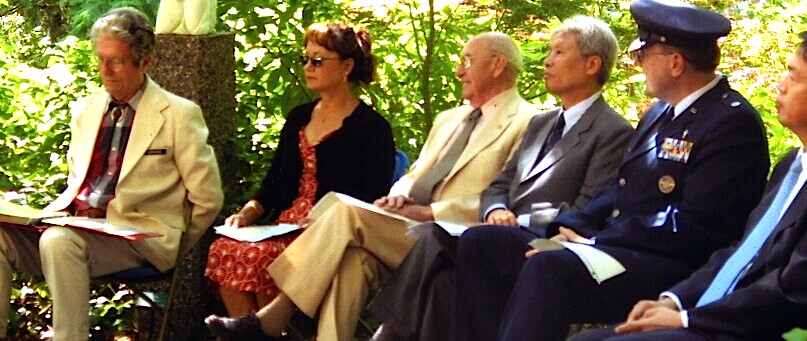
When I contacted the coordinator of that event, Dr. George Drake, he provided me with the photograph above, which shows the speakers that day. Drake appears to the left, and yours truly is in uniform, to the right. The primary speaker was Chaplain Russell Blaisdell, center, who saved the lives of at least a thousand Korean orphans during the war, delivering them from almost certain death as Seoul fell to the Communists. (My next post will reflect on his heroism and humility.)

The war in Korea was horrific. The frontlines swept across the peninsula, leaving desolation and tragedy in their wake. The number of orphans created by the violence was legion. In the cruel ebb and flow of the conflict, many perished. Still, even in the crimson terror there were expressions of mercy and grace.

Chaplains often led the way in reaching out to the children, but their efforts would have accomplished little if the compassion of the common Soldier, Marine, Sailor and Airman had not moved them as well to make sacrifices to care for the children.

Chaplains who serve in Korea today have maintained the strong bonds of support for orphanages that was so vital to the wartime chaplains represented by Blaisdell.

During my year in Taegu (Daegu), I coordinated the ministry of the airmen at Taegu Air Base in partnership with Love and Hope Orphanage. Love and Hope has a unique role, caring for the least of the least . . . children with serious physical and/or mental handicaps. There is little room for them in most societies, and Korea is no exception.

Orphans are made not by war alone, of course, but by a variety of tragic confluences of suffering. Some lose parents to accident or disease. Today, we find the greatest number of orphaned children in various parts of Africa where AIDS has devastated local adult populations. Similarly, following natural disasters such as major earthquakes and tsunamis, many orphans are left alone in the rubble or receding waters.

Some children flee abusive homes, or are rescued from dangerous environments; in one sense these were orphans even before their legal bonds with cruel predators were severed.

Many causes account for the existence of orphans. And, as long as we live in this fallen world, orphans will be among us. This is why we must never forget that, “Religion that is pure and undefiled before God, the Father, is this: to visit orphans and widows in their affliction, and to keep oneself unstained from the world” (James 1:27, ESV).

C.S. Lewis was well acquainted with the sorrow of wartime violence and the shattering of families. A veteran of World War I, he saw many friends perish just as they were embarking on adulthood. After World War II, one of his many correspondents was Don Giovanni Calabria, who operated an orphanage in devastated Italy

In 1951, Lewis sent his friend a newly translated copy of the first book in his Chronicles of Narnia. He invited the priest (who would be canonized by the Roman Catholic Church less than fifty years later) to pass the book on to one of the orphans in his care.

I am sending you my tale recently translated into Italian in which, frankly, I have rather played than worked. I have given my imagination free rein yet not, I hope, without regard for edification—for building up both my neighbour and myself. I do not know whether you will like this kind of trifle. But if you do not, perhaps some boy or girl will like it from among your “good children.”

While I imagine the volume remained close to the future “saint,” I trust that Lewis’ powerful tale delighted many of the young children in his care.

As Chaplain Blaisdell says about caring for innocent children, the act itself provides more than sufficient reward. Formal recognition is not required, and may in fact detract from the intrinsic satisfaction that accompanies the giving of oneself in service. Ninety-nine percent of those who sacrifice for the widow and orphan remain essentially anonymous to all but God, and this is just fine. (You can read more about the Kiddy Car Airlift and who received credit for it here.)

Words of Death

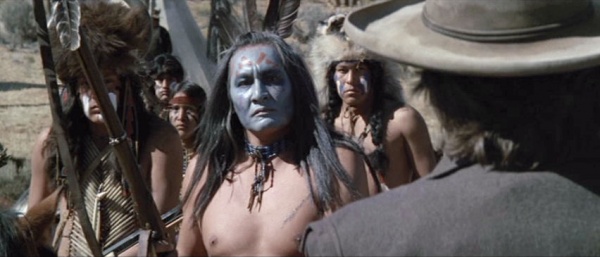
joseyOne of the cinema’s most powerful scenes occurs in a film many might disregard due to its genre. In “The Outlaw Josey Wales,” a man trying to rebuild his war-shattered life, rides out to face a Comanche chieftain.

Josey: You be Ten Bears?

Ten Bears: I am Ten Bears.

Josey: I’m Josey Wales.

Ten Bears: I have heard. You’re the Gray Rider. You would not make peace with the Blue Coats. You may go in peace.

Josey: I reckon not. Got nowhere to go.

Ten Bears: Then you will die.

Josey: I came here to die with you. Or, live with you. Dying ain’t so hard for men like you and me, it’s living that’s hard; when all you ever cared about has been butchered or raped. Governments don’t live together, people live together. With governments you don’t always get a fair word or a fair fight. Well I’ve come here to give you either one, or get either one from you. I came here like this so you’ll know my word of death is true. And that my word of life is then true. The bear lives here, the wolf, the antelope, the Comanche. And so will we. Now, we’ll only hunt what we need to live on, same as the Comanche does. And every spring when the grass turns green and the Comanche moves north, he can rest here in peace, butcher some of our cattle and jerk beef for the journey. The sign of the Comanche, that will be on our lodge. That’s my word of life.

Ten Bears: And your word of death?

Josey: It’s here in my pistols, there in your rifles . . . I’m here for either one.

Ten Bears: These things you say we will have, we already have.

Josey: That’s true. I ain’t promising you nothing extra. I’m just giving you life and you’re giving me life. And I’m saying that men can live together without butchering one another.

Ten Bears: It’s sad that governments are chiefed by the double-tongues. There is iron in your word of death for all Comanche to see. And so there is iron in your word of life. No signed paper can hold the iron, it must come from men. The word of Ten Bears carries the same iron of life and death. It is good that warriors such as we meet in the struggle of life . . . or death. It shall be life.

This conversation has always caused me to stop and think—even as I typed it out now. It contains many profound thoughts about honesty, commitment, respect and even peace. Most captivating to my thoughts, though, is the contrast between words of death and words of life.

“There is iron in your word of death . . . And so, there is iron in your word of life.”

People say all sorts of things, often without much regard as to whether or not they are true. They often speak without thinking about the words before they leave their lips. Most daily conversation is superficial, and immediately forgotten.

That changes, when we speak of death. Sure, comedians joke about it, but when people discuss actual death—often in the wake of someone’s passing—our words become more measured, our tempo slows, and we more consciously ponder what we are saying.

I recall a conversation with a fellow chaplain who described his father’s dying. He contracted a terminal disease, which would take some time to extinguish his life, and he told his children: “As you have grown up, I’ve done my best to teach you how to live. Now I will do my best to teach you how to die.”

It doesn’t require faith in God to die with dignity, but those of us who know the resurrected Jesus, face death with a confidence that death does not have the final word.

The truly wise live all of their days in the knowledge that we all will someday (barring the parousia) experience physical death. In light of that, our words should not be careless, or even frivolous. That’s true for our life words, as well as our death words.

By this I do not mean that we should not play with language or engage in humor. After all, humor is inarguably one of God’s most precious gifts to us. Nor should we allow the cloud of death that hangs over all mortal flesh rob us of the many joys life brings.

C.S. Lewis would have understood the essence of the conversation quoted above. (The movie was made thirteen years after his own death.) When grieving the death of his wife, Lewis wrote:

You never know how much you really believe anything until its truth or falsehood becomes a matter of life and death to you. It is easy to say you believe a rope to be strong and sound as long as you are merely using it to cord a box. But suppose you had to hang by that rope over a precipice. Wouldn’t you then first discover how much you really trusted it? . . . Only a real risk tests the reality of a belief. (A Grief Observed).

What I am trying to capture is more than simply the notion that our words of life, our day to day conversations, should be just as sincere and thoughtful as our words of death. It’s more in line with what Lewis was referring to. That our words, thoughts, and hopes have been tested and proven true . . . because they are based not on the fancy of the moment, but on the final, concluding whole of the testimony of our lives.

In other words, it is precisely because one’s word of death (ultimate, naked honesty) is true, that you can trust their word of life.

That’s a message that echoes both the sound of a hammer driving nails on a Judean hill, and a heavy stone rolling away from the entrance to a sealed tomb, two days later.

Common People

narnia shieldNone of us like to be considered “common.” No surprise; it’s not a complimentary adjective. We prefer to think of ourselves as exceptional . . . and, if not extraordinary, at least special.

In our democracies, with the possible exception of monarchies where the terminology may still exist, we’re no longer referred to a “commoners.” In fact, in the United States we can even design our own coats of arms!

If you want to add a “title” to your legal name, you can follow the example of some Americans who actually name their sons “Sir.” (Believe it or not, in 2012 it was the 998th most popular male name in California. Then there’s also “Prince Michael ‘Blanket’ Jackson II,” but let’s not go there.)

Owning a noble name is no prerequisite to possessing value. A well known quotation from C.S. Lewis dispels the misassumption that any human being is common or lacking in value. Every person is precious. Every person. And, no matter how tiny you ever feel on your most dejected day, you are special . . . precious . . . and (literally) unique!

There are no ordinary people. You have never met a mere mortal. Nations, cultures, arts, civilisations—these are mortal, and their life is to ours as the life of a gnat. But it is immortals whom we joke with, work with, marry, snub, and exploit—immortal horrors or everlasting splendours.
(The Weight of Glory).

As I was considering this subject I came across a less familiar, but equally true, comment from Lewis. He was writing during an age when class distinctions in Europe were still implicit. He turned the matter on its head in a wartime essay entitled “Private Bates.” Here Lewis says that the very things the “elite” esteem reveal just how slavishly they follow appearances.

We must get rid of our arrogant assumption that it is the masses who can be led by the nose. As far as I can make out, the shoe is on the other foot. The only people who are really the dupes of their favourite newspapers are the intelligentsia. It is they who read leading articles: the poor read the sporting news, which is mostly true.

There’s much truth, I think, to Lewis’ observation. Or, perhaps that is merely my blue-collar upbringing speaking.

Let’s close our thoughts on “common folk” with a rarely read piece of poetry from Lewis’ Spirits in Bondage. (This was a pre-conversion collection, and is the only work of C.S. Lewis that is currently in the public domain.)

Thank God that there are solid folk . . .

Who feel the things that all men feel

And think in well-worn grooves of thought

Whose honest spirits never reel

Before man’s mystery, overwrought.

Yet not unfaithful nor unkind

With work-day virtues surely staid

Theirs is the sane and humble mind

And dull affections undismayed.

O happy people! I have seen

No verse yet written in your praise

And, truth to tell, the time has been

I would have scorned your easy ways.

But now thro’ weariness and strife

I learn your worthiness indeed

The world is better for such life

As stout, suburban people lead.

“In Praise of Solid People”

Spirits in Bondage

Discordant Dictionaries

dictionary 1Most “word people” like dictionaries. Some writers go so far as to love dictionaries, but I don’t wish to quibble about where one rests on the affection spectrum in terms of these repositories of words.

This guy, though, has to be pegged on the extreme (idolatry) end of the meter. Ammon Shea wrote Reading the OED: One Man, One Year, 21,730 Pages after having done just that. The Oxford English Dictionary, you may know, comprises 25 volumes, and Shea warns that reading it at such a rapid pace took a toll on his eyesight. It’s not surprising, that he admits he is not your typical reader.

One could say that I collect word books, since by last count I have about a thousand volumes of dictionaries, thesauri, and assorted glossaries. . . . I do not collect these words because I want to impress friends and colleagues with my erudition. . . .

My friends know that I read dictionaries for fun, and have come to accept this proclivity with relative good grace, but they are not terribly interested in or impressed by my word collection.

Pierre Jules Théophile Gautier advised his fellow poets to read the dictionary. No better way to enrich one’s language, he claimed, although he also read cook books, almanacs and the like. In fact, his biographer offered this fascinating observation.

He found pleasure in the most indifferent novels, as he did in books of the highest philosophical conceptions, and in works of pure science. He was devoured with the desire to learn, and said: “No conception is so poor, no twaddle so detestable that it cannot teach us something by which we may profit.”

C.S. Lewis indicated that so-called “definitions” offered outside the ordinances of the dictionary must be approached warily. “When we leave the dictionaries we must view all definitions with grave distrust” (Studies in Words). He offers a very sensible reason for such precautions.

It is the greatest simplicity in the world to suppose that when, say, Dryden defines wit or Arnold defines poetry, we can use their definition as evidence of what the word really meant when they wrote. The fact that they define it at all is itself a ground for scepticism.

Unless we are writing a dictionary, or a text-book of some technical subject, we define our words only because we are in some measure departing from their real current sense. Otherwise there would be no purpose in doing so (Studies in Words).

Dictionaries are, of course, their own genre. Lectionaries, collections of words and meanings, are different than any other type of written composition. For example, glossaries may draw together specialized vocabulary—say for medical or theological purposes—but by their very nature they are not intended to blaze any new literary pathways.

There is, invariably, an exception to this rule. Some “dictionaries” are creative exercises. They are works of fiction, and some are entertaining indeed.

The most famous of these satirical works is Ambrose Bierce’s Devil’s Dictionary (originally published as The Cynic’s Word Book). The volume is not expressly irreverent, although people of faith will encounter some offensive examples in its pages. However, a number of the entries are brilliant.

Kilt

  1. A costume sometimes worn by Scotchmen in America and Americans in Scotland.

Rank

  1. Relative elevation in the scale of human worth.

He held at court a rank so high

That other noblemen asked why.

“Because,” ’twas answered, “others lack

His skill to scratch the royal back.”

Emancipation

  1. A bondman’s change from the tyranny of another to the despotism of himself.

He was a slave: at word he went and came;

     His iron collar cut him to the bone.

Then Liberty erased his owner’s name,

     Tightened the rivets and inscribed his own.

Goose

  1. A bird that supplies quills for writing. These, by some occult process of nature, are penetrated and suffused with various degrees of the bird’s intellectual energies and emotional character, so that when inked and drawn mechanically across paper by a person called an “author,” there results a very fair and accurate transcript of the fowl’s thought and feeling. The difference in geese, as discovered by this ingenious method, is considerable: many are found to have only trivial and insignificant powers, but some are seen to be very great geese indeed.

Another Frenchman, Gustave Flaubert, composed his Dictionary of Received Ideas, which found humor in peculiarities of common understandings.

Absinthe

Extra-violent poison: one glass and you’re dead. Newspapermen drink it as they write their copy. Has killed more soldiers than the Bedouin.

Archimedes

On hearing his name, shout “Eureka!” Or else: “Give me a fulcrum and I will move the world.” There is also Archimedes’ screw, but you are not expected to know what it is.

Omega

Second letter of the Greek alphabet. [Note: this would only apply to biblically literate societies.]

The earliest such example of a satirical dictionary was that by the Persian writer Nezam od-Din Ubeydollah Zâkâni. I have not located a copy of his 14th century lexicon, but it apparently includes entries that are still understandable in our modern world.

Thought

What uselessly makes people ill.

Orator

A donkey.

Word lovers can easily get caught up in conversations like this. In fact, I’m certain more than one Mere Inkling reader has contemplated compiling their own creative dictionary! It’s not an insurmountable project, since it’s accomplished one word at a time.

_____

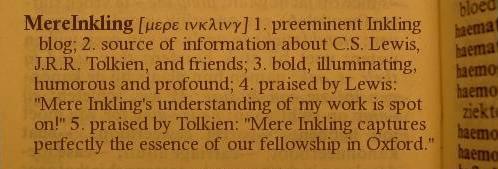
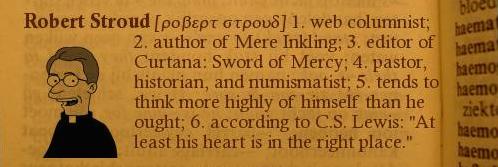
For those desiring to create their own dictionary “entries” such as the one that graces the top of this blog, there a free meme generator you can use online. Available here, it’s a fun little tool. It’s also suitable for creating a little self-deprecating humor.

dictionary 2

Beware of Moths

mothI try not to hate moths. They’re obviously not so pretty as butterflies, but I remind myself that’s not their fault. They’re a nuisance around the porch lights on summer evenings, but that’s instinct, not choice.

I strive to see the best in moths, like C.S. Lewis, who was able to capitalize on their impulsiveness in his 1933 poem, “The Naked Seed.”

Oh, thou that art unwearying, that dost neither sleep

      Nor slumber, who didst take

All care for Lazarus in the careless tomb, oh keep

      Watch for me till I wake.

If thou think for me what I cannot think, if thou

      Desire for me what I

Cannot desire, my soul’s interior Form, though now

      Deep-buried, will not die,

—No more than the insensible dropp’d seed which grows

      Through winter ripe for birth

Because, while it forgets, the heaven remembering throws

      Sweet influence still on earth,

—Because the heaven, moved moth-like by thy beauty, goes

      Still turning round the earth.

I really want to give moths the benefit of the doubt . . . but that’s become virtually impossible since I learned some of them are vampiric!

Before we consider their blood-sucking rituals, I want to share a traumatic moth encounter my wife and I experienced several years ago when we lived in Eastern Washington.

We had a huge fragrant collection of plants that ran across nearly the whole of the front of our house. There was a bush at the far end, and some delightful quail nested there. The flowers brought us other welcome guests. Hummingbirds would crowd around them as sun was setting, and savor their nectars.

We loved watching them hover near the blooms, and wondered precisely what species of hummingbirds they were, since they were slightly smaller than the ones we were accustomed to.

One day I was getting a close up view of their activity and I saw something that shattered my sense of reality. Instead of a beak, these hummingbirds had tongues that curled and uncurled, not unlike those “party horns” that children blow at celebrations.

My wife said I had to be imagining what I’d seen. I assured her that I hadn’t seen anything like this in the scifi shows I regularly watched, and I was pretty sure that these abominations weren’t hummingbirds.

Eventually I persuaded her to look for herself, and she too was aghast at the question of what they might be. Some of you already know, because you’ve had the misfortune of growing up where these creepy things thrive. For the rest of you—the fortunate ones who’ve been spared the curse of hemaris sphinx moths—let me assure you, their maladapted proboscises are grotesque.

I thought they were the worst thing the world of the moths had to offer. (Well, aside from the 1961 Japanese film “Mothra.”)

That’s what I thought, until recently, when I learned that some misbegotten moths had followed mosquitoes in their descent into parasitical evil by drinking the blood of other creatures.

The calyptra moths are another proof of the fall. No longer do they flutter around from plant to plant, seeking sustenance as a proper herbivore. The aptly named “vampire moth” has chosen to adapt its proboscis to pierce the skin of other animals such as buffaloes . . . and human beings.

In the equal opportunity world of the corruption of the natural order, while female mosquitoes drink blood, it is male moths that do so. Apparently, they’ve already infested Malaysia, the Urals and Southern Europe. Now they are adjusting to the climate of Scandinavia. The question arises, where can be we safe from these monsters?

Returning to C.S. Lewis, he records an incident that occurred in Narnia involving mistaken identity.

It is a very funny thing that the sleepier you are, the longer you take about getting to bed; especially if you are lucky enough to have a fire in your room. Jill felt she couldn’t even start undressing unless she sat down in front of the fire for a bit first. And once she had sat down, she didn’t want to get up again. She had already said to herself about five times, “I must go to bed,” when she was startled by a tap on the window.

She got up, pulled the curtain, and at first saw nothing but darkness. Then she jumped and started backward, for something very large had dashed itself against the window, giving a sharp tap on the glass as it did so. A very unpleasant idea came into her head—“Suppose they have giant moths in this country! Ugh!”

But then the thing came back, and this time she was almost sure she saw a beak, and that the beak had made the tapping noise. “It’s some huge bird,” thought Jill. “Could it be an eagle?” She didn’t very much want a visit even from an eagle, but she opened the window and looked out. Instantly, with a great whirring noise, the creature alighted on the window-sill and stood there filling up the whole window, so that Jill had to step back to make room for it. It was the Owl. (The Silver Chair).

Fortunately for Jill, and the rest of the children who visited Narnia, there is no record of them ever encountering giant moths . . . vampire moths . . . or moths deceptively impersonating hummingbirds.

_____

Note: The monster moth pictured above is not (to my knowledge) a blood or flesh eater. But I still wouldn’t want one that size landing on my shoulder.

Who Should We Trust?

staffordshire cross“You can trust me, I’m a pastor.” When I was ordained thirty-three years ago, that might have been sufficient to persuade many people to give me the benefit of the doubt. Not so today.

The latest Gallup poll records the continuing decline of our trust in “clergy.” Relentless negative press (much of it recording genuinely criminal and repellent behaviors) has taken its toll. Today only 47% of Americans trust ministers (of all faiths).

The good news, if you can consider it that, is that clergy still rank as the seventh most trusted group (out of twenty-two vocations considered).

But it remains quite pitiful. And quite understandable. Even being a pastor, there are many people considered clergy who I would not trust. First of all, anyone who purchased their “ordination” over the internet, and has the audacity to pretend to be a minister. I see a credibility gap there. (I would not include those who buy one of the fake diplomas as a “joke” to be untrustworthy . . . only those who pass themselves off as a “real minister.”)

I could go on, but my purpose here is not to trash clergy, since more than enough people already devote themselves to that purpose.

I am curious just who, in our increasingly uncertain and selfish world, we should trust.

I personally am in a rather envious position. I don’t have to rely on hoping people will trust me because I’m a pastor. I am also a sworn officer of the law. Albeit, I merely serve as a volunteer chaplain with my local county Sheriff’s Office, but we honestly do swear an oath to uphold the law, and we proudly wear regular uniforms, complete with our own chaplain badges (stars).

The thing about being in law enforcement is that I can benefit from the fact that it is the sixth most respected institution. So that carries me across the halfway mark all the way to the 54% trustworthiness milestone. I guess that’s fair, since I too place a higher trust in the integrity and professionalism of the average deputy or officer than I do in the average minister.

But, as I already said, I’m in a rather unique position, in that I also qualify for an even more respected category, that of a military officer. The 69% level of trust for military officers ties that of doctors and is only 1% below grade school teachers and pharmacists. So, I guess that if I want to instill confidence in my integrity, I’d best tell people that I’m a (retired) Air Force officer, and not that I am a member of the First Estate.

Trust is important. It’s a key commodity in any relationship, and absolutely essential for intimate relationships such as those shared within a family. Trust takes a great deal of time to build, and it can be shattered in just a moment. Its fragility is the primary reason why it must be treasured and guarded.

Trusted are those who never give others a cause to doubt them. My wife and I made a promise to our children that we would never lie to them. Never. We explained there would be times when we could not tell them something, or where we could only reveal a portion of the facts about a matter . . . but we promised them that whatever we did tell them would be the absolute truth insofar as we were aware.

Because of our honesty with them, our children (all adults now, of course), have been amazingly honest with us the whole of their lives. They trust us. We trust them. And none of us take that amazing gift for granted.

In Surprised by Joy, C.S. Lewis describes his introduction to J.R.R. Tolkien. Although the two would become lifelong friends, there were obstacles that needed to be overcome. One, described by Lewis, was that Tolkien belonged to not one, but two, categories of people who Lewis had been taught to regard as suspect. He was an atheist at the time, but it wasn’t simply Tolkien’s deep faith in Christ that gave him pause.

When I began teaching for the English Faculty, I made two other friends, both Christians (these queer people seemed now to pop up on every side) who were later to give me much help in getting over the last stile. They were H.V.V. Dyson (then of Reading) and J.R.R. Tolkien.

Friendship with the latter marked the breakdown of two old prejudices. At my first coming into the world I had been (implicitly) warned never to trust a Papist, and at my first coming into the English Faculty (explicitly) never to trust a philologist. Tolkien was both.

I’m not sure where philologists ranked on Gallup’s recent poll, but I am quite sure they did not include questions about different denominations or faith groups. Before ending these thoughts I suppose I should share with you the most trusted group in the survey—nurses. Eighty-two percent of Americans trust nurses. And I too would agree with that.

The matter of who we can safely trust is of great importance. In fact, it could be argued that it is the most important question in our lives.

Ultimately, even when we assure one another we will only speak the truth . . . even then we disappoint one another. Being human, we are finite, imperfect. We cannot always be there, even for those we love. Sometimes we fail to live up to our own standards and our promises dispel like a vapor in the wind.

Johnny Cash recorded a powerful song before he died. He had lived a rough and tumble life, and had found peace in a relationship with Christ. That peace, however, did not cure all of the ills or heal all of the scars he had experienced, and his profound familiarity with this world inspired the gritty lyrics of “Hurt.”

I wear this crown of thorns

Upon my liar’s chair

Full of broken thoughts

I cannot repair

Beneath the stains of time

The feelings disappear

You are someone else

I am still right here

What have I become

My sweetest friend

Everyone I know goes away

In the end

And you could have it all

My empire of dirt

I will let you down

I will make you hurt

In a moment, I’ll share a link to his performance of this moving song. But first, the answer to the question with which we began.

Who, exactly, should we trust? Johnny Cash learned the answer to that question, and so did C.S. Lewis. I trust the same Person that they did—someone who will never disappoint. Someone who cannot lie, since he himself is the Truth. As Paul wrote in 2 Timothy 2:

Remember Jesus Christ, risen from the dead, the offspring of David . . . I endure everything for the sake of the elect, that they also may obtain the salvation that is in Christ Jesus with eternal glory. The saying is trustworthy, for:

If we have died with him, we will also live with him;

if we endure, we will also reign with him . . .

if we are faithless, he remains faithful—

for he cannot deny himself.

_____

If you wish to watch the video of Johnny Cash’s musical epitaph, you can see it here.

The pectoral cross show above is part of the Staffordshire Hoard, which is the largest collection of Anglo-Saxon metalwork ever found. It dates from the 7th or 8th century.

Libraries & Imagination

librarycardI just got a new library card. It’s emblazoned with the word “Imagination.” While that would be boring news to most, to people who value reading, it’s noteworthy. Some might wonder, why did he wait until he was nearly sixty to get a library card. That’s because there is more to the story.

I happen to live “across the water” from one of the most literacy-loving communities in the United States—Seattle. (“Across the water” means that the quickest way to get to Seattle is by taking one of our scenic, but outrageously expensive, ferries, across Puget Sound.)

Our relatively small county has superb libraries of our own, but they can’t hope to match the holdings of Seattle’s grandiose institutions. Personally, I am not enticed by the sheer volume of volumes available there. I desire access to their abundant research resources, most notably access to historic newspapers.

The great news is that Kitsap County, where I am blessed to reside, maintains reciprocal library privileges with Seattle! When I made a trip to the metropolis to enroll, not only did they expeditiously process my information, the library pulled open a drawer with a dozen colorful options and said, “which card would you like?” (Now, I see how sheltered a life I live; I didn’t know some libraries actually offered members a choice of what image they want to embellish their cards.)

I selected the one bearing the iconic image of the Space Needle. (I actually visited the Space Needle during the World’s Fair . . . but that’s a story for another day.)

Only after I selected it because of the picture, did I realize each card carried the imprint of a single word. “Imagination,” the librarian said, “a good choice.” A very good choice, I thought to myself. Since I place an extremely high value on that ephemeral trait.

Libraries, I’m afraid, are undervalued today. It’s good to see them continuing to provide a valuable service to our communities. Reading is vital to civilization, growth and culture.

C.S. Lewis enjoyed the family library in the home of his youth, and in one of his boarding schools experienced the library not only as a vestibule of knowledge, but also as a place of refuge. The upper classmen of the school subjected the younger boys to relentless hazing, but the library was off limits to their abusive behaviors.*

The other undisguised blessing of the Coll [Wyvern College] was “the Gurney,” the school library; not only because it was a library, but because it was sanctuary. As the Negro used to become free on touching English soil, so the meanest boy was “un-faggable” once he was inside the Gurney.

It was not, of course, easy to get there. In the winter terms if you were not on the list for “Clubs” you had to go out for a run. In summer you could reach sanctuary of an afternoon only under favorable conditions. You might be put down for Clubs, and that excluded you. Or there might be either a House match or a Coll match which you were compelled to watch. Thirdly, and most probably, on your way to the Gurney you might be caught and fagged for the whole afternoon.

But sometimes one succeeded in running the gauntlet of all these dangers; and then— the books, silence, leisure, the distant sound of bat and ball (“Oh the brave music of a distant drum”), bees buzzing at the open windows, and freedom. In the Gurney I found Corpus Poeticum Bo reale and tried, vainly but happily, to hammer out the originals from the translation at the bottom of the page. There too I found Milton, and Yeats, and a book on Celtic mythology, which soon became, if not a rival, yet a humble companion, to Norse. (Surprised by Joy).

While this passage described the library as a glorious sanctuary, it also reveals a tragic snapshot of the bullying that is endemic to many schools. Since I don’t wish to end these thoughts on a negative image, allow me to offer another revelation from Lewis. In a brief essay, he praises imagination, while acknowledging its limitations.

It must not be supposed that I am in any sense putting forward the imagination as the organ of truth. We are not talking of truth, but of meaning: meaning which is the antecedent condition both of truth and falsehood, whose antithesis is not error but nonsense.

I am a rationalist. For me, reason is the natural organ of truth; but imagination is the organ of meaning. Imagination, producing new metaphors or revivifying old, is not the cause of truth, but its condition. It is, I confess, undeniable that such a view indirectly implies a kind of truth or rightness in the imagination itself. (“Bluspels and Flalansferes: A Semantic Nightmare”).

“Producing new metaphors or revivifying old . . .” What an apt description of the wonders of imagination. And this insight is only one of the countless gems of wisdom I have gratefully received from C.S. Lewis.

_____

* In the language of the school the “Bloods” were the sadistic elites. The youngest and most vulnerable were labeled “fags,” and their mistreatment (forced menial drudgery) was called “fagging.”

Those interested in seeing all five of the Seattle Library options for their new cards, you can do so here.