Free C.S. Lewis Course

hillsdaleA free college course about C.S. Lewis? Too good to be true? No, it’s for real . . . and it’s offered by a well respected American College that traces its roots back more than 170 years. (Note, for the Europeans reading this, that makes it quite mature here in North America.)

Hillsdale college is currently offering its online course, “An Introduction to C.S. Lewis: Writing and Significance” at no charge. Here is the link to the enrollment page.

In addition to being a first class college today, Hillsdale has a very distinguished past. Founded in 1844, its leadership in the anti-slavery cause allowed it to host two speeches by Frederick Douglass. The first was delivered during the Civil War itself.*

C.S. Lewis offered a fascinating twist on the injustice of slavery. In an essay entitled “Equality,” written 80 years after Douglass decried slavery at Hillsdale, Lewis advocated democracy as an imperfect philosophy. I agree with his inference that despite its shortcomings, it is the least-flawed form of government.

I am a democrat because I believe in the Fall of Man. I think most people are democrats for the opposite reason. A great deal of democratic enthusiasm descends from the ideas of people like Rousseau, who believed in democracy because they thought mankind so wise and good that everyone deserved a share in the government. The danger of defending democracy on those grounds is that they’re not true. . . . I find that they’re not true without looking further than myself. I don’t deserve a share in governing a hen-roost, much less a nation. Nor do most people—all the people who believe advertisements, and think in catchwords and spread rumours.

The real reason for democracy is . . . Mankind is so fallen that no man can be trusted with unchecked power over his fellows. Aristotle said that some people were only fit to be slaves. I do not contradict him. But I reject slavery because I see no men fit to be masters.

This is the barest example of C.S. Lewis’ keen mind. Enrolling in the course will certainly introduce participants to much, much more.

Like most online resources, this class is offered for personal growth. While a certificate is offered to those who complete the course, it doesn’t result in formal college “credit.” That said, the course could also be of great benefit to a motivated high school student.

Formal studies, even those like this one for which we set a personal pace, are worthwhile. Not only do we profit from the wisdom of the team of professors. Most of us also benefit from the discipline a course offers. Left to our own devices, most of us would not end up with the well-rounded familiarity with Lewis’ work that this class promises.

Shared Wisdom from Douglass and Lewis

One contemporary author noted a parallel thought in the writings of these two men. Thomas Sowell is a distinguished thinker and a talented writer. (Traits he shares with these two gifted authors.) On his website** Sowell has an extremely selective collection of quotations, on which he pairs the following. The first was written by Frederick Douglass and the second by C.S. Lewis.

Everybody has asked the question. . . “What shall we do with the Negro?” I have had but one answer from the beginning. Do nothing with us! Your doing with us has already played the mischief with us. Do nothing with us! If the apples will not remain on the tree of their own strength, if they are wormeaten at the core, if they are early ripe and disposed to fall, let them fall! I am not for tying or fastening them on the tree in any way, except by nature’s plan, and if they will not stay there, let them fall. And if the Negro cannot stand on his own legs, let him fall also. All I ask is, give him a chance to stand on his own legs! Let him alone! (Frederick Douglass, “What the Black Man Wants”).

Of all tyrannies, a tyranny sincerely exercised for the good of its victims may be the most oppressive. It would be better to live under robber barons than under omnipotent moral busybodies. The robber baron’s cruelty may sometimes sleep, his cupidity may at some point be satiated; but those who torment us for our own good will torment us without end for they do so with the approval of their own conscience. (C.S. Lewis, “The Humanitarian Theory of Punishment”).

I think Sowell’s connection of these two excerpts is quite perceptive. Although he is an economist by PhD, I regard him as a brilliant sociologist as well.

Education is a worthwhile pursuit. It is one embraced by Douglass, Lewis and Sowell. Hillsdale’s invitation to enroll in this course allows all of us to engage in the same meaningful exercise. After all, learning is one of the pleasures that makes life truly worth living.

_____

* You can read about Douglass’ speeches at Hillsdale College here.

** This link will take you to Sowell’s website.
Using Your Entire Brain

Brain1
Have you ever wondered just how much of your own brain you effectively use?

Unfortunately, the percentage of our brains harnessed for daily work remains a bit of a mystery, based upon unproven theories.

One thing is certain though—the frequently repeated notion that human beings only utilize 10% of their brains is nonsense. Despite the fact that this myth has never been supported by scientists, it has gained a proverbial life of its own.

Though an alluring idea, the “10 percent myth” is so wrong it is almost laughable, says neurologist Barry Gordon at Johns Hopkins School of Medicine . . .*

Another neurologist adds another interesting perspective.

Although it’s true that at any given moment all of the brain’s regions are not concurrently firing, brain researchers using imaging technology have shown that, like the body’s muscles, most are continually active over a 24-hour period. “Evidence would show over a day you use 100 percent of the brain,” says John Henley, a neurologist at the Mayo Clinic . . .

Which Half Runs the Show?

Assuming you use nearly all of the gray and white matter stuffed in your cranium, there is another question that begs an answer. Which hemisphere is dominant?

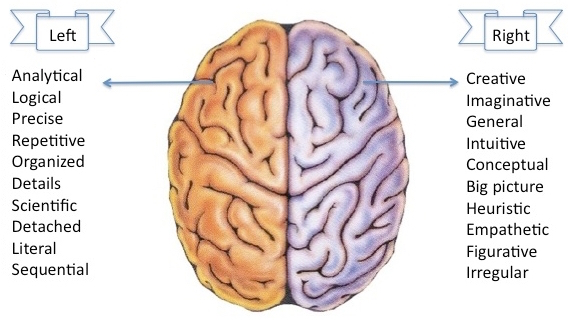
Medical scientists have identified numerous mental functions with particular regions of the brain. As the illustration above suggests, because of that the human mind relies on different hemispheres for different activities.

Most of us have already determined whether we are “right-brained” or “left-brained.” And, since we often know ourselves rather well, we’re probably correct in our assessment.

Still, there are some online tests capable of answering the question of just how well balanced we are in using whatever portion of our minds to which we have access. I recently took two of the assessment instruments and learned that I am a reasonably balanced individual.

You just may be more balanced than you think. Not that “balanced” is better than having one or the other side dominant. In fact, it feels a bit like being a “jack of all trades.”

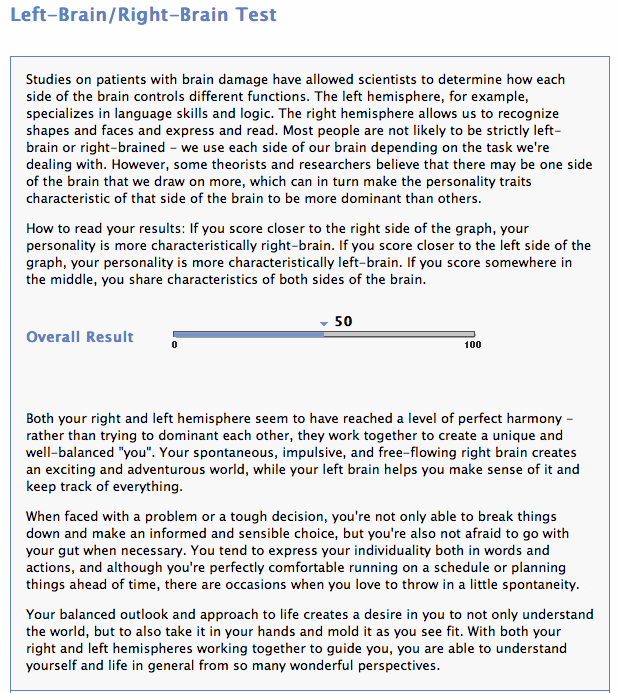
Brain 2The first test—available for you to take here—gave me the wonderful news that my “right and left hemispheres seem to have reached a level of perfect harmony.”

It sounds almost like attaining Nirvana, if one believes in such things.

It was amazing what they were able to discern about my deepest being with twelve simple questions.

Brain 3

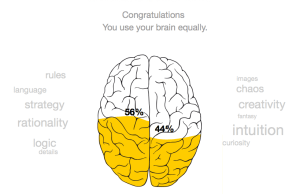
The second test—available here—gave me the following result. It reveals the mental equilibrium I have achieved with this informative graphic.

I really enjoyed the image (yellow is my second favorite color) . . . until I realized the uncolored portions of my brain suggested they were dormant. (I suspect the very fact that I’m concerned about the possibility implies it might be true.)

Lewis on the Human Mind

C.S. Lewis wrote about many aspects of human nature. That included, of course, the least understood organ, the brain. In the following passage from a 1921 letter, he describes the way our memories possess the power to transform the realities of the past.

I still feel that the real value of such a holiday is still to come, in the images and ideas which we have put down to mature in the cellarage [cellar or basement] of our brains, thence to come up with a continually improving bouquet.

Already the hills are getting higher, the grass greener, and the sea bluer than they really were; and thanks to the deceptive working of happy memory our poorest stopping places will become haunts of impossible pleasure and Epicurean repast.

The following argument is found in 1944’s “Is Theology Poetry?” His thoughts on how the human brain supports the existence of a Creator are well worth considering.

When I accept Theology I may find difficulties, at this point or that, in harmonising it with some particular truths which are imbedded in the mythical cosmology derived from science. But I can get in, or allow for, science as a whole. Granted that Reason is prior to matter and that the light of that primal Reason illuminates finite minds. I can understand how men should come, by observation and inference, to know a lot about the universe they live in.

If, on the other hand, I swallow the scientific cosmology as a whole, then not only can I not fit in Christianity, but I cannot even fit in science. If minds are wholly dependent on brains, and brains on bio-chemistry, and bio-chemistry (in the long run) on the meaningless flux of the atoms, I cannot understand how the thought of those minds should have any more significance than the sound of the wind in the trees.

And this is to me the final test.

This is how I distinguish dreaming and waking. When I am awake I can, in some degree, account for and study my dream. The dragon that pursued me last night can be fitted into my waking world. I know that there are such things as dreams: I know that I had eaten an indigestible dinner: I know that a man of my reading might be expected to dream of dragons. But while in the nightmare I could not have fitted in my waking experience. The waking world is judged more real because it can thus contain the dreaming world: the dreaming world is judged less real because it cannot contain the waking one.

For the same reason I am certain that in passing from the scientific point of view to the theological, I have passed from dream to waking. Christian theology can fit in science, art, morality, and the sub-Christian religious. The scientific point of view cannot fit in any of these things, not even science itself.

Even with my limited mind, which too often seems to run on only six of its eight cylinders, I recognize the wisdom of Lewis’ contrast between dreaming and waking. He is brilliant.

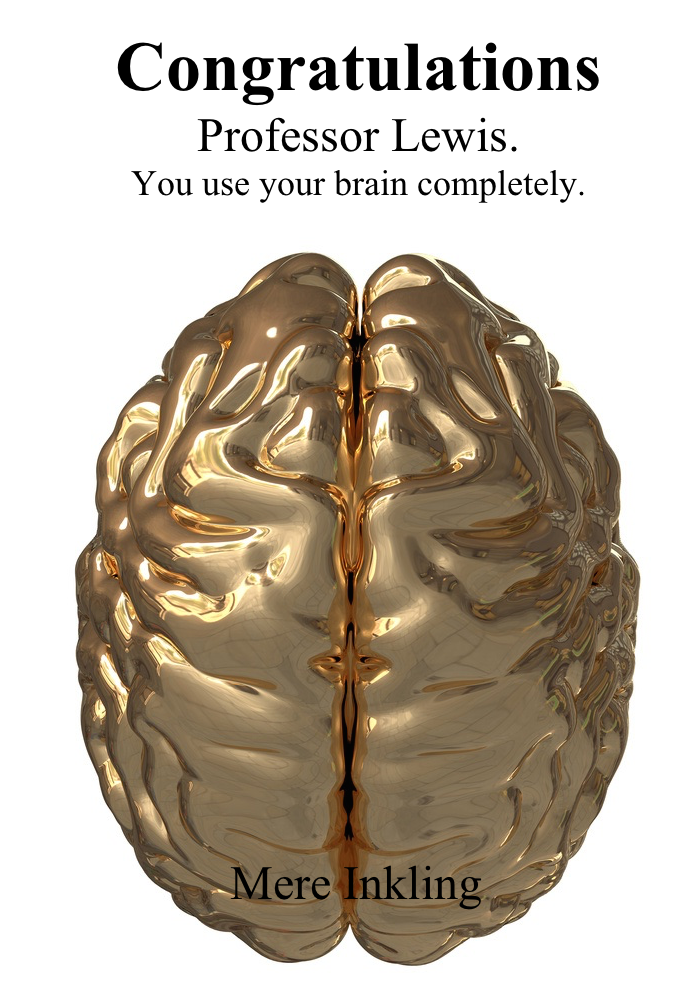
I imagine that our favorite Oxford dean’s online results might have looked something like this.

Lewis Brain

_____

* This quotation, and the one which follows it, come from Scientific American.

I have blogged in the past about the human brain. You might find one of the following posts interesting:

Engage Brain

Distant Fathers

Mensa & C.S. Lewis

Malapropistic Entertainment

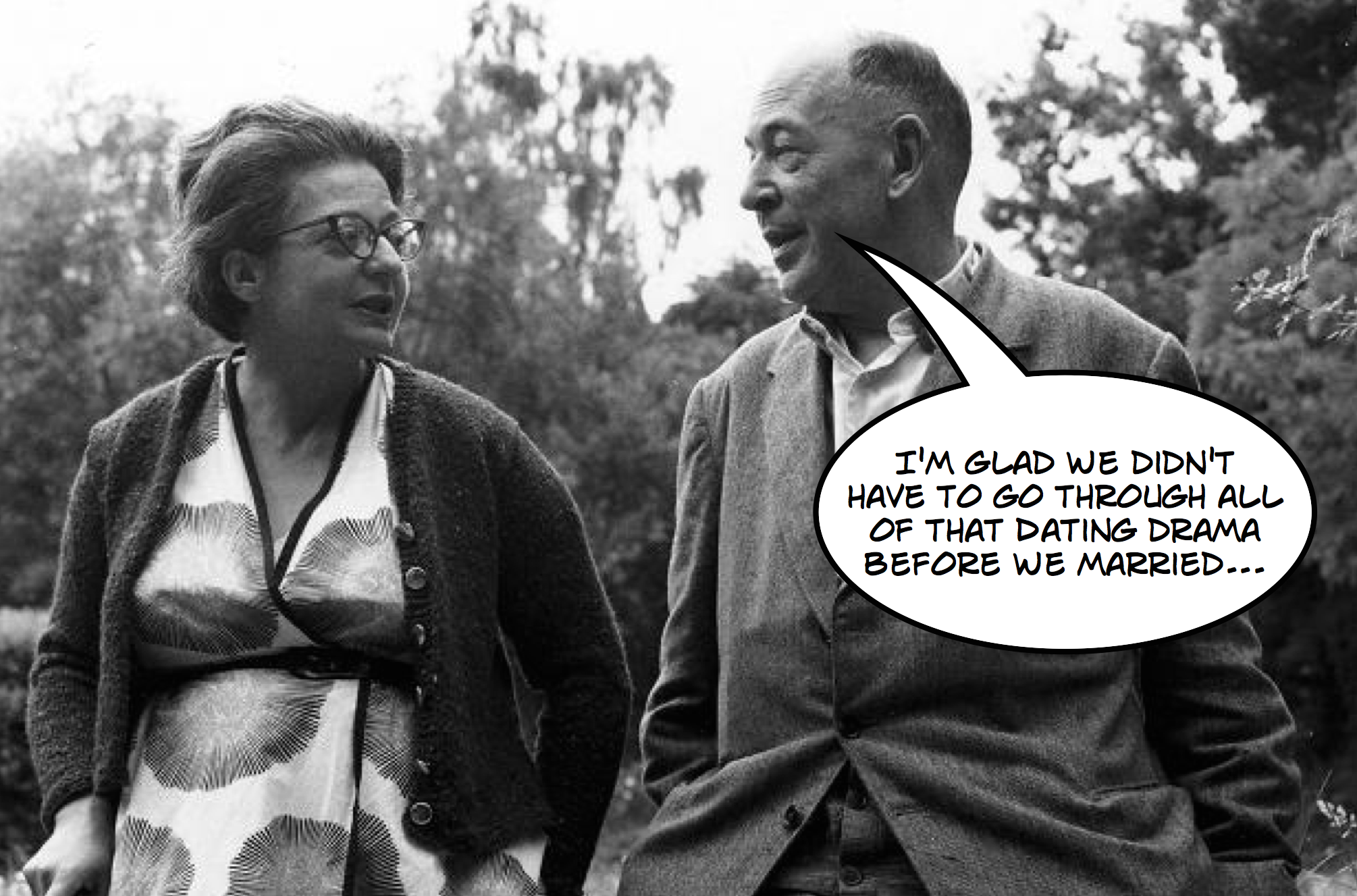
Dating Like an Inkling

datingI don’t recall ever reading about C.S. Lewis’ dating life.

Certainly, much has been written about his late marriage to Joy Gresham. It began as one of legal convenience, allowing her to remain in England, and grew into genuine love.

The book he anonymously penned as he grieved her passing is regarded by many as his most moving work.*

Another relationship in Lewis’ life that has provoked much speculation, was his care for the mother of one of his friends who died in WWI. The fact that the two young soldiers had vowed to care for one another’s parents in that event, does not dispel questions about what that particular relationship may have developed into.

Yes, I’ve read a great deal about the women in Lewis’ life, but until recently I had not encountered his thoughts on dating while he was a young man. In a 1926 letter to his father, he related an odd predicament he was experiencing as a young professor.

My dear Papy,

. . . I have been bothered into the last job I ever expected to do this term: taking a class of girls once a week at one of the women’s Colleges. However, I am not engaged to be married yet, and there are always seven of them there together, and the pretty ones are stupid and the interesting ones are ugly, so it is alright.

I say this because as a general rule women marry their tutors.

I suppose if a girl is determined to marry and has a man alone once a week to whom she can play the rapt disciple (most fatal of all poses to male vanity) her task is done.

The most humorous part of this is Lewis’ accurate assessment of male vanity.

This passage got me thinking about the subject of dating.

Is dating fun? I’m sure to many it is. But, I suspect that to the majority of people, lacking a committed relationship is an unwelcome fact of life.

It seems to me that one of the very best things about having been happily married for 39 years, is not needing to date. I don’t remember it a being all that fun at the time. But then, memories can get foggy after so long.

Lewis was utterly content being an aging bachelor. In truth, the state suited him well, and many of his friends were shocked when he wed.

In marriage he encountered much unexpected happiness. But Lewis, despite being a Romantic, remained a Rationalist. He was no dreamer who professed idealized version of marriage that was immune to human flaws.

In 1962 he shared this wonderfully honest assessment of marriage . . . and this refers to a truly good marriage.

I nominally have [a place of my own] and am nominally master of the house, but things seldom go as I would have chosen. The truth is that the only alternatives are either solitude (with all its miseries and dangers, both moral and physical) or else all the rubs and frustrations of a joint life.

The second, even at its worst seems to me far the better. I hope one is rewarded for all the stunning replies one thinks of one does not utter! But alas, even when we don’t say them, more comes out in our look, our manner, and our voice. An elaborately patient silence can be very provoking! We are all fallen creatures and all very hard to live with.

If only we were all so honest as Lewis. Life would be simpler and we might actually become a little “easier to live with.” Spouses, family and friends would surely appreciate that new self-awareness.

_____

* A Grief Observed. I have quoted from the volume in the past, including here and here.


From Ear to Quill

anglo saxonConsider how one humble Anglo-Saxon poet can teach us about the ancient transition from the oral to written delivery of poetry.

In recent study about the transition from aural to literary communication I came upon the following fascinating fact.

In an essay entitled “Oral to Written,” J.B. Bessinger writes:

As literate authors learned to assimilate oral materials to pen-and-parchment composition, and since cultural life and centres of writing were controlled so largely by the Church, it was inevitable that the oral transmission of pagan verse would die out, or at best leave few records of an increasingly precarious existence. Meanwhile the invasion of bookish culture into an oral tradition proceeded.

Amid the overwhelming anonymity of the period, Cynewulf was the only poet who troubled to record his name, not from motives of a new literary vanity, but against the Day of Judgement:* “I beg every man of human kind who recites this poem to remember my name and pray . . .”

I’ve read elsewhere that the names of a dozen Anglo-Saxon poets were recorded, although only four have any work that has survived. I understand, however, why Cynewulf is so well recognized—several thousand lines of his poetry are extant. You can access copies of his work for free at Project Gutenberg and Internet Archive.

Curiously, we know no details about Cynewulf other than his name. This he included in his manuscripts, spelled in runic characters.

Cynewulf’s poetry was familiar to the Inklings.

In his diary during the 1920s, C.S. Lewis describes reading Cynewulf and Cyneheard while he bemoaned that Old English Riddles continued to represent an obstacle to him.

I set to on my O.E. Riddles: did not progress very quickly but solved a problem which has been holding me up. [Henry] Sweet is certainly an infuriating author . . .

[Following afternoon tea, Lewis] retired to the drawing room and had a go at the Riddles. I learned a good deal, but found them too hard for me at present.

J.R.R. Tolkien paid an unimaginable tribute to Cynewulf. He attributed to the ancient poet no less than the original inspiration for his mythopoeic conscience.

In the summer of 1913 Tolkien . . . switched course to the English School after getting an “alpha” in comparative philology. At this time he read the great eighth-century alliterative poem Christ, by Cynewulf and others.

Many years later from the poem he cited Eala Earendel engla beorhtost (“Behold Earendel brightest of angels”) from Christ as “rapturous words from which ultimately sprang the whole of my mythology.”**

Cynewulf was an inspired poet. And, it is possible to discern some Anglo-Saxon words which have made it into contemporary English when passages are lined up, side by side.

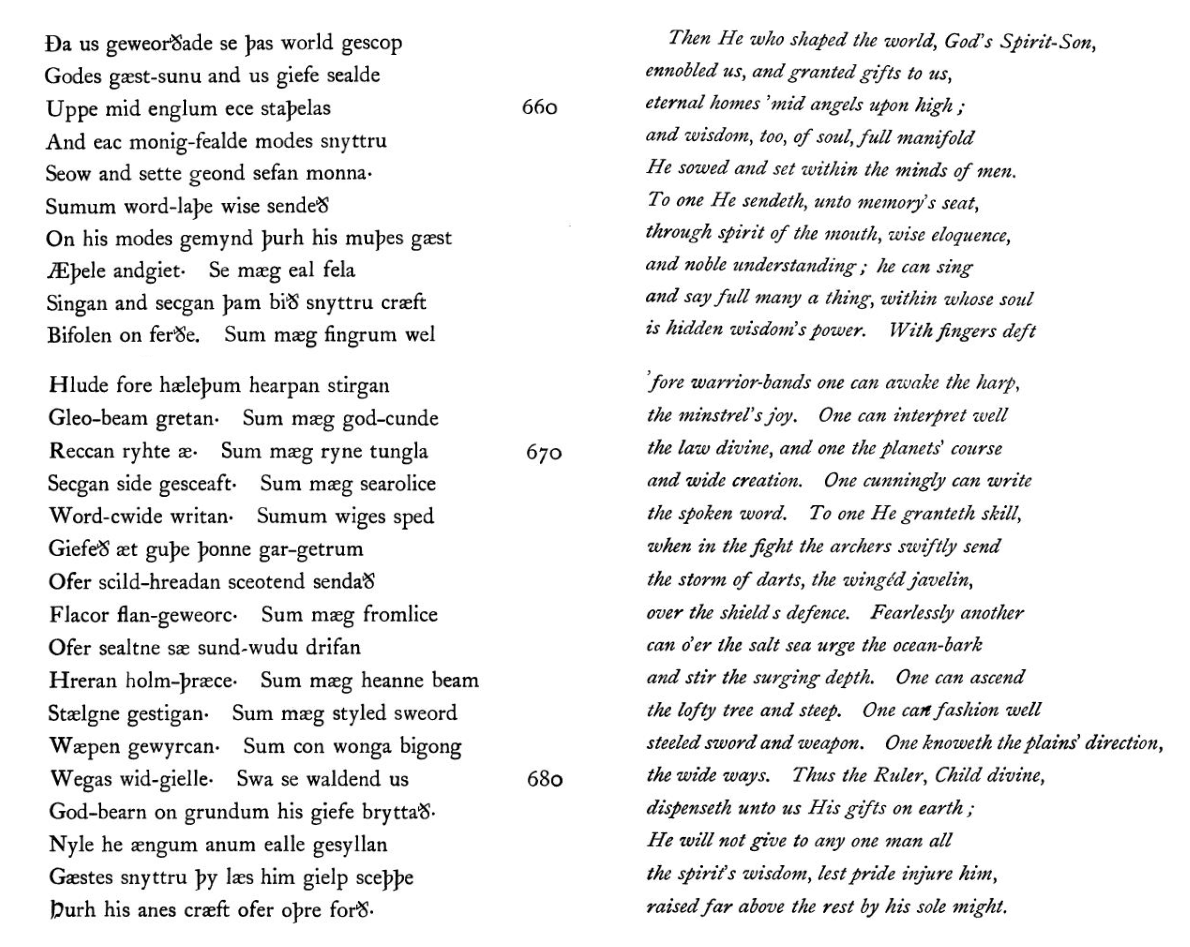
We’ll close now with a passage from his poem, Christ. These words come from the beginning of Part II (Ascension) and comprise the beginning of chapter four. For those who would like to compare the texts, a parallel version follows.*** (Just click on the image to enlarge it.)

Enjoy Cynewulf’s celebration of God’s abundant gifts, extended to poets, musicians, and all others.

Then He who shaped the world, God’s Spirit-Son,

ennobled us, and granted gifts to us,

eternal homes ’mid angels upon high;

and wisdom, too, of soul, full manifold

He sowed and set within the minds of men.

To one He sendeth, unto memory’s seat,

through spirit of the mouth, wise eloquence,

and noble understanding; he can sing

and say full many a thing, within whose soul

is hidden wisdom’s power. With fingers deft

’fore warrior-bands one can awake the harp,

the minstrel’s joy. One can interpret well

the law divine, and one the planets’ course

and wide creation. One cunningly can write

the spoken word. To one He granteth skill,

when in the fight the archers swiftly send

the storm of darts, the wingéd javelin,

over the shields defence. Fearlessly another

can o’er the salt sea urge the ocean-bark

and stir the surging depth. One can ascend

the lofty tree and steep. One can fashion well

steeled sword and weapon. One knoweth the plains’ direction,

the wide ways. Thus the Ruler, Child divine,

dispenseth unto us His gifts on earth;

He will not give to any one man all

the spirit’s wisdom, lest pride injure him,

raised far above the rest by his sole might.

cynewulf

_____

* Please don’t correct me regarding the misspelling of “judgment;” this quotation comes from a British text. ;)

** From Tolkien and C.S. Lewis: The Gift of Friendship by Colin Duriez.

*** This image is derived from the 1892 translation of Cynewulf’s Christ by Israel Gollancz.

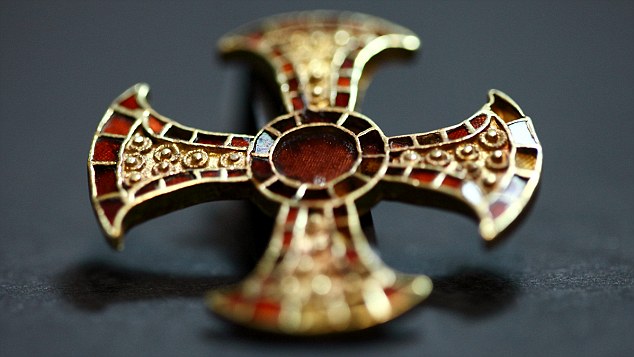
The lovely Anglo Saxon cross at the top of this page was discovered several years ago in the grave of a young teenage girl who had been buried near Cambridge.

I have blogged about Anglo Saxon legacy in the past . . . here and here.

Religious Kitsch

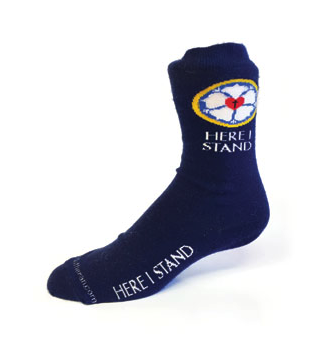
socksAre souvenir socks a good way of celebrating one of the move pivotal points in human history? That’s right, stockings. Socks emblazoned with one of the most famous statements of Christian faith made during the past millennium.

Hier stehe ich!” “Here I stand” (on the clear message of God’s word). This was Martin Luther’s steadfast defense where his salvation on the teaching that we are saved by God’s grace and mercy, not by our own efforts.

Ich kann nicht anders.” I can do no other, Luther continued. He invited his adversaries to correct him if they could show him in error, according to the Scriptures.

We are beginning a season when many people are celebrating the 500th anniversary of the Reformation of the Church. Some of the commemorations are quite noteworthy. Others . . . less so.

On the positive side, I rank near the top The Wittenberg Project, the restoration of the Old Latin School in the city where Luther preached the Gospel.

Near the other extreme, I have to place the “Here I Stand” socks. While I briefly considered purchasing a pair for one of my sons, my admittedly plebian sense of fashion saved me from doing so. (If you, on the other hand, find them tasteful or suitable for an acquaintance, you’ll find a link to the footwear below.)*

In his essay, “What Christmas Means to Me,” C.S. Lewis describes this sort of product. In his description of the “commercial racket” associated with the season, he writes:

I condemn it on the following grounds. . . . Things are given as presents which no mortal ever bought for himself – gaudy and useless gadgets, ‘novelties’ because no one was ever fool enough to make their like before.

Have we really no better use for materials and for human skill and time than to spend them on all this rubbish?

I understand that one person’s “rubbish,” though, can be another’s treasure. Still, as Edward Veith writes in The State of the Arts:

The problem with religious kitsch is that its cuteness and self-gratifying nature can domesticate and thereby distort Biblical faith. Christianity is not a sickly, sweet religion . . . The anemic figurines of Jesus Christ are poor testimony to His deity and His lordship.

Viewing It All in (a Humorous) Perspective

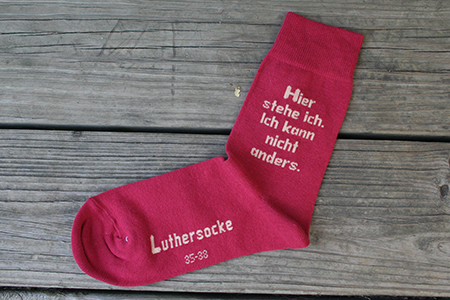
sockeWhile surfing the net researching this peculiar item, I encountered an entertaining website where we see how the Catholic—Reformer struggle lives on today.

A Roman Catholic website comments on the same sort of socks—tastefully offered in the original German. The author of The Ironic Catholic writes:

With all due apologies to my Lutheran brothers and sisters: while this catapults you into a real race with the Catholics for kitsch, we will crush you like grapes in this arena.

It’s all good-natured, of course. I haven’t bothered to research Catholic variations on the footings quotations front, but I imagine they are equally pithy.

I did, however, find one prolific Roman Catholic author whose following statement might be just as suitable for a hat as for stockings.

“It is because we are standing on our heads that Christ’s philosophy seems upside-down.” (G.K. Chesterton)

_____

* You can order your own pair of “Here I Stand” socks here.

** The Ironic Catholic post is here.

Listening to Sermons

pewsPastors aren’t always good at listening to sermons.* That makes my experience this month all the more special.

The statement that pastors aren’t the best “listeners,” may sound strange to some readers. There are many exceptions, of course, but the majority of pastors are handicapped by a couple of factors when it comes to listening to their peers preach.

Many of us were formally trained in our homiletics courses to actively critique other preachers. Even when we can get past this, our minds often (involuntarily) leap to how we would expound on various passages.

Wordsmiths within the clerical ranks are particularly vulnerable to this hazard. Grammatical errors screech like claws on a chalk board. Breaks in logic force us to stifle an inner cry for public redress. God-willing, we are able to remain in our seats and avoid causing embarrassment.

When we experience these uncharitable reactions, we silently ask for God’s forgiveness. We request from the Lord another portion of humility. And we try our best to refocus on what the pastor is preaching, rather than how he is doing it.

I recently spent a few days conducting research at Concordia Seminary. I enjoyed attending the daily chapel services while in St. Louis.

One sermon spoke to me with particular power. (Amazing, since the professors who preach in chapel are restricted to seven minutes! Just try to enforce that at a Baptist seminary!)

The Rev. Dr. Tony Cook preached on a passage from  James. He skillfully wove together a number of the elements in his brief ** sermon. Among his warnings, echoing the biblical text, he noted that we too often “place our confidence in the world,” and offer a “confession without compassion.” Too true.

He offered a timely word about the ecclesiastical practice of finding specks in the eyes of those with whom we differ. He said, “We do what Satan cannot. We tear down the Church from within.”

A final important reminder came in his proclamation that “We are made perfect by Jesus, not by our rhetoric about him.”

Amen.

C.S. Lewis, the Considerate Parishioner

Rev. Will Vaus wrote an informative article about Lewis’ relationship with his home congregation. The article includes a number of beneficial insights. Included in it is the following insight into how respectful he was toward a pastor he found less than stimulating.

Douglas Gresham, Lewis’s step-son . . . showed our mostly-American tour group around Holy Trinity Church [C.S. Lewis’ home parish].

[Gresham mentioned] how Jack sat behind the pillar during the service so that his facial expression could not be seen by the vicar, Ron Head.

“Was that because he disagreed with the vicar’s theology?” I asked.

“No,” said Doug. “It was not so much Ron’s basic theology that Jack objected to, but the slants that he put on it. Ron was a fine scholar of church history and by intellect a High Church Anglican. However, in his sermons there were often many things that would cause a spasm of pain or perhaps a look of total boredom to cross Jack’s face.

Sitting as he did out of sight of Ron, Jack could yawn if he had to without causing pain to a man whom he regarded as something of a bore, one who had become lost in the trivial aspects of his calling whilst ignoring some of the essential ones. Ron was a very nice and indeed I think a good man and none of us would have hurt him for the world.”

In fact Jack referred to Ron Head as “a very trying curate” in a letter written to Mrs. Mary Van Deusen on April 22, 1954. Head was curate at Holy Trinity from 1952 to 1956, prior to serving as vicar. On December 28, 1953, Lewis wrote to the same Mrs. Van Deusen and said:

“I think someone ought to write a book on ‘Christian life for Laymen under a bad Parish Priest’ for the problem is bound to occur in the best churches. The motto would be of course Herbert’s lines about the sermon ‘If all lack sense, God takes a text and preaches patience’”

A Preacher in His Own Right

C.S. Lewis, though he was a layman, was invited to preach on a number of occasions. Another professor offers a great analysis of Lewis’ own preaching here. Hal Poe*** writes:

Forty years after his death, C. S. Lewis still offers preachers a model for how to approach the serious task of bringing the word of God to a congregation of believers or an audience of unbelievers.

The attitude toward preaching that Lewis represents does not produce dull or boring sermons. Rather, it engages people in a way that they must come to grips with what God has said.

_____

* Actually, there are a number of things that pastors are not particularly adept at . . . but those are stories for another day.

** Brevity is not an enemy to powerful communication. Poetry, for example, says in a phrase a truth prose might require several paragraphs to explain. In addition, we’re familiar with writers like Mark Twain who echoed Blaise Pascal’s 1656 statement that “I would have written a shorter letter, but I did not have the time.”

*** Yes, Dr. Poe is an indirect descendant of the famous writer of the macabre.

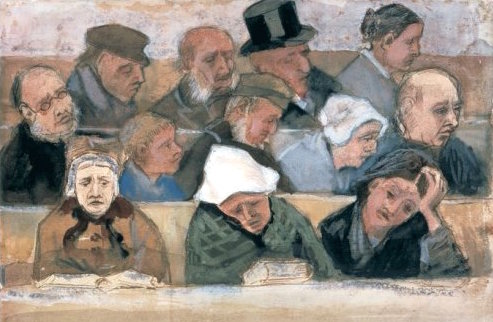
The rather discomforting painting at the top of this column is Church Pew with Worshippers, painted by Vincent van Gogh in 1882. (I’m happy to say I’ve never preached to a congregation that looked quite as miserable as this one.)

Africa Comes to America

saharaYes, you read the title correctly; it’s no typo. Africa itself arrived in America this summer—and it’s an event that apparently takes place every year!

In a recent post by one of Mere Inkling’s earliest subscribers, I learned about the annual Saharan Air Layer. It is an enormous dust cloud that transits the entire Atlantic Ocean and is vital to the western hemisphere, especially the Amazonian rain forests. More about the SAL below.

I find this phenomenon fascinating. It reveals how intricately balanced and interconnected God has created this amazing ecosystem we call earth.

I appreciate this fact, even though I don’t consider myself an environmentalist. That doesn’t mean, of course, that I don’t recycle. What’s more, I would actually like to see brazen polluters incarcerated and tasked with personally cleaning toxic waste dumps . . . but that’s not the theme of this reflection.

It seems to me that part of being truly human, is possessing an appreciation—or even a love—for the world in which our Creator has allowed us to dwell. By love, I mean a deep affection for the flora and fauna, and even the mountains and valleys themselves.

I am not proposing idolatry.

I am in good company in valuing nature. C.S. Lewis found time spent walking in the countryside to be invigorating. It was renewing, for body, mind and soul.

Several years back a book was published with the peculiar subtitle, The Environmental Vision of C.S. Lewis.

The authors of Narnia and the Fields of Arbol explores the way Lewis displays his “ecological” concerns, particularly in his fiction. They also consider J.R.R. Tolkien’s similar attitude.

It is no coincidence that these two men, as soldiers during the Great War, had seen the worst violence humanity could do to nature. The ravages wrought by the orcs surrounding Isengard were echoes of the lifeless terrain of shell-shattered Western Front.

Writing this now, I recall a poem I wrote for Curtana: Sword of Mercy.

“A Foreshadowing of Epics” begins:

Filthy trenches greeted the novice soldiers’ eyes,

their two imaginations envisioned greener lands.

Crimson combat splashed red their vision,

and colored portraits one day painted with their words.

The frontlines were barren,

scarred earth stripped of all life.

Fallen trees mimicked casualties,

not even the smallest of creatures escaped death.

It may seem ironic to some that those very fields now are green, and teeming with life. It is the mercy of God that restores the scarred and heals the broken. And, as impressive as those miracles are evident in nature, they are far more wondrous when it is human lives that are transformed and resurrected.

So it is that I find the wonder of the barren and seemingly lifeless Saharan dust bringing nutrients to hungry forests on the other side of the earth amazing. No mere accident that.

If Jesus delays his return and this globe continues to spin for more centuries still, I would not be surprised to see the Americas returning to Africa a similar gift of life.

_____

Weather.com has a short video about the Saharan Air Layer here.

Pharisaical Cats

catsCats or dogs? Which makes the best companion? This is one of the few topics guaranteed to arouse arguments as intense as political debates.

The fact is, the first three words already elicited a visceral reaction from most readers. “Cats or dogs” might as well read “cats versus dogs.”

Even though many of our homes welcome both species as residents, we all know they are drastically different. Many dogs eagerly solicit feline playful attention, while most cats choose to remain aloof from them, barely tolerating their canine presence.

The humans who share the habitation may genuinely loves both types of animals, but in the deep recesses of their hearts everyone possesses a (sometimes secret) preference for one or the other.

Of course, if we’re a “cat person” we wouldn’t want our dogs to know that; it would hurt their feelings. And, if we’re a “dog person” we wouldn’t want our cats to know, lest they treat us with even greater disdain than they already do.

C.S. Lewis was an animal lover. He had both dogs and cats during his lifetime. And he recognized well their differences. In a 1955 letter to an American correspondent, he wrote:

We were talking about Cats & Dogs the other day & decided that both have consciences but the dog, being an honest, humble person, always has a bad one, but the Cat is a Pharisee and always has a good one. When he sits and stares you out of countenance he is thanking God that he is not as these dogs, or these humans, or even as these other Cats!

I love Lewis’ comparison of their temperaments. I don’t think I’ve ever met a cat who was not at least a little bit self-righteous. As for canines . . . even disobedient rascals (like our yet-to-be-sufficiently-trained adolescent border collie) are quite aware of the fact that they are being “bad.” Some are even grow remorseful.

In a 1961 missive Lewis addresses the psychoanalysis of a cat. He is responding to a correspondent’s announcement that her veterinarian had diagnosed her cat with some behavioral problem.

I hope your vet is not a charlatan? Psychological diagnoses even about human patients seem to me pretty phoney. They must be even phonier when applied to animals.

You can’t put a cat on a couch and make it tell you its dreams or produce words by ‘free association’. Also—I have a great respect for cats—they are very shrewd people and would probably see through the analyst a good deal better than he’d see through them.

Lewis is quite likely correct in this observation. Our cats obviously see through all of their human “family.” They are not only astute, they act disinterested, but actively observe us all day long. (Well, at least during the ninety-four minutes when they are not napping each day.)

I have written about C.S. Lewis’ dogs in the past. I’ll close now with a passing reference Lewis made in a 1962 letter to a fellow cat-lover.

We [you and I] are also both ruled by cats. Joy’s Siamese—my ‘step-cat’ as I call her—is the most terribly conversational animal I ever knew. She talks all the time and wants doors and windows to be opened for her 1000 times an hour.

So it goes with our pharisaical felines. With majestic posture, they patiently wait for us to fulfill their commands.


Do Dads Matter?

dadsaurusThey most certainly do, if you are discussing the influence of parents on their children’s religious practices.

And, as politically uncomfortable as it may make people, the example of the father appears to exert far more influence than that of the mother.

In 2000, a Swiss study was released that revealed, in part, the way parental faith is transmitted to children. I was reminded of it while reading “Dads Being Dads,” in the current issue of The Lutheran Witness.

A Touchstone article (linked below) analyzed the study. It compared the frequency of worship attendance by parents with the consequential involvement of their children as they matured.

If both father and mother attend regularly, 33 percent of their children will end up as regular churchgoers, and 41 percent will end up attending irregularly. Only a quarter of their children will end up not practicing at all.

If the father is irregular and mother regular, only 3 percent of the children will subsequently become regulars themselves, while a further 59 percent will become irregulars. Thirty-eight percent will be lost.

These numbers sound extreme, don’t they? Some of us will be doing calculations in our minds. In my own family, my mother was a faithful Christian. My father was agnostic. (Actually, he was a practicing atheist who would argue “I believe in God.”)

Of the three kids, I am a regular church attender. Not just because I’m a pastor; since I’m “retired” and have no external obligation to attend. My sister attends occasionally. My brother only for special, family events.

Hmmm, that is merely anecdotal, of course, but my observation of other family histories seems to bear out the findings of the demographic study.

While some readers may wish to challenge the applicability of a Swiss study to other nations, the simple fact that the burden to do so rests on them. The experience in Switzerland is almost certainly common to the rest of Europe and the other increasingly secularized countries of the West.

And, since it is about gender distinctions rather than culture variations per se, it may even correlate to less industrialized contexts.

Just how much more significant is a father’s example than a mother’s?

Even when the father is an irregular attender there are some extraordinary effects. An irregular father and a non-practicing mother will yield 25 percent of their children as regular attenders in their future life and a further 23 percent as irregulars. This is twelve times the yield where the roles are reversed.

Let’s consider that statistic a fluke, and cut it in half . . . no, into quarters. Even if is off by that great a magnitude, it would still mean that in this scenario, a father’s example is three times as significant as mother’s.

The study does not concern itself with the reasons for the disparity, but I have a theory. At the risk of sounding like a traditional dinosaur, as C.S. Lewis described himself, allow me to offer it.

  • Women are inherently more receptive to Christian virtues such as compassion, gentleness, and mercy.
  • Even if their mother discounts worship, the hearts of most girls are still attuned to its song.
  • Christian virtues of forgiveness and meekness resonate less in boys (not just because of their upbringings).
  • If a father goes to church without his wife, daughters will still be inclined to desire to accompany him.
  • If a father stays home, it promotes a boy’s innate suspicion (reinforced by external forces) that “religion is women’s business.”

This doesn’t mean, of course, that single mothers should despair. God is the One who draws us to himself, and he can most definitely do so in the absence of any other positive influences.

This is my prayer of gratitude: God bless faithful mothers.

As a reward for those who read these thoughts to their end, I would like to share one of Lewis’ allusions to himself as a dinosaur. This passage comes from his essay, “De Descriptione Temporum.”

If a live dinosaur dragged its slow length into the laboratory, would we not all look back as we fled? What a chance to know at last how it really moved and looked and smelled and what noises it made!

And if the Neanderthaler could talk, then, though his lecturing technique might leave much to be desired, should we not almost certainly learn from him some things about him which the best modern anthropologist could never have told us? He would tell us without knowing he was telling.

One thing I know: I would give a great deal to hear any ancient Athenian, even a stupid one, talking about Greek tragedy. He would know in his bones so much that we seek in vain. At any moment some chance phrase might, unknown to him, show us where modern scholarship had been on the wrong track for years.

Ladies and gentlemen, I stand before you somewhat as that Athenian might stand. I read as a native texts you must read as foreigners. You see why I said that the claim was not really arrogant; who can be proud of speaking fluently his mother tongue or knowing his way about his father’s house. . .

Where I fail as a critic, I may yet be useful as a specimen. I would even dare to go further. Speaking not only for myself but for all other Old Western men whom you may meet, I would say, use your specimens while you can. There are not going to be many more dinosaurs.

_____

You can read the cited article from Touchstone magazine here.


The Bible’s Complexity

locustsWhy is it people say the Bible has many writers, but only one Author? The answer to that question is simpler than it seems.

Many different people, over a span of centuries, wrote the various books we find in the Scriptures. At the same time, each of these diverse individuals was inspired by the same Person—the Holy Spirit. Thus it is said by orthodox Christians that the Scriptures are the “Word of God.”*

The word “scripture” itself simply means a written work, although it is almost always applied to books regarded as sacred.

For Christians, Scripture/s can be singular or plural since the Bible possesses both aspects, being inspired by a single Author, yet compiled by numerous individual scribes.

The current issue of World magazine offers a satisfying interview** with David Skeel, a professor at the University of Pennsylvania Law School.

Skeel was raised with minimal exposure to Christianity, and while majoring in English, he found his ignorance of biblical allusions to be a serious handicap.

To rectify that problem, he decided to read the Bible over the summer after his sophomore year. Riding on a cross country trip with some classmates, he says “by the time I’d gotten a few chapters into Genesis I was persuaded it was true. I had never read anything so beautiful, so psychologically real.”

I was especially intrigued by the following insight offered by Skeel.

Christianity impressed you because it’s complicated?

Absolutely. The psychological complexity of Christianity was really powerful for me, as was the complexity of the language of the Bible. Truth can’t be conveyed in a single genre, so the Bible’s mix of genres, language and images is part of the evidence of its veracity.***

I don’t recall ever thinking of it that way, but he is right. God’s revelation of his mercy and grace is far too vast to be “conveyed in a single genre.”

Back to Oxford

Skeel doesn’t mention C.S. Lewis in his interview, and I have no idea whether Lewis’ work has influenced his life.

Despite that, his response to the question above reinforced for me one of the reasons Lewis has proven to be such a powerful blessing in my own pilgrimage.

Lewis intuitively recognized that same truth. God’s message is too boundless to be restrained to a single means of proclaiming it. And because of that, he used every genre at his command to celebrate it.

Essays, debates, poetry, fantasies and history were all fair game.

Which brings me to a corollary to Skeel’s observation. Not only is Truth too immeasurable to be limited to a single genre . . . by God’s design, humanity’s diversity is too abundant to allow for a single manner of communication to speak with the same power.

Some are moved by God’s poetry in a singing brook. Others by his majesty in the face of a snow-capped summit.

Some are drawn to his embrace through stories of human struggle and redemption. Others by logical arguments that appeal to their confidence in reason.

This is precisely why different individuals favor different books in the Scriptures, just as they prefer various writings over others within the Lewis “canon.”

Fortunately, Skeel’s literary interest in the Bible led him to pick it up without any life-changing expectations. That makes him one of the rare exceptions to Lewis’ observation with which we will close.

It may be asked whether now, when only a minority of Englishmen regard the Bible as a sacred book, we may anticipate an increase of its literary influence. I think we might if it continued to be widely read. But this is not very likely.

Our age has, indeed, coined the expression “the Bible as literature.” It is very generally implied that those who have rejected its theological pretensions nevertheless continue to enjoy it as a treasure house of English prose. It may be so.

There may be people who, not having been forced upon familiarity with it by believing parents, have yet been drawn to it by its literary charms and remained as constant readers. But I never happen to meet them.

Perhaps it is because I live in the provinces. But I cannot help suspecting, if I may make an Irish bull [an incongruous statement], that those who read the Bible as literature do not read the Bible. (“The Literary Impact of the Authorised Version”).

_____

* Although the Bible is commonly referred to as the “Word of God,” it is more properly referred to as the written Word of God. The actual Word is none other than Jesus Christ himself, through whom all things were spoken into existence. This is clear when you compare the following passages from the Scriptures. If you have any questions about this, feel free to write to me here at Mere Inkling.

Creation as described in the book of Genesis, chapter 1.

Echo of creation in the Gospel according to John, chapter 1.

** You can read the interview here.

*** In his response, Skeel wisely answers the actual question by substituting the word “complex” for “complicated.” The latter implies unnecessary complexity and a problem. The former, complexity, simply states the facts. It is impossible to adequately describe an infinite God with finite words.

The illustration on this page is from the Walters Art Museum and portrays the plague of locusts visited upon the Egyptians.