Read This Before Buying Christmas Cards

xmas cards

Fortunately, Christmas cards are not yet obsolete. Surely, many have substituted electronic alternatives, but even children of the digital age recognize that a personally scribbled note conveys a rare message—

You are worth the timeit takes me to choose a card, inscribe it, address the envelope and send it on its (dare I say, “merry”) way to you.

This pre-Christmas post is appearing so early because many of us are already addressing our Christmas greetings during the Advent season. And so it goes that Christmas cards and paraphernalia will soon usurp the place of other products in our local stores.

Whether you purchase your cards each winter, or wait until those amazing after-Christmas sales to buy them at 70% off, please keep this advice from C.S. Lewis in mind when you choose them.

Send cards that are appropriate for your recipients.

As a rule, if you are a Christian, you should send a card that celebrates the true meaningof the holy day. Naturally, this can be waived if it would cause genuine offense. However, if someone genuinely practices a different faith, why would you send them a Christmas card in the first place? A Hanukkah card, or a secular New Year’s Day or Thanksgiving seasonal missive would probably be more appropriate.

But my opinion is that for those who would not be overtly offended, a true Christ-mass card is appropriate. After all, many cards are quite gentle and inoffensive. For instance, the genre that picture a star (we recognize that celestial light as a Christian symbol during this particular season), along with words like “may you experience the joy and peace ushered in by this holy season.”

What I would encourage you to avoid sending during this time when we focus on the Incarnation miracle, is the sort of pastoral scenes with their innocuous tidings. For example, the happily sleighing family traveling in a conveyance very few of us will ever see. Send them at some other time, if you will, but they have little or nothing to do with the Nativity.

Now it’s fine if you think I’m old fashioned like the dinosaurs we recently considered.

But if you dismiss my opinion, please consider that of C.S. Lewis.

Lewis’ opinions about the commercialization of the Christmas season are well known, and we have discussed them here at Mere Inkling in the past. He, of course, abhorred the secularization of a sacred event. How sad he would be today to witness how Santa has continued to supplant Jesus.

Some will point out that Lewis himself included Father Christmas in his Chronicles of Narnia. This is true, but it is distinct from the modern secular excesses. In The Lion, the Witch and the Wardrobe, Father Christmas more closely resembles Saint Nicholas, in giving gifts and proclaiming the arrival of the King. It’s not accidental that he begins and ends his visit with the children by pointing to Aslan.

“I’ve come at last,” said he. “She has kept me out for a long time, but I have got in at last. Aslan is on the move. The Witch’s magic is weakening. . . .” Then he cried out, “Merry Christmas! Long live the true King!” and cracked his whip, and he and the reindeer and the sledge and all were out of sight before anyone realized that they had started.

C.S. Lewis was a truly devoted correspondent. He wrote back to the many fans who sought him out, and offered thoughtful responses to even the most frivolous queries. The writing was burdensome, and only the assistance of his brother Warnie for many years kept him from being forced to cease his generous practice.

Some of his correspondents were, or became, his friends. In December of 1955, he thanked one of these for the Christmas card he had sent. The friend was Peter Milward, a Jesuit priest. Lewis’ comments are still timely for Christian readers today.

Thank you for y[ou]r letter of Nov. 17. The enclosed card was one of the v[ery] few I have been pleased at getting.

Christmas cards in general and the whole vast commercial drive called ‘Xmas’ are one of my pet abominations: I wish they could die away and leave the Christian feast unentangled.

Not of course that even secular festivities are, on their own level, an evil: but the laboured and organised jollity of this—the spurious childlikeness—the half-hearted and sometimes rather profane attempts to keep up some superficial connection with the Nativity—are disgusting.

But your card is most interesting as an application of Japanese style to a Christian subject: and, me judice [in my opinion] extremely successful.

I hope you will reflect on Lewis’ thoughts on this subject. Christmas is too precious a time to be “entangled” with secular and pagan baggage.

If you send any holiday communiques—even of a digital nature—choose them wisely.


For more on C.S. Lewis and Christmas, read “A New C.S. Lewis Christmas Gift.”

 

C.S. Lewis the Irishman

irish aslan

Contrary to the common assumption that C.S. Lewis was English, he was actually an Irishman. He was born in Belfast, and those who know him attested to how his Irish-ness lasted the whole of his life.

Lewis was proud of his roots, and celebrated them. When he first journeyed to England, he experienced a culture shock. “No Englishman will be able to understand my first impressions of England,” he wrote in Surprised by Joy.

Lewis always loved Ireland. He vacationed there regularly, and chose the island for his honeymoon, late in life. One of his Irish students, David Bleakley, related that the transplant professor declared, “Heaven is Oxford lifted and placed in the middle of County Down.” (C.S. Lewis at home in Ireland)

Several years ago, David Clare of the University of Limerick wrote “C.S. Lewis: An Irish Writer.” It appeared in Irish Studies Review, and the abstract is illuminating.

This article examines the effect of C.S. Lewis’s Irish background on his work. It attempts to contradict the assumption that this Belfast-born writer should be included in the English and not the Irish canon. It emphasises that Lewis saw himself as Irish, was seen by others as Irish, and that his Irish background, contrary to what some have written, was important to him throughout his lifetime.

It goes on to demonstrate the ways in which his work was influenced by his youth in Ireland and by the Irish mythology that he loved. Furthermore, this article maintains that, as a child of pre-partition Ireland with roots throughout the island, Lewis was influenced by the country as a whole, not just his native Ulster. Finally, it attempts to understand why Lewis, a proud Irishman, did not do more to promote himself as an Irish writer.

Clare’s argument is necessary because of Irish political correctness. In Surprised by C.S. Lewis, Alister McGrath describes the prejudice.

So why is Lewis not celebrated as one of the greatest Irish writers of all time? Why is there no entry for “Lewis, C.S.” in the 1,472 pages of the supposedly definitive Dictionary of Irish Literature (1996)? The real issue is that Lewis does not fit—and, indeed, must be said partly to have chosen not to fit—the template of Irish identity that has dominated the late twentieth century.

In some ways, Lewis represents precisely the forces and influences which the advocates of a stereotypical Irish literary identity wished to reject. One of the reasons why Ireland has largely chosen to forget about Lewis is that he was the wrong kind of Irishman. . . .

Lewis may have chosen to rise above the provinciality of Irish literature; he nevertheless remains one of its most luminous and famous representatives.

It should be noted, of course, that countless Irish men and women are proud of Lewis, and count him as one of their own.

There’s No Other Place Quite Like Ireland

On a less serious note, and at the risk of contributing to a stereotype, I want to share with you an incident that occurred in Dublin.

First some context. Some people suggest that people in Ireland have a particular affinity for alcohol. This may be a bit of an exaggeration, since they are only ranked twenty-first in the world (for alcohol consumption).

The 1875 tragedy goes by several names, but one is the “Dublin Whiskey Fire.” A malt house and a whiskey warehouse caught fire, and as thousands of gallons of their contents poured down the street in a fiery channel, the blaze spread to many homes and businesses.

Miraculously, the fire did not take any lives. That does not mean, however, that there were not a number of fatalities. A dozen people died from alcohol poisoning. Tempted by unrestricted access to the alcohol, many Dubliners cupped their hands or used their boots to gather up the liquid and drink themselves into oblivion.

You can read an account of the bizarre occurrence in The Irish Times.

I wonder what Lewis thought about this revolting event, since he was surely aware of it. The deranged consumption of filthy and burning alcohol would be condemned by any sane person.

Among teetotalers, however, even a sip of alcohol is objectionable. Many attribute their aversion to their faith. While the Christian Scriptures strongly condemn drunkenness, some verses tacitly affirm the drinking of wine in moderation.*

C.S. Lewis and Drink

C.S. Lewis was among the majority of Christians who accept drinking while avoiding drunkenness. I have written on this subject at length.

In Mere Christianity, Lewis says,

Temperance is, unfortunately, one of those words that has changed its meaning. It now usually means teetotalism. But in the days when the second Cardinal virtue was christened ‘Temperance,’ it meant nothing of the sort. Temperance referred not specially to drink, but to all pleasures; and it meant not abstaining, but going the right length and no further.

It is a mistake to think that Christians ought all to be teetotallers . . . Of course it may be the duty of a particular Christian, or of any Christian, at a particular time, to abstain from strong drink, either because he is the sort of man who cannot drink at all without drinking too much, or because he is with people who are inclined to drunkenness and must not encourage them by drinking himself.

But the whole point is that he is abstaining, for a good reason, from something which he does not condemn and which he likes to see other people enjoying. One of the marks of a certain type of bad man is that he cannot give up a thing himself without wanting every one else to give it up. That is not the Christian way.

An individual Christian may see fit to give up all sorts of things for special reasons—marriage, or meat, or beer, or the cinema; but the moment he starts saying the things are bad in themselves, or looking down his nose at other people who do use them, he has taken the wrong turning.

This is wise counsel. Recapturing the original meaning of temperance—and living as temperate people—results in happier lives and a more peaceful world.


* For those who God expressly commands not to drink, should avoid it completely. For example, an angel told Zechariah that John the Baptist, “must not drink wine or strong drink, and he will be filled with the Holy Spirit, even from his mother’s womb.” (Luke 1:15). John’s cousin Jesus, on the other hand, miraculously created wine for a wedding party, and offered the Passover wine to his disciples with the words “this cup that is poured out for you is the new covenant in my blood.” (Luke 22:20)


Tolkien’s Dinosaur Discovered

sauron dino

The “new” dinosaur illustrated above is impressive enough to merit its naming in honor of Sauron in Tolkien’s Lord of the Rings. Sauroniops, which means “eye of Sauron,” was one of those enormous bipedal predators that Jurassic Park keeps reproducing despite numerous warnings and unnumbered devoured guests. 

Fittingly, the new genus was identified through the discovery of a bone related to the eye socket of the beast. And, as all fans of Middle Earth know, Sauron’s piercing eye marks his terrible presence in the world.

Tolkien isn’t the only author to receive this sort of homage. In a humorous post celebrating the discovery of this new dinosaur in 2012, one writer pointed out:

Last week, the colossal Moroccan theropod Sauroniops joined the ranks of Mojoceratops and Dracorex Hogwarsti, recently discovered dinosaurs named after nerd icons.

sauron skull

As for the Sauronic fossil itself, and its full story of its identification, you can download the complete official report in Acta Palaeontologica Polonica

One of the things that most amazes me about paleontology is the skill (imagination?) they have when they reconstruct ancient life forms with very few fossils. In fact, in the case of Sauroniops, there is only a single bone fragment!

Despite the lack of evidence, it’s probably safe to suppose that Sauroniops was binocular, like other related species. However, that remains conjecture, and it is utterly possible that this new genus was a cyclops variety, more akin to Sauron non corporeal

C.S. Lewis & Dinosaurs

Lewis readily recognized that his deep appreciation for the past made him an oddity in Oxford. He eschewed the essence of the modernism that enraptured most of his peers. Lewis was a man rooted in history. He praised its merits and avoided its pitfalls. All of this, he confessed, made him a “dinosaur.”

He used the image as a metaphor for himself and his vocation, “explaining as clearly as I can the way in which I approach my work.” When he assumed his chair at Cambridge University, he delivered a memorable lecture, entitled De Descriptione Temporum. The text of the entire lecture is available here, but only the pertinent portion is quoted below.

And now for the claim: which sounds arrogant but, I hope, is not really so. I have said that the vast change which separates you from Old Western has been gradual and is not even now complete. Wide as the chasm is, those who are native to different sides of it can still meet; are meeting in this room. This is quite normal at times of great change.

The correspondence of Henry More* and Descartes is an amusing example; one would think the two men were writing in different centuries. And here comes the rub. I myself belong far more to that Old Western order than to yours. I am going to claim that this, which in one way is a disqualification for my task, is yet in another a qualification. The disqualification is obvious. You don’t want to be lectured on Neanderthal Man by a Neanderthaler, still less on dinosaurs by a dinosaur. And yet, is that the whole story?

If a live dinosaur dragged its slow length into the laboratory, would we not all look back as we fled? What a chance to know at last how it really moved and looked and smelled and what noises it made!

And if the Neanderthaler could talk, then, though his lecturing technique might leave much to be desired, should we not almost certainly learn from him some things about him which the best modern anthropologist could never have told us? He would tell us without knowing he was telling.

One thing I know: I would give a great deal to hear any ancient Athenian, even a stupid one, talking about Greek tragedy. He would know in his bones so much that we seek in vain. At any moment some chance phrase might, unknown to him, show us where modern scholarship had been on the wrong track for years.

Ladies and gentlemen, I stand before you somewhat as that Athenian might stand. I read as a native texts that you must read as foreigners. You see why I said that the claim was not really arrogant; who can be proud of speaking fluently his mother tongue or knowing his way about his father’s house?

It is my settled conviction that in order to read Old Western literature aright you must suspend most of the responses and unlearn most of the habits you have acquired in reading modern literature. And because this is the judgement of a native, I claim that, even if the defence of my conviction is weak, the fact of my conviction is a historical datum to which you should give full weight.

That way, where I fail as a critic, I may yet be useful as a specimen. I would even dare to go further. Speaking not only for myself but for all other Old Western men whom you may meet, I would say, use your specimens while you can. There are not going to be many more dinosaurs.

As Lewis was preparing to broadcast this inaugural lecture, the BBC sent him an edited copy of the presentation “designed more than anything else to remove the lecture from the special Cambridge setting.” In his response, Lewis indicated that the dinosaurian references had already gained some public traction.

I return one copy with my corrections which, as you see, embody most of yours. Strictly speaking, if we want to detach it as cleanly as possible from its original academic context, it ought to end with the end of the second para. on p. 17: but as the dinosaur has already achieved some popularity, you may want to keep the rest. I don’t mind either way.

Fortunately, Lewis was not the only dinosaur roaming around, reminding us of important truths. In his closing in a 1955 letter to Dorothy Sayers, Lewis writes:

My brother joins me in all good wishes for Easter. Shd. [should] we someday form a Dinosaurs’ Club (with an annual dinner in the Victoria & Albert)?

In 1957 he would address his renowned friend as “sister Dinosaur.” It would have been fascinating to see who would have joined Sayers on the roster of the Dinosaurs’ Club Lewis imagines.

Sadly, as Lewis’ health seriously declined in 1963, he wrote to a correspondent a sort of epitaph.

Thanks for the kind things you say, but look for no help from me. I am but a fossil dinosaur now.

C.S. Lewis recognized himself to be a dinosaur, as he defined it. And in this comment, he suggests that he is becoming a simple fossil. Fortunately, however, this is one of the cases where he was wrong. Just as Lewis is alive, even now, in the presence of his Savior, so too his words continue to speak life and wisdom to our confused world.

A Suggestion for Your Personal Library

prayer

I just added a rare C.S. Lewis book to my library for a very reasonable price, and you can too. But you might want to hurry, since this volume will probably never be reprinted.

The small book is entitled Beyond the Bright Blur. It’s contents will be familiar to you if you have read Lewis’ final book, Letters to Malcolm: Chiefly on Prayer. That is because the former is a prepublication printing of chapters fifteen through seventeen from Letters to Malcolm.

It was published under unique circumstances, and it is thought that only 350 copies were printed in 1963 by Harcourt, Brace & World.

The title of Beyond the Bright Blur is taken from what would appear as letter fifteen in the complete volume. The “bright blur” to which Lewis refers is our imperfect, abstract and remote impression of “God.” He argues that to engage in genuine conversation with our Creator, we must dispel this fabrication.

What happens to me if I try to [approach prayer] “simply,” is the juxtaposition of two “representations” or ideas or phantoms. One is the bright blur in the mind which stands for God. The other is the idea I call “me.”

But I can’t leave it at that, because I know—and it’s useless to pretend I don’t know—that they are both phantasmal. The real I has created them both—or, rather, built them up in the vaguest way from all sorts of psychological odds and ends.

Very often, paradoxically, the first step [in genuine prayer] is to banish the “bright blur”—or, in statelier language, to break the idol.

Lewis’ candid sharing about his personal pilgrimage in prayer is just part of the treasure that is Letters to Malcolm. It is must reading. But, its priceless message is not the subject of this post.

Beyond the Bright Blur, this modest yet sturdy (hardback) tome, stands complete as it is. And it was expressly designed for a small audience. As the flyleaf states, “This limited edition is published as a New Year’s greeting to friends of the author and his publisher.”

The complete book would not be published until 1964, after Lewis had joined his wife Joy in the presence of our Lord. It is quite fitting that the final pages describe the author’s thoughts about the nature of heaven. It concludes with his final glorious epiphany that “Joy is the serious business of Heaven.”

Consider Adding this Gem to Your Own Library

I know that most readers of Mere Inkling share my affection for literature . . . along with my own affection for literature incarnated in its own natural state, physical books.

The wonderful thing is that adding this particular treasure to your personal collection is within your reach. While the price varies due to the respective booksellers and the condition of each copy, AbeBooks.com often include copies for less than forty dollars.

Occasionally an inscribed volume appears on the market, with a corresponding surcharge in the price. As I write this, the copy presented to the poet John Ciardi (1916-86) is available for purchase. While he’s most famous for his translation of The Divine Comedy, he also co-authored a collection of limericks with Isaac Asimov!

The posting says the volume includes his signature on the front end paper and “a paragraph [underlined] in the text in red ink.” Still, a truly unique volume such as this is quite a bargain at less than two hundred dollars—especially if you are a fan of Ciardi.

I suspect Ciardi received his copy as a gift from the publisher. I haven’t found any evidence that he and C.S. Lewis were acquainted. I did, however, uncover one utterly trivial connection between the two. It appears the two shared an illustrator for some of their American editions. Roger Hane, the cover illustrator for the 1970 Collier-Macmillan edition of the Chronicles of Narnia, also illustrated Ciardi’s undated The Morality of Poetry.


Books on the Battlefield

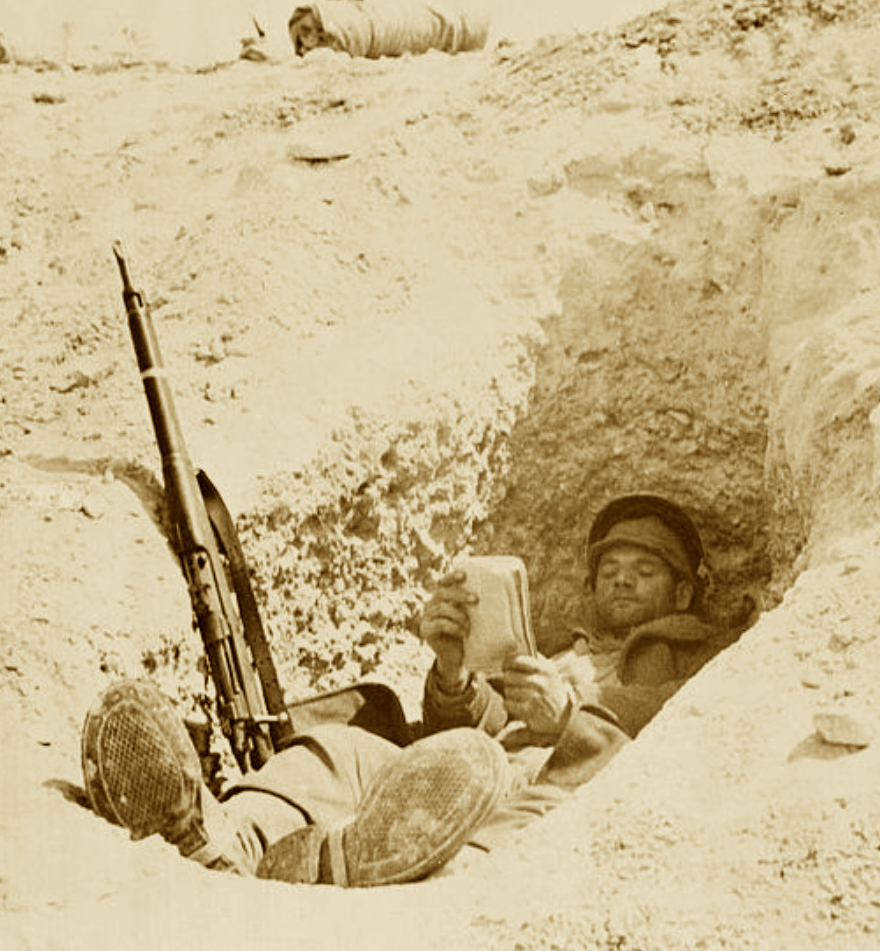
war book.png

Some would say “only a fool would bring a book to a gunfight.” That might be true if the person carried the book in lieu of a firearm, but the fact is many varieties of literature accompany soldiers to war.

When Edward Bulwer-Lytton wrote “the pen is mightier than the sword,” he offered a powerful insight into how ultimate victory hinges more on knowledge and ideas than on direct violence. Of course, he didn’t mean that in a personal conflict between two combatants a quill could best a saber.

Even those who’ve never been to war realize warriors need to have their bodies, minds and spirits renewed in order to be at their best when their lives hang in the balance. Bodies are taken care of by providing healthy sustenance, swift medical attention, and opportunities to remain fit.

Minds and spirits overlap somewhat, but for the latter, most of the world’s militaries send chaplains to accompany the men and women “in harm’s way.” Spiritual encouragement often comes even more readily from their fellow military members.

Wartime is, surprising no one, an optimal time for people to consider their spiritual wellbeing and contemplate their eternal destiny. Still, that does not make true the adage “there are no atheists in foxholes.”

That said, war zones are places where the fields are literally “white unto harvest” (Luke 4).

It is no accident copies of the Bible have accompanied Christians to war since the first printed copies were available.

During the American Civil War, personal Bibles and religious tracts were widely distributed. It was not uncommon for a soldier to send a particularly meaningful tract home to his family. In addition to chaplains, numerous ministries today work to ensure no service member who desires a Bible is without one.

Reading for the Mind

It would be wrong to think religious works dominate the literature available to military members dispatched to war. Most locations offer access to numerous publications, and even the internet. The Department of Defense even provides access to the nonpartisan Stars and Stripes, which offers some of its headline articles here.

And then there are books. Books of all genres, though perhaps, tilted towards thrillers and sports subjects. Soldiers pass their books around, and for many lucky enough to serve in a garrison type of setting, there is often a library.

Yes, a real library—except that the books are typically all available for free. This is due in large part to the generosity of publishers. During the Second World War, the Council on Books in Wartime, founded by publishers and others, provided over 120 million paperbacks in their Armed Services Editions. (The classic titles sold for an average of six cents.) The Council’s slogan was, “books are weapons in the war of ideas.”

So, military folks read lots of books overseas. In fact, here is a photo of yours truly reading one of my favorite authors (David Drake) while I was on a flight between Pakistan and Afghanistan back in 2002.

I was delighted recently when rereading C.S. Lewis’ autobiography to see that I was following in his footsteps. Lewis is discussing how actual books, and not merely periodicals, can accompany us on our journeys. He refers briefly to his war experiences.

Soon too we gave up the magazines; we made the discovery (some people never make it) that real books can be taken on a journey and that hours of golden reading can so be added to its other delights.

(It is important to acquire early in life the power of reading sense wherever you happen to be. I first read Tamburlaine while traveling from Larne to Belfast in a thunderstorm, and first read Browning’s Paracelsus by a candle which went out and had to be relit whenever a big battery fired in a pit below me, which I think it did every four minutes all that night.) (Surprised by Joy)

I would not equate our two situations. After all, a comfortable C-130 (even when making “combat” landings and take-offs) can hardly be compared to a muddy WWI trench.

But, like nearly all of Mere Inkling’s audience, I do share C.S. Lewis’ joy at knowing books need never be far from our hand. Whether it be on holiday, in the hospital, or even in prison (God forbid), we can always find some pleasure and peace in reading.


Postscript:

During Desert Storm, I helped ship thousands of donated books to troops on the front lines. Unfortunately, there was a problem with the clothing worn by most of the women on the covers. We learned the Saudis were destroying some of the books, deeming them pornography.

As a result, our book processors began tearing the cover off of every book featuring a woman. As a compromise, I offered to become an informal “Saudi censor.” With a large black marker, I was able to suitably cover up elements of the female anatomy that would have presumably offended our Middle East allies.

Despite my misgivings about “defacing” the covers, I felt it was less destructive than removing the entire cover. I’ll leave it to you to be the judge.

C.S. Lewis’ Hypocrisy

hypocrite

If you think the title of this column indicates what follows will be an attack on C.S. Lewis, you are wrong.

On the contrary, the incident described below actually emphasizes the integrity which guided Lewis’ life.

Hypocrisy afflicts us all. It’s hold is strongest, it seems to me, on those who claim they are completely free of the flaw. To paraphrase Jesus’ words recorded in John’s Gospel, “Let he who is without hypocrisy among you cast the first stone.”

It’s quite possible for our own flaws to be invisible to us. However, one of the requirements of being a moral individual is self-examination. The more honestly we can explore and assess our own actions and nature, the healthier we will be.

Some hypocrisy seems rather innocuous. For example in All My Road Before Me, Lewis describes a day in 1922 spent canoeing with his close friend Arthur, and Veronica FitzGerald Hinckley. Veronica was a recent graduate of Oxford.

In light of Lewis’ eventual life’s work, this diary entry is rather ironic:

[Veronica] made one good remark—that an educational career is a school of hypocrisy in which you spend your life teaching others observances which you have rejected yourself.

While academia does host its share of hypocrites, this vice also flourishes elsewhere. Tragically, of all the myriad contexts for hypocrisy, religious hypocrisy is the most ill-begotten.

Naturally, we would assume that basically “good” people are relatively free of hypocrisy. This is true. However, the key to uprooting these sinful influences begins with recognizing them.

In his autobiography, Surprised by Joy, Lewis acknowledges one of his most shameful acts. That it happened before his conversion to Christianity doesn’t lessen for him the wrongness of what he did.

And what was this great crime? It was on the occasion of his confirmation in the Anglican Church. Confirmation is a religious rite in which young people (particularly those in denominations which practice infant baptism) publicly profess, or confirm, their Christian faith. The problem arose because Lewis’ childhood faith had already been extinguished.

My [strained] relations to my father help to explain (I am not suggesting that they excuse) one of the worst acts of my life.

I allowed myself to be prepared for confirmation, and confirmed, and to make my first Communion, in total disbelief, acting a part, eating and drinking my own condemnation.

As Johnson points out, where courage is not, no other virtue can survive except by accident. Cowardice drove me into hypocrisy and hypocrisy into blasphemy.*

It is true that I did not and could not then know the real nature of the thing I was doing: but I knew very well that I was acting a lie with the greatest possible solemnity.

It seemed to me impossible to tell my father my real views. Not that he would have stormed and thundered like the traditional orthodox parent. On the contrary, he would (at first) have responded with the greatest kindness. “Let’s talk the whole thing over,” he would have said. But it would have been quite impossible to drive into his head my real position.

Lewis is sharing with us a sad episode of his life, to encourage us to confess our own transgressions and find forgiveness. After all, the last thing that God desires is people who just go through the motions—hypocrites who are “lovers of pleasure rather than lovers of God, having the appearance of godliness, but denying its power.” (1 Timothy 3:4-5)

A Final Warning

In The Screwtape Letters, we find the mature (and Christian) C.S. Lewis describing the sort of religious hypocrisy to which we fallen creatures are prone. Screwtape, the devil, is here advising his understudy on fostering hypocrisy in his “patient.” He has been telling Wormwood that he should nurture a sense of superiority in the person he has been assigned to tempt.

I have been writing hitherto on the assumption that the people in the next pew afford no rational ground for disappointment. Of course if they do—if the patient knows that the woman with the absurd hat is a fanatical bridge-player or the man with squeaky boots a miser and an extortioner—then your task is so much the easier.

All you then have to do is to keep out of his mind the question ‘If I, being what I am, can consider that I am in some sense a Christian, why should the different vices of those people in the next pew prove that their religion is mere hypocrisy and convention?’

You may ask whether it is possible to keep such an obvious thought from occurring even to a human mind. It is, Wormwood, it is! Handle him properly and it simply won’t come into his head.

He has not been anything like long enough with the Enemy [i.e. God] to have any real humility yet. What he says, even on his knees, about his own sinfulness is all parrot talk. At bottom, he still believes he has run up a very favourable credit-balance in the Enemy’s ledger by allowing himself to be converted, and thinks that he is showing great humility and condescension in going to church with these ‘smug,’ commonplace neighbours at all. Keep him in that state of mind as long as you can . . .

Hypocrisy is a powerful foe. But once it is recognized as the damning lie it is, hypocrisy loses its control over us. We are freed to rebuke it, repent of it, and be healed.

—-

* “For I received from the Lord what I also delivered to you, that the Lord Jesus on the night when he was betrayed took bread, and when he had given thanks, he broke it, and said, “This is my body, which is for you. Do this in remembrance of me.” In the same way also he took the cup, after supper, saying, “This cup is the new covenant in my blood. Do this, as often as you drink it, in remembrance of me.” For as often as you eat this bread and drink the cup, you proclaim the Lord’s death until he comes.

“Whoever, therefore, eats the bread or drinks the cup of the Lord in an unworthy manner will be guilty concerning the body and blood of the Lord. Let a person examine himself, then, and so eat of the bread and drink of the cup. For anyone who eats and drinks without discerning the body eats and drinks judgment on himself. That is why many of you are weak and ill, and some have died. But if we judged ourselves truly, we would not be judged.” (1 Corinthians 11:23-31)

C.S. Lewis at Belsen

belsen school

Boarding schools are somewhat rare in the United States. And that is a good thing.

C.S. Lewis attended three, and he considered two of them to be torturous. The first he came to refer to as Belsen, in reference to the deadly Nazi concentration camp. His older brother, Warnie, had moved to the same school when he too was nine, three years earlier.

The headmaster of Wynyard School in Hertfordshire was an Anglican priest named Robert Capron who was quite unhinged. In fact,

The school that [his father] Albert Lewis, after careful study and deep reflection, chose for his sons was run quite autocratically by a man who had already been prosecuted for cruelty to his students and who, within a very few years, would be certified as insane. (The Narnian)

Honestly, there is a proper place for boarding schools—as long as they are not operated by lunatics.

As I finished seminary, a window opened for my wife and me to serve on the “mission field.” After serious prayer, we told the missions agency that “we will happily serve in any nation, discharging any type of ministry duties . . . so long as our children can remain with us.”

Some people are willing to make even that sacrifice. And they not limited to those in ministry. When I was stationed in the United Kingdom, the United Stated Department of Defense operated its own boarding school for military dependents at RAF High Wycombe. (Canadians attended as well.)

Leaving a Mark

It’s no surprise boarding schools left a deep imprint on Lewis’ psyche. For seven-plus months of the year, they controlled nearly every aspect of his life, from “reveille” to slumber.

He wrote about the repercussions in a variety of places, most notably his autobiography,  Surprised by Joy: The Shape of My Early Life. During a recent rereading of the collection of essays in Present Concerns, I enjoyed “My First School.”

The essence of the essay is anticipation—anticipation of good events, such as holidays, and ominous occasions (in this case, the return to the schoolhouse). Before exploring that subject, Lewis sets the stage by briefly describing the grim environment at Belsen.

The Head [Rev. Capron] had, indeed, a grown-up son, a smooth-faced carpet-slipper sort of creature . . . a privileged Demi-god who ate the same food as his father though his sisters shared the food of the boys.

But we ourselves were . . . Beaten, cheated, scared, ill-fed . . .

Later, as a Christian adult, Lewis was able to glean some good even from these demoralizing days.

Life at a vile boarding school is, in this way, a good preparation for the Christian Life, that it teaches one to live by hope. Even, in a sense, by faith; for at the beginning of each term, home and holidays are so far off that it is as hard to realize them as to realize heaven. (Surprised by Joy)

It teaches one to live by hope.

In 1911 Lewis would be sent to a far better school, Cherbourg House in England. It was a prep school for Malvern College where he would follow his brother as a student. Although this school was healthier, it possessed its own shortcomings.

Cherbourg House was the tragic place where Lewis lost his childhood faith.

The chronology of this disaster is a little vague, but I know for certain that it had not begun when I went there and that the process was complete very shortly after I left. I will try to set down what I know of the conscious causes and what I suspect of the unconscious.

Most reluctantly, venturing no blame, and as tenderly as I would at need reveal some error in my own mother, I must begin with dear Miss C., the Matron. No school ever had a better Matron, more skilled and comforting to boys in sickness, or more cheery and companionable to boys in health. She was one of the most selfless people I have ever known. We all loved her; I, the orphan, especially.

Now it so happened that Miss C., who seemed old to me, was still in her spiritual immaturity, still hunting, with the eagerness of a soul that had a touch of angelic quality in it, for a truth and a way of life. Guides were even rarer then than now.

She was (as I should now put it) floundering in the mazes of Theosophy, Rosicrucianism, Spiritualism; the whole Anglo-American Occultist tradition. Nothing was further from her intention than to destroy my faith; she could not tell that the room into which she brought this candle was full of gunpowder.

I had never heard of such things before; never, except in a nightmare or a fairy tale, conceived of spirits other than God and men. I had loved to read of strange sights and other worlds and unknown modes of being, but never with the slightest belief . . .

But now, for the first time, there burst upon me the idea that there might be real marvels all about us, that the visible world might be only a curtain to conceal huge realms uncharted by my very simple theology. And that started in me something with which, on and off, I have had plenty of trouble since—the desire for the preternatural . . . (Surprised by Joy)

In closing with Lewis’ sad slide into atheism, this brief look at his experience in boarding schools affords us a sobering reminder.

Christian parents (indeed, all parents) are quite wise to be cautious about where they have their children schooled. After all, educators also expose their students to their particular worldviews.


I have written previously about education in the column “Were All Valedictorians!

For a brief consideration of Belsen’s influence on the Chronicles of Narnia, turn here.

Suicide as a Gateway to Paradise

hamas

I wonder what C.S. Lewis would have made of our twisted world in which some adherents of a globe-spanning “monotheistic tradition” believe they can enter heaven by spilling the blood of innocents.

Not long ago, a husband and wife in Indonesia, simultaneously attacked three different Christian churches. Yes, three. There, in the world’s largest Islamic nation, they killed all four of their own children to work ISIS-inspired jihad.  

The father blew himself up at one church in a car bomb. The two teenage sons exploded at a second congregation. And the woman who had given birth to these willing murders, ushered her 9 and 12 year old daughters into a Christian sanctuary and . . . 

CNN has some video related to the incident, accompany their article on the attacks. 

I’ve written about suicide in the past from two perspectives. This discussion considered the question in a general sense, and this piece was inspired by my own encounter with a suicide situation.

The horrific event describe above—the mass murder accomplished by a single family—leaves us speechless. How can this be? How can a group of people be so deceived as to think the suffering of others will purchase their entrance into heaven? How can they wantonly sacrifice their own children on that altar of hatred?

The only answer to these questions is that it is caused by evil. Not confusion, evil. And not even merely evil—but Evil. The precedent for such vile acts go all the way back to humanity’s first family.

We should not be like Cain, who was of the evil one and murdered his brother. And why did he murder him? Because his own deeds were evil and his brother’s righteous. (1 John 3:12)

A dozen victims died that morning. More than forty more were wounded. And this murder/suicide will surely not be the last of its kind.

C.S. Lewis’ View

Lewis was acquainted with evil. He recognized it bears many faces. Yet, it seems to me, that he too would find this murderous abomination incredible. Incredible in its most naked sense—impossible to believe.

I believe Lewis would be stunned. Just like we are. 

This is true, despite the fact that Lewis was prescient about the decay of the life-affirming core of civilization. In the words of an insightful article by Richard Weikart:

Many Christians recognize that we are living in a “culture of death,” where—especially in intellectual circles—there is easy acceptance of abortion and increasing support for physician-assisted suicide, infanticide, and euthanasia. . . . 

When C.S. Lewis cautioned about the dangers of dehumanizing secular ideologies in The Abolition of Man and his science fiction novel That Hideous Strength . . . on the whole, the intellectual world paid little heed, careening further down the fateful road against which Lewis warned. 

Few of us, by God’s mercy, see this sort of evil face-to-face. Military personnel and first responders are more likely to encounter it.

Despite our personal insulation from this violence, we too are targets of the Evil One. However, the tactics he employs against us are usually far more subtle and insidious. 

Lewis recognized this well. The Screwtape Letters is his masterful exploration of the way the Devil attempts to corrupt even those among us who do not believe in his existence. 

It does not matter how small the sins are provided that their cumulative effect is to edge the man away from the Light and out into the Nothing. Murder is no better than cards if cards can do the trick. Indeed the safest road to Hell is the gradual one—the gentle slope, soft underfoot, without sudden turnings, without milestones, without signposts . . .

No one who reads Mere Inkling will be tempted to immolate themselves. Much less to steal the life of innocents. Still, the more conscious we become of this world’s self-destructive inclinations, the better equipped we should become to consciously become life-affirming influences in our cultures. 

This, I believe, is our common prayer.

C.S. Lewis and the Sense of Smell

UK candle

Years after I was part of a Search and Recovery team at the site of a horrific airliner crash, images of the scene would flash into my mind. Strangely, they were seldom triggered by the things I saw or heard.

It was usually some unusual or unanticipated smell that ushered the sad memories to the forefront of my mind.

I know I am not alone in knowing the power of smells. Odors can evoke wholesome recollections from the past. Isn’t it amazing how we are reminded by some scent, of our mother’s or grandmother’s kitchens?

In 1915, C.S. Lewis wrote from his boarding school to his friend Arthur Greeves, referring to his longing to return home to Northern Ireland.

How I pity you people who never have known the pleasures and the pains—which are an integral part of the pleasures—of a regular interchange of home-coming and school going. . . .

These last few days! Every little nuiscance, every stale or tiresome bit of work, every feeling of that estrangement which I never quite get over in another country, serves as a delightful reminder of how different it will all be soon.

Already one’s mind dwells upon the sights and sounds and smells of home, the distant murmuring of the ‘yards,’ the broad sweep of the lough, the noble front of the cave hill, and the fragrant little glens and breazy meadows of our own hills!

And the sea! I cannot bear to live too far away from it. At Belfast, whether hidden or in sight, still it dominates the general impression of nature’s face, lending its own crisp flavour to the winds and its own subtle magic to horizons, even when they conceal it.

A sort of feeling of space, and clean fresh vigour hangs over all in a country by the sea: how different from the stuffiness of Bookham: here the wind—that is to say, the true, brisk, boisterous irresistable wind—never comes.

And yet, I would not for a moment disparage the beauty of Surrey: these slumbering little vallies, and quaint farmsteads have a mellow charm of their own, that Ulster has not.

C.S. Lewis employed the sense of smell in creative ways in his fiction. For example, consider the following episode from The Voyage of the Dawn Treader.

Lucy looked along the beam and presently saw something in it. At first it looked like a cross, then it looked like an aeroplane, then it looked like a kite, and at last with a whirring of wings it was right overhead and was an albatross.

It circled three times round the mast and then perched for an instant on the crest of the gilded dragon at the prow. It called out in a strong sweet voice what seemed to be words though no one understood them.

After that it spread its wings, rose, and began to fly slowly ahead, bearing a little to starboard. Drinian steered after it not doubting that it offered good guidance.

But no one except Lucy knew that as it circled the mast it had whispered to her, “Courage, dear heart,” and the voice, she felt sure, was Aslan’s, and with the voice a delicious smell breathed in her face.

Another, more mundane but quite effective, example from the Chronicles of Narnia appears in The Horse and His Boy.

But what Shasta chiefly noticed was the air. He couldn’t think what was missing, until at last he realized that there was no smell of fish in it.

For of course, neither in the cottage nor among the nets, had he ever been away from that smell in his life. And this new air was so delicious, and all his old life seemed so far away, that he forgot for a moment about his bruises and his aching muscles . . .

Curiously, a book entitled The Perception of Odors references Lewis in the opening paragraph of its introduction.

Before odor pollution became a widespread problem, the sense of smell received only cursory attention in scientific treatments of its psychology and physiology.

By contrast, writers like C.S. Lewis held this modality in higher esteem.

As Lewis commented in a discussion of the value of perceptual experience: “Of landscapes, as of people, one becomes more tolerant after one’s twentieth year. . . . We learn to look at them not in the flat but in depth as things to be burrowed into. It is not merely a question of lines and colors but of smells, sounds and tastes as well: I often wonder if professional artists don’t lose by seeing it in eye sensation only.”*

C.S. Lewis’ Hyposmia

More “mature” readers of Mere Inkling may be familiar with hyposmia, even if the word is new to them. It refers to a decreased ability to smell. Like many others, Lewis suffered from it during his life. (Anosmia is the inability to perceive any odor, and is not always permanent.)

In some of his correspondence during 1953, Lewis candidly describes his frustration with this ailment. The following appears in a letter to one of his editors.

Your friend thinks I am ‘smelling things’ in the same sense in which the D.T. (delirium tremens) patient ‘sees things.’ But it’s not quite as bad as that. My smell (ambiguous phrase) is subjective only in the sense that it does not come from the outer world.

There is a real physical stimulus within the body—a sinus discharging its corrupt humours just under the olfactory nerves. So don’t be alarmed lest in my next letter I tell you that a marsh-wiggle called on me or something of that sort.

The same year, he told another correspondent, “I have been neglecting everything except the bare minimum of routine duties for many months, being worn to a ravelling by continued sinusitis in all its varying phases of much catarrh and little pain, much pain and little catarrh, and (sometimes) much of both.

Leave it to Lewis to draw a lesson out of even such an unpleasant illness. He continues the same letter with this astute observation.

One may perhaps add that the internal smell (‘bad smell in the nose’ like ‘bad taste in the mouth’) is rather allegorical: the world seems to stink, but (as often) the real corruption is in the observer.

We might well think of this, the next time we are tempted to remark that the world stinks. Perhaps some part of the problem—even if it is infinitesimal—lies within us. Acknowledging this truth, we may have more patience with others and be more inclined to sincerely pray for the wellbeing of our neighbor.


*The final section of this quotation appears in volume 1 of The Collected Letters of C.S. Lewis as: “I often wonder if professional artists don’t lose something of the real love of earth by seeing it in eye sensations exclusively?”

I’m not quite sure how they capture the smells of various nations, especially since they are “made in small batches in the USA,” but Homesick® hasn’t forgotten our neighbor to the north.

Canada candle

C.S. Lewis and American Fjords

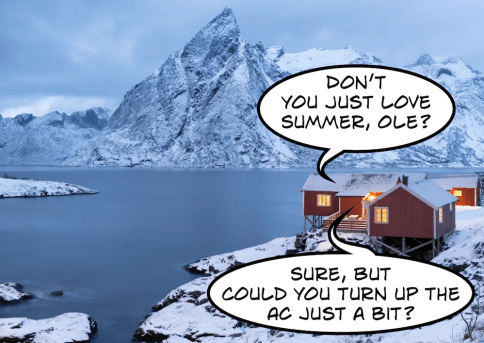
fjord

Norwegian immigrants to North America were a hardy breed, and some of their descendants continue to display that resilience.

When they came to the United States, they scoffed at the thought of heading southward where any average human being could survive. Instead, they flowed in great numbers to Minnesota and the Dakotas. Spawned near the arctic, they appreciated the balmy temperature of places like Sioux Falls and Fargo.

The Norwegianest of the immigrants chided their countrymen and women for settling in the tropics, and aimed higher than the United States. They opted to move to Canada, which was nearer their native land’s latitude. To make up for being closer to the equator, they compensated by settling in Canada’s harsh heartland where no ocean currents mediated the bitter cold.

Meanwhile, back in the States . . . as farmers continued to settle further west, some of them eventually happened upon paradise on earth. They crossed over the Rockies and Cascades and came to Puget Sound, a land with abundant coasts and shorelines which reminded them of the fjords back home. There the Norse placed deep roots.

Fjords are inherently impressive. In The Voyage of the Dawn Treader, C.S. Lewis describes encountering just such a body of water.

When morning came, with a low, gray sky but very hot, the adventurers found they were in a bay encircled by such cliffs and crags that it was like a Norwegian fjord.

In front of them, at the head of the bay, there was some level land heavily overgrown with trees that appeared to be cedars, through which a rapid stream came out. Beyond that was a steep ascent ending in a jagged ridge and behind that a vague darkness of mountains which ran into dull-colored clouds so that you could not see their tops.

The nearer cliffs, at each side of the bay, were streaked here and there with lines of white which everyone knew to be waterfalls, though at that distance they did not show any movement or make any noise.

Indeed the whole place was very silent and the water of the bay as smooth as glass. It reflected every detail of the cliffs.

Some of my own ancestors settled in the late 1800s in Poulsbo, a modest community that came to be known as “Little Norway.” They bore the familiar surname Olsen (Ole’s son). My grandfather married one of their descendants and our family name became Nesby (so revised because English’s stunted alphabet lacked two of the original name’s letters: Næsbø).

Following my retirement from the United States Air Force, I moved near to my family’s American homestead. However, I ended up living next to a rare geographic feature, a fjord.

It sounds reasonable that America would have fjords in Alaska, but Washington is home to a number of them as well. Much of Puget Sound was carved by glaciers that deeply scored the western portion of the state. Independent of these is a long inlet called Hood Canal. It is part of the Salish Sea.

This amazing fjord extends for approximately fifty miles. That makes it almost the length of Romsdalsfjord, Norway’s ninth longest fjord.

I absolutely love surveying the waters of Hood Canal. I suspect I was genetically preordained to feel at home here.

Fjords Appealed to C.S. Lewis Too

In 1958, C.S. Lewis described a visit he and his wife Joy had recently made to Ireland. They were awestruck by the scenery.

Yes, my wife and I had a glorious trip to Ireland. For one thing, we flew and it was for both of us a new experience. I can quite believe that for really long journies it can be dull and monotonous.

But one’s first sight of the cloud-scape from above—then, when the clouds cleared, the coastlines looking (as I’d never really quite believed) just as they do on maps—the first bit of Ireland shining out on the dark sea like enamel work—all this was indescribably beautiful. . . .

As for beauty . . . we saw mountains, heather just beginning to bloom, loughs (= fjords), yellow sand, fuchsia, seas Mediterraneanly blue, gulls, peat, ruins, and waterfalls as many as we could digest.

Lewis’ words serve as a reminder that while we may not all be so fortunate as to live beside a fjord, there is nothing to prevent us from visiting one to savor its wonder.