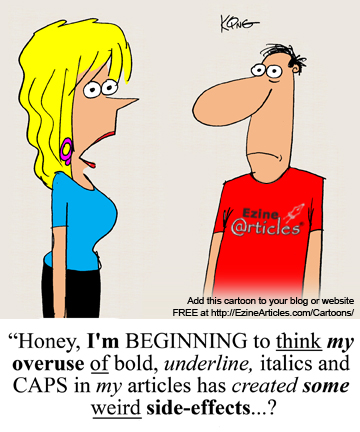
Emphasizing Italics

italicsSermons do not make great books. Sorry, but that’s the opinion of this pastor who has to compel himself to read the sermons of preachers.

Yes, some of them sell decently (when the author has a national “pulpit”). But I suspect many copies of those books are purchased out of support of their broader ministry. I imagine most purchasers try to wade through a few of the homilies, but decide after a while they prefer listening to the sermon “preached.”

As a lifelong student of communication, I continue to be intrigued by the different ways in which aural and printed word can be used to communicate the good news. The subject promises to be a major part of my dissertation research.

Sermons are meant to be delivered orally. Transposing them to the page, without making various accommodations, is (in my personal opinion) a mistake.

C.S. Lewis apparently agreed with me on that—before he came to disagree with the effort.

Ever since the rise of the keyboard, I have celebrated the ability to use italics for emphasis. I consider the availability of italics especially important when we translate spoken messages into text.

C.S. Lewis discussed this process in his preface to Mere Christianity. His focus was on how best to transpose words prepared for oral delivery to a written medium, while still maintaining their original voice.

The contents of this book were first given on the air, and then published in three separate parts as Broadcast Talks (1942), Christian Behaviour (1943) and Beyond Personality (1944).

In the printed versions I made a few additions to what I had said at the microphone, but otherwise left the text much as it had been. A “talk” on the radio should, I think, be as like real talk as possible, and should not sound like an essay being read aloud. In my talks I had therefore used all the contractions and colloquialisms I ordinarily use in conversation.

In the printed version I reproduced this, putting don’t and we’ve for do not and we have. And wherever, in the talks, I had made the importance of a word clear by the emphasis of my voice, I printed it in italics.

I am now inclined to think that this was a mistake—an undesirable hybrid between the art of speaking and the art of writing.

A talker ought to use variations of voice for emphasis because his medium naturally lends itself to that method: but a writer ought not to use italics for the same purpose. He has his own, different, means of bringing out the key words and ought to use them.

In this edition I have expanded the contractions and replaced most of the italics by a recasting of the sentences in which they occurred: but without altering, I hope, the “popular” or “familiar” tone which I had all along intended. I have also added and deleted where I thought I understood any part of my subject better now than ten years ago or where I knew that the original version had been misunderstood by others.

When one’s mentor advises something, it demands thoughtful consideration. Lewis’ opinion that the use of italics for emphasis is not ideal forced me to seriously consider the practice, which I obviously favor.

I agree with Lewis on expanding contractions. I learned that lesson when I wrote a paper during seminary studies and the professor instructed me to make that change.

However, I disagree about the use of italics. They need to be properly applied, of course. And I recognize that the most gifted of writers may be able to consistently avoid using them. (Or “leaning on them” as an anti-italics anarchist would probably say.)

In the end, I guess it is time to ponder again Lewis’ pronouncement that writers have their “own, different, means of bringing out the key words and ought to use them.”

Until I receive a divine mandate, C.S. Lewis notwithstanding, you should continue to expect to occasionally see italics here at Mere Inkling.

_____

The cartoon at the top of the page comes from an interesting site. You can find the original source for the image here. Just for the record, I hate ALL CAPS, and I absolutely despise underlining.

Corrupted Poetry

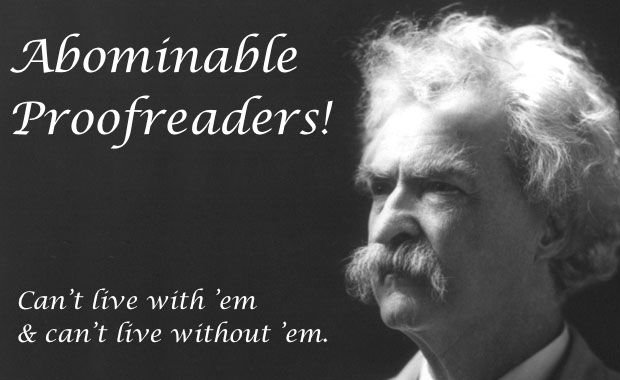
proofreadersA sloppy proofreader can ruin the most praiseworthy writing. (Just ask Mark Twain.)

If you’ve ever seen something you wrote poorly edited—or including introduced errors—you know personally just how criminal this is.

My choice of adjectives reveals that these tragedies are nearly always mistakes, and not malevolent. Despite that fact, they disrupt the flow and impugn the skill of truly good writers.

I was thinking about this subject today after running across the following passage during my research of the American Civil War. An 1861 newspaper lifted the following from an issue of the Boston Courier.

The Errors of the Press—“Really,” said a printer, in conversing with a literary man about errors of the press, “gentlemen should not place such unlimited confidence in the eyesight of our hard worked and half-blinded reader of proofs; for I am ashamed to say that we utterly ruined one poet through a ludicrous misprint.”

“Indeed! and what was the unhappy line?”

“Why, sir, the poet intended to say:

     ‘See the pale martyr in a sheet of fire;’

instead of which we made him say:

     ‘See the pale martyr with his shirt on fire.’”

The critics were down fierce on the poet; but we don’t see why. A man “with his shirt on fire” must be a highly poetical object, as his life would be in imminent danger.—Boston Courier.

I can easily picture the exhausted proofreader unintentionally substituting a burning garment for a consuming inferno. It made sense to him. And, since he was unlikely to have an ear tuned to poetic imagery, the practical reference to ignited clothing must be what the poet actually meant.

This reminds me that it’s impossible to have too many eyes cast upon the final draft of a work before it goes to print. Take care of your friends and family who offer you the gift of proofreading; their talents deserve to be appreciated and rewarded.

Mark Twain’s Thoughts on the Subject

Samuel Clemens got his own start in the newspaper business and knew firsthand how challenging proofreading was. However, that did not prevent him from venting about the poor proofreading of his novel More Tramps Abroad.

The following was written to his publishers in regard to the printer’s shortcomings. The 1897 letter clearly reveals Twain’s colorful (and occasionally vulgar) writing.

I give it up. These printers pay no attention to my punctuation. Nine-tenths of the labor & vexation put upon me by [them] consists in annihilating their ignorant & purposeless punctuation & restoring my own.

This latest batch [also has] my punctuation ignored & their insanities substituted for it. I have read two pages of it—I can’t stand any more. If they will restore my punctuation themselves & then send the purified pages to me I will read it for errors of grammar & construction—that is enough to require of another who writes as legible a hand as I do, & who knows more about punctuation in two minutes than any damned bastard of a proof-reader can learn in two centuries.

Conceive of this tumble-bug interesting himself in my punctuation—which is none of his business & with which he has nothing to do—& then instead of correcting mis-spelling, which is in his degraded line, striking a mark under the word & silently confessing that he doesn’t know what the hell to do with it!

The following year he wrote a mellower review of the work of the proofreader. Not in the heat of correcting a muddled manuscript, he was able to comment on the benefits afforded by good proofreading.

You think you are reading proof, whereas you are merely reading your own mind; your statement of the thing is full of holes & vacancies but you don’t know it, because you are filling them from your mind as you go along.

Sometimes—but not often enough—the printer’s proof-reader saves you–& offends you—with this cold sign in the margin: (?) & you search the passage & find that the insulter is right—it doesn’t say what you thought it did: the gas-fixtures are there, but you didn’t light the jets.

I must say that I have been rescued by my proofreaders far more frequently than I have been abused by them. May God grant you the same blessing.

Really Creative Writing

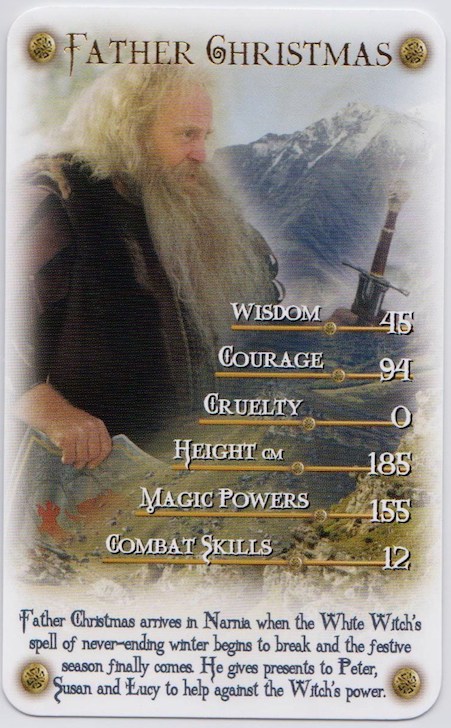
father christmasWhen did you first learn how to express yourself creatively? Some of us were blessed with parents who recognized the importance of things like music, art and literature. Others, alas, were not.

Most readers of Mere Inkling like to dabble in writing themselves. Many are quite skilled, and disciplined enough to persist with the demanding task of regularly composing interesting pieces for their own online columns. Some, in fact, are quite accomplished and successful in their personal literary efforts.

Becoming a good, truly good, writer requires experience. One may be born with the innate ability to become a Shakespeare or a Hemingway, but the skills need to be sharpened through effort. Study often helps, but it can never replace the necessity of practice in honing our writing.

It seems to me that the sooner we begin the process of unbridling our imaginations, translating our visions into words, and writing it all down in a way that engages the imaginings of others, the better we can become.

Many of you, especially Europeans, will be familiar with a gaming product that arose in the United Kingdom. They are called Top Trumps, and the cards come in a wide variety of themes. One set that I own is Narnia, from which the image at the top of this page comes.

Tolkien fans will be delighted to learn they just reissued a Lord of the Rings set that comes in an amazing Eye of Sauron tin. You can learn more about that unique item here.

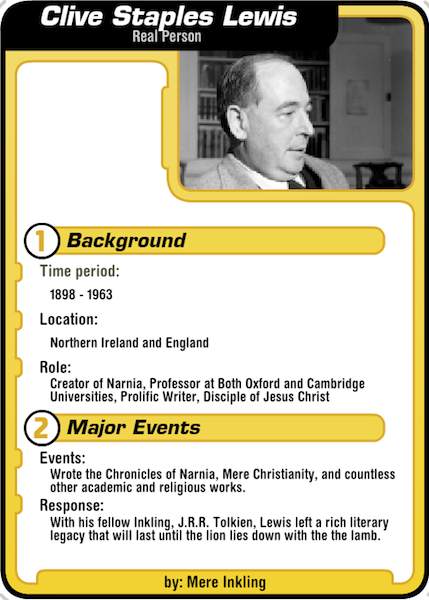
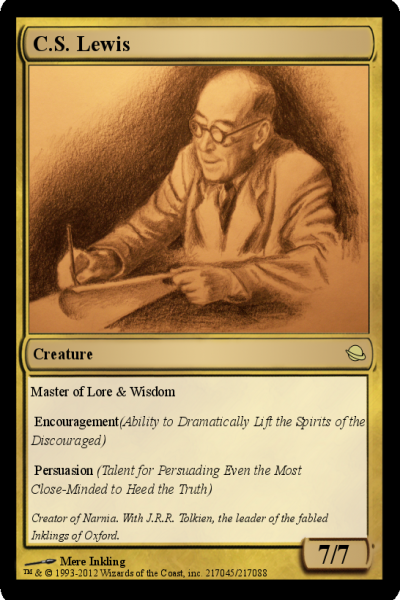
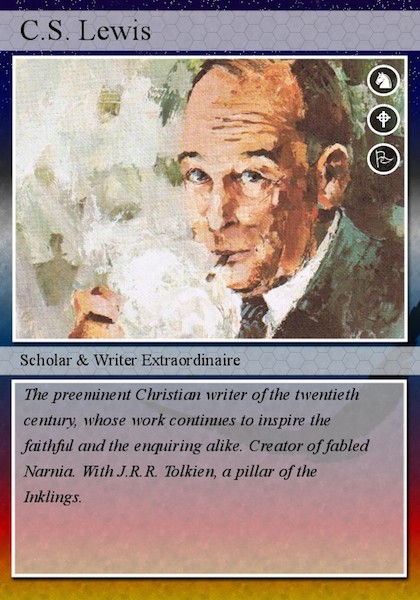
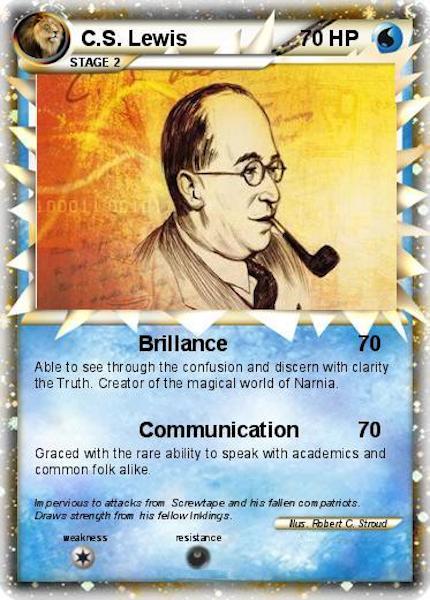
It was while thinking about my Narnia cards when I got the idea to see if there was an online mechanism for making one’s own playing cards. I was toying with the idea of fashioning a C.S. Lewis card to illustrate one of my posts.

I was actually searching online for a site where I could “create” such a card. I found several. Only later did I consider the irony of using that particular word.

For theologians, the word create bears profound significance. When it comes to the human activity of bringing together in some novel shape pre-existing images or ideas, it is not truly accurate. Lewis wrote about that in a 1943 letter to Sister Penelope.

‘Creation’ as applied to human authorship . . . seems to me an entirely misleading term. We . . . re-arrange elements He has provided. There is not a vestige of real creativity de novo in us. Try to imagine a new primary colour, a third sex, a fourth dimension, or even a monster which does not consist of bits of existing animals stuck together! Nothing happens.

And that surely is why our works (as you said) never mean to others quite what we intended: because we are re-combining elements made by Him and already containing His meanings. Because of those divine meanings in our materials it is impossible we should ever know the whole meaning of our own works, and the meaning we never intended may be the best and truest one.

Writing a book is much less like creation than it is like planting a garden or begetting a child: in all three cases we are only entering as one cause into a causal stream which works, so to speak, in its own way. I would not wish it to be otherwise.

Still, even though we are not true “creators,” it is enjoyable to rearrange the mundane elements (or words) of this life in fresh ways.

That’s one reason I was pleased to discover a website devoted to offering a “Trading Card Creator” hosted by the International Reading Association. It “gives students an alternative way to demonstrate their literacy knowledge and skill when writing about popular culture texts or real world examples.”
Why didn’t they have cool stuff like this when I was growing up? (If they did, I might be able to express myself better than by having to rely on phrases like “cool stuff.”)

Below you will find their website, along with a second option. I was thinking that my grandchildren might find it interesting to create a set of cards about our family tree. Their own sketches could be used for ancestors for whom we have no photograph. The comprehensive trading card creator maker offers a variety of templates, including for people, places, events and objects.

The template offered by the second site is generic enough that the cards can be produced in similar categories.

Unleash your imagination. And, after you’ve had some fun, consider sharing these links with a child you may know.

ReadWriteThink Trading Cards

Big Huge Labs Trading Cards

C.S. Lewis Card 3C.S. Lewis Card 2C.S. Lewis Card 1C.S. Lewis Card 4

One Person’s Joy, Another’s Curse

Dislike emoticonEmoticons. Some people love them. Others find them irritating. I’m in the latter camp. That’s why I enjoyed a comic in the paper this week.* A fifty-something husband and wife are talking as she’s typing on her desktop.

Jeannie: I wish I was a little more computer-literate.

Charlie: I don’t really care for that term.

Jeannie: Why not?

Charlie: I don’t like ascribing literacy to people who think emoticons are a part of speech.

I am forced to respond with a wholehearted “ditto!”

I find the evolution of alphabets fascinating. Primitive pictographs amaze me. Emoticons, not so much.

I have to admit that I occasionally use the primitive :) to indicate that something is intended to be humorous, rather than serious. It has served as useful shorthand for written speech, conveying what would be evident in the intonations of oral communication.

However, this nouveau-punctuation has mutated into an abomination. Today there are innumerable graphic variations of that once modest “smile.” And some of them are truly bizarre.

Emoticons run amuck are an evidence of humanity’s demand for novelty. In The Screwtape Letters, C.S. Lewis shows how an incessant demand for something new saps the joy out of the present moment. As the senior demonic tempter declares:

Now just as we pick out and exaggerate the pleasure of eating to produce gluttony, so we pick out this natural pleasantness of change and twist it into a demand for absolute novelty. This demand is entirely our workmanship. If we neglect our duty, men will be not only contented but transported by the mixed novelty and familiarity of snowdrops this January, sunrise this morning, plum pudding this Christmas. . . . Only by our incessant efforts is the demand for infinite, or unrhythmical, change kept up. This demand is valuable in various ways. In the first place it diminishes pleasure while increasing desire.

I realize it’s a bit of a stretch to apply this passage to the subject at hand, but the principle remains the same. When is enough enough? When it comes to emoticons, apparently, that level has yet to be reached. 

I am not seriously suggesting that there is a conspiracy going on here, but one never knows.

Please forgive me if I have offended any Mere Inkling readers who may suffer from emoticonaddiction or some other disorder. It is not my desire to upset you. Feel free to continue your unbridled (ab)use of these tiny monstrosities.

Simply include me (and C.S. Lewis) alongside Charlie in saying, “I don’t like ascribing literacy to people who think emoticons are a part of speech.”

Postscript: I must confess to finding one set of emoticons rather amusing. If you are familiar with Spock from Star Trek, you too may enjoy these Vulcan emoticons that exhibit the full range of Vulcan expression.

vulcan

_____

* You can see the strip I am referring to here.


Is More Better?

everettThat’s a trick question. More of some things certainly is better . . . more peace, more compassion. But more—even of good things—can sometimes become too much.

Case in point: words.

I continue to frustrate one of my critique group friends because I write “like a historian rather than a journalist.” The distinction being:

Journalist – Just the facts, please.
Historian – Lover of descriptions, details, esoterica, and trivia.

Guilty as charged.

C.S. Lewis commends the literary virtue of brevity. The following passage is found in his aptly named essay, “Before We Can Communicate.”

In the very process of eliminating from your matter all that is technical, learned, or allusive, you will discover, perhaps for the first time, the true value of learned language: namely, brevity. It can say in ten words what popular speech can hardly get into a hundred.

Last year marked the 150th Anniversary of one of the world’s most famous speeches. Not only Americans are familiar with Abraham Lincoln’s Gettysburg Address. It has become a monument to succinctness and power.

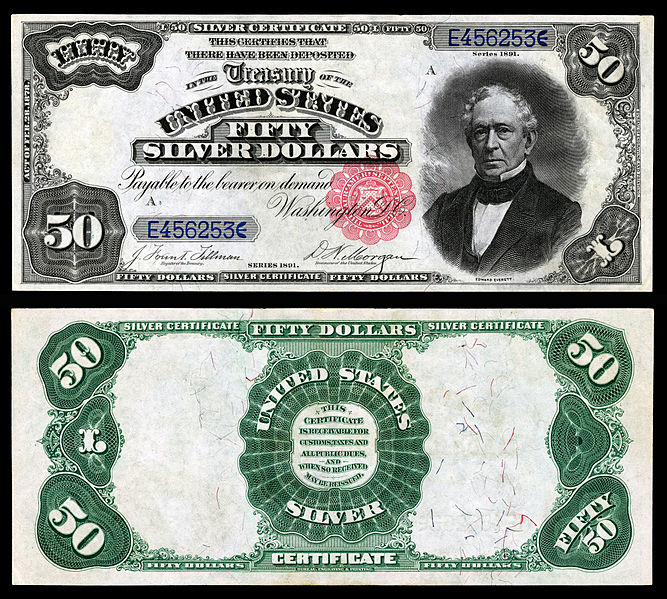
Rereading it recently I began to wonder about the other speech delivered at the event . . . the two hour oration delivered by Edward Everett, one of the era’s most highly regarded public speakers.*

The journalists and audience at the dedication of the Gettysburg National Cemetery were extremely impressed by Everett’s presentation, and surprised by the brevity of Lincoln’s remarks.

Following the event, both men lauded each other’s message. Lincoln responded to Everett’s note which praised him for the “eloquent simplicity & appropriateness” of his remarks. Everett said, “I should be glad, if I could flatter myself that I came as near to the central idea of the occasion, in two hours, as you did in two minutes.”

Your kind note of to-day is received. In our respective parts yesterday, you could not have been excused to make a short address, nor I a long one. I am pleased to know that, in your judgment, the little I did say was not entirely a failure. Of course I knew Mr. Everett would not fail; and yet, while the whole discourse was eminently satisfactory, and will be of great value, there were passages in it which transcended my expectation. The point made against the theory of the general government being only an agency, whose principals are the States, was new to me, and, as I think, is one of the best arguments for the national supremacy. The tribute to our noble women for their angel-ministering to the suffering soldiers, surpasses, in its way, as do the subjects of it, whatever has gone before.

I tracked down an online copy of Everett’s Gettysburg speech. I’ve skimmed it, and it is rather interesting. With the course of the war still undetermined at the time it was presented, it is easy to see how its stirring words could inspire an already war-weary nation. As he elaborates on the efforts of the Confederates to establish a new nation, he begs for patience. “Pardon me, my friends, for dwelling on these wretched sophistries.” Sophistries indeed.

The speech offers a partisan analysis of the entire course of the war up to that time. International readers of Mere Inkling may find the references to other countries interesting. He describes “civil wars” in England, Germany, Italy and France. Since he spoke during an era when Italy was still disunited, allow me to quote that portion of the speech.

In Italy, on the breaking up of the Roman Empire, society might be said to be resolved into its original elements–into hostile atoms, whose only movement was that of mutual repulsion. Ruthless barbarians had destroyed the old organizations, and covered the land with a merciless feudalism. As the new civilization grew up, under the wing of the Church, the noble families and the walled towns fell madly into conflict with each other; the secular feud of Pope and Emperor scourged the land; province against province, city against city, street against street, waged remorseless war with each other from father to son, till Dante was able to fill his imaginary hell with the real demons of Italian history.

So ferocious had the factions become, that the great poet-exile himself, the glory of his native city and of his native language, was, by a decree of the municipality, condemned to be burned alive if found in the city of Florence. But these deadly feuds and hatreds yielded to political influences, as the hostile cities were grouped into States under stable governments; the lingering traditions of the ancient animosities gradually died away, and now Tuscan and Lombard, Sardinian and Neapolitan, as if to shame the degenerate sons of America, are joining in one cry for a united Italy.

For those who are interested, this paragraph from Everett’s speech is only fifty-five words shorter than the entire Gettysburg Address.

Of course, just as being loquacious does not guarantee irrelevance, neither does brevity ensure quality.

The key is using the right number of words. That will vary from person to person.

In the twenty-first century, though, a good rule of thumb is to follow the example of Lincoln rather than his speechifying colleague.

_____
* Everett had a prolific political career. It included: U.S. House of Representatives, Governor of Massachusetts, U.S. Ambassador to the United Kingdom, U.S. Secretary of State, U.S. Senator. Oh, and he was also President of Harvard University, a job that probably included at least as much politics as his previous endeavors.

Discordant Dictionaries

dictionary 1Most “word people” like dictionaries. Some writers go so far as to love dictionaries, but I don’t wish to quibble about where one rests on the affection spectrum in terms of these repositories of words.

This guy, though, has to be pegged on the extreme (idolatry) end of the meter. Ammon Shea wrote Reading the OED: One Man, One Year, 21,730 Pages after having done just that. The Oxford English Dictionary, you may know, comprises 25 volumes, and Shea warns that reading it at such a rapid pace took a toll on his eyesight. It’s not surprising, that he admits he is not your typical reader.

One could say that I collect word books, since by last count I have about a thousand volumes of dictionaries, thesauri, and assorted glossaries. . . . I do not collect these words because I want to impress friends and colleagues with my erudition. . . .

My friends know that I read dictionaries for fun, and have come to accept this proclivity with relative good grace, but they are not terribly interested in or impressed by my word collection.

Pierre Jules Théophile Gautier advised his fellow poets to read the dictionary. No better way to enrich one’s language, he claimed, although he also read cook books, almanacs and the like. In fact, his biographer offered this fascinating observation.

He found pleasure in the most indifferent novels, as he did in books of the highest philosophical conceptions, and in works of pure science. He was devoured with the desire to learn, and said: “No conception is so poor, no twaddle so detestable that it cannot teach us something by which we may profit.”

C.S. Lewis indicated that so-called “definitions” offered outside the ordinances of the dictionary must be approached warily. “When we leave the dictionaries we must view all definitions with grave distrust” (Studies in Words). He offers a very sensible reason for such precautions.

It is the greatest simplicity in the world to suppose that when, say, Dryden defines wit or Arnold defines poetry, we can use their definition as evidence of what the word really meant when they wrote. The fact that they define it at all is itself a ground for scepticism.

Unless we are writing a dictionary, or a text-book of some technical subject, we define our words only because we are in some measure departing from their real current sense. Otherwise there would be no purpose in doing so (Studies in Words).

Dictionaries are, of course, their own genre. Lectionaries, collections of words and meanings, are different than any other type of written composition. For example, glossaries may draw together specialized vocabulary—say for medical or theological purposes—but by their very nature they are not intended to blaze any new literary pathways.

There is, invariably, an exception to this rule. Some “dictionaries” are creative exercises. They are works of fiction, and some are entertaining indeed.

The most famous of these satirical works is Ambrose Bierce’s Devil’s Dictionary (originally published as The Cynic’s Word Book). The volume is not expressly irreverent, although people of faith will encounter some offensive examples in its pages. However, a number of the entries are brilliant.

Kilt

  1. A costume sometimes worn by Scotchmen in America and Americans in Scotland.

Rank

  1. Relative elevation in the scale of human worth.

He held at court a rank so high

That other noblemen asked why.

“Because,” ’twas answered, “others lack

His skill to scratch the royal back.”

Emancipation

  1. A bondman’s change from the tyranny of another to the despotism of himself.

He was a slave: at word he went and came;

     His iron collar cut him to the bone.

Then Liberty erased his owner’s name,

     Tightened the rivets and inscribed his own.

Goose

  1. A bird that supplies quills for writing. These, by some occult process of nature, are penetrated and suffused with various degrees of the bird’s intellectual energies and emotional character, so that when inked and drawn mechanically across paper by a person called an “author,” there results a very fair and accurate transcript of the fowl’s thought and feeling. The difference in geese, as discovered by this ingenious method, is considerable: many are found to have only trivial and insignificant powers, but some are seen to be very great geese indeed.

Another Frenchman, Gustave Flaubert, composed his Dictionary of Received Ideas, which found humor in peculiarities of common understandings.

Absinthe

Extra-violent poison: one glass and you’re dead. Newspapermen drink it as they write their copy. Has killed more soldiers than the Bedouin.

Archimedes

On hearing his name, shout “Eureka!” Or else: “Give me a fulcrum and I will move the world.” There is also Archimedes’ screw, but you are not expected to know what it is.

Omega

Second letter of the Greek alphabet. [Note: this would only apply to biblically literate societies.]

The earliest such example of a satirical dictionary was that by the Persian writer Nezam od-Din Ubeydollah Zâkâni. I have not located a copy of his 14th century lexicon, but it apparently includes entries that are still understandable in our modern world.

Thought

What uselessly makes people ill.

Orator

A donkey.

Word lovers can easily get caught up in conversations like this. In fact, I’m certain more than one Mere Inkling reader has contemplated compiling their own creative dictionary! It’s not an insurmountable project, since it’s accomplished one word at a time.

_____

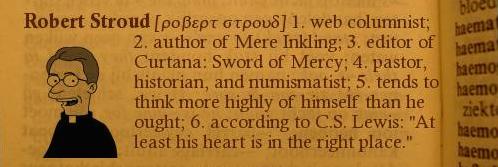
For those desiring to create their own dictionary “entries” such as the one that graces the top of this blog, there a free meme generator you can use online. Available here, it’s a fun little tool. It’s also suitable for creating a little self-deprecating humor.

dictionary 2

Unintentional Acrostics

letterSome writers sweat to find precisely the right word, the one that expresses the unique meaning and tone we seek to convey. We often fail, as the reference to perspiration in my first sentence readily reveals. A recent observation from the executive editor of First Things  provides me with another crippling concern.

“This for those interested in how magazines work. My son Christopher pointed out that the initial capital letters on a two-page spread . . . spelled “a wit.” Which was kind of nice. Accidental, but nice. And then I thought: Suppose some day we accidentally spelled out a rude four-letter word? Now, after the magazine is laid out, one of the junior fellows reads through the magazine to make sure we haven’t accidentally made a word that will embarrass us. It’s a small thing, and probably paranoid, but here paranoia equals prudence.”

Unless each writer maintains constant vigilance, since most of us don’t have “junior fellows” to assign the duty, it’s quite possible for unintentional acrostics to slip into our work. Like the seamen in the crow’s nest of the Titanic—I just watched a new documentary on the subject last night—we can easily miss the veiled iceberg which threatens to sink our best effort.

Prone as we are to playing with the depths of individual words, we are normally sensitive to the fact more than 90% of a word’s value in a particular context may lie beneath the surface. That does not mean, however, that we always see the larger picture.

It is not uncommon for a writer to become almost paralyzed while composing something, when the ideal word continues to elude us. It is almost “literally” painful to have to settle for a substitute, when we suspect the perfect word is floating somewhere just beyond our reach.

Dodging mundane words is not easy. They are common, in part at least, because they are so simple and easy to plug into sentences. And so, we “go” to the store, when we might just as easily “drive,” “walk,” “ride,” or even “hitchhike.” A movie is described as “good,” when readers would value a vivid word, such as, “suspenseful,” “hilarious,” “complex,” “moving,” or even “groundbreaking.”

Reflections on the Psalms, one of C.S. Lewis’ gems, explores the beauty of the Bible’s hymnal. “The Psalms,” he notes, “are poems, and poems intended to be sung: not doctrinal treatises, nor even sermons.” Because of this, they have nourished the worship lives of Jew and Christian alike, for thousands of years.

Even without a theological education, Lewis offers great insight into the Psalms. “I am no Hebraist, no higher critic, no ancient historian, no archaeologist.” He candidly discusses passages he initially found difficult to embrace, as well as those which soar to spiritual and poetic heights. The following comes from his discussion of Psalm 119, which is skillfully composed around an alphabetic acrostic.

“As everyone knows, the Psalm specially devoted to the Law is 119, the longest in the whole collection. And everyone has probably noticed that from the literary or technical point of view, it is the most formal and elaborate of them all. The technique consists in taking a series of words which are all, for purposes of this poem, more or less synonyms (word, statutes, commandments, testimonies, etc.), and ringing the changes on them through each of its eight-verse sections—which themselves correspond to the letters of the alphabet. . . . this poem is not, and does not pretend to be, a sudden outpouring of the heart like, say, Psalm 18. It is a pattern, a thing done like embroidery, stitch by stitch, through long, quiet hours, for love of the subject and for the delight in leisurely, disciplined craftsmanship.”

Done like embroidery, stitch by stitch.” Many writers, I suspect, will appreciate that description. While we are sometimes forced to throw something together in a rush, the patchwork results offend our sensitivities.

Even when writing rather pedestrian things like much of our email correspondence, most writers seek to employ lively verbiage. It’s a valuable exercise, after all, to consider the pace of all of our work, and not simply those words we hope to see “published.” And, having written something worth reading, there is one more consideration.

Reviewing what we have written is well worth the time required. And, as Editor David Mills suggested in First Things, our examination should include any unintentional acrostics we may have created. After all, no respectable writer would ever wish to, even accidentally, offend their readers.

Having Our Writing Criticized

roeShould literary critics look down on authors whose work proves popular with “common” people? Is it appropriate for the literary elite to smirk dismissively whenever the prose of a writer outside their circle resonates with the masses?

These, my friends, are rhetorical questions. The answer to both is “no,” and if you believe otherwise, you probably won’t find yourself too comfortable with the opinions shared here at Mere Inkling.

I believe each piece of literature, regardless of its source, should be judged on its own merits. Not all genres appeal to all people. And not all writers compose their works with equal skill. Nevertheless, it is possible for even a poor miner to strike gold.

Likewise, an accomplished writer is not infallible. Even a master wildcatter can sink a dry well.

I’ve been writing an article about Civil War chaplain who became one of America’s most popular writers during the nineteenth century. In fact, many years his novels outsold the works of Samuel Clemens himself.

And yet, despite his success—or possibly, because average people enjoyed his stories—he received an extraordinary amount of criticism from the literary establishment.

I’m going to share his insights about writing in a moment, but  before doing so, I want to draw a parallel with one of the twentieth century’s most gifts authors. C.S. Lewis was loved by common women and men of Britain and other English-speaking countries. And yet, this very popularity undermined his standing in the world of academia and, I daresay, literary snobbery.

Lewis describes this condescending mindset in a 1939 essay entitled, “High Brows and Low Brows.”

The great authors of the past wrote to entertain the leisure of their adult contemporaries, and a man who cared for literature needed no spur and expected no good conduct marks for sitting down to the food provided for him.

Boys at school were taught to read Latin and Greek poetry by the birch, and discovered the English poets as accidentally and naturally as they now discover the local cinema. Most of my own generation, and many, I hope, of yours, tumbled into literature in that fashion.

Of each of us some great poet made a rape when we still wore Eton collars. Shall we be thought immodest if we claim that most of the books we loved from the first were good books and our earliest loves are still unrepented? If so, that very fact bears witness to the novelty of the modern situation; to us, the claim that we have always liked Keats is no prouder than the claim that we have always liked bacon and eggs. For there are changes afoot.

I foresee the growth of a new race of readers and critics to whom, from the very outset, good literature will be an accomplishment rather than a delight, and who will always feel, beneath the acquired taste, the backward tug of something else which they feel merit in resisting.

Such people will not be content to say that some books are bad or not very good; they will make a special class of “lowbrow” art which is to be vilified, mocked, quarantined, and sometimes (when they are sick or tired) enjoyed. They will be sure that what is popular must always be bad, thus assuming that human taste is naturally wrong, that it needs not only improvement and development but veritable conversion.

For them a good critic will be, as the theologians say, essentially a “twice-born” critic, one who is regenerate and washed from his Original Taste. They will have no conception, because they have had no experience, of spontaneous delight in excellence.

I confess I’ve sometimes felt slightly embarrassed when in the presence of a group of people singing the praises of authors of fiction popular among the well-educated. Sometimes I don’t even recognize their names, much less have an idea of what they have written.

Part of my “handicap” rises from the fact that I’m by and large a non-fiction sort of guy. As seminary I was less enraptured by abstract “systematic theology” than the time-proven lessons learned during the Church’s two millennia history. Likewise, I found “practical theology” far more beneficial. After all, I was being equipped not to be a theologian per se, but to become a shepherd entrusted with the cura animarum (the cure of souls).

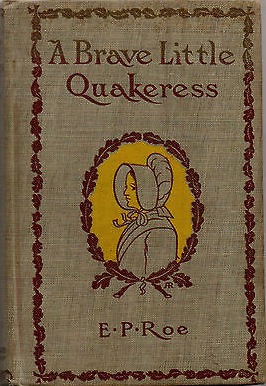
In that spirit, valuing history and lessons I could put into practice as a pastor and writer, I have been researching the legacy of Edward Payson Roe (1838-1888). He was a Presbyterian pastor who served as a chaplain in the Union cavalry, and later as a military hospital chaplain.

After the war, Roe served a congregation, and eventually turned his energies to writing wholesome fiction. He played a key role in helping many suspicious Protestants realize that, like manna, fiction was neither good nor bad. It’s effects depended on the use to which it was put. Roe proved quite popular with readers. Less so with the literary establishment.

The following account comes from an essay about his life solicited by one of the prominent magazines of his day. It is well worth reading, touching as it does on a broad range of subjects, including international copyrights and the vagaries of publishing in the late 1800s. Most precious, though, are the echoes of Roe’s humility and his realistic understanding of the vocation of writing.

“While writing my first story, I rarely thought of the public, the characters and their experiences absorbing me wholly. When my narrative was actually in print, there was wakened a very deep interest as to its reception. I had none of the confidence resulting from the gradual testing of one’s power or from association with literary people, and I also was aware that, when published, a book was far away from the still waters of which one’s friends are the protecting headlands.

“That I knew my work to be exceedingly faulty goes without saying; that it was utterly bad, I was scarcely ready to believe. Dr. Field, noted for his pure English diction and taste, would not publish an irredeemable story, and the constituency of the New York ‘Evangelist’ is well known to be one of the most intelligent in the country.

“Friendly opinions from serial readers were reassuring as far as they went, but of course the great majority of those who followed the story were silent. A writer cannot, like a speaker, look into the eyes of his audience and observe its mental attitude toward his thought. If my memory serves me, Mr. R.R. Bowker was the earliest critic to write some friendly words in the ‘Evening Mail;’ but at first my venture was very generally ignored.

Then some unknown friend marked an influential journal published in the interior of the State and mailed it so timely that it reached me on Christmas eve. I doubt if a book was ever more unsparingly condemned than mine in that review, whose final words were, ‘The story is absolutely nauseating.’ In this instance and in my salad days I took pains to find out who the writer was, for if his view was correct I certainly should not engage in further efforts to make the public ill.

“I discovered the reviewer to be a gentleman for whom I have ever had the highest respect as an editor, legislator, and honest thinker. My story made upon him just the impression he expressed, and it would be very stupid on my part to blink the fact. Meantime, the book was rapidly making for itself friends and passing into frequent new editions. Even the editor who condemned the work would not assert that those who bought it were an aggregation of asses. People cannot be found by thousands who will pay a dollar and seventy-five cents for a dime novel or a religious tract.

“I wished to learn the actual truth more sincerely than any critic to write it, and at last I ventured to take a copy to Mr. George Ripley, of the New York ‘Tribune.’ ‘Here is a man,’ I thought, ‘whose fame and position as a critic are recognized by all. If he deigns to notice the book, he will not only say what he thinks, but I shall have much reason to think as he does.’ Mr. Ripley met the diffident author kindly, asked a few questions, and took the volume. A few weeks later, to my great surprise, he gave over a column to a review of the story. Although not blind to its many faults, he wrote words far more friendly and inspiring than I ever hoped to see; it would seem that the public had sanctioned his verdict

“From that day to this these two instances have been types of my experience with many critics, one condemning, another commending. There is ever a third class who prove their superiority by sneering at or ignoring what is closely related to the people. Much thought over my experience led to a conclusion which the passing years confirm: the only thing for a writer is to be himself and take the consequences. Even those who regard me as a literary offender of the blackest dye have never named imitation among my sins.

“As successive books appeared, I began to recognize more and more clearly another phase of an author’s experience. A writer gradually forms a constituency, certain qualities in his book appealing to certain classes of minds. In my own case, I do not mean classes of people looked at from the social point of view. A writer who takes any hold on popular attention inevitably learns the character of his constituency. He appeals, and minds and temperaments in sympathy respond. Those he cannot touch go on their way indifferently; those he offends may often strike back. This is the natural result of any strong assertion of individuality.

“Certainly, if I had my choice, I would rather write a book interesting to the young and to the common people, whom Lincoln said ‘God must love, since He made so many of them.’ The former are open to influence; the latter can be quickened and prepared for something better. As a matter of fact, I find that there are those in all classes whom my books attract, others who are repelled, as I have said.

“It is perhaps one of the pleasantest experiences of an author’s life to learn from letters and in other ways that he is forming a circle of friends, none the less friendly because personally unknown. Their loyalty is both a safeguard and an inspiration. On one hand, the writer shrinks from abusing such regard by careless work; on the other, he is stimulated and encouraged by the feeling that there is a group in waiting who will appreciate his best endeavor.

“While I clearly recognize my limitations, and have no wish to emulate the frog in the fable, I can truthfully say that I take increasing pains with each story, aiming to verify every point by experience—my own or that of others. Not long since, a critic asserted that changes in one of my characters, resulting from total loss of memory, were preposterously impossible. If the critic had consulted Ribot’s ‘Diseases of Memory,’ or some experienced physician, he might have written more justly.

“I do not feel myself competent to form a valuable opinion as to good art in writing, and I cannot help observing that the art doctors disagree woefully among themselves. Truth to nature and the realities, and not the following of any school or fashion, has ever seemed the safest guide. I sometimes venture to think I know a little about human nature. My active life brought me in close contact with all kinds of people; there was no man in my regiment who hesitated to come to my tent or to talk confidentially by the campfire, while scores of dying men laid bare to me their hearts. I at least know the nature that exists in the human breast.

“It may be inartistic, or my use of it all wrong. That is a question which time will decide, and I shall accept the verdict. Over twelve years ago, certain oracles, with the voice of fate, predicted my speedy eclipse and disappearance. Are they right in their adverse judgment? I can truthfully say that now, as at the first, I wish to know the facts in the case. The moment an author is conceited about his work, he becomes absurd and is passing into a hopeless condition. If worthy to write at all, he knows that he falls far short of his ideals; if honest, he wishes to be estimated at his true worth, and to cast behind him the mean little Satan of vanity. If he walks under a conscious sense of greatness, he is a ridiculous figure, for beholders remember the literary giants of other days and of his own time, and smile at the airs of the comparatively little man. On the other hand, no self-respecting writer should ape the false deprecating ‘’umbleness’ of Uriah Heep. In short, he wishes to pass, like a coin, for just what he is worth.

“Mr. Matthew Arnold was ludicrously unjust to the West when he wrote, ‘The Western States are at this moment being nourished and formed, we hear, on the novels of a native author called Roe.’ Why could not Mr. Arnold have taken a few moments to look into the bookstores of the great cities of the West, in order to observe for himself how the demand of one of the largest and most intelligent reading publics in the world is supplied? He would have found that the works of Scott and Dickens were more liberally purchased and generally read than in his own land of ‘distinction.’ He should have discovered when in this country that American statesmen (?) are so solicitous about the intelligence of their constituents that they give publishers so disposed every opportunity to steal novels describing the nobility and English persons of distinction; that tons of such novels have been sold annually in the West, a thousand to one of the ‘author called Roe.’

“The simple truth in the case is that in spite of this immense and cheap competition, my novels have made their way and are being read among multitudes of others. No one buys or reads a book under compulsion; and if any one thinks that the poorer the book the better the chance of its being read by the American people, let him try the experiment. When a critic condemns my books, I accept that as his judgment; when another critic and scores of men and women, the peers of the first in cultivation and intelligence, commend the books, I do not charge them with gratuitous lying. My one aim has become to do my work conscientiously and leave the final verdict to time and the public. I wish no other estimate than a correct one; and when the public indicate that they have had enough of Roe, I shall neither whine nor write.”

_____

If you are interested in learning more about E.P. Roe, check out my article in the new issue (4.2) of Curtana: Sword of Mercy which was published online just last week.

Chocolate Mushrooms

mushroomThat’s right, chocolate mushrooms. And it gets worse.

Some flavors are not intended to ever be combined. Years ago, some friends who knew I loved chocolate and despised mushrooms found the perfect gift for me. Chocolates shaped like mushrooms.

There was only one small problem. The chocolates were actually mushroom-flavored. Imagine a chocolate bar melted into a can of cream of mushroom soup, and you get the idea.

Even people like my wife who love both distinct tastes, couldn’t stomach the blend.

Well, a new product has entered the market and it immediately reminded me of that unsavory fiasco.

A company in Hawaii has capitalized on merging two very flavors that are popular in many locales but just sound a wee bit incompatible. They have taken the delectable taste and gentle crunch of macadamia nuts and accented them with the aromatic zest of spam.

That’s right. Spam-flavored macadamia nuts. They sound irresistible, don’t they?

Probably not. But then, most readers of Mere Inkling aren’t in the target audience of Hamakua Macadamia Nut Company. The fact is—and those of us who’ve experienced the joy of living in the Pacific and Micronesia know this well—there are vast numbers of people who absolutely love spam.

I actually don’t have an objection to either of these products . . . individually. Spam casserole was a staple in the home of my youth, and I can eat it with pleasure today. Macadamias still seem a bit exotic and shipping costs make them a bit pricier than most of their competition, but they taste great.

Two wonderful flavors. Logic tells us that if they are both good alone, they’ll be even better together!

But some things were never meant to be combined.

Then again, some different qualities are magnificent when they are brought together. This is especially true when it comes to the art of writing.

Evelyn Underhill, a gifted author in her own right, composed a letter to C.S. Lewis in 1938 praising him for his recently released Out of the Silent Planet.

It is so seldom that one comes across a writer of sufficient imaginative power to give one a new slant on reality: & this is just what you seem to me to have achieved. And what is more, you have not done it in a solemn & oppressive way but with a delightful combination of beauty, humour & deep seriousness. I enjoyed every bit of it, in spite of starting with a decided prejudice against “voyages to Mars.”

“Beauty, humor, and deep seriousness . . .” Traits those of us who love Lewis’ work have come to expect. In great quantity. And we are not disappointed.

Good writing can excel in a single dimension. Great writing, it seems to me, earns that appellation by weaving together a variety of strong “flavors.”

It’s like comparing a superb violin solo to a flawless symphony. Part of the wonder of the latter is the skill with which each disparate element combines into a glorious whole.

Or, returning to the culinary realm with which we began, powerful writing properly combines distinct flavors that complement one another . . . such as chocolate and peanut butter, or spam and . . . Well, I trust I’ve made my point.

Poetry for Geeks

csl ipadThe word “Geeks,” we know, is no longer an insult. It often refers to those über-intelligent folks who author the invisible “codes” that make computer software work.

Their mystical incantations make the modern world go round.

Two years ago some creative programmers decided to invent a new genre of poetry. It’s called “code poetry,” and they’ve published a collection entitled code {poems}.

It’s an intriguing genre, but the examples I’ve read suggest that you need to have at least an elementary understanding of programming languages to truly appreciate the poems. Consider “Dailygrind.”

DAILYGRIND

by Paul Illingworth (// Java)

import java.util.Date;

public class DailyGrind {


   public static final void main(String[] args) {


        boolean its_time_to_go_home = false;


         boolean away_the_hours = true;


        while (away_the_hours) {


              Date now = new Date();


               its_time_to_go_home = now.getHours() > 17


                         && now.getMinutes() > 30;


              if (its_time_to_go_home) {


                   break;


               }


      try {


                   Thread.sleep(60000);


               } catch (InterruptedException e) {


                   // ignore


               }


          }


     }


}

As I understand it, the code needs to (1) be functional (i.e. it has to actually work on a computer), and to (2) possess a lyrical essence.

Boasting no programming skills, I find it rather confusing. Then again, I’ve been confused by other examples of atypical poetry. I guess I’m a poor judge on the matter.

C.S. Lewis, on the other hand, was an expert on nearly all things literary. Although he died before the development of the internet, I would be curious to see how he would measure this novel approach to verse.

Although he was little praised for his poetic forays, Lewis penned a number of poems. Some are sprinkled throughout his writings, and others were compiled after his passing by Walter Hooper. The collection Poems is quite enjoyable. And Hooper’s preface to the collection is very informative.

He relates a delightful example of Lewis’ poetic admission that he found a particular poetic image particularly inappropriate.

The fact that he did not publish these poems during his lifetime suggests that Lewis was hesitant about their publication. He knew his poems were very unlike most contemporary verse. Because of this, he could not be certain of the reaction of his readers. The answer is not far to seek. In the poem, “A Confession,” Lewis says with ironical disappointment:

I am so coarse, the things the poets see

Are obstinately invisible to me.

For twenty years I’ve stared my level best

To see if evening—any evening—would suggest

A patient etherized upon a table;

In vain. I simply wasn’t able.

Lewis found Mr Eliot’s comparison of an evening to a patient on an operating table unpleasant, one example of the decay of proper feelings. He mistrusted, in fact, the free play of mere immediate experience. He believed, rather, that man’s attitudes and actions should be governed by, what he calls in the same poem, Stock Responses (e.g. love is sweet, death bitter, and virtue lovely).

Man must, for his own safety and pleasure, be taught to copy the Stock Responses in hopes that he may, by willed imitation, make the proper responses. He found this perfectly summed up in Aristotle’s “We learn how to do things by doing the things we are learning to do.”

Returning to the question of what Lewis might have thought of code poetry, I suspect he would be just as mystified as I am. Still, depending on how each individual poem resonates with the stock responses to which Hooper alludes . . . perhaps Lewis would embrace some of them as worthy expressions of a genuinely poetic heart.

_____

The T.S. Eliot poem to which Lewis was responding, “The Love Song of J. Alfred Prufrock,” was published in 1915. If you are up to the challenge of interpreting it, you can read it here.