Choosing Trustworthy Fonts

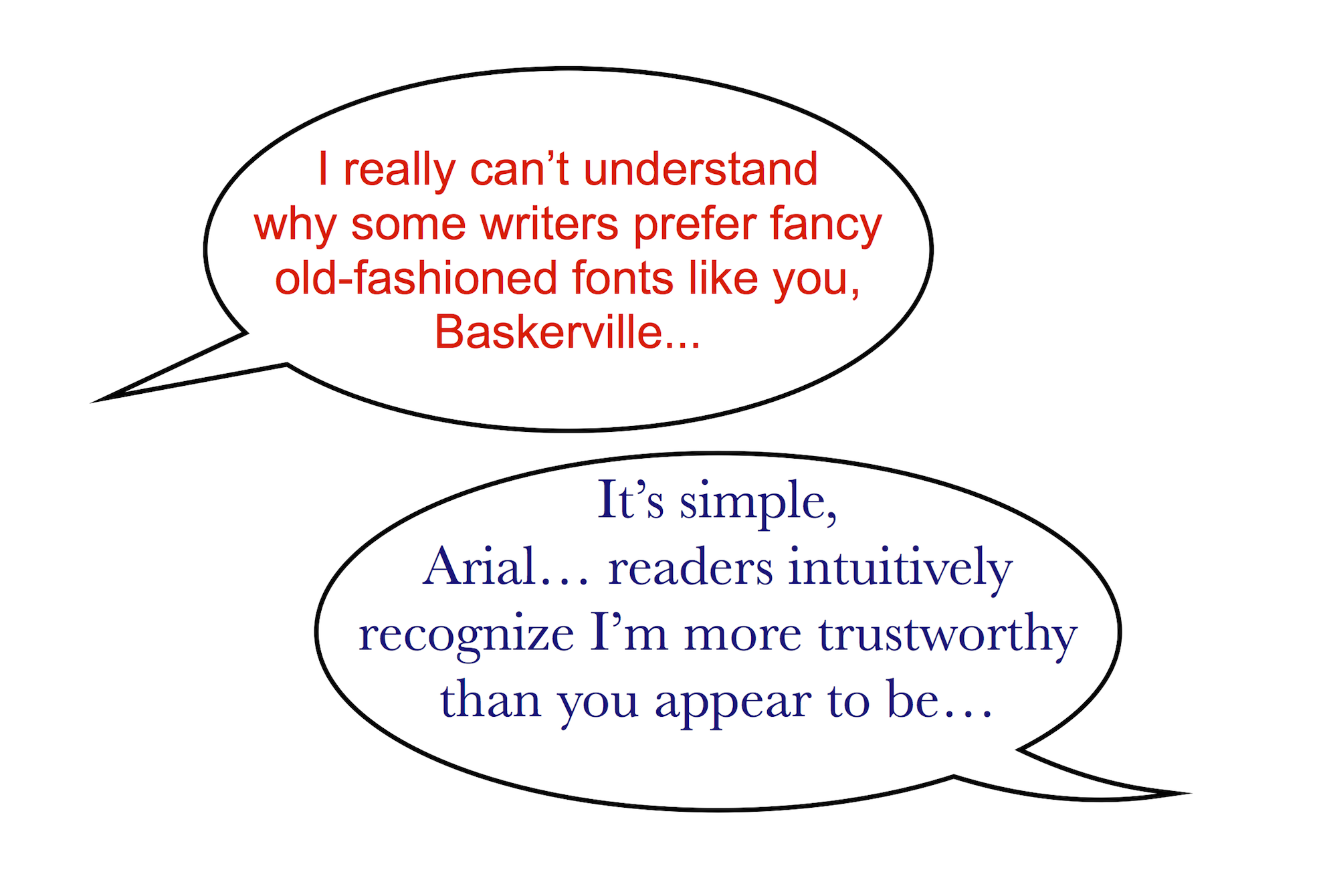
font conversationDo you want readers to trust what you write? If so, beware of using common fonts like Arial and Helvetica.

It turns out that serif fonts (those with more traditional finishing strokes) are not simply more legible than their sans serif counterparts.

There is evidence that serif fonts also contribute to the confidence people feel they can place in what they read. You can read a brief account of the research in “Can a Font Make Us Believe Something is True?

The brief article linked above refers to the results of a study conducted in the New York Times.

The experiment revealed dual effects of using serif fonts. They increased the intensity of agreement with statements, and they reduced the intensity of those who disagreed with the statements.

For many writers, fonts barely register as a consideration. For others, such as yours truly, they are an object of fascination. (Not obsession.) Mere Inkling has approached the subject from a number of angles.

A Font for Dyslexics

Monastic Fonts

Uninhibited Fonts

The Purpose of Punctuation

Even if the subject bores or confuses you, it is certainly worth taking note: if you want to enhance the perceived veracity of what you write, avoid the sterile sans serif fonts and stick with more traditional variants.

C.S. Lewis on Trust

It is ironic that a concept so vital as trust receives so little conscious reflection.

We rely on intuition, those proverbial “gut feelings,” to guide in awarding credence to different sources or individuals.

Well, intuition and prejudices.

Sometimes we distrust people because of their professions. Politicians, used car salesmen, and (in recent years) clergy, do not always rank high when it comes to trust. In Surprised by Joy, C.S. Lewis describes his introduction to J.R.R. Tolkien. Though they became close friends, Lewis was initially quite wary.

When I began teaching for the English Faculty, I made two other friends, both Christians [who would play roles in Lewis’ conversion from atheism]. They were H.V.V. Dyson and J.R.R. Tolkien. Friendship with the latter marked the breakdown of two old prejudices. At my first coming into the world I had been (implicitly) warned never to trust a Papist, and at my first coming into the English Faculty (explicitly) never to trust a philologist. Tolkien was both.

Prejudices are part of the human experience. Everyone has them. Wise are those who recognize their own.

Subconscious “prejudices” are more hazardous. Most, fortunately, are of little consequence. In this category I would file the subject of how fonts influence perceptions of truthfulness.

Nevertheless, despite the miniscule influence they may exert, it would be foolish to ignore the evidence that our selection of fonts does matter. It would be foolish to ignore that fact.

Creative writers and publishers have a multitude of fonts to choose from. Making those selections consciously—with an awareness of how they affect readers’ impressions of our truthfulness—is essential.

Postscript – While the content here at Mere Inkling may range across a wide spectrum, one thing you can be sure of. . . the odds of having to endure the Comic Sans* font is almost nil.

_____

*Comic Sans is one of my wife’s favorite fonts. I’m glad for that, because with all of her other amazing traits, I am sometimes tempted to forget she is merely human.
Publishing Troubles

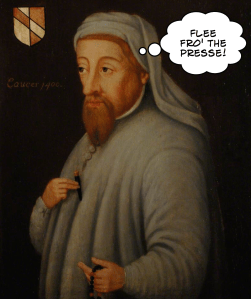
chaucerDespite C.S. Lewis’ vast experience as an author, even he was abused by publishers to the point where he could simply echo Chaucer in saying, “Flee from the Press!”



Print on demand technology has delivered a stout, but not debilitating, blow to traditional publishers. They still possess a significant amount of influence.

And—like all power—that which is wielded by publishers can be used for either good or evil.

We can thank many different publishers for making the works of Lewis, J.R.R. Tolkien and their fellow Inklings available to us. We would be wrong, however, to assume these relationships were without their stresses.

John H. McCallum was an American editor with whom Lewis worked. McCallum worked at Harcourt, Brace & World.

A piece of correspondence from 1960 reveals how complex the publishing world remained even to a veteran such as Lewis.

McCallum had sought permission to publish Lewis’ latest work, and the Cambridge professor had sought to accommodate that request. Unfortunately, he had negotiated a contract that restricted him from doing so. He begins his letter of explanation with an apology for having taken so long to respond.

Dear Mac

‘Why the heck can’t C.S.L. have the civility to answer a letter?’ I don’t blame you, but it wasn’t exactly my fault. Like a fool, I dealt direct with C.U.P. [Cambridge University Press] for Studies in Words instead of working through [his regular literary agent] Curtis Brown: chiefly because I regarded this book as too academic to be of any serious commercial value.

And like a double fool I’ve let them take it up so that I’m not free to arrange for an American edn. with anyone else.

The delay in answering you is due to the fact that I’ve been all this time trying to get out of them whether this is exactly what my contract with them means. It is. But of all the impenetrable block heads! Their answer—the correspondence was long and infuriating—dealt with every question under the sun except the one I had asked (besides being unintelligible and contradictory).

I am sorry about all this. How well Chaucer advised us ‘Flee fro the Presse’!

Yours Lewis, C.S.

Dealing with publishers today remains challenging. They are, in a sense, gatekeepers. One of their roles is to prevent undeserving works from seeing print. Unfortunately, because literary tastes are utterly subjective, they bar many worthwhile manuscripts as well.

For that reason, we can be thankful that digital publishing allows quality works that would formerly have been overlooked to find their audience. The price of that boon, however, is that we must sometimes wade through major quantities of dregs to savor fine writing.

The majority of writers, given the opportunity, would prefer to be published by traditional publishing houses. There is no way around the fact that this adds a degree of status to most books. A recent poll supports this notion. It found among those published traditionally, “32% of respondents said the prestige of having a deal with a traditional publisher was important to them, while a further 54% said it was one of the appealing aspects of a traditional publishing deal.”

If we should ever seek “publication” for our own work, it is good to remember that the publishing business could puzzle even as gifted a writer as C.S. Lewis. If the author of so many impressive books could be mystified by it, it’s no wonder it seems labyrinthine to the likes of us.

Perhaps Chaucer’s advice, offered more than 500 years ago, really does ring just as true today.

Priceless Letters

letterHow precious is a single letter?

If it is eagerly anticipated correspondence from a close friend or loved one, it may be invaluable.

Telephones and email have diminished the impact offered by the contents of an individual message, yet even now we value the touch of the written word shared by our soul mates across the miles.

Prior to the invention of the internet, and before the cost of international calls grew reasonable, I spent a year in the Republic of Korea, far from my wife and three young children. Naturally, like all military members serving far from home—even during times of peace—I missed them terribly.

While many wonderful things happened during the course of that year, and lifelong friendships were born, the highlight of each day was a visit to the installation post office. And, due to the faithfulness of my mother, sister and wife, I was greeted nearly every day by one or more handwritten messages of love and encouragement.

So important were these bonds that, prior to my departure, Delores and I covenanted to write one another every single day. A promise we both kept. In addition, I promised to write each of my three children their own letter each week. One evidence of the impact of those letters was the seamless reunion our family experienced when I returned after a year away.

In the even more distant past, this means of communication was even more vital. As little as a century ago, when individuals and families emigrated from their homelands they recognized the sad truth that they would probably never see their loved ones again.

Think about that for a moment. Saying “goodbye” usually meant “I will never see you again in this life.” How precious those missives must have been when they found their way between intimate companions!

Eighty-five years ago, C.S. Lewis was carrying on an active correspondence with the dearest friend from his youth, Arthur Greeves.

In the 1930s, the two men were corresponding on a weekly basis. Lewis opened one of his letters with the following paragraph to gently reprimand Greeves for allowing other responsibilities to delay his writing.

July 8th 1930

My dear Arthur,

Your letters get later and later every week. If you write on Monday the first week, on Tuesday the second week, and so on, then in seven weeks you will be writing on Monday again: but you will have written one letter less than you should.

In a year you will have written eight letters less, that is thirty six pages. Assuming that we both live thirty years more you will in that time have cheated me out of one thousand and eighty pages. Why, oh why, do you do these things?

As I said, the “reprimand” is gentle, even humorous, but it is sincere. It reveals just how meaningful each piece of his friend’s correspondence was to Lewis.

Many of us can relate to Lewis’ experience. We know firsthand how a smile comes to our lips and our pulse quickens when we find a message from a close companion.

I wanted to share this thought with each of you today for two reasons. First, I thought it might remind you of those whose words have encouraged and supported you in the past.

My second motivation is more important. I would like to suggest that you pause to consider just how important your letters are to others.

There are thousands of reasons for not scheduling (and guarding) time to write letters. Life is busy. The distractions vying for our attention are certainly more numerous, and loud, than they were in decades past.

Still, reminded of the value of the gift we offer when we write, perhaps it is time to shuffle our priorities.

Fleeting Fame

fameIt’s likely that the names of 98.6% of authors who top the bestseller charts today will be unremembered a century from now.

This weekend I posted the latest issue of Curtana: Sword of Mercy, a journal I edit about military chaplains. (If you are interested in checking it out, you can download a free copy here.)

The current issue includes an interesting article about two chaplains from Vermont who served during the War of 1812. (For international readers, that was the war following the winning of America’s independence when they British got their revenge—they captured our national capital and burned the capitol.)

In the biographical portion of the article, the author included a final summary of the life of one of the chaplains. Solomon Aiken (1758-1833) left his civilian pulpit to serve soldiers and sailors.

Aiken was quite prominent in his day. Not only was he a well known preacher and writer, he actually served as a member of Vermont’s legislature. Yet, I doubt that even Vermonters would recognize his name today.

Here is the quotation from a nineteenth century tribute published after his passing.

Mr. Aiken enjoyed uncommon health and vigor. He never took a particle of medicine, or lost a relish for food, until his final and brief sickness—a pleurisy fever. He possessed peculiar power as a logician, and was very popular as a preacher. He was kind-hearted and benevolent, almost to a fault. But it is chiefly as a political writer that Mr. Aiken is remembered. He was sent as a representative for two years, by the town of Dracut. He published several sermons and pamphlets, chiefly upon political themes, which excited much attention in their season.

The words that seized my attention were the conclusion, “. . . which excited much attention in their season.”

“In their season . . .” That season must have been brief, since the history was written just twenty years after Aiken’s death. By then his works had either withered or, more optimistically, gone to seed. In either case, their day was passed.

Translating that to our modern era, where things become obsolete almost as soon as they are envisioned, it would imply that our “season” of fame or reputation will last little more than a handful of months. And that, of course, assumes that a person actually achieves some level of renown.

Fame is fleeting. It has always been so, and the good Reverend Aiken is simply another example of that truth.

Thank God (literally) that there is more to life than notoriety.

C.S. Lewis is one of the 1.4% whose fame lasts. His has not diminished; it continues to grow. Just a year ago, on the fiftieth anniversary of his death, he was honored by having a plaque dedicated in Poet’s Corner in Westminster Abbey.

Lewis never sought fame, as the following discussion from his essay “The Weight of Glory” clearly reveals.

I turn next to the idea of glory. There is no getting away from the fact that this idea is very prominent in the New Testament and in early Christian writings. Salvation is constantly associated with palms, crowns, white robes, thrones, and splendour like the sun and stars. All this makes no immediate appeal to me at all, and in that respect I fancy I am a typical modern.

Glory suggests two ideas to me, of which one seems wicked and the other ridiculous. Either glory means to me fame, or it means luminosity. As for the first, since to be famous means to be better known than other people, the desire for fame appears to me as a competitive passion and therefore of hell rather than heaven. As for the second, who wishes to become a kind of living electric light bulb?

When I began to look into this matter I was stocked to find such different Christians as Milton, Johnson and Thomas Aquinas taking heavenly glory quite frankly in the sense of fame or good report. But not fame conferred by our fellow creatures—fame with God, approval or (I might say) “appreciation’ by God.

And then, when I had thought it over, I saw that this view was scriptural; nothing can eliminate from the parable the divine accolade, “Well done, thou good and faithful servant.” With that, a good deal of what I had been thinking all my life fell down like a house of cards.

This exceptional work merits consideration not only by people of faith. It invites all honest readers to gaze within themselves at their deepest yearnings.

Another passage from C.S. Lewis that relates strongly to the subject at hand comes from The Great Divorce. You can read the entire passage here, but the heart of it is this. Lewis views a simple woman, presently in heaven, receiving magnificent praise and celebration. He naturally assumes she must have been some well known saint.

He is, however, informed that she lived an obscure life, despite the fact that she touched countless nondescript people and animals with her compassion. Lewis’ heavenly guide is rather surprised that the Oxford professor has overlooked a simple truth:

Fame in heaven “and fame on Earth are two quite different things.”

Only the second will last.

Literary Martial Arts

nonficOne of the lowest moments in my writing life occurred when a creative writing professor advised me to “stick with nonfiction.” Oh, she said it gently, but it still struck me with the power of a mixed martial arts (MMA) hammerfist.

I was majoring in editorial journalism at the University of Washington. Attempting to expand my scope, I took a short story writing course. It was a mistake.

I thought I had done adequately during the course. I was even moderately pleased with a couple of my stories. The instructor, on the other hand, well let’s just say she was not impressed with my effort.

She was right. At the time, my ear for good fiction was quite immature. I do not claim that it’s particularly well developed today, but I have written a story about a medieval pilgrimage that I hope to unveil in a year or two.

I was reminded of my literature professor’s grim assessment as I recently read an interview with a pastor, who is also a lawyer, and happens to be a writer as well. His name is Randy Singer.

Singer describes the similarity of his professions by saying “They all require skills in persuasion, in telling stories to illustrate things.” I guess he’s right.

The difference being that pastors tell true stories, authors of fiction write imaginary stories, and attorneys weave tales that lie somewhere in between.

The part of the interview, which appeared in World Magazine, that I found particularly insightful was this:

When your only desire is to tell the story so people don’t even notice the wording, at that point you’ve become a fiction author.

Singer’s description struck me with the force of an MMA ridge hand (a reverse knife-hand). When I came to, I finally knew why composing fiction does not come naturally to me.

I love words too much. Too much to sacrifice them simply for the sake of the story. Oh, I value the message also, but getting there is half the fun.

Although I don’t love words to the degree many poets lust after them, I still possess an affection that does not allow me to view them through purely utilitarian lenses.

To add insult to his literary injury, Singer adds the following, in response to the question of what he learned while writing several successful novels.

Third, to be less verbose and let the action carry the story instead of thinking, “What are some really flowery and cool phrases and words that I can weave into this?”

That’s enough, friend. You made your point. I would have responded a bit more colorfully and fragrantly, but I hear you.

Singer doesn’t cite C.S. Lewis in the interview, but his counsel is consistent with that of the Oxford don. Lewis advised using clear and concrete language, “so as to make quite clear what you mean and make sure your sentence couldn’t mean anything else.” (Personal Correspondence, 1956).

Similarly, Lewis would always argue for the words not to draw attention to themselves. Essentially, they need to get out of the way so the message can come through. “Don’t use adjectives which merely tell us how you want us to feel about the things you are describing. I mean, instead of telling us a thing was “terrible,” describe it so that we’ll be terrified.”

It’s wisdom like that which causes us to recognize C.S. Lewis as the brilliant, gifted, creative, versatile and anointed writer that he was.

As for Singer, perhaps I’ll have to check out one of his legal thrillers. The latest is set in antiquity, with a Roman jurist defending Paul before Nero. Should be quite interesting. Not so good as a nonfiction account of such a trial would be . . . but probably worth reading.

Marrying a Writer

museA recent episode of the series Castle illustrated something all of the spouses of writers know—they are wed to peculiar people.

The premise for the program, currently in its seventh season, is that a mystery novelist accompanies homicide detectives in New York City on their investigations.

Despite his frequently outlandish theories, Richard Castle often contributes significantly to solving the crimes. His counterpart is Kate Beckett, the senior detective who leads the team.

The two of them recently wed, which led to the following exchange while they were on their honeymoon, which doubled as a homicide investigation at a frontier “dude ranch.”

Faced with complex evidence, Castle says, “That’s why we approach this as writers.”

Beckett responds with a comment representative of literary spouses. “So we procrastinate and we make things up?”

Ouch.

That strikes a bit close to home. The second element—making things up—can be construed by our nimble minds as an actual compliment. Yes, we do think creatively and out of the mundane box. Thank you very much.

On the other hand, the procrastination label . . . well, speaking for myself, it fits far too well.

Writing, after all, is not simple. Even poor writing requires effort. And, if one hopes to write well . . . it requires time, skill and practice.

Few can sit down at the keyboard and imperiously command their “muse” or inspiration to be at hand. This is true for all authors, including Christian writers who seek guidance from the Holy Spirit.

The simple fact is, however, that if we waited until we felt fully inspired, most of us would accomplish little.

In my own case, I sincerely attribute anything good that I might write to the Lord. The chaff comes from me. I won’t presume to guess what small percentage of the words are wheat, but I will confess that I am most productive when I discipline myself to write. And, this discipline typically involves a self-imposed deadline.

Thus the reason for the graphic at the head of the page. I have recognized in the fall of life, as I seek to pursue my writing avocation more seriously, that “The deadline is my Muse.”

Beckett knows very well that her fictional husband often requires a deadline to complete his novels.

My wife sees the same principle at work when I request her urgent proofreading of something I’ve waited too long to complete.

C.S. Lewis had ample experience with deadlines himself. And he knew well that even a required submission date could not guarantee literary production. In 1958 he wrote to his editor, Jocelyn Gibb, saying that he may, or may not, be able to provide a contribution to an upcoming edition of The Psalms as Poetry.

Dear Gibb, Thanks for the book, a very nice bit of work. I’ll try to re-read Miracles for mis-prints while I’m in Ireland, where my wife and I go tomorrow. When is deadline for your Fifty-Two? Not that I’m sure I can pump anything up anyway.

He did manage to provide a contribution, which he later included as part of the introductory chapter for Reflections on the Psalms.

I’m not certain whether Lewis wrote those pages simply because inspiration compelled him to . . . or if the issue deadline provided a little supplemental motivation. I suspect it was the latter.

To any writers out there who never require the encouragement of a deadline—consider yourself uniquely blessed!

To the masses who share my battle with the plague of procrastination, you have my sympathy. Still, after pausing for just a moment to commiserate, let’s get back to the pleasant labor of writing, and the thrill of “making things up.”

Bach’s Lost Classics

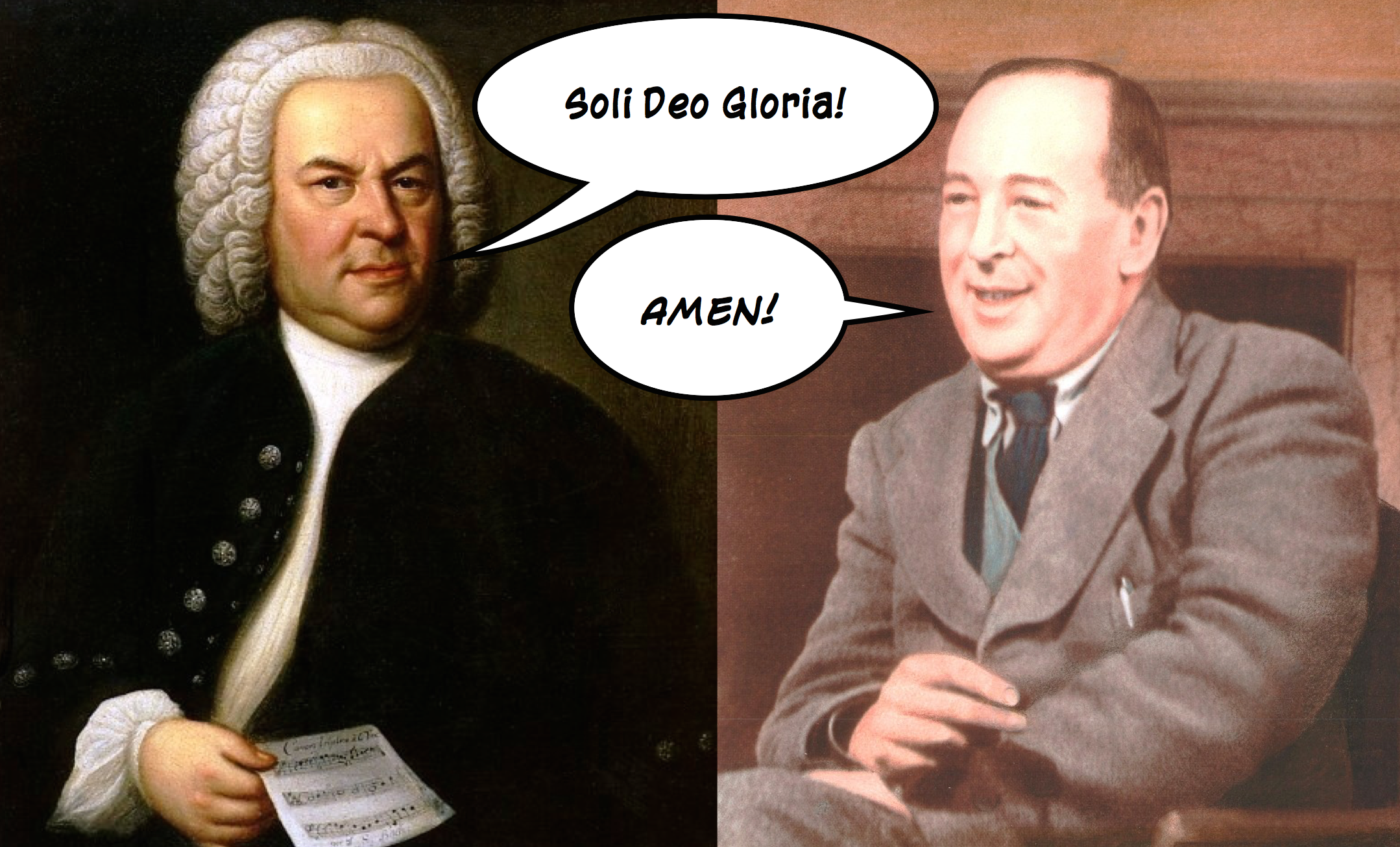
csl bach


Were you aware that scholars believe half of Johann Sebastian Bach’s music has been lost to the world due to the carelessness of his relatives?

I was unaware of that sad fact until recently.

J.S. Bach was the preeminent prodigy of a gifted musical family. His father, Johann Ambrosius Bach, was the leader of the musicians in their German city. All of his uncles were professional musicians. Two of Bach’s sons also became noteworthy composers.

Bach (1685-1750) held a number of important posts. These included serving the courts of Leopold, Prince of Anhalt-Köthen and Augustus III, King of Poland and Grand Duke of Lithuania.

It is not uncommon for gifted men and women to remain unrecognized during their lifetimes. In such cases, it is not surprising that many of their works would be lost.

Bach, on the other hand, was appreciated during his own lifetime. Despite that fact, many of his creations would pass into oblivion. Why?

Amazing, only a single early cantata was published during his lifetime.

Upon his death, all of his precious musical manuscripts—chorales, motets, arias, sonatas, suites, fugues, concertos, canons and more—were divided among his family. Some of the manuscripts were sold, and others presumably were saved and eventually lost to time. Perhaps someday more pieces will be rediscovered, but that remains to be seen.

Bach was a devout Christian (of Lutheran persuasion). While the Cantor of St. Thomas Church in Leipzig he wrote more than 300 cantatas inspired by the Gospel readings for Sundays and church festivals. One hundred of these musical gems have not survived.

C.S. Lewis enjoyed Bach. In An Experiment in Criticism, he uses the composer’s music as an example of something so profound that it continues to satisfy.

Many people enjoy popular music in a way which is compatible with humming the tune, stamping in time, talking, and eating. And when the popular tune has once gone out of fashion they enjoy it no more. Those who enjoy Bach react quite differently.

In his Diary, Lewis’ brother Warnie describes the inauguration of a new record player in 1933. “This after my long expected new gramophone arrived . . . I am delighted with it . . . After supper Jack, Minto and I sat cozily in the study and I played them the Pastoral Symphony and a sonata of Bach.”

In our modern world, the increase in leisure time has allowed many people to pursue their creative dreams. Some write, others paint, and a smaller number compose music.

Bach’s tale makes one wonder what will happen to their labors of love once they are gone. Will our family or friends divide them among themselves? Will they ever be read?

Rather than be depressed by these questions, let me encourage you to share your work with others now. Perhaps a blog would be a suitable avenue for publishing your thoughts? There are also a number of options for publishing ebooks, including some that do so at no cost.

Of course, not everything we write merits publication. We should strive to write something worthwhile, and edit it to the point where we can be suitably “proud” of our literary offspring. No doubt Bach spent many hours revising his compositions until they sounded perfect to his own ear.

And, for those of us who share the faith of Bach, it is worth noting the words he wrote at the close of each of his religious works (and many of his secular pieces): Soli Deo Gloria . . . Glory to God Alone.

Convoluted Language

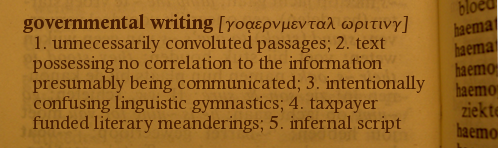
govwritingAre you a skilled reader? Do you pride yourself on possessing a knack for making sense of challenging prose?

Even if you consider yourself a proficient interpreter of text, there is one genre of literature that may still cause you to tremble. Government documents.

Even the most experienced lexical navigators find it challenging to traverse governmental communications. This despite the fact that in 2010 the United States actually passed the Plain Writing Act.

And I’m not even referring to legislation—where seeking sanity and clarity is virtually hopeless. And, it doesn’t matter how simple the source message is. Government scribes are capable of making a document about how to obtain a building permit read like a manual for constructing an orbital weapons platform.

I am not sure whether or not the United States is typical of other nations when it comes to this literary tradition. However, I suspect every nation, aside perhaps from those with populations under 10,000, is plagued by convoluted governmental documents. (There are thirteen such, potentially exempt, communities.*)

A prime example of institutional gobbledygook comes from this question, posed to the Chicago Manual of Style:

Q. Can you please help settle a disagreement? In the following sentence, should “instead of” be replaced with “rather than”? Overpayments occurred because facility purchased care staff processed payments using the local VA Fee schedule instead of the technical component of RBRVS.

A. Let me get this straight: in that nearly unreadable sentence (“because facility purchased care staff processed payments”?), the disagreement centers on whether to use “instead of” or “rather than”?  (Oh, wait—I see from your e-mail address that this is a government office.) Replace the phrase if you are certain that (1) there is a significant difference in meaning, and (2) the current wording does not express the meaning intended. If you cannot reach agreement on these points, you might have to fund a study.

C.S. Lewis offered much sage advice about writing. Sadly, nearly every principle he proposed is utterly alien to governmental documents. His 1956 advice (to a child) should be the required background and screen saver for all government computers:

“Always try to use the language so as to make quite clear what you mean and make sure your sentence couldn’t mean anything else.”

It’s not that I don’t have sympathy for civil servants who write official documents. After all, I edited Air Force Recurring Periodical 52-1 for three years. But I sometimes wonder whether there might be an eccentric psychological disorder that afflicts many government-funded writers . . .

So, it appears, I have made an unintentional confession. The regular readers of Mere Inkling may now know the source of some of the peculiar aspects of these columns.

I have asked my children to have me institutionalized if I ever use the phrase “care staff processed payments.” Short of that, however, these brief conversations are likely to continue for many years to come.

_____

* The following nations and “dependent territories” boast populations under ten thousand, in ascending order:

Pitcairn Islands

Cocos Islands

Vatican City

Tokelau

Niue

Christmas Island

Norfolk Island

Svalbard and Jan Mayen

Falkland Islands

Saint Helena, Ascension and Tristan da Cunha

Montserrat

Saint Pierre and Miquelon

Saint Barthelemy

Nauru barely misses the list due to an excess of eighty-four citizens, according to their 2011 census.

Getting Fresh

freshenIt’s possible for blogs to get stale. That’s no surprise, to regular readers.

Like everything else in life, same old same old (American slang) gets old.

I’ve never been one to desire change for its own sake. C.S. Lewis satirizes such notions in his poem, “Evolutionary Hymn.”

Lead us, Evolution, lead us

     Up the future’s endless stair:

Chop us, change us, prod us, weed us.

     For stagnation is despair:

Groping, guessing, yet progressing

     Lead us nobody knows where.

Still, for some time I have felt like I wanted to freshen up the look of Mere Inkling.

I’ve taken the plunge and purchased the package where I can tailor colors and fonts. I’ve also decided to move some of my old websites here to Mere Inkling.

First of all, I have added The Odes of Solomon. If you’re interested in learning about the most ancient Christian hymnal, check it out. I have included paraphrases of five of the Odes.

Next I will either move my C.S. Lewis Chronicles pages here, or the information that I’ve assembled online for two of our family’s ancestors who served in the American Civil War. I have also added a link to the military chaplaincy journal I edit.

Those will all be static pages, of course. The main feature of Mere Inkling will continue to be the regular columns, or posts.

I hope you enjoy the new format. I think it is an improvement, and enabling me to get all of these efforts under a single digital “roof,” will certainly help me stay better organized.

In expanding the offerings of Mere Inkling, I have maintained the valued past and am importing material that will be of interest to some. My goal has been to have the site “grow,” in the sense used by C.S. Lewis in “Hamlet: The Prince or the Poem.”

Mere change is not growth. Growth is the synthesis of change and continuity, and where there is no continuity there is no growth.

Avoiding Gadzookeries

gadzookeryWriting quality historical fiction is challenging. This is especially true if one wishes to avoid the common crutch that a talented writer of the last century first labeled “gadzookery.”

And just what is this faux pas we should avoid when writing about the past? Well, it relates most directly to the dialog placed on the lips of historical figures. The offensive technique involves the overuse of archaic expressions or phrases. (Some would argue it includes any use of any archaisms.)

If the word gadzookery sounds a tad, how shall I put it, “goofy” to you, you may prefer using another word that means the same thing: “tushery.” Tushery was coined by Robert Louis Stevenson. Way back in the nineteenth century.

Gadzookery is a newer version, insulting the same lazy writing technique. I believe it may have been coined by Rosemary Sutcliff (1920-1992). Sutcliff’s historical influence has exerted a literary influence on my life second only to C.S. Lewis.*

The article about Sutcliff in The Oxford Encyclopedia of Children’s Literature praises her work, saying, “She carefully creates dialogue in her novels that recollects the speech of a bygone era without falling into what she termed ‘gadzookery.’”

Having tested the waters of historical fiction myself, I know this to be far more difficult that it may sound.

Sutcliff had several things in common with C.S. Lewis. Both wrote for adults and for children. (It was her young adult series about the decline of Roman influence in Britain that sparked my own lifelong interest in Rome.)

Both authors also received the Carnegie Medal for their work. When Lewis was awarded his, he received a congratulatory letter from Pauline Baynes, who had illustrated several of his books. He responded quite graciously.

Dear Miss Baynes, Very nice to hear from you again, and thanks for sending on the book, which I have returned to Lane. Thanks for your congratulations on the Carnegie, but is it not rather ‘our’ Medal? I’m sure the illustrations were taken into consideration as well as the text. I am well, and as happy as a man can be whose wife is desperately ill.

Although C.S. Lewis had married, quite late in life, the two authors were alike in spending most of their life single. Sutcliff, in fact, lived with her parents during most of her life, having suffered crippling arthritis as a child. She did not resent remaining unmarried. In a 1992 interview she said,

Beatrix Potter wrote all her gorgeous stories when she was very lonely and not very happy—after she married, she never wrote another thing. Nothing worth reading, anyway.

Another similarity between the two was that they both fell under the powerful sway of myth during their childhoods. They used their familiarity with its rich echoes to imbue their own work with themes that flowed far beyond the familiar channels travelled by other writers.

Each of them took their readers seriously, and refused to speak down to them. That is why they share one more quality I wish to mention in closing—their high standards. Neither Lewis nor Sutcliff could tolerate poor writing. And their finely tuned skills meant neither ever needed to resort to gadzookery.

______

* Excepting, of course, the Bible itself, which is literature of an entirely different sort. I don’t consider it fair to compare mortal writers, no matter how inspired, to a volume I regard as God’s written word.