What Do People Call You?

sobriquetNearly everyone has a sobriquet, even those who don’t know what it is.

C.S. Lewis knew what they are, of course, and he created his own at a young age.

Sobriquet is a French word for moniker (which is, itself, traced back to Shelta, a covert language of Irish gypsies). In more common parlance, a sobriquet or moniker is simply a nickname.

C.S. Lewis loved dogs. This is significant because his earliest nickname—the self-appointed one—derived from a dog he cared for during his youth. As his stepson relates the story:

When he was a small boy, he didn’t like the name [Clive] and soon changed it to “Jacksie” by simply refusing to answer to anything else. It was actually because of a small dog that he was fond of that he picked the name Jacksie . . .

It was run over (probably by a horse and cart as there were almost no cars at the time and place where he was a child), and Jack, as he later became known, just took the name for himself. (Jack’s Life)

C.S. Lewis’ Personal Sobriquet

Jacksie wasn’t Lewis’ only childhood sobriquet. He and his brother Warnie embraced a pair of titles that have a delightful source. Warnie was “Archpiggiebotham” and Jack was “Smallpiggiebotham.” A footnote in volume one of The Collected Letters of C.S. Lewis explains the names.

Jack sometimes addressed Warnie as “APB” and, in turn, Warnie addressed his brother as “SPB.” When Warnie and Jack were very young their nurse, Lizzie Endicott, when drying them after a bath, threatened to smack their “pigieboties” or “piggiebottoms.”

In time the brothers decided that Warnie was the “Archpiggiebotham” and Jack the “Smallpiggiebotham” or “APB” and “SPB.” Thereafter they used these terms of one another, particularly in their correspondence.

Like most famous individuals, Lewis collected a variety of (not always flattering) nicknames as he rose to what passed for celebrity status in Oxford. (I’ve written about how some of his peers resented his reputation—probably due to envy.)

Inkling Sobriquets

The Inklings were a richly creative community. Tollers (Tolkien) shared the limelight with Lewis. Tolkien’s self-assumed epithet was “a hobbit in all but size.”

Charles Williams adopted the nickname Serge, by which some of his most intimate friends addressed him. His collected letters to his wife were published under the title of both of their nicknames, To Michal from Serge.

In Oxford Inklings, Colin Duriez writes, “nicknames and the use of last names were common in Oxford, perhaps reflecting the enduring influence of the private schools that most students and teaching staff of that time had experienced.” Sadly, I’ve yet to find a place where these names were compiled.

David Downing, author of Looking for the King does mention several. On his website he lists the members of the Inklings. He says of one faithful member, who was also C.S. Lewis’ physician:

[Robert] Havard became one of the most regular attendees at Inklings meetings and seems to have collected the most nicknames. Hugo Dyson started calling him “Humphrey,” and the name seems to have been used more than Havard’s Christian name. (The physician mentioned briefly in Lewis’s novel Perelandra is called “Humphrey.”)

Havard was also called the “Useless Quack” or “U.Q.” by Warren Lewis and the “Red Admiral” by C.S. Lewis when he returned from World War II service at sea wearing a ruddy beard. [Editor: I’m confident Warnie meant Useless Quack affectionately.]

That the Inklings were fond of nicknames is evidenced by the fact they even bestowed a nickname on the Eagle and Child pub where they gathered. They called it the Bird and Baby.

C.S. Lewis: The Paternal Professor

I will close with a passage from one of Lewis’ students whose recollections are preserved in the collection, C.S. Lewis Remembered. It is significant in part because it challenges the false criticisms of Lewis biographer A.N. Wilson. It is noteworthy this description comes from a student who remained a devoted atheist who regarded “religious propositions as not even erroneous, but simply as meaningless.”

All Lewis’ most interesting tutorial students would turn up [for his literary discussions]. A.N. Wilson reported complaints that Lewis delighted in “verbal bullying” and was unapproachable and daunting as a tutor. Not in my time. The suggestion that Lewis could be “intimidating” would have raised incredulous laughter in this group. His affectionate sobriquet was “Papa Lewis.”

What a wonderful nickname for a brilliant professor. Would that we all might have had an opportunity to study at the feet of Papa Lewis.

C.S. Lewis & Cruelty to Animals

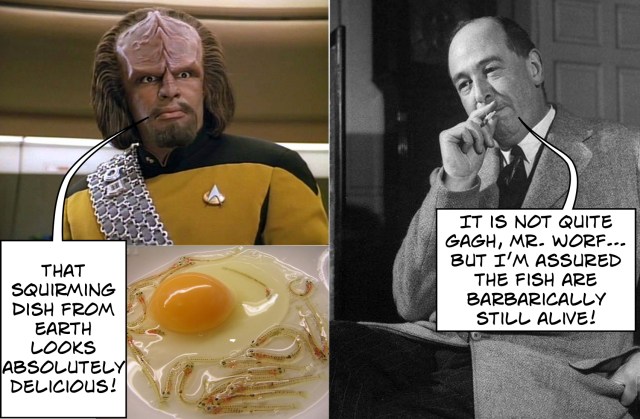
gagh.jpg

I recently read something quite disturbing about human beings. Something that revealed we have in common with Klingons and Ferengis one of their most disgusting traits. These people eat living creatures while they’re still alive (redundancy intentional).

Gene Roddenberry, creator of the Star Trek universe, foresaw a future in which humanity would rise above its omnivorous ways. “Replicated” food could still take the form of meat, but it would just be made of assorted atoms. The epitome of this view is found in Star Trek: The Next Generation. There, Commander William T. Riker declares to a diplomat from a race that consumes living mammals, “we no longer enslave animals for food purposes.”

In Roddenberry’s dream, humans have attained utopia on Earth. One way other races reveal their inferiority is by their diet. In addition to larvae and slugs, a main part of the Ferengi diet consists of squirmy Tube Grubs.* The more aggressive Klingons prefer assorted mollusks and their staple, the appropriately named Gagh. Gagh could be eaten cold or cooked, but the “serpent worms” were preferred live.**

I had deluded myself to think the devouring of living creatures was relegated to science fiction and the predators of the animal world. Sadly I recently learned about two Asian meals that merit the same stigma.

Goong ten is a Thai meal known as “dancing shrimp,” because the crustaceans are devoured alive.

In the Northeast Thailand region of Isaan, cooks often serve meat raw . . . Street vendors sometimes take the uncooked element one step further, selling a dish known as “dancing shrimp” (goong ten) from double-basket carts. On one side, seasonings await. On the other, a heap of small, translucent shrimp try in vain to escape from beneath a cloth. . . .

Those who might be anxious about eating a still-moving snack can opt to eat each bite swathed in a betel leaf. The traditional wrap conveniently prevents diners from accidentally making eye contact with their meal. Should curiosity get the better of you, however, a standard serving offers dozens of creatures you can stare down before eating alive.

In Japan, shirouo no odorigui describes another squirming delight.

Odorigui refers to the feeling of eating live sea creatures, or “dance-eating.” When it comes to shirouo no odorigui, the creatures dancing to their death are minnow-sized, transparent fish. In Japan’s Fukuoka prefecture, diners down these fish, also known as ice gobies, in shot glasses. As they’re served with nothing but a dash of soy sauce, there’s no hiding from the tiny faces of these slippery, still-moving snacks.

Eating Animals

I would be a hypocrite to condemn eating fish and other animals. However, I find myself utterly repelled by the notion of chewing something that is still alive. It seems unnecessarily cruel. I doubt I’ll ever hold membership in PETA, but I agree with their view that the abuse of animals is a grievous wrong.

C.S. Lewis would share this conviction that the abuse of these creatures is immoral. He wrote that “in justifying cruelty to animals we put ourselves also on the animal level. We choose the jungle and must abide by our choice.”

The merciful treatment of animals is one of Scripture’s most overlooked themes.

Judaism places great stress on proper treatment of animals. Unnecessary cruelty to animals is strictly forbidden, and in many cases, animals are accorded the same sensitivity as human beings. This concern for the welfare of animals is unusual in Western civilization. Most civilized nations did not accept this principle until quite recently; cruelty to animals was not outlawed until the 1800s, and even now it is not taken very seriously.

The primary principle behind the treatment of animals in Jewish law is preventing tza’ar ba’alei chayim, the suffering of living creatures. . . . Judaism has always recognized the link between the way a person treats animals and the way a person treats human beings. A person who is cruel to a defenseless animal will undoubtedly be cruel to defenseless people.

Even the slaughtering of animals is intended, under Kosher rules, “to be as fast and painless as possible . . . Hunting for sport is strictly prohibited, and hunting and trapping for legitimate needs is permissible only when it is done in the least painful way possible.

More on the Subject from Lewis

C.S. Lewis possessed a concern for suffering animals. We used to call this regard “humane,” because it reflected a natural compassion that God instills within us. Sadly, in many people it has been all but extinguished.

In 1940, Lewis included a full chapter on “Animal Pain” in The Problem of Pain. There he advocates a compassionate attitude, without being so doctrinaire as the aforementioned PETA. His concern is theological. He desires to explain how animals can suffer despite the “goodness” of God’s creation. Lewis recognizes that, in a word, the suffering of animals is an evil.

The problem of animal suffering is appalling . . . because the Christian explanation of human pain cannot be extended to animal pain. So far as we know beasts are incapable either of sin or virtue: therefore they can neither deserve pain nor be improved by it.

Lewis also confronted a distortion of biblical teaching that is often employed to justify the mistreatment of animals. Some say humanity is intended to lord over creation (including animals) however we see fit. However, in 1956 Lewis wrote to a correspondent that animals should be treasured.

I think God wants us to love Him more, not to love creatures (even animals) less. We love everything in one way too much (i.e. at the expense of our love for Him) but in another way we love everything too little. No person, animal, flower, or even pebble, has ever been loved too much—i.e. more than every one of God’s works deserves.

The Ethics & Religious Liberty Commission of the Southern Baptist Convention offers an excellent article on the positive place of animals in creation. Animals are precious to God. “They aren’t the product of happenstance or fortuitous natural processes any more than humans are.” Their ten biblical observations about animals echo the thoughts of Lewis, and are quite worthy of your consideration.

One of Lewis’ essays, “Vivisection,” upset a number of his contemporaries who had no reservations at all about experimentation on animals. It appears in the collection God in the Dock, but here are a few excerpts.

The vast majority of vivisectors have no such [Christian] theological background. They are most of them naturalistic and Darwinian. Now here, surely, we come up against a very alarming fact.

The very same people who will most contemptuously brush aside any consideration of animal suffering if it stands in the way of “research” will also, on another context, most vehemently deny that there is any radical difference between man and the other animals. On the naturalistic view the beasts are at bottom just the same sort of thing as ourselves. . . .

We sacrifice other species to our own not because our own has any objective metaphysical privilege over others, but simply because it is ours.

Once the old Christian idea of a total difference in kind between man and beast has been abandoned, then no argument for experiments on animals can be found which is not also an argument for experiments on inferior men. . . . The victory of vivisection marks a great advance in the triumph of ruthless, non-moral utilitarianism over the old world of ethical law; a triumph in which we, as well as animals, are already the victims, and of which Dachau and Hiroshima mark the more recent achievements.

In justifying cruelty to animals we put ourselves also on the animal level. We choose the jungle and must abide by our choice.

And what does this human jungle bring into being?

If we cut up beasts simply because they cannot prevent us and because we are backing our own side in the struggle for existence, it is only logical to cut up imbeciles, criminals, enemies, or capitalists for the same reasons.

If you are interested in learning more about Lewis’ view of the ethical treatment of animals, download “C.S. Lewis and Animal Experimentation” by Michael Gilmour.

It appeared in 2015 in Perspectives on Science and Christian Faith. All issues of the journal, going back to its founding in 1949, are accessible for free online.

The older I have grown, the more sympathetic to animals I have become. Admittedly, the live worms and crustaceans concern me less than the agony of mammals, which are far more conscious of their pain. And . . . I sincerely grieve for people who do not feel compassion for their suffering.


* The Ferengi also love their Slug-o-Cola, with its guaranteed “43% live algae in every bottle.”

** There are presumably more than 5- types of gagh, some of which had feet. And if that doesn’t gag you, your gut has a much higher quotient of iron than does mine.

*** For a lively discussion of whether “the human race has gone vegetarian in Star Trek,” check out this site.

Recalling Information Like C.S. Lewis

csl forgetica

Do you have trouble remembering what you read? Read on for a solution to your problem.

C.S. Lewis possessed an amazing memory of what he had read. While eidetic memory remains theoretical, many attributed a “photographic memory” to the Oxford don. Owen Barfield, Lewis’ close friend, described this gift.

He had that very pictorial imagination. I know when we used to go on walks, I used to envy him that. . . . He had what I think is called by some people an “eidetic memory,” when your imaginative pictures are almost photographic. (Owen Barfield on C.S. Lewis edited by G.B. Tennyson)

Describing Lewis’ earnest patience with others, however “ignorant or naïve” (Barfield’s opinion) the person, Barfield describes how readily Lewis recalled pertinent facts.

First he would speak as one simple man exchanging experiences with another, and only afterward (if the occasion seemed to call for it and always without the least nuance of didacticism) would he bring to bear, out of his wide reading and phenomenal memory, some pithy utterance—it might be from Aristotle’s Ethics, it might be from an Icelandic saga, it might be from George MacDonald—that contained the very substance of what the two of them had just discovered they had in common.

There appears to be hope on the horizon for those of us who are not blessed with Lewis’ talent for recalling what we read. RMIT University (formerly the Royal Melbourne Institute of Technology) has devised a new font that uses a psychological principle called “desirable difficulty” to help readers retain more.

Take a look at Sans Forgetica in its own font. forgetica


The “difficult” part is evident in the lacunae that force one’s mind to fill in the gaps and make sense of each letter and word. The “desirability” comes with the way that our brains are able to decipher with just enough effort to imprint the material more deeply in our minds.

This principle reminded me of something written by Richard Foster, author of Celebration of Discipline. He describes the importance of concentration on our spiritual growth, as we seriously examine and process whatever is worthy of thinking upon. (Philippians 4:8)

I have mentioned the disciplines of service and worship. There are many others. Inward disciplines, like meditation, prayer, fasting, and study, cultivate our heart and mind toward the way of Christ. Meditation is the ability to hear God’s voice and obey his word.

Prayer is ongoing dialogue with the Father about what God and we are doing together. Fasting is the voluntary denial of an otherwise normal function for the sake of intense spiritual activity.

Study is the process through which we bring the mind to conform to the order of whatever we are concentrating upon. (Becoming Like Christ)

On the Elegance of Fonts

Longtime readers of Mere Inkling are well aware of my personal fascination with fonts. This link will reveal posts I’ve tagged with the subject. It reveals that different fonts exist for more than aesthetic reasons.

While some are simply created for decorative or mood-setting purposes—such as typefaces that mimic monastic scripts or the text created for the first Narnia film—others are devised for more practical purposes. The latter collection includes one created to aid those who suffer from dyslexia (Dyslexie). The intentionally useful category will now include Sans Forgetica.

Sans Forgetica is available for free. As evidence of either its merit or the promotional skills of its creators, they have already created an extension for the Chrome browser. It allows users to convert internet text on their screens to the memorable font.

I would suggest that such an application be used sparingly. Most of what we read on the internet is not worth recalling, much less clogging our brains with trivia and worse. Still, if applied selectively, it could be useful. After all, if it only moves us a centimeter in the direction of retaining information like C.S. Lewis, that’s a move in the right direction!


C.S. Lewis the Irishman

irish aslan

Contrary to the common assumption that C.S. Lewis was English, he was actually an Irishman. He was born in Belfast, and those who know him attested to how his Irish-ness lasted the whole of his life.

Lewis was proud of his roots, and celebrated them. When he first journeyed to England, he experienced a culture shock. “No Englishman will be able to understand my first impressions of England,” he wrote in Surprised by Joy.

Lewis always loved Ireland. He vacationed there regularly, and chose the island for his honeymoon, late in life. One of his Irish students, David Bleakley, related that the transplant professor declared, “Heaven is Oxford lifted and placed in the middle of County Down.” (C.S. Lewis at home in Ireland)

Several years ago, David Clare of the University of Limerick wrote “C.S. Lewis: An Irish Writer.” It appeared in Irish Studies Review, and the abstract is illuminating.

This article examines the effect of C.S. Lewis’s Irish background on his work. It attempts to contradict the assumption that this Belfast-born writer should be included in the English and not the Irish canon. It emphasises that Lewis saw himself as Irish, was seen by others as Irish, and that his Irish background, contrary to what some have written, was important to him throughout his lifetime.

It goes on to demonstrate the ways in which his work was influenced by his youth in Ireland and by the Irish mythology that he loved. Furthermore, this article maintains that, as a child of pre-partition Ireland with roots throughout the island, Lewis was influenced by the country as a whole, not just his native Ulster. Finally, it attempts to understand why Lewis, a proud Irishman, did not do more to promote himself as an Irish writer.

Clare’s argument is necessary because of Irish political correctness. In Surprised by C.S. Lewis, Alister McGrath describes the prejudice.

So why is Lewis not celebrated as one of the greatest Irish writers of all time? Why is there no entry for “Lewis, C.S.” in the 1,472 pages of the supposedly definitive Dictionary of Irish Literature (1996)? The real issue is that Lewis does not fit—and, indeed, must be said partly to have chosen not to fit—the template of Irish identity that has dominated the late twentieth century.

In some ways, Lewis represents precisely the forces and influences which the advocates of a stereotypical Irish literary identity wished to reject. One of the reasons why Ireland has largely chosen to forget about Lewis is that he was the wrong kind of Irishman. . . .

Lewis may have chosen to rise above the provinciality of Irish literature; he nevertheless remains one of its most luminous and famous representatives.

It should be noted, of course, that countless Irish men and women are proud of Lewis, and count him as one of their own.

There’s No Other Place Quite Like Ireland

On a less serious note, and at the risk of contributing to a stereotype, I want to share with you an incident that occurred in Dublin.

First some context. Some people suggest that people in Ireland have a particular affinity for alcohol. This may be a bit of an exaggeration, since they are only ranked twenty-first in the world (for alcohol consumption).

The 1875 tragedy goes by several names, but one is the “Dublin Whiskey Fire.” A malt house and a whiskey warehouse caught fire, and as thousands of gallons of their contents poured down the street in a fiery channel, the blaze spread to many homes and businesses.

Miraculously, the fire did not take any lives. That does not mean, however, that there were not a number of fatalities. A dozen people died from alcohol poisoning. Tempted by unrestricted access to the alcohol, many Dubliners cupped their hands or used their boots to gather up the liquid and drink themselves into oblivion.

You can read an account of the bizarre occurrence in The Irish Times.

I wonder what Lewis thought about this revolting event, since he was surely aware of it. The deranged consumption of filthy and burning alcohol would be condemned by any sane person.

Among teetotalers, however, even a sip of alcohol is objectionable. Many attribute their aversion to their faith. While the Christian Scriptures strongly condemn drunkenness, some verses tacitly affirm the drinking of wine in moderation.*

C.S. Lewis and Drink

C.S. Lewis was among the majority of Christians who accept drinking while avoiding drunkenness. I have written on this subject at length.

In Mere Christianity, Lewis says,

Temperance is, unfortunately, one of those words that has changed its meaning. It now usually means teetotalism. But in the days when the second Cardinal virtue was christened ‘Temperance,’ it meant nothing of the sort. Temperance referred not specially to drink, but to all pleasures; and it meant not abstaining, but going the right length and no further.

It is a mistake to think that Christians ought all to be teetotallers . . . Of course it may be the duty of a particular Christian, or of any Christian, at a particular time, to abstain from strong drink, either because he is the sort of man who cannot drink at all without drinking too much, or because he is with people who are inclined to drunkenness and must not encourage them by drinking himself.

But the whole point is that he is abstaining, for a good reason, from something which he does not condemn and which he likes to see other people enjoying. One of the marks of a certain type of bad man is that he cannot give up a thing himself without wanting every one else to give it up. That is not the Christian way.

An individual Christian may see fit to give up all sorts of things for special reasons—marriage, or meat, or beer, or the cinema; but the moment he starts saying the things are bad in themselves, or looking down his nose at other people who do use them, he has taken the wrong turning.

This is wise counsel. Recapturing the original meaning of temperance—and living as temperate people—results in happier lives and a more peaceful world.


* For those who God expressly commands not to drink, should avoid it completely. For example, an angel told Zechariah that John the Baptist, “must not drink wine or strong drink, and he will be filled with the Holy Spirit, even from his mother’s womb.” (Luke 1:15). John’s cousin Jesus, on the other hand, miraculously created wine for a wedding party, and offered the Passover wine to his disciples with the words “this cup that is poured out for you is the new covenant in my blood.” (Luke 22:20)


Rewarding Destructive Behaviors

monopoly

It is almost too obvious to require saying: you reinforce the behaviors you reward. Why then, would any society intentionally train its youth to be dishonest?

One justification I’ve heard, more and more frequently in recent years, is that it’s all about winning—coming out on top. The motto of these folks is “do whatever it takes to win.” Yet this is a recipe for a disastrous life. In the words of Jesus: “what does it profit a man if he gains the whole world and loses or forfeits himself?” (Luke 9:25)*

Our recreational choices say a lot about us and our values. Digital options have reduced the influence of board games, so one perennial favorite has devised a strategy to regain its market share.

Monopoly is based on accumulating wealth and, for the merciless, crushing one’s competitors. Some might argue that the capitalism which provides the basis for the game is corrupt in and of itself. Still, Monopoly has always had clear rules that governed actions.

But some players cheated. Capitalizing on this sinister impulse, Monopoly has created a new “Cheaters Edition.” Yes, you read that right.

Christian publications have announced the game’s arrival. The current issue of Citizen notes that even though cheating is actively encouraged in the game, negative consequences are also possible.

Mind you, it’s not that anything goes. Cheat successfully and you get rewarded; get caught and you get punished.

Even the “secular” Bloomberg review of the new game acknowledges the moral confusion of the product, closing its report with:

Clearly this begs some deeper philosophical questions about modern life and the future of morality and humanity, but, wait, did you just land on Boardwalk? Yes, I definitely always had a hotel on there! Trust me.

Nurturing Healthy Behaviors

One does not have to be a parent to recognize this wisdom of this Proverb: “Train up a child in the way he should go; even when he is old he will not depart from it” (Proverbs 22:6).

In fact, even pet “owners” know the necessity of training (e.g. housebreaking) our canine and feline family members.

Many games highlight positive choices, consciously or subconsciously reinforcing good. The simplest and most common method for this process comes not in a board game or a digital alternative. It is found in verbal praise.

There is ongoing debate about the value of praise. It’s clear that insincere or mechanistic praise would be of insignificant worth, and potentially dangerous. Some psychologists go so far as to state that “Positive reinforcement can undercut a child’s intrinsic motivation.”

C.S. Lewis understood that we cannot manufacture our own motivations.

I cannot, by direct moral effort, give myself new motives. After the first few steps in the Christian life we realise that everything which really needs to be done in our souls can be done only by God (Mere Christianity).

Despite this truth, it is also argued that our character can be shaped, in a sense, by consciously and repeatedly choosing to do what is right. Gradually then, by God’s grace, obedience may gradually give way to a more honest and natural motivation as the positive paths become our normal, well-traveled path.

This is not simply a “Christian” concern. The philosopher Aristotle noted “Good habits formed during youth make all the difference.” (What do you think Aristotle would think about the Cheater’s Edition of Monopoly?)

C.S. Lewis would doubtless concur with Aristotle. I assume most of Mere Inkling’s readers agree with the ancient wisdom as well.

A final thought. This cheater’s edition of Monopoly probably possesses less power to damage lives than Hasbro’s Ouijà board game. But that’s a subject for another day


* In Matthew 16 we read the more familiar “For what will it profit a man if he gains the whole world and forfeits his soul? Or what shall a man give in return for his soul?”

cheat card

Degrees of Importance

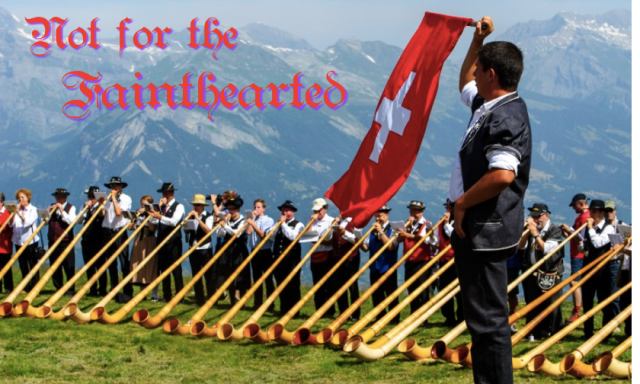
swiss horn

Not all college degrees are created equal. Some are “marketable,” and lead to well compensated careers. Others do not necessarily make one “employable,” but offer intrinsic satisfaction.

Engineering degrees would probably be in the first category. Creative writing degrees typically fall into the latter.

If I had the good fortune to study at Oxford when C.S. Lewis and J.R.R. Tolkien taught there, I would have savored the opportunity to sit in their presence and explore the wonders of Medieval Literature or Old English. (In America, at least, both of those degrees would fall into the second category identified above.)

As it was, my initial degree was in journalism. It seemed that every quarter our professors at the University of Washington would remind us that five years after graduation, no more than five percent of us would be working in that particular field. (I referred to those sessions as de-motivational chats.)

Still, learning how to write is a skill that serves one well in nearly any field.

Learning to yodel, on the other hand, probably possesses far fewer applications.

This year the Lucerne University of Applied Sciences and Arts will introduce a course on alpine “singing.” The University has expressed hope they will inspire enough Swiss yodelers to establish a degree program. If their efforts really pay off, they dream of offering a graduate degree in the rarified field.

The BBC reports “Yodelling is enjoying something of a resurgence in Switzerland, even featuring on successful chart albums last year.” I guess that answers the question about what the Swiss do beyond banking and making confectioneries.

If you have led a life so sheltered that you are uncertain exactly what yodeling is, the BBC describes it as “a form of singing which involves wobbling the voice up and down in a rapid change of pitch.”

An online dictionary defines yodel as a verb meaning “to sing with frequent changes from the ordinary voice to falsetto and back again, in the manner of Swiss and Tyrolean mountaineers.”

While most of us prefer our falsetto music in small doses, yodeling capitalizes on the full range of the human larynx, and then some.

The course will be taught by a famous yodeler, Nadja Räss. I’ve linked to one of her performances below.

I was curious as to what Lewis and Tolkien would have thought about this subject’s suitability for academic study. I suspect it would have provided the Inklings a chuckle, but they would affirm the value of studying one’s unique cultural heritage.

I did find one curious encounter Lewis had with a Swiss traveler in 1927. It has nothing to do with yodeling, and only tangentially touches on the university, but it is rather interesting. In a letter to his brother he mentions that Minto (Janie Moore) who lived with him, was being visited by an acquaintance.

You will be surprised to hear that while I write this, Minto is out to dinner. This results from the chief event since you left—the arrival of ‘un ami’ of Florence de Forest—not staying here, thank heavens.

He is a little Swiss commercial traveller, ‘Villie Goût,’ as smart as a bandbox, and very polite. Beyond making horrible noises in clearing his ‘pipes . . .’ and being intensely ugly, he is really quite harmless, tho’ of course very vulgar. He and Florence absolutely insisted on Minto’s dining with them at the Eastgate tonight, and won the day.

They know how to move their monde, as you will see from this fact and also when I tell you that they made me take them up Magdalen Tower this morning—as well as round the College. When I showed them the deer he made one of those extremely simple French jokes with which Maurice and M. Zée have familiarised us.

I had explained that these deer were descendants of a herd wh. had been there before the College was founded (that is quite true by the by, or as true as a College tradition need be), and I added ‘So you may say they are the oldest members of the College’.

‘And ze most intelligent?’ returned M. Goût.

I am confident that Mr. Goût and his companion enjoyed their visit to Oxford. Perhaps he returned home to Switzerland hoping that someday their universities would rival those of Britain.

Lucerne University of Applied Sciences and Arts was not founded until 1997, but their bold academic vision would have made Goût proud.

_____

You can enjoy a sample of Nadja Räss’ singing here.


How One Speaks to Royalty

bowing

How does your voice subtly alter as you are introduced to foreign royalty? When you kneel before your sovereign, if you summon the courage to speak, does your voice crack, or assume the volume of a whisper.

A recent study argues that “Non-verbal behaviours, including voice characteristics during speech, are an important way to communicate social status.”

The research involved interviews with potential employers (most likely because too few individuals with royal blood were available).

We found that vocal modulations were apparent between responses to the neutral and high-status targets, with participants . . . increasing fundamental frequency.

That means that when people talked to those they considered more powerful or prestigious than themselves, their voices got higher and squeakier. [Note: the study itself does not refer explicitly to the squeakiness quotient.]

C.S. Lewis was a gifted orator, who could well have served as the prestigious participant in a study such as this. “Lewis had a rich, deep, booming voice,” notes a recent volume.

This may be one reason that Adolf Hitler rued Lewis’ contribution to the Allied war effort.

There are a bevy of studies related to how all manner of things exert a subconscious effect on our vocal pitch. For example, you may not be aware that “Japanese women modify their pitch when reading English sentences, producing speech in a slightly lower pitch range” (Japanese Language, Gender, and Ideology).

Another fact of which you may be unaware, is that on the Supreme Court of the United States, “when male justices respond to female justices, they are more likely to raise their pitch.” What’s more, as the years pass, “female justices lower their voice pitch over time, whereas male justices raise their voice pitch over time.” What do we make of that?

In an article about how “study after study has suggested that low voices, ‘masculine’ voices, are an asset to those seeking leadership roles, in politics and beyond,” we discover how this relates to women, as well.

We perceive men with lower-pitched voices to be more attractive and physically stronger–and also more competent and more trustworthy—than their less burly-voiced peers. And we perceive women with lower-pitched voices along the same lines (though we also tend to perceive them, tellingly, as less attractive than their Betty Boop-y counterparts).

C.S. Lewis and the Idea of Voice

Accustomed as he was to an academic world constructed on the scaffolding of lecture and debate, Lewis was well acquainted with the power of “voice.” In fact, in one of his most creative essays, “Two Lectures,” Lewis describes hearing a predictable lecture on the subject of “evolution, development, the slow struggle upwards and onwards from crude and inchoate beginnings towards ever-increasing perfection . . .”

He then describes a “dream” that very night in which all of the lecturers presuppositions are reversed, raising the question of whether it might be “equally reasonable to look outside Nature for the real Originator of the natural order?”

The portion of the essay which is pertinent to the subject of the current column is the way he introduces the Dream Lecturer, but praising the “voice and figure” of its human precursor.

None of this [i.e. the evolution lecture], of course, was new to me or to anyone else in the audience. But it was put very well (much better than it appears in my reproduction) and the whole voice and figure of the lecturer were impressive. At least they must have impressed me, for otherwise I cannot account for the curious dream I had that night.

In “The Decline of Religion,” Lewis praises open and uninhibited conversations about faith. In contrast, he describes an earlier age of superficial religiosity in which Christianity, “if it had to be spoken of, it was spoken of in a hushed, medical voice.” Ah, the medical voice. We who have been around hospitals and sickbeds (for those seriously ill) are quite familiar with that somber and muted tone.

In “Meditation in a Toolshed,” Lewis illustrates the distinction between studying something and peering more deeply into it. His description of the voice of one’s beloved is quite poetic.

A young man meets a girl. The whole world looks different when he sees her. Her voice reminds him of something he has been trying to remember all his life, and ten minutes’ casual chat with her is more precious than all the favours that all other women in the world could grant. [Italics added.]

Reading these words, I am reminded of the Song of Solomon.

O my dove, in the clefts of the rock, in the crannies of the cliff, let me see your face, let me hear your voice, for your voice is sweet, and your face is lovely. (2:14)

The Voice of C.S. Lewis

Fortunately, we possess a small number of recordings of Lewis’ voice. Sadly, however, many more were lost.

During WWII, the BBC used twelve-inch metal disks coated with acetate for recordings. But because metal was in short supply, those disks were primarily reserved for field recording, so only one of Lewis’s WWII talks was preserved.

If a sufficient number of recordings had survived, an analysis of Lewis’ voice pitch might have earned a modern graduate their PhD.

It is fitting to close these thoughts with a thoroughly Lewisian quotation. Lewis was a deeply charitable man. In his writings he mentions a number of times how he strove to put the best face on the words and actions of others.

In a letter to one of his regular correspondents who is extremely “distraught” at another’s behavior, he urges patience. In doing so he mentions how we can become so prejudiced toward others that their very voice becomes a bludgeon. But read on and see how he makes his gracious point.

It is a pity he ‘gets on your nerves’ but you are, rightly, controlling your reactions. I know well how a person’s very voice, looks, and mannerisms may grate on one! I always try to remember that mine probably do the same to him—and of course I never hear or see myself.

C.S. Lewis and Poor Writers

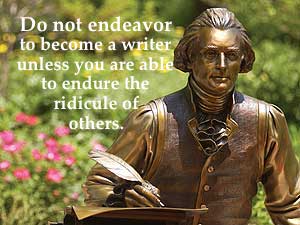
rididule

C.S. Lewis seldom kept a secret his low opinion of poor writers. This wasn’t because he was a literary snob, it’s because he was a literary critic.

Actually, the breadth of Lewis’ literary tastes was extraordinary. He didn’t expect texts to be more than what they purported to be, and could even enjoy the pulp fiction of his day. Still, Lewis had an eye for pretentious and anemic writing, and he sometimes penned cutting commentary

One of his lifelong friendships began with a discussion about poor writers. More about Lewis’ friendship with Oxford Classics scholar Nan Vance Dunbar (1928-2005) in a moment.

There are some contemporary voices that argue Lewis was misogynistic. Many of these complainants are non-Christian, and eager to see Lewis’ influence diminished. The truth is he possessed a strong traditional respect for women. And, while he unapologetically enjoyed the company of men—no surprise for a longtime bachelor—he counted a number of women scholars among his close friends.

My friend Brenton Dickieson has an excellent column on the subject of women in Lewis’ life, in which he persuasively argues that Lewis “was hardly the insular, sexist, Oxford bachelor that some would make him out to be.”

Professor Dunbar was a devout Christian, of the Presbyterian persuasion (no surprise, since she was Scottish). She attended one of Lewis’ lectures in 1955, and respectfully challenged in correspondence, his interpretation of the Roman poet Statius.

Their friendship grew, although they never agreed upon the status of Statius. The Collected Letters of C.S. Lewis includes a biography of Dunbar which describes how the subject even brought her some peace when she was grieving Lewis’ death.

Lewis’s final letter to her, on 21 November 1963–possibly the last he wrote–was to arrange for a visit in December. When he died the next day, Nan was beside herself with grief.

She was consoled by the theologian, Henry Chadwick, Regius Professor of Divinity at Oxford. Professor Chadwick reminded her that she would some day die. “And when you get to Heaven,” he said, “you will be met by Lewis. He will have got there before you, and he’ll have his arm firmly around a small man in a toga, who is being dragged along to meet you. ‘All right,’ Lewis will be saying to the ancient Roman–“Tell her!! Tell her!!”’

Nan had no doubt that Lewis would be in heaven, and she roared with laughter at the thought of Statius waiting there to rebuke her. Perhaps such thoughts gave her comfort when she confronted her own death.

The two had grown quite close. “Everyone would agree that Nan Dunbar–with her erudition, her common sense, her Christian faith, her lively conversation–would have been the ideal daughter for Lewis. Indeed, years later, in his letter of 18 November 1963, he spoke of her as ‘the liveliest and learnedest of my daughters.’” (Collected Letters).

Their Discussion about Bad Writers

Diplomas are not required for people to criticize books and writers. Wherever readers gather it is possible to find discussions about favorite, and least favorite writers.

Some literary reputations are so notorious they have awards devoted to them. Each year, for example, The Bulwer-Lytton Fiction Contest draws thousands of entrants. Their motto is quite inviting: “Where WWW Means ‘Wretched Writers Welcome’”

The event honors the great author whose opening line in 1830 also enriches every story ever begun by Charles Schulz’ canine novelist Snoopy.

It was a dark and stormy night; the rain fell in torrents—except at occasional intervals, when it was checked by a violent gust of wind which swept up the streets (for it is in London that our scene lies), rattling along the housetops, and fiercely agitating the scanty flame of the lamps that struggled against the darkness. (Edward George Bulwer-Lytton, Paul Clifford)

It is unknown whether B-L’s name arose in the following conversation, but we do find references to two other “notorious” writers.

Dunbar met Lewis for the first time at a dinner in Girton College, probably on 25 January 1956. On finally meeting his critic, Lewis said: “Ah! Miss Dunbar! I’m glad to find you actually exist–I’d thought perhaps you were only the personification of my conscience!”

Lewis was charmed by this delightful Scottish woman, whose wonderful talk and Glaswegian accent made one think she had stepped out of a novel by Sir Walter Scott.

Dunbar remembered that over dinner she talked to Lewis about the Scottish writer William McGonagall (1825–1902), said to be the world’s worst poet, while Lewis introduced her to the Irish novelist Amanda McKittrick Ros (1860–1939), known as the world’s worst novelist. (Collected Letters).

If you care to read anything written by the writers Lewis and Dunbar mentioned in their dinner conversation, refer to the links below. While on its surface their repartee may appear uncharitable, it was certainly not intended to be.

After all, if our own writing brings some measure of joy and entertainment to others, most writers would welcome that. Similarly, to have one’s name associated in history with truly talented writers (even in such an unflattering manner) is by far preferable to the anonymity which is the swift destiny of all but a few.

_____

To learn more about McGonagall and Ros, you may wish to download the following free volumes: 

“He was not a poet at all, and that he has become synonymous with bad poetry in Scotland is only a natural consequence of Scottish insensitivity to the qualities alike of good poetry and of bad.” (Scottish Eccentrics)

“Sympathise with me, indeed! Ah, no! Cast your sympathy on the chill waves of troubled waters; fling it on the oases of futurity; dash it against the rock of gossip; or, better still, allow it to remain within the false and faithless bosom of buried scorn. Such were a few remarks of Irene as she paced the beach of limited freedom, alone and unprotected.” (Irene Iddesleigh by Amanda McKittrick Ros)


C.S. Lewis Compared J.R.R. Tolkien to What?

polyps

These two great Oxford giants were good friends. As such, they accepted each other’s eccentricities. But that doesn’t mean that they couldn’t find humor in those peculiarities.

The Inklings were notorious for their candid critiques and their not-so-subtle teasing of one another. That’s what we all do with our good friends, right?

It’s humor offered not to wound, but to gently discombobulate our companion. And it’s success is measured in the laughter generated among colleagues who share goodwill.

I recently came across a reference, however, where Lewis may have transgressed the bounds of propriety. I leave the assessment of that fact to you.

In a 1947 letter to Margaret Douglas, who had recently lost her mother, Lewis offers warm words of consolation. In addition, he briefly references two publications that she had apparently alluded to in her own letter. The first was his Preface to Essays Presented to Charles Williams, which he refers to as the memoir. The second is Tolkien’s sequel to The Hobbit, which would become The Lord of the Rings.

Dear Miss Douglas, Accept my deepest sympathy on the death of your mother: for I think the bond between you was unusually close. You have one great consolation which few bereaved people have—a clear conscience towards the dead.

It was apparent that you were spending yourself largely upon her. I remember her very vividly, and much admired that blend of the playful and the stately, of which only old ladies have the secret.

I am so glad that you approved of the memoir. Professor Tolkien’s second Hobbit is still unfinished: he works like a coral insect you know!

With all good wishes, yours sincerely, C. S. Lewis

Just How Unflattering is the Comparison?

To compare Tolkien to a minute sea creature of sedentary nature may not, at first read, seem offensive. One might wonder though whether it is quite so innocuous as it might appear.

The National Ocean Service, here in the U.S. provides an answer to the frequently posed question, “are corals animals or plants?” Like Lewis, we already know the answer to that—“a coral insect you know!”—but their colorful description illuminates said insect in a curious manner.

Corals actually comprise an ancient and unique partnership, called symbiosis, that benefits both animal and plant life in the ocean. Corals are animals, though, because they do not make their own food, as plants do. Corals have tiny, tentacle-like arms that they use to capture their food from the water and sweep it into their inscrutable mouths.

I wasn’t aware that they had tentacles. And I don’t think I want to know what makes their mouths “inscrutable.” However, the description adds one more element that I certainly don’t recall from my childhood science classes . . . it’s what the tiny creatures that create such lovely exoskeletons are called.

Most structures that we call “coral” are, in fact, made up of hundreds to thousands of tiny coral creatures called polyps. Each soft-bodied polyp—most no thicker than a nickel—secretes a hard outer skeleton of limestone (calcium carbonate) that attaches either to rock or the dead skeletons of other polyps.

Either I never knew the zoological definition of the word polyp, or it’s been pushed aside in my mind by the more common pathological meaning of the word. It just makes the association of someone with these “columnar bod[ied] . . . mouth and tentacles” oddities seem even more disturbing.

Fortunately, it’s obvious Lewis wasn’t equating the creator of Middle Earth with invertebrate coelenterates. The creator of Narnia was simply likening Tolkien’s publication pace to the secretion rate of the polyps that populate the corals themselves.

Over the years, some of my best friends have labeled me in what an outsider might regard as an unflattering way. While I taught at USAF Chaplain School, my teammates called me “Lemming.” (On occasion, they still do.) The reference had nothing to do with me following the crowd . . . and everything to do with being directed to march off any number of cliffs.

I doubt that Lewis ever shared this association with Tolkien himself. It’s likely that he freely associated the idea at the moment he wrote it, and never thought about it again.

That was one of Lewis’ gifts, being able to use creative analogies to make his points. It is simply one of his talents I would love to share.

And, as for Lewis’ use of the word “insect” here, he is obviously alluding to the polyp’s small size. It would not surprise me to learn that there is an archaic British precedent for such usage. Or, is it just possible that he knew the proper word for the creature, and was too cultured to use it in this context? Perhaps we will never know.

coralpolyp.jpg

Style Books, Capitonyms & C.S. Lewis

capital key

Today’s lesson will be . . . wait a second, we don’t post “lessons” here at Mere Inkling. We hope many of our columns are thought-provoking, and it would be nice to think a moderate share of them are entertaining.

However, if there’s any learning to be done, it’s incidental.

This post, though, verges on being educational. It addresses a subject readers and writers encounter every day. A subject about which there is frequent disagreement.

The question of which words should be capitalized is a major inspiration for writing Style Guides. (Oh no, I probably shouldn’t have capitalized that genre title.)

I am not alluding here to the style guides that major companies invest big bucks in designing to present their preferred image to the world. You can see some stunning examples of those here.

I’m interested in literary style guides. If you’ve ever written for publication, you’re likely familiar with the type of single sheet guidelines magazines create for prospective writers. The last thing you want, after wetting the manuscript’s pages with sweat and tears, is to have it discarded without review because you violated some editor’s pet peeves.

A standard stylebook that was required knowledge back in my college Journalism* days is the AP Stylebook. AP, of course, stands for “Associated Press.” And, where would the world of Academia be without the Chicago Manual of Style?

An even older stylebook that continues to play an important role is The Elements of Style written by William Strunk, Jr. Modern editions are attributed to “Strunk and White,” since it was revised and enlarged in 1959 by E.B. White. (Yes, that E.B. White, who authored Charlotte’s Web and other children’s classics.)

You can download a free copy of The Elements of Style at the Internet Archives, but it might be a tad risky to rely on the style described in Strunk’s first edition, since it was penned during the First World War.

It should be noted that not everyone is quite as enamored with the book as Mr. and Mrs. William Strunk, Sr. probably were. The author of one particularly haughty essay alleges that “the book’s contempt for its own grammatical dictates seems almost willful, as if the authors were flaunting the fact that the rules don’t apply to them.”

Christians & Capitalization

Religious writers vary in their capitalization of particular words. This variation crosses faith boundaries and is sometimes referred to as “reverential capitalization.”

The most obvious example in English literature is the question of whether or not the divine pronoun should be capitalized. This issue is encountered when a pronoun refers to God. The New American Standard Bible translation, for example, follows the traditional practice.

Seek the Lord and His strength; Seek His face continually. Remember His wonders which He has done, His marvels and the judgments uttered by His mouth . . . (Psalm 105:4-5)

My own practice of not capitalizing divine pronouns has occasionally scandalized members of critique groups to which I have belonged.*** A very few appear incapable of recognizing it’s a grammatical consideration, rather than a spiritual one. (Sadly, this sort of reaction often presages an individual’s departure from the writing support community, even when they are precisely the type of person who could best benefit from joining in.)

It should come as no surprise to learn that C.S. Lewis capitalized divine pronouns. Typical of his writing is this profound excerpt from Weight of Glory.

I read in a periodical the other day that the fundamental thing is how we think of God. By God Himself, it is not! How God thinks of us is not only more important, but infinitely more important.

Indeed, how we think of Him is of no importance except insofar as it is related to how He thinks of us. It is written that we shall “stand before” Him, shall appear, shall be inspected. The promise of glory is the promise, almost incredible and only possible by the work of Christ, that some of us, that any of us who really chooses, shall actually survive that examination, shall find approval, shall please God.

To please God… to be a real ingredient in the divine happiness… to be loved by God, not merely pitied, but delighted in as an artist delights in his work or a son—it seems impossible, a weight or burden of glory which our thoughts can hardly sustain. But so it is.

The Christian Writer’s Manual of Style acknowledges that “The capitalization of pronouns referring to persons of the Trinity has been a matter of debate for many decades.” They go so far as to state that doing so can impede our ability to communicate with “modern readers.”

Because capitalizing the deity pronoun, as well as a vast number of other religious terms, was the predominant style in the late nineteenth- and early twentieth-century publishing, it gives a book, at best, a dated, Victorian feel, and at worst, an aura of complete irrelevance to modern readers.

Capitonyms are a subgroup of homonyms. Their meaning changes on the basis of whether or not they are capitalized. A simple example would be distinguishing between a farmer’s concern for the quality of the earth in his fields and his regard for the planet on which he resides. Speaking of the Earth, we talk about the moons circling Jupiter, but all recognize that the Moon is the satellite that orbits 1.28 light-seconds above the surface of our planet.

In some Christian traditions, certain doctrines and events are capitalized while the very same words are not capitalized in a different sense. For example, many Christians would consider the following sentence correct.

It was the Resurrection of the only begotten Son of God that prepares the way for the resurrection of all those who take up their own cross and follow him.

The obvious difference is that the first use of the word refers to the singular miraculous event that transpired on Easter, while the latter points to its generalized definition.

In my most recent post I referred to the Gospels, as a genre unique to the writings about the life and significance of Jesus of Nazareth. As literary works, individually or collectively, the Gospels are capitalized, even when they do not include their full title [e.g. the Gospel According to Luke]. Most writers do not, however, capitalize gospel when used in a general sense, such as “every modern-day guru claims to possess a gospel of their own.” Just to make matters more interesting, some traditions capitalize Gospel when it refers to God’s love as embodied in the sacrificial death of Christ for the forgiveness of humanity’s sin.

One witty blogger chides the Church*** for over-capitalization.

I may just be cynical, and I’m definitely a literary snob, but it seems sometimes as though American Christians capitalize words related to Christianity just to make them seem holier.

For example, hymns and worship songs never refer to God and his mercy. It’s evidently more holy to capitalize the divine pronoun and refer to God and His mercy.

And if we capitalize mercy, which is a divine attribute, it makes the hymn or worship song even holier. I mean, God and His Mercy is clearly holier than God and his mercy, isn’t it?

So sermons are full of Grace, Goodness, Predestination, Prophecy, Agape, Apostles, Epistles, Pre-Millennialism, Mid-Millennialism, Post-Millennialism and the Millennium Falcon. All right, maybe not that last one.

Additional Insights from Lewis

One online writer offers a curious contrast between Lewis and e.e. cummings.

The writers who taught me the exponential value of capitalization: C.S Lewis and e.e. cummings. You know the rules of capitalization . . . Lewis and Cummings allow the capital letter to go deeper in its responsibility in communicating to the reader. . . .

For Lewis, capitalization often serves as a signpost of spiritual realities. He uses it to name a reality [as in The Screwtape Letters:] “We of course see the connecting link, which is Hatred.”

The most disorienting example of capitalization by Screwtape is his reference to God as the “Enemy.” It is a startling reversal of the true enemy, whose various names are commonly capitalized: Lucifer, Satan, Adversary, the Beast, Father of Lies and Evil One. Not to mention devils, which is sometimes used to refer to evil spirits (also known as demons or fallen angels), in contrast to the Devil himself who is also known by the aforementioned titles.

With so many alternatives when it comes to capitalization, the key is to follow the example of C.S. Lewis. It’s two-fold. First, have a reason why you select the option you do. Then, be consistent. Most readers readily adapt to different usages. What they can’t forgive, is inconsistency and literary chaos.

_____

* “Journalism” is capitalized here because it refers specifically to an academic college and degree program in many universities.

** The conservative Lutheran denomination to which I belong includes in its Stylebook for Authors and Editors the following guidance.

Gospel   Uppercase when referring to the Gospel message of salvation in Jesus Christ. Also uppercase when referring to one of the four New Testament Gospels.

The second rule indicates that one would use lowercase to refer to pseudepigraphical or heretical gospels. However, if the entire title of the text is used—precisely because it is a text, it would be capitalized (e.g. the Gospel of Thomas).

*** My wife occasionally finds time in her hectic schedule to proofread my posts before publication. (These would be the ones that appear without mistakes.) Well, Delores kindly pointed out just now that she too is scandalized by my irreverent failure to capitalize divine pronouns. After forty years of mostly-blissful marriage you would think she might have overlooked saying that… but, then again, when they’re truly scandalized how could someone be expected to remain silent?

**** I prefer to capitalize “Church” when it refers to the whole Body of Christ, but not when it references a congregation, denomination or a building . . . unless it’s part of a formal name such as the Church of the Nativity, in Bethlehem.