Dogs are Better than Kids

dressed dogAt least that appears to be the thinking in Seattle. A recent census of the city’s population found that the preference isn’t even close.

While Seattle boasts 107,178 children it is home to about 153,000 dogs.

As a dog-loving Washingtonian, I’m not surprised by this statistic. But I don’t support the odd excesses of some pet owners. These include a woman who uses a baby stroller to keep her Chihuahua safe. “She also owns a basket full of dog clothes, including a few dog necklaces and wigs…”

Seattle Magazine notes the city is becoming a top destination for canine travelers.

Seattle’s dog-mecca status is starting to get noticed nationally; it’s considered one of the top 20 destinations in the United States for people who want to travel with their dogs, according to Melissa Halliburton, the founder of Bring Fido, a dog-focused travel agency out of South Carolina. “Seattle has 45 pet-friendly hotels, 38 [pet-friendly] attractions—including the dog-friendly Fremont Sunday Ice Cream Cruise…”

As delightful as an Ice Cream Cruise for dogs sounds, I’d prefer to invest in my children’s educations and take our Border Collies for a brisk walk. I’m sure they’d enjoy the frozen treat, but they will appreciate the exercise even more.

Why Dogs Instead of Kids?

Obviously, simultaneously enjoying human offspring and doggie kids is possible. They aren’t mutually exclusive. And most of the parents I know understand how having a dog in the family helps children grow up healthier (allergies aside).

The article asks this question and offers insightful thoughts.

Why are we so dog crazy? It could be that the 41 percent of us who are single appreciate the companionship. Maybe our outdoorsy pursuits are more fun with dogs. Or maybe dogs just make us feel good.

I heartily concur with the second and third points. And I find the first suggestion (highlighted in the original article) to be quite provocative.

God created us to desire companionship. “Then the Lord God said, ‘It is not good that the man [or woman] should be alone…”

This companionship need not be restricted to marriage. Some people have the gift of celibacy and can live chastely without marrying. C.S. Lewis would be a good example of this. He found his needs for deep friendships met by a handful of intimate friends. The profound joy he experienced when he married caught him totally off guard.

Unfortunately though, there are many who long to find their life companion and have yet to find that prayer answered. Then there are those tragic cases where illness, accident or war have stolen a spouse far too early. The Christian Church has always possessed an intense compassion for widows.

In either of these cases, the companionship of a dog provides a responsive outlet for our affection. Here too C.S. Lewis provides an example. I’ve written here in the past about his love of dogs.

However, it is not only the still-waiting and the bereaved who find themselves reluctantly single.

Another case that is far more common arises when people have made themselves vulnerable and opened their hearts to another… only to be betrayed.* This betrayal may have been physical, emotional, or psychological. Often it is all of these.

In these cases, replacing our unfaithful partner with a dog is especially apropos. There could be no more faithful and forgiving a friend than a dog. A dog who welcomes you every time you come through the door with passionate enthusiasm and happiness impossible to fake.

The truth is that as special as they are, dogs aren’t better than kids… even in Seattle. But, that said, life is sure a lot more fun with them in the mix.

_____

* Just as most of us know the pain of betrayal, many of us recognize we too may have been betrayers. There have been times—perhaps many—when we have disappointed or wounded those who trusted and loved us. However, it does not need to end here, with us mired in guilt.

If you find yourself in this situation, seek reconciliation or forgiveness from the person(s) you have wronged. Confess what you have done as the sin it is, and receive his promised forgiveness. And finally, as Jesus himself said, “Neither do I condemn you; go, and from now on sin no more.”


Priceless Letters

letterHow precious is a single letter?

If it is eagerly anticipated correspondence from a close friend or loved one, it may be invaluable.

Telephones and email have diminished the impact offered by the contents of an individual message, yet even now we value the touch of the written word shared by our soul mates across the miles.

Prior to the invention of the internet, and before the cost of international calls grew reasonable, I spent a year in the Republic of Korea, far from my wife and three young children. Naturally, like all military members serving far from home—even during times of peace—I missed them terribly.

While many wonderful things happened during the course of that year, and lifelong friendships were born, the highlight of each day was a visit to the installation post office. And, due to the faithfulness of my mother, sister and wife, I was greeted nearly every day by one or more handwritten messages of love and encouragement.

So important were these bonds that, prior to my departure, Delores and I covenanted to write one another every single day. A promise we both kept. In addition, I promised to write each of my three children their own letter each week. One evidence of the impact of those letters was the seamless reunion our family experienced when I returned after a year away.

In the even more distant past, this means of communication was even more vital. As little as a century ago, when individuals and families emigrated from their homelands they recognized the sad truth that they would probably never see their loved ones again.

Think about that for a moment. Saying “goodbye” usually meant “I will never see you again in this life.” How precious those missives must have been when they found their way between intimate companions!

Eighty-five years ago, C.S. Lewis was carrying on an active correspondence with the dearest friend from his youth, Arthur Greeves.

In the 1930s, the two men were corresponding on a weekly basis. Lewis opened one of his letters with the following paragraph to gently reprimand Greeves for allowing other responsibilities to delay his writing.

July 8th 1930

My dear Arthur,

Your letters get later and later every week. If you write on Monday the first week, on Tuesday the second week, and so on, then in seven weeks you will be writing on Monday again: but you will have written one letter less than you should.

In a year you will have written eight letters less, that is thirty six pages. Assuming that we both live thirty years more you will in that time have cheated me out of one thousand and eighty pages. Why, oh why, do you do these things?

As I said, the “reprimand” is gentle, even humorous, but it is sincere. It reveals just how meaningful each piece of his friend’s correspondence was to Lewis.

Many of us can relate to Lewis’ experience. We know firsthand how a smile comes to our lips and our pulse quickens when we find a message from a close companion.

I wanted to share this thought with each of you today for two reasons. First, I thought it might remind you of those whose words have encouraged and supported you in the past.

My second motivation is more important. I would like to suggest that you pause to consider just how important your letters are to others.

There are thousands of reasons for not scheduling (and guarding) time to write letters. Life is busy. The distractions vying for our attention are certainly more numerous, and loud, than they were in decades past.

Still, reminded of the value of the gift we offer when we write, perhaps it is time to shuffle our priorities.

Crying for Attention

abcxyzAre you driven by the unquenchable thirst to be the center of everyone’s attention. Or, would you be more content to live out your life appreciated by a small cadre of friends?

A woman in South America recently displayed an extreme case of the former impulse. She had grown tired of her name because it was too mundane. Apparently she garnered insufficient attention as Ladyzunga Cyborg.

So now her name, legally changed, is ABCDEFGHIJKLMNOPQRSTUVWXYZ.

My first thought when reading this was not that I didn’t believe it. In our foolish world, where people use symbols that aren’t even words for their names, I just shook my head. And . . . I thought “how fortunate for her that she’s not Chinese,” with its 46,964 characters as recorded in the Kangxi Dictionary.

This is not the sort of publicity Columbia needs. She’s acting bizarrely enough to be a mistaken for a Californian.

Of course, people at the opposite extreme—those who cannot bear the presence of other human beings—are also troubled. As with so many aspects of the human personality, people at either of the extreme poles are frequently deemed mentally ill.

This fetish for exhibitionism is alien to me. I would much prefer downing a pint with friends at the Eagle and Child to standing on some stage in front of “adoring crowds.”

My “introvert” quotient appears to be eclipsing my “extravert” qualities.

C.S. Lewis never sought the limelight either. He did not find his experience with notoriety pleasant. And yet, he accepted its burden graciously.

It is commonly known that some days he would spends hours (literally) corresponding with some of the thousands of readers who wrote to him as the creator of Narnia.

It was exhausting.

I assume people like Ms. Abcdefghijklmnopqrstuvwxyz seek attention because they feel insignificant or unnoticed.

I find that tragic. Tragic because their name, their true name, is known by the most important and amazing person in the universe. The God who created them.

Each and every person, including you, is unique, precious and loved.

Knowing this provides profound peace. It also delivers us from the constant compulsion to seek attention.

Jesus described the profound value of each person by contrasting God’s love for us with the attention he devotes even to a single sparrow . . . “Not one of them will fall to the ground outside your Father’s care.”

And you, that’s you, are far more precious than these.

Vodka the Opiate

ApolloIn our troubled world, some disappointed souls seek solace in a bottle. There are also corrupt governments that steer their people toward such destructive distractions to draw their attention from their rulers’ crimes.

Such, sadly, is the current state of Russia.

I have long felt a compassion and affinity for Russia. Even when it was the Soviet Union, I knew that the Russian people did not want the world to end in a nuclear conflagration.

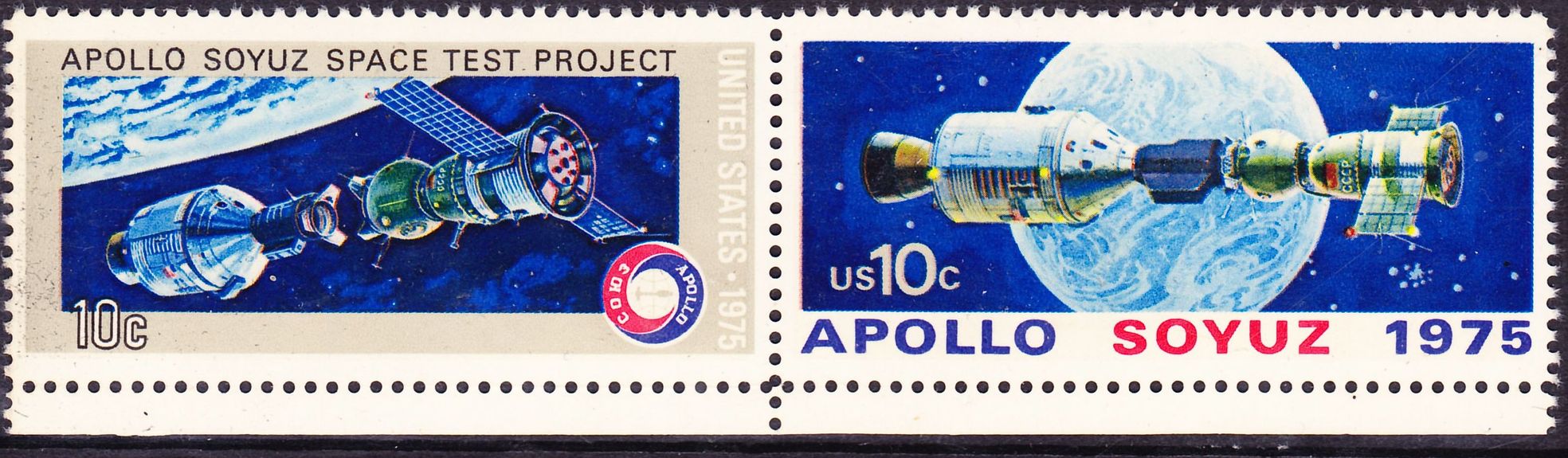
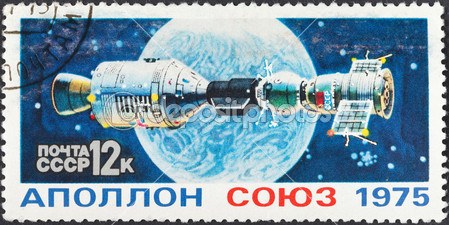
For many years I displayed the dual Soviet and American stamps issued to commemorate the docking of the Soyuz and Apollo spacecraft. I saw that event as a promise of the peace and cooperation that might someday exist between our nations. A peaceful, even warm, relationship that would be a blessing to the entire world.

I thought that day might have arrived with the end of the Soviet Union and the restoration of a Russian nation.

Unfortunately, democracy was not to prevail—at least at this moment—in that historic land. Russia ended up with the worst elements of capitalism. They got the West’s privileged (i.e. rich) classes who hoarded the nation’s wealth. And, the Russian version was even harsher. The masses have been left with dreams unfulfilled, and an oligarchy living in luxury.

As the people begin to awaken to the injustice, their leaders turn to a proven means of dulling human thought—alcohol. And, since we are talking about Russia, that means vodka. I found this analysis by David Satter quite interesting.

The Putin regime needs an end to sanctions—not because they are crippling in themselves but because, in combination with the growing crisis of the economy and the unpredictable trajectory of the war [in eastern Ukraine], they could help lead to the destabilization of Russia. . . . It is a measure of the government’s concern that it has cut the price of vodka. . . . This is a transparent attempt to use vodka to tranquilize the population.

SoyuzWhile I will continue to pray for the people of Russia, this description of Putin’s strategy reminded me of the oft-quoted Communist adage that “religion is the opiate of the masses.”

Marx or Lewis?

Karl Marx was right, in that manmade “religion” can be used to blind people to their surroundings.

Marx, however, did not understand Christianity. Because Jesus of Nazareth dispels all illusion and enables us to truly comprehend reality.

C.S. Lewis referred to Marx’s slander in his book, The Problem of Pain.

Those who reject Christianity will not be moved by Christ’s statement that poverty is blessed. But here a rather remarkable fact comes to my aid. Those who would most scornfully repudiate Christianity as a mere ‘opiate of the people’ have a contempt for the rich, that is, for all mankind except the poor.

They regard the poor as the only people worth preserving from ‘liquidation,’ and place in them the only hope for the human race. But this is not compatible with a belief that the effects of poverty on those who suffer it are wholly evil; it even implies that they are good.

The Marxist thus finds himself in real agreement with the Christian in those two beliefs which Christianity paradoxically demands–that poverty is blessed and yet ought to be removed.

Lewis aptly describes the hypocrisy of the elite who live with the comforts they supposedly disdain. In contrast, he affirms Christ’s own words about how the least are the greatest in the Kingdom of God.

Far from serving as a debilitating opiate, Christianity moves people to overcome the trials of this world. It motivates them to care for the less fortunate. It is active, not passive and resigned.

Unlike a mind-dulling spirit, Christianity calls us to forgive even our enemies and extend to them a hand of peace.

Who knows if lowering the price of vodka will distract the Russian people from the disastrous direction of their ruling regime. I hope not.

I pray that Russia will seize instead the promise bequeathed them in their Christian heritage. So that, following in the footsteps of the Prince of Peace, they might become an example of national righteousness for the rest of us, whose homelands have their own deep imperfections.

_____

Satter’s editorial, which appeared in the Wall Street Journal, is available here.

Imitating Animals

bearsHave you ever imitated a bear? Perhaps not intentionally. Still, if you are typical, you may do so routinely.

And it’s all because of your acnestis.

When I first saw the word, I thought it might be some recently coined term to address a semi-serious subject. But, the word is neither new, nor is the dilemma it describes exaggerated.

From the 1828 edition of Webster’s Dictionary.

ACNESTIS, n.

That part of the spine in quadrupeds which extends from the metaphrenon, between the shoulder blades, to the loins; which the animal cannot reach to scratch.*

While most human beings may not replicate bears’ behavior with trees, it is not uncommon to seek relief from a handy doorjamb.

Scratching that unreachable epicenter of that infernal itch has motivated the creation of a variety of tools. Yet none of these instruments can match the sheer relief offered by a sturdy doorway. I doubt I am alone, or excessively ursine, for believing that.

It could be worse, of course. At least people (most of them) don’t follow the example of dogs. We’ve all seen how they use the excuse of scratching their backs, to justify picking up unsavory scents while they wriggle around on the ground.

Descending to Subhuman Levels

Emulating animals has implications extending far beyond physical considerations. It is one thing to share a mutual appreciation for scratching one’s acnestis. Quite another to echo their baser natures.

In one of his letters, the Apostle Peter considers the fate of false prophets. After describing the damnation of fallen angels, he writes about those who teach deceitful doctrines. “But these, like irrational animals, creatures of instinct, born to be caught and destroyed, blaspheming about matters of which they are ignorant, will also be destroyed . . .” (2 Peter 2:12, ESV).

The following passage from the Psalms reveals how even the righteous are not immune to behaving like animals. “When my soul was embittered, when I was pricked in heart, I was brutish and ignorant; I was like a beast toward you [God]. Nevertheless, I am continually with you; you hold my right hand. . . . My flesh and my heart may fail, but God is the strength of my heart and my portion forever” (Psalm 73:21-23, 26, ESV).

God’s word is filled with allusions to bestial behaviors. One of the most literal is found in the example of the humiliation of the great King Nebuchadnezzar. You can read it here, from the fourth chapter of the Book of Daniel.

What Distinguishes Us from the Beasts?

C.S. Lewis describes how being a true human being differentiates us from animals. We share physical natures and numerous biological similarities. But we are far more. Lewis explores this in The Abolition of Man, which begins with the chapter “Men Without Chests.”

This image of lacking a “chest” actually refers to a classical reference for the part of a person where our character or virtue resides.

The excerpt below addresses how the enlightened or morally educated individual is capable of transcending the slavery of animals to their fleshly nature.

Without the aid of trained emotions the intellect is powerless against the animal organism. I had sooner play cards against a man who was quite sceptical about ethics, but bred to believe that ‘a gentleman does not cheat,’ than against an irreproachable moral philosopher who had been brought up among sharpers.

In battle it is not syllogisms that will keep the reluctant nerves and muscles to their post in the third hour of the bombardment. The crudest sentimentalism . . . about a flag or a country or a regiment will be of more use.

We were told it all long ago by Plato. As the king governs by his executive, so Reason in man must rule the mere appetites by means of the ‘spirited element.’

The head rules the belly through the chest—the seat, as Alanus tells us, of Magnanimity, of emotions organized by trained habit into stable sentiments.

The Chest-Magnanimity-Sentiment—these are the indispensable liaison officers between cerebral man and visceral man. It may even be said that it is by this middle element that man is man: for by his intellect he is mere spirit and by his appetite mere animal.

It is wise, I believe, for every man and woman to devote themselves to the health and of their own heart and purpose—that which makes us human.

In doing so, we will still share some of the basic behaviors of the animal world about us, such as being plagued by our acnestis . . . but the choices that direct the course of our lives will no longer be dictated solely by carnal instincts.

And such growth, my friends, will make us each day, a little bit more human.

_____

* I realize Noah Webster limited his definition to quadrupeds, but today it has been expanded to aptly apply to all of us who suffer from this curse.

Pacifism as an Enemy of Peace 

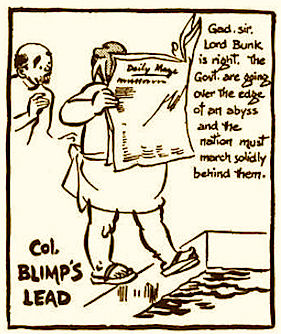
blimp 01The literary careers of C.S. Lewis and George Orwell overlapped in some interesting ways.* Today we will consider a rather odd British personality mentioned by each of them in wartime essays, Colonel Blimp.

Colonel Blimp was a cartoon figure, inspired by a conversation between two military officers who were arguing that “cavalry” officers should continue to wear spurs even when they migrated into tanks.**

At one time the cartoon was so popular that Lewis wrote:

It may well be that the future historian, asked to point to the most characteristic expression of the English temper in the period between the two wars, will reply without hesitation, “Colonel Blimp.” (“Blimpophobia”).

The good colonel echoes similar foolish notions as he blusters about in a caricature of pompous military commanders. Blimp is retired, but harangues all within earshot about the wisest course for the nation.

Orwell wrote derisively of the military and imperialistic middle class, that he called “the Blimps.” He drew the label from the “colonel with his bull neck and diminutive brain, like a dinosaur.” (“The Lion and the Unicorn”).***

blimp 02The cartoon above illustrates how Colonel Blimp is certain he has the solution to winning the arms race. The frame to the right shows that he believes his wisdom extends beyond the military to politics in general.

Timely Advice from C.S. Lewis

In “Blimpophobia,” Lewis offers advice which proves apropos for our modern age. Today, as fanatical barbarians seek to destroy civilization, enlightened nations and individuals must be vigilant.

One dimension of that vigilance involves walking the fine line between unbridled nationalism and self-absorbed pacifism. When he wrote, Lewis was worried about the anti-war sentiment that threatened to undermine Britain’s response to the Nazis.

Lewis, a wounded combat veteran of the Great War, recognized the truth of the Colonel Blimp caricature. He said something veterans recognize even more clearly than civilians. There is an overabundance of preening and stupidity in the military.

The infection of a whole people with Blimpophobia would have been impossible but for one fact—the fact that seven out of every ten men who served in the last war, emerged from it hating the regular army much more than they hated the Germans. How mild and intermittent was our dislike of “Jerry” compared with our settled detestation of the Brass Hat, the Adjutant, the Sergeant-Major, the regular Sister, and the hospital Matron!

Now that I know more (both about hatred and about the army) I look back with horror on my own state of mind at the moment when I was demobilized. I am afraid I regarded a Brass Hat and a Military Policeman as creatures quite outside the human family.

Still, he said we cannot allow that sad truth to cause us to deny the requirement to maintain a strong defense. “A nation convulsed with Blimpophobia will refuse to take necessary precautions and will therefore encourage her enemies to attack her.”

C.S. Lewis warned his countrymen of the dangers military-phobia during the Second World War. And—among the war-weary nations of the free world battling jihadism—we are wise to heed his wise words today.

The future of civilization depends on the answer to the question, “Can a democracy be persuaded to remain armed in peacetime?” If the answer to that question is No, then democracy will be destroyed in the end. But “to remain armed” here means “to remain effectively armed”. A strong navy, a strong air force, and a reasonable army are the essentials. If they cannot be had without conscription, then conscription must be endured. (C.S. Lewis, “Blimpophobia”).

_____

* In “A Literary Phobia,” I compared some advice they offered to writers. The counsel in question sounds similar on the surface, but actually differs. In “Orwellian Advice,” I contrast the two authors in much greater detail.

** Blimp’s creator, David Low, resided in London but was actually a New Zealander.

*** You can read Orwell’s 1941 essay, “The Lion and the Unicorn,” here.

Food that Bites

Guardians_of_the_Galaxy_Rocket_movie_posterMany peculiar delights are eaten in Los Angeles County, but diners might want to reconsider the fare offered at The Metro Supermarket. While it’s apparently not illegal to sell raccoons for consumption, it could become dangerous when the Guardians of the Galaxy learn of the practice.

In one of the year’s most successful blockbusters, Guardians of the Galaxy, we were introduced to Rocket Raccoon. Rocket is a genetically altered Procyon lotor designed to be a deadly fighting machine. Not only is he a brilliant tactician, the genetic manipulations have left him with one bad attitude.

Which makes it all the more important for the customers who purchase the ten-dollar-a-pound frozen raccoon carcasses to be cautious.

On a more serious note, the question of what we eat is not merely academic.

I’m not referring to modern insights into healthy diets. I’m talking about international, and potentially intergalactic, relations!

World travelers are often introduced to foods that seem, to put it gracefully, exotic. On such occasions, some respond enthusiastically—eager to sample alien delights. Others are somewhat more wary—reluctant to place in their mouths things they cannot quite identify.

Back in the 1980s I resided for a year in the Republic of Korea. I declined to eat gaegogi, not because I assumed dog meat would be unpalatable, but because I could not imagine contributing in any way to the slaughter of dogs for their flesh.

Another time that year, a sergeant who worked at our chapel purchased a paper cone full of toasted rice during an outing. When he was done with the rice (burned, he thought, rather than “toasted”), his Korean girlfriend clarified that he had just devoured a cup of rice beetles.

Military members stationed abroad are encouraged to be respectful of the cultures they encounter. And those cultures included different foods.

We need not travel to other nations to experience this diversity. I grew up in a family which considered processed “fish sticks” to be seafood. Combined with canned tuna fish and an occasional canned salmon “patty” it constituted the whole of my exposure to the abundance of the sea.

While I have since that time expanded my tastes to include many types of fresh fish, I must admit that crustaceans are not among my favorite foods. And, well, let’s not even talk about those creatures that have tentacles . . .

Not that I’m a culinary snob. In Texas I sampled rattlesnake. In South Carolina I ate alligator. (I preferred the rattlesnake, but I don’t reserve a regular spot for reptiles on my menu.)

To Eat, Or Not to Eat

Showing respect to others by dining as they do, is not a new concept. The early Christians were advised to eat without reluctance food that may have been sacrificed in a pagan temple, without questioning their hosts as to its source. “If one of the unbelievers invites you to dinner and you are disposed to go, eat whatever is set before you without raising any question on the ground of conscience” (1 Corinthians 10:25, ESV).

C.S. Lewis enjoyed a good meal. And he wrote many times about eating. Here are two of his insights on the subject.

For eating and reading are two pleasures that combine admirably. Of course not all books are suitable for mealtime reading. It would be a kind of blasphemy to read poetry at table. What one wants is a gossipy, formless book which can be opened anywhere. (Surprised by Joy).

Contrasting humility and pride, he wrote:

A man who is eating or lying with his wife or preparing to go to sleep in humility, thankfulness and temperance, is, by Christian standards, in an infinitely higher state than one who is listening to Bach or reading Plato in a state of pride. (Letters of C.S. Lewis).

Those interested in learning more about how Lewis approached the subject of meals in his fiction should download a copy of a doctoral thesis on the subject. Lower Sacraments: Theological Eating in the Fiction of C.S. Lewis is available for free here.

We’ll close with the following words from the newly minted “doctor’s” abstract to his dissertation, citing some of the subjects he explores.

For years, critics and fans of C. S. Lewis have noted his curious attentiveness to descriptions of food and scenes of eating. Some attempts have been made to interpret Lewis‘s use of food, but never in a manner comprehensively unifying Lewis‘s culinary expressions with his own thought and beliefs.

My study seeks to fill this void [proposing] ecclesiastical themes appear whenever Lewis’s protagonists eat together. The ritualized meal progression, evangelistic discourse, and biographical menus create a unity that points to parallels between Lewis’s body of protagonists and the church. . . .

Lewis’s meals which are eaten in the presence of the novel’s Christ figure or which include bread and wine in the menu reliably align with the Anglo-Catholic doctrine of the Eucharist. . . . sinful eating affects the spiritual states of Lewis’s characters.

The author ends his introduction with a particularly intriguing thesis that makes sense with my own reading of Lewis. He argues “Lewis’s culinary language draws from Edenic sources, resonating with a very gastronomic Fall of Humanity, then examines how the progressively sinful eating of certain characters signifies a gradual alienation from the Divine. . . . Lewis’s portrayal of culinary desire and pleasure ultimately points to an eschatological theme”

I love that phrase, “gastronomic Fall of Humanity.” I’m not sure I can work it into a sermon someday, but only time will tell.

Until then, I have to be content to regard the eating of dogs—and probably raccoons as well—as consequences of humanity’s Fall. And I will look forward to the new creation when all such things will have passed away.

Autobiographical Lies

cardsWatching the series House of Cards is not a “guilty pleasure.” It is often a painful exercise in examining just how corrupting, dehumanizing and (ultimately) damning political power can be. The depth of the viewers’ discomfort is a tribute to the perfectly pitched acting and writing.

It’s set in Washington D.C., and I am afraid it is more accurate portrait of that dark political environ than anyone but Mephistopheles could imagine.

Political corruption is not an American problem. It’s a human condition. Sadly, the perversions of power are replicated in capitals around the globe.

House of Cards examines the rise of a particularly evil pair, President Francis Underwood and his wife Claire.* They will stop at nothing—literally, nothing—to sate their shared hunger for power.

President Underwood is so self-consumed that few viewers will identify with his dead soul. On the other hand, he is in many ways an attractive, witty and “charismatic” man. This, of course, is the whitewash over the sepulcher that has allowed his rise to the heights of human dominance.

Despite his moral decay, there are elements of his behavior with which many can relate. I am not referring to his devotion to his wife, which appears noble but is actually a twisted symbiosis.

One way we see how a human being with the potential for true greatness has fallen to such depths comes in small sins. The ones that many of us commit without wasting a “second thought.” Such compromises often lead, as we know from personal experience, to greater transgressions.

Too often, our fall begins with a lie. We see a glimmer of this in the following scene.** The president has enlisted a popular writer to pen his “autobiography.” The author chooses to open the book with a dramatic story about Underwood’s courage and willingness to risk all for a cause.

He relates a story from the president’s youth in South Carolina. He stunned his peers by his commitment to swim all the way out to the famous Fort Sumter, at the mouth of Charleston Harbor. He did not make it the first time, and needed to be rescued by the Coast Guard. However, he tried and tried again, until he defeated the tides and waves, and rose triumphant on the island’s shore.

After the writer reads the stirring account to the president, in a dramatic aside,*** Underwood says to the audience:

I never tried to swim to Fort Sumter. Thomas probably knows I made it up. But he wrote it anyway because he understands the greater truth. Imagination is its own form of courage.

This passage is powerful. It not only displays the impulse for self-aggrandizement to which many powerful people are disposed. It also seeks to justify that compromise with integrity, by transforming the very flaw into a virtue! “Imagination is its own form of courage.” True, but given the context, repugnant.

And that sort of perversion, which had to have seemed a discordant rationale when he originally voiced it, becomes a rule for his life.

I can make up any lie that serves my purpose, because the very act of creating that new “truth” is heroic in itself. In essence, the ends (my accumulation of power), will forever justify the means.

C.S. Lewis on the Lies We Make Our Truths

One of Lewis’ lesser read theological books is The Problem of Pain. The book offers Lewis’ insights into why a loving God would allow suffering. One intriguing feature of the text is its chapter on the suffering of animals, which reveals the breadth of Lewis’ concern as well as his affection for what we now call “other species.”

The following passages suggest that when we tell ourselves the lie—that existence is ultimately about us—we are destined for disappointment. This is the tragedy being staged before our lives in the television series we have been discussing. It can be summarized in the scriptural maxim familiar even to those who never read a Bible: “For what will it profit a man if he gains the whole world and forfeits his soul?” (Matthew 16:26, ESV).

[Humanity] fell. Someone or something whispered that they could become as gods—that they could cease directing their lives to their Creator and taking all their delights as uncovenanted mercies, as ‘accidents’ (in the logical sense) which arose in the course of a life directed not to those delights but to the adoration of God.

As a young man wants a regular allowance from his father which he can count on as his own, within which he makes his own plans (and rightly, for his father is after all a fellow creature), so they desired to be on their own, to take care for their own future, to plan for pleasure and for security, to have a meum [personal possession] from which, no doubt, they would pay some reasonable tribute to God in the way of time, attention, and love, but which, nevertheless, was theirs not His. They wanted, as we say, to ‘call their souls their own.’

But that means to live a lie, for our souls are not, in fact, our own.

They wanted some corner in the universe of which they could say to God, ‘This is our business, not yours.’ But there is no such corner. They wanted to be nouns, but they were, and eternally must be, mere adjectives.

. . .

I have begun with the conception of Hell as a positive retributive punishment inflicted by God because that is the form in which the doctrine is most repellent, and I wished to tackle the strongest objection. But, of course, though Our Lord often speaks of Hell as a sentence inflicted by a tribunal, He also says elsewhere that the judgement consists in the very fact that men prefer darkness to light, and that not He, but His ‘word,’ judges men.

We are therefore at liberty—since the two conceptions, in the long run, mean the same thing—to think of this bad man’s perdition not as a sentence imposed on him but as the mere fact of being what he is. The characteristic of lost souls is ‘their rejection of everything that is not simply themselves.’

Our imaginary egoist has tried to turn everything he meets into a province or appendage of the self. The taste for the other, that is, the very capacity for enjoying good, is quenched in him except in so far as his body still draws him into some rudimentary contact with an outer world. Death removes this last contact. He has his wish—to lie wholly in the self and to make the best of what he finds there. And what he finds there is Hell.

Lewis’ description of his “imaginary egoist” ably fits the fictional President Underwood and his First Lady. Their lives are consumed by self. The fiction derives its power from the reality. The Underwoods are not simple cartoons. They reveal the life choices of real people in our world.

Men and women who have clawed their way onto the throne in their lives, find in the end, that it crumbles beneath them. Only a miracle can rescue them from their terrible chosen destinies . . . and gloriously, that redeeming miracle awaits their cry for mercy, so long as they have breath.

______

* Kevin Spacey and Robin Wright play their tragic characters so well that both have won Golden Globe awards and a variety of other accolades.

** From “Chapter 34,” season three, episode four.

*** An “aside” is a device where a character speaks directly to the audience, revealing some private thought or knowledge. It can easily be overused, but is quite finely tuned in this series. The writers of House of Cards are definitely talented.

Engage Brain

brainsWhen I attended the University of Washington, we had to learn the old-fashioned way—by studying. Now they are anticipating downloading information directly into students’ brains.

Literal brain dumps are actually still in the future . . . but researchers have documented the first indisputable brain-to-brain interface between humans!

My first paragraph is not an exaggeration of what researchers think may one day happen.

The project could also eventually lead to “brain tutoring,” in which knowledge is transferred directly from the brain of a teacher to a student.

The student would view this shortcut as advantageous. (It could also save a great deal in tuition expenses, if each course only took, say, an hour or two of brain interfacing.)

The university sees another advantage—circumventing limited teaching skills.

“Imagine someone who’s a brilliant scientist but not a brilliant teacher. Complex knowledge is hard to explain – we’re limited by language,” said co-author Chantel Prat, a faculty member at the Institute for Learning & Brain Sciences and a UW assistant professor of psychology.

My main question is, what will the teacher do, once their knowledge has been transferred to a student?

Presumably they will be able to retain a semblance of their knowledge, unlike the experience of the unfortunate Orbanians. They rely on a nanite technology, and it leaves the brilliant brain in a childlike state after the knowledge is siphoned out of it. You can learn more about them in “Learning Curve,” a documentary about the Stargate project.

C.S. Lewis had a great deal to say about education. He was a popular professor, despite the fact many of his students were intimidated by his brilliance. It is possible that if his students were able to download his knowledge, it might have caused their crania to explode.

In one essay, Lewis explains the differences between education and training, declaring “If education is beaten by training, civilization dies.” (“Our English Syllabus”).

Lewis continues, arguing that learning itself, is something distinct. It is not marked by a transfer of knowledge, but by a hunger to grow.

Now learning, considered in itself, has, on my view, no connexion at all with education. It is an activity for . . . all [who] desire to know. . . .

Societies have usually held a belief . . . that knowledge is the natural food of the human mind: that those who specially pursue it are being specially human; and that their activity is good in itself besides being always honourable and sometimes useful to the whole society.

Oh, and if you are waiting to “learn” when they can download knowledge directly into your skull, consider this wise advice from Lewis.

The only people who achieve much are those who want knowledge so badly that they seek it while the conditions are still unfavourable. (“Learning in Wartime”).

_____

The picture above shows two UW guinea pigs transferring brain waves to one another. (I am uncertain whether two-way transfer is already possible, or if one brain is forced to serve in a receptacle role.)

The article announcing the results can be seen here.

Sanctified Languages

petrusOne major difference between Christianity and Islam is their view of language. For the Muslim, Arabic is the language by which the Quran is to be known. For the Christian, there is a great impulse to translate the Scriptures into every tongue in the world.

In Islamic worship, the Quran is properly recited only in Arabic, whether the individual understands Arabic or not. This is similar to the way that most Hindus chant mantras in ancient Sanskrit.

A parallel can be drawn with the medieval practice in the Western branches of Christianity where Latin continued to be used for worship, even after it lost its role as the shared language.

The fact, however, that the Bible had even been translated into Latin was due to the Christian desire to make God’s word accessible to all people. Jerome, an early Christian theologian, became a linguistic scholar with the goal of translating the Vulgate, into the common language of his day.

It would have been a great shock to him, and to Pope Damasus I who commissioned his effort, to see the Latin so ingrained in the church’s usage that their heirs in leadership lost sight of the desire to bring the Lord’s words directly to the people so that all could understand them.

One of the great successes of the Reformation was the successful translation and distribution of the Scriptures into the vernacular of various language groups. Martin Luther’s translation, in fact, standardized the German language which had evolved into several different dialects.

Coincidentally, Lutherans have remained at the forefront of Bible translation, and Lutheran Bible Translators continue that vital work today. They currently have twenty-two Bible translations in process. LBT works in conjunction with Wycliffe Bible Translators, which is an even larger organization.

C.S. Lewis delivered a lecture at the University of London entitled “The Literary Impact of The Authorised Version.” In one portion he addressed the influence of the King James translation on the English language. While not nearly so pronounced as Luther’s on German, it is measurable.

The history of the Authorised Version has been told so often that I will not attempt to re-tell it, and its beauties praised so lavishly that I will not praise them. Instead, I will proceed at once to its influence as an English book. I shall attempt to define that influence, for I think there has been misunderstanding about it and even a little exaggeration.

Lewis’ argument is that the Bible has a profound influence on English literature, the particular translation, less so.

Ideally, all Christians would understand Hebrew and Greek, and be able to read the Scriptures in their original languages. However, there is no stigma in reading a translation. In fact, there are small pockets of people who do not understand the history of the Bible who believe that one particular translation (i.e. the King James Version) is the only authoritative text.

Sadly, I once saw an advertisement in a newspaper inviting worshipers that read: “Are you tired of people changing the Authorized Version of God’s Word with Greek and other languages? If so, come and join us at . . .”

Fortunately, the vast majority of Jesus’ disciples celebrate the translation of God’s word of life into every language spoken today.

Meanwhile, memorization of the Quran in Arabic (even when that is not the reciter’s actual language) remains highly regarded in Islam. Arabic has been regarded as so holy, in fact, that there was great reluctance to contaminate the Quran by using a printing press.

During the Ottoman Empire, until 1729, printing anything in Arabic was a crime. Somewhat ironically, the first printing utilizing Arabic movable type was done by Pope Julius II in the first decade of the sixteenth century. It was created for the benefit of Christians living in Arabic lands.

To provide a powerful illustration of a Christian validation of the authentic inspiration and power of God’s words—in any language—we turn once again to the German reformer.

Since it becomes Christians then to make good use of the Holy Scriptures as their one and only book and it is a sin and a shame not to know our own book or to understand the speech and words of our God, it is a still greater sin and loss that we do not study languages, especially in these days when God is offering and giving us men and books and every facility and inducement to this study, and desires his Bible to be an open book. . . .

In proportion then as we value the gospel, let us zealously hold to the languages. For it was not without purpose that God caused his Scriptures to be set down in these two languages alone—the Old Testament in Hebrew, the New in Greek. Now if God did not despise them but chose them above all others for his word, then we too ought to honor them above all others. St. Paul declared it to be the peculiar glory and distinction of Hebrew that God’s word was given in that language, when he said in Romans 3, “What advantage or profit have those who are circumcised? Much indeed. To begin with, God’s speech is entrusted to them. . . .”

Similarly, the Greek language too may be called sacred, because it was chosen above all others as the language in which the New Testament was to be written, and because by it other languages too have been sanctified as it spilled over into them like a fountain through the medium of translation. (Martin Luther, “To the Councilmen of Germany”).

_____

The image above is an illuminated “P” which begins the name Petrus (Peter). The manuscript is displayed in Malmesbury Abbey in England, but was originally transcribed in Belgium circa 1400.