A Symbol of Death & Life

nن – Arabic letter nun (n)

You may never have seen this symbol or, if you did, its foreign context may not have impressed it on your mind.

This Arabic letter is now being used to mark people for persecution and death. Yet, at the very same moment, this same symbol is also being transformed into an emblem that stands for courage and life.

The Islamic State has martyred or enslaved many Christians. Survivors have had all of their property stolen from them and been marked for death if they do not reject Christ and embrace the Muslim religion.

They have gone throughout the neighborhoods of their new conquests and placed this mark, the nun, on homes to mark them for evacuation or death. The “N” stands for “Nazarene,” referring to Jesus’ home town.

With the passage of time, we will likely see once again the truth proclaimed by Tertullian, that the blood of the martyrs is the seed of the church. In the meantime, everyone of good will (Christian, Jew, Muslim, Agnostic alike) should rally to the support of the suffering.

We do not yet know the magnitude of the atrocities committed by ISIS/ISIL. Like Nazi concentration camps, the complete story will not be revealed until the sites of the horror are liberated from their vile control. And, like the Mogen David (Star of David) which marked its bearers as Jews, the nun marks its bearers as Christians and targets of militant Islam.

C.S. Lewis recognized the horror of Nazism early on. In 1933 he wrote about the cruelty, and stupidity of Hitler’s attack on Judaism.

Did you see that [Hitler] said “The Jews have made no contribution to human culture and in crushing them I am doing the will of the Lord.” Now as the whole idea of the “Will of the Lord” is precisely what the world owes to the Jews, the blaspheming tyrant has just fixed his absurdity for all to see in a single sentence, and shown that he is as contemptible for his stupidity as he is detestable for his cruelty.

One can only imagine what Lewis would write about the leaders of Islamofascism today.

There are a number of organizations that support Christians currently experiencing violent persecution. None, however, approaches this work from the same perspective of Voice of the Martyrs. I wholeheartedly commend their labors to you.

They are currently offering shirts emblazoned with the letter nun. They are even more important as a witnessing tool, than as a fundraiser. Please read more about them here and share the link with your friends. Also, please take a few minutes to explore their website once you are there.

To boldly state “I am N” is to identify with the oppressed. It is to show the world you understand that each disciple of Jesus must be prepared to take up his or her own cross. Dying for one’s faith in Jesus is not a myth; it is a daily reality.

The ن symbol, intended as a mark of derision, humiliation and rejection, has assumed a new meaning. It has become a mark of hope, courage, and deliverance.

What the persecutors in Iraq and Syria intended to be a label of death has been transformed by the Holy Spirit and the faithfulness of Christians into a symbol of life.

Avoiding Gadzookeries

gadzookeryWriting quality historical fiction is challenging. This is especially true if one wishes to avoid the common crutch that a talented writer of the last century first labeled “gadzookery.”

And just what is this faux pas we should avoid when writing about the past? Well, it relates most directly to the dialog placed on the lips of historical figures. The offensive technique involves the overuse of archaic expressions or phrases. (Some would argue it includes any use of any archaisms.)

If the word gadzookery sounds a tad, how shall I put it, “goofy” to you, you may prefer using another word that means the same thing: “tushery.” Tushery was coined by Robert Louis Stevenson. Way back in the nineteenth century.

Gadzookery is a newer version, insulting the same lazy writing technique. I believe it may have been coined by Rosemary Sutcliff (1920-1992). Sutcliff’s historical influence has exerted a literary influence on my life second only to C.S. Lewis.*

The article about Sutcliff in The Oxford Encyclopedia of Children’s Literature praises her work, saying, “She carefully creates dialogue in her novels that recollects the speech of a bygone era without falling into what she termed ‘gadzookery.’”

Having tested the waters of historical fiction myself, I know this to be far more difficult that it may sound.

Sutcliff had several things in common with C.S. Lewis. Both wrote for adults and for children. (It was her young adult series about the decline of Roman influence in Britain that sparked my own lifelong interest in Rome.)

Both authors also received the Carnegie Medal for their work. When Lewis was awarded his, he received a congratulatory letter from Pauline Baynes, who had illustrated several of his books. He responded quite graciously.

Dear Miss Baynes, Very nice to hear from you again, and thanks for sending on the book, which I have returned to Lane. Thanks for your congratulations on the Carnegie, but is it not rather ‘our’ Medal? I’m sure the illustrations were taken into consideration as well as the text. I am well, and as happy as a man can be whose wife is desperately ill.

Although C.S. Lewis had married, quite late in life, the two authors were alike in spending most of their life single. Sutcliff, in fact, lived with her parents during most of her life, having suffered crippling arthritis as a child. She did not resent remaining unmarried. In a 1992 interview she said,

Beatrix Potter wrote all her gorgeous stories when she was very lonely and not very happy—after she married, she never wrote another thing. Nothing worth reading, anyway.

Another similarity between the two was that they both fell under the powerful sway of myth during their childhoods. They used their familiarity with its rich echoes to imbue their own work with themes that flowed far beyond the familiar channels travelled by other writers.

Each of them took their readers seriously, and refused to speak down to them. That is why they share one more quality I wish to mention in closing—their high standards. Neither Lewis nor Sutcliff could tolerate poor writing. And their finely tuned skills meant neither ever needed to resort to gadzookery.

______

* Excepting, of course, the Bible itself, which is literature of an entirely different sort. I don’t consider it fair to compare mortal writers, no matter how inspired, to a volume I regard as God’s written word.

C.S. Lewis’ Bilingualism

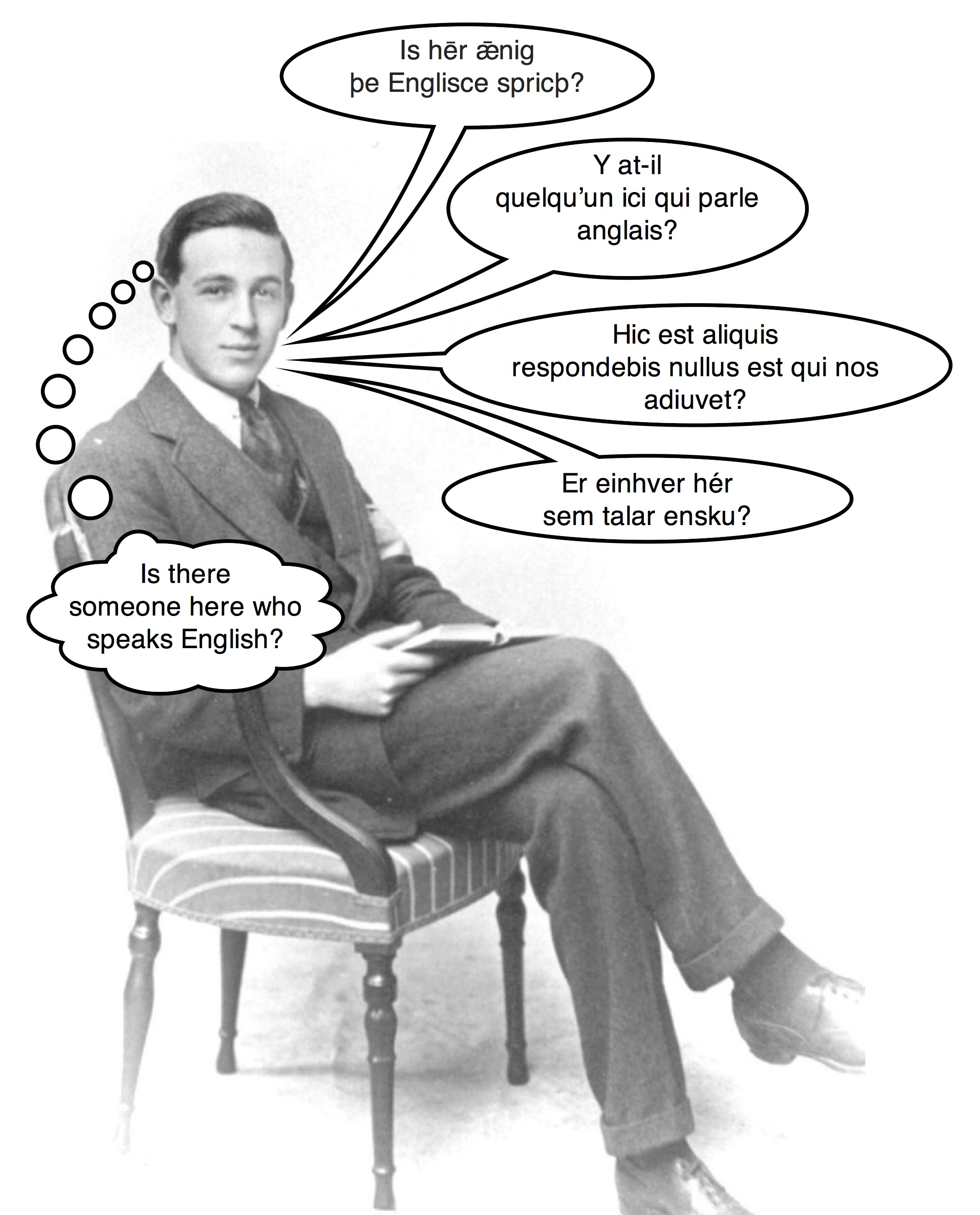
csl bilingualHow many extremely intelligent and well educated people do you know . . . who can actually communicate with those of us possessing normal human intelligence?

That talent is a rarity.

And it is precisely what makes C.S. Lewis such an unusual man. He was brilliant. Yet he could communicate with the common person—even the child—just as easily as he conversed with his fellow university dons.

Lewis, of course, could comprehend a number of languages, so he was more than merely “bilingual.” But that is not exactly the sense in which I am using the word today. I mean it in the sense of my opening paragraphs. It is the ability to communicate (even with the same “language”) to distinctly different groups who would normally not be able to readily understand one another.

In an interview that appeared in Christianity Today, Detroit pastor Christopher Brooks was asked about the challenges of urban ministry.

How have you included both righteousness and justice in your setting?

I think about C.S. Lewis, who had the challenge of building the bridge between the culture of Oxford and Cambridge and the culture of the church. These cultures were worlds apart by his time, but he was bilingual, in a sense: able to speak the language of Oxford to the church and the language of the church to the intellectuals and naturalists.

One of the titles for ancient Roman priests that was adopted by their Christian successors is “pontifex.” It means “bridge-maker.” The Pontifex Maximus was, of course, referred to the greatest of these offices.

In light of Brooks’ words about Lewis as building bridges between elite academia and Christianity, I have added that dimension to my view of him. C.S. Lewis, Pontifex Maximus. (I doubt it would make him happy, so I’ll keep it under wraps . . . and probably never mention it again.) But I am genuinely happy about his skill in building these bridges of understanding.

Before signing off, a special treat. If you call someone who speaks two languages “bilingual,” and someone who speaks three “trilingual,” what do you call someone who only speaks one language? Why, an American, of course.

That joke would not be as funny if it were not so sadly true. While the rest of the world almost assumes that people know at least two languages, most Americans stumble their way through the study of a second language for two or three years and never develop a comfort level with it. But that’s a story for another day.

Civilized Savages

civilization-and-savageryWhat are the proper criteria for determining who is civilized? If you asked a score of people, you would probably end up with twenty different opinions.

In continuing my research about America’s first woman chaplain, I encountered an early American teaching resource that offered great insight into education during the early nineteenth century.

Some of it was quaint—“goats were made as profitable to the farmer as sheep.”

Some of it was insightful—“In America the Grecian architecture is prevailing, as it is better adapted than the Gothic to small buildings, and does not require splendid edifices to display its beauty.”

The text, Peter Parley’s Universal History, on the Basis of Geography, was used in schools and homes.

After finding confirmation of the point I was researching, I couldn’t resist skimming through the volume. Out of its myriad lessons, the one that got me thinking most seriously was a discussion of relative levels of civilization.

At the end of each lesson, several questions are posed. In this case:

Questions: What would you observe in traveling through other countries? What of people in a savage state? What of people in the barbarous state? What of people in the civilized state? What of people in the highest state of civilization?

Preceding these questions is the lesson proper, from which I now quote passages that correspond to the questions just listed.

In some countries the people live in huts built of mud or sticks, and subsist by hunting with bow and arrow. These are said to be in the savage state . . .

In some countries the people live in houses partly of stone and mud. They have few books, no churches or meeting-houses, and worship idols. . . . These are said to be in the barbarous state . . .

In some countries the inhabitants live in tolerable houses, and the rich have fine palaces. The people have many ingenious arts, but the schools are poor, and but a small portion are taught to read and write. . . . which may be called a civilized state.

In many parts of Europe, and in the United States, the people live in good houses; they have good furniture, many books, good schools, churches, meeting-houses, steamboats and railroads. These are in the highest state of civilization.

It appears that Peter Parley (the pseudonym of Samuel Griswold Goodrich) considered two factors to be the clearest measures of civilization—the quality of a society’s domiciles, and the access to learning and increase in literacy.

These are not inappropriate measures, although the latter dwarfs the former in significance.

I realize these lessons are intended for elementary education, so I don’t fault Goodrich for failing to address the subject from a more philosophical or mature angle. Nevertheless, I could not help wondering whether the societies that have attained the “highest state of civilization” are truly the least barbaric.

In some ways, the societies that have attained the loftiest technological levels might also be considered among the most savage.

I don’t have the time or inclination to pursue this thought any further in Mere Inkling, but I offer it to you. Some readers will agree that it merits reflections and others will consider it absurd.

Before moving on the Inklings, though, I wish to share a pertinent bit of wisdom from economist Thomas Sowell. “Each new generation born is in effect an invasion of civilization by little barbarians, who must be civilized before it is too late.”

C.S. Lewis thought, and wrote, a great deal about civilization. In English Literature in the Sixteenth Century there is a delightful remark, made in passing, that it is possible to retreat from civilization, once attained.

From the varied excellence of the fourteenth century to the work of the early sixteenth it is a history of decay; so that in turning from the Scotch poetry of the age to the English we pass from civilization to barbarism.

I end with a longer citation from C.S. Lewis which connects uniquely with the mindset with which Goodrich penned his textbook. Lewis also affirms true education, and the advancement of humanity towards that for which it was created, as the genuine mark of civilization.

One of the most dangerous errors instilled into us by nineteenth-century progressive optimism is the idea that civilization is automatically bound to increase and spread. The lesson of history is the opposite; civilization is a rarity, attained with difficulty and easily lost. The normal state of humanity is barbarism, just as the normal surface of our planet is salt water. Land looms large in our imagination of the planet and civilization in our history books, only because sea and savagery are, to us, less interesting.

And if you press to know what I mean by civilization, I reply “Humanity,” by which I do not mean kindness so much as the realization of the human idea. Human life means to me the life of beings for whom the leisured activities of thought, art, literature, conversation are the end, and the preservation and propagation of life merely the means. That is why education seems to me so important: it actualizes that potentiality for leisure, if you like for amateurishness, which is man’s prerogative.

You have noticed, I hope, that man is the only amateur animal; all the others are professionals. They have no leisure and do not desire it. When the cow has finished eating she chews the cud; when she has finished chewing she sleeps; when she has finished sleeping she eats again. She is a machine for turning grass into calves and milk—in other words, for producing more cows. The lion cannot stop hunting, nor the beaver building dams, nor the bee making honey. When God made the beasts dumb He saved the world from infinite boredom, for if they could speak they would all of them, all day, talk nothing but shop. (“Our English Syllabus”).

_____

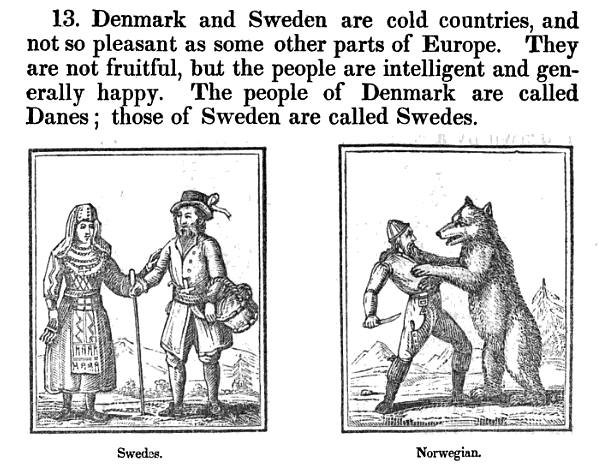
An illustration from the book, which taught generations of Americans that the heirs of the Vikings were still a picturesque and virile people.

scandinavians

Suspicious Séances

lincolnsDid you hear about the séances that were held at the White House? It’s true, but it’s not recent news. They were conducted for Mary Todd Lincoln, and her husband, the president, apparently joined in attendance at some of them.

The Lincoln’s had lost their eleven year old son Willie to Typhoid in February 1862. Nearly all historians describing Mary’s grief accurately use the word “inconsolable”.

Since the Lincoln’s were not Christian, Mary sought the illusion of comfort in spiritualism, a thriving movement in the mid-nineteenth century. Spiritualism typically contends that the spirits of the dead survive in a manner where they can, and do, communicate with the living. This interchange is typically facilitated by a “medium,” someone particularly attuned to the “spirit world.”

Mediums sometimes allow themselves to become physical vessels for these spirits.

Christians either dismiss such experiences as fraud, or as demonic possession. Which depends on their own worldview. Some Christians dismiss the spiritual realm, while others recognize it is quite real.

C.S. Lewis would be in the latter camp, as his preface to The Screwtape Letters amply illustrates.

There are two equal and opposite errors into which our race can fall about the devils. One is to disbelieve in their existence. The other is to believe, and to feel an excessive and unhealthy interest in them. They themselves are equally pleased by both errors and hail a materialist or a magician with the same delight.

Christians who acknowledge the spiritual warfare which is waged beyond our physical senses understand the meaning of Paul’s words: “For we do not wrestle against flesh and blood, but against the rulers, against the authorities, against the cosmic powers over this present darkness, against the spiritual forces of evil in the heavenly places” (Ephesians 6:12).

Returning to the 1800s

The reason I have been thinking about Mary Lincoln—who would later be institutionalized and attempted suicide—is because I’m finishing up an article for the online journal I edit about the military chaplaincy. It’s called Curtana: Sword of Mercy, and the new issue will be posted by the end of the month.*

The specific article relates the story of Ellen Elvira Gibson (Hobart),** who was the first woman chaplain in the American military. She served a Wisconsin regiment, and her story is nothing short of fascinating.

Hobart was a spiritualist, and “ordained” by a group of the same who banded together to provide just such credentials. Interestingly, although she gave hundreds of (paid) lectures in a spiritual “trance” state, she would ultimately reject spiritualism. She turned to a more radical and secular “freethinking” as spiritualism was waning in popularity, but still a formidable presence.

Chaplain Hobart would gain renown in anti-Christian circles for her book The Godly Women of the Bible by an Ungodly Woman of the Nineteenth Century. Numerous atheist websites cite a quotation from the volume. “The abominable laws respecting [women in the Bible] . . . are a disgrace to civilization and English literature; and any family which permits such a volume to lie on their parlor-table ought to be ostracized from all respectable society. . .”

Contemporary readers will find it odd that one of the reasons spiritualism received a warm welcome in Europe and America was precisely because it seemed to offer measurable, “scientific” evidence of the afterlife. In This Republic of Suffering: Death and the American Civil War, Drew Faust writes:

To an age increasingly caught up in the notion of science as the measure of truth, spiritualism offered belief that seemed to rely on empirical evidence rather than revelation and faith. If the dead could cause tables to rise, telegraph messages from the world beyond, and even communicate in lengthy statements through spirit mediums, an afterlife clearly must exist. Here was, in the words of one popular spiritualist advocate, ‘proof palpable of immortality’” (180-81).

Returning to the Inklings

One of Lewis’ dearest friends was Owen Barfield. Sadly, the two remained separated throughout life by their religious beliefs. Barfield had helped Lewis come to believe in God (i.e. theism) but could not journey with Lewis on to Christianity. Barfield, instead, became one of the greatest of Anthroposophist evangelists.

Anthroposophy possesses elements of philosophy, but is also inarguably a religion in its own right. It also holds a view of the afterlife distinct from both Christianity and historic spiritualism.

But the nature of the religion created by Rudolf Steiner (which evolved from his involvement in Theosophy) is not the subject of our reflections here. However, if one is interested in learning more about Owen Barfield, a 1992 documentary can be viewed here.

_____
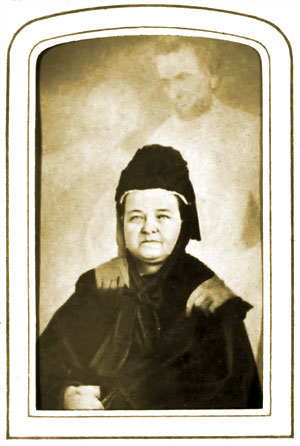
The image above is a famous example of “spirit photography” taken by William Mulmer, who made it popular. He was once placed on trial for fraud, but the case was dismissed for lack of evidence.

* I may delay publication of this particular article since the issue will already carry the biography of another chaplain.

** The reason “Hobart” is bracketed, is because it was her married name at the time of her military service. However, the marriage was short lived, and most of her life she went by “Ella E. Gibson.”

Beware the Tablet

tabletDid the ancient wax writing tablet of the Romans possess the power to terrorize enemies? Two ancient texts suggest that under some circumstances, carrying these humble wax tablets could cost someone their life.

I love history. I love writing. When you combine the two, I’m in a literary paradise. I just read a journal article that took me there. I recently joined a fascinating online organization called Academia.edu, where international scholars freely share their research.

It’s like stumbling into a free four-star buffet for the mind.

I do not only love words themselves. I’ve long been interested in the physical or mechanical aspects of writing, as well. Along this line, I’ve written here in the past about typewriters and the printing press.

I do not recall, however, writing about one of the most fascinating literary devices used by both common and gifted writers for century upon century. I am referring to the wax tablets of Rome, and the often elaborate styluses used to write on them.

I read a captivating article today that related a pair of historical incidents—one ancient, the other medieval—in which modest tablets such as these were mistaken for weapons. Deadly consequences followed.

In a Welsh journal entitled Studia Celtica, there appears “Tírechán on St. Patrick’s Writing Tablets,” by David Woods of University College, Cork. Cork is, of course, in Ireland, that enchanted isle from which the sainted C.S. Lewis also sprang. In fact, in a letter written to a child, Lewis once wrote: “I was born in Holy Ireland where there are no snakes because, as you know, St. Patrick sent them all away.

The purpose of the article was to explain how writing tablets being carried by Saint Patrick and his party could be mistaken (from a distance) as swords. The author is persuasive in revealing the historic scene and the potential for misunderstanding. In doing so, he appeals to an ancient incident in which Octavius (who would become Caesar Augustus) unjustly executed a political enemy he suspected had posed a threat.

When Quintus Gallius, a praetor, held some folded tablets under his robe as he was paying his respects, Augustus, suspecting that he had a sword concealed there, did not dare to make a search on the spot for fear it should turn out to be something else; but a little later he had Gallius hustled from the tribunal by some centurions and soldiers, tortured him as if he were a slave, and though he made no confession, ordered his execution, first tearing out the man’s eyes with his own hand.

The incident with Saint Patrick was not quite so gruesome, although it may have easily turned bloody, if the pagan’s hoping to instigate a bloodbath had succeeded.

Patrick came from Mag Arthicc to Drummut Cérrigi . . . and people saw him with eight or nine men, holding written tablets in their hands like Moses. The pagans shouted as they saw them, demanding that one should kill the holy men, and said: “They have swords in their hands for killing people. In their hands they look wooden by day, but we believe they are swords of iron for shedding blood.”

The big crowd was on the point of doing harm to the holy men; but there was a man among them who felt pity, Hercaith by name, of the race of Nothe, the father of Feradach. He believed in Patrick’s God, and Patrick baptized him and his son Feradach.

Fortunately, reason prevailed, and Patrick continued to spread the gospel in the land to which he had originally been carried as a slave.

The article also references occasions where the stylus, rather than the innocuous tablet, was used as a weapon. “For example, when his assassins confronted Julius Caesar in the senate in 44 BC, he sought to defend himself with his stylus, and stabbed one of them, Casca, in the arm with it.”

The pen, (the original) Caesar’s weapon of last resort.

This delightful article offered a wealth of knowledge. It alerted me to the fact that it is not only wax tablets that are threatening. Those who are wise will exercise extreme caution, whenever they are confronted by any and all writing tools.

Is More Better?

everettThat’s a trick question. More of some things certainly is better . . . more peace, more compassion. But more—even of good things—can sometimes become too much.

Case in point: words.

I continue to frustrate one of my critique group friends because I write “like a historian rather than a journalist.” The distinction being:

Journalist – Just the facts, please.
Historian – Lover of descriptions, details, esoterica, and trivia.

Guilty as charged.

C.S. Lewis commends the literary virtue of brevity. The following passage is found in his aptly named essay, “Before We Can Communicate.”

In the very process of eliminating from your matter all that is technical, learned, or allusive, you will discover, perhaps for the first time, the true value of learned language: namely, brevity. It can say in ten words what popular speech can hardly get into a hundred.

Last year marked the 150th Anniversary of one of the world’s most famous speeches. Not only Americans are familiar with Abraham Lincoln’s Gettysburg Address. It has become a monument to succinctness and power.

Rereading it recently I began to wonder about the other speech delivered at the event . . . the two hour oration delivered by Edward Everett, one of the era’s most highly regarded public speakers.*

The journalists and audience at the dedication of the Gettysburg National Cemetery were extremely impressed by Everett’s presentation, and surprised by the brevity of Lincoln’s remarks.

Following the event, both men lauded each other’s message. Lincoln responded to Everett’s note which praised him for the “eloquent simplicity & appropriateness” of his remarks. Everett said, “I should be glad, if I could flatter myself that I came as near to the central idea of the occasion, in two hours, as you did in two minutes.”

Your kind note of to-day is received. In our respective parts yesterday, you could not have been excused to make a short address, nor I a long one. I am pleased to know that, in your judgment, the little I did say was not entirely a failure. Of course I knew Mr. Everett would not fail; and yet, while the whole discourse was eminently satisfactory, and will be of great value, there were passages in it which transcended my expectation. The point made against the theory of the general government being only an agency, whose principals are the States, was new to me, and, as I think, is one of the best arguments for the national supremacy. The tribute to our noble women for their angel-ministering to the suffering soldiers, surpasses, in its way, as do the subjects of it, whatever has gone before.

I tracked down an online copy of Everett’s Gettysburg speech. I’ve skimmed it, and it is rather interesting. With the course of the war still undetermined at the time it was presented, it is easy to see how its stirring words could inspire an already war-weary nation. As he elaborates on the efforts of the Confederates to establish a new nation, he begs for patience. “Pardon me, my friends, for dwelling on these wretched sophistries.” Sophistries indeed.

The speech offers a partisan analysis of the entire course of the war up to that time. International readers of Mere Inkling may find the references to other countries interesting. He describes “civil wars” in England, Germany, Italy and France. Since he spoke during an era when Italy was still disunited, allow me to quote that portion of the speech.

In Italy, on the breaking up of the Roman Empire, society might be said to be resolved into its original elements–into hostile atoms, whose only movement was that of mutual repulsion. Ruthless barbarians had destroyed the old organizations, and covered the land with a merciless feudalism. As the new civilization grew up, under the wing of the Church, the noble families and the walled towns fell madly into conflict with each other; the secular feud of Pope and Emperor scourged the land; province against province, city against city, street against street, waged remorseless war with each other from father to son, till Dante was able to fill his imaginary hell with the real demons of Italian history.

So ferocious had the factions become, that the great poet-exile himself, the glory of his native city and of his native language, was, by a decree of the municipality, condemned to be burned alive if found in the city of Florence. But these deadly feuds and hatreds yielded to political influences, as the hostile cities were grouped into States under stable governments; the lingering traditions of the ancient animosities gradually died away, and now Tuscan and Lombard, Sardinian and Neapolitan, as if to shame the degenerate sons of America, are joining in one cry for a united Italy.

For those who are interested, this paragraph from Everett’s speech is only fifty-five words shorter than the entire Gettysburg Address.

Of course, just as being loquacious does not guarantee irrelevance, neither does brevity ensure quality.

The key is using the right number of words. That will vary from person to person.

In the twenty-first century, though, a good rule of thumb is to follow the example of Lincoln rather than his speechifying colleague.

_____
* Everett had a prolific political career. It included: U.S. House of Representatives, Governor of Massachusetts, U.S. Ambassador to the United Kingdom, U.S. Secretary of State, U.S. Senator. Oh, and he was also President of Harvard University, a job that probably included at least as much politics as his previous endeavors.

Undue Honor

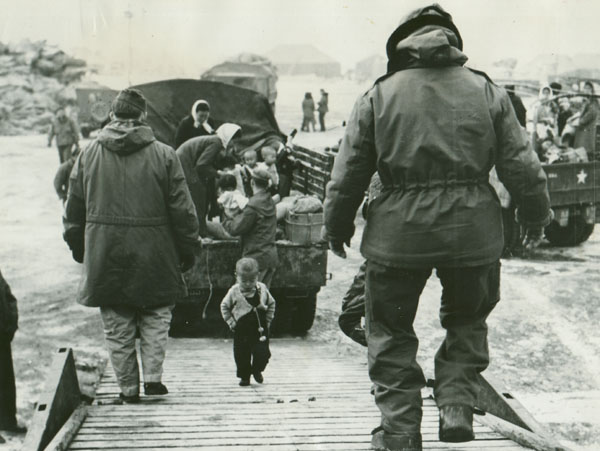
orphan flightHow should we respond when someone else receives all of the praise and accolades for something we actually accomplished? I confess my natural, human reaction is to resent them for it. The example of one outstanding Korean War chaplain, however, clearly reveals how it is much more noble to simply reject resentment and move forward in life.

This column continues a story introduced in my last post, so if you missed it, you may find it helpful to pause and read that piece before continuing. It’s available here.

In discussing the plight of the orphans during the Korean War, I mentioned the name of Chaplain Russell Blaisdell. He and his ministry partner, Staff Sergeant Mike Strang, saved nearly a thousand orphans during a single heroic action in December of 1950.

The full story of the Kiddy Car Airlift can be found on the website of the Korean War Children’s Memorial.

Here are the highlights. For months Chaplain Blaisdell and Sergeant Strang had been rescuing homeless children from the streets of Seoul. Due to the rapid advance of Communist forces, the fall of the capital city became imminent.

The military was rapidly attempting to redeploy its assets, to minimize the resources which were destined to fall into the hands of the enemy. Transporting noncombatants to safety fell far down the long list of urgent missions. The children were nonessential. To everyone, that is, except these two men.

The details of their heroic effort are the stuff of movies. And a movie that included this great escape was indeed made. The only problem is that it did not reflect the true story, and neither of the true heroes received their due.

The story of this injustice is related online here. Briefly, another Air Force officer, a pilot who assisted Blaisdell with finding quarters for the refugees behind friendly lines, received the credit due to the ministry team. So, exactly how did this travesty come about?

Colonel Dean Hess wrote a book, entitled Battle Hymn. It sold well, and included many significant actions in which the author had presumably been directly involved. However, the most significant event, in which he was involved only indirectly, was a focal point of book and its subsequent film (starring Rock Hudson, no less).

Only in very recent years, and unfortunately after Strang had died, has the story been set straight. Blaisdell has received overdue recognition from the Air Force and the Republic of Korea. Strang’s recognition has necessarily been posthumous.

Dr. George Drake wrote an article on this unfortunate tale, and although he entitles it “Hess: Fraudulent Hero,” he does offer a less critical rationale for how misperceptions may have been carried so far.

Once the movie was released it seemed impossible for Hess to say “This is not a true portrayal of what happened.” Hess had become a captive of his own earlier mis-statement of the facts of the rescue. Recently Hess has privately, but not publicly, stated that he was upset with the way the movie distorted the story of the rescue but the truth of the matter is that his concern for that distortion of the facts did not prevent him from accepting the honors due someone else.

Drake reproduces correspondence between Strang and Blaisdell related to the matter. In 1957, Strang wrote his friend about having dinner with Hess in California, in the hopes that he might get a role in the film. “I went out there and he met me one night for dinner and asked me a few questions about what happened on Kiddy Car Operation and I never heard from him after that, as a matter of fact I called him any number of times and he never even had the courtesy to return my call or even leave a message for me.”

Blaisdell’s response brings us back to the question with which I began this column. Based on how the two of them had been overlooked, and especially in light of Strang’s disappointment at failing to get a break in a hoped for civilian career, what should the two of them do? Blaisdell took the high ground and wrote to his comrade in arms:

In regard to doing anything about it, I have decided in the negative. Although I agree with you in principle, the goal of our efforts, in regard to the orphans and also in the evacuation of the Koreans by convoy, was the saving of lives, which would otherwise have been lost. That was accomplished.

In a sense, Mike, well-doing has its own reward, which is not measured in dollars, prestige, or good will . . . This does not mean that I would not be willing to state the facts as they existed to anyone who might properly request them to substantiate your story.

Strang joined his chaplain on the high moral ground, and did not create a scandal. I hope that, had I been in their combat boots, I would have joined them there.

There is something quite alluring about fame. Not everyone is vulnerable to it—we all have our own weak links in our personal armor—but many are. Writers, I suspect are particularly susceptible to the wounds pride and renown can inflict. After all, who among us who writes does not desire a large audience? (Or at least a small but clearly “devoted” one.)

Even C.S. Lewis was not impervious to the assault of fame. In a letter to his friend Don Giovanni Calabria, Lewis describes how personal concerns prevented him from doing much writing at the time. With great personal insight and wisdom, he adds that this may not be such a bad thing.

As for my own work, I would not wish to deceive you with vain hope. I am now in my fiftieth year. I feel my zeal for writing, and whatever talent I originally possessed, to be decreasing; nor (I believe) do I please my readers as I used to. I labour under many difficulties. . . .

These things I write not as complaints but lest you should believe I am writing books. If it shall please God that I write more books, blessed be He. If it shall please Him not, again, blessed be He. Perhaps it will be the most wholesome thing for my soul that I lose both fame and skill lest I were to fall into that evil disease, vainglory.

Like Lewis, we are well served when we ponder the effects of fleeting fame and worldly success on our lives and souls. And, like Strang and Blaisdell, we should carefully weigh our own motivations whenever we desire to seize the recognition we believe we deserve.

orphan airliftAfter all, in the end what is untrue will be dispelled like the morning mists . . . and when that bright Light shines upon us all, only what is true and selfless will glow with the reflection of God’s own glory.

Rescuing Orphans

orphansWar is a terrible thing. It should be avoided at (nearly) all costs. As C.S. Lewis wrote during Hitler’s atrocities, “If war is ever lawful, then peace is sometimes sinful” (“The Conditions for a Just War”).

I was writing this weekend about one of the sad consequences of war—the creation of orphans. As an adopted child of God, I possess deep compassion for children without parents in this world. Over a decade ago I was privileged to represent the United States Air Force at the dedication of the Korean War Children’s Memorial.

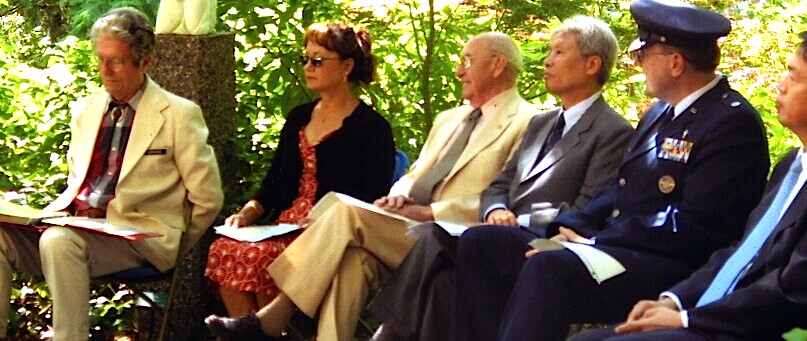
When I contacted the coordinator of that event, Dr. George Drake, he provided me with the photograph above, which shows the speakers that day. Drake appears to the left, and yours truly is in uniform, to the right. The primary speaker was Chaplain Russell Blaisdell, center, who saved the lives of at least a thousand Korean orphans during the war, delivering them from almost certain death as Seoul fell to the Communists. (My next post will reflect on his heroism and humility.)

The war in Korea was horrific. The frontlines swept across the peninsula, leaving desolation and tragedy in their wake. The number of orphans created by the violence was legion. In the cruel ebb and flow of the conflict, many perished. Still, even in the crimson terror there were expressions of mercy and grace.

Chaplains often led the way in reaching out to the children, but their efforts would have accomplished little if the compassion of the common Soldier, Marine, Sailor and Airman had not moved them as well to make sacrifices to care for the children.

Chaplains who serve in Korea today have maintained the strong bonds of support for orphanages that was so vital to the wartime chaplains represented by Blaisdell.

During my year in Taegu (Daegu), I coordinated the ministry of the airmen at Taegu Air Base in partnership with Love and Hope Orphanage. Love and Hope has a unique role, caring for the least of the least . . . children with serious physical and/or mental handicaps. There is little room for them in most societies, and Korea is no exception.

Orphans are made not by war alone, of course, but by a variety of tragic confluences of suffering. Some lose parents to accident or disease. Today, we find the greatest number of orphaned children in various parts of Africa where AIDS has devastated local adult populations. Similarly, following natural disasters such as major earthquakes and tsunamis, many orphans are left alone in the rubble or receding waters.

Some children flee abusive homes, or are rescued from dangerous environments; in one sense these were orphans even before their legal bonds with cruel predators were severed.

Many causes account for the existence of orphans. And, as long as we live in this fallen world, orphans will be among us. This is why we must never forget that, “Religion that is pure and undefiled before God, the Father, is this: to visit orphans and widows in their affliction, and to keep oneself unstained from the world” (James 1:27, ESV).

C.S. Lewis was well acquainted with the sorrow of wartime violence and the shattering of families. A veteran of World War I, he saw many friends perish just as they were embarking on adulthood. After World War II, one of his many correspondents was Don Giovanni Calabria, who operated an orphanage in devastated Italy

In 1951, Lewis sent his friend a newly translated copy of the first book in his Chronicles of Narnia. He invited the priest (who would be canonized by the Roman Catholic Church less than fifty years later) to pass the book on to one of the orphans in his care.

I am sending you my tale recently translated into Italian in which, frankly, I have rather played than worked. I have given my imagination free rein yet not, I hope, without regard for edification—for building up both my neighbour and myself. I do not know whether you will like this kind of trifle. But if you do not, perhaps some boy or girl will like it from among your “good children.”

While I imagine the volume remained close to the future “saint,” I trust that Lewis’ powerful tale delighted many of the young children in his care.

As Chaplain Blaisdell says about caring for innocent children, the act itself provides more than sufficient reward. Formal recognition is not required, and may in fact detract from the intrinsic satisfaction that accompanies the giving of oneself in service. Ninety-nine percent of those who sacrifice for the widow and orphan remain essentially anonymous to all but God, and this is just fine. (You can read more about the Kiddy Car Airlift and who received credit for it here.)

Jews Following Jesus

interfaithJewish poetry is breathtaking. The Psalms have nourished people of faith, as well as secularists, for millennia. C.S. Lewis wrote this about the providence of God in using the Jewish people as his conduit for blessing the world.

My enjoyment of the Psalms has been greatly increased lately. The point has been made before, but let me make it again: what an admirable thing it is in the divine economy that the sacred literature of the world should have been entrusted to a people whose poetry, depending largely on parallelism, should remain poetry in any language you translate it into.

He alluded to this in a letter to Sister Penelope, an Anglican nun and writer. In 1941 she sent him a copy of her new book, Windows on Jerusalem: A Study in the Mystery of Redemption. Lewis responded with gratitude. (Contemporary authors will find the detail of Lewis’ informal critique of her book illustrative of what he brought to the meetings of the Inklings.)

Thank you very much for the book. It has given me real help. What I particularly enjoy in all your work, specially this, is the avoidance of that curious drabness which characterises so many ‘little books on religion.’ Partly it is due to your Hebraic background which I envy you: partly, no doubt, to deeper causes.

Things that particularly pleased me were the true meanings of Beloved (p. 8) and Son (p. 9), the whole account of the Transfiguration (pp. 16 et seq), the passage on Sacrifice (p. 32), the passage ‘This was a shock’ (on p. 35), on our inability to understand sin (41 and 47), the very important bit about Hebrew & Roman ideas of ransom (52, 53): the really splendid account of how God can’t help deceiving the devil (56) and the allegorical close. There are, in fact, a good many Gifford Lectures and other such weighty tomes out of which I’ve got less meat (and indeed less efficient cookery!).

Judaism & Christianity

Jews and Christians have a complex relationship. This is even more true for Jewish people who come to accept Jesus as the promised Messiah. For most Jews, this automatically results in their expulsion from the Jewish community. However, for a growing number, there is a more gracious attitude developing.

A recent survey conducted by the Pew Research Center revealed some interesting statistics. Note the percentage of United States Jews considering the following to be essential:

Remembering the Holocaust – 73%

Leading an Ethical & Moral Life – 69%

Caring about Israel – 43%

Having a Good Sense of Humor – 42%

Observing Jewish Law – 19%

Here is the most surprising part of the survey. Thirty-four percent of American Jews consider believing Jesus is the Messiah, is compatible with being Jewish.

Let me repeat that . . . 34% of Jews in the United States (35% of the ultra-Orthodox Jews) believe that “Messianic Jews” remain Jewish.

I find that amazing. I also find it encouraging, since it’s consistent with the understanding of the Jews in first century Judea who worshipped beside the followers of Jesus in Jerusalem until its fall.

Some years ago I heard a lecture by a prominent Jewish theologian who described how historical Judaism rarely rejected those who considered any particular rabbi to be the Messiah. Apparently this remains true today, as some modern Jews, for example, consider  Menachem Mendel Schneerson (1902-1994) to be the Messiah.

Returning to the case of Jesus of Nazareth, the improving attitude is encouraging to see. In part, because most Messianic Jews say accepting Jesus as the Messiah has made them more Jewish. By that, most mean that they now practice the traditions of their Jewish heritage more faithfully than they previously did.

Following his conversion, C.S. Lewis grew in his positive consideration of the Jewish faith and people. In 1933, as Hitler’s hatred for Judaism became more evident, he wrote in a letter:

I might agree that the Allies are partly to blame, but nothing can fully excuse the iniquity of Hitler’s persecution of the Jews, or the absurdity of his theoretical position. Did you see that he said “The Jews have made no contribution to human culture and in crushing them I am doing the will of the Lord.”

Now as the whole idea of the “Will of the Lord” is precisely what the world owes to the Jews, the blaspheming tyrant has just fixed his absurdity for all to see in a single sentence, and shown that he is as contemptible for his stupidity as he is detestable for his cruelty. For the German people as a whole we ought to have charity: but for dictators, “Nordic” tyrants and so on . . .

All of the civilized people of the world share Lewis’ revulsion with Hitler and his agenda. In that we definitely agree with the vast majority of Jews who regard “Remembering the Holocaust” as something essential.

Postscript:

As positive a sign as the 34% support of Messianic Jews remaining Jewish is, the survey includes a more sobering corollary. Exactly twice that number, 68%, agreed that you can remain Jewish even if you don’t believe in the existence of God. Shocking. But that’s a subject for another day.