A Pair of Brilliant Writers

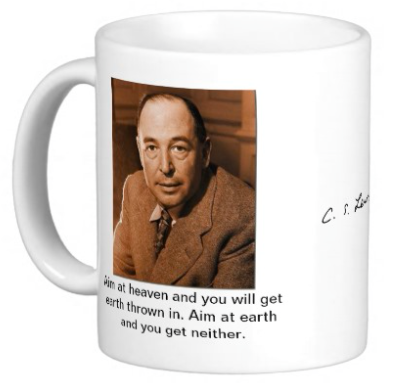
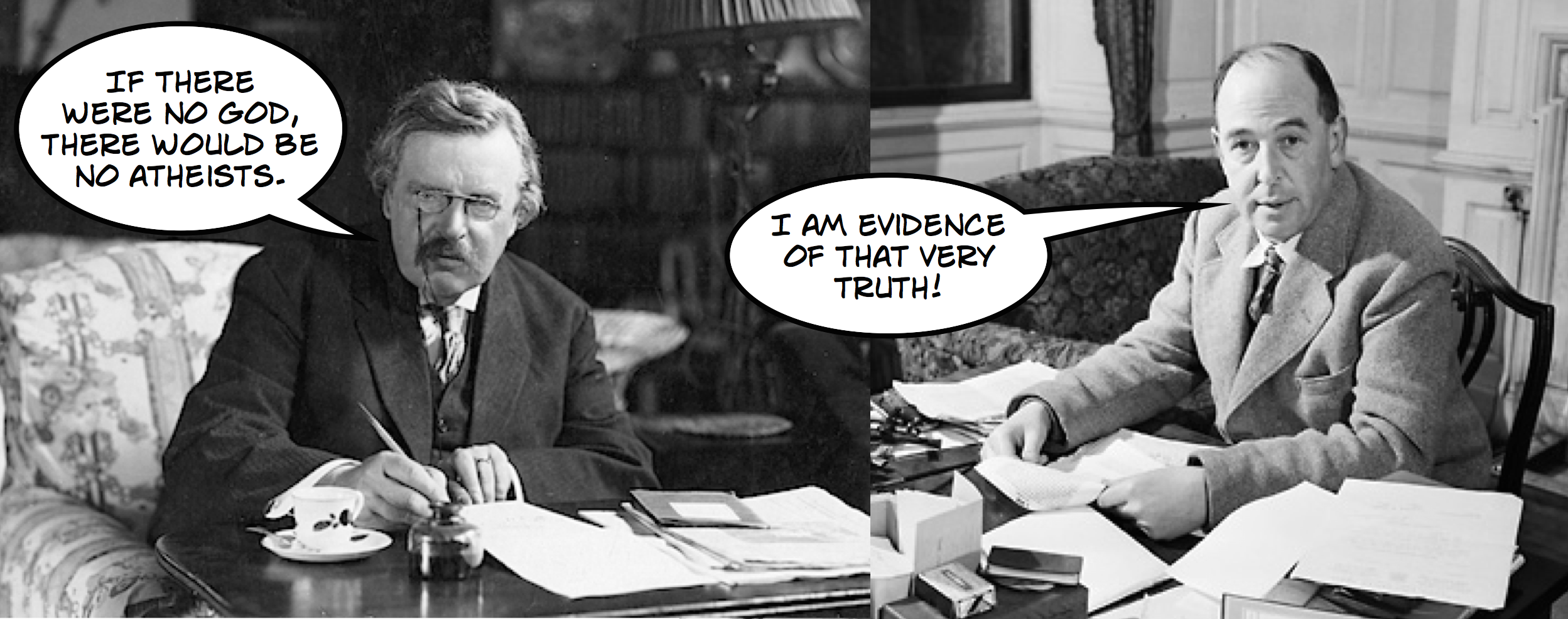
csl & chesterton

Sadly, politics are by definition nearly always polarizing. In the linguistic battleground of political warfare, we seem to more and more frequently encounter a “take no prisoners” attitude. It’s ominous.

I recently read the following words which describe, quite well I think, the positions of the two main rivals in virtually all political campaigns. (And, in this sentence, I’m referring to the military definition of “campaign.”)

“The whole modern world has divided itself into Conservatives and Progressives. The business of Progressives is to go on making mistakes. The business of the Conservatives is to prevent the mistakes from being corrected.”

Some things never change. This cutting critique appeared nearly a century ago (in the 19 April 1924 issue of the Illustrated London News). It was penned by G.K. Chesterton, a British writer who was admired by many of his contemporaries, from a number of different perspectives. George Bernard Shaw, a Socialist, considered the conservative journalist a “man of colossal genius.”

Chesterton was one of the Christian writers whose faith made a significant impression on the unbelieving C.S. Lewis. Before encountering Jesus, the atheist Lewis resented the “intrusions” of Christian references into the writings of authors he otherwise enjoyed. He describes this conundrum delightfully in Surprised by Joy.

All the books were beginning to turn against me. Indeed, I must have been as blind as a bat not to have seen, long before, the ludicrous contradiction between my theory of life and my actual experiences as a reader. George MacDonald had done more to me than any other writer; of course it was a pity he had that bee in his bonnet about Christianity. He was good in spite of it.

Chesterton had more sense than all the other moderns put together; bating, of course, his Christianity. Johnson was one of the few authors whom I felt I could trust utterly; curiously enough, he had the same kink. Spenser and Milton by a strange coincidence had it too.

Even among ancient authors the same paradox was to be found. The most religious (Plato, Aeschylus, Virgil) were clearly those on whom I could really feed.

On the other hand, those writers who did not suffer from religion and with whom in theory my sympathy ought to have been complete—Shaw and Wells and Mill and Gibbon and Voltaire—all seemed a little thin; what as boys we called “tinny.” It wasn’t that I didn’t like them. They were all (especially Gibbon) entertaining; but hardly more. There seemed to be no depth in them. They were too simple. The roughness and density of life did not appear in their books. . . .

The upshot of it all could nearly be expressed in a perversion of Roland’s great line in the Chanson—Christians are wrong, but all the rest are bores. The natural step would have been to inquire a little more closely whether the Christians were, after all, wrong.

And C.S. Lewis, to his eternal joy, did just that. He inquired more deeply into the faith held by the writers he so respected. This included, of course, Chesterton. Echoes of Chesterton’s masterful expressions of Christian faith recur in the work of Lewis. For example, in his essay “Membership,” Lewis writes:

Equality is a quantitative term and therefore love often knows nothing of it. . . . Even in the life of the affections, much more in the body of Christ, we step outside that world which says “I am as good as you.” . . . We become, as Chesterton said, taller when we bow; we become lowlier when we instruct.

Similarly, in A Preface to Paradise Lost, Lewis describes how best to savor the historical work of writers from different eras. Although the reference to Chesterton here is given in passing, I will reproduce the larger passage in light of its insight into how best to benefit from what we read.

The things which separate one age from another are superficial. Just as, if we stripped the armour off a medieval knight or the lace off a Caroline courtier, we should find beneath them an anatomy identical with our own, so, it is held, if we strip off from Virgil his Roman imperialism, from Sidney his code of honour, from Lucretius his Epicurean philosophy, and from all who have it their religion, we shall find the Unchanging Human Heart, and on this we are to concentrate.

I held this theory myself for many years, but I have now abandoned it. I continue, of course, to admit that if you remove from people the things that make them different, what is left must be the same, and that the Human Heart will certainly appear as Unchanging if you ignore its changes. . . .

Instead of stripping the knight of his armour you can try to put his armour on yourself; instead of seeing how the courtier would look without his lace, you can try to see how you would feel with his lace; that is, with his honour, his wit, his royalism, and his gallantries out of the Grand Cyrus. I had much rather know what I should feel like if I adopted the beliefs of Lucretius than how Lucretius would have felt if he had never entertained them. The possible Lucretius in myself interests me more than the possible C.S. Lewis in Lucretius.

There is in G.K. Chesterton’s Avowals and Denials a wholly admirable essay called “On Man: Heir of All the Ages.” An heir is one who inherits and “any man who is cut off from the past . . . is a man most unjustly disinherited.” . . .

You must, so far as in you lies, become an Achaean chief while reading Homer, a medieval knight while reading Malory, and an eighteenth century Londoner while reading Johnson. Only thus will you be able to judge the work “in the same spirit that its author writ” and to avoid chimerical criticism.

G.K. Chesterton is well worth reading, and most fans of Lewis will appreciate his prodigious work. The best thing about Chesterton, is that since he entered the presence of his Lord in 1936, nearly everything he wrote is in the public domain. His essays, poetry, apologetic works—and even the tales of his fictional detective Father Brown—are readily accessible online.

For a friendly introduction to the relationship between Lewis and Chesterton, I recommend “Chesterton and Lewis, Side by Side.” In an issue devoted entirely to comparing the two pillars of Twentieth Century Christian apologetics, the St. Austin Review, we read:

In 1946, ten years after Chesterton died, Lewis wrote a short article defending Chesterton against the two charges with which he is still attacked—or dismissed—by most academicians: one, that he was popular, and two, that he was dated. Of course, Lewis is attacked for the same two reasons.

The entire article is available here. Those interested in one of the areas where Chesterton’s writing overlapped with that of Lewis and his good friend, J.R.R. Tolkien, will also enjoy “G.K. Chesterton: Fairy Tale Philosopher,” which is available here.

Poet-olatry: Poetry Misperceived

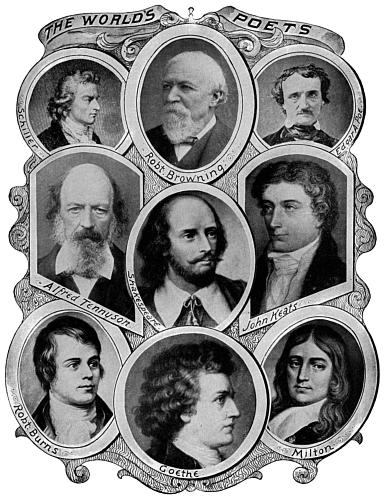
poetsWhen does our appreciation of a particular writer border on literary idolatry? Well, not idolatry proper, since even shrines like Poet’s Corner at Westminster Abbey don’t endorse “worship.”

We naturally appreciate the memory of those whose work has contributed to our lives. And that’s fine. But when we begin to focus more on them, than on the real, breathing people around us, our priorities are skewed.

In 1989, Hollywood released a film entitled “Dead Poet’s Society.” It was nominated for an Oscar for Best Picture, and ironically won the Oscar for Best Writing. In the movie, an English teacher awakens his moribund students to literature, and the more reflective aspects of life.

At last week’s writers meeting, we were introducing ourselves to a visitor, and as part of that process, mentioned the type of writing each of us pursues. I listed several genres and concluded with the words “but I’m not a poet.”

A member of the group immediately “corrected” me, since I have, in fact, written several poems during the past couple of years. Well, I guess I should get used to saying something like, “I don’t consider myself a poet.”

Poetry, some poets insinuate, carries a more artistic air than other, pedestrian genres. Fiction, of course, has its own advocates, and they too occasionally look down on folks like me who typically muddle around in the nonfiction worlds history and religion.*

In the following paragraphs, C.S. Lewis offers some provocative thoughts about how we should rightly feel toward departed writers. His argument is really about how we must not neglect our duty to living humanity by focusing on those who are “gone.”

A special treat in the selection is his coining of the word which inspires the title of this post.

There is a reaction at present going on against the excessive love of pet animals. We have been taught to despise the rich, barren woman who loves her lap dog too much and her neighbor too little.

It may be that when once the true impulse is inhibited, a dead poet is a nobler substitute than a live Peke, but this is by no means obvious. You can do something for the Peke, and it can make some response to you. It is at least sentient; but most poetolaters hold that a dead man has no consciousness, and few indeed suppose that he has any which we are likely to modify.

Unless you hold beliefs which enable you to obey the colophons of the old books by praying for the authors’ souls, there is nothing that you can do for a dead poet: and certainly he will do nothing for you.

He did all he could for you while he lived: nothing more will ever come. I do not say that a personal emotion towards the author will not sometimes arise spontaneously while we read; but if it does we should let it pass swiftly over the mind like a ripple that leaves no trace.

If we retain it we are cosseting with substitutes an emotion whose true object is our neighbour. Hence it is not surprising that those who most amuse themselves with personality after this ghostly fashion often show little respect for it in their parents, their servants, or their wives. (The Personal Heresy).**

Lewis alleges our emotional “bonds” with departed writers are fruitless, imaginary, and perhaps even detrimental. I agree that when they displace our connections with living people, it is tragic.

While I rarely disagree with the Magister Lewis, I will in this case. I would make an exception to his argument—in a single sense. For Christians, our filial affection for a departed Christian writer, is a unique case. The distinction being the fact, that in light of the resurrection, and the gift of eternal life, we are not talking about others who are permanently severed from a genuine relationship with us.

On the contrary, there are many other disciples of Jesus living today who feel a powerful connection to writers like Lewis himself. And, with all eternity ahead, there should be ample time for each of us to enjoy his company, and thank him for the blessing he bequeathed to us through his work.

Postscript:

I recognize that it may be in questionable taste, but the subject of departed artists reminds me of a humorous song from Monty Python’s Flying Circus. It’s called “Decomposing Composers,” and the modestly disconcerting lyrics are rendered in a somber, classical manner. If interested, you can listen to it here.

_____

* I intentionally refer to “religion” as nonfiction, since I regard it to be just that. (And also because I know that pushes some people’s buttons.)

** Last year I approached this same passage by Lewis from a different perspective. If you would like to read some thoughts related to pet fads, check them out here.

The Lion’s Command

crowned lionI recently had a few free moments while waiting for a flight, and I decided to revisit that enjoyable childhood treasure, Aesop’s Fables. It had been many years since I explored them, and I found the following tale particularly entertaining.

Aesop may have been a fable himself. Aristotle refers to him as an historical figure, but since Aesop supposedly lived three centuries before the philosopher’s day, he had already transformed into a legend.

Plutarch describes Aesop’s death as occurring when he was thrown from a cliff during a failed diplomatic mission. Presumably after insulting the city of Delphi, they accused him of stealing some temple items. (Perhaps he tried to be too witty for his own good.)

Whether he was an actual person or not, the anecdotes that have accreted around his name have entertained countless generations. On now to the story that captured my imagination.

The Kingdom of the Lion

The beasts of the field and forest had a Lion as their king. He was neither wrathful, cruel, nor tyrannical, but just and gentle as a king could be. During his reign he made a royal proclamation for a general assembly of all the birds and beasts, and drew up conditions for a universal league, in which the Wolf and the Lamb, the Panther and the Kid, the Tiger and the Stag, the Dog and the Hare, should live together in perfect peace and amity.

The Hare said, “Oh, how I have longed to see this day, in which the weak shall take their place with impunity by the side of the strong.” And after the Hare said this, he ran for his life.

The Moral: Saying something does not make it so. (Aesop’s Fables).

Although Aesop’s Lion bears a resemblance to C.S. Lewis’ own vision, he is no Aslan. Both are the kings of their respective domains. Both dictate that there be peace among their subjects.

Aslan alone, though, can make this pacific vision reality. And, because sin had entered Narnia, he had to do it by creating a new Narnia. The amazing story of the conclusion of the temporary and inauguration of the eternal is told in The Last Battle. The original plan, recorded in The Magician’s Nephew, was that the creatures live in divine harmony.

The chosen beasts who remained were now utterly silent, all with their eyes fixed intently upon the Lion. The cat-like ones gave an occasional twitch of the tail but otherwise all were still. For the first time that day there was complete silence . . .

The Lion, whose eyes never blinked, stared at the animals as hard as if he was going to burn them up with his mere stare. And gradually a change came over them. The smaller ones— the rabbits, moles, and such-like— grew a good deal larger. The very big ones— you noticed it most with the elephants— grew a little smaller. Many animals sat up on their hind legs. Most put their heads on one side as if they were trying very hard to understand.

The Lion opened his mouth, but no sound came from it; he was breathing out, a long, warm breath; it seemed to sway all the beasts as the wind sways a line of trees. Far overhead from beyond the veil of blue sky which hid them the stars sang again; a pure, cold, difficult music. Then there came a swift flash like fire (but it burnt nobody) either from the sky or from the Lion itself, and every drop of blood tingled in the children’s bodies, and the deepest, wildest voice they had ever heard was saying:

“Narnia, Narnia, Narnia, awake. Love. Think. Speak. Be walking trees. Be talking beasts.”

Such love and harmony would not last. Just as in our own world, selfishness and idolatry came to reign. Lewis recognized sin’s corruption cannot be bandaged. It needs to be excised. A broken vessel can be repaired, but it can never regain the purity of its origin without miraculous intervention.

That’s why Christians—who believe in the “resurrection of the (physical) body”—know that these restored bodies will be new.

There are heavenly bodies and earthly bodies, but the glory of the heavenly is of one kind, and the glory of the earthly is of another. There is one glory of the sun, and another glory of the moon, and another glory of the stars; for star differs from star in glory.

So is it with the resurrection of the dead. What is sown is perishable; what is raised is imperishable. It is sown in dishonor; it is raised in glory. It is sown in weakness; it is raised in power. It is sown a natural body; it is raised a spiritual body. . . . The first man [Adam] was from the earth, a man of dust; the second man [Christ] is from heaven.

As was the man of dust, so also are those who are of the dust, and as is the man of heaven, so also are those who are of heaven. Just as we have borne the image of the man of dust, we shall also bear the image of the man of heaven. (First Corinthians 15:40f).

Just as Aesop’s lion commanded, and Lewis’ Aslan ordained, the Messianic age will one day arrive. And when it does, “The wolf and the lamb shall graze together; the lion shall eat straw like the ox, and dust shall be the serpent’s food” (Isaiah 65:25).

The Moral: When God says something, that does make it so.

Coffee or Tea for C.S. Lewis and Me

Screenshot 2014-02-03 22.27.31The older I grow, the more important coffee becomes. Spending the last past two weekends ensconced in the doctoral program of a Midwestern seminary near the polar vortex has merely reinforced that fact.

Coffee versus tea. It is the perennial international battle between caffeinated beverages. C.S. Lewis, famously, weighed in on the side of tea. (That’s no surprise, given the historic hold Camellia sinensis’ on British taste buds.)

One of Lewis’ most frequently quoted aphorisms is, after all: “You can never get a cup of tea large enough or a book long enough to suit me.”

In Studies in Medieval and Renaissance Literature Lewis alludes to this cultural preference. In a passage discussing different ways of experiencing foreign customs, he describes the quintessential “bad tourist.”

One man carries his Englishry abroad with him and brings it home unchanged. Wherever he goes he consorts with the other English tourists. By a good hotel he means one that is like an English hotel. He complains of the bad tea where he might have had excellent coffee.

Despite their preference for tea, as the quotation above reveals that many Brits enjoy a good cup of coffee. Lewis himself loved a good cup at appropriate moments. In a 1939 letter to his brother Warnie, he mentions his need for a caffeine jolt prior to proctoring examinations.

My colleague Bone asked me to lunch with him at St John’s prior to an afternoon’s invigilation. I’ve known him quite good company: on this occasion, however, he spoke in almost a whisper and very seldom, and while other people were eating all round us (this was in John’s) nothing arrived for us till I was ‘nearly sick’ with hunger and embarrassment.

When at last we’d had some chicken another pause ensued, during which, almost in desperation for something to say, I asked him for the cheese, only to be told in sepulchral tones that there was a sweet coming. It came. Another pause.

Desperate for my coffee, I said presently that I supposed I’d better be getting along: my host, after pondering this for a minute or two, replied yes, he supposed I had. On our way out he stopped at the other end of the table and introduced me to a jolly old man as his father Sir Muirhead Bone. Now can it be that the mere paternal presence explains the whole business? One can imagine such things! Anyway I went off to my 3 hours’ invigilating without any coffee.

While we’re considering the role of coffee in the life of the Oxford don, I thought it might be an interesting exercise to search the Chronicles of Narnia to see if the drink is mentioned there. I uncovered several, the last of which is particularly delightful.

From The Horse and His Boy.

By the time Shasta had finished his porridge, the Dwarf’s two brothers (whose names were Rogin and Bricklethumb) were putting the dish of bacon and eggs and mushrooms, and the coffee pot and the hot milk, and the toast, on the table. It was all new and wonderful to Shasta for Calormene food is quite different. He didn’t even know what the slices of brown stuff were, for he had never seen toast before. He didn’t know what the yellow soft thing they smeared on the toast was, because in Calormen you nearly always get oil instead of butter.

And the house itself was quite different from the dark, frowsty, fish-smelling hut of Arsheesh and from the pillared and carpeted halls in the palaces of Tashbaan. The roof was very low, and everything was made of wood, and there was a cuckoo-clock and a red-and -white checked tablecloth and a bowl of wild flowers and little curtains on the thick-paned windows. It was also rather troublesome having to use dwarf cups and plates and knives and forks.

This meant that helpings were very small, but then there were a great many helpings, so that Shasta’s plate or cup was being filled every moment, and every moment the Dwarfs themselves were saying, “Butter please ,” or “Another cup of coffee ,” or “I’d like a few more mushrooms,” or “What about frying another egg or so?” And when at last they had all eaten as much as they possibly could the three Dwarfs drew lots for who would do the washing-up, and Rogin was the unlucky one.

From Prince Caspian.

They breakfasted at last in another of the dark cellars of Aslan’s How. It was not such a breakfast as they would have chosen, for Caspian and Cornelius were thinking of venison pasties, and Peter and Edmund of buttered eggs and hot coffee, but what everyone got was a little bit of cold bear-meat (out of the boys’ pockets), a lump of hard cheese, an onion, and a mug of water. But, from the way they fell to, anyone would have supposed it was delicious.

From The Silver Chair.

Breakfast was scrambled eggs and toast and Eustace tackled it just as if he had not had a very large supper in the middle of the night. “I say, Son of Adam,” said the Faun, looking with a certain awe at Eustace’s mouthfuls. “There’s no need to hurry quite so dreadfully as that. I don’t think the Centaurs have quite finished their breakfasts yet.”

“Then they must have got up very late,” said Eustace. “I bet it’s after ten o’clock.”

“Oh no,” said Orruns. “They got up before it was light.”

“Then they must have waited the dickens of a time for breakfast,” said Eustace.

“No, they didn’t,” said Orruns. “They began eating the minute they awoke.”

“Golly!” said Eustace. “Do they eat a very big breakfast?”

“Why, Son of Adam, don’t you understand? A Centaur has a man-stomach and a horse-stomach . And of course both want breakfast. So first of all he has porridge and pavenders and kidneys and bacon and omelette and cold ham and toast and marmalade and coffee and beer.

“And after that he attends to the horse part of himself by grazing for an hour or so and finishing up with a hot mash, some oats, and a bag of sugar. That’s why it’s such a serious thing to ask a Centaur to stay for the weekend. A very serious thing indeed.”

I occasionally wonder what it would have been like to have shared a pint with Lewis at the Eagle and Child. Magnificent, to be sure.

But perhaps better still would have been to share a conversation in his study or home over a simple cup of coffee (or tea). After all, just as a good meal establishes the mood for jovial discussion, so too can a soothing warm “brew” whet one’s desire to share an intimate conversation.

Following Your Heart

trust your heartI read a lot. That’s no surprise, and it’s true of most readers of Mere Inkling. We read a lot.

It is not easy to resist the temptation to pass on many more of the profound insights I encounter on my literary meanderings. I am encouraged there are so many brilliant people in the world who understand what it means live life with integrity and influence in this new millennium.

I want to share a comment taken from a recent interview with Steven James.* He has authored more than thirty books, and won a number of awards. Since most of my reading is nonfiction, I confess I’m not familiar with his writings, but based on the interview I am quite intrigued about his work.

James was asked: “Are non-Christian books and movies more often either manic or depressant?”

That’s a nicely provocative question. There are certainly many examples that could justify either response. In his response, James identifies one of the lies that has come to dominate Western thinking—that there is no ultimate, objective truth.

Building upon that underlying premise, we see the inevitable consequence. Today’s governing philosophy has become one of personal freedom and choice. Nothing (certainly not a nonexistent agreement on right and wrong) can stem the resultant  moral and ethical chaos.

“To thine own self be true,” reads one of Shakespeare’s best recalled lines. Its power arises from the fact it resonates with our deepest desires. Don’t impose your standards on me, our flesh cries out, I will be the master of my own destiny. Of course we wouldn’t want to be untrue to our own conscience. The part that is so often left out here, is the need to pursue truth (Truth).

The Book of Proverbs includes the following maxim: “Every way of a man is right in his own eyes . . .” (We prefer to dispense with the second part of the wisdom saying: “. . . but the Lord weighs the heart.”)

What, you may be wondering, was James’ response to the interview question. Trust me, it was worth the wait.

Some movies and books say life is just terrible now: Slit your wrists. Disney on the other hand is: Follow your dreams and everything will be wonderful in the end. This whole idea of follow your heart—that’s not Christian either. Rapists follow their hearts. Pedophiles are true to themselves.

Nazis pursued their dreams. The Bible says that the heart’s deceitful above all things. Why would you want to follow something deceitful? We believe you should follow something greater than your heart, that you need Someone else to inform your dreams. We turn to God.

Point made. Nihilistic films aside, even the sentimental, idealistic, “positive” types of entertainment are fundamentally flawed. Neither reflects reality. And, while the poisoned fruit of the former may be more apparent in its corruption than the latter, the produce of unrealistic optimism is also tainted.

C.S. Lewis describes the untrustworthiness of personal desires, consciences and hearts.

“If our heart condemn us, God is greater than our heart.” And equally, if our heart flatter us, God is greater than our heart.

I sometimes pray not for self-knowledge in general but for just so much self-knowledge at the moment as I can bear and use at the moment; the little daily dose. Have we any reason to suppose that total self-knowledge, if it were given us, would be for our good?

Children and fools, we are told, should never look at half-done work; and we are not yet, I trust, even half-done. You and I wouldn’t at all stages, think it wise to tell a pupil exactly what we thought of his quality. It is much more important that he should know what to do next. . . . The unfinished picture would so like to jump off the easel and have a look at itself! (Letters to Malcolm).

This isn’t all bad news, of course. As Lewis says, we are freed from depending on our hearts—the emotions of the moment—for our understanding. We no longer need to be “tossed about by the waves” of circumstance.

In the scriptural passage Lewis cites, we are reminded that “God is greater than our hearts.” He alone deserves to be the “Someone else” who “informs our dreams” and reveals to us reality. And, the wonderful result is that when we listen to God, we learn just how deeply he loves us.

_____

* The interview was entitled “Truth Teller,” and appears in the 14 December 2013 issue of World magazine.

Thanksgiving in London

thanksgiving ukHappy Thanksgiving. I extend this wish and my goodwill to all readers of Mere Inkling, whatever your nationality.

I recognize that many countries have similar days, during which the population pauses to offer thanks to God for all of their blessings. Whatever its name, a nationwide recognition that we owe gratitude to God’s divine provision is a good thing.

I was thinking today, as I often do, about our years in the United Kingdom, and the hospitality of St. Paul’s Cathedral in London. Each year they open their doors on Thanksgiving as hosts to a wonderful service for “expatriates.”

Although Thanksgiving is a civil, rather than ecclesial celebration, it revolves around prayer. Simple logic says without Someone to “thank,” there could be no thanksgiving.

However, on the civic or “patriotic” side of the ceremony, we expect to see military honor guards and sing various familiar anthems.

And St. Paul’s offers a gracious welcome. Since Britain is “ahead” of the United States in terms of the clock, I actually saw photographs from today’s service already posted to their website. While online, I also saw something I didn’t recall from my visits there. It’s likely I saw it in the nineties, but I found it inspirational to read about the American Memorial Chapel.

St Paul’s Cathedral has a long-standing connection with the American people. At the east end of the Cathedral behind the High Altar is the American Memorial Chapel.

This part of the building was destroyed during the Blitz of World War II and as part of the post-war restoration it was decided that the people of Britain should commemorate the 28,000 Americans who were killed on their way to, or stationed in, the UK during the Second World War. Their names are recorded in the 500-page roll of honour encased behind the high altar. This was presented by General Eisenhower in 1951 and a page of the book is turned every day.

The American Chapel was designed by Stephen Dykes Bower and constructed by Godfrey Allen, Surveyor to the Fabric 1931-1956. The images that adorn its wood, metalwork and stained glass include depictions of the flora and fauna of North America and references to historical events. The three chapel windows date from 1960. They feature themes of service and sacrifice, while the insignia around the edges represent the American states and the US armed forces. The limewood panelling incorporates a rocket—a tribute to America’s achievements in space.

In a 1952 letter Lewis illustrates a post-war British opinion about Americans. Many Europeans—Lewis included—had been extremely grateful to the United States for massive amounts of aid sent there to assist with rebuilding. Most American’s are shocked to learn that in many parts of Europe, rationing continued long after the war. (It ceased in 1946 in American, and 1954 in the United Kingdom.)

As you say, we shall no doubt have large numbers of Americans in England for the Coronation, and some of them may not be a good advertisement for your country; but it is an odd thing that I have noticed, that since the war, the type of American visitor we have had is much nicer on the whole than that which came to us between the wars.

I suppose it is that, owing to the drop in sterling, we are now getting the Americans of modest means. And it has been my experience that the rich of any country are usually the least attractive specimens of the nation.

Curiously, Lewis had second thoughts about how his words might be read, and he added his own footnote to the paragraph.

There are very important exceptions. Also, on further thought, I don’t believe much in “French, American, or English people.” There are only individuals really.

In a world that often seems increasingly hostile, it’s encouraging to see the goodwill shared by some members of the international community.

And that is one treasure for which I am very thankful today.

_____

The photograph above features the bald eagle above the American Memorial Chapel altar in St. Paul’s Cathedral.

Adoption = Love

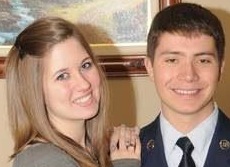
coupleToday marks a very special day in our family, the anniversary of our oldest grandchild’s adoption into our family.

While seven of our grandkids are aged seven and younger, Andrew is an amazing young man who has already married a lovely young woman. My wife and I are terribly proud of the path he is on, which has taken him to Japan, where he is promoting peace as a member of the United States Air Force.

While we all naturally love children physically “born into” our families, there is a singular affection—a consciously chosen and active love—we extend to those we adopt.

Delores and I seriously investigated international adoption during my assignment to Korea in the late eighties. Unfortunately, the doors closed, and it was not to be. We believe strongly in the importance and delight of adoption.

Although adoptions bring a few unique challenges to the family mix, there is no stress free recipe for parenting. Every successful formula involves a number of the same ingredients. Among them, patience and forgiveness need to be poured out in considerable quantity.

I wish to commend each of you readers who have adopted a child, or helped others to do so. And I also pray for God’s blessing upon each of you who are foster parents.

Finally, I offer a prayer for each of you who are, yourself, adopted. May your relationship with your parents fulfill all of the hopeful dreams that were held by all on the day that you entered your “new” family.

C.S. Lewis knew a great deal about adoption. He recognized how ill-prepared he was to become a step-father and ultimately a widowed single parent. In a 1957 letter he wrote:

I have married a lady suffering from cancer. I think she will weather it this time: after that, life under the sword of Damocles. Very little chance (not exactly none) of a permanent escape. I acquire two schoolboy stepsons. My brother and I have been coping with them for their Christmas holidays. Nice boys, but gruelling work for 2 old bachelors! I’m dead tired now.

In his biography, Jack’s Life, Douglas Gresham, one of those “nice boys,” described the situation after the death of his mother, Joy.

Jack also had a new responsibility to take care of, two teenage stepsons, each presenting the typical problems associated with growing up, though each in his own unique way. As was typical of the man he had become, Jack did everything he could to help these two young men. He knew all too well from his own life’s experiences how difficult their lives had been and tried hard to do the best he could for them.

A closing thought, as we all return to our other tasks and diversions. Christians see themselves as adopted. While all humanity is created in the wondrous image of God, entrance into the community of faith, the family of God, comes through faith in his only begotten Son. Because of Jesus’ life, death and resurrection, we are able to rightly call God, “Father.”

I’m overjoyed to be adopted into that holy family. And that adoption didn’t occur because I was smart, or handsome, or witty, or praiseworthy in any way. I was adopted solely because of the mercy and love of God.

And that divine adoption provides the perfect model for us to emulate in our world today.

Interplanetary Life

death valley stars

How many galaxies exist out there? How many stars? How many planets? Billions upon billions, apparently.

Of all of those myriad worlds, how many boast life?

C.S. Lewis pondered that subject in an essay entitled “Religion and Rocketry.” He said that either result—an absence of life, or an abundance of living creatures throughout the cosmos—can be used by atheists to deny the existence of our Creator.

In my time I have heard two quite different arguments against my religion put forward in the name of science. When I was a youngster, people used to say that the universe was not only not friendly to life but positively hostile to it.

Life had appeared on this planet by a millionth chance, as if at one point there had been a breakdown of the elaborate defenses generally enforced against it. We should be rash to assume that such a leak had occurred more than once. Probably life was a purely terrestrial abnormality. We were alone in an infinite desert. Which just showed the absurdity of the Christian idea that there was a Creator who was interested in living creatures.

But then came Professor F.B. Hoyle, the Cambridge cosmologist, and in a fortnight or so everyone I met seemed to have decided that the universe was probably quite well provided with habitable globes and with livestock to inhabit them. Which just showed (equally well) the absurdity of Christianity with its parochial idea that Man could be important to God.

Lewis, brilliant and honest, then predicts the future. Believers and cynics alike, he says, will seek to interpret all new data in a fashion that proves their own, preexisting beliefs.

This is a warning of what we may expect if we ever do discover animal life (vegetable does not matter) on another planet. Each new discovery, even every new theory, is held at first to have the most wide-reaching theological and philosophical consequences.

It is seized by unbelievers as the basis for a new attack on Christianity; it is often, and more embarrassingly, seized by injudicious believers as the basis for a new defence.

Fascinating as these comments are, they merely represent Lewis’ introduction to the subject. The heart of his concern is this—what would it mean if we should one day encounter alien beings created by God on a distant world?

In a moment I’ll share with you one of the most provocative thoughts Lewis expresses in this essay, but first take a moment to watch this amazing reminder of the vastness of our universe and the power of its Creator.

A video presentation like this can leave us feeling rather small, lost in the abyss of an immeasurable vastness. Or, it can inspire us. It can baptize us with an increased appreciation for the majesty of the One who loved each of us so profoundly that he sent his only begotten Son into the world to redeem us from destruction. I hope your reaction is the latter.

I promised another fascinating observation from Lewis, and here it is. He poses the question of precisely what might transpire if humanity encounters another sentient race. His Christian interpretation may shock some readers, but I believe he is right.

It sets one dreaming—to interchange thoughts with beings whose thinking had an organic background wholly different from ours (other senses, other appetites), to be unenviously humbled by intellects possibly superior to our own yet able for that very reason to descend to our level, to descend lovingly ourselves if we met innocent and childlike creatures who could never be as strong or as clever as we, to exchange with the inhabitants of other worlds that especially keen and rich affection which exists between unlikes; it is a glorious dream.

But make no mistake. It is a dream. We are fallen. We know what our race does to strangers. Man destroys or enslaves every species he can. Civilized man murders, enslaves, cheats, and corrupts savage man. Even inanimate nature he turns into dust bowls and slag-heaps. There are individuals who don’t. But they are not the sort who are likely to be our pioneers in space.

Our ambassador to new worlds will be the needy and greedy adventurer or the ruthless technical expert. They will do as their kind has always done. What that will be if they meet things weaker than themselves, the black man and the red man can tell. If they meet things stronger, they will be, very properly, destroyed.

Lewis continues, addressing related themes in this amazing work that seems more prescient each year. He next compares our encounters with fallen, and unfallen races. I highly commend the essay, which appears in The World’s Last Night and Other Essays.

If you prefer a fictional consideration of these same topics, I encourage you to read C.S. Lewis’ Cosmic Trilogy (Out of the Silent Planet, Perelandra, and That Hideous Strength).

_____

Appreciation goes to a retired USAF chaplain colleague of mine, Chuck McGathy, for bringing this Hubble video to my attention.

Face to Face with God

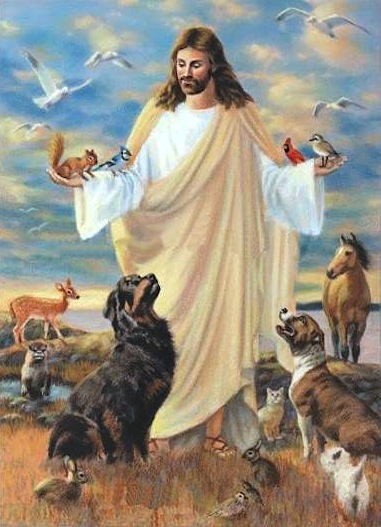
Jesus with animalsA recent letter to the editor of Lutheran Witness includes a delightful example of the wondrous glory of childhood simplicity.

When our four-year-old son . . . saw a bird outside the window, he commented “I wish I were a bird with wings so I could fly up to heaven and talk to Jesus.” [His parents] asked what he would say to Jesus if he were a bird. His simple reply . . . “Tweet, tweet.”

How gloriously innocent. So unpretentious and joyously pure. I think this captures the essence of what Jesus was referring to when he said “Truly, I say to you, unless you turn and become like children, you will never enter the kingdom of heaven. Whoever humbles himself like this child is the greatest in the kingdom of heaven” (Matthew 18:3-4, ESV).

C.S. Lewis discussed the innocence of children in his essay “The Abolition of Man.” He is discussing the monolithic power of society, or government, in reshaping what it means to be human. God preserve us from those who would redefine and eradicate the very qualities of humanity Jesus praised.

Human nature will be the last part of Nature to surrender to Man. The battle will then be won. . . . But who, precisely, will have won it? For the power of Man to make himself what he pleases means, as we have seen, the power of some men to make other men what they please. . . .

Hitherto the plans of educationalists have achieved very little of what they attempted and indeed, when we read them—how Plato would have every infant “a bastard nursed in a bureau,” and Elyot would have the boy see no men before the age of seven and, after that, no women, and how Locke wants children to have leaky shoes and no turn for poetry—we may well thank the beneficent obstinacy of real mothers, real nurses, and (above all) real children for preserving the human race in such sanity as it still possesses.

But the man-moulders of the new age will be armed with the powers of an omnicompetent state and an irresistible scientific technique: we shall get at last a race of conditioners who really can cut out all posterity in what shape they please.

When you and I stand in the presence of God, our adult words will vary. We’ll all drop to our knees—some in adoration, others perhaps in fear—but what will we say?

I can imagine some of the words that will come to our lips.

“Thank you.”

“Why did you allow . . ?”

“I love you.”

“I despise you because . . ?”

“Hallelujah.”

Or, perhaps, “Why did you delay so long?”*

I suspect we will probably be speechless. Certainly, at first. There’s a song that captures well the mystery that awaits us when we find ourselves face to face with our Creator. It’s more in spirit with the response of the young child who simply tweeted out his greeting to God.

Surrounded by Your Glory, what will my heart feel?

Will I dance for you, Jesus? Or in awe of You, be still?

Will I stand in Your presence, or to my knees will I fall?

Will I sing ‘Hallelujah!’? Will I be able to speak at all?

I can only imagine! I can only imagine!

We used to sing this song at chapel services in southwest Asia. I have often thought it would be very meaningful to record this song in my own voice, to be played at my own funeral (should the Lord tarry).

That’s not nearly as morbid as some might think. It’s a song of praise, awe and wonder, in my rendition I would end it with the words “I no longer imagine,” for my faith in God will have given way to sight.

_____
* The answer to that question is actually found in the Scriptures. From the third chapter of Peter’s second epistle:

This is now the second letter that I am writing to you, beloved. In both of them I am stirring up your sincere mind by way of reminder, that you should remember the predictions of the holy prophets and the commandment of the Lord and Savior through your apostles, knowing this first of all, that scoffers will come in the last days with scoffing, following their own sinful desires. They will say, “Where is the promise of his coming? For ever since the fathers fell asleep, all things are continuing as they were from the beginning of creation.” For they deliberately overlook this fact, that the heavens existed long ago, and the earth was formed out of water and through water by the word of God, and that by means of these the world that then existed was deluged with water and perished. But by the same word the heavens and earth that now exist are stored up for fire, being kept until the day of judgment and destruction of the ungodly.

But do not overlook this one fact, beloved, that with the Lord one day is as a thousand years, and a thousand years as one day. The Lord is not slow to fulfill his promise as some count slowness, but is patient toward you, not wishing that any should perish, but that all should reach repentance. But the day of the Lord will come like a thief, and then the heavens will pass away with a roar, and the heavenly bodies will be burned up and dissolved, and the earth and the works that are done on it will be exposed.

Since all these things are thus to be dissolved, what sort of people ought you to be in lives of holiness and godliness, waiting for and hastening the coming of the day of God, because of which the heavens will be set on fire and dissolved, and the heavenly bodies will melt as they burn! But according to his promise we are waiting for new heavens and a new earth in which righteousness dwells.

The Bible’s Songbook

psalmistI experienced an embarrassing moment many years ago while taking a broadcasting media course at seminary. I had used a passage from the Psalms as the basis for an assigned devotional, and when the professors (from several different seminary faculties) critiqued it, a distinguished professor dismissively pointed out that I had mispronounced the word “psalm” itself!

I had foolishly pronounced the “l” sound in the word (the way I’d always heard it pronounced). I don’t know whether any of the other students were as ignorant as I, but no one denied that the condescending correction was correct.

The first thing I did upon returning home was grab my dictionary to see if the doctor of theology was right. It turned out, of course, that he was right with how to pronounce the word [i.e. sahm] . . . but he was definitely wrong about how to properly correct a student.

On a more positive note, the Psalms are the foundation and epitome of worship music for Jews and Christians alike. One could read a Psalm each day and since there are one hundred and fifty, when you returned to the first psalm five months after beginning, it would be utterly fresh.

C.S. Lewis enjoyed the Psalms. The following passage comes from a letter written in 1940.

My enjoyment of the Psalms has been greatly increased lately. The point has been made before, but let me make it again: what an admirable thing it is in the divine economy that the sacred literature of the world should have been entrusted to a people whose poetry, depending largely on parallelism, should remain poetry in any language you translate it into.

And glorious poetry it is. The beauty of the songs extends far beyond the family “Lord is my shepherd . . .” And yet, it would be impossible to comprehend the number of grieving souls that have been comforted with the words “Even though I walk through the valley of the shadow of death, I will fear no evil, for you are with me; your rod and your staff, they comfort me.”

Most Christian traditions greatly value the Psalms, and many include them as a portion of the regular service or liturgy. And individuals who include them in the personal devotions are never disappointed.

C.S. Lewis included them in his prayer and devotion. In fact, he enjoyed the Psalms so much that in 1958 he wrote a book entitled Reflections on the Psalms. There he proclaims, “The most valuable thing the Psalms do for me is to express that same delight in God which made David dance.”

The Church has added an immense repertoire to the Psalms during the past two millennia, but they will never be replaced. In fact, many inspired songs owe a major debt to the Psalms themselves. This includes the Odes of Solomon, the first (post-Psalms) Christian hymnal (composed circa 100 A.D.).

Speaking of the Odes, I wrote a thesis on them many years ago, and have been considering writing a book about these treasures. Perhaps I’ll share more about them in the future.

_____

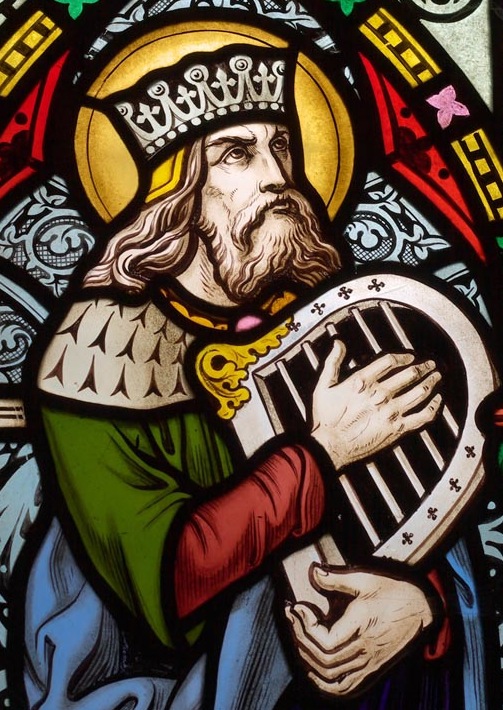
The lovely window pictured above is from a church in Fringford, England. David was likely a bit younger when most of the psalms he composed were written.