Physical (and Spiritual) Deafness

kellerSome are born deaf. Others lose their hearing due to accident or illness. Still others find our hearing failing us gradually, as it is displaced by the persistent presence of that unwelcome visitor, tinnitus.

As I was pondering the slow decay of my own hearing, I recalled one of C.S. Lewis’ most brilliant insights.

We can ignore even pleasure. But pain insists upon being attended to. God whispers to us in our pleasures, speaks in our conscience, but shouts in our pains: it is his megaphone to rouse a deaf world. (The Problem of Pain)

Even as I am concerned about the inevitable decline of my hearing—and more so, my vision—I try to conscientiously follow my wife’s guidance about vitamins and behaviors that will keep these senses around as long as possible.

At the same time, being a realist, I have decided to disengage my emotions from the matter as much as I am able, and simply accept the unavoidable. In fact, I have learned to enjoy some of the inaccuracies of hearing that I more and more often experience.

Hardly a day passes when I do not get a good laugh out of something I misheard. What I mean is that my brain translates the garbled sounds into actual words that constitute some sense that is in reality nonsensical. It hasn’t cause any problems yet, so I just smile or chuckle. If the mishearing is especially humorous, I sometimes share it with my family.

Recently, I smiled when my pastor went on about how great “Lutheran circuses” are, and how important it was that we invite others to attend our “Lutheran worship circuses” (services). That substitution was easy to recognize; it’s far funnier when I mishear something and what I think they said makes an odd sense that could almost be true . . . but is actually ludicrous.

I don’t share my personal way of dealing with the weakening of my sense of hearing with the intention of belittling the seriousness of a cross many have to bear as their lives are detrimentally impacted by these afflictions.

The Original Plan

Certainly, the impairment of any of the senses God has given us is cause for sadness. After all, when our first parents were created, their senses of sight, hearing, touch, smell and taste were undiminished. That’s the way that the Lord intended for us to enjoy the rest of his creation.

Actually, some people argue that there are seven senses, adding two that do make sense:

Vestibular – the sense of balance, perceiving our body in relationship to gravity and movement (equilibrioception)

Proprioception – the sense of the relative position of different parts of the body, particularly as it pertains to movement (kinesthesia)

Another source declares there are nine senses, adding to the palette

Thermoception – the sensation of the presence or absence of heat

Nociception – “nonconscious perception of nerve or tissue damage”

I personally imagine that when “the day of the Lord” arrives, and we witness the restoration of a new heaven and a new earth, that our restored bodies* will possess a myriad of other senses we are not even capable of fathoming at this present moment.

Yes, it is a tragedy when people have to live with their senses crippled. This is especially true when it is the young who are afflicted. To be born without sight or hearing rightly seems like a curse to many. The testimony of Helen Keller, who actually lost her vision and hearing at the age of nineteen months, illustrates how the human spirit is capable of transcending even these severe limitations.**

In 1952, C.S. Lewis wrote a letter to a young teacher at the Manchester Royal School for the Deaf.

The work you are engaged in is a magnificent one (much in my mind because, as it falls out, I’ve just been reading Helen Keller’s book): hard, no doubt, but you can never be attacked by the suspicion that it is not worth doing. There are jolly few professions of which we can say that.

The translation of great stories into a limited vocabulary will, incidentally, be a wonderful discipline: you will learn a lot about thought and language in general before you are done. I hope you will sometimes let me know how you get on. God bless you.

In writing this column I learned something of which I had been unaware. Keller was also a poet.

And, while I’m a poor judge of verse, I found my brief exploration of hers to be moving. However, here is a review from The New York Times which declares, “Modern psychology cannot account for Miss Keller nor explain the psychic sense by which she apprehends the minutest phases of a beauty she has never witnessed.”

You can download a copy of the book The Song of the Stone Wallhere.

Across the meadow, by the ancient pines,

Where I, the child of life that lived that spring,

Drink in the fragrances of the young year,

The field-wall meets one grimly squared and straight

Beyond it rise the old tombs, gray and restful,

And the upright slates record the generations.

Stiffly aslant before the northern blasts.

Like the steadfast, angular beliefs

Of those whom they commemorate, the head-stones stand,

Cemented deep with moss and invisible roots.

The rude inscriptions charged with faith and love,

Graceless as Death himself, yet sweet as Death,

Are half erased by the impartial storms.

As children lisping words which move to laughter

Are themselves poems of unconscious melody,

So the old gravestones with their crabbed muse

Are beautiful for their halting words of faith,

Their groping love that had no gift of song.

But all the broken tragedy of life

And all the yearning mystery of death

Are celebrated in sweet epitaphs of vines and violets.

Helen Keller’s life is a witness to the fact that God can intervene in our brokenness and make us whole. It is also a foretaste of that complete restoration that awaits disciples of Jesus on the Last Day.

And one more thing her life proves is the truth of C.S. Lewis’ insight that in our suffering we become more attuned to our need, and God “shouts in our pains: it is his megaphone to rouse a deaf world.”

_____

The image at the top of the page shows Helen Keller as she looked on the day of her graduation from college.

* This transition from these fragile and perishing bodies to the new is described here. And, here’s a link to a readable essay on the subject of the resurrected or new body Christians are promised.

** Helen Keller found hope in the good news of Jesus Christ, albeit through the extremely peculiar teachings of the philosopher Emanuel Swedenborg. Helen Keller’s book My Religion is available for free download here.

The Urgent Need for Chivalry

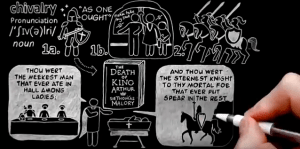
chivalryWith all the nations of the world engaged in power struggles—or cowering behind the protection of their more courageous allies—C.S. Lewis’ essay on “The Necessity of Chivalry” demands our attention.

Yes, the very word “chivalry” reeks of a bygone era that has been superseded and relegated to history books. But those who consider the concept outdated impoverish their lives and quite possibly contribute to the violent spirit of our age.

Warfare is not an abstract concept to the millions—yes, millions—of people who are surrounded by vicious threats every hour. Britain itself was in this position when Lewis penned these words during the Battle of Britain.

As he wrote, three days before Winston Churchill’s most famous speech, Lewis commended those same few to whom so many owed so much. It was 1940, and Germany’s advance had yet to be halted. Ultimate victory in the world conflagration would remain uncertain for years.

It is in this milieu, but not only for this context, that Lewis challenges us to combine the chivalrous values of meekness and ferocity.

Lewis argues that in the chivalrous “knight,” true humility and the capacity for great (but moral) violence are merged. The result is not a schizophrenic warrior, but a noble defender of what is good.

Indeed, even apart from wartime, it is vital that society has heroes to protect sheep from wolves. In a moment I will share with you a brief video featuring an amazing artistic rendering of this essay on chivalry.*

In the essay, Lewis’ examples span Western history. He uses Launcelot as the archetype of the chivalrous man. And he offers the hope and evidence that chivalry is not extinct. A veteran of the previous war, he wrote at the outset of the Second World War:

Launcelot is not yet irrecoverable. To some of us this war brought a glorious surprise in the discovery that after twenty years of cynicism and cocktails the heroic virtues were still unimpaired in the younger generation and ready for exercise the moment they were called upon. Yet with this “sternness” there is much “meekness;” from all I hear, the young pilots in the R.A.F. (to whom we owe our life from hour to hour) are not less, but more, urbane and modest than the 1915 model. (“The Necessity of Chivalry”)

And accordingly, in our own day there are many serving in uniform who exemplify the same virtues. Would, though, that all who bear arms could be described thusly.

Some who are reading these words may regard chivalry as a “sexist” concept. It is not. Certainly no more than courage, strength and virtue could be deemed such. The fact that Lewis’ historical examples of society’s defenders are men simply reflects history.

In the seventy-five years since he wrote, it has become evident that women too can easily embody both meekness and unyielding courage. One need look no further than the ranks of the military and law enforcement to see this borne out.

Chivalry for the Civilian

It would be a tragic mistake to think that chivalry is only required during war. It is a vital, daily necessity of all social life. And the increasing incivility of the world suggests its erosion. (Many attribute this in part to the anonymity of the internet, which allows bullies to savage others anonymously and without mercy.)

This is what Lewis was saying when he described Launcelot as being “not a compromise or happy mean between ferocity and meekness; he is fierce to the nth and meek to the nth.”

After all, it is not the bland or “lukewarm” person who makes this world a better place. It is upon chivalrous men and women that the majority of the vulnerable must ever rely.

Each of us needs to be willing to examine our own lives for the union of these two traits: courage that does not surrender to what is wrong, and meekness that is gentle, calm and patient with others.

These are the values that we need to promote in our communities, media and schools. Because what we instill in receptive minds is precisely that which will take root. To use more contemporary terms, the “programming” these young minds are subject to will directly influence the behaviors that they “output.”

Let us do all we are capable of, to be, and to raise up, what is chivalrous. After all, despite all of the utopian promises of those who believe humanity is capable of purifying itself, the evidence shows otherwise. As Lewis said,

There was, to be sure, a rumour in the last century that wolves would gradually become extinct by some natural process; but this seems to have been an exaggeration.

Enjoy this fine presentation of  “The Necessity of Chivalry.”

_____

* This video is a creation of CSLewisDoodle, about which I have written before. (Their name may sound quaint, but the expertise with which they visualize Lewis’ words is astounding.)

The Artistry of Nature

flamingoes
This picture of flamingos is delightful. That they “randomly” arranged themselves into a silhouette of themselves is amazing. Or, perhaps a divine hand painted this glorious portrait?

“What a fanciful thought,” poets muse.

“How absurd!” atheists groan.

“Is he serious?” realists wonder.

“Now that’s something to ponder…” people of faith think.

“Of course God has fashioned nature’s beauties with his hands,” the eremite smiles.

I happen to believe God was speaking literally when he said through the Psalmist:

For every beast of the forest is mine, the cattle on a thousand hills. I know all the birds of the hills, and all that moves in the field is mine (Psalm 50).

It was on the fifth day of creation that the Lord spoke into existence for the first time “every winged bird according to its kind.”

And God blessed them, saying, “Be fruitful and multiply and fill the waters in the seas, and let birds multiply on the earth” (Genesis 1:22).

And, to reveal God’s concern for the creatures he has made did not end with their genesis, allow me one more biblical citation . . . a familiar one. In reminding us of how precious we are to our Father, Jesus describes that God’s concern extends even to the least of his creation.

Are not two sparrows sold for a penny? And not one of them will fall to the ground apart from your Father (Matthew 10:29).

C.S. Lewis touches on the preciousness of creation in a 1956 letter to one of his regular correspondents.

I think God wants us to love Him more, not to love creatures (even animals) less. We love everything in one way too much (i.e. at the expense of our love for Him) but in another way we love everything too little. No person, animal, flower, or even pebble, has ever been loved too much—i.e. more than every one of God’s works deserves (Letters to an American Lady).

Now, does God’s concern for his creatures, in this case flamingoes, mean that he takes the time to direct their flight, their nesting, and the shape of their earthly “congregations?” Of course not. But even in saying that, it is wise to note that if he chose to do so, he could. And there are, of course, some scriptural examples of his using animals in specific ways.

It’s possible, and even likely, that this was a mere coincidence. Like the clouds whose shapes sometimes mirror actual things, even in minute detail. While there are rather odd people who believe cloud shapes can foretell the future, I don’t believe there are any Christians who would base their decisions upon the physical arrangements of a flock, colony, gaggle, or flamboyance (with is fancy name for a group of flamingos).

That said, I still believe that the divine Artist is not above occasionally enjoying some playfulness with the tapestry he has fashioned here on earth, and in the heavens.

Lewis & Flamingos

On 12 July 1956, C.S. Lewis attended a garden party at Buckingham Palace hosted by Queen Elizabeth II. Below you will find excerpts from two letters mentioning the subject. They were written to Ruth Pitter (1897-1992), a well-regarded poet with whom Lewis enjoyed a strong friendship.

Lewis wondered if she might be attending the same event, and suggested they might accompany one another, if so. Less than a week later, following the event, he shares with her his delightful observations of the teeming gathering.

Dear Ruth

Do you play croquet with the Queen on Thursday? (Croquet is not mentioned in the invitation but I am well-read enough to know that a royal garden party will involve hedgehogs, flamingos, soldiers, Heads-man, and the grin of a Cheshire cat). If so are you coming via Oxford? I was thinking of going up by 1.58 and returning by the 6.45 or 7.35 on either of which we could dine. You are an experienced courtier and it would give me great moral support to arrive in your company!

Apparently Pitter was not in attendance at this particular outing, also she had been the first woman to receive the Queen’s Gold Medal for Poetry the previous year. Two decades later the Queen would appoint her a Commander of the Order of the British Empire (CBE) for her contributions to English literature. Two days after the extravaganza, Lewis wrote again.

Dear Ruth

You were well out of it. I learn from the papers that I was one of 8000 guests and also that the Queen was present, a fact of which I had no evidence from my own experience. One could not even get a cup of tea for the crowd round the refreshment tables was reminiscent of Liverpool Street station on an August bank holiday. Most people didn’t know one another. One saw many married couples pathetically keeping up between themselves a dialogue which was obviously wearing very thin. If I hadn’t run across Archbishop Matthew I’d have been in a vast solitude.

There are flamingoes: metal silhouettes of them round the lake—a tasteful device which we perhaps owe to Prince Albert. In a word, it was simply ghastly. Two pints at the little pub on Praed St. were necessary afterwards.

A Postscript on Pitter

Ruth Pitter was a talented poet, but because she was a traditionalist—something quite agreeable to Lewis—she has not been accorded the respect she merits. One scholar who published her letters in 2014 writes:

Pitter, in contrast to T.S. Eliot, Ezra Pound, and W.H. Auden, is a traditional poet in the line of George Herbert, Thomas Treharne, Thomas Hardy, A.E. Housman, W.B. Yeats, and Philip Larkin. Unlike the modernists, she rarely experiments with meter or verse form, nor does she explore modernist themes or offer critiques of modern English society.

Instead, she works with familiar meters and verse forms, and her reluctance to alter her voice to follow in the modernist line explains in part why critics have overlooked her poetry. She is not trendy, avant-garde, nor, thankfully, impenetrable.

As mentioned above, their friendship was deep. Lewis’ friend George Sayer says Lewis once volunteered that if he had not been a confirmed bachelor, Pitter was just the sort of woman to whom he could be happily married.

They influenced one another professionally, sharing poetic advice and critique. Pitter also attributed her spiritual reawakening, her conversion to Christianity, to Lewis’ influence. In 1948 she wrote to a friend:

Did I tell you I’d taken to Christianity? Yes, I went & got confirmed a year ago or more. I was driven to it by the pull of C. S. Lewis and the push of misery. Straight prayer book Anglican, nothing fancy . . . I realize what a tremendous thing it is to take on, but I can’t imagine turning back. It cancels a great many of one’s miseries at once, of course: but it brings great liabilities, too.

In 1985 she wrote to a correspondent about the same subject.

As to my faith, I owe it to C. S. Lewis. For much of my life I lived more or less as a Bohemian, but when the second war broke out, Lewis broadcast several times, and also published some little books (notably The Screwtape Letters), and I was fairly hooked. I came to know him personally, and he came here several times. Lewis’s stories, so very entertaining but always about the war between good and evil, became a permanent part of my mental and spiritual equipment.

Since we have been introduced to this unique woman now, it’s fitting to close with one of her poems. A poem inspired by another of the avian wonders created by our artistic God.

stormcock

Stormcock in Elder

In my dark hermitage, aloof

From the world’s sight and the world’s sound,

By the small door where the old roof

Hangs but five feet above the ground,

I groped along the shelf for bread

But found celestial food instead:

For suddenly close at my ear,

Loud, loud and wild, with wintry glee,

The old unfailing chorister

Burst out in pride of poetry;

And through the broken roof I spied

Him by his singing glorified.

Scarcely an arm’s-length from the eye,

Myself unseen, I saw him there;

The throbbing throat that made the cry,

The breast dewed from the misty air,

The polished bill that opened wide

And showed the pointed tongue inside;

The large eye, ringed with many a ray

Of minion feathers, finely laid,

The feet that grasped the elder-spray;

How strongly used, how subtly made

The scale, the sinew, and the claw,

Plain through the broken roof I saw;

The flight-feathers in tail and wing,

The shorter coverts, and the white

Merged into russet, marrying

The bright breast to the pinions bright,

Gold sequins, spots of chestnut, shower

Of silver, like a brindled flower.

Soldier of fortune, northwest Jack,

Old hard-times’ braggart, there you blow

But tell me ere your bagpipes crack

How you can make so brave a show,

Full-fed in February, and dressed

Like a rich merchant at a feast.

One-half the world, or so they say,

Knows not how half the world may live;

So sing your song and go your way,

And still in February contrive

As bright as Gabriel to smile

On elder-spray by broken tile.

_____

The Bible verses quotes above are taken from the ESV, the English Standard Version.

The “stormcock” in whose humble honor Pitter dedicates this poem is also called the Mistle Thrush. Its informal nickname arises from its eagerness to sing its songs in every sort of weather.

C.S. Lewis Versus Socialism

chavezSocialism is in the news, and we need not wonder what the prolific and wise C.S. Lewis would have thought about it.

In the United States, for example, one of the serious contenders for the presidential election this fall belonged to neither the Democrat nor Republican parties.

Bernie Sanders dropped the “D” descriptor he had, for political convenience, worn for several months. He did so soon after Hillary clinched the Democrat nomination, saying he was elected as an “Independent,” and would return to the Senate as one.

Elsewhere in the world we see one of the most recent experiments in socialism following the historic pattern. Venezuela has fallen from the ranks of successful nation states into the abyss of socialist turmoil.

Even liberal (progressive) voices are acknowledging the abject failure of socialism in a formerly comfortable country.

When a Venezuelan entrepreneur we know launched a manufacturing company in western Venezuela two decades ago, he never imagined he’d one day find himself facing jail time over the toilet paper in the factory’s restrooms. But Venezuela has a way of turning yesterday’s unimaginable into today’s normal.

The entrepreneur’s ordeal started about a year ago, when the factory union began to insist on enforcing an obscure clause in its collective-bargaining agreement requiring the factory’s restrooms to be stocked with toilet paper at all times. The problem was that, amid deepening shortages of virtually all basic products (from rice and milk to deodorant and condoms) finding even one roll of toilet paper was nearly impossible in Venezuela—let alone finding enough for hundreds of workers. When the entrepreneur did manage to find some TP, his workers, understandably, took it home: It was just as hard for them to find it as it was for him.

Toilet-paper theft may sound like a farce, but it’s a serious matter for the entrepreneur: Failing to stock the restrooms puts him in violation of his agreement with the union, and that puts his factory at risk of a prolonged strike, which in turn could lead to its being seized by the socialist government under the increasingly unpopular President Nicolas Maduro.

So the entrepreneur turned to the black market, where he found an apparent solution: a supplier able to deliver, all at once, enough TP to last a few months. (We’re not naming the entrepreneur lest the government retaliate against him.) The price was steep but he had no other option—his company was at risk.

But the problem wasn’t solved.

No sooner had the TP delivery reached the factory than the secret police swept in. Seizing the toilet paper, they claimed they had busted a major hoarding operation, part of a U.S.-backed “economic war” the Maduro government holds responsible for creating Venezuela’s shortages in the first place. The entrepreneur and three of his top managers faced criminal prosecution and possible jail time.

Yes, it “may sound like a farce,” but thinkers like C.S. Lewis have recognized all along that socialism doesn’t work.

Europe took years to recover from the ravages of World War II. One consequence, common to many nations throughout the world during the war, was severe rationing.

The war’s end signaled a swift return to normal life in the United States and Canada. Meanwhile, in places like the United Kingdom, rationing continued, and some products (notably potatoes) were added to the list.

Rationing in the U.K. did not end until 1954, and one of Britain’s staples—tea!—was still rationed in 1952.

It’s in this context that we read the following letter that Lewis penned to one of his American correspondents. Vera Gebbert and her husband were among the Americans who occasionally forwarded food gifts which Lewis generously shared with others.

In 1954 he thanks her for her generosity and acknowledges the welcome end of rationing. In the same letter he offers a humorous political aside—at the expense of socialism.

Dear Mrs. Gebbert, Many thanks for your nice letter of the 15th, though it would have given both of us more pleasure if your account of your own state had been better: which I hope it now is.*

And I’m so glad that the Horse helped to see you through an illness, which I trust is now a thing of the past. My brother thanks you too for all the kind things you say of the Century,** and says he hopes to have another book out either late this year or early next, of which you shall have a copy.

I’m afraid it would be sheer dishonesty to pretend that we now have any kitchen needs; this government has done a magnificent job in getting us on our feet again, and a few weeks back, we solemnly burnt our Ration Books. Everything is now ‘off ration,’ and though at first of course, prices went up with a rush, they are now dropping.

But cheer up, if our friends the Socialists get back into power, you will be able to exercise your unfailing kindness once more by supplying us, not with little luxuries, but with the necessities of life!

‘How is Cambridge?’ Well, so to speak, it isn’t; in other words, I have not yet begun my Cambridge career. And when I do, the break will not be so big as you might imagine; for I shall be non-resident. Cambridge will be content with my presence there from Tuesdays to Saturdays in term time, so I shall be able to keep on the house at Oxford and become what I think you call a ‘commutor’ don’t you? Our sister college, Magdalene, has been good enough to give me a set of rooms, so I shall be very snug during the week.

The subject addressed above is not simply about toiletry scarcities or the eccentricities of antediluvian politicians. It dramatically affects the lives of real people.

Our thoughts and prayers should be offered on behalf of the victims of socialism. Just as we should recognize that unbridled capitalism does not nurture a paradise, either. However, it is unfathomable to imagine a contemporary democracy (based on capitalism) imposing serfdom on its citizens, as Venezuela is now doing.

So, it seems Lewis was correct about the propensity of socialism to undermine order and dishevel systems of proven success. After all, those supermarket shelves were not always empty before the Chaveznistas took over.

_____

* Gebbert had shared with Lewis about her domestic problems which were culminating in an imminent divorce.

** The Splendid Century: Life in the France of Louis XIV, was a well-received study Warnie had written.

Tolkien, C.S. Lewis and Music

albumHave you ever written something that inspired a musician to compose new music? J.R.R. Tolkien hoped to do so one day, and had he lived to hear the scores of the Lord of the Rings trilogy created by Howard Shore, he would have been in awe.

I was reading Tolkien’s correspondence last week and came across a fascinating letter he wrote to a musician who was requesting permission to write a serious composition based on The Hobbit.

This would have been quite different than the quaint “Ballad of Bilbo Baggins,” made famous by Leonard Nimoy. (I wish their choreographer had read the book, so we could have been spared the tiny T-Rex arms sported during the chorus by the dancers.)

Anyway, returning to more serious musical ventures, in 1964 Tolkien received a request for permission to write a “Hobbit Overture.” It came from British composer Carey Blyton (1932-2002) who would become best known for his song “Bananas in Pyjamas.”

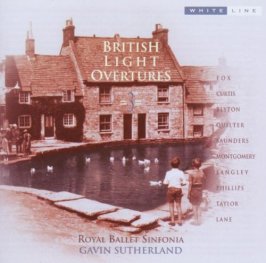
Tolkien’s response to the composer’s query is fascinating, on several levels. First, he is gracious in extending his permission, without any restrictions. And, in 1967 Blyton did compose “The Hobbit” Overture, opus 52a. It appears on the CD, British Light Overtures 3.

Secondly, he shares his unspoken desire that his work might someday inspire music. Then he makes a curious comment about the illustrations of Pauline Baynes, which would similarly grace the work of C.S. Lewis.

After that, Tolkien describes his own, musically impoverished, upbringing. Finally he expresses his deep appreciation for good music, despite his lack of knowledge on the subject.

And Tolkien accomplishes all of this in just a handful of sentences!

You certainly have my permission to compose any work that you wished based on The Hobbit. . . . . As an author I am honoured to hear that I have inspired a composer. I have long hoped to do so, and hoped also that I might perhaps find the result intelligible to me, or feel that it was akin to my own inspiration—as much as are, say, some (but not all) of Pauline Baynes’ illustrations. . . . .

I have little musical knowledge. Though I come of a musical family, owing to defects of education and opportunity as an orphan, such music as was in me was submerged (until I married a musician), or transformed into linguistic terms. Music gives me great pleasure and sometimes inspiration, but I remain in the position in reverse of one who likes to read or hear poetry but knows little of its technique or tradition, or of linguistic structure.

It is common for people of sincere Christian devotion, such as Tolkien and Lewis, to express an appreciation for the divine capacity of music to touch the human spirit.

luteMartin Luther, for example, wrote much about music. “Music is God’s greatest gift,” he proclaimed. He was not only a composer of hymns, but also an acceptable player of the lute, which he used to accompany his children during their family devotions.

Music is deeply intertwined with the heart of Christian worship.

C.S. Lewis on the Subject of Music

One of the modest challenges in contrasting fellow Inklings J.R.R. Tolkien and C.S. Lewis results from the significantly different natures of their literary corpora. While they both wrote fantasy, though of a vastly different magnitude, Lewis’ vocation as one of Christianity’s chief modern apologists necessitated that he defend the faith in diverse contexts. Thus, he wrote numerous essays and a number of texts addressing a wide range of considerations that his friend Tolkien never discussed in print.

Because of this distinction, it is relatively simple to discover what Lewis thought about the nature and powers of music. Typical of the man’s practical orientation, Lewis appears little interested in the abstract attributes of music. What interests him is its confluence with human existence. The following profound insight comes from his essay “On Church Music.”

There are two musical situations on which I think we can be confident that a blessing rests. One is where a priest or an organist, himself a man of trained and delicate taste, humbly and charitably sacrifices his own (aesthetically right) desires and gives the people humbler and coarser fare than he would wish, in a belief (even, as it may be, the erroneous belief) that he can thus bring them to God. The other is where the stupid and unmusical layman humbly and patiently, and above all silently, listens to music which he cannot, or cannot fully, appreciate, in the belief that it somehow glorifies God, and that if it does not edify him this must be his own defect.

Neither such a High Brow nor such a Low Brow can be far out of the way. To both, Church Music will have been a means of grace; not the music they have liked, but the music they have disliked. They have both offered, sacrificed, their taste in the fullest sense.

But where the opposite situation arises, where the musician is filled with the pride of skill or the virus of emulation and looks with contempt on the unappreciative congregation, or where the unmusical, complacently entrenched in their own ignorance and conservatism, look with the restless and resentful hostility of an inferiority complex on all who would try to improve their taste—there, we may be sure, all that both offer is unblessed and the spirit that moves them is not the Holy Ghost.

This discussion about church music is particularly interesting due to Lewis’ personal dislike for much of the music used in worship, which I’ve written about before.

Lewis described his own church music pilgrimage in “Answers to Questions on Christianity.”

My own experience is that when I first became a Christian, about fourteen years ago, I thought that I could do it on my own, by retiring to my rooms and reading theology, and I wouldn’t go to the churches . . .

If there is anything in the teaching of the New Testament which is in the nature of a command, it is that you are obliged to take the Sacrament [holy communion], and you can’t do it without going to Church. I disliked very much their hymns, which I considered to be fifth-rate poems set to sixth-rate music. But as I went on I saw the great merit of it.

I came up against different people of quite different outlooks and different education, and then gradually my conceit just began peeling off. I realized that the hymns (which were just sixth-rate music) were, nevertheless, being sung with devotion and benefit by an old saint in elastic-side boots in the opposite pew, and then you realize that you aren’t fit to clean those boots. It gets you out of your solitary conceit.

In “The Weight of Glory,” Lewis addresses this notion that we must look beyond the music itself, to assess its influence on our humanity.

The books or the music in which we thought the beauty was located will betray us if we trust to them; it was not in them, it only came through them, and what came through them was longing. These things—the beauty, the memory of our own past—are good images of what we really desire; but if they are mistaken for the thing itself they turn into dumb idols, breaking the hearts of their worshippers.

For they are not the thing itself; they are only the scent of a flower we have not found, the echo of a tune we have not heard, news from a country we have never yet visited.

Lewis recognized the deep influence and mystery with which music communicates and inspires. It is no accident that Narnia’s creation itself comes through Aslan’s song.

The Lion was pacing to and fro about that empty land and singing his new song. It was softer and more lilting than the song by which he had called up the stars and the sun; a gentle, rippling music. And as he walked and sang the valley grew green with grass. It spread out from the Lion like a pool.

It ran up the sides of the little hills like a wave. In a few minutes it was creeping up the lower slopes of the distant mountains, making that young world every moment softer.

Returning to “On Church Music,” Lewis expands on the importance of our intentions as we approach music.

It seems to me that we must define rather carefully the way, or ways, in which music can glorify God. There is . . . a sense in which all natural agents, even inanimate ones, glorify God continually by revealing the powers He has given them. . . . An excellently performed piece of music, as natural operation which reveals in a very high degree the peculiar powers given to man, will thus always glorify God whatever the intention of the performers may be. But that is a kind of glorifying which we share with the ‘dragons and great deeps,’ with the ‘frost and snows.’

What is looked for in us, as men, is another kind of glorifying, which depends on intention. How easy or how hard it may be for a whole choir to preserve that intention through all the discussions and decisions, all the corrections and the disappointments, all the temptations to pride, rivalry and ambition, which precede the performance of a great work, I (naturally) do not know. But it is on the intention that all depends.

When it succeeds, I think the performers are the most enviable of men; privileged while mortals to honor God like angels and, for a few golden moments, to see spirit and flesh, delight and labour, skill and worship, the natural and the supernatural, all fused into that unity they would have had before the Fall. . . .

We must beware of the naïve idea that our music can ‘please’ God as it would please a cultivated human hearer. That is like thinking, under the old Law, that He really needed the blood of bulls and goats. To which an answer came, ‘mine are the cattle upon a thousand hills,’ and ‘if I am hungry, I will not tell thee.’ If God (in that sense) wanted music, He would not tell us. For all our offerings, whether of music or martyrdom, are like the intrinsically worthless present of a child, which a father values indeed, but values only for the intention.

At the outset of this column I declared Tolkien would have been “in awe” of the musical score written to accompany the Lord of the Rings movies. Lewis too, I believe, would have been impressed by the scores composed for the three Chronicles of Narnia films made thus far. We owe a debt of gratitude to three composers: Howard Shore,* Harry Gregson-Williams,** and David Arnold***.

An Historical Postscript

In the spirit of Lewis and Tolkien, who appreciated the importance of music, we’ll close now with another engaging quotation from the wry pen of Doctor Martin Luther.

I wish all lovers of the unshackled art of music grace and peace from God the Father and from our Lord Jesus Christ! I truly desire that all Christians would love and regard as worthy the lovely gift of music, which is a precious, worthy, and costly treasure given to mankind by God.

The riches of music are so excellent and so precious that words fail me whenever I attempt to discuss and describe them…. In summa, next to the Word of God, the noble art of music is the greatest treasure in the world.

A person who gives this some thought and yet does not regard music as a marvelous creation of God, must be a clodhopper indeed and does not deserve to be called a human being; he should be permitted to hear nothing but the braying of asses and the grunting of hogs.

_____

* Howard Shore has nearly a hundred credits as a composer, conductor and orchestrator on the Internet Movie Database (IMDb). In addition to the Tolkien cinema projects, he has also worked on a number of other very successful films and ninety-six episodes of Saturday Night Live. Shore won three Oscars for his work on Lord of the Rings.

** Harry Gregson-Williams has nearly a hundred credits on the IMDb, including a number of box office successes, a variety of popular video games, and several productions in the Shrek series. He won awards for his work on the Chronicles of Narnia series and another of my favorite films, Kingdom of Heaven.

*** David Arnold, wrote the score for the third Narnia film, The Chronicles of Narnia: The Voyage of the Dawn Treader. He has seventy-three credits listed on IMDb, ranging from this year’s Independence Day: Resurgence, all the way back to a BBC made for tv picture entitled Mr. Stink.

Sharia Law Versus Democracy

chaldean

“Liberal and democratic principles are worth nothing here [in Iraq]. Islam does not say that all men are equal.” (Amal Nona). You cannot state the truth more concisely than that.

Nona is a Chaldean Catholic archbishop who “doesn’t have a diocese anymore. He doesn’t have a church. ISIS destroyed all that, and his people are scattered. But he’s not afraid to speak forthrightly, even when ISIS was at his doorstep.” (“Happy Warriors”)

The Chaldean Catholic Church is no stranger to persecution. They are descendants of the Assyrians who maintained the faith through the Muslim conquest up until today. They are a courageous people, but that is not the subject I wish to address here.

As the archbishop alludes, the reason that Western nations have been utterly unsuccessful in transplanting democracy to countries with Islamic majority populations is that democracy is alien to their worldview.

To the literalist Muslim (i.e. those who accept the words of the Quran at face value), it’s ludicrous to claim that Christians are equal to followers of Islam. Even without appealing to detailed Sharia law, the simple notion that infidels should possess the same rights as the followers of Allah is foolish, or worse. They are dhimmi—second class citizens, at best and actively persecuted and martyred, at worse.

This is the default setting for Islamic nations. Just look at Turkey and Egypt, two nations with actual democratic governments. The terrorist Muslim Brotherhood continues to exert destructive influences in both, and Turkey’s president, Recep Tayyip Erdoğan has used the excuse of the recent coup attempt to further destroy the vestiges of democracy (e.g. free speech) which he has long been undermining. Egypt is currently enjoying a respite after removing Mohamed Morsi, a man with a similar, anti-democratic agenda.

Retired military analyst Ralph Peters recently penned a frightening (and I believe accurate) appraisal of where Erdoğan will take his nation.

The ragtag ISIS caliphate is merely the forerunner of the more ambitious caliphate to come. It’s coming in Turkey.

The immense and destructive crackdown underway in Turkey now, with at least 10,000 Turks taken into custody and as many as 100,000 others dismissed from their positions—not only soldiers, but judges, civil servants, police and academics—isn’t an end-game. It’s a beginning. . . .

Erdoğan didn’t need a reason for this pre-planned purge. He had his reasons and his lists of names. He needed an excuse. The failed coup was a gift.

Now we’re witnesses to the destruction of Turkey’s secular society and the forced-march reversion to religious regimentation and obscurantism, to intolerance and oppressive fundamentalism. This is the triumph of mosque over modernity, not of the rule of law, but of its supersession.

Professors have been forbidden to leave the country. The government demanded the resignation of all the deans of higher-level schools and universities. Book-banning is on the way, and book-burning wouldn’t surprise me in the least.

To those of us in the West, including numerous Muslim immigrants who have recognized the universal benefits of freedom of conscience and equal rights, the historic interpretations of government based on the Quran seem disconcerting. Part of the reason they seem unfathomable, is because we do not take the time to study them. Nor do we listen to the voices of minority populations who have been long subjugated and deprived of what we deem basic human rights.

Archbishop Nona, and others like him, need to be heeded. His warning about the challenge of translating democratic principles, points to the proper beginning place: education. It is no accident that the Muslim countries with the highest educations and most moderate (i.e. non-fundamentalist) adherents replicate democratic freedoms most consistently.

I consider the best course for promoting peace to be educating all people, and encouraging freedom of conscience, especially when it comes to religion and speech. And I recognize that the statement with which we began remains a vital fact that must be recognized at the outset of that effort. The following observation appeared in an article last year.

The lust for power corrupts religion, just as the quest for piety is vulnerable to hubris. As Cengiz Erdoğan, a CHP [minority political party] member who runs a car repair workshop, put it to me: “He’s power-hungry and he’s dedicated to the Islamist way.” Or, as C.S. Lewis once warned: “Of all bad men, religious bad men are the worst.”

The principles guiding Democracies and Republics arose in the Western world. There they found fertile soil. Yet even here in the West, we see on a daily basis that democracy is fragile. Tolkien and Lewis scholar, Joseph Laconte, wrote an “optimistic” essay about the 2015 elections in Turkey. Erdoğan had been prevented from achieving an absolute majority.

The danger, at least for the moment, has been averted. . . . [Some Turks fear] Erdoğan’s early reformist talk was a mere façade for his hardcore Islamism.

That may be reason enough to cheer Turkey’s election results: they offer the hope that corrupted religion will find it harder to derail the nation’s experiment in democratic self-government. More than hope, of course, will be needed. For if secular authoritarianism has left the stage in Turkey, its religious counterpart is waiting hungrily in the wings.

Unfortunately, what political minorities in Turkey feared, is now coming to fruition, with a vengeance.

A Positive Postscript from the Chaldeans

Christianity rejects the notion that any person possesses greater worth than another. In the Christian world there are no castes . . . there are no dhimmi.

Each and every life is precious. In fact, the Good Shepherd is not content to keep the faithful ninety-nine under his protection, he leaves them to go out in search of the one—the individual one—that has strayed.

Chaldean Christians have some of the most ancient roots in Christian history. Despite the fact that most the Assyrian Christians have been driven from their ancestral homes, and are unlikely to ever be allowed to return, they have retained their hope. That is because they do not place their faith in humanity or their own strength. The following description of Archbishop Nona comes from another article.

I’d even go so far as to say that before me is a happy man. Indeed, he tells me: “We were always a minority. We always knew it was not important what we have but what we do. The Lord shows us how it is important to be happy in all situations.”

He emphasizes that the Christian has no other identity than as a Christian. The Gospel is what you want to conform your life to, he says. “For us, we want to practice our identity. We are not another identity. Our identity is to live like Jesus Christ.”

There is no other life, he says, for a Christian. Christ becomes everything, and so there is no life without Christ. “I think all our problems lie in this point: that in our life, sometimes we forget to live like Jesus. It’s not theology, it’s reality.”

It is not difficult to hear echoes of C.S. Lewis in his words. And these come not from a mutual acquaintance between the two . . . rather from a common acquaintance with the Messiah.

In the end, it’s not about theology, philosophies or human political institutions. It’s about a Redeemer.

_____

The icon above is of Saint Addai (Thaddeus of Edessa). He was a missionary to Mesopotamia, and contributed to the Divine Liturgy used by much of the Eastern Church. The image portrays Addai presenting the Mandylion to King Abgar of Edessa.

Desiring Silence

coptic quietDo you enjoy noise, or do your mind and soul long for moments of silence? If you appreciate escaping the cacophony of sounds that weigh against you, you’re in good company. The Inklings were men who respected the value of silence.

I attended a funeral for a former parishioner today. The fact that I did not conduct the service allowed me to sit beside my wife who shared my sincere fondness for the saint we were bidding farewell.

The service was comforting, being resurrection-focused as such matters ought to be. Despite our singing three hymns during its course, it was also quiet. Quiet in the sense of calm and peaceful like a deep brook that rushes along in relative silence, compared to its chattering companions that dance across the rocks in a shallow creek.

Joe was a humble man, though he was one of the rare breed who truly deserve the accolade of being part of the “greatest generation.” Though he never bragged about it, he served throughout the Second World War, and survived D-Day while landing in just the second wave at Omaha Beach.

It was a service that befitted a humble ninety-two-year-old man who faithfully ushered at his church up until his death. A man who had spent most of his life in activities serving others, and who kept his marital vows to his now widowed bride for seventy years.

Reflecting on that quality this afternoon, I recalled how silence was appreciated by the Inklings. C.S. Lewis expressed this thought on many occasions. One of the best known comes from The Weight of Glory.

We live, in fact, in a world starved for solitude, silence, and private: and therefore starved for meditation and true friendship.

Lewis’ opinion of noise went beyond disdain. He even included a description in The Screwtape Letters of how noise itself could serve malevolent purposes.

My dear Wormwood: Music and silence—how I detest them both! How thankful we should be that ever since our Father [Lucifer] entered Hell . . . no square inch of infernal space and no moment of infernal time has been surrendered to either of those abominable forces, but all has been occupied by Noise–Noise, the grand dynamism, the audible expression of all that is exultant, ruthless, and virile—Noise which alone defends us from silly qualms, despairing scruples, and impossible desires.

We will make the whole universe a noise in the end. We have already made great strides in this direction as regards the Earth. The melodies and silences of Heaven will be shouted down in the end. But I admit we are not yet loud enough, or anything like it. Research is in progress.

The world has only gotten noisier since Lewis wrote those words. And silence is in ever-shorter supply. That’s one of the reasons, I suppose, why I appreciate living in the forest, where even the tentacles of cable television do not reach. Their absence contributes to an involuntary amplification of the silence that resides around our home.

Tolkien Shared Lewis’ Opinion

Since I’ve been reading some of J.R.R. Tolkien’s correspondence recently, the following excerpt came to my mind.

Like many thinkers, and nearly all writers, Tolkien found noise distracting. In a 1964 letter, he wrote the following description of the sounds that assaulted him in his neighborhood. (The last sentence is particularly delightful.)

Headington is no paradise of peace. Sandfield Road was a cul-de-sac when I came here, but was soon opened at the bottom end, and became for a time an unofficial lorry by-pass, before Headley Way was completed. Now it is a car-park for the field of ‘Oxford United’ at the top end. While the actual inhabitants do all that radio, tele, dogs, scooters, buzzbikes, and cars of all sizes but the smallest, can do to produce noise from early morn to about 2 a.m.

In addition in a house three doors away dwells a member of a group of young men who are evidently aiming to turn themselves into a Beatle Group.

What a vivid description. But one would expect nothing less from the creator of Middle Earth.

The same year as the Allied attack on Normandy, Tolkien wrote to his son Christopher who was in South Africa earning his wings with the Royal Air Force. A veteran of the First World War, the concerned father knew all too well what might lie ahead. In 1944 he wrote the following:

I have the autumn wanderlust upon me, and would fain be off with a knapsack on my back and no particular destination, other than a series of quiet inns. One of the too long delayed delights we must promise ourselves, when it pleases God to release us and reunite us, is just such a perambulation, together, preferably in mountainous country, not too far from the sea, where the scars of war, felled woods and bulldozed fields, are not too plain to see.

Like Tolkien, C.S. Lewis was also a veteran of the “war to end all wars.” The Inklings, like all Europeans of their generation, were acutely acquainted with warfare and its costs. Still, because of their wisdom and faith, Tolkien and Lewis were confident the Allies would prevail. They trusted that the blessed silence of peace would ultimately triumph over war’s cries.

In that light, we continue reading from Tolkien’s letter to Christopher. Immediately after his suggestion to Christopher that the two of them take a walking tour, Tolkien describes the plans the Inklings had already established to celebrate the eventual end of the war.

The Inklings have already agreed that their victory celebration, if they are spared to have one, will be to take a whole inn in the country for at least a week, and spend it entirely in beer and talk, without reference to any clock!

I don’t recall reading about their intentions before, but it has made me curious as to whether or not these dreams were ever realized. If they were, I am certain that the absence of other guests, and the removal of all clocks, would have made for a calm, quiet and renewing week indeed.

_____

The image above comes from an eighth century Coptic fresco.

A more modern image of silence, although originating all the way back in 1965, would be the “cone of silence,” which will be familiar to fans of the series Get Smart. For reflections on that theme, you might want to check out the this article.

If you aren’t familiar with the aforementioned cone, take two minutes to rectify that shortcoming by watching this video.

C.S. Lewis & the Police

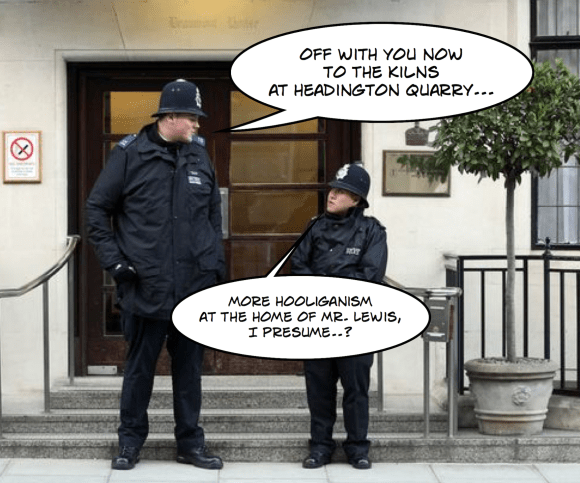
policePolice are entrusted with the power and authority to protect the innocent. That very power provides them with the opportunity to abuse that trust.

Recent events in the United States have drawn to the world’s attention the fact that human beings are incapable of providing perfect law enforcement. That should come as no surprise since, due to our fallen nature, we can do nothing perfectly.

C.S. Lewis never wrote a treatise specifically about law enforcement, but he did refer to it on a number of occasions. This week I thought it might be beneficial to consider a number of his insights. The final quotation relates a specific experience Lewis had with responsive police and a rather unresponsive judiciary.

Lewis had an impressive knack for using familiar images to illustrate biblical principles. In the following example he uses police, an occupation recognized by all, to display the absurdity of the logic of skeptics of Christianity.

If the universe is teeming with life, this, we are told, reduces to absurdity the Christian claim—or what is thought to be the Christian claim—that man is unique, and the Christian doctrine that to this one planet God came down and was incarnate for us men and our salvation.

If, on the other hand, the earth is really unique, then that proves that life is only an accidental by-productd in the universe, and so again disproves our religion. Really, we are hard to please. We treat God as the police treat a man when he is arrested; whatever He does will be used in evidence against Him. (“Dogma and the Universe”)

Let us now consider a few of the principles easily gleaned from Lewis’ writings.

Law Enforcement is a Normal Occupation

In that sense, police are no different than any other member of the community. C.S. Lewis illustrates that truth by including them in a list of “regular” occupations.

Dr. Pittenger would be a more helpful critic if he advised a cure as well as asserting many diseases. How does he himself do such work? What methods, and with what success, does he employ when he is trying to convert the great mass of storekeepers, lawyers, realtors, morticians, policemen and artisans who surround him in his own city? (“Rejoinder to Dr. Pittenger”)

Law Possesses a Vital Function

The State exists simply to promote and to protect the ordinary happiness of human beings in this life. A husband and wife chatting over a fire, a couple of friends having a game of darts in a pub, a man reading a book in his own room or digging in his own garden—that is what the State is there for. And unless they are helping to increase and prolong and protect such moments, all the laws, parliaments, armies, courts, police, economics, etc., are simply a waste of time. (Mere Christianity)

In his essay “Vivisection,” Lewis mentions in passing the role of law enforcement in society. We have assigned to them the responsibility of investigating suspicious behavior to determine whether it conforms to the law of the land. And they do so according to whatever guidelines or restrictions the government (presumably of by and for the people) levies upon them.

In justifying cruelty to animals we put ourselves also on the animal level. We choose the jungle and must abide by our choice. You will notice I have spent no time in discussing what actually goes on in the laboratories. We shall be told, of course, that there is surprisingly little cruelty. That is a question with which, at present, I have nothing to do. We must first decide what should be allowed: after that it is for the police to discover what is already being done.

In Democracies Police are Generally Trustworthy

Lewis acknowledges that there are places where the police are frequently corrupt and perhaps even brutal. But he reminds us that we who live in democratic nations should be grateful for the normal behavior of those who serve in law enforcement.

The decline of ‘religion’ is no doubt a bad thing for the ‘World.’ By it all the things that made England a fairly happy country are, I suppose, endangered: the comparative purity of her public life, the comparative humanity of her police, and the possibility of some mutual respect and kindness between political opponents.

But I am not clear that it makes conversions to Christianity rarer or more difficult: rather the reverse. It makes the choice more unescapable. When the Round Table is broken every man must follow either Galahad or Mordred: middle things are gone. (“The Decline of Religion”)

Is it inappropriate to note how prophetic Lewis’ observation was that the secularization of Western culture would also erode political civility?

“Police States,” by Contrast, are Evil

In his preface to The Screwtape Letters, Lewis divulges where he found some of his images for his infernal milieu.

I live in the Managerial Age, in a world of “Admin.” The greatest evil is not now done in those sordid “dens of crime” that Dickens loved to paint. It is not done even in concentration camps and labour camps. In those we see its final result. But it is conceived and ordered (moved, seconded, carried, and minuted) in clean, carpeted, warmed and well-lighted offices, by quiet men with white collars and cut fingernails and smooth-shaven cheeks who do not need to raise their voices. Hence, naturally enough, my symbol for Hell is something like the bureaucracy of a police state or the office of a thoroughly nasty business concern.

C.S. Lewis’ father was an attorney. But not just any sort of solicitor. He was a Police Court Solicitor, an important role which had as one of its purposes allowing a person who was arrested on suspicion of a criminal offense to consult with a lawyer while in initial police custody.

Lewis describes in his autobiography how his father regaled him and his brother Warnie with stories about curious police-court happenings. At the same time, Lewis confesses to his father’s struggle to relate to his boys after the loss of his wife when they were still young. Confessing that he frequently found his father’s conversations with his young sons confusing, he writes:

The man who, in his armchair, sometimes appeared not so much incapable of understanding anything as determined to misunderstand everything, was formidable in the police court and, I presume, efficient in his office. He was a humorist, even on occasion, a wit. (Surprised by Joy)

Corrupt Governments Corrupt the Police Force

One of the characteristics of police states is that they have extensive networks of “secret police,” who are often imbued with extraordinary prerogatives. One such malevolent presence plays just such a role in The Lion, the Witch, and the Wardrobe. Searching for Mr. Tumnus, the Pevensie children are discovered by Mr. Beaver. When they inquire of Lucy’s friend, the faun, he says:

“Ah, that’s bad,” said Mr. Beaver, shaking his head. “That’s a very, very bad business. There’s no doubt he was taken off by the police. I got that from a bird who saw it done.”

That explains the note the children had discovered at Mr. Tumnus’ ransacked home.

The former occupant of these premises, the Faun Tumnus, is under arrest and awaiting his trial on a charge of High Treason against her Imperial Majesty Jadis, Queen of Narnia, Chatelaine of Cair Paravel, Empress of the Lone Islands, etc., also of comforting her said Majesty’s enemies, harboring spies and fraternizing with Humans.

signed MAUGRIM, Captain of the Secret Police

LONG LIVE THE QUEEN!

One more passage reveals how quickly the deceitful captain can vacillate between threatening and gracious poses. Edmund has arrived at the Witch’s castle is been confronted by Maugrim.

“If you please, sir,” said Edmund, trembling so that he could hardly speak, “my name is Edmund, and I’m the Son of Adam that Her Majesty met in the wood the other day, and I’ve come to bring her the news that my brother and sisters are now in Narnia—quite close, in the Beavers’ house. She—she wanted to see them.”

“I will tell Her Majesty,” said the Wolf. “Meanwhile, stand still on the threshold, as you value your life.”

Then it vanished into the house. Edmund stood and waited, his fingers aching with cold and his heart pounding in his chest, and presently the gray wolf, Maugrim, the Chief of the Witch’s Secret Police, came bounding back and said, “Come in! Come in! Fortunate favorite of the Queen—or else not so fortunate.”

The Police Can Solve Problems

Yes, the example below comes from his novel The Silver Chair, but it is too good to overlook. Lewis is skilled at teaching through his fiction as well as in his essays.

This excerpt come from one of the Chronicles of Narnia, and Aslan has just returned Jill and Eustace to England, where there was a “corrective” encounter with some school bullies. The headmistress calls the police, and we join the scene . . .

When the police arrived and found no lion, no broken wall, and no convicts, and the Head behaving like a lunatic, there was an inquiry into the whole thing. And in the inquiry all sorts of things about Experiment House came out, and about ten people got expelled.

After that, the Head’s friends saw that the Head was no use as a Head, so they got her made an Inspector to interfere with other Heads. And when they found she wasn’t much good even at that, they got her into Parliament where she lived happily ever after.

Police are Not Soldiers

In the following passage, Lewis shows an astute awareness of the actual role of the Roman soldier in the Jerusalem of Jesus’ day. They were certainly an occupation force, but their role in garrison was not to be “soldiers,” but rather to be “peacekeepers.” They were to maintain law and order, the so-called Pax Romana.

And because the whole difficulty for us is that the natural life has to be, in a sense, ‘killed,’ [Jesus] chose an earthly career which involved the killing of His human desires at every turn—poverty, misunderstanding from His own family, betrayal by one of His intimate friends, being jeered at and manhandled by the Police, and execution by torture. (Mere Christianity)

Lewis does the same thing in his essay “Modern Translations of the Bible,” where he compares the common* nature of the Greek used to write the Scriptures with the Incarnation.

The New Testament in the original Greek is not a work of literary art: it is not written in a solemn, ecclesiastical language . . . It is a sort of `basic’ Greek; a language without roots in the soil, a utilitarian, commercial and administrative language. Does this shock us? It ought not to, except as the Incarnation itself ought to shock us.

The same divine humility which decreed that God should become a baby at a peasant-woman’s breast, and later an arrested field-preacher in the hands of the Roman police, decreed also that He should be preached in a vulgar, prosaic and unliterary literary language. If you can stomach the one, you can stomach the other.

C.S. Lewis’ Experience with the (In)Justice System

In 1957, Lewis wrote an essay** about a personal experience with the British judicial system. I choose to close with this selection because it is quintessential Lewis. He uses a fine critique of the treatment of criminals to also acknowledge his personal sinfulness. In this true story, the police do their job admirably. The judge . . . not so much.

Not long ago some of my young neighbours broke into a little pavilion or bungalow which stands in my garden and stole several objects—curious weapons and an optical instrument. This time the police discovered who they were. As more than one of them had been convicted of similar crimes before, we had high hopes that some adequately deterrent sentence would be given.

But I was warned: “It’ll all be no good if the old woman’s on the bench.” I had, of course, to attend the juvenile court and all fell out pat as the warning had said. The—let us call her—Elderly Lady presided. It was abundantly proved that the crime had been planned and that it was done for gain: some of the swag had already been sold.

The Elderly Lady inflicted a small fine. That is, she punished not the culprits but their parents. But what alarmed me more was her concluding speech to the prisoners. She told them that they must, they really must, give up these “stupid pranks.”

Of course I must not accuse the Elderly Lady of injustice. Justice has been so variously defined. If it means, as [Athenian sophist] Thrasymachus thought, “the interest of the stronger,” she was very just; for she enforced her own will and that of the criminals and they together are incomparably stronger than I.

But if her intention was—and I do not doubt that the road on which such justice is leading us all is paved with good ones—to prevent these boys from growing up into confirmed criminals, I question whether her method was well judged. If they listened to her (we may hope they did not) what they carried away was the conviction that planned robbery for gain would be classified as a “prank”—a childishness which they might be expected to grow out of.

A better way of leading them on, without any sense of frontiers crossed, from mere inconsiderate romping and plundering orchards to burglary, arson, rape and murder, would seem hard to imagine.

This little incident seems to me characteristic of our age. Criminal law increasingly protects the criminal and ceases to protect his victim. One might fear that we were moving towards a Dictatorship of the Criminals or (what is perhaps the same thing) mere anarchy. But that is not my fear; my fear is almost the opposite.

According to the classical political theory of this country we surrendered our right of self-protection to the State on condition that the State would protect us. Roughly, you promised not to stab your daughter’s murderer on the understanding that the State would catch him and hang him.

Of course this was never true as a historical account of the genesis of the State. The power of the group over the individual is by nature unlimited and the individual submits because he has to. The State, under favourable conditions (they have ceased), by defining that power, limits it and gives the individual a little freedom.

And so we see that Lewis shared a concern that has only become accentuated among many today. When the State abuses its prodigious power, and especially when it revises the role of those in law enforcement, transforming them into “enforcers,” we are in dire straits.

Thankfully, that has not yet transpired in most democratic lands. Still, the possibility of such decay has not been eliminated, and wisdom suggests that we remain vigilant should we see things sliding in that direction.

_____

* On the subject of the commonness of the language God uses to speak to us, you may wish to read my column on “Vulgar Christianity.”

** “Delinquents in the Snow” is included in the readily available collection, God in the Dock.

C.S. Lewis’ Wedding

jack & joyC.S. Lewis put his priest in an awkward position, relying on him to perform a wedding ceremony that was contrary to church rules—for at least two reasons. (More on this below.)

I performed a wedding this past weekend. Clergy commonly say “I married so-and-so,” but that phrase sometimes leads to confusion, and occasionally elicits snickers.

At any rate, I’m marrying fewer couples now that I’m semi-retired. Serving as a military chaplain, with a youngish population, I sometimes got weighed down by the number of requests to conduct wedding ceremonies. That’s no longer the case, although ironically both bride and groom in this case are on active duty in the United States armed forces (the Air Force and Army respectively).

The reason I allude to weddings being a bit of a burden, is that—for the conscientious pastor, which I strive, imperfectly, to be—they involve far more than the ceremony itself.

The majority of pastors I know require premarital counseling . . . and that requires time. It may come as a shock to some, but pastors don’t schedule those counseling sessions for their own benefit. Pastors provide them (and even require them) for the benefit of the couple. It’s called “pastoral care,” and decently done, it can only enhance the chances for a marriage’s success.

This was one of those wonderful weddings where I am quite confident the couple will live happily ever after. I really don’t mean to be trite, but they have the qualifications that strongly influence marital success, e.g. emotional maturity and a shared faith in Christ (who will be the cornerstone of their union, just as he is of the Church).

They understand, insofar as our finite minds are capable, that God truly has accomplished the miracle of making of the two of them a single flesh. And now they are living out that adventure.

So, as I write this post my thoughts are not about Independence Day (although it is the fourth day of July). Instead I’ve been rereading the story of C.S. Lewis’ two weddings with Joy Davidman. Their initial union was a sham, in the sense that it was a legal act conducted for ulterior reasons (circumventing immigration laws).

And this fact, that they were not married with the intention of truly being husband and wife, is one reason to validly question the validity of the very act.

If you’ve never read about Joy, or at least viewed the film Shadowlands, you are missing out on a fascinating story . . . and you lack familiarity with one of the most important elements of C.S. Lewis’ life. I’ve briefly discussed Lewis and Joy at Mere Inkling in the past, including “Dating Like an Inkling” and “C.S. Lewis and Women.”

When the two of them married, it was in a purely civil ceremony, on 23 April 1956, in Oxford. Naturally, they continued to live separately.

Only after she was diagnosed with terminal cancer did Lewis realize he had fallen in love. He accordingly sought to make of their fiction a true marriage. This meant, for Lewis and Joy, marrying “in the church.”

Unfortunately, the Church of England would not sanction the marriage, since Joy was divorced. (The fact that her husband, William Gresham was a serial adulterer did not excuse that fact.)

And thus we arrive at the focus of my reflection.

Since the church could not officially bless his marriage, Lewis turned to an Anglican priest who was a former student and a personal friend. His name was Peter Bide.

Pastoral Flexibility

I suspected that the Reverend Bide needed to give the request some prayerful consideration. After all, a pastor does not “bend” the practices of the church (and faith) he represents without serious reflection. Still, Christian ministers do possess what is referred to as pastoral discretion.

The concept is already developed in early Christian theology. In the Orthodox churches, it is referred to as pastoral economy (οἰκονομία, oikonomia). It relates to the pastoral principle of following the spirit, rather than the strictest letter of the law.*

Joy’s death was thought to be imminent when Bide joined them in marriage at her hospital bedside. Yet, they were blessed with a three year remission of the cancer, and enjoyed some precious time together before its grim return. Bide had initially been asked by Lewis simply to come and pray for her.

In a fascinating letter to Dorothy Sayers, written on the 25th of June, Lewis alludes to this concept while relating his special news.

I ought to tell you my own news. On examination it turned out that Joy’s previous marriage, made in her pre-Christian days, was no marriage: the man had a wife still living. The Bishop of Oxford said it was not the present policy to approve re-marriage in such cases, but that his view did not bind the conscience of any individual priest.

Then dear Father Bide (do you know him?) who had come to lay his hands on Joy—for he has on his record what looks very like one miracle—without being asked and merely on being told the situation at once said he would marry us. So we had a bedside marriage with a nuptial Mass.

It is interesting that Lewis uses the words “without being asked.”

That’s not quite how Bide recalls it.

Fortunately, Bide provided an account of this event, published under the title “Marrying C.S. Lewis.” (The title provides a prime example of what I said earlier about how pastors talk about weddings.) It appears in C.S. Lewis and His Circle: Essays and Memoirs from the Oxford C.S. Lewis Society

When I got there, up to the quarry where he lived, Jack said, ‘Peter, what I’m going to ask you isn’t fair. Do you think you could marry us? I’ve asked the Bishop, I’ve asked all my friends at the faculty here, and none of them will.’ He said, ‘It doesn’t seem to me to be fair. They won’t marry us because Joy was divorced, but the man she married in the first place was a divorced man, so in the eyes of the church, surely there isn’t any marriage anyway. What are they making all this fuss about?’

Well, I must admit that I had always thought that the Church of England’s attitude to marriage was untenable. They rested everything upon the promises given in the marriage service, and said that they couldn’t possibly be repeated elsewhere. However, there was one exception. If the man turned out not to be able to consummate the marriage, then a Decree of Nullity would go through the courts and be recognized by the church. This made the whole thing collapse in my view. I mean, if you promise for better or worse, and non-consummation isn’t for worse, I don’t know what is.

On the other hand, I went to a minor public school, and a public school is a terrible place not least because it gives you a lasting fear of authority. ‘The headmaster wants to see you.’ And that lasts all through life—I’ve never got rid of it totally. And so the fact that there were church laws by the dozen which forbade me to do anything of the sort really worried me. I mean it worried me because it wasn’t something that I just thought was a superficial thing, something I could just push to one side. I wasn’t in my own parish, I wasn’t in my own diocese. What right had I to go charging into a situation like this which everybody else had refused to have anything to do with?

Well, I know you’ll probably find this a rather corny thing, but after long cogitations—and it took me the best part of an hour—I said to myself, ‘What would He [Jesus] have done?’ and then there wasn’t any further answer at all. Of course He would have married them, wouldn’t He? Would He have regarded the law and everything else above the expression of love which this woman had made both towards the church and Himself and to her future husband? And so I married them in the hospital, with Warnie and the ward sister as witnesses.

Bide continues, expressing his frustration at how differing versions of the story have proliferated, while the truth of the matter has been left unexplored.

I don’t understand this, I never have . . . but that is the story, and what you see in Shadowlands has little or nothing to do with it. It made me very cross that there have been about six different treatments of this episode in the course of the last ten years and nobody has ever come and asked me what happened. It strikes me as absolutely extraordinary.

A.N. Wilson went all the way to America to talk to somebody who had talked to me: an expensive journey, when he could have walked down the road and found me himself. It’s a very odd thing, but now you know what the truth is.

Reverend Bide died in 2003, and his obituary includes some fascinating facts. I had not realized that, like Joy, in his early and foolishly idealistic years he too became a communist!

The article in The Telegraph describes his reprimand by the Bishop of Oxford, and the gentler correction offered by his own bishop. And it uses a word rarely seen in the United States to describe the episode.

A year at Wells Theological College was followed by ordination at Chichester in 1949 and appointment to a curacy at Portslade with Hangleton, near Hove. His dynamic ministry there led to the creation of a separate Hangleton parish, with himself as its first vicar since the Middle Ages. Then came the contretemps over the Lewis/Davidman marriage and his move to Goring-by-Sea in 1957.

It is interesting to note that Bide was no child when he chose to conduct the marriage ceremony. Although he had only been ordained for eight years, he was a veteran of WWII and MI6 before attending seminary.

A Sad Postscript

Lewis and Bide shared the pain of losing their wives the same year. Immediately after learning about Bide’s wife’s death, Lewis wrote the following letter. It provides a fitting conclusion to our reflections on the subject of the contretemps of Lewis’ wedding.

The Kilns, Headington Quarry, Oxford 20 Sept 1960

My dear Peter I have just come in from saying my morning prayers in the wood, including as always one for ‘Peter and Margy and Joy and me,’ and found your letter. I hope they are allowed to meet and help one another. You and I at any rate can. I shall be here on Wed. next. If you could let me have a card mentioning the probable time of your arrival, all the better. If not, I shall just ‘stand by’. Yes–at first one is sort of concussed and ‘life has no taste and no direction.’ One soon discovers, however, that grief is not a state but a process–like a walk in a winding valley with a new prospect at every bend God bless all four of us.

Yours Jack

_____

* Several New Testament passages refer to the “letter of the law,” including Romans 7:6-7 and 2 Corinthians 3:5-6.

The photograph above was created by combining images of the real couple with a transparent image of the couple as portrayed in Shadowlands by Anthony Hopkins and Debra Winger.

Vulgar Christianity

vulgarityIf I were to say “vulgar Christianity is a good thing,” what would you think?

It depends, doesn’t it, on the meaning you ascribe to the word “vulgar.” For, even though it is most often used in a derogatory sense today, vulgar also means common or genuine.

Here, in modified order, are some definitions gleaned from an internet dictionary. The first three represent the most vulgar use of the word.

Vulgar, 1350-1400; Middle English < Latin vulgāris, equivalent to vulg (us) the general public + -āris -ar

  1. characterized by ignorance of or lack of good breeding or taste: vulgar ostentation.
  2. indecent; obscene; lewd: a vulgar work; a vulgar gesture.
  3. crude; coarse; unrefined: a vulgar peasant.

The next two definitions relate to the more historic, rather less crass application of the word.

  1. of, relating to, or constituting the ordinary people in a society: the vulgar masses.
  2. lacking in distinction, aesthetic value, or charm; banal; ordinary: a vulgar painting.
  3. current; popular; common: a vulgar success; vulgar beliefs.

The final definition of vulgar relates to language: “spoken by, or being in the language spoken by, the people generally; vernacular: vulgar tongue.”

The most visible adaptation of the root word likely comes in the title of the Latin translation of the Holy Scriptures completed by the ascetic saint, Jerome (347-420). The Vulgate, came to be called in Latin versio vulgata or vulgata editio, which meant the commonly used or read version.

Vulgarity in C.S. Lewis

Naturally, Lewis did not communicate in a vulgar (objectionable) way. He did, however, strive to reach the common men and women of the day, doing so more effectively than many clergy appear(ed) capable.

There are ample examples of the wide use of the word in Lewis’ works. In “Christianity and Culture,” he distinguishes between objective and subjective assessments of the value of literature.

A bad book is to be deemed a real evil in so far as it can be shown to prompt to sensuality, or pride, or murder, or to conflict with the doctrine of Divine Providence, or the like. The other dyslogistic terms dear to critics (vulgar, derivative, cheap, precious, academic, affected, bourgeois, Victorian, Georgian, “literary,” etc.) had better be kept strictly on the taste side of the account.

In discovering what attitudes are present you can be as subtle as you like. But in your theological and ethical condemnation (as distinct from your dislike of the taste) you had better be very un-subtle. You had better reserve it for plain mortal sins, and plain atheism and heresy.

For our passions are always urging us in the opposite direction, and if we are not careful criticism may become a mere excuse for taking revenge on books whose smell we dislike by erecting our temperamental antipathies into pseudo-moral judgements.

In Studies in Words, we gain an interesting insight into Lewis’ understanding of himself. He discusses how the concept of “bourgeois,” which simply means middle-class or conventional, is twisted by elitists to mean something offensive.

All my life the epithet bourgeois has been, in many contexts, a term of contempt, but not for the same reason. When I was a boy—a bourgeois boy—it was applied to my social class by the class above it; bourgeois meant “not aristocratic, therefore vulgar.”

When I was in my twenties this changed. My class was now vilified by the class below it; bourgeois began to mean “not proletarian, therefore parasitic, reactionary.” Thus it has always been a reproach to assign a man to that class which has provided the world with nearly all its divines, poets, philosophers, scientists, musicians, painters, doctors, architects, and administrators.

I am so happy, and blessed, that C.S. Lewis was a vulgar man . . . just like me.

For those who have read this far, I offer now one of Lewis’ poem with a related theme. Enjoy.

On a Vulgar Error

No. It’s an impudent falsehood. Men did not

Invariably think the newer way

Prosaic mad, inelegant, or what not.

Was the first pointed arch esteemed a blot

Upon the church? Did anybody say

How modern and how ugly? They did not.

Plate-armour, or windows glazed, or verse fire-hot

With rhymes from France, or spices from Cathay,

Were these at first a horror? They were not.

If, then, our present arts, laws, houses, food

All set us hankering after yesterday,

Need this be only an archaising mood?

Why, any man whose purse has been let blood

By sharpers, when he finds all drained away

Must compare how he stands with how he stood.

If a quack doctor’s breezy ineptitude

Has cost me a leg, must I forget straightway

All that I can’t do now, all that I could?

So, when our guides unanimously decry

The backward glance, I think we can guess why.

_____

The image above is taken from Grose’s Classical Dictionary of the Vulgar Tongue by Pierce Egan (1823). Caution, even though this slang is centuries old, some of it is vulgar in every sense of the word; it may even cause one to blush.