A Caveat about Caveats

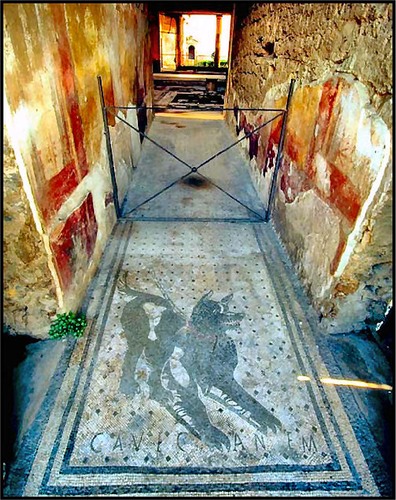
cave canemA caveat, most readers will know, is a warning. One of my favorite usages comes from ancient Rome, where many villa owners procured guard dogs to protect their property. Cave Canem–beware of the dog–became a common motif for entryway mosaics.

One of the most familiar caveats is caveat emptor—buyer beware. Not only is this warning well known, it is absolutely true. Without an express warranty, you may have little hope recouping your loss when something you purchase fails.

Caveats, however, need not infer that the subjects they refer to are dangerous.

For example, the guard dog may well be an affectionate “member of the family,” who warms up quickly, even to strangers who have been invited into the home. Likewise, the new car I’m contemplating purchasing may be ideal for me. Fairly priced, economical to drive, and not so dated in appearance that it shouts, “yes, I’m a grandpa.”

Caveats don’t mean “stay away.” They merely advise us all to think before we act. (And, as universal rules go, this is a very good one.) Caveats, and good parenting, remind us to read the “fine print” before signing anything.

I want to encourage all readers of Mere Inkling to use their God-given intelligence to evaluate what you read on these pages. In the same way, I hope you will all apply your God-instilled conscience to measure my words.

In light of this sincere desire, I encourage you to read the gentle caveats offered below.

General Caveats for Readers

What should readers of Mere Inkling keep in mind as they peruse these posts? First of all, there are a number of general considerations—applicable to everything each of us reads and hears.

1.  Understand the perspective of the writer. What are the assumptions and worldview of the person who wrote the piece? It can be hazardous to simply assume that a writer shares your own values—or even definitions. Many people would be shocked at the diversity of definitions for a word like “church” that roam the internet.

2.  Ensure we read what we think we did. By this I mean that we should reread sections that we find confusing or offensive. It may be we have misread what the author intended. (This is especially true when a writer seeks to play with the English language, and uses phrasing unfamiliar to our ear.) In cases where we have normally enjoyed the writing, but now find ourselves bothered by something, it is always good to ask the writer to clarify what they meant. More often than not, I’ve found this opportunity to elaborate dispels the problem.

3.  Reject the myth that anything you read is absolutely objective. Objectivity, except for mathematics, is essentially impossible. Our education, values, experiences and mood all affect the words we write. The best we can hope for in what we read—something Mere Inkling strives for—is personal honesty and fairness.

Mere Inkling Caveats

1.  Mere Inkling’s author is a fallen human being. By definition, that means that I am imperfect. Not all-knowing, nor always gracious. Imperfect though I am, I try my best to speak here in a forthright, considerate, modestly entertaining and, most importantly, a truthful way. When I fall short of that, feel free to write to me about it.

2.  I am a Christian. I certainly don’t apologize for this. Nor do I apologize for the wish of all disciples of Jesus that everyone might know the joy, forgiveness and peace that comes from abiding in the Vine (a metaphor for Jesus, as described in John 15).

3.  Your host at Mere Inkling is an evangelical Christian. This is a hazy adjective, often used in mutually contradictory ways. I apply it here to myself in the context of holding fast to the basic Christian truths, including the aforementioned desire of God that all people might come to him through his only begotten Son.

4.  I am a catholic Christian. Not a Roman Catholic (with a capital C), but catholic in the word’s creedal sense—a member of the one universal Church. As a catholic Christian, I subscribe to the ecumenical creeds, agreed upon as the fundamental doctrines of the faith during its earliest years. These include the Triune nature of God, the Incarnation miracle, and the atonement. Like my mentor, C.S. Lewis, here at Mere Inkling we focus on “Mere Christianity,” the common core of the faith. I consistently attempt to qualify my words on subjects where there is not a clear consensus.

Each of us has his individual emphasis: each holds, in addition to the Faith, many opinions which seem to him to be consistent with it and true and important. And so perhaps they are. But as apologists it is not our business to defend them. We are defending Christianity; not “my religion.” When we mention our personal opinions we must always make quite clear the difference between them and the Faith itself. (C.S. Lewis, “Christian Apologetics”).

5.  I am a Lutheran Christian. Again, I do not apologize. Lutherans understand we are only a small part of the “one holy catholic and apostolic faith.” Each denomination (indeed, each individual) possesses a distinctive interpretation of the Christian faith. We are free, of course, to associate with that community we believe follows God’s leading most faithfully. (It is a given that no community is without flaw, since no human being is.) I have written more on this aspect of my identity in the next point, and on the “Mercy” tab you will find at the top of the page.

6.  I am an evangelical Lutheran Christian. This is not a formal category, but means that I subscribe to historic Lutheranism as it has been taught and held since the Reformation, rather than some of the current expressions of “religion” that may be labeled Lutheran. In essence, this can be summarized in the “solas” of Lutheran doctrine.

Sola Scripture – Scripture Alone meaning that the Bible, the Jewish and Christian Scriptures, are the ultimate authority for determining true faith.

Sola Gratia – Grace Alone meaning salvation is an unearned gift of God, given not because we have earned it.

Sola Fides – Faith Alone meaning that God’s grace is apprehended not through wisdom, good works, or any means other than a simple trust in the promise. Ironically, this faith itself is also a gift of God.

7.  I am a pastor. While pastors with seminary educations do study Greek, Hebrew, Theology and assorted other subjects, we are not the same as what most people mean by the word “theologians.” Pastoral Theology is distinct from Systematic Theology. The former focuses on practical ministry to individuals, while the latter is most concerned with abstract matters. While I also possess a second graduate degree, my Master of Theology degree (much different than an M.A. in theology) was earned in the study of Early Church History. My concern remained the work of God among everyday human beings, rather than scholastic philosophy.

8.  While I never intentionally write anything with the goal of offending any reader, I recognize it is impossible to avoid all offense. (Even the least controversial prose is capable of offending.)

Allow me to illustrate how simple truths can elicit dramatically different responses, with two simple declarations.

God loves all people. This is true, and inoffensive. Most people today, and all orthodox (biblical) Christians would agree with the statement.

Not all people will go to heaven. This too is true. However, it provokes great outcries from many quarters, including some religious organizations that arise out of the Judeo-Christian tradition. Jesus himself offered “hard sayings” that elicited grumbling. John’s Gospel records a powerful account of this, occurring immediately after the Feeding of the Five Thousand.

When many of his disciples heard it, they said, “This is a hard saying; who can listen to it?” But Jesus, knowing in himself that his disciples were grumbling about this, said to them, “Do you take offense at this? . . . The words that I have spoken to you are spirit and life. But there are some of you who do not believe.” . . . “This is why I told you that no one can come to me unless it is granted him by the Father.” After this many of his disciples turned back and no longer walked with him.

C.S. Lewis referred to the alienating nature of some truths when he wrote the essay, “Cross-Examination.”

I believe that there are many accommodating preachers, and too many practitioners in the church who are not believers. Jesus Christ did not say “Go into all the world and tell the world that it is quite right.” The Gospel is something completely different. In fact, it is directly opposed to the world.

9.  I am an American. Again, no apologies. I applaud much of what this nation has valued and shared during its history. I regret many of the mistakes the United States has made, and continues to make. I recognize how fortunate I have been to live in a nation with access to educational and medical resources not available to all. I genuinely appreciate other cultures and have been privileged to live in Europe, Asia and the Pacific. The right I treasure most—and one I pray will be extended to all people—is freedom of religion.

10.  I welcome offline correspondence. I recognize many people are reluctant to post a comment on a blog, which is visible to the public. I also realize that some readers would appreciate privately offering a comment or posing a question. I welcome this, and encourage you to use the form below to write to me. I will respond from my personal email account and we can discuss sensitive matters in greater depth. I must say in advance, however, that I do not have the leisure time to aid with any research. Similarly, while I am happy to offer general pastoral advice, only a fool or con artist would presume to conduct serious counseling or therapy via email. (You need a local pastor or counselor for that.) That said, I do enjoy spirited and honest discourse, so d feel free to contact me.

← Back

Thank you for your response. ✨

_____

The picture at the top of the page comes from the entryway to the “House of the Tragic Poet” in Pompeii.


Avoiding Gadzookeries

gadzookeryWriting quality historical fiction is challenging. This is especially true if one wishes to avoid the common crutch that a talented writer of the last century first labeled “gadzookery.”

And just what is this faux pas we should avoid when writing about the past? Well, it relates most directly to the dialog placed on the lips of historical figures. The offensive technique involves the overuse of archaic expressions or phrases. (Some would argue it includes any use of any archaisms.)

If the word gadzookery sounds a tad, how shall I put it, “goofy” to you, you may prefer using another word that means the same thing: “tushery.” Tushery was coined by Robert Louis Stevenson. Way back in the nineteenth century.

Gadzookery is a newer version, insulting the same lazy writing technique. I believe it may have been coined by Rosemary Sutcliff (1920-1992). Sutcliff’s historical influence has exerted a literary influence on my life second only to C.S. Lewis.*

The article about Sutcliff in The Oxford Encyclopedia of Children’s Literature praises her work, saying, “She carefully creates dialogue in her novels that recollects the speech of a bygone era without falling into what she termed ‘gadzookery.’”

Having tested the waters of historical fiction myself, I know this to be far more difficult that it may sound.

Sutcliff had several things in common with C.S. Lewis. Both wrote for adults and for children. (It was her young adult series about the decline of Roman influence in Britain that sparked my own lifelong interest in Rome.)

Both authors also received the Carnegie Medal for their work. When Lewis was awarded his, he received a congratulatory letter from Pauline Baynes, who had illustrated several of his books. He responded quite graciously.

Dear Miss Baynes, Very nice to hear from you again, and thanks for sending on the book, which I have returned to Lane. Thanks for your congratulations on the Carnegie, but is it not rather ‘our’ Medal? I’m sure the illustrations were taken into consideration as well as the text. I am well, and as happy as a man can be whose wife is desperately ill.

Although C.S. Lewis had married, quite late in life, the two authors were alike in spending most of their life single. Sutcliff, in fact, lived with her parents during most of her life, having suffered crippling arthritis as a child. She did not resent remaining unmarried. In a 1992 interview she said,

Beatrix Potter wrote all her gorgeous stories when she was very lonely and not very happy—after she married, she never wrote another thing. Nothing worth reading, anyway.

Another similarity between the two was that they both fell under the powerful sway of myth during their childhoods. They used their familiarity with its rich echoes to imbue their own work with themes that flowed far beyond the familiar channels travelled by other writers.

Each of them took their readers seriously, and refused to speak down to them. That is why they share one more quality I wish to mention in closing—their high standards. Neither Lewis nor Sutcliff could tolerate poor writing. And their finely tuned skills meant neither ever needed to resort to gadzookery.

______

* Excepting, of course, the Bible itself, which is literature of an entirely different sort. I don’t consider it fair to compare mortal writers, no matter how inspired, to a volume I regard as God’s written word.

Misnaming Kids

baby namesWhy do they do it? I’m sure they considered it witty. They may have laughed as they inscribed his name on the birth certificate of their newborn son. (I doubt he shared the humor of the moment.)

Let’s think about this for just a moment. If your family name was Lemon, a totally respectable and not uncommon name, would you give your child a first name that is also a citrus?

That’s what I encountered as I completed the current issue of the military chaplaincy journal that I edit. One of the American Civil War chaplains I mentioned in the current issue of Curtana: Sword of Mercy bore the striking name “Orange V. Lemon.”

Really? Yes, really.

It reminded me of a quaint Canadian television series that my dad used to enjoy, The Red Green Show. His parents should have known that one color in a person’s name is sufficient.

Still, the temptation to be silly is irresistible to some people. Years ago I knew an attorney whose last name was Cain. Her parents had named her Candy, of course. Peculiar names are so common today, of course, that there are myriads of internet repositories for them.

Names are more important than many of us realize. I’ve written in the past about how my wife and I followed the biblical example of choosing our children’s names based on their meanings.

Even if that approach doesn’t appeal to a parents, there are an almost unlimited number of options that would not subject their children to unwanted attention.

Fortunately, when we get older, we have some control over what we are called. I was “Robbie” in my childhood, and graduated to “Rob” as soon as I could. “Robert’s” always been fine with me, since it’s my given name and what I expect someone I’ve never met to call me. “Bob,” however, is not okay. There’s nothing wrong with “Bob,” except that I’ve never been one. And when someone greets me as such it projects a very false familiarity.

Curiously, I recall reading in the Oxford dictionary of names that more primitive nicknames for Robert included Hob, Dob and Nob. So I suppose I should count my blessings when addressed as Bob.

C.S. Lewis chose his own name. Many people are surprised when they learn that he went by the name of Jack. How, they wonder, could one get “Jack” out of “Clive Staples?” Good question.

Lewis was not enamored with the name Clive. When he was only four, he decided to use the name of a pet dog that had been killed by an early motorist. The pet’s name was a human-friend designation, “Jacksie.” His brother Warren relates the event thusly, in his 1966 collection of Lewis’ letters.

Then, in the course of one holiday, my brother made the momentous decision to change his name. Disliking “Clive”, and feeling his various baby-names to be beneath his dignity, he marched up to my mother, put a forefinger on his chest, and announced “He is Jacksie.” He stuck to this next day and thereafter, refusing to answer to any other name: Jacksie it had to be, a name contracted to Jacks and then to Jack. So to his family and his intimate friends, he was Jack for life: and Jack he will be for the rest of this book.

It’s fascinating that Lewis’ family acquiesced to his demand, but it took. One small consequence, of course, is that this gifted writer is known today as “C.S.” rather than by his full names.

As for faithful Orange, I don’t know if he adopted any other name during his lifetime. He may have been quite content. It certainly did not prevent him from enjoying a meaningful life. He became a Methodist pastor and served as chaplain with the 36th Indiana Infantry.

Any Name But That

jesus nameThis week I read one of the clearest descriptions of the gospel I have ever heard. It appeared in an article written by the most (how do I put this mildly?) daunting professor I have encountered in my Doctor of Ministry studies. “Intimidating” would also work . . .

But his brilliance and rapid fire delivery of thought-provoking concepts is not the reason for me mentioning him here. It is his ability to cut through the confusion, and express simply the essence of the good news, the Christian hope, the gospel.

I’m not pandering to him, mind you, because my grade for his systematics course was filed long ago. It is simply that Joel Biermann said extremely succinctly, something that I have always attempted to emphasize in my own ministry.

The Gospel is the good news, but it is not just any good news. The Gospel is a word of liberation and encouragement, but it is not just any word of liberation and encouragement. The Gospel is a wonderful event and a joyful experience, but it is not just any wonderful event and joyful experience.

In other words, when it comes to defining the Gospel, it is vitally important that we move past vague ideas or general notions and grab hold of the central thing. The central thing is Jesus.

This is a truth too many fail to understand. Sadly, this is true for some “inside” the Church as well as outside of its doors.

Goodness is good. Generosity is wonderful. Encouragement is precious. Courage is noble. Love is (almost) divine.

Yet none of these are the Gospel. The Gospel is Jesus. In him the world discovers every good thing from the hand of God the Father, our Creator.

Jesus is indispensable. Without his holy name, the “faith” would simply be a praiseworthy “religion.” Without Jesus, it could instruct how to live, but it could not redeem.

It is precisely this point—the name of Jesus—that makes the Gospel objectionable to some. “Care for the sick,” some say, “just don’t mention that name.” On other lips we hear “The Church does lots of things that benefit the community, but please don’t mention that name that offends people.”

They arrested the apostles and put them in the public prison. But during the night an angel of the Lord opened the prison doors and brought them out, and said, “Go and stand in the temple and speak to the people all the words of this Life. . . .”

And someone came and told [the High Priest], “Look! The men whom you put in prison are standing in the temple and teaching the people. . . .”

And the high priest questioned them, saying, “We strictly charged you not to teach in this name, yet here you have filled Jerusalem with your teaching, and you intend to bring this man’s blood upon us.”

But Peter and the apostles answered, “We must obey God rather than men. The God of our fathers raised Jesus, whom you killed by hanging him on a tree. God exalted him at his right hand as Leader and Savior, to give repentance to Israel and forgiveness of sins. And we are witnesses to these things, and so is the Holy Spirit, whom God has given to those who obey him.” (Acts of the Apostles, chapter five).

C.S. Lewis knew quite well that Christianity is all about Jesus. Without him, the person Jesus the Christ, whatever passes for the “Church” would merely be a noisy gong. Lots of “religious” talk would remain . . . but the Gospel would be absent.

“What are we to make of Christ?” There is no question of what we can make of Him, it is entirely a question of what He intends to make of us. You must accept or reject the story. The things He says are very different from what any other teacher has said. Others say, “This is the truth about the Universe. This is the way you ought to go,” but He says, “I am the Truth, and the Way, and the Life.” He says, “No man can reach absolute reality, except through Me. Try to retain your own life and you will be inevitably ruined. Give yourself away and you will be saved. . . .”

“Come to Me everyone who is carrying a heavy load, I will set that right. Your sins, all of them, are wiped out, I can do that. I am Re-birth, I am Life.” (1950 essay, “What Are We to Make of Jesus Christ?”).

In the same way as the apostles, C.S. Lewis, my seminary professor, and all of those who have entrusted themselves to the grace of God in Christ, know the name of Jesus is not optional. In fact, it is all about the name.

For it is Jesus, and him alone, who is the alpha, omega and the whole of the Gospel.

Emphasizing Italics

italicsSermons do not make great books. Sorry, but that’s the opinion of this pastor who has to compel himself to read the sermons of preachers.

Yes, some of them sell decently (when the author has a national “pulpit”). But I suspect many copies of those books are purchased out of support of their broader ministry. I imagine most purchasers try to wade through a few of the homilies, but decide after a while they prefer listening to the sermon “preached.”

As a lifelong student of communication, I continue to be intrigued by the different ways in which aural and printed word can be used to communicate the good news. The subject promises to be a major part of my dissertation research.

Sermons are meant to be delivered orally. Transposing them to the page, without making various accommodations, is (in my personal opinion) a mistake.

C.S. Lewis apparently agreed with me on that—before he came to disagree with the effort.

Ever since the rise of the keyboard, I have celebrated the ability to use italics for emphasis. I consider the availability of italics especially important when we translate spoken messages into text.

C.S. Lewis discussed this process in his preface to Mere Christianity. His focus was on how best to transpose words prepared for oral delivery to a written medium, while still maintaining their original voice.

The contents of this book were first given on the air, and then published in three separate parts as Broadcast Talks (1942), Christian Behaviour (1943) and Beyond Personality (1944).

In the printed versions I made a few additions to what I had said at the microphone, but otherwise left the text much as it had been. A “talk” on the radio should, I think, be as like real talk as possible, and should not sound like an essay being read aloud. In my talks I had therefore used all the contractions and colloquialisms I ordinarily use in conversation.

In the printed version I reproduced this, putting don’t and we’ve for do not and we have. And wherever, in the talks, I had made the importance of a word clear by the emphasis of my voice, I printed it in italics.

I am now inclined to think that this was a mistake—an undesirable hybrid between the art of speaking and the art of writing.

A talker ought to use variations of voice for emphasis because his medium naturally lends itself to that method: but a writer ought not to use italics for the same purpose. He has his own, different, means of bringing out the key words and ought to use them.

In this edition I have expanded the contractions and replaced most of the italics by a recasting of the sentences in which they occurred: but without altering, I hope, the “popular” or “familiar” tone which I had all along intended. I have also added and deleted where I thought I understood any part of my subject better now than ten years ago or where I knew that the original version had been misunderstood by others.

When one’s mentor advises something, it demands thoughtful consideration. Lewis’ opinion that the use of italics for emphasis is not ideal forced me to seriously consider the practice, which I obviously favor.

I agree with Lewis on expanding contractions. I learned that lesson when I wrote a paper during seminary studies and the professor instructed me to make that change.

However, I disagree about the use of italics. They need to be properly applied, of course. And I recognize that the most gifted of writers may be able to consistently avoid using them. (Or “leaning on them” as an anti-italics anarchist would probably say.)

In the end, I guess it is time to ponder again Lewis’ pronouncement that writers have their “own, different, means of bringing out the key words and ought to use them.”

Until I receive a divine mandate, C.S. Lewis notwithstanding, you should continue to expect to occasionally see italics here at Mere Inkling.

_____

The cartoon at the top of the page comes from an interesting site. You can find the original source for the image here. Just for the record, I hate ALL CAPS, and I absolutely despise underlining.

Introducing Anatole France

papeThere’s always a new author to meet. Some are more worth meeting than others.

I was introduced to Anatole France (1844-1924) when I saw him listed on the “must read” list of F. Scott Fitzgerald.

I’m not a big Fitzgerald fan, but as an amateur literary historian, I was curious about how this particular list was recovered. Apparently, he had dictated it to one of his nurses, several years before his death. However, the list only turned up last year, having lain unnoticed in the nurse’s effects.

The France title that Fitzgerald deemed essential was The Revolt of the Angels. Its importance to him is highlighted by the fact that this relatively short list only included twenty-two titles. And one of that mere score of selections was The Revolt of the Angels.

The angelic dimension of the work is what intrigued me. Angels, of course, are real beings. They’re distinct from people (contrary to the pervasive contemporary notion that when people die they “become” angels).

There actually was an angelic revolt, and there are several references to it in the Scriptures. “How you are fallen from heaven,
O Day Star, son of Dawn!” (Isaiah 14:12).

I was curious whether France was writing about this ancient event. I was also intrigued by Fitzgerald’s interest in the volume, given its subject.

I was disappointed.

It turns out that, like Mark Twain, France was sympathetic to the Devil. I’m sure he thought himself quite the wit when he wrote, in reference to the Bible, “We have never heard the devil’s side of the story, God wrote the whole book.”

I don’t have time to read texts like this—when there is more than enough good literature to keep me occupied for several lifetimes. However, it appears to be based on Gnostic concepts with God (the Creator of this world) viewed as an imperfect demiurge. His incompetence, it seems, justifies the heavenly revolt.

Suffice it to say, the book is commended for reading by the Freedom From Religion Foundation. That sort of endorsement speaks volumes.

Here, however, is a random paragraph. It may be illustrative of the tone of the work, even though pulled from its context. The speaker is, I believe, one of the positive characters in the book. While France himself was an atheist, his sympathetic character summarizes a pagan cosmology quite elegantly.

Young Maurice’s guardian angel [said] “I argue, like you, in the language of human beings. And what is human language but the cry of the beasts of the forests or the mountains, complicated and corrupted by arrogant anthropoids. How then . . . can one be expected to argue well with a collection of angry or plaintive sounds like that?

Angels do not reason at all; men, being superior to the angels, reason imperfectly. I will not mention the professors who think to define the absolute with the aid of cries that they have inherited from the pithecanthropoid monkeys, marsupials, and reptiles, their ancestors! It is a colossal joke! How it would amuse the demiurge, if he had any brains!”

That is actually a rather provocative quote, and I’m sure it may lead some to explore the text even further. I certainly don’t object to that, and would be curious to hear back from anyone familiar with the book. I would especially like to see the reaction of Christians to The Revolt of the Angels.

If you are interested in a more creative fictional treatment of fallen angels, be sure to read C.S. Lewis’ The Screwtape Letters. While the presentation is truly groundbreaking, Lewis’ take on the motives and nature of these defeated beings is actually based on reality. Cast from the heavens they are consumed with rage and hatred of God.

A positive note about Anatole France

Whatever I think about the writer’s theology, I did read several wise quotations attributed to him. I’d like to close with these, as they may be more edifying than our discussion of Gnostic cosmology.

“Nine tenths of education is encouragement.”

“Some succeed because they are destined to; most succeed because they are determined to.”

“If 50 million people say a foolish thing, it is still a foolish thing.”

“When a thing has been said and well said, have no scruple; take it and copy it.”

And my favorite:

“Until one has loved an animal, a part of one’s soul remains unawakened.”

_____

The illustration above is the work of Frank C. Papé (1874-1972) an English book illustrator. It comes from another of France’s “religious” works.

Volcano Hurricane

volcanoVolcano hurricane. An epic disaster film! No sharks, but copious amounts of lava flung by gale force winds across the globe. And all from the mind of a six year old boy.

Imaginations are great. They are one of the most precious gifts of God (which makes it all the more tragic when the human imagination is diverted towards carnal ends).

The minds of young boys, thankfully, have yet to turn to such lamentable matters. Their innocence shields them from the worst of human corruption. They, instead, are consumed with thoughts of spiders and other things that creep out girls . . . and especially their moms.

Our almost-seven-year-old grandson was here for the weekend with his family. We had a wonderful time. We had actually found the ideal book to include as part of his birthday celebration: How to Convince Your Parents You Can Care for a Pet Tarantula. Perfect.

Young male imaginations seem to revolve around things that shock—and also things that gross others out.

Our kids have trained their own children well. For example, they always excuse themselves when they experience flatulence. It’s a natural experience, of course, and as we mature, adults learn to ignore potentially embarrassing moments related to it. That’s part of becoming “civilized.”

Six year olds . . . not so much. Our grandson properly excuses himself, but he typically does so in the midst of enthusiastic laughter. It’s as though he relishes just how uncultured the moment seems.

During this particular visit, he leaped into my lap in a semi-ninja attack. As we wrestled, there was a minor explosion. Not quite volcanic, but close enough. He apologized, amidst great hilarity. “Sorry about my little gas,” he added.

And here’s where I made the mistake. I reinforced his innate boyhood grossness by saying, “little! . . . that sounded like it was a buffalo!”

Not quite the right thing to say, since it simply encouraged the precocious guy. But what I can say . . . time may change a boy into a man, but in most of us . . . somewhere deep in the recesses of our psyches . . . that boyhood irreverence lingers.

Not that I enjoy the crass “body humor” that pervades so much comedy (on tv and film). I steadfastly avoid it. It insults my mind and viewing it constitutes a total waste of time. Still, with my grandson wrapped in my arms, laughing away, it all seemed so genuine and innocently funny.

Of course, I recognize one needed to be there—and probably to also be related by bloodline to the participants—to find any humor in the moment. But it certainly seemed funny to us.

C.S. Lewis and Children

I was thinking about that moment as I sat down to write this post. I intended to focus on the amazing imaginations of children, and my grandson’s current preoccupation with gigantic volcanoes.

But whim or muse redirected the column. In the end, it turns out to be a reflection on the simple pleasure that we adults experience when we interact with kids. Especially when they are children who are precious to us.

I wish that C.S. Lewis had been able to experience that joy. He wasn’t. His awkwardness with children is well known. Most attribute it to the early passing of his mother, and the emotional distance his father maintained from his sons.

In a 1935 letter he wrote to a close friend, “I theoretically hold that one ought to like children, but am shy with them in practice.”

In The Abolition of Man he was even more forthcoming, sharing that, “I myself do not enjoy the society of small children: . . . I recognize this as a defect in myself.”

So, Lewis recognized his discomfort with children as a shortcoming. It was something he wished could be dispelled. Unfortunately, we can’t simply wish (or pray) away our ingrained personality traits. We’re lucky if we can tame them or reshape them.

We work hard to strengthen our positive traits and the wise deny nourishment to their weaker qualities. People often use the analogy of wearing off one’s rough edges, and that’s an apt image.

Lewis’ reticence with children makes his creation of Narnia all the more wondrous. The Chronicles of Narnia have captivated the hearts and imaginations of innumerable children, and adults alike. Certainly Lewis was correct when he wrote the following in “On Stories.”

No book is really worth reading at the age of ten which is not equally (and often far more) worth reading at the age of fifty—except, of course, books of information. The only imaginative works we ought to grow out of are those which it would have been better not to have read at all.

With his marriage, late in life, Lewis became a step-father. He did the very best he could, but was conscious of just how ill-equipped he was to raise Douglas and David. Both became successful men. Doug shares his parents’ love of Christ, and helps direct the course of various Lewisian projects today.

Allow me to close with another evidence of the greatness of C.S. Lewis. He was able to rise far above his innate uneasiness with children. In fact, his fabled correspondence included many children who had written to him seeking his attention. In 1951 he wrote to one of them, saying:

I am glad you all liked The Lion. A number of mothers, and still more, schoolmistresses, have decided that it is likely to frighten children, so it is not selling very well. But the real children like it, and I am astonished how some very young ones seem to understand it. I think it frightens some adults, but v[ery] few children.

Lewis did not disappoint the many children who wrote to him during those terribly busy years. Nor do his writings disappoint us today. Unlike the transience of youthful volcano hurricanes, Lewis’ legacy will forever remain alive in the imaginations of child and adult alike.

Humanity’s Interstellar Exodus

evoraEarth’s days are numbered. Eventually, all scientist agree, she will die . . . and all life on the planet will perish.

Even if this doesn’t occur due to a catastrophic accident like a massive asteroid impact or an alien invasion, it is inevitable. Inevitable.

If nothing else interferes, scientists tell us earth will die in the death throes of its own star. In about 2.8 billion years, the sun will destroy all life here. Before the sun consumes its nuclear fuels and transforms into a “red giant,” it will have scorched the solar system.

It’s a disturbing thought. At least, it can be to those who place their hope in the future of humanity. Christians, in contrast, look forward to the promise of a new creation, a new heaven and a new earth, where even the harmony of the cosmos will be restored.

For those who believe that ultimate meaning can only be found in the continuing evolution of humanity, it is necessary to see an opportunity to continue the race. Until we evolve into pure mind and energy forms (right!) we need to find a place on hospitable worlds where we can survive, prosper and continue to advance.

So, if we assume it’s necessary for humanity to continue to exist, and our days here on earth are numbered, what are we to do?

The answer’s obvious. We must migrate to the stars. Baby steps are already being taken, with planning for our first colonies on Mars and our own moon. Many movies have explored establishing our presence in other solar systems. In fact, it’s become a trope of the scifi genre.

Some writers and directors envision a welcoming universe. Others populate it with hostile environments and competitors.

One of the most disturbing thoughts I have heard in the past few months was voiced by a scientist contemplating this subject. In essence, he said that our observation of nature shows that it is the predators (not their gentle prey) that must become smarter than the rest of the fauna to survive. The presumption being that it is the predator, not the grazer, that would evolve farthest and potentially venture into space.

I grew up influenced by the utopian images of Star Trek. Sure, there were Klingons and other threats out there, but there were also a large number of affable races that were eager to band together and share their knowledge and culture.

Star Trek went a step further. Even our one-time enemies (like the aforementioned Klingons, the Cardassians and the Ferengi) could become our allies. Well, there’s a precedent in that here on Earth (think post-war Germany and Japan). Still, it may be a tad naïve when it comes to interstellar swashbucklers.

Of course, all this presumes that we are no “alone” in the universe. By alone, we mean, the only sentient beings to populate the stars. (That’s figurative language, of course. No one lives on the stars themselves . . . that we know of.)

The prolific writer C.S. Lewis wrote a series of books about humanity’s first encounters with life beyond our planet. The Space Trilogy will be of interest to open-minded fans of science fiction, and to people who enjoy learning more about Lewis’ broad interests.

The first book in the series is called Out of the Silent Planet. In a 1939 letter, he explained to a correspondent one of his reasons for writing the book. [The quotation refers to Professor Weston, who is the novel’s nemesis. One of his goals is to usher in the age of human colonization beyond our own orbit.]

The letter [at the end of Out of the Silent Planet] is pure fiction and the “circumstances which put the book out of date” are merely the way of preparing for a sequel. But the danger of “Westonism” I meant to be real.

What set me about writing the book was the discovery that a pupil of mine took all that dream of interplanetary colonization quite seriously, and the realization that thousands of people in one way and another depend on some hope of perpetuating and improving the human race for the whole meaning of the universe—that a “scientific” hope of defeating death is a real rival to Christianity.

With this, we return to our initial thought. If we are looking to the stars for humanity’s hope, I’m afraid we will ultimately be disappointed.

I don’t know if there is mortal life beyond our planet. If there is, I can’t predict whether it would be friendly, or inimical to us.

Who knows whether we could even communicate? It’s a mystery for now. What isn’t a mystery, is whether or not we need to look beyond this tiny blue globe. After all, it is certain this world’s days are numbered.

_____

Note: The alien at the top of the page is the Regent of the Evora species, a Federation protectorate. I used her image because of the curious marking on the crown of her head. It resembles a tattoo of a cross, but from the lines on the sides of her head I suspect they might all merely be varicose veins.

Rational Fears

men at lunchFear comes in many forms. It also comes at many heights. This famous 1932 photograph shows eleven men—without safety harnesses—taking a lunch break during construction of the Rockefeller Center in New York City.

Simply looking at the picture of them leaning in various poses as they casually converse with one another is enough to send shivers up the spine of someone suffering from acrophobia.

I don’t personally have an “irrational fear of heights.” After all, I’ve enjoyed forays into the sky via the Eiffel Tower, the Tokyo Tower and the Space Needle in nearby Seattle. Still, I must confess that when I stand high above the earth on a piece of clear glass or acrylic that I do find it a bit disconcerting. It’s not as if I doubt the building is secure . . . but precisely what clear substance like that is worth trusting our lives to?

cracksIn fact, not long ago, a group of people were standing on just such a viewing panel when it began to crack. Two facts, it was new (opened in 2009) and it was on the 103rd floor of the Chicago building. The quaintly named “Ledge” was certified to 10,000 pounds, and it’s difficult to imagine the family standing on it, when it fractured, as exceeding that weight.

Let’s return for a moment to 1932. There’s a lesser known photo, taken the same day as the renowned image. It is even more disturbing. Check this out.

restThis shot was taken after the men had staged the lunch picture for the press. They were simply resting after eating, before returning to work.

Now, I appreciate rest as much as anyone, and far more than most. But, if I was on that steel girder, 840 feet above the pavement, I would be so hyper vigilant a tranquilizer dart couldn’t put me down.

That picture, frankly, scares me.

Fortunately, C.S. Lewis reminds us that there is nothing wrong with fear. Beyond sometimes protecting us from foolish risk-taking, the fear itself does not determine our reaction to it. In other words, a soldier can rightly be afraid on the battlefield, yet overcome that fear and do something heroic. Common men and women often surprise themselves when they overcome fear they might have thought would cripple them.

C.S. Lewis says it this way. “The act of cowardice is all that matters; the emotion of fear is, in itself, no sin” (The Screwtape Letters).

I’ve learned through the years that there is wisdom in learning about one’s own fears. Sometimes what we learn diminishes the fear. At other times, understanding our fears can prevent us from misattributing our emotions to another source.

For example, you might think you dislike a person who frequently invites you to share your thoughts with a group. When, in actuality, it might merely be your fear of public speaking, or your fear of having your ideas rejected that troubles you. Upon recognizing this, you might even grow to like the other person, seeing how they are confident that you have something of value to offer to the discussion.

Like every other fallen human being, I’m riddled with fears and buried under worries. It is beyond comprehension how God has manifested his love for us in his only begotten Son . . . truly we can cast all of our burdens onto his compassionate and willing shoulders.

In fact, it is during our darkest hours when, assailed by our personal terrors, we lean most upon his strength. Without a doubt, if severe unemployment has forced me to be one of those construction workers nearly a century ago, I would most definitely have been one praying man!

_____

P.S. – Oh, and if anyone is curious about the flask held by the construction worker on the right, I’m sure it only contained water and not some useless form of “liquid courage.”

Deadly Jobs

bad newsIt’s bad enough not liking your job . . . but being allergic to your chosen profession? That’s absolutely miserable.

And that’s what happened to one American journalist. Despite the myriads of new avenues for journalism, newspaper writing remains a primary context for the skill.

I actually earned my first degree in journalism. Editorial Journalism, via the University of Washington’s School of Communication. But I was never cut out to be a member of the Fourth Estate. (Ironically, I ended up belonging to the First Estate, but that’s another story.)

Journalism is a vocation important to the wellbeing of society. Good journalists are vital to society’s health. Those who spew vitriol, not so much.

Apparently a reporter for a Baltimore newspaper recently discovered—after thirty-eight years in the business, that he’s allergic to newspapers. Not their content, their composition. Specifically, he is allergic to pine resin which is used to make newsprint ink.

I assume he’s making a “quality of life” transition now to digital news sources.

Journalism is a broader field than many realize. Our first thought usually turns to newspaper “reporters.” We have often considered them to be objective relaters of events. Of course, complete objectivity is something that is beyond human grasp. Everyone approaches the “news” with their own biases and a worldview that shapes their perception of “facts.”

C.S. Lewis has a fun essay which touches on this. It’s called “Private Bates.”

We must get rid of our arrogant assumption that it is the masses who can be led by the nose. As far as I can make out, the shoe is on the other foot. The only people who are really the dupes of their favourite newspapers are the intelligentsia. It is they who read leading articles: the poor read the sporting news, which is mostly true.

I recall some debates back in my college days when others attempted to persuade me that objectivity was not only possible, it was the standard practice of reporters. That myth has long been exposed, and I try to be content with those who strive to be as fair as they can.

In a 1955 letter, C.S. Lewis is even more blunt than in the previously cited essay. He tells one of his regular correspondents, “I never read the papers. Why does anyone? They’re nearly all lies, and one has to wade thru’ such reams of verbiage and ‘write up’ to find out even what they’re saying.”

One reason journalism receives so little respect today is because people confuse reporting with editorializing. Reporting, of course, is just the facts. (Admittedly, even these are subjectively perceived.) Editorializing, on the other hand, is offering one’s unbridled opinion.

For the latter to masquerade as the former is criminal. But to accept the fact that honestly offered “opinion” is just that, is fine.

After all, one reason you’ve taken the time to read this post is because you appreciate reading gems from C.S. Lewis . . . and you don’t mind wading through the “opinionated” verbiage of this humble columnist to find it.