Hope in the Face of Danger

We live in what some consider a scary age. Even if you avoid all the dystopian books and films, real life provides more than enough worries. Thank God that C.S. Lewis offers wise counsel to help us cope with our fears without despairing.

The Department of Defense just released its 2019 report from the Electromagnetic Defense Task Force. The 2018 Report, which lays the foundation for the latest electromagnetic pulse (EMP) study, is also available.

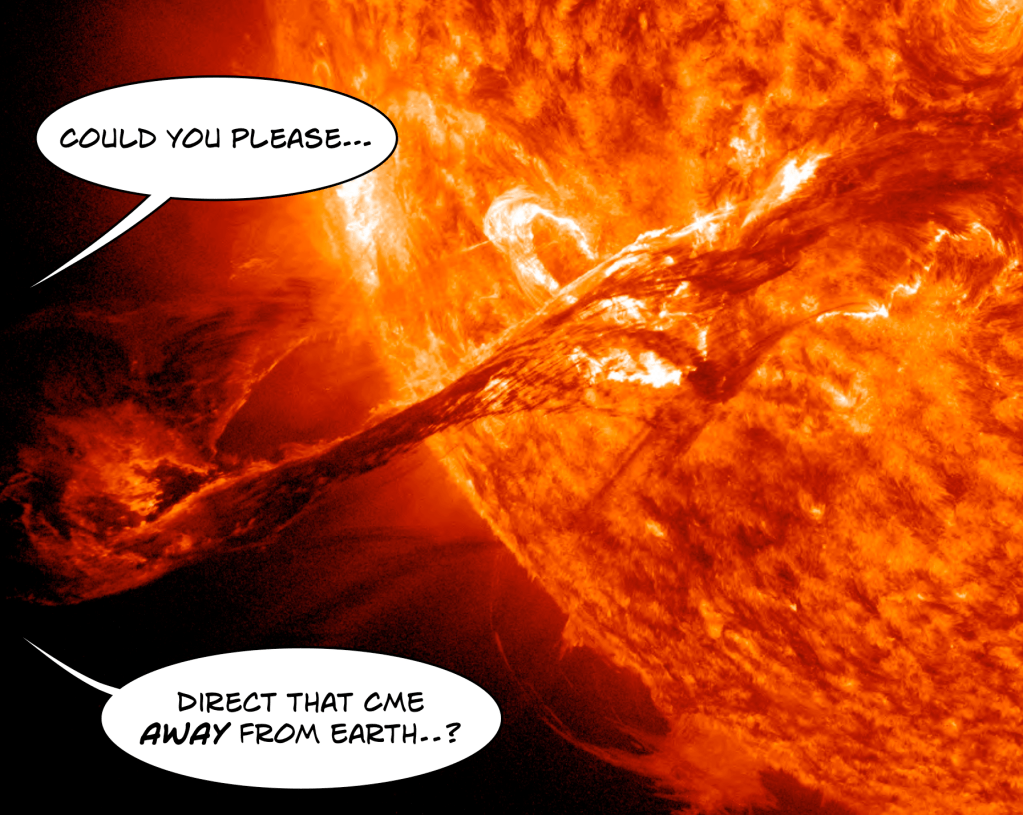
These reports make fascinating, though sobering, reading. Their warnings are applicable not only to the United States, but to everyone depending on modern conveniences such as electricity. The EMP threat comes, after all, not only from nuclear attacks, but also from coronal mass ejections which are spawned regularly by the sun. (NASA agrees with the potential dangers.)

As the report says, “The potentially catastrophic effects of these types of natural or man-made EMP events are not science fiction but science fact and have been well studied and documented for nearly six decades.”

Warning people about the dangers—and preparations that can easily be made in advance to survive them—is the mandate of the Task Force. I imagine one of their educational recommendations they suggest might come to resemble the “Duck and Cover” training provided to students in the 1950s and 1960s.

How Bad Could It Be?

Pretty terrible, if the worst circumstances align. The reports support the findings of a previous Congressional study that “an EMP-induced blackout could cause a long-term nationwide grid collapse and the loss of up to 90 percent of the population through starvation, disease, and societal collapse.”

Ninety percent. This would be nothing less than apocalyptic. Yet, even in such a scenario, we would not need to surrender to hopelessness. I’ve discussed this in the past.

Most of the fatalities would result from starvation, since food production would drop dramatically, and there would be no fuel available to move it to markets. The even more ominous threat would come from our fellow citizens. Describing this, one contributor to the report cites three certain factors that are not currently considered in any official plans: human desperation, starvation, and “living without the rule of law” which has its own acronym, WROL.

C.S. Lewis’ Response

The danger of EMPs was little known during Lewis’ life. Nonetheless, he did write about the possibilities for global disaster created by the existence of hydrogen bombs. And Lewis’ response was the Christian one—do not despair, since these threats change almost nothing. Even without them, we humans are mortal. Likewise, barring the creation of a new heaven (which is coming), even the expanding universe we inhabit is destined to fade away.

Our ultimate hope comes not from the material creation, which itself shares the scars of humanity’s fall. We are not simply physical beings. Created in the image of God, you and I possess a spiritual nature. And God will deliver us from this final dissolution.

Lewis describes this dilemma extremely well in his essay “On Living in an Atomic Age.” And this video helps to illustrate Lewis’ words.

As Lewis says,

If we are all going to be destroyed by [an event such as an EMP], let that [event] when it comes find us doing sensible and human things—praying, working, teaching, reading, listening to music, bathing the children, playing tennis, chatting to our friends over a pint and a game of darts—not huddled together like frightened sheep” dwelling on our vulnerability. Such terrible events “may break our bodies (a microbe can do that) but they need not dominate our minds.” (On Living in an Atomic Age)

Preparing for Disasters

When we lived in the Midwest, where winter storms could readily strand motorists for a day or more, we carried a “survival kit.” It was a wise precaution, though by the grace of God we never needed to use it.

Off the West Coast of the U.S. and Canada, lies a mounting danger. The Cascadia Subduction Zone generates earthquakes and mega-tsunamis every 500 years or so . . . Today tsunami escape routes have become a normal component of disaster preparedness for those living on the Washington and Oregon coasts.

Each individual and family must determine their own course when it comes to disaster preparation. If my family had settled in Texas where two tornadoes passed near our home while we lived there, I would not have relied on taking shelter in a hallway beneath an antique table. I would have prepared for the potential threat by having a home built with a basement designed to serve as a tornado shelter.

The problem isn’t that people take precautions that often prove unnecessary—at worst they have expended money that purchased only peace of mind. The problem is that some people become consumed by the prospect of a national or global disaster. Their fear can grow to the point where it is all they can think about and the rest of their life often ends up in ruins.

It is to people in this group—those we might call extreme doomsday preppers—that C.S. Lewis speaks most intentionally. He offers sound advice that can help restore balance to the lives of those who have been crippled by fear.

It will be very interesting to see how the recommendations of the Electromagnetic Defense Task Force are implemented. Particularly their challenge to actively educate the public. Hopefully whatever program arises will be reasonable and constructive, and avoid excessive drama. But, living in our increasingly hyperbolic world, I’m not confident that will be true. Prepare to hear more about this subject in the years ahead.


The image above was captured by NASA’s Solar Dynamics Observatory and the “Sun-flanking STERO-B spacecraft” in 2012.
Good, Bad and Ugly Hymns

There’s good “church music.” There’s mediocre church music. (And, there’s even terrible church music.) Read on and I’ll provide a link to an article I wrote about one questionable ditty that wormed its way into a military hymnal.

C.S. Lewis was not a fan of most church music. I’ve written about his musical tastes previously.

His assessment is no secret. He deemed most hymns to be “fifth-rate poems set to sixth-rate music.”

When it comes to hymns, there is general agreement on what’s good. These songs have passed the test of time. They have proven edifying and inspirational for generations. Some contemporary music is also biblically faithful and possesses the potential to join the ranks of the church’s lasting hymnody.

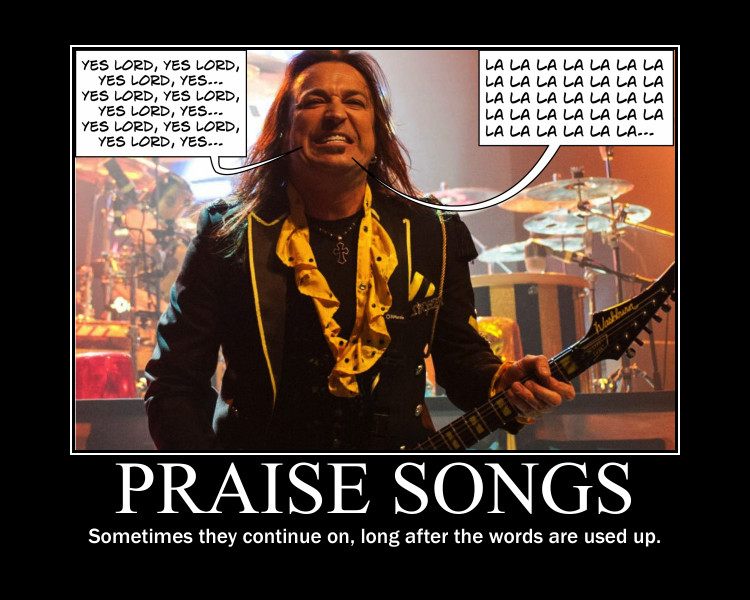
Then there are the others. Uninhibited redundancy, for example, suggests a corresponding shallowness. I forego the idiom about something being broad but shallow, since such songs are actually narrow and shallow. Case in point, the song “Yes, Lord.”

It begins promisingly enough:
I’m trading my sorrow
I’m trading my shame
I’m laying it down for the joy of the Lord

Then the theology gets a wee bit blurrier, especially for believers who still suffer after praying for healing:

I’m trading my sickness
I’m trading my pain
I’m laying it down for the joy of the Lord

But it’s the chorus that undermines the song’s edificatory potential.

And we say
Yes Lord yes Lord yes yes Lord
Yes Lord yes Lord yes yes Lord Amen

Yes Lord yes Lord yes yes Lord
Yes Lord yes Lord yes yes Lord Amen

The last two chorus breaks are replaced by the less challenging:

La la la la la la
La la la la la
La la la la la la
La la la la la
La la la la la la la la la
La la la la

La la la laLa la
La la la la la
La la la la la la
La la la la la
La la la la la la la la la
La la la laLa la la la

To those of you who adore this particular song—please accept my apologies for singling it out. Yet I stand by my view of these lyrics. And I can certainly imagine what C.S. Lewis would have thought of it.

The Power of Music

Various Christian leaders have expressed the opinion it’s more important to write the church’s hymns than its theological books. Hopefully that’s hyperbole, but few would deny the words we sing directly influence our thinking.

Arius, one of the early heretics who denied the divinity of Christ, knew this. His movement created tremendous confusion and resulted in much persecution. One of his most successful tools consisted of composing heretical songs. The words were “religious,” and the tunes were catchy, so people were singing them even when they didn’t agree with his doctrine.

C.S. Lewis & Church Music

As mentioned above, C.S. Lewis was very candid about his own disaffection for most church hymnody. In “Answers to Questions on Christianity,” Lewis answers the question of whether it’s necessary to attend worship services. He describes how duty rather than desire brought him to congregational worship.

When I first became a Christian . . . I thought that I could do it on my own, by retiring to my rooms and reading theology, and I wouldn’t go to the churches and Gospel Halls; and then later I found that it was the only way of flying your flag . . .

[However,] I disliked very much their hymns, which I considered to be fifth-rate poems set to sixth-rate music. But as I went on I saw the great merit of it. I came up against different people of quite different outlooks and different education, and then gradually my conceit just began peeling off.

I realized that the hymns (which were just sixth-rate music) were, nevertheless, being sung with devotion and benefit by an old saint in elastic-side boots in the opposite pew, and then you realize that you aren’t fit to clean those boots. It gets you out of your solitary conceit.

In light of Lewis’ attitude toward religious hymnody, it’s ironic that in 1946 he was invited to help evaluate new hymns.

The Hymn Society of Great Britain and Ireland is opening a file of new hymns to which modern hymn-writers are to be asked to contribute. I have been asked to write to you and ask if you will be a member of the panel to whom new hymns may be submitted in order that their merit may be assessed . . .

Lewis’ response to the invitation is as revealing as it is (unintentionally, I’m sure) curt.

The truth is that I’m not in sufficient sympathy with the project to help you. I know that many of the congregation like singing hymns: but I am not yet convinced that their enjoyment is of a spiritual kind. It may be: I don’t know.

To the minority, of whom I am one, the hymns are mostly the dead wood of the service. Recently in a party of six people I found that all without exception would like fewer hymns. Naturally, one holding this view can’t help you.

Two months later, the men exchanged letters again, and Lewis clarified his thoughts.

I can’t quite remember my own last letter; but I was wrong if I said or implied that . . . hymns, were bad in principle. . . . In modern England, however, we can’t sing—as the Welsh and Germans can. Also (a great pity, but a fact) the art of poetry has developed for two centuries in a private and subjective direction.

That is why I find hymns ‘dead wood.’ But I spoke only for myself and a few others. If an improved hymnody—or even the present hymnody—does edify other people, of course it is an elementary duty of charity and humility for me to submit. I have never spoken in public against the use of hymns . . .

The Gospel Coalition has an informative essay on Lewis’ broader view of worship here.

The Armed Forces Hymnal Scandal

At the outset of this column I promised readers a link to a recently published article. If you would like to read about a bizarre hymn that (temporarily) slithered into the Book of Worship for United States Forces, check it out here. The article begins on page fifteen of the new issue of Curtana: Sword of Mercy.

The hymn in question may be thought-provoking, but it belongs in a discussion group, not in a worship service. The lyrics are placed on the tongue of thief crucified beside Jesus. The criminal who was not invited by Jesus to “be with [him] in paradise” (Luke 23). The first stanza will amply illustrate the spirit of the piece.

It was on a Friday morning that they took me from my cell,
And I saw they had a carpenter to crucify as well
You can blame it on to Pilate, you can blame it on the Jews,
You can blame it on the Devil, It’s God I accuse.
(Refrain)
It’s God they ought to crucify, instead of you and me.
I said to the carpenter a-hanging on the tree.

If you read the article, and consider me unfair to the song’s writer, please leave a comment below. I would love the chance to respond. Likewise, if you think I’ve been too harsh in my evaluation of “Yes, Lord.” Given a choice between mediocre and terrible hymns, there’s no contest.

One wonders how Lewis would have rated “It was on a Friday Morning.” I suspect it would not even rise to the bar of being a “fifth-rate poem.”

What’s Behind the Cover?

csl book cover.png

Have you ever wondered if publishers change the covers on their books trying to trick you into buying an extra copy? While I’m sure some unscrupulous publishing houses may have engaged in such questionable practices, surely they would never do so with the books of so honest a man as C.S. Lewis!

Over the past forty years I’ve purchased multiple copies of various works by C.S. Lewis. Occasionally I’ve needed to replace a loan copy that was never returned. A number of times when I’ve taught a class on one of his works, I’ve provided everyone with a personal copy. Sometimes I’ve purchased them with the sole intent to give them to the curious—I have some on my bookshelf right now waiting for the right home.

Through the years I have been struck by the frequency with which covers change. Sometimes, of course, it’s due to different publishers gaining rights to the titles. Often, though, it seems to be based almost on whim. Consider, for example, the diversity in covers for the final volume in C.S. Lewis’ space trilogy. (I picked this title arbitrarily, because of the interplanetary subject matter.)

If you examine the collage of covers, you’ll note some similarities and image reuse. However, the thing that surprised me was the way that a single publisher, Pan Books, had no fewer than four different covers. (Perhaps there is something to the suspicion that booksellers are more than happy to sell multiple copies to inattentive readers?)

It’s no secret that book covers are extremely important. They can increase the sales of marginal works and suppress the distribution of exceptional books. Their enormous influence gave rise to the wise maxim: “Don’t judge a book by its cover.” Jesus applied a variation of this theme to the publicly righteous hypocrites of his day when he said, “woe to you, scribes and Pharisees, hypocrites! For you are like whitewashed tombs, which outwardly appear beautiful, but within are full of dead people’s bones and all uncleanness” (Matthew 23:27, ESV).

Sadly, I’ve begun reading more than one book that bore an inviting cover and was filled with decomposing grammar, decaying plotlines and putrid characters.

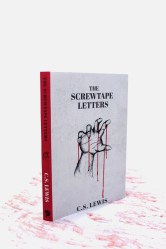
On a website for creative artists, a fan of C.S. Lewis’ works recently experimented with creating innovative covers for three of Lewis’ most popular books.

Will Jacott explains,

screwtape cover.jpg I wanted to convey an accurate image of the book, while also allowing for some ambiguity so the reader could project their own meaning onto the cover. C.S. Lewis books are traditionally marketed toward Christian audiences, and often have light-hearted covers. . . . I wanted the books to appeal to a non-Christian audience, and I wanted the books to have a gritty and more emotional feeling, while also alluding to the extraordinary qualities inside the book.

I believe Will succeeded in his goals . . . and also made the covers simpler and more striking than many of the cluttered covers that adorn my shelf.

C.S. Lewis’ Thoughts on Book Covers

In 1915, Lewis wrote to his closest friend, Arthur Greeves, about hoping to get a library-worthy copy of The Faerie Queene by Edmund Spenser.* Unfortunately, he found the most suitable edition unappealing. “The pictures are tolerable but the print, if I remember, rather coarse (you know what I mean) and the cover detestable.”

In 1936, Lewis was writing to a friend in which he recommends the books of Charles Williams. After commending Williams’ skill in portraying virtuous characters, he adds, “the fact that Gollancz publishes them (in lurid covers) suggests that all this substantial edification—for it is nothing less—must be reaching the ordinary thriller-reader.” The comment makes me wonder what Lewis would have thought of some of the contemporary covers chosen for his own books.

Pauline Baynes was the illustrator with whom Lewis worked for The Chronicles of Narnia. In 1951 Lewis provided her with a sketch of the map of Narnia and its surroundings. The next week he wrote to her.

My idea was that the map should be more like a medieval map than an Ordnance Survey–mountains and castles drawn–perhaps winds blowing at the corners–and a few heraldic-looking ships, whales and dolphins in the sea. Aslan gazing at the moon would make an excellent cover design (to be repeated somewhere in the book; but do as you please about that.)

In a 1958 letter to Jocelyn Gibb, Lewis discusses his changes to the editing proofs of Reflections. His remarks about the cover of the book are interesting, particularly as they reveal his distaste for handwriting fonts, at least in that context.

About the Dust Cover, I like the colour scheme and wouldn’t object. If you have it, I should go for the best design, and archaeology be damned. But I don’t like the letters. We have very nice plain Roman Capitals now . . . and I think it a bad fashion to substitute printed mimicry of ugly handwriting. I wish all publishers would stop it.

Even if the handwriting were a beautiful script, which this is not, the whole idea that decoration consists in making everything masquerade as something else, is surely wrong. Do you like smoking-rooms on ships made up to look like Scotch baronial halls?

There is no better way to end this column than by quoting C.S. Lewis’ glorious description at the finale of The Chronicles of Narnia. As the stories end, the children are ushered into heaven by Aslan who, as he spoke, “no longer looked to them like a lion; but the things that began to happen after that were so great and beautiful that I cannot write them.”

All their life in this world and all their adventures had only been the cover and the title page: now at last they were beginning Chapter One of the Great Story which no one on earth has read: which goes on for ever: in which every chapter is better than the one before (The Last Battle).

__________________

* Lewis would have loved to own this critical edition of The Fairie Queene, which would not be published until seventeen years after he wrote this letter. And, today, you can download volume one for free!


Dangers of Our Modern Age

csl dragon.png

In 1957, C.S. Lewis wrote an encouraging letter to a young author whose first book had been written at the age of fourteen. Jane Gaskell’s Strange Evil was described by the Times Literary Supplement as “a fantasy of macabre and gorgeous nonsense.” The review even alluded to Lewis himself in its description of the novel.

Judith, who poses nude for a living, is carried off to a C.S. Lewis-ish land where a monster called Baby conducts his reign of terror and where one extravagantly gory battle follows another.

Miss Gaskell is eloquently fascinated by words, the longer and more lush the better, and her book reveals an undoubted talent for fanciful description.

Gaskell went on to become a journalist. She also authored several more novels, and ultimately became a professional astrologer.

But, returning to the young girl and her first publication . . . Lewis considered the young girl worthy of encouragement.

My wife and I have just been reading your book and I want to tell you that I think it a quite amazing achievement–incomparably beyond anything I could have done at that age. The story runs, on the whole, very well and there is some real imagination in it.

The idea of the gigantic spoiled brat (had you a horrid baby brother once?) is really excellent: perhaps even profound. Unlike most modern fantasies your book also has a firm core of civilised ethics. On all these grounds, hearty congratulations.

Lewis does, however, offer a suggestion for how the book may have been improved. “I hope you will not think it impertinent if I mention (this is only one man’s opinion of course) some mistakes you can avoid in future.”

In a fantasy every precaution must be taken never to break the spell, to do nothing which will wake the reader and bring him back with a bump to the common earth. But this is what you sometimes do.

The moving bar on which they travel is a dull invention at best, because we can’t help conceiving it as mechanical. But when you add upholstered seats, lavatories, and restaurants, I can’t go on believing in faerie for a moment. It has all turned into commonplace technological luxury!

This concept is noteworthy for writers—especially writers of fiction, for whom imagination is an indispensable ingredient. We must avoid elements that derail the story, as inappropriate technology can sometimes do.

Beware of the Temptation

I suspect most writers today experience technology as a more concrete threat to their vocation than the inopportune example Lewis was noting. It’s not that we include too many or too few mechanical or scientific references in our work. The problem is that we are so distracted by the wonders of the world in which we live, that we never get around to putting the pen to paper.

Some of us can lose ourselves in the internet or social media. One fascinating read leads to another and we wonder “where the time has gone.” Vast programming “on demand,” is ready at a moment’s notice to occupy (or, sometimes, numb) our minds. And even when we do sit down at the keyboard, emails and messages interrupt our concentration.*

Technology, of course, is not only dangerous to writers. It can distract any of us from what is most important in life. How many hours have we squandered when we could have spent our time with family or friends? Why do we prefer to anesthetize ourselves with digital opiates, rather than helping a neighbor?

Not long ago, Christianity Today conducted an interview with Richard Foster. Foster’s 1978 book, A Celebration of Discipline, has been extremely influential in calling believers to lives of deeper simplicity and prayer. In their article they mentioned a revision in the preface that speaks powerfully to me.

Oh, for the day when all we had to do was turn off the television if we wanted solitude and silence! . . . we are bombarded by the broad distractions of constant noise, constant demands, constant news. Everyone, it seems, wants us to be accessible 24/7 and to respond instantly to any and every request.

Neuroscience studies are now showing us that the neural pathways of our brains are being rewired accordingly, so that our physical capacity for sustained attention is decreasing.

We, of course, complain endlessly about our wired world. But—let’s be honest—we do enjoy our technological gluttony. There is, however, a better way to live.

I’m going to close this post with a personal prayer. Feel free to join me in it, if you desire.

Gracious Father, forgive me my trespasses, and deliver me from the sin of technological gluttony to which I so often surrender. Draw me away from the table of excess, and lead me on that better path . . . the way that leads to life, and to you. Amen.


* Many of these distractions can be significantly decreased by setting your software to provide fewer “notifications” when various things occur. For example, I recently had to reset my iTunes because the program was throwing up a message every time a new song began.

When I am listening to the soundtrack of The Lord of the Rings, I don’t care to be told that “The Foot of Orthanc” is coming up as the strains of “The Road to Isengard” are fading away.

C.S. Lewis & Humanity’s Tragic Flaw

achilles

If you don’t know the meaning of “hamartia,” you’re not alone. But it’s a very important word, for more than one reason, so read on.

Hamartia describes a feature many writers of fiction or drama instill in their most memorable characters. It simply means “tragic flaw.” The deep character defect which cannot be overcome by sincere intention or persistent effort.

Merriam-Webster describes it this way.

Aristotle introduced the term in the Poetics to describe the error of judgment which ultimately brings about the tragic hero’s downfall. As you can imagine, the word is most often found in literary criticism.

However, news writers occasionally employ the word when discussing the unexplainable misfortune or missteps of übercelebrities regarded as immortal gods and goddesses before being felled by their own shortcomings.

Despite being a thespian in high school, I never formally studied drama. So I didn’t encounter the word there.

Likewise, I have written consistently since earning a Journalism degree four decades ago. However, since I have a 37:1 nonfiction to fiction ratio, I did not know this Greek word had found its way into the English lexicon.

I was surprised to discover its English meaning in my usually-familiar word of the day email (from The Free Dictionary).

While I was unfamiliar with its English usage, I already knew the word. I originally met hamartia (ἁμαρτία) while studying the New Testament in Greek. Hamartia literally refers to “missing the mark,” and it is the primary biblical Greek word for sin.

The first usage of the word in the sense of being an inner quality, occurs in Aristotle’s Poetics.  Aristotle writing as a pre-Christian philosopher, naturally perceived the literary device in a pagan manner.

The Greek word hamartia translates pretty directly as “error” or “shortcoming” without any necessary overtones of guilt or moral failure. Our modern conception of tragedy and the “tragic flaw” of the hero usually involves the concept of hubris, or overweening pride, that leads to disaster.

Macbeth, for instance, has the arrogance to think he can overstep the laws of God and state, and ultimately pays dearly for this arrogance. Macbeth is a tragic hero with a clear tragic flaw: his downfall results from a moral failing and can be seen as divine retribution proportional to his guilt. But Macbeth also contains heavy Christian overtones that would of course be found nowhere in Greek tragedy.

An understanding of Aristotle’s concept of hamartia—and indeed an understanding of Greek tragedy in general—relies on an understanding of the ethics and cosmology of the ancient Greeks. . . . Greek ethics are based more on the notion of virtue than obligation.

What of the Consequences?

In a 2014 article entitled “C.S. Lewis: The Anti-Platonic Platonist,” Grace Tiffany skillfully explores the Platonic echoes in Lewis’ writings. In discussing his literary examples of human failings, she writes:

There are of course Biblical models justifying Lewis’ “negatively capable” presentations of misguided characters . . . An older philosophical source, if not a Platonic one, also justifies mimetic representations of evil by the argument that these are morally purgative.

Imitations of hamartia, or tragic error, produce “fear and pity” (Aristotle, Poetics 1453b)—compassion for the character elicited by a skilled simulation of his psychology, naturally accompanied by a healthy fear of ourselves making similar mistakes. What ensures the fear is, of course, the dramatization of the horrible end to which hamartia has led . . . (Christianity and Literature 63.3).

In 1953, C.S. Lewis wrote to a correspondent that sin was more than merely making a mistake. In doing so, he alludes to the change in the meaning of the word ἁμαρτία.

No. I don’t think sin is completely accounted for by faulty reasoning nor that it can be completely cured by re-education. That view has, indeed, been put forward: by Socrates and, in the early 19th Century, by Godwin.

But I think it overlooked the (to me) obviously central fact that our will is not necessarily determined by our reason. If it were, then, as you say, what are called ‘sins’ would not be sins at all but only mistakes, and would require not repentances but merely correction.

Returning to the literary or dramatic definition of hamartia as a tragic flaw, it seems to me that this term offers a fitting parallel to the word sin.

Ever since humanity’s fall, we suffer the curse of bearing original sin, a tragic flaw. It is a scar that no medical or psychological treatment can cure and no amount of determination can repair. This tragic flaw will be our doom. Unless, that is, there is One who is capable and desirous of restoring us to our original health and purity. One, perhaps, in whose own image you and I were created . . .

This wonder is something well worth pondering—and perhaps one day, writing about.

C.S. Lewis & Animal Authors

dog author

Wouldn’t it be amazing to read about the adventures, struggles, triumphs, thoughts, and dreams of real animals? C.S. Lewis thought so.

Admittedly, referring to the thoughts and dreams of a squirrel or a hummingbird is a bit fanciful. But isn’t it feasible to imagine that a pregnant doe is hoping to find a lush meadow, or that a beaver who’s just finished a fine meal is gratefully contented as he snuggles down for the night in his lodge?

In one of his thought-provoking books—which I enthusiastically recommend to everyone who likes to read—Lewis describes exactly how reading is vital to expanding our world. “Those of us who have been true readers all our life seldom fully realise the enormous extension of our being which we owe to authors” (An Experiment in Criticism).

In this volume, Lewis argues that books are better measured by how they are read,  than by how they are written. In other words, Lewis is making the case that the true value of a book is not determined by the skill the author applied to its creation. Instead, Lewis writes, “so far as I can see . . . the specific value or good of literature [is that] it admits us to experiences other than our own.”

Lewis continues, with a fascinating discussion of his “experiment,” which flips traditional literary criticism on its head. Don’t rush through the following excerpt from the argument. It’s well worth taking your time to ponder his words and see if you agree.

[The experiences of others] are not, any more than our personal experiences, all equally worth having. Some, as we say, ‘interest’ us more than others. The causes of this interest are naturally extremely various and differ from one man to another; it may be the typical (and we say ‘How true!’) or the abnormal (and we say ‘How strange !’); it may be the beautiful, the terrible, the awe-inspiring, the exhilarating, the pathetic , the comic, or the merely piquant. Literature gives the entrée to them all.

Those of us who have been true readers all our life seldom fully realise the enormous extension of our being which we owe to authors. We realise it best when we talk with an unliterary friend. He may be full of goodness and good sense but he inhabits a tiny world. In it, we should be suffocated. The man who is contented to be only himself, and therefore less a self, is in prison.

My own eyes are not enough for me, I will see through those of others. Reality, even seen through the eyes of many, is not enough. I will see what others have invented. Even the eyes of all humanity are not enough.

At this point we arrive at the utterly Lewisian notion that even animals (e.g. uncivilized “brutes”) would be capable of broadening the horizons of our own thinking.

I regret that the brutes cannot write books. Very gladly would I learn what face things present to a mouse or a bee; more gladly still would I perceive the olfactory world charged with all the information and emotion it carries for a dog.

Literary experience heals the wound, without undermining the privilege, of individuality. There are mass emotions which heal the wound; but they destroy the privilege. In them our separate selves are pooled and we sink back into sub-individuality.

But in reading great literature I become a thousand men and yet remain myself. Like the night sky in the Greek poem, I see with a myriad eyes, but it is still I who see. Here, as in worship, in love, in moral action, and in knowing, I transcend myself; and am never more myself than when I do” (An Experiment in Criticism).

On the Subject of Reading & Rereading

If you need any more encouragement to seek out a copy of this wonderful book, allow me to share with you two profound points Lewis makes in support of his distinction between “literary” and “unliterary” people. (Lewis, of course, does not demean the latter. On the contrary, he grieves for the “tiny world” they choose to inhabit.)

The majority [of unliterary people], though they are sometimes frequent readers, do not set much store by reading. They turn to it as a last resource. They abandon it with alacrity as soon as any alternative pastime turns up. It is kept for railway journeys, illnesses, odd moments of enforced solitude, or for the process called ‘reading oneself to sleep.’

They sometimes combine it with desultory conversation; often, with listening to the radio. But literary people are always looking for leisure and silence in which to read and do so with their whole attention (An Experiment in Criticism).

In terms of rereading, Lewis was a fervent advocate of reading good books more than once. Most of us would say lack of time is the greatest deterrent to rereading classics, but most of us do have some favorites that we have returned to more than once.

The majority never read anything twice. The sure mark of an unliterary man is that he considers ‘I’ve read it already’ to be a conclusive argument against reading a work. We have all known women who remembered a novel so dimly that they had to stand for half an hour in the library skimming through it before they were certain they had once read it.

But the moment they became certain, they rejected it immediately. It was for them dead, like a burnt-out match, an old railway ticket, or yesterday’s paper; they had already used it (An Experiment in Criticism).

In contrast, Lewis describes how “those who read great works, on the other hand, will read the same work ten, twenty or thirty times during the course of their life.” Many of us would initially think our rereading frequency falls short of those specific tallies, perhaps we should reconsider. After all, most readers of Mere Inkling reread with great frequency portions of a particular library of sixty-six books,* gathered together in a book called the Bible.


* More books in the Roman Catholic and Eastern Orthodox collection of the Scriptures, which include seven Deuterocanonical books. Fewer, of course, for our Jewish friends who follow the teachings of twenty-four books, which are also included in the Christian Bible.

Consider Planting a Tree

treebeard & groot

Not only do trees cleanse the air we breathe, there’s more evidence they contribute to our mental health as well.

An article entitled “Greener Childhood Associated with Happier Adulthood,” describes research from Denmark’s Aarhus University discovering that “growing up near vegetations is associated with an up to 55 percent lower risk of mental health disorders in adulthood.” An American researcher commented on the findings.

“The scale of this study is quite something,” says Kelly Lambert, a neuroscientist at the University of Richmond who studies the psychological effects of natural spaces. Smaller studies have hinted that lack of green space increases the risk of mood disorders and schizophrenia and can even affect cognitive development.

In a rapidly urbanizing world, this data is particularly troubling. Most of us must live “where the work is,” and our children sometimes grow up in places where trees are few and far between (and I wouldn’t really count Joshua “trees” which are Monocotyledons, and not true trees).*

This research confirms my own, personal experience. I have always found lush greenery energizing. I used to attribute this association with family—while growing up in a USMC family, we would try to make an annual trip “home” to Puget Sound. The nearer we got to my grandparents, the greener the Puget Sound terrain grew.

In my affection for trees, I am akin to the Inklings. Much has been written about J.R.R. Tolkien’s description of the forests of Middle Earth. The terrible damage to the Fangorn forest done by the army of Saruman is one of the tragedies of The Lord of the Rings.

C.S. Lewis and his friends enjoyed walking trips. Much of the countryside they covered in these treks was adorned by healthy copses, but they do not appear to have ventured into any deep forests.

In a 1953 letter to a correspondent who was attempting to lure Lewis to visit America, he paints a clear picture of what he finds alluring.

How wrong you are when you think that streamlined planes and trains would attract me to America. What I want to see there is yourself and 3 or 4 other good friends, after New England, the Rip Van Winkle Mts., Nantucket, the Huckleberry Finn country, the Rockies, Yellowstone Park, and a sub-Arctic winter.

And I should never come if I couldn’t manage to come by sea instead of air: preferably on a cargo boat that took weeks on the voyage.

I’m a rustic animal and a maritime animal: no good at great cities, big hotels, or all that. But this is becoming egotistical. And here comes my first pupil of the morning.

All blessings, and love to all. Yours, C.S. Lewis

I’d love to see a bear, a snow-shoe, and a real forest.

Lewis wrote a fascinating poem about the spiritual price of deforestation.

The Future of Forestry

How will the legend of the age of trees
Feel, when the last tree falls in England?

When the concrete spreads and the town conquers
The country’s heart; when contraceptive
Tarmac’s laid where farm has faded,
Tramline flows where slept a hamlet,
And shop-fronts, blazing without a stop from
Dover to [Cape] Wrath, have glazed us over?

Simplest tales will then bewilder
The questioning children, “What was a chestnut?
Say what it means to climb a Beanstalk,
Tell me, grandfather, what an elm is.
What was Autumn? They never taught us.”

Then, told by teachers how once from mould
Came growing creatures of lower nature
Able to live and die, though neither
Beast nor man, and around them wreathing
Excellent clothing, breathing sunlight –
Half understanding, their ill-acquainted
Fancy will tint their wonder-paintings
Trees as men walking, wood-romances
Of goblins stalking in silky green,
Of milk-sheen froth upon the lace of hawthorn’s
Collar, pallor in the face of birchgirl.

So shall a homeless time, though dimly
Catch from afar (for soul is watchfull)
A sight of tree-delighted Eden.

Plant a Tree

In “The Arbor of God,” the physician who founded Blessed Earth poses a thoughtful question: “Trees are everywhere in Scripture. Why have they gone missing from Christian theology?”

I’ve always loved trees. I love their look, their shade, the sound of wind in their leaves, and the taste of every fruit they produce. As a grade-schooler, I first planted trees with my father and grandfather. I’ve been planning them ever since. . . .

But a dozen years ago, when I offered to plant trees at our church, one of the pastors told me I had the theology of a tree-hugger.

This was not meant as a compliment.

There is a possibly apocryphal statement credited to Martin Luther during the Reformation. In a spirit of faith and commendable actions for Christians, Luther said, “If I knew the world was to end tomorrow, I would still plant an apple tree today.”

As I gaze out the window now, at the four blossoming apple trees we planted just three years ago, I’m inspired to plant some more trees. This year, I think, it will be some bushes and plants that provide year-round nectar for the hummingbirds that grace our woodlands. Even the anticipation of planting them brings me joy.


* Joshua trees, such as those which surrounded our home at Edwards AFB, are actually “flowering plants.” As such, they do have green growth and even fruit. So, in a generous spirit, I’ll credit them with 50% of the positive effect on mental health that a maple or fir might offer.

Teaching English in China

CSL China

If C.S. Lewis had desired to teach English in China he would probably have succeeded. However, due to some rather peculiar requirements, he may not have passed muster.

In that Asian nation, you need four years of college to become a teacher. At 山西师范大学 (Shaanxi Normal University) they include another odd requirement. Shaanxi has a minimal height standard. Men must be at least 5-foot-1 and women must be no shorter than 4-foot-7.

C.S. Lewis would have passed this mandate; he was just shy of 5-foot-11. But who knows what other arbitrary dictates may have barred him from sharing his brilliant mind.

The university’s policy came to international attention when the plight of a young student who completed her studies only to be informed that she was four inches too short to receive her diploma. As the BBC reports, there is a waiver for those who wish to teach the very young.

Those wanting to teach at nursery are able to apply for special accreditation if they are five centimetres shorter.

The school’s, albeit flimsy, rationale is that teachers may need to reach high on blackboards when they are teaching their students. (So much for using modern technology to compensate.)*

It would be bad enough if they failed to admit such candidates to their program, but obviously some are not informed of the standard until they have completed their university studies. One can hardly imagine how that unfortunate graduate felt.

C.S. Lewis spent his academic life at Oxford and Cambridge. Although he lectured in a variety of venues, no international university was blessed to have him serve as a visiting scholar.

Fortunately, however, his words reached far beyond the campuses of Oxbridge. And, even though Lewis never taught in China (or in Chinese), his words are available today via translation. At Wheaton College, the Marion E. Wade Center preserves a great deal of information about the Inklings, including some original material.

The Wade’s translation collection has a diverse amount of languages represented, even if only by one book. The languages at the Wade include: Afrikaans, Albanian, Arabic, Bulgarian, Catalan, Chinese, Croatian, Czech,  Danish, Dutch, Esperanto, Estonian, Faroese, Finnish, French, Gaelic, German, Greek, Hebrew, Hungarian, Indonesian, Italian, Japanese, Korean, Latin, Latvian, Lithuanian, Norwegian, Polish, Portuguese, Romanian, Russian, Serbian, Slovak, Slovenian, Spanish, Swedish, Thai, Turkish, Ukrainian, and Welsh.

A Two-Way Street

Those of us who have taught realize better than others that teachers often learn as much from their students as they offer to them. Preparing to teach demands that we study to know the subject matter as intimately as we can, so we might convey it effectively to others.

Although he was a brilliant teacher, C.S. Lewis was also a diligent lifelong learner.

Lewis held great respect for Chinese civilization. He was interested in the Chinese philosophical concept of the Tao. I’ve written about his thoughts on this subject before.

Lewis viewed the Tao as being similar to what Christian theologians traditionally refer to as Natural Law.

The Tao, which others may call Natural Law or Traditional Morality or the First Principles of Practical Reason or the First Platitudes, is not one among a series of possible systems of value. It is the sole source of all value judgments.

If it is rejected, all value is rejected. If any value is retained, it is retained. The effort to refute it and raise a new system of value in its place is self-contradictory. There has never been, and never will be, a radically new judgment of value in the history of the world.

What purport to be new systems or . . . ideologies . . . all consist of fragments from the Tao itself, arbitrarily wrenched from their context in the whole and then swollen to madness in their isolation, yet still owing to the Tao and to it alone such validity as they possess. (The Abolition of Man)

Lewis was an advocate of what some refer to as Classical Education. It involves loftier goals than simply communicating data. In his essay “Our English Syllabus,” Lewis “propagated education’s end, rather than as the filling of students’ heads with information or their muscles with habits, as the inculcation of virtue.”

Lewis treasured the essence of knowledge rather than its trappings. He was patient with those genuinely hungry for knowledge. But you could also readily apply to him the maxim that he did not suffer fools gladly.

It does not take a genius to discern what C.S. Lewis would have thought about this Chinese height requirement. To prevent a motivated and capable educator from pursuing her vocation simply because she may lack the reach of someone taller, does not pass the test of common sense.


* “The first interactive whiteboard was released in 1991,” and I assume The People’s Republic “magically” secured that very technology no later than 1992.


Return with Me to Middle Earth

tolkien.pngJ.R.R. Tolkien’s tales of Middle Earth will once more be displayed in all of their digital radiance when a new series begins in two years. Yes, I said “series,” because it will not be coming to theaters. Instead it will be developed for subscribers to Amazon’s subscription service.
Some fans of Tolkien are understandably wary. Will it remain faithful to Tolkien’s vision (insofar as any heathen international corporation can understand it)? However, I’m inclined to feel optimistic.

One reason for my optimism is Amazon’s commitment to the quality of the production—they anticipate investing around one billion dollars in the property during the next five years. Beyond that, I suspect Amazon will protect this massive investment by not straying too far afield from the true spirit of Middle Earth.

The Hollywood Reporter states it’s up to Peter Jackson* whether or not he will be involved in the project. His attorney said Amazon was wise to bid high for this “property.”

We are in an era where [online] streamers are bidding up the price of programming. I think Amazon is taking a page out of the studios’ emphasis on franchises. They also are realizing that with the overproduction of television, you need to get the eyeballs to the screen, and you can do that with franchise titles.

Another technology news site points to the example of Game of Thrones upping the value of the Lord of the Rings project.

In a world where Disney has laid out impressive, interconnected franchises with its Marvel and Star Wars properties, and HBO is considering anywhere between three and five spinoffs for Game of Thrones, Middle-earth could be a property that gives Amazon a significant boost in the coming streaming wars, one that could entice even more people to sign up for Amazon’s Prime service.

This is wonderfully ironic, since G.R.R. Martin readily acknowledges his debt to Tolkien. In a solid article on this subject, “Is George R.R. Martin the ‘American Tolkien?’” the author identifies a significant difference between the two writers.

Tolkien’s creation displays a sense of depth yet unrivaled in the fantasy genre. In this way, Lord of the Rings is to Game of Thrones as the Atlantic Ocean is to Lake Michigan. In contrast to the invention of Martin’s world, which is secondary to his plotline, Tolkien built his reality from the ground up starting with languages.

The Rotten Tomatoes media review site offers some tantalizing details about what we can anticipate in the new series.

Amazon’s first map rendered a number of geographic features specific to the Third Age, including the East Bight of Mirkwood Forest . . . But fans who were hoping to see some of the great stories from earlier days dramatized with Amazon’s production values are in luck.

Stories like the sinking of Númenor—Tolkien’s take on the Atlantis myth, in which Sauron corrupted an island of seafaring men to invade the forbidden shores of the world’s far West—and the founding of the kingdoms of Arnor and Gondor could make for some spectacular television. . . .

So what does this mean? For one, the series will undoubtedly focus on Númenor** over other regions of Middle-earth. To understand the island’s significance, we need to go back to the end of the First Age and the downfall of the Dark Lord Morgoth.***

Wow.

This is going to be great. And to think, we owe it all to C.S. Lewis!


* Peter Jackson, of course, is the director who brought The Hobbit and The Lord of the Rings to the big screen.

** Númenor was the great island kingdom of humankind.

*** Morgoth is the greatest of the Ainur (angels in the Middle Earth cosmology). He fell from grace when he resisted the will of the Creator. He was an even greater Evil than his servant Sauron, who plagues the world in the Lord of the Rings trilogy.

The reference to Westeros in the illustration above is to the island in the Game of Thrones ruled by the Seven Kingdoms.

C.S. Lewis & the Inklings Seated at the Round Table

arthur.png

This book belongs in the library of every fan of the Inklings and each devotee of King Arthur. The truth is that anyone interested in British literature or the Dark Ages will find much that appeals to their curiosity. King Arthur is known around the world as an archetypal hero, and he was a central fixture in the minds of the Inklings.

The Inklings & King Arthur (TIKA) is impressive in every way. However, it’s 555 rich pages should not intimidate potential readers. Editor Sørina Higgins masterfully gathered diverse insights from a score of scholars, and the individual chapters can be approached in any manner the reader desires. Even if a few of the chapter titles fail to resonate with a particular reader, the solid value of the remainder far exceed the price of the work.

Mere Inkling seldom offers reviews of books, despite the “libraries” of new Inkling literature published every year. The Inklings & King Arthur is the exception, for two reasons.*

TIKA does not require a familiarity with its subject. The academic background of the contributors allows them to usher readers into rewarding discussions without additional research. C.S. Lewis described “the task of the modern educator [as] not to cut down jungles, but to irrigate deserts.” The writers in this volume have written so clearly that even if your knowledge of King Arthur is the Mojave, and your familiarity with the Inklings is the Sahara, you will enjoy reading this book.

Truth be told, much has been written about King Arthur. Likewise, films have explored the myths, with varying degrees of faithfulness. Some make no effort at all to be faithful to the inspiring story. An extreme example would be the ludicrous storyline of the 2017 film, Transformers: The Last Knight. In striking contrast to this, the Inklings sought to penetrate the mists of time and discern the reasons Arthur’s story has inspired men and women for so many generations.

In the book’s introduction, Higgins says her hope was “to fill a sizeable hole in the field of Inkling studies” (2). She surely achieved this task. She also says “the present collection endeavors to usher the field of Inklings studies into more rigorous theoretical territory” (3). This goal, the contributors have surpassed.

Proceeding to some specific comments, my first would be to point out the accuracy of the volume’s title. It is an exploration of “the Inklings,” rather than simply Lewis and/or Tolkien. The fact that less well-known members of the literary group wrote the most Arthuriana means their works are particularly well represented in the current collection.

This fact might discourage a potential reader who is disinterested in the lesser known authors. However, the truth is, exposure to work of these friends and influencers of the two über-Inklings helps us better understand them and the confluences that flowed together in that unique literary fellowship.

Most articles consider the Inklings as group in relationship to a theme. For example, Christopher Gaertner discusses, “Shape and Direction: Human Consciousness in the Inklings’ Mythological Geographies.” The author identifies their differing viewpoints and how they influenced one another. Despite “their shared resistance to a scientistic worldview” (150), Tolkien, Lewis and Owen Barfield did not share identical understandings of how the world should be perceived.

Beyond the Eagle & Child

One pleasant surprise is the inclusion of an essay on G.K. Chesterton (1874-1936). Chesterton’s The Everlasting Man contributed to the conversion of C.S. Lewis.

In his TIKA essay “All Men Live by Tales,” J. Cameron Moore reveals how Chesterton’s poetry about Arthur is rooted in England. Arthur was important enough for Chesterton to return several times to the story of this hero who is “Mythic, Roman, and Christian (205). You can download a free copy of The Ballad of St. Barbara which includes “The Myth of Arthur” here. You can read “The Grave of Arthur” at this site.

Benjamin Shogren explores the significance of the addition of two new names—Pendragon and Fisher-king” to the protagonist of C.S. Lewis’ space trilogy. Elwin Ransom “represents Arthur by . . . evoking the primary imagery associated with the role of Arthur” (399). Ransom is now imbued with a mythological aura of royal leadership and courageous chivalry.

This volume overflows with richness. In “On Fairy Stories,” J.R.R. Tolkien describes the dense blend of mythologies present in the story of Arthur, using the image of a pot of soup with various ingredients added over time.

It seems fairly plain that Arthur, once historical (but perhaps as such not of great importance), was also put into the Pot. There he was boiled for a long time, together with many other older figures and devices, of mythology and Faerie, and even some other stray bones of history (such as Alfred’s defence against the Danes), until he emerged as a King of Faerie.

The situation is similar in the great Northern “Arthurian” court of the Shield-Kings of Denmark, the Scyldingas of ancient English tradition. King Hrothgar and his family have many manifest marks of true history, far more than Arthur; yet even in the older (English) accounts of them they are associated with many figures and events of fairy-story: they have been in the Pot.

The soup or stew pot may also serve as a fitting metaphor for The Inklings & King Arthur. This exceptional volume offers a potent mix of wisdom and insights that go beyond the boundaries of its title. Readers will be rewarded, in fact, with many satisfying literary meals.


* The first reason is that the academic weight of the work merits the undertaking. The second is because I have received a review copy, which obligates me in a sense, to providing a review—not a positive review, of course, but an honest assessment of its value, from my personal perspective.

Honest reviewers, of course, are mandated to acknowledge the fact that they received a particular volume gratis. This is done to protect one’s integrity. At the same time, a writer’s honor is also protected by their pledge to provide an honest evaluation of each work, for good or ill. This is what you will discover here.

The volume’s editor, Sørina Higgins, gathered an impressive group of Inkling scholars to contribute. She is a poet who is Chair of Language and Literature at Signum University.

It would be challenging to find any flaw in this amazing volume. Its sole weakness, in this reviewer’s opinion, is that it is so detailed and thorough, that it transcends the reading skills (or perhaps, “tastes”) of some of today’s readers. Despite that, the authors have gone to significant effort to write clearly and make their extremely detailed subject matter accessible to all.