Corrupted Poetry

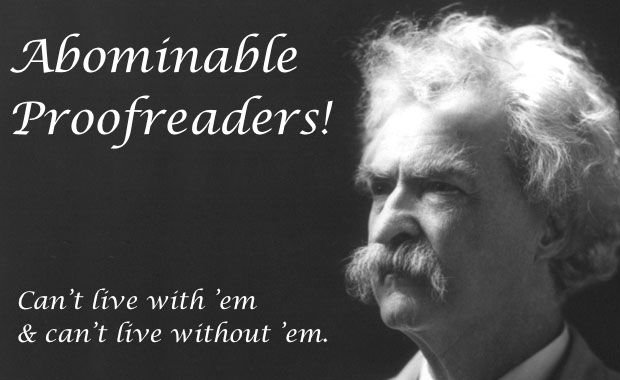
proofreadersA sloppy proofreader can ruin the most praiseworthy writing. (Just ask Mark Twain.)

If you’ve ever seen something you wrote poorly edited—or including introduced errors—you know personally just how criminal this is.

My choice of adjectives reveals that these tragedies are nearly always mistakes, and not malevolent. Despite that fact, they disrupt the flow and impugn the skill of truly good writers.

I was thinking about this subject today after running across the following passage during my research of the American Civil War. An 1861 newspaper lifted the following from an issue of the Boston Courier.

The Errors of the Press—“Really,” said a printer, in conversing with a literary man about errors of the press, “gentlemen should not place such unlimited confidence in the eyesight of our hard worked and half-blinded reader of proofs; for I am ashamed to say that we utterly ruined one poet through a ludicrous misprint.”

“Indeed! and what was the unhappy line?”

“Why, sir, the poet intended to say:

     ‘See the pale martyr in a sheet of fire;’

instead of which we made him say:

     ‘See the pale martyr with his shirt on fire.’”

The critics were down fierce on the poet; but we don’t see why. A man “with his shirt on fire” must be a highly poetical object, as his life would be in imminent danger.—Boston Courier.

I can easily picture the exhausted proofreader unintentionally substituting a burning garment for a consuming inferno. It made sense to him. And, since he was unlikely to have an ear tuned to poetic imagery, the practical reference to ignited clothing must be what the poet actually meant.

This reminds me that it’s impossible to have too many eyes cast upon the final draft of a work before it goes to print. Take care of your friends and family who offer you the gift of proofreading; their talents deserve to be appreciated and rewarded.

Mark Twain’s Thoughts on the Subject

Samuel Clemens got his own start in the newspaper business and knew firsthand how challenging proofreading was. However, that did not prevent him from venting about the poor proofreading of his novel More Tramps Abroad.

The following was written to his publishers in regard to the printer’s shortcomings. The 1897 letter clearly reveals Twain’s colorful (and occasionally vulgar) writing.

I give it up. These printers pay no attention to my punctuation. Nine-tenths of the labor & vexation put upon me by [them] consists in annihilating their ignorant & purposeless punctuation & restoring my own.

This latest batch [also has] my punctuation ignored & their insanities substituted for it. I have read two pages of it—I can’t stand any more. If they will restore my punctuation themselves & then send the purified pages to me I will read it for errors of grammar & construction—that is enough to require of another who writes as legible a hand as I do, & who knows more about punctuation in two minutes than any damned bastard of a proof-reader can learn in two centuries.

Conceive of this tumble-bug interesting himself in my punctuation—which is none of his business & with which he has nothing to do—& then instead of correcting mis-spelling, which is in his degraded line, striking a mark under the word & silently confessing that he doesn’t know what the hell to do with it!

The following year he wrote a mellower review of the work of the proofreader. Not in the heat of correcting a muddled manuscript, he was able to comment on the benefits afforded by good proofreading.

You think you are reading proof, whereas you are merely reading your own mind; your statement of the thing is full of holes & vacancies but you don’t know it, because you are filling them from your mind as you go along.

Sometimes—but not often enough—the printer’s proof-reader saves you–& offends you—with this cold sign in the margin: (?) & you search the passage & find that the insulter is right—it doesn’t say what you thought it did: the gas-fixtures are there, but you didn’t light the jets.

I must say that I have been rescued by my proofreaders far more frequently than I have been abused by them. May God grant you the same blessing.

Deadly Jobs

bad newsIt’s bad enough not liking your job . . . but being allergic to your chosen profession? That’s absolutely miserable.

And that’s what happened to one American journalist. Despite the myriads of new avenues for journalism, newspaper writing remains a primary context for the skill.

I actually earned my first degree in journalism. Editorial Journalism, via the University of Washington’s School of Communication. But I was never cut out to be a member of the Fourth Estate. (Ironically, I ended up belonging to the First Estate, but that’s another story.)

Journalism is a vocation important to the wellbeing of society. Good journalists are vital to society’s health. Those who spew vitriol, not so much.

Apparently a reporter for a Baltimore newspaper recently discovered—after thirty-eight years in the business, that he’s allergic to newspapers. Not their content, their composition. Specifically, he is allergic to pine resin which is used to make newsprint ink.

I assume he’s making a “quality of life” transition now to digital news sources.

Journalism is a broader field than many realize. Our first thought usually turns to newspaper “reporters.” We have often considered them to be objective relaters of events. Of course, complete objectivity is something that is beyond human grasp. Everyone approaches the “news” with their own biases and a worldview that shapes their perception of “facts.”

C.S. Lewis has a fun essay which touches on this. It’s called “Private Bates.”

We must get rid of our arrogant assumption that it is the masses who can be led by the nose. As far as I can make out, the shoe is on the other foot. The only people who are really the dupes of their favourite newspapers are the intelligentsia. It is they who read leading articles: the poor read the sporting news, which is mostly true.

I recall some debates back in my college days when others attempted to persuade me that objectivity was not only possible, it was the standard practice of reporters. That myth has long been exposed, and I try to be content with those who strive to be as fair as they can.

In a 1955 letter, C.S. Lewis is even more blunt than in the previously cited essay. He tells one of his regular correspondents, “I never read the papers. Why does anyone? They’re nearly all lies, and one has to wade thru’ such reams of verbiage and ‘write up’ to find out even what they’re saying.”

One reason journalism receives so little respect today is because people confuse reporting with editorializing. Reporting, of course, is just the facts. (Admittedly, even these are subjectively perceived.) Editorializing, on the other hand, is offering one’s unbridled opinion.

For the latter to masquerade as the former is criminal. But to accept the fact that honestly offered “opinion” is just that, is fine.

After all, one reason you’ve taken the time to read this post is because you appreciate reading gems from C.S. Lewis . . . and you don’t mind wading through the “opinionated” verbiage of this humble columnist to find it.

C.S. Lewis’ Bilingualism

csl bilingualHow many extremely intelligent and well educated people do you know . . . who can actually communicate with those of us possessing normal human intelligence?

That talent is a rarity.

And it is precisely what makes C.S. Lewis such an unusual man. He was brilliant. Yet he could communicate with the common person—even the child—just as easily as he conversed with his fellow university dons.

Lewis, of course, could comprehend a number of languages, so he was more than merely “bilingual.” But that is not exactly the sense in which I am using the word today. I mean it in the sense of my opening paragraphs. It is the ability to communicate (even with the same “language”) to distinctly different groups who would normally not be able to readily understand one another.

In an interview that appeared in Christianity Today, Detroit pastor Christopher Brooks was asked about the challenges of urban ministry.

How have you included both righteousness and justice in your setting?

I think about C.S. Lewis, who had the challenge of building the bridge between the culture of Oxford and Cambridge and the culture of the church. These cultures were worlds apart by his time, but he was bilingual, in a sense: able to speak the language of Oxford to the church and the language of the church to the intellectuals and naturalists.

One of the titles for ancient Roman priests that was adopted by their Christian successors is “pontifex.” It means “bridge-maker.” The Pontifex Maximus was, of course, referred to the greatest of these offices.

In light of Brooks’ words about Lewis as building bridges between elite academia and Christianity, I have added that dimension to my view of him. C.S. Lewis, Pontifex Maximus. (I doubt it would make him happy, so I’ll keep it under wraps . . . and probably never mention it again.) But I am genuinely happy about his skill in building these bridges of understanding.

Before signing off, a special treat. If you call someone who speaks two languages “bilingual,” and someone who speaks three “trilingual,” what do you call someone who only speaks one language? Why, an American, of course.

That joke would not be as funny if it were not so sadly true. While the rest of the world almost assumes that people know at least two languages, most Americans stumble their way through the study of a second language for two or three years and never develop a comfort level with it. But that’s a story for another day.

Civilized Savages

civilization-and-savageryWhat are the proper criteria for determining who is civilized? If you asked a score of people, you would probably end up with twenty different opinions.

In continuing my research about America’s first woman chaplain, I encountered an early American teaching resource that offered great insight into education during the early nineteenth century.

Some of it was quaint—“goats were made as profitable to the farmer as sheep.”

Some of it was insightful—“In America the Grecian architecture is prevailing, as it is better adapted than the Gothic to small buildings, and does not require splendid edifices to display its beauty.”

The text, Peter Parley’s Universal History, on the Basis of Geography, was used in schools and homes.

After finding confirmation of the point I was researching, I couldn’t resist skimming through the volume. Out of its myriad lessons, the one that got me thinking most seriously was a discussion of relative levels of civilization.

At the end of each lesson, several questions are posed. In this case:

Questions: What would you observe in traveling through other countries? What of people in a savage state? What of people in the barbarous state? What of people in the civilized state? What of people in the highest state of civilization?

Preceding these questions is the lesson proper, from which I now quote passages that correspond to the questions just listed.

In some countries the people live in huts built of mud or sticks, and subsist by hunting with bow and arrow. These are said to be in the savage state . . .

In some countries the people live in houses partly of stone and mud. They have few books, no churches or meeting-houses, and worship idols. . . . These are said to be in the barbarous state . . .

In some countries the inhabitants live in tolerable houses, and the rich have fine palaces. The people have many ingenious arts, but the schools are poor, and but a small portion are taught to read and write. . . . which may be called a civilized state.

In many parts of Europe, and in the United States, the people live in good houses; they have good furniture, many books, good schools, churches, meeting-houses, steamboats and railroads. These are in the highest state of civilization.

It appears that Peter Parley (the pseudonym of Samuel Griswold Goodrich) considered two factors to be the clearest measures of civilization—the quality of a society’s domiciles, and the access to learning and increase in literacy.

These are not inappropriate measures, although the latter dwarfs the former in significance.

I realize these lessons are intended for elementary education, so I don’t fault Goodrich for failing to address the subject from a more philosophical or mature angle. Nevertheless, I could not help wondering whether the societies that have attained the “highest state of civilization” are truly the least barbaric.

In some ways, the societies that have attained the loftiest technological levels might also be considered among the most savage.

I don’t have the time or inclination to pursue this thought any further in Mere Inkling, but I offer it to you. Some readers will agree that it merits reflections and others will consider it absurd.

Before moving on the Inklings, though, I wish to share a pertinent bit of wisdom from economist Thomas Sowell. “Each new generation born is in effect an invasion of civilization by little barbarians, who must be civilized before it is too late.”

C.S. Lewis thought, and wrote, a great deal about civilization. In English Literature in the Sixteenth Century there is a delightful remark, made in passing, that it is possible to retreat from civilization, once attained.

From the varied excellence of the fourteenth century to the work of the early sixteenth it is a history of decay; so that in turning from the Scotch poetry of the age to the English we pass from civilization to barbarism.

I end with a longer citation from C.S. Lewis which connects uniquely with the mindset with which Goodrich penned his textbook. Lewis also affirms true education, and the advancement of humanity towards that for which it was created, as the genuine mark of civilization.

One of the most dangerous errors instilled into us by nineteenth-century progressive optimism is the idea that civilization is automatically bound to increase and spread. The lesson of history is the opposite; civilization is a rarity, attained with difficulty and easily lost. The normal state of humanity is barbarism, just as the normal surface of our planet is salt water. Land looms large in our imagination of the planet and civilization in our history books, only because sea and savagery are, to us, less interesting.

And if you press to know what I mean by civilization, I reply “Humanity,” by which I do not mean kindness so much as the realization of the human idea. Human life means to me the life of beings for whom the leisured activities of thought, art, literature, conversation are the end, and the preservation and propagation of life merely the means. That is why education seems to me so important: it actualizes that potentiality for leisure, if you like for amateurishness, which is man’s prerogative.

You have noticed, I hope, that man is the only amateur animal; all the others are professionals. They have no leisure and do not desire it. When the cow has finished eating she chews the cud; when she has finished chewing she sleeps; when she has finished sleeping she eats again. She is a machine for turning grass into calves and milk—in other words, for producing more cows. The lion cannot stop hunting, nor the beaver building dams, nor the bee making honey. When God made the beasts dumb He saved the world from infinite boredom, for if they could speak they would all of them, all day, talk nothing but shop. (“Our English Syllabus”).

_____

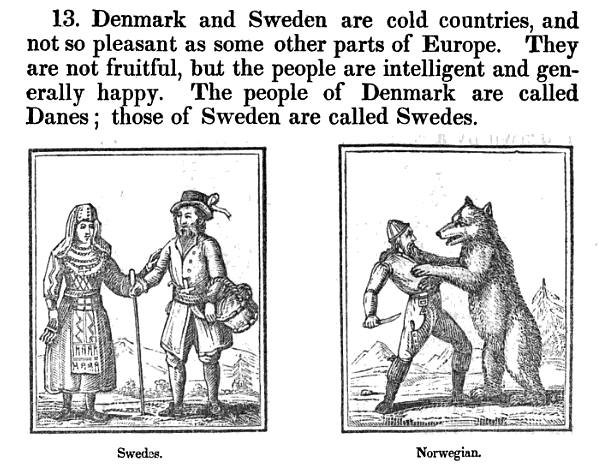
An illustration from the book, which taught generations of Americans that the heirs of the Vikings were still a picturesque and virile people.

scandinavians

Really Creative Writing

father christmasWhen did you first learn how to express yourself creatively? Some of us were blessed with parents who recognized the importance of things like music, art and literature. Others, alas, were not.

Most readers of Mere Inkling like to dabble in writing themselves. Many are quite skilled, and disciplined enough to persist with the demanding task of regularly composing interesting pieces for their own online columns. Some, in fact, are quite accomplished and successful in their personal literary efforts.

Becoming a good, truly good, writer requires experience. One may be born with the innate ability to become a Shakespeare or a Hemingway, but the skills need to be sharpened through effort. Study often helps, but it can never replace the necessity of practice in honing our writing.

It seems to me that the sooner we begin the process of unbridling our imaginations, translating our visions into words, and writing it all down in a way that engages the imaginings of others, the better we can become.

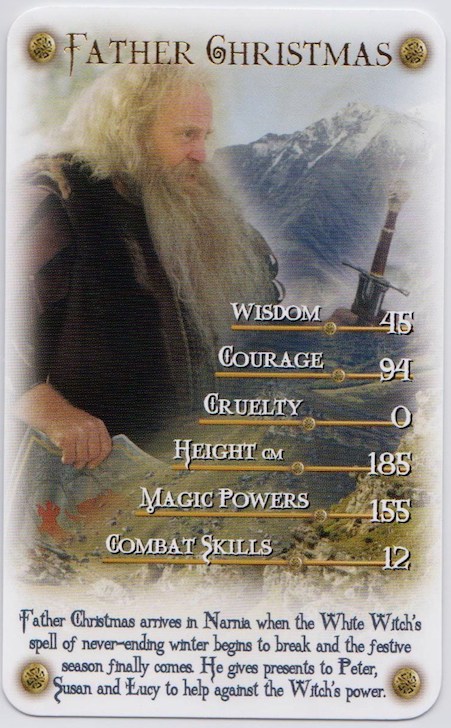
Many of you, especially Europeans, will be familiar with a gaming product that arose in the United Kingdom. They are called Top Trumps, and the cards come in a wide variety of themes. One set that I own is Narnia, from which the image at the top of this page comes.

Tolkien fans will be delighted to learn they just reissued a Lord of the Rings set that comes in an amazing Eye of Sauron tin. You can learn more about that unique item here.

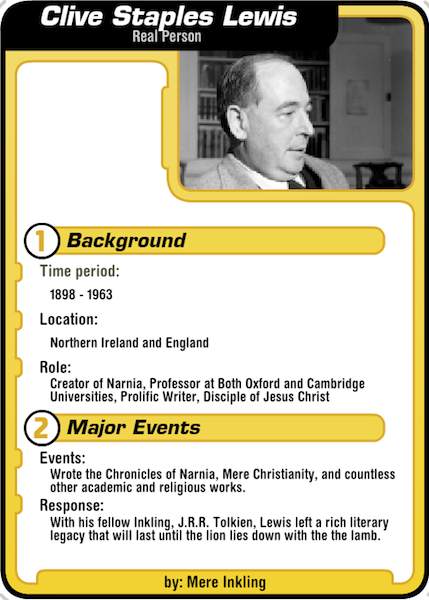
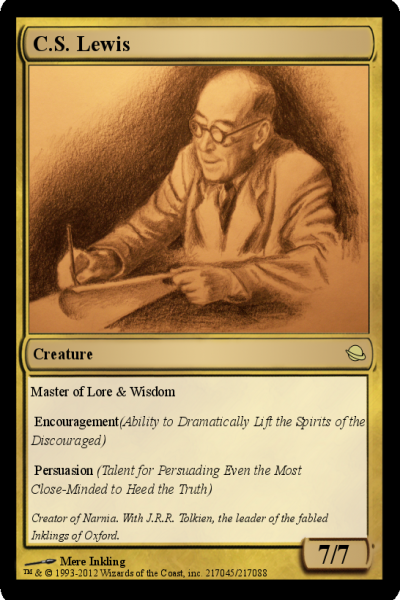
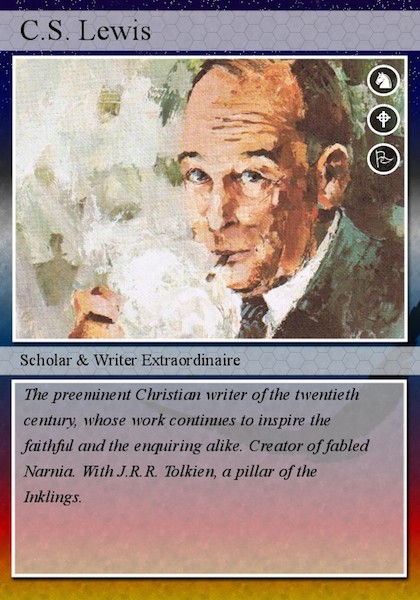
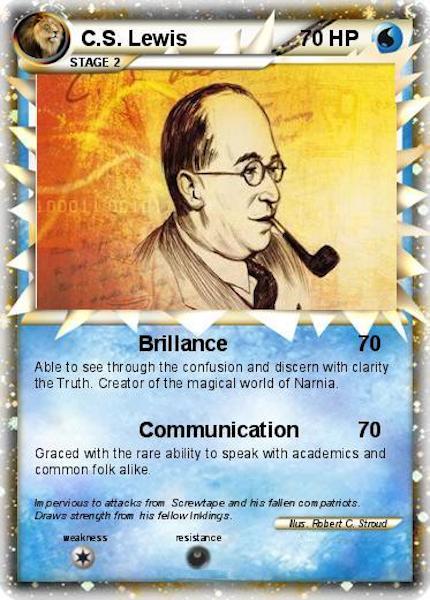
It was while thinking about my Narnia cards when I got the idea to see if there was an online mechanism for making one’s own playing cards. I was toying with the idea of fashioning a C.S. Lewis card to illustrate one of my posts.

I was actually searching online for a site where I could “create” such a card. I found several. Only later did I consider the irony of using that particular word.

For theologians, the word create bears profound significance. When it comes to the human activity of bringing together in some novel shape pre-existing images or ideas, it is not truly accurate. Lewis wrote about that in a 1943 letter to Sister Penelope.

‘Creation’ as applied to human authorship . . . seems to me an entirely misleading term. We . . . re-arrange elements He has provided. There is not a vestige of real creativity de novo in us. Try to imagine a new primary colour, a third sex, a fourth dimension, or even a monster which does not consist of bits of existing animals stuck together! Nothing happens.

And that surely is why our works (as you said) never mean to others quite what we intended: because we are re-combining elements made by Him and already containing His meanings. Because of those divine meanings in our materials it is impossible we should ever know the whole meaning of our own works, and the meaning we never intended may be the best and truest one.

Writing a book is much less like creation than it is like planting a garden or begetting a child: in all three cases we are only entering as one cause into a causal stream which works, so to speak, in its own way. I would not wish it to be otherwise.

Still, even though we are not true “creators,” it is enjoyable to rearrange the mundane elements (or words) of this life in fresh ways.

That’s one reason I was pleased to discover a website devoted to offering a “Trading Card Creator” hosted by the International Reading Association. It “gives students an alternative way to demonstrate their literacy knowledge and skill when writing about popular culture texts or real world examples.”
Why didn’t they have cool stuff like this when I was growing up? (If they did, I might be able to express myself better than by having to rely on phrases like “cool stuff.”)

Below you will find their website, along with a second option. I was thinking that my grandchildren might find it interesting to create a set of cards about our family tree. Their own sketches could be used for ancestors for whom we have no photograph. The comprehensive trading card creator maker offers a variety of templates, including for people, places, events and objects.

The template offered by the second site is generic enough that the cards can be produced in similar categories.

Unleash your imagination. And, after you’ve had some fun, consider sharing these links with a child you may know.

ReadWriteThink Trading Cards

Big Huge Labs Trading Cards

C.S. Lewis Card 3C.S. Lewis Card 2C.S. Lewis Card 1C.S. Lewis Card 4

Beware the Tablet

tabletDid the ancient wax writing tablet of the Romans possess the power to terrorize enemies? Two ancient texts suggest that under some circumstances, carrying these humble wax tablets could cost someone their life.

I love history. I love writing. When you combine the two, I’m in a literary paradise. I just read a journal article that took me there. I recently joined a fascinating online organization called Academia.edu, where international scholars freely share their research.

It’s like stumbling into a free four-star buffet for the mind.

I do not only love words themselves. I’ve long been interested in the physical or mechanical aspects of writing, as well. Along this line, I’ve written here in the past about typewriters and the printing press.

I do not recall, however, writing about one of the most fascinating literary devices used by both common and gifted writers for century upon century. I am referring to the wax tablets of Rome, and the often elaborate styluses used to write on them.

I read a captivating article today that related a pair of historical incidents—one ancient, the other medieval—in which modest tablets such as these were mistaken for weapons. Deadly consequences followed.

In a Welsh journal entitled Studia Celtica, there appears “Tírechán on St. Patrick’s Writing Tablets,” by David Woods of University College, Cork. Cork is, of course, in Ireland, that enchanted isle from which the sainted C.S. Lewis also sprang. In fact, in a letter written to a child, Lewis once wrote: “I was born in Holy Ireland where there are no snakes because, as you know, St. Patrick sent them all away.

The purpose of the article was to explain how writing tablets being carried by Saint Patrick and his party could be mistaken (from a distance) as swords. The author is persuasive in revealing the historic scene and the potential for misunderstanding. In doing so, he appeals to an ancient incident in which Octavius (who would become Caesar Augustus) unjustly executed a political enemy he suspected had posed a threat.

When Quintus Gallius, a praetor, held some folded tablets under his robe as he was paying his respects, Augustus, suspecting that he had a sword concealed there, did not dare to make a search on the spot for fear it should turn out to be something else; but a little later he had Gallius hustled from the tribunal by some centurions and soldiers, tortured him as if he were a slave, and though he made no confession, ordered his execution, first tearing out the man’s eyes with his own hand.

The incident with Saint Patrick was not quite so gruesome, although it may have easily turned bloody, if the pagan’s hoping to instigate a bloodbath had succeeded.

Patrick came from Mag Arthicc to Drummut Cérrigi . . . and people saw him with eight or nine men, holding written tablets in their hands like Moses. The pagans shouted as they saw them, demanding that one should kill the holy men, and said: “They have swords in their hands for killing people. In their hands they look wooden by day, but we believe they are swords of iron for shedding blood.”

The big crowd was on the point of doing harm to the holy men; but there was a man among them who felt pity, Hercaith by name, of the race of Nothe, the father of Feradach. He believed in Patrick’s God, and Patrick baptized him and his son Feradach.

Fortunately, reason prevailed, and Patrick continued to spread the gospel in the land to which he had originally been carried as a slave.

The article also references occasions where the stylus, rather than the innocuous tablet, was used as a weapon. “For example, when his assassins confronted Julius Caesar in the senate in 44 BC, he sought to defend himself with his stylus, and stabbed one of them, Casca, in the arm with it.”

The pen, (the original) Caesar’s weapon of last resort.

This delightful article offered a wealth of knowledge. It alerted me to the fact that it is not only wax tablets that are threatening. Those who are wise will exercise extreme caution, whenever they are confronted by any and all writing tools.

Thesaurus Club

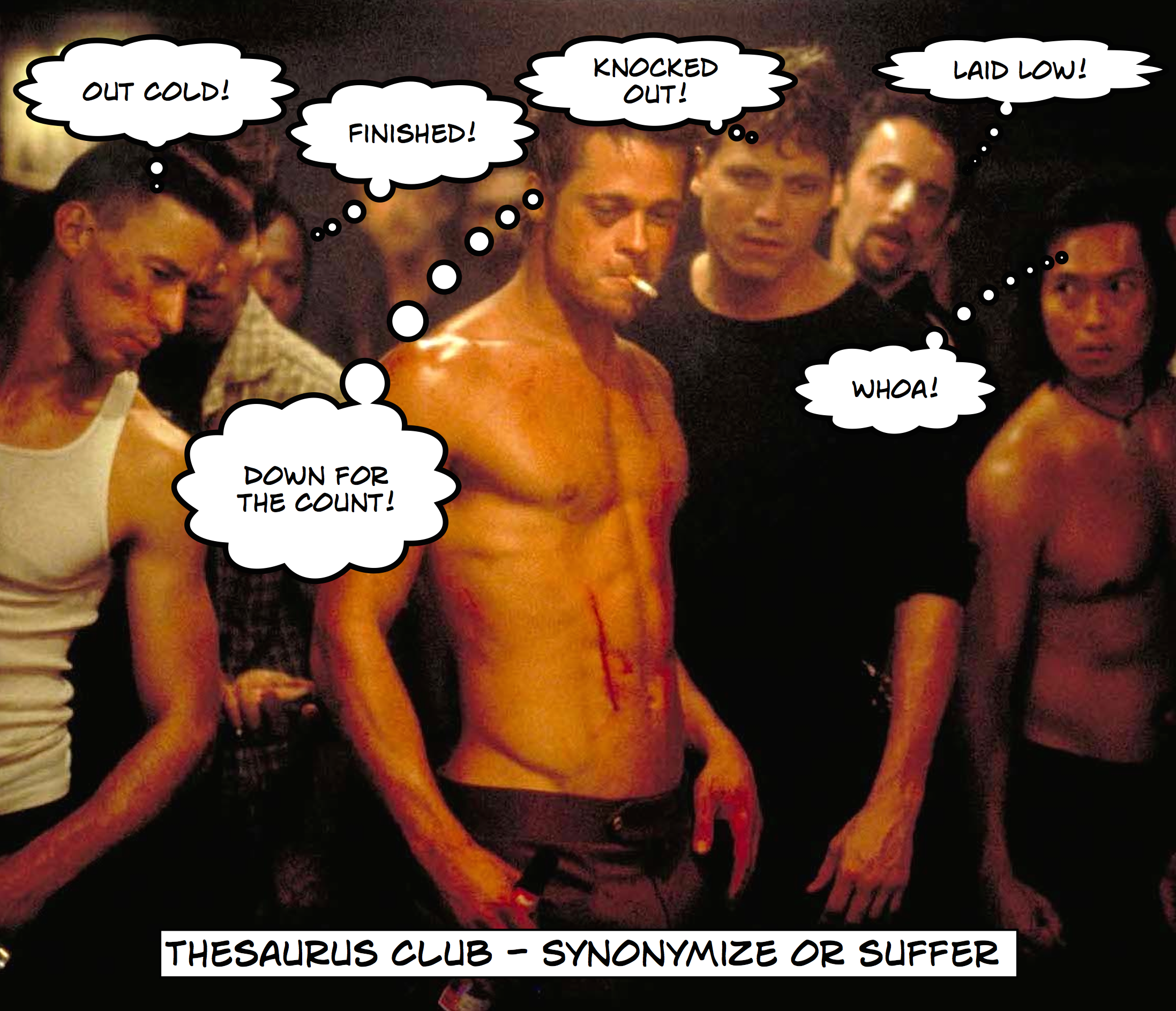
thesaurus club“The first rule is: If this is your first night at Thesaurus Club, you have to synonymize!”

“The second rule of Thesaurus Club is: You don’t talk about, mention, comment on, allude to, speak of, discuss, converse about, whisper of, gossip about, or chat or chinwag about Thesaurus Club!”

Only a true logophile (word lover) could enjoy the scene described above . . . but if you’re as captivated as I am by wordplay, you may appreciate the creativity. Of course, understanding the reference to the film Fight Club reveals more clearly its wit.

Words are fun to play with.

Although we tend to think of cartoonists as artists, the fact is they are usually just as skillful in their artistry with words. (The successful ones, at least.)

Not long ago I saw a single panel cartoon showing a seated man in a suit addressing a secretary, steno pad in hand. Nothing funny about the picture, of course, but the caption said, “One more thing: Remember to introduce me as a lawyer, not a liar.” Nice.

Even funnier if you think about synonyms. (No offense intended to Mere Inkling’s readers who are attorneys.)

Words are powerful. But they are also finite. C.S. Lewis noted their limits in an essay entitled “Prudery and Philology.”

We are sometimes told that everything in the world can come into literature. This is perhaps true in some sense. But it is a dangerous truth unless we balance it with the statement that nothing can go into literature except words, or (if you prefer) that nothing can go in except by becoming words. And words, like every other medium, have their own proper powers and limitations.

Lewis was quite sensitive to the abuse of language. It doesn’t require a graduate degree to know what he would think of today’s word processing programs with their built in thesauri.

No doubt these fingertip resources have contributed immensely to the modern proclivity of many writers to write artificial prose. I’m confident Lewis would have mourned their creation.

That’s precisely why joining the Thesaurus Club would be so daunting. There you stand, stripped of your ever-present literary crutches, proving just what you’re made of. Will you find victory (triumph, success) or will you taste defeat (downfall, failure)?

_____

I wish I could take credit for the concept at the top of this page, but I stumbled upon the notion elsewhere and modified it for Mere Inkling. (I did make the graphic, though.)

Discordant Dictionaries

dictionary 1Most “word people” like dictionaries. Some writers go so far as to love dictionaries, but I don’t wish to quibble about where one rests on the affection spectrum in terms of these repositories of words.

This guy, though, has to be pegged on the extreme (idolatry) end of the meter. Ammon Shea wrote Reading the OED: One Man, One Year, 21,730 Pages after having done just that. The Oxford English Dictionary, you may know, comprises 25 volumes, and Shea warns that reading it at such a rapid pace took a toll on his eyesight. It’s not surprising, that he admits he is not your typical reader.

One could say that I collect word books, since by last count I have about a thousand volumes of dictionaries, thesauri, and assorted glossaries. . . . I do not collect these words because I want to impress friends and colleagues with my erudition. . . .

My friends know that I read dictionaries for fun, and have come to accept this proclivity with relative good grace, but they are not terribly interested in or impressed by my word collection.

Pierre Jules Théophile Gautier advised his fellow poets to read the dictionary. No better way to enrich one’s language, he claimed, although he also read cook books, almanacs and the like. In fact, his biographer offered this fascinating observation.

He found pleasure in the most indifferent novels, as he did in books of the highest philosophical conceptions, and in works of pure science. He was devoured with the desire to learn, and said: “No conception is so poor, no twaddle so detestable that it cannot teach us something by which we may profit.”

C.S. Lewis indicated that so-called “definitions” offered outside the ordinances of the dictionary must be approached warily. “When we leave the dictionaries we must view all definitions with grave distrust” (Studies in Words). He offers a very sensible reason for such precautions.

It is the greatest simplicity in the world to suppose that when, say, Dryden defines wit or Arnold defines poetry, we can use their definition as evidence of what the word really meant when they wrote. The fact that they define it at all is itself a ground for scepticism.

Unless we are writing a dictionary, or a text-book of some technical subject, we define our words only because we are in some measure departing from their real current sense. Otherwise there would be no purpose in doing so (Studies in Words).

Dictionaries are, of course, their own genre. Lectionaries, collections of words and meanings, are different than any other type of written composition. For example, glossaries may draw together specialized vocabulary—say for medical or theological purposes—but by their very nature they are not intended to blaze any new literary pathways.

There is, invariably, an exception to this rule. Some “dictionaries” are creative exercises. They are works of fiction, and some are entertaining indeed.

The most famous of these satirical works is Ambrose Bierce’s Devil’s Dictionary (originally published as The Cynic’s Word Book). The volume is not expressly irreverent, although people of faith will encounter some offensive examples in its pages. However, a number of the entries are brilliant.

Kilt

  1. A costume sometimes worn by Scotchmen in America and Americans in Scotland.

Rank

  1. Relative elevation in the scale of human worth.

He held at court a rank so high

That other noblemen asked why.

“Because,” ’twas answered, “others lack

His skill to scratch the royal back.”

Emancipation

  1. A bondman’s change from the tyranny of another to the despotism of himself.

He was a slave: at word he went and came;

     His iron collar cut him to the bone.

Then Liberty erased his owner’s name,

     Tightened the rivets and inscribed his own.

Goose

  1. A bird that supplies quills for writing. These, by some occult process of nature, are penetrated and suffused with various degrees of the bird’s intellectual energies and emotional character, so that when inked and drawn mechanically across paper by a person called an “author,” there results a very fair and accurate transcript of the fowl’s thought and feeling. The difference in geese, as discovered by this ingenious method, is considerable: many are found to have only trivial and insignificant powers, but some are seen to be very great geese indeed.

Another Frenchman, Gustave Flaubert, composed his Dictionary of Received Ideas, which found humor in peculiarities of common understandings.

Absinthe

Extra-violent poison: one glass and you’re dead. Newspapermen drink it as they write their copy. Has killed more soldiers than the Bedouin.

Archimedes

On hearing his name, shout “Eureka!” Or else: “Give me a fulcrum and I will move the world.” There is also Archimedes’ screw, but you are not expected to know what it is.

Omega

Second letter of the Greek alphabet. [Note: this would only apply to biblically literate societies.]

The earliest such example of a satirical dictionary was that by the Persian writer Nezam od-Din Ubeydollah Zâkâni. I have not located a copy of his 14th century lexicon, but it apparently includes entries that are still understandable in our modern world.

Thought

What uselessly makes people ill.

Orator

A donkey.

Word lovers can easily get caught up in conversations like this. In fact, I’m certain more than one Mere Inkling reader has contemplated compiling their own creative dictionary! It’s not an insurmountable project, since it’s accomplished one word at a time.

_____

For those desiring to create their own dictionary “entries” such as the one that graces the top of this blog, there a free meme generator you can use online. Available here, it’s a fun little tool. It’s also suitable for creating a little self-deprecating humor.

dictionary 2

A Pair of Brilliant Writers

csl & chesterton

Sadly, politics are by definition nearly always polarizing. In the linguistic battleground of political warfare, we seem to more and more frequently encounter a “take no prisoners” attitude. It’s ominous.

I recently read the following words which describe, quite well I think, the positions of the two main rivals in virtually all political campaigns. (And, in this sentence, I’m referring to the military definition of “campaign.”)

“The whole modern world has divided itself into Conservatives and Progressives. The business of Progressives is to go on making mistakes. The business of the Conservatives is to prevent the mistakes from being corrected.”

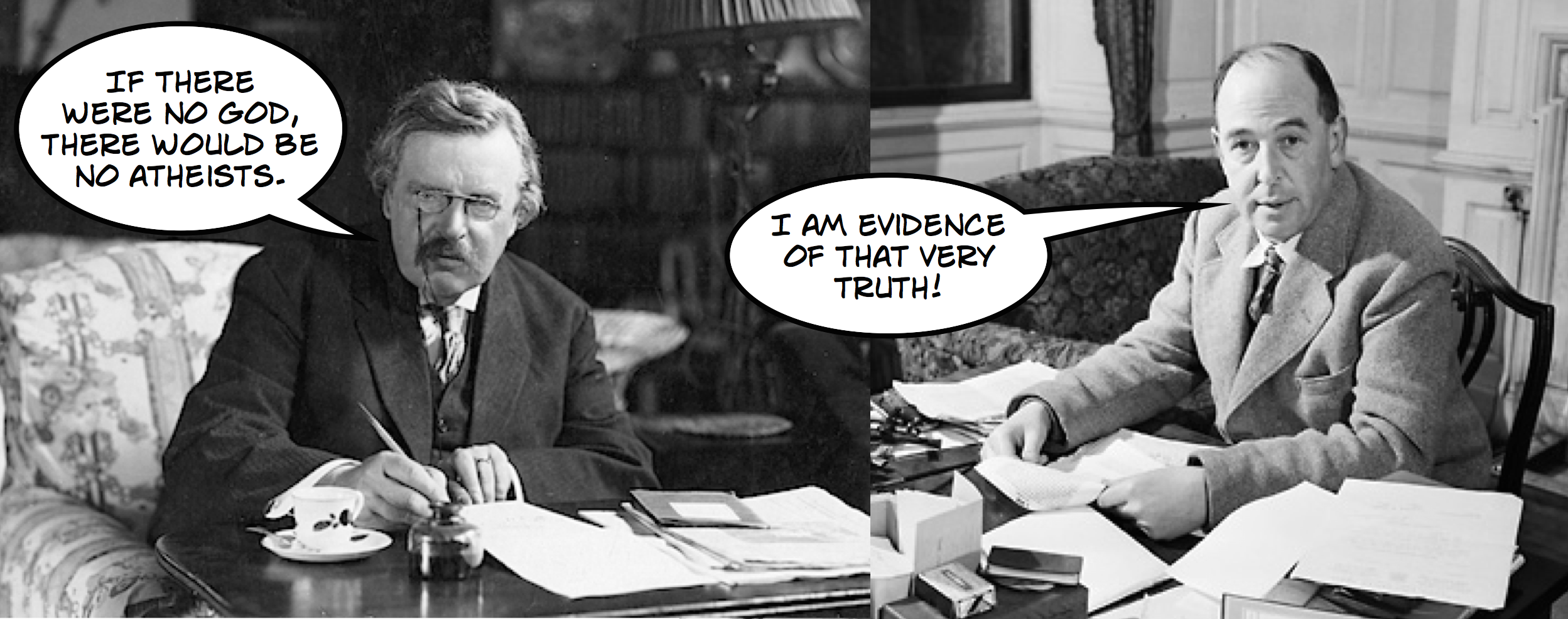
Some things never change. This cutting critique appeared nearly a century ago (in the 19 April 1924 issue of the Illustrated London News). It was penned by G.K. Chesterton, a British writer who was admired by many of his contemporaries, from a number of different perspectives. George Bernard Shaw, a Socialist, considered the conservative journalist a “man of colossal genius.”

Chesterton was one of the Christian writers whose faith made a significant impression on the unbelieving C.S. Lewis. Before encountering Jesus, the atheist Lewis resented the “intrusions” of Christian references into the writings of authors he otherwise enjoyed. He describes this conundrum delightfully in Surprised by Joy.

All the books were beginning to turn against me. Indeed, I must have been as blind as a bat not to have seen, long before, the ludicrous contradiction between my theory of life and my actual experiences as a reader. George MacDonald had done more to me than any other writer; of course it was a pity he had that bee in his bonnet about Christianity. He was good in spite of it.

Chesterton had more sense than all the other moderns put together; bating, of course, his Christianity. Johnson was one of the few authors whom I felt I could trust utterly; curiously enough, he had the same kink. Spenser and Milton by a strange coincidence had it too.

Even among ancient authors the same paradox was to be found. The most religious (Plato, Aeschylus, Virgil) were clearly those on whom I could really feed.

On the other hand, those writers who did not suffer from religion and with whom in theory my sympathy ought to have been complete—Shaw and Wells and Mill and Gibbon and Voltaire—all seemed a little thin; what as boys we called “tinny.” It wasn’t that I didn’t like them. They were all (especially Gibbon) entertaining; but hardly more. There seemed to be no depth in them. They were too simple. The roughness and density of life did not appear in their books. . . .

The upshot of it all could nearly be expressed in a perversion of Roland’s great line in the Chanson—Christians are wrong, but all the rest are bores. The natural step would have been to inquire a little more closely whether the Christians were, after all, wrong.

And C.S. Lewis, to his eternal joy, did just that. He inquired more deeply into the faith held by the writers he so respected. This included, of course, Chesterton. Echoes of Chesterton’s masterful expressions of Christian faith recur in the work of Lewis. For example, in his essay “Membership,” Lewis writes:

Equality is a quantitative term and therefore love often knows nothing of it. . . . Even in the life of the affections, much more in the body of Christ, we step outside that world which says “I am as good as you.” . . . We become, as Chesterton said, taller when we bow; we become lowlier when we instruct.

Similarly, in A Preface to Paradise Lost, Lewis describes how best to savor the historical work of writers from different eras. Although the reference to Chesterton here is given in passing, I will reproduce the larger passage in light of its insight into how best to benefit from what we read.

The things which separate one age from another are superficial. Just as, if we stripped the armour off a medieval knight or the lace off a Caroline courtier, we should find beneath them an anatomy identical with our own, so, it is held, if we strip off from Virgil his Roman imperialism, from Sidney his code of honour, from Lucretius his Epicurean philosophy, and from all who have it their religion, we shall find the Unchanging Human Heart, and on this we are to concentrate.

I held this theory myself for many years, but I have now abandoned it. I continue, of course, to admit that if you remove from people the things that make them different, what is left must be the same, and that the Human Heart will certainly appear as Unchanging if you ignore its changes. . . .

Instead of stripping the knight of his armour you can try to put his armour on yourself; instead of seeing how the courtier would look without his lace, you can try to see how you would feel with his lace; that is, with his honour, his wit, his royalism, and his gallantries out of the Grand Cyrus. I had much rather know what I should feel like if I adopted the beliefs of Lucretius than how Lucretius would have felt if he had never entertained them. The possible Lucretius in myself interests me more than the possible C.S. Lewis in Lucretius.

There is in G.K. Chesterton’s Avowals and Denials a wholly admirable essay called “On Man: Heir of All the Ages.” An heir is one who inherits and “any man who is cut off from the past . . . is a man most unjustly disinherited.” . . .

You must, so far as in you lies, become an Achaean chief while reading Homer, a medieval knight while reading Malory, and an eighteenth century Londoner while reading Johnson. Only thus will you be able to judge the work “in the same spirit that its author writ” and to avoid chimerical criticism.

G.K. Chesterton is well worth reading, and most fans of Lewis will appreciate his prodigious work. The best thing about Chesterton, is that since he entered the presence of his Lord in 1936, nearly everything he wrote is in the public domain. His essays, poetry, apologetic works—and even the tales of his fictional detective Father Brown—are readily accessible online.

For a friendly introduction to the relationship between Lewis and Chesterton, I recommend “Chesterton and Lewis, Side by Side.” In an issue devoted entirely to comparing the two pillars of Twentieth Century Christian apologetics, the St. Austin Review, we read:

In 1946, ten years after Chesterton died, Lewis wrote a short article defending Chesterton against the two charges with which he is still attacked—or dismissed—by most academicians: one, that he was popular, and two, that he was dated. Of course, Lewis is attacked for the same two reasons.

The entire article is available here. Those interested in one of the areas where Chesterton’s writing overlapped with that of Lewis and his good friend, J.R.R. Tolkien, will also enjoy “G.K. Chesterton: Fairy Tale Philosopher,” which is available here.

Unintentional Acrostics

letterSome writers sweat to find precisely the right word, the one that expresses the unique meaning and tone we seek to convey. We often fail, as the reference to perspiration in my first sentence readily reveals. A recent observation from the executive editor of First Things  provides me with another crippling concern.

“This for those interested in how magazines work. My son Christopher pointed out that the initial capital letters on a two-page spread . . . spelled “a wit.” Which was kind of nice. Accidental, but nice. And then I thought: Suppose some day we accidentally spelled out a rude four-letter word? Now, after the magazine is laid out, one of the junior fellows reads through the magazine to make sure we haven’t accidentally made a word that will embarrass us. It’s a small thing, and probably paranoid, but here paranoia equals prudence.”

Unless each writer maintains constant vigilance, since most of us don’t have “junior fellows” to assign the duty, it’s quite possible for unintentional acrostics to slip into our work. Like the seamen in the crow’s nest of the Titanic—I just watched a new documentary on the subject last night—we can easily miss the veiled iceberg which threatens to sink our best effort.

Prone as we are to playing with the depths of individual words, we are normally sensitive to the fact more than 90% of a word’s value in a particular context may lie beneath the surface. That does not mean, however, that we always see the larger picture.

It is not uncommon for a writer to become almost paralyzed while composing something, when the ideal word continues to elude us. It is almost “literally” painful to have to settle for a substitute, when we suspect the perfect word is floating somewhere just beyond our reach.

Dodging mundane words is not easy. They are common, in part at least, because they are so simple and easy to plug into sentences. And so, we “go” to the store, when we might just as easily “drive,” “walk,” “ride,” or even “hitchhike.” A movie is described as “good,” when readers would value a vivid word, such as, “suspenseful,” “hilarious,” “complex,” “moving,” or even “groundbreaking.”

Reflections on the Psalms, one of C.S. Lewis’ gems, explores the beauty of the Bible’s hymnal. “The Psalms,” he notes, “are poems, and poems intended to be sung: not doctrinal treatises, nor even sermons.” Because of this, they have nourished the worship lives of Jew and Christian alike, for thousands of years.

Even without a theological education, Lewis offers great insight into the Psalms. “I am no Hebraist, no higher critic, no ancient historian, no archaeologist.” He candidly discusses passages he initially found difficult to embrace, as well as those which soar to spiritual and poetic heights. The following comes from his discussion of Psalm 119, which is skillfully composed around an alphabetic acrostic.

“As everyone knows, the Psalm specially devoted to the Law is 119, the longest in the whole collection. And everyone has probably noticed that from the literary or technical point of view, it is the most formal and elaborate of them all. The technique consists in taking a series of words which are all, for purposes of this poem, more or less synonyms (word, statutes, commandments, testimonies, etc.), and ringing the changes on them through each of its eight-verse sections—which themselves correspond to the letters of the alphabet. . . . this poem is not, and does not pretend to be, a sudden outpouring of the heart like, say, Psalm 18. It is a pattern, a thing done like embroidery, stitch by stitch, through long, quiet hours, for love of the subject and for the delight in leisurely, disciplined craftsmanship.”

Done like embroidery, stitch by stitch.” Many writers, I suspect, will appreciate that description. While we are sometimes forced to throw something together in a rush, the patchwork results offend our sensitivities.

Even when writing rather pedestrian things like much of our email correspondence, most writers seek to employ lively verbiage. It’s a valuable exercise, after all, to consider the pace of all of our work, and not simply those words we hope to see “published.” And, having written something worth reading, there is one more consideration.

Reviewing what we have written is well worth the time required. And, as Editor David Mills suggested in First Things, our examination should include any unintentional acrostics we may have created. After all, no respectable writer would ever wish to, even accidentally, offend their readers.