

Caring for Nature with an Inkling Spirit

I never thought I would become an apiarist, but living in forests of America’s Pacific Northwest made this a logical stage in my growth as a naturalist. And I’m convinced that if he had known how simple it is to promote healthy bee populations, C.S. Lewis would have joined me in the hobby.

After all, he delighted in their work ethic, describing the moment of their Narnian creation with the words, “Butterflies fluttered [and] Bees got to work on the flowers as if they hadn’t a second to lose.”

In “An Experiment in Criticism” Lewis discussed the value of seeing the world through the eyes of others. In awe of the majesty of creation he expressed a yearning to explore its myriad facets from perspectives other than his own.

The man who is contented to be only himself, and therefore less a self, is in prison. My own eyes are not enough for me, I will see through those of others. Reality, even seen through the eyes of many, is not enough. . . .

Even the eyes of all humanity are not enough. I regret that the brutes cannot write books. Very gladly would I learn what face things present to a mouse or a bee: more gladly still would I perceive the olfactory world charged with all the information and emotion it carries for a dog.

Like most people, I grew up thinking of beekeepers as the people who dress in protective gear and harvest the honey produced by those tireless little workers. Honeybees, however, are only one type of bee. The Treehugger site offers an illustrated page featuring the bee types, with Hoverflies (good, and in more than 6,000 species) and Wasps (bad, and in more that 100,000 species) thrown in.

The bees I help to encourage in our area are not honeybees or bumblebees, who form colonies. They are mason bees, who are solitary by nature. They don’t have an aggressive bone in their tiny bodies and they are excellent at their jobs. They “pollinate around 95% of the flowers they visit, whereas honey bees generally only pollinate about 5%.” 

C.S. Lewis, like his close friend J.R.R. Tolkien, loved nature. Like most people Lewis either knew nothing about solitary bees, or his attention was directed by default to the honeybees we prize for the honey refined in their hives. In 1930, he wrote to his friend Arthur Greeves about the deeper motivations that drive people such as themselves to become writers.

As for the real motives for writing after one has ‘got over’ the desire for acknowledgement . . . I found and find, that precisely at the moment when you have really put all that out of your mind and decided not to write again . . . precisely then the ideas – which came so rarely in the days when you regarded yourself officially as an author – begin to bubble and simmer, and sooner or later you will have to write . . .

Who knows . . . what will in the end reach the ear of humanity? The successes of our own age may be speedily forgotten: some poem scribbled in pencil on the fly leaf of a schoolbook may survive and be read and be an influence when English is a dead language. . . .

So . . . whether the necessity and duty of writing is laid on a man or not can soon be discovered by his own feelings. With remote consequences we have no concern. We never know enough. I think the thing is to obey the ordinary rules of morality . . . but for ultimate justifications & results to trust to God.

The bee builds its cell and the bird its nest, probably with no knowledge of what purpose they will serve: another sees to that. Nobody knows what the result of your writing, or mine . . . will be. But I think we may depend upon it that endless and devoted work on an object to which a man feels seriously impelled will tell somewhere or other: himself or others, in this world or others, will reap a harvest exactly proportional to the output.

In 1914, C.S. Lewis shared with his father a humorous anecdote from the Roman poet Virgil. 

Did you ever at Lurgan read the 4th Georgic? It is the funniest example of the colossal ignorance of a great poet that I know. It’s about bees, and Virgil’s natural history is very quaint: bees, he thinks, are all males: they find the young in the pollen of flowers. They must be soothed by flute playing when anything goes wrong etc., etc.

C.S. Lewis enjoyed his laugh at Virgil’s poetic ignorance about bees. Coincidentally, he would discuss the humble creatures in a poem of his own. It appears in his posthumous Poems collection, as the fourth and fifth of his “Five Sonnets.”

Pitch your demands heaven-high and they’ll be met.
Ask for the Morning Star and take (thrown in)
Your earthly love. Why, yes; but how to set
One’s foot on the first rung, how to begin?
The silence of one voice upon our ears
Beats like the waves; the coloured morning seems
A lying brag; the face we loved appears
Fainter each night, or ghastlier, in our dreams.
“That long way round which Dante trod was meant
For mighty saints and mystics not for me,”
So Nature cries. Yet if we once assent
To Nature’s voice, we shall be like the bee
That booms against the window-pane for hours
Thinking that way to reach the laden flowers.

“If we could speak to her,” my doctor said,
“And told her, “Not that way! All, all in vain
You weary out your wings and bruise your head,”
Might she not answer, buzzing at the pane,
“Let queens and mystics and religious bees
Talk of such inconceivables as glass;
The blunt lay worker flies at what she sees,
Look there—ahead, ahead—the flowers, the grass!”
We catch her in a handkerchief (who knows
What rage she feels, what terror, what despair?)
And shake her out—and gaily out she goes
Where quivering flowers stand thick in summer air,
To drink their hearts. But left to her own will
She would have died upon the window-sill.”

British Bees

The British are quite enamored with quaint names for their public houses. Because of that, I knew I would be able to find a suitable pub to feature at the top of this post. I was, however, caught off guard by an embarrassment of riches in the return to my google search.

In addition to “The Bumble Bee” in Quedgeley pictured above (which I chose because of the lamppost in the garden), I found images of similarly named pubs in Blackwood, Flitwick, Gloucester, Gwent, Westoning, and Fleur-de-lis, Wales.

I’m sure I could find many other tributes to buzzing pollinators, if I broadened my search to include pubs like “The Beehive” in Egham or “The Golden Bee” in Stratford-upon-Avon.

The story of one more bee will bring our reflections to an end. In his early diary, All My Road Before Me, C.S. Lewis mentioned a number of visits to Bee Cottage, where some of his friends occasionally resided. For example, one summer Sunday in 1922, he recorded:

After lunch I bicycled to Beckley and called at Bee Cottage where I found [Cecil] Harwood alone and reading in a pleasant, stumpy 18th Century Bible. He quoted from Genesis “Whatever Adam called anything, that was the name of the thing,” as an excellent definition of poetry.

Once lost to the mysteries of time, the precise location of Bee Cottage has been discovered, as we can read in Bee and Church Cottage.

Laurence Harwood, C.S. Lewis’s godson, was a lecturer at [the 2009] Summer Seminar on C.S. Lewis Remembered.  His father, Cecil Harwood, was a close personal friend of Lewis as well as fellow Inkling Owen Barfield. 

Harwood and Barfield had often rented a small cottage-Bee Cottage-in Beckley, a few miles from Lewis’s home in the Kilns, and Lewis often visited the place (perhaps while on walking tours though the countryside just like his character Elwin Ransom).  Unfortunately its precise location was lost and remained unknown.

Following the lectures, “Laurence decided that searching for the cottage would be a . . . great way to remember Lewis.” He and several friends “managed to locate the small house, and found that it looked just as anyone would have expected-the waning summer sun sinking behind it, and the bees buzzing about the lavender plants alongside the stairs.”

Bees are important members of our environment. Many would argue they are essential and famine would certainly follow if they became extinct. The Environmentor says,

If all the bees died, humans would become responsible for taking up the slack. This is already happening in China, where a majority of the bees have already died. People take buckets full of pollen and “paint” the pollen on with a paintbrush.

But, this could only be done with a few of the plants that require pollination because there simply aren’t enough humans to perform the task.

The alternative, offered by Brittanica is that we could “robo-pollinate.” But I have already written about where that ominous trend might lead. 

I think it’s best that we diligently care for bees we currently enjoy, and nurture all their future generations. And I believe C.S. Lewis would agree.
Elegies, Eulogies & C.S. Lewis

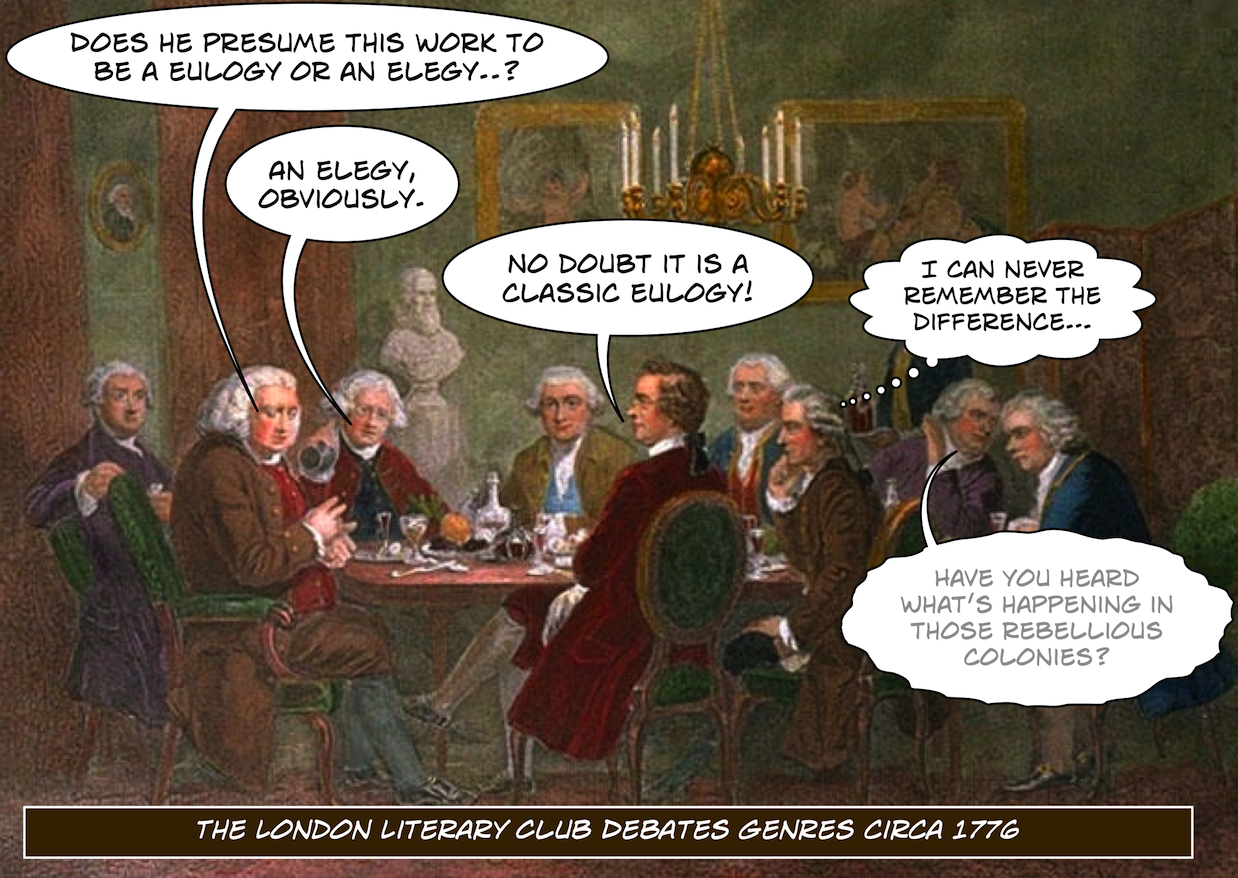
For a long time I was puzzled by the difference between the two words, elegy and eulogy. My confusion was not simply due to their obvious visual and aural similarities. My puzzlement was increased by their use in similar contexts (e.g. death). Even worse, they are sometimes (mis)used interchangeably.

If you are confused, let me clarify the matter—the words have significantly different definitions. The fact they are both three syllables and share four letters, is simply coincidence. Both are frequently written, but only eulogies are intended to be delivered as an oration.

A eulogy (ˈyü-lə-jē) is a message of commendation and praise, typically offered in honor of someone who has died. (It originates from the Greek word eulogia which means praise.)

An elegy (ˈe-lə-jē) is a poem, or possibly a song, with a melancholy tone. It can, but does not have to, be about someone who is deceased. (It finds its origin in elegos, the Greek word for a song of mourning.)

Thus, even when both eulogies and elegies are offered in response to the same person’s passing, they remain quite distinct from one another. The eulogy focuses on praise, and is positive in tone. The elegy focuses on sorrow and is like a lamentation.

As a young man, C.S. Lewis wrote to his father about the nature of exaggeration often found in eulogies.

I was sorry to see the other day news of our friend Heineman’s sudden death. The papers have been so covering him with eulogy since he went that I begin to feel glad I met him, if only for once—Vergilium vidi tantum! [“I have seen the great Virgil!” (Ovid, Tristia)]

In this case however I think the virtues are not wholly of the tombstone nature: a great publisher is really something more than a mere machine for making money: he has opportunities for doing things for the best of motives, and if one looks round most of our English houses, I think he avails himself of them as well as anyone can expect. I always put up a fight for the tribe of publishers here where so many young men with manuscripts have nothing too bad to say of them.

The close companionship of the Inklings meant that they took one another’s death quite hard. C.S. Lewis’ brother Warren wrote a moving eulogy when Charles Williams passed. In it he said, “the blackout has fallen, and the Inklings can never be the same again.”

The talented Christian writer, Dorothy Sayers, shared a dynamic friendship with C.S. Lewis. Lewis wrote a heartfelt eulogy for her when she died in 1957. Her son wrote back thanking him for the warm and uplifting gift.

Lewis was unable to present it in person at the funeral, so his eulogy was read to the congregation by the Lord Bishop of Chichester. It is quite substantial and because Sayers’ son preserved a copy, it is now preserved in the essay collection On Stories. It is entitled “A Panegyric for Dorothy L. Sayers,” panegyric being another word for publicly rendered praise. At the conclusion of the sensitive tribute, Lewis praises her translation of Dante’s Divine Comedy. Unfortunately, Sayers died before completing the final section of the work. After complimenting her work on the initial section, the Inferno, he concludes:

. . . when I came to the Purgatorio, a little miracle seemed to be happening. She had risen, just as Dante himself rose in his second part: growing richer, more liquid, more elevated. Then first I began to have great hopes of her Paradiso. Would she go on rising? Was it possible? Dared we hope?

Well. She died instead; went, as one may in all humility hope, to learn more of Heaven than even the Paradiso could tell her. For all she did and was, for delight and instruction, for her militant loyalty as a friend, for courage and honesty, for the richly feminine qualities which showed through a port and manner superficially masculine and even gleefully ogreish—let us thank the Author who invented her.

As a literary historian, C.S. Lewis was extremely familiar with elegies. In an essay, “Donne and Love Poetry in the Seventeenth Century,” he critically analyzes that author’s elegies. (You can download the complete collection of Donne’s poems in two volumes here: 12.)

In another essay, “Shelley, Dryden, and Mr. Eliot,” Lewis praises Shelley’s “Witch of Atlas,” and moves on to an interesting critique of Adonais: An Elegy on the Death of John Keats.

If Shelley had written only such poems he would have shown his genius: his artistry, the discipline and power of obedience which makes genius universal, are better shown elsewhere. Adonais naturally occurs to the mind, for here we see Shelley fruitfully submitting to the conventions of a well-established form.

It has all the traditional features of the elegy—the opening dirge, the processional allegory, and the concluding consolation. There is one bad error of taste. The Muse, lamenting Adonais, is made to lament her own immortality,

     I would give All that I am to be as thou now art!
     But I am chained to Time, and cannot thence depart! (xxvi)

This is to make a goddess speak like a new-made human widow, and to dash the public solemnity of elegy with the violent passions of a personal lyric. How much more fitting are the words of the Roman poet:

Immortales mortales si foret fas flere
Flerent divae Camenae Naevium poetam.

[Gnaeus Naevius (c. 270-199 BC) was a Roman poet who composed this modest epitaph for his tomb:
If it would be lawful for immortals to weep for mortals,
the divine Muses would weep for the poet Naevius.]

A Special Bonus

For readers who have continued to this point, I have a special treat. It is a satirical elegy written by G.K. Chesterton (1874-1936), who was a popular English writer, and staunch defender of Christianity (particularly of the Roman Catholic flavor).

This excellent column describes the influence Chesterton had on the Inklings, especially Lewis and J.R.R. Tolkien. Chesterton often launched his work from current events or twists on common knowledge, creatively manipulating it to provide new insights. He did this very thing with the following, famous elegy.

In 1751, English poet Thomas Gray wrote “Elegy Written in a Country Churchyard.”  It grew in fame, and was memorized by many English schoolchildren. It consists of more than thirty stanzas. The link offers the entire poem, but eight lines will suffice to illustrate for our purpose here.

Elegy Written in a Country Churchyard
by Thomas Gray

Far from the madding crowd’s ignoble strife,
     Their sober wishes never learn’d to stray;
Along the cool sequester’d vale of life
     They kept the noiseless tenor of their way.

Yet ev’n these bones from insult to protect,
     Some frail memorial still erected nigh,
With uncouth rhymes and shapeless sculpture deck’d,
     Implores the passing tribute of a sigh.

Their name, their years, spelt by th’ unletter’d muse,
     The place of fame and elegy supply:
And many a holy text around she strews,
     That teach the rustic moralist to die.

And here we close with Chesterton’s brief version, intentionally bearing the same title. It is both somber (in the first two sincere stanzas) and scathing (in the last verse). I am certain citizens of many nations would nod in agreement if this elegy was applied to their own countries.

Elegy in a Country Churchyard
by G.K. Chesterton

The men that worked for England
They have their graves at home:
And birds and bees of England
About the cross can roam.

But they that fought for England,
Following a falling star,
Alas, alas for England
They have their graves afar.

And they that rule in England,
In stately conclave met,
Alas, alas for England
They have no graves as yet.

Learning New Words

When you encounter an unfamiliar word, do you consider that inconvenient, or exciting?

I encountered a new word today. I read a lot, but rarely do I encounter an unfamiliar word.* I share it with you because of its peculiar meaning. You may want to use it sometime. The drawback is that it is a tad antiquated (thus its unfamiliarity). The word is “Panglossian.”

My “passing” grade in the study of Classical Greek in 1977 suggested the word might mean multi-lingual, since pan means “all,” and glossa means languages or tongues. I was wrong—but for a very odd reason.

Panglossian, you see, doesn’t refer to the literal meaning of its root words. It is based on the qualities of a character created by Voltaire for his satirical novella, Candide. Ironically, Voltaire presumably christened his professor of métaphysico-théologo-cosmolonigologie with this nomen⁑ because of its actual meaning.

The adjective Panglossian, however, has a completely distinct definition. Its difference was signaled for me by the capitalization of the first letter. Fans of Voltaire (among whom I do not count myself, or C.S. Lewis, for that matter) may already know its meaning. a definition, trust me, we shall get to momentarily.

First, I want to share C.S. Lewis’ observation about Voltaire, a Deist who was a savage critic of Christianity. In his autobiography Lewis includes the philosopher in a list of people he considered allies during his own season of atheism.

All the books were beginning to turn against me. Indeed, I must have been as blind as a bat not to have seen, long before, the ludicrous contradiction between my theory of life and my actual experiences as a reader.

George MacDonald had done more to me than any other writer; of course it was a pity he had that bee in his bonnet about Christianity. He was good in spite of it. Chesterton had more sense than all the other moderns put together; bating, of course, his Christianity. Johnson was one of the few authors whom I felt I could trust utterly; curiously enough, he had the same kink. Spenser and Milton by a strange coincidence had it too.

Even among ancient authors the same paradox was to be found. The most religious (Plato, Aeschylus, Virgil) were clearly those on whom I could really feed.

On the other hand, those writers who did not suffer from religion and with whom in theory my sympathy ought to have been complete—Shaw and Wells and Mill and Gibbon and Voltaire—all seemed a little thin; what as boys we called “tinny.” It wasn’t that I didn’t like them. They were all (especially Gibbon) entertaining; but hardly more. There seemed to be no depth in them. They were too simple. (Surprised by Joy).

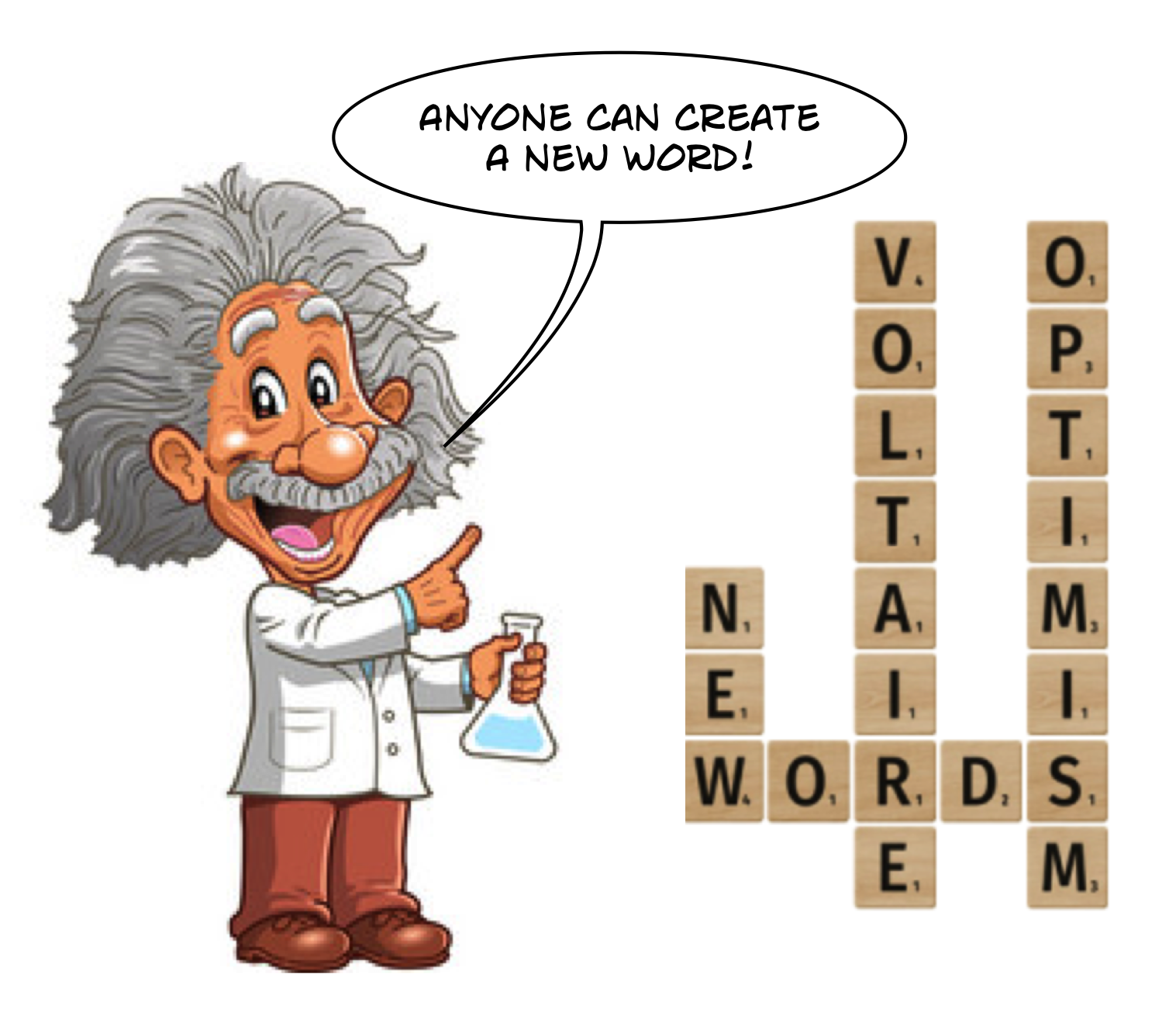
Voltaire’s religious views aside, in Dr. Pangloss he devised a character energized by an incurable optimism. From that characterization, fifty years after Voltaire’s work another writer derived the adjective. If you are like me, knowing a word’s etymology—its origin and history—is intrinsically satisfying.

So, as Merriam Webster says: Pan·​gloss·​ian | pan-ˈglä-sē-ən was first used in 1831 to describe someone or something as being “marked by the view that all is for the best in this best of possible worlds: excessively optimistic.”

And, since the minting of new words is an ongoing process, it comes as no surprise panglossian has spawned variations.

According to a word research site, “writers have since made several compounds out of his name, such as Panglossic and Panglossism, but the adjective Panglossian is by far the most common and is frequently found even today.”

I encountered the word in an interesting First Things essay entitled “The Gospel According to Dickens.” The author describes Dickens’ hopeful tone and confidence, but declares “Dickens was not Panglossian, however. He expressed scorn for the society that insults and injures the weak and vulnerable.”

While I’m neither panglossic nor inclined in the least to panglossism, I’m glad such people exist. Their naiveté makes this world of ours far more interesting.⁂


* This is true, aside from specific “names” of things like an animal genus (e.g. trochilidae for hummingbirds or urochordate for the beloved sea squirt), or a pharmaceutical (e.g. Unituxin or Tecfidera). The business channel CNBC reports:

“If it seems as if drug names have been getting weirder, it’s because, in some cases, they have. . . . drug names use the letter Q three times as often as words in the English language. For Xs, it’s 16 times as much. Zs take the cake, at more than 18 times the frequency you’d find them in English words. And Ws? You’ll rarely see one in a drug name.” And, shockingly, the cost ranges from $75,000 to $250,000 for developing a single drug brand name.”

⁑ I studied Latin too, way back in 1969-71. The grades for my Latin scholarship were also “satisfactory.”

⁂ No offense intended to any readers of Mere Inkling who count themselves among the excessively optimistic! But, as for me, I’ve yet to be panglossterized.