Do Not Read the Bible

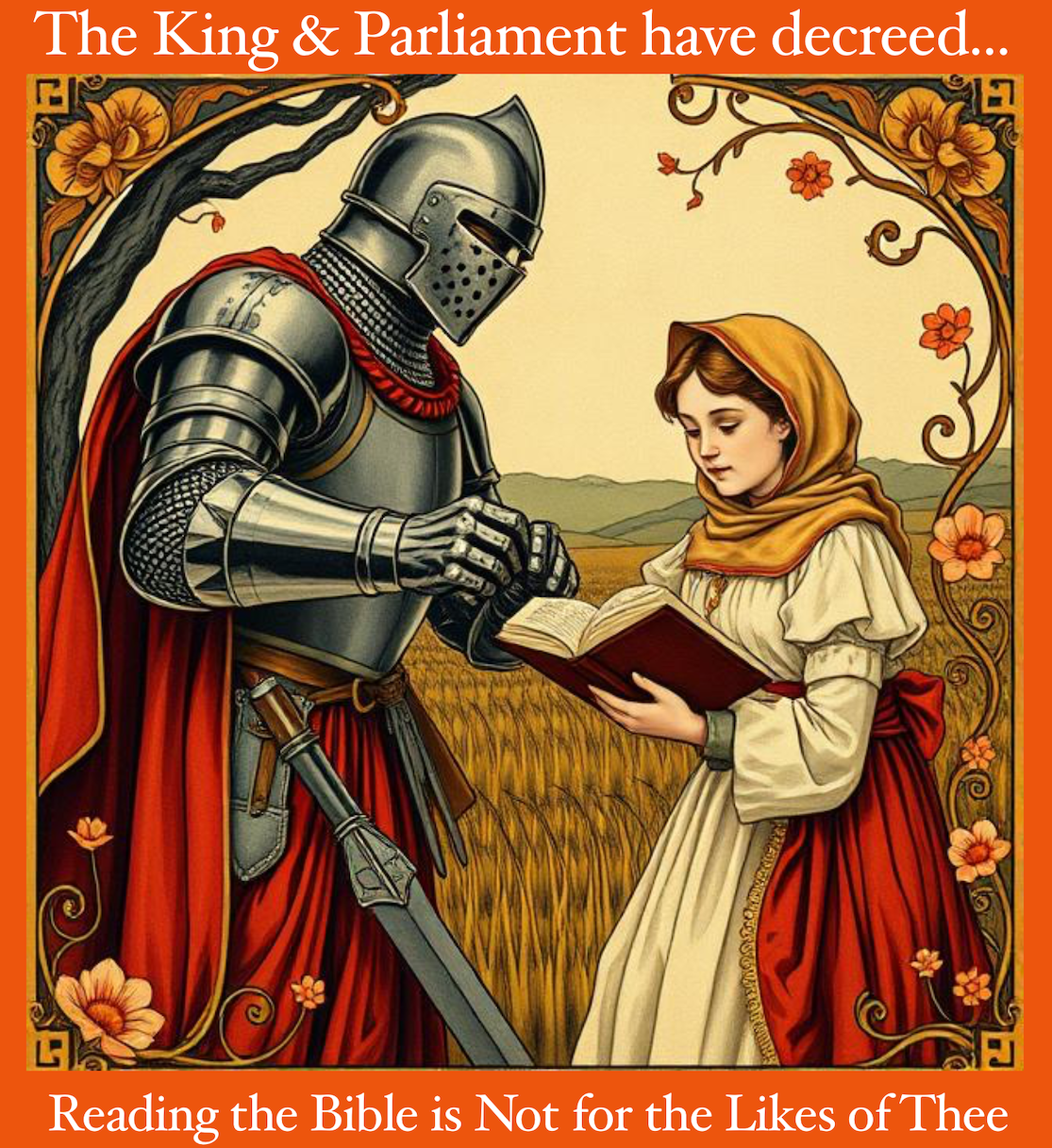
How would you respond if the government prohibited you from reading the Holy Scriptures? That was the situation in Great Britain when the Parliament passed the ironically named “Act for the Advancement of True Religion.”

Nearly five centuries ago, on May 12, 1543, Britain’s enlightened politicians and bishops determined that people of the “lower sort” needed to be protected from reading and interpreting the Bible themselves. 

Just sixty-one years later, King James VI/I would commission the translation of the Authorized Version, making God’s Word more accessible to all who could read English. William Tyndale (c. 1494 – 1536) had actually translated a fair portion of the Scriptures a decade prior to Parliament’s restrictive law. For this, and similar “Protestant” sins, Tyndale was strangled and burned at the stake in Belgium.

Even the so-called Great Bible had been authorized by Henry VIII in 1539. The approval decreed “one book of the bible of the largest volume in English, and the same set up in some convenient place within the said church that ye have care of, whereas your parishioners may most commodiously resort to the same and read it [emphasis mine].”

Nevertheless, not all of the powers that be apparently agreed with making the text of the Bible accessible to the common folk. We will consider this category of “inadequates” momentarily.

First let’s consider the distaste expressed by some for any modern translation of the Scriptures. (If you’ve ever attended a Bible study group you have probably encountered at least one person who insists on using the true KJV, despite the archaic language.

C.S. Lewis addressed this reticence for clear translations in an essay entitled “Christian Apologetics.” It was originally presented to Anglican priests and youth leaders in 1945.

“Do we not already possess,” [some will say] “in the Authorised Version the most beautiful rendering which any language can boast?” Some people whom I have met go even further and feel that a modern translation is not only unnecessary but even offensive.

They cannot bear to see the time-honoured words altered; it seems to them irreverent. There are several answers to such people. In the first place the kind of objection which they feel to a new translation is very like the objection which was once felt to any English translation at all.

Dozens of sincerely pious people in the sixteenth century shuddered at the idea of turning the time-honoured Latin of the Vulgate into our common and (as they thought) ‘barbarous’ English. A sacred truth seemed to them to have lost its sanctity when it was stripped of the polysyllabic Latin, long heard at Mass and at Hours, and put into . . . language steeped in all the commonplace associations of the nursery, the inn, the stable, and the street.

The Biblically Unworthy

So, who were these “lower sort” of individuals deemed unsuited for reading the Scriptures already translated into their native tongue? Well, they included “women, artificers, apprentices, journeymen, serving-men of the rank of yeoman and under, husbandmen and laborers.” Women of the gentry class were allowed an exception, being able to read the Scriptures, but only in private.

Fortunately, the law was short-lived. Henry’s son, Edward VI/I would have it repealed in the Treason Act of 1547. (Of course, this goodwill did not prevent Edward from condemning the translations of the aforementioned martyr, William Tyndale.)

Who Should Read the Bible?

The short answer is “everyone.” Yet the fact exists that some individuals are susceptible to confusion – or even to intentional twisting of the clear meaning of God’s Word. So, while the Scriptures should be accessible to all, it is wise to guide children and the easily-confused in their studies. After all, what we all desire is honest understanding and enlightenment.

This direct access is one reason Martin Luther, William Tyndale and others labored so tirelessly to translate the Bible into the vernacular. Cheerfully, “believers no longer had to read Latin [or Greek, Hebrew or Aramaic] to understand the word of God.”

As for those who would directly attempt to distort God’s inspired words, a clear example is found in the New World version paraphrase invented by Jehovah’s Witnesses. Another example, which I have discussed in the past, is the distorted abomination created by the Chinese Communist Party

There are also “abbreviated” versions of the Bible, which contain properly translated passages, but leave out passages that challenge preconceived positions. This would include Thomas Jefferson’s cut and paste Bible and an edition of the Scriptures developed for teaching slaves to read.


If you are interested in receiving daily notes about Christian history such as the one which prompted this post, visit the Christian History Institute.
C.S. Lewis & French Poetry

Ah, the snow is wrapping the world in a thick blanket, and I have no where I need to be. As I sit at my desk gazing out at the whitewashed forest, I attempt now something that I seldom do. I am writing a poem.

I admit that I haven’t read Jane Kenyon’s work, but I can definitely relate to one of her famous quotations: “My ear is not working, my poetry ear. I can’t write a line that doesn’t sound like pots and pans falling out of the cupboard.”

One of the bloggers I follow hosts a weekly poetry contest. I’ve never been tempted to compete, although I’m eminently qualified. You see, this is a “Terrible Poetry Contest.”

I had already begun writing my next post, and it relates to the depression some people feel during the winter. Of course, I do my best to make sure that what I write for Mere Inkling is not “terrible.” But I decided to delay that column and pause to enter this contest. On a whim. I certainly don’t expect to win . . . which in this case is, ironically, good news.

I decided to use an uncommon poetic form, since I can at least have the satisfaction that it offers patient readers an “educational” tidbit. I chose the French descort poetic form, because it seems expressly tailored to generate terrible poetry. According to Writer’s Digest, “the descort differentiates itself from other forms by differentiating its lines from other lines within the poem. That is, the main rule of descort poems is that each line needs to be different from every other line in the poem.”

A descort poem has different line lengths, meters, avoids rhyming with other lines, no refrains, and that goes for stanzas as well. In other words, no two lines in a descort should look like each other, and the same could be said for each descort.

The strength of the form is that it allows utter freedom to the poet. The weakness is that the results are appalling. (Read the example written by the editor of the linked article, if you don’t believe me.) Without further ado, I present my latest experiment with verse.* (There’s really nothing “French” about it, beyond the fact it’s a descort.)⁑

Frigid French Philologies
by Robert C. Stroud

Shards of bleak winter gestate day after day.
The citric cannonade gurgled melodies of complacency.
Echinodermata rides again.

Hagar was not so Horrible.
Beware 48°52.6′S 123°23.6′W.
Fini.
Don’t stare at dark holes.
A Galapagos penguin reads about tobacco.

Captain Kirk sings the National Anthem.
Angkor longed to visit Tenochtitlán.
Sheepish wolves.
From lofty Mount Olympus descended Odin.

Soon comes the summer of our discontent.

A French Poem by C.S. Lewis

C.S. Lewis wrote poetry. There is actually a plaque in his honor in Poet’s Corner in Westminster Abbey. Deservedly so. Nevertheless, Lewis’ poetry was never highly regarded.

I, for one, consider this lack of appreciation providential. By this I mean that even though C.S. Lewis had to suffer the disappointment of not realizing his desires as a poet, it is a blessing to the whole world that his energies were redirected into his other writings. Who knows, if his poetry had been celebrated, whether or not Narnia would ever have existed?

The only book of Lewis’ which is in the public domain (i.e. free for downloading), is Spirits in Bondage: A Cycle of Lyrics. It was published after the First World War, written while he was still an atheist. While it makes for interesting reading, much of the imagery will be a bit disorienting for readers only familiar with Lewis after he encountered Christ.

The following poem is taken from that collection. As Alister McGrath writes in The Telegraph article, Lewis’ hopes were dashed relatively early.

The early poems remain a powerful witness to Lewis’s early atheism, railing against an absent and uncaring God who failed to halt the slaughter the author saw around him. But he never achieved recognition as a “war poet,” like Rupert Brooke and Siegfried Sassoon, who are also commemorated in Poets’ Corner. Indeed, not only did he fail to secure recognition for his war poetry, he was not acclaimed as a poet of any kind, as the lack of interest in his second volume of verse—Dymer (1926)—made painfully clear.

This example of Lewis’ war poetry does stand tall in comparison to the verse of the “acclaimed” war poets (in my modest opinion). It describes a battle site during the war—and the transformation of human beings into beasts.

French Nocturne (Monchy-Le-Preux)

Long leagues on either hand the trenches spread
And all is still; now even this gross line
Drinks in the frosty silences divine
The pale, green moon is riding overhead.

The jaws of a sacked village, stark and grim;
Out on the ridge have swallowed up the sun,
And in one angry streak his blood has run
To left and right along the horizon dim.

There comes a buzzing plane: and now, it seems
Flies straight into the moon. Lo! where he steers
Across the pallid globe and surely nears
In that white land some harbour of dear dreams!

False mocking fancy! Once I too could dream,
Who now can only see with vulgar eye
That he’s no nearer to the moon than I
And she’s a stone that catches the sun’s beam.

What call have I to dream of anything?
I am a wolf. Back to the world again,
And speech of fellow-brutes that once were men
Our throats can bark for slaughter: cannot sing.

I confess (though I did it on purpose) that the heading for this section was a bit misleading. “French poem” may have been interpreted as a poem written in French. While Lewis was certainly fluent in French, he did not write in the language. He did, however, appreciate the tongue.

In 1952 he wrote his publisher about the French translation of The Lion, the Witch and the Wardrobe. He praised quality of the translation, as well as the tone achieved by the translator, in Le Lion et la Sorcière Blanche.

I don’t foresee many occasions for copies of Le Lion, but if you will kindly send me 2, they might come in useful. The translator deserves to be congratulated of course—French is a very powerful language—the children become perfect little Frenchmen, but that is all to the good.

What pleased and surprised me is the passage at the end where I made them talk like characters in Malory, and he has really got some of the quality of the French 13th century prose romances: grande honte en aurions⁂—is exactly right.

C.S. Lewis’ brother, Warnie, was a bit of a Francophile. He knew his subject well enough that he authored a book about its history, The Splendid Century: Life In The France Of Louis XIV. He offers an entertaining account of some literary gatherings where the works of Jean Chapelain (1595-1674) were employed in a novel manner. The writers shared agreed upon rules, and transgressions demanded discipline. Thus the punishment for “the breach of rules was to read a verse of Chapelain’s poetry, or, in aggravated circumstances, a whole page.”

I won’t hold my breath awaiting the results of the poetry contest. Though I periodically enjoy dabbling in poetry, I feel I am destined to share the fate of Lewis when it comes to the way in which the masses assess the quality of our verse.


* I have written poetry in the past. I explored the quintain here, and have a few of my experiments in poetry posted at All Poetry.

⁑ According to Encyclopedia Britannica, descort can also refer to “a poem in medieval Provençal literature with stanzas in different languages.”

⁂ The phrase means “great shame we would have.”

Translating the Word

translationsThe science of translation is only partially scientific. It is also an art—with the insight into intuiting the intent of the original author a critical dimension of good translating.

First, of course, the translator must possess a sound grasp of the original language. Second, he or she must know the language into which they are translating the work equally well. With this knowledge, the translator can do an adequate job.

Only with that indefinable intuition mentioned above, is a translator empowered to do justice to a writer’s work when recreating it in a different language.

All translation work is demanding, but those entrusted with transferring documents of faith into new languages face an additional burden. The adherents of various religions typically regard this literature as “inspired,” and therefore to be approached with only the most serious and respectful of intentions.

This is certainly true for Christianity. Transferring the Scriptures from Hebrew, Aramaic and Greek into Latin, German and English involved devout theologians who approached the task with reverence as well as skill.

That balance remains a constant these many centuries after the earliest translation efforts. Today the Christian Bible is still being translated into languages where it has never been available before. The Wycliffe Bible Translators community is the largest organization working toward this end, although there are many others, such as the Lutheran Bible Translators, who are laboring in noncompetitive venues.

Wycliffe estimates that 350 million people do not yet have the Bible available in their native language. They have been instrumental in putting God’s Word into 700 different tongues, and with various other organizations are committed to continuing their vital work.

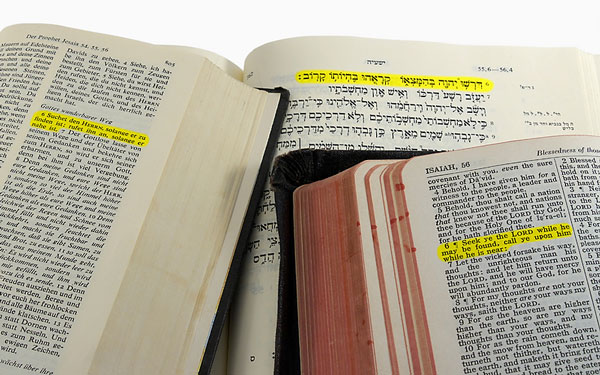
Some of the targeted language groups actually speak dialects of more common tongues. For example, De Nyew Testament is now available for speakers of Gullah. Spoken by the descendants of slaves residing in the South Carolina and Georgia coastlines. It is an English-based creole language featuring numerous African contributions. A comparison of a sample verse will illustrate the differences. The first verse of the Gospel according to John reads:

Fo God mek de wol, de Wod been dey. De Wod been dey wid God, an de Wod been God. Fo God mek de wol, de Wod been dey wid God. Shru dat Wod, God mek ebryting. Ain nottin een de whole wol wa God mek dat been done dout de Wod. (Gullah New Testament).

In the beginning was the Word, and the Word was with God, and the Word was God. The same was in the beginning with God. All things were made by him; and without him was not any thing made that was made. (King James Version).

At the beginning God expressed himself. That personal expression, that word, was with God, and was God, and he existed with God from the beginning. All creation took place through him, and none took place without him. (J.B. Phillips’ New Testament).

Why, you may wonder, have I included the relatively unknown translation by Phillips? Because none other than the brilliant and devout scholar, C.S. Lewis, regarded it highly. Lewis recognized that the archaic usage of the Authorized (King James) Version impeded its use by many people. In fact, in a 1961 letter he wrote: “A modern translation is for most purposes far more useful than the Authorised Version.”

Lewis was one of the readers of Phillips’ initial translation of the Pauline epistles who encouraged him to proceed with the task of translating the entire New Testament. Lewis, in fact, was key in encouraging Geoffrey Bies to publish the new version. Technically, though, calling this text a “translation” is a bit misleading; in many ways it is more honestly labeled a “paraphrase.” Still, it did make the Scriptures more accessible to many younger readers.

Phillips’ New Testament in Modern English is available online at the Christian Classics Library.

C.S. Lewis wrote an entire essay on the subject of translating God’s revelation. It is entitled “Modern Translations of the Bible,” and included in the God in the Dock collection. The following wisdom comes from that source.

The only kind of sanctity that Scripture can lose (or, at least, New Testament scripture) by being modernized is an accidental kind which it never had for its writers or its earliest readers. The New Testament in the original Greek is not a work of literary art: it is not written in a solemn, ecclesiastical language, it is written in the sort of Greek which was spoken over the Eastern Mediterranean after Greek had become an international language and therefore lost its real beauty and subtlety. In it we see Greek used by people who have no real feeling for Greek words because Greek words are not the words they spoke when they were children. It is a sort of “basic” Greek; a language without roots in the soil, a utilitarian, commercial and administrative language.

Does this shock us? It ought not to, except as the Incarnation itself ought to shock us. The same divine humility which decreed that God should become a baby at a peasant-woman’s breast, and later an arrested field-preacher in the hands of the Roman police, decreed also that He should be preached in a vulgar, prosaic and unliterary language. If you can stomach the one, you can stomach the other. The Incarnation is in that sense an irreverent doctrine: Christianity, in that sense, an incurably irreverent religion.