Misplaced Trust

trustingWhy do some nurses kill? Most people attracted to the nursing profession possess deep reservoirs of compassion for others. And yet, every once in a while we read about a nurse intentionally taking the life of a patient.

Today’s case comes from Italy, where a forty-two year old nurse is under investigation for thirty-eight possible cases of murder. And we are not talking about the ending of a life that some would term euthanasia.

Poggiali did not overdose them to end their suffering. She did it simply because they irritated her. She, or their relatives, bothered her.

One troubling aspect of the case could only happen today. Authorities have actually found a photograph on her phone where she is standing beside a deceased patient giving a “thumbs up” sign. (The article didn’t indicate whether this was a sickening “selfie,” or if there is another person at the hospital with a similarly demented sense of humor.

When people we implicitly trust violate our faith in them, it is jarring. We struggle to comprehend things when . . .

Medical professionals intentionally cause injury . . .

Clergy behave immorally, particularly when they attempt to justify it from the pulpit . . .

Police victimize rather than protect . . .

Teachers care more about themselves than their students . . .

Soldiers display cowardice rather than courage . . .

There is some good news here. It is precisely because these breaches of our expectations are the rare exception, that we are shocked by them. For the most part, people entrusted by the public with authority or power honor that trust.

(Let’s exclude, for our discussion here, the case of politicians, where that supposition would be hotly debated. As Lewis in his essay “Equality” wrote, “Mankind is so fallen that no man can be trusted with unchecked power over his fellows.”)

Our trust in people who occupy special positions goes so far as to be illogical. For example, we tend to think of actors or actresses as possessing the traits of various characters they have portrayed.

We laugh at the joke, “I’m not a doctor, but I play one on TV.” Yet, we’re still tempted to ask the person how we can best deal with our persistent cough or chronic rash.

We think of television cops as believing in law and order, but if we seriously considered the matter, we would recognize just how foolish that is. They are no more, or less, likely than anyone else in Hollywood to be law abiding.

An ongoing scandal reveals just how disorienting it can be to have our illusions shattered. It is the case of Stephen Collins. In the popular Seventh Heaven series, he played the ideal father. A pastor, no less. We mourn for the lives he has injured, and we subconsciously grieve our own disillusionment.

The solution to the problem is not in ceasing to trust others. Life from that perch would result in paranoia and alienation.

No, I think that it still makes sense to trust—within limits. I am willing to extend my trust to someone in a respected profession who I have just met. That is based on the profession’s self-policing of standards.* Most require minimal education and competence standards, and have mechanisms for decertifying those who violate professional ethics.

Still, when time allows, the best advice is probably to “trust and verify.” The time I take to verify whether the person’s credentials or claims are true corresponds to the importance of what I’m entrusting to them. I would leave my car with a mechanic far sooner than I would entrust my child to a babysitter.

Returning to the case with which we began, we assume that a hospital is one of the safest places to be. And, even in light of the latest tragedy, this remains true.

For every one nurse tempted to end a complainer’s life early, there are a hundred thousand** who are striving to prolong the lives of their charges.

Trusting should not only be viewed as something we extend to others. Each of us would do well to ponder for a few moments just how trustworthy we are. This is especially true for those of us in privileged or respected professions. However, it is no exaggeration to say that the measure of any woman or man is determined by the degree to which they have earned the trust of others.

Lewis writes about the nature of trust, as it relates to friendship. It doesn’t relate to trust imbued in societal roles, but rather in the trust that exists where a relationship is already present. Still, he expertly describes the interplay between mind and heart, when it comes to trust. And this explains, in part, why the betrayal of our trust causes us so much anguish, in mind and soul.

To love involves trusting the beloved beyond the evidence, even against much evidence. No man is our friend who believes in our good intentions only when they are proved. No man is our friend who will not be very slow to accept evidence against them. Such confidence, between one man and another, is in fact almost universally praised as a moral beauty, not blamed as a logical error. And the suspicious man is blamed for a meanness of character, not admired for the excellence of his logic. (“On Obstinacy in Belief”).

_____

* The fact that some “professions” don’t have any mandatory requirements or standards, means that I remain wary when I meet people sporting those titles. For example, in America it’s possible to “ordain” oneself (or buy a meaningless diploma or certificate online). Thus, when someone tells me they are a minister, I am eager to learn more (about their education, congregation, accountability, etc.). There are far too many hucksters out there to take a person’s word for it that they are a genuine minister of God.

** Perhaps a slight exaggeration, but I’d like to continue believing that the ratio is something wonderful like that, 1:100,000. Then again, if I think of it literally, in terms of how many are “tempted” to expedite the passing of an inconsiderate and ungrateful patient, I imagine the numbers might be rather less encouraging.


Loving Prostitutes

comfort womenI love prostitutes.

It’s true.

Although I have never in my life “physically” loved one, I possess great compassion for them.

Sharing physical intimacy with a prostitute would have nothing to do with “love,” anyway.

My empathy for prostitutes grew significantly during the year I spent stationed with the United States Air Force in South Korea during the 1980s.

My love for them has just been reignited by an article I read about the plight of aged Korean prostitutes who are being evicted from their hovels so that developers can profit. These women, ostracized by their own society and discarded by their pimps and the soldiers, sailors and airmen who abused them, have nowhere to go.

Americans have a perverse understanding of prostitution. Calling it a “victimless crime” is incomprehensible. For every one American call girl living in comfort and able to choose her “clients,” there are probably five thousand who are beaten daily, and driven to an early (often welcome) death.

No woman, at least none with a healthy mind, wants to sell their body and forfeit their future.

The gifted author and professor, C.S. Lewis, recognized this fact.

Prostitutes are in no danger of finding their present life so satisfactory that they cannot turn to God: the proud, the avaricious, the self-righteous, are in that danger (The Problem of Pain).

I love prostitutes because God has granted me the vision to see them as he does. Jesus spoke with true love (agape love) to one unloved and physically used woman he met at a well. You can read the story here.

She had been passed from one man to another and no longer had any options. Her current partner had not even bothered to marry her. She was not unlike the poor prostitutes of South Korea.

Jesus looked into this woman’s scarred soul and offered her forgiveness, healing and peace.

South Korea is prosperous today. It was not always so. During the Second World War, and the Japanese occupation, thousands of woman were enslaved as “comfort women.” The Korean government provides these victims with special compensation. Not so the post-war “comfort women” who serviced the country’s allies.

They did not have a choice either. Which is one reason C.S. Lewis writes, “a cold, self-righteous prig who goes regularly to church may be far nearer to hell than a prostitute.” (Mere Christianity).

And now they languish. Others, working in bars and “clubs” near bases today, are in their “prime.” It won’t last. This will be their destiny as well.

Because I love prostitutes, I pray that they might be liberated from their bondage. And, I also pray, that if they remain trapped in their current plight, that their souls might be free . . . that they might encounter the Messiah who can offer them “a spring of water welling up to eternal life” (John 4:14).

The article I read, and linked to above, ends with a potent yet tragic image.

Jang Young-mi, 67, who was orphaned as a girl and worked in a military camptown for nearly two decades, lives with three mangy dogs. A bite from one of them left the long white scar on her hand, but she refuses to abandon the offending animal.

Dogs too, are often outcasts in many societies. The irony is not lost that in Korea a dog is as likely to be devoured, as it is to be embraced and protected.

_____

The WWII image of so-called “comfort women” is of Indonesian women. It is estimated that the Imperial Japanese Army enslaved a quarter of a million women in Asia to serve in this cruel and vile manner. Due to the large number of victims, many still live today, still hoping for an official apology for their suffering.

Lemming Legends

lemmingThe closest camaraderie I ever experienced in my life, was on the staff of the USAF Chaplain School. A sign of our esprit de corps was seen in the nicknames we gave one another. Mine was Lemming. (Not too dashing, I know, but read on and you’ll see why it was bestowed with affection and respect.)

Those of us who worked on “Air Staff” projects (for the Chief of Chaplains) were in the Resource Division. Probably because we were always rushing (scurrying?) around responding to emergencies, the other chaplains called us the “Resource Rats.” We were close indeed, and our energies and creativity was magnified by our synergy . . . just like the Inklings.

We embraced the label, and before we knew it each of us had been identified as a particular member of the rodent family. We had a rabbit, hamster, beaver, squirrel and fudged a bit with a ferret and a weasel. Among assorted other “rats,” I was nicknamed—you didn’t choose your identity, your friends awarded it to you—Lemming.

They called me Lemming because I had a unique duty on the team. One of my duties was to do a little bit of “ghostwriting” for the Chief of Chaplains. Some would consider it an honor, but trust me, due to the general for whom I wrote the first year, it was anything but.

Why a Lemming? Well, because whenever a tasking came down I would dutifully march off in obedience . . . even if it meant marching right off of a cliff. Like the humble Lemming, I accepted my fate, and made the best of it.

We all know their tragic story. When the Lemming burrows become overcrowded, a large number of them will sacrificially gather together and march to the sea. There, those who did not perish in catastrophic falls, nobly swim out to sea so that their relatives back in the warren can once again devote themselves to overpopulating their habitat.

I was proud of the appellation. I wore the name (literally, on the shirt logo pictured above) as a badge of honor. Until . . . until I discovered it was all based on a lie.

Lemmings, we have learned, do not suffer from periodic mass suicidal impulses. The common myth is based on an insidious 1958 “nature film” made by Disney. I have no idea why they would compromise their flawless reputation for scientific accuracy in their naturalist media, but in White Wilderness, they cast all integrity aside. (And now I know why C.S. Lewis and J.R.R. Tolkien were wary of the machinations and shadowy motives of Walt Disney Studios.)

With utter disregard to the reputation of these clever arctic creatures, the film showed (supposed) members of the Scandinavian clans eagerly casting themselves to their deaths. However, their bizarre behavior was manipulated by cinematic chicanery.

It turns out that not only did Disney pull the lemmings out of their normal habitat for filming—since they were too intelligent to voluntarily leap to their death, they were thrown off of the cliff from a modified turntable! Ghastly.

Learning that lemmings will not march knowingly (and stupidly) to their own demise has actually made me a bit prouder to bear the title. I mean, it’s one thing as a member of the armed forces to risk your life in the defense of your nation. It’s quite another to commit suicide because a general thought one of your commas was in the wrong place. But that’s a story for another day.

Navy Nerds

nerdEvery once in a while, the military has a good idea. Sure, they have a knack for technological breakthroughs in warfare . . . but what about other fields? The NAVY NeRD answers that question in the affirmative.

NeRD stands for Navy eReader Device.

Well-informed readers of Mere Inkling are already aware of the growing intensity of international cyberwarfare. It is no joke, and lives are at stake.

Draconian policies are in place to avoid the contamination of the military computer system by innocently transferred viruses. Since virtually all digital platforms allow for the transfer of data, they are potentially dangerous.

Because of that, even ereaders have been off limits in certain environments. Now, however, someone has thought outside the proverbial box and come up with a solution to that problem.

The United States Navy has devised a novel ereader that comes loaded with 300 titles, but has no ports or wireless connectivity to allow for inadvertent viral transfers.

The selection of books sounds pretty well rounded. Some public domain classics, and a number of contemporary best sellers like A Game of Thrones. Fans of J.R.R. Tolkien will be delighted to know the readers also include The Lord of the Rings.

Reading is a productive way to spend one’s free time during a lengthy period at sea. Even for those not prone to opting for it when faced with all the distractions ashore.

During WWII, C.S. Lewis wrote a letter to a former student who was serving in the Navy, “out of reach of libraries.” It acknowledges the perennial problem of sailors—lack of space for personal property. The letter was written in response to a request from Michael Rayner Thwaites for reading recommendations. Thwaites was an Australian poet and military intelligence officer.

A man who has already your linguistic training might well, I think, begin the Anglo Saxon on his own. You will need E. Wardale Old English Grammar. . . . For texts, the ordinary beginning is first Sweet’s Anglo Saxon Primer and then his Old English Reader. But you, being a classic might well, after a dip in the Primer go on to King Alfred’s trans. of Boethius De Consolatione Philosophiae . . .

Whether you can begin O.E. poetry on your own I don’t know. But try getting . . . Beowulf: and with it Clark Hall’s trans. ed. by Wrenn with preface by Tolkien . . . This edition is essential for it is Tolkien’s part of metre wh. is essential. (O.E. verse uses both quality and accent, and your ear is prob. ruined, as mine was, by the false way they teach Latin metre at schools–drastic re-education is required. . . .

As to modern literature. You must not start out to study it ‘as it reveals man’s hesitant advance to the idea of a God-created world’. Don’t you see you are laying down in advance what a phenomenon is to reveal before you have examined the phenomenon? It may reveal that: it may not. You have to find out. I don’t think I can lay down any v. definite course of reading.

All I can point out is that while you are in the navy and out of reach of libraries and new publications, this is the proper time for solid reading through the big (i.e. long) authors, critical works and histories of lit. can come later. Now is the time for Chaucer, Malory, Spenser, Sidney, Shakespeare, Dryden, Pope, Swift, Johnson, Fielding, Richardson, Cowper, Scott, Wordsworth, Byron, Dickens etc etc.

If you usually keep two books of widely different period and type going together (e.g. Faerie Queene & Tom Jones) you won’t get bored. I myself always index a good book when I read it for the first time noting (a) Linguistic phenomena. (b) Good & bad passages. (c) Customs: meal times, social classes, what they read etc. (d) Moral ideas.

All this reading, tho’ dedicated ad Dei gloriam in the long run must not be infected by any immediate theological, ethical, or philosophic reference. Your first job is simply the reception of all this work with your imagination & emotions. Each book is to be read for the purpose the author meant it to be read for: the story as a story, the joke as a joke.

Back to the NeRD

The Navy is making 385 devices at first, with more to follow, with five being sent to each submarine in the Navy to be shared among the crew.

That’s only the start, of course. One would anticipate that even for a military crew (for example, 155 personnel on a Trident sub), a mere five mini-libraries would prove insufficient. (No offense intended; yours truly is a veteran himself.)

Who Should We Trust?

staffordshire cross“You can trust me, I’m a pastor.” When I was ordained thirty-three years ago, that might have been sufficient to persuade many people to give me the benefit of the doubt. Not so today.

The latest Gallup poll records the continuing decline of our trust in “clergy.” Relentless negative press (much of it recording genuinely criminal and repellent behaviors) has taken its toll. Today only 47% of Americans trust ministers (of all faiths).

The good news, if you can consider it that, is that clergy still rank as the seventh most trusted group (out of twenty-two vocations considered).

But it remains quite pitiful. And quite understandable. Even being a pastor, there are many people considered clergy who I would not trust. First of all, anyone who purchased their “ordination” over the internet, and has the audacity to pretend to be a minister. I see a credibility gap there. (I would not include those who buy one of the fake diplomas as a “joke” to be untrustworthy . . . only those who pass themselves off as a “real minister.”)

I could go on, but my purpose here is not to trash clergy, since more than enough people already devote themselves to that purpose.

I am curious just who, in our increasingly uncertain and selfish world, we should trust.

I personally am in a rather envious position. I don’t have to rely on hoping people will trust me because I’m a pastor. I am also a sworn officer of the law. Albeit, I merely serve as a volunteer chaplain with my local county Sheriff’s Office, but we honestly do swear an oath to uphold the law, and we proudly wear regular uniforms, complete with our own chaplain badges (stars).

The thing about being in law enforcement is that I can benefit from the fact that it is the sixth most respected institution. So that carries me across the halfway mark all the way to the 54% trustworthiness milestone. I guess that’s fair, since I too place a higher trust in the integrity and professionalism of the average deputy or officer than I do in the average minister.

But, as I already said, I’m in a rather unique position, in that I also qualify for an even more respected category, that of a military officer. The 69% level of trust for military officers ties that of doctors and is only 1% below grade school teachers and pharmacists. So, I guess that if I want to instill confidence in my integrity, I’d best tell people that I’m a (retired) Air Force officer, and not that I am a member of the First Estate.

Trust is important. It’s a key commodity in any relationship, and absolutely essential for intimate relationships such as those shared within a family. Trust takes a great deal of time to build, and it can be shattered in just a moment. Its fragility is the primary reason why it must be treasured and guarded.

Trusted are those who never give others a cause to doubt them. My wife and I made a promise to our children that we would never lie to them. Never. We explained there would be times when we could not tell them something, or where we could only reveal a portion of the facts about a matter . . . but we promised them that whatever we did tell them would be the absolute truth insofar as we were aware.

Because of our honesty with them, our children (all adults now, of course), have been amazingly honest with us the whole of their lives. They trust us. We trust them. And none of us take that amazing gift for granted.

In Surprised by Joy, C.S. Lewis describes his introduction to J.R.R. Tolkien. Although the two would become lifelong friends, there were obstacles that needed to be overcome. One, described by Lewis, was that Tolkien belonged to not one, but two, categories of people who Lewis had been taught to regard as suspect. He was an atheist at the time, but it wasn’t simply Tolkien’s deep faith in Christ that gave him pause.

When I began teaching for the English Faculty, I made two other friends, both Christians (these queer people seemed now to pop up on every side) who were later to give me much help in getting over the last stile. They were H.V.V. Dyson (then of Reading) and J.R.R. Tolkien.

Friendship with the latter marked the breakdown of two old prejudices. At my first coming into the world I had been (implicitly) warned never to trust a Papist, and at my first coming into the English Faculty (explicitly) never to trust a philologist. Tolkien was both.

I’m not sure where philologists ranked on Gallup’s recent poll, but I am quite sure they did not include questions about different denominations or faith groups. Before ending these thoughts I suppose I should share with you the most trusted group in the survey—nurses. Eighty-two percent of Americans trust nurses. And I too would agree with that.

The matter of who we can safely trust is of great importance. In fact, it could be argued that it is the most important question in our lives.

Ultimately, even when we assure one another we will only speak the truth . . . even then we disappoint one another. Being human, we are finite, imperfect. We cannot always be there, even for those we love. Sometimes we fail to live up to our own standards and our promises dispel like a vapor in the wind.

Johnny Cash recorded a powerful song before he died. He had lived a rough and tumble life, and had found peace in a relationship with Christ. That peace, however, did not cure all of the ills or heal all of the scars he had experienced, and his profound familiarity with this world inspired the gritty lyrics of “Hurt.”

I wear this crown of thorns

Upon my liar’s chair

Full of broken thoughts

I cannot repair

Beneath the stains of time

The feelings disappear

You are someone else

I am still right here

What have I become

My sweetest friend

Everyone I know goes away

In the end

And you could have it all

My empire of dirt

I will let you down

I will make you hurt

In a moment, I’ll share a link to his performance of this moving song. But first, the answer to the question with which we began.

Who, exactly, should we trust? Johnny Cash learned the answer to that question, and so did C.S. Lewis. I trust the same Person that they did—someone who will never disappoint. Someone who cannot lie, since he himself is the Truth. As Paul wrote in 2 Timothy 2:

Remember Jesus Christ, risen from the dead, the offspring of David . . . I endure everything for the sake of the elect, that they also may obtain the salvation that is in Christ Jesus with eternal glory. The saying is trustworthy, for:

If we have died with him, we will also live with him;

if we endure, we will also reign with him . . .

if we are faithless, he remains faithful—

for he cannot deny himself.

_____

If you wish to watch the video of Johnny Cash’s musical epitaph, you can see it here.

The pectoral cross show above is part of the Staffordshire Hoard, which is the largest collection of Anglo-Saxon metalwork ever found. It dates from the 7th or 8th century.

Boot Camp Religion

drill instructorShould pastors be more like cheerleaders, or drill instructors? That’s an interesting question recently posed by the president of World Vision United States.

While flying to Saint Louis, I brought along several magazines I hadn’t had an opportunity to read. (The opportunity to read for an extended period is about the only thing I still enjoy about long distance travel.)

One of the magazines included a review of Unfinished: Believing is Only the Beginning by Richard Stearns.

It included an interesting comparison which intrigued both as a pastor and a military chaplain.

The great commandments of Scripture have now become just great suggestions, offered like fortune cookies, to take with us or leave behind in the pews. Jesus said, “If anyone would come after me, he must deny himself and take up his cross daily and follow me” (Luke 9:23). If churches are going to lead a revolution to change the world, then our pastors need to act and speak less like spiritual cheerleaders and more like drill sergeants.

It’s a valid question. But, the truth is that we are talking about a spectrum, not an either/or dichotomy. A pastor should never be a mere cheerleader. Nor should a minister ever be a simple drill sergeant.

Being a pastor is much more complex than either of those labels. Far better to use the metaphor of shepherd.

The author’s point is well made though. In our current “feel good” age, with its divinization of the notion of self esteem, many clergy seem to think their primary role is to “encourage” the saints. They forget that we should be encouraging them to do something. Something, perhaps, like running a race.*

That’s actually the theme of the book—Christian discipleship. Following Christ more closely each day, as we correspondingly come to more and more resemble our Father.

Disciples are not expected to just “talk the talk” of obedience; they are to “walk the walk.” Studying the blueprint in Scripture means that we follow its instructions. It requires that we obey what Scripture teaches. Anyone seeking to truly know God’s calling on his or her life must be serious about obedience. Do we really think that God is going to give a critical kingdom assignment to someone who hasn’t been faithful in day-to-day obedience to his commands?

There’s even a passing C.S. Lewis reference in Unfinished, albeit not a particularly flattering one. The author doesn’t actually speak ill of the Oxford don, but he does criticize the way that some preachers tend to “proof text” their message with pertinent quotations. (I avoid taking personal umbrage at the criticism, since the point Stearns is making is quite valid.)

Far too many Sunday sermons bat around theological ideas like badminton birdies for half an hour. They quote a few verses of Scripture, tell a few stories, throw in a line or two from C.S. Lewis or Dietrich Bonhoeffer, but never challenge the congregation to change anything in their lives.

The sermon is offered like a piece of gum for congregants to chew on for half an hour, but as soon as they get to the parking lot, most will spit it out. The job of the church is not merely to explain the truth but, rather, to use the truth to bring about life change.

I’ve never been accused of preaching chewing gum sermons myself, but I know exactly what he is alluding to.

Unfinished doesn’t actually object to quoting Lewis, just to a shallow, formulaic approach to sermon preparation. The book, in fact, includes several Lewisian citations of its own, referencing no fewer than four of his works.

As a fellow writer and theologian who loves quoting C.S. Lewis, I’ll forgo pointing out the irony.

_____

* The role of the coach, as in training athletes for their competition, is a useful image. Note 1 Corinthians 9:24-25, “Do you not know that in a race all the runners run, but only one receives the prize? So run that you may obtain it. Every athlete exercises self-control in all things. They do it to receive a perishable wreath, but we an imperishable.”

Also, Hebrews 12:1-2, “Therefore, since we are surrounded by so great a cloud of witnesses, let us also lay aside every weight, and sin which clings so closely, and let us run with endurance the race that is set before us, looking to Jesus, the founder and perfecter of our faith, who for the joy that was set before him endured the cross, despising the shame, and is seated at the right hand of the throne of God.”

Obstreperous Language

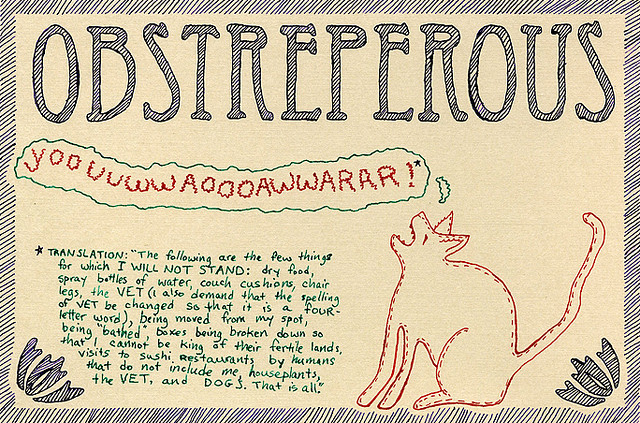
obstreperous

© Stella Belikiewicz and used by permission.

Despite my many shortcomings, I do “pride” myself on possessing a rather considerable vocabulary. My 97th percentile score of the GRE* reinforced my impression that I knew a lot about words.

One technique which has increased my vocabulary is to never let an unknown word pass by without making an effort to learn its meaning. This is simple when I’m working at the computer. If I’m unsure of a definition, I immediately look it up in an online dictionary such as this.

Very rarely do I “guess” at a meaning, based upon its context. This mainly occurs if I’m listening to the radio while I’m driving, and I don’t have recourse to a dictionary. Even then I try to impress the new word on my memory so that I can research it when I return home.

The word in this column’s title motivated me to discuss the importance of accurately understanding word definitions. When I encountered “obstreperous,” it rang vague bells of recollection. And, I was able to discern the word’s general meaning from the context of the article. While some readers of Mere Inkling are already familiar with its meaning—and perhaps use it in daily conversations—allow me to share the context in which I encountered it.

I was reading an article in a military journal about the “battle over ballistic missiles” which was fought inside the Air Force as the manned-bombers-only mindset had to be breached so the United States could advance into the ICBM age. The champions of the two positions were two successive Air Force Chiefs of Staff, Thomas White and Curtis LeMay.

White struggled with how to control the obstreperous LeMay. He knew he didn’t have the political power to force LeMay out, nor could he outwait his [Strategic Air Command] chief. LeMay received his fourth star in 1951 at age 44, which made him the youngest four-star U.S. general since Ulysses S. Grant.**

I’m rarely content with possessing an amorphous definition of a word, so I looked it up. My general impressions of its meaning were confirmed, and I added another word to my personal vocabulary. (The fact that I may never use it beyond its appearance in this post is irrelevant.) Here’s the dictionary entry:

ob·strep·er·ous [uhb-strep-er-uhs]

adjective

1. resisting control or restraint in a difficult manner; unruly.

2. noisy, clamorous, or boisterous: obstreperous children.

Parents give their children a precious gift by encouraging the growth of their own vocabularies. In the pre-computer days, we had a dictionary not far away when we had dinner, and it wasn’t uncommon for it to find its way to the table during our conversations.

Consciously adding new words to our vocabulary is a skill especially vital to writers.

C.S. Lewis wrote about how common usage of familiar words requires no contextual definition. However, he warns of the danger of accepting subjective “definitions” offered outside the context of credible dictionaries.

When we leave the dictionaries we must view all definitions with grave distrust. It is the greatest simplicity in the world to suppose that when, say, Dryden defines wit or Arnold defines poetry, we can use their definition as evidence of what the word really meant when they wrote.

The fact that they define it at all is itself a ground for scepticism. Unless we are writing a dictionary, or a text-book of some technical subject, we define our words only because we are in some measure departing from their real current sense. Otherwise there would be no purpose in doing so. . . .

The word wit will illustrate this. We . . . find old critics giving definitions of it which are contradicted not only by other evidence but out of the critics’ own mouths. Off their guard they can be caught using it in the very sense their definition was contrived to exclude.

A student who should read the critical debate of the seventeenth century on wit under the impression that what the critics say they mean by wit is always, or often, what they really mean by wit would end in total bewilderment.

He must understand that such definitions are purely tactical. They are attempts to appropriate for one side, and to deny to the other, a potent word. You can see the same “war of positions” going on today.

A certain type of writer begins “The essence of poetry is” or “All vulgarity may be defined as,” and then produces a definition which no one ever thought of since the world began, which conforms to no one’s actual usage, and which he himself will probably have forgotten by the end of the month. (Studies in Words)

I find it rather fitting to include this passage from Lewis, with its martial imagery, in a column inspired by a description of a surly advocate of massive nuclear bombing as the best deterrence of World War III.

Writers, particularly those attempting to be persuasive, are wise to ponder Lewis’ wise counsel. We cannot surrender the battlefield to those who would revise the clear and historic meanings of words in an effort “to appropriate for one side, and to deny to the other, a potent word.”

_____

* The Graduate Record Exam is a standardized test used as part of the admission process for many university graduate programs in the United States. We won’t be discussing my mathematics score here . . .

** If the source article interests you, you can read it at Air Force Magazine.

The artwork above is copyrighted by its creator, Stella Belikiewicz, and used with her permission.

Literary Words

I must confess that I like words. In fact, it’s not excessive to say that I delight in brilliantly witty “turns of phrase” and elegantly painted landscapes that allow me to clearly see what the author is painting with his or her words.

I’ve grown convinced that loving words is a handicap to becoming an excellent writer. Yes, scribblers like me can become adequate or even appreciated writers . . . but to stand in the highest ranks a writer must be willing to ruthlessly slash and slay excess words that impede their perfect vision.

Self-editing is a discipline. It’s something that can be learned and refined through practice. That it forever remains a bit painful for some of us is clear evidence we are overly attached to the words we have put to paper.

C.S. Lewis addressed this general subject in a 1932 letter to his good friend Arthur Greeves. While he was not a slave to the number of words required, he aimed for simplicity and clarity. Lewis wrote:

I think I see, from your criticisms, that you like a much more correct, classical, and elaborate manner than I. I aim chiefly at being idiomatic and racy, basing myself on Malory, Bunyan, and Morris, tho’ without archaisms: and would usually prefer to use ten words, provided they are honest native words and idiomatically ordered, than one “literary word.” To put the thing in a nutshell you want “The man of whom I told you,” and I want “The man I told you of.”

I smiled as I typed Lewis’ remark about “ten words.” He used that to illustrate his willingness to use excessive verbiage to communicate clearly. Brevity was, however, an admirable goal. And brevity is a virtue I’ve seldom been accused of possessing.

In the military, comrades and associates are frequently presenting plaques and remembrances to those who are “rotating” to new assignments. Having served in a dozen different “permanent” assignments, I have boxes full of such memorabilia.

Two of the few I display are genuinely precious. The first is an icon of Saint Athanasius, presented to me by the best “boss” I ever had, an Orthodox priest by the name of John Stefero. The reasons for the personal gift were theological and I accepted it with genuine appreciation and humility.

The second prized gift is a gracefully curved etched glass keepsake featuring the seal of the United States Air Force Chaplain School where I served for three wonderful years. The commandant was speechless as he presented the plaque to me, reading for the first time the inscription that my closest companions had composed for me.

He says in a book what others say in a sentence.

The commandant (later our Chief of Chaplains) was stunned. I was delighted. I led the gathering’s laughter and bellowed, “Yes, and it’s a book well worth reading!”

Jack Lewis may have chided me a bit for the underlying reason for the accolade, but I am confident he would have delighted in the affectionate friendship and esprit de corps with which it was presented.

So much for my shortcomings. For all other writers (including, perhaps, you?) . . . I would recommend following the master’s example, rather than my own.

Compassion Fatigue

Jesus at GethsemaneI just returned from a weeklong gathering with a group of armed forces chaplains. They represented all the branches—Army, Navy & Air Force. (The Navy provides the chaplains for the Marine Corps and the Coast Guard in the United States.)

I retired four years ago, after nearly a quarter century as a chaplain in the Air Force. I miss the people, the esprit de corps, and the awareness of doing something truly important.

On the other hand, I miss neither the innumerable meetings nor the rank consciousness of some chaplains. (Sadly, to some chaplains their rank insignia is more important than the religious symbol they bear.)

I’ve been privileged, in my semi-retirement, to serve my denomination on our national Ministry to the Armed Forces committee. We determine which of our pastors should be allowed to serve as military chaplains. It was in that capacity I attended our annual conference for “our” chaplains.

As always, we offered a first-class program. This one was conducted by Doxology and our speakers were a veteran pastor and a gifted psychologist. They covered a lot of ground during the week, but one of the subjects they began with was helping us assess our own degrees of “compassion fatigue.”

Compassion fatigue is experienced by many people in the so-called helping professions. Medical personnel, first responders and (especially) those in the ministry give so much of themselves without adequate replenishment, that they often end up spiritually exhausted.

It’s easy for critics to judge someone who is genuinely fatigued, because they can become impatient and irritable. People may accuse them of trying to do everything “in their own strength,” rather than relying on God’s grace and anointing.

In his famous prayer, Francis of Assisi asked, “Lord, make me an instrument of your peace . . .” This is precisely how most clergy view themselves. But, to more precisely focus the petition, we might pray, “Lord, make me a conduit of your grace.”

If you understand the distinction . . . you can see how even regarding ourselves as God’s instruments or hands or voice in the world, can compel those in the ministry to serve until they drop. So much for the Puritan work ethic. Few of us pause adequately for the rest and renewal we require.

C.S. Lewis described just how costly this love for others can be.

To love at all is to be vulnerable. Love anything, and your heart will certainly be wrung and possibly be broken. If you want to make sure of keeping it intact, you must give your heart to no one. . . . It will not be broken; it will become unbreakable, impenetrable, irredeemable. The alternative to tragedy, or at least the risk of tragedy, is damnation. The only place outside Heaven where you can be perfectly safe from all the dangers and perturbations of love is Hell. (The Four Loves.)

You may well be on the verge of compassion fatigue yourself, assuming you care deeply about the suffering of others. If you are, I encourage you to join me in identifying times and places to pause and rest in the presence of God. Scheduling opportunities to meditate on his word and listen for his still small voice as we communicate with him in prayer, will refresh and strengthen each of us.

These precious moments won’t occur accidentally. We need to be intentional in carving them out of our too-busy schedules. But, when we do so, we are spared the pain and numbness of compassion fatigue. We can continue to love others, despite the vulnerability, and still remain healthy and whole.

The Church Militant (Or Not)

I was surfing wordpress sites the other day and came across one that linked to a fascinating collection of distinctive church buildings. I’ll include the link at the end of this column (so you don’t get too distracted, and fail to finish reading my impressions).

Many of the edifices are intriguing. Most are unique. A handful are truly inspiring.

One of the “unique” designs is found in the architecture of Saint Joseph Ukrainian Catholic Church in Chicago. For some viewers, the structure suggests minarets. Others see it as a contemporary version of Moscow’s Cathedral of Saint Basil. For me, it evokes a rather more martial memory.

In the early 1990s I was stationed at RAF Greenham Common where we were part of the nuclear deterrence mission. We supported the GLCM (ground launched cruise). We actually accomplished our national goal, in persuading the Soviet Union to mutually disarm through the Intermediate-Range Nuclear Forces Treaty. That was a significant accomplishment.

As part of the process, NATO and the Soviets dispatched Verification Teams to ensure that each was following through with the reduction and ultimate elimination of the missiles. After all of ours had been removed, I was privileged to serve as a Soviet Escort Officer during one such visit. It was interesting to watch how the highlight for the Soviets was their visit to our base exchange. (They were shocked by the diverse offerings of everyday capitalism and suspected that we depleted other stores to stock this one in a manner that would impress them.)

While they were visiting, they conducted pro forma inspections of all the locations where a missile could be hidden, including under regular manhole covers, as I recall.

Perhaps by now you understand why the Saint Joseph building reminds me of that tour of duty?

I am probably the only person whose first thought upon viewing this building is: what an amazing disguise for missile silos! Of course, one factor for my reaction is the clearly Russian/Ukrainian shape of the entire structure. A peculiar response to the picture, right? And yet . . . without inspecting the tubes, who can say with certainty whether or not my first reaction may have been accurate?

Here’s the link to the 50 Most Extraordinary Churches.