Explosive Clergy

What’s with pastors? As one, I probably know more than the typical person does about them – and all too often, they disappoint.

That’s a bit harsh. Most pastors are pretty selfless. That’s fairly evident in their salaries (if they even receive one). And, trust me, trying to be a faithful leader and peacemaker in any group comprised of human beings, is no easy task.

My sainted grandmother, born at the end of the nineteenth century, was the daughter of Norwegian immigrants. She was an authentic follower of Jesus, and when she was young the sermons at Fordefjord Lutheran Church* were preached in the immigrants’ tongue. We occasionally talked about how scandalized she was when one of the ministers serving the congregation pronounced “helvete vil være fullt av pastorer” (hell will be full of pastors).

Well, not “full” perhaps, but in principle he was right. And, sadly, his warning is not at all shocking to us today. We read regularly about clergy who are arrested for violating the trust of the most vulnerable. Likewise, we hear about the outrageous wealth of some ministers (including, it seems, nearly every televangelist). Even pastors in small enclaves with little access to the temptation offered by easily accessible cash, can too often succumb to the sirens of pride and power, twisting their pastoral authority into a weapon to abuse others. (It’s the opposite of the messianic promise found in Isaiah 2:4.)

It’s almost enough to drive a person from the Lord’s house. But that is not the answer, of course. Finding a truly Christian church, with a pastor earnestly (albeit imperfectly) pursuing his holy vocation, is the best course.

The Scriptures say many things about ministry, and Jesus himself provides the perfect example of willingness to lay down one’s life for the sheep.

The letter of James cautions those considering a life of “ministry” that they will face a stricter judgment than the laity (which comes from λαός which refers to the people at large).

Personally, I especially appreciate being reminded of God’s warning to religious leaders from the lips of Jeremiah. (I also appreciate the ironic tone of God’s judgment.)

“Woe to the shepherds who destroy and scatter the sheep of my pasture!” declares the Lord. Therefore thus says the Lord, the God of Israel, concerning the shepherds who care for my people: “You have scattered my flock and have driven them away, and you have not attended to them. Behold, I will attend to you for your evil deeds,” declares the Lord.

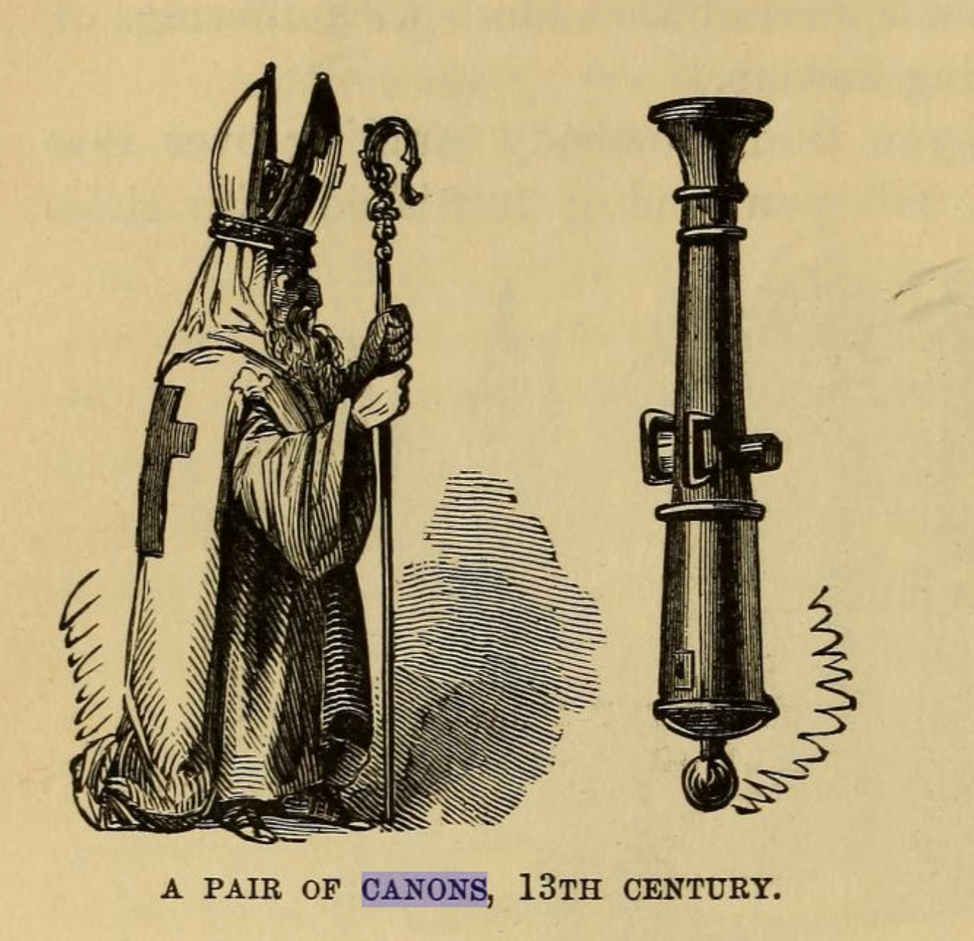
The picture at the top of this column comes from one of Mark Twain’s travelogues. It illustrates the vindictive priest Fulbert, in Twain’s retelling of the story of Abelard and Héloïse, 12th century lovers. More about that momentarily. Abelard was a prominent philosopher who tangled for several years with Saint Bernard of Clairvaux, a significant dispute ably discussed here.

Abelard and the Inklings

Abelard (c. 1079-1142) was a philosopher who, as was common during the Middle Ages, was also a theologian. Among his contributions to religion was revising the Roman Catholic doctrine of limbus infantium (Limbo for unbaptized infants).

In popular culture, Abelard’s love affair with his eventual “wife” is more prominent than his religious pursuits. Although Abelard was a famous figure during the medieval period, he did not feature significantly in C.S. Lewis’ thought. He did, however, exert a prominent influence on Charles Williams’ Place of the Lion, a volume Lewis praised.

In “Friendship in The Place of the Lion,” Dan Hamilton provides a very accessible synopsis of Williams’ book. He describes the experience of a primary character, who is writing her dissertation on “Pythagorean Influences on Abelard.” As she struggles with the appearance of supernatural phenomena, “she encounters the specter of Abelard, a major subject of her studies. But he is dead, and powerless to give her any aid, not even a meaningful word.” The “archetypes” in the story, by contrast, possess genuine power. It is a very unique book.

Returning to Mark Twain’s retelling of the popular medieval tale, we leave the realm of platonic philosophy, and enter the world of sordid human activities. Twain, you see, was not sympathetic to Abelard’s wooing of a young student and his eventual repentance. In his account, Twain desired “to show the public that they have been wasting a good deal of marketable sentiment very unnecessarily.” If you are curious as to his perspective on the events, continue reading.

Twain’s Take on Abelard and Héloïse
(not brief, but well worth reading)

In his own words, Twain’s “faithful” version of their story – but first, he begins with a description of their shared gravesite.

But among the thousands and thousands of tombs in Père la Chaise [cemetery] there is one that no man, no woman, no youth of either sex, ever passes by without stopping to examine. Every visitor has a sort of indistinct idea of the history of its dead, and comprehends that homage is due there, but not one in twenty thousand clearly remembers the story of that tomb and its romantic occupants. This is the grave of Abelard and Heloise – a grave which has been more revered, more widely known, more written and sung about and wept over, for seven hundred years, than any other in Christendom, save only that of the Saviour.

All visitors linger pensively about it; all young people capture and carry away keepsakes and mementoes of it; all Parisian youths and maidens who are disappointed in love come there to bail out when they are full of tears; yea, many stricken lovers make pilgrimages to this shrine from distant provinces to weep and wail and “grit” their teeth over their heavy sorrows, and to purchase the sympathies of the chastened spirits of that tomb with offerings of immortelles and budding flowers.

Go when you will, you find somebody snuffling over that tomb. Go when you will, you find it furnished with those bouquets and immortelles. Go when you will, you find a gravel-train from Marseilles arriving to supply the deficiencies caused by memento-cabbaging vandals whose affections have miscarried.

Yet who really knows the story of Abelard and Heloise? Precious few people. The names are perfectly familiar to every body, and that is about all. With infinite pains I have acquired a knowledge of that history, and I propose to narrate it here, [italics added] partly for the honest information of the public and partly to show that public that they have been wasting a good deal of marketable sentiment very unnecessarily.

Heloise was born seven hundred and sixty-six years ago. She may have had parents. There is no telling. She lived with her uncle Fulbert, a canon of the cathedral of Paris. I do not know what a canon of a cathedral is, but that is what he was. He was nothing more than a sort of a mountain howitzer, likely, because they had no heavy artillery in those days. Suffice it, then, that Heloise lived with her uncle the howitzer, and was happy.

She spent the most of her childhood in the convent of Argenteuil – never heard of Argenteuil before, but suppose there was really such a place. She then returned to her uncle, the old gun, or son of a gun, as the case may be, and he taught her to write and speak Latin, which was the language of literature and polite society at that period.

Just at this time, Pierre Abelard, who had already made himself widely famous as a rhetorician, came to found a school of rhetoric in Paris. The originality of his principles, his eloquence, and his great physical strength and beauty created a profound sensation. He saw Heloise, and was captivated by her blooming youth, her beauty and her charming disposition. He wrote to her; she answered. He wrote again, she answered again. He was now in love. He longed to know her – to speak to her face to face.

His school was near Fulbert’s house. He asked Fulbert to allow him to call. The good old swivel saw here a rare opportunity: his niece, whom he so much loved, would absorb knowledge from this man, and it would not cost him a cent. Such was Fulbert – penurious . . . He asked Abelard to teach her.

Abelard was glad enough of the opportunity. He came often and staid long. A letter of his shows in its very first sentence that he came under that friendly roof like a cold-hearted villain as he was, with the deliberate intention of debauching a confiding, innocent girl. This is the letter :

“I can not cease to be astonished at the simplicity of Fulbert; I was as much surprised as if he had placed a lamb in the power of a hungry wolf. Heloise and I, under pretext of study, gave ourselves up wholly to love, and the solitude that love seeks our studies procured for us. Books were open before us, but we spoke oftener of love than philosophy, and kisses came more readily from our lips than words.”

And so, exulting over an honorable confidence which to his degraded instinct was a ludicrous “simplicity,” this unmanly Abelard seduced the niece of the man whose guest he was. Paris found it out. Fulbert was told of it – told often – but refused to believe it. He could not comprehend how a man could be so depraved as to use the sacred protection and security of hospitality as a means for the commission of such a crime as that. But when he heard the rowdies in the streets singing the love-songs of Abelard to Heloise, the case was too plain – love-songs come not properly within the teachings of rhetoric and philosophy.

He drove Abelard from his house. Abelard returned secretly and carried Heloise away to Palais, in Brittany, his native country. Here, shortly afterward, she bore a son, who, from his rare beauty, was surnamed Astrolabe. . . . The girl’s flight enraged Fulbert, and he longed for vengeance, but feared to strike lest retaliation visit Heloise – for he still loved her tenderly. At length Abelard offered to marry Heloise – but on a shameful condition: that the marriage should be kept secret from the world, to the end that (while her good name remained a wreck, as before) his priestly reputation might be kept untarnished. It was like that miscreant.

Fulbert saw his opportunity and consented. He would see the parties married, and then violate the confidence of the man who had taught him that trick; he would divulge the secret and so remove somewhat of the obloquy that attached to his niece’s fame. But the niece suspected his scheme. She refused the marriage, at first; she said Fulbert would betray the secret to save her, and besides, she did not wish to drag down a lover who was so gifted, so honored by the world, and who had such a splendid career before him. It was noble, self-sacrificing love, and characteristic of the pure-souled Heloise, but it was not good sense.

But she was overruled, and the private marriage took place. Now for Fulbert! The heart so wounded should be healed at last; the proud spirit so tortured should find rest again; the humbled head should be lifted up once more. He proclaimed the marriage in the high places of the city, and rejoiced that dishonor had departed from his house. But lo! Abelard denied the marriage! Heloise denied it! The people, knowing the former circumstances, might have believed Fulbert, had only Abelard denied it, but when the person chiefly interested – the girl herself – denied it, they laughed despairing Fulbert to scorn.

The poor canon of the cathedral of Paris was spiked again. The last hope of repairing the wrong that had been done his house was gone. What next? Human nature suggested revenge. He compassed it. The historian says: “Ruffians, hired by Fulbert, fell upon Abelard by night, and inflicted upon him a terrible and nameless mutilation.”

I am seeking the last resting-place of those “ruffians.” When I find it I shall shed some tears on it, and stack up some bouquets and immortelles, and cart away from it some gravel whereby to remember that howsoever blotted by crime their lives may have been, these ruffians did one just deed, at any rate, albeit it was not warranted by the strict letter of the law.

Heloise entered a convent and gave good-bye to the world and its pleasures for all time. For twelve years she never heard of Abelard – never even heard his name mentioned. She had become prioress of Argenteuil, and led a life of complete seclusion. She happened one day to see a letter written by him, in which he narrated his own history. She cried over it, and wrote him. He answered, addressing her as his “sister in Christ.”

They continued to correspond, she in the un-weighed language of unwavering affection, he in the chilly phraseology of the polished rhetorician. She poured out her heart in passionate, disjointed sentences; he replied with finished essays, divided deliberately into heads and sub-heads, premises and argument. She showered upon him the tenderest epithets that love could devise, he addressed her from the North Pole of his frozen heart as the “Spouse of Christ!” The abandoned villain!

On account of her too easy government of her nuns, some disreputable irregularities were discovered among them, and the Abbot of St. Denis broke up her establishment. Abelard was the official head of the monastery of St. Grildas de Ruys, at that time, and when he heard of her homeless condition a sentiment of pity was aroused in his breast (it is a wonder the unfamiliar emotion did not blow his head off), and he placed her and her troop in the little oratory of the Paraclete, a religious establishment which he had founded.

She had many privations and sufferings to undergo at first, but her worth and her gentle disposition won influential friends for her, and she built up a wealthy and flourishing nunnery. She became a great favorite with the heads of the church, and also the people, though she seldom appeared in public. She rapidly advanced in esteem, in good report and in usefulness, and Abelard as rapidly lost ground. The Pope so honored her that he made her the head of her order.

Abelard, a man of splendid talents, and ranking as the first debater of his time, became timid, irresolute, and distrustful of his powers. He only needed a great misfortune to topple him from the high position he held in the world of intellectual excellence, and it came. Urged by kings and princes to meet the subtle St. Bernard in debate and crush him, he stood up in the presence of a royal and illustrious assemblage, and when his antagonist had finished he looked about him, and stammered a commencement; but his courage failed him, the cunning of his tongue was gone: with his speech unspoken, he trembled and gat down, a disgraced and vanquished champion.

He died a nobody, and was buried at Cluny, A.D., 1144. They removed his body to the Paraclete afterward, and when Heloise died, twenty years later, they buried her with him, in accordance with her last wish. He died at the ripe age of 64, and she at 63. After the bodies had remained entombed three hundred years, they were removed once more. They were removed again in 1800, and finally, seventeen years afterward, they were taken up and transferred to Pere la Chaise, where they will remain in peace and quiet until it comes time for them to get up and move again.

History is silent concerning the last acts of the mountain howitzer. Let the world say what it will about him, I, at least, shall always respect the memory and sorrow for the abused trust, and the broken heart, and the troubled spirit of the old smooth-bore. Rest and repose be his!

Such is the story of Abelard and Heloise. (Innocents Abroad).


* Later Fordefjord was unimaginatively renamed “First Lutheran Church.”

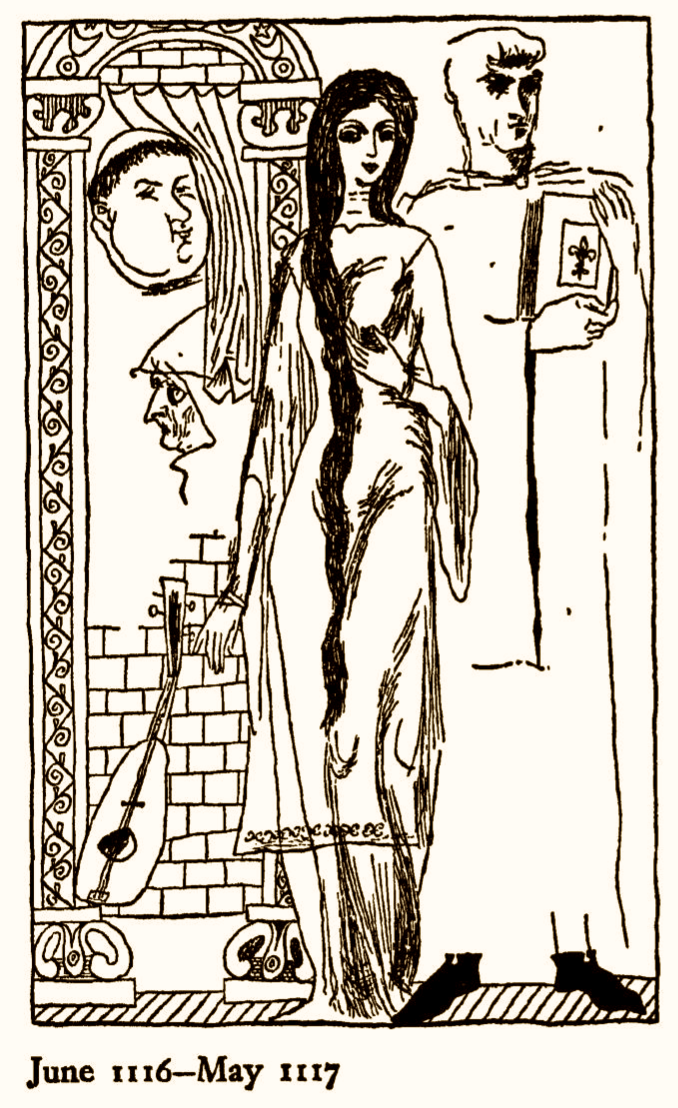
A novel entitled Peter Abelard was published in 1933 by Helen Waddell. It is available at Internet Archive for those who prefer their history via the medium of historical fiction. The illustration below, apparently imitating a fading fresco, comes from that volume.

C.S. Lewis & Roald Dahl

Do C.S. Lewis (1898-1963) and Roald Dahl (1916-1990) have anything in common, besides authoring books enjoyed by children?

Looking back, I must have been deprived of opportunities to read common children’s books. I recall my mom having many of Dr. Seuss’ classics, but don’t remember more advanced works such as those of Beatrix Potter or E.B. White.

I suppose that is why Roald Dahl’s name means little to me. By the time I was aware of his popular works, I was too old to appreciate them. Added to that was my intense dislike for the cinematic presentation of his Chocolate Factory, which has permanently (and probably unfairly) soured my impression of the poor man.

In Matilda, published in 1988, Dahl offers a rather curious homage to the Inklings. The young protagonist offers to her teacher the following observations.

“I like The Lion, the Witch and the Wardrobe,” Matilda said. “I think Mr. C.S. Lewis is a very good writer. But he has one failing. There are no funny bits in his books.”

“You are right there,” Miss Honey said.

“There aren’t many funny bits in Mr. Tolkien either,” Matilda said.

If you are intrigued by this brief interchange, you would probably enjoy reading “Disagreeing with Matilda on Lewis and Tolkien.”

Curiously, a number of people have offered their evaluations of Lewis and Dahl, vis-à-vis one another. Author Grudge Match: Roald Dahl vs. C.S. Lewis invited diverse contributions to the debate eight years ago on LibraryThing.

A Christian blogger offers a faith-based appraisal on an entertaining website called “Like but better.” It’s entitled “How C.S Lewis is like Roald Dahl, but better (and Aslan is like Willy Wonka, but better).”

C.S Lewis is serious about what Dahl jokes about; even as both want us to pursue a childlike wonder and joy. For Lewis these enchanted stories and our sense of wonder are small stories reflecting on the big story — the ‘myth that became history’ — the death and resurrection of Jesus.

A BBC Culture article is quite critical of Dahl, despite his popularity. The introduction to “The Dark Side of Roald Dahl” aptly describes the essay.

Roald Dahl was an unpleasant man who wrote macabre books – and yet children around the world adore them. Perhaps this shouldn’t surprise us, writes Hephzibah Anderson.

An article by a Jewish journalist refers to both of the authors discussed here. It describes his bitter introduction to the major flaws of an author whose work he enjoyed as a child. “Why I Hope My Kids Never Read Roald Dahl” is, for me, most valuable for the way in which the journalist regards the faith which underlies the tales of Narnia.

As a nerdy Jewish kid in Indiana and Tennessee in the late 1970s and 1980s, I had far better relationships with books than I did with other kids. If I liked a book, I read it again, and again and again.

And so it was with Roald Dahls “Charlie and the Chocolate Factory.” Dahl’s protagonists Charlie and later James (of the “Giant Peach”) both provided early models for how to find a better way through a hostile world where I always felt like an outsider.

Given that personal history, the announcement that Netflix has acquired Dahl’s entire catalog and plans a robust lineup of multimedia adaptations ought to feel like good news. . . .

Seeing his work still celebrated fills me with sadness, leaving me caught between attachment to something that mattered to me as a boy and commitment to the principles that, I hope, make me the man I am today.

Because I know that Roald Dahl hated Jewish people like me.

There are cases where it’s complicated to ascribe modern values to figures from the past and as a reader, my feelings, my emotions, are just not going to be consistent. I don’t share C.S. Lewis’ religious views . . . J.R.R. Tolkien’s “Lord of the Rings” trilogy is, I’m sad to say, bound up in long histories of racism.But my childhood copies of their books still occupy my shelves, some missing covers and pages, and I bought new copies for my kids and tried – with mixed success – to share my love of those stories with them. It’s hardly new for readers of one generation to struggle with the views of authors from another.But Dahl is different. He passed away in 1990, only 31 years ago. And we know he was an anti-Semite because he said so.

While I would challenge Perry’s modest critiques of the Inklings, I am delighted he is able to look beyond his adult disappointment with their imperfections to commend them to his own children. As for Dahl . . . this article reinforces my lack of regret in being unfamiliar with his work.

Enough, now, of their differences. I promised readers a surprising similarity between the two British authors.

And What Is Their Unusual Commonality?

In 1951, C.S. Lewis was approached by Prime Minister Churchill’s office to accept an honor occasionally bestowed upon renowned literary figures. He was invited to become a Commander of the Most Excellent Order of the British Empire. Lewis declined, because he felt the political implications might overshadow the nonpartisan spirit of his writings. He was, however, honored to have been offered the honour.

This decision brings us to the peculiar similarity between the two writers. It turns out that Roald Dahl also passed up the invitation to join this chivalric order.

And the two were not alone. In 2012 a list of deceased individuals who had declined related honors between 1951 and 1999 was published.

Literary names were prominent amongst those to have said no to CBEs, OBEs and knighthoods in the annual New Year or Birthday Honours list, with Dahl, Lewis, and Huxley . . . joined by fellow naysayers Eleanor Farjeon, the children’s author, the poets Philip Larkin and Robert Graves, who said no to both a CBE and a CH (Order of the Companions honour), literary critic F.R. Leavis, Booker [Prize] winner Stanley Middleton and the authors J.B. Priestley and Evelyn Waugh.

An aspiring literary historian might do well to research whether and why successful writers might be more inclined to dismiss such an honor than other British citizens. I wonder if that inclination would carry over to other nationalities or cultures.

Ultimately, I assume most writers care less about receiving honors, than having their work read. And, perchance, having their literary efforts improve the lives of one or two others along the way. [This statement inspired vigorous debate when I shared this draft with members of my critique group.]

That desire – to enrich lives – is what motivates me. I believe it is also what inspired C.S. Lewis. And I know we are not alone.

Glorifying the Evil One

One perplexing behavior of humanity, is seen in the inclination of some to glorify our greatest enemy. Some people sincerely adore a being who desires nothing more than humanity’s suffering and eternal separation from our loving Creator.

I once heard the difference between God and Satan put this way: even when you hate him, God still loves you, and even when you love him, Lucifer still hates you.

Yet some still idealize this fallen angel who has earned many corrupt titles, including Tempter and Father of Lies.

In literature and other media you can readily find positive treatments of the Devil. John Milton’s Paradise Lost presents Lucifer as the classic tragic figure. Even his arrogance and vanity about his beauty are presented in a sympathetic fashion. In “Why Satan’s Character in Paradise Lost is the Original Antihero,” Lisa Ampleman says “at the 350th anniversary of its publication, Milton’s masterpiece seems ever more relevant.”

The Romantic poet William Blake even said that Milton was “of the Devil’s party without knowing it.” For the first few books, the charismatic demon’s concerns are front and center, and God seems authoritarian and legalistic.

Fortunately, Milton does not leave us with this sympathetic portrayal of Lucifer. As the article’s author writes, Satan “is not the absolute evil we may have expected, and a sympathetic devil is a dangerous devil.” In Book IX, the Devil even confesses his grim obsession.

But neither here seek I, no nor in Heaven
To dwell, unless by mastering Heaven’s Supreme;
Nor hope to be myself less miserable
By what I seek, but others to make such
As I, though thereby worse to me redound:

For only in destroying I find ease
To my relentless thoughts; and, him destroyed,
Or won to what may work his utter loss,
For whom all this was made, all this will soon
Follow, as to him linked in weal or woe;

In woe then; that destruction wide may range:
To me shall be the glory sole among
The infernal Powers, in one day to have marred
What he, Almighty styled, six nights and days
Continued making . . .

In his Preface to Paradise Lost, C.S. Lewis astutely describes Milton’s depiction of the Devil’s eternal dilemma.

What we see in Satan is the horrible co-existence of a subtle and incessant intellectual activity with an incapacity to understand anything. This doom he has brought upon himself; in order to avoid seeing one thing he has, almost voluntarily, incapacitated himself from seeing at all.

And thus, throughout the poem, all his torments come, in a sense, at his own bidding, and the Divine judgement might have been expressed in the words “thy will be done.” He says “Evil be thou my good” (which includes “Nonsense be thou my sense”) and his prayer is granted.

Turning to one of America’s most renowned authors, we encounter in Mark Twain an unabashedly positive portrayal of Lucifer. In Letters from the Earth (which was too controversial for publication during his lifetime), Satan remains a trusted member of God’s Grand Council. It is left to Satan to question God’s arbitrary creation of violent and flawed creatures.

After a long time and many questions, Satan said, “The spider kills the fly, and eats it; the bird kills the spider and eats it; the wildcat kills the goose; the — well, they all kill each other. It is murder all along the line. Here are countless multitudes of creatures, and they all kill, kill, kill, they are all murderers. And they are not to blame, Divine One?”

“They are not to blame. It is the law of their nature. And always the law of nature is the Law of God. Now – observe – behold! A new creature – and the masterpiece – Man!”

Far from humanity being created in the Divine image, Twain’s twisted version of the Creator has God throwing together all of the positive, and negative, traits he had bestowed on the imperfect animals.

“Put into each individual, in differing shades and degrees, all the various Moral Qualities, in mass, that have been distributed, a single distinguishing characteristic at a time, among the nonspeaking animal world – courage, cowardice, ferocity, gentleness, fairness, justice, cunning, treachery, magnanimity, cruelty, malice, malignity, lust, mercy, pity, purity, selfishness, sweetness, honor, love, hate, baseness, nobility, loyalty, falsity, veracity, untruthfulness – each human being shall have all of these in him, and they will constitute his nature.

“In some, there will be high and fine characteristics which will submerge the evil ones, and those will be called good men; in others the evil characteristics will have dominion, and those will be called bad men.”

Satan later offered some sarcastic compliments about creation and is exiled briefly to Earth. There, Twain’s hero pens a number of letters to archangels sympathetic to his views. A single passage is adequate to illustrate the whole.

Man is a marvelous curiosity. When he is at his very very best he is a sort of low grade nickel-plated angel; at his worst he is unspeakable, unimaginable; and first and last and all the time he is a sarcasm. Yet he blandly and in all sincerity calls himself the “noblest work of God. . . .”

Moreover – if I may put another strain upon you – he thinks he is the Creator’s pet. He believes the Creator is proud of him; he even believes the Creator loves him; has a passion for him; sits up nights to admire him; yes, and watch over him and keep him out of trouble. He prays to Him, and thinks He listens. Isn’t it a quaint idea?

For an accurate illustration of Satan’s activities and purposes, one need look no further than C.S. Lewis’ Screwtape Letters. In one letter, Screwtape highlights the progress Satan’s minions have made in desensitizing humanity to what was recognized as provocative in an earlier age.

We have engineered a great increase in the licence which society allows to the representation of the apparent nude (not the real nude) in art, and its exhibition on the stage or the bathing beach. It is all a fake, of course; the figures in the popular art are falsely drawn; the real women in bathing suits or tights are actually pinched in and propped up to make them appear firmer and more slender and more boyish than nature allows a full-grown woman to be.

Yet at the same time, the modern world is taught to believe that it is being ‘frank’ and ‘healthy’ and getting back to nature. As a result we are more and more directing the desires of men to something which does not exist – making the rôle of the eye in sexuality more and more important and at the same time making its demands more and more impossible. What follows you can easily forecast!

Artistic Presentations of a Sympathetic Devil

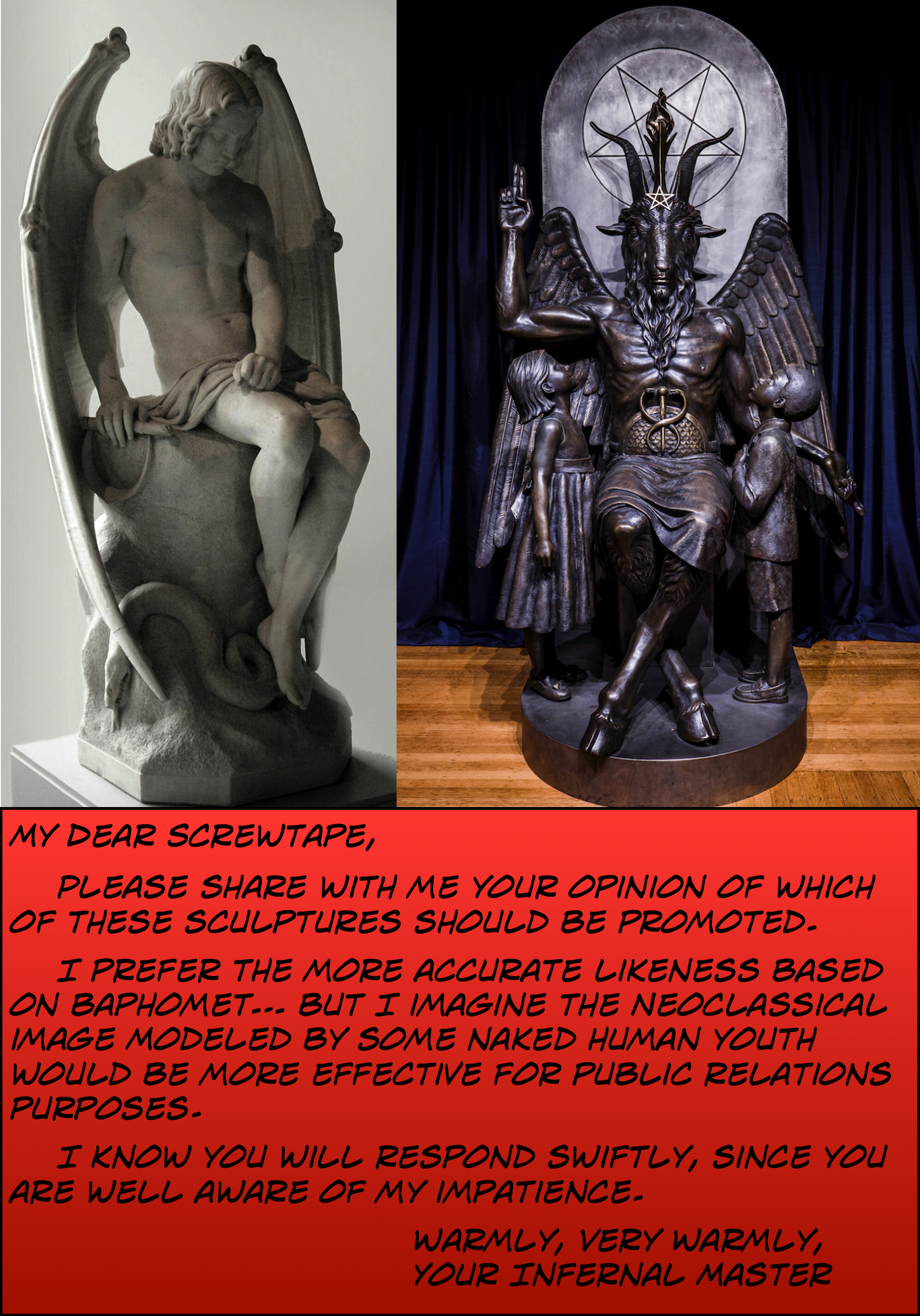
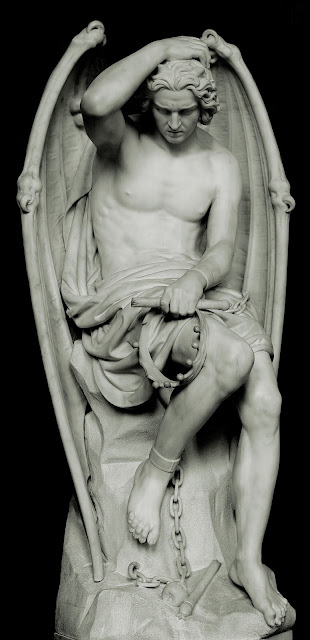
It was actually a nineteenth century Belgian sculpture of Lucifer which is part of the elaborate pulpit of St. Paul’s Cathedral in Liège which inspired today’s reflections. Guillaume Geefs was commissioned to create the piece as part of a general theme of the triumph of religion over evil. The Devil as he portrayed the rebel angel, is rather too appealing for those acquainted with his actual biblical portrait.

Even though his wings have devolved to appear more like those of a bat than a bird, and his foot is chained, the sculpture’s physique is attractive. His apparent regret, evident in his expression and the presence of a tear, invite sympathy. It is regarded as an outstanding example of Romanticism. In a word, it serves as an attractive personification of a vile and malignant being. And this presents a dangerously misleading view of the very real spiritual warfare raging about us.

Curiously, Guillaume’s nude (with a robe safely draped over his lap) was actually a more modest and religious alternative to the image originally intended for the space. Ironically, it was the artist’s younger brother, Joseph, who originally received the commission. Joseph’s sculpture was regarded as even more titillating, and it was replaced. The Royal Museums of Fine Arts of Belgium admits “Joseph created one of the most disturbing works of the period.”

When it was revealed, the initial version of “Le Génie du Mal” (The Genius of Evil) raised questions about its positive portrayal. One publication reported the cathedral’s administrators determined “this devil is too sublime.”

The last thing imperfect human beings living in a fallen world need are sublime and alluring depictions of evil. In the words of C.S. Lewis,

To admire Satan, then, is to give one’s vote not only for a world of misery, but also for a world of lies and propaganda, of wishful thinking, of incessant autobiography. Yet the choice is possible. Hardly a day passes without some slight movement towards it in each one of us.

That is what makes Paradise Lost so serious a poem. The thing is possible, and the exposure of it is resented. Where Paradise Lost is not loved, it is deeply hated. (A Preface to “Paradise Lost”).

Replacement Sculpture by Guillaume Geefs.

C.S. Lewis, Writing and Lust

We’re accustomed to hearing the word “lust” used in a positive manner, such as “she has a lust for life.”

You might even see this in the context of writing. C.S. Lewis himself did this. In 1948, in a letter to an American pastor, he apparently answers a query about what inspires him to write. “The ‘incentive’ for my books has always been the usual one—an idea and then an itch or lust to write.”

I resonate with Lewis’ response. Some idea dawns on me—usually arising from something I’m reading—and then I get the desire to put my own twist on it and share the original idea with others.

This post is no different. I have been working on the military chaplaincy journal that I edit, and I was reading the poetry of a British chaplain from the First World War. Rev. G.A. Studdert Kennedy (1883-1929) was an Anglican priest. He was awarded the Military Cross due to his “disregard for his own safety in attending to the wounded under heavy fire.” The award also noted his Gospel contribution to the harsh life of WWI trenches. “He searched shell holes for our own and enemy wounded, assisting them to the dressing station, and his cheerfulness and endurance had a splendid effect upon all ranks in the front line trenches, which he constantly visited.”

You can read many of his poems in past issues of Curtana: Sword of Mercy, which is available for free download here.

After reading some of his poetry, I turned for the first time to one of his postwar books. It was entitled “Lies!” and addresses a litany of deceptions that plague the world. Included among these deceits is “the lie of lust.”

In the following excerpt, he refers to writing prurient literature which can guarantee a market. It is echoed by a later comment I read from a writer who said she had to write erotic novels to supplement her preferred titles, just so she could make a living. She used a pen name, of course, for the smut.

You can follow Chaplain Kennedy’s argument in the excerpt which follows. Since it is rather lengthy, I will highlight the reference to writing by using a boldface font. Kennedy contrasts in this passage the conflict between humanity’s sinfulness and our call to holiness, the struggle the Apostle Paul describes so succinctly in the seventh chapter of Romans.

“For I do not do the good I want, but the evil I do not want is what I keep on doing. Now if I do what I do not want, it is no longer I who do it, but sin that dwells within me.”

Here is Kennedy’s argument:

But lust in a man is obscene and filthy because it is unnatural. It becomes cruel and debased. It does not proceed to the making of children naturally and cleanly; it descends to unmentionable and disgusting things. The report on the German atrocities in Belgium* provides a kind of horror-chamber in which we can see what lust can bring men to. As one reads that awful document a kind of hot shame comes over one, and makes one sweat for sorrow over sin.

The sting of that shame lies in the fact that one is dreadfully conscious that the root of that disgusting horror is there in one’s own soul. Have you never felt a ghastly doubt rising up in your mind when you read such things? Now what am I reading this for? Is it purely because I want to hate it . . ?

Write a book about the cruelties and debaucheries of a Nero or a Rasputin, and it will sell. There is an appeal in it which thousands, nay, which all men feel, which all men would answer, if the other force within them failed. But the horror of it, the shame for it, is, thank God, as real, more real, than the appeal. There is human history: the war between the appeal and the repulsion of sin: the war between the monkey and the man.

There are thousands of writers, artists, playwrights, musicians, who are making their fortunes out of the appeal to the animal in man. It is the best paying business in the world. Yet, if there is anything that human experience makes certain, it is that there is no end to the journey a man makes in answer to that appeal except damnation, the utter loss of all that makes life good. Lust cannot satisfy a man, because he needs Love. Lust is unnatural in man, it leaves one side of his nature out, and sooner or later that neglected side has its revenge, and turns life’s sweetness bitter to his taste. Then in his despair he will descend in search of new sensations to things which men cannot mention, or even think of without shame. That is the way of it with all men if the great force fail that leads them upward from the animal to the human and divine (Lies! published in 1919).⁑

C.S. Lewis on Carnality

As noted, Lewis was able to use the word “lust” in its muted, nonliteral sense. He was also able to address it literally, and to challenge the hold it exerts on so many lives. In “Religion: Reality or Substitute?” C.S. Lewis vividly described how lust is an enemy.

If we wish to be rational, not now and then, but constantly, we must pray for the gift of Faith, for the power to go on believing not in the teeth of reason but in the teeth of lust and terror and jealousy and boredom and indifference that which reason, authority, or experience, or all three, have once delivered to us for truth.

In a more metaphorical manner, in the Great Divorce Lewis uses the surprising image of a foreboding ruddy lizard to portray the sinister nature of lust.  

I saw coming towards us a Ghost who carried something on his shoulder. Like all the Ghosts, he was unsubstantial, but they differed from one another as smokes differ. Some had been whitish; this one was dark and oily. What sat on his shoulder was a little red lizard, and it was twitching its tail like a whip and whispering things in his ear. As we caught sight of him he turned his head to the reptile with a snarl of impatience. “Shut up, I tell you!” he said. It wagged its tail and continued to whisper to him. He ceased snarling, and presently began to smile.

The encounter which follows is amazing. I won’t spoil it by describing how it ends, but I will once again encourage you to read what is one of my favorite novels. The Great Divorce is about the separation between Heaven and Hell, and explains how a loving God could allow some of his creation to choose a path away from him.

And a Bonus Insight from Dorothy Sayers

Lewis and Sayers were friends, and they deeply respected one another’s work. In 1943, Lewis wrote to Sayers congratulating her on her recently published The Other Six Deadly Sins. He said, “it is one of the few things which I find, within its limits, perfect—i.e. there is nothing one would wish added or removed or altered.” High praise.

Sayers brilliantly strips away some of the euphemisms that mask and confuse candid discussions about sin. This is how she begins what was originally delivered as a public address:

Perhaps the bitterest commentary on the way in which Christian doctrine has been taught in the last few centuries is the fact that to the majority of people the word “immorality” has come to mean one thing and one thing only. The name of an association like yours is generally held to imply that you are concerned to correct only one sin out of those seven which the Church recognizes as capital.

By a hideous irony, our shrinking reprobation of that sin has made us too delicate so much as to name it, so that we have come to use for it the words which were made to cover the whole range of human corruption. A man may be greedy and selfish; spiteful, cruel, jealous, and unjust; violent and brutal; grasping, unscrupulous, and a liar; stubborn and arrogant; stupid, morose, and dead to every noble instinct—and still we are ready to say of him that he is not an immoral man. I am reminded of a young man who once said to me with perfect simplicity: “I did not know there were seven deadly sins: please tell me the names of the other six.”

About the sin called Luxuria or Lust, I shall therefore say . . . that it is a sin, and that it ought to be called plainly by its own name, and neither huddled away under a generic term like immorality, nor confused with love.

The book sounds like it’s well worth reading. It has been out of print for eighty years⁂ but it appears to have been reproduced in toto by this website. (I plan to read the essay as soon as I get this post uploaded!)


* Over 800 civilians were killed by German troops as they advanced through neutral Belgium in 1914. A short describing of these events can be found at this British Library site.

⁑ You can download free copies of Chaplain Kennedy’s books at Internet Archive: Lies! or a collection of his poetry in Rough Rhymes of a Padre.

⁂ A single used copy is currently available via amazon, for the modest price of $287.36, with the comforting notation that the shipping is free.