Anxiety & Nighttime

Everyone experiences some anxiety, but it is only considered a “disorder” when it negatively affects one’s quality of life. Sadly, that level has been reached by nearly twenty percent of Americans.

An estimated 19.1% of U.S. adults had an anxiety disorder in the past year. Past year prevalence of any anxiety disorder was higher for females (23.4%) than for males (14.3%). An estimated 31.1% of U.S. adults experience any anxiety disorder at some time in their lives (National Institute of Mental Health).

As one specialist puts it, “there’s a very strong, well-documented bidirectional link between sleep and mental health issues like anxiety.” And it can become a vicious cycle: “If you have poor sleep, you’re at greater risk of a mental health issue. And if you have a mental health condition like anxiety, you’re more likely to develop a sleep disorder.”

Those “disorder” figures are only for anxiety passing a problematic threshold. Feeling some anxiety is a normal part of life, even for Christians. (Fortunately, however, we have an Intercessor who alleviates anxiety in our fallen lives.)

Do not be anxious about anything, but in everything by prayer and supplication with thanksgiving let your requests be made known to God. And the peace of God, which surpasses all understanding, will guard your hearts and your minds in Christ Jesus (Philippians 4:6-7).

The universality of experiencing anxiety is evidenced by the etymology of the word itself. The Latin anxius simply means troubled or worried (i.e. anxious). 

In his classic Letters to Malcolm: Chiefly on Prayer, C.S. Lewis addresses the negativity associated with being anxious, that actually worsens the problem.

Some people feel guilty about their anxieties and regard them as a defect of faith. I don’t agree at all. They are afflictions, not sins. Like all afflictions, they are, if we can so take them, our share in the Passion of Christ.

So, if most of us admit to experiencing some worry, the question posed by a recent article in TIME is whether the anxiety peaks at night. While not universal, “research has long suggested that, for many people, anxiety symptoms spike and mental health otherwise suffers at night.” While the piece cited several reasons, it left out two causes I consider self-evident.

The article points to studies about how substance abuse and suicidal behavior rise “after midnight,” and how “the racing thoughts that plague many anxiety sufferers are at their worst in the evening.” While I didn’t read the linked research, these statements are simply descriptive of the problem.

As for identified causes, the studies point to our diminished ability to “regulate emotions” as we tire. The issue of isolation is noted as a second factor, since “the rest of the world is asleep.” Further, the lack of daytime distractions may set the stage for “runaway anxiety” as we ponder the “what ifs” of the future. Another logical finding is that anxiety builds as we sleep poorly because we are worrying, which makes us prone to becoming even more anxious.

So What are the Uncited Factors?

First, it seems to me that the darkness of night itself is a major consideration. Since primordial times, night was foreboding. Sharpened wooden or stone-tipped weapons offered little enough defense when we could see predators (beast or human). Our ability to make fires and light candles ignited trifling circles of light that barely penetrated the shadows.

The uncertainty about what lurks in those shadows remains with us today. Just consider how quickly chaos can arise when there are power outages and the “protection” offered by light instantly evaporates.

Related to this is the simple fact that bad things (like crimes), increase during darkness. While many unlawful acts certainly occur during daylight hours, many of the most violent and heinous crimes, such as rape, occur after the sun sets. You can compare many variables at this website

It is simply common sense to recognize we are more vulnerable to violent attack when darkness masks attackers’ identities. The Book of Job vividly describes this lawless predilection.

There are those who rebel against the light,
    are not acquainted with its ways,
    and do not stay in its paths.
The murderer rises before it is light,
    that he may kill the poor and needy,
    in the night he is like a thief.
The eye of the adulterer also waits for the twilight,
    saying, ‘No eye will see me;’
    he veils his face.
In the dark they dig through houses;
    by day they shut themselves up;
    they do not know the light.
For deep darkness is morning to all of them;
for they are friends with the terrors of deep darkness (Job 24:13-17).

While the increased criminal behavior during darkness may have been omitted due to the tacit acknowledgment that it is a factor, my second observation was quite possibly overlooked due to ignorance or prejudice.

The Spiritual Consideration

I am convinced there is a spiritual component to our wariness related to darkness. Even those secularists dismissive of this reality would likely recognize this as a common perception. After all, it is no accident that stories (ancient and modern) depict wicked gatherings and malevolent supernatural events as taking place primarily at night.

The Scriptures discuss this Light/Dark dichotomy extensively. One of the clearest examples comes in the explanation for why sinful people choose to reject the coming of Christ.

In the beginning was the Word, and the Word was with God, and the Word was God. . . . In him was life, and the life was the light of men. The light shines in the darkness, and the darkness has not overcome it. . . .

[Jesus said] “For God so loved the world, that he gave his only Son, that whoever believes in him should not perish but have eternal life. For God did not send his Son into the world to condemn the world, but in order that the world might be saved through him. Whoever believes in him is not condemned . . . the light has come into the world, and people loved the darkness rather than the light because their works were evil.

For everyone who does wicked things hates the light and does not come to the light, lest his works should be exposed. But whoever does what is true comes to the light, so that it may be clearly seen that his works have been carried out in God” (John 1–3, selected verses).

Because darkness helps mask unsavory behavior, author Dave Jenkins advises people to be vigilant regarding their own temptations. He shares his personal story attesting to his contention that “night time for many men and women is danger time.”

This certainly is not God’s desire for any of us. As “The Godliness of a Good Night’s Sleep” concludes, “sleep, it seems, is no fallen necessity, nor merely a fleshly temptation, but a divine gift.”

In The Screwtape Letters, C.S. Lewis’ brilliant exploration of diabolic strategies, the senior demon advises his protégé, how to rob humanity of this blessing.

There is nothing like suspense and anxiety for barricading a human’s mind against the Enemy. He wants men to be concerned with what they do; our business is to keep them thinking about what will happen to them.

But fortunately, humanity’s first Enemy does not have the final say in the matter.

Even During the Darkest Night

We need never be alone nor despair in the night. In fact, even the trials posed by anxiety can become a pathway to a more intimate reliance and relationship with God.

Perhaps most famously, this concept has been associated in Christian circles with “Dark Night of the Soul,” a poem written by Saint John of the Cross in the sixteenth century. In an upcoming post, we will consider John’s life and the controversial actions which followed his death.
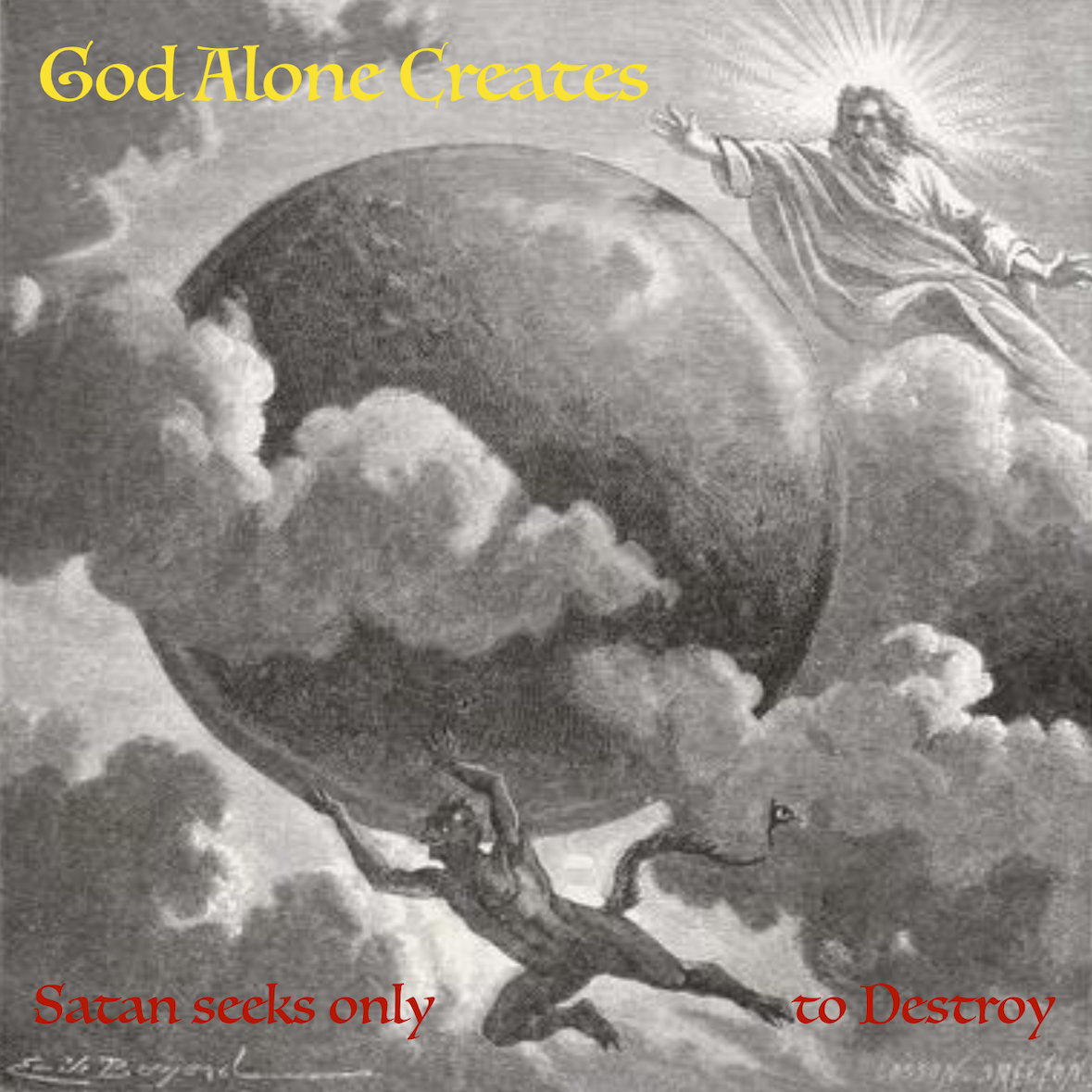
God as the Author of Creation

Satan is powerless versus Christians, especially those who know he exists. Yet, vis-à-vis unbelievers, he “prowls around like [an invisible] lion, seeking someone to devour” (1 Peter 5). Christian “immunity” to Lucifer’s power, if not his temptations, is due to the indwelling presence of God’s Holy Spirit.

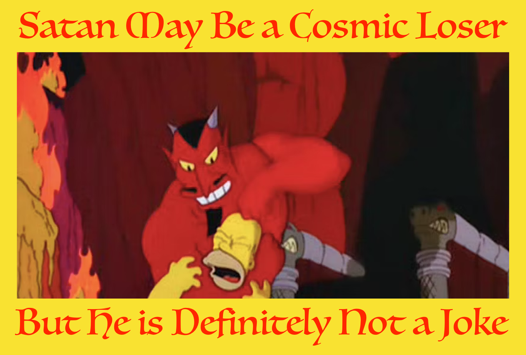
Still, for every human being, whatever their personal belief, the Devil is no mere cartoon, with whom to be trifled. I discussed this briefly in my previous post, “Only God Can Create,” which you might want to read before continuing here.

As for humanity’s vulnerability to the Devil’s influence, the consensus in paradoxically-labeled “enlightened” cultures is that he doesn’t even exist. Sadly, this cosmic lie even tricks self-described “Christians.”

This illusion plays directly into his purposes, as C.S. Lewis described in The Screwtape Letters. Screwtape, a senior demon, instructs his protégée Wormwood in the preferred method of dispelling human wariness about Evil.

The fact that “devils” are predominantly comic figures in the modern imagination will help you. If any faint suspicion of your existence begins to arise in his mind, suggest to him a picture of something in red tights, and persuade him that since he cannot believe in that (it is an old textbook method of confusing them) he therefore cannot believe in you.

Ironically, the populations of less Westernized cultures possess some immunity to this deception. Even in their traditional religions, there is a keen awareness of the existence of evil presences. In the words of The African Study Bible, “we Africans understand instinctively the stories of angelic visitations, spiritual warfare, and demonic oppression that are in the Bible.”

Christians believe in God, not the Devil. While the Scriptures attest to the personal identity of this fallen angel, acknowledgment of his existence is not salvific (i.e. it is not essential to salvation). Thus, C.S. Lewis is correct in his 1944 essay “Answers to Questions on Christianity” when he writes:

No reference to the Devil or devils is included in any Christian Creeds, and it is quite possible to be a Christian without believing in them. I do believe such beings exist, but that is my own affair.

Supposing there to be such beings, the degree to which humans were conscious of their presence would presumably vary very much. I mean, the more a man was in the Devil’s power, the less he would be aware of it, on the principle that a man is still fairly sober as long as he knows he’s drunk. It is the people who are fully awake and trying hard to be good who would be most aware of the Devil. It is when you start arming against Hitler that you first realize your country is full of Nazi agents.

Of course, they don’t want you to believe in the Devil. If devils exist, their first aim is to give you an anaesthetic – to put you off your guard. Only if that fails, do you become aware of them.

On the Matter of Creative Power

Only God can create. That was the core message of our previous discussion. C.S. Lewis recognized, as do biblically-grounded believers, that Satan is merely a sinful, fallen being, little different from humanity in that regard. This truth shatters the pagan philosophy of dualism, or the misguided notion that two equal and opposite forces (e.g. good and evil) exist in some sort of equilibrium. 

In “The Seeing Eye,” C.S. Lewis described the way in which God is beyond his creation. 

Looking for God – or Heaven – by exploring space is like reading or seeing all Shakespeare’s plays in the hope that you will find Shakespeare as one of the characters . . . Shakespeare is in one sense present at every moment in every play. But he is never present in the same way as Falstaff or Lady Macbeth. . . .

If there were an idiot who thought plays existed on their own, without an author . . . our belief in Shakespeare would not be much affected by his saying, quite truly, that he had studied all the plays and never found Shakespeare in them. . . .

My point is that, if God does exist, He is related to the universe more as an author is related to a play than as one object in the universe is related to another. If God created the universe, He created space-time, which is to the universe as the metre is to a poem or the key is to music.

To look for Him as one item within the framework which He Himself invented is nonsensical. If God – such a God as any adult religion believes in – exists, mere movement in space will never bring you any nearer to Him or any farther from Him than you are at this very moment. You can neither reach Him nor avoid Him by travelling to Alpha Centauri or even to other galaxies.

Mark Twain’s Divinized Satan

I had intended to mention Samuel Clemens in my previous article, as one who advanced the assertion that Satan possesses creative ability. Whether Twain regarded the Devil as an actual entity is certainly debatable. What is undeniable, however, is his devoted defense of Lucifer.

As Twain famously wrote in his autobiographical writings, “But who prays for Satan? Who, in eighteen centuries, has had the common humanity to pray for the one sinner that needed it most?” 

Mark Twain was (in)famous for his atheism, or his agnostic antipathy of the Christian understanding of our Creator. Not content to disbelieve, Samuel Clemens actively worked to undermine Christian faith. One of his books, Letters from the Earth, had to be printed posthumously, due its irreverent (or blasphemous) nature.

It bears a superficial resemblance to C.S. Lewis’ amazing Screwtape Letters – insofar as both fictional works present themselves as demonic correspondence. 

The similarity ends there. While Lewis provides keen insight into Evil’s tactics in wreaking havoc in human lives, Twain’s letters present Satan in a positive, even noble, light.

Letters from the Earth is only one of Mark Twain’s anti-Christian works. The Mysterious Stranger is one of his most bizarre. It evidences his long-term preoccupation with Satan, in that it was composed (in various versions) between 1897 and 1908.

The first serious rendition, The Chronicle of Young Satan, was completed in 1900. I mention it here because there is a scene in which the Devil “creates” a miniature world. Obviously it errs in attributing to Lucifer the power to create life – but to its credit, it does reveal Satan as a capricious, vain, cruel, and compassionless lord.

In 1985 a claymation film was released titled The Adventures of Mark Twain. It features the mock scene from Chronicle of Young Satan. It is quite disturbing. However, if one is curious about the subject, and wishes to be forearmed regarding such deceptions, you can view the excerpt here.

Especially for those who do choose to view Twain’s portrayal of the Devil in his fictional “youth,” I desire to end our current discussion on a positive note.

Claymation was also the medium for a long-lived Christian television series. Davey & Goliath, the story of a regular kid and his dog, ran between 1964 and 1975. Many of the episodes can be seen here.

And finally (and forever), we can celebrate with C.S. Lewis the wonder that this world we currently inhabit will not be God’s sole creation. In fact, because of Jesus’ redemptive sacrifice, we can look forward to a new cosmos, untainted by sin.

The New Testament writers speak as if Christ’s achievement in rising from the dead was the first event of its kind in the whole history of the universe. He is the “first fruits”, the “pioneer of life”.

He has forced open a door that has been locked since the death of the first man. He has met, fought, and beaten the King of Death. Everything is different because He has done so. This is the beginning of the New Creation: a new chapter in cosmic history has opened (Miracles).

Only God Can Create

Satan has many disciples in this world. Some know him by other names, or worship him in spirit without recognizing his actual existence (e.g. Mammon). The irony, of course, is that the Devil is simply a posturer, or in modern parlance, a poser. And the presence of the Holy Spirit makes any single Christian more than his match.

A prime evidence of Satan’s weakness is that he is a mere created being, without any creative powers of his own. Although some would grant the Adversary a glory he does not own, the truth is that since his expulsion from Heaven, he has devolved into the Great Pretender.

C.S. Lewis never pretended to be a theologian (for whatever authority that debatable title might convey). Instead, he was a brilliant disciple of Jesus with a sincere desire to follow the teachings of the Scriptures. Lewis certainly wasn’t infallible (and he has many critics who delight in pointing out that obvious fact).

Nevertheless, Lewis’ private insights on the subject of Lucifer’s noncreative limitation are right on the biblical target. Responding to a question posed by a reader, Lewis offered his opinion. 

Dear Mrs [Belle] Allen, I think it would be dangerous to suppose that Satan had created all the creatures that are disagreeable or dangerous to us for (a) those creatures, if they could think, would have just the same reason for thinking that we were created by Satan. (b) I don’t think evil, in the strict sense, can create.

It can spoil something that Another has created. Satan may have corrupted other creatures as well as us. Part of the corruption in us might be the unreasoning horror and disgust we feel at some creatures quite apart from any harm they can do us. (I can’t abide a spider myself.) (correspondence, 11 January 1954).

No, God alone creates . . . and redeems. The impotent Devil can never create, or rescue. His utter corruption results in an admittedly powerful spiritual being (a fallen angel) who is devoted to twisting, breaking, tainting, warping, spoiling, corrupting, rotting, perverting, and ruining all that God loves.

Granted, in our fallen world, Satan can fashion an abomination from some preexisting thing he corrupts – for example, Ophiocordyceps unilateralis the parasitic fungus that turns ants into zombies – but he can never create something out of nothing. These poor abominations are an excellent example of what Lewis referred to when he described the “horror and disgust we feel at some creatures . . .”

Meanwhile, Human Beings Can Create

Well, not exactly “create” on the creatio ex nihilo (created out of nothing) sense. Only God can do that, as he did when he spoke all things into existence. Just as Aslan echoed, when he sang Narnia into being in Lewis’ Chronicles.

“And God said, ‘Let there be light,’ and there was light” (Genesis 1).

“In the beginning was the Word [Logos], and the Word was with God, and the Word was God. . . . All things were made through him . . .” (John 1)

The Lion was pacing to and fro about empty land and singing his new song. It was softer and more lilting than the song by which he had called up the stars and the sun; a gentle, rippling music. And as he walked and sang the valley grew green with grass. It spread out from the Lion like a pool. It ran up the sides of the little hills like a wave” (The Magician’s Nephew)

As for humans like you and me being able to create, that is one of God’s most precious gifts to us. In truth, we use elements already created by the Lord: clay and stone to sculpt, pigments to paint, quill and ink to write.

The Inklings understood this creative impulse quite well. They not only understood it; they lived it. 

Like Christians before and since, they recognized that our creative capacity is based in the fact that we are created imago Dei, in the image of God.

Many people mistakenly believe J.R.R. Tolkien coined the word subcreation (or sub-creation, for the hyphen-infatuated). He certainly applied it for the first time to the intentional creation of what the Oxford English Dictionary calls “the action or process of creating a fully realized and internally consistent imaginary (or ‘secondary’) world.” 

Subcreation may be considered a form of “creation by a created being.” But even the most talented of writers and artists should remember this truth, stated by a Canadian astrophysicist: “God did not grant to the devil or any of his creatures the power to create.”

There is much more to consider on this subject, but Mere Inkling readers will need to wait until my next post, when we will conclude our discussion of this fascinating matter. 

There are two equal and opposite errors into which our race can fall about the devils. One is to disbelieve in their existence. The other is to believe, and to feel an excessive and unhealthy interest in them.

They themselves are equally pleased by both errors, and hail a materialist or a magician with the same delight. (The Screwtape Letters).


The image above is based on the work of Émile Bayard (1837-1891), a French illustrator who was born in Cairo, Egypt.

C.S. Lewis & Longevity

How long is it good for us to live? That’s a strange question, I know. But, do you have an answer? C.S. Lewis had some thoughts on the subject that you may find provocative.

Aging is on my mind this week. I had never thought about myself becoming a septuagenarian – but this week I became one. Well, I still think of myself as being in my fifties, but that appears to be more common than one would guess. When I entered my fifties, I told my dad (then in his seventies) that “I still picture myself as being in my thirties.”

My dad responded without a moment’s thought: “That doesn’t surprise me at all. I still think of myself as being in my fifties.” 

Many people become preoccupied with age. The only time I recall it mattering to me, was when I turned eighteen – able to vote, and registered for the draft (with Vietnam still a war zone) . . . and when I turned twenty-one, for reasons I prefer not to divulge at this time.

People are living longer, and I’m not convinced that translates into living better. Listen to C.S. Lewis, as he writes in his essay “Is Progress Possible?”

I care far more how humanity lives than how long. Progress, for me, means increasing goodness and happiness of individual lives. For the species, as for each man, mere longevity seems to me a contemptible ideal.

Lewis elaborates on this concept – that long life and happiness do not always intertwine – in the Screwtape Letters. The words which follow are the advice of a senior Tempter (devil) to a less experienced junior.

The truth is that the Enemy [i.e. the true God], having oddly destined these mere animals to life in His own eternal world, has guarded them pretty effectively from the danger of feeling at home anywhere else. That is why we must often wish long life to our patients; seventy years is not a day too much for the difficult task of unravelling their souls from Heaven and building up a firm attachment to the Earth.

While they are young we find them always shooting off at a tangent. Even if we contrive to keep them ignorant of explicit religion, the incalculable winds of fantasy and music and poetry . . . are always blowing our whole structure away. They will not apply themselves steadily to worldly advancement, prudent connections, and the policy of safety first.

So inveterate is their appetite for Heaven, that our best method, at this stage, of attaching them to Earth is to make them believe that Earth can be turned into Heaven at some future date by politics or eugenics or “science” or psychology or what not.

Real worldliness is a work of time. . . . How valuable time is to us may be gauged by the fact that the Enemy allows us so little of it. . . .

We are allowed to work only on a selected minority of the race, for what humans call a “normal life” is the exception. Apparently He wants some – but only a very few – of the human animals with which He is peopling Heaven to have had the experience of resisting us through an earthly life of sixty or seventy years. Well, there is our opportunity. The smaller it is, the better we must use it. (Letter XXVIII).

Sadly, far too many people grow far too attached to this world. They lose sight of the promise of Resurrection (if they had ever known it), and as death approaches crave just one more year, another month, another week, another day, even another hour.

Now, I’m not saying long life is a negative, per se. I agree with C.S. Lewis when he wrote “I must never, like the Stoics, say that death does not matter. Nothing is less Christian than that” (“The Grand Miracle”). The danger is not in enjoying the Lord’s wonderful creation. It is in growing too attached to this fallen version of it – in losing touch with the truth proclaimed by musician Larry Norman, that this sin-stained world is not our ultimate home.

Dying

Having been at the bedside of too many people as they face their mortality, I have witnessed many final days. Some literally go, trembling and cursing. Others depart with grim resignation, and no evidence of hope. And then there are those who die with faith, experiencing true peace and joyous anticipation, despite the pain they may be enduring. 

I wish everyone could die in such a state, at peace and earnestly desiring to see the glory of God unblurred by our mortal eyes (1 Corinthians 13). 

On that day we will enter into the fullness of life, into eternal life. (Dr. Michael Zeigler offers an encouraging sermon you can read or listen to at “The Problem and Promise of Deathbed Conversion.”)

The Screwtape Letters is one of C.S. Lewis’ most imitated books. I have even experimented with his model myself. But, rather than emulate these letters, today I would be so bold as to offer an addition to this demonic epistle. 

My supplement is not intended for Christians, except as a truth they may wish to share with others who are walking through the valley of the shadow of death.

And never, my dear Wormwood, at the risk of your own torment, forget this one dire threat. Even after a long life, lived in hedonistic pleasure, deeply tethered to this decaying world, it is still possible for these wretches to be rescued from our claws.

The Enemy is so blindly compassionate that he will foolishly overlook a magnitude of savory sins sown during a carnal life. The dissolute lives we have toiled so steadfastly to soil with uncountable depravities and unrelenting selfishness, remain vulnerable until the patients’ final breath is exhaled.

The Gordian Knot we have so skillfully twisted can be undone in an instant, if they cry out to the Enemy for forgiveness. That is why we must remain vigilant to the very end. It is ideal to have them railing at the end against a God who has allowed them to suffer.

Yet it is sufficient that they die without that rage. A hopeless resignation to what they foolishly consider the end of their existence, still provides fodder for the insatiable appetite of Our Father Below quite adequately.

Final Encouragement

God’s mercy is beyond our ability to comprehend it. While there is breath, there remains hope. Even at the end of a squandered life, God’s love in Jesus Christ is sufficient to wash away every failing, and usher a penitent soul into the glory of everlasting life. 

Remember that, if you find yourself feeling too defiled to come to Christ at the end, that is a lie of Satan. Every single one of us Christians was in similar straits – “while we were still sinners, Christ died for us.”

And, should you ever have the experience of traveling beside a dying friend who sees only darkness ahead, share with them this gospel hope.

Out of Context

Journalists quickly learn the skill of taking the words of people they dislike out of context. By doing this, they can make absolutely brilliant men and women sound like simpletons.

If the person is a public figure, with lots of material to sort through, you can find partial quotations (or obviously humorous or sarcastic remarks) that make the object of their ridicule sound like nearly anything – from a compassionate philanthropist to a conniving fascist.

That’s one reason some people who hope to tarnish the reputation of C.S. Lewis consciously avoid citing his work in its totality (or each piece in its honest context). Thus, as this article suggests, intelligent readers understand Lewis’ writing is “exceptionally good,” while some infantile critics regard it as “dodgy and unpleasant.”

(Do you appreciate my skillful use of adjectives in the previous sentence? They, of course, represent another dishonest method of undermining the arguments of people with whom one disagrees.)

Returning to the idea of taking things out of their context, I offer the graphic (meme, if you will) that I created for the top of this column. It was inspired by “The 12 Most Inspiring Verses In The Bible” in the Babylon Bee. The brief article humorously illustrates how excising words from their context can make them sound rather bizarre.

These examples (mine included) are offered in a light-hearted way. However, the internet teems with examples of malicious attacks on God’s written Word. And many of these rely on the tried and true[false] technique of ignoring the immediate or full context to construct their strawman.

Strawmen or strawwomen are another dishonest form of argument, as “Logical Fallacies 101” explains.

Strawmen, scarecrows, and mannequins all have one thing in common: they are, by nature, flimsy objects that are easy to knock down. In the context of logical fallacies, a “straw man” argument is an argument that is framed in such a way that it is easy to “knock down” or dismantle.

How many times have you been in conversation with someone—someone who holds an opposing viewpoint to yours—who frames your position in a way that you have not? Then once they frame your position in that way, they attack it, supposing that by doing so they have won the argument?

In “Lewis on the Atheist’s Straw Man,” the author quotes a concise argument provided by C.S. Lewis “in Mere Christianity, [where] Lewis warns about over simplifying Christianity (something some people who call themselves Christians sometimes do), and the straw man Atheists often build from this. It’s definitely worth the read.

Biblical Verses that Demand Knowledge of Their Context

Admittedly, there are some passages in the Scriptures that are challenging to comprehend, apart from the whole. Intervarsity Press even has a website “Hard Sayings of the Bible,” subtitled “A Difficult Passage Explained Each Day.”

In “Encountering Difficult Passages,” the author charts a helpful course in how to discover their meaning. Here’s a sample of their sound advice:

Be extra careful with Google. I know. It’s so easy. It’s so tempting. You think, “Google tells me where to go when I’m physically lost; why can’t it help when I’m lost in the Bible?”

The problem is that Google only shows you what’s popular; it cannot differentiate between sites that provide truth and sites that provide ignorance. Avoid your natural impulse to click the first link that appears in a search. There are good websites out there to find answers, but you have to be discerning.

Some of Jesus’ own teachings were difficult for the disciples to comprehend. This was especially true of his announcement that he must die as part of the divine plan to deliver us all from the consequences of sin. When he announced the marvelous mystery of the eucharist (Lord’s Supper) he said “I am the bread of life. . . . Whoever feeds on my flesh and drinks my blood has eternal life, and I will raise him up on the last day. . . . This is the bread that came down from heaven, not like the bread the fathers ate, and died. Whoever feeds on this bread will live forever” (John 6).

While the twelve who become the Apostles continued to follow the Lord, some fell away in confusion because “When many of his disciples heard it, they said, ‘This is a hard saying; who can listen to it?’”

The Bible Truly “In Context”

Christians understand that the Incarnation, Life, Death, Resurrection and Return of Jesus Christ is the final, ultimate Word of the Bible. The Word himself, through whom all things were created, is the central, life-giving message of the holy Scriptures.

Because of this truth, we can evaluate the entire, comprehensive meaning of the Scriptures. We recognize the clear significance of those passages dealing with the Savior of humanity are vital, while those dealing with the nutritional value of locusts are rather less so.

While many people consciously practice this Christocentric reading of the God’s Word, one of its great champions was Martin Luther. If you wish to explore this subject in detail, I commend to you “All Scripture is Pure Christ: Luther’s Christocentric Interpretation in the Context of Reformation Exegesis.” You can find the entire volume in which this essay appears here.

As Martin Luther puts it, “To him who has the Son, Scripture is an open book; and the stronger his faith in Christ becomes, the more brightly will the light of Scripture shine for him.”

Christians are not Gnostics, who believe the Bible is hiding divine secrets from the uninitiated. Quite the contrary. However, the only way to truly understand the meaning of the Scriptures is to read them in their full context. And that context is Jesus, “the Lamb of God, who takes away the sin of the world!”

For the Love of Words

Most writers, including the majority of bloggers, share a common affection. We love words, don’t we?

That love extends beyond mere fondness. We can find ourselves in a state of genuine wonder as we ponder definitions, etymologies (evolutions through diverse languages), and phonesthetics (how they sound). As C.S. Lewis once wrote, “Isn’t it funny the way some combinations of words can give you – almost apart from their meaning – a thrill like music?”

This is one aspect of a great article in the current issue of The Lutheran Witness.* In “For the Love of Words,” editor Roy Askins uses C.S. Lewis’ classic The Four Loves to explore the relationship we have with words. He does so from a Christian perspective shared by the Oxford don.

Words shape us in profound ways. God formed creation and continues to sustain it by the Word of His mouth. . . . Words, then, are not incidental to our lives, but form a central part and core of our identity as God’s people. It’s certainly appropriate for us to talk about “loving words.”

The very word for a lover of words – logophile – combines the Greek logos (word) with philia, which Lewis deems priceless, like “that Philia which Aristotle classified among the virtues or that Amicitia on which Cicero wrote a book.”

[Coincidentally, I have an article about ministry to those who are mourning in the current issue of The Lutheran Witness, as well. I assure you, however, that’s not why I’m citing “For the Love of Words.”] Longtime readers of Mere Inkling are well acquainted with my personal fascination with words and wordplay.

Many of you share this predilection. C.S. Lewis describes us in Studies in Words.

I am sometimes told, that there are people who want a study of literature wholly free from philology; that is, from the love and knowledge of words. Perhaps no such people exist. If they do, they are either crying for the moon or else resolving on a lifetime of persistent and carefully guarded delusion.

Literature, Lewis argues, is not simply the sum of its words. It involves the history of the words, their complex shades of meaning, and even what those very words meant to their original writers.

The Uniquely Christian Perspective

God pours out his gifts of writing quite broadly. Countless styluses, quills and pens have been wielded by talented pagans and atheists over the centuries.

Still, as Askins’ article alludes, Christians have a unique connection to words. Not only did God speak all creation into existence through his Word, but that Logos, that Word became incarnate and suffered an innocent death so that humanity might be redeemed. Askins concludes his article with a joyful truth.

When we seek to love words, then, we do not seek to love them as words in themselves. This danger we editors and writers must mark and avoid. No, we love words because in them and by them, we hear of and share God’s love for us in Christ. He alone makes words holy and precious; He alone makes words worth loving.

I love these closing words. And I strongly believe C.S. Lewis would too.


* The Lutheran Witness is the magazine of the Lutheran Church – Missouri Synod.

Intentional Mispronunciations

Don’t you find it slightly irritating when people intentionally mispronounce words? Sometimes it isn’t merely a silly affectation. What bothers me are cases where people consciously reject the accurate version and flaunt their personal (inaccurate) alternative. It comes across to me like they are magnifying their ignorance with a sizeable dose of obnoxious stubbornness.

Anyone, of course, can accidentally mispronounce a word. Well, anyone aside from C.S. Lewis and J.R.R. Tolkien, that is.

I don’t enjoy (but don’t object to) simple silliness. In a 1932 American Speech article entitled “Intentional Mispronunciations,” the author says, “the custom is an old one, and in our age of light-hearted youth it is unusually widespread.” She immediately notes one danger.

The use of mispronunciations sometimes becomes habit, and it is often difficult to speak correctly when one is in sophisticated company.

The humble person, when advised on the proper enunciation of a particular word, thanks their friend (only friends should dare to sensitively point out such a slip). After expressing that appreciation, they go forward with the commitment to being a bastion of proper usage of the word in question.

However, there are those obstinate ignoramuses (OIs) who defiantly insist on perpetuating their sins.  

Let us consider a common error. One that is quite easily corrected, unless the OI insists on actively rejecting knowledge. The word is “nuclear,” and you already know what the all too common mistake is. How can anyone, much less a graduate of Yale, entrusted with the Gold Codes, accompanied at all times by a military aide ready to hand them the “nuclear football,” continue to use the non-word nu-cu-lar? I have no idea how common this atrocity is outside the United States, but here in the States, it is far from rare.

A good friend of mine, who does public speaking, insists on pronouncing “recognize” without its “g.” I understand he must have learned it that way, but I will never get used to a person with advanced degrees saying “rec-a-nize.” My father was a curmudgeon, and this conscious affront reinforced his chosen image. He loved to push my buttons by adding an “r” to the state I call home. Warshington doesn’t exist on any map, but it certainly did in his mind.

Why Pronunciations Err

People are prone to mispronunciation when they’ve only read a word, and never heard it pronounced before. This was especially perilous before the existence of online dictionaries.

There is another hazard which can mislead someone in pronouncing a word incorrectly—and it was to this that I succumbed my first year at seminary. This is the case where a word is spelled in a manner that makes the errant pronunciation possible, and you have only heard it pronounced in the wrong way. This is the story of my shame.

I was taking a consortium course on ministry and media, which was taught by professors from four or five different seminaries. In my first “radio” presentation, I cited a passage from one of the Psalms. Everyone said it was well done—until the Roman Catholic professor (with nary a hint of affirmation) declared, ex cathedra: “it’s ‘sahm;’ you don’t pronounce the ‘l.’”

I was so embarrassed that I remained silent and soon as I got home I pulled out my dictionary, and darned if he wasn’t right. I have pronounced it correctly ever since, even in the face of a world that now considers me to be wrong.

My aversion to the intentional-mispronunciators does not extend to people who say “salm.” After all, that’s how the word should be pronounced.* But those people who insist on saying “re-la-ter” when the profession is clearly spelled “re-al-tor,” are begging for some sort of aversion therapy.

There is one additional case I wish to note here. That is when there are two (or more?) legitimate ways to pronounce a word. I’m not referring to homographs, like wind (wĭnd) and wind (wīnd).

C.S. Lewis also discusses pronunciation at great length in his essay “The Alliterative Metre,” where he notes,

In modern English many words, chiefly monosyllables, which end in a single consonant are pronounced differently according to their position in the sentence. If they come at the end of a sentence or other speech-group—that is, if there is a pause after them—the final consonant is so dwelled upon that the syllable becomes long.

If the reader listens carefully he will find that the syllable man is short in ‘Manifold and great mercies’ or ‘The man of property,’ but long in ‘The Invisible Man’ or ‘The Descent of Man.’

Words with multiple formally accepted pronunciations are fair game—as long as a person’s choice is from the list. Here’s one where pronouncing the “l” is optional: almond. Apricot can begin with either the sound “app” or “ape.”

A Playful Game Using Homographs

The following example uses a name, but the principle would be the same for any word with more than one authentic pronunciation. It comes from a book I read many years ago, which has retained a fond place in my memory. Robert McAfee Brown (1920-2001) was a Presbyterian theologian. The title of the volume suggests its satirical bent: The Collect’d Writings of St. Hereticus.

One of the appendices in the book is called “Theological Gamesmanship.” One of the games he features is “How to Win a Theological Discussion Without Knowing Anything.” The following gambit is called “Help from St. Augustine.”

A quiet yet forceful way of demonstrating superiority when Augustine is under discussion is to pronounce his name in contrary fashion to the pronunciation of the Opponent.⁑ Make a point of emphasizing the contrast, so that it will be apparent that you know you are right, and not even for politeness’ sake will you pronounce the name incorrectly as Opponent is doing. Either,

Opponent: . . . leading ideas in Augustine (Ogg-us-teen).
Self: Augustine (uh-Gust’n)may have said that on one or two occasions, but . . .
Or,
Opponent (usually an Anglican in this case): . . . leading ideas in Augustine.
Self: Augustine may have said that on one or two occasions, but the whole Augustinian tradition, following, as I believe, the essential Augustine himself . . .

In this second gambit, it is advisable to maneuver the conversation into a discussion of “the Augustinian tradition” as indicated, so that when Opponent refers to it, as he must, without pronouncing it “the Augustinian tradition,” you can smile deprecatingly, to indicate that your point has been made.

[Brown adds a footnote that reads:] With sensitive Anglicans, it will often be enough simply to raise, ever so slightly, (a) both eyebrows, and (b) the second, third, and fourth fingers of the left hand.

Naturally, I’m not seriously suggesting that one-upmanship is something in which one should engage. On the contrary, Brown (and I) are holding up this sort of petty behavior as beneath the dignity of good people.

I’m sure that some would argue that correcting someone’s pronunciation in even the most glaring examples of verbal atrocities, constitutes bad manners. I, however, appreciate being privately corrected, so that I might not continue making the same mistake. Thus, I consider it the act of a friend.

C.S. Lewis was a patient and gracious man. He was quite tolerant of variation in pronunciation, even when it came to his own creations. In 1952 he responded to a correspondent inquiring how to properly pronounce the name of Aslan. I would guess the most common American version would be “æzˌlæn” opting to pronounce the “s” as a “z.” Here is Lewis’ response:

It is a pleasure to answer your question. I found the name in the notes to Lane’s Arabian Nights: it is the Turkish for Lion. I pronounce it Ass-lan [æsˌlæn] myself. And of course I meant the Lion of Judah. I am so glad you liked the book.

I loved the book, and I affirm its readers, whichever way they pronounce the name of the Great Lion. Well, as long as they don’t intentionally mispronounce it, including an invisible “r.” After all, there is most certainly no beloved image of Christ named Arslan!


* This waiver does not extend, however, to what may be the most common biblical mistake. The Book of Revelation does not have an “s.” Yet, how often do you hear it cited as Revelations?

⁑ This brazen technique is equally effective, no matter which pronunciation the person you seek to upstage has used.

The cartoon at the top of this post is used with the permission of xkcd.

Not Quite Christmas

Sadly, most people miss out on the true meaning of Christmas. But then, there are some people who really miss the mark altogether. That was the case with many Brits during the Victorian era.

Today I read in Philosopher Mouse of the Hedge about Victorian Christmas cards. Phil’s great post was inspired by a BBC article, “Frog Murder and Boiled Children: ‘Merry Christmas’ Victorian style.” As Phil writes, “and you thought that sinister Elf on the Shelf was creepy.”

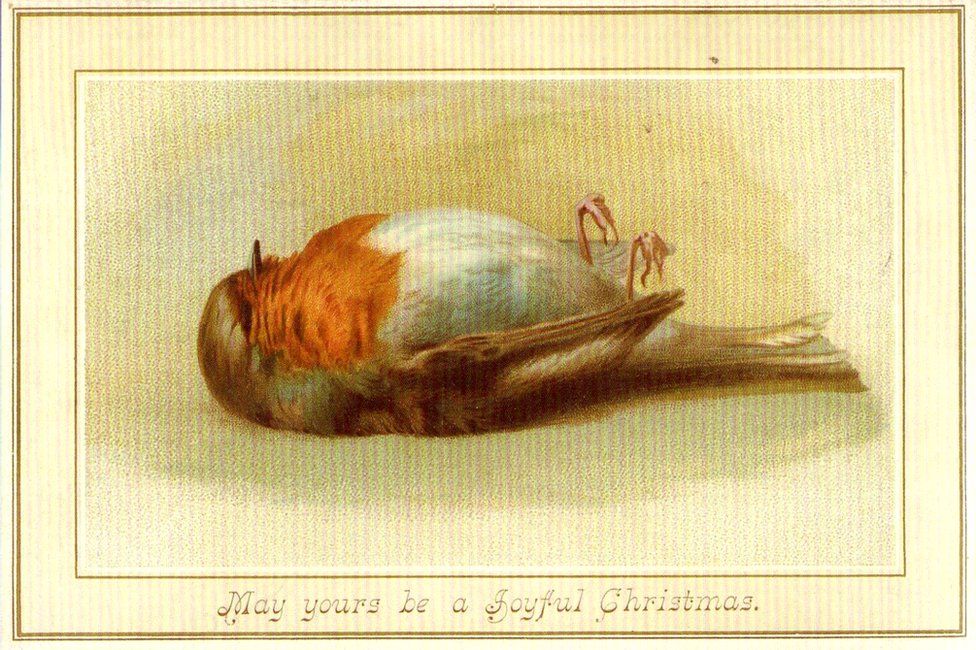
The card at the top of my post comes from the BBC collection. Pretty morbid. Where does the “Joyful Christmas” enter in? One might think this is the kind of card a passive aggressive victim of ornithophobia might send an enemy—but that was not its original design.

The Robin redbreast is a treasured resident of Britain, as this interesting article describes in detail. Just a few years ago, in fact, “it won a BBC Springwatch poll to choose the UK’s national bird.” The author describes their distinctive association with Christmas, although I am positive he did not have the image of this unfortunate creature in mind when he penned these words.

Another reason we connect robins with Christmas is that the early postmen wore red uniforms, and so were nicknamed ‘robins.’ And, as the cards pop through your letter box over the coming days, note how many feature a robin!

Here’s another peculiar card that has nothing to do with Christmas. At least it simply refers to “the Season,” and doesn’t tarnish the word “Christmas” itself.

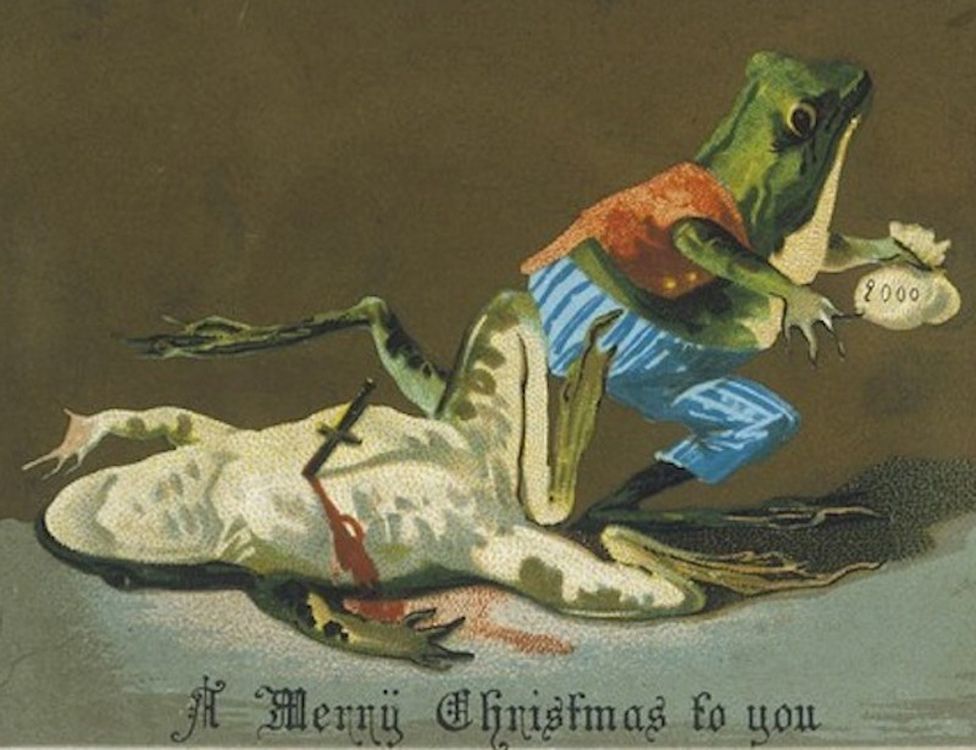
Such a modicum of good taste did not deter the creator of the next card from associating robbery and homicide (actually frogicide) with the day celebrating Christ’s birth. One must hope that the grim illustration was originally fashioned for a different context.

C.S. Lewis knew that the British had a problem comprehending Christmas’ meaning. Why, they even twisted things sufficiently to link telling ghost stories to the commemoration of the Nativity.

It may have something to do with a confused relationship between church and state. Nations with “state religions” typically see those religious faiths morph into distortions of their true selves. Thus history is filled with examples of total secularists or hedonists who were the “titular head” of a state church.

Henry VIII set the bar for hypocrisy quite high, with adultery and murder his bywords. C.S. Lewis includes a tribute (of damning sorts) to this despicable ruler in his sequel to The Screwtape Letters, “Screwtape Proposes a Toast.” In the address, fictitiously delivered by the devil Screwtape, the Tempter bemoans the mediocre vices of the humans whose anguish provides the main course.

The scene is in Hell at the annual dinner of the Tempters’ Training College for young Devils. The Principal, Dr Slubgob, has just proposed the health of the guests. Screwtape, who is the guest of honour, rises . . .

Your dreaded Principal has included in a speech full of points something like an apology for the banquet which he has set before us. Well, gentledevils, no one blames him. But it would be vain to deny that the human souls on whose anguish we have been feasting tonight were of pretty poor quality.

Not all the most skilful cookery of our tormentors could make them better than insipid. Oh to get one’s teeth again into a Farinata,* a Henry VIII, or even a Hitler! There was real crackling there; something to crunch; a rage, an egotism, a cruelty only just less robust than our own. It put up a delicious resistance to being devoured. It warmed your innards when you’d got it down.

So much for Henry VIII and the peculiarities of Church and State relations in England. Whatever the origin of this confusion about Christmas, it is quite tragic and disturbing.

So, What is the Proper Focus?

For an entertaining take on the proper focus during Christmas, you might want to check out “Martin Luther Yells about Anglican Christmas Hymns.” (Apologies to those who love English hymns for sentimental reasons.)

And now, one final Victorian card which serves as a fitting capstone to today’s conversation. ’Tis innocent mirth that gives Christmas its worth. (Or not.)


* Manente degli Uberti (aka Farinata delgi Uberti, 1212-1264) was an Italian heretic mentioned by Dante in Inferno.

C.S. Lewis & the Police

policePolice are entrusted with the power and authority to protect the innocent. That very power provides them with the opportunity to abuse that trust.

Recent events in the United States have drawn to the world’s attention the fact that human beings are incapable of providing perfect law enforcement. That should come as no surprise since, due to our fallen nature, we can do nothing perfectly.

C.S. Lewis never wrote a treatise specifically about law enforcement, but he did refer to it on a number of occasions. This week I thought it might be beneficial to consider a number of his insights. The final quotation relates a specific experience Lewis had with responsive police and a rather unresponsive judiciary.

Lewis had an impressive knack for using familiar images to illustrate biblical principles. In the following example he uses police, an occupation recognized by all, to display the absurdity of the logic of skeptics of Christianity.

If the universe is teeming with life, this, we are told, reduces to absurdity the Christian claim—or what is thought to be the Christian claim—that man is unique, and the Christian doctrine that to this one planet God came down and was incarnate for us men and our salvation.

If, on the other hand, the earth is really unique, then that proves that life is only an accidental by-productd in the universe, and so again disproves our religion. Really, we are hard to please. We treat God as the police treat a man when he is arrested; whatever He does will be used in evidence against Him. (“Dogma and the Universe”)

Let us now consider a few of the principles easily gleaned from Lewis’ writings.

Law Enforcement is a Normal Occupation

In that sense, police are no different than any other member of the community. C.S. Lewis illustrates that truth by including them in a list of “regular” occupations.

Dr. Pittenger would be a more helpful critic if he advised a cure as well as asserting many diseases. How does he himself do such work? What methods, and with what success, does he employ when he is trying to convert the great mass of storekeepers, lawyers, realtors, morticians, policemen and artisans who surround him in his own city? (“Rejoinder to Dr. Pittenger”)

Law Possesses a Vital Function

The State exists simply to promote and to protect the ordinary happiness of human beings in this life. A husband and wife chatting over a fire, a couple of friends having a game of darts in a pub, a man reading a book in his own room or digging in his own garden—that is what the State is there for. And unless they are helping to increase and prolong and protect such moments, all the laws, parliaments, armies, courts, police, economics, etc., are simply a waste of time. (Mere Christianity)

In his essay “Vivisection,” Lewis mentions in passing the role of law enforcement in society. We have assigned to them the responsibility of investigating suspicious behavior to determine whether it conforms to the law of the land. And they do so according to whatever guidelines or restrictions the government (presumably of by and for the people) levies upon them.

In justifying cruelty to animals we put ourselves also on the animal level. We choose the jungle and must abide by our choice. You will notice I have spent no time in discussing what actually goes on in the laboratories. We shall be told, of course, that there is surprisingly little cruelty. That is a question with which, at present, I have nothing to do. We must first decide what should be allowed: after that it is for the police to discover what is already being done.

In Democracies Police are Generally Trustworthy

Lewis acknowledges that there are places where the police are frequently corrupt and perhaps even brutal. But he reminds us that we who live in democratic nations should be grateful for the normal behavior of those who serve in law enforcement.

The decline of ‘religion’ is no doubt a bad thing for the ‘World.’ By it all the things that made England a fairly happy country are, I suppose, endangered: the comparative purity of her public life, the comparative humanity of her police, and the possibility of some mutual respect and kindness between political opponents.

But I am not clear that it makes conversions to Christianity rarer or more difficult: rather the reverse. It makes the choice more unescapable. When the Round Table is broken every man must follow either Galahad or Mordred: middle things are gone. (“The Decline of Religion”)

Is it inappropriate to note how prophetic Lewis’ observation was that the secularization of Western culture would also erode political civility?

“Police States,” by Contrast, are Evil

In his preface to The Screwtape Letters, Lewis divulges where he found some of his images for his infernal milieu.

I live in the Managerial Age, in a world of “Admin.” The greatest evil is not now done in those sordid “dens of crime” that Dickens loved to paint. It is not done even in concentration camps and labour camps. In those we see its final result. But it is conceived and ordered (moved, seconded, carried, and minuted) in clean, carpeted, warmed and well-lighted offices, by quiet men with white collars and cut fingernails and smooth-shaven cheeks who do not need to raise their voices. Hence, naturally enough, my symbol for Hell is something like the bureaucracy of a police state or the office of a thoroughly nasty business concern.

C.S. Lewis’ father was an attorney. But not just any sort of solicitor. He was a Police Court Solicitor, an important role which had as one of its purposes allowing a person who was arrested on suspicion of a criminal offense to consult with a lawyer while in initial police custody.

Lewis describes in his autobiography how his father regaled him and his brother Warnie with stories about curious police-court happenings. At the same time, Lewis confesses to his father’s struggle to relate to his boys after the loss of his wife when they were still young. Confessing that he frequently found his father’s conversations with his young sons confusing, he writes:

The man who, in his armchair, sometimes appeared not so much incapable of understanding anything as determined to misunderstand everything, was formidable in the police court and, I presume, efficient in his office. He was a humorist, even on occasion, a wit. (Surprised by Joy)

Corrupt Governments Corrupt the Police Force

One of the characteristics of police states is that they have extensive networks of “secret police,” who are often imbued with extraordinary prerogatives. One such malevolent presence plays just such a role in The Lion, the Witch, and the Wardrobe. Searching for Mr. Tumnus, the Pevensie children are discovered by Mr. Beaver. When they inquire of Lucy’s friend, the faun, he says:

“Ah, that’s bad,” said Mr. Beaver, shaking his head. “That’s a very, very bad business. There’s no doubt he was taken off by the police. I got that from a bird who saw it done.”

That explains the note the children had discovered at Mr. Tumnus’ ransacked home.

The former occupant of these premises, the Faun Tumnus, is under arrest and awaiting his trial on a charge of High Treason against her Imperial Majesty Jadis, Queen of Narnia, Chatelaine of Cair Paravel, Empress of the Lone Islands, etc., also of comforting her said Majesty’s enemies, harboring spies and fraternizing with Humans.

signed MAUGRIM, Captain of the Secret Police

LONG LIVE THE QUEEN!

One more passage reveals how quickly the deceitful captain can vacillate between threatening and gracious poses. Edmund has arrived at the Witch’s castle is been confronted by Maugrim.

“If you please, sir,” said Edmund, trembling so that he could hardly speak, “my name is Edmund, and I’m the Son of Adam that Her Majesty met in the wood the other day, and I’ve come to bring her the news that my brother and sisters are now in Narnia—quite close, in the Beavers’ house. She—she wanted to see them.”

“I will tell Her Majesty,” said the Wolf. “Meanwhile, stand still on the threshold, as you value your life.”

Then it vanished into the house. Edmund stood and waited, his fingers aching with cold and his heart pounding in his chest, and presently the gray wolf, Maugrim, the Chief of the Witch’s Secret Police, came bounding back and said, “Come in! Come in! Fortunate favorite of the Queen—or else not so fortunate.”

The Police Can Solve Problems

Yes, the example below comes from his novel The Silver Chair, but it is too good to overlook. Lewis is skilled at teaching through his fiction as well as in his essays.

This excerpt come from one of the Chronicles of Narnia, and Aslan has just returned Jill and Eustace to England, where there was a “corrective” encounter with some school bullies. The headmistress calls the police, and we join the scene . . .

When the police arrived and found no lion, no broken wall, and no convicts, and the Head behaving like a lunatic, there was an inquiry into the whole thing. And in the inquiry all sorts of things about Experiment House came out, and about ten people got expelled.

After that, the Head’s friends saw that the Head was no use as a Head, so they got her made an Inspector to interfere with other Heads. And when they found she wasn’t much good even at that, they got her into Parliament where she lived happily ever after.

Police are Not Soldiers

In the following passage, Lewis shows an astute awareness of the actual role of the Roman soldier in the Jerusalem of Jesus’ day. They were certainly an occupation force, but their role in garrison was not to be “soldiers,” but rather to be “peacekeepers.” They were to maintain law and order, the so-called Pax Romana.

And because the whole difficulty for us is that the natural life has to be, in a sense, ‘killed,’ [Jesus] chose an earthly career which involved the killing of His human desires at every turn—poverty, misunderstanding from His own family, betrayal by one of His intimate friends, being jeered at and manhandled by the Police, and execution by torture. (Mere Christianity)

Lewis does the same thing in his essay “Modern Translations of the Bible,” where he compares the common* nature of the Greek used to write the Scriptures with the Incarnation.

The New Testament in the original Greek is not a work of literary art: it is not written in a solemn, ecclesiastical language . . . It is a sort of `basic’ Greek; a language without roots in the soil, a utilitarian, commercial and administrative language. Does this shock us? It ought not to, except as the Incarnation itself ought to shock us.

The same divine humility which decreed that God should become a baby at a peasant-woman’s breast, and later an arrested field-preacher in the hands of the Roman police, decreed also that He should be preached in a vulgar, prosaic and unliterary literary language. If you can stomach the one, you can stomach the other.

C.S. Lewis’ Experience with the (In)Justice System

In 1957, Lewis wrote an essay** about a personal experience with the British judicial system. I choose to close with this selection because it is quintessential Lewis. He uses a fine critique of the treatment of criminals to also acknowledge his personal sinfulness. In this true story, the police do their job admirably. The judge . . . not so much.

Not long ago some of my young neighbours broke into a little pavilion or bungalow which stands in my garden and stole several objects—curious weapons and an optical instrument. This time the police discovered who they were. As more than one of them had been convicted of similar crimes before, we had high hopes that some adequately deterrent sentence would be given.

But I was warned: “It’ll all be no good if the old woman’s on the bench.” I had, of course, to attend the juvenile court and all fell out pat as the warning had said. The—let us call her—Elderly Lady presided. It was abundantly proved that the crime had been planned and that it was done for gain: some of the swag had already been sold.

The Elderly Lady inflicted a small fine. That is, she punished not the culprits but their parents. But what alarmed me more was her concluding speech to the prisoners. She told them that they must, they really must, give up these “stupid pranks.”

Of course I must not accuse the Elderly Lady of injustice. Justice has been so variously defined. If it means, as [Athenian sophist] Thrasymachus thought, “the interest of the stronger,” she was very just; for she enforced her own will and that of the criminals and they together are incomparably stronger than I.

But if her intention was—and I do not doubt that the road on which such justice is leading us all is paved with good ones—to prevent these boys from growing up into confirmed criminals, I question whether her method was well judged. If they listened to her (we may hope they did not) what they carried away was the conviction that planned robbery for gain would be classified as a “prank”—a childishness which they might be expected to grow out of.

A better way of leading them on, without any sense of frontiers crossed, from mere inconsiderate romping and plundering orchards to burglary, arson, rape and murder, would seem hard to imagine.

This little incident seems to me characteristic of our age. Criminal law increasingly protects the criminal and ceases to protect his victim. One might fear that we were moving towards a Dictatorship of the Criminals or (what is perhaps the same thing) mere anarchy. But that is not my fear; my fear is almost the opposite.

According to the classical political theory of this country we surrendered our right of self-protection to the State on condition that the State would protect us. Roughly, you promised not to stab your daughter’s murderer on the understanding that the State would catch him and hang him.

Of course this was never true as a historical account of the genesis of the State. The power of the group over the individual is by nature unlimited and the individual submits because he has to. The State, under favourable conditions (they have ceased), by defining that power, limits it and gives the individual a little freedom.

And so we see that Lewis shared a concern that has only become accentuated among many today. When the State abuses its prodigious power, and especially when it revises the role of those in law enforcement, transforming them into “enforcers,” we are in dire straits.

Thankfully, that has not yet transpired in most democratic lands. Still, the possibility of such decay has not been eliminated, and wisdom suggests that we remain vigilant should we see things sliding in that direction.

_____

* On the subject of the commonness of the language God uses to speak to us, you may wish to read my column on “Vulgar Christianity.”

** “Delinquents in the Snow” is included in the readily available collection, God in the Dock.

Echoes of Christmas

Rosary Basilica LourdesI love greeting people with “Merry Christmas” after the day itself has passed.

Most people are surprised—probably thinking that I slept through the celebration. Many Christians, however, respond with their own best wishes, in recognition that the celebration of Jesus’ nativity marks the beginning of a season of wonder.

The celebration of the Incarnation miracle is far too wondrous to be confined to a single day.

People often ask “how was your Christmas?” By that, most are inquiring as to whether it was enjoyable.

It is a profound question, if one truly reflects upon it.

As a child, I must confess that the quality of my “Christmas” was probably determined to large extent by the presents I received. I don’t remember many of the particular gifts—these many years later—but I do recall the anticipation I felt as we awaited Christmas Day and the glorious unwrapping.

As a parish pastor my perceptions of a “good” Christmas were determined in large part by the number and enthusiasm of the individuals attending the season’s special worship services. (I am not proud, of course, to confess this.)

In later, semi-retired days, I gauge the joy of each Christmas by the time spent with family. To have all the kids and grandkids near is magnificent. To be able to connect with our “extended family” is icing on the cake.

Obviously, I’m not alone in measuring the quality of my “Christmas experience” by the presence of family.

At the close of the First World War, as C.S. Lewis had finished recuperating from his wounds, he longed to be able to return home to Ireland to celebrate with his father and brother. The Armistice had been signed a month earlier, but delays prevented his arrival by December 25th. Nevertheless, he did manage to arrive for the Christmas season, as Warnie recorded in his diary two days later.

A red letter day. We were sitting in the study about eleven o’clock this morning when we saw a cab coming up the avenue. It was Jack! He had been demobilized, thank God. Needless to say there were great doings. He is looking pretty fit . . . In the evening there was bubbly for dinner in honour of the event: the first time I have ever had champagne at home.

Family can be a wonderful thing, although there seem to be an increasing number of people in our day who are a scourge to their families. My heart goes out to those who have lost their loved ones, or who have never experienced familial love in the first place.

These holiday seasons—filled with laughter and champagne for most—can be a barren emotional wasteland for many.

It is good for us all to remember that fact, and remain vigilant to draw the lonely into the light of our family campfires.

The Deep Joy of Christmas

I have said that as a child, I relished the anticipation of my gifts. Later in life I have focused on other matters in assessing whether or not my Christmas has been an exceptional one.

The fact is that the foundation for all of my happiness comes from an awareness of Christmas’ true meaning.

In a word, Emmanuel. God with us.

For me and my family, it simply would not be Christmas if we were not able to gather with our sisters and brothers in Christ to celebrate Jesus’ birth. That said, for believers in some Islamic and Buddhist nations where Christians are not free, the miracle of Christmas rings no less true.

The presence of the Holy Spirit, and the constancy of Christ’s grace are such an indivisible part of my life, that I often take them for granted. And so it is during Christmas.

The gift-giving and family can occupy the forefront of my thoughts. However, it is only because of the life-giving sacrifice of that innocent Child that events in this life possess the potential to have eternal significance.

Jesus came in humility. He came to serve. He came to suffer. He came to offer his own pure life to redeem our imperfect and corrupt lives.

That’s what Christmas is about, and that is why it is too wondrous for its celebration to be relegated to one brief day.