C.S. Lewis & Assassinations

The brilliant author C.S. Lewis died on the same day that an American president was assassinated. The violent death of John F. Kennedy in November of 1963 eclipsed Lewis’ own passing, so many people were unaware of it for some time. Yet on that autumn day, both Camelot and Narnia lost their inspirations.

Unfortunately, Kennedy’s shooting was not the only political assassination that was connected in a manner to C.S. Lewis’ life. Archduke Franz Ferdinand Carl Ludwig Joseph Maria of Austria was the heir apparent to the throne of Austria-Hungary. A nineteen year old political activist cold-bloodedly murdered the archduke and his wife, Sofie.

Franz and Sophie had married for love, despite her inadequate social rank, which resulted in a morganatic marriage. In recent years such unions have become more common, but at the time, it was a serious matter. The archduke was forced by his uncle, the emperor, to accept that their descendants would never have a right to the throne.

In a convoluted fashion, Ferdinand’s death nearly led to C.S. Lewis’ own. The 1914 assassination was the spark that set the globe on fire during the First World War. And, during that grim conflict, C.S. Lewis was severely wounded by an artillery shell that killed friends standing nearby.

The Causes and Impact of Political Assassinations” was published by the Combating Terrorism Center at West Point. It begins with the fact that “political assassinations have been part of social reality since the emergence of communal social frameworks . . .” And so, since social frameworks will forever exist, they continue.

Humanity’s Violent History

Assassination has been a relatively common practice throughout human history. This shouldn’t surprise anyone who knows the sad story of Abel and his angry brother, Cain. 

Philip II of Macedon, the father of Alexander the Great, was killed attending the wedding of his daughter Cleopatra (no, not that Cleopatra). Later Cleopatra, as a widow, would be assassinated herself by one of her unsuccessful suitors.

Three centuries later, Julius Caesar was murdered by the political elite of Rome, who feared his growing influence. And in 453, one of Rome’s greatest enemies, Attila the Hun, was arguably murdered on his wedding night by his new bride, Ildico.

Several assassinations are recorded in the Bible. Over such a lengthy and turbulent historical period, that is unsurprising. The two excerpts below have links to the fuller accounts.

[Canaanite general] Sisera fled away on foot to the tent of Jael, the wife of Heber the Kenite, for there was peace between Jabin the king of Hazor and the house of Heber the Kenite. And Jael came out to meet Sisera and said to him, “Turn aside, my lord; turn aside to me; do not be afraid.” So he [entered] the tent, and she covered him with a rug. . . . And he said to her, “Stand at the opening of the tent, and if any man comes and asks you, ‘Is anyone here?’ say, ‘No.’” But Jael the wife of Heber took a tent peg, and took a hammer in her hand. Then she went softly to him and drove the peg into his temple until it went down into the ground while he was lying fast asleep from weariness (Judges 4).

Joab took Amasa by the beard with his right hand to kiss him. But Amasa did not observe the sword that was in Joab’s hand. So Joab struck him with it in the stomach and spilled his entrails to the ground without striking a second blow, and he died (2 Samuel 20).

As a sort of counterbalance to these “positive” instances – elimination of Israel’s enemies – you may want to read about King David’s condemnation of the assassinations of his political rivals, men to whom he would have extended mercy. When two brothers sought a reward for murdering King Ish-bosheth, Saul’s son, David declared “when wicked men have killed a righteous man in his own house on his bed, shall I not now require his blood at your hand and destroy you from the earth?” (2 Samuel 4).

All told, however, there was much violence in the ancient world. As C.S. Lewis’ wife, Joy Davidman, wrote in Smoke on the Mountain: An Interpretation of the Ten Commandments in Terms of Today:

How the ancient Jews did slaughter! They killed in hot blood and in cold; they killed for loot, for God, and for fun. . . . The tribes killed . . . by political assassination as when Ehud stabbed King Eglon in his fat belly . . . [The graphic story of Eglon’s assassination is detailed in Judges 3.]

Another historically consequential assassination occurred in the year 661, when Muhammad’s son-in-law Ali ibn Abi Talib was slain with a poison-coated sword while praying in the Great Mosque of Kufa. This incident caused Islam to separate into two major denominations, and Sunni-Shia relations continue to be contentious.

In the modern era, political murders remain unabated. Vladimir Putin  may be the current master of the deadly art. Even discounting the growing number of “suicides” among his advisers and generals following his ill-advised invasion of Ukraine, we have the case of Alexei Navalny. Navalny was one of Putin’s critics who in 2020 survived poisoning with Novichok nerve agent. Nevertheless, imprisoned in the arctic, he later died under extremely suspicious circumstances. 

In the western hemisphere, the recent attempted assassination of former President Donald Trump invites a review of the danger of serving in that particular office. Despite the (obvious) risk of inviting non-Americans to mock the United States, consider a few facts.

  • Since 1789 (when the office was established) we have had 45 presidents
  • Four sitting presidents have been assassinated while in office
  • Three other presidents (one while in office) were wounded in assassination attempts

Assassination During the Protestant Reformation

In C.S. Lewis’ landmark tome English Literature in the Sixteenth Century, recalls a peculiar passage from the History of the Reformation of Religion within the Realm of Scotland. The author, John Knox refers to the murder of Scotland’s last pre-Reformation Roman Catholic cardinal. It would be more than four centuries before the Pope appointed another.

In the cast of [Knox’s] mind, too, there is something not unlike Tacitus’ sombre pungency, though Knox’s humour, as becomes a countryman of Dunbar, is more boisterous and ferocious.

Sometimes, indeed, it is so ferocious that we should not recognize it at all if we were not told; as when after describing the murder of Cardinal Beaton down to the last grim detail of packing the corpse in salt (‘the wether was hote’) he proceeds, ‘These things we wreat mearelie: but we wold that the reader should observe Goddis just judgementis.’

He was apparently afraid lest the fun of the thing might lead us to forget that even an assassination may have its serious side.

Quite true. An assassination, even of a despised ruler such as Adolf Hitler, remains a serious matter.

A More Peaceful Time

It seems like a dream, when I recall a college course I took where Jews and Muslims peacefully discussed the turbulent history of the Middle East. And how we discussed that sad story in a cordial, and even sympathetic, manner.

The contrast between that day and 2023 – when people cannot even agree that tiny infants should not suffer for the sins of their parents – is mind-bending.

We assume that all people desire peace. Would that it were so. In his essay “First and Second Things,” C.S. Lewis offers a timely insight.

As far as peace (which is one ingredient in our idea of civilization) is concerned, I think many would now agree that a foreign policy dominated by desire for peace is one of the many roads that lead to war.

I was an undergrad at the University of Washington in the mid-1970s, when I saw a graduate level course with a fascinating title: “Wars that have Shaped the History of the Middle East.” My high school friend and I “begged” the professor to allow us into the class. He cautioned us that he would have the same requirements for us as he did for everyone else; there would be no mercy extended if we failed to meet the syllabus’ demands.

“No problem,” we said . . . although, being young procrastinators, at the end of the quarter we foolishly required a couple of all-nighters to complete our comprehensive term papers.

We, both Christians, were the only undergraduates in the small class. Our professor was Jewish, as were two of the students. One of these, was Israeli. He was, in fact, a veteran of the recent Yom Kippur War, during which he had served as the commander of a tank. I don’t recall which front on which he fought, but when you look at a map of Israel, it’s clear that every part of that small nation is a potential combat zone.

The remaining members of the class consisted of three Muslim students. One was American and a second was Iranian (back when the Shah was still in power). The third Islamic member of the class taught at a Seattle community college. He was Palestinian. And not merely Palestinian – his family was displaced during the 1948 Arab-Israeli War, which is referred to by the Israelis as the War of Independence.

You can imagine that with a group like that, opinions were deeply entrenched. Yet, although the preexisting opinions were indeed fixed, the individuals were not obstinate. Conversations were civil. Disagreements were conducted with reason rather than emotion. And, most surprisingly of all, we were able to socialize together at the end of the course.

It was a different world, apparently. It’s challenging to conceive of partisans today being capable of treating others with such respect. The last half century has marked a steep decline in the humanity of humanity.

Anti-Semitism is a Curse

It is strange to ponder how we’ve come to define antisemitism, confining it to anti-Jewish sentiment. After all, the word Semite refers to all people who speak a Semitic language, including Arabs.

Etymologically, Semite “comes via Latin from Greek Sēm ‘Shem,’ son of Noah in the Bible, from whom these people were traditionally supposed to be descended.”

If you are interested in an excellent article titled “C.S. Lewis’s Anti-Anti-Semitism in The Great Divorce,” simply follow the link embedded here.

Israel’s Wars

There has been no shortage of blood shed on the land the Romans called Judea and Arabia Petraea. And the history of the past seventy-five years have been violent indeed. For a description of all of the wars and military operations involving Israel, see this website.

We students each had to select one of the Middle Eastern regional wars to research in depth. We also had to make a detailed presentation and lead the discussion based on general readings completed by everyone.

As soon as I saw that requirement in the syllabus, my mind was mired in confusion over which of Israel’s wars would be the least controversial. Fortunately, as I read further I discovered that the purview of the course did not begin with the end of the Palestine Mandate, which was administered by Britain. Due to the influence of the Ottoman Empire, which had overshadowed the region until the end of the First World War, the professor elected to begin the course with the relatively nonconfrontational consideration of the Crimean War. I was the first student to raise my hand and voice my preference.

During the Palestine Mandate, C.S. Lewis had a number of former students serving in the Levant. In a 1940 letter to his brother Warnie, he describes a pleasant visit from one of these who went on to serve in a political capacity throughout the region for several more decades. This statesman refers to a fellow student who would go on to teach at East Anglia University.

I had a visit one night last week from Pirie-Gordon back from leave from Palestine, where (and in Egypt and Turkey) he says everything is “as good as gold.” The last riot was quelled by the cavalry regiment in which Rivière serves . . . In fact as P.G. said “I raised the riot and Rivière quelled it.”

I wonder how the members of the class would relate to one another if we were reunited for a discussion of what has transpired since 1975. With members of the American government at each other’s throats on our nation’s response to Hamas’ war, I doubt our discussions would be as respectful as they were back in the twentieth century. Still, conversations – even painful ones – need to happen if people are ever to get along with one another. That’s true not only for nations, but also for neighbors, and families.

I recommend two things to move us in the right direction. Honest communication, where we do a lot of listening. And prayer. The fact we do so poorly with the first, makes the second all that more essential.

Theological Humor

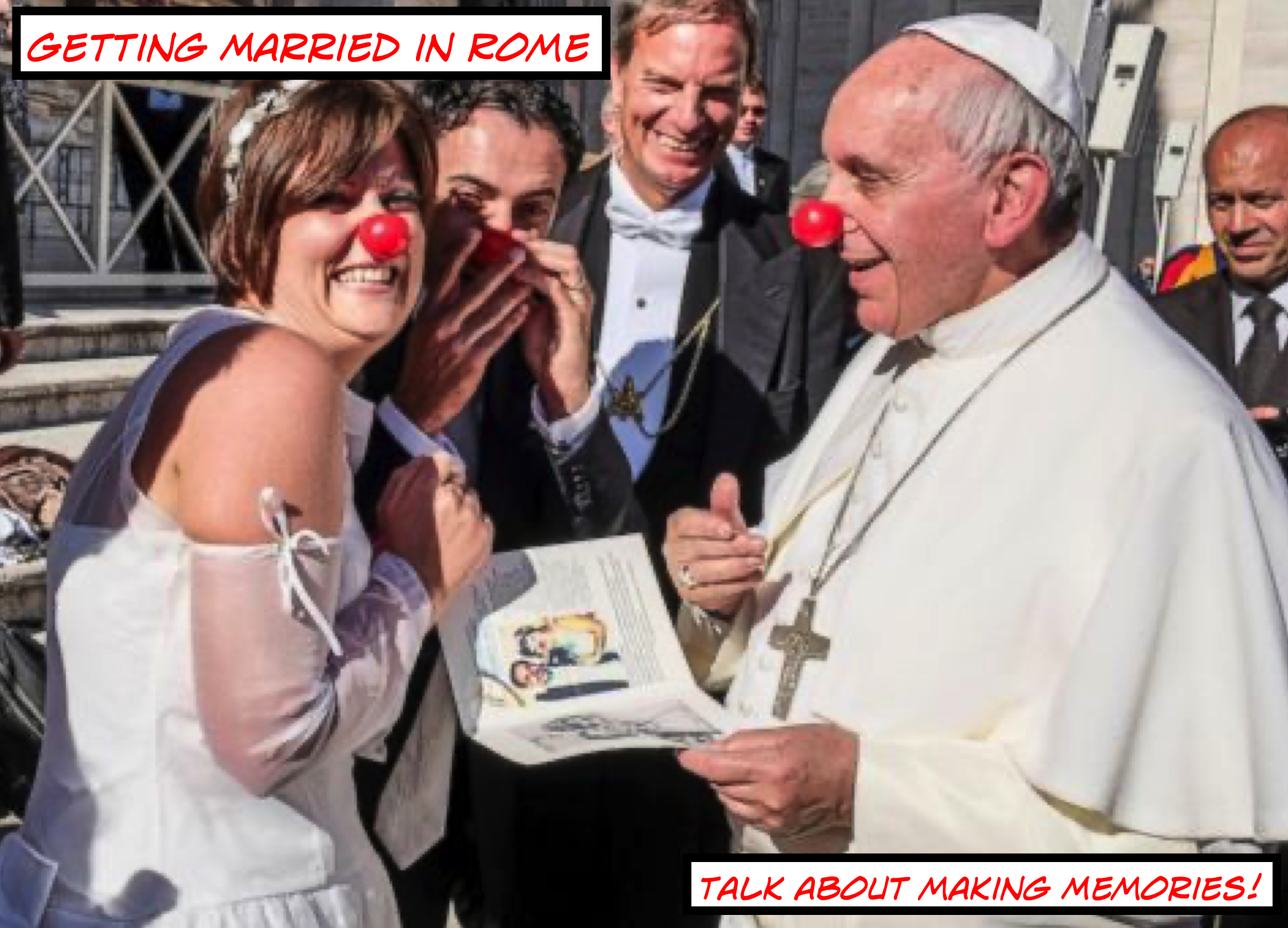
Pope Francis jokes with a newlywed couple in Rome.

Don’t be surprised, but many clergy possess keen senses of humor. Sure, there are staid, grimacing ministers who consider acting dour to be a virtue. (They’re often legalistic.) But most of the pastors and military chaplains I’ve worked beside, love to laugh. I think I’ve written enough about humor to verify that.

C.S. Lewis maintained strong bonds with a number of clergy, from a variety of denominations, and that would hardly have been true if they had lacked a sense of humor. Humor, to Lewis, is an essential part of life. He proclaims this truth from the lips of Aslan himself, as the newly created Talking Animals hear the first (accidental) joke.

“Laugh and fear not, creatures. Now that you are no longer dumb and witless, you need not always be grave. For jokes as well as justice come in with speech.” (The Magician’s Nephew)

I recently read about a fascinating incident one historian described as “perhaps the only really satisfactory practical joke in the whole history of theology.” Allow me to set the scene.

The Byzantine Empire lasted for a thousand years, before being defeated and desecrated* by Islamic armies. During the centuries surrounding its apex, it suffered from the political intrigue and competition with which we are all too familiar.

Photios I was a Byzantine scholar who was twice the Patriarch of Constantinople during the ninth century. Twice is unusual, but it was due to the machinations of emperors and empresses who meddled in the affairs of the church.

He had a troubled relationship with another priest named Ignatius, who also served two times as Patriarch. The good news is that the men were eventually reconciled and both are regarded by Orthodox Christians as saints.

The anecdote comes from the period of their rivalry. Photios, whose brilliance was widely acknowledged, and presumably envied by Ignatius, decided to pull an embarrassing public prank on his nemesis.

Photios devised a bizarre theory that human beings have two souls. His goal was to trick Ignatius into taking it seriously, whereupon Photius withdrew the thesis and admitted he had not been serious. Apparently, everyone unsatisfied with Ignatius’ leadership found it quite entertaining.

Fortunately, among clergy the humiliation of others is rarely the object of humor. Yet, sadly, I have seen it attempted. I personally repent of ever having done so myself, and regard it as sharing, along with vulgarity and blasphemy, the lowest level of “humor.” 

The Wisdom of Lewis

In Reflections on the Psalms, C.S. Lewis relates something I know to be true from my own experience.

A little comic relief in a discussion does no harm, however serious the topic may be. (In my own experience the funniest things have occurred in the gravest and most sincere conversations.) 

Clergy deal with serious topics, like death, quite frequently. Perhaps that is one reason a well-developed sense of humor is common among their ranks.


Skip this footnote if you want to end on a “happy” note.

* “Desecration” may sound like a harsh word to our interfaith-sensitive ears, but it is accurate here. Islam is rarely a gentle master for Christians, and it has been common to see churches and holy places seized and converted to foreign religious uses. For example, in the capital Constantinople (now called Istanbul), Orthodox Christianity’s most magnificent church, Hagia Sophia, saw much of its glorious and historic iconography destroyed when it was converted to a mosque. Many years later, in 1934, an enlightened Turkish government ended the insult, and chose to treat the holy place as a museum. Sadly, the current regressive government under Recep Tayyip Erdoğan, reversed that decision, and in 2020 the Church of Holy Wisdom was returned to its usage as a mosque.

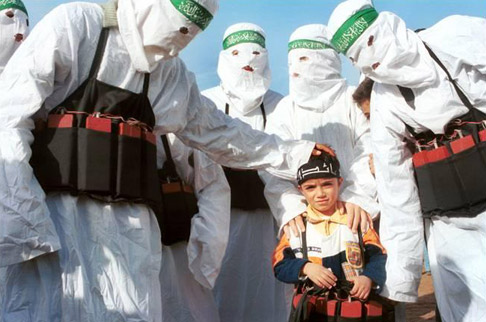
Suicide as a Gateway to Paradise

hamas

I wonder what C.S. Lewis would have made of our twisted world in which some adherents of a globe-spanning “monotheistic tradition” believe they can enter heaven by spilling the blood of innocents.

Not long ago, a husband and wife in Indonesia, simultaneously attacked three different Christian churches. Yes, three. There, in the world’s largest Islamic nation, they killed all four of their own children to work ISIS-inspired jihad.  

The father blew himself up at one church in a car bomb. The two teenage sons exploded at a second congregation. And the woman who had given birth to these willing murders, ushered her 9 and 12 year old daughters into a Christian sanctuary and . . . 

CNN has some video related to the incident, accompany their article on the attacks. 

I’ve written about suicide in the past from two perspectives. This discussion considered the question in a general sense, and this piece was inspired by my own encounter with a suicide situation.

The horrific event describe above—the mass murder accomplished by a single family—leaves us speechless. How can this be? How can a group of people be so deceived as to think the suffering of others will purchase their entrance into heaven? How can they wantonly sacrifice their own children on that altar of hatred?

The only answer to these questions is that it is caused by evil. Not confusion, evil. And not even merely evil—but Evil. The precedent for such vile acts go all the way back to humanity’s first family.

We should not be like Cain, who was of the evil one and murdered his brother. And why did he murder him? Because his own deeds were evil and his brother’s righteous. (1 John 3:12)

A dozen victims died that morning. More than forty more were wounded. And this murder/suicide will surely not be the last of its kind.

C.S. Lewis’ View

Lewis was acquainted with evil. He recognized it bears many faces. Yet, it seems to me, that he too would find this murderous abomination incredible. Incredible in its most naked sense—impossible to believe.

I believe Lewis would be stunned. Just like we are. 

This is true, despite the fact that Lewis was prescient about the decay of the life-affirming core of civilization. In the words of an insightful article by Richard Weikart:

Many Christians recognize that we are living in a “culture of death,” where—especially in intellectual circles—there is easy acceptance of abortion and increasing support for physician-assisted suicide, infanticide, and euthanasia. . . . 

When C.S. Lewis cautioned about the dangers of dehumanizing secular ideologies in The Abolition of Man and his science fiction novel That Hideous Strength . . . on the whole, the intellectual world paid little heed, careening further down the fateful road against which Lewis warned. 

Few of us, by God’s mercy, see this sort of evil face-to-face. Military personnel and first responders are more likely to encounter it.

Despite our personal insulation from this violence, we too are targets of the Evil One. However, the tactics he employs against us are usually far more subtle and insidious. 

Lewis recognized this well. The Screwtape Letters is his masterful exploration of the way the Devil attempts to corrupt even those among us who do not believe in his existence. 

It does not matter how small the sins are provided that their cumulative effect is to edge the man away from the Light and out into the Nothing. Murder is no better than cards if cards can do the trick. Indeed the safest road to Hell is the gradual one—the gentle slope, soft underfoot, without sudden turnings, without milestones, without signposts . . .

No one who reads Mere Inkling will be tempted to immolate themselves. Much less to steal the life of innocents. Still, the more conscious we become of this world’s self-destructive inclinations, the better equipped we should become to consciously become life-affirming influences in our cultures. 

This, I believe, is our common prayer.

Sharia Law Versus Democracy

chaldean

“Liberal and democratic principles are worth nothing here [in Iraq]. Islam does not say that all men are equal.” (Amal Nona). You cannot state the truth more concisely than that.

Nona is a Chaldean Catholic archbishop who “doesn’t have a diocese anymore. He doesn’t have a church. ISIS destroyed all that, and his people are scattered. But he’s not afraid to speak forthrightly, even when ISIS was at his doorstep.” (“Happy Warriors”)

The Chaldean Catholic Church is no stranger to persecution. They are descendants of the Assyrians who maintained the faith through the Muslim conquest up until today. They are a courageous people, but that is not the subject I wish to address here.

As the archbishop alludes, the reason that Western nations have been utterly unsuccessful in transplanting democracy to countries with Islamic majority populations is that democracy is alien to their worldview.

To the literalist Muslim (i.e. those who accept the words of the Quran at face value), it’s ludicrous to claim that Christians are equal to followers of Islam. Even without appealing to detailed Sharia law, the simple notion that infidels should possess the same rights as the followers of Allah is foolish, or worse. They are dhimmi—second class citizens, at best and actively persecuted and martyred, at worse.

This is the default setting for Islamic nations. Just look at Turkey and Egypt, two nations with actual democratic governments. The terrorist Muslim Brotherhood continues to exert destructive influences in both, and Turkey’s president, Recep Tayyip Erdoğan has used the excuse of the recent coup attempt to further destroy the vestiges of democracy (e.g. free speech) which he has long been undermining. Egypt is currently enjoying a respite after removing Mohamed Morsi, a man with a similar, anti-democratic agenda.

Retired military analyst Ralph Peters recently penned a frightening (and I believe accurate) appraisal of where Erdoğan will take his nation.

The ragtag ISIS caliphate is merely the forerunner of the more ambitious caliphate to come. It’s coming in Turkey.

The immense and destructive crackdown underway in Turkey now, with at least 10,000 Turks taken into custody and as many as 100,000 others dismissed from their positions—not only soldiers, but judges, civil servants, police and academics—isn’t an end-game. It’s a beginning. . . .

Erdoğan didn’t need a reason for this pre-planned purge. He had his reasons and his lists of names. He needed an excuse. The failed coup was a gift.

Now we’re witnesses to the destruction of Turkey’s secular society and the forced-march reversion to religious regimentation and obscurantism, to intolerance and oppressive fundamentalism. This is the triumph of mosque over modernity, not of the rule of law, but of its supersession.

Professors have been forbidden to leave the country. The government demanded the resignation of all the deans of higher-level schools and universities. Book-banning is on the way, and book-burning wouldn’t surprise me in the least.

To those of us in the West, including numerous Muslim immigrants who have recognized the universal benefits of freedom of conscience and equal rights, the historic interpretations of government based on the Quran seem disconcerting. Part of the reason they seem unfathomable, is because we do not take the time to study them. Nor do we listen to the voices of minority populations who have been long subjugated and deprived of what we deem basic human rights.

Archbishop Nona, and others like him, need to be heeded. His warning about the challenge of translating democratic principles, points to the proper beginning place: education. It is no accident that the Muslim countries with the highest educations and most moderate (i.e. non-fundamentalist) adherents replicate democratic freedoms most consistently.

I consider the best course for promoting peace to be educating all people, and encouraging freedom of conscience, especially when it comes to religion and speech. And I recognize that the statement with which we began remains a vital fact that must be recognized at the outset of that effort. The following observation appeared in an article last year.

The lust for power corrupts religion, just as the quest for piety is vulnerable to hubris. As Cengiz Erdoğan, a CHP [minority political party] member who runs a car repair workshop, put it to me: “He’s power-hungry and he’s dedicated to the Islamist way.” Or, as C.S. Lewis once warned: “Of all bad men, religious bad men are the worst.”

The principles guiding Democracies and Republics arose in the Western world. There they found fertile soil. Yet even here in the West, we see on a daily basis that democracy is fragile. Tolkien and Lewis scholar, Joseph Laconte, wrote an “optimistic” essay about the 2015 elections in Turkey. Erdoğan had been prevented from achieving an absolute majority.

The danger, at least for the moment, has been averted. . . . [Some Turks fear] Erdoğan’s early reformist talk was a mere façade for his hardcore Islamism.

That may be reason enough to cheer Turkey’s election results: they offer the hope that corrupted religion will find it harder to derail the nation’s experiment in democratic self-government. More than hope, of course, will be needed. For if secular authoritarianism has left the stage in Turkey, its religious counterpart is waiting hungrily in the wings.

Unfortunately, what political minorities in Turkey feared, is now coming to fruition, with a vengeance.

A Positive Postscript from the Chaldeans

Christianity rejects the notion that any person possesses greater worth than another. In the Christian world there are no castes . . . there are no dhimmi.

Each and every life is precious. In fact, the Good Shepherd is not content to keep the faithful ninety-nine under his protection, he leaves them to go out in search of the one—the individual one—that has strayed.

Chaldean Christians have some of the most ancient roots in Christian history. Despite the fact that most the Assyrian Christians have been driven from their ancestral homes, and are unlikely to ever be allowed to return, they have retained their hope. That is because they do not place their faith in humanity or their own strength. The following description of Archbishop Nona comes from another article.

I’d even go so far as to say that before me is a happy man. Indeed, he tells me: “We were always a minority. We always knew it was not important what we have but what we do. The Lord shows us how it is important to be happy in all situations.”

He emphasizes that the Christian has no other identity than as a Christian. The Gospel is what you want to conform your life to, he says. “For us, we want to practice our identity. We are not another identity. Our identity is to live like Jesus Christ.”

There is no other life, he says, for a Christian. Christ becomes everything, and so there is no life without Christ. “I think all our problems lie in this point: that in our life, sometimes we forget to live like Jesus. It’s not theology, it’s reality.”

It is not difficult to hear echoes of C.S. Lewis in his words. And these come not from a mutual acquaintance between the two . . . rather from a common acquaintance with the Messiah.

In the end, it’s not about theology, philosophies or human political institutions. It’s about a Redeemer.

_____

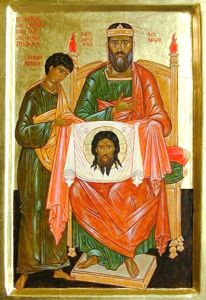
The icon above is of Saint Addai (Thaddeus of Edessa). He was a missionary to Mesopotamia, and contributed to the Divine Liturgy used by much of the Eastern Church. The image portrays Addai presenting the Mandylion to King Abgar of Edessa.

Sanctified Languages

petrusOne major difference between Christianity and Islam is their view of language. For the Muslim, Arabic is the language by which the Quran is to be known. For the Christian, there is a great impulse to translate the Scriptures into every tongue in the world.

In Islamic worship, the Quran is properly recited only in Arabic, whether the individual understands Arabic or not. This is similar to the way that most Hindus chant mantras in ancient Sanskrit.

A parallel can be drawn with the medieval practice in the Western branches of Christianity where Latin continued to be used for worship, even after it lost its role as the shared language.

The fact, however, that the Bible had even been translated into Latin was due to the Christian desire to make God’s word accessible to all people. Jerome, an early Christian theologian, became a linguistic scholar with the goal of translating the Vulgate, into the common language of his day.

It would have been a great shock to him, and to Pope Damasus I who commissioned his effort, to see the Latin so ingrained in the church’s usage that their heirs in leadership lost sight of the desire to bring the Lord’s words directly to the people so that all could understand them.

One of the great successes of the Reformation was the successful translation and distribution of the Scriptures into the vernacular of various language groups. Martin Luther’s translation, in fact, standardized the German language which had evolved into several different dialects.

Coincidentally, Lutherans have remained at the forefront of Bible translation, and Lutheran Bible Translators continue that vital work today. They currently have twenty-two Bible translations in process. LBT works in conjunction with Wycliffe Bible Translators, which is an even larger organization.

C.S. Lewis delivered a lecture at the University of London entitled “The Literary Impact of The Authorised Version.” In one portion he addressed the influence of the King James translation on the English language. While not nearly so pronounced as Luther’s on German, it is measurable.

The history of the Authorised Version has been told so often that I will not attempt to re-tell it, and its beauties praised so lavishly that I will not praise them. Instead, I will proceed at once to its influence as an English book. I shall attempt to define that influence, for I think there has been misunderstanding about it and even a little exaggeration.

Lewis’ argument is that the Bible has a profound influence on English literature, the particular translation, less so.

Ideally, all Christians would understand Hebrew and Greek, and be able to read the Scriptures in their original languages. However, there is no stigma in reading a translation. In fact, there are small pockets of people who do not understand the history of the Bible who believe that one particular translation (i.e. the King James Version) is the only authoritative text.

Sadly, I once saw an advertisement in a newspaper inviting worshipers that read: “Are you tired of people changing the Authorized Version of God’s Word with Greek and other languages? If so, come and join us at . . .”

Fortunately, the vast majority of Jesus’ disciples celebrate the translation of God’s word of life into every language spoken today.

Meanwhile, memorization of the Quran in Arabic (even when that is not the reciter’s actual language) remains highly regarded in Islam. Arabic has been regarded as so holy, in fact, that there was great reluctance to contaminate the Quran by using a printing press.

During the Ottoman Empire, until 1729, printing anything in Arabic was a crime. Somewhat ironically, the first printing utilizing Arabic movable type was done by Pope Julius II in the first decade of the sixteenth century. It was created for the benefit of Christians living in Arabic lands.

To provide a powerful illustration of a Christian validation of the authentic inspiration and power of God’s words—in any language—we turn once again to the German reformer.

Since it becomes Christians then to make good use of the Holy Scriptures as their one and only book and it is a sin and a shame not to know our own book or to understand the speech and words of our God, it is a still greater sin and loss that we do not study languages, especially in these days when God is offering and giving us men and books and every facility and inducement to this study, and desires his Bible to be an open book. . . .

In proportion then as we value the gospel, let us zealously hold to the languages. For it was not without purpose that God caused his Scriptures to be set down in these two languages alone—the Old Testament in Hebrew, the New in Greek. Now if God did not despise them but chose them above all others for his word, then we too ought to honor them above all others. St. Paul declared it to be the peculiar glory and distinction of Hebrew that God’s word was given in that language, when he said in Romans 3, “What advantage or profit have those who are circumcised? Much indeed. To begin with, God’s speech is entrusted to them. . . .”

Similarly, the Greek language too may be called sacred, because it was chosen above all others as the language in which the New Testament was to be written, and because by it other languages too have been sanctified as it spilled over into them like a fountain through the medium of translation. (Martin Luther, “To the Councilmen of Germany”).

_____

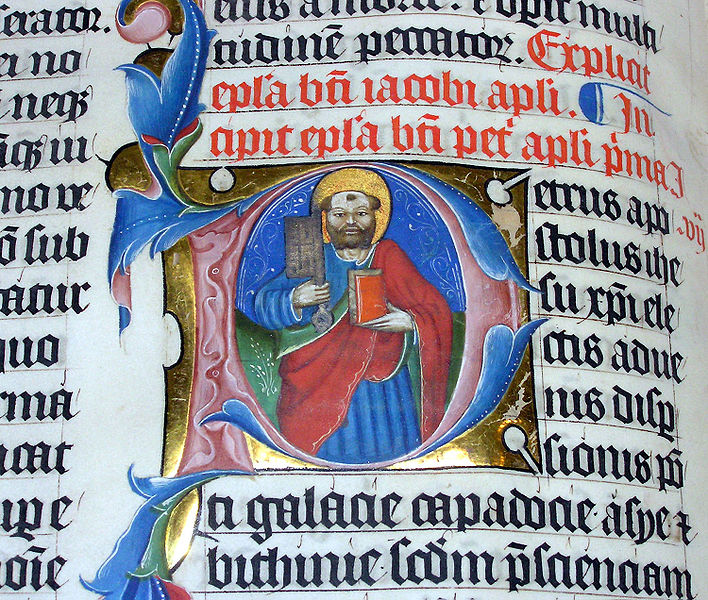
The image above is an illuminated “P” which begins the name Petrus (Peter). The manuscript is displayed in Malmesbury Abbey in England, but was originally transcribed in Belgium circa 1400.

A Symbol of Death & Life

nن – Arabic letter nun (n)

You may never have seen this symbol or, if you did, its foreign context may not have impressed it on your mind.

This Arabic letter is now being used to mark people for persecution and death. Yet, at the very same moment, this same symbol is also being transformed into an emblem that stands for courage and life.

The Islamic State has martyred or enslaved many Christians. Survivors have had all of their property stolen from them and been marked for death if they do not reject Christ and embrace the Muslim religion.

They have gone throughout the neighborhoods of their new conquests and placed this mark, the nun, on homes to mark them for evacuation or death. The “N” stands for “Nazarene,” referring to Jesus’ home town.

With the passage of time, we will likely see once again the truth proclaimed by Tertullian, that the blood of the martyrs is the seed of the church. In the meantime, everyone of good will (Christian, Jew, Muslim, Agnostic alike) should rally to the support of the suffering.

We do not yet know the magnitude of the atrocities committed by ISIS/ISIL. Like Nazi concentration camps, the complete story will not be revealed until the sites of the horror are liberated from their vile control. And, like the Mogen David (Star of David) which marked its bearers as Jews, the nun marks its bearers as Christians and targets of militant Islam.

C.S. Lewis recognized the horror of Nazism early on. In 1933 he wrote about the cruelty, and stupidity of Hitler’s attack on Judaism.

Did you see that [Hitler] said “The Jews have made no contribution to human culture and in crushing them I am doing the will of the Lord.” Now as the whole idea of the “Will of the Lord” is precisely what the world owes to the Jews, the blaspheming tyrant has just fixed his absurdity for all to see in a single sentence, and shown that he is as contemptible for his stupidity as he is detestable for his cruelty.

One can only imagine what Lewis would write about the leaders of Islamofascism today.

There are a number of organizations that support Christians currently experiencing violent persecution. None, however, approaches this work from the same perspective of Voice of the Martyrs. I wholeheartedly commend their labors to you.

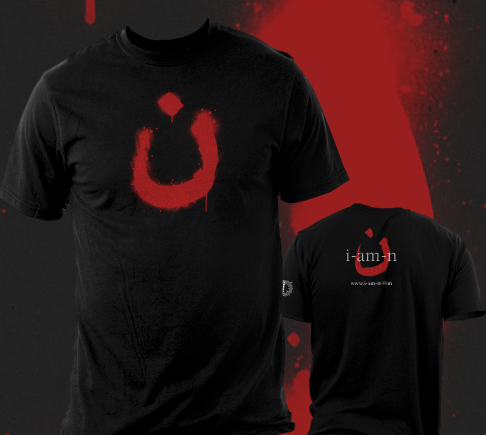
They are currently offering shirts emblazoned with the letter nun. They are even more important as a witnessing tool, than as a fundraiser. Please read more about them here and share the link with your friends. Also, please take a few minutes to explore their website once you are there.

To boldly state “I am N” is to identify with the oppressed. It is to show the world you understand that each disciple of Jesus must be prepared to take up his or her own cross. Dying for one’s faith in Jesus is not a myth; it is a daily reality.

The ن symbol, intended as a mark of derision, humiliation and rejection, has assumed a new meaning. It has become a mark of hope, courage, and deliverance.

What the persecutors in Iraq and Syria intended to be a label of death has been transformed by the Holy Spirit and the faithfulness of Christians into a symbol of life.