Sanctified Languages

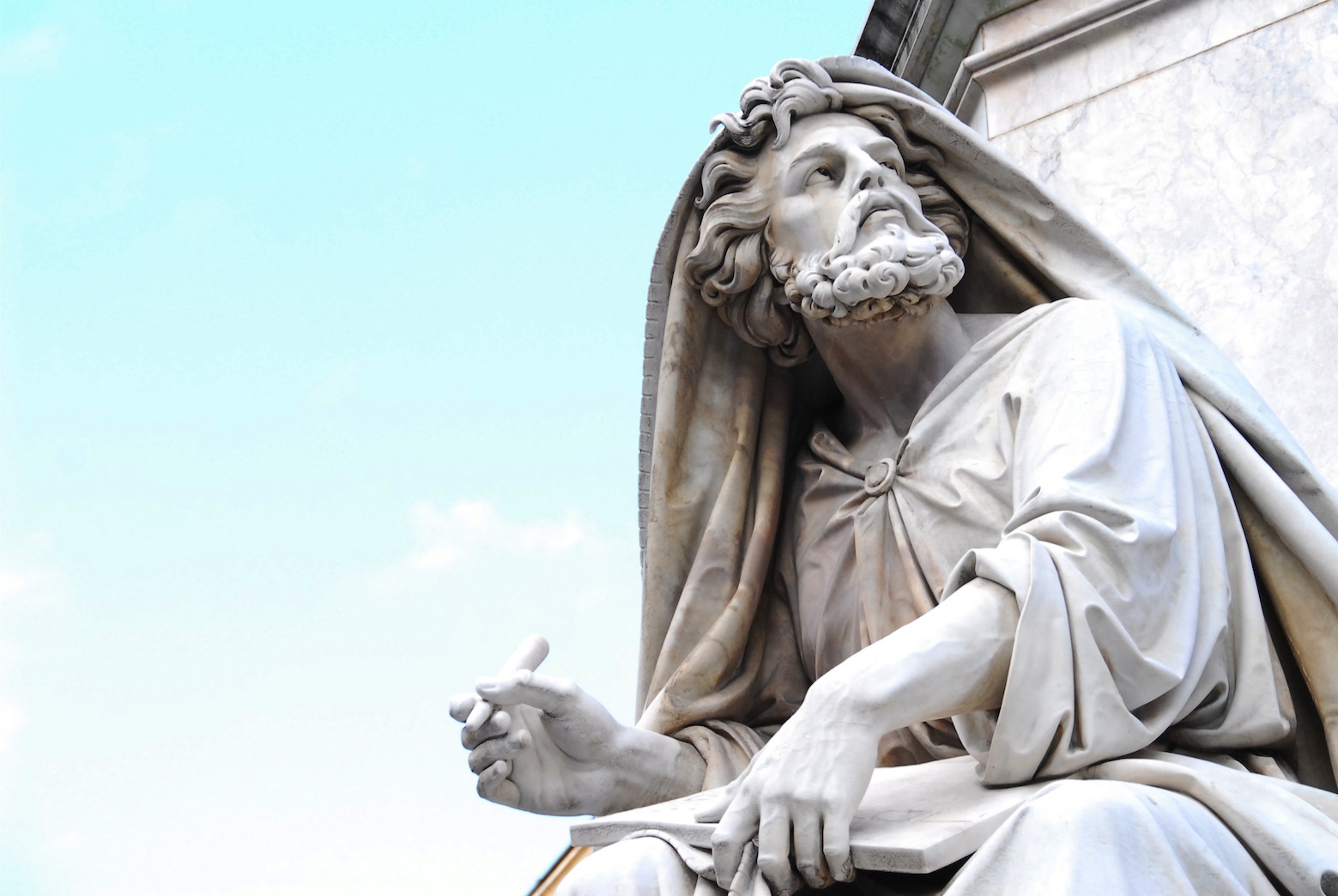
petrusOne major difference between Christianity and Islam is their view of language. For the Muslim, Arabic is the language by which the Quran is to be known. For the Christian, there is a great impulse to translate the Scriptures into every tongue in the world.

In Islamic worship, the Quran is properly recited only in Arabic, whether the individual understands Arabic or not. This is similar to the way that most Hindus chant mantras in ancient Sanskrit.

A parallel can be drawn with the medieval practice in the Western branches of Christianity where Latin continued to be used for worship, even after it lost its role as the shared language.

The fact, however, that the Bible had even been translated into Latin was due to the Christian desire to make God’s word accessible to all people. Jerome, an early Christian theologian, became a linguistic scholar with the goal of translating the Vulgate, into the common language of his day.

It would have been a great shock to him, and to Pope Damasus I who commissioned his effort, to see the Latin so ingrained in the church’s usage that their heirs in leadership lost sight of the desire to bring the Lord’s words directly to the people so that all could understand them.

One of the great successes of the Reformation was the successful translation and distribution of the Scriptures into the vernacular of various language groups. Martin Luther’s translation, in fact, standardized the German language which had evolved into several different dialects.

Coincidentally, Lutherans have remained at the forefront of Bible translation, and Lutheran Bible Translators continue that vital work today. They currently have twenty-two Bible translations in process. LBT works in conjunction with Wycliffe Bible Translators, which is an even larger organization.

C.S. Lewis delivered a lecture at the University of London entitled “The Literary Impact of The Authorised Version.” In one portion he addressed the influence of the King James translation on the English language. While not nearly so pronounced as Luther’s on German, it is measurable.

The history of the Authorised Version has been told so often that I will not attempt to re-tell it, and its beauties praised so lavishly that I will not praise them. Instead, I will proceed at once to its influence as an English book. I shall attempt to define that influence, for I think there has been misunderstanding about it and even a little exaggeration.

Lewis’ argument is that the Bible has a profound influence on English literature, the particular translation, less so.

Ideally, all Christians would understand Hebrew and Greek, and be able to read the Scriptures in their original languages. However, there is no stigma in reading a translation. In fact, there are small pockets of people who do not understand the history of the Bible who believe that one particular translation (i.e. the King James Version) is the only authoritative text.

Sadly, I once saw an advertisement in a newspaper inviting worshipers that read: “Are you tired of people changing the Authorized Version of God’s Word with Greek and other languages? If so, come and join us at . . .”

Fortunately, the vast majority of Jesus’ disciples celebrate the translation of God’s word of life into every language spoken today.

Meanwhile, memorization of the Quran in Arabic (even when that is not the reciter’s actual language) remains highly regarded in Islam. Arabic has been regarded as so holy, in fact, that there was great reluctance to contaminate the Quran by using a printing press.

During the Ottoman Empire, until 1729, printing anything in Arabic was a crime. Somewhat ironically, the first printing utilizing Arabic movable type was done by Pope Julius II in the first decade of the sixteenth century. It was created for the benefit of Christians living in Arabic lands.

To provide a powerful illustration of a Christian validation of the authentic inspiration and power of God’s words—in any language—we turn once again to the German reformer.

Since it becomes Christians then to make good use of the Holy Scriptures as their one and only book and it is a sin and a shame not to know our own book or to understand the speech and words of our God, it is a still greater sin and loss that we do not study languages, especially in these days when God is offering and giving us men and books and every facility and inducement to this study, and desires his Bible to be an open book. . . .

In proportion then as we value the gospel, let us zealously hold to the languages. For it was not without purpose that God caused his Scriptures to be set down in these two languages alone—the Old Testament in Hebrew, the New in Greek. Now if God did not despise them but chose them above all others for his word, then we too ought to honor them above all others. St. Paul declared it to be the peculiar glory and distinction of Hebrew that God’s word was given in that language, when he said in Romans 3, “What advantage or profit have those who are circumcised? Much indeed. To begin with, God’s speech is entrusted to them. . . .”

Similarly, the Greek language too may be called sacred, because it was chosen above all others as the language in which the New Testament was to be written, and because by it other languages too have been sanctified as it spilled over into them like a fountain through the medium of translation. (Martin Luther, “To the Councilmen of Germany”).

_____

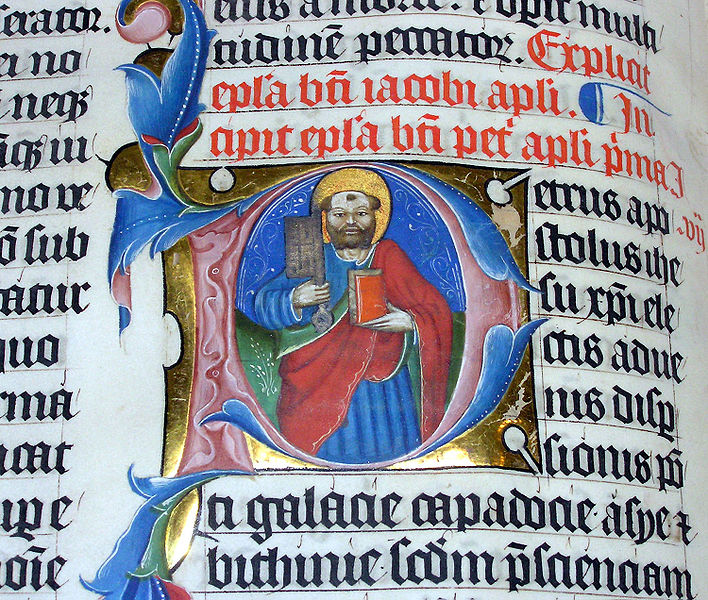
The image above is an illuminated “P” which begins the name Petrus (Peter). The manuscript is displayed in Malmesbury Abbey in England, but was originally transcribed in Belgium circa 1400.
Marrying a Writer

museA recent episode of the series Castle illustrated something all of the spouses of writers know—they are wed to peculiar people.

The premise for the program, currently in its seventh season, is that a mystery novelist accompanies homicide detectives in New York City on their investigations.

Despite his frequently outlandish theories, Richard Castle often contributes significantly to solving the crimes. His counterpart is Kate Beckett, the senior detective who leads the team.

The two of them recently wed, which led to the following exchange while they were on their honeymoon, which doubled as a homicide investigation at a frontier “dude ranch.”

Faced with complex evidence, Castle says, “That’s why we approach this as writers.”

Beckett responds with a comment representative of literary spouses. “So we procrastinate and we make things up?”

Ouch.

That strikes a bit close to home. The second element—making things up—can be construed by our nimble minds as an actual compliment. Yes, we do think creatively and out of the mundane box. Thank you very much.

On the other hand, the procrastination label . . . well, speaking for myself, it fits far too well.

Writing, after all, is not simple. Even poor writing requires effort. And, if one hopes to write well . . . it requires time, skill and practice.

Few can sit down at the keyboard and imperiously command their “muse” or inspiration to be at hand. This is true for all authors, including Christian writers who seek guidance from the Holy Spirit.

The simple fact is, however, that if we waited until we felt fully inspired, most of us would accomplish little.

In my own case, I sincerely attribute anything good that I might write to the Lord. The chaff comes from me. I won’t presume to guess what small percentage of the words are wheat, but I will confess that I am most productive when I discipline myself to write. And, this discipline typically involves a self-imposed deadline.

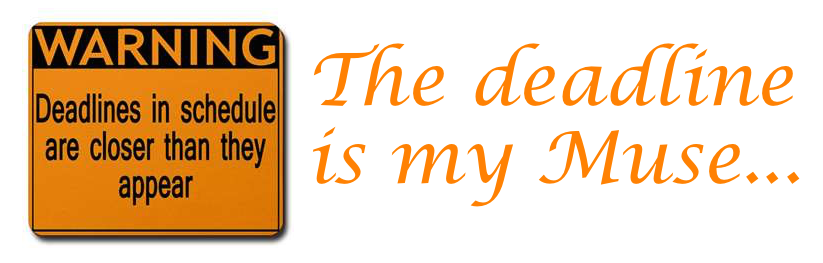
Thus the reason for the graphic at the head of the page. I have recognized in the fall of life, as I seek to pursue my writing avocation more seriously, that “The deadline is my Muse.”

Beckett knows very well that her fictional husband often requires a deadline to complete his novels.

My wife sees the same principle at work when I request her urgent proofreading of something I’ve waited too long to complete.

C.S. Lewis had ample experience with deadlines himself. And he knew well that even a required submission date could not guarantee literary production. In 1958 he wrote to his editor, Jocelyn Gibb, saying that he may, or may not, be able to provide a contribution to an upcoming edition of The Psalms as Poetry.

Dear Gibb, Thanks for the book, a very nice bit of work. I’ll try to re-read Miracles for mis-prints while I’m in Ireland, where my wife and I go tomorrow. When is deadline for your Fifty-Two? Not that I’m sure I can pump anything up anyway.

He did manage to provide a contribution, which he later included as part of the introductory chapter for Reflections on the Psalms.

I’m not certain whether Lewis wrote those pages simply because inspiration compelled him to . . . or if the issue deadline provided a little supplemental motivation. I suspect it was the latter.

To any writers out there who never require the encouragement of a deadline—consider yourself uniquely blessed!

To the masses who share my battle with the plague of procrastination, you have my sympathy. Still, after pausing for just a moment to commiserate, let’s get back to the pleasant labor of writing, and the thrill of “making things up.”

Claiming Divine Inspiration

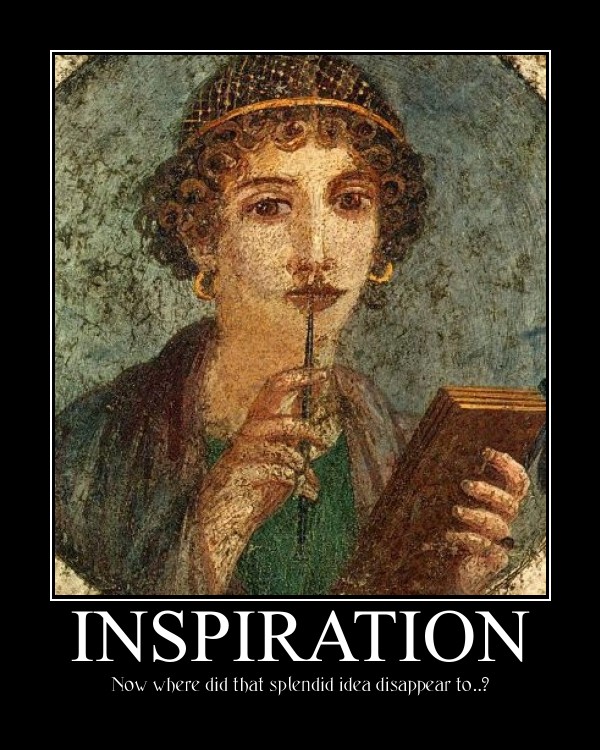
inspirationSome Christian writers face a terrifying dilemma. They think God has inspired their work. That may be true. But then they proceed a step further and assume that “if God has given these words to me, they can’t be changed.”

The inference, of course, is that the message is essentially inspired in the same sense as Christians normally view the Holy Scriptures themselves. They become, in a word, inviolate.

It’s almost as though the author has appropriated the words of the Apostle John, who in his Revelation was inspired to write:

I warn everyone who hears the words of the prophecy of this book: if anyone adds to them, God will add to him the plagues described in this book, and if anyone takes away from the words of the book of this prophecy, God will take away his share in the tree of life and in the holy city, which are described in this book. (Revelation 22:18-19, ESV).

Naturally, this mindset can cause a bit of a problem when it rears its head in a writing critique group. I’ve witnessed it more times than I can recall, having been a member of such groups on several continents.

I’ve learned to be extremely cautious in how I attempt to explain to the person that while they may rightly feel that their work is inspired by their faith, it doesn’t necessarily follow that it remains in an unblemished condition . . . as it was received by our imperfect human senses, processed by our imperfect minds, and put into words via our imperfect skills and finite vocabulary.

No matter how gently this is said, most of these individuals don’t last long in writers groups. They drop out when others offer suggestions on how to improve their work, seemingly stunned that everyone else doesn’t simply fall prostrate in adoration at their words. It’s quite sad.

That’s why it was so refreshing to read the following in the preface to J. Budziszewski’s What We Can’t Not Know, which I highly recommend.

It seems to me that every writer should end with gratitude to the one who was in the beginning, and whose very name is Word. A reviewer—a friendly one—once remarked that it seemed strange to see that sort of thanks in a book, as though the author were claiming divine inspiration. Of course, for whatever is amiss in these pages (and there will be much), the blame is mine. But permit me to be grateful if anything in them is true.

I love this paragraph. In part, because I share his sentiments. It echoes my own words, spoken at my military retirement, “attribute to me all of the failings and disappointments in my work, and to God any positive or healing results that followed my ministry.”

This worldview proclaims Soli Deo Gloria,* and simultaneously acknowledges that I am not God. It is good for writers to occasionally be reminded of that fact.

It should come as no surprise that our friend C.S. Lewis offers worthwhile insight into inspiration. In his essay, “The Vision of John Bunyan,” he considers that writer’s comments about how the classic Pilgrim’s Progress came to be.

Lewis begins with a quotation, and offers his own wise insights, with which I will close.

For having now my Method by the end;

Still as I pull’d, it came.

It came. I doubt if we shall ever know more of the process called “inspiration” than those two monosyllables tell us.

Perhaps we may hazard a guess as to why it came at just that moment. My own guess is that the scheme of a journey with adventures suddenly reunited two things in Bunyan’s mind which had hitherto lain far apart.

One was his present and lifelong preoccupation with the spiritual life. The other, far further away and longer ago, left behind (he had supposed) in childhood, was his delight in old wives’ tales and such last remnants of chivalric romance as he had found in chap-books. The one fitted the other like a glove. Now, as never before, the whole man was engaged.

_____

* Glory to God alone or all glory be to God.

Echoes of Narnia

garrelsI just met an amazing new artist. Well, not literally.

I met him, figuratively speaking, through his innovative music. And, although he is “new” to me, he’s been recording for more than a decade. His name is Josh Garrels, and in a moment, I’ll introduce you to two examples of his lyrical poetry.

The reason I first checked out his work was because I received word that he is giving away his music! Amazing, isn’t it? Right now you can download any of his albums for free. However . . . oh, there’s a string attached, you’re thinking . . . he is requesting that you make a donation to aid the suffering in the war-ravaged Democratic Republic of the Congo. So there’s really no string at all, since it’s merely a suggestion, and the gift would be tax deductible anyway. The albums are free. Garrels doesn’t want a penny from us. But he does want us to consider aiding the 70 million struggling people of the Congo.

Despite the Congo being the eleventh largest country in the world, few Westerners follow the terrible news flowing from the wounded nation. For the next two weeks, one hundred percent of the “tips” received for Garrels’ albums will go to World Relief—for their work saving precious lives and bringing peace to the hopeless.

In listening to some of Garrels’ music, I was reminded of the versatility of C.S. Lewis, who wrote so skillfully in so many different genres. I’m not sure how to describe Garrels’ songs; perhaps they defy categorization. It’s not the music I typically listen to . . . but the depth of his lyrics have won me over. Consider the following two songs. I’ll share the lyrics here, and then offer links to each of them below. I encourage you to read the words first and then listen to the music.

“Slip Away”

Hold on, before I slip away

The flames gone dark, I am afraid

How strong is flesh and blood

I cannot can take back what I’ve done

To you, my sweetest friend

I betrayed you, I walked away again

Hold on, before I slip away

The flame’s gone dark, I am afraid

How strong is flesh and blood

I cannot take back what I’ve done

To you, my sweetest friend

I betrayed you, I walked away again

Now all that’s left, is what might have been

Please forgive me, before we reach the end

Please forgive me, before we reach the end

And—for a delightful tale composed in the spirit of Narnia, be sure to listen to “Rabbit and the Bear.” Much of its imagery is shared with the homeland of the Chronicles of Narnia, but it’s clearly the Bible that provides both “composers” with their strongest inspiration.

“Rabbit & the Bear”

Run, run so fast

Over fields and grass

At last, at last

We escaped from the trap

With the rabbit and the bear

And the sparrows of the air

Come one, come all

The hunter is gone

And this is our chance

To crawl under the wire

Through the darkest wood

On up to the mountain of fire

Where everything is free

In the light of the sun

Where every creature sings

Oh Lord, you rescued us all

Don’t listen to the snake

For he lies and he takes

Your hope, your faith

Away from you

But when the lion comes around

With his claw and his crown

Follow, follow

His every move

After you’ve listened to these two pieces, I encourage you to visit this site and download his albums—for free. And, if you feel so inclined, I add my voice to Garrels’ in encouraging you to support World Vision’s vital work in the Congo.

Discovering Your Elvish Name

Most readers of Mere Inkling are either fans of C.S. Lewis and his fellow Inklings, or writers interested in similar topics such as adventure, virtue, imagination, and spirituality. In light of that, and the fact that the finale of the trilogy won Oscar for Best Film, I assume the vast majority have seen “The Lord of the Rings.”

When you watched the films, with whom did you most identify? Ladies had options from warriors, to counselors, to royalty. Likewise for the men. Then there were the different races of Middle Earth . . . did you cast yourself as human, elf or dwarf? Or perhaps, as a modest, earthy hobbit? (I hope there weren’t too many who identified with the orcs, and if you did, I’d suggest an appointment with your local therapist.)

If the notion of living a long, peaceful life, studying the arts and enjoying God’s creation inspires you, then it may be you possess a kinship with the Elvish soul. And if you do (or even if you’re merely curious) there is a wonderful website where you can learn not only how to speak your name in the Elf tongue, but also to write it in the Elf script.

J.R.R. Tolkien, C.S. Lewis’ treasured friend, was at heart a philologist. Few people have ever lived who shared the intensity of his love for language. Not everyone knows though, that the matchless realm of Middle Earth with its timeless sagas grew neither from a vision for the heroic story nor out of the visualization of any of its vibrant inhabitants. No, the seeds of the most renowned fantasy realm ever envisioned, were planted and watered by Tolkien’s love of language.

It was primarily linguistic in inspiration and was begun in order to provide the necessary background of ‘history’ for Elvish tongues. (J.R.R. Tolkien, Forward to the Second Edition of The Lord of the Rings).

Tolkien’s passion for the languages of Middle Earth is legend. Today, other linguists continue to study, document and teach the sophisticated system. Tolkien’s creation was so complex that it resulted in the creation (and evolution) of several languages—distinguished by both history and geography. In the same way, Tolkien was not content to settle for a single version of text with which to pen these musical dialects. He created no fewer than three styles, with Tengwar being most familiar. (You can download these and related fonts here.)

So, how exactly do you discover your Elvish name?

There have long been “random generators” for Middle Earth-sounding names. The generator at one site renders my Elvish name as Eöl Séregon, which does sound fairly distinguished. (Who knows whether or not it means anything?) These programs may satisfy the curiosity of the passing surfer seeking random oddities. However, for those who respect the love Tolkien invested in his linguistic progeny, this will never suffice.

Fortunately, there is an amazing website, overseen by a bona fide lover of languages. Moreover, his site is devoted to maintaining the integrity of Tolkien’s Elvish tongues. (And many of us who are writers are similarly enamored with language itself, making this a worthwhile domain to visit.)

The host of Quenya101 embraced the tongue so completely that in college he even took lecture notes in the language! Today he teaches Quenya through his website and other means. Although there’s a long waiting list (that can be circumvented, I believe, by donating to the site) he will actually translate names into Quenya. Note that I said “translate.” This is no mere transposing of letters.

He does not waste his time with transliterations. He actually applies the etymology of your given name to rendering the very same meaning in the Elvish language. For good measure, he provides a Tengwar rendition of your Elvish name. (It may be that he has already translated your name and has it posted at the site.)

Here’s how it works, as illustrated by my own name. Fortunately, my father’s name has also been translated, so I am seeking the Quenya for “Robert (son of) Charles.”

Robert

From: Germanic name Hrodebert.

Meaning: Bright fame, derived from the Germanic elements

     hrod ”fame” and beraht “bright”.

Quenya: Calialcaro

     (calima+alcar+[o] = bright+splendour, glory+[masculine names suffix])

Charles

From: Germanic name Karl, which was derived from the same Germanic word. However, an alternative theory states that it is derived from the common Germanic element hari

Meaning: Karl means “man” & hari means “army, warrior”

Quenya: Nér (nér = man) or Ohtatyaro (ohtatyaro = warrior)

So, henceforth you may address me as Calialcaro Ohtatyaro!

It is encouraging to see people keeping alive the vision and wonder of Middle Earth. The same is true for Narnia, of course, though you cannot really compare the purpose. These magical realms were both created by geniuses. It is a divine coincidence that these men, with major differences in their temperaments and imaginations, were lifelong friends.

Discovering your unique Elvish name can establish a dramatic connection with an imaginary, but at the same time gloriously real, realm.

Exercising Your Creativity

If you work in an “institutional” or office setting, you may be acquainted with the ubiquitous motivational posters that adorn offices from sea to shining sea. (I can’t speak for other countries, but here in the United States, these encouraging slogans can be found in government and private businesses across the land.)

They are so common, in fact, that they have been parodied by a company that offers “The Demotivator’s Collection.” They sell entertaining posters such as:

1. [Image of a sinking ship]

MISTAKES

It could be that the purpose of your life is only to serve as a warning to others.

2. [Image of a salmon leaping up a raging river directly into the mouth of a waiting bear]

AMBITION

The journey of a thousand miles sometimes ends very, very badly.

3. [Image of a fast food carton of french fries]

POTENTIAL

Not everyone gets to be an astronaut when they grow up.

Humor is powerful. I image that many of these demotivational posters adorn the walls of companies that recognize this fact. (You know, the ones with young, dynamic, iconoclastic leaders.)

Here’s one I might even have tempted to hang up in a couple offices where I used to work:

4. [Image of five hands linked together.]

COMMITTEES

Just like teamwork. Only without the work.

I agree with C.S. Lewis about the vital role humor plays in the lives of healthy people. As he wrote in Reflections on the Psalms: “A little comic relief in a discussion does no harm, however serious the topic may be. (In my own experience the funniest things have occurred in the gravest and most sincere conversations.)”

If you feel inspired by the concept of creating thoughtful—or witty—phrases to elaborate on a specific word or brief phrase, you can manufacture these graphics online yourself. Using this free application, you can craft your own (de)motivational posters—just as I did the one displayed above. Yes, that’s my handiwork.

The images you make are yours to download for free. The company needs to turn a profit though, so they offer high quality digital files or posters, for a price. (The free versions are only suitable for smaller applications, like blogs or other websites.)

How’s that for a great way to express your creativity? And it only requires a couple of minutes!

Oh, and if you’re wondering whether my poster about INSPIRATION is a motivator or a demotivator . . . well, I guess that’s in the eye of the beholder.