Hunting Facts

librariansI’m having a serious problem. One that was shared by C.S. Lewis.

Unfortunately, it has reached its greatest intensity as I am striving to meet the deadline for my doctoral dissertation.

The problem is one that should be simple to remedy, yet I’m crippled by it. The solution is so simple that it is almost embarrassing to admit what it is.

But, confession is good for the soul. (That’s not a biblical verse, by the way, in case you were wondering. Nevertheless, it’s quite true.)

So, here’s my confession. I love to conduct research.

The internet is tailor made for a lifelong student like me; I can follow any avenue that piques my interest from one corner of the world wide web to the other.

And, I do.

That’s the problem, of course. I always over-research the things that I write. And this dissertation is no different. I have so much research—good stuff—to cram into it that I’m dreading hearing back from my advisor . . . who now has the first three chapters in hand.

So, how does this plight resonate with the life of C.S. Lewis? Well, not in the sense of my possessing his brilliant intellect and memory. Lewis had no need of the internet to sort out all of the material he had studied.

Still, the two of us do share one important character trait. He too, was an inveterate collector of information.

In his anthology of George MacDonald’s writings, Lewis confesses his pleasure at conducting research. He says it in this fashion:

“I am a don, and “source-hunting” (Quellen-forschung) is perhaps in my marrow.”

Alas, my marrow is filled with the same unquenchable hunger.

Considering Your Own Writing

It may be that some Mere Inkling readers share this passion for pursuing knowledge for its own sake.

It can certainly be argued that it is an important facet of writing. But there are other aspects of writing, and it is quite natural for different elements of the process to appeal to different individuals.

Perhaps you prefer the initial brainstorming, daydreaming or idea phase of a writing project.

Or, as we have discussed, researching information may be the high point of your writing efforts.

This typically leads to outlining, in various shades of detail. Some writers prefer to proceed without any structure in mind. (This is usually not a good idea when writing nonfiction.) I like outlining. I find establishing a logical structure satisfying work, probably because I’m NTJ.

There are, of course those who honestly love the writing itself, especially when they are in the zone and the creativity is really flowing. Frankly, for me the writing is work. (That doesn’t mean I don’t enjoy the feeling that flashes when you come upon the perfect word or phrase.)

And, although I’m a brutal editor of my own work, and find sharpening an article rewarding work, I must admit I am a little surprised when I encounter a writer who enjoys this phase of the process the most of all.

Then there is sharing or submitting a manuscript for publication. Most writers are a little nervous about this, but some find it exhilarating.

Once someone has published a book, it is now normal for the bulk of responsibility for its promotion to rest upon their own shoulders, as the author. I’m still waiting to meet someone who claims that this is their favorite phase of the writing cycle.

Back Again to the Oxford Don

Lewis’ writing is so enjoyable that I want to close with a longer excerpt from the introduction.

C.S. Lewis’ high regard for MacDonald is well known. This anthology of his work was a tribute to him, in the hopes of introducing many more readers to his work. This book is insightful into the hearts of both men. After all, the editor’s choice of quotations cannot help but reveal much about them too.

In making this collection I was discharging a debt of justice. I have never concealed the fact that I regarded him as my master; indeed I fancy I have never written a book in which I did not quote from him. But it has not seemed to me that those who have received my books kindly take even now sufficient notice of the affiliation.

Honesty drives me to emphasize it. And even if honesty did not— well, I am a don, and “source-hunting” (Quellen-forschung) is perhaps in my marrow. It must be more than thirty years ago that I bought— almost unwillingly, for I had looked at the volume on that bookstall and rejected it on a dozen previous occasions— the Everyman edition of Phantastes. A few hours later I knew that I had crossed a great frontier.

_____

There is no authoritative step-by-step list of the writing process. Some sources call the idea stage “prewriting.” Others break writing down into two parts: “drafting” and “revising.” Some consider editing primarily to be “proofreading,” while you can see from post that I merge the revising and proofreading into what I call “editing.” There are various other structures that are used to describe the writing process. My suggestion is to go with what works for you.

MacDonald’s works are now in the public domain. You can download a free copy of Phantastes here. There is a LibriVox (audio) recording available at the same site.
C.S. Lewis & Women

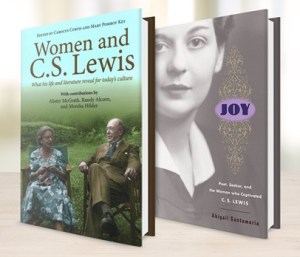
hermeneuticDid C.S. Lewis disrespect women? Some of his detractors make that argument, but two new books reveal just how weak the notion is.

There is a great book review in the herŸ.menenutics column of the current issue of Christianity Today. You can read it here, but please finish reading this post before checking it out.

Readers of Mere Inkling who are only familiar with Lewis through the Chronicles of Narnia or his classic Mere Christianity, may be surprised to learn that there are some who claim he was a misogynist. While they pull decontextualized examples from his works, the essence of their arguments seem to arise from an animosity to Lewis’ Christian worldview.

Even if you do not go on to read either of the books discussed, taking a moment to read the review itself will be worthwhile. For example, they cite one of Lewis’ longtime friendships.

Lewis’s good friend the detective novelist Dorothy L. Sayers once remarked that when it came to women as a whole, “he had a complete blank in his mind.” But this didn’t keep her from liking and corresponding with him, often in the form of cheerful and vigorous argument . . .it was friendships like hers that “blew away Lewis’ assumptions about women,” helping his ideas to change and develop over time.

The first text discussed in the review is Women and C.S. Lewis: What His Life and Literature Reveal for Today’s Culture, edited by Carolyn Curtis and Mary Pomroy Key. The volume has a diverse collection of contributors and portrays the writer honestly. Many of the chapters are written by well respected authors who have written their own works on Lewis.

The book offers no foolish attempt to make a feminist of Lewis. The contributions are thoughtful and nuanced. Lewis’ views were a product of his era and upbringing. Yet, to that stodgy context, he added a Christian appreciation for the all of humanity, male and female, created in the image of God.

The second volume examines the life of the woman who played the most significant role in C.S. Lewis’ life. This is a true biography of Joy Davidman, not restricted to the years she spent with Lewis, who was her second husband. It is no hagiography of this convert from atheism to Christianity. Precisely because of that, it promises to provide valuable insights into the woman, Lewis, and Lewis’ attitudes towards women.

And, great news for those interested in this subject. The Kindle version of Joy: Poet, Seeker, and the Woman Who Captivated C. S. Lewis is currently on sale for only $2.99, a price any student of the Oxford Inkling can scarcely ignore.

If you don’t recall my post several months ago about Lewis and “dating,” you may find it interesting.

I will close now with a quotation from a letter Lewis wrote to a Benedictine monk in 1952. I chose it because it juxtaposes two aspects of his experience with women. The first is based on his daily experience with the discipline of carrying on an excessive correspondence with readers. The second was a remark in passing about Jane Austen which compliments her for both her substance and her strength.

It isn’t chiefly men I am kept in touch with by my huge mail: it is women. The female, happy or unhappy, agreeing or disagreeing, is by nature a much more epistolary animal than the male. . . . I am glad you think J. Austen a sound moralist. I agree. And not platitudinous, but subtle as well as firm.

Just one small example of what the linked book review praises as “his ability to see and appreciate a woman as a whole, multifaceted person.”

2019 Addendum: Last year a new, well-reviewed book was published on this subject: Becoming Mrs. Lewis: The Improbable Love Story of Joy Davidman and C. S. Lewis by Patti Callahan.

True Friendship

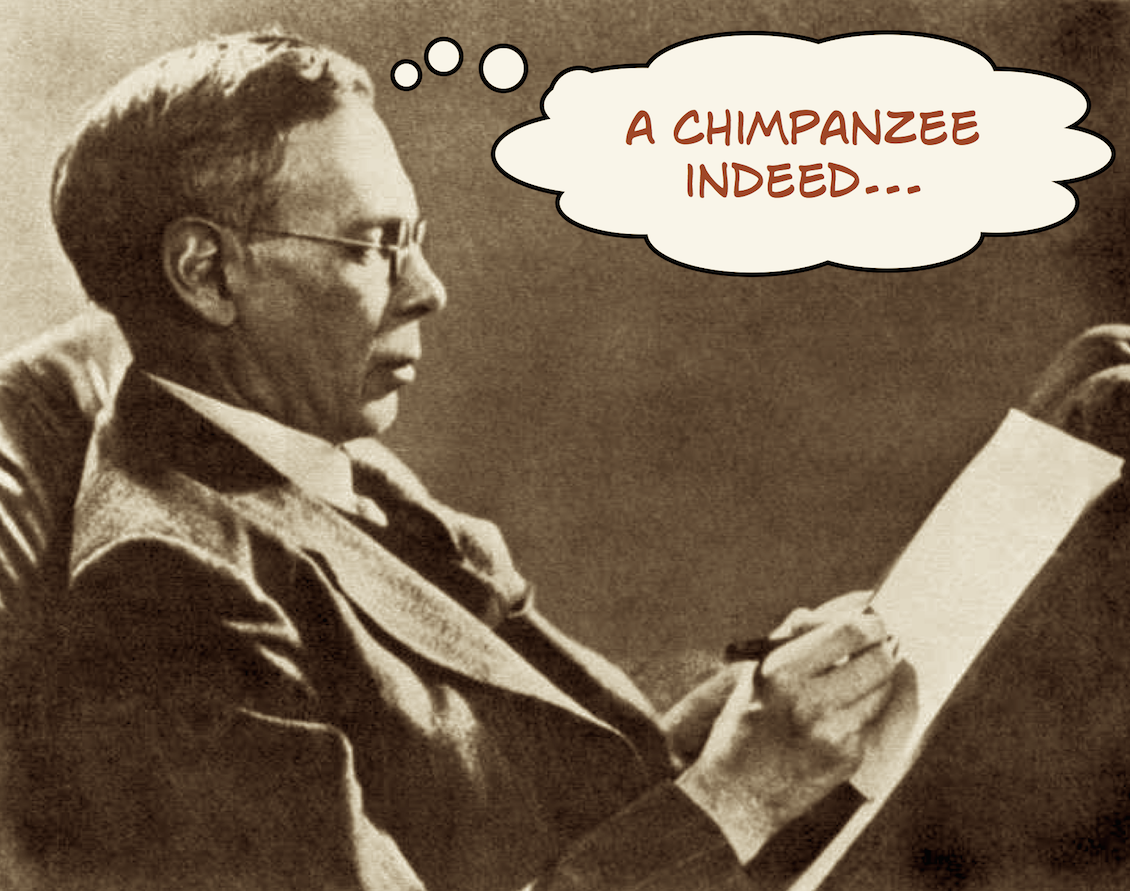
charles williamsIt seems odd to describe someone you deeply respect with the words “ugly as a chimpanzee,” but that’s precisely what C.S. Lewis once did.

Yet, reading the description in full, we find that Lewis considered the physical unattractiveness of his mentor to be a positive thing. In a sense, it accented his impressive persona.

Describing Charles Williams to his childhood friend, Arthur Greeves, Lewis wrote:

As for the man: he is about 52, of humble origin (there are still traces of cockney in his voice), ugly as a chimpanzee but so radiant (he emanates more love than any man I have ever known) that as soon as he begins talking whether in private or in a lecture he is transfigured and looks like an angel. He sweeps some people quite off their feet and has many disciples. Women find him so attractive that if he were a bad man he could do what he liked either as a Don Juan or a charlatan.

I find this description evocative of the words about Jesus’ physical appearance. You can read the full passage about Jesus, the promised Messiah, here.

For he grew up before him like a young plant, and like a root out of dry ground; he had no form or majesty that we should look at him, and no beauty that we should desire him.

Lewis continues with his description of Williams, revealing a more intimate relationship than the previous words might suggest. Williams, you see, was one of the Inklings.

He works in the Oxford University Press. In spite of his “angelic” quality he is also quite an earthy person and when Warnie, Tolkien, he and I meet for our pint in a pub in Broad Street, the fun is often so fast and furious that the company probably thinks we’re talking bawdy when in fact we’re very likely talking Theology. He is married and, I think, youthfully in love with his wife still.

I find it amazing how vivid Lewis’ portrait of his colleague is. He briefly passes over his physical appearance (the least important of human traits, despite what the modern era intimates). And, even though his words are not flattering, the rest of the description reveals they are expressed with deep affection.

Lewis then quickly presses on to a poetic depiction of Williams’ oratorical skills, and concludes with a personable picture of the man among brothers. The final sentence, given Lewis’ perception that he himself would remain a lifelong bachelor, is quite perceptive.

Mutual respect—especially when tempered with affection—generates bonds that allow for honest assessments of both weaknesses and strengths.

A Personal Experience

I recall receiving a lovely engraved glass plaque as a memento of my tour at the United States Air Force Chaplain School. Most of my duties related to writing, but it was common knowledge that there were few subjects on which I did not have something to say.

When the Commandant of the Institute read the inscription during the presentation (it was the first time he had seen it), he paused in embarrassed silence thinking he must have read it wrong. It didn’t sound like the flattery that traditionally adorns such tokens.

“He says in a book what others say in a sentence.”

You can only offer such a dialectical “compliment” to a friend.

It was true, of course, and it was to much laughter that I immediately responded, “True, and it is a book well worth reading.”

When I read this description of the literary friend who made such a profound impression on Lewis, it makes me smile. It is all the more poignant, since it was written just a year before Williams’ death.

There are far, far worse things a person can experience than having someone who respects and loves them say they resemble a chimpanzee . . . or that they tend to be just a little bit verbose.

Publishing Troubles

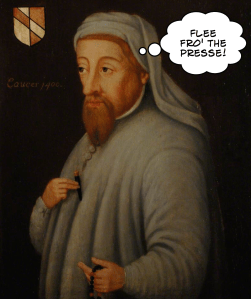
chaucerDespite C.S. Lewis’ vast experience as an author, even he was abused by publishers to the point where he could simply echo Chaucer in saying, “Flee from the Press!”
Print on demand technology has delivered a stout, but not debilitating, blow to traditional publishers. They still possess a significant amount of influence.

And—like all power—that which is wielded by publishers can be used for either good or evil.

We can thank many different publishers for making the works of Lewis, J.R.R. Tolkien and their fellow Inklings available to us. We would be wrong, however, to assume these relationships were without their stresses.

John H. McCallum was an American editor with whom Lewis worked. McCallum worked at Harcourt, Brace & World.

A piece of correspondence from 1960 reveals how complex the publishing world remained even to a veteran such as Lewis.

McCallum had sought permission to publish Lewis’ latest work, and the Cambridge professor had sought to accommodate that request. Unfortunately, he had negotiated a contract that restricted him from doing so. He begins his letter of explanation with an apology for having taken so long to respond.

Dear Mac

‘Why the heck can’t C.S.L. have the civility to answer a letter?’ I don’t blame you, but it wasn’t exactly my fault. Like a fool, I dealt direct with C.U.P. [Cambridge University Press] for Studies in Words instead of working through [his regular literary agent] Curtis Brown: chiefly because I regarded this book as too academic to be of any serious commercial value.

And like a double fool I’ve let them take it up so that I’m not free to arrange for an American edn. with anyone else.

The delay in answering you is due to the fact that I’ve been all this time trying to get out of them whether this is exactly what my contract with them means. It is. But of all the impenetrable block heads! Their answer—the correspondence was long and infuriating—dealt with every question under the sun except the one I had asked (besides being unintelligible and contradictory).

I am sorry about all this. How well Chaucer advised us ‘Flee fro the Presse’!

Yours Lewis, C.S.

Dealing with publishers today remains challenging. They are, in a sense, gatekeepers. One of their roles is to prevent undeserving works from seeing print. Unfortunately, because literary tastes are utterly subjective, they bar many worthwhile manuscripts as well.

For that reason, we can be thankful that digital publishing allows quality works that would formerly have been overlooked to find their audience. The price of that boon, however, is that we must sometimes wade through major quantities of dregs to savor fine writing.

The majority of writers, given the opportunity, would prefer to be published by traditional publishing houses. There is no way around the fact that this adds a degree of status to most books. A recent poll supports this notion. It found among those published traditionally, “32% of respondents said the prestige of having a deal with a traditional publisher was important to them, while a further 54% said it was one of the appealing aspects of a traditional publishing deal.”

If we should ever seek “publication” for our own work, it is good to remember that the publishing business could puzzle even as gifted a writer as C.S. Lewis. If the author of so many impressive books could be mystified by it, it’s no wonder it seems labyrinthine to the likes of us.

Perhaps Chaucer’s advice, offered more than 500 years ago, really does ring just as true today.

The Devil’s Printing Press

pressIf the devil has used the printing press so effectively to advance his purposes, one can only imagine how easily the internet can be twisted to his purposes.

Whether or not you believe Satan is an actual (fallen angelic) person, we all recognize the web provides a ready conduit for unimaginable evil. Recent discussions of the traffic that occurs on the Dark Web is sobering. Actually, not “sobering,” but frightening.

While a small fraction of the data is innocent, the majority deals with criminal and dehumanizing material. Some investigators suggest more than half of the data transfers involve pedophilia.

I’ve been doing some personal research into parallels between the advent of the printing press and the rise of the internet. I’m approaching it from the perspective of how each has provided access to competing faith claims.

Martin Luther viewed the “recent” invention of Gutenberg’s press as divinely appointed to coincide with what would come to be known as the Reformation.

Roman Catholics also published treatises and pamphlets opposing the calls for institutional change within the church. The persuasiveness of arguments aside, one reason for their lack of success against the evangelical leaders was simple.

Rather than writing for the German people in their own tongue, they directed nearly all of their initial energies at writing for the elite, in Latin. While only a minority of sixteenth century Germans were literate, only a small percentage of these were able to read Latin.

During the first half century of the existence of movable type for the press, the majority of published titles were religious. Only later did popular and secular titles eclipse them.

However, they did. Many were wonderful. Scientific and literary knowledge blossomed.

Foremost among the good fruits disseminated by the press, we would have to include the works of the Inklings, especially C.S. Lewis and J.R.R. Tolkien. (Consecrated imaginations are capable of wondrous creations!)

Eventually, of course—given humanity’s imperfect nature—this neutral device was harnessed to baser purposes.

This would lead a nineteenth century minister to write an essay with the title of this column, “The Devil’s Printing Press.” Thomas Green described the dilemma vividly.

The first book printed in Europe had six hundred leaves, and it took nearly ten years to make it. Now books are written, printed, sold, read and forgotten in one-fourth the time. A single century ago, and a man well to do, thought himself fortunate if he had one book in this wild western world.

Today there are books in well kept rank upon almost every cottage shelf It is little wonder that the powers of evil should have invaded the province of the influence of the book shelf and bound up in attractive colors and insidious page the poison of wickedness and sin.

Later in his address, available to read at your leisure here, he contrasts the noble and corrupt purposes for which the press (or internet) might be used.

There are papers of every shape and for every use; daily, tri-daily and almost hourly, weekly and semi-weekly, monthly and quarterly, and filled with everything. You have no idea unless you have given it especial attention, of the magnitude and wondrous dimensions of the newspaper as a factor in civilization. You have little idea, unless you have studied it, of the influence, the formative power of this outwardly ephemeral agency upon human life.

You have little idea, unless you have sought it, of the labor, the enterprise, the energy, the talent, the outlay necessary to plan and execute this gigantic result. You have little conception of the influence of the printing press, as an enlightener, as a pioneer of civilization, as a promoter, a creator, a conservator of purity and virtue; and you have little idea of the magnitude of the devil’s work through this mighty agency, as in a thousand ways he uses it for pollution and ruin.

Green’s florid and dated verbiage may weaken the impact of his argument. Likewise the revivalist tones of his message. Still, as the existence of the dark web reminds us, even the good can be touched by corruption. Perhaps our vigilance can reduce this danger.

We will close now with another description by the author of the lurid material which preceded the pornography which abounds today. Would that our dulled sensitivities remained innocent enough to “blush” at explicit material, as he says.

But the devil has a channel by which he ruins life and character, in a specialty in the newspaper line that panders to the low and more bestial part of man’s being. Broadcast over the land there are sown every day almost countless thousands of papers filled with the corrupt, lascivious, the impure, gathered from all the fact and fancy that a filthy mind can contrive.

Facts that transpire often in the lowest slums of life are here placarded with all the embellishment of illustration and seductive coloring; language and recitals no man would read without a blush are hidden in its folds. It is a slimy, salacious mosaic of filth and wickedness, and yet go up and down the city streets and in every news-dealer’s window and on every corner stand they are spread out for inspection and sale.

_____

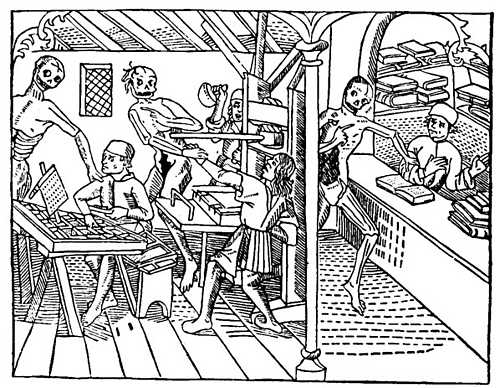
The woodcut illustration above comes from a book entitled The Dance of Death, and is the first representation of a printing press. The point being made was not to associate death with printing, but to reveal how death comes to all, unanticipated, regardless of who they are.

Similes & Metaphors

agdeiSimiles are wonderful literary tools. Being able to compare two dissimilar things in a way that brings out subtle nuances and insights is quite enjoyable.

Here are a couple of examples off the top of my head. (I don’t pretend others haven’t written these things, but I didn’t plagiarize them.).

A politician is like a weathervane.

Arguing theology is like having indigestion.

Disliking Narnia is like hating a feast.

Metaphors, of course, are far more powerful than similes. When we consider a metaphor we are pondering how two different things actually share some fundamental quality.

Comprehending metaphors requires the ability to think abstractly. A child—confined to a world of concrete concepts—cannot begin to think of their nation as a “motherland” or “fatherland,” as the case may be. Yet, those are powerful nurturing and bonding words that countless patriots have embraced throughout the centuries.

A simile might say “our country is like a family.” A metaphor suggests far more. In this case, it might convey that one’s allegiance to their nation should exceed their loyalty to their biological kin.

Nowhere is the magnificence of metaphors more manifest than in the way we talk about God. One of the most famous biblical passages is a straight forward example. “God is love” (1 John 4:8).

Jesus the Christ said of himself, “I am the Way, the Truth and the Life” (John 14:6). He also called himself the “Light of the world. Whoever follows me,” he added, “will not walk in darkness, but will have the light of life” (John 8:12).

It is a sad thing when a symbol loses its meaning. There is a prime example of that phenomenon in Oxford. And you can see it in the sign that hangs above a pub frequented by the Inklings.

No, not the Eagle and Child, which they affectionately referred to as the Bird and Baby.

After renovations to the Eagle and Child eliminated their privacy, the writers transitioned across the street to the Lamb and Flag. Both pubs trace their history back to the seventeenth century, and the latter is actually owned by St. John’s College. (It’s profits fund student scholarships.) In a 1963 letter, Lewis colorfully described the move thusly:

Mon 11 March it is. But note that our causeries de lundi are now permanently transferred to the Lamb & Flag. We were sorry to break with tradition, but the B & B had become too intolerably cold, dark, noisy, and child-pestered.

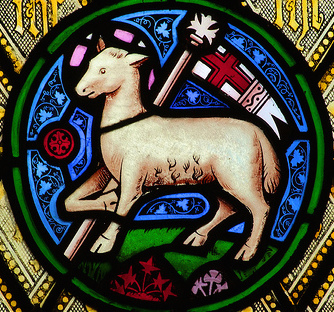
Sadly, when many people look at the Lamb on the pub’s sign, they fail to recognize it’s significance. The lamb carrying a cross-emblazoned banner is nothing other than the Agnus Dei, the Lamb of God.

What, some may wonder, is the Lamb of God? The better question is “who” is the lamb. The symbol represents Jesus Christ himself. It hearkens to the declaration of John the Baptizer as Jesus approached the Jordan: “Behold, the Lamb of God, who takes away the sin of the world!” (John 1:29).

To understand what it means to say “Jesus is the Lamb,” requires two things. First, a recognition that it is more than a simile; it is not simply that he possesses some of the attributes we would naturally associate with a lamb, such as gentleness. The second requisite is that we understand something about the Jewish sacrificial system.

For, Jesus being the Lamb of God means nothing less than that he is the true, complete, ultimate and final sacrifice for the sins of humanity.

And that is a wonder definitely worth pondering during this Christmas season.

Free Books

lunchIf you would like to pick up a free kindle copy of a very recent book on C.S. Lewis, you need to hurry. No telling how long the offer will last.

If I Had Lunch with C. S. Lewis by Alister McGrath has a normal (U.S.) price of $17.99, so it’s quite an offer.

But read on for another great deal. Ugh, that sounded like what a shill—which I am not—might say. Allow me to rephrase.

But keep reading. That’s not the only special offer for kindle readers right now. (And remember, even if you don’t own a kindle reader, Amazon offers a free program for use on your computer.)

I rarely look for free kindle titles, since it’s a genuine effort to sort through the chaff to find the grains of wheat. Today, however, I took a quick look, and I’m glad I did.

When this book was first released, just this year, I thought it looked interesting. Only last year, McGrath wrote the biography, C.S. Lewis A Life: Eccentric Genius, Reluctant Prophet.

The free title offers a thematic introduction to Lewis. It’s subtitle reads, Exploring the Ideas of C.S. Lewis on the Meaning of Life. It may be something you might want to suggest to your acquaintances unfamiliar with the Oxford Inkling.

Often, when items or services are offered without cost, it indicates a lack of value. This is why the maxim “you get what you pay for” arose.

However, the rapidly morphing publishing business contradicts the usual accuracy of that principle.

In order to promote their work, and expand their paying audience, a new distribution model has writers offering their books for free. And, alert readers can take advantage of the opportunities.

In light of that, allow me to share with you another time sensitive offer that I found as I browsed further. Right now you can purchase the kindle version of volume three of Lewis’ correspondence for a mere ninety-nine cents. I can’t recall now what I paid for my hardback and kindle copies of the volume, but trust me . . . this is an amazing deal.

Free Bonus Book

Students of C.S. Lewis will recall the significant impression that George MacDonald (1824-1905) made on his life. Right now you can download a collection of 365 quotations from MacDonald’s works for free.

365 Meditations from George MacDonald’s Fiction is edited by David Wilson-Okamura. This work, he writes, “was inspired by George MacDonald, An Anthology: 365 Readings, edited by C. S. Lewis (1946).”

Really Creative Writing

father christmasWhen did you first learn how to express yourself creatively? Some of us were blessed with parents who recognized the importance of things like music, art and literature. Others, alas, were not.

Most readers of Mere Inkling like to dabble in writing themselves. Many are quite skilled, and disciplined enough to persist with the demanding task of regularly composing interesting pieces for their own online columns. Some, in fact, are quite accomplished and successful in their personal literary efforts.

Becoming a good, truly good, writer requires experience. One may be born with the innate ability to become a Shakespeare or a Hemingway, but the skills need to be sharpened through effort. Study often helps, but it can never replace the necessity of practice in honing our writing.

It seems to me that the sooner we begin the process of unbridling our imaginations, translating our visions into words, and writing it all down in a way that engages the imaginings of others, the better we can become.

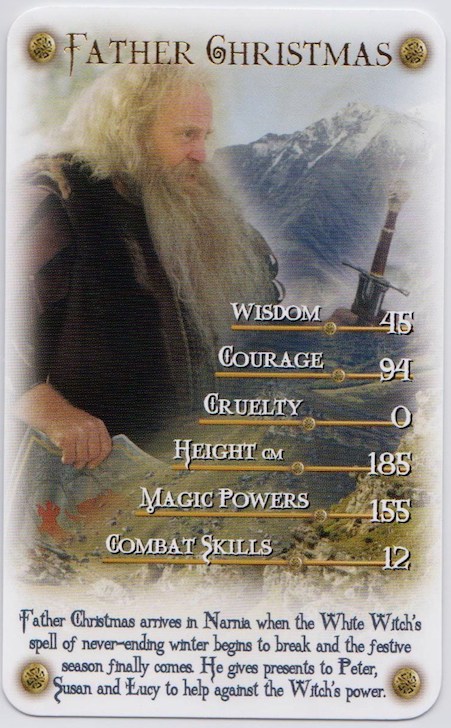
Many of you, especially Europeans, will be familiar with a gaming product that arose in the United Kingdom. They are called Top Trumps, and the cards come in a wide variety of themes. One set that I own is Narnia, from which the image at the top of this page comes.

Tolkien fans will be delighted to learn they just reissued a Lord of the Rings set that comes in an amazing Eye of Sauron tin. You can learn more about that unique item here.

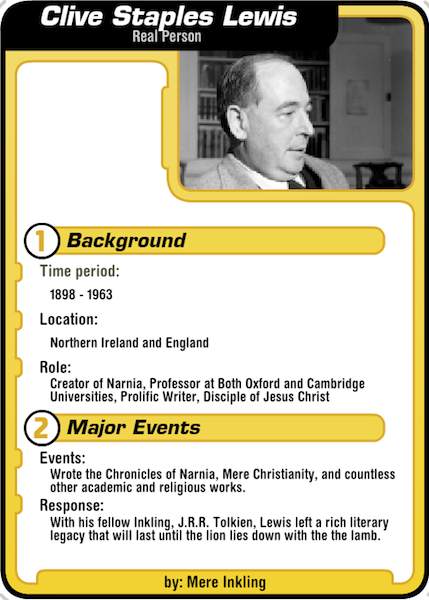
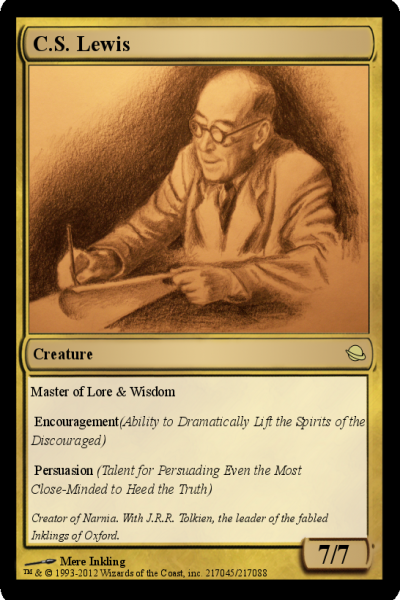
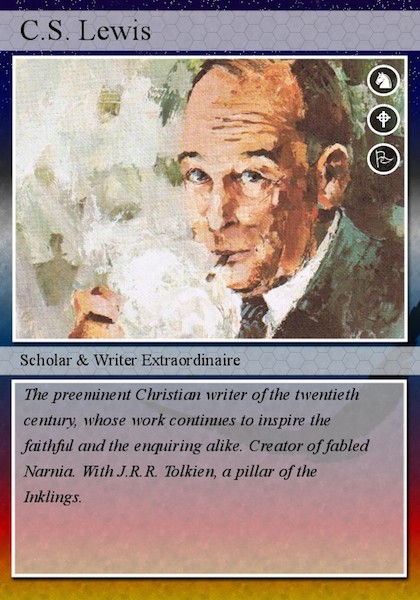
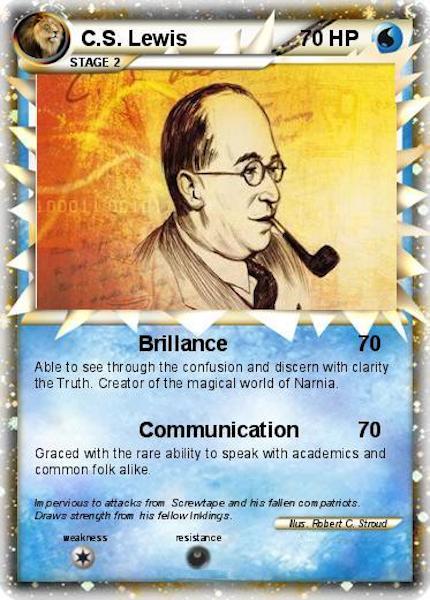
It was while thinking about my Narnia cards when I got the idea to see if there was an online mechanism for making one’s own playing cards. I was toying with the idea of fashioning a C.S. Lewis card to illustrate one of my posts.

I was actually searching online for a site where I could “create” such a card. I found several. Only later did I consider the irony of using that particular word.

For theologians, the word create bears profound significance. When it comes to the human activity of bringing together in some novel shape pre-existing images or ideas, it is not truly accurate. Lewis wrote about that in a 1943 letter to Sister Penelope.

‘Creation’ as applied to human authorship . . . seems to me an entirely misleading term. We . . . re-arrange elements He has provided. There is not a vestige of real creativity de novo in us. Try to imagine a new primary colour, a third sex, a fourth dimension, or even a monster which does not consist of bits of existing animals stuck together! Nothing happens.

And that surely is why our works (as you said) never mean to others quite what we intended: because we are re-combining elements made by Him and already containing His meanings. Because of those divine meanings in our materials it is impossible we should ever know the whole meaning of our own works, and the meaning we never intended may be the best and truest one.

Writing a book is much less like creation than it is like planting a garden or begetting a child: in all three cases we are only entering as one cause into a causal stream which works, so to speak, in its own way. I would not wish it to be otherwise.

Still, even though we are not true “creators,” it is enjoyable to rearrange the mundane elements (or words) of this life in fresh ways.

That’s one reason I was pleased to discover a website devoted to offering a “Trading Card Creator” hosted by the International Reading Association. It “gives students an alternative way to demonstrate their literacy knowledge and skill when writing about popular culture texts or real world examples.”
Why didn’t they have cool stuff like this when I was growing up? (If they did, I might be able to express myself better than by having to rely on phrases like “cool stuff.”)

Below you will find their website, along with a second option. I was thinking that my grandchildren might find it interesting to create a set of cards about our family tree. Their own sketches could be used for ancestors for whom we have no photograph. The comprehensive trading card creator maker offers a variety of templates, including for people, places, events and objects.

The template offered by the second site is generic enough that the cards can be produced in similar categories.

Unleash your imagination. And, after you’ve had some fun, consider sharing these links with a child you may know.

ReadWriteThink Trading Cards

Big Huge Labs Trading Cards

C.S. Lewis Card 3C.S. Lewis Card 2C.S. Lewis Card 1C.S. Lewis Card 4

Suspicious Séances

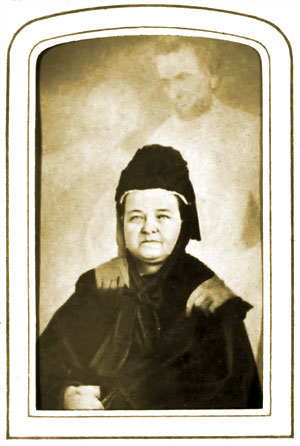
lincolnsDid you hear about the séances that were held at the White House? It’s true, but it’s not recent news. They were conducted for Mary Todd Lincoln, and her husband, the president, apparently joined in attendance at some of them.

The Lincoln’s had lost their eleven year old son Willie to Typhoid in February 1862. Nearly all historians describing Mary’s grief accurately use the word “inconsolable”.

Since the Lincoln’s were not Christian, Mary sought the illusion of comfort in spiritualism, a thriving movement in the mid-nineteenth century. Spiritualism typically contends that the spirits of the dead survive in a manner where they can, and do, communicate with the living. This interchange is typically facilitated by a “medium,” someone particularly attuned to the “spirit world.”

Mediums sometimes allow themselves to become physical vessels for these spirits.

Christians either dismiss such experiences as fraud, or as demonic possession. Which depends on their own worldview. Some Christians dismiss the spiritual realm, while others recognize it is quite real.

C.S. Lewis would be in the latter camp, as his preface to The Screwtape Letters amply illustrates.

There are two equal and opposite errors into which our race can fall about the devils. One is to disbelieve in their existence. The other is to believe, and to feel an excessive and unhealthy interest in them. They themselves are equally pleased by both errors and hail a materialist or a magician with the same delight.

Christians who acknowledge the spiritual warfare which is waged beyond our physical senses understand the meaning of Paul’s words: “For we do not wrestle against flesh and blood, but against the rulers, against the authorities, against the cosmic powers over this present darkness, against the spiritual forces of evil in the heavenly places” (Ephesians 6:12).

Returning to the 1800s

The reason I have been thinking about Mary Lincoln—who would later be institutionalized and attempted suicide—is because I’m finishing up an article for the online journal I edit about the military chaplaincy. It’s called Curtana: Sword of Mercy, and the new issue will be posted by the end of the month.*

The specific article relates the story of Ellen Elvira Gibson (Hobart),** who was the first woman chaplain in the American military. She served a Wisconsin regiment, and her story is nothing short of fascinating.

Hobart was a spiritualist, and “ordained” by a group of the same who banded together to provide just such credentials. Interestingly, although she gave hundreds of (paid) lectures in a spiritual “trance” state, she would ultimately reject spiritualism. She turned to a more radical and secular “freethinking” as spiritualism was waning in popularity, but still a formidable presence.

Chaplain Hobart would gain renown in anti-Christian circles for her book The Godly Women of the Bible by an Ungodly Woman of the Nineteenth Century. Numerous atheist websites cite a quotation from the volume. “The abominable laws respecting [women in the Bible] . . . are a disgrace to civilization and English literature; and any family which permits such a volume to lie on their parlor-table ought to be ostracized from all respectable society. . .”

Contemporary readers will find it odd that one of the reasons spiritualism received a warm welcome in Europe and America was precisely because it seemed to offer measurable, “scientific” evidence of the afterlife. In This Republic of Suffering: Death and the American Civil War, Drew Faust writes:

To an age increasingly caught up in the notion of science as the measure of truth, spiritualism offered belief that seemed to rely on empirical evidence rather than revelation and faith. If the dead could cause tables to rise, telegraph messages from the world beyond, and even communicate in lengthy statements through spirit mediums, an afterlife clearly must exist. Here was, in the words of one popular spiritualist advocate, ‘proof palpable of immortality’” (180-81).

Returning to the Inklings

One of Lewis’ dearest friends was Owen Barfield. Sadly, the two remained separated throughout life by their religious beliefs. Barfield had helped Lewis come to believe in God (i.e. theism) but could not journey with Lewis on to Christianity. Barfield, instead, became one of the greatest of Anthroposophist evangelists.

Anthroposophy possesses elements of philosophy, but is also inarguably a religion in its own right. It also holds a view of the afterlife distinct from both Christianity and historic spiritualism.

But the nature of the religion created by Rudolf Steiner (which evolved from his involvement in Theosophy) is not the subject of our reflections here. However, if one is interested in learning more about Owen Barfield, a 1992 documentary can be viewed here.

_____
The image above is a famous example of “spirit photography” taken by William Mulmer, who made it popular. He was once placed on trial for fraud, but the case was dismissed for lack of evidence.

* I may delay publication of this particular article since the issue will already carry the biography of another chaplain.

** The reason “Hobart” is bracketed, is because it was her married name at the time of her military service. However, the marriage was short lived, and most of her life she went by “Ella E. Gibson.”

Impromptu Poetry

eye

I had to endure a to and fro transcontinental trip this week. Endure is the right word, when flying miles above what would otherwise be a scenic, albeit lengthy, journey.

One positive thing about flying is that I have time to catch up on some of my “pleasure” reading. This week it included an article about cinquains.

A quintain is a poem with five verses. A cinquain is a specific form which has the following number of syllables in each of the lines: two, four, six, eight, and two.

I took a break from my reading and drafted a few of these small poems. I found it quite simple, and it’s likely you may as well.

I make no promises about the quality of my verse, but perhaps you’ll find one or more of them interesting. Or, at least they may inspire you to write some of your own.

Springtime
Narnian hope
Delayed by the White Witch
Borne by Aslan’s Resurrection
New dawn

Pilgrim
Traveling through
This world is not my home
Destined for a new creation
With Christ

True hope
He died for us
Emancipation now
Washed clean by the blood of the Lamb
New life

Inklings
Lewis, Tolkien
Friends rounded out the group
Imaginations unfettered
Wonder