Hitler Versus C.S. Lewis

hitler“Meme.” A ubiquitous word among younger generations, but a concept still rather foreign to many who are slightly more “mature.”

The word was introduced by Richard Dawkins in 1976 and means an idea or social behavior that is transmitted by repetition “in a manner analogous to the biological transmission of genes.” Dawkins echoed the sound of “gene,” using the Greek word mimeisthai (to imitate).

Some memes are quite comical. Other quickly grow wearisome (remember the “dancing baby?”).

One I find particularly creative is a scene of Hitler in his bunker during the final days of the Third Reich. The dialog is in German, and the ingenuity is manifest in all of the hilarious subtitles that people create to coincide with the actions of the characters.

I’m sure there are many tasteless examples (to be avoided), but during the last few years I’ve viewed a couple of dozen and found most quite entertaining.

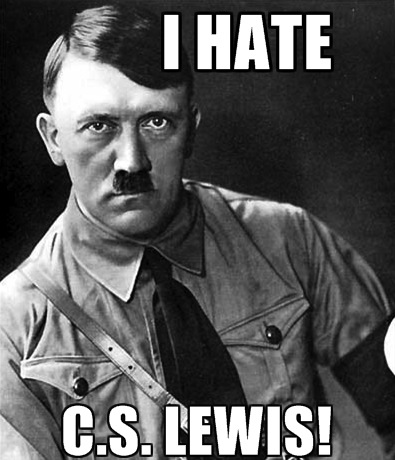
When I discovered a website that allows you to create your own version, I couldn’t resist. And, of course, I could think of no subject better suited to coinciding with Hitler’s demise than the heroic work of C.S. Lewis. In just a moment I’ll share a link to my film “adaptation.”

Lewis, of course, was a patriot who volunteered for the British army and served on the frontlines. He was seriously wounded. (He was not a Christian at the time.)

During the Second World War, Lewis supported the war effort from home. He provided tremendous encouragement to his countrymen via well-received talks broadcast on BBC. And this is the inspiration for my “take” on the Hitler Bunker meme.

His sequel to The Screwtape Letters, “Screwtape Proposes a Toast,” mentions the madman by name. Portraying the demons at the banquet as feasting on the souls of the damned, Screwtape complains:

. . . it would be vain to deny that the human souls on whose anguish we have been feasting tonight were of pretty poor quality. Not all the most skilful cookery of our tormentors could make them better than insipid.

Oh to get one’s teeth again into a Farinata, a Henry VIII, or even a Hitler! There was real crackling there; something to crunch; a rage, an egotism, a cruelty only just less robust than our own. It put up a delicious resistance to being devoured.

Curiously, in English Literature in the Sixteenth Century, Lewis mentioned how Hitler could be viewed in a humorous light.

The mixture of farce and terror would be incredible if we did not remember that boys joked most about flogging under Keate, and men joked most about gallows under the old penal code. It is apparently when terrors are over that they become too terrible to laugh at; while they are regnant they are too terrible to be taken with unrelieved gravity. There is nothing funny about Hitler now.

Lewis’ point, accurate I believe, is that in the terror of the experience itself, humor can provide some relief. Laughing in ridicule at the source of the horror can help to preserve our sanity. Only in the aftermath—once the threat has been dispatched—can we allow the true magnitude of the carnage to be comprehended. And, in that moment, there is nothing at all that is funny.

Of course, years later, when the sights and smells of Dachau are no longer recalled by the living, things shift once again. (Very few of those tragic victims or liberating heroes remain.) When the scarred battlefields have been covered with velvet grass, and it was no longer even “dad’s war,” but now “grandpa’s” or even “great-grandpa’s,” the bitterness has grown stale.

Today, it is natural to scorn and laugh at the tragic dictator who caused so much sorrow. He was a pitiful human being, and without minimizing his crimes, it is fitting that he be ridiculed once again.

History Proves Lewis True

The fact that at a certain point it becomes acceptable to ridicule a monster, is the premise behind the hilarious film “The Producers.” If you’ve never seen it, by all means take a moment to watch the theme song, “Springtime for Hitler.” For a cinematic example of Hitler-ridicule, there may be none finer than that “musical” (overlooking the tasteless burlesque costumes).

Of course, true to Lewis’ maxim, ridicule was also heaped upon the “Bohemian Corporal” during the war itself.

The classic example would be Charlie Chaplin’s celebrated “The Great Dictator.” (In addition to starring in the film, Chaplin wrote, directed and produced the movie. Oh, and he also co-composed the music.) The film was made in 1940, while war already raged, but prior to the entry of the United States.

Chaplin’s movie confirms Lewis’ contention that we should not joke about such matters while the wounds are raw. We learn from Chaplin’s My Autobiography, that in the post-war realization of the depth of Hitler’s evil, he regretted treating him with such levity. “Had I known of the actual horrors of the German concentration camps, I could not have made The Great Dictator, I could not have made fun of the homicidal insanity of the Nazis.”

[Best if viewed in the order presented, beginning with the external link to my parody.]

A Visit to the Cinema

Hitler Versus C.S. Lewis (by Mere Inkling)

Click this link: http://meemsy.com/v/12897

Springtime for Hitler and Germany” from The Producers

Charlie Chaplin’s Version of the German Dictator

The Three Stooges actually beat Chaplin to the screen with their short, “You Nazty Spy!” The sequel, “I’ll Never Heil Again” was released the following year.

A Scene from Nazty Spy

A Brief Clip from I’ll Never Heil Again

And finally, returning full circle to the original meme in which I participated, I was surprised to discover a version of it in which Hitler views the trailer for the 2012 Three Stooges movie. (Apparently, despite their rather disrespectful treatment of him, according to this meme der fuhrer was a fan!) And with that, today’s Hitler cinema will close.
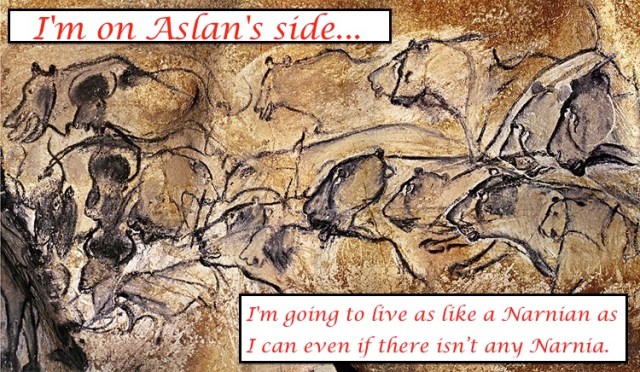
Return to Narnia

Chauvet Quote

Great news for all fans of Narnia—after a three year delay, it’s just been announced that they will be making a film based on The Silver Chair!

Voyage of the Dawn Treader was released in 2010, although it seems to many of us even more time has passed. And, due to the vagaries of film making, the fourth title in the series may not see the screen until 2018. However, there is additional good news too.

Most fans will be happy to learn that the new partner in the production is Mark Gordon. Among the films and shows Gordon has produced are Saving Private Ryan, The Patriot, Speed, The Day After Tomorrow and Grey’s Anatomy. Gordon is quoted as saying:

Like many readers, both young and old, I am a huge fan of C.S. Lewis’ beautiful and allegorical world of Narnia. These fantasy stories inspire real-world passion among millions of devoted fans around the world. As we prepare to bring the next book to life, we are humbled and excited to contribute to the outstanding legacy of Narnia.

Lewis’ son, Doug Gresham, will continue to work on the project, and strive to maintain fidelity to the author’s vision.

The Silver Chair offers a fascinating tale, much of which takes place in a subterranean realm. I’m certain the cinematography will be spectacular.

The story marks the return of Eustace Scrubb and the addition of a classmate, Jill Pole. The other major character—aside from Aslan, of course—is Puddleglum, a taciturn Marsh-wiggle. (We named the pond on our property in his honor, enjoying the alliteration.)

As the script is written, I’m most concerned about how Puddleglum will be portrayed. He’s not a cartoon character, although much that he says in utter seriousness comes across as slightly silly.

Much of the “humor” comes from the fact that Puddleglum is the archetypal pessimist, as I’ll illustrate in a moment. I just hope they don’t pursue the all too common path of setting him up as comic relief (à la Jar Jar Binks).

Puddleglum, in fact, is the hero of the story. He leads the young children on their dangerous mission to locate the son and heir of King Caspian (who we met in the two previous films). Here are a few quotations from the courageous Marsh-wiggle.

Good morning Guests . . . Though when I say good I don’t mean it won’t probably turn to rain or it might be snow, or fog, or thunder. You didn’t get any sleep, I daresay.

. . . but I’d better not tell you that story. It might lower your spirits, and that’s a thing I never do.

The bright side of it is . . . that if we break our necks getting down the cliff, then we’re safe from being drowned in the river.

Life isn’t all fricasseed frogs and eel pie.

In the climatic confrontation with the Queen of the Underland, Puddleglum champions the truth in this amazing scene.

One word, Ma’am . . . All you’ve been saying is quite right, I shouldn’t wonder. I’m a chap who always liked to know the worst and then put the best face I can on it. So I won’t deny any of what you said. But there’s one more thing to be said, even so. Suppose we have only dreamed, or made up, all those things–trees and grass and sun and moon and stars and Aslan himself. Suppose we have. Then all I can say is that, in that case, the made-up things seem a good deal more important than the real ones. Suppose this black pit of a kingdom of yours is the only world. Well, it strikes me as a pretty poor one.

And that’s a funny thing, when you come to think of it. We’re just babies making up a game, if you’re right. But four babies playing a game can make a play-world which licks your real world hollow. That’s why I’m going to stand by the play world.

I’m on Aslan’s side even if there isn’t any Aslan to lead it. I’m going to live as like a Narnian as I can even if there isn’t any Narnia. So, thanking you kindly for our supper, if these two gentlemen and the young lady are ready, we’re leaving your court at once and setting out in the dark to spend our lives looking for Overland. Not that our lives will be very long, I should think; but that’s a small loss if the world’s as dull a place as you say.

Simply rereading these words has whet my hunger for the new addition to the Narnian cinematic canon. May it arrive soon.

During the next few years, as a script is written, the cast is chosen and the various scenes are filmed and edited, join me in offering an occasional prayer that the movie’s producers will both remain true to Lewis’ message, and produce a film worthy of the novel upon which it is based.

Shut Up He Explained

LardnerMy wife and I love that phrase, and we often recall it when we encounter particularly over-strained (or “broken”) grammar. When I encountered it as the title of a book, I was unaware of its original source.

This is where I reveal that I wasn’t an American Lit major in college. (Well, regular readers probably figured that out long ago.)

I had never heard of Ring Lardner until today. (If you don’t recognize his name either, you needn’t feel embarrassed . . . he died eighty years ago.)

Lardner was a well regarded humorist who considered himself a sports writer. One of his satires was entitled The Young Immigrunts. It was a parody of a popular English book, The Young Visitors, which was allegedly written by a young girl.

The Young Immigrunts is fictitiously ascribed to Lardner’s son, Ringgold Wilmer Lardner, Jr. His son was only four, at the time. Later he would become a successful screenwriter, winning an Academy Award for the film M*A*S*H. He also wrote prolifically for the television series.

Perhaps Lardner Junior is best remembered as one of the Communist writers blacklisted in Hollywood. But we need not go into that, since his father was merely using his young son as a surrogate author for the work.

The book takes the form of the ramblings of a child, and its quaintness will appeal to many readers. You can download a copy of it here.

It’s not my own preferred genre, so I won’t be reading it in its entirety, but in small doses, I find it rather entertaining.

A little later who should come out on the porch and set themselfs ner us but the bride and glum [pictured above].

Oh I said to myself I hope they will talk so as I can hear them as I have always wandered what newlyweds talk about on their way to Niagara Falls and soon my wishs was realized.

Some night said the young glum are you warm enough.

I am perfectly comfertible replid the fare bride tho her looks belid her words what time do we arrive in Buffalo.

9 oclock said the lordly glum are you warm enough.

I am perfectly comfertible replid the fare bride what time do we arive in Buffalo.

9 oclock said the lordly glum I am afrade it is too cold for you out here.

Well maybe it is replid the fare bride and without farther adieu they went in the spacius parlers.

I wander will he be arsking her 8 years from now is she warm enough said my mother with a faint grimace.

The weather may change before then replid my father.

Are you warm enough said my father after a slite pause.

No was my mothers catchy reply.

And now the phrase that always makes me smile.

The lease said about my and my fathers trip from the Bureau of Manhattan to our new home the soonest mended. In some way ether I or he got balled up on the grand concorpse and next thing you know we was thretning to swoop down on Pittsfield.

Are you lost daddy I arsked tenderly.

Shut up he explained.

I am curious as to whether or not C.S. Lewis was acquainted with Lardner’s work. It doesn’t quite conform to his literary tastes, but Lewis was so widely read that I think it’s possible he was at least acquainted with who he was.

My research on the matter did produce an interesting juxtaposition between the two authors. I discovered it in a book by Sherwood Wirt, perhaps the last reporter to interview C.S. Lewis (for Decision magazine, of which he was editor). I was privileged to know “Woody,” so I enjoyed finding that he mentioned both men in his book I Don’t Know what Old is, But Old is Older than Me.

With twentieth century fiction we have to be quite selective. In limiting my comments to the American scene, I will pass by many of the great names of fiction — Henry James, Stephen Crane, Edith Wharton, Jack London, Theodore Dreiser, Ring Lardner, William Faulkner, Sherwood Anderson, Sinclair Lewis, Scott Fitzgerald, Ernest Hemingway, James Baldwin, John Steinbeck, Vladimir Nabokov, Norman Mailer, and Truman Capote.

While most of these are excellent writers, I doubt whether they have much to say to today’s older readers that would make life more pleasant, more interesting, or more fruitful in the closing stretches of life’s journey. Nor do I think that these authors have anything worthwhile to say about what lies beyond death. We might better spend our reading hours riding off into the sunset with Louis L’Amour or Zane Grey, rather than punish ourselves with a ghastly tale like In Cold Blood.

We old boys and girls have been around a long time. We know what the world is like. We know sleaze when we see it, and we don’t need contemporary authors to embellish it or explain it to us.

The reading tastes of the American public have been corrupted almost beyond redemption by blasphemy, vulgarity, and scatology, all for the sake of increased book sales to prurient minds. There are, however, many twentieth-century American novels worth reading, such as Margaret Mitchell’s Gone With the Wind, Thornton Wilder’s The Bridge of San Luis Rey, Harper Lee’s To Kill a Mockingbird, Tom Clancy’s The Hunt for Red October, the Savannah quartet of Eugenia Price, and the Sebastian series of James L. Johnson, to name only a few.

Earlier in the century the Christian novels of Lloyd C. Douglas—The Magnificent Obsession, The Robe, and The Big Fisherman—inspired thousands of readers young and old, but no American has since matched his popular appeal.

The demand for detective fiction continues unabated, and no one needs my advice to read Agatha Christie. I would, therefore, limit my remarks to a reference to two British creations, G.K. Chesterton’s Father Brown and Dorothy Sayers’ Lord Peter Wimsey, since both are written from Christian backgrounds. My two favorite Wimsey stories are Busman’s Honeymoon and The Nine Tailors.

In contrast there is a wealth of devotional literature that makes wonderful reading for older people. One can start with the sermons of D.L. Moody, Charles Spurgeon, Samuel P. Jones, Joseph Parker, and T. DeWitt Talmage of the nineteenth century. The early twentieth century gave us Andrew Murray, Ole Hallesby, P.T. Forsyth, and Oswald Chambers, whose writings are hard to surpass. Amy Carmichael’s poetry and prose written in India, have blessed millions of readers. More contemporary are the writings of C.S. Lewis and A.W. Tozer, which carry seeds of greatness.

The passage above comes from the book’s chapter on “Reading.” If you would like to see more, the entire book (although published as recently as 1992) is legally available for your review online.

“Shut up he explained” may not be proper English, but literature doesn’t need to be proper to be entertaining. And even though Lardner is no longer a familiar name, perhaps his writings are worth visiting.

For the moment, knowing the context of this delightful phrase makes the words all the more entertaining to me. After all, like many others, my dad often “explained” the same thing to me!

Avoid them Like the Plague

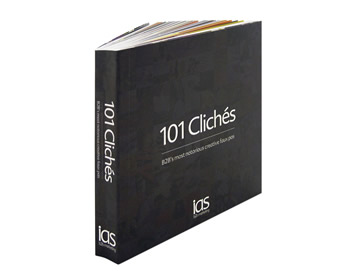
cliche bookAvoiding clichés in one’s writing is such oft-repeated advice it’s nearly become a cliché itself.

Many do not make much sense to people approaching a language from a literal perspective. For example, those new to American English may require a bit of explanation to understand that “hit the books” refers to studying rather than literary pugilism.

Some clichés are easily deciphered, especially when read in context. As an admonition to stop obstructing a view, we can understand why someone would say, “You make a better door than a window.”

“Don’t rain on my parade” adequately warns the hearer to avoid dampening the speaker’s special plans or activities.

Folksy adages are common where clichés are concerned. Take “The acorn doesn’t fall far from the tree.” We all know it references a child who shares numerous traits with a parent.

And we have interchangeable versions of the same notion, in case a lazy writer wishes to alternate your redundancies. He/she is a “chip off the old block” means essentially the same thing. And there’s always the classic “like father, like son,” and its corollary “like mother, like daughter.”

“As snug as a bug in a rug” used to be a favorite of my mother, ever applicable as she tucked little ones into their beds. Today, however, with bedbugs plaguing humanity in epidemic proportions, that cuddly image may have lost a touch of its appeal.

Some clichés have clearly outlived any usefulness they may once have possessed. “Too many chiefs, and not enough Indians,” clearly refers to a situation in which everyone is in charge and there no one is able or willing to actually carry out the project. However, few writers would tempt incurring the wrath of readers by using such a dated and rather prejudiced saying.

A cliché, of course, is a typically trite phrase that has lost its element of ingenuity due to overuse. It is something serious writers strive to avoid at all costs. But the final phrase in my previous sentence reveals how difficult it can be to purge these worn out words from our writing. Whenever used, they should be included consciously; writers might utilize them to establish, for example, a comic tone.

Even the gifted C.S. Lewis recognized the threat of clichés worming their way into one’s work. In a 1922 entry in his diary he wrote:

Tried to work at Dymer [his narrative poem] and covered some paper: but I am very dispirited about my work at present—especially as I find it impossible to invent a new opening for the Wild Hunt. The old one is full of clichés and will never do. I have learned too much on the idea of being able to write poetry and if this is a frost I shall be rather stranded . . .

The word cliché itself originated in France, where it was a printing plate or stereotype cast from an original composed of movable type. (The casting freed the movable type for new projects while maintaining the lettering for possible future printings.) The word came to be applied to ready-made phrases. However, the casting of printing plates is one thing. Recycling exhausted phrases ad nauseum is quite another.

Clichés are generally limited to a particular country or culture. Some are restricted to given regions. When outsiders hear or read these phrases, they often make little sense.

Some gain international esteem. More than a century ago Lord Acton described a universal truth of politics that resonates across boundaries. We have all witnessed the truth that “absolute power corrupts absolutely,” but those wise words are not something we should typically parrot in our own writings.

Not knowing the original source of a cliché is common. It is rather tragic, though, when it comes to texts that should be familiar to writers. For example:

“All’s well that ends well” is one of Shakespeare’s best loved maxims. If most Americans were asked whether it came from the pen of the Bard or Benjamin Franklin, we might be sadly disappointed with the results.

“The writing is on the wall” infers the outcome is already determined. But too few recognize this as a reference to a miracle recorded in the Book of Daniel. (If you’re not familiar with it, you can read the story here.)

Some clichés that relate to the art of writing would include the following [with my modest illustrations attached]:

“You can’t judge a book by its cover.”

     Appearances may be misleading.

Someone who appears wonderful when you first meet them may be just like an ebook with a professionally designed cover that contains a poorly scanned reprint replete with typos.

“It’s nothing to write home about.”

     Something that’s boring and not worth retelling.

While the freedom of POD technology has created democracy within the publishing industry, it’s also led to millions of meandering “books” that should “never have seen the light of day.”

A person is “an open book.”

     Someone who readily reveals their personality through word and action.

The type of character skilled authors will wish to introduce in limited quantities, especially if they are writing mysteries.

“Throw the book at him.”

     Give him the maximum possible judicial punishment.

The well-deserved fate of best-selling authors who rest on their laurels and start “phoning in” their sequels.

We turn now to a non-literary but colorful example of an American colloquialism that has spread far from its origins in the swine-breeding communities where it undoubtedly originated. It’s one of my favorite clichés, and it just may have a few good uses left in it, so feel free to include it in your next column or book . . . and no need to cite me as your source:

“You can’t make a silk purse out of a sow’s ear.”

     A task is impossible, given what you have to work with.

The echoing refrain of editors whose clients expect them to transform a few dusty lumps of coal into diamonds.

Possible Valid Uses for Clichés

While it’s safest for writers to avoid them altogether, there are a handful of occasions where they are not utterly inappropriate.

One suitable place for “chesnuts” like these to appear is in dialogue—especially when it’s written for a character a writer desires to portray as rather shallow-thinking.

It’s incorrect to suggest good writers never use clichés in conversation or composition. They do. The difference is that when they do include such tired phrases in their normally witty banter, they do it with a sense of irony.

C.S. Lewis, master of wordplay that he was, illustrated how we can creatively re-imagine or reword a cliché to reinvigorate it. Only the very best minds are up to this task. Yet, when it’s successfully accomplished, it can prove quite entertaining. The following comes from an informal conversation that was recorded before his retirement, preserved in the collection On Stories. Lewis refers in passing to an overly detailed passage in literature that nearly obscured the storyline.

The only trouble is that Golding writes so well. In one of his other novels, The Inheritors, the detail of every sensuous impression, the light on the leaves and so on, was so good that you couldn’t find out what was happening. I’d say it was almost too well done. All these little details you only notice in real life if you’ve got a high temperature. You couldn’t see the wood for the leaves.

Malapropistic Entertainment

marshianWhenever I have an appointment with a doctor, I try to remember to bring along my own magazine or (better yet) the current writing project with which I’m wrestling. Unfortunately, I’m often in a hurry, and sometimes forget . . . which means I need to rely on that odd potpourri of dated magazines that typically migrate to medical waiting rooms.

This week found me in precisely this precarious predicament. I arrived rather early in my dentist’s office, and it turned out that he was slightly behind schedule. Not the best of circumstances. I approached the magazine rack with trepidation.

To my delight I saw a Reader’s Digest with a cover article about “Fifty Dumb Boss Stories.” Having worked for my share of dullards, I thought this should be entertaining. The fact that it included comments from Dwight Schrute of The Office made it just that much more promising.

I wasn’t disappointed. Among the many silly acts recorded in the article were a collection of malaprops voiced by witless bosses. Here are a few:

The Greek pyramids weren’t built in a day.

Spurt me out an email.

Let’s not put the horse before the cart.

We’re not preparing the report because it would be an exercise in fertility.

And my personal favorite, the elegantly mixed metaphor: “It’s not rocket surgery!” Nor is it, I suspect, brain science.

Most of us appreciate humor—even when it’s unintended. C.S. Lewis, in Reflections on the Psalms, wrote: “A little comic relief in a discussion does no harm, however serious the topic may be. (In my own experience the funniest things have occurred in the gravest and most sincere conversations.)”

Now, before ending this post, I need to point out one more truth. Dimwitted bosses aren’t the only people who stumble over words and meld images better left autonomous. Every one of us has occasionally experienced the proverbial “slip of the tongue,” and sometimes with quite entertaining results. Jokes—whether intentional or accidental—can all be appreciated. As the newly created Talking Animals of Narnia are told by Aslan:

“Laugh and fear not, creatures. Now that you are no longer dumb and witless, you need not always be grave. For jokes as well as justice come in with speech.” (The Magician’s Nephew).

Skillful Turns of Phrase

frank burnsEveryone loves an exquisite turn of phrase. Those of us who dabble in writing are particularly susceptible to their numinous power.

I’ve been doing some research on the Father Mulcahy character from M*A*S*H. William Christopher transformed the fictional character from a caricature of military chaplaincy, into a compassionate and respected representative of the Holy. During my research, I’ve been reviewing episodes of the series in which he was featured.

In “Alcoholics Unanimous,” which originally aired in 1974, Mulcahy has been tasked with delivering a lecture on temperance. In an interesting twist he wears full clerical garb and prepares what is essentially a sermon. Since the lecture is a “mandatory formation,” the mess tent (which doubles as the chapel) is filled to capacity.

Sitting in the front row are the hypocritical Majors Burns and Houlihan. (For those unfamiliar with the show, they constantly call for the most rigid of military standards, even as they are all the while breaking the military’s Uniform Code that prohibits adultery.) Major Houlihan’s nickname, in fact, is “Hotlips.”

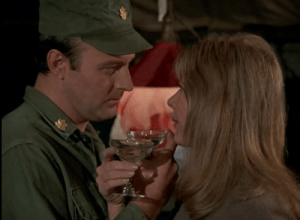
In the aforementioned episode they have a delightful little exchange that illustrates through its witty banter the skill of the Hollywood writers at their best. As the hospital’s temporary commander, Burns has banned all alcohol and mandated attendance at the lecture. The tent is filled to its limits as Houlihan turns adoring towards her paramour and says:

Houlihan: Frank, what a turnout!

Burns: Lemmings must be directed to the sea.

Houlihan: You’re magic with a phrase!

It requires skill to create a well-crafted turn of phrase. Well, even a fool like Frank Burns can stumble across a clever phrase, but only a master can repeatedly coax them from their ethereal realms.

C.S. Lewis was just such a master. His works abound with profound and captivating language. And he recognized it in the works of others. In “Dante’s Similes,” in Studies in Medieval and Renaissance Literature, he wrote:

[Dante] is the most translatable of the poets—not, probably, that he entrusts less wealth than others to the music of the words and the nuance of the phrase but that he entrusts more than others to the “plain sense.”

In The Four Loves, Lewis reveals just how impoverished much of our language is . . . even when it relates to the most inspiring of matters. Describing the difference between carnal “love” and genuine love, he shows that even impoverished phrases can begin to grasp the truth behind the dynamics of affection and commitment.

We must do the works of Eros when Eros is not present. This all good lovers know, though those who are not reflective or articulate must be able to express it only in a few conventional phrases about “taking the rough along with the smooth,” not “expecting too much,” having “a little common sense,” and the like. And all good Christian lovers know that this programme, modest as it sounds, will not be carried out except by humility, charity and divine grace; that it is indeed the whole Christian life seen from one particular angle.

Surely those who are more articulate can more expressively communicate our love for our spouse. Yet, even in so-called matters of the heart, we frequently utter phrases that are utterly mundane.

The History of the Phrase “Turn of Phrase”

One online dictionary uses these definitions:

a turn of phrase

1. a way of saying something “Significant other,” meaning “partner,” now that’s an interesting turn of phrase.

2. the ability to express yourself well She has a nice turn of phrase which should serve her well in journalism.

The Phrase Finder website provides excellent information about numerous phrases. And, in discussing this idiomatic phrase about phrases, they do not disappoint.

So, a phrase was a style of speaking or writing, and style meant beauty of expression. We can now interpret a fine “turn of phrase” as analogous to a skillfully crafted piece of wood turned on a lathe. John Dryden referred to the “turning” of words in this sense in The Satires of Decimus Junius Juvenalis, 1693: “Had I time, I cou’d enlarge on the Beautiful Turns of Words and Thoughts; which are as requisite in this, as in Heroique Poetry.”

Check out their entire article about turns of phrase at the link above. And, may your own writing be filled with impressive verbal ballets, replete with inspiring leaps and unforgettable pirouettes.

Humor & Health

I had to have blood drawn today for an upcoming physical exam. It’s not one of my favorite things to do, but I consciously try not to allow my feelings to negatively affect the caregivers who provide these essential procedures for our wellbeing. (Trust me, dentists especially are sorely in need of our appreciation.) I often try to add a little smile to their day employing a touch of light humor.

Today, for example, I was repeating a blood test I had already accomplished earlier this week. When the corpsman (Naval hospital) asked which arm I said, “you better take it out of my left arm . . . they weren’t happy with the numbers in the sample they got from my right.”

Now, a modest joke like that won’t make it into any comedians’ monologues, but it did inspire a chuckle from the four of us in the lab at that moment.

It reminded me of getting my flu shot last year and having my choice of four different corpsmen to administer it. Each had a waiting line. I could only imagine what it was like to be puncturing one anonymous arm after another for eight hours. Most “victims” silent, but many grimacing and some feeling compelled to describe to you just how much they hate shots.

Three of the corpsmen were normal sized human beings. But the fourth was a behemoth. The seams of his uniform were near to bursting due to his extraordinary musculature. I doubt he was on steroids, but his massive figure could have fit into the offensive line of any team in the NFL. And, for some mysterious reason, his waiting line was the shortest.

When I approached him to receive my vaccination, I ventured (in a voice loud enough for his companions to hear): “I chose you because you look like you’re gentle.” Everyone got a laugh out of that, and I felt pleased at having momentarily brightened their day.

My kids are always wary when I make comments like this. They recognize that every time we open our mouths, it’s a gamble. We can achieve our goal, and elicit someone’s precious smile . . . or we can make a fool of ourselves.

As a grandfather, I have the added “protection” of not having too much expected of me, in the wittiness department. By the grace of God, I’m still in possession of the bulk of my mental capacities. I imagine that, should I live long enough, most of my attempts at humor may grow rather lame. But, if there remains any cultural respect for our elders, even these attempts will be recognized for what they are—goodwill. And, as such, there are those from whom they will still elicit a smile.

We should not be afraid of humor, especially in its most humble and intimate forms. Woven amidst the threads of our daily conversations, it enriches life.

C.S. Lewis recognized this quite well. In The Magician’s Nephew, which recounts the creation of Narnia, Aslan says to the newly anointed animals: “Laugh and fear not, creatures. Now that you are no longer dumb and witless, you need not always be grave. For jokes as well as justice come in with speech.”

Lewis notes something in Reflections on the Psalms that I too have found to be true. “A little comic relief in a discussion does no harm, however serious the topic may be. (In my own experience the funniest things have occurred in the gravest and most sincere conversations.)”

Because of this, it’s not uncommon when we sit with those who have lost a loved one, to find that the conversation often drifts towards those happy and humorous moments that were shared with the departed. I’ve heard much healing laughter in the still sorrowing presence of the grieving. And, whether the words or thoughts evoke bold laughter or simple smiles, I tend to consider them a good thing indeed.

Exercising Your Creativity

If you work in an “institutional” or office setting, you may be acquainted with the ubiquitous motivational posters that adorn offices from sea to shining sea. (I can’t speak for other countries, but here in the United States, these encouraging slogans can be found in government and private businesses across the land.)

They are so common, in fact, that they have been parodied by a company that offers “The Demotivator’s Collection.” They sell entertaining posters such as:

1. [Image of a sinking ship]

MISTAKES

It could be that the purpose of your life is only to serve as a warning to others.

2. [Image of a salmon leaping up a raging river directly into the mouth of a waiting bear]

AMBITION

The journey of a thousand miles sometimes ends very, very badly.

3. [Image of a fast food carton of french fries]

POTENTIAL

Not everyone gets to be an astronaut when they grow up.

Humor is powerful. I image that many of these demotivational posters adorn the walls of companies that recognize this fact. (You know, the ones with young, dynamic, iconoclastic leaders.)

Here’s one I might even have tempted to hang up in a couple offices where I used to work:

4. [Image of five hands linked together.]

COMMITTEES

Just like teamwork. Only without the work.

I agree with C.S. Lewis about the vital role humor plays in the lives of healthy people. As he wrote in Reflections on the Psalms: “A little comic relief in a discussion does no harm, however serious the topic may be. (In my own experience the funniest things have occurred in the gravest and most sincere conversations.)”

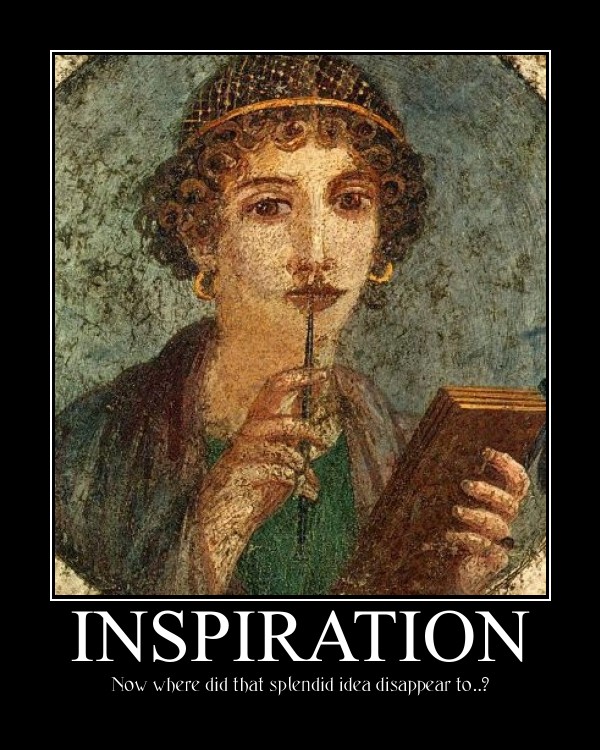
If you feel inspired by the concept of creating thoughtful—or witty—phrases to elaborate on a specific word or brief phrase, you can manufacture these graphics online yourself. Using this free application, you can craft your own (de)motivational posters—just as I did the one displayed above. Yes, that’s my handiwork.

The images you make are yours to download for free. The company needs to turn a profit though, so they offer high quality digital files or posters, for a price. (The free versions are only suitable for smaller applications, like blogs or other websites.)

How’s that for a great way to express your creativity? And it only requires a couple of minutes!

Oh, and if you’re wondering whether my poster about INSPIRATION is a motivator or a demotivator . . . well, I guess that’s in the eye of the beholder.