C.S. Lewis & the Colors of Heaven

What wonders await the color blind in Heaven! That thought recently occurred to me out of the proverbial blue. 

I was sitting on my patio, tossing a ball to my border collie, when she decided to explore some of the local forest scents, as she is wont to do. As I normally do, I used that peaceful, shalom moment, to pray.

I don’t recall whether I closed my eyes, or gazed at the brilliantly white clouds dancing above me. In either case, my mind and spirit were focused on prayer. Prayer for those I love, and for strangers I have never met.

What wonders await the color blind in the presence of God. Too profound for me to take credit for thinking, but perhaps one of those serendipitous epiphanies God offers unexpectedly to his children.

In The Great Divorce, C.S. Lewis describes an excursion to the foothills of Heaven. The sheer reality of Heaven exceeds fallen humanity’s ability to comprehend it.

Before me green slopes made a wide amphitheatre, enclosing a frothy and pulsating lake into which, over many-coloured rocks, a waterfall was pouring.

Here once again I realised that something had happened to my senses so that they were now receiving impressions which would normally exceed their capacity. On Earth, such a waterfall could not have been perceived at all as a whole; it was too big. Its sound would have been a terror in the woods for twenty miles. Here, after the first shock, my sensibility ‘took’ both as a well-built ship takes a huge wave. I exulted. . . .

Near the place where the fall plunged into the lake there grew a tree. Wet with the spray, half-veiled in foam-bows, flashing with the bright, innumerable birds that flew among its branches, it rose in many shapes of billowy foliage, huge as a fen-land cloud. From every point apples of gold gleamed through the leaves.

When the Narnians sail to the “edge of the world,” they are greeted by a wonder that hints at the beauty of Heaven beyond. Barring their way into that place it rose “between them and the sky, a greenish-gray, trembling, shimmering wall.”

Then up came the sun, and at its first rising they say it through the wall and it turned into wonderful rainbow colors. Then they knew that the wall was really a long, tall wave – a wave endlessly fixed in one place . . . (Voyage of the Dawn Treader).

At the end of the Chronicles of Narnia, C.S. Lewis ushers his heroes into Heaven. They too experience the overwhelming awe inspired by their divine surroundings. 

It is as hard to explain how this sunlit land was different from the old Narnia as it would be to tell you how the fruits of that country taste. Perhaps you will get some idea of it if you think like this. You may have been in a room in which there was a window that looked out on a lovely bay of the sea or a green valley that wound away among mountains.

And in the wall of that room opposite to the window there may have been a looking-glass. And as you turned away from the window you suddenly caught sight of that sea or that valley, all over again, in the looking-glass. And the sea in the mirror, or the valley in the mirror, were in one sense just the same as the real ones: yet at the same time they were somehow different – deeper, more wonderful, more like places in a story: in a story you have never heard but very much want to know.

The difference between the old Narnia and the new Narnia was like that. The new one was a deeper country: every rock and flower and blade of grass looked as if it meant more. I can’t describe it any better than that: if you ever get there you will know what I mean (The Last Battle).

I find Lewis’ fictional visions of Heaven inspiring in their self-confessed inadequacies. Heaven, no doubt, is profoundly more glorious than any human being can imagine.

The Bible employs brilliant colors to help describe Heaven’s beauty. In John’s vision of Heaven we find these descriptions:

And he who sat [upon the throne] had the appearance of jasper and carnelian, and around the throne was a rainbow that had the appearance of an emerald. Around the throne were twenty-four thrones, and seated on the thrones were twenty-four elders, clothed in white garments, with golden crowns on their heads.

From the throne came flashes of lightning, and rumblings and peals of thunder . . . and before the throne there was as it were a sea of glass, like crystal (Revelation 4).

[An angel] showed me the holy city Jerusalem coming down out of Heaven from God, having the glory of God, its radiance like a most rare jewel, like a jasper, clear as crystal. . . .

The wall was built of jasper, while the city was pure gold, like clear glass. The foundations of the wall of the city were adorned with every kind of jewel. The first was jasper, the second sapphire, the third agate, the fourth emerald, the fifth onyx, the sixth carnelian, the seventh chrysolite, the eighth beryl, the ninth topaz, the tenth chrysoprase, the eleventh jacinth, the twelfth amethyst. And the twelve gates were twelve pearls, each of the gates made of a single pearl, and the street of the city was pure gold, like transparent glass (Revelation 21).

The Power of Color

Colors are not merely aesthetic. Their influence on human perception has been studied for many years. One key researcher, Faber Birren (1900-88), served as a respected consultant on the subject for numerous businesses and even the United States government itself. 

Shades of Meaning” relates that “in 1939, Walt Disney invited Birren to work as a color consultant. He ended up advising Disney animators on the design of BambiFantasia, and Pinocchio.” 

In Color Psychology and Color Therapy, Birren begins his discussion of the subject with the proposal that “it is perhaps a mistaken notion that man in his love of color was impelled by some aesthetic urge.” He contends that:

The greatest weight of evidence points to the fact that color was involved with the supernatural and therefore had significance that went beyond what might be thought of as mere sensuous delight. . . .

Color, being a manifestation of light, held divine meaning. Historical records of color show little interest in the physical nature of color, nor yet in its abstract beauty, but in a symbolism that attempted to resolve the strange workings of creation and give it personal and human meaning.

If this spiritual aspect of color is actual, then being colorblind carries a liability beyond simply missing out on one of life’s simple pleasures.

Color Blindness Among Humanity

You may not know anyone who is color blind. That’s not surprising, since it isn’t a common subject of conversation. Nevertheless, in the general population, approximately eight percent – or 1 in 12 – men suffer from some form of it. Meanwhile, the rate of this condition, which is most frequently genetic, for women is far lower. Only about one in two hundred.

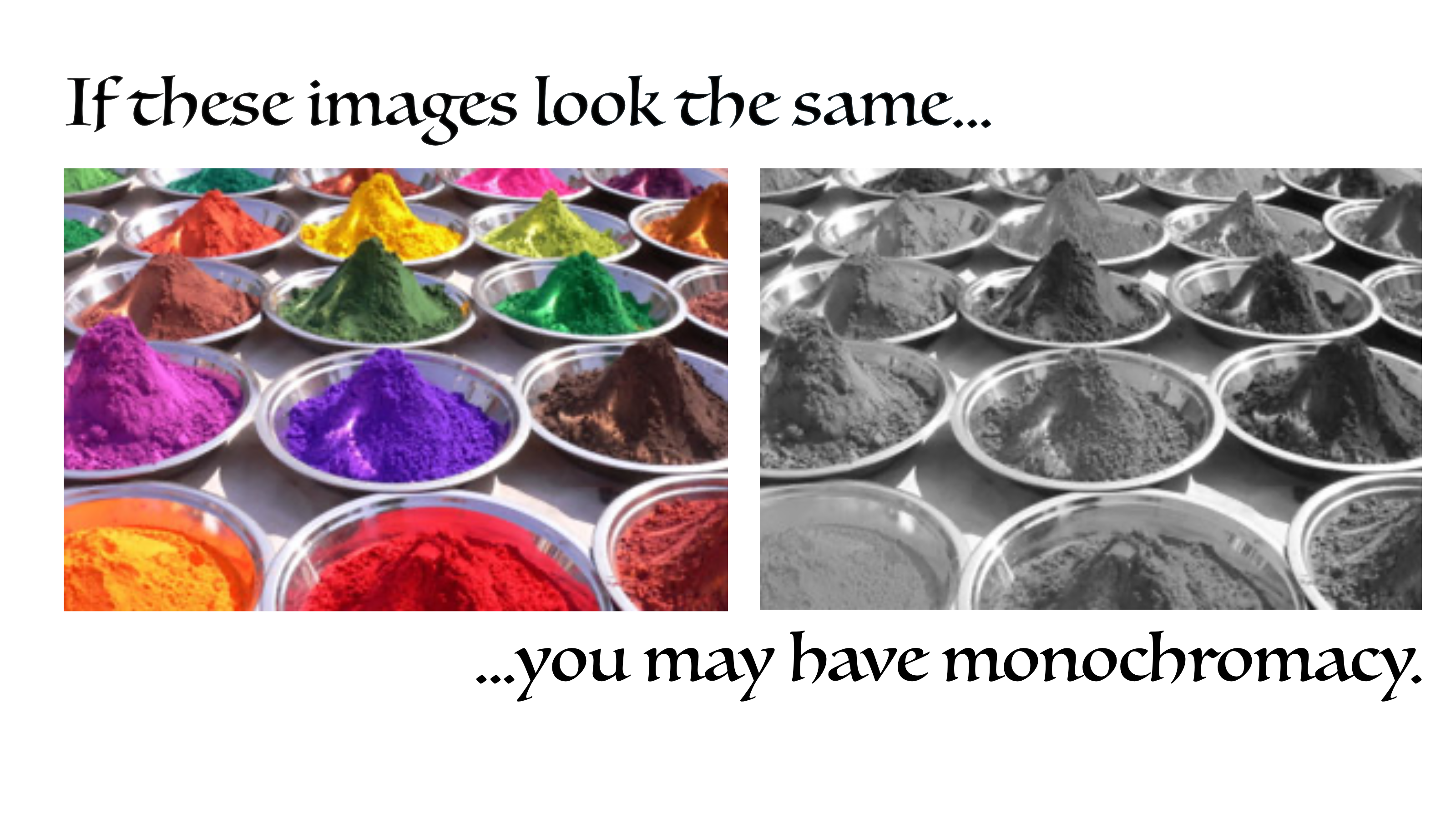
There are several varieties of color vision deficiency, with most people able to perceive some shades of certain colors. The most severe form of the problem involves a failure to see any colors. Only shades of gray distinguish between different hues. It’s called achromatopsia, and is quite rare. 

Achromatopsia is a congenital hereditary condition found in only one birth in every 33,000 to 50,000 births.  Thus less than 10,000 Americans may have achromatopsia. There are two basic forms . . . Rod Monochromatism, . . . is the most common [and] routinely occurs in both men and women. . . .

Blue Cone Monochromatism has an incidence of 1 in 50,000-100,000 births in males and could be as rare as 1 in 10 billion in females.

If you are curious about achromatopsia, you should definitely read about research on a Micronesian Island where ten percent of the people share this affliction.

Many individuals first learned of achromatopsia in 1997, when Oliver Sacks published his classic book, Island of the Color Blind.  This story beautifully chronicles Oliver Sack’s 1994 quest with Knut Nordby and Bob Wasserman to the isolated atoll of Pingelap in Micronesia, where 10% of the population have rod monochromatism. A video of the journey is available here.

Possible Visions of Heaven

Although I am quite wary of so-called near death experiences (with some being spurious, and others, spiritual deception), it is intriguing how color has entered into a number of the stories. The following examples appear in the accounts of several different individuals in Imagine Heaven: Near-Death Experiences, God’s Promises, and the Exhilarating Future that Awaits You.

The entire city was bathed in light, an opaque whiteness in which the light was intense but diffused. In that dazzling light every color imaginable seemed to exist and – what’s the right word? – played. The colors seemed to be alive, dancing in the air. I had never seen so many different colors. It was breathtaking.

Below me lay the purest, most perfect grass, precisely the right length and not a blade that was bent or even out of place. It was the most vibrant green I had ever seen. If a color can be said to be alive, the green I saw was alive, slightly transparent and emitting light and life from within each blade. The iridescent grass stretched endlessly over gently rolling hills upon which were sprinkled the most colorful wild flowers, lifting their soft-petaled beauty skyward, almost as if they were a chorus of flowers caught up in their own way of praising God.

The most gorgeous sky ever seen here on earth cannot even come close to the atmosphere in Heaven.  It is bright because of the glory of our God. . . .  The atmosphere is something you experience, not just see.  It is golden, yellow, white, and had more colors moving throughout it . . . like the Aurora Borealis lights.

The sky [and] the firmament surrounding the heavens, were a wilder and bluer yonder than you would ever believe. . . . The closest shade I can associate this otherworldly blue with is the surreal tones of the water in the Caribbean or off the coast of Hawaii at sunset. . . . That color is waiting for you and me on the other side.

The colors and lights in Heaven were simply sublime. . . . They were the deepest, richest, most gloriously lush colors I had ever seen, and some I had never seen before. Heaven is a dream-come-true for those who love all things colorful, and our home there is lit by the Father of Lights. . . . [There were] robust and bold and vigorous beams that were somehow gentle to my eyes. I simply don’t think those colors and lights exist on earth.

I saw the most dazzling colors, which was all the more surprising because I’m color-blind. I can distinguish the primary colors, but pastels all look the same to me. But suddenly I could see them, all kinds of different shades. Don’t ask me to name them because I lack the necessary experience for that.

Take a Moment to Test Your Own Color Vision

There are a number of simple, free vision tests available online. If you want to assure yourself that you can see all of the normal colors – though not necessarily all of the heavenly colors awaiting us – check out one of the following.

Color Blind Test

EnChroma Color Blind Test

X-Rite Color Challenge and Hue Test

Colorlite Collection of Tests

Final Thoughts

When I described the wonders awaiting the color blind in Heaven, I was referring to all of us. (In this life, as the Scriptures say, “For now we see in a mirror dimly . . .” (1 Corinthians 13).

All who trust in the love of Jesus Christ, and thereby enter Heaven’s environs by the unmerited grace of God’s mercy, will be overwhelmed by its beauty and wonder.

The million or more colors a person with full vision can now see, will be eclipsed by the infinite tapestry of hues in our Creator’s mind. Even those with the scientifically-presumed capability to currently perceive distinctions between up to 100 million will surely be in awe.

C.S. Lewis closes our discussion of Heaven’s colors with a fascinating thought related to the angels who worship God in that divine place. Lewis begins by noting a significant distinction between God’s angels and humanity.

But for our body one whole realm of God’s glory – all that we receive through the senses-would go unpraised. For the beasts can’t appreciate it and the angels are, I suppose, pure intelligences.

They understand colors and tastes better than our greatest scientists; but have they retinas or palates? 

I fancy the “beauties of nature” are a secret God has shared with us alone. That may be one of the reasons why we were made-and why the resurrection of the body is an important doctrine (Letters to Malcolm: Chiefly on Prayer).

Errors that Seem to be True (Angels)

Many people have been taught so little about biblical Truth that they believe many errors. For example, many people (and no offense intended if you are among them) mistakenly believe that when people die, they become angels.

That connection is so blatantly contrary to the fact that angels who “see the face [of God] who is in heaven” are completely different creations than the Sons of Adam and Daughters of Eve who are actually human beings, created in the image of God.

In his preface to The Screwtape Letters, C.S. Lewis alludes to how this confusion is reinforced by humanity’s lack of familiarity with angels in their true or natural (for them) form. While there are clear examples in the Bible where God has his angels appear in the likeness of human beings (e,g. before Sodom’s judgment and at the empty tomb), there are also times when their celestial radiance is not disguised (i.e. when the shepherds are informed about birth of the Savior or in John’s visions as recorded in the Book of Revelation).

[Angels] are given human form because man is the only rational creature we know. Creatures higher in the natural order than ourselves, either incorporeal or animating bodies of a sort we cannot experience, must be represented symbolically if they are to be represented at all (Screwtape Letters).

Nevertheless, this myth permeates the thinking of our secular culture. Once, some years past, a pastor friend was relating to me that one of his distant relatives had recently died. He said it comforted him to know that she was now an angel. I started to chuckle in response to his humorous way of lightening his own mood, until I realized he wasn’t joking. This poor, genuinely compassionate minister had been tricked by the spirit of this world into buying into a lie.

C.S. Lewis famously said that anything worth reading once is worth reading again. I’m clearing out some magazines from several years ago, and rereading insightful articles as I go. In a short piece about a complex subject, “What Happens to the Dead?” Ryan Pemberton makes a troubling comment.

Pop culture has done more to shape modern views about death than biblical teaching has.

The brevity of the article prevents the author from exploring other subjects, but his observation is applicable to a wide array of concerns.

I’m confident I could state, without fear of contradiction, that contemporary culture has done more to shape modern views about marriage than biblical teaching has. And, adding only a few additional examples, more about . . . justice . . . demons . . . love . . . mental health . . . responsibility . . . heaven . . . labor . . . creation . . . and Jesus himself.

It’s Not All Bad

It should be admitted that not all contemporary insights have been 100% misguided. One area where modern sensibilities have restored balance to truthful thinking is in the area of care for the environment. Ignoring extreme notions about nature being more important than human life, we can applaud the work of Christian environmentalists who have helped restore a biblical (i.e. true) view of the world around us.

Reacting to twisted notions that humanity’s “dominion” over the earth allows for nature’s misuse and abuse, these men and women helped open our eyes to the fact that God calls us to be trustworthy stewards in our care of, and appreciation for, this amazing world he has made.

The Inklings, C.S. Lewis and J.R.R. Tolkien, in particular, possessed a profound love for nature. Their general antipathy to the ugly and polluting trappings of industrialization are grounded in their belief that the world God created was truly “good.” With that came the recognition that man does little to enhance, and much to undermine, that initial goodness.

When two ideas clash, go with the one that is correct. And, when one of those authorities is the Word of the Creator of all that exists, well, isn’t it obvious which is the right choice?

Angels & People

For more on the angelic subject with which we began, check out the provocatively titled “People Aren’t Downgraded to Angels When They Die.” As the author there so rightly explains,

When Christians die, heaven does not “get another angel.” We cannot become angels any more than we can become giraffes or ocean waves or stars. We are people and will remain so after this present life. God did not make a mistake when he made us human.

A More Peaceful Time

It seems like a dream, when I recall a college course I took where Jews and Muslims peacefully discussed the turbulent history of the Middle East. And how we discussed that sad story in a cordial, and even sympathetic, manner.

The contrast between that day and 2023 – when people cannot even agree that tiny infants should not suffer for the sins of their parents – is mind-bending.

We assume that all people desire peace. Would that it were so. In his essay “First and Second Things,” C.S. Lewis offers a timely insight.

As far as peace (which is one ingredient in our idea of civilization) is concerned, I think many would now agree that a foreign policy dominated by desire for peace is one of the many roads that lead to war.

I was an undergrad at the University of Washington in the mid-1970s, when I saw a graduate level course with a fascinating title: “Wars that have Shaped the History of the Middle East.” My high school friend and I “begged” the professor to allow us into the class. He cautioned us that he would have the same requirements for us as he did for everyone else; there would be no mercy extended if we failed to meet the syllabus’ demands.

“No problem,” we said . . . although, being young procrastinators, at the end of the quarter we foolishly required a couple of all-nighters to complete our comprehensive term papers.

We, both Christians, were the only undergraduates in the small class. Our professor was Jewish, as were two of the students. One of these, was Israeli. He was, in fact, a veteran of the recent Yom Kippur War, during which he had served as the commander of a tank. I don’t recall which front on which he fought, but when you look at a map of Israel, it’s clear that every part of that small nation is a potential combat zone.

The remaining members of the class consisted of three Muslim students. One was American and a second was Iranian (back when the Shah was still in power). The third Islamic member of the class taught at a Seattle community college. He was Palestinian. And not merely Palestinian – his family was displaced during the 1948 Arab-Israeli War, which is referred to by the Israelis as the War of Independence.

You can imagine that with a group like that, opinions were deeply entrenched. Yet, although the preexisting opinions were indeed fixed, the individuals were not obstinate. Conversations were civil. Disagreements were conducted with reason rather than emotion. And, most surprisingly of all, we were able to socialize together at the end of the course.

It was a different world, apparently. It’s challenging to conceive of partisans today being capable of treating others with such respect. The last half century has marked a steep decline in the humanity of humanity.

Anti-Semitism is a Curse

It is strange to ponder how we’ve come to define antisemitism, confining it to anti-Jewish sentiment. After all, the word Semite refers to all people who speak a Semitic language, including Arabs.

Etymologically, Semite “comes via Latin from Greek Sēm ‘Shem,’ son of Noah in the Bible, from whom these people were traditionally supposed to be descended.”

If you are interested in an excellent article titled “C.S. Lewis’s Anti-Anti-Semitism in The Great Divorce,” simply follow the link embedded here.

Israel’s Wars

There has been no shortage of blood shed on the land the Romans called Judea and Arabia Petraea. And the history of the past seventy-five years have been violent indeed. For a description of all of the wars and military operations involving Israel, see this website.

We students each had to select one of the Middle Eastern regional wars to research in depth. We also had to make a detailed presentation and lead the discussion based on general readings completed by everyone.

As soon as I saw that requirement in the syllabus, my mind was mired in confusion over which of Israel’s wars would be the least controversial. Fortunately, as I read further I discovered that the purview of the course did not begin with the end of the Palestine Mandate, which was administered by Britain. Due to the influence of the Ottoman Empire, which had overshadowed the region until the end of the First World War, the professor elected to begin the course with the relatively nonconfrontational consideration of the Crimean War. I was the first student to raise my hand and voice my preference.

During the Palestine Mandate, C.S. Lewis had a number of former students serving in the Levant. In a 1940 letter to his brother Warnie, he describes a pleasant visit from one of these who went on to serve in a political capacity throughout the region for several more decades. This statesman refers to a fellow student who would go on to teach at East Anglia University.

I had a visit one night last week from Pirie-Gordon back from leave from Palestine, where (and in Egypt and Turkey) he says everything is “as good as gold.” The last riot was quelled by the cavalry regiment in which Rivière serves . . . In fact as P.G. said “I raised the riot and Rivière quelled it.”

I wonder how the members of the class would relate to one another if we were reunited for a discussion of what has transpired since 1975. With members of the American government at each other’s throats on our nation’s response to Hamas’ war, I doubt our discussions would be as respectful as they were back in the twentieth century. Still, conversations – even painful ones – need to happen if people are ever to get along with one another. That’s true not only for nations, but also for neighbors, and families.

I recommend two things to move us in the right direction. Honest communication, where we do a lot of listening. And prayer. The fact we do so poorly with the first, makes the second all that more essential.

C.S. Lewis and Robots

robot.png

No robots were involved in the writing of this column.

That’s not to say that robots aren’t writing a considerable amount of what you might come across today on the internet.

A recent article, entitled “Robots Wrote this Story,” describes how “in 2013, AI-powered journalism was in its infancy . . . [but today it] identifies the relevant data, matches it with the corresponding phrases in the template, merges them, and then publishes different versions across different platforms.”

The various artificial intelligences writing the news for us have interesting names. Among them are Wibbitz (USA Today), News Tracer (Reuters), Buzzbot (open source), and Heliograf (Washington Post). Rumors are that Skynet may be on the horizon.

A Washington Post reporter optimistically says, “We’re naturally wary about any technology that could replace human beings. But this technology seems to have taken over only some of the grunt work.”

So far.

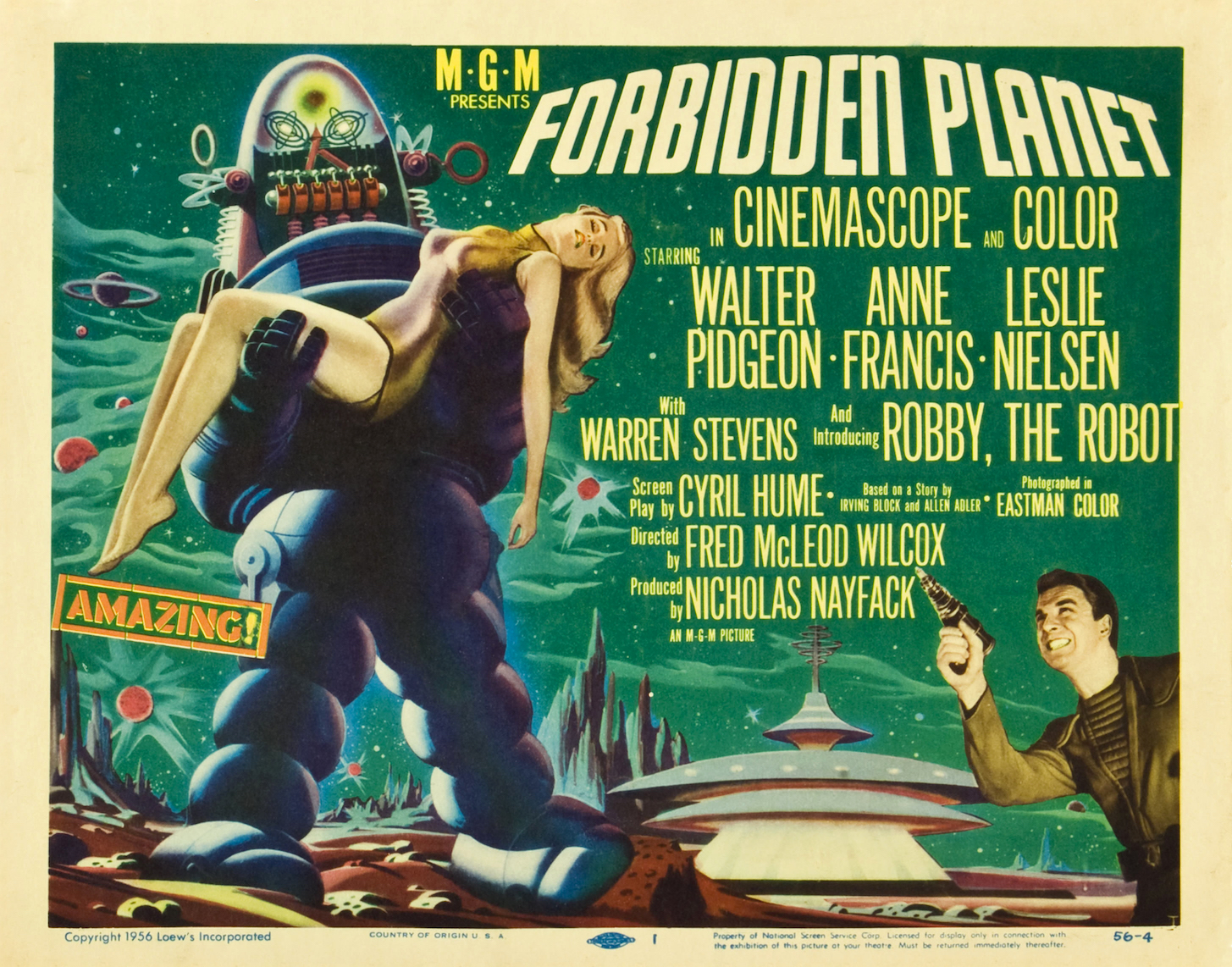
Lewis certainly wasn’t overly impressed by the robot in a classic science fiction film released in 1956.

Before leaving home [for a trip to Northern Ireland] I saw the film of The Forbidden Planet, a post-civilisation version of the Tempest with a Robot for Caliban . . . The contrast between the magnificent technical power and the deplorable level of ethics and imagination in the story was what struck me most.*

Count me as a member of C.S. Lewis’ camp. He possessed little to no fear of robots. He was far more suspicious about a future shaped by the devotees of scientism.

Scientism is that warped theory that, in the words of one Professor of Biological Sciences, surrenders to the “temptation to overreach.”

When I decided on a scientific career, one of the things that appealed to me about science was the modesty of its practitioners. The typical scientist seemed to be a person who knew one small corner of the natural world and knew it very well, better than most other human beings living and better even than most who had ever lived.

But outside of their circumscribed areas of expertise, scientists would hesitate to express an authoritative opinion. This attitude was attractive precisely because it stood in sharp contrast to the arrogance of the philosophers of the positivist tradition, who claimed for science and its practitioners a broad authority with which many practicing scientists themselves were uncomfortable. (Emphasis added.)

Scientism, not robotics, is clearly the danger. However . . . what if the disciples of scientism intend to use robots to further their misanthropic plans?

I suspect taking over our news sources may only be the first stage of the robot blueprint for humanity’s future ruin.

Where are we prepared to draw the line in terms of robots displacing humanity. Apparently, not even in the realm of spiritual matters and worship. I have previously written about a curious, presumably docile, robot. It is, in fact, a Buddhist monk, and presumably a moderately successful evangelist.

A Greater Danger

A futuristic threat that once fell in the domain of science fiction has become science fact. Scientific American has reported that “some of the brightest minds in science and tech think we need a plan to keep humans safe from supersmart machines.”

C.S. Lewis identified a much more ominous alternative than robots seeking to lord it over humans. Lewis worried about the danger of human beings devolving into robots. Well, not robots per se, but beings who have suppressed the qualities that make us who we are, and forfeited our humanity.

The Jewish and Christian scriptures describe an event that must have stunned the angels in heaven. God deigned to create humanity, men and women, in his own image.

It is precisely when we choose to disobey God’s leading, and further distort that divine image, that we become less human.

When I was a child, I wondered why God would create people capable of disobedience. Not only capable but, as the Lord knew in his omniscience, beings who would disobey him. To a more mature mind, the answer seems obvious. No automaton, guided by its programming, can truly love. Lewis explores this dilemma in Mere Christianity.

God created things which had free will. That means creatures which can go either wrong or right. Some people think they can imagine a creature which was free but had no possibility of going wrong; I cannot.

If a thing is free to be good it is also free to be bad. And free will is what has made evil possible. Why, then, did God give them free will? Because free will, though it makes evil possible, is also the only thing that makes possible any love or goodness or joy worth having.

A world of automata—of creatures that worked like machines—would hardly be worth creating.

The happiness which God designs for His higher creatures is the happiness of being freely, voluntarily united to Him and to each other in an ecstasy of love and delight compared with which the most rapturous love between a man and a woman on this earth is mere milk and water. And for that they must be free.

Of course, God knew what would happen if they used their freedom the wrong way: apparently He thought it worth the risk. . . .

If God thinks this state of war in the universe a price worth paying for free will—that is, for making a live world in which creatures can do real good or harm and something of real importance can happen, instead of a toy world which only moves when He pulls the strings—then we may take it it is worth paying.

_____

* The Forbidden Planet received an Academy Award nomination for Best Visual Effects. It is also received the honor of being selected to be preserved for posterity by America’s National Film Preservation Board.

Along with its literary influence, highly influential special effects and visual style, the film also pushed the boundaries of cinematic science fiction. For the first time, all action happened intergalatically (not on Earth) and humans are depicted as space travelers, regularly jetting off to the far reaches of the cosmos. Additionally, Forbidden Planet is remembered for its innovative score—or lack thereof. No music exists on the film’s soundtrack; instead, all ambient sounds are “electronic tonalities.”

forbidden planet.jpg

C.S. Lewis and Supermen

NietzscheI unexpectedly encountered C.S. Lewis while unpacking a box today.

I’m ashamed to admit it, but five years after moving into our retirement home, I have yet to unpack half of my library.

The text that stood out among the two score volumes restored to the light today is called The Cult of the Superman. It was written in 1944 by Eric Bentley.

The 1969 edition which I possess includes “An Appreciation” by C.S. Lewis. Before emigrating to the United States, Bentley had studied under Lewis at Oxford. He spent his own professorial career at Columbia University.*

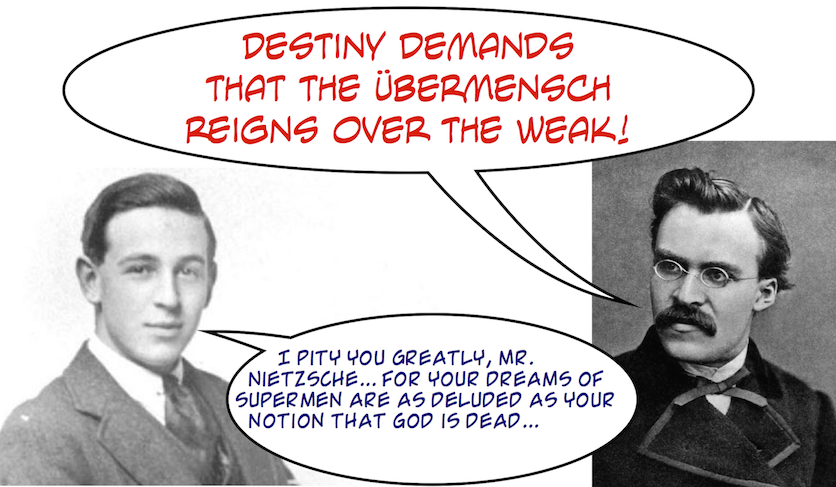
I have yet to find the time to read the volume, but it’s subtitle clarifies the profound subject it addresses: A Study of the Idea of Heroism in Carlyle and Nietzsche, With Notes on Other Hero-Worshippers of Modern Times. Thomas Carlyle and Nietzsche, in elevating the exceptionality of the hero or superman who “shapes history,” diminish the value of the vast majority of human beings who seek no such domineering role.

This view, so warmly embraced by the Nazis, is directly opposed to the Christian worldview.

The news that God lifts the lowly will come as a disappointment to any supermen or superwomen who are reading this.

However, to those of us who do not yearn to rule over the masses, it is joyous news. “Blessed are the poor in spirit, for theirs is the kingdom of heaven.”

In Jesus’ own words, “Whoever exalts himself will be humbled, and whoever humbles himself will be exalted.”

Nietzsche would revile those words, yet his knee too will one day bow before the One who “emptied himself, by taking the form of a servant, being born in the likeness of men.”

In his “Appreciation,” Lewis declares that Bentley is the right man to address this challenging topic.

The Author, though sternly critical, has a sympathy which I cannot emulate with those elements in Heroic Vitalism which really deserve a serious answer, and this enables him to make a constructive book out of what might easily have become a mere chamber of horrors.

Sheep or Wolves?

This aggrandizement of those who seize their self-ordained right to lord over others can certainly lead to horrors. One example I recently saw was a violent criminal’s justification for his actions. “There are sheep and there are wolves. I’m a wolf. The sheep only exist for my benefit.”

Those of us who comprise the lambs find it inconceivable that evil people believe we exist only to be preyed upon. Yet, this is precisely what predators think. And this Nietzschean notion can justify any atrocity, based as it is upon the maxim that “might makes right.”

Coincidentally, as I was writing this column, “Fishers of Men” by The Newsboys began playing. The first lyrics in the song coincide perfectly with the biblical promise above that every single person—including you—is precious to God.

Seven billion people on a spinning ball,

And they all mean the world to You.

So much for those who would consider themselves super-men . . .

_____

* Lewis’ praise for Bentley’s work is also found in a letter included as an expression of appreciation in ‪The Play and Its Critic: Essays for Eric Bentley.

For an interesting assessment of Lewis’ influence on Bentley’s vocation as a drama critique, Donald Cunningham writes in his Ph.D. dissertation:

Dissent and debate were seen by Lewis as a method for testing ideas, and so he felt that discussion of an ideological sort could only strengthen a grasp on truth. . . . It is possible, then, that Bentley’s positive attitude toward conflict and its necessary presence in a pluralistic, growth-oriented world was learned at Oxford.

Imitating Animals

bearsHave you ever imitated a bear? Perhaps not intentionally. Still, if you are typical, you may do so routinely.

And it’s all because of your acnestis.

When I first saw the word, I thought it might be some recently coined term to address a semi-serious subject. But, the word is neither new, nor is the dilemma it describes exaggerated.

From the 1828 edition of Webster’s Dictionary.

ACNESTIS, n.

That part of the spine in quadrupeds which extends from the metaphrenon, between the shoulder blades, to the loins; which the animal cannot reach to scratch.*

While most human beings may not replicate bears’ behavior with trees, it is not uncommon to seek relief from a handy doorjamb.

Scratching that unreachable epicenter of that infernal itch has motivated the creation of a variety of tools. Yet none of these instruments can match the sheer relief offered by a sturdy doorway. I doubt I am alone, or excessively ursine, for believing that.

It could be worse, of course. At least people (most of them) don’t follow the example of dogs. We’ve all seen how they use the excuse of scratching their backs, to justify picking up unsavory scents while they wriggle around on the ground.

Descending to Subhuman Levels

Emulating animals has implications extending far beyond physical considerations. It is one thing to share a mutual appreciation for scratching one’s acnestis. Quite another to echo their baser natures.

In one of his letters, the Apostle Peter considers the fate of false prophets. After describing the damnation of fallen angels, he writes about those who teach deceitful doctrines. “But these, like irrational animals, creatures of instinct, born to be caught and destroyed, blaspheming about matters of which they are ignorant, will also be destroyed . . .” (2 Peter 2:12, ESV).

The following passage from the Psalms reveals how even the righteous are not immune to behaving like animals. “When my soul was embittered, when I was pricked in heart, I was brutish and ignorant; I was like a beast toward you [God]. Nevertheless, I am continually with you; you hold my right hand. . . . My flesh and my heart may fail, but God is the strength of my heart and my portion forever” (Psalm 73:21-23, 26, ESV).

God’s word is filled with allusions to bestial behaviors. One of the most literal is found in the example of the humiliation of the great King Nebuchadnezzar. You can read it here, from the fourth chapter of the Book of Daniel.

What Distinguishes Us from the Beasts?

C.S. Lewis describes how being a true human being differentiates us from animals. We share physical natures and numerous biological similarities. But we are far more. Lewis explores this in The Abolition of Man, which begins with the chapter “Men Without Chests.”

This image of lacking a “chest” actually refers to a classical reference for the part of a person where our character or virtue resides.

The excerpt below addresses how the enlightened or morally educated individual is capable of transcending the slavery of animals to their fleshly nature.

Without the aid of trained emotions the intellect is powerless against the animal organism. I had sooner play cards against a man who was quite sceptical about ethics, but bred to believe that ‘a gentleman does not cheat,’ than against an irreproachable moral philosopher who had been brought up among sharpers.

In battle it is not syllogisms that will keep the reluctant nerves and muscles to their post in the third hour of the bombardment. The crudest sentimentalism . . . about a flag or a country or a regiment will be of more use.

We were told it all long ago by Plato. As the king governs by his executive, so Reason in man must rule the mere appetites by means of the ‘spirited element.’

The head rules the belly through the chest—the seat, as Alanus tells us, of Magnanimity, of emotions organized by trained habit into stable sentiments.

The Chest-Magnanimity-Sentiment—these are the indispensable liaison officers between cerebral man and visceral man. It may even be said that it is by this middle element that man is man: for by his intellect he is mere spirit and by his appetite mere animal.

It is wise, I believe, for every man and woman to devote themselves to the health and of their own heart and purpose—that which makes us human.

In doing so, we will still share some of the basic behaviors of the animal world about us, such as being plagued by our acnestis . . . but the choices that direct the course of our lives will no longer be dictated solely by carnal instincts.

And such growth, my friends, will make us each day, a little bit more human.

_____

* I realize Noah Webster limited his definition to quadrupeds, but today it has been expanded to aptly apply to all of us who suffer from this curse.

Common People

narnia shieldNone of us like to be considered “common.” No surprise; it’s not a complimentary adjective. We prefer to think of ourselves as exceptional . . . and, if not extraordinary, at least special.

In our democracies, with the possible exception of monarchies where the terminology may still exist, we’re no longer referred to a “commoners.” In fact, in the United States we can even design our own coats of arms!

If you want to add a “title” to your legal name, you can follow the example of some Americans who actually name their sons “Sir.” (Believe it or not, in 2012 it was the 998th most popular male name in California. Then there’s also “Prince Michael ‘Blanket’ Jackson II,” but let’s not go there.)

Owning a noble name is no prerequisite to possessing value. A well known quotation from C.S. Lewis dispels the misassumption that any human being is common or lacking in value. Every person is precious. Every person. And, no matter how tiny you ever feel on your most dejected day, you are special . . . precious . . . and (literally) unique!

There are no ordinary people. You have never met a mere mortal. Nations, cultures, arts, civilisations—these are mortal, and their life is to ours as the life of a gnat. But it is immortals whom we joke with, work with, marry, snub, and exploit—immortal horrors or everlasting splendours.
(The Weight of Glory).

As I was considering this subject I came across a less familiar, but equally true, comment from Lewis. He was writing during an age when class distinctions in Europe were still implicit. He turned the matter on its head in a wartime essay entitled “Private Bates.” Here Lewis says that the very things the “elite” esteem reveal just how slavishly they follow appearances.

We must get rid of our arrogant assumption that it is the masses who can be led by the nose. As far as I can make out, the shoe is on the other foot. The only people who are really the dupes of their favourite newspapers are the intelligentsia. It is they who read leading articles: the poor read the sporting news, which is mostly true.

There’s much truth, I think, to Lewis’ observation. Or, perhaps that is merely my blue-collar upbringing speaking.

Let’s close our thoughts on “common folk” with a rarely read piece of poetry from Lewis’ Spirits in Bondage. (This was a pre-conversion collection, and is the only work of C.S. Lewis that is currently in the public domain.)

Thank God that there are solid folk . . .

Who feel the things that all men feel

And think in well-worn grooves of thought

Whose honest spirits never reel

Before man’s mystery, overwrought.

Yet not unfaithful nor unkind

With work-day virtues surely staid

Theirs is the sane and humble mind

And dull affections undismayed.

O happy people! I have seen

No verse yet written in your praise

And, truth to tell, the time has been

I would have scorned your easy ways.

But now thro’ weariness and strife

I learn your worthiness indeed

The world is better for such life

As stout, suburban people lead.

“In Praise of Solid People”

Spirits in Bondage