C.S. Lewis & Longevity

How long is it good for us to live? That’s a strange question, I know. But, do you have an answer? C.S. Lewis had some thoughts on the subject that you may find provocative.

Aging is on my mind this week. I had never thought about myself becoming a septuagenarian – but this week I became one. Well, I still think of myself as being in my fifties, but that appears to be more common than one would guess. When I entered my fifties, I told my dad (then in his seventies) that “I still picture myself as being in my thirties.”

My dad responded without a moment’s thought: “That doesn’t surprise me at all. I still think of myself as being in my fifties.” 

Many people become preoccupied with age. The only time I recall it mattering to me, was when I turned eighteen – able to vote, and registered for the draft (with Vietnam still a war zone) . . . and when I turned twenty-one, for reasons I prefer not to divulge at this time.

People are living longer, and I’m not convinced that translates into living better. Listen to C.S. Lewis, as he writes in his essay “Is Progress Possible?”

I care far more how humanity lives than how long. Progress, for me, means increasing goodness and happiness of individual lives. For the species, as for each man, mere longevity seems to me a contemptible ideal.

Lewis elaborates on this concept – that long life and happiness do not always intertwine – in the Screwtape Letters. The words which follow are the advice of a senior Tempter (devil) to a less experienced junior.

The truth is that the Enemy [i.e. the true God], having oddly destined these mere animals to life in His own eternal world, has guarded them pretty effectively from the danger of feeling at home anywhere else. That is why we must often wish long life to our patients; seventy years is not a day too much for the difficult task of unravelling their souls from Heaven and building up a firm attachment to the Earth.

While they are young we find them always shooting off at a tangent. Even if we contrive to keep them ignorant of explicit religion, the incalculable winds of fantasy and music and poetry . . . are always blowing our whole structure away. They will not apply themselves steadily to worldly advancement, prudent connections, and the policy of safety first.

So inveterate is their appetite for Heaven, that our best method, at this stage, of attaching them to Earth is to make them believe that Earth can be turned into Heaven at some future date by politics or eugenics or “science” or psychology or what not.

Real worldliness is a work of time. . . . How valuable time is to us may be gauged by the fact that the Enemy allows us so little of it. . . .

We are allowed to work only on a selected minority of the race, for what humans call a “normal life” is the exception. Apparently He wants some – but only a very few – of the human animals with which He is peopling Heaven to have had the experience of resisting us through an earthly life of sixty or seventy years. Well, there is our opportunity. The smaller it is, the better we must use it. (Letter XXVIII).

Sadly, far too many people grow far too attached to this world. They lose sight of the promise of Resurrection (if they had ever known it), and as death approaches crave just one more year, another month, another week, another day, even another hour.

Now, I’m not saying long life is a negative, per se. I agree with C.S. Lewis when he wrote “I must never, like the Stoics, say that death does not matter. Nothing is less Christian than that” (“The Grand Miracle”). The danger is not in enjoying the Lord’s wonderful creation. It is in growing too attached to this fallen version of it – in losing touch with the truth proclaimed by musician Larry Norman, that this sin-stained world is not our ultimate home.

Dying

Having been at the bedside of too many people as they face their mortality, I have witnessed many final days. Some literally go, trembling and cursing. Others depart with grim resignation, and no evidence of hope. And then there are those who die with faith, experiencing true peace and joyous anticipation, despite the pain they may be enduring. 

I wish everyone could die in such a state, at peace and earnestly desiring to see the glory of God unblurred by our mortal eyes (1 Corinthians 13). 

On that day we will enter into the fullness of life, into eternal life. (Dr. Michael Zeigler offers an encouraging sermon you can read or listen to at “The Problem and Promise of Deathbed Conversion.”)

The Screwtape Letters is one of C.S. Lewis’ most imitated books. I have even experimented with his model myself. But, rather than emulate these letters, today I would be so bold as to offer an addition to this demonic epistle. 

My supplement is not intended for Christians, except as a truth they may wish to share with others who are walking through the valley of the shadow of death.

And never, my dear Wormwood, at the risk of your own torment, forget this one dire threat. Even after a long life, lived in hedonistic pleasure, deeply tethered to this decaying world, it is still possible for these wretches to be rescued from our claws.

The Enemy is so blindly compassionate that he will foolishly overlook a magnitude of savory sins sown during a carnal life. The dissolute lives we have toiled so steadfastly to soil with uncountable depravities and unrelenting selfishness, remain vulnerable until the patients’ final breath is exhaled.

The Gordian Knot we have so skillfully twisted can be undone in an instant, if they cry out to the Enemy for forgiveness. That is why we must remain vigilant to the very end. It is ideal to have them railing at the end against a God who has allowed them to suffer.

Yet it is sufficient that they die without that rage. A hopeless resignation to what they foolishly consider the end of their existence, still provides fodder for the insatiable appetite of Our Father Below quite adequately.

Final Encouragement

God’s mercy is beyond our ability to comprehend it. While there is breath, there remains hope. Even at the end of a squandered life, God’s love in Jesus Christ is sufficient to wash away every failing, and usher a penitent soul into the glory of everlasting life. 

Remember that, if you find yourself feeling too defiled to come to Christ at the end, that is a lie of Satan. Every single one of us Christians was in similar straits – “while we were still sinners, Christ died for us.”

And, should you ever have the experience of traveling beside a dying friend who sees only darkness ahead, share with them this gospel hope.


An Author with the Heart of an Inkling

C.S. Lewis and Frederick Buechner never met, yet they are “friends” because they share so many similarities as authors writing from a Christian perspective. In terms of Buechner’s themes and range of his writings, this award winning American author and ordained Presbyterian minister may have as much in common with C.S. Lewis as his own British Inklings. So let me introduce Frederick Buechner and his writings.

Do you read primarily to relax and allow your imagination to soar? Or, do you normally select “useful” books, with the potential to be applicable to meeting the challenges of real life?

During my college years, I enjoyed scifi and fantasy. I still have a weak spot for alternative histories. But my seminary years had a subtle effect on my reading. With time always at a premium as a young pastor with a family, I had so many practical, pastoral books and journals to study, that I seldom had time for something so frivolous as “fiction.” Fortunately, semi-retirement has released me from that restrictive literary diet.

I’ve finally found some time to unpack a few of the boxes of books sitting in my garage. (The fact we moved them into the garage around 2010 would be embarrassing if it got out, so I ought not to mention it here.)

As one would expect, I’ve encountered many pleasant surprises. A number of books I had been missing have turned up, I’ve found some that are even more timely today than when they were stored, and—best of all in the minds of my adult children—I’ve been able to part with about two-thirds of the titles, and recently donated about 150 volumes to a local charity.

One of the titles I am currently reading is Frederick Buechner’s Telling Secrets. I had picked up a copy when it was highly recommended to me, only to discover it was a memoir. Being a “practical pastor” who always had too many utilitarian books to read, I set it aside . . . only to pick it up twenty years later.

And what a joyous surprise it has been. Buechner is in his nineties, and is widely respected. He has been a prolific writer, and has received numerous awards for his fictional works. Readers, particularly from the Reformed branch of Christianity have been especially fervent fans of the Presbyterian pastor and theologian. My friend, Brenton Dickieson is quite fond of Buechner and has written about him in A Pilgrim in Narnia on several occasions. He notes that Buechner quotes a number of the Inklings, including Tolkien, Williams and Lewis.

I vaguely recall the Lewis connection being one reason my fellow Air Force chaplain recommended Telling Secrets to me. But I had forgotten that the first section is entitled “The Dwarves in the Stable.” This is, of course, an allusion to an extremely momentous scene in The Final Battle, the final volume of the Chronicles of Narnia. It was originally published as an independent essay, as this entertaining post points out.

Buechner shares a dark family secret, the consequences of his father’s suicide in 1936. Listen to how movingly he describes the secret’s power:

His suicide was a secret we nonetheless tried to keep as best we could, and after a while my father himself became such a secret. There were times when he almost seemed a secret we were trying to keep from each other.

Buechner moves on to relate the suffering the family experienced during his daughter’s battle with anorexia. He shares few details, since “it is not mine to tell but hers.” Nevertheless, he describes setbacks in the struggle causing him to feel as though he “was in hell.”

I choose the term hell with some care. Hell is where there is no light but only darkness, and I was so caught up in my fear for her life, which had become in a way my life too, that none of the usual sources of light worked any more, and light was what I was starving for. . . .

I remained so locked inside myself that I was not really present with them at all. Toward the end of C.S. Lewis’s The Last Battle there is a scene where a group of dwarves sit huddled together in a tight little knot thinking that they are in a pitch black, malodorous stable when the truth of it is that they are out in the midst of an endless grassy countryside as green as Vermont with the sun shining and blue sky overhead.

The huge golden lion, Aslan himself, stands nearby with all the other dwarves “kneeling in a circle around his forepaws” as Lewis writes, “and burying their hands and faces in his mane as he stooped his great head to touch them with his tongue.” When Aslan offers the dwarves food, they think it is offal.

When he offers them wine, they take it for ditch water. “Perfect love casteth out fear,” John writes (1 John 4:18), and the other side of that is that fear like mine casteth out love, even God’s love. The love I had for my daughter was lost in the anxiety I had for my daughter.

This is just a single example of the sensitive wisdom Buechner shares throughout this grace-filled work.

After I finish Telling Secrets, I look forward to reading two of Buechner’s novels already on my shelf, Godric and Brendan. They are both historical fiction, telling the stories of two sainted monks from the twelfth and sixth centuries respectively.

I encourage any of you unfamiliar with his writings to explore his work. If an autobiography can be this good, I’m eager to take a journey through what I have no doubt will be quite an adventure in his fiction.

Buechner possesses an additional connection to C.S. Lewis, which has the potential to last centuries. He describes his decision to offer his personal papers to Wheaton College, where they are available in the archives. The theologian describes his decision in this humble manner.

Wheaton College [has] a great collection there of the manuscripts and papers of people like C.S. Lewis, G.K. Chesterton, George MacDonald, J.R.R. Tolkien, Dorothy Sayers, and the like, and because I could think of no more distinguished company than theirs among whom to have my own literary remains molder, a year earlier I had offered them everything I had stowed away over the years in cardboard boxes and scrapbooks and manila folders; and to my delight they said that they would be delighted to have it.

If you would enjoy learning more about the relationship between Buechner and the Inklings, check out this fine article; “C.S. Lewis and Frederick Buechner: Literary Expression of Faith” is available for download. It’s quite enlightening.


Bonus Insight

The second chapter of Telling Secrets is entitled “The White Tower.” Many Inkling fans will jump to the conclusion (especially after reading this post) that it is a reference to the citadel of Minas Tirith, the capital of Gondor. Like me, they would be incorrect.

Buechner is not alluding here to Tolkien’s masterpiece. On the contrary, he is referring to the central tower which was the old keep of the Tower of London. Ironically, that very keep, the White Tower, was built by a Norman monk who became the Bishop of Rochester. His name . . . Gundulf.

Buechner chose this metaphor for the human condition for the following reason.

I think here of the Tower of London. More particularly I think of that oldest part of it, known as the White Tower, which was built by William the Conqueror in the eleventh century. On the second floor of it there is a small Norman chapel called the Chapel of Saint John. It is very bare and very simple. It is built all of stone with twelve stone pillars and a vaulted ceiling.

There is a cool, silvery light that comes in through the arched windows. . . . The chapel is very silent, very still. It is almost a thousand years old. You cannot enter it without being struck by the feeling of purity and peace it gives. If there is any such thing in the world, it is a holy place.

But that is not all there is in the White Tower. Directly below the chapel is the most terrible of all the tower’s dungeons. It has a heavy oak door that locks out all light and ventilation. It measures only four feet square by four feet high so that a prisoner has no way either to stand upright in it or to lie down at full length. There is almost no air to breathe in it, almost no room to move. It is known as the Little Ease.

I am the White Tower of course. To one degree or another all of us are.

Covid’s Ancillary Destruction (Updated)

Have you severed ties with a friend or relative because you view the question of vaccination policies differently?

Apparently this tragedy is growing in frequency. Just last week, a person very, very dear to me declared that we had “come to a parting of the ways.” I pray for a restoration of the relationship when emotions cool, but for the moment, it seems I am “dead” to my sister.

She is one of the people who find themselves at one end of the vaccination spectrum. There are, of course, some who believe those who receive vaccinations are dupes, endangering their health with possibly unnecessary medicine that may have lasting side effects. At the opposite end, stand those who consider anyone unwilling to be vaccinated as tantamount to being a heartless murderer.

Sadly, those of us who lie midway along said spectrum—who understand precisely how others might arrive at those extreme positions, and call for reasonable, respectful conversation—are typically regarded with contempt by each extreme.

Ironically, my wife and I eagerly received our injections at the first possible opportunity. Yet, because our adult children (intelligent and mature, one and all) have made a different decision, we have suffered this separation from some of our extended family.

A report published this week revealed 14% of vaccinated respondents said “they ended things with friends who refused to get vaccinated.” That suggests that approximately one out of seven people are unwilling to place friendships on pause; they apparently prefer to terminate them.

“Stress from the Pandemic Can Destroy Relationships with Friends—Even Families” describes the tragedy in the following way.

The pandemic’s toll on friendships goes deeper than mere political polarization — the confusion of a mask with support for “big government.” It’s more about discovering personality differences between you and your relatives and friends, including different levels of risk-tolerance and what might seem like irrational optimism on one side vs. hysterical alarmism on the other.

At a time when many of us are losing sleep, picturing ourselves or someone we love gasping for air in a crowded emergency room, these differences are painfully relevant.

Taking these words to heart should help us all be more tolerant of our varying responses to the strain of living during this pandemic.

I hope that you have not experienced the pain of ruined relationships. And, I beg you, if you are inclined to write off friends who disagree with you on this controversial subject, please reconsider. After all, as C.S. Lewis wisely said to those who claim to be followers of Jesus, “to be a Christian means to forgive the inexcusable, because God has forgiven the inexcusable in you” (The Weight of Glory).

You Should Read This

I just finished the best article I’ve read on this subject, and commend it to you. Pastor Peter Leithart authored the provocatively titled “Why I Didn’t Get the Covid Vaccine.”

The title is a little misleading, since Leithart’s rationale is that as a covid survivor he currently has the resulting “natural immunity.”

The article is quite enlightening, however, because it is not an argument for or against the treatment per se. Rather, it is a very brief historical reminder of a perhaps more perilous ailment. He approaches the subject through the work of an Italian philosopher.

As Roberto Esposito put it in Biopolitics, political authority was traditionally the authority to kill. Under the reign of biopolitics, rulers care for and manage life. Once upon a time, the ruler bore a sword; now, a syringe.

“Body politic” is an ancient metaphor, but in biopolitical regimes the body becomes the real place “where the exercise of power [is] concentrated.” Public health takes center stage in a “limitless process of medicalization” as health care is “superimposed” on politics. It’s now the government’s job—its primary job—to keep us safe and healthy.

“Life becomes government business,” Esposito writes, and “government becomes first and foremost the governance of life.” To manage life, governments have to exercise social control, keep populations under surveillance, maintain constantly-updated databases, and, as necessary, isolate and separate sectors deemed dangerous to the corporate body.

In an article written more than a year ago, entitled “Biopolitics in the Time of Coronavirus,” the writer describes the evolution of the concept of biopolitics since the 1970s. He warned then, “Instead of worrying about the increase of surveillance mechanisms and indiscriminate control under a new state of exception, I therefore tend to worry about the fact that we already are docile, obedient biopolitical subjects.” One can only imagine what he might say today.

Back to Relationships

I am no philosopher, and it is not the purpose of this post to answer the big questions. What I believe is simple. The vaccine is good for some, but not all. And disease is terrifying, especially when it can be terminal.

Oh, and I believe one other thing. We should discuss such matters civilly. Graciously, even. Because differences of honest opinion about debatable matters are insufficient grounds for destroying lifelong relationships. After all, true friendships are precious . . . and rare.

C.S. Lewis discerned a little-known truth about the importance of friendships. One that reminds us they should not be discarded in the passion of a moment. Lewis describes here how there are eternal repercussions related to our actions. Refer to salvation, the resurrection and heaven as the “glory” God desires for all people, Lewis writes:

It may be possible for each to think too much of his own potential glory hereafter; it is hardly possible for him to think too often or too deeply about that of his neighbour. The load, or weight, or burden of my neighbour’s glory should be laid on my back, a load so heavy that only humility can carry it, and the backs of the proud will be broken. . . .

All day long we are, in some degree, helping each other to one or other of these destinations [heaven or hell].

It is in the light of these overwhelming possibilities, it is with the awe and the circumspection proper to them, that we should conduct all our dealings with one another, all friendships, all loves, all play, all politics.

There are no ordinary people. You have never met a mere mortal. Nations, cultures, arts, civilisations—these are mortal, and their life is to ours as the life of a gnat.

But it is immortals whom we joke with, work with, marry, snub, and exploit—immortal horrors or everlasting splendours (The Weight of Glory).

Update

[April 2024] When I originally posted this, I expressly shared that “I pray for a restoration of the relationship…” God has answered that prayer. My sister had been under great pressure when we had initially spoken; her youngest grandson was severely ill from the virus. Thus her quite understandable intensity in her concern about the potential role of the unvaccinated at that time.

Our meeting this week was filled with grace and healing. She was wounded not only by my children’s decisions, but also by this post itself. I had no intention to embarrass anyone, but instead to caution others about the dangers of argumentation that substitutes for discourse—which is something that to which both political parties in the United States have inexcusably contributed.

One reason for adding this update is to encourage anyone who reads this column to pursue reconciliation and healing in all of your damaged relationships. Though deeply saddened during the months of estrangement, I knew that God specializes in healing… and the Lord loves each one of us more than we will ever know. As long as you live, don’t give up hope. Keep praying and extending a humble and loving invitation to the friends and loved ones with whom you differ.

Oh, we didn’t discuss vaccinations per se, since that wasn’t the important concern. It was all about relationship.

Glorifying the Evil One

One perplexing behavior of humanity, is seen in the inclination of some to glorify our greatest enemy. Some people sincerely adore a being who desires nothing more than humanity’s suffering and eternal separation from our loving Creator.

I once heard the difference between God and Satan put this way: even when you hate him, God still loves you, and even when you love him, Lucifer still hates you.

Yet some still idealize this fallen angel who has earned many corrupt titles, including Tempter and Father of Lies.

In literature and other media you can readily find positive treatments of the Devil. John Milton’s Paradise Lost presents Lucifer as the classic tragic figure. Even his arrogance and vanity about his beauty are presented in a sympathetic fashion. In “Why Satan’s Character in Paradise Lost is the Original Antihero,” Lisa Ampleman says “at the 350th anniversary of its publication, Milton’s masterpiece seems ever more relevant.”

The Romantic poet William Blake even said that Milton was “of the Devil’s party without knowing it.” For the first few books, the charismatic demon’s concerns are front and center, and God seems authoritarian and legalistic.

Fortunately, Milton does not leave us with this sympathetic portrayal of Lucifer. As the article’s author writes, Satan “is not the absolute evil we may have expected, and a sympathetic devil is a dangerous devil.” In Book IX, the Devil even confesses his grim obsession.

But neither here seek I, no nor in Heaven
To dwell, unless by mastering Heaven’s Supreme;
Nor hope to be myself less miserable
By what I seek, but others to make such
As I, though thereby worse to me redound:

For only in destroying I find ease
To my relentless thoughts; and, him destroyed,
Or won to what may work his utter loss,
For whom all this was made, all this will soon
Follow, as to him linked in weal or woe;

In woe then; that destruction wide may range:
To me shall be the glory sole among
The infernal Powers, in one day to have marred
What he, Almighty styled, six nights and days
Continued making . . .

In his Preface to Paradise Lost, C.S. Lewis astutely describes Milton’s depiction of the Devil’s eternal dilemma.

What we see in Satan is the horrible co-existence of a subtle and incessant intellectual activity with an incapacity to understand anything. This doom he has brought upon himself; in order to avoid seeing one thing he has, almost voluntarily, incapacitated himself from seeing at all.

And thus, throughout the poem, all his torments come, in a sense, at his own bidding, and the Divine judgement might have been expressed in the words “thy will be done.” He says “Evil be thou my good” (which includes “Nonsense be thou my sense”) and his prayer is granted.

Turning to one of America’s most renowned authors, we encounter in Mark Twain an unabashedly positive portrayal of Lucifer. In Letters from the Earth (which was too controversial for publication during his lifetime), Satan remains a trusted member of God’s Grand Council. It is left to Satan to question God’s arbitrary creation of violent and flawed creatures.

After a long time and many questions, Satan said, “The spider kills the fly, and eats it; the bird kills the spider and eats it; the wildcat kills the goose; the — well, they all kill each other. It is murder all along the line. Here are countless multitudes of creatures, and they all kill, kill, kill, they are all murderers. And they are not to blame, Divine One?”

“They are not to blame. It is the law of their nature. And always the law of nature is the Law of God. Now – observe – behold! A new creature – and the masterpiece – Man!”

Far from humanity being created in the Divine image, Twain’s twisted version of the Creator has God throwing together all of the positive, and negative, traits he had bestowed on the imperfect animals.

“Put into each individual, in differing shades and degrees, all the various Moral Qualities, in mass, that have been distributed, a single distinguishing characteristic at a time, among the nonspeaking animal world – courage, cowardice, ferocity, gentleness, fairness, justice, cunning, treachery, magnanimity, cruelty, malice, malignity, lust, mercy, pity, purity, selfishness, sweetness, honor, love, hate, baseness, nobility, loyalty, falsity, veracity, untruthfulness – each human being shall have all of these in him, and they will constitute his nature.

“In some, there will be high and fine characteristics which will submerge the evil ones, and those will be called good men; in others the evil characteristics will have dominion, and those will be called bad men.”

Satan later offered some sarcastic compliments about creation and is exiled briefly to Earth. There, Twain’s hero pens a number of letters to archangels sympathetic to his views. A single passage is adequate to illustrate the whole.

Man is a marvelous curiosity. When he is at his very very best he is a sort of low grade nickel-plated angel; at his worst he is unspeakable, unimaginable; and first and last and all the time he is a sarcasm. Yet he blandly and in all sincerity calls himself the “noblest work of God. . . .”

Moreover – if I may put another strain upon you – he thinks he is the Creator’s pet. He believes the Creator is proud of him; he even believes the Creator loves him; has a passion for him; sits up nights to admire him; yes, and watch over him and keep him out of trouble. He prays to Him, and thinks He listens. Isn’t it a quaint idea?

For an accurate illustration of Satan’s activities and purposes, one need look no further than C.S. Lewis’ Screwtape Letters. In one letter, Screwtape highlights the progress Satan’s minions have made in desensitizing humanity to what was recognized as provocative in an earlier age.

We have engineered a great increase in the licence which society allows to the representation of the apparent nude (not the real nude) in art, and its exhibition on the stage or the bathing beach. It is all a fake, of course; the figures in the popular art are falsely drawn; the real women in bathing suits or tights are actually pinched in and propped up to make them appear firmer and more slender and more boyish than nature allows a full-grown woman to be.

Yet at the same time, the modern world is taught to believe that it is being ‘frank’ and ‘healthy’ and getting back to nature. As a result we are more and more directing the desires of men to something which does not exist – making the rôle of the eye in sexuality more and more important and at the same time making its demands more and more impossible. What follows you can easily forecast!

Artistic Presentations of a Sympathetic Devil

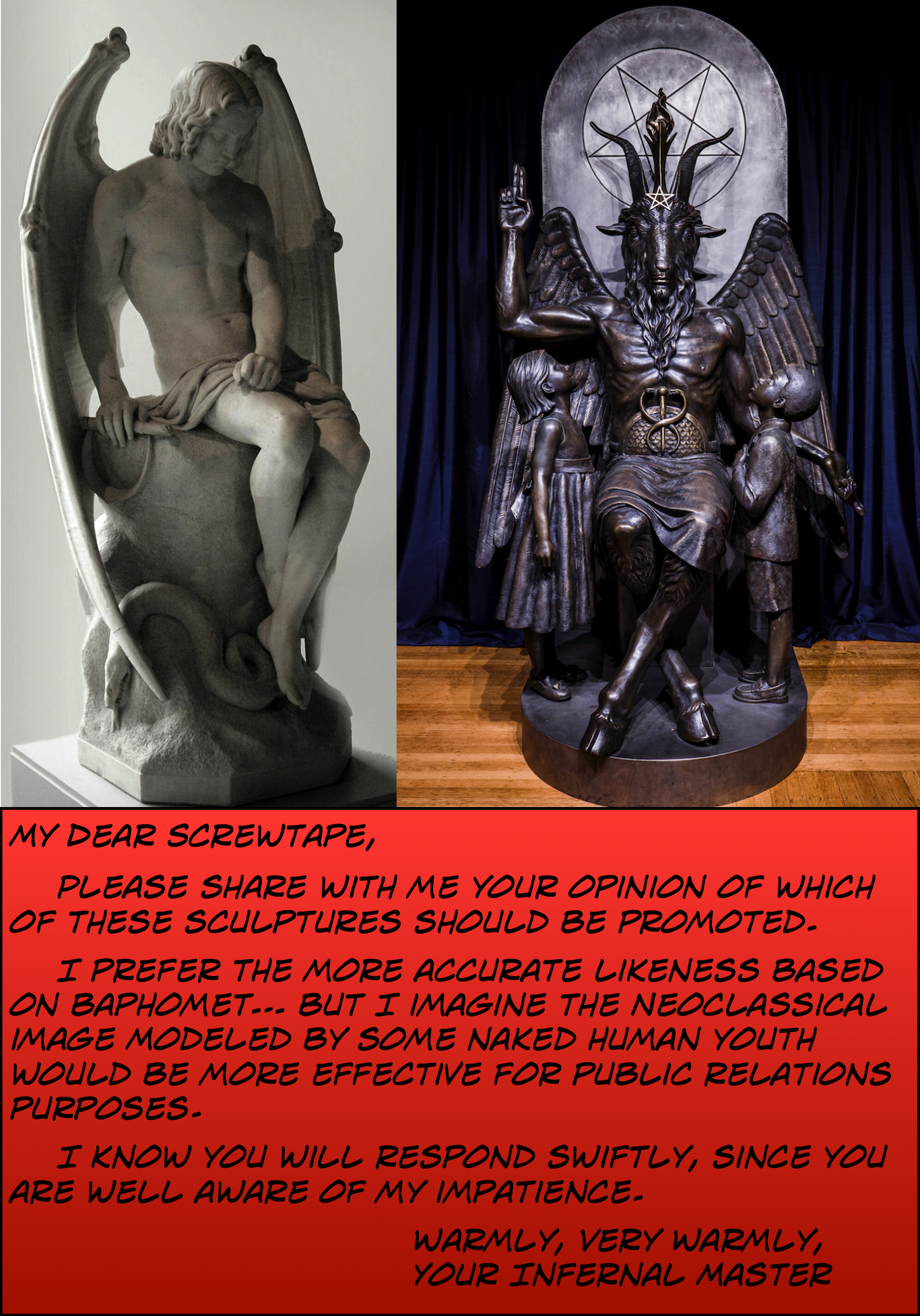
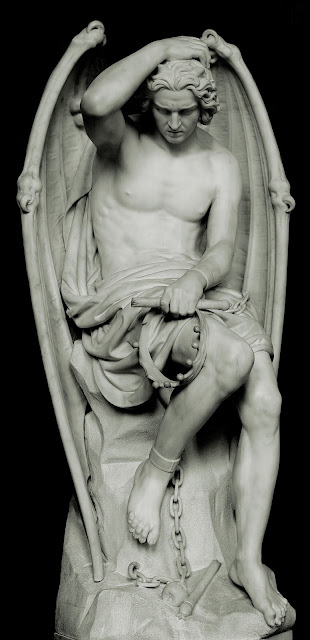
It was actually a nineteenth century Belgian sculpture of Lucifer which is part of the elaborate pulpit of St. Paul’s Cathedral in Liège which inspired today’s reflections. Guillaume Geefs was commissioned to create the piece as part of a general theme of the triumph of religion over evil. The Devil as he portrayed the rebel angel, is rather too appealing for those acquainted with his actual biblical portrait.

Even though his wings have devolved to appear more like those of a bat than a bird, and his foot is chained, the sculpture’s physique is attractive. His apparent regret, evident in his expression and the presence of a tear, invite sympathy. It is regarded as an outstanding example of Romanticism. In a word, it serves as an attractive personification of a vile and malignant being. And this presents a dangerously misleading view of the very real spiritual warfare raging about us.

Curiously, Guillaume’s nude (with a robe safely draped over his lap) was actually a more modest and religious alternative to the image originally intended for the space. Ironically, it was the artist’s younger brother, Joseph, who originally received the commission. Joseph’s sculpture was regarded as even more titillating, and it was replaced. The Royal Museums of Fine Arts of Belgium admits “Joseph created one of the most disturbing works of the period.”

When it was revealed, the initial version of “Le Génie du Mal” (The Genius of Evil) raised questions about its positive portrayal. One publication reported the cathedral’s administrators determined “this devil is too sublime.”

The last thing imperfect human beings living in a fallen world need are sublime and alluring depictions of evil. In the words of C.S. Lewis,

To admire Satan, then, is to give one’s vote not only for a world of misery, but also for a world of lies and propaganda, of wishful thinking, of incessant autobiography. Yet the choice is possible. Hardly a day passes without some slight movement towards it in each one of us.

That is what makes Paradise Lost so serious a poem. The thing is possible, and the exposure of it is resented. Where Paradise Lost is not loved, it is deeply hated. (A Preface to “Paradise Lost”).

Replacement Sculpture by Guillaume Geefs.

An Audience of Angels

Most writers are content to have humans read their works. Not so, William Blake (1757-1827). He indicated on various occasions that his audience included angels.

Blake was a very odd man. Talented, true. Inspired, likely. (Though by whom, debatable.) Christian, I think not. C.S. Lewis had a mixed opinion of him, affirming some of his poetry, and challenging one of his most prominent theological errors.*

True, Blake drew most of his imagery from Christian themes, but that is to be expected by someone writing and painting around the turn of the nineteenth century in Britain. His views of Christian faith were anything but consistent with orthodoxy.

Indeed, Blake appears to have fashioned his own religion, with an unrestrained syncretistic impulse, and an unhealthy measure of sinuous semantics.

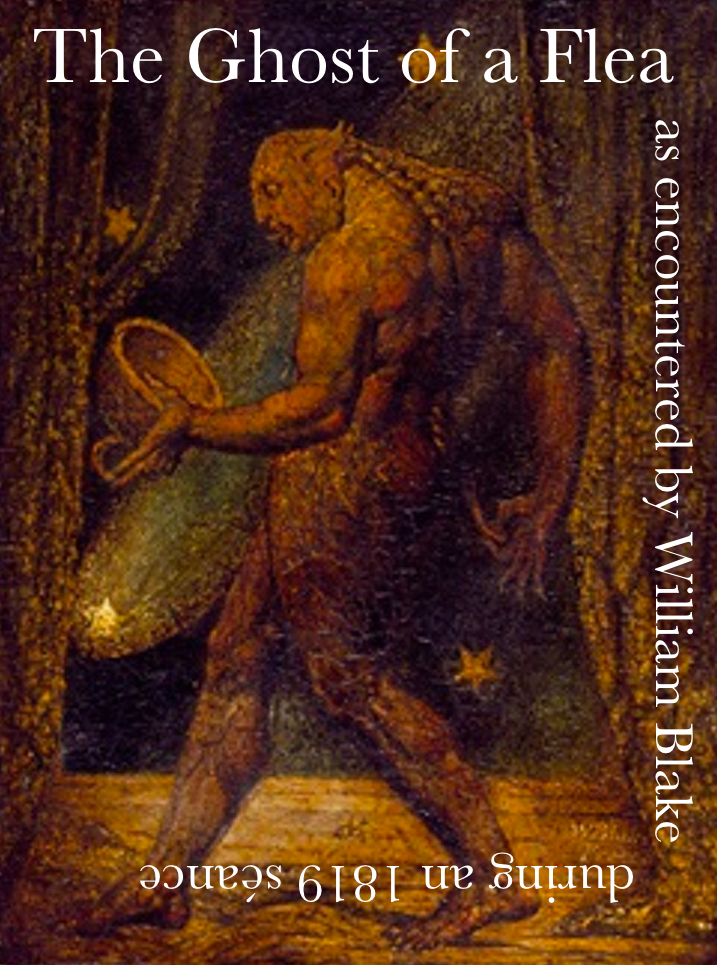
The source of many of Blake’s unorthodox musings appears to have been spiritual sources. He reported seeing visions, beginning in his childhood. Apparently, he would sketch the likenesses of spirits that presented themselves to him. At an 1819 séance he saw and communicated with the ghost of a flea (portrayed above).

The British Library offers a brief and informative video about Blake’s spiritual visions which is available here.

He sees angels—they’re angels to him. He sees figures at the window of his bedroom and as life goes on, these visions become more challenging. The old prophets, or Raphael, the painter, or some great figure he wants to discuss things with, appears in his chamber—it’s a kind of séance.

Eventually Blake’s conflated visions of heavenly beings and departed humans, developed into his own peculiar blend of spiritualism. In 1800, he wrote to comfort a friend whose son had died.

I know that our deceased friends are more really with us than when they were apparent to our mortal part. Thirteen years ago I lost a brother, and with his spirit I converse daily and hourly in the spirit, and see him in my remembrance, in the region of my imagination. I hear his advice, and even now write from his dictate.⁑

Despite William Blake’s flaws, C.S. Lewis was capable of appreciating his poetry.

I am just back from my Easter walking tour with Barfield and co., this year in Derbyshire. Have you been there? It is appreciably more like my ideal country than any I have yet been [to].

It is limestone mountains: which means, from the practical point of view, that it has the jagg’d sky lines and deep valleys of ordinary mountainous country, but with this important difference, that owing to the paleness of the rock and the extreme clarity of the rivers, it is light instead of sombre–sublime yet smiling–like the delectable mountains. It gives you something [like] the same sensation as Blake’s songs.

Lewis is referring here to Blake’s collection, Songs of Innocence. From that collection, I particularly enjoy “The Lamb,” which you can read in the footnote section below.⁂

When I previously wrote about C.S. Lewis’ visits to the home of William Butler Yeats (1865-1939), I shared Lewis’ impression of the occultic flavor of the residence. In a 1921 letter to a close friend, Lewis writes the following:

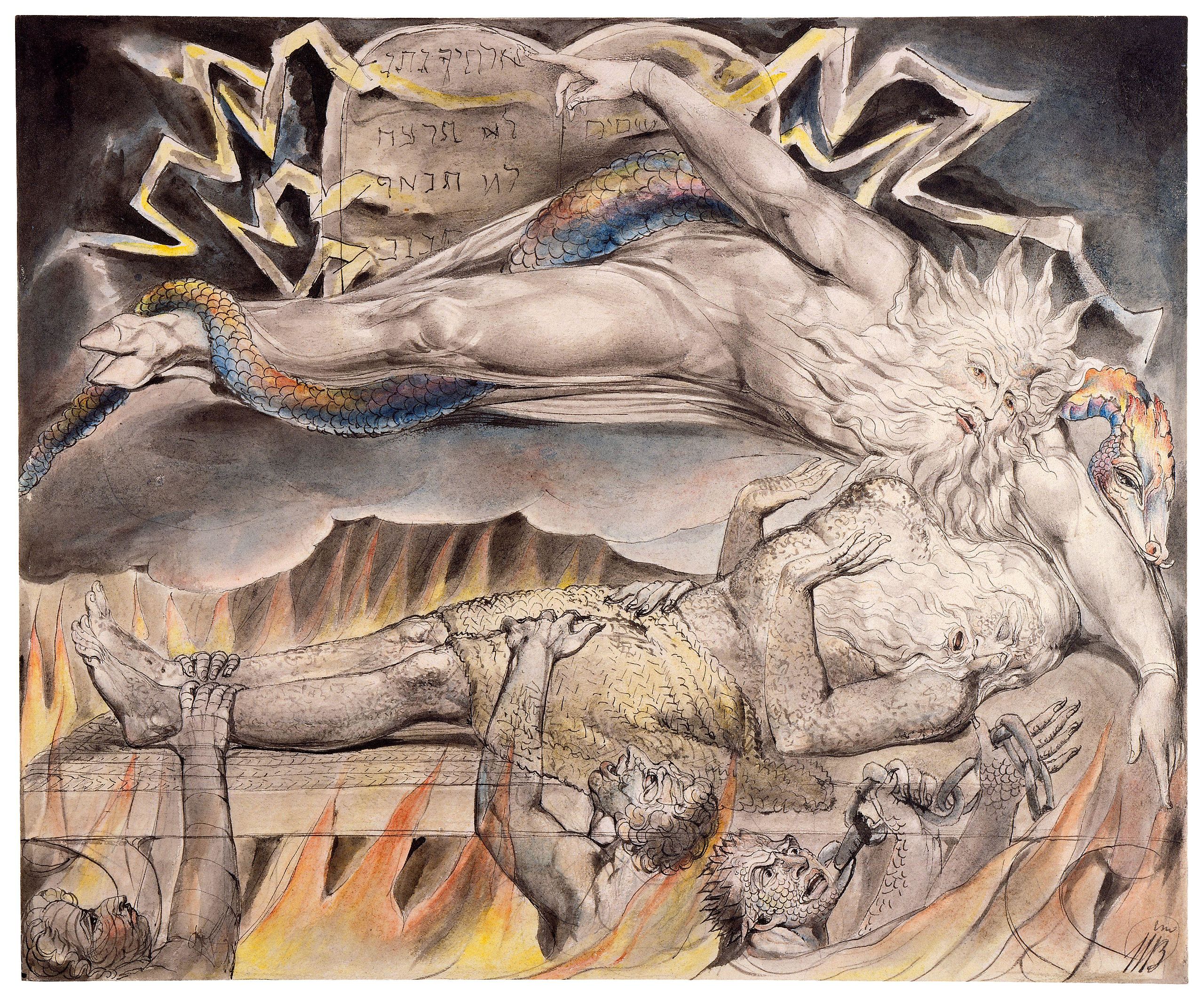
His house is in Broad Street: you go up a long staircase lined with pictures by Blake–chiefly the ‘Book of Job’ and the ‘Paradise Lost’ ones, which thus, en masse, have a somewhat diabolical appearance.

We cannot know exactly which images adorned Yeats’ stairwell, but this sample comes from Blake’s Illustrations of the Book of Job.

Returning to Spiritual Matters

Not only did Blake’s angelic audience laud his work, their praise was so great he could pen this bizarre description of the celestial realms. (How much is irreligious satire, and what part is genuinely inspired by actual visions and belief, remains debatable.)

I am more famed in Heaven for my works than I could well conceive. In my Brain are studies & Chambers filled with books & pictures of old, which I wrote & painted in ages of Eternity before my mortal life; & those works are the delight & Study of Archangels.

Perhaps C.S. Lewis’ most direct response to the confusion promoted by William Blake’s beliefs is found in his classic, The Great Divorce. This illuminating exploration of the gulf between heaven and hell was written, in part, as a response to Blake’s volume, The Marriage of Heaven and Hell. But, the comparison between the two requires an examination more than worthy of its independent discussion.

Suffice it here to include an example of Blake’s advocacy for hell. Blake describes a confrontation between “a Devil in a flame of fire, who arose before an Angel that sat on a cloud.” After their brief argument about God, the Angel “stretched out his arms embracing the flame of fire, and he was consumed . . .” That was not his end, however, for Blake adds a “Note.”

This Angel, who is now become a Devil, is my particular friend; we often read the Bible together in its infernal or diabolical sense . . . (William Blake, The Marriage of Heaven and Hell).

As noted, the matter of whether Blake’s championing of Satan was sincere or simply an arcane literary device is debatable.⁑⁑ However, his correspondence reveals his belief in the supernatural was certainly genuine.

In the end, there’s no question that C.S. Lewis’ assessment of William Blake was accurate. Unsurprisingly, it is one I share. The poet Blake possessed talent, and some of his poetry is quite good. However, as a theologian, this confused mystic is utterly unreliable.

Of course, Christians may be wrong regarding Blake’s spiritual enlightenment. What if, after all, Blake’s vision of his distinguished reputation with the angelic hosts was not a mere delusion? In the unimaginable possibility that this odd man truly is “famed in Heaven,” you must count me among those due to be the most surprised.  


* Even as he challenged one of Blake’s major works, C.S. Lewis wrote, “if I have written [disagreeing with Blake] this is not because I think myself a fit antagonist for so great a genius . . .”

⁑ Some might contend that Blake is referring here to “imagining” the presence of his brother in some sentimental fashion. That is clearly not the case. The fact that he states his brother is, at that moment, advising him on what to write, is intended to be understood as fact. It should be noted he is not referring to the spiritualist practice of “automatic writing,” which is done in a state of trance or spirit possession. Blake’s description of the process is more that of conversational interaction and “advice.”

⁂ “The Lamb,” by William Blake
Little lamb, who made thee?
Dost thou know who made thee,
Gave thee life, and bade thee feed
By the stream and o’er the mead;
Gave thee clothing of delight,
Softest clothing, woolly, bright;
Gave thee such a tender voice,
Making all the vales rejoice?
   Little lamb, who made thee?
   Dost thou know who made thee?
   Little lamb, I’ll tell thee;
   Little lamb, I’ll tell thee:
He is called by thy name,
For He calls Himself a lamb.
He is meek, and He is mild,
He became a little child,
I a child and thou a lamb,
We are called by His name.
  Little lamb, God bless thee!
   Little lamb, God bless thee!

⁑⁑ Like most literary expressions, Blake’s was likely an amalgam of his beliefs and his fancies. A fascinating article on this subject is Peter A. Schock’s, “The Marriage of Heaven and Hell: Blake’s Myth of Satan and Its Cultural Matrix,” published in 1993. Shock says, “The Marriage of Heaven and Hell presents a programmatic expression of [Blake’s] interconnected political, moral and metaphysical thought . . .”

C.S. Lewis, Writing and Lust

We’re accustomed to hearing the word “lust” used in a positive manner, such as “she has a lust for life.”

You might even see this in the context of writing. C.S. Lewis himself did this. In 1948, in a letter to an American pastor, he apparently answers a query about what inspires him to write. “The ‘incentive’ for my books has always been the usual one—an idea and then an itch or lust to write.”

I resonate with Lewis’ response. Some idea dawns on me—usually arising from something I’m reading—and then I get the desire to put my own twist on it and share the original idea with others.

This post is no different. I have been working on the military chaplaincy journal that I edit, and I was reading the poetry of a British chaplain from the First World War. Rev. G.A. Studdert Kennedy (1883-1929) was an Anglican priest. He was awarded the Military Cross due to his “disregard for his own safety in attending to the wounded under heavy fire.” The award also noted his Gospel contribution to the harsh life of WWI trenches. “He searched shell holes for our own and enemy wounded, assisting them to the dressing station, and his cheerfulness and endurance had a splendid effect upon all ranks in the front line trenches, which he constantly visited.”

You can read many of his poems in past issues of Curtana: Sword of Mercy, which is available for free download here.

After reading some of his poetry, I turned for the first time to one of his postwar books. It was entitled “Lies!” and addresses a litany of deceptions that plague the world. Included among these deceits is “the lie of lust.”

In the following excerpt, he refers to writing prurient literature which can guarantee a market. It is echoed by a later comment I read from a writer who said she had to write erotic novels to supplement her preferred titles, just so she could make a living. She used a pen name, of course, for the smut.

You can follow Chaplain Kennedy’s argument in the excerpt which follows. Since it is rather lengthy, I will highlight the reference to writing by using a boldface font. Kennedy contrasts in this passage the conflict between humanity’s sinfulness and our call to holiness, the struggle the Apostle Paul describes so succinctly in the seventh chapter of Romans.

“For I do not do the good I want, but the evil I do not want is what I keep on doing. Now if I do what I do not want, it is no longer I who do it, but sin that dwells within me.”

Here is Kennedy’s argument:

But lust in a man is obscene and filthy because it is unnatural. It becomes cruel and debased. It does not proceed to the making of children naturally and cleanly; it descends to unmentionable and disgusting things. The report on the German atrocities in Belgium* provides a kind of horror-chamber in which we can see what lust can bring men to. As one reads that awful document a kind of hot shame comes over one, and makes one sweat for sorrow over sin.

The sting of that shame lies in the fact that one is dreadfully conscious that the root of that disgusting horror is there in one’s own soul. Have you never felt a ghastly doubt rising up in your mind when you read such things? Now what am I reading this for? Is it purely because I want to hate it . . ?

Write a book about the cruelties and debaucheries of a Nero or a Rasputin, and it will sell. There is an appeal in it which thousands, nay, which all men feel, which all men would answer, if the other force within them failed. But the horror of it, the shame for it, is, thank God, as real, more real, than the appeal. There is human history: the war between the appeal and the repulsion of sin: the war between the monkey and the man.

There are thousands of writers, artists, playwrights, musicians, who are making their fortunes out of the appeal to the animal in man. It is the best paying business in the world. Yet, if there is anything that human experience makes certain, it is that there is no end to the journey a man makes in answer to that appeal except damnation, the utter loss of all that makes life good. Lust cannot satisfy a man, because he needs Love. Lust is unnatural in man, it leaves one side of his nature out, and sooner or later that neglected side has its revenge, and turns life’s sweetness bitter to his taste. Then in his despair he will descend in search of new sensations to things which men cannot mention, or even think of without shame. That is the way of it with all men if the great force fail that leads them upward from the animal to the human and divine (Lies! published in 1919).⁑

C.S. Lewis on Carnality

As noted, Lewis was able to use the word “lust” in its muted, nonliteral sense. He was also able to address it literally, and to challenge the hold it exerts on so many lives. In “Religion: Reality or Substitute?” C.S. Lewis vividly described how lust is an enemy.

If we wish to be rational, not now and then, but constantly, we must pray for the gift of Faith, for the power to go on believing not in the teeth of reason but in the teeth of lust and terror and jealousy and boredom and indifference that which reason, authority, or experience, or all three, have once delivered to us for truth.

In a more metaphorical manner, in the Great Divorce Lewis uses the surprising image of a foreboding ruddy lizard to portray the sinister nature of lust.  

I saw coming towards us a Ghost who carried something on his shoulder. Like all the Ghosts, he was unsubstantial, but they differed from one another as smokes differ. Some had been whitish; this one was dark and oily. What sat on his shoulder was a little red lizard, and it was twitching its tail like a whip and whispering things in his ear. As we caught sight of him he turned his head to the reptile with a snarl of impatience. “Shut up, I tell you!” he said. It wagged its tail and continued to whisper to him. He ceased snarling, and presently began to smile.

The encounter which follows is amazing. I won’t spoil it by describing how it ends, but I will once again encourage you to read what is one of my favorite novels. The Great Divorce is about the separation between Heaven and Hell, and explains how a loving God could allow some of his creation to choose a path away from him.

And a Bonus Insight from Dorothy Sayers

Lewis and Sayers were friends, and they deeply respected one another’s work. In 1943, Lewis wrote to Sayers congratulating her on her recently published The Other Six Deadly Sins. He said, “it is one of the few things which I find, within its limits, perfect—i.e. there is nothing one would wish added or removed or altered.” High praise.

Sayers brilliantly strips away some of the euphemisms that mask and confuse candid discussions about sin. This is how she begins what was originally delivered as a public address:

Perhaps the bitterest commentary on the way in which Christian doctrine has been taught in the last few centuries is the fact that to the majority of people the word “immorality” has come to mean one thing and one thing only. The name of an association like yours is generally held to imply that you are concerned to correct only one sin out of those seven which the Church recognizes as capital.

By a hideous irony, our shrinking reprobation of that sin has made us too delicate so much as to name it, so that we have come to use for it the words which were made to cover the whole range of human corruption. A man may be greedy and selfish; spiteful, cruel, jealous, and unjust; violent and brutal; grasping, unscrupulous, and a liar; stubborn and arrogant; stupid, morose, and dead to every noble instinct—and still we are ready to say of him that he is not an immoral man. I am reminded of a young man who once said to me with perfect simplicity: “I did not know there were seven deadly sins: please tell me the names of the other six.”

About the sin called Luxuria or Lust, I shall therefore say . . . that it is a sin, and that it ought to be called plainly by its own name, and neither huddled away under a generic term like immorality, nor confused with love.

The book sounds like it’s well worth reading. It has been out of print for eighty years⁂ but it appears to have been reproduced in toto by this website. (I plan to read the essay as soon as I get this post uploaded!)


* Over 800 civilians were killed by German troops as they advanced through neutral Belgium in 1914. A short describing of these events can be found at this British Library site.

⁑ You can download free copies of Chaplain Kennedy’s books at Internet Archive: Lies! or a collection of his poetry in Rough Rhymes of a Padre.

⁂ A single used copy is currently available via amazon, for the modest price of $287.36, with the comforting notation that the shipping is free.

Does Sincerity Result in Good Writing?

Most aspiring writers are sincere. The question is, does the earnestness of their work translate into excellence? In other words, does honesty correlate to quality?

C.S. Lewis addressed this question in an essay about John Bunyan (1628-1688). Bunyan was the English writer and Puritan preacher best known for The Pilgrim’s Progress. At the outset of the allegory Bunyan attempts to “show the profit of my book,” and encourage its reading.

This book is writ in such a dialect
As may the minds of listless men affect:
It seems a novelty, and yet contains
Nothing but sound and honest gospel strains.

While C.S. Lewis respected this classic work, he argues that its value is not simply a consequence of Bunyan’s honesty.

The other thing we must not say is that Bunyan wrote well because he was a sincere, forthright man who had no literary affectations and simply said what he meant. I do not doubt that is the account of the matter that Bunyan would have given himself. But it will not do. (“The Vision of John Bunyan”)

Lewis is not, of course, challenging Bunyan’s claim to honesty. What Lewis does, in fact, is challenge a common misconception. He dismantles the excuse for any who would dismiss grammar and literary rules as unimportant because they are writing earnestly. Basically, Lewis suggests we cannot justify creating a mediocre product and by burnishing it with the declaration that “it is an outpouring of our deepest passion.”

“If [candid honesty] were the real explanation,” states Lewis, “then every sincere, forthright, unaffected man could write as well.”

And we all know that is not the case. Lewis proceeds to offer an illuminating and curious illustration. It recalls the days of the First World War when one of the responsibilities of the officers was to review the correspondence of the troops before they accidentally divulged classified military information to their family at home.

But most people of my age learned from censoring the letters of the troops, when we were subalterns [lieutenants] in the first war, that unliterary people, however sincere and forthright in their talk, no sooner take a pen in hand than cliché and platitude flow from it. The shocking truth is that, while insincerity may be fatal to good writing, sincerity, of itself, never taught anyone to write well. It is a moral virtue, not a literary talent. We may hope it is rewarded in a better world: it is not rewarded on Parnassus.*

Lewis continues, praising Bunyan’s writing.

We must attribute Bunyan’s style to a perfect natural ear, a great sensibility for the idiom and cadence of popular speech, a long experience in addressing unlettered audiences, and a freedom from bad models. I do not add ‘to an intense imagination,’ for that also can shipwreck if a man does not find the right words.

A Lesson for Modern Writers

C.S. Lewis’ keen analysis of Bunyan’s writing is more than a mere history lesson. It offers a lesson to those of us who take up the pen today. By all means, we should exercise the moral virtue of sincerity in our writing. However, we should not rest on the strength of our integrity to ensure the quality of our writing.

We should hone our skills. Likewise, we should welcome the constructive criticism of our peers, as did the Inklings themselves.

Our work will also benefit when we intently listen. Learning the idiom and cadence of our characters (real or fictional) enables them to rise alive from the page.

Lewis’ essay on Bunyan offers another suggestion I would highlight. This will be true for any writer, but I think it is of particular import to Christian authors. Lewis affirms a forthright, honest, and powerful presentation of the truth as we perceive it. He cautions against pulling our punches because we are timid about how the austere truth may be received.

For some readers the ‘unpleasant side’ of The Pilgrim’s Progress [lies] in the intolerable terror which is never far away. Indeed unpleasant is here a ludicrous understatement. The dark doctrine has never been more horrifyingly stated than in the words that conclude Part I: Then I saw that there was a way to Hell, even from the Gates of Heaven, as well as from the City of Destruction.

In my opinion the book would be immeasurably weakened as a work of art if the flames of Hell were not always flickering on the horizon. I do not mean merely that if they were not it would cease to be true to Bunyan’s own vision and would therefore suffer all the effects which a voluntary distortion or expurgation of experience might be expected to produce. I mean also that the image of this is necessary to us while we read.

The urgency, the harsh woodcut energy, the continual sense of momentousness, depend on it. We might even say that, just as Bunyan’s religious theme demanded for its vehicle this kind of story, so the telling of such a story would have required on merely artistic grounds to be thus loaded with a further significance, a significance which is believed by only some, but can be felt (while they read) by all, to be of immeasurable importance.

Keeping this in mind—that we should be faithful to the truth of what we are professing—will serve us well in the final accounting. After all, it is the compromises of the tepid of which we must beware.


* Parnassus refers to a Greek mountain associated by the ancients with Apollo, the Muses and poetry.

The Pilgrim’s Progress is available in a variety of free versions.

The Pilgrim’s Progress, an Allegory features a “Biographical Sketch of the author, by Lord Macaullay.”

In an 1834 edition, we have Bunyan’s Pilgrim’s Progress, Metrically Condensed: In Six Cantos.

The version with the most entertaining title has to be: The Pilgrim’s Progress [by John Bunyan] In Words of One Syllable.

The Child’s Pilgrim’s Progress can be downloaded in not one, but two volumes. It was published in 1860, with the preface:

No endeavour has been made in this little book to improve Bunyan’s Pilgrim’s Progress. To do so would be simply absurd. To bring prominently into view scenes supposed most attractive to children has been attempted; and, while the Dreamer’s narrative is preserved, others of less striking character have been thrown into the back ground. The quaint, simple language of the incomparable Bunyan is, for the most part, retained.

The Pilgrim’s Progress: for the Young was published in 1850. Its introduction includes commentary that echoes the theme of the post above.

John Bunyan, though a very pious and good man, was not a learned one ; for he was by trade a tinker, and had no opportunity to learn much more than to read, in his youth, and when a boy he was wild and wicked. But he made very good use afterward of what he knew ; and very diligently studied his Bible and other good books.

He was also what is called a genius, which means that he had great natural talent. He wrote many works, and one of his books, called the Pilgrim’s Progress, has been read and admired by more people than any other book except the Bible. Learned and unlearned men have read it again and again, and it has been translated into all modern languages.

I Don’t Need No Forgiveness

repentanceC.S. Lewis foresaw one of the greatest plagues of the post-modern world. He knew that humanity’s insistence on its own “goodness” would undermine our love for God

Believing the lie that we do not require forgiveness causes us to rely on a deception that will ultimately disappoint. As Lewis wrote, “a man who admits no guilt can accept no forgiveness” (The Problem of Pain).

In the United States we have a sad propensity to worship celebrity. Famous people possess an allure that many find irresistible.

I am amazed so many people who lived for American Idol never recognized the irony of the program’s name.*

I suspect most famous people recognize fame’s fickle and fleeting nature. Some avoid the dangers of fame’s flames, but many rush headlong into the furnace.

Some allow the illusory nature of celebrity to deceive them into thinking they rise above the concerns of normal human beings. Why, you might even find one of them professing to be a Christian while denying the very core of the faith.

One of our presidential candidates (unnamed here, because this post is not about politics) went so far as to profess his love for God and when asked if he has ever asked God for forgiveness responded, “I am not sure I have. I just go on and try to do a better job from there. I don’t think so. . . . I don’t bring God into that picture.”**

It is vitally important for all of us to understand that (1) we need forgiveness and (2) God is eager to extend it to us.

Most Christians understand this.

It is second nature, for example, to orthodox Lutherans. Lutheran preaching is based on the Law/Gospel dialectic. While it’s often short on the “How Then Shall We Live?” counsel, it goes to great lengths to avoid any intermingling of the Law and the Gospel.

This sharp divide between the two is proclaimed throughout the Scriptures, but clearly seen in the following passage: “For the wages of sin is death, but the free gift of God is eternal life in Christ Jesus our Lord” (Romans 7:23).

A proper understanding of the Law, and our sinfulness, lays the solid foundation for understanding the Gospel. It declares we cannot—under any circumstances—rescue ourselves.

“None is righteous, no, not one; no one understands; no one seeks for God. All have turned aside; together they have become worthless; no one does good, not even one. . . . But now the righteousness of God has been manifested apart from the law, although the Law and the Prophets bear witness to it the righteousness of God through faith in Jesus Christ for all who believe. For there is no distinction: for all have sinned and fall short of the glory of God, and are justified by his grace as a gift, through the redemption that is in Christ Jesus, whom God put forward as a propitiation by his blood, to be received by faith. (Romans 3:10-12, 21-25).

Or, as the Apostle John cautions us: “If we say we have no sin, we deceive ourselves, and the truth is not in us. 9 If we confess our sins, he is faithful and just to forgive us our sins and to cleanse us from all unrighteousness. 10 If we say we have not sinned, we make him a liar, and his word is not in us” (1 John 1:8-10).

I need not belabor here our need for God’s mercy. God help those who choose to rely on their own corrupt “holiness!”

C.S. Lewis’ Take on Rejecting Mercy

In one of Lewis’ most amazing books, The Great Divorce, he addresses a common excuse for atheism. How could a loving God allow Hell to exist? He illustrates with a number of fascinating vignettes the sad truth.

There are only two kinds of people in the end: those who say to God, “Thy will be done,” and those to whom God says, in the end, “Thy will be done.” All that are in Hell, choose it. Without that self-choice there could be no Hell. No soul that seriously and constantly desires joy will ever miss it. Those who seek, find. Those who knock, it is opened.

My favorite encounter in the book involves a liberal, atonement-denying theologian, but there is another that perfectly illustrates the point of this column.

We all require mercy.

One of the lost souls has been approached by a redeemed saint who attempts to persuade him to continue journeying towards the presence of God. It so happens that the “ghost” (as the insubstantial disbelievers are called, knew the forgiven man while both were alive. And the redeemed person had committed murder. The perceived “injustice” of the forgiveness of that sin only reinforces the intransigence of the ghost towards God’s mercy.

‘Look at me, now,’ said the Ghost, slapping its chest (but the slap made no noise). ‘I gone straight all my life. I don’t say I was a religious man and I don’t say I had no faults, far from it. But I done my best all my life, see? I done my best by everyone, that’s the sort of chap I was. I never asked for anything that wasn’t mine by rights. If I wanted a drink I paid for it and if I took my wages I done my job, see? That’s the sort I was and I don’t care who knows it.’

‘It would be much better not to go on about that now.’

‘Who’s going on? I’m not arguing. I’m just telling you the sort of chap I was, see? I’m asking for nothing but my rights. . . . But I got to have my rights same as you, see?’

‘Oh no. It’s not so bad as that. I haven’t got my rights, or I should not be here. You will not get yours either. You’ll get something far better. Never fear.’

‘That’s just what I say. I haven’t got my rights. I always done my best and I never done nothing wrong. . . . I’m only telling you the sort of chap I am. I only want my rights. I’m not asking for anybody’s bleeding charity.’

‘Then do. At once. Ask for the Bleeding Charity. Everything is here for the asking and nothing can be bought.’

‘That may do very well for you, I daresay. If they choose to let in a bloody murderer all because he makes a poor mouth at the last moment, that’s their look out. But I don’t see myself going in the same boat as you, see? Why should I? I don’t want charity. I’m a decent man and if I had my rights I’d have been here long ago and you can tell them I said so.’

Every time I read those words I am reminded of the truth that I am not a perfect man . . . I don’t want to pay the price the Law demands . . . I want, and need, to receive the bloody Charity of God that flowed from the wounds of my Lord on Golgotha.

It is my hope and prayer that you share this joy with me.

_____

* Yes, I realize it was based on a British show with a similar title; that may suggest that some other Western nations succumbed even more dangerously to secularism than America. Talent competitions make fine entertainment, but a little more thought should have gone into naming the two series.

** Ironically, this individual professes to be Presbyterian, and I am confident that if Calvin were still alive, he would have a few facts he would like to teach him.

Autobiographical Lies

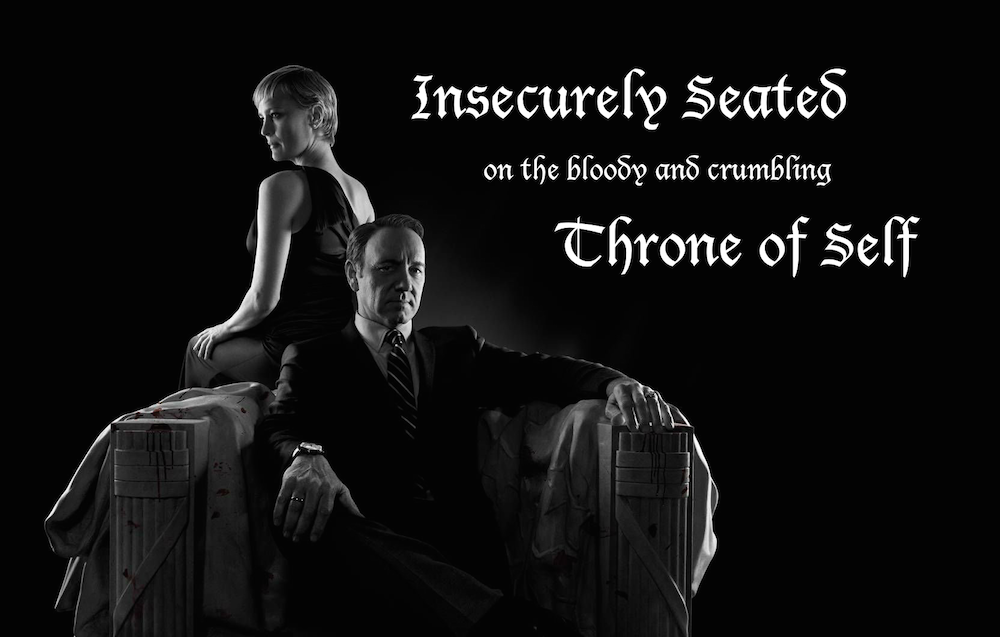
cardsWatching the series House of Cards is not a “guilty pleasure.” It is often a painful exercise in examining just how corrupting, dehumanizing and (ultimately) damning political power can be. The depth of the viewers’ discomfort is a tribute to the perfectly pitched acting and writing.

It’s set in Washington D.C., and I am afraid it is more accurate portrait of that dark political environ than anyone but Mephistopheles could imagine.

Political corruption is not an American problem. It’s a human condition. Sadly, the perversions of power are replicated in capitals around the globe.

House of Cards examines the rise of a particularly evil pair, President Francis Underwood and his wife Claire.* They will stop at nothing—literally, nothing—to sate their shared hunger for power.

President Underwood is so self-consumed that few viewers will identify with his dead soul. On the other hand, he is in many ways an attractive, witty and “charismatic” man. This, of course, is the whitewash over the sepulcher that has allowed his rise to the heights of human dominance.

Despite his moral decay, there are elements of his behavior with which many can relate. I am not referring to his devotion to his wife, which appears noble but is actually a twisted symbiosis.

One way we see how a human being with the potential for true greatness has fallen to such depths comes in small sins. The ones that many of us commit without wasting a “second thought.” Such compromises often lead, as we know from personal experience, to greater transgressions.

Too often, our fall begins with a lie. We see a glimmer of this in the following scene.** The president has enlisted a popular writer to pen his “autobiography.” The author chooses to open the book with a dramatic story about Underwood’s courage and willingness to risk all for a cause.

He relates a story from the president’s youth in South Carolina. He stunned his peers by his commitment to swim all the way out to the famous Fort Sumter, at the mouth of Charleston Harbor. He did not make it the first time, and needed to be rescued by the Coast Guard. However, he tried and tried again, until he defeated the tides and waves, and rose triumphant on the island’s shore.

After the writer reads the stirring account to the president, in a dramatic aside,*** Underwood says to the audience:

I never tried to swim to Fort Sumter. Thomas probably knows I made it up. But he wrote it anyway because he understands the greater truth. Imagination is its own form of courage.

This passage is powerful. It not only displays the impulse for self-aggrandizement to which many powerful people are disposed. It also seeks to justify that compromise with integrity, by transforming the very flaw into a virtue! “Imagination is its own form of courage.” True, but given the context, repugnant.

And that sort of perversion, which had to have seemed a discordant rationale when he originally voiced it, becomes a rule for his life.

I can make up any lie that serves my purpose, because the very act of creating that new “truth” is heroic in itself. In essence, the ends (my accumulation of power), will forever justify the means.

C.S. Lewis on the Lies We Make Our Truths

One of Lewis’ lesser read theological books is The Problem of Pain. The book offers Lewis’ insights into why a loving God would allow suffering. One intriguing feature of the text is its chapter on the suffering of animals, which reveals the breadth of Lewis’ concern as well as his affection for what we now call “other species.”

The following passages suggest that when we tell ourselves the lie—that existence is ultimately about us—we are destined for disappointment. This is the tragedy being staged before our lives in the television series we have been discussing. It can be summarized in the scriptural maxim familiar even to those who never read a Bible: “For what will it profit a man if he gains the whole world and forfeits his soul?” (Matthew 16:26, ESV).

[Humanity] fell. Someone or something whispered that they could become as gods—that they could cease directing their lives to their Creator and taking all their delights as uncovenanted mercies, as ‘accidents’ (in the logical sense) which arose in the course of a life directed not to those delights but to the adoration of God.

As a young man wants a regular allowance from his father which he can count on as his own, within which he makes his own plans (and rightly, for his father is after all a fellow creature), so they desired to be on their own, to take care for their own future, to plan for pleasure and for security, to have a meum [personal possession] from which, no doubt, they would pay some reasonable tribute to God in the way of time, attention, and love, but which, nevertheless, was theirs not His. They wanted, as we say, to ‘call their souls their own.’

But that means to live a lie, for our souls are not, in fact, our own.

They wanted some corner in the universe of which they could say to God, ‘This is our business, not yours.’ But there is no such corner. They wanted to be nouns, but they were, and eternally must be, mere adjectives.

. . .

I have begun with the conception of Hell as a positive retributive punishment inflicted by God because that is the form in which the doctrine is most repellent, and I wished to tackle the strongest objection. But, of course, though Our Lord often speaks of Hell as a sentence inflicted by a tribunal, He also says elsewhere that the judgement consists in the very fact that men prefer darkness to light, and that not He, but His ‘word,’ judges men.

We are therefore at liberty—since the two conceptions, in the long run, mean the same thing—to think of this bad man’s perdition not as a sentence imposed on him but as the mere fact of being what he is. The characteristic of lost souls is ‘their rejection of everything that is not simply themselves.’

Our imaginary egoist has tried to turn everything he meets into a province or appendage of the self. The taste for the other, that is, the very capacity for enjoying good, is quenched in him except in so far as his body still draws him into some rudimentary contact with an outer world. Death removes this last contact. He has his wish—to lie wholly in the self and to make the best of what he finds there. And what he finds there is Hell.

Lewis’ description of his “imaginary egoist” ably fits the fictional President Underwood and his First Lady. Their lives are consumed by self. The fiction derives its power from the reality. The Underwoods are not simple cartoons. They reveal the life choices of real people in our world.

Men and women who have clawed their way onto the throne in their lives, find in the end, that it crumbles beneath them. Only a miracle can rescue them from their terrible chosen destinies . . . and gloriously, that redeeming miracle awaits their cry for mercy, so long as they have breath.

______

* Kevin Spacey and Robin Wright play their tragic characters so well that both have won Golden Globe awards and a variety of other accolades.

** From “Chapter 34,” season three, episode four.

*** An “aside” is a device where a character speaks directly to the audience, revealing some private thought or knowledge. It can easily be overused, but is quite finely tuned in this series. The writers of House of Cards are definitely talented.

C.S. Lewis On Stage

fpaIf you live in one of the cities listed below, you will definitely want to see the impressive stage performance of “The Great Divorce,” currently touring the United States.

This weekend my wife and I journeyed great distances to the city of the Space Needle. (It’s an arduous trek, and involves taking to the seas aboard ferry boats that tourists love and commuters endure.)

Frankly, it requires a lot to move me to subject myself to the teeming masses of traffic and humanity on the streets of urban Seattle—but this performance was more than worth the trip.

“The Great Divorce” has been adapted for the stage by Max McLean and Brian Watkins. McLean is the Founder and Artistic Director of the Fellowship for Performing Arts (FPA) in New York City. You can learn more about the Fellowship and their offerings here.

His last foray into C.S. Lewis’ work was a widely applauded rendition of “The Screwtape Letters.” It was so well received that it may be taken on tour again in upcoming years.

In the current production, three talented actors bring to life a wide range of characters from Lewis’ work about the gulf (“divorce”) between heaven and hell.

Following the performance, McLean offers the audience a short Q&A session on the work. During ours, he was asked if he is contemplating any more Lewisian adaptations. With a broad smile he assured us he was, saying, “I’m smitten by Lewis.”

When asked about the way in which Lewis’ fantasy work was a response to William Blake’s The Marriage of Heaven and Hell, he paraphrased Lewis’ remarks in the preface of The Great Divorce. Then McLean said he wished they had used Lewis’ original title for the work.

In May of 1945 Lewis wrote to a regular correspondent, “The title Who Goes Home? has had to be dropped because someone has used it already. The little book will be called The Great Divorce and will appear about August.” Those acquainted with the volume will recognize how much better suited to the work Lewis’ preferred title was.

So, Where Will the Play Be Performed

Here are the remaining locations for the performances. They are in the midst of their tour, so I will not list places they have already visited. (Don’t wish to disappoint anyone who missed out on an opportunity to see it.)

Portland, Oregon

Chicago, Illinois

Milwaukee, Wisconsin

Grand Rapids, Michigan

Minneapolis, Minnesota

Cincinnati, Ohio

Everything FPA creates is exceptional. I encourage you to sign up for their email list to keep apprised of their future offerings, including updates to their tour schedule.