Fonts that Can Make Your Literary Dreams Come True

Would you be interested in owning a copy of an attractive new font called Middle Earth? If so, read on and you’ll find a link to download this typeface created by Swedish designer Måns Grebäck.

When it comes to fonts, there are basically two types of people – those who pay no attention to them as they read, and others who notice the nuances between similar fonts and are fascinated by extraordinary examples.

Longtime readers of Mere Inkling know I am in the latter category. Every year or two I actually write on the subject. I’ve discussed monastic fonts, legal fonts, trustworthy fonts, uninhibited fonts, a dyslexia font, a memory-enhancing font, fonts based on the handwriting of historical figures, and being a fontaholic.

The reason for my current interest in fonts is due to Microsoft’s decision to jettison Calibri as their default font for Office products. They needed to make room for its replacement, Aptos. Seriously, when you view the two sans serif* fonts, side-by-side, you may be surprised at how little they differ.

To make matters even more confusing, CNBC describes a curious aspect of Aptos saga.

Aptos will remain available in the font list under the old Bierstadt name for people who are accustomed to it. Users can also choose to set any other font as the default.

Apple’s mac computers also allow users to choose their own defaults. One typography community discusses this selection opportunity, even as they bemoan the fact that in many programs, the standard installations include suboptimal fonts.

Unfortunately, many of us work on computers where we have no control over what fonts are loaded onto the machine, so we have created a list of the top 10 most common system fonts everyone should know and how to handle them.

This website offers a brief description and history of ten of the most common fonts we typically encounter. For example:

Times New Roman is a serif typeface designed by Stanley Morison and Victor Lardent in 1931. It was commissioned by the British newspaper The Times, which wanted a new typeface to replace its existing font, Times Old Roman.

And I love their estimation of Comic Sans, one of my wife’s favorite fonts, which I avoid like the proverbial plague. (Delores is a young at heart special education teacher, and I’m more of a Lewisian dinosaur.) 

Do use: if you are designing a comic for 6-year-olds.
Don’t use: if you want to be taken seriously by work colleagues.

Another pastor, who learned this lesson the hard way, shared his advice with the warning: “pastors don’t let your bulletins print out in Comic Sans!”

Apparently, his astute wife preserved his professional reputation by telling him to (1) avoid using a “smorgasbord of fonts” in a single document, and (2) “resist the temptation to print serious things in less than serious fonts.”

Advice for Writers

While authors have little control over the fonts in which their work is published by commercial publishers, they do have freedom to choose the typeface they use for the actual composition. “How To Choose the Best Font for Your Writing” addresses that latitude in the following way.

Do you have a favorite font? Are you dedicated to Times New Roman, or are you more of an “anything-but-Wingdings” kind of writer? Maybe you haven’t given your choice of font much thought.

Quite simply, as research shows, texts that look good make you feel good while interacting with them. This is why it’s so important to choose a font that not only is easy to read, optimizes line length, and has the right mood, but also is one that you like!

MasterClass describes the various aspects of each font that will contribute to your overall impression of each font. In “Typography for Writers: How to Pick the Best Type for Writing,” they explain the significance of bowls, ascenders, spines, counters, and more.

Typographers and type designers have their own universe of special terms, each of which refers to a specific part of a given letter. Understanding these basic elements of typography can help you decide precisely what typographic style you want to employ to grab your reader’s attention.

InDesignSkills goes so far as to match a number of typefaces to specific genres, saying “we judged the legibility, beauty, simplicity and variety of weights available of a huge range of fonts, and whittled them down to these faithful five.” They even offer an ironclad promise, proclaiming their selection will “never let your typesetting down, guaranteed.”

Obviously, personal tastes play a large role in appreciating or disapproving of various fonts. One author describes how the quest for the perfect font is integral to writers’ creativity.

Let’s talk about one of our favourite writing avoidance devices: picking the right font for your manuscript.

The Best and Worst Fonts (and why they’re good or bad),” describes the bond a writer can develop with their typographic fancies.

Fonts are one of the most important design choices to make when developing your brand identity. The best fonts leave you feeling like you’ve made an instant friend while the worst fonts are like a stranger who won’t leave you alone.

The writer offers her personal preferences (and prejudices). I don’t agree with all of her judgments, but I am forced to concur with her inclusion of Jokerman and Bleeding Cowboys on the list of “worst fonts.” And I am pretty sure that C.S. Lewis would agree.

Write in the Spirit of Middle Earth

If you have read this far, your reward is to receive the download link for Middle Earth. 

As noted aboved, Måns Grebäck is a prolific Swedish typographer. He makes many of his creations freely available to individuals for non-commercial use. (Commercial licenses are available as well.) The independent FontSpace describes it thusly:

With the historic charm of ancient manuscripts and the ethereal beauty of elven realms, Middle Earth typeface weaves tales of valor and legends. Its calligraphic allure is accentuated by rounded contours, reminiscent of Tolkien’s enchanted worlds.

Middle Earth truly is ethereally elegant. Enjoy.


* Sans serif fonts are those without serifs, which are the tiny lines or marks that appear at the end of a character’s stroke. Arial would be a common sans serif font, while Times New Roman is a familiar serif font.
Historical Font Facts

Consider yourself blessed if you’re not a fontaholic. The affliction leads to clogged font directories on your computer, and an unavoidable prejudice toward either serif or sans serif fonts.

People who are intrigued by typography know exactly what I’m talking about. At least two or three times a year they will inextricably find themselves on some font website (there are scores of them) without consciously knowing how they got there or there or there.*

I’ve written about fontaholicism in the past. Unfortunately, despite my advocacy, the Diagnostic and Statistical Manual of Mental Disorders has yet to classify the malady as a recognized illness. That said, the American Psychiatric Association does sound a bit obsessive compulsive in terms of their font guidance for annual meeting posters.

If any or all of the work in this poster was prepared with commercial support, a statement “Supported by funding from [name of company]” must be noted in the lower left corner of the poster in Arial 72 point font, with no bold, italics, special colors, or other enhancement of the company name, product, or any other portions of the statement.

One wonders what sort of reaction a person would get from the APA if they used Times Roman or Comic Sans by mistake.

C.S. Lewis & Fonts

It should be acknowledged up front that C.S. Lewis was not obsessed with fonts. However, he was wise enough to recognize their significant role in communication. Good fonts could be transparent, while problematic fonts blurred the message. He highlighted one of the most significant aspects of a font’s usage—size—in a 1957 letter. He told a fellow Brit, “you’d be much wiser to get my books in the American edition as these now have larger print and better paper than our own.”

A year earlier he had discussed a related issue with his publisher. There was a problem with a Shakespeare quotation intended for the title page of Till We Have Faces.

The quotation would, I agree, look better on a page to itself, but (what is more important) I am very strongly opposed to the idea of dividing it. I agree that it ‘looks wrong as it is’ but I think it will look equally with any division whatever. I do not see why it need be printed ‘absurdly small’ to fit in as one line . . .

Now a line of that length on a page to itself would I believe, look ugly if it came anywhere near the middle of a page–because it would then seem to divide the page into two halves. But would it not look quite nice if put near the top? It would then have the properties of a frieze or dado with plain wall under it.

And we may perfectly well omit the word ‘Shakespeare’ if we think that makes a better design. But I’d prefer even a bad design to a division of the verse.

Free Books about Fonts

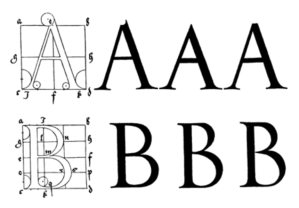
You can find a number of interesting books about fonts at some of the wonderful internet libraries such as Project Gutenberg. During recent historical research about Reformation-era artists, I discovered a book written by Albrecht Dürer (1471–1528). Since his fame is derived from his portraits of prominent people, I was surprised he had written a guide for properly shaping letters, based on geometric principles. The introduction provides a fascinating portrait of sixteenth century artistry in northern Europe.

In our Germany . . . are to be found at the present day many young men of a happy talent for the Art Pictorial, who without any artistic training whatever, but taught only by their daily exercise of it, have run riot like an unpruned tree, so that unhesitatingly and without compunction they turn out their works, purely according to their own judgment.

But when great and ingenious artists behold their so inept performances, not undeservedly do they ridicule the blindness of such men; since sane judgment abhors nothing so much as a picture perpetrated with no technical knowledge, although with plenty of care and diligence.

Now the sole reason why painters of this sort are not aware of their own error is that they have not learnt Geometry, without which no one can either be or become an absolute artist; but the blame for this should be laid upon their masters, who themselves are ignorant of this art.

Since this is in very truth the foundation of the whole graphic art, it seems to me a good thing to set down for studious beginners a few rudiments, in which I might, as it were, furnish them with a handle for using the compass and the rule, and thence, by seeing Truth itself before their eyes, they might become not only zealous of the arts, but even arrive at a great and true understanding of them.

Dürer’s book sparked my curiosity, and a very quick subsequent search hinted at the wealth of typographical information online. For example, you can read about The Typography of Advertisements, circa 1911. There you will be warned that bolder is not always better.

“But,” some one says, “the heavier and bolder type-faces furnish a greater contrast to the white of the paper, and therefore should be easier to read.”

It is true that a greater contrast of color is furnished in the use of the bolder type-faces, but to force these greater contrasts on the eye is to literally club it into reading the text, whether or no. Are the salesman’s statements of better selling value because they are shouted loudly in direct contrast to the quiet of the office?

There may be, and undoubtedly are, some on whom this force is necessary, but to those who are sufficiently educated and intelligent to be reached through the appeal of an advertisement, the quiet dignity of the salesman’s statements made in well-modulated tones will be more attractive.

Gaze back even farther, to what was considered Early Typography in 1872. There you will discover a medieval religious order devoted to worship and manuscripts.

Reference has more than once been made to the impulse given to learning at the end of the fourteenth and the beginning of the fifteenth centuries. This movement was helped forward by no one in Holland and Germany more than by Gerhard Groote, or Magnus, of Deventer, (b. 1326, d. 1370), who after studying theology at Paris, became a canon of Utrecht and Aix-la-Chapelle, and founded the Order of the Brethren and Clerks of the Common Life, generally known as the “Gemeiineslebens,” or “Frères de la Vie Commune . . .”

It was divided into the literary Brethren or Clerks, and the unlearned Brethren, who lived in different houses, but in bonds of the greatest friendship. The Clerks devoted themselves to transcribing books, the cultivation of polite learning, and the instruction of youth; and they erected schools wherever they went. The Brethren laboured with their hands, and pursued various mechanic trades. Neither were under the restraint of religious vows; but still they ate at a common table, and had a general community of goods.

There are many other curious titles available to those who choose to explore obscure typography in greater depth. A person might even wish to begin with 1891’s Specimens Of Book, Jobbing, And Ornamental Printing Type In Use In The Government Central Printing Office, Simla [India].

Fonts, fonts, fonts. As I said above, you are fortunate if they don’t draw you too deeply into their orbit. However, if you recognize you too are a fontaholic, take comfort in the knowledge that you are not alone.


* And here’s another font site I had never seen before writing this post. It has a delightful name, Font Squirrel. Once I finish writing this piece, you can guess where I will be spending some of my web surfing research time.

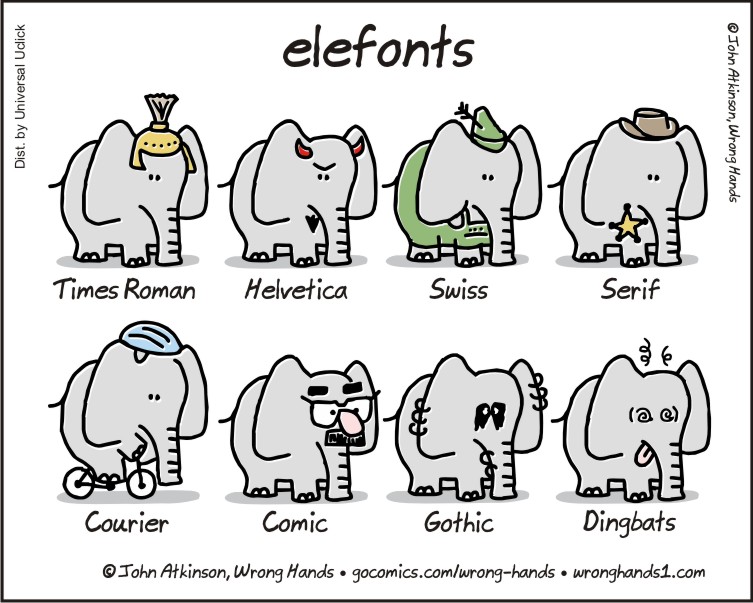
The Elefonts cartoon at the top of the page is a creation of talented Canadian John Atkinson, and is used with permission.