Crying for Attention

abcxyzAre you driven by the unquenchable thirst to be the center of everyone’s attention. Or, would you be more content to live out your life appreciated by a small cadre of friends?

A woman in South America recently displayed an extreme case of the former impulse. She had grown tired of her name because it was too mundane. Apparently she garnered insufficient attention as Ladyzunga Cyborg.

So now her name, legally changed, is ABCDEFGHIJKLMNOPQRSTUVWXYZ.

My first thought when reading this was not that I didn’t believe it. In our foolish world, where people use symbols that aren’t even words for their names, I just shook my head. And . . . I thought “how fortunate for her that she’s not Chinese,” with its 46,964 characters as recorded in the Kangxi Dictionary.

This is not the sort of publicity Columbia needs. She’s acting bizarrely enough to be a mistaken for a Californian.

Of course, people at the opposite extreme—those who cannot bear the presence of other human beings—are also troubled. As with so many aspects of the human personality, people at either of the extreme poles are frequently deemed mentally ill.

This fetish for exhibitionism is alien to me. I would much prefer downing a pint with friends at the Eagle and Child to standing on some stage in front of “adoring crowds.”

My “introvert” quotient appears to be eclipsing my “extravert” qualities.

C.S. Lewis never sought the limelight either. He did not find his experience with notoriety pleasant. And yet, he accepted its burden graciously.

It is commonly known that some days he would spends hours (literally) corresponding with some of the thousands of readers who wrote to him as the creator of Narnia.

It was exhausting.

I assume people like Ms. Abcdefghijklmnopqrstuvwxyz seek attention because they feel insignificant or unnoticed.

I find that tragic. Tragic because their name, their true name, is known by the most important and amazing person in the universe. The God who created them.

Each and every person, including you, is unique, precious and loved.

Knowing this provides profound peace. It also delivers us from the constant compulsion to seek attention.

Jesus described the profound value of each person by contrasting God’s love for us with the attention he devotes even to a single sparrow . . . “Not one of them will fall to the ground outside your Father’s care.”

And you, that’s you, are far more precious than these.

Annual Encouragement

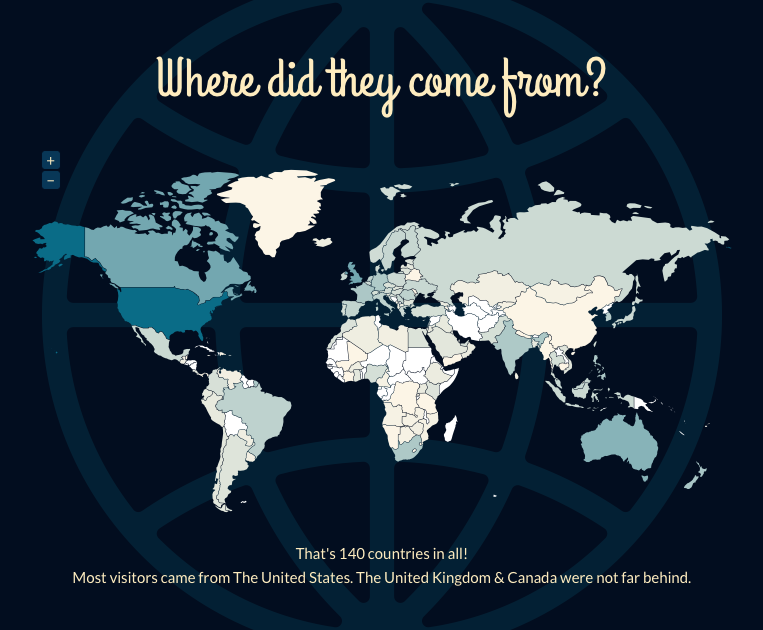
2013Our grandparents never dreamed a single person could touch as many other people as we now take for granted in our digital age. If you had told them that in a single year, you could interact with people from 140 different nations—and all from the comfort of your own home—they would have had you institutionalized.

Yet, that’s precisely what we do today. And what may be even odder, we consider it commonplace.

Readers who are familiar with the “wordpress community” know that the arrival of the new year includes a welcome ritual. We receive a congratulatory note on our blogging accomplishments during the previous year.

In addition to various statistical notes, the report identifies particularly successful posts. For example, a couple of years ago I wrote “Lessons Taught by Onions,” and for some peculiar reason it continues to draw visitors every single month.

At the top of this post I have reproduced what many of us regard as the most intriguing aspect of the report–revealing where your readers reside. As a novice blogger it’s a wonderful feeling when we first see something we’ve written read by people in a foreign land.

Over the years it’s fascinating to see how the list of visitors grows.

Some countries are tough to reach. This year I finally had a visitor or two from the People’s Republic of China and Mongolia . . . a couple of those challenging lands.

I still haven’t been able to penetrate North Korea. But then, that’s no surprise since they only have one computer with international access, and I don’t publish the type of material that would be of interest to the resident of the presidential palace.

As the new year begins, it’s good to be encouraged by others for one’s past performance. Most of us require a bit of encouragement now and then.

Speaking of encouraging, in a 1956 letter, C.S. Lewis expresses appreciation to a writer who enjoyed his book, Till We Have Faces.

It was nice of you to write about Till We Have Faces (I originally called it Bareface, but the publishers vetoed that because they said people would think it was a ‘Western’!), and a most needed encouragement to me, for it has so far had a more hostile reception from the critics than any book I ever wrote. Not that critics really matter very much. The real question is how the book goes 10 or 15 years after publication.

Encouragement is always welcome, and never more so than in the wake of abundant discouragement.

And then, of course, there is the feigned or teasing sort of encouragement that can only be offered by someone we trust. Someone we know regards us with affection. In that light, I couldn’t resist including the following passage from a letter Lewis wrote in 1951.

All well here except myself, who have a bad cold; but I’m off to Ireland I hope on Friday for a fortnight, which may shift it. (Warnie in his usual way of encouragement, reads me paragraphs from the paper at breakfast about liners wind bound in the Mersey and waves 6 ½ feet high off the Irish coast.)

I must confess that with a large and literate family, I receive more than my share of just this sort of “encouragement.” And I welcome it.

In the meantime, however, the annual report of Mere Inkling’s popularity does inspire me to press on with my self-imposed pace of two columns a week. I warmly invite you to continue the journey alongside me.

Chinese Complexity

Chinese ChroniclesSome people consider “writing” difficult. It’s not. When you add the adverb “well,” it does become much rarer. Still, writing in English is not challenging at all when you compare it to the hurdle traditional Chinese authors face.

One of the most popular television programs in the People’s Republic of China is essentially a “spelling bee.” During a recent episode the studio audience was embarrassed by the fact only one-third of them were able to correctly write “gan ga,” which means “embarrassed.”

Chinese ComplexThe problem is apparently two-fold. First, Chinese characters are “complex.” That’s why I selected that very word to include here.

The most comprehensive Chinese dictionary, Zhonghua Zihai, was compiled in 1994. It includes 85,568 characters. When compared to the Latin alphabet of 26 characters, it’s no surprise that a poll in China found 99% of the population admitting they forget how to write words. (To be fair, I’m not sure we could find even 1% in the West claiming that they never forget how to spell a word.)

The second reason for the growing national writing crisis in China is the amazing phenomenon called pinyin. Pinyin is the official phonetic system for transcribing the sound of Chinese characters into Latin script. It was created in 1958 by mainland China and has been adopted by the Republic of China as well.

The influence of pinyin has grown dramatically with the advent of computing, and many young Chinese have become dependent on the shortcut. Some educators have labeled the crippling practice “a type of social disease.”

Fortunately for aspiring Chinese authors, knowing a meager 4,000 distinct characters makes one “functionally” literate. Still, even that seems rather daunting. I’ll no longer take for granted my good fortune in having a mere 26 characters to strive to master.

C.S. Lewis offered some fascinating observations about the Chinese worldview. While he discussed the subject in a variety of places, he presents his thoughts most extensively in The Abolition of Man. He finds the concept of “Tao” a useful corollary to what Christians usually refer to as Natural Law.

The Chinese also speak of a great thing (the greatest thing) called the Tao. It is the reality beyond all predicates, the abyss that was before the Creator Himself. It is Nature, it is the Way, the Road. It is the Way in which the universe goes on, the Way in which things everlastingly emerge, stilly and tranquilly, into space and time. It is also the Way which every man should tread in imitation of that cosmic and supercosmic progression, conforming all activities to that great exemplar.

“In ritual,” say the Analects, “it is harmony with Nature that is prized.” The ancient Jews likewise praise the Law as being “true.” This conception in all its forms, Platonic, Aristotelian, Stoic, Christian, and Oriental alike, I shall henceforth refer to for brevity simply as “the Tao.”

Some of the accounts of it which I have quoted will seem, perhaps, to many of you merely quaint or even magical. But what is common to them all is something we cannot neglect. It is the doctrine of objective value, the belief that certain attitudes are really true, and others really false, to the kind of thing the universe is and the kind of things we are.

Although the following story does not relate to C.S. Lewis directly, it offers an interesting insight into the subject of this post. It appears in the book Remembering C.S. Lewis: Recollections of Those who Knew Him, and refers to J.A. Smith, one of Lewis’ fellow professors at Magdalen.

“At the Breakfast Table” was written by another member of the faculty, Adam Fox. Both men knew Lewis well, since they were part of a breakfast foursome in the Common Room at the college.

Now J.A. had fallen into the way of speculating on odd little problems, which apparently assailed him in bed when sleep deserted him. I remember him coming down one morning and telling us that he had been thinking in the night what a dreadful thing it would be for a learned Chinese to go blind. I do not know if the other members of the party knew why it would be more dreadful for a Chinese than for any other learned person.

I had no idea, but I knew my place, and when I asked why this was so, it appeared, according to J.A., that many of the ideograms that make Chinese writing so beautiful conveyed meaning to the eye but had no sound attached to them. Reading in Chinese was in part at least like looking at a picture book, and for that reason, of course, a blind man is fatally handicapped.

As an epilogue of sorts, I can’t resist including one of my favorite Chinese characters. Perhaps you’ll enjoy it also.

Chinese Verbose

Ironically, since it required sixty-four strokes, the word zhé fell from common usage around the fifth century.

Promoting Our Writing

blog promoOne of the common frustrations online writers face is the question: “is anyone out there reading what I write?”

I suspect that’s been the plaintive lament of all authors, since the dawn of written languages. Just as a conversation can’t occur when one of the parties ignores the other, no “communication” takes place when something is written, but never read.

Blogs provide an excellent framework for exploring this phenomenon. Bloggers don’t write merely for themselves. (If they wanted to do that, they’d simply “journal.”) Bloggers long to have others read their words. And the commonest disappointment of new online writers is just how few people actually visit their sites.

Fortunately, communities such as wordpress include features that allow us to track statistics in an accurate manner. Even when visitors fail to comment or formally “like” a post, they still leave digital footprints. I’ve written before about how enjoyable it is to see how frequently your page has been visited by people from all around the world.

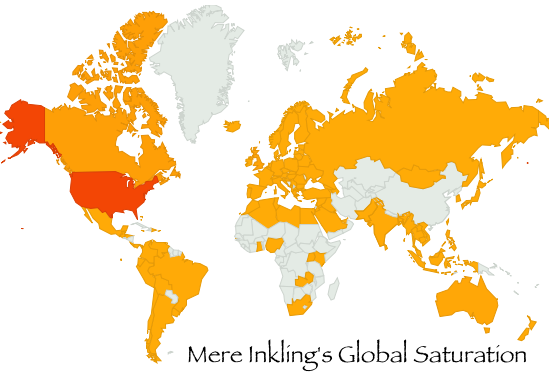
At that time I shared my statistical world map, (directly below). Today I follow it with my current status . . . which reveals that I have finally penetrated the Great Wall and accessed the vast population of the People’s Republic of China! (Of course, I have long suspected the Chinese military of spying on my column, in an effort to glean military secrets about the Inklings’ military service during WWI.)

countries

countries 2

Methods of Increasing Visits to Our Sites

There are a number of concrete ways to expose others to our words. A few appear below. Still, it’s good to remain realistic in our expectations.

I recently read that it’s worthwhile being listed in the Technorati blog directories. As part of the verification process for inclusion there, I need to include in one of my blogs the code RFQE8T2R48RG. (I just hope their verification search engine isn’t confused by the numerous occasions when I’ve used that very same code in my previous blogs.)

As promised, here are a handful of nearly universal recommendations for increasing the number of visitors to our websites.

  • Write on subjects we feel passionate about.
  • Write well.
  • Be as unique as possible (in our personal publishing niche).
  • Encourage people to leave comments.
  • Dialog with the readers who do.
  • Create intriguing titles for our posts.
  • Write regularly (at least weekly, but not hourly).
  • Offer RSS and email subscription options.
  • Visit other blogs & offer encouraging comments.
  • Tell everyone you know to read Mere Inkling.

Truly sorry about that last plug. I’m simply trying extra hard to ensure my words don’t drop into the obsidian darkness of digital anonymity. Blessings in your own efforts to ensure the same!

Honor Your Parents . . . Or Else!

parentsThere are a variety of reasons for expressing affection and care for one’s parents. Many feel gratitude for the sacrifices their parents made while providing for them. Others treasure memories of never doubting their parents’ love for them. Some enjoyed less idyllic childhoods, but honor their parents out of a sense of duty.

C.S. Lewis described the last type of family in The Four Loves. Rather than giving cause for their children to appreciate them, some parents raise obstacles to their affections.

We hear a great deal about the rudeness of the rising generation. I am an oldster myself and might be expected to take the oldsters’ side, but in fact I have been far more impressed by the bad manners of parents to children than by those of children to parents.

Who has not been the embarrassed guest at family meals where the father or mother treated their grown-up offspring with an incivility which, offered to any other young people, would simply have terminated the acquaintance?

Dogmatic assertions of matters which the children understand and their elders don’t, ruthless interruptions, flat contradictions, ridicule of things the young take seriously—sometimes of their religion—insulting references to their friends, all provide an easy answer to the question “Why are they always out? Why do they like every house better than their home?” Who does not prefer civility to barbarism?

Yes, there are several reasons for honoring our parents, even when they have not “earned” that respect. And now we can add another incentive to do so—because you might be sued in court if you do not honor them! While this statute has not arrived in the Western world, it is a relatively new law in the world’s most populous nation.

The recently revised law requires that adult children visit their parents “often” . . . without defining the specific frequency. Apparently, too many children have become preoccupied with their own concerns. (Shades of Harry Chapin’s “Cats in the Cradle.”)

Traditional Chinese culture is renowned for the value it places on revering elders in general, and parents specifically. In the Analects of the philosopher Confucius, an entire section is devoted to “filial piety.”

58. Confucius said: “When at home, a young man should serve his parents; when away from home, he should be respectful to his elders. He should always be earnest and truthful, express love to all, and follow men of virtue. Then, if he has the time and energy, he should study literature and the arts.” [1.6]

71. Confucius said: “When your father is alive, obey him. When your father has passed on, live as he did. If you do so for [at least] three years after your father’s death, then you are a true son.” [1.11]

72. Tzu Lu asked about the meaning of filial piety. Confucius said: “Nowadays filial piety means being able to support your parents. But we support even our horses and dogs. Without respect, what’s the difference between the two kinds of support?” [2.7]

73. Tzu Hsia asked about filial piety. Confucius said: “What matters is the expression you show on your face. ‘Filial piety’ doesn’t mean merely doing physical tasks for your parents, or merely providing them with food and wine.” [2.8]

74. Confucius said: “In serving your parents, you may disagree with them from time to time and seek to correct them gently. But if they will not go along with you, you must continue to respect and serve them without complaining.” [4.18]

75. Confucius said: “Never ignore your parents’ ages, which are both a source of joy (because they are still living) and a source of anxiety (because their deaths are coming nearer).” [4.21]

The Judeo-Christian tradition, of course, also demands respect for one’s parents. “Honor your father and your mother, that your days may be long in the land that the Lord your God is giving you (Exodus 20:12, ESV). And from the Letter to the Church in Ephesus: “Children, obey your parents in the Lord, for this is right. ‘Honor your father and mother’ (this is the first commandment with a promise), “that it may go well with you and that you may live long in the land.”

It is challenging to discern what it means to honor a parent who does not merit gratitude. Indeed, destructive (abusive) parents may well disqualify themselves from receiving honor, since they tacitly reject the very essence of what it means to be a mother or father.

Aside from these extreme cases, where only a biological relationship exists, we must be honest. None of our parents are perfect. But then the corollary is also true—none of their children are, either. It is in these common, shaded cases where our own character is tested.

C.S. Lewis lost his mother at a young age. His father remained distant, and sent his sons to distant boarding schools. During the First World War, Lewis was severely wounded and shipped from the front lines to a London hospital where he recuperated. While a patient he wrote the following to his father in Ireland.

Wherever I am I know that you will come and see me. You know I have some difficulty in talking of the greatest things; it is the fault of our generation and of the English schools. But at least you will believe that I was never before so eager to cling to every bit of our old home life and to see you.

I know I have often been far from what I should be in my relation to you, and have undervalued an affection and generosity which an experience of “other people’s parents” has shown me in a new light. But, please God, I shall do better in the future. Come and see me, I am homesick, that is the long and the short of it.

Sadly, Lewis’ father did not make the trip to visit his son at the hospital. Such is the nature of real life relationships . . . and such is the reason why honoring our parents sometimes needs to assume the form of a law, or even a Commandment.

May it not be so in your family. If your parents still live, I pray God will grant you great joy in honoring them. And, if you have children, I pray that the Lord will fill them with well-deserved affection for you.

_____

If you have never heard the song “Cats in the Cradle,” you owe it to yourself to ponder its powerful message today. You can view it here.


International Blogging

countries

Who reads blogs? Well, initially, we find just two sources of readers.

  1. Family & Close Friends who we can coerce into reading it, and put on the spot by publicly asking questions related to our recent columns to tighten the screws just a smidge.
  2. Fellow bloggers who search for interesting reads with the ulterior hope that the writers of posts they “like” will make a reciprocal journey to their site.

Expanding beyond those two categories is the challenge. I suspect that most bloggers are resigned to only reaching a relatively small audience. And that’s not necessarily a bad thing. After all, junk mail reaches the boxes of millions, but it is tossed into recycling without a second thought. On the other hand, a blog may only be read by a handful of people, but one or two of them may be wonderfully touched or encouraged through that brief encounter. Junk mail is deleted with a groan. Our posts, in sharp contrast, may elicit a smile, a laugh, or perhaps even an appropriate tear.

I can settle for that.

One of the nice things about being part of the WordPress community is the way writers can monitor their site statistics. One fascinating feature is “Views by Country,” which tracks the national origin of visitors to a blog. (Well, not necessarily their ethnic origin, but the country from which they established their online connection with the website.)

Checking out this resource is fantastic for several reasons. First, it’s pleasant as we note visits from locales with which we have a special bond. Republic of Korea, spent a busy year there ministering to those guarding democracy, but still managed to visit many beautiful sites and established many friendships. United Kingdom, got to live there with my family, and visited amazing historic locations too numerous to list. (But, shouldn’t the UK count as three or four countries?) Guam, we got to live there too and enjoy the scenic ocean vistas. (Of course, it’s not a separate country either, being a Territory of the United States.) So what if the word “country” is applied a bit loosely, the sheer breadth of the program’s coverage is impressive.

A second value of the list is that it is educational. You can learn about the existence and/or location of many exotic lands. I’ve had visitors from the Mongolian steppes of the Khans, WWI catalyst Montenegro, freedom-seeking Syria, and the Viking-haunted Faroe Islands.

The third major benefit of visiting the statistics tool is that it can actually reinforce a writer’s sense that someone out there in the vast global unknown is actually interested in their words. I’m amazed, and a mite humbled, to have had visitors to MereInkling from 129 “countries.” Pretty amazing. When I revisit the list every two or three months I see one or two newly reached populations. Yet, as I look at the map, I see many nations remain to be reached. For example, most of the “-stans” and many countries in Africa have yet to feel the warm and liberating glimmer of light MereInkling attempts to deliver.

The Remaining Mystery

I am still plagued by one unanswered question though.

I readily understand why the People’s [misnamed] “Republic” of China has barred MereInkling from internet availability for their billions of prisoners residents.

What perplexes me is why the Kingdom of Denmark has barred access to MereInkling for the subjugated country of Greenland?!? One would think that, in light of their 5 day summer and 360 winter that they would be eager to read something as entertaining as MereInkling. Why has an internet wall been erected to prevent them from doing so? What, we must wonder, is going on behind that impenetrable Ice Curtain?

Yes, for those who think they’ve noted a flaw in my conspiracy theory, I am fully aware that the Faroe Islands are also technically part of the Danish empire. So, why would citizens of Denmark proper and the occupied Faroes be allowed to visit MereInkling while the Greenlanders are left to find enjoyment in measuring the advance and retreat of massive glaciers? The mystery deepens.

As C.S. Lewis wrote in “The Efficacy of Prayer,” in a passage I’ve wrenched completely out of context: “There is a mystery here which, even if I had the power, I might not have the courage to explore.”

Theological Training

I’m proud I graduated from a well-respected seminary. And I’m proud of following that Master of Divinity degree with an advanced Master of Theology degree in Patristics. And that’s precisely the problem . . . I’m proud.

As a Christian, I recognize that pride is one of the most destructive and insidious sins. As a pastor and chaplain, I have seen all too frequently how pride expressly targets members of the clergy. Our vulnerability to the temptation to be proud is one of the common chinks in the armor of the ordained.

C.S. Lewis recognized this fact. In A Severe Mercy, he wrote:

I think there is a great deal to be said for having one’s deepest spiritual interest distinct from one’s ordinary duty as a student or professional man. St. Paul’s job was tent-making. When the two coincide I shd. have thought there was a danger lest the natural interest in one’s job and the pleasures of gratified ambition might be mistaken for spiritual progress and spiritual consolation; and I think clergymen sometimes fall into this trap. . . .

In fact, the change [to a Christian ministry] might do good or harm. I’ve always been glad myself that Theology is not the thing I earn my living by. On the whole, I’d advise you to get on with your tent-making. The performance of a duty will probably teach you quite as much about God as academic Theology wd. do. Mind, I’m not certain: but that is the view I incline to.

Lewis understood that “advancement” in ecclesiastical contexts can mask the inner heart and be mistaken as a form of holiness when it is in actuality vanity. I was reminded of this weakness in clerical armor recently, when I read a tribute to a Chinese Christian whose name is little known beyond his homeland. Dr. Sun Yi-yin, known in America as “Freddie Sun,” died in August at the age of 76. A professor of Geology, he lost his faculty position for failing to deny Christ.

Like thousands of other Christians living under the atheist regime, he was imprisoned for his work in establishing churches and Bible schools. He raised the funds to start no fewer than 154 of these training centers, and was key to the equipping of approximately 60,000 underground pastors and teachers. The “underground” Church in China is distinguished from the government-controlled “Three-Self Patriotic Movement.”

For his labors, Sun endured a decade in a Chinese labor camp. (His wife, Dorothy Chang, was also imprisoned. Rather than reducing his faith, during his sojourn in the harshest of conditions, Sun experienced a personal revival and his zeal increased.

His story is amazing, but here is the aspect that hit the mark in the center of my conscience. In his autobiography, The Man in the Fiery Furnace, Sun described his imprisonment as his “seminary” experience: “Instead of learning homiletics, hermeneutics, Greek, and Hebrew, I was being taught the greater lessons of obedience, submission, forgiveness, love, endurance, and patience.”

Now, I am grateful that God has preserved me from the “fiery furnace,” but I do long to experience the fruit of the spirit that Sun so richly harvested in prison. While not dismissing the importance of the classical subjects of homiletics and hermeneutics, as the Apostle says, “If I speak in the tongues of men and of angels, but have not love, I am a noisy gong or a clanging cymbal. And if I have prophetic powers, and understand all mysteries and all knowledge, and if I have all faith, so as to remove mountains, but have not love, I am nothing. If I give away all I have, and if I deliver up my body to be burned, but have not love, I gain nothing.” (I Corinthians 13:1-3, ESV).

In The Problem of Pain, Lewis’ treatise on suffering, he addresses how God can redeem terrible things such as unjust punishments. For those desiring to understand how an omnipotent God can allow evil to occur, Lewis’ presentation is quite helpful. And, the life example of Dr. Sun provides a superb example of its validity.

I advance six propositions necessary to complete our account of human suffering which do not arise out of one another and must therefore be given in an arbitrary order. 1. There is a paradox about tribulation in Christianity. Blessed are the poor, but by ‘judgement’ (i.e., social justice) and alms we are to remove poverty wherever possible. Blessed are we when persecuted, but we may avoid persecution by flying from city to city, and may pray to be spared it, as Our Lord prayed in Gethsemane.

But if suffering is good, ought it not to be pursued rather than avoided? I answer that suffering is not good in itself. What is good in any painful experience is, for the sufferer, his submission to the will of God, and, for the spectators, the compassion aroused and the acts of mercy to which it leads. In the fallen and partially redeemed universe we may distinguish (1) the simple good descending from God, (2) the simple evil produced by rebellious creatures, and (3) the exploitation of that evil by God for His redemptive purpose, which produces (4) the complex good to which accepted suffering and repented sin contribute.

Now the fact that God can make complex good out of simple evil does not excuse—though by mercy it may save—those who do the simple evil. And this distinction is central. Offences must come, but woe to those by whom they come; sins do cause grace to abound, but we must not make that an excuse for continuing to sin. The crucifixion itself is the best, as well as the worst, of all historical events, but the role of Judas remains simply evil.

I thank God for the life and testimony of Sun. I pray God will reap an abundance of believers in China, and elsewhere, due to his faithfulness. And I thank God for using Sun’s words to cause me to stop in the midst of my busy activities and take the time to examine my own heart and motives.