What We Worship

worshipping squirrel

It’s curious to consider the varieties of deities worshipped throughout history and around the globe. And it is important that we understand the god we choose to follow, as well as the nature of “faith” allows us.

This picture came from a nearby garden. The squirrel effects the pose of a worshipper, but it’s motivated by the nuts the gardener has rested in the Buddha’s lap. It’s not intended to be irreverent, and one assumes that Siddhārtha Gautama would not be offended.

The image is provocative. If you were to put yourself in the squirrel’s place, it would be of no surprise that you would be devoted to the “Provider of Nuts,” especially if you did not make the connection between the gentleman who filled and the statue that actually offers them to you.

Whether we are adherents of one of the so-called monotheistic religions, or pantheists who see the presence of god in all of universal nature, our “religion” directly affects our worldview and life choices.

And then there are the “no religious preferences,” who embrace or reject labels like “agnostic.” Some of them long to believe, but demand proof, where God calls for faith. Others opt for lives of hedonism, gambling that their notion there is no Creator is right. Many of these individuals actively hope that there is no God, and not a few of them have a nagging fear that he may just exist, and call them to account one day for their selfish lives.

C.S. Lewis was in the latter category. Before he became a Christian, Lewis entertained no desire to seek Christ out. “Amiable agnostics,” he wrote, “will talk cheerfully about ‘man’s search for God.’ To me, as I then was, they might as well have talked about the mouse’s search for the cat” (Surprised by Joy).

About the Nature of Faith

God chooses to call us into a restored relationship with himself through the mechanism of faith. If that word troubles you, think of it as “trust.” Faith is necessary, for an obvious reason. In the New Testament, we read, “without faith it is impossible to please him, for whoever would draw near to God must believe that he exists and that he rewards those who seek him” (Hebrews 11:6).

That faith is necessary may sound intimidating. However, the good news is that what God demands, he himself provides . . . even to the most reluctant of converts such as Saul of Tarsus or C.S. Lewis of Oxford.

For by grace you have been saved through faith. And this is not your own doing; it is the gift of God, not a result of works, so that no one may boast. (Ephesians 2:8-9)

In Mere Christianity, C.S. Lewis discusses the nature of faith at great length. He provides a number of helpful images. In the book he clearly distinguishes between faith (trust) and feelings or moods. I enjoy the way that the final sentence of this passage is evocative of the worshipping squirrel which inspired these reflections.

Faith, in the sense in which I am here using the word, is the art of holding on to things your reason has once accepted, in spite of your changing moods. For moods will change, whatever view your reason takes. I know that by experience.

Now that I am a Christian I do have moods in which the whole thing looks very improbable: but when I was an atheist I had moods in which Christianity looked terribly probable. This rebellion of your moods against your real self is going to come anyway.

That is why Faith is such a necessary virtue: unless you teach your moods “where they get off,” you can never be either a sound Christian or even a sound atheist, but just a creature dithering to and fro, with its beliefs really dependent on the weather and the state of its digestion.

Dithering to and fro, indeed.

A Surrealistic Postscript

I had been thinking about writing on this subject ever since I saw the photo, some months ago. I was spurred to compose it now, by a fact that recently appeared in Ripley’s Believe It or Not. It speaks for itself.

A Brazilian grandmother believed she was praying to a figurine of Saint Anthony for years, only to discover that it was an action figure of the Elf Lord Elrond from the “Lord of the Rings” films!

Communicating with Conviction

bold cmu.png

It is sad that a lie spoken with conviction can often mislead, while truths communicated timidly are frequently overlooked or doubted.

It was 20 July 1940. C.S. Lewis wrote to his brother Warnie about his thoughts after listening to one of Hitler’s many speeches. The German Army had already occupied the Bailiwicks of Jersey and Guernsey in the Channel Islands.

Unbeknownst to the two veterans of World War One, just four days before Lewis wrote this letter, Hitler issued Führer Directive #16, setting into motion Operation Sea Lion—initiating planning for the invasion of Britain itself.

The fact that both men recognized the malignancy* that was Adolf Hitler, makes Lewis’ candid comment which follows, all the more powerful.

Humphrey came up to see me last night (not in his medical capacity) and we listened to Hitler’s speech together. [The BBC offered a running translation.] I don’t know if I’m weaker than other people: but it is a positive revelation to me how while the speech lasts it is impossible not to waver just a little.

I should be useless as a schoolmaster or a policeman. Statements which I know to be untrue all but convince me, at any rate for the moment, if only the man says them unflinchingly.

The same weakness is why I am a slow examiner: if a candidate with a bold, mature handwriting attributed Paradise Lost to Wordsworth, I should feel a tendency to go and look it up for fear he might be right after all.

Lewis recognized as a flaw his particular susceptibility to implicitly trusting boldly made statements.

This human vulnerability lies at the heart of the infamous declaration of another demagogue, Vladimir Lenin, that “a lie told often enough becomes the truth.”

I suspect many of us share this inclination to trust words we hear spoken with conviction. At the same time, we are probably much less vulnerable to their manipulation than Lewis was, if for no other reason than because our modern ears have become dulled to the incessant and strident lies flooding the public forum.

A Note for Christian Writers

Skillfully treading the line between the modern deities of Pluralism and Tolerance becomes more challenging each day.

The temptation is to temper our message, to timidly whisper what we know to be true. Thus, we dilute Jesus’ clear declaration that he is the Truth (John 14:6), by adding qualifiers such as “at least, he’s the truth for me.”

Speaking boldly is not arrogant. It has been a vital quality of apostolic preaching since the beginning. Peter and John were seized for preaching the Gospel.

Now when they saw the boldness of Peter and John, and perceived that they were uneducated, common men, they were astonished. . . . So they called them and charged them not to speak or teach at all in the name of Jesus. But Peter and John answered them, “Whether it is right in the sight of God to listen to you rather than to God, you must judge, for we cannot but speak of what we have seen and heard.”

[After their release, they prayed:] “Lord, look upon their threats and grant to your servants to continue to speak your word with all boldness . . .” (Acts 4, ESV).

Just so, we who know Christ “cannot but speak” about how he is at work in the world and in our lives.

Though our boldness is tempered by humility arising from our awareness that we have no righteousness of our own, we must still offer the truth we know, with confidence. “For God has not given us a spirit of timidity, but of power and love and discipline.” (2 Timothy 1:7, NASB).


* There is evidence Adolf Hitler did not appreciate C.S. Lewis’ wartime service.


Pen or Keyboard: A Literary Dilemma

peck typing

Is it better to write by hand or via keyboard? There are those who would argue there is a correct answer to that question, and it is not simply a matter of preference.

Our recent discussion about C.S. Lewis’ handwriting caused a recent article on this subject to draw my close attention.

In “Phenomenology of the Hand,” Mark Bauerlein, an editor of First Things, recently addressed the disassociation from one’s words that results from the intervention of the computer.

Despite all the promises made when keyboards were introduced to classrooms, he says, “Students write faster with keyboard and mouse, but would anybody say that student writing has improved in the last three decades?”

That is a subjective determination, but the rhetorical nature of the question assumes what most of us sense—that today’s graduates are not better writers than their predecessors.

The essay makes pleasurable reading, whatever your opinion.

The pen moves more slowly, but that isn’t a drawback. Like other “slow” movements (slow food, slow reading, slow art), slow writing aims for a fuller and tighter relation to the object, a nearness of mind to the language it utters.

The plodding process of “drawing” letters instead of tapping keys and telling a computer to draw them gives words greater intimacy and presence. The hand­written word is closer, and that makes a writer more deliberate with words.

C.S. Lewis’ Typewriter

Narnia’s creator did not type. He wrote all of his books and relied on his brother Warnie to type the final versions. Not that Warnie was a particularly talented typist, relying as he did on only his index fingers (the hunt-and-peck method).

Lewis sincerely appreciated his brother’s assistance converting his “scrawl” into a readable text. In 1953, he began a letter with a witty verb describing the typing process.

This will have to be an inadequate scrawl for my brother, who drives the typewriter, is away and I’ve so much to do that I can hardly write– in the double sense that I’ve hardly time and that my right hand is stiff and tired with compulsory scribbling!

You can read an interesting anecdote related to Lewis’ disinterest in typewriters on the Desiring God website.

They sponsored a Lewis-related conference, and nearly included a scene in a promotional video that could have “discredited” their scholarship. (Desiring God provides free access to the sessions of the superb conference here.)

But one scene nobody saw was Lewis at his typewriter, not because we didn’t accidentally film the scene (and delete it later), but because such a scene never happened. Lewis detested typewriters.

Some writers may be accused of being technophobes, but the truth is many are eager to embrace novel technologies. Referring to his sturdy Remington, Samuel Clemens (Mark Twain) famously bragged that he “was the first person in the world to apply the typemachine to literature.”

Curiously, he could not recall which manuscript he first completed on the newfangled contraption. He recalled it was Tom Sawyer in 1874, but historians have determined it was actually Life on the Mississippi, eight years later.

The First Things essay would take issue with Twain’s enthusiastic endorsement. In fact, it concludes with a rather harsh judgment.

The virtues of the computer—faster, easier, simpler—are vices when it comes to writing. The pen personalizes the labor of writing, reminding us that we are responsible for what we write.

C.S. Lewis, who advised a novice writer to avoid typewriters because “the noise will destroy your sense of rhythm,” would likely concur.

Renaissance Rap Music

renaissance rap

If you never listen to classical music, you are missing out on one of life’s greatest pleasures. If you have been exposed to small doses, and developed an unfortunate distaste for historic music from the past several centuries, give it a second chance.

The fact is there are so many varieties, with exciting variations introduced by countless gifted composers, that almost anyone can find something in the field that inspires them.

It was probably classical works that C.S. Lewis had in mind when he wrote to Arthur Greeves in 1916, “Isn’t it funny the way some combinations of words can give you—almost apart from their meaning—a thrill like music?”

Our Director of Parish Music recently shared some interesting facts that I had not known. Although I’ve sung in a number of choirs through the years, I never mastered any “instrument.”

Sure, teachers attempted to teach me about music back in the days of the flutophone. (Yes, I was introduced to instrumental music way back in the day before most elementary schools upgraded to plastic instruments properly called “recorders.”)

A flutophone may look like a toy, but it is actually a legitimate “pre-band instrument” belonging to the wind family.

Returning to the class I attended . . . our Music Director introduced us to one of the seventeenth century’s finest composers, Heinrich Schütz. This German Lutheran studied with the Italian Roman Catholic Giovanni Pierluigi da Palestrina, a master of polyphony. Curiously, their shared devotion to religious music allowed for a genuine friendship, despite the Thirty Years War which raged across Central Europe at the time.

In addition to learning some history about composers, I was stunned to learn that rap music had been invented as long ago as 1635-45.

It was called “recitative,” and is a style of vocal music that alternated between speaking and singing. We listened to some examples, and I immediately realized that even fans of modern rap (among whom I do not include myself) can find some classical music they would likely enjoy.

C.S. Lewis and the Blessings of Music

Luther famously declared, “next to the Word of God, the noble art of music is the greatest treasure in the world.”

C.S. Lewis also regarded music as a gift of God. In his essay, “On Church Music,” he ponders the blessing received by those who listen to religious music. He finds that humility is the key.

There are two musical situations on which I think we can be confident that a blessing rests. One is where a priest or an organist, himself a man of trained and delicate taste, humbly and charitably sacrifices his own (aesthetically right) desires and gives the people humbler and coarser fare than he would wish, in a belief (even, as it may be, the erroneous belief) that he can thus bring them to God.

The other is where the stupid and unmusical layman humbly and patiently, and above all silently, listens to music which he cannot, or cannot fully, appreciate, in the belief that it somehow glorifies God, and that if it does not edify him this must be his own defect.

Neither such a High Brow nor such a Low Brow can be far out of the way. To both, Church Music will have been a means of grace: not the music they have liked, but the music they have disliked. They have both offered, sacrificed, their taste in the fullest sense.

But where the opposite situation arises, where the musician is filled with the pride of skill or the virus of emulation and looks with contempt on the unappreciative congregation, or where the unmusical, complacently entrenched in their own ignorance and conservatism, look with the restless and resentful hostility of an inferiority complex on all who would try to improve their taste—there, we may be sure, all that both offer is unblessed and the spirit that moves them is not the Holy Ghost.

Lewis continues his thoughts, turning to the practical application of his thoughts to the local parish. Members of a typical congregation, of course, do not all share the same musical tastes.

These highly general reflections will not, I fear, be of much practical use to any priest or organist in devising a working compromise for a particular church. The most they can hope to do is to suggest that the problem is never a merely musical one.

Where both the choir and the congregation are spiritually on the right road no insurmountable difficulties will occur. Discrepancies of taste and capacity will, indeed, provide matter for mutual charity and humility.

What wise advice. The presence of love and humility, essential elements of Christian spirituality, can see a congregation through discrepancies of taste. We should each remind ourselves of this, the next time we hear something in worship that does not appeal to our personal preferences.

The question should not be whether we “like” specific music or not, but rather whether or not it truly glorifies God.


The unattributed photograph below suggests C.S. Lewis may have enjoyed a periodic musical interlude as he toiled over piles of correspondence.

Lewis and recorder

Write Like C.S. Lewis

escher hands.jpg

What would you give to be able to write like the creator of Narnia? It’s unlikely his brilliance will be replicated in the near future, but there is one peculiar sense in which writing “like” Lewis may be feasible.

The digital creation of the fonts we see on our computer monitors—and print to physical copies—is far simpler than the manual process used by Gutenberg. In fact, with just a few clicks, you can be reproducing text nearly identical to the documents printed by Johann five centuries ago.

I have previously confessed I am addicted to fonts. I consider myself a connoisseur, since I am not drawn to every font I encounter. Still, my tastes are quite eclectic, and I cannot deny that I am a fontaholic.

I have written in the past about the frequently overlooked importance of the fonts we choose. This link will show you some posts I’ve written about why common fonts such as Arial and Helvetica are less reliable than other options, the wisdom of avoiding ALL CAPS, a font designed for dyslexics, free monastic scribal fonts, and more.

You probably see where I’m going. When I said that we might be able “to write” like C.S. Lewis, I was alluding to using a font based upon his unique handwriting. In one sense, it would look like the genuine writing of the master. The literary merit of the words would clearly be another matter.

Creating a font based on Lewis’ handwriting is a feasible project, as the following examples illustrate.

Writing Like Other Famous Individuals

A moment ago I mentioned Johann Gutenberg. One of the first writers to take full advantage of his innovations, was the reformer Martin Luther. Various examples of Luther’s personal penmanship exist, and at this very moment a German craftsman is in the process of reproducing it as a font that could be used by anyone.

I learned about the project in the posts of Gene Veith, a scholar who writes about religious issues, especially those with some Lutheran connection.

The Kickstarter Project promises a copy of the font for a mere 10€ (about $12, U.S.). The typographer has already reproduced the handwriting of Albert Einstein and Sigmund Freud.

Whether or not you are interested in the handwriting of Luther, Freud or Einstein, is not my concern here.

I am hoping that somewhere out there, there is a skilled typographer who would be interested in digitizing the handwriting of C.S. Lewis. It’s a project that would not make them rich, but I know I would not be alone in appreciating their effort. Since he eschewed the typewriter, there are numerous examples of Lewis’ handwriting in existence.

This chart from the Wade Center illustrates various changes in his script through the years. During the last two decades of his life, Lewis often apologized for his writing, writing in 1955, “I’m sorry my handwriting is so hard: it was very nice until about 10 years ago, but now I have rheumatism in my wrist.”

Fonts of the Famous

Interest in handwriting is not limited to the script of historical figures. Artists and literary stars (some “historical” in their own right) have been the subject of similar efforts.

The creator of a René Descartes font cites a typical challenge.

In 1634, from Amsterdam, he wrote a famous letter to his friend Mersenne, a great scientist monk, in which he spoke about [Galileo’s] works. The greatest part of our glyphs is based on this document. We have added some letters Descartes himself didn’t use, like modern s and j (he used exclusively s long and i instead of j).

There is one particular font producer, P22 Type Foundry, that “specializes” in recreating the handwriting of artists. (I find Michelangelo and Da Vinci more inspirational than Vincent van Gogh.) The font designer even recreated Da Vinci’s “mirror writing.”

This set faithfully captures Leonardo’s remarkable imagination and includes an exclusive Da Vinci Backwards font (reflecting the artist’s own unique style of handwriting). The 72 extras included are drawn from Leonardo’s sketchbooks and journals.

A number of the P22 fonts have been produced in partnership with various museums and institutions. (Perhaps someone connected with the Marion E. Wade Center would like to run this past them?)

Returning to the Handwriting of C.S. Lewis

If people can be sufficiently inspired to create a script for Grigori Rasputin, how is it we are still awaiting a C.S. Lewis font?

Despite his apologies, even in his later years, Lewis’ handwriting is generally quite legible. This despite his comment the final year of his life that, “My mind has not, I trust, decayed so badly as my handwriting.”

In 2008, HarperCollins commissioned a professional graphologist to anonymously analyze this handwriting. The results were quite intriguing.

At first glance this small, neat script appears to trot unprepossessingly across the page. His exceedingly small personal pronoun does indeed suggest that this man is a modest individual; but being modest does not mean ineffectual.

There is evidence of strong personal discipline in this angular, firm script. Here we have a man who is far more likely to harbour a preference for detailed, factual understatement than “in your face” floridity of wording.

It seems to me that he takes himself rather seriously. He requires no outside criticism as he provides more than enough for himself. He is self-critical and self-monitoring. He really cares about getting things right. I don’t think he’s shy—but he chooses to keep himself to himself.

I began to trace the writing and found that it is guarded and careful rather than relaxed and freely written. This is someone who is particularly sensitive and at times somewhat pedantic; not the sort of person to easily catch unawares.

And, Should You Desire to Write Like Jane Austen . . .

If you are curious about the accommodations graphologists must make during these projects, check out the discussion and download a copy of Jane Austen’s handwriting font here. (If you explore the creator’s website you will discover a font based on Giovanni Borgia, eldest illegitimate child of Pope Alexander VI.)

A New C.S. Lewis Christmas Gift

csl christmas

Wouldn’t it be great if they found another work written by C.S. Lewis? Well, great news . . . every once in a while they do!

No, it isn’t a novel, or another adventure in Narnia. But it’s the next best thing for this holy season. A scholar recently recovered two essays written by Lewis in the 1940s, and one of them is about Christmas.

In the current issue of Christianity TodayStephanie Derrick describes her discovery of the articles at the National Library of Scotland in Edinburgh. The articles appeared in The Strand, through which Arthur Conan Doyle’s “Adventures of Sherlock Holmes” became famous.

A favorite among the British upper classes, The Strand was widely read and earned a devoted following at home and abroad. Its high standing kept the magazine afloat during the Second World War when many others were forced to cease printing due to paper shortages.

Both of Lewis’ contributions appeared shortly after the war. One is written about the game cricket, for which Lewis used his pseudonym Clive Hamilton.

The other piece is the one of far greater interest to Christians. Most students of Lewis are familiar with his critique of the secular celebration of “Exmas.” I have also written here at Mere Inkling about other Lewis ties to the Nativity of Christ. “Echoes of Christmas” and “Christmas Interruptions” appeared the past two years.

In the recently recovered “A Christmas Sermon for Pagans,” Lewis explains how paganism is inappropriately used to describe post-Christian Europe. He powerfully illustrates how the latter is more impoverished than the former. Blurring the two, he says, is “like thinking … a street where the houses have been knocked down is the same as a field where no house has yet been built.”

Rubble, dust, broken bottles, old bedsteads and stray cats are very different from grass, thyme, clover, buttercups and a lark singing overhead.

Lewis proceeds, of course, to offer the hope of the world, Emmanuel, whose incarnation we celebrate on Christmas.

Brent Dickieson offers his own worthwhile insights into the recent discovery in his current post. It is well worth reading, and includes the cover of the issue of The Strand that included Lewis’ Christmas sermon.


Brevity & Clear Communication

facts.png

There is something to be said for brevity. But I won’t belabor that here.

In an essay entitled “Before We Can Communicate,” C.S. Lewis explores the frequently overlooked necessity of using commonly agreed upon definitions. He cites examples where apparent disagreement could be traced to differing assumptions about how others would interpret a given word.

We’ve all experienced that sort of confusion and if emotions become involved in the dispute, it can result in more than simple frustration.

As a military chaplain, working in an extremely diverse and pluralistic environment, I devoted much attention to communicating clearly. As an example, when dealing with “theological matters,” I always inquired into the religious background of the person with whom I was speaking.

I did not do so with the intention of altering an iota of the conversation that followed. I learned early on that the religious training each person received carried with it a sort of doctrinal dictionary, where the words carried particular meaning. One problematic example is “baptism,” which means something quite different for different parts of Christ’s Body. When focusing on communication, the question is not which understanding is most biblical. It is, what does the word mean in its present usage in this conversation.

In Lewis’ essay on communication, he describes something that should be a core skill of every pastor.

What we want to see in every ordination exam is a compulsory paper on (simply) translation; a passage from some theological work to be turned into plain vernacular English. Just turned; not adorned, nor diluted, nor made “matey.”

The exercise is very like doing Latin prose. Instead of saying, “How would Cicero have said that?” you have to ask yourself, “How would my scout or bedmaker have said that?”

Lewis cites multiple benefits from this effort. Foremost among them is the usefulness of a commonly understood vocabulary, which he refers to as “learned language.”

In the very process of eliminating from your matter all that is technical, learned, or allusive, you will discover, perhaps for the first time, the true value of learned language: namely, brevity.

It can say in ten words what popular speech can hardly get into a hundred. Your popularisation of the passage set will have to be very much longer than the original. And this we must just put up with.

People who know (and love) me, consider me wordy. I confess to the crime. But in my defense, I declare that with misunderstandings resulting from even the simplest conversations, I strive to dispel as thoroughly as possible, all clouds of potential confusion.

A Note on the Future of Mere Inkling

As is natural in dynamic or living things, such as active blogs, change naturally occurs over time. Such drifting, or even radical alteration, is normal. While altering course results from a conscious decision, drift typically takes place subtly, and slowly.

Over the past year or two, the columns posted here at Mere Inkling have grown in length. While this has allowed for deeper exposition of complex subjects, and a more nuanced treatment of C.S. Lewis’ contributions to the ideas discussed, the increased length has had other unhappy consequences.

The first is that it has, I believe, modestly decreased the readership of Mere Inkling. The internet, by its very nature, favors shorter treatments, and that is a simple truism. Combined with our rapidly decreasing attention spans, an online writer must consciously weigh the tradeoffs.

The second reason is that it takes significantly longer to write a more thorough “essay.” Increasing demands on my time have made the “long form” posting more of a hardship.

So, in light of these considerations, it is my desire to return Mere Inkling to its roots. I will endeavor to keep the posts shorter—along the lines of today’s column above this “note.”

I hope this minor reorientation will be welcomed by you, dear member of the Mere Inkling family.

Enriching Your Writing

lit crit

Writers find literature inspiring. That sounds self-evident—and cliché—when we think of the statement aesthetically. It seems to me, however, that the words are also true in a literal sense. The very act of reading inspires us to fashion our own creations, each of which is consciously or unconsciously indebted to all that we have read and learned during our lives.

This activity is sometimes called bricolage. I wrote about it recently. Skilled writers frequently use devices to enrich their work. Quotations, allusions, pastiche and parody are obvious examples. Some critics would even include plagiarism as an intertextual exercise, and in the strictest sense, it is. While unacknowledged direct quotations are inappropriate, many readers savor reading volumes filled with well-done allusions.

Our minds are a composite of all that to which we have been exposed. When we come up with fresh ideas, they are seldom “new” in a true sense. When they are genuinely novel, at best they offer a unique take on a subject. Still, our expression relies in many aspects on what we ourselves have read in the past. After all, there is nothing new under the sun.*

When we owe a large debt to another source, it is right to offer credit. Not doing so invites people who recognize the source to question our integrity. The exception being when the source is so familiar to the anticipated reader, that it would be redundant. For example, the final sentence in the previous paragraph did not require a citation. If it is not known from its original biblical source, it is recognized as a common proverb . . . or, perhaps, from the Pete Seeger song, “Turn! Turn! Turn!”

One of the striking things about C.S. Lewis is his powerful grasp of the vast breadth of literature he had read. As I wrote in the aforementioned post, “Lewis was generous in thanking thinkers to whom he was indebted, and only failed to do so when he assumed any educated reader would recognize the source of an image or phrase.”

So, what about those times when we have forgotten a source, or don’t even recall that a particular idea came from anywhere other than our own cranium?

Unintentional Bricolage

While teaching at Oxford and Cambridge, Lewis taught many individuals who achieved notoriety in their own right. J.A.W. Bennett, studied under Lewis at Oxford, and eventually replaced him as professor of Medieval and Renaissance literature at Cambridge.

In “The Humane Medievalist: An Inaugural Address,” Bennett describes how Lewis’ vast familiarity with diverse literature meant that his own creative work was permeated by the wisdom of others.

The whole man was in all his judgements and activities . . . and a discriminating zest for life, for “common life,” informs every page he wrote. “Grete Clerke” as he was, he was never wilfully esoteric: Quotations and allusions rose unbidden to the surface of his full and fertile mind, but whether they are to Tristram Shandy or James Thurber they elucidate, not decorate. His works are all of a piece: a book in one genre will correct, illumine or amplify what is latent in another.

As a reader who relishes allusions (especially to the Scriptures), I approach Lewis knowing I’ve been invited to a feast. With C.S. Lewis we find bricolage at its richest and most refined.

In An Experiment in Criticism, Lewis describes two types of readers, literary and unliterary. He says the measure of a book is the extent to which it entices its literary readers to reread it.

In the following excerpt, Lewis mentions how the talented writer weaves together an elegant tapestry (via bricolage). Because literature is so complex and intricate, we benefit from rereading it. He also discusses how literature interacts with our preexisting thoughts and sometimes reshapes them.

Nevertheless, we have already seen that the literary sometimes fall into what I think bad modes of reading, and even that these are sometimes subtler forms of the same errors that the unliterary commit.

They may do so when reading poems. The literary sometimes ‘use’ poetry instead of ‘receiving’ it. They differ from the unliterary because they know very well what they are doing and are prepared to defend it. ‘Why,’ they ask, ‘should I turn from a real and present experience—what the poem means to me, what happens to me when I read it—to inquiries about the poet’s intention or reconstructions, always uncertain, of what it may have meant to his contemporaries?’

There seem to be two answers. One is that the poem in my head which I make from my mistranslations of Chaucer or misunderstandings of Donne may possibly not be so good as the work Chaucer or Donne actually made.

Secondly, why not have both? After enjoying what I made of it, why not go back to the text, this time looking up the hard words, puzzling out the allusions, and discovering that some metrical delights in my first experience were due to my fortunate mispronunciations, and see whether I can enjoy the poet’s poem, not necessarily instead of, but in addition to, my own one?

If I am a man of genius and uninhibited by false modesty I may still think my poem the better of the two. But I could not have discovered this without knowing both. Often, both are well worth retaining.

Do we not all still enjoy certain effects which passages in classical or foreign poets produced in us when we misunderstood them? We know better now.

We enjoy something, we trust, more like what Virgil or Ronsard meant to give us. This does not abolish or stain the old beauty. It is rather like revisiting a beautiful place we knew in childhood. We appraise the landscape with an adult eye; we also revive the pleasures—often very different—which it produced when we were small children.

Admittedly, we can never quite get out of our own skins. Whatever we do, something of our own and of our age’s making will remain in our experience of all literature.

Equally, I can never see anything exactly from the point of view even of those whom I know and love best. But I can make at least some progress towards it. I can eliminate at least the grosser illusions of perspective.

Literature helps me to do it with live people, and live people help me to do it with literature. If I can’t get out of the dungeon I shall at least look out through the bars. It is better than sinking back on the straw in the darkest corner. (An Experiment in Criticism)

An Experiment in Criticism may not be Lewis’ simplest essay to understand, but it is a rich one. In fact, I can almost guarantee that if you should reread the passage quoted above, you will gain new insights that you missed during your first reading.

And that dynamic interplay between our thoughts and the literature we read is exactly what Lewis is explaining, and illustrating.

When it comes to choosing between what we personally receive from a work, and what the author originally intended to say, I love Lewis’ solution: “why not have both?”

_____

* “What has been is what will be, and what has been done is what will be done, and there is nothing new under the sun. Is there a thing of which it is said, ‘See, this is new?’ It has been already in the ages before us” (Ecclesiastes 1:9-10).


Writing with the Materials at Hand

wedding.pngIf you know the meaning of bricolage and understand its application to C.S. Lewis, I doff my cap to you.

Since I’m not an artist (the field in which the word is most common), “bricolage” was foreign to me before I encountered it during my doctoral studies. I read there that it constitutes a valid “approach to qualitative research.”

The term “bricolage” was taken from the work of the French anthropologist Claude Lévi-Strauss (1968), who used it to distinguish mythological from scientific thought. . . . Levi-Strauss described the bricoleur as someone who uses whatever tools and materials are at hand to complete a project.

The key idea is that rather than developing a logically consistent plan in advance and then systematically using the materials and tools that the plan and the norms of the community prescribe (as science is widely, though I think somewhat incorrectly, believed to do), the bricoleur spontaneously adapts to the situation, creatively employing the available tools and materials to come up with unique solutions to a problem. (Qualitative Research Design: An Interactive Approach)

If you picked up on the “mythological” reference within the definition—and drew a connection to the creator of Narnia—you may have the makings of a fine bricoleur. (But don’t add it to your résumé quite yet.)

Lévi-Strauss contrasted this mythological approach with the technological dominance of modern thinking.

The characteristic feature of mythical thought is that it expresses itself by means of a heterogeneous repertoire which, even if extensive, is nevertheless limited. It has to use this repertoire, however, whatever the task in hand because it has nothing else at its disposal. Mythical thought is therefore a kind of intellectual “bricolage.” (The Savage Mind)

Fordham University has a comparative literature journal entitled Bricolage, inspired by “literary bricoleurs [who] produced stories, ones with historical and cultural significance and unique relevance attached to them, that colored the past with intentional highlights and included questions, ideas, and voices that were never part of the frozen time period they wrote about, but always had the potential to be.”

If that makes sense to you, and even inspires you, they have a list of prompts on the website to guide your own submission to the periodical. (I particularly like open-ended: “Describe the problem.”)

They even solicit suggestions for future prompts, if you would like to game the system by suggesting a subject for which you already possess some bricoleurological notions.

I don’t wish to suggest that this literary journal does not include some genuinely insightful work. Consider the following, from “Imagination: An Internal Reality” by Brittany Gilmartin.

While reality is an external landscape for our bodies and senses, the imagination is an internal landscape for our minds and thoughts. A limitless realm that only we ourselves can control, the imagination is a space for us to think freely about the outside world and create a new reality inside of us.

This mental reality is a place that we can escape to when we are not satisfied with the real world, as in “Leaf by Niggle” by J.R.R. Tolkien, or find the real world too hard to bear, as in “An Occurrence at Owl Creek Bridge” by Ambrose Bierce.

Some may argue that instead of escaping into the fantasy of our imaginations, we should focus on factual knowledge; however, the imagination can teach us about the facts in a new light. Indeed, L. Frank Baum, in The Wonderful Wizard of Oz, and C. S. Lewis, in The Chronicles of Narnia, use their imaginations to redefine their external realities through allegories, allowing their readers to gain a deeper understanding of these realities than they could have gained through a textbook.

Great writers, such as the Inklings, did not bring newborn imaginations to the task of writing their diverse works. They were nourished and stirred by their lifelong consumption of a rich banquet of literature. And the way in which these themes are intentionally (and accidentally) woven into new texts displays their great talent.

Intertextuality as a Tool for the Bricoleur

Skilled writers frequently use devices to enrich their work. Quotations, allusions, pastiche and parody are obvious examples. Some critics would even include plagiarism as an intertextual exercise, and in the strictest sense, it is. While unacknowledged direct quotations are inappropriate, many readers savor reading volumes filled with well-done allusions.

By their very nature, shaped as they are by each culture’s history and ethos, fairy tales provide fertile soil for bricolage.

C.S. Lewis pointed out that fairy tales don’t have to be great works of fiction, or even especially well written, to be unforgettable. . . . The libretti of ballets such as The Sleeping Beauty, Swan Lake, and many others invent this and borrow that, crystallizing various elements from national folklore (Russian folk tales) and literary classics (Perrault, E.T.A. Hoffmann).

The raw materials are not, however, always readily identifiable, but have been transformed freely by the creators’ imagination: The Firebird and Giselle are original dramatic works in their own right.

Yet they are also essentially fairy tales, composed by bricolage with features that define the genre: supernatural and mysterious beings, a prevailing atmosphere of enchantment and vulnerability to destiny, and opening to another, imaginary world that is only accessible through the work of art. (Once Upon a Time: A Short History of Fairy Tale)

When the Bricoleur Denies External Influences

Many, if not most, examples of intertextual dependence or allusion are intentional. And, since few of us possess perfect memory, there will be cases where we “borrow” from other works unconsciously.

Many writers find their path to success by following well-worn paths and adding some new twist of their own. To be called “derivative” is not flattering, but carrying bags full of cash to the bank can take the sting out of the label.

In any case, it is disingenuous to deny the influence of others on your work—when their voice is recognizable to all.

The Harry Potter books are, without question, the outstanding British literary phenomenon of the last twenty years. Not everybody likes them, though. . . .  surely nobody can deny that, when it comes to her prose, Rowling is not remotely in the same league as, say, T.H. White or J.R.R. Tolkien, let alone Kenneth Grahame or Edith Nesbit.

So, why are her books so successful? The obvious answer is that, as the critic Wendy Doniger puts it, Rowling “is a wizard herself at the magic art of bricolage: new stores crafted out of recycled pieces of old stories.”

Long after she had become a multi-millionaire, Rowling tried to play down her borrowings from earlier authors, insisting that she was “not a huge fan of fantasy,” had never finished The Lord of the Rings and had a “big problem” with C.S. Lewis’s Narnia stories, which she had never finished either.

Perhaps her memory was playing her false, though, for in earlier interviews she had talked warmly of her affections for The Lord of the Rings . . . In 1998 she even told an interviewer that she “loved” C.S. Lewis, whom she considered a “genius,” and actively reread his Narnia books.

None of this, though, would surprise an attentive reader of her work. Indeed, I suspect much of the attraction of the Harry Potter stories is the fun of spotting the allusions, as well as the nostalgic reassurance of seeing old devices and even familiar characters in a new context. (The Great British Dream Factory: The Strange History of Our National Imagination)

On the opposite end of the humility spectrum, consider C.S. Lewis. Although his Chronicles of Narnia were in many ways groundbreaking, he readily offered gratitude to his various sources of inspiration.

Lewis was generous in thanking thinkers to whom he was indebted, and only failed to do so when he assumed any educated reader would recognize the source of an image or phrase.

With the contemporary state of literary education, this is an assumption modern writers are unwise to share. Sadly, this ignorance of formerly pervasive ideas and expressions is most visible in the realm of biblical literacy. But that is a subject for another day.

Stay Tuned

Our next post will consider an aspect of “unintentional bricolage” that C.S. Lewis found quite entertaining. I suspect many of us will agree.


When the Angel is a Demon

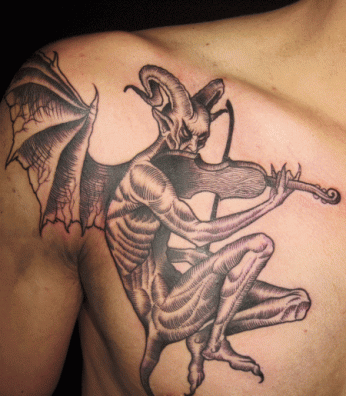
devil tatoo

Not every supernatural being claiming to be an angel really is.

C.S. Lewis’ most familiar discussion of fallen angels (also refered to as demons) appears in The Screwtape Letters. In the preface, he describes the equally disastrous errors people can fall into when pondering the occult.

There are two equal and opposite errors into which our race can fall about the devils. One is to disbelieve in their existence. The other is to believe, and to feel an excessive and unhealthy interest in them. They themselves are equally pleased by both errors, and hail a materialist or a magician with the same delight.

In a separate discussion, Lewis acknowledges the different opinions Christians can have on the subject, and he notes that it is not a salvific concern.

No reference to the Devil or devils is included in any Christian Creeds, and it is quite possible to be a Christian without believing in them. I do believe such beings exist, but that is my own affair. Supposing there to be such beings, the degree to which humans were conscious of their presence would presumably vary very much.

I mean, the more a man was in the Devil’s power, the less he would be aware of it, on the principle that a man is still fairly sober as long as he knows he’s drunk. It is the people who are fully awake and trying hard to be good who would be most aware of the Devil . . .

Of course, they don’t want you to believe in the Devil. If devils exist, their first aim is to give you an anaesthetic—to put you off your guard. Only if that fails, do you become aware of them. (“Answers to Questions on Christianity”)

I have mentioned in the past one of my seminary professors who served in Madagascar as a medical missionary. He had since become a successful psychiatrist. When he left for Africa, he did not believe in the existence of demons.

A final observation about demons, or devils as he typically refers to them: they act in a manner opposite to God. In That Hideous Strength, he includes the observation that, “In fighting those who serve devils one always has this on one’s side; their Masters hate them as much as they hate us.”

This echoes a truthful dialectic.

God loves everyone, even those who hate him. While Lucifer hates everyone, even those who love him.

An Ancient Illustration

I’ve been reading recently wisdom from the Desert Fathers and Mothers. They left ancient Roman cities to pursue spiritual growth as hermits and monks beginning in the middle of the third century.

The history of Christian monasticism is fascinating. All the way up to our own day, male and female monastics of Orthodox, Roman Catholic, and Protestant traditions have pursued holiness by this particular path.

A common occurrence for desert monks involved waging spiritual warfare of a more intense nature than most of us ever experience. I particularly enjoyed the following encounter (which reminded me of Martin Luther’s advice about ridiculing Satan and his minions). The following episode comes from an ancient collection of Desert sayings.

“The devil appeared to a monk disguised as an angel of light, and said to him, ‘I am the angel Gabriel, and I have been sent to you.’ But the monk said, ‘Are you sure you weren’t sent to someone else? I am not worthy to have an angel sent to me.’ At that the devil vanished.”

Good riddance, C.S. Lewis and I would agree.


The image above is of a tattoo whose “wearer” will one day experience great remorse.