C.S. Lewis & Assassinations

The brilliant author C.S. Lewis died on the same day that an American president was assassinated. The violent death of John F. Kennedy in November of 1963 eclipsed Lewis’ own passing, so many people were unaware of it for some time. Yet on that autumn day, both Camelot and Narnia lost their inspirations.

Unfortunately, Kennedy’s shooting was not the only political assassination that was connected in a manner to C.S. Lewis’ life. Archduke Franz Ferdinand Carl Ludwig Joseph Maria of Austria was the heir apparent to the throne of Austria-Hungary. A nineteen year old political activist cold-bloodedly murdered the archduke and his wife, Sofie.

Franz and Sophie had married for love, despite her inadequate social rank, which resulted in a morganatic marriage. In recent years such unions have become more common, but at the time, it was a serious matter. The archduke was forced by his uncle, the emperor, to accept that their descendants would never have a right to the throne.

In a convoluted fashion, Ferdinand’s death nearly led to C.S. Lewis’ own. The 1914 assassination was the spark that set the globe on fire during the First World War. And, during that grim conflict, C.S. Lewis was severely wounded by an artillery shell that killed friends standing nearby.

The Causes and Impact of Political Assassinations” was published by the Combating Terrorism Center at West Point. It begins with the fact that “political assassinations have been part of social reality since the emergence of communal social frameworks . . .” And so, since social frameworks will forever exist, they continue.

Humanity’s Violent History

Assassination has been a relatively common practice throughout human history. This shouldn’t surprise anyone who knows the sad story of Abel and his angry brother, Cain. 

Philip II of Macedon, the father of Alexander the Great, was killed attending the wedding of his daughter Cleopatra (no, not that Cleopatra). Later Cleopatra, as a widow, would be assassinated herself by one of her unsuccessful suitors.

Three centuries later, Julius Caesar was murdered by the political elite of Rome, who feared his growing influence. And in 453, one of Rome’s greatest enemies, Attila the Hun, was arguably murdered on his wedding night by his new bride, Ildico.

Several assassinations are recorded in the Bible. Over such a lengthy and turbulent historical period, that is unsurprising. The two excerpts below have links to the fuller accounts.

[Canaanite general] Sisera fled away on foot to the tent of Jael, the wife of Heber the Kenite, for there was peace between Jabin the king of Hazor and the house of Heber the Kenite. And Jael came out to meet Sisera and said to him, “Turn aside, my lord; turn aside to me; do not be afraid.” So he [entered] the tent, and she covered him with a rug. . . . And he said to her, “Stand at the opening of the tent, and if any man comes and asks you, ‘Is anyone here?’ say, ‘No.’” But Jael the wife of Heber took a tent peg, and took a hammer in her hand. Then she went softly to him and drove the peg into his temple until it went down into the ground while he was lying fast asleep from weariness (Judges 4).

Joab took Amasa by the beard with his right hand to kiss him. But Amasa did not observe the sword that was in Joab’s hand. So Joab struck him with it in the stomach and spilled his entrails to the ground without striking a second blow, and he died (2 Samuel 20).

As a sort of counterbalance to these “positive” instances – elimination of Israel’s enemies – you may want to read about King David’s condemnation of the assassinations of his political rivals, men to whom he would have extended mercy. When two brothers sought a reward for murdering King Ish-bosheth, Saul’s son, David declared “when wicked men have killed a righteous man in his own house on his bed, shall I not now require his blood at your hand and destroy you from the earth?” (2 Samuel 4).

All told, however, there was much violence in the ancient world. As C.S. Lewis’ wife, Joy Davidman, wrote in Smoke on the Mountain: An Interpretation of the Ten Commandments in Terms of Today:

How the ancient Jews did slaughter! They killed in hot blood and in cold; they killed for loot, for God, and for fun. . . . The tribes killed . . . by political assassination as when Ehud stabbed King Eglon in his fat belly . . . [The graphic story of Eglon’s assassination is detailed in Judges 3.]

Another historically consequential assassination occurred in the year 661, when Muhammad’s son-in-law Ali ibn Abi Talib was slain with a poison-coated sword while praying in the Great Mosque of Kufa. This incident caused Islam to separate into two major denominations, and Sunni-Shia relations continue to be contentious.

In the modern era, political murders remain unabated. Vladimir Putin  may be the current master of the deadly art. Even discounting the growing number of “suicides” among his advisers and generals following his ill-advised invasion of Ukraine, we have the case of Alexei Navalny. Navalny was one of Putin’s critics who in 2020 survived poisoning with Novichok nerve agent. Nevertheless, imprisoned in the arctic, he later died under extremely suspicious circumstances. 

In the western hemisphere, the recent attempted assassination of former President Donald Trump invites a review of the danger of serving in that particular office. Despite the (obvious) risk of inviting non-Americans to mock the United States, consider a few facts.

  • Since 1789 (when the office was established) we have had 45 presidents
  • Four sitting presidents have been assassinated while in office
  • Three other presidents (one while in office) were wounded in assassination attempts

Assassination During the Protestant Reformation

In C.S. Lewis’ landmark tome English Literature in the Sixteenth Century, recalls a peculiar passage from the History of the Reformation of Religion within the Realm of Scotland. The author, John Knox refers to the murder of Scotland’s last pre-Reformation Roman Catholic cardinal. It would be more than four centuries before the Pope appointed another.

In the cast of [Knox’s] mind, too, there is something not unlike Tacitus’ sombre pungency, though Knox’s humour, as becomes a countryman of Dunbar, is more boisterous and ferocious.

Sometimes, indeed, it is so ferocious that we should not recognize it at all if we were not told; as when after describing the murder of Cardinal Beaton down to the last grim detail of packing the corpse in salt (‘the wether was hote’) he proceeds, ‘These things we wreat mearelie: but we wold that the reader should observe Goddis just judgementis.’

He was apparently afraid lest the fun of the thing might lead us to forget that even an assassination may have its serious side.

Quite true. An assassination, even of a despised ruler such as Adolf Hitler, remains a serious matter.

Dangerous Facial Hair

Beards come, and beards go. Yet humanity offers no consensus on their value. Perhaps that is because there are so many diverse styles, ranging from restrained to insane.

C.S. Lewis mentioned in passing the “biblical” style of beards in a 1939 letter to his brother Warnie.

For instance the presence of the revolving bookcase in the study has just introduced me to a book of Minto’s mother’s which is well worth studying. It is called Gems of Literature/Elegant, rare, and Suggestive

The engravings are of a sort you can probably imagine – damsels with those peculiar comic-section or peg-top legs and eyes raised to heaven and old men with what can only be called Biblical beards.

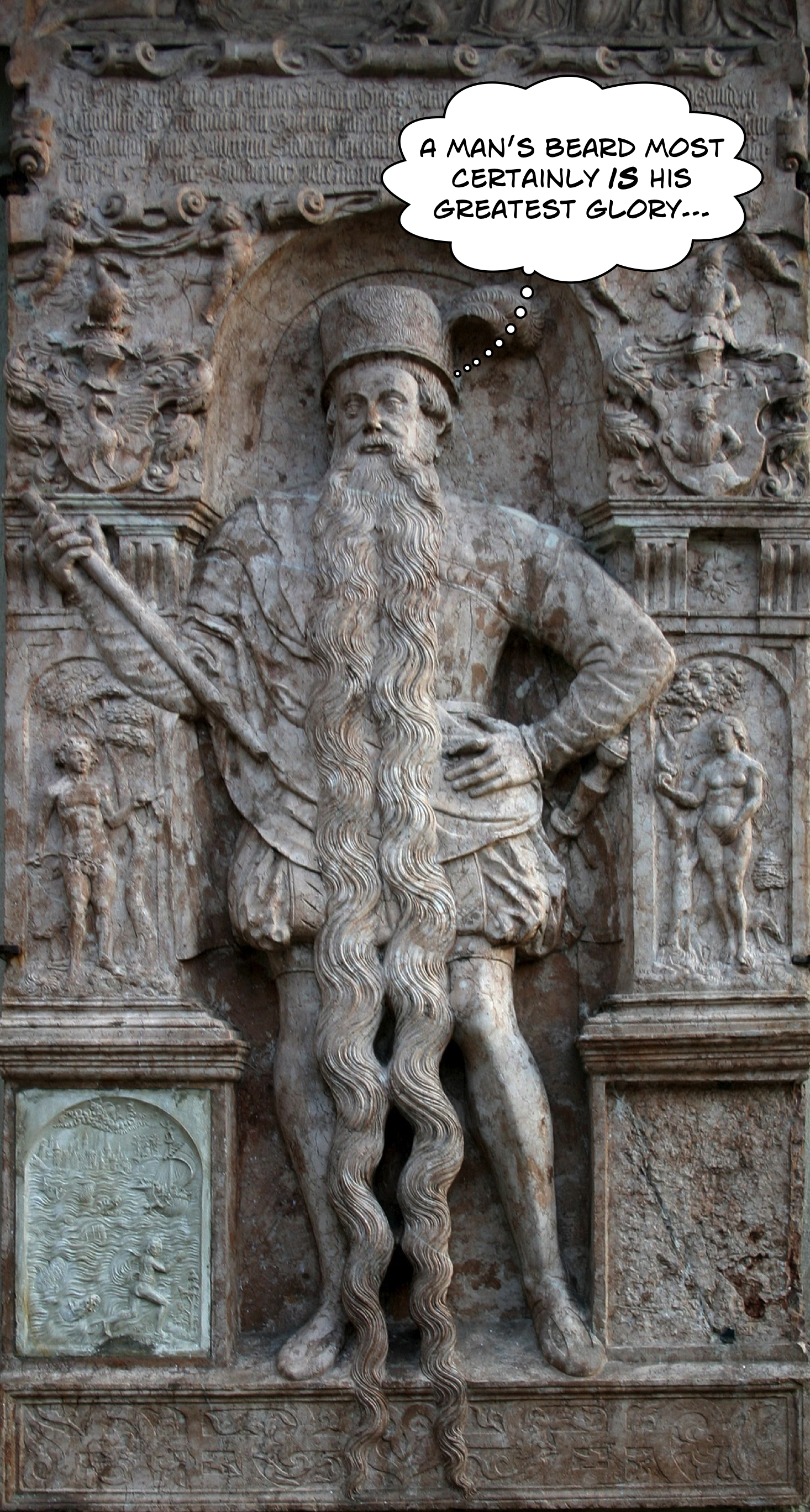
Facial hair is a personal choice. But when that choice becomes deadly, perhaps society should intervene. Take the case of Hans Steininger, a sixteenth century burgomaster in the Austrian-German city that would one day become the birthplace of Adolf Hitler.

Some mental disorder apparently compelled him to have scissors banned from his city, lest a single hair on his magnificent beard be severed. Seriously, he died because he tripped over his chin whiskers during a major fire in 1567.

Steininger usually kept his prodigious beard hair rolled up and stuffed in a pocket, but during the commotion he was running around with it hanging free. In the midst of the chaos, he managed to step on his own beard, sending him tumbling down a flight of stairs and breaking his neck…

The full-body illustration at the church shows Steininger’s beard bifurcated into two scraggly strands, stretching down past his feet. And tucked away in the local district museum is the town’s most hirsute artifact: the 450-year-old beard of Steininger.

Even in ancient times, everyone recognized an unkempt beard was a liability, particularly in combat. In The Life of Theseus, Plutarch states this was why Alexander the Great ordered his soldiers in his phalanxes to shave.

They write also that this was the reason why Alexander gave command to his captains that all the beards of the Macedonians should be shaved, as being the readiest hold for an enemy.

Although I sported a modest mustache for a short time back in the day when Tom Selleck starred as Magnum P.I., I’ve never been a big fan of facial hair. Seeing Steininger’s likeness reinforces that.

Add to that the biblical warning from Leviticus: “When a man or woman has a disease on the head or the beard, the priest shall examine the disease. And if it appears deeper than the skin, and the hair in it is yellow and thin, then the priest shall pronounce him unclean.” (Leviticus 13).

Historical Biases

While well-maintained beards are okay, two additional (historical) factors contribute to my discomfiture. First, as a student of the American Civil War, I find myself repelled by the odd appearance choices of people such as General Ambrose Burnside. Although he gave his name to “sideburns,” that’s hardly what I would call these monstrosities. (Also called mutton chops, which is precisely what the cultured bon vivant should have adorning their cheeks.)

The second reason for my wariness is due to the affinity of too many pastors in my own denomination for beards. I doubt they wear them to wow the ladies. Perhaps they think the beards make them appear more distinguished?

Actually, I’ve become desensitized to most pastors who opt for facial hair – with one bizarre exception. To employ a cliché literally: for the life of me, I can’t understand why anyone living in the twenty-first century would opt for a “chin curtain.” I understand the Amish have an affinity for them, but who ever considered those German Anabaptists fashionable?

Sadly, because my church also possesses a strong Germanic strain, I’ve discovered more than one minister bearing this mark of Cain. Perhaps they hope to emulate the denomination’s first president, the Rev. Dr. C.F.W. Walther. If so, my advice is they follow his example of conscientious pastoral care, and dispense with the externals. (I will concede that his black leather suit does look rather dapper, being that the image was captured for posterity in the mid-1800s.)

C.S. Lewis & His Beard

I can forgive C.S. Lewis for aligning with the beard-faction on at least two occasions. That’s because there were extenuating circumstances.

In 1924 he wrote to his father about an illness that led to what may have been his first transgression.

My dear Papy,

I got chicken pox and am only now out of quarantine. I have of course been quite well enough to write for some time but I don’t know whether you have had this complaint and thought it better not to chance infecting you: I am told that the older you are the less likely it will be to ‘take’, but the worse if it does.

I had a pretty high temperature at the beginning and some very uncomfortable nights of intense perspiration, but it soon passed off.

The danger of cutting any of the spots on my face of course made shaving impossible till this very day and I had a fine beard. I have left the moustache which would excite ‘poor Warren’s’ envy, but I shall probably get tired of it in a few weeks. It is very stiff, and all the hairs grow in different directions and it is thicker on one side than on the other.

In a 1931 letter to his childhood friend, Arthur Greeves, he mentions offhand as he closes that he has altered his appearance.

I suppose you have heard about Warnie’s peerage – for gallantry during the recent manoeuvres. I have grown a beard – Good night.

In two letters written in 1956, C.S. Lewis would describe the illness-induced beard he had mentioned to his father.  He humorously describes its imperfections. The first was written to a young fan.

Your mother tells me you have all been having chicken pox. I had it long after I was grown up and it’s much worse if you are a man for of course you can’t shave with the spots on your face. So I grew a beard and though my hair is black the beard was half yellow and half red! You should have seen me.

The following month he shared more details with a longtime correspondent.

The Tycoon may count himself lucky to have got chickenpox before he reaches the age of shaving brushes and razors. I had it in my late 20’s and grew a beard which was part yellow and part red though my hair is black – a very striking colour scheme.

Apart from that, though, I think it a very good sort of illness on the whole. A nice long quarantine which by sentencing one to solitary confinement secures one against pupils, committees etc. But no doubt it had no such charms for you.

Seeing C.S. Lewis adorned with a beard would surely make for an odd photograph. Especially one taken in color.

Postscript

Forgive me. I’ve vented more than I intended. Wear whatever hairstyle you prefer. However, I would caution you that if your beard drags on the ground, it’s best to carry an emergency set of shears, lest you stumble during an emergency stampede.

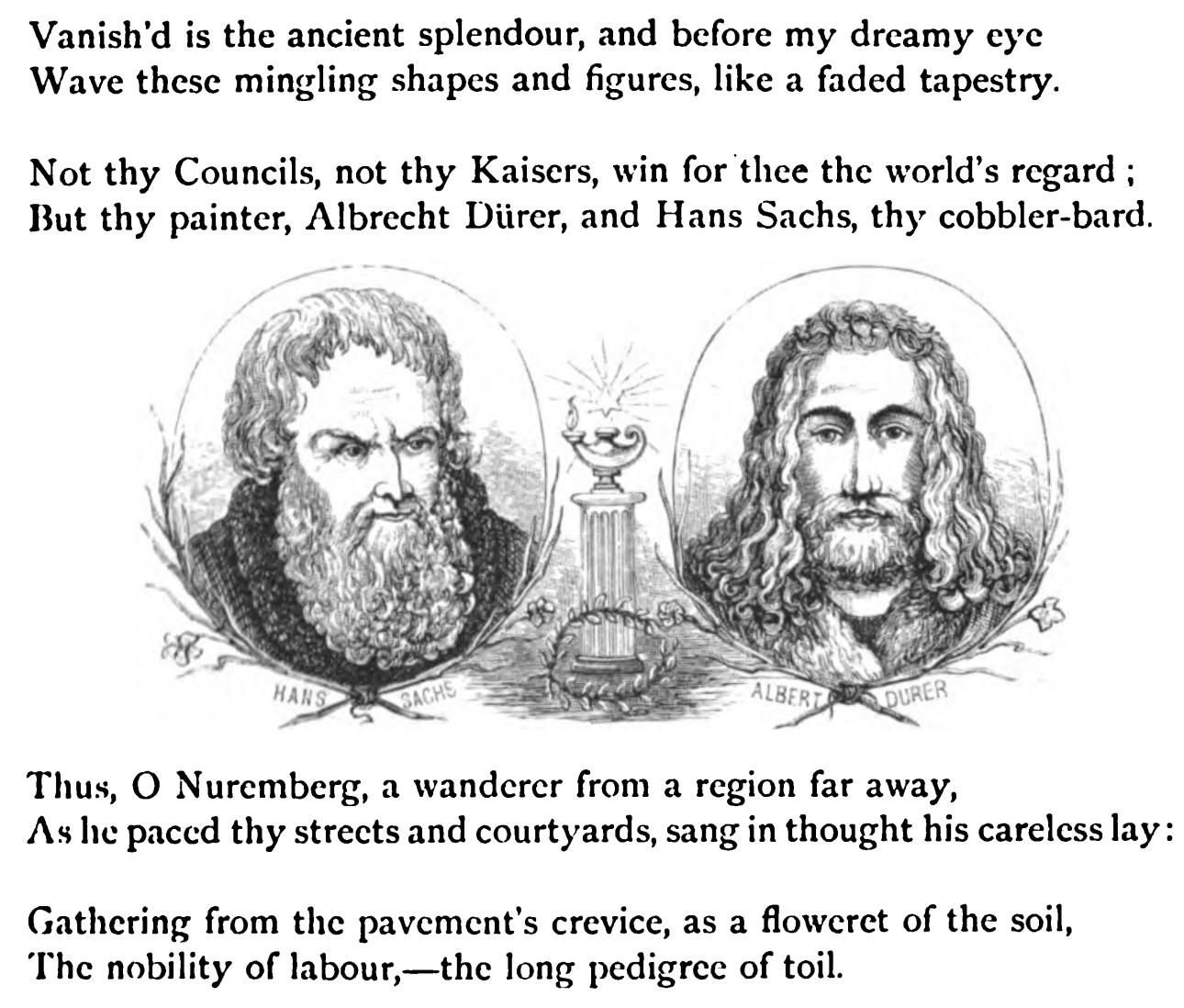
As a treat for those who have read to the end of this column, here is an image from Gems of Literature. I suspect these were two of the “Biblical beards” to which C.S. Lewis referred.

Bonus for beard aficionados: For a curious look at a guy whose quest is to see how many facial hair variations he “can check off from the chart of facial hair types,” visit this site.

Understanding the Bible

P52_recto

True or False? The Bible is so simple to understand that studying how to read it is just a waste of time.

Obviously, the answer to that question is a resounding “False.” While some might argue with me, every serious student of the Scriptures knows that probing its depths requires a variety of skills beyond simple faith.

Well, “simple faith” actually is essential for understanding God’s word, but it requires more than simply possessing faith to comprehend its meaning. If that were not true, then everyone being trained in seminaries and colleges to help others explore God’s word are wasting their time.

Exegesis—the focused study of biblical texts—is a core subject for Bible students. It goes deeper than secular “Bible as Literature” courses, and strives to interpret each passage as faithfully as possible. After all, Christians believe these words are inspired.

In 1952 C.S. Lewis wrote a letter in which he noted the value of knowledgeable instructors in understanding the Bible.

It is Christ Himself, not the Bible, who is the true word of God. The Bible, read in the right spirit and with the guidance of good teachers, will bring us to Him.

Bible Study Magazine had an exceptionally good issue several months ago. They provide online access to some of their articles, but sadly, not to the essay I wish to cite. It was written by Karen Jobes, a retired professor of “New Testament and Exegesis” from Wheaton College and Graduate School. She writes:

Different cultures’ writings function in particular ways and settings, and a given literary genre is signaled by textual clues—stock phrases or forms recognizable to anyone familiar with the literature of a given culture.

Jobes begins her article with an example. “Imagine you’re sitting down to read . . . The book in your hands begins, ‘Once upon a time.’” Western readers would know immediately what to anticipate in the pages that follow.

Then she raises a curious question. “Now imagine you’re a student taking a physics course. If your textbook began, ‘Once upon a time,’ you’d no doubt be confused by the phrase and wonder how you should understand it in a scientific context.”

Her article discusses the importance of properly recognizing the genre of what we are reading. This is a concept quite familiar to most readers of Mere Inkling. But what is unfamiliar to many, who have not had opportunity to study biblical exegesis, are the genres and guiding principles employed by Old and New Testament writers.

Reading the Gospels

In two brief pages, Dr. Jobes explains a fundamental principle that we spent weeks discussing in my seminary courses. Knowing the genre of the biblical text is the key to understanding it. Let’s look at the Gospels.

Mark . . . identifies his text as evangelion (“good news,” Mark 1:1), picking up the term Jesus himself used to describe his message (Mark 1:15). The early church came to refer to all four accounts of Jesus’ life using the same term, which survives today in English as “gospel,” a literary genre unique to accounts about Jesus.

The author points out a similarity between the Gospels and “an ancient Greek genre called bioi (“lives”). Rather than provide a day-by-day journal, these “biographies” focus on what is truly important in the perception of the writer.* John offers the prime Christian example of this, in devoting nearly forty percent of his Gospel to the final ten days of Jesus’ life.

C.S. Lewis’ Rules for Exegesis

Hundreds of people sought advice from the Oxford professor. Many asked questions about various Bible passages and religious doctrines. Lewis did his best to point them in the right direction, all the while explaining that he was not a trained theologian.

Within his letters, we find examples of his advice about how to understand the meaning of the Scriptures. “I take it as a first principle that we must not interpret any one part of Scripture so that it contradicts other parts, and specially we must not use an apostle’s teaching to contradict that of Our Lord.” He also wrote:

The two things one must not do are (a) to believe on the strength of Scripture or on any other evidence that God is in any way evil (In Him is no darkness at all) (b) to wipe off the slate any passage which seems to show that He is.

Behind the shocking passage be sure there lurks some great truth which you don’t understand. If one ever does come to understand it, one sees that it is good and just and gracious in ways we never dreamed of. Till then it must just be left on one side.

But why are baffling passages left in at all? Oh, because God speaks not only for us little ones but for the great sages and mystics who experience what we can only read about, and to whom all the words have therefore different (richer) contents.

Would not a revelation which contained nothing that you and I did not understand, be for that very reason rather suspect? To a child it would seem a contradiction to say both that his parents made him and God made him, yet we see how both can be true.

We began with a question, so it’s fitting to end with one.

True or False? Understanding the Bible is so challenging that we should postpone reading it until we become experts at exegesis?

The answer to this question is as obvious as the one with which we began. Don’t delay reading the Scriptures. Immerse yourself in God’s word. But, if you long to know them better, invest some time in learning how to best understand their full meaning.

_____

* In his biographical collection entitled Parallel Lives, the Greek philosopher and historian Plutarch (c. 46 – c. 122) expressly described the bioi genre.

In writing the Lives of Alexander the Great and of Cæsar the conqueror of Pompeius, which are contained in this book, I have before me such an abundance of materials, that I shall make no other preface than to beg the reader, if he finds any of their famous exploits recorded imperfectly, and with large excisions, not to regard this as a fault.

I am writing biography, not history; and often a man’s most brilliant actions prove nothing as to his true character, while some trifling incident, some casual remark or jest, will throw more light upon what manner of man he was than the bloodiest battle, the greatest array of armies, or the most important siege.

Therefore, just as portrait painters pay most attention to those peculiarities of the face and eyes, in which the likeness consists, and care but little for the rest of the figure, so it is my duty to dwell especially upon those actions which reveal the workings of my heroes’ minds, and from these to construct the portraits of their respective lives, leaving their battles and their great deeds to be recorded by others.

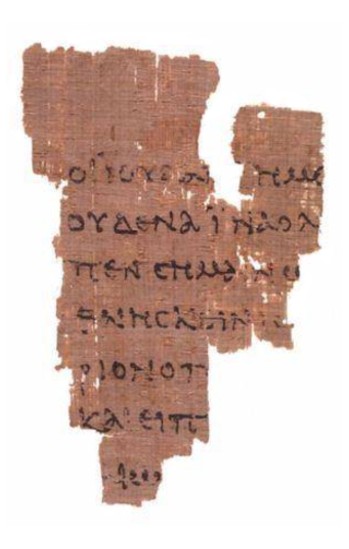
The parchment shown above is the earliest copy of the Gospel According to John. Included on the recto (front) are John 18:32-33.