C.S. Lewis and the Oddities of Editors

editors wants

The goal of most writers is to become published writers. In his diary, C.S. Lewis describes a rather peculiar route to publication followed by one of his acquaintances at Oxford.

During his prolific career, Lewis dealt with many different editors. Some experiences were positive, while others were less so.

In the diary entry which follows, Lewis expresses his befuddlement at the criteria some editors use to make their decisions.

“Stead” was William Stead, an American poet who came to England as a diplomat, became an Anglican priest, baptized T.S. Eliot, and returned to the States prior to WWII. Stead also introduced Lewis to W.B. Yeats, a curious encounter I will be writing about quite soon.

Wednesday 5 April: Started revising Greek History today. At first I found my notes etc. in great confusion, but when that was straightened out I worked with more interest and pleasure than I had expected. . . .

I also got the two poems (typed v. accurately for I/-)* and saw Stead in order to get the address of the London Mercury.

He told me with a solemn face and admirable naivety how he had got his accepted. Two or three were sent back by return post, whereupon he went up to London and called on the Editor, saying, “Look here Mr Squire, you haven’t taken these poems of mine and I want to know what’s wrong with them!!”

If the story ended there, it would be merely a side light on Stead, but the joke is that Squire said, “I’m glad you’ve come to talk it over: that’s just what I want people to do” and actually accepted what he’d formerly refused. Truly the ways of editors are past finding out! (All My Road Before Me)

Anyone who has submitted their work for publication consideration can relate to Lewis’ incredulity. Long ago I resigned myself to their arbitrariness and irrationality. They are, after all, simply human beings, and as such, inescapably subjective.

While we could all agree on circular filing** submissions filled with typos or misspellings, they sometimes reject what is excellent and embrace what is maudlin. The stories of best sellers that were repeatedly rejected are common.

It’s true that some publications have pretty exhaustive stylebooks, but when it comes to the content of what they publish, it frequently appears to be based on momentary whim.

After many years of writing, and a handful of years as an editor myself, I have come to believe the decisions are purely subjective. Subjective and arbitrary, depending on the mood, time of day, weather, status of family relations and digestion of the editor.

A Postscript on C.S. Lewis and Stead

After the diary excerpt cited above, Lewis continues with a bit more about the brash American.

Stead gave me the proof of his new book, The Sweet Miracle, wh. I took away. So far it seems rather dull. Worked for the rest of the day, except for a nightcap of Repington.

If you would like to assess for yourself the “dullness” of Stead’s poetry, you can download a copy of The Sweet Miracle and Other Poems via Hathitrust.

The book Lewis refers to as his “nightcap” was a history of the First World War, in which he had personally served. It was written by Lieutenant Colonel Charles à Court Repington, a war correspondent. Both volumes are available for your bedtime reading (volume one, volume two).


* “Typed very accurately for one pound.”

** Also referred to as the “round file.”


A Dose of Humility for Writers

self-impressed

Most writers are saturated with humility, especially those who actively submit their work and courageously collect rejections. Accepting this lack of reinforcement as an inevitable aspect of the writing life, they reveal a maturity that is literarily unpretentious.

On the other hand, there are some who publicly tout the most modest of accomplishments as great feats. By their own account, you would think it’s merely a matter of time before they’re polishing their Pulitzer or Nobel Prize in Literature.

The following notes on humility are for the benefit of the latter category of authors.

C.S. Lewis was a scholar abundantly acquainted with literary pride. He was also a Christian saint (in that biblical sense wherein it applies to all who place their faith in Jesus). As a disciple of Christ, Lewis recognized pride is toxic.

He wrote much about the subjects of pride and humility. Among his wisdom on the subject, is the observation that we must not allow our circumstances to shape our character in negative ways. In “Williams and the Arthuriad,” he illustrates this by discussing different sorts of roles in a play. His comment about “false modesty” is particularly astute.

What but to thank God for the “excellent absurdity” which enables us, if it so happen, to play great parts without pride and little ones without dejection, rejecting nothing through that false modesty which is only another form of pride, and never, when we occupy for a moment the centre of the stage, forgetting that the play would have gone off just as well without us . . .

Lewis also offers an antidote to pride. One that well suits the title of this column. “If anyone would like to acquire humility, I can, I think, tell him the first step. The first step is to realise that one is proud. And a biggish step, too. At least, nothing whatever can be done before it. If you think you are not conceited, it means you are very conceited indeed.” (Mere Christianity)

A 500 Year Old Prescription

Nearly a half millennia ago, Martin Luther reluctantly allowed his writings to be gathered together into a collection, for which he wrote a preface. It was that introduction I recently encountered.

He elaborates on the proper way to study theology, based on principles in Psalm 119. After reminding readers that we must possess humility to submit ourselves to God’s word, he tacks on a vivid warning. It is quintessential Luther.

These words apply not only to theologians, or even to those addressing “religious” subjects. They should be of interest to all who consider themselves writers.

If, however, you feel and are inclined to think you have made it, flattering yourself with your own little books, teaching, or writing, because you have done it beautifully and preached excellently; if you are highly pleased when someone praises you in the presence of others; if you perhaps look for praise, and would sulk or quit what you are doing if you did not get it—if you are of that stripe, dear friend, then take yourself by the ears, and if you do this in the right way you will find a beautiful pair of big, long, shaggy donkey ears.

Then do not spare any expense! Decorate them with golden bells, so that people will be able to hear you wherever you go, point their fingers at you, and say, “See, See! There goes that clever beast, who can write such exquisite books and preach so remarkably well.”

That very moment you will be blessed and blessed beyond measure in the kingdom of heaven. Yes, in that heaven where hellfire is ready for the devil and his angels.

To sum up: Let us be proud and seek honor in the places where we can. But in this book the honor is God’s alone, as it is said, “God opposes the proud, but gives grace to the humble” [I Pet. 5:5]; to whom be glory, world without end, Amen.

Thank you, Doctor Luther, for the warning to periodically check my ears. And thank you as well, Doctor Lewis, for your inspirational modeling of humility.

An Important Exception

While humility remains important, in unbalanced doses it can make individuals vulnerable. The story of Puzzle the donkey in The Last Battle illustrates this fact well.

There were very few Talking Beasts or Men or Dwarfs, or people of any sort, in that part of the wood, but Shift had one friend and neighbor who was a donkey called Puzzle.

At least they both said they were friends, but from the way things went on you might have thought Puzzle was more like Shift’s servant than his friend. He did all the work.

When they went together to the river, Shift filled the big skin bottles with water but it was Puzzle who carried them back. When they wanted anything from the towns further down the river it was Puzzle who went down with empty panniers on his back and came back with the panniers full and heavy.

And all the nicest things that Puzzle brought back were eaten by Shift; for as Shift said, “You see, Puzzle, I can’t eat grass and thistles like you, so it’s only fair I should make it up in other ways.”

And Puzzle always said, “Of course, Shift, of course. I see that.” Puzzle never complained, because he knew that Shift was far cleverer than himself and he thought it was very kind of Shift to be friends with him at all.

And if ever Puzzle did try to argue about anything, Shift would always say, “Now, Puzzle, I understand what needs to be done better than you. You know you’re not clever, Puzzle.”

And Puzzle always said, “No, Shift. It’s quite true. I’m not clever.” Then he would sigh and do whatever Shift had said.

Fortunately, Puzzle’s simple humility is ultimately vindicated. Even while he is the instrument of a terrible hoax, his guileless trust in Aslan preserves his innocence. It is a powerful story, worth reading even if you have never touched the Chronicles of Narnia.

In the same way, God watches over his children who are humble. He becomes our champion and delivers us from those who would do us harm. Blessed indeed, are the meek.

Travel Pictures Ltd

C.S. Lewis and Poor Writers

rididule

C.S. Lewis seldom kept a secret his low opinion of poor writers. This wasn’t because he was a literary snob, it’s because he was a literary critic.

Actually, the breadth of Lewis’ literary tastes was extraordinary. He didn’t expect texts to be more than what they purported to be, and could even enjoy the pulp fiction of his day. Still, Lewis had an eye for pretentious and anemic writing, and he sometimes penned cutting commentary

One of his lifelong friendships began with a discussion about poor writers. More about Lewis’ friendship with Oxford Classics scholar Nan Vance Dunbar (1928-2005) in a moment.

There are some contemporary voices that argue Lewis was misogynistic. Many of these complainants are non-Christian, and eager to see Lewis’ influence diminished. The truth is he possessed a strong traditional respect for women. And, while he unapologetically enjoyed the company of men—no surprise for a longtime bachelor—he counted a number of women scholars among his close friends.

My friend Brenton Dickieson has an excellent column on the subject of women in Lewis’ life, in which he persuasively argues that Lewis “was hardly the insular, sexist, Oxford bachelor that some would make him out to be.”

Professor Dunbar was a devout Christian, of the Presbyterian persuasion (no surprise, since she was Scottish). She attended one of Lewis’ lectures in 1955, and respectfully challenged in correspondence, his interpretation of the Roman poet Statius.

Their friendship grew, although they never agreed upon the status of Statius. The Collected Letters of C.S. Lewis includes a biography of Dunbar which describes how the subject even brought her some peace when she was grieving Lewis’ death.

Lewis’s final letter to her, on 21 November 1963–possibly the last he wrote–was to arrange for a visit in December. When he died the next day, Nan was beside herself with grief.

She was consoled by the theologian, Henry Chadwick, Regius Professor of Divinity at Oxford. Professor Chadwick reminded her that she would some day die. “And when you get to Heaven,” he said, “you will be met by Lewis. He will have got there before you, and he’ll have his arm firmly around a small man in a toga, who is being dragged along to meet you. ‘All right,’ Lewis will be saying to the ancient Roman–“Tell her!! Tell her!!”’

Nan had no doubt that Lewis would be in heaven, and she roared with laughter at the thought of Statius waiting there to rebuke her. Perhaps such thoughts gave her comfort when she confronted her own death.

The two had grown quite close. “Everyone would agree that Nan Dunbar–with her erudition, her common sense, her Christian faith, her lively conversation–would have been the ideal daughter for Lewis. Indeed, years later, in his letter of 18 November 1963, he spoke of her as ‘the liveliest and learnedest of my daughters.’” (Collected Letters).

Their Discussion about Bad Writers

Diplomas are not required for people to criticize books and writers. Wherever readers gather it is possible to find discussions about favorite, and least favorite writers.

Some literary reputations are so notorious they have awards devoted to them. Each year, for example, The Bulwer-Lytton Fiction Contest draws thousands of entrants. Their motto is quite inviting: “Where WWW Means ‘Wretched Writers Welcome’”

The event honors the great author whose opening line in 1830 also enriches every story ever begun by Charles Schulz’ canine novelist Snoopy.

It was a dark and stormy night; the rain fell in torrents—except at occasional intervals, when it was checked by a violent gust of wind which swept up the streets (for it is in London that our scene lies), rattling along the housetops, and fiercely agitating the scanty flame of the lamps that struggled against the darkness. (Edward George Bulwer-Lytton, Paul Clifford)

It is unknown whether B-L’s name arose in the following conversation, but we do find references to two other “notorious” writers.

Dunbar met Lewis for the first time at a dinner in Girton College, probably on 25 January 1956. On finally meeting his critic, Lewis said: “Ah! Miss Dunbar! I’m glad to find you actually exist–I’d thought perhaps you were only the personification of my conscience!”

Lewis was charmed by this delightful Scottish woman, whose wonderful talk and Glaswegian accent made one think she had stepped out of a novel by Sir Walter Scott.

Dunbar remembered that over dinner she talked to Lewis about the Scottish writer William McGonagall (1825–1902), said to be the world’s worst poet, while Lewis introduced her to the Irish novelist Amanda McKittrick Ros (1860–1939), known as the world’s worst novelist. (Collected Letters).

If you care to read anything written by the writers Lewis and Dunbar mentioned in their dinner conversation, refer to the links below. While on its surface their repartee may appear uncharitable, it was certainly not intended to be.

After all, if our own writing brings some measure of joy and entertainment to others, most writers would welcome that. Similarly, to have one’s name associated in history with truly talented writers (even in such an unflattering manner) is by far preferable to the anonymity which is the swift destiny of all but a few.

_____

To learn more about McGonagall and Ros, you may wish to download the following free volumes: 

“He was not a poet at all, and that he has become synonymous with bad poetry in Scotland is only a natural consequence of Scottish insensitivity to the qualities alike of good poetry and of bad.” (Scottish Eccentrics)

“Sympathise with me, indeed! Ah, no! Cast your sympathy on the chill waves of troubled waters; fling it on the oases of futurity; dash it against the rock of gossip; or, better still, allow it to remain within the false and faithless bosom of buried scorn. Such were a few remarks of Irene as she paced the beach of limited freedom, alone and unprotected.” (Irene Iddesleigh by Amanda McKittrick Ros)


C.S. Lewis and Reality

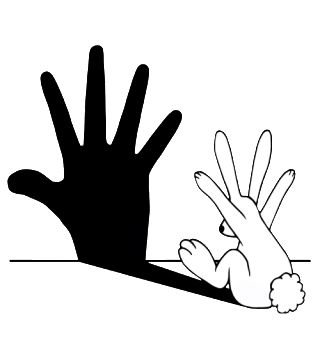
Rabbit-Hand-Shadow.jpg

In this increasingly relativistic cauldron we call “the world,” chaos is fueled by the concept that everyone is entitled to determine their own reality.

It all depends on one’s perspective.

“Perception is reality,” is a common sentiment. More clearly said, “an individual’s perception is their personal reality.” In other words, the way that a person thinks things are, is reality as far as they are concerned.

Changing a person’s perception of reality is no easy thing. Nor should it be (in most cases).

People base their thinking on a variety of approaches. Those who are more analytical are terribly frustrated by others who base their views of reality on their emotions, or what they “want” to be true.

Nowhere do I find this more striking then when people who have nary a religious thought in their daily lives gather together for a funeral. At least 66% of what one hears, for example “he’s looking down on us now,” is based on nothing other than wishful thinking or irrational notions.

C.S. Lewis described how reason is the crucial mechanism for understanding. In his book Miracles, he makes the following argument.

All possible knowledge, then, depends on the validity of reasoning. If the feeling of certainty which we express by words like must be and therefore and since is a real perception of how things outside our own minds really “must” be, well and good.

But if this certainty is merely a feeling in our own minds and not a genuine insight into realities beyond them—if it merely represents the way our minds happen to work—then we can have no knowledge. Unless human reasoning is valid no science can be true.

Mental Illness and Perception

One particularly fascinating aspect of the perception and reality question comes in the case of some mentally ill individuals. Schizophrenia, for instance, frequently involves delusions or hallucinations that are indistinguishable from reality (in the mind of the sufferer).

A well person may find it implausible to accept that a person could genuinely believe impossible things were true. Meanwhile, from the perspective of the deluded, it may make all the sense in the world that they are the only person alive who recognizes how things truly are.

Decades ago I spent several months in a psychiatric ward. (Not as a patient, as a clinical pastoral education student.) I had many conversations with a delightful resident who had been institutionalized because he was utterly convinced that he was one of Jesus’ apostles.

Thanks to the proper medications, he knew that to be illusory, and he was optimistic that he would soon be released to begin his studies to become a mental health worker. One reason for his confidence that he was truly getting better was because his previous hospitalization came when he became certain that he was one of the Old Testament patriarchs.

From his point of view, the increasing chronological proximity between his delusions and reality indicated he was almost well.

Some of these people do become healthy enough to recognize that their perception of reality is askew. These are the few who continue to take their meds so they can function as the majority of us perceive to be “normal.”

Many psychotic individuals, of course, only take their prescriptions under duress and when they are not monitored, cease to take them because they either (1) already feel better, so they obviously don’t need them, or (2) prefer chaos to the side effects such as lethargy.

Truth is Not Based on Perspective

Truth, in the ultimate or alethiological sense, is not relative. It doesn’t shift due to the distortions of individual perception. It remains the same yesterday, today and tomorrow.

Now, since what we human beings regard as truth does shift (e.g. shape of the Earth), ultimate truth must come from a source other than mortal minds, transient philosophies or momentary scientific theories.

Christians believe they have found that source in God’s self-revelation, the Judeo Christian Scriptures. In fact, Christians believe that their Savior, Jesus the Messiah, was the embodiment of truth. We believe he was speaking the eternal truth when he said “I am the way, and the truth, and the life.”

C.S. Lewis was quite candid about the truthfulness of the scriptural testimony being the necessary cornerstone for faith. In dialogue with atheists and agnostics, he wisely points out that the conversation must address this essential question.

One of the great difficulties is to keep before the audience’s mind the question of Truth. They always think you are recommending Christianity not because it is true but because it is good. . . .

One must keep on pointing out that Christianity is a statement which, if false, is of no importance, and if true, of infinite importance. The one thing it cannot be is moderately important. (“Christian Apologetics”)

In a world that wants to relegate Jesus to the status of some great teacher or prophet, it is vital to say that if he was lying when he said “the Father and I are one,” Christianity should be dismissed altogether.

_____

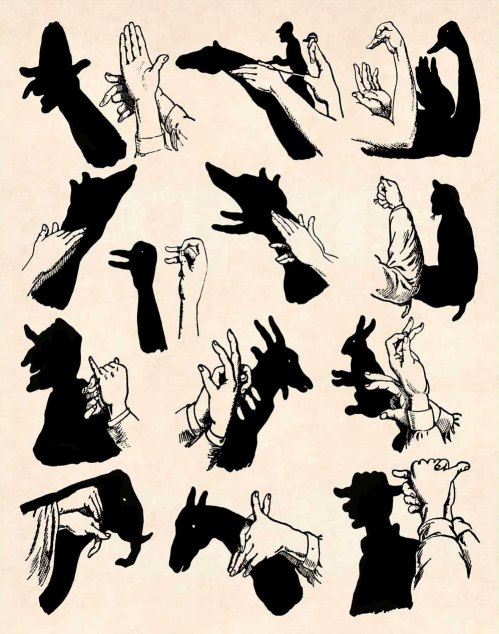
For those who enjoy challenges:

hand shadows

C.S. Lewis and Robots

robot.png

No robots were involved in the writing of this column.

That’s not to say that robots aren’t writing a considerable amount of what you might come across today on the internet.

A recent article, entitled “Robots Wrote this Story,” describes how “in 2013, AI-powered journalism was in its infancy . . . [but today it] identifies the relevant data, matches it with the corresponding phrases in the template, merges them, and then publishes different versions across different platforms.”

The various artificial intelligences writing the news for us have interesting names. Among them are Wibbitz (USA Today), News Tracer (Reuters), Buzzbot (open source), and Heliograf (Washington Post). Rumors are that Skynet may be on the horizon.

A Washington Post reporter optimistically says, “We’re naturally wary about any technology that could replace human beings. But this technology seems to have taken over only some of the grunt work.”

So far.

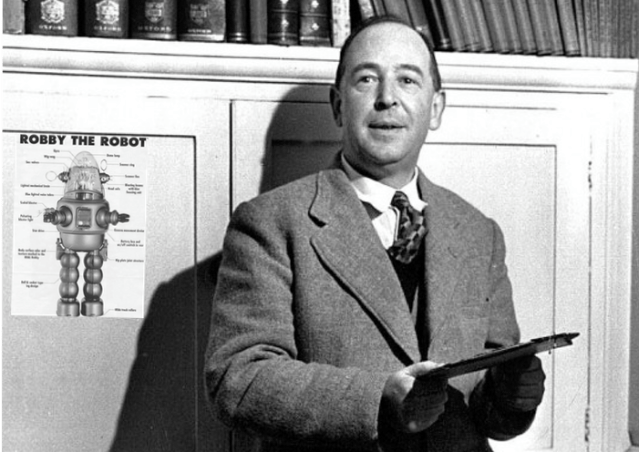
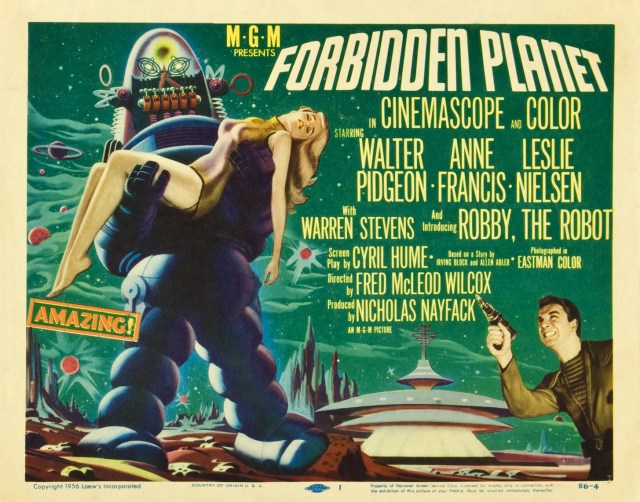
Lewis certainly wasn’t overly impressed by the robot in a classic science fiction film released in 1956.

Before leaving home [for a trip to Northern Ireland] I saw the film of The Forbidden Planet, a post-civilisation version of the Tempest with a Robot for Caliban . . . The contrast between the magnificent technical power and the deplorable level of ethics and imagination in the story was what struck me most.*

Count me as a member of C.S. Lewis’ camp. He possessed little to no fear of robots. He was far more suspicious about a future shaped by the devotees of scientism.

Scientism is that warped theory that, in the words of one Professor of Biological Sciences, surrenders to the “temptation to overreach.”

When I decided on a scientific career, one of the things that appealed to me about science was the modesty of its practitioners. The typical scientist seemed to be a person who knew one small corner of the natural world and knew it very well, better than most other human beings living and better even than most who had ever lived.

But outside of their circumscribed areas of expertise, scientists would hesitate to express an authoritative opinion. This attitude was attractive precisely because it stood in sharp contrast to the arrogance of the philosophers of the positivist tradition, who claimed for science and its practitioners a broad authority with which many practicing scientists themselves were uncomfortable. (Emphasis added.)

Scientism, not robotics, is clearly the danger. However . . . what if the disciples of scientism intend to use robots to further their misanthropic plans?

I suspect taking over our news sources may only be the first stage of the robot blueprint for humanity’s future ruin.

Where are we prepared to draw the line in terms of robots displacing humanity. Apparently, not even in the realm of spiritual matters and worship. I have previously written about a curious, presumably docile, robot. It is, in fact, a Buddhist monk, and presumably a moderately successful evangelist.

A Greater Danger

A futuristic threat that once fell in the domain of science fiction has become science fact. Scientific American has reported that “some of the brightest minds in science and tech think we need a plan to keep humans safe from supersmart machines.”

C.S. Lewis identified a much more ominous alternative than robots seeking to lord it over humans. Lewis worried about the danger of human beings devolving into robots. Well, not robots per se, but beings who have suppressed the qualities that make us who we are, and forfeited our humanity.

The Jewish and Christian scriptures describe an event that must have stunned the angels in heaven. God deigned to create humanity, men and women, in his own image.

It is precisely when we choose to disobey God’s leading, and further distort that divine image, that we become less human.

When I was a child, I wondered why God would create people capable of disobedience. Not only capable but, as the Lord knew in his omniscience, beings who would disobey him. To a more mature mind, the answer seems obvious. No automaton, guided by its programming, can truly love. Lewis explores this dilemma in Mere Christianity.

God created things which had free will. That means creatures which can go either wrong or right. Some people think they can imagine a creature which was free but had no possibility of going wrong; I cannot.

If a thing is free to be good it is also free to be bad. And free will is what has made evil possible. Why, then, did God give them free will? Because free will, though it makes evil possible, is also the only thing that makes possible any love or goodness or joy worth having.

A world of automata—of creatures that worked like machines—would hardly be worth creating.

The happiness which God designs for His higher creatures is the happiness of being freely, voluntarily united to Him and to each other in an ecstasy of love and delight compared with which the most rapturous love between a man and a woman on this earth is mere milk and water. And for that they must be free.

Of course, God knew what would happen if they used their freedom the wrong way: apparently He thought it worth the risk. . . .

If God thinks this state of war in the universe a price worth paying for free will—that is, for making a live world in which creatures can do real good or harm and something of real importance can happen, instead of a toy world which only moves when He pulls the strings—then we may take it it is worth paying.

_____

* The Forbidden Planet received an Academy Award nomination for Best Visual Effects. It is also received the honor of being selected to be preserved for posterity by America’s National Film Preservation Board.

Along with its literary influence, highly influential special effects and visual style, the film also pushed the boundaries of cinematic science fiction. For the first time, all action happened intergalatically (not on Earth) and humans are depicted as space travelers, regularly jetting off to the far reaches of the cosmos. Additionally, Forbidden Planet is remembered for its innovative score—or lack thereof. No music exists on the film’s soundtrack; instead, all ambient sounds are “electronic tonalities.”

forbidden planet.jpg

Offering Comfort Like C.S. Lewis

comfort bunny

Some people flee from those who are depressed. Others feel compelled to do their best to lift their spirits. Did you react the same way as C.S. Lewis to the suffering of others?

Recently I’ve had the privilege of sharing the anguish of several people who see no solution to their personal challenges. In truth, even though I sincerely believe “with God, all things are possible,” it is likely that these particular dilemmas will trouble these people the remainder of their lives.

Some people are “fixers,” or problem-solvers. They want to step in, quickly resolve the difficulty, and return to their normal routine as soon as possible. When faced with an intransigent challenge, they typically get called away by other matters, or they fade into the background.

There is a sort of spectrum when it comes to offering comfort to people. At one end, we have the people who offer insincere clichés like “I’m so sorry.” These remarks are often an automatic response and the only thing the speaker is “sorry” about is having their time “wasted” by the litany of another’s suffering.

Better than these liars, are the pretenders. They actually do feel sorry for the person when they say so. Only, they’re not sorry enough to actually devote another moment’s thought to their pain. They are hypocrites, because if they really understood what the word sorrow means, they would understand that it doesn’t evaporate into the mists six mere heartbeats after it is experienced.

Most people fall further along the spectrum, where we might place sympathy and empathy. Although the words are frequently used interchangeably, this site offers a concise definition of their differences.

In essence, when we are empathetic, we identify more intimately with the sufferer. It seems to me that empathy, often viewed as a sort of super-sympathy, is not necessarily the mark of a better sympathizer. Sometimes it corresponds to our own life experiences. For example, while my mother was still living I could readily sympathize with those who had lost their own. After my mom’s untimely death, I found myself naturally, and sometimes intensely, empathizing with their grief.

Genuine sympathy is a precious commodity. But it must grant higher honor to that form of consolation that puts our emotional concern into actual action. The specific actions are less important than the fact that we have physically placed the needs of the other ahead of our own. They might consist of attending to someone’s responsibilities while they are incapacitated, or simply holding a hand for long hours in a silent bedside vigil. The form matters little; the essence of the gift is everything. It is nothing less than love in action.

Lewis’ Compassionate Heart

Lewis constantly offered consolation to those with whom he corresponded. Our last post included an excellent example of this. What made his brief expressions of concern so powerful was not their eloquence. It was their sincerity. As we read the words we have no doubt that Lewis meant them. What’s more, when he said that he was praying for someone, he truly was.

Lewis also incorporated moving scenes of compassionate empathy in his fiction. Read how Steven Garber described the comfort he has received from the Chronicles of Narnia.

“A children’s story which is enjoyed only by children is a bad children’s story. The good ones last,” Lewis once wrote. Over the years, in the moments when life seems bleakest, when I can only sigh or groan, I have come back again and again to The Magician’s Nephew. . . .

Lewis gives us an image that is profoundly rich and wonderfully tender. We need both. The tears of God are complex. They must be tears of sympathy, even empathy, as Aslan weeps for Digory’s mother and as Jesus weeps with his friends at the death of their brother.

But sometimes they are also tears of anger at the unnaturalness of death, at the distortion of death, at the skewing of human hopes, as Jesus “groaned severely in his spirit” at the death of Lazarus. (Visions of Vocation)

One of the clearest examples of consolation offered by Lewis is found in his provision for Mrs. Moore, the mother of a WWI friend. The story is complex, but it is based upon Lewis keeping a promise—that if one of them died in the trenches, the other would care for that soldier’s parent.

Lesser men would have conveniently forgotten their vow, but Lewis provided for her from 1917 until her death in 1951. Their relation during the early years is uncertain, but there is no doubt that after his conversion to Christianity, it was chaste. Lewis was dutiful, like a true son, in caring for a woman more than twenty-five years his senior, whose own daughter acknowledged was emotionally abusive towards Lewis.

Professor Alice von Hildebrand offers a candid essay on this sensitive subject here. She includes the following quotation from the diary of Lewis’ brother, Warnie, who was a member of the same household.

One of Jack’s friends is supposed to have said, “Cursed be the day that thou fell into the hands of the Moore.” Warren gave vent to his frustration and constant irritation by confiding in his diary. He writes:

“It fills me with both admiration and irritation to see how completely the whole of J’s [Jack, the name by which Lewis’ friends addressed him] life is subordinated to hers—financially, socially, recreationally: the pity of it is that on his selflessness her selfishness fattens . . .”

True Compassion

An essay on this subject could easily grow into a book. To avoid that, I will restrain myself to one final point.

Only a master of language, and an astute student of humanity, recognizes the immense power, and the fragile limitation, of words. Ironically, it is when they are most important—such as in the offering of comfort to someone bereaved—that their shortcomings are most clear.

In the wake of the unbearable loss of his wife, Joy, Lewis wrote A Grief Observed. In this enlightening text, he points out the hollowness of mere words.

Talk to me about the truth of religion and I’ll listen gladly. Talk to me about the duty of religion and I’ll listen submissively. But don’t come talking to me about the consolations of religion or I shall suspect that you don’t understand.

This is something few people recognize before they are the recipients of word-oriented attempts at comfort. That’s why we stumble about saying things that frequently provide precious little true consolation.

Lewis had learned that abstract theological declarations—even those based on certain promises of God—do little to remove the deep sting of death. Far more effective, is sharing the crippling pain of the loss. To offer, as Jesus did to the sisters of Lazarus, one’s own tears.

If you are interested in reading more about this subject, you might want to check out one of my earlier posts on the nature of genuine consolation.

_____

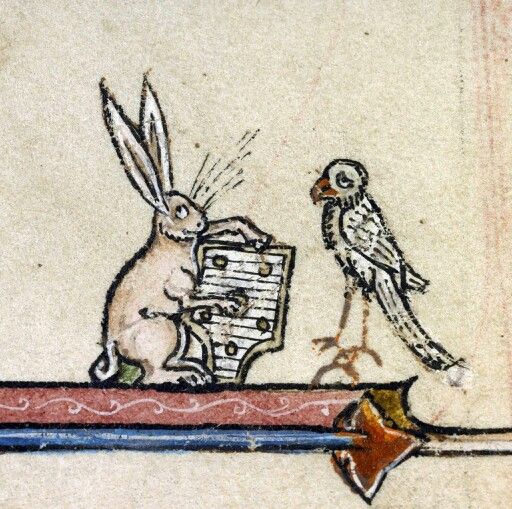
The illustration above comes from a thirteenth century manuscript. I have included it here, because the effort of the rabbit seeking to console the forlorn bird seems quite Narnianesque. It echoes the essence of Lewis’ childhood world of Boxen as well, and I imagine that C.S. Lewis would have enjoyed this marginalia on its own merit.

C.S. Lewis Compared J.R.R. Tolkien to What?

polyps

These two great Oxford giants were good friends. As such, they accepted each other’s eccentricities. But that doesn’t mean that they couldn’t find humor in those peculiarities.

The Inklings were notorious for their candid critiques and their not-so-subtle teasing of one another. That’s what we all do with our good friends, right?

It’s humor offered not to wound, but to gently discombobulate our companion. And it’s success is measured in the laughter generated among colleagues who share goodwill.

I recently came across a reference, however, where Lewis may have transgressed the bounds of propriety. I leave the assessment of that fact to you.

In a 1947 letter to Margaret Douglas, who had recently lost her mother, Lewis offers warm words of consolation. In addition, he briefly references two publications that she had apparently alluded to in her own letter. The first was his Preface to Essays Presented to Charles Williams, which he refers to as the memoir. The second is Tolkien’s sequel to The Hobbit, which would become The Lord of the Rings.

Dear Miss Douglas, Accept my deepest sympathy on the death of your mother: for I think the bond between you was unusually close. You have one great consolation which few bereaved people have—a clear conscience towards the dead.

It was apparent that you were spending yourself largely upon her. I remember her very vividly, and much admired that blend of the playful and the stately, of which only old ladies have the secret.

I am so glad that you approved of the memoir. Professor Tolkien’s second Hobbit is still unfinished: he works like a coral insect you know!

With all good wishes, yours sincerely, C. S. Lewis

Just How Unflattering is the Comparison?

To compare Tolkien to a minute sea creature of sedentary nature may not, at first read, seem offensive. One might wonder though whether it is quite so innocuous as it might appear.

The National Ocean Service, here in the U.S. provides an answer to the frequently posed question, “are corals animals or plants?” Like Lewis, we already know the answer to that—“a coral insect you know!”—but their colorful description illuminates said insect in a curious manner.

Corals actually comprise an ancient and unique partnership, called symbiosis, that benefits both animal and plant life in the ocean. Corals are animals, though, because they do not make their own food, as plants do. Corals have tiny, tentacle-like arms that they use to capture their food from the water and sweep it into their inscrutable mouths.

I wasn’t aware that they had tentacles. And I don’t think I want to know what makes their mouths “inscrutable.” However, the description adds one more element that I certainly don’t recall from my childhood science classes . . . it’s what the tiny creatures that create such lovely exoskeletons are called.

Most structures that we call “coral” are, in fact, made up of hundreds to thousands of tiny coral creatures called polyps. Each soft-bodied polyp—most no thicker than a nickel—secretes a hard outer skeleton of limestone (calcium carbonate) that attaches either to rock or the dead skeletons of other polyps.

Either I never knew the zoological definition of the word polyp, or it’s been pushed aside in my mind by the more common pathological meaning of the word. It just makes the association of someone with these “columnar bod[ied] . . . mouth and tentacles” oddities seem even more disturbing.

Fortunately, it’s obvious Lewis wasn’t equating the creator of Middle Earth with invertebrate coelenterates. The creator of Narnia was simply likening Tolkien’s publication pace to the secretion rate of the polyps that populate the corals themselves.

Over the years, some of my best friends have labeled me in what an outsider might regard as an unflattering way. While I taught at USAF Chaplain School, my teammates called me “Lemming.” (On occasion, they still do.) The reference had nothing to do with me following the crowd . . . and everything to do with being directed to march off any number of cliffs.

I doubt that Lewis ever shared this association with Tolkien himself. It’s likely that he freely associated the idea at the moment he wrote it, and never thought about it again.

That was one of Lewis’ gifts, being able to use creative analogies to make his points. It is simply one of his talents I would love to share.

And, as for Lewis’ use of the word “insect” here, he is obviously alluding to the polyp’s small size. It would not surprise me to learn that there is an archaic British precedent for such usage. Or, is it just possible that he knew the proper word for the creature, and was too cultured to use it in this context? Perhaps we will never know.

coralpolyp.jpg

C.S. Lewis & Brother Lawrence

presence

Have you read The Practice of the Presence of God? Between the world wars, C.S. Lewis pondered this devotional collection written in the 1600s.

Lewis was rather disappointed during his initial reading, but he apparently grew in his respect for the slim volume. He read it in 1930, the year prior to his becoming a communing member of the local Anglican church. His body rests in its cemetery today.

In a letter to his closest friend, Arthur Greeves, Lewis describes his impression of the work. It is impressive to note how he acknowledges that his own “mood” may have influenced his reception.

In reading I have of course little to record, and never shall have much in term time. I read in two evenings a little book that came from Leeborough called The Practice of the Presence of God which I picked up & put in the study when I was there last because it seemed to me a promising title. It is by a seventeenth century monk.

It is full of truth but somehow I didn’t like it: it seemed to me a little unctuous. That sort of stuff, when it is not splendid beyond words, is terribly repulsive, or can be, can’t it?

No doubt it depends very largely on one’s mood. I had just finished the fourth Gospel in Greek (as I think you know) before you came, and after that most other things are a come down. Not that I liked that in all respects either.

It’s fascinating that Lewis acknowledges that his reading of the humble kitchen monk and sandal-maker followed in the wake of his reading of The Gospel according to John, in the Greek. This must rank near the top of Lewis’ greatest understatements: “and after that most other things are a come down.” (Who among us would ever desire for even our finest writing to be compared to John’s inspired Gospel?)

Lewis was not dismissive of the seventeenth century work. As late as 1956, the two friends discussed the volume in their correspondence. That year Lewis wrote “Yes, Bro. Lawrence is of course right” in response to an unpreserved observation made by Greeves.

Christianity Today offers a brief account of the Frenchman’s life here. It describes a pivotal point in the life of the man who would become a soldier, and then a monk.

Born Nicolas Herman in 1614 in a small village in Lorraine, France, he had a soul-altering experience at 18. That winter, while looking at a leafless tree, he marveled that its barrenness would soon turn green again, flower, and bear fruit. This insight made him intimately aware of God’s love from then on.

The Soul of C.S. Lewis describes one example of the similarities shared by the Oxford professor and the French monk whose work he described as “full of truth.”

One of Brother Lawrence’s secrets was in realizing what Lewis would one day also discover: that every activity can be either religious or irreligious. The difference is in our minds and hearts.

Obviously, The Practice of the Presence of God is now in the public domain (since its author died in 1691). There is no excuse to ignore this Christian devotional classic which has long been appreciated by many Protestants, as well as Lawrence’s fellow Roman Catholics. You can download it in several formats here or obtain a (currently) free kindle version from Amazon.

Lewis Quotes Brother Lawrence

Although the following excerpt lacks sufficient context to make a great deal of sense, it is worth noting the following from That Hideous Strength, the final volume in Lewis’ space trilogy. It reveals that the wisdom of the uneducated monk remained with Lewis, even as he wrote his own religious treasures.

In the book, Dr. Dimble is a good-willed academic who Lewis uses to interpose some of his personal thoughts.

Dr. Dimble drove out to St. Anne’s dissatisfied with himself, haunted with the suspicion that if he had been wiser, or more perfectly in charity with this very miserable young man, he might have done something for him. “Did I give way to my temper? Was I self-righteous? Did I tell him as much as I dared?” he thought.

Then came the deeper self-distrust that was habitual with him. “Did you fail to make things clear because you really wanted not to? Just wanted to hurt and humiliate? To enjoy your own self-righteousness . . ?” The sadness that came over him had novelty in it. “And thus,” he quoted from Brother Lawrence, “thus I shall always do, whenever You leave me to myself.”

This intriguing passage suggests that Brother Lawrence’s thoughts continued to inspire Lewis . . . long after his initial exposure to them. Here the fictional professor nearly succumbs to his self-doubt before he reminds himself that this is a common result of introspection that ignores the love and presence of God.

If you have not yet decided to read, or reread, The Practice of the Presence of God, perhaps one of these excerpts will inspire you to do so.

“We ought not to be weary of doing little things for the love of God, who regards not the greatness of the work, but the love with which it is performed.”

“There is not in the world a kind of life more sweet and delightful, than that of a continual conversation with God; those only can comprehend it who practice and experience it.”

“That we should establish ourselves in a sense of God’s Presence, by continually conversing with Him. That it was a shameful thing to quit His conversation, to think of trifles and fooleries.”

“We must know before we can love. In order to know God, we must often think of Him; and when we come to love Him, we shall then also think of Him often, for our heart will be with our treasure.”

C.S. Lewis and Military Service

home guard stamp

If you were going to enlist in the military, which branch of the armed forces would you choose? And why?

The choice would have great consequences. The simple fact is that despite their similar charters, not all branches are created equal. Your choice will influence countless aspects of your life, including your post-military employment options and even the likelihood of whether or not you’ll survive your enlistment.

Gallup recently completed research into which branch of the armed forces most Americans would encourage someone to join. The Air Force came out on top.

Americans hold all branches of the U.S. military in high regard, but that does not necessarily translate into a desire to see their loved ones enlist. Fewer than half would be likely to recommend joining the Coast Guard (48%), Marines (43%) or Army (41%) to their children or grandchildren, while a majority would be likely to recommend the Navy (53%) or Air Force (64%).

As a chaplain, I heard some amazing reasons for people’s choice of service. One Army NCO told me, “I was leaning toward the Air Force until the Army recruiter pulled out this huge poster covered with every imaginable weapon, and said, ‘we’ll teach you how to use all of these.’” Not a bad technique for persuading testosterone-fueled eighteen-year-olds to sign on the dotted line.

One young woman who had served a tour in the Marines told me she didn’t even consider another option. “It was the Corps or nothing,” she said, before shouting “Semper Fi!” The USMC has the advantage of requiring fewer recruits and has brilliantly fostered a reputation as “the most prestigious of the military branches.”

A common motivator for Navy recruits seems to be the exotic locations of many of their installations. Can’t argue with that. Most of them are located on or near coasts, while the Air Force strategically places its bases where a falling aircraft would have the smallest chance of injuring someone on the ground. Places like Lubbock, Texas, where I served my first active duty tour at Reese AFB. [The people in Lubbock are amazing patriots.]

The Coast Guard, a sometimes-military organization, attracts people interested in their search and rescue ethos. This despite the fact that most of their mission involves enforcing laws and protecting the nation’s borders.

The Air Force draws lots of recruits who are interested in pursuing technical fields. The other services have similar career paths, of course, but the clear perception is that the Air Force offers the most. Still, it’s a bit embarrassing to share here the reason one friend of mine chose the USAF. Actually, it was his reason for choosing the chaplain assistant career field in particular. “I told them at basic training that I would take any job where I worked in a climate-controlled environment.” He was serious, but the last laugh was on him. When we deploy to the field, chaplain assistants are not only responsible their own safety, they have to protect their noncombatant chaplains as well (in any weather).

The different branches of the military go to war against their nation’s enemies—but they also maintain intense rivalries with their sister services. This competition is usually fun to observe . . . as long as alcohol is not in the vicinity.

C.S. Lewis’ Military Service

In the United Kingdom, the Navy is the senior service. Seems fitting for an island nation. That doesn’t mean that the Army traditions, which date back to historic militias, lack prestige.

During the First World War, C.S. Lewis was exempt from the draft. This, because he was from Northern Ireland. Despite this, he followed his brother Warren into the Royal Army.

Warnie was a career officer, graduating in 1914 from an expedited course at the Royal Military College, Sandhurst. Jack, in contrast, was one of many young college students who were subjected to a far more rapid training regimen, commissioned, and shipped off to the front.

In 1918 C.S. Lewis was severely wounded. One writer summarizes this event quite effectively.

The Lewis who crawled away from the carnage was not yet the C.S. Lewis of The Chronicles of Narnia, The Space Trilogy, The Screwtape Letters and Mere Christianity. Then, he was like so many others who fought in World War I—just another wounded soldier desperate not to bleed to death.

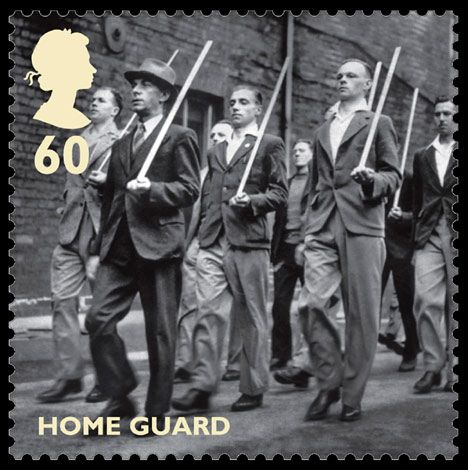
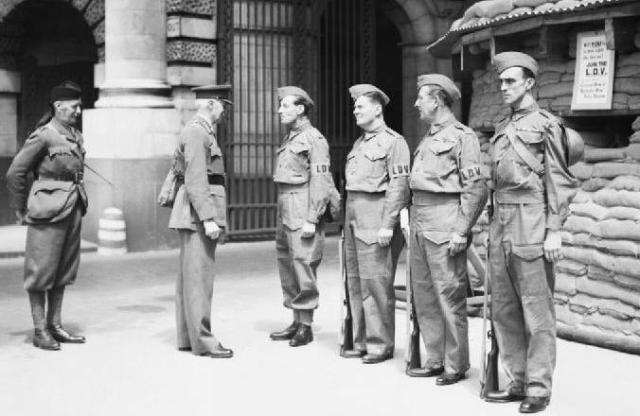
Eventually Lewis would wear another “military” uniform during the Second World War—that of the Home Guard (originally called the “Local Defence Volunteers”). But that is a curious story for another day. Lewis patrolled Oxford in a uniform similar to those portrayed in the photos on this page.

Lewis did not have formal personal ties to the Navy, although his maternal grandfather, a Church of Ireland priest, had served as chaplain in the Royal Navy.

During WWII Lewis developed a warm relationship with members of the Royal Air Force. He offered lectures at a number of installations and taught at the RAF Chaplain School. Although his first lecture began rather inauspiciously, his work with the airmen proved extremely fruitful.

Lewis is a fine example of the man of gentle demeanor who “does his duty” when called upon by his country. Had his lifetime not overarched two global conflicts, he would have been utterly content to remain a civilian and wear the “uniform” of an Oxbridge professor.

home guard


Style Books, Capitonyms & C.S. Lewis

capital key

Today’s lesson will be . . . wait a second, we don’t post “lessons” here at Mere Inkling. We hope many of our columns are thought-provoking, and it would be nice to think a moderate share of them are entertaining.

However, if there’s any learning to be done, it’s incidental.

This post, though, verges on being educational. It addresses a subject readers and writers encounter every day. A subject about which there is frequent disagreement.

The question of which words should be capitalized is a major inspiration for writing Style Guides. (Oh no, I probably shouldn’t have capitalized that genre title.)

I am not alluding here to the style guides that major companies invest big bucks in designing to present their preferred image to the world. You can see some stunning examples of those here.

I’m interested in literary style guides. If you’ve ever written for publication, you’re likely familiar with the type of single sheet guidelines magazines create for prospective writers. The last thing you want, after wetting the manuscript’s pages with sweat and tears, is to have it discarded without review because you violated some editor’s pet peeves.

A standard stylebook that was required knowledge back in my college Journalism* days is the AP Stylebook. AP, of course, stands for “Associated Press.” And, where would the world of Academia be without the Chicago Manual of Style?

An even older stylebook that continues to play an important role is The Elements of Style written by William Strunk, Jr. Modern editions are attributed to “Strunk and White,” since it was revised and enlarged in 1959 by E.B. White. (Yes, that E.B. White, who authored Charlotte’s Web and other children’s classics.)

You can download a free copy of The Elements of Style at the Internet Archives, but it might be a tad risky to rely on the style described in Strunk’s first edition, since it was penned during the First World War.

It should be noted that not everyone is quite as enamored with the book as Mr. and Mrs. William Strunk, Sr. probably were. The author of one particularly haughty essay alleges that “the book’s contempt for its own grammatical dictates seems almost willful, as if the authors were flaunting the fact that the rules don’t apply to them.”

Christians & Capitalization

Religious writers vary in their capitalization of particular words. This variation crosses faith boundaries and is sometimes referred to as “reverential capitalization.”

The most obvious example in English literature is the question of whether or not the divine pronoun should be capitalized. This issue is encountered when a pronoun refers to God. The New American Standard Bible translation, for example, follows the traditional practice.

Seek the Lord and His strength; Seek His face continually. Remember His wonders which He has done, His marvels and the judgments uttered by His mouth . . . (Psalm 105:4-5)

My own practice of not capitalizing divine pronouns has occasionally scandalized members of critique groups to which I have belonged.*** A very few appear incapable of recognizing it’s a grammatical consideration, rather than a spiritual one. (Sadly, this sort of reaction often presages an individual’s departure from the writing support community, even when they are precisely the type of person who could best benefit from joining in.)

It should come as no surprise to learn that C.S. Lewis capitalized divine pronouns. Typical of his writing is this profound excerpt from Weight of Glory.

I read in a periodical the other day that the fundamental thing is how we think of God. By God Himself, it is not! How God thinks of us is not only more important, but infinitely more important.

Indeed, how we think of Him is of no importance except insofar as it is related to how He thinks of us. It is written that we shall “stand before” Him, shall appear, shall be inspected. The promise of glory is the promise, almost incredible and only possible by the work of Christ, that some of us, that any of us who really chooses, shall actually survive that examination, shall find approval, shall please God.

To please God… to be a real ingredient in the divine happiness… to be loved by God, not merely pitied, but delighted in as an artist delights in his work or a son—it seems impossible, a weight or burden of glory which our thoughts can hardly sustain. But so it is.

The Christian Writer’s Manual of Style acknowledges that “The capitalization of pronouns referring to persons of the Trinity has been a matter of debate for many decades.” They go so far as to state that doing so can impede our ability to communicate with “modern readers.”

Because capitalizing the deity pronoun, as well as a vast number of other religious terms, was the predominant style in the late nineteenth- and early twentieth-century publishing, it gives a book, at best, a dated, Victorian feel, and at worst, an aura of complete irrelevance to modern readers.

Capitonyms are a subgroup of homonyms. Their meaning changes on the basis of whether or not they are capitalized. A simple example would be distinguishing between a farmer’s concern for the quality of the earth in his fields and his regard for the planet on which he resides. Speaking of the Earth, we talk about the moons circling Jupiter, but all recognize that the Moon is the satellite that orbits 1.28 light-seconds above the surface of our planet.

In some Christian traditions, certain doctrines and events are capitalized while the very same words are not capitalized in a different sense. For example, many Christians would consider the following sentence correct.

It was the Resurrection of the only begotten Son of God that prepares the way for the resurrection of all those who take up their own cross and follow him.

The obvious difference is that the first use of the word refers to the singular miraculous event that transpired on Easter, while the latter points to its generalized definition.

In my most recent post I referred to the Gospels, as a genre unique to the writings about the life and significance of Jesus of Nazareth. As literary works, individually or collectively, the Gospels are capitalized, even when they do not include their full title [e.g. the Gospel According to Luke]. Most writers do not, however, capitalize gospel when used in a general sense, such as “every modern-day guru claims to possess a gospel of their own.” Just to make matters more interesting, some traditions capitalize Gospel when it refers to God’s love as embodied in the sacrificial death of Christ for the forgiveness of humanity’s sin.

One witty blogger chides the Church*** for over-capitalization.

I may just be cynical, and I’m definitely a literary snob, but it seems sometimes as though American Christians capitalize words related to Christianity just to make them seem holier.

For example, hymns and worship songs never refer to God and his mercy. It’s evidently more holy to capitalize the divine pronoun and refer to God and His mercy.

And if we capitalize mercy, which is a divine attribute, it makes the hymn or worship song even holier. I mean, God and His Mercy is clearly holier than God and his mercy, isn’t it?

So sermons are full of Grace, Goodness, Predestination, Prophecy, Agape, Apostles, Epistles, Pre-Millennialism, Mid-Millennialism, Post-Millennialism and the Millennium Falcon. All right, maybe not that last one.

Additional Insights from Lewis

One online writer offers a curious contrast between Lewis and e.e. cummings.

The writers who taught me the exponential value of capitalization: C.S Lewis and e.e. cummings. You know the rules of capitalization . . . Lewis and Cummings allow the capital letter to go deeper in its responsibility in communicating to the reader. . . .

For Lewis, capitalization often serves as a signpost of spiritual realities. He uses it to name a reality [as in The Screwtape Letters:] “We of course see the connecting link, which is Hatred.”

The most disorienting example of capitalization by Screwtape is his reference to God as the “Enemy.” It is a startling reversal of the true enemy, whose various names are commonly capitalized: Lucifer, Satan, Adversary, the Beast, Father of Lies and Evil One. Not to mention devils, which is sometimes used to refer to evil spirits (also known as demons or fallen angels), in contrast to the Devil himself who is also known by the aforementioned titles.

With so many alternatives when it comes to capitalization, the key is to follow the example of C.S. Lewis. It’s two-fold. First, have a reason why you select the option you do. Then, be consistent. Most readers readily adapt to different usages. What they can’t forgive, is inconsistency and literary chaos.

_____

* “Journalism” is capitalized here because it refers specifically to an academic college and degree program in many universities.

** The conservative Lutheran denomination to which I belong includes in its Stylebook for Authors and Editors the following guidance.

Gospel   Uppercase when referring to the Gospel message of salvation in Jesus Christ. Also uppercase when referring to one of the four New Testament Gospels.

The second rule indicates that one would use lowercase to refer to pseudepigraphical or heretical gospels. However, if the entire title of the text is used—precisely because it is a text, it would be capitalized (e.g. the Gospel of Thomas).

*** My wife occasionally finds time in her hectic schedule to proofread my posts before publication. (These would be the ones that appear without mistakes.) Well, Delores kindly pointed out just now that she too is scandalized by my irreverent failure to capitalize divine pronouns. After forty years of mostly-blissful marriage you would think she might have overlooked saying that… but, then again, when they’re truly scandalized how could someone be expected to remain silent?

**** I prefer to capitalize “Church” when it refers to the whole Body of Christ, but not when it references a congregation, denomination or a building . . . unless it’s part of a formal name such as the Church of the Nativity, in Bethlehem.