Similes & Metaphors

agdeiSimiles are wonderful literary tools. Being able to compare two dissimilar things in a way that brings out subtle nuances and insights is quite enjoyable.

Here are a couple of examples off the top of my head. (I don’t pretend others haven’t written these things, but I didn’t plagiarize them.).

A politician is like a weathervane.

Arguing theology is like having indigestion.

Disliking Narnia is like hating a feast.

Metaphors, of course, are far more powerful than similes. When we consider a metaphor we are pondering how two different things actually share some fundamental quality.

Comprehending metaphors requires the ability to think abstractly. A child—confined to a world of concrete concepts—cannot begin to think of their nation as a “motherland” or “fatherland,” as the case may be. Yet, those are powerful nurturing and bonding words that countless patriots have embraced throughout the centuries.

A simile might say “our country is like a family.” A metaphor suggests far more. In this case, it might convey that one’s allegiance to their nation should exceed their loyalty to their biological kin.

Nowhere is the magnificence of metaphors more manifest than in the way we talk about God. One of the most famous biblical passages is a straight forward example. “God is love” (1 John 4:8).

Jesus the Christ said of himself, “I am the Way, the Truth and the Life” (John 14:6). He also called himself the “Light of the world. Whoever follows me,” he added, “will not walk in darkness, but will have the light of life” (John 8:12).

It is a sad thing when a symbol loses its meaning. There is a prime example of that phenomenon in Oxford. And you can see it in the sign that hangs above a pub frequented by the Inklings.

No, not the Eagle and Child, which they affectionately referred to as the Bird and Baby.

After renovations to the Eagle and Child eliminated their privacy, the writers transitioned across the street to the Lamb and Flag. Both pubs trace their history back to the seventeenth century, and the latter is actually owned by St. John’s College. (It’s profits fund student scholarships.) In a 1963 letter, Lewis colorfully described the move thusly:

Mon 11 March it is. But note that our causeries de lundi are now permanently transferred to the Lamb & Flag. We were sorry to break with tradition, but the B & B had become too intolerably cold, dark, noisy, and child-pestered.

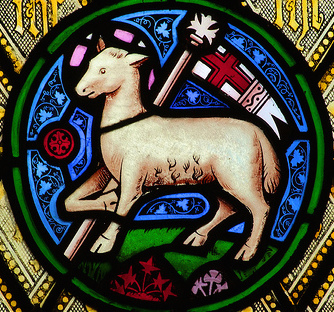
Sadly, when many people look at the Lamb on the pub’s sign, they fail to recognize it’s significance. The lamb carrying a cross-emblazoned banner is nothing other than the Agnus Dei, the Lamb of God.

What, some may wonder, is the Lamb of God? The better question is “who” is the lamb. The symbol represents Jesus Christ himself. It hearkens to the declaration of John the Baptizer as Jesus approached the Jordan: “Behold, the Lamb of God, who takes away the sin of the world!” (John 1:29).

To understand what it means to say “Jesus is the Lamb,” requires two things. First, a recognition that it is more than a simile; it is not simply that he possesses some of the attributes we would naturally associate with a lamb, such as gentleness. The second requisite is that we understand something about the Jewish sacrificial system.

For, Jesus being the Lamb of God means nothing less than that he is the true, complete, ultimate and final sacrifice for the sins of humanity.

And that is a wonder definitely worth pondering during this Christmas season.

Civilized Savages

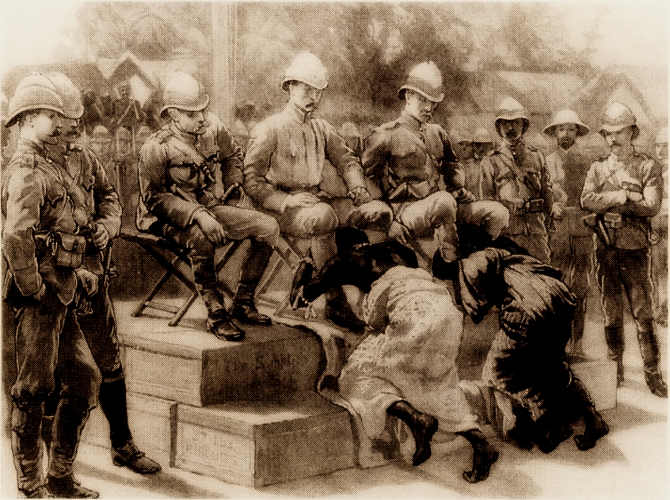
civilization-and-savageryWhat are the proper criteria for determining who is civilized? If you asked a score of people, you would probably end up with twenty different opinions.

In continuing my research about America’s first woman chaplain, I encountered an early American teaching resource that offered great insight into education during the early nineteenth century.

Some of it was quaint—“goats were made as profitable to the farmer as sheep.”

Some of it was insightful—“In America the Grecian architecture is prevailing, as it is better adapted than the Gothic to small buildings, and does not require splendid edifices to display its beauty.”

The text, Peter Parley’s Universal History, on the Basis of Geography, was used in schools and homes.

After finding confirmation of the point I was researching, I couldn’t resist skimming through the volume. Out of its myriad lessons, the one that got me thinking most seriously was a discussion of relative levels of civilization.

At the end of each lesson, several questions are posed. In this case:

Questions: What would you observe in traveling through other countries? What of people in a savage state? What of people in the barbarous state? What of people in the civilized state? What of people in the highest state of civilization?

Preceding these questions is the lesson proper, from which I now quote passages that correspond to the questions just listed.

In some countries the people live in huts built of mud or sticks, and subsist by hunting with bow and arrow. These are said to be in the savage state . . .

In some countries the people live in houses partly of stone and mud. They have few books, no churches or meeting-houses, and worship idols. . . . These are said to be in the barbarous state . . .

In some countries the inhabitants live in tolerable houses, and the rich have fine palaces. The people have many ingenious arts, but the schools are poor, and but a small portion are taught to read and write. . . . which may be called a civilized state.

In many parts of Europe, and in the United States, the people live in good houses; they have good furniture, many books, good schools, churches, meeting-houses, steamboats and railroads. These are in the highest state of civilization.

It appears that Peter Parley (the pseudonym of Samuel Griswold Goodrich) considered two factors to be the clearest measures of civilization—the quality of a society’s domiciles, and the access to learning and increase in literacy.

These are not inappropriate measures, although the latter dwarfs the former in significance.

I realize these lessons are intended for elementary education, so I don’t fault Goodrich for failing to address the subject from a more philosophical or mature angle. Nevertheless, I could not help wondering whether the societies that have attained the “highest state of civilization” are truly the least barbaric.

In some ways, the societies that have attained the loftiest technological levels might also be considered among the most savage.

I don’t have the time or inclination to pursue this thought any further in Mere Inkling, but I offer it to you. Some readers will agree that it merits reflections and others will consider it absurd.

Before moving on the Inklings, though, I wish to share a pertinent bit of wisdom from economist Thomas Sowell. “Each new generation born is in effect an invasion of civilization by little barbarians, who must be civilized before it is too late.”

C.S. Lewis thought, and wrote, a great deal about civilization. In English Literature in the Sixteenth Century there is a delightful remark, made in passing, that it is possible to retreat from civilization, once attained.

From the varied excellence of the fourteenth century to the work of the early sixteenth it is a history of decay; so that in turning from the Scotch poetry of the age to the English we pass from civilization to barbarism.

I end with a longer citation from C.S. Lewis which connects uniquely with the mindset with which Goodrich penned his textbook. Lewis also affirms true education, and the advancement of humanity towards that for which it was created, as the genuine mark of civilization.

One of the most dangerous errors instilled into us by nineteenth-century progressive optimism is the idea that civilization is automatically bound to increase and spread. The lesson of history is the opposite; civilization is a rarity, attained with difficulty and easily lost. The normal state of humanity is barbarism, just as the normal surface of our planet is salt water. Land looms large in our imagination of the planet and civilization in our history books, only because sea and savagery are, to us, less interesting.

And if you press to know what I mean by civilization, I reply “Humanity,” by which I do not mean kindness so much as the realization of the human idea. Human life means to me the life of beings for whom the leisured activities of thought, art, literature, conversation are the end, and the preservation and propagation of life merely the means. That is why education seems to me so important: it actualizes that potentiality for leisure, if you like for amateurishness, which is man’s prerogative.

You have noticed, I hope, that man is the only amateur animal; all the others are professionals. They have no leisure and do not desire it. When the cow has finished eating she chews the cud; when she has finished chewing she sleeps; when she has finished sleeping she eats again. She is a machine for turning grass into calves and milk—in other words, for producing more cows. The lion cannot stop hunting, nor the beaver building dams, nor the bee making honey. When God made the beasts dumb He saved the world from infinite boredom, for if they could speak they would all of them, all day, talk nothing but shop. (“Our English Syllabus”).

_____

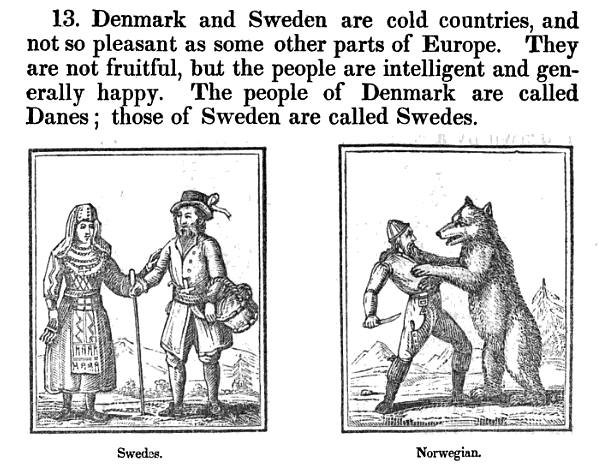
An illustration from the book, which taught generations of Americans that the heirs of the Vikings were still a picturesque and virile people.

scandinavians

Thesaurus Club

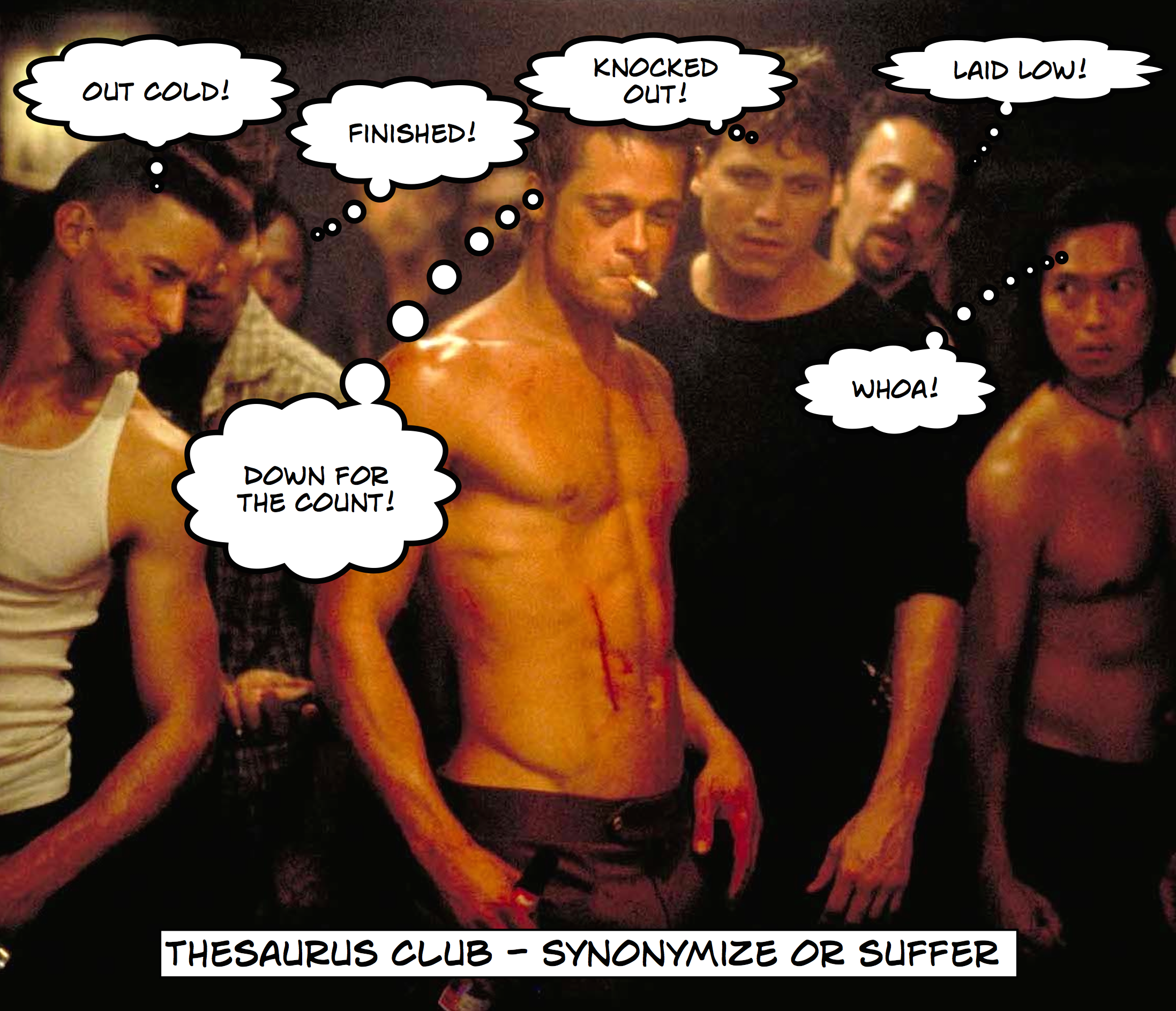
thesaurus club“The first rule is: If this is your first night at Thesaurus Club, you have to synonymize!”

“The second rule of Thesaurus Club is: You don’t talk about, mention, comment on, allude to, speak of, discuss, converse about, whisper of, gossip about, or chat or chinwag about Thesaurus Club!”

Only a true logophile (word lover) could enjoy the scene described above . . . but if you’re as captivated as I am by wordplay, you may appreciate the creativity. Of course, understanding the reference to the film Fight Club reveals more clearly its wit.

Words are fun to play with.

Although we tend to think of cartoonists as artists, the fact is they are usually just as skillful in their artistry with words. (The successful ones, at least.)

Not long ago I saw a single panel cartoon showing a seated man in a suit addressing a secretary, steno pad in hand. Nothing funny about the picture, of course, but the caption said, “One more thing: Remember to introduce me as a lawyer, not a liar.” Nice.

Even funnier if you think about synonyms. (No offense intended to Mere Inkling’s readers who are attorneys.)

Words are powerful. But they are also finite. C.S. Lewis noted their limits in an essay entitled “Prudery and Philology.”

We are sometimes told that everything in the world can come into literature. This is perhaps true in some sense. But it is a dangerous truth unless we balance it with the statement that nothing can go into literature except words, or (if you prefer) that nothing can go in except by becoming words. And words, like every other medium, have their own proper powers and limitations.

Lewis was quite sensitive to the abuse of language. It doesn’t require a graduate degree to know what he would think of today’s word processing programs with their built in thesauri.

No doubt these fingertip resources have contributed immensely to the modern proclivity of many writers to write artificial prose. I’m confident Lewis would have mourned their creation.

That’s precisely why joining the Thesaurus Club would be so daunting. There you stand, stripped of your ever-present literary crutches, proving just what you’re made of. Will you find victory (triumph, success) or will you taste defeat (downfall, failure)?

_____

I wish I could take credit for the concept at the top of this page, but I stumbled upon the notion elsewhere and modified it for Mere Inkling. (I did make the graphic, though.)

Discordant Dictionaries

dictionary 1Most “word people” like dictionaries. Some writers go so far as to love dictionaries, but I don’t wish to quibble about where one rests on the affection spectrum in terms of these repositories of words.

This guy, though, has to be pegged on the extreme (idolatry) end of the meter. Ammon Shea wrote Reading the OED: One Man, One Year, 21,730 Pages after having done just that. The Oxford English Dictionary, you may know, comprises 25 volumes, and Shea warns that reading it at such a rapid pace took a toll on his eyesight. It’s not surprising, that he admits he is not your typical reader.

One could say that I collect word books, since by last count I have about a thousand volumes of dictionaries, thesauri, and assorted glossaries. . . . I do not collect these words because I want to impress friends and colleagues with my erudition. . . .

My friends know that I read dictionaries for fun, and have come to accept this proclivity with relative good grace, but they are not terribly interested in or impressed by my word collection.

Pierre Jules Théophile Gautier advised his fellow poets to read the dictionary. No better way to enrich one’s language, he claimed, although he also read cook books, almanacs and the like. In fact, his biographer offered this fascinating observation.

He found pleasure in the most indifferent novels, as he did in books of the highest philosophical conceptions, and in works of pure science. He was devoured with the desire to learn, and said: “No conception is so poor, no twaddle so detestable that it cannot teach us something by which we may profit.”

C.S. Lewis indicated that so-called “definitions” offered outside the ordinances of the dictionary must be approached warily. “When we leave the dictionaries we must view all definitions with grave distrust” (Studies in Words). He offers a very sensible reason for such precautions.

It is the greatest simplicity in the world to suppose that when, say, Dryden defines wit or Arnold defines poetry, we can use their definition as evidence of what the word really meant when they wrote. The fact that they define it at all is itself a ground for scepticism.

Unless we are writing a dictionary, or a text-book of some technical subject, we define our words only because we are in some measure departing from their real current sense. Otherwise there would be no purpose in doing so (Studies in Words).

Dictionaries are, of course, their own genre. Lectionaries, collections of words and meanings, are different than any other type of written composition. For example, glossaries may draw together specialized vocabulary—say for medical or theological purposes—but by their very nature they are not intended to blaze any new literary pathways.

There is, invariably, an exception to this rule. Some “dictionaries” are creative exercises. They are works of fiction, and some are entertaining indeed.

The most famous of these satirical works is Ambrose Bierce’s Devil’s Dictionary (originally published as The Cynic’s Word Book). The volume is not expressly irreverent, although people of faith will encounter some offensive examples in its pages. However, a number of the entries are brilliant.

Kilt

  1. A costume sometimes worn by Scotchmen in America and Americans in Scotland.

Rank

  1. Relative elevation in the scale of human worth.

He held at court a rank so high

That other noblemen asked why.

“Because,” ’twas answered, “others lack

His skill to scratch the royal back.”

Emancipation

  1. A bondman’s change from the tyranny of another to the despotism of himself.

He was a slave: at word he went and came;

     His iron collar cut him to the bone.

Then Liberty erased his owner’s name,

     Tightened the rivets and inscribed his own.

Goose

  1. A bird that supplies quills for writing. These, by some occult process of nature, are penetrated and suffused with various degrees of the bird’s intellectual energies and emotional character, so that when inked and drawn mechanically across paper by a person called an “author,” there results a very fair and accurate transcript of the fowl’s thought and feeling. The difference in geese, as discovered by this ingenious method, is considerable: many are found to have only trivial and insignificant powers, but some are seen to be very great geese indeed.

Another Frenchman, Gustave Flaubert, composed his Dictionary of Received Ideas, which found humor in peculiarities of common understandings.

Absinthe

Extra-violent poison: one glass and you’re dead. Newspapermen drink it as they write their copy. Has killed more soldiers than the Bedouin.

Archimedes

On hearing his name, shout “Eureka!” Or else: “Give me a fulcrum and I will move the world.” There is also Archimedes’ screw, but you are not expected to know what it is.

Omega

Second letter of the Greek alphabet. [Note: this would only apply to biblically literate societies.]

The earliest such example of a satirical dictionary was that by the Persian writer Nezam od-Din Ubeydollah Zâkâni. I have not located a copy of his 14th century lexicon, but it apparently includes entries that are still understandable in our modern world.

Thought

What uselessly makes people ill.

Orator

A donkey.

Word lovers can easily get caught up in conversations like this. In fact, I’m certain more than one Mere Inkling reader has contemplated compiling their own creative dictionary! It’s not an insurmountable project, since it’s accomplished one word at a time.

_____

For those desiring to create their own dictionary “entries” such as the one that graces the top of this blog, there a free meme generator you can use online. Available here, it’s a fun little tool. It’s also suitable for creating a little self-deprecating humor.

dictionary 2

Unintentional Acrostics

letterSome writers sweat to find precisely the right word, the one that expresses the unique meaning and tone we seek to convey. We often fail, as the reference to perspiration in my first sentence readily reveals. A recent observation from the executive editor of First Things  provides me with another crippling concern.

“This for those interested in how magazines work. My son Christopher pointed out that the initial capital letters on a two-page spread . . . spelled “a wit.” Which was kind of nice. Accidental, but nice. And then I thought: Suppose some day we accidentally spelled out a rude four-letter word? Now, after the magazine is laid out, one of the junior fellows reads through the magazine to make sure we haven’t accidentally made a word that will embarrass us. It’s a small thing, and probably paranoid, but here paranoia equals prudence.”

Unless each writer maintains constant vigilance, since most of us don’t have “junior fellows” to assign the duty, it’s quite possible for unintentional acrostics to slip into our work. Like the seamen in the crow’s nest of the Titanic—I just watched a new documentary on the subject last night—we can easily miss the veiled iceberg which threatens to sink our best effort.

Prone as we are to playing with the depths of individual words, we are normally sensitive to the fact more than 90% of a word’s value in a particular context may lie beneath the surface. That does not mean, however, that we always see the larger picture.

It is not uncommon for a writer to become almost paralyzed while composing something, when the ideal word continues to elude us. It is almost “literally” painful to have to settle for a substitute, when we suspect the perfect word is floating somewhere just beyond our reach.

Dodging mundane words is not easy. They are common, in part at least, because they are so simple and easy to plug into sentences. And so, we “go” to the store, when we might just as easily “drive,” “walk,” “ride,” or even “hitchhike.” A movie is described as “good,” when readers would value a vivid word, such as, “suspenseful,” “hilarious,” “complex,” “moving,” or even “groundbreaking.”

Reflections on the Psalms, one of C.S. Lewis’ gems, explores the beauty of the Bible’s hymnal. “The Psalms,” he notes, “are poems, and poems intended to be sung: not doctrinal treatises, nor even sermons.” Because of this, they have nourished the worship lives of Jew and Christian alike, for thousands of years.

Even without a theological education, Lewis offers great insight into the Psalms. “I am no Hebraist, no higher critic, no ancient historian, no archaeologist.” He candidly discusses passages he initially found difficult to embrace, as well as those which soar to spiritual and poetic heights. The following comes from his discussion of Psalm 119, which is skillfully composed around an alphabetic acrostic.

“As everyone knows, the Psalm specially devoted to the Law is 119, the longest in the whole collection. And everyone has probably noticed that from the literary or technical point of view, it is the most formal and elaborate of them all. The technique consists in taking a series of words which are all, for purposes of this poem, more or less synonyms (word, statutes, commandments, testimonies, etc.), and ringing the changes on them through each of its eight-verse sections—which themselves correspond to the letters of the alphabet. . . . this poem is not, and does not pretend to be, a sudden outpouring of the heart like, say, Psalm 18. It is a pattern, a thing done like embroidery, stitch by stitch, through long, quiet hours, for love of the subject and for the delight in leisurely, disciplined craftsmanship.”

Done like embroidery, stitch by stitch.” Many writers, I suspect, will appreciate that description. While we are sometimes forced to throw something together in a rush, the patchwork results offend our sensitivities.

Even when writing rather pedestrian things like much of our email correspondence, most writers seek to employ lively verbiage. It’s a valuable exercise, after all, to consider the pace of all of our work, and not simply those words we hope to see “published.” And, having written something worth reading, there is one more consideration.

Reviewing what we have written is well worth the time required. And, as Editor David Mills suggested in First Things, our examination should include any unintentional acrostics we may have created. After all, no respectable writer would ever wish to, even accidentally, offend their readers.

Posing Like a Corpse

savasanaThere are some things you should never tell an elderly person to do. And, I recently came across a faux pas that certainly belongs in that number.

It may just be me, but I think one should never, ever tell a senior citizen to pose like a corpse.

Nevertheless, in a recent article in a periodical expressly written for “mature” Americans,* readers were advised to assume the “corpse pose.” My discomfort with that directive was not allayed by the description that followed.

Lie flat on your back, pillow under your head, eyes closed. Allow your feet to play to the sides. Rest your arms alongside your body, palms facing up. Then relax, surrender to the floor, and breathe deeply.

Up until being told to “breathe,” one might rightly be confused with precisely how we are emulating a corpse.

While I make no claim to understand what it means to “surrender to the floor,” I can understand how body posture has become a valued part of yoga. After all, even without the counsel of a yogi, I learned at an early age the sheer joy and peace of lying on my back with eyes closed.

I don’t wish to impugn the benefits of yoga; I wish that I were able to master my physical body half as well as many of them do. However, I would like to suggest to the yoga community that they re-label their corpse pose.

Admittedly, advocates for maintaining this verbiage can state it is clearly not intended to refer to a literal cadaver. In arguing this they are simply being human. As C.S. Lewis wrote in “Studies in Words”—“Like all philosophers, Aristotle gives words the definitions which will be most useful for his own purpose.” This approach is not, of course, the domain of philosophers alone.

The fact is that there are perfectly good words that could be substituted which do not reference a lifeless body. “Reclined,” “Reposed,” or even “Resting” or “Sleeping” come readily to mind.

Of course, I may be missing something here. Perhaps the allusion to a corpse is intentional? Perhaps the image of dissipation of energy and effort is expressly intended to be similar to a comatose state? Perhaps that is what becoming one with the floor is hinting at? Flesh to floor . . . ashes to ashes, dust to dust.

In this case, it might be clearer if we were provided with a definition of what the title of the pose actually means. I suppose that practitioners may learn this as part of their lessons, but to those on the “outside,” the label seems slightly off-putting.

As Lewis wrote in the aforementioned essay:

The fact that [writers] define it at all is itself a ground for scepticism. Unless we are writing a dictionary, or a text-book of some technical subject, we define our words only because we are in some measure departing from their real current sense. Otherwise there would be no purpose in doing so.

Thus, if “corpse” here doesn’t mean what we normally understand it to, we might benefit from a brief definition or explanation of the users’ intent.

This matter—the proper use of the precise word that will be clearly understood—is a concern for all communicators. Writers need to remain vigilant that their own vocabulary or metaphors do not confuse.

One last caveat for those who practice yoga. If you seek to master the corpse pose, be cautious in just how well you perfect it. Please stop short of emulating death so well that your resting body is discovered and a crime scene established.

_____

savasana 2* AARP the Magazine is published by the organization formerly known as the American Association of Retired People. Apparently, the sound “AARP” is considered more dignified than the original title. It remains a requirement, however, that members have survived at least a half century before applying for membership.

Confusing Creeds

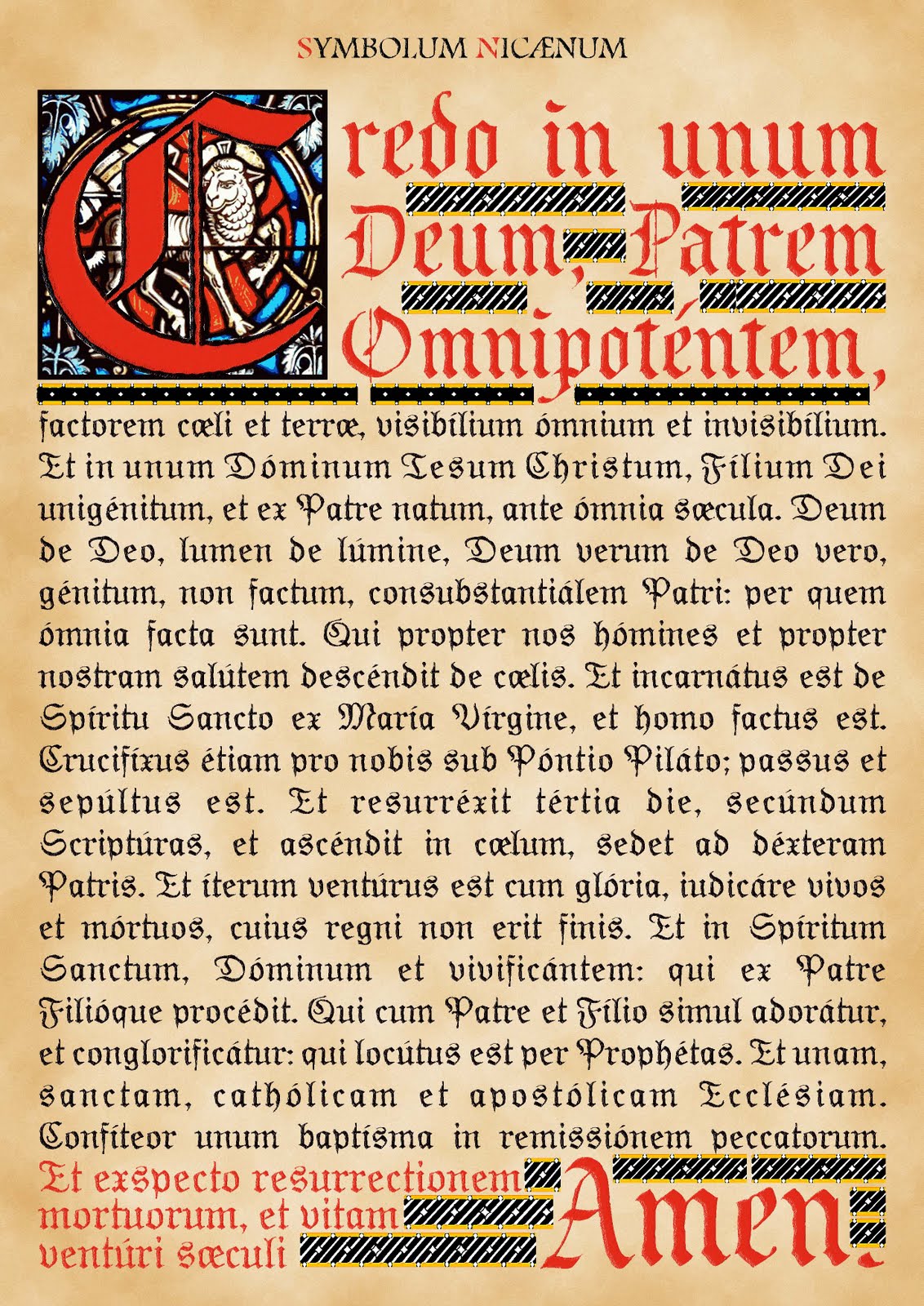
Nicene CreedThere are a couple of sentences in the traditional translation of the basic Christian creeds (statements of faith) that lead to confusion.

Due to the literary examples below, Christian readers may find the following discussion more interesting than non-Christians—but everyone interested in clarity versus confusion should find something intriguing.

The creeds offer a prime example of why it is absolutely crucial to ensure that gradual shifts in language do not undermine or blur the intended meaning of a given sentence. To illustrate, consider this line from the Nicene Creed.

. . . [Jesus] who for us men and for our salvation came down from heaven and was incarnate by the Holy Spirit of the virgin Mary and was made man. (1662, Anglican Book of Common Prayer).*

The potential confusion here lies in the archaic usage of the word “of.” Whose Holy Spirit are we referring to? Mary’s innate holiness and purity? The educated Christian may stumble over that dated phrase—which is still used in some denominations—but a person not acquainted with the doctrine of the Trinity might easily misinterpret it as a Maryological, rather than Christological, confession.

Let’s consider two more recent translations, and note how the first restores the intent of the original writers. The second of these commonly used translations reflects the hand(s) of “politically correct” revisers.

For us and for our salvation he [Jesus] came down from heaven: by the power of the Holy Spirit he became incarnate from the Virgin Mary, and was made man. (1975 International Consultation on English Texts version).

For us and for our salvation he came down from heaven, was incarnate of the Holy Spirit and the Virgin Mary and became truly human. (1988, English Language Liturgical Consultation version).

We will consider a second example momentarily, but let’s first look at something C.S. Lewis wrote about reflecting on the importance of the creeds. He noted that too often we rattle through the words without considering their significance. This is unfortunate.

In an essay entitle “On Forgiveness,” Lewis describes a personal epiphany and offers counsel to those tempted to take familiar words for granted.

We say a great many things in church (and out of church too) without thinking of what we are saying. For instance, we say in the Creed “I believe in the forgiveness of sins.” I had been saying it for several years before I asked myself why it was in the Creed. At first sight it seems hardly worth putting in. “If one is a Christian,” I thought “of course one believes in the forgiveness of sins. It goes without saying.”

But the people who compiled the Creed apparently thought that this was a part of our belief which we needed to be reminded of every time we went to church. And I have begun to see that, as far as I am concerned, they were right. To believe in the forgiveness of sins is not so easy as I thought. Real belief in it is the sort of thing that easily slips away if we don’t keep on polishing it up.

As usual, the Oxford don was correct. However, just as good translations possess the power to inspire, so too poor or antiquated translations exercise the ability to confuse.

Here is the promised second example.

And the third day he rose again according to the Scriptures . . . (1662).

Ah, I understand, think the uncatechized, the Bible teaches us that Jesus rose from the dead on Easter. Well, yes it does, but that is not the sense in which the second phrase is intended. Here, “according to the Scriptures,” means that Jesus’ life, death and resurrection were all accomplished in accordance with the promises of the Word of God.

In other words, “just as was promised in the Garden of Eden and foretold by the prophets, Jesus won victory when he rose from the grave in accordance with the loving plan of God the Father.” The newer versions make that fact only slightly clearer.

On the third day he rose again in accordance with the Scriptures . . . (1975 and 1988).

Perhaps a future revision will replace “in accordance with,” using something like “as foretold in” or “fulfilling the scriptural promises.”

Some of us worship in congregations using a variant of the seventeenth century creed, but at least we can take comfort in the fact that most of them have at least replaced “And he shall come again with glory to judge both the quick and the dead” with “both the living an the dead.” After all, we wouldn’t want people to think that one’s salvation is dependent upon their speed.

_____

* This slightly contemporized version of the creed has already remedied the terribly confusing term “Holy Ghost,” which evokes images of disembodied souls and hauntings.

Free C.S. Lewis Book

bookshelvesC.S. Lewis has encouraged innumerable prominent individuals in their own faith and writing journeys. I know of no others who offer at no cost a book about his influence.

John Piper is a pleasant exception to that. In a moment I’ll provide the link where you can download a free copy of Alive to Wonder: Celebrating the Influence of C.S. Lewis.

The volume includes a number of extended excerpts from Piper’s fifty-plus books . . . passages where Lewis’ imprint is particularly vivid. For example:

The synthesis of mind and heart was embodied in C.S. Lewis. Lewis became for me in my college days what Jonathan Edwards became in my seminary days. He was a “romantic rationalist”—that was the name of a small book about Lewis that got me very excited because it summed up what I thought I was (which may be very akin to “pastor-scholar”). Lewis has had a tremendous influence on me in several ways.

Lewis embodied the fact that rigorous, precise, penetrating logic is not inimical to deep, soul-stirring feeling and vivid, lively—even playful—imagination. He combined what almost everybody today assumes are mutually exclusive terms: rationalism and poetry, cool logic and warm feeling, disciplined prose and free imagination. In shattering these old stereotypes, he freed me to think hard and to write poetry, to argue for the resurrection and to compose hymns to Christ, to smash an argument and to hug a friend, to demand a definition and to use a metaphor.

The author is chancellor of Bethlehem College & Seminary. It was founded by Bethlehem Baptist Church in Minneapolis, where Piper served as pastor for several decades.

The writer’s desiringGod website actually offers free PDF copies of many of his books and articles, even though most remain in print and available for regular purchase.

As delightful as Alive to Wonder is, most students of Lewis will find the materials from the 2013 desiringGod National Conference even more welcome. This year’s theme was “The Romantic Rationalist: God, Life, and Imagination in the Work of C.S. Lewis.”

Piper’s website includes ten keynote presentations plus an informative panel discussion, all of which are available for download in audio files. Best of all, the lineup of speakers is first-class, featuring a number of familiar names.

And, since we’re on the subject of “free books,” allow me to share another interesting website.

Forgotten Books offers approximately a million volumes, to which “subscribers” have unlimited access. What sets them apart from other “public domain aggregates,” is that they (unlike books.google.com) provide a searchable text, in a variety of epub formats.

For those who are not interested in purchasing a subscription, they offer a Free Book of the Day option in which you receive the link to one of their texts which is good for twenty-four hours.

I recently used it to add Pure English: A Treatise on Words and Phrases, or Practical Lessons in the Use of Language to my kindle library. I find the reading of dated literary books to be:

Entertaining

Educational

and, occasionally, even

Inspiring

Here are a few sample passages from Pure English. The first sounds remarkably contemporary:

The abuse to which the English language is so generally subjected must be a source of sincere regret to all who appreciate its beauties. Ours is an age of progress and civilization, and it ought to be remembered that language, is also progressive.

In a section entitled “Objectionable and Obsolete Words” we read:

Banister is a common barbarism. The proper word is baluster, or balustrade.

— Noted. In the future I will alternate between baluster and balustrade.

“Disremember,” often employed in the sense of do not remember, although given in Webster, is condemned by the critics as a low vulgarism.

— Apparently so vulgar as to have fallen out of usage completely.

Hence, authoress and poetess are superfluous. So, also, are such words as conductress, directress, inspectress, waitress, etc., all of which have recently come into current use. Perhaps the next edition of our dictionaries will, if the custom continues, be enriched by the addition of such words as writeress, officeress, carpenteress, manageress, secretaryess, treasureress, singeress, walkeress, talkeress, etc.

— How did “waitress” survive, especially in the wake of such witty sarcasm?

It is questionable taste to call a coffin a casket. The pleasing name applicable to a case for jewels does not lessen the dread of death and burial.

— I hadn’t known before the sentiment behind the adoption of the word “casket,” since it’s become so thoroughly associated with this usage that was apparently at one time novel.

If you are interested in the books I’ve mentioned above, you You can download a free copy of Alive to Wonder here, and you can sign up for the free book of the day here.

Powerful Names

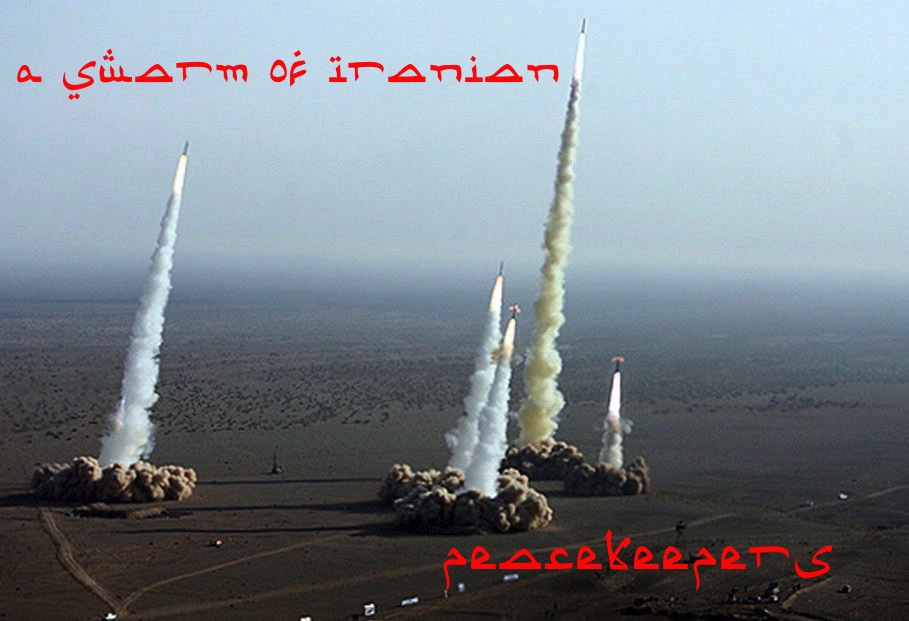
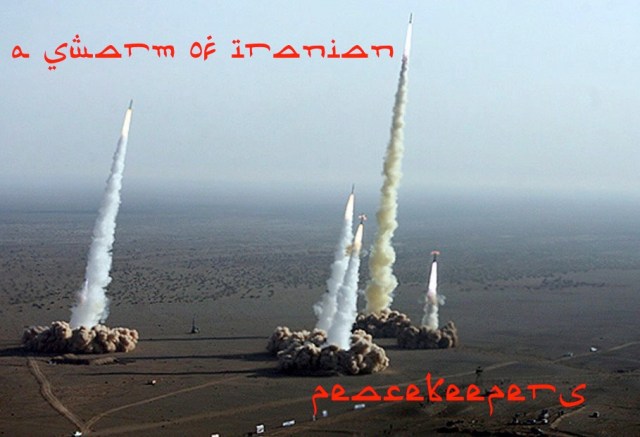
missilesIt’s all in the name. The person who succeeds in naming (or labeling) something wields great power.

Whether it be a concrete object, or an idea, the power to name carries the power to shape perceptions.

Philosophically, we might agree that:

“That which we call a rose by any other name would smell as sweet” (Juliet, Romeo and Juliet).

But, if we are perfectly honest, calling it “skunk cabbage” might affect our perception of its aroma.

A classic example of the power of naming comes from the era of Norse exploration. In the ninth century, Vikings began settling in the inhospitably named “Iceland.” The island was majestic, and its spectacular glaciers and volcanoes still allowed room for extremely fertile farmsteads.

Less than a century and a half later, Erik the Red was exiled from Iceland. He sailed west and established the first colony on a much larger island that he enticingly named Greenland. Erik’s brilliant advertising ploy was quite effective, and hundreds of settlers joined him in the much harsher climes to Iceland’s west.

The specific appellations which led me to ponder the power that resides in naming once again,* actually came from a much more modern source—weaponry.

Military leaders have a knack for generating striking names. Often they are brilliant; occasionally they completely miss the mark. In either case, it’s curious to note the message their choice of nomenclature seeks to emphasize. Consider for a moment two different American missiles.

The AGM-114 Hellfire and the LGM-118A Peacekeeper

The reader naturally assumes the purpose of the former is to rain sulfur and brimstone down on the enemy, while the mission of the latter is to benignly maintain peace. One suspects, however, that being at the epicenter of either explosive device would be equally disastrous.

Another example we might consider is a bit more controversial, but fascinating nonetheless. Consider these labels for movements involved in the abortion debate.

Self-Preferred  ||  Used by Opponents  ||  Used by the Media

Pro-Choice  ||  Pro-Abortion  ||  Pro-Choice

Pro-Life  ||  Anti-Choice  ||  Anti-Abortion

It doesn’t require a brilliant intellect to comprehend the tone each of these labels evokes. Nor should it come as a surprise how the mainstream media tends to line up in the debate.

It’s all in the name. The person who succeeds in naming something wields great power.

C.S. Lewis was a master of language. He knew names exercise significant influence on how things are perceived. In the following passage from “The Humanitarian Theory of Punishment,” he describes how a powerful word—in this case “mercy”—can be dangerously misleading when applied to something inimical to itself.

Mercy, detached from Justice, grows unmerciful. That is the important paradox. As there are plants which will flourish only in mountain soil, so it appears that Mercy will flower only when it grows in the crannies of the rock of Justice: transplanted to the marshlands of mere Humanitarianism, it becomes a man-eating weed, all the more dangerous because it is still called by the same name as the mountain variety.

In another essay, “‘Bulverism:’ or, the Foundation of 20th Century Thought,” Lewis actually coins a word which has found favor with a literate subculture. The peculiar word he created conveys a sense of obtuse, opinionated self-smugness. (Yes, I may be reading just a little bit into “Bulverism,” but I really don’t think so. The aristocratic or remote sounding surname “Bulver,” the “ism” suffix and, of course, the “Bul” prefix all combine to engender an odd and unappealing impression.)

The subject Lewis addresses in this work is the unwillingness of disagreeing parties to honestly debate the merits of an issue. Instead, they rush to employ the invalid (and terribly effective) ad hominem approaches that characterize so much of modern politics.

C.S. Lewis is so talented (and ingenious) that he provides us with a biographical note on the fictional creator of the deficient form of “debate” prevalent in the modern era. “The modern method [of argument],” Lewis begins, “is to assume without discussion [your opponent] is wrong and then distract his attention from this (the only real issue) by busily explaining how he became so silly.”

In the course of the last fifteen years I have found this vice so common that I have had to invent a name for it. I call it “Bulverism.” Some day I am going the write the biography of its imaginary inventor, Ezekiel Bulver, whose destiny was determined at the age of five when he heard his mother say to his father—who had been maintaining that two sides of a triangle were together greater than the third—“Oh, you say that because you are a man.”

“At that moment,” E. Bulver assures us, “there flashed across my opening mind the great truth that refutation is no necessary part of argument. Assume your opponent is wrong, and then explain his error, and the world will be at your feet. Attempt to prove that he is wrong or (worse still) try to find out whether he is wrong or right, and the national dynamism of our age will thrust you to the wall.” That is how Bulver became one of the makers of the Twentieth Century.

. . . Bulverism is a truly democratic game in the sense that all can play it all day long, and that it gives no unfair privilege to the small and offensive minority who reason.

Sadly, Bulver’s disciples continue to increase, rather than diminish.

Since it was military missiles that initially got me thinking about the subject of the power of naming, it might be fitting to end with a few more evocative labels. They certainly elicit a wide range of impressions.

Condor: Argentina’s avian contribution

Piranha: Tiny but vicious and straight from Brazil’s Amazon

Velvet Glove: Canada’s mixed message

Sky Sword: China’s blending of the ancient and modern

Apache: French, which confuses this American veteran**

Meteor: A European offering sure to land hard if it doesn’t disappear in the atmosphere

Martel: Anglo-French venture they surely don’t want Islamists to think is a tribute to Charles Martel, Hero of the Battle of Tours***

V-1 Flying Bomb: Got to Hand it to the Germans for straight-forward labeling.

Rhinemaidens (Rheintöchter): There’s apparently Teutonic Poetry as well

Fateh: Iran’s “Conqueror”

Zelzal: Iran’s “Earthquake”

Sejjil: Iran’s “Baked Clay” (well we can’t expect all the Persian names to be winners)

Jericho: From Israel where we know whose walls tumbled down

Spike: Israeli and probably not a reference to Jael and the Book of Judges****

Hatf: Pakistani “Vengeance” (derived from the gentle sword of Muhammad)

Hyunmoo: Korea’s mythical “Guardian of the Northern Sky” (mayhap a reference to their aggressive northern neighbor)

Penguin: Those Norwegians really know how to frighten their enemies

Malakhit (Малахит): Just one of Russia’s curiously named explosives in their “mineral missile series”

Umkhonto: South African “Spear” from the Zulu tongue

The Brits are uniquely creative when it comes to naming missiles. They include: Blowpipe, Brimstone, Green Cheese, Rapier, Sea Skua and, of course, Fairey Fireflash and it’s less intimidating companion Fairey Stooge.

For some reason, I find a missile named “Green Cheese” particularly disconcerting. Whoever named that specific weapon was devilishly clever. If I were a world leader, I’d surrender immediately, rather than face a foe confident enough in their military prowess to use that sort of twisted culinary nomenclature for their armaments.

______

* I have written on the subject of personal names in the past.

** It just may translate as “Ruffian,” but I don’t think I want to go there, since it hints at political incorrectness.

*** It’s actually a combination of the missile’s guidance options: Missile, Anti-Radiation, Television. I’m sure the parallel with the Frankish defender of the Christian Church is a mere coincidence.

**** The fourth chapter of the Book of Judges.

Obstreperous Language

obstreperous

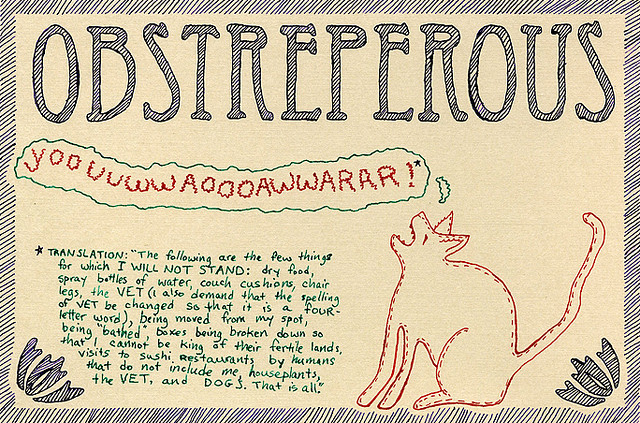
© Stella Belikiewicz and used by permission.

Despite my many shortcomings, I do “pride” myself on possessing a rather considerable vocabulary. My 97th percentile score of the GRE* reinforced my impression that I knew a lot about words.

One technique which has increased my vocabulary is to never let an unknown word pass by without making an effort to learn its meaning. This is simple when I’m working at the computer. If I’m unsure of a definition, I immediately look it up in an online dictionary such as this.

Very rarely do I “guess” at a meaning, based upon its context. This mainly occurs if I’m listening to the radio while I’m driving, and I don’t have recourse to a dictionary. Even then I try to impress the new word on my memory so that I can research it when I return home.

The word in this column’s title motivated me to discuss the importance of accurately understanding word definitions. When I encountered “obstreperous,” it rang vague bells of recollection. And, I was able to discern the word’s general meaning from the context of the article. While some readers of Mere Inkling are already familiar with its meaning—and perhaps use it in daily conversations—allow me to share the context in which I encountered it.

I was reading an article in a military journal about the “battle over ballistic missiles” which was fought inside the Air Force as the manned-bombers-only mindset had to be breached so the United States could advance into the ICBM age. The champions of the two positions were two successive Air Force Chiefs of Staff, Thomas White and Curtis LeMay.

White struggled with how to control the obstreperous LeMay. He knew he didn’t have the political power to force LeMay out, nor could he outwait his [Strategic Air Command] chief. LeMay received his fourth star in 1951 at age 44, which made him the youngest four-star U.S. general since Ulysses S. Grant.**

I’m rarely content with possessing an amorphous definition of a word, so I looked it up. My general impressions of its meaning were confirmed, and I added another word to my personal vocabulary. (The fact that I may never use it beyond its appearance in this post is irrelevant.) Here’s the dictionary entry:

ob·strep·er·ous [uhb-strep-er-uhs]

adjective

1. resisting control or restraint in a difficult manner; unruly.

2. noisy, clamorous, or boisterous: obstreperous children.

Parents give their children a precious gift by encouraging the growth of their own vocabularies. In the pre-computer days, we had a dictionary not far away when we had dinner, and it wasn’t uncommon for it to find its way to the table during our conversations.

Consciously adding new words to our vocabulary is a skill especially vital to writers.

C.S. Lewis wrote about how common usage of familiar words requires no contextual definition. However, he warns of the danger of accepting subjective “definitions” offered outside the context of credible dictionaries.

When we leave the dictionaries we must view all definitions with grave distrust. It is the greatest simplicity in the world to suppose that when, say, Dryden defines wit or Arnold defines poetry, we can use their definition as evidence of what the word really meant when they wrote.

The fact that they define it at all is itself a ground for scepticism. Unless we are writing a dictionary, or a text-book of some technical subject, we define our words only because we are in some measure departing from their real current sense. Otherwise there would be no purpose in doing so. . . .

The word wit will illustrate this. We . . . find old critics giving definitions of it which are contradicted not only by other evidence but out of the critics’ own mouths. Off their guard they can be caught using it in the very sense their definition was contrived to exclude.

A student who should read the critical debate of the seventeenth century on wit under the impression that what the critics say they mean by wit is always, or often, what they really mean by wit would end in total bewilderment.

He must understand that such definitions are purely tactical. They are attempts to appropriate for one side, and to deny to the other, a potent word. You can see the same “war of positions” going on today.

A certain type of writer begins “The essence of poetry is” or “All vulgarity may be defined as,” and then produces a definition which no one ever thought of since the world began, which conforms to no one’s actual usage, and which he himself will probably have forgotten by the end of the month. (Studies in Words)

I find it rather fitting to include this passage from Lewis, with its martial imagery, in a column inspired by a description of a surly advocate of massive nuclear bombing as the best deterrence of World War III.

Writers, particularly those attempting to be persuasive, are wise to ponder Lewis’ wise counsel. We cannot surrender the battlefield to those who would revise the clear and historic meanings of words in an effort “to appropriate for one side, and to deny to the other, a potent word.”

_____

* The Graduate Record Exam is a standardized test used as part of the admission process for many university graduate programs in the United States. We won’t be discussing my mathematics score here . . .

** If the source article interests you, you can read it at Air Force Magazine.

The artwork above is copyrighted by its creator, Stella Belikiewicz, and used with her permission.