Africa Comes to America

saharaYes, you read the title correctly; it’s no typo. Africa itself arrived in America this summer—and it’s an event that apparently takes place every year!

In a recent post by one of Mere Inkling’s earliest subscribers, I learned about the annual Saharan Air Layer. It is an enormous dust cloud that transits the entire Atlantic Ocean and is vital to the western hemisphere, especially the Amazonian rain forests. More about the SAL below.

I find this phenomenon fascinating. It reveals how intricately balanced and interconnected God has created this amazing ecosystem we call earth.

I appreciate this fact, even though I don’t consider myself an environmentalist. That doesn’t mean, of course, that I don’t recycle. What’s more, I would actually like to see brazen polluters incarcerated and tasked with personally cleaning toxic waste dumps . . . but that’s not the theme of this reflection.

It seems to me that part of being truly human, is possessing an appreciation—or even a love—for the world in which our Creator has allowed us to dwell. By love, I mean a deep affection for the flora and fauna, and even the mountains and valleys themselves.

I am not proposing idolatry.

I am in good company in valuing nature. C.S. Lewis found time spent walking in the countryside to be invigorating. It was renewing, for body, mind and soul.

Several years back a book was published with the peculiar subtitle, The Environmental Vision of C.S. Lewis.

The authors of Narnia and the Fields of Arbol explores the way Lewis displays his “ecological” concerns, particularly in his fiction. They also consider J.R.R. Tolkien’s similar attitude.

It is no coincidence that these two men, as soldiers during the Great War, had seen the worst violence humanity could do to nature. The ravages wrought by the orcs surrounding Isengard were echoes of the lifeless terrain of shell-shattered Western Front.

Writing this now, I recall a poem I wrote for Curtana: Sword of Mercy.

“A Foreshadowing of Epics” begins:

Filthy trenches greeted the novice soldiers’ eyes,

their two imaginations envisioned greener lands.

Crimson combat splashed red their vision,

and colored portraits one day painted with their words.

The frontlines were barren,

scarred earth stripped of all life.

Fallen trees mimicked casualties,

not even the smallest of creatures escaped death.

It may seem ironic to some that those very fields now are green, and teeming with life. It is the mercy of God that restores the scarred and heals the broken. And, as impressive as those miracles are evident in nature, they are far more wondrous when it is human lives that are transformed and resurrected.

So it is that I find the wonder of the barren and seemingly lifeless Saharan dust bringing nutrients to hungry forests on the other side of the earth amazing. No mere accident that.

If Jesus delays his return and this globe continues to spin for more centuries still, I would not be surprised to see the Americas returning to Africa a similar gift of life.

_____

Weather.com has a short video about the Saharan Air Layer here.

Life in Middle Earth

theodenIf you resided in Middle Earth during the Third Age,* which of the major characters might you have been? Boromir,** Pippin, or perhaps Gandalf himself?

And, we’re only talking about the “good guys and gals.” We’ll have no one identifying with villains like Saruman, the Nazgûl ringwraiths or Grima Wormtongue here at Mere Inkling!

In a moment, I’ll help you answer that question.

Unfortunately, the internet abounds with time-consuming black holes. Pouring minutes and hours of our lives into the abyss of mindless videos or addictive games is the sad result.

Some entertaining diversions, however, possess merit. Case in point, an analysis of the leaders of Lord of the Rings, arranged according to their personality types.

Visiting a website such as this is not only fun, it offers insight into human differences. And, for the unwary, it may even reveal some new insights into our own nature.

I believe in the general validity of the best known personality inventory, the Myers-Briggs Type Indicator. I have posted in the past about C.S. Lewis’ (likely) personality type being an INFP. That appropriately identifies him with none other than Frodo, “the idealist.”

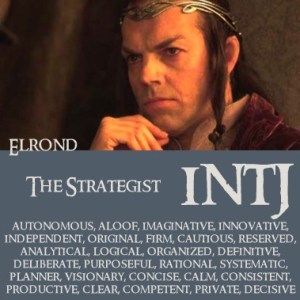
elrondMy own type is ENTJ, which matches with King Théoden above. As I age, however, I am finding myself less extraverted and more desirous of solitude. That means I am progressively becoming an INTJ, and that aligns me with Elrond. Frankly, both of the characterizations suit me quite well.

A person’s type is determined by which of four polarities is dominant.

Extraversion/Introversion

Sensing/Intuition

Thinking/Feeling

Judging/Perceiving

If you don’t know your type, and have the time to take an online assessment now, you can do so for free here.

You don’t need to do it to enjoy the Lord of the Rings chart though. So, which are Middle Earth leader are you? Find out here.

A Note of Caution

While instructive, tools such as this should never be used to put people into boxes (which is ironic, since the MBTI is graphically presented in that fashion).

The last thing we need is someone thinking they are defined by a psychological instrument such as this. After all, today’s Gimli may just well be tomorrow’s Bilbo.

_____

* The complete timeline of Middle Earth is available here.

** I have written in the past about the hero Boromir.


Who is Your Muse?

reposeWhich Muse provides your inspiration? Poetry, history, music, dance, epic?

I’ve always been fascinated by the Greek & Roman concept of the Muse. While I don’t regard these personifications as true “beings,” they provide wonderful insight into the multifaceted nature of inspiration.

The Muses were personifications (representations of abstract concepts in human form). It’s not the same thing as believing in a “god,” although devotional exercises could be offered in “their” honor. (The simple people, in fact, may have regarded them as minor deities.)

The number of Muses—who represented the arts and fields of knowledge—varied in the ancient world. However, nine constituted the final Roman tabulation.

Possessing a historical nature, my “matron” Muse would necessarily be Clio (History).

Sadly, I’ve learned Muses don’t always fulfill their promises. At my suggestion, my wife agreed to name our puppy Calli, abbreviated from Calliope, the Muse of epic poetry. Unfortunately, at ten months her raucous barking sounds anything but poetic.

In his biography, Surprised by Joy: The Shape of My Early Life, C.S. Lewis includes an interesting reference to Muses. It relates to one of their secondary qualities, civility. In the following passage, Lewis had been sent to the Headmaster of his school for review due to “bad work” (i.e. inadequate academic performance).

The Headmaster misunderstood Smewgy’s report and thought there had been some complaint about my manners. Afterward Smewgy got wind of the Head’s actual words and at once corrected the mistake, drawing me aside and saying, “There has been some curious misunderstanding. I said nothing of the sort about you. You will have to be whipped if you don’t do better at your Greek Grammar next week, but naturally that has nothing to do with your manners or mine.”

The idea that the tone of conversation between one gentleman and another should be altered by a flogging (any more than by a duel) was ridiculous. His manner was perfect: no familiarity, no hostility, no threadbare humor; mutual respect; decorum. “Never let us live with amousia” was one of his favorite maxims: amousia, the absence of the Muses. And he knew, as Spenser knew, that courtesy was of the Muses.

For Lewis’ instructor, the concept of the Muse meant more than simply inspiring some form of art or literature. The influence of the Muses flowed into the broader culture. In a sense, it reflected the distinction the Greeks held between themselves and the barbarians. Surely the uncivilized savages had no Muses of their own!

Sources of Inspiration

It isn’t uncommon today for people to use muse (lower case) as a shorthand for a person who inspires them. Pablo Picasso, for example, considered his favorite model (and mistress) to be his muse. The portrait of Marie-Thérèse Walter above, entitled “Repose,” surely conveys the profound vision she provided him.

In cinema, there was the 1999 movie aptly named The Muse, which posits a deflated screenwriter seeking the aid of the supposed “daughter of Zeus.”

Speaking of Christians . . . they too identify a source for their inspiration. In addition to other human beings, who may offer wisdom, insight or encouragement, the preeminent source of inspiration is the Holy Spirit.

There is a danger in considering God himself to be the source of one’s inspiration. When taken to an extreme, it results in God being blamed for a lot of maudlin prose and gross violations of grammar.

Fortunately, few Christians believe their own writing is infallible. That divine quality is reserved for the Scriptures themselves.

Editors at Christian publishing houses would probably argue with my statement that few Christian authors are so presumptuous as to claim God “breathed” into them every word found in their manuscripts.

So, who is your Muse? When I said Clio is mine, it is because History—the story of humanity and especially God’s hand in it—fascinates me more intensely than any other subject. For you, it could be music or poetry.

Even astronomy has its own Muse, Urania. And, gazing at the boundless heavens God spoke into existence, it is no wonder that many would find their inspiration there.

A Classical Lewisian Poem

C.S. Lewis wrote a number of poems that are satires of Greek and Roman poetry. Some of them are quite witty.

For those interested in reading one such poem, I am pleased to offer “A Cliche Came Out of Its Cage.” In C.S. Lewis: Fantasist, Mythmaker, and Poet, Bruce Edwards describes it as “a sharp attack upon moderns who believe they are heralds of a return to the ‘golden age’ of paganism.” Included in his critique are F.R. Leavis and Bertrand Russell whose philosophy he rejected.

A Cliche Came Out of Its Cage

You said ‘The world is going back to Paganism.’
Oh bright Vision! I saw our dynasty in the bar of the House
Spill from their tumblers a libation to the Erinyes,
And [F.R.] Leavis with Lord Russell wreathed in flowers,
heralded with flutes,
Leading white bulls to the cathedral of the solemn Muses
To pay where due the glory of their latest theorem.
Hestia’s fire in every flat, rekindled, burned before
The Lardergods. Unmarried daughters with obedient hands
Tended it. By the hearth the white-armed venerable mother
Domum servabat, lanam faciebat. At the hour
Of sacrifice their brothers came, silent, corrected, grave
Before their elders; on their downy cheeks easily the blush
Arose (it is the mark of freemen’s children) as they trooped,
Gleaming with oil, demurely home from the palaestra or the dance.
Walk carefully, do not wake the envy of the happy gods,
Shun Hubris. The middle of the road, the middle sort of men,
Are best. Aidos surpasses gold. Reverence for the aged
Is wholesome as seasonable rain, and for a man to die
Defending the city in battle is a harmonious thing.
Thus with magistral hand the Puritan Sophrosune
Cooled and schooled and tempered our uneasy motions;
Heathendom came again, the circumspection and the holy fears …
You said it. Did you mean it? Oh inordinate liar, stop.

Or did you mean another kind of heathenry?
Think, then, that under heaven-roof the little disc of the earth,
Fortified Midgard, lies encircled by the ravening Worm.
Over its icy bastions faces of giant and troll
Look in, ready to invade it. The Wolf, admittedly, is bound;
But the bond will break, the Beast run free. The weary gods,
Scarred with old wounds the one-eyed Odin, Tyr who has lost a hand,
Will limp to their stations for the Last Defence. Make it your hope
To be counted worthy on that day to stand beside them;
For the end of man is to partake of their defeat and die
His second, final death in good company. The stupid, strong
Unteachable monsters are certain to be victorious at last,
And every man of decent blood is on the losing side.
Take as your model the tall women with yellow hair in plaits
Who walked back into burning houses to die with men,
Or him who as the death spear entered into his vitals
Made critical comments on its workmanship and aim.
Are these the Pagans you spoke of? Know your betters and crouch, dogs;
You that have Vichy water in your veins and worship the event
Your goddess History (whom your fathers called the strumpet Fortune).

_____

You can read about my true Muse here.
 

Great Grandparent or Great-Grandparent?

ggfI have never been more glad to have a birthday than I was this year. After all, at a mere sixty, I would have been far too young to become a great-grandfather. Now, at sixty-one, I feel adequately prepared for the momentous event which transpired just under an hour ago.

Tobin (meaning “God is Good”) is the child of my grandson and his wife, who currently reside in Texas where dad handles munitions for B-1 bombers.

Age and offspring do not always line up the way that we ourselves would plan. Yet every precious child is a miraculous gift from God.

Our grandson was born to our precious daughter-in-law while she was in high school. We didn’t get to meet him until he was ten, but we’ve done our best to make up for lost time. Our grandson, early on began calling us his “great grandparents.” That didn’t make us feel old, just special.

When my wife worked in a residential care facility for severely handicapped children, one of the aides arrived one morning with joyous news. “I’m a great-grandmother!”

Because the woman seemed too young, Delores responded, “Congratulations, you look so young for being a grandmother.”

The lady laughed and said, “No, a great-grandmother!” It turns out she was not yet forty . . . having been 13 when she had a daughter who was 13 when she had her own daughter who now had birthed her own baby. (I don’t recall the gender of the child.)

As I wrote this, it dawned on me that this all took place thirty-seven years ago, so it’s quite possible there are now several more generations in that particular family tree.

Some people will scoff at the thought of celebrating such early and assumedly unintended pregnancies. But, that caregiver knew the truth—every young life is a gift from God.

As an imperfect parent and grandparent, I recognize all too well that I won’t be the great-grandfather Tobin should have. I do pray, though, that God would grant that my mistakes with him would be few, and the memories forged during this life will help this little one grow into the finest man that he can become.

Most importantly, I pray that he will see Christ in my life and recognize the value of faith. Only the Lord knows what the future will bring, and I will not be here to share too many decades of life with my grandchildren and great-grandchildren. But my hope is that the time we do have will leave a lasting legacy of encouragement, faith, and compassion.

The letters of C.S. Lewis provide insights into the influence of his grandparents on his young life.

In a 1905 letter to his brother Warnie, he describes family festivities on Halloween. They even persuaded his grandfather to join in.

On Halow-een we had great fun and had fireworks; rockets, and Catherine wheels, squbes, and a kind of thing that you lit and twirled and then they made stars. We hung up an apple and bit at it. We got [his paternal] Grandfather down to watch and he tried to bite.

In a 1916 letter to his father, he refers to his grandmother’s declining health. (She died two weeks after he wrote.) Lewis refers to the common sentiment that we should have tried harder to spend time with family while they were with us. “I am sorry to hear what you say about [Lewis’ maternal] Grandmother: I feel that we ought to have seen more of her, but it was not easy.”

I should dearly love to get away for a bit, but, as you say, for so short a time, the expense and the interruption of work is hardly worth it. The Colonel must have had an unpleasant journey: I wish he would keep a diary which we could compare with that of Grandfather Hamilton in the same waters. Two generations of sub-tropical Atlantic and Hamilton temperament would be worth studying!

The diaries left by C.S. Lewis’ grandfather, and by his brother Warnie, provide a reminder to us that a written legacy will outlast our voices. If we have something important to say to our descendants, perhaps that is something we should keep in mind.

Choosing Trustworthy Fonts

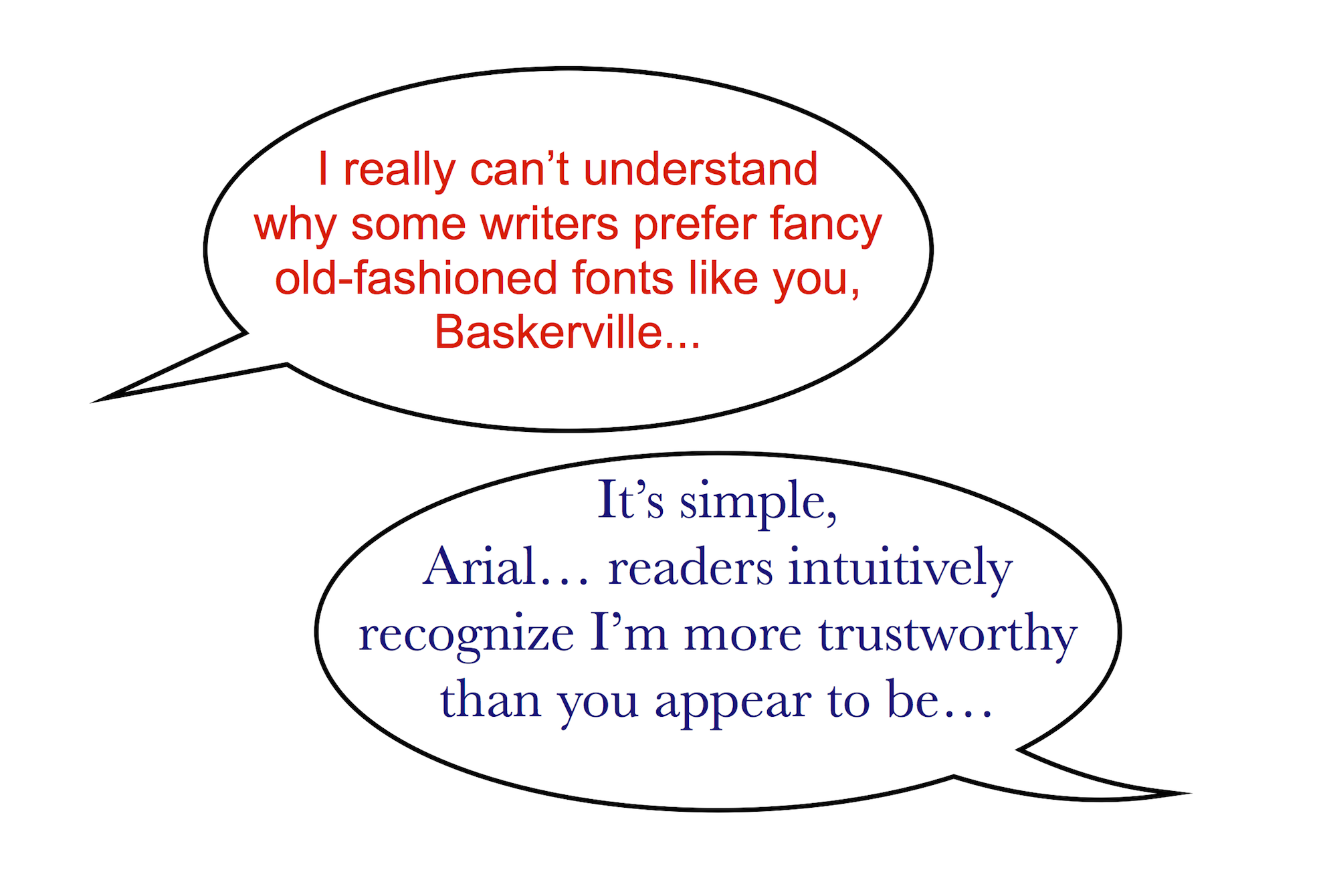
font conversationDo you want readers to trust what you write? If so, beware of using common fonts like Arial and Helvetica.

It turns out that serif fonts (those with more traditional finishing strokes) are not simply more legible than their sans serif counterparts.

There is evidence that serif fonts also contribute to the confidence people feel they can place in what they read. You can read a brief account of the research in “Can a Font Make Us Believe Something is True?

The brief article linked above refers to the results of a study conducted in the New York Times.

The experiment revealed dual effects of using serif fonts. They increased the intensity of agreement with statements, and they reduced the intensity of those who disagreed with the statements.

For many writers, fonts barely register as a consideration. For others, such as yours truly, they are an object of fascination. (Not obsession.) Mere Inkling has approached the subject from a number of angles.

A Font for Dyslexics

Monastic Fonts

Uninhibited Fonts

The Purpose of Punctuation

Even if the subject bores or confuses you, it is certainly worth taking note: if you want to enhance the perceived veracity of what you write, avoid the sterile sans serif fonts and stick with more traditional variants.

C.S. Lewis on Trust

It is ironic that a concept so vital as trust receives so little conscious reflection.

We rely on intuition, those proverbial “gut feelings,” to guide in awarding credence to different sources or individuals.

Well, intuition and prejudices.

Sometimes we distrust people because of their professions. Politicians, used car salesmen, and (in recent years) clergy, do not always rank high when it comes to trust. In Surprised by Joy, C.S. Lewis describes his introduction to J.R.R. Tolkien. Though they became close friends, Lewis was initially quite wary.

When I began teaching for the English Faculty, I made two other friends, both Christians [who would play roles in Lewis’ conversion from atheism]. They were H.V.V. Dyson and J.R.R. Tolkien. Friendship with the latter marked the breakdown of two old prejudices. At my first coming into the world I had been (implicitly) warned never to trust a Papist, and at my first coming into the English Faculty (explicitly) never to trust a philologist. Tolkien was both.

Prejudices are part of the human experience. Everyone has them. Wise are those who recognize their own.

Subconscious “prejudices” are more hazardous. Most, fortunately, are of little consequence. In this category I would file the subject of how fonts influence perceptions of truthfulness.

Nevertheless, despite the miniscule influence they may exert, it would be foolish to ignore the evidence that our selection of fonts does matter. It would be foolish to ignore that fact.

Creative writers and publishers have a multitude of fonts to choose from. Making those selections consciously—with an awareness of how they affect readers’ impressions of our truthfulness—is essential.

Postscript – While the content here at Mere Inkling may range across a wide spectrum, one thing you can be sure of. . . the odds of having to endure the Comic Sans* font is almost nil.

_____

*Comic Sans is one of my wife’s favorite fonts. I’m glad for that, because with all of her other amazing traits, I am sometimes tempted to forget she is merely human.

Pet Names

hypocorismHow many hypocorisms do you have? Which of them are your favorites? Are there any you would sooner never hear again?

I subscribe to one of those “word of the day” emails sent by services such as dictionary.com or thefreedictionary.com.

The truth is, more often than not I’m already familiar with the word they choose to define each day. However, when something hits me out of the proverbial blue—I am amazed and pause to ponder its meaning, history, and reasons why I may never have crossed its path before. (I imagine this behavior is widely replicated among word lovers.)

“Hypocorism” is one of those surprises. It had no place in my lexicon, although the concept of “pet names that are bestowed with affection” is something my family and I have always practiced.

I grew up being called Robbie, and as a young adolescent told my family I preferred to go by Rob. Rob is probably verbal shorthand for Robert, but Robbie is definitely hypocoristic. It is amusing to me that my beloved grandmother never ceased to call me Robbie—even though every precious letter I received from her while serving in the military far from home began, “Dear Robert.”

We’ve already noted the key aspect of a hypocorism. It is a name expressing endearment, not disrespect. That doesn’t mean, of course, that it is not embarrassing. Many people bestow pet names on their loved ones that are best shared only with family.

Some pet names are simply silly. Two of my granddaughters often call me “Bumpa.” That is not a reference to any lumpiness on my part, but to the way the eldest of them began pronouncing “Grandpa” when she was oh so tiny. It was cute, special, and passed on to her younger sister, at first through aural osmosis . . . and later through conscious affection.

C.S. Lewis’ family members were enthusiastic practitioners of hypocorism.

One of the things that new students of Lewis often find confusing is his own name. The fact that he was known to family and friends as “Jack” begs the question of the source of that name. The story, though oft told, remains quite entertaining.

The initial version of Lewis’ adopted name was Jacksie. Lewis loved dogs, and his stepson Douglas Gresham writes that Jacksie was one of these childhood animals.

When he was a small boy, he didn’t like the name [Clive] and soon changed it to “Jacksie” by simply refusing to answer to anything else. It was actually because of a small dog that he was fond of that he picked the name Jacksie, which was what the dog was called. It was run over (probably by a horse and cart as there were almost no cars at the time and place where he was a child), and Jack, as he later became known, just took the name for himself. (Jack’s Life)

I have shared in the past how Lewis’ brother Warnie [Warren] related the event.

Then, in the course of one holiday, my brother made the momentous decision to change his name. Disliking “Clive”, and feeling his various baby-names to be beneath his dignity, he marched up to my mother, put a forefinger on his chest, and announced “He is Jacksie.”

He stuck to this next day and thereafter, refusing to answer to any other name: Jacksie it had to be, a name contracted to Jacks and then to Jack. So to his family and his intimate friends, he was Jack for life: and Jack he will be for the rest of this book.

Lewis’ life was filled with other hypocorisms. One of the most curious was the nick name “Minto,” given to Janie Moore. Mrs. Moore and her daughter were supported in his home by Lewis after her son Paddy had been killed in WWI. The two men had pledged that if only one survived, he would care for the other’s widowed parent. Lewis kept that promise.

As you reflect on the pet names that you share with those you love, you are in good company. An affectionate hypocorism is a truly precious gift.

True Friendship

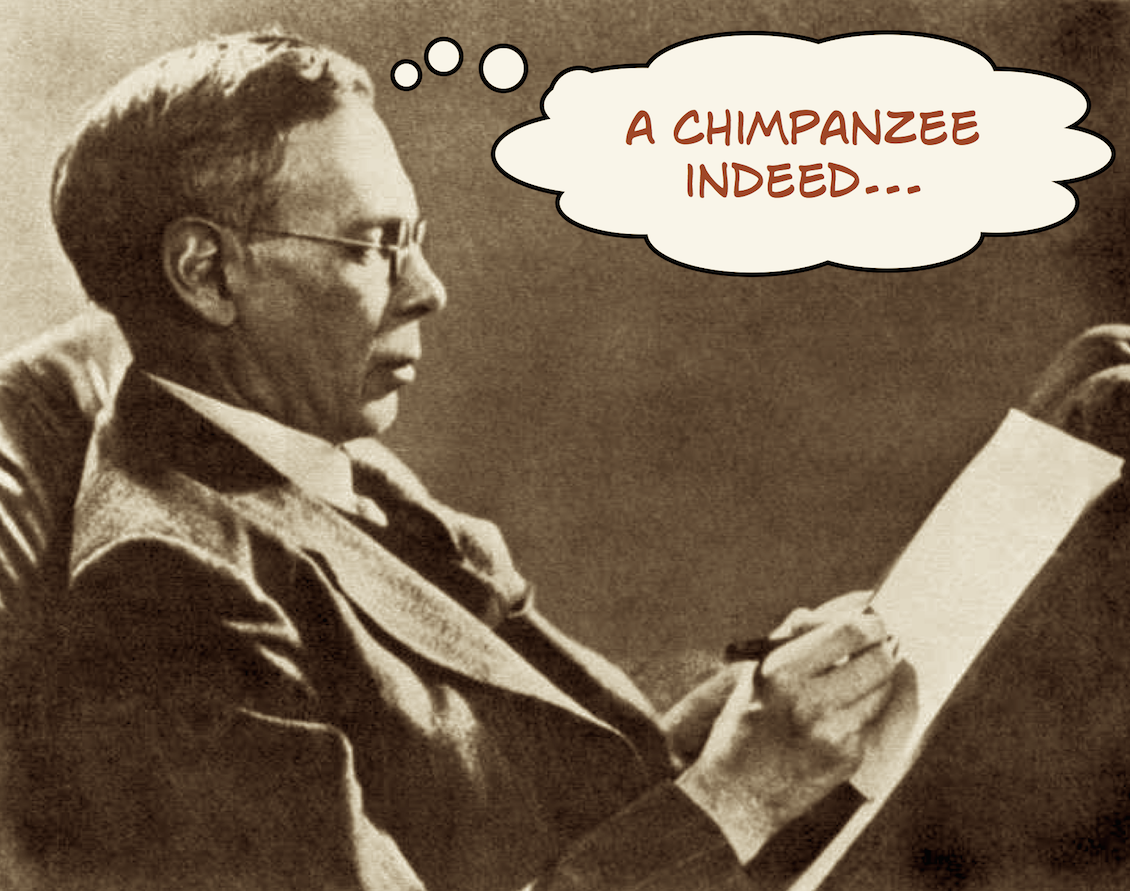
charles williamsIt seems odd to describe someone you deeply respect with the words “ugly as a chimpanzee,” but that’s precisely what C.S. Lewis once did.

Yet, reading the description in full, we find that Lewis considered the physical unattractiveness of his mentor to be a positive thing. In a sense, it accented his impressive persona.

Describing Charles Williams to his childhood friend, Arthur Greeves, Lewis wrote:

As for the man: he is about 52, of humble origin (there are still traces of cockney in his voice), ugly as a chimpanzee but so radiant (he emanates more love than any man I have ever known) that as soon as he begins talking whether in private or in a lecture he is transfigured and looks like an angel. He sweeps some people quite off their feet and has many disciples. Women find him so attractive that if he were a bad man he could do what he liked either as a Don Juan or a charlatan.

I find this description evocative of the words about Jesus’ physical appearance. You can read the full passage about Jesus, the promised Messiah, here.

For he grew up before him like a young plant, and like a root out of dry ground; he had no form or majesty that we should look at him, and no beauty that we should desire him.

Lewis continues with his description of Williams, revealing a more intimate relationship than the previous words might suggest. Williams, you see, was one of the Inklings.

He works in the Oxford University Press. In spite of his “angelic” quality he is also quite an earthy person and when Warnie, Tolkien, he and I meet for our pint in a pub in Broad Street, the fun is often so fast and furious that the company probably thinks we’re talking bawdy when in fact we’re very likely talking Theology. He is married and, I think, youthfully in love with his wife still.

I find it amazing how vivid Lewis’ portrait of his colleague is. He briefly passes over his physical appearance (the least important of human traits, despite what the modern era intimates). And, even though his words are not flattering, the rest of the description reveals they are expressed with deep affection.

Lewis then quickly presses on to a poetic depiction of Williams’ oratorical skills, and concludes with a personable picture of the man among brothers. The final sentence, given Lewis’ perception that he himself would remain a lifelong bachelor, is quite perceptive.

Mutual respect—especially when tempered with affection—generates bonds that allow for honest assessments of both weaknesses and strengths.

A Personal Experience

I recall receiving a lovely engraved glass plaque as a memento of my tour at the United States Air Force Chaplain School. Most of my duties related to writing, but it was common knowledge that there were few subjects on which I did not have something to say.

When the Commandant of the Institute read the inscription during the presentation (it was the first time he had seen it), he paused in embarrassed silence thinking he must have read it wrong. It didn’t sound like the flattery that traditionally adorns such tokens.

“He says in a book what others say in a sentence.”

You can only offer such a dialectical “compliment” to a friend.

It was true, of course, and it was to much laughter that I immediately responded, “True, and it is a book well worth reading.”

When I read this description of the literary friend who made such a profound impression on Lewis, it makes me smile. It is all the more poignant, since it was written just a year before Williams’ death.

There are far, far worse things a person can experience than having someone who respects and loves them say they resemble a chimpanzee . . . or that they tend to be just a little bit verbose.

Publishing Troubles

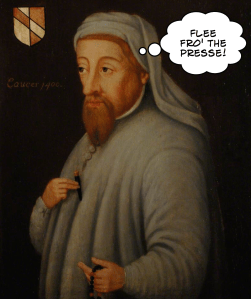
chaucerDespite C.S. Lewis’ vast experience as an author, even he was abused by publishers to the point where he could simply echo Chaucer in saying, “Flee from the Press!”

Print on demand technology has delivered a stout, but not debilitating, blow to traditional publishers. They still possess a significant amount of influence.

And—like all power—that which is wielded by publishers can be used for either good or evil.

We can thank many different publishers for making the works of Lewis, J.R.R. Tolkien and their fellow Inklings available to us. We would be wrong, however, to assume these relationships were without their stresses.

John H. McCallum was an American editor with whom Lewis worked. McCallum worked at Harcourt, Brace & World.

A piece of correspondence from 1960 reveals how complex the publishing world remained even to a veteran such as Lewis.

McCallum had sought permission to publish Lewis’ latest work, and the Cambridge professor had sought to accommodate that request. Unfortunately, he had negotiated a contract that restricted him from doing so. He begins his letter of explanation with an apology for having taken so long to respond.

Dear Mac

‘Why the heck can’t C.S.L. have the civility to answer a letter?’ I don’t blame you, but it wasn’t exactly my fault. Like a fool, I dealt direct with C.U.P. [Cambridge University Press] for Studies in Words instead of working through [his regular literary agent] Curtis Brown: chiefly because I regarded this book as too academic to be of any serious commercial value.

And like a double fool I’ve let them take it up so that I’m not free to arrange for an American edn. with anyone else.

The delay in answering you is due to the fact that I’ve been all this time trying to get out of them whether this is exactly what my contract with them means. It is. But of all the impenetrable block heads! Their answer—the correspondence was long and infuriating—dealt with every question under the sun except the one I had asked (besides being unintelligible and contradictory).

I am sorry about all this. How well Chaucer advised us ‘Flee fro the Presse’!

Yours Lewis, C.S.

Dealing with publishers today remains challenging. They are, in a sense, gatekeepers. One of their roles is to prevent undeserving works from seeing print. Unfortunately, because literary tastes are utterly subjective, they bar many worthwhile manuscripts as well.

For that reason, we can be thankful that digital publishing allows quality works that would formerly have been overlooked to find their audience. The price of that boon, however, is that we must sometimes wade through major quantities of dregs to savor fine writing.

The majority of writers, given the opportunity, would prefer to be published by traditional publishing houses. There is no way around the fact that this adds a degree of status to most books. A recent poll supports this notion. It found among those published traditionally, “32% of respondents said the prestige of having a deal with a traditional publisher was important to them, while a further 54% said it was one of the appealing aspects of a traditional publishing deal.”

If we should ever seek “publication” for our own work, it is good to remember that the publishing business could puzzle even as gifted a writer as C.S. Lewis. If the author of so many impressive books could be mystified by it, it’s no wonder it seems labyrinthine to the likes of us.

Perhaps Chaucer’s advice, offered more than 500 years ago, really does ring just as true today.

Fit to Print?

amazonIt’s challenging enough to conduct painstaking research. But, only to have it become immediately obsolete by virtue of it’s own publication—that is simply too much.

Flying home from a whirlwind trip from the Pacific to the Atlantic, I came across an interesting analysis of how many sheets of paper would be required to print out the entire contents of the internet.

One hundred and thirty-six billion.

Didn’t sound like all that many when I read it. Why, that’s not even a fraction of the annual deficit here in the United States.

Still, it’s quite a few sheets of paper. As the article said, stacked on one another, the pile would tower 8,300 miles high. That sounds a bit more impressive.

The researchers determined eight million Amazonian trees would have to be sacrificed to provide sufficient pulp. Impressive. But then they turn about and make that very number far less remarkable by declaring that this total would constitute only 0.002% of the rainforest.

The Flaw in the Research

Sadly, as diligent and mathematical as the researchers were, there was a weakness in their model. You see, they did not factor in their own research. Immediately upon it’s publication, their numbers were obsolete.

In fact, because they meddled with the internet equilibrium, there were at least 36,000,000,002 pages. (And, although I am not a scientific researcher, I suspect there were even more.) And, despite my mediocre numerical skills, even I know that when I hit post with this column, the internet page counter will advance another digit.

More ominously, especially in light of our recent reflections about the dark web, is the following:

Also, it is thought the non-explicit web is only a mere 0.2% of the total internet, the rest encompassing the Dark Web. This would mean that printing the entire internet including the Dark web would use 2% of the rainforest.

This relates to the question that entered my mind when I read the original statistic. (And I was not even thinking about the garbage that oozes throughout the internet.)

A More Important Question

As entertaining as it might be to ponder how many pages of data exist on the web, there is a far more valuable question. How many pages of the material on the internet are worth printing out?

C.S. Lewis has a delightful passage about wasted newsprint in Surprised by Joy. Although he is specifically talking about how students should not squander time or attention on newspapers, his point extends beyond that to people of all ages, and to all media including the internet.

I think those are very wrong who say that schoolboys should be encouraged to read the newspapers. Nearly all that a boy reads there in his teens will be known before he is twenty to have been false in emphasis and interpretation, if not in fact as well, and most of it will have lost all importance.

Most of what he remembers he will therefore have to unlearn; and he will probably have acquired an incurable taste for vulgarity and sensationalism and the fatal habit of fluttering from paragraph to paragraph to learn how an actress has been divorced in California, a train derailed in France, and quadruplets born in New Zealand.

If Lewis were alive today, I have no doubt he would share my opinion that most of what is written both on- and offline, is not worth printing.

Perhaps someone should undertake a study of how many trees would need to be cut to print everything worthy of being printed? If they did so, I am fairly confident we would need not worry about the future of the Amazonian rain forest.

The Devil’s Printing Press

pressIf the devil has used the printing press so effectively to advance his purposes, one can only imagine how easily the internet can be twisted to his purposes.

Whether or not you believe Satan is an actual (fallen angelic) person, we all recognize the web provides a ready conduit for unimaginable evil. Recent discussions of the traffic that occurs on the Dark Web is sobering. Actually, not “sobering,” but frightening.

While a small fraction of the data is innocent, the majority deals with criminal and dehumanizing material. Some investigators suggest more than half of the data transfers involve pedophilia.

I’ve been doing some personal research into parallels between the advent of the printing press and the rise of the internet. I’m approaching it from the perspective of how each has provided access to competing faith claims.

Martin Luther viewed the “recent” invention of Gutenberg’s press as divinely appointed to coincide with what would come to be known as the Reformation.

Roman Catholics also published treatises and pamphlets opposing the calls for institutional change within the church. The persuasiveness of arguments aside, one reason for their lack of success against the evangelical leaders was simple.

Rather than writing for the German people in their own tongue, they directed nearly all of their initial energies at writing for the elite, in Latin. While only a minority of sixteenth century Germans were literate, only a small percentage of these were able to read Latin.

During the first half century of the existence of movable type for the press, the majority of published titles were religious. Only later did popular and secular titles eclipse them.

However, they did. Many were wonderful. Scientific and literary knowledge blossomed.

Foremost among the good fruits disseminated by the press, we would have to include the works of the Inklings, especially C.S. Lewis and J.R.R. Tolkien. (Consecrated imaginations are capable of wondrous creations!)

Eventually, of course—given humanity’s imperfect nature—this neutral device was harnessed to baser purposes.

This would lead a nineteenth century minister to write an essay with the title of this column, “The Devil’s Printing Press.” Thomas Green described the dilemma vividly.

The first book printed in Europe had six hundred leaves, and it took nearly ten years to make it. Now books are written, printed, sold, read and forgotten in one-fourth the time. A single century ago, and a man well to do, thought himself fortunate if he had one book in this wild western world.

Today there are books in well kept rank upon almost every cottage shelf It is little wonder that the powers of evil should have invaded the province of the influence of the book shelf and bound up in attractive colors and insidious page the poison of wickedness and sin.

Later in his address, available to read at your leisure here, he contrasts the noble and corrupt purposes for which the press (or internet) might be used.

There are papers of every shape and for every use; daily, tri-daily and almost hourly, weekly and semi-weekly, monthly and quarterly, and filled with everything. You have no idea unless you have given it especial attention, of the magnitude and wondrous dimensions of the newspaper as a factor in civilization. You have little idea, unless you have studied it, of the influence, the formative power of this outwardly ephemeral agency upon human life.

You have little idea, unless you have sought it, of the labor, the enterprise, the energy, the talent, the outlay necessary to plan and execute this gigantic result. You have little conception of the influence of the printing press, as an enlightener, as a pioneer of civilization, as a promoter, a creator, a conservator of purity and virtue; and you have little idea of the magnitude of the devil’s work through this mighty agency, as in a thousand ways he uses it for pollution and ruin.

Green’s florid and dated verbiage may weaken the impact of his argument. Likewise the revivalist tones of his message. Still, as the existence of the dark web reminds us, even the good can be touched by corruption. Perhaps our vigilance can reduce this danger.

We will close now with another description by the author of the lurid material which preceded the pornography which abounds today. Would that our dulled sensitivities remained innocent enough to “blush” at explicit material, as he says.

But the devil has a channel by which he ruins life and character, in a specialty in the newspaper line that panders to the low and more bestial part of man’s being. Broadcast over the land there are sown every day almost countless thousands of papers filled with the corrupt, lascivious, the impure, gathered from all the fact and fancy that a filthy mind can contrive.

Facts that transpire often in the lowest slums of life are here placarded with all the embellishment of illustration and seductive coloring; language and recitals no man would read without a blush are hidden in its folds. It is a slimy, salacious mosaic of filth and wickedness, and yet go up and down the city streets and in every news-dealer’s window and on every corner stand they are spread out for inspection and sale.

_____

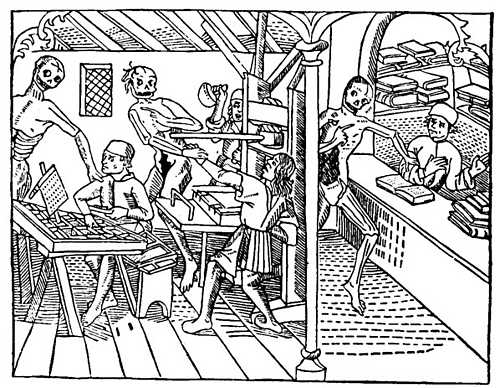
The woodcut illustration above comes from a book entitled The Dance of Death, and is the first representation of a printing press. The point being made was not to associate death with printing, but to reveal how death comes to all, unanticipated, regardless of who they are.