Devastated by Criticism

calvin-criticismHow do you feel when others criticize something you’ve written? Do you just want to tear your work up and start all over again? If you do, you have something in common with J.R.R. Tolkien, creator of Lord of the Rings. And he is not the only great writer with whom you share this hypersensitive trait.

Tolkien’s inability to accept constructive criticism is no secret; it is frequently noted in biographies.

Few people enjoy receiving criticism, and we are often suspicious of the mental health of those who do. Yet many writers actively seek out constructive criticism in order to sharpen their skills and improve their work.

That is a major reason for the existence of writers’ groups which pop up in varying expressions wherever serious writers live. While another benefit of such communities is the simple encouragement that comes from gathering with others who share your passion, it is the critical examination of each other’s manuscripts which provides the clearest concrete benefit. It’s no accident many such literary meetings are actually called critique groups.

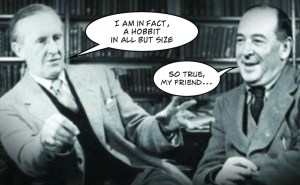
Tolkien was a member of one of the most famous such fellowships that ever existed, the Inklings. It was in that setting where he first shared the stories of hobbits and elves who would make such a profound impact on Western literature. He said it was primarily through the encouragement of the Inklings—specifically his good friend, C.S. Lewis—that these amazing stories were ever published.

You see, Tolkien had a terrible and frequently fatal flaw . . . When his writing was criticized, he felt compelled to toss it aside and begin anew. Many other writers have been afflicted with this curse, and not all of them had a C.S. Lewis to rescue their words from the dust bin.

I have shared in the past Lewis’ description of his friend’s handicap.

No one ever influenced Tolkien—you might as well try to influence a bander-snatch. We listened to his work, but could affect it only by encouragement. He has only two reactions to criticism; either he begins the whole work over again from the beginning or else takes no notice at all.

Criticism of the Constructive Variety

As I said a moment ago, no one really craves criticism, and yet most serious writers actively solicit it. As I write this very column, it is with the intention of sharing it tomorrow with my friends in my own writing circles.

When you read it, it will likely have changed, probably in subtle, enriching ways. You can gauge the benefit of mutual critiquing by the amount and the quality of the criticism which is shared. And, should you feel violated, rebuke defensiveness and remind yourself that even the greats, like Tolkien and Lewis, gained from the comments and suggestions of their friends.

I recently learned of another individual who struggled with receiving criticism. It was John Calvin, the father of Reformed theology. Belonging to the Lutheran branch of the church universal, my readings in Reformed history have been limited. However, I’m currently reading two similarly titled books* and I discovered something that may be commonly known to Reformed clergy but was news to me.

He often tended to express his disappointment in extravagant terms. When he encountered an obstacle, his reaction was stark: he would burn his manuscript, never write again, never publish anything again. His decision to write was motivated by external factors: a request by his circle of friends and colleagues, or as the result of his emotional reaction to an event or a work that he read. . . . (John Calvin and the Printed Book)

The good news though is Calvin did not allow these obstacles to have the final say. Instead, he turned to those he trusted and sought their counsel.

Indeed, his extreme sensitivity meant that he needed to have the emotional support of close friends. As a Reformer and specifically as an author, Calvin never worked in isolation even though he was the dominant figure in his setting. While he was confident of the quality of his writings, Calvin still had no hesitation in submitting them to his colleagues before publication. (Ibid.)

Not that Calvin always welcomed suggestions. There was one particular Reformer to whom he sent some of his work whose “commend from Zurich were too numerous and detailed. Hence Calvin stopped sending his manuscripts to Bullinger prior to printing, although he maintained cordial relations with the Zurich Reformer.” I can almost read Calvin’s mind at the time: I asked for your suggestions, not a complete rewrite of the manuscript.

So, it appears those of us who feel discomfort at the sting of criticism—even when we request it—stand in good company. So don’t ever let that temporary pain discourage you from continuing to write.

____

* A 2005 volume is called John Calvin and the Printed Book, while a 2015 collection of essays is called Calvin and the Book.

C.S. Lewis and Metaphors

hobbit-quoteLearn how to effectively wield metaphors, and you will be powerful indeed. They are one of the most creative and intrinsically rewarding tools used by communicators.

Metaphors are not simply ornamental. Nor are they limited to abstracts subjects. The following description comes from C.S. Lewis’ book, Miracles.

It is a serious mistake to think that metaphor is an optional thing which poets and orators may put into their work as a decoration and plain speakers can do without. The truth is that if we are going to talk at all about things which are not perceived by the senses, we are forced to use language metaphorically.

Books on psychology or economics or politics are as continuously metaphorical as books of poetry or devotion. There is no other way of talking, as every philologist is aware. . . . All speech about supersensibles is, and must be, metaphorical in the highest degree.

To effectively communicate—especially about deep or profound subjects—metaphors need to be part of a readers’ or speakers’ core vocabulary. That’s what Lewis meant by saying “we are forced to use language metaphorically” when speaking about things that transcend our senses.

Former Time editor James Geary has echoed Lewis’ description of the universality of metaphors.

Metaphor is not just confined to art and literature but is at work in all fields of human endeavor, from economics and advertising, to politics and business, to science and psychology. . . .

There is no aspect of our experience not molded in some way by metaphor’s almost imperceptible touch. (I Is an Other: The Secret Life of Metaphor and How It Shapes the Way We See the World)

Without being conscious of it, we all use metaphors more frequently than we realize it. Geary claims “We utter about one metaphor for every ten to twenty-five words, or about six metaphors a minute.” Granted, most of these are routine like the four appearing in this sentence he quotes from an economic report.

“Britain’s recovery from the worst recession in decades is gaining traction but confused economic data and the high risk of a hung parliament could yet snuff out its momentum.”

Metaphors Versus Similes

Envisioning fresh metaphors may seem challenging, but it is a skill which can be practiced. One need not feel embarrassed if they find the subject of metaphors confusing. In their simplest form, they are like especially meaningful similes.

In a simile we compare two distinctly different things and declare that they are similar. For example, someone might say about the sleek new stealth destroyer, “the USS Zumwalt is like a Porsche.” This simile suggests a number of attributes and the statement contains the familiar phrase “is like.”

By contrast, a metaphor is not merely “like” something else. Using a metaphor implies that the two different things share, in a true sense, some common nature or element. So, a person might write, “the current election season is a nightmare.” Certainly, a less confident writer might weaken the power of this sentence, by diluting it into a simile, it’s “like” a nightmare.

But the bold speaker or writer recognizes how much more sharply the metaphor communicates their message. They want to state that the experience is not just nightmarish. It is a nightmare. It is (to many) horrific, frightening, and something from which we wish we could awaken to resume our lives in a world that still makes sense.

Like any rhetorical or literary tool, metaphors can be misused. They can be stretched so far that they don’t make sense, or they only appeal to individuals who share some narrow interpretation of existence.

While metaphors can be used in an ostentatious or overdone way, that simply weakens their effect. The judicious application of metaphors is a skill well worth practicing.

The Scriptures as a Treasure Trove

The subtitle above can itself be viewed as a similar or a metaphor. But that’s beside the point, since it simply introduces our discussion of the fact that the Bible is filled to overflowing with metaphors.

This is unsurprising, since almost the entire text deals with the story of an infinite Creator’s love for his fallen creation.

Put another way, our God, whose nature is utterly incomprehensible to the beings he fashioned from the earth (adamah), longs to communicate his love for we whose lives in this world are so very brief. How could the Lord accomplish this without metaphors? Thus he describes himself in this fashion:

“I am the alpha and the omega.”

“I am the bread of life.”

“I am the light of the world.”

“I am the vine; you are the branches.”

“I am the resurrection and the life.”

Metaphors are not reserved for God in the Scriptures. On the contrary, they abound, like radiant dandelions in the early days of summer.

“The teaching of the wise is a fountain of life . . .”

“The Lord is my shepherd . . .”

“O Lord . . . we are the clay, and you are our potter . . .”

“If anyone is in Christ, he is a new creation.”

All of us, “new creations” in particular, have much to learn from C.S. Lewis about metaphors. A good place to start is the brief essay “C.S. Lewis and the Apt Metaphor.”

After reflection, you may want to try your hand at creating a novel metaphor. After all, a thought-provoking metaphor is a refreshing breath in any conversation.

_____

I’ve written about metaphors in the past posts, including this one. I also wrote a a column which includes George Orwell’s advice for writers: “Never use a metaphor, simile, or other figure of speech which you are used to seeing in print.”

Roy Campbell and the Inklings

african-steerWho was the mysterious poet whose quiet, brim-shrouded attentiveness to C.S. Lewis in a pub inspired J.R.R. Tolkien to describe the hero Aragon in a similar pose?

Being neither a poet nor a literature major, I’m not ashamed to admit I have been unfamiliar with the interesting story of Roy Campbell. While his friendship with the Inklings of Oxford most intrigues me, his life itself is a fascinating story.

A South African who offered his deepest emotional devotion to Spain, his early years were influenced by the license of London’s bohemian underworld. He did, however, end up criticizing the excesses of the Bloomsbury Group.

Later, he and his wife would convert to Roman Catholicism, and even risk their lives to protect the letters of Saint John of the Cross from murderous Spanish revolutionaries who sought to burn them. They accepted responsibility for the documents shortly before the seventeen monks at the monastery were rounded up and shot in the street while their library burned.

Several days later the Campbells were visited by a search party of militiamen. Expecting such an intrusion, Roy and Mary had already taken the precaution of removing all crucifixes and religious pictures from the walls. Their main fear was that the trunk containing the Carmelite archives, including the personal letters of St John of the Cross, would be discovered.

The search, however, was not particularly thorough. At one stage some of the militiamen even leaned their rifles on the trunk without thinking of opening it. (Joseph Pearce, “The poet who saved a saint’s priceless letters”)

C.S. Lewis & Roy Campbell

C.S. Lewis considered Campbell’s championing of the Spanish fascists (who protected the Roman Catholic Church from the Leftist rebels) to be naïve. He even wrote a poem in direct response to Campbell’s lengthy “Flowering Rifle,” which is included in issue 4.2 of Curtana: Sword of Mercy.

I happen to edit the military chaplaincy journal Curtana, which is currently on hiatus. In the same issue I included another Campbell poem, “Christ in Uniform” (see pages 78-79).

In a second article, Joseph Pearce who was quoted above provides a lengthy exploration of the relationship between the two men. Its subtitle, “The Best of Friends and Enemies” reveals its theme. While Lewis remained critical of his acceptance of fascists, the two eventually became friends.

In spite of such an unpromising encounter, Lewis warmed to Campbell and invited him to meetings of the Inklings. He even offered to put Campbell up when he was in Oxford, offering him “dinner, bed and breakfast” at his home. They would exchange correspondence about the poetry of Milton, which both men admired, and settled into an altogether affable relationship.

Another peculiar thing about their friendship is how Lewis based a satirical character on Campbell in The Pilgrim’s Regress. When a song is requested, it is a one of the most savage of the men who first takes the stage.

“I will,” cried thirty voices all together: but one cried much louder than the others and its owner had stepped into the middle of the room before anyone could do anything about it.

He was one of the bearded men and wore nothing but a red shirt and a cod-piece made of the skins of crocodiles: and suddenly he began to beat on an African tom-tom and to croon with his voice, swaying his lean, half-clad body to and fro and staring at them all, out of eyes which were like burning coals.

This time John saw no picture of an Island at all. He seemed to be in a dark green place full of tangled roots and hairy vegetable tubes: and all at once he saw in it shapes moving and writhing that were not vegetable but human.

The passage continues, but it’s best read in context. Especially since it precedes an accusation that John, the pilgrim in the tale, is so unsophisticated as to be unable to distinguish between art and pornography.

The Making of a Poet

Lewis and Campbell were both poets. Campbell was successful in this pursuit, and admired by many. Lewis . . . much less so. But it was my recent reading of one of Campbell’s poems on the subject of poetry that set me to researching for this column. So it’s only fitting that I close now with his poem entitled, “The Making of a Poet.”

It’s quite visceral, evoking the savage imagery of his native Africa, and hints at what inspired Lewis to caricature him in the way we read a moment ago.

In every herd there is some restive steer
Who leaps the cows and heads each hot stampede,
Till the old bulls unite in jealous fear
To hunt him from the pastures where they feed.

Lost in the night he hears the jungles crash
And desperately, lest his courage fail,
Across his hollow flanks with sounding lash
Scourges the heavy whipcord of his tail.

Far from the phalanxes of horns that ward
The sleeping herds he keeps the wolf at bay,
At nightfall by the slinking leopard spoored,
And goaded by the fly-swarm through the day.

You can read more of Campbell’s poetry here.

Physical (and Spiritual) Deafness

kellerSome are born deaf. Others lose their hearing due to accident or illness. Still others find our hearing failing us gradually, as it is displaced by the persistent presence of that unwelcome visitor, tinnitus.

As I was pondering the slow decay of my own hearing, I recalled one of C.S. Lewis’ most brilliant insights.

We can ignore even pleasure. But pain insists upon being attended to. God whispers to us in our pleasures, speaks in our conscience, but shouts in our pains: it is his megaphone to rouse a deaf world. (The Problem of Pain)

Even as I am concerned about the inevitable decline of my hearing—and more so, my vision—I try to conscientiously follow my wife’s guidance about vitamins and behaviors that will keep these senses around as long as possible.

At the same time, being a realist, I have decided to disengage my emotions from the matter as much as I am able, and simply accept the unavoidable. In fact, I have learned to enjoy some of the inaccuracies of hearing that I more and more often experience.

Hardly a day passes when I do not get a good laugh out of something I misheard. What I mean is that my brain translates the garbled sounds into actual words that constitute some sense that is in reality nonsensical. It hasn’t cause any problems yet, so I just smile or chuckle. If the mishearing is especially humorous, I sometimes share it with my family.

Recently, I smiled when my pastor went on about how great “Lutheran circuses” are, and how important it was that we invite others to attend our “Lutheran worship circuses” (services). That substitution was easy to recognize; it’s far funnier when I mishear something and what I think they said makes an odd sense that could almost be true . . . but is actually ludicrous.

I don’t share my personal way of dealing with the weakening of my sense of hearing with the intention of belittling the seriousness of a cross many have to bear as their lives are detrimentally impacted by these afflictions.

The Original Plan

Certainly, the impairment of any of the senses God has given us is cause for sadness. After all, when our first parents were created, their senses of sight, hearing, touch, smell and taste were undiminished. That’s the way that the Lord intended for us to enjoy the rest of his creation.

Actually, some people argue that there are seven senses, adding two that do make sense:

Vestibular – the sense of balance, perceiving our body in relationship to gravity and movement (equilibrioception)

Proprioception – the sense of the relative position of different parts of the body, particularly as it pertains to movement (kinesthesia)

Another source declares there are nine senses, adding to the palette

Thermoception – the sensation of the presence or absence of heat

Nociception – “nonconscious perception of nerve or tissue damage”

I personally imagine that when “the day of the Lord” arrives, and we witness the restoration of a new heaven and a new earth, that our restored bodies* will possess a myriad of other senses we are not even capable of fathoming at this present moment.

Yes, it is a tragedy when people have to live with their senses crippled. This is especially true when it is the young who are afflicted. To be born without sight or hearing rightly seems like a curse to many. The testimony of Helen Keller, who actually lost her vision and hearing at the age of nineteen months, illustrates how the human spirit is capable of transcending even these severe limitations.**

In 1952, C.S. Lewis wrote a letter to a young teacher at the Manchester Royal School for the Deaf.

The work you are engaged in is a magnificent one (much in my mind because, as it falls out, I’ve just been reading Helen Keller’s book): hard, no doubt, but you can never be attacked by the suspicion that it is not worth doing. There are jolly few professions of which we can say that.

The translation of great stories into a limited vocabulary will, incidentally, be a wonderful discipline: you will learn a lot about thought and language in general before you are done. I hope you will sometimes let me know how you get on. God bless you.

In writing this column I learned something of which I had been unaware. Keller was also a poet.

And, while I’m a poor judge of verse, I found my brief exploration of hers to be moving. However, here is a review from The New York Times which declares, “Modern psychology cannot account for Miss Keller nor explain the psychic sense by which she apprehends the minutest phases of a beauty she has never witnessed.”

You can download a copy of the book The Song of the Stone Wallhere.

Across the meadow, by the ancient pines,

Where I, the child of life that lived that spring,

Drink in the fragrances of the young year,

The field-wall meets one grimly squared and straight

Beyond it rise the old tombs, gray and restful,

And the upright slates record the generations.

Stiffly aslant before the northern blasts.

Like the steadfast, angular beliefs

Of those whom they commemorate, the head-stones stand,

Cemented deep with moss and invisible roots.

The rude inscriptions charged with faith and love,

Graceless as Death himself, yet sweet as Death,

Are half erased by the impartial storms.

As children lisping words which move to laughter

Are themselves poems of unconscious melody,

So the old gravestones with their crabbed muse

Are beautiful for their halting words of faith,

Their groping love that had no gift of song.

But all the broken tragedy of life

And all the yearning mystery of death

Are celebrated in sweet epitaphs of vines and violets.

Helen Keller’s life is a witness to the fact that God can intervene in our brokenness and make us whole. It is also a foretaste of that complete restoration that awaits disciples of Jesus on the Last Day.

And one more thing her life proves is the truth of C.S. Lewis’ insight that in our suffering we become more attuned to our need, and God “shouts in our pains: it is his megaphone to rouse a deaf world.”

_____

The image at the top of the page shows Helen Keller as she looked on the day of her graduation from college.

* This transition from these fragile and perishing bodies to the new is described here. And, here’s a link to a readable essay on the subject of the resurrected or new body Christians are promised.

** Helen Keller found hope in the good news of Jesus Christ, albeit through the extremely peculiar teachings of the philosopher Emanuel Swedenborg. Helen Keller’s book My Religion is available for free download here.

One Weakness of Modern Books

mayanC.S. Lewis offered one of his keen insights into literature when he wrote: “The more ‘up to date’ the book is, the sooner it will be dated.” (Letters to Malcolm)

The racks of clearance titles at bookstores provide ample evidence of that truth. It’s particularly evident with nonfiction works dealing with technology. Their shelf life can be counted in months (if they are fortunate).

But the short lifespan of modern writing is not restricted to science-driven topics. It also relates to the literary “fads” that come and go like mists dispelled by the afternoon sun.

There appears to be a direct correlation between touting the modernity or timeliness of a book and it imminent obsolescence. Many readers of Mere Inkling vividly recall the deluge of books warning about the dangers posed by Y2K. The new millennium was guaranteed—in the eyes of publishers milking the rare event—to bring momentous change, perhaps including catastrophic disasters.

When that crisis failed to materialize, there was a slightly less voluminous—but equally ominous—discussion of the threat of Armageddon heralded by the end of the Mayan calendar in 2012. It was newsworthy enough that NASA posted this message the day after “doomsday.”

News flash: the world didn’t end on Dec. 21, 2012. You’ve probably already figured that out for yourself. Despite reports of an ancient Maya prophecy, a mysterious planet on a collision course with Earth, or a reverse in Earth’s rotation, we’re still here.

The Mayan connection “was a misconception from the very beginning,” says Dr. John Carlson, director of the Center for Archaeoastronomy. “The Maya calendar did not end on Dec. 21, 2012, and there were no Maya prophecies foretelling the end of the world on that date.”*

It is unfair, though, to single out time sensitive publications as doomed to pass quickly into the recycling bin. After all, it wasn’t technological or calendar-focused texts Lewis was referring to.

What Lewis was critiquing is books that consciously attempt to catch the latest wave of popularity . . . without recognizing that only a small fraction of such movements are of lasting value.

He despised books that lacked substance and were utterly transient in their “value.”

Lewis knew from personal experience about the varying quality and potential lifespan of books. The following passage from his autobiography describes vividly how in his childhood he was exposed to books of all sorts, even though some had been purchased only because of his parents’ “transient” interests.

I am a product of long corridors, empty sunlit rooms, upstairs indoor silences, attics explored in solitude, distant noises of gurgling cisterns and pipes, and the noise of wind under the tiles.

Also, of endless books. My father bought all the books he read and never got rid of any of them. There were books in the study, books in the drawing room, books in the cloakroom, books (two deep) in the great bookcase on the landing, books in a bedroom, books piled as high as my shoulder in the cistern attic, books of all kinds reflecting every transient stage of my parents’ interest, books readable and unreadable, books suitable for a child and books most emphatically not.

Nothing was forbidden me. In the seemingly endless rainy afternoons I took volume after volume from the shelves. I had always the same certainty of finding a book that was new to me as a man who walks into a field has of finding a new blade of grass. (Surprised by Joy)

Lewis believed that any good book was worth rereading. As a relatively young man he wrote in 1916, “You really lose a lot by never reading books again.” Sixteen years later he would write to Arthur Greeves once again and say, “I can’t imagine a man really enjoying a book and reading it only once.” And, without belaboring the subject, in 1933 he would once again voice this conviction to his lifelong friend. “Clearly one must read every good book at least once every ten years.”

The “good books,” of course, were those that had proven themselves over the passage of time. They were polar opposites to the shallow, insipid writing Lewis derided.

In An Experiment in Criticism, Lewis elaborates on this notion. He argues that no truly worthwhile text can be fully digested in a single reading.

The sure mark of an unliterary man is that he considers “I’ve read it already” to be a conclusive argument against reading a work. . . . Those who read great works, on the other hand, will read the same work ten, twenty or thirty times during the course of their life.

It is honest to acknowledge that a book only recently published is not inherently of lesser value than something that has remained of sufficient value to have been preserved over the centuries. After all, every book was at one time new.

Lewis offers a persuasive rationale for his position reading outside one’s own historical context is beneficial.

Every age has its own outlook. It is specially good at seeing certain truths and specially liable to make certain mistakes. We all, therefore, need the books that will correct the characteristic mistakes of our own period. And that means the old books. (“On the Reading of Old Books”)

It should be noted that Lewis did offer an exception to his rule about revisiting texts. He regarded it as feasible that a volume of facts or “information” could be processed in one reading.

No book is really worth reading at the age of ten which is not equally (and often far more) worth reading at the age of fifty—except, of course, books of information. The only imaginative works we ought to grow out of are those which it would have been better not to have read at all. (“On Stories”)

Lewis could exclude “books of information” from requiring rereading due to his prodigious memory which made that unnecessary. Lesser minds, such as that of the writer of this column, often benefit from returning to even these books.

Lewis, however, was absolutely convinced that the classics (using the term in a broad sense) were vital to developing the mind. He even proposed a specific ratio for one’s literary consumption.

It is a good rule, after reading a new book, never to allow yourself another new one till you have read an old one in between. If that is too much for you, you should at least read one old one to every three new ones. (“On the Reading of Old Books”)

One reason for alternating one’s reading is to ensure we don’t ingest too much mental “junk food.” After all, as Lewis writes in “Learning in War-Time,”

You are not, in fact, going to read nothing . . . if you don’t read good books you will read bad ones. If you don’t go on thinking rationally, you will think irrationally.

The Classics as Curricula

Recent years have witnessed a revival of interest in reading what Lewis called “old books,” as the essential foundation for an excellent education. He would certainly have applauded this movement.

Numerous American colleges and universities offer Great Books programs. The Association for Core Texts and Courses tracks them here.

One Roman Catholic university describes theirs in this way:

Our students immerse themselves in the Great Books (the Western Canon), the Good Book (the Bible), and God’s “First Book” (nature)—all of which we consider necessary for a true liberal education. Our humanities curriculum starts our freshmen off in Homeric Greece and brings our seniors through modernity and postmodernity. In a time of cultural amnesia, this deep study in the sweep of Western literature, history, politics, and philosophy cultivates the intellect and the heart.**

The Great Books Foundation is an organization established to provide resources for younger students. It’s never too early, supporters believe, to undertake this approach to grounding one’s education.

The C.S. Lewis Society, which operates the Study Center at the Kilns where Lewis resided, has been attempting to fund C.S. Lewis College in the States. They have a grand dream, inspired by the worldview of their namesake. “C.S. Lewis College will be a college of the Great Books and the Visual and Performing Arts.”

God-willing, in the future, more and more enlightened readers, taught from their youth to value quality literature, will echo Lewis’ words, saying, I too “am a product . . . of endless books.”

_____

* The full article is here and offers an interesting insight in to Mayan religion. According to Carlson,

“If we could time warp a Maya to the present day, they would say that Dec. 21, 2012, is a very important date. Many Maya believed that their gods who created the world 5125 years ago would return. One of them in particular, an enigmatic deity named Bolon Yokte’ K’uh, would conduct old rites of passage, to set space and time in order, and to regenerate the cosmos.” The world would be refreshed, not destroyed.

** “Mother Church or Uncle Sam” by Kevin Roberts (unfortunately not available in full online).


Desiring Silence

coptic quietDo you enjoy noise, or do your mind and soul long for moments of silence? If you appreciate escaping the cacophony of sounds that weigh against you, you’re in good company. The Inklings were men who respected the value of silence.

I attended a funeral for a former parishioner today. The fact that I did not conduct the service allowed me to sit beside my wife who shared my sincere fondness for the saint we were bidding farewell.

The service was comforting, being resurrection-focused as such matters ought to be. Despite our singing three hymns during its course, it was also quiet. Quiet in the sense of calm and peaceful like a deep brook that rushes along in relative silence, compared to its chattering companions that dance across the rocks in a shallow creek.

Joe was a humble man, though he was one of the rare breed who truly deserve the accolade of being part of the “greatest generation.” Though he never bragged about it, he served throughout the Second World War, and survived D-Day while landing in just the second wave at Omaha Beach.

It was a service that befitted a humble ninety-two-year-old man who faithfully ushered at his church up until his death. A man who had spent most of his life in activities serving others, and who kept his marital vows to his now widowed bride for seventy years.

Reflecting on that quality this afternoon, I recalled how silence was appreciated by the Inklings. C.S. Lewis expressed this thought on many occasions. One of the best known comes from The Weight of Glory.

We live, in fact, in a world starved for solitude, silence, and private: and therefore starved for meditation and true friendship.

Lewis’ opinion of noise went beyond disdain. He even included a description in The Screwtape Letters of how noise itself could serve malevolent purposes.

My dear Wormwood: Music and silence—how I detest them both! How thankful we should be that ever since our Father [Lucifer] entered Hell . . . no square inch of infernal space and no moment of infernal time has been surrendered to either of those abominable forces, but all has been occupied by Noise–Noise, the grand dynamism, the audible expression of all that is exultant, ruthless, and virile—Noise which alone defends us from silly qualms, despairing scruples, and impossible desires.

We will make the whole universe a noise in the end. We have already made great strides in this direction as regards the Earth. The melodies and silences of Heaven will be shouted down in the end. But I admit we are not yet loud enough, or anything like it. Research is in progress.

The world has only gotten noisier since Lewis wrote those words. And silence is in ever-shorter supply. That’s one of the reasons, I suppose, why I appreciate living in the forest, where even the tentacles of cable television do not reach. Their absence contributes to an involuntary amplification of the silence that resides around our home.

Tolkien Shared Lewis’ Opinion

Since I’ve been reading some of J.R.R. Tolkien’s correspondence recently, the following excerpt came to my mind.

Like many thinkers, and nearly all writers, Tolkien found noise distracting. In a 1964 letter, he wrote the following description of the sounds that assaulted him in his neighborhood. (The last sentence is particularly delightful.)

Headington is no paradise of peace. Sandfield Road was a cul-de-sac when I came here, but was soon opened at the bottom end, and became for a time an unofficial lorry by-pass, before Headley Way was completed. Now it is a car-park for the field of ‘Oxford United’ at the top end. While the actual inhabitants do all that radio, tele, dogs, scooters, buzzbikes, and cars of all sizes but the smallest, can do to produce noise from early morn to about 2 a.m.

In addition in a house three doors away dwells a member of a group of young men who are evidently aiming to turn themselves into a Beatle Group.

What a vivid description. But one would expect nothing less from the creator of Middle Earth.

The same year as the Allied attack on Normandy, Tolkien wrote to his son Christopher who was in South Africa earning his wings with the Royal Air Force. A veteran of the First World War, the concerned father knew all too well what might lie ahead. In 1944 he wrote the following:

I have the autumn wanderlust upon me, and would fain be off with a knapsack on my back and no particular destination, other than a series of quiet inns. One of the too long delayed delights we must promise ourselves, when it pleases God to release us and reunite us, is just such a perambulation, together, preferably in mountainous country, not too far from the sea, where the scars of war, felled woods and bulldozed fields, are not too plain to see.

Like Tolkien, C.S. Lewis was also a veteran of the “war to end all wars.” The Inklings, like all Europeans of their generation, were acutely acquainted with warfare and its costs. Still, because of their wisdom and faith, Tolkien and Lewis were confident the Allies would prevail. They trusted that the blessed silence of peace would ultimately triumph over war’s cries.

In that light, we continue reading from Tolkien’s letter to Christopher. Immediately after his suggestion to Christopher that the two of them take a walking tour, Tolkien describes the plans the Inklings had already established to celebrate the eventual end of the war.

The Inklings have already agreed that their victory celebration, if they are spared to have one, will be to take a whole inn in the country for at least a week, and spend it entirely in beer and talk, without reference to any clock!

I don’t recall reading about their intentions before, but it has made me curious as to whether or not these dreams were ever realized. If they were, I am certain that the absence of other guests, and the removal of all clocks, would have made for a calm, quiet and renewing week indeed.

_____

The image above comes from an eighth century Coptic fresco.

A more modern image of silence, although originating all the way back in 1965, would be the “cone of silence,” which will be familiar to fans of the series Get Smart. For reflections on that theme, you might want to check out the this article.

If you aren’t familiar with the aforementioned cone, take two minutes to rectify that shortcoming by watching this video.

C.S. Lewis’ Wedding

jack & joyC.S. Lewis put his priest in an awkward position, relying on him to perform a wedding ceremony that was contrary to church rules—for at least two reasons. (More on this below.)

I performed a wedding this past weekend. Clergy commonly say “I married so-and-so,” but that phrase sometimes leads to confusion, and occasionally elicits snickers.

At any rate, I’m marrying fewer couples now that I’m semi-retired. Serving as a military chaplain, with a youngish population, I sometimes got weighed down by the number of requests to conduct wedding ceremonies. That’s no longer the case, although ironically both bride and groom in this case are on active duty in the United States armed forces (the Air Force and Army respectively).

The reason I allude to weddings being a bit of a burden, is that—for the conscientious pastor, which I strive, imperfectly, to be—they involve far more than the ceremony itself.

The majority of pastors I know require premarital counseling . . . and that requires time. It may come as a shock to some, but pastors don’t schedule those counseling sessions for their own benefit. Pastors provide them (and even require them) for the benefit of the couple. It’s called “pastoral care,” and decently done, it can only enhance the chances for a marriage’s success.

This was one of those wonderful weddings where I am quite confident the couple will live happily ever after. I really don’t mean to be trite, but they have the qualifications that strongly influence marital success, e.g. emotional maturity and a shared faith in Christ (who will be the cornerstone of their union, just as he is of the Church).

They understand, insofar as our finite minds are capable, that God truly has accomplished the miracle of making of the two of them a single flesh. And now they are living out that adventure.

So, as I write this post my thoughts are not about Independence Day (although it is the fourth day of July). Instead I’ve been rereading the story of C.S. Lewis’ two weddings with Joy Davidman. Their initial union was a sham, in the sense that it was a legal act conducted for ulterior reasons (circumventing immigration laws).

And this fact, that they were not married with the intention of truly being husband and wife, is one reason to validly question the validity of the very act.

If you’ve never read about Joy, or at least viewed the film Shadowlands, you are missing out on a fascinating story . . . and you lack familiarity with one of the most important elements of C.S. Lewis’ life. I’ve briefly discussed Lewis and Joy at Mere Inkling in the past, including “Dating Like an Inkling” and “C.S. Lewis and Women.”

When the two of them married, it was in a purely civil ceremony, on 23 April 1956, in Oxford. Naturally, they continued to live separately.

Only after she was diagnosed with terminal cancer did Lewis realize he had fallen in love. He accordingly sought to make of their fiction a true marriage. This meant, for Lewis and Joy, marrying “in the church.”

Unfortunately, the Church of England would not sanction the marriage, since Joy was divorced. (The fact that her husband, William Gresham was a serial adulterer did not excuse that fact.)

And thus we arrive at the focus of my reflection.

Since the church could not officially bless his marriage, Lewis turned to an Anglican priest who was a former student and a personal friend. His name was Peter Bide.

Pastoral Flexibility

I suspected that the Reverend Bide needed to give the request some prayerful consideration. After all, a pastor does not “bend” the practices of the church (and faith) he represents without serious reflection. Still, Christian ministers do possess what is referred to as pastoral discretion.

The concept is already developed in early Christian theology. In the Orthodox churches, it is referred to as pastoral economy (οἰκονομία, oikonomia). It relates to the pastoral principle of following the spirit, rather than the strictest letter of the law.*

Joy’s death was thought to be imminent when Bide joined them in marriage at her hospital bedside. Yet, they were blessed with a three year remission of the cancer, and enjoyed some precious time together before its grim return. Bide had initially been asked by Lewis simply to come and pray for her.

In a fascinating letter to Dorothy Sayers, written on the 25th of June, Lewis alludes to this concept while relating his special news.

I ought to tell you my own news. On examination it turned out that Joy’s previous marriage, made in her pre-Christian days, was no marriage: the man had a wife still living. The Bishop of Oxford said it was not the present policy to approve re-marriage in such cases, but that his view did not bind the conscience of any individual priest.

Then dear Father Bide (do you know him?) who had come to lay his hands on Joy—for he has on his record what looks very like one miracle—without being asked and merely on being told the situation at once said he would marry us. So we had a bedside marriage with a nuptial Mass.

It is interesting that Lewis uses the words “without being asked.”

That’s not quite how Bide recalls it.

Fortunately, Bide provided an account of this event, published under the title “Marrying C.S. Lewis.” (The title provides a prime example of what I said earlier about how pastors talk about weddings.) It appears in C.S. Lewis and His Circle: Essays and Memoirs from the Oxford C.S. Lewis Society

When I got there, up to the quarry where he lived, Jack said, ‘Peter, what I’m going to ask you isn’t fair. Do you think you could marry us? I’ve asked the Bishop, I’ve asked all my friends at the faculty here, and none of them will.’ He said, ‘It doesn’t seem to me to be fair. They won’t marry us because Joy was divorced, but the man she married in the first place was a divorced man, so in the eyes of the church, surely there isn’t any marriage anyway. What are they making all this fuss about?’

Well, I must admit that I had always thought that the Church of England’s attitude to marriage was untenable. They rested everything upon the promises given in the marriage service, and said that they couldn’t possibly be repeated elsewhere. However, there was one exception. If the man turned out not to be able to consummate the marriage, then a Decree of Nullity would go through the courts and be recognized by the church. This made the whole thing collapse in my view. I mean, if you promise for better or worse, and non-consummation isn’t for worse, I don’t know what is.

On the other hand, I went to a minor public school, and a public school is a terrible place not least because it gives you a lasting fear of authority. ‘The headmaster wants to see you.’ And that lasts all through life—I’ve never got rid of it totally. And so the fact that there were church laws by the dozen which forbade me to do anything of the sort really worried me. I mean it worried me because it wasn’t something that I just thought was a superficial thing, something I could just push to one side. I wasn’t in my own parish, I wasn’t in my own diocese. What right had I to go charging into a situation like this which everybody else had refused to have anything to do with?

Well, I know you’ll probably find this a rather corny thing, but after long cogitations—and it took me the best part of an hour—I said to myself, ‘What would He [Jesus] have done?’ and then there wasn’t any further answer at all. Of course He would have married them, wouldn’t He? Would He have regarded the law and everything else above the expression of love which this woman had made both towards the church and Himself and to her future husband? And so I married them in the hospital, with Warnie and the ward sister as witnesses.

Bide continues, expressing his frustration at how differing versions of the story have proliferated, while the truth of the matter has been left unexplored.

I don’t understand this, I never have . . . but that is the story, and what you see in Shadowlands has little or nothing to do with it. It made me very cross that there have been about six different treatments of this episode in the course of the last ten years and nobody has ever come and asked me what happened. It strikes me as absolutely extraordinary.

A.N. Wilson went all the way to America to talk to somebody who had talked to me: an expensive journey, when he could have walked down the road and found me himself. It’s a very odd thing, but now you know what the truth is.

Reverend Bide died in 2003, and his obituary includes some fascinating facts. I had not realized that, like Joy, in his early and foolishly idealistic years he too became a communist!

The article in The Telegraph describes his reprimand by the Bishop of Oxford, and the gentler correction offered by his own bishop. And it uses a word rarely seen in the United States to describe the episode.

A year at Wells Theological College was followed by ordination at Chichester in 1949 and appointment to a curacy at Portslade with Hangleton, near Hove. His dynamic ministry there led to the creation of a separate Hangleton parish, with himself as its first vicar since the Middle Ages. Then came the contretemps over the Lewis/Davidman marriage and his move to Goring-by-Sea in 1957.

It is interesting to note that Bide was no child when he chose to conduct the marriage ceremony. Although he had only been ordained for eight years, he was a veteran of WWII and MI6 before attending seminary.

A Sad Postscript

Lewis and Bide shared the pain of losing their wives the same year. Immediately after learning about Bide’s wife’s death, Lewis wrote the following letter. It provides a fitting conclusion to our reflections on the subject of the contretemps of Lewis’ wedding.

The Kilns, Headington Quarry, Oxford 20 Sept 1960

My dear Peter I have just come in from saying my morning prayers in the wood, including as always one for ‘Peter and Margy and Joy and me,’ and found your letter. I hope they are allowed to meet and help one another. You and I at any rate can. I shall be here on Wed. next. If you could let me have a card mentioning the probable time of your arrival, all the better. If not, I shall just ‘stand by’. Yes–at first one is sort of concussed and ‘life has no taste and no direction.’ One soon discovers, however, that grief is not a state but a process–like a walk in a winding valley with a new prospect at every bend God bless all four of us.

Yours Jack

_____

* Several New Testament passages refer to the “letter of the law,” including Romans 7:6-7 and 2 Corinthians 3:5-6.

The photograph above was created by combining images of the real couple with a transparent image of the couple as portrayed in Shadowlands by Anthony Hopkins and Debra Winger.


Vulgar Christianity

vulgarityIf I were to say “vulgar Christianity is a good thing,” what would you think?

It depends, doesn’t it, on the meaning you ascribe to the word “vulgar.” For, even though it is most often used in a derogatory sense today, vulgar also means common or genuine.

Here, in modified order, are some definitions gleaned from an internet dictionary. The first three represent the most vulgar use of the word.

Vulgar, 1350-1400; Middle English < Latin vulgāris, equivalent to vulg (us) the general public + -āris -ar

  1. characterized by ignorance of or lack of good breeding or taste: vulgar ostentation.
  2. indecent; obscene; lewd: a vulgar work; a vulgar gesture.
  3. crude; coarse; unrefined: a vulgar peasant.

The next two definitions relate to the more historic, rather less crass application of the word.

  1. of, relating to, or constituting the ordinary people in a society: the vulgar masses.
  2. lacking in distinction, aesthetic value, or charm; banal; ordinary: a vulgar painting.
  3. current; popular; common: a vulgar success; vulgar beliefs.

The final definition of vulgar relates to language: “spoken by, or being in the language spoken by, the people generally; vernacular: vulgar tongue.”

The most visible adaptation of the root word likely comes in the title of the Latin translation of the Holy Scriptures completed by the ascetic saint, Jerome (347-420). The Vulgate, came to be called in Latin versio vulgata or vulgata editio, which meant the commonly used or read version.

Vulgarity in C.S. Lewis

Naturally, Lewis did not communicate in a vulgar (objectionable) way. He did, however, strive to reach the common men and women of the day, doing so more effectively than many clergy appear(ed) capable.

There are ample examples of the wide use of the word in Lewis’ works. In “Christianity and Culture,” he distinguishes between objective and subjective assessments of the value of literature.

A bad book is to be deemed a real evil in so far as it can be shown to prompt to sensuality, or pride, or murder, or to conflict with the doctrine of Divine Providence, or the like. The other dyslogistic terms dear to critics (vulgar, derivative, cheap, precious, academic, affected, bourgeois, Victorian, Georgian, “literary,” etc.) had better be kept strictly on the taste side of the account.

In discovering what attitudes are present you can be as subtle as you like. But in your theological and ethical condemnation (as distinct from your dislike of the taste) you had better be very un-subtle. You had better reserve it for plain mortal sins, and plain atheism and heresy.

For our passions are always urging us in the opposite direction, and if we are not careful criticism may become a mere excuse for taking revenge on books whose smell we dislike by erecting our temperamental antipathies into pseudo-moral judgements.

In Studies in Words, we gain an interesting insight into Lewis’ understanding of himself. He discusses how the concept of “bourgeois,” which simply means middle-class or conventional, is twisted by elitists to mean something offensive.

All my life the epithet bourgeois has been, in many contexts, a term of contempt, but not for the same reason. When I was a boy—a bourgeois boy—it was applied to my social class by the class above it; bourgeois meant “not aristocratic, therefore vulgar.”

When I was in my twenties this changed. My class was now vilified by the class below it; bourgeois began to mean “not proletarian, therefore parasitic, reactionary.” Thus it has always been a reproach to assign a man to that class which has provided the world with nearly all its divines, poets, philosophers, scientists, musicians, painters, doctors, architects, and administrators.

I am so happy, and blessed, that C.S. Lewis was a vulgar man . . . just like me.

For those who have read this far, I offer now one of Lewis’ poem with a related theme. Enjoy.

On a Vulgar Error

No. It’s an impudent falsehood. Men did not

Invariably think the newer way

Prosaic mad, inelegant, or what not.

Was the first pointed arch esteemed a blot

Upon the church? Did anybody say

How modern and how ugly? They did not.

Plate-armour, or windows glazed, or verse fire-hot

With rhymes from France, or spices from Cathay,

Were these at first a horror? They were not.

If, then, our present arts, laws, houses, food

All set us hankering after yesterday,

Need this be only an archaising mood?

Why, any man whose purse has been let blood

By sharpers, when he finds all drained away

Must compare how he stands with how he stood.

If a quack doctor’s breezy ineptitude

Has cost me a leg, must I forget straightway

All that I can’t do now, all that I could?

So, when our guides unanimously decry

The backward glance, I think we can guess why.

_____

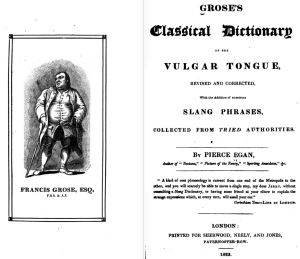
The image above is taken from Grose’s Classical Dictionary of the Vulgar Tongue by Pierce Egan (1823). Caution, even though this slang is centuries old, some of it is vulgar in every sense of the word; it may even cause one to blush.

Who Said That?

thoms and lewisWho said that? It’s a question people ask when they recall a familiar saying and don’t remember the source.

Occasionally when we are reminded of the source, we shake our heads and think that’s right; how could I have forgotten!

At other times though, discovering the source of the maxim doesn’t help at all. It could be because the proverb is anonymous, or it might be due to the fact that it’s originator was not particularly well known.

That’s the case of the following statement, which is familiar to many Christians.

“Be careful how you live; you will be the only Bible some people ever read.”

When I thought of this phrase several weeks ago, I had a bit of trouble tracking it down. I actually found it on a number of sites, but the problem was that the author’s name was so unfamiliar it was almost always misspelled.

He was usually cited as “William Toms.” Yet I was pretty sure the saying hadn’t originated, however, with an Irish footballer.*

Just when I assumed I had encountered a clichéd brick wall, I stumbled upon the truth. Like so many classic maxims, the quotation did indeed originate from the British Isles.

The British writer William J. Thoms penned this thoughtful maxim, and it isn’t the only wise thing he wrote.

William John Thoms (1803 – 1885) was a British writer credited with coining the term “folklore” in the 1840s. Thoms’ investigation of folklore and myth led to a later career of debunking longevity myths. Hence, he is an early advocate of “validation research” when examining demographics.

Several of Thoms’ works are available online. They include:

C.S. Lewis had more in common with Thoms than simply being British and engaging in literary pursuits. The two men shared an interest in simple tales that intrigued and inspired men and women through the ages.

It was Thoms, in fact, who in 1846 introduced into English the term “folklore.”

A shared interest in legends and even the supernatural, suggests that the two may well have enjoyed one another’s company, had their lives intersected.

Sadly, Thoms’ desire to compile a comprehensive “Folk-Lore of England” was never realized, as this superb article describes.

The two scholars shared another trait of bookish people. (“Bookish,” by the way, is a compliment here at Mere Inkling.) Neither man sought out the frivolities of popular society. They were both content to socialize with similar minds in more intimate community. The following description of Thoms, from the Dictionary of National Biography,could just as naturally have been written about Lewis.

Thoms went little into society, but at congenial resorts, such as the ‘Cocked Hat Club,’ he was remarkable for a ready play of wit and an almost inexhaustible fund of humorous anecdote and reminiscence.

Can’t you just picture the Cocked Hat Club meeting at one table in the Eagle and Child while the Inklings shared their own warm friendship at their table at the other end of the pub?

_____

* Not that I follow English football, but I learned an athlete by that name played forward for Plymouth Argyle and Manchester United.

** The Book of the Court, published in 1838 with the second edition, linked here, printed six years later, has the delightful, if rather lengthy, subtitle: Exhibiting the History, Duties, and Privileges of the Several Ranks of the English Nobility and Gentry, Particularly of the Great Officers of State and members of the Royal Household; Including Vaious Forms of Court Etiquette, Tables of Precedency, Rules to be Observed at Levers and Drawing Rooms, Etc.

Enlarging C.S. Lewis’ Vocabulary

csl sayersCan you imagine receiving a compliment like this from C.S. Lewis? Your work “even enlarged my vocabulary.”

Shocking . . . but another writer did receive that rare praise.

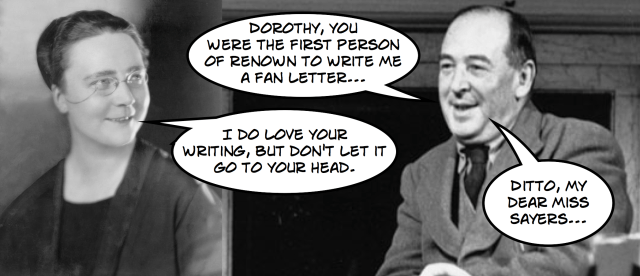
In 1954, Lewis wrote a lengthy letter to his friend Dorothy Sayers, praising her recent publication of Introductory Papers on Dante. Lewis’ opening sentence reveals his delight. “Your Introductory Papers have given me a regular feast.”

Lewis specifically comments on a number of insights he found particularly worthwhile. And remember, Lewis was an expert on Dante in his own right.

One evidence that Lewis’ praise is sincere, and not mere flattery, comes in his comment that “every essay and nearly every page enriched me.” Not every page, mind you, but very nearly every one of them.

Offering Gentle Criticism

Consistent with the nature of friendly literary criticism (like one receives in a healthy writers group), Lewis does offer some specific advice on how to strengthen a specific point that he regards as overemphasized. In this case it relates to a classical Latin phrase.

At one point Lewis expresses awe about a portion of the book, and then immediately proceeds to make an enjoyable comment about the limitations of the English language.

P. 52 is a blaze of (just) splendour. (Drat our homophones: by just I don’t mean ‘nothing but,’ I mean ‘justified,’ ‘veracious.’)

Toward the close of his letter, Lewis raises a profound notion about our perception of humor. He cautions Sayers, in her interpretation of Dante’s Comedy, not to read it directly through the lens of our own day. “I’ve a feeling that in handling particular passages you are too certain that whatever is comic to us was, and was meant to be, comic at the time.” He continues:

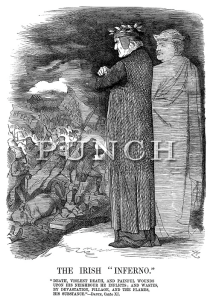
Because, as any one can see even from the old Punches,* nothing changes so quickly as the sense of humour: so that in reading any old book there is nothing we are less sure of than which places wd. welcome a smile. And oughtn’t we to start by a recognition that our generation (yours & mine) was quite abnormally ‘tickle o’ the sere’** (already the young people are less so).

A Poetic Postscript

Lewis ends his letter to Sayers with some advice for her subsequent work with Dante. He courteously writes, “Don’t give me the next set, I’ll buy it.”

Then he makes a suggestion to protect her from the spurious criticisms of ignorant literary critics. (Note that he doesn’t use the choice descriptive in a vulgar sense common today, but in more classical sense of extreme foolishness.)

And do put in an essay on D. as ‘poet’ in the old, narrowest sense—his sheer poeticalness. Otherwise we shall have some ass saying that because you like so many other qualities, you are oblivious to that.

_____

* Punch Magazine was published in England until 1992. The 1881 image below is inspired by Dante’s Inferno, and applied to the violence in Ireland.

** Easily made to laugh. From Hamlet: “The clown shall makes those laugh whose lungs are tickle o’ the sere.” The seare, or sere, was part of the trigger of old matchlock guns, so arranged that the slightest movement would make the gun discharge. Lungs, then, “tickle o’ the sere,” are those easily moved to laughter.

punch dante