Sanctified Languages

petrusOne major difference between Christianity and Islam is their view of language. For the Muslim, Arabic is the language by which the Quran is to be known. For the Christian, there is a great impulse to translate the Scriptures into every tongue in the world.

In Islamic worship, the Quran is properly recited only in Arabic, whether the individual understands Arabic or not. This is similar to the way that most Hindus chant mantras in ancient Sanskrit.

A parallel can be drawn with the medieval practice in the Western branches of Christianity where Latin continued to be used for worship, even after it lost its role as the shared language.

The fact, however, that the Bible had even been translated into Latin was due to the Christian desire to make God’s word accessible to all people. Jerome, an early Christian theologian, became a linguistic scholar with the goal of translating the Vulgate, into the common language of his day.

It would have been a great shock to him, and to Pope Damasus I who commissioned his effort, to see the Latin so ingrained in the church’s usage that their heirs in leadership lost sight of the desire to bring the Lord’s words directly to the people so that all could understand them.

One of the great successes of the Reformation was the successful translation and distribution of the Scriptures into the vernacular of various language groups. Martin Luther’s translation, in fact, standardized the German language which had evolved into several different dialects.

Coincidentally, Lutherans have remained at the forefront of Bible translation, and Lutheran Bible Translators continue that vital work today. They currently have twenty-two Bible translations in process. LBT works in conjunction with Wycliffe Bible Translators, which is an even larger organization.

C.S. Lewis delivered a lecture at the University of London entitled “The Literary Impact of The Authorised Version.” In one portion he addressed the influence of the King James translation on the English language. While not nearly so pronounced as Luther’s on German, it is measurable.

The history of the Authorised Version has been told so often that I will not attempt to re-tell it, and its beauties praised so lavishly that I will not praise them. Instead, I will proceed at once to its influence as an English book. I shall attempt to define that influence, for I think there has been misunderstanding about it and even a little exaggeration.

Lewis’ argument is that the Bible has a profound influence on English literature, the particular translation, less so.

Ideally, all Christians would understand Hebrew and Greek, and be able to read the Scriptures in their original languages. However, there is no stigma in reading a translation. In fact, there are small pockets of people who do not understand the history of the Bible who believe that one particular translation (i.e. the King James Version) is the only authoritative text.

Sadly, I once saw an advertisement in a newspaper inviting worshipers that read: “Are you tired of people changing the Authorized Version of God’s Word with Greek and other languages? If so, come and join us at . . .”

Fortunately, the vast majority of Jesus’ disciples celebrate the translation of God’s word of life into every language spoken today.

Meanwhile, memorization of the Quran in Arabic (even when that is not the reciter’s actual language) remains highly regarded in Islam. Arabic has been regarded as so holy, in fact, that there was great reluctance to contaminate the Quran by using a printing press.

During the Ottoman Empire, until 1729, printing anything in Arabic was a crime. Somewhat ironically, the first printing utilizing Arabic movable type was done by Pope Julius II in the first decade of the sixteenth century. It was created for the benefit of Christians living in Arabic lands.

To provide a powerful illustration of a Christian validation of the authentic inspiration and power of God’s words—in any language—we turn once again to the German reformer.

Since it becomes Christians then to make good use of the Holy Scriptures as their one and only book and it is a sin and a shame not to know our own book or to understand the speech and words of our God, it is a still greater sin and loss that we do not study languages, especially in these days when God is offering and giving us men and books and every facility and inducement to this study, and desires his Bible to be an open book. . . .

In proportion then as we value the gospel, let us zealously hold to the languages. For it was not without purpose that God caused his Scriptures to be set down in these two languages alone—the Old Testament in Hebrew, the New in Greek. Now if God did not despise them but chose them above all others for his word, then we too ought to honor them above all others. St. Paul declared it to be the peculiar glory and distinction of Hebrew that God’s word was given in that language, when he said in Romans 3, “What advantage or profit have those who are circumcised? Much indeed. To begin with, God’s speech is entrusted to them. . . .”

Similarly, the Greek language too may be called sacred, because it was chosen above all others as the language in which the New Testament was to be written, and because by it other languages too have been sanctified as it spilled over into them like a fountain through the medium of translation. (Martin Luther, “To the Councilmen of Germany”).

_____

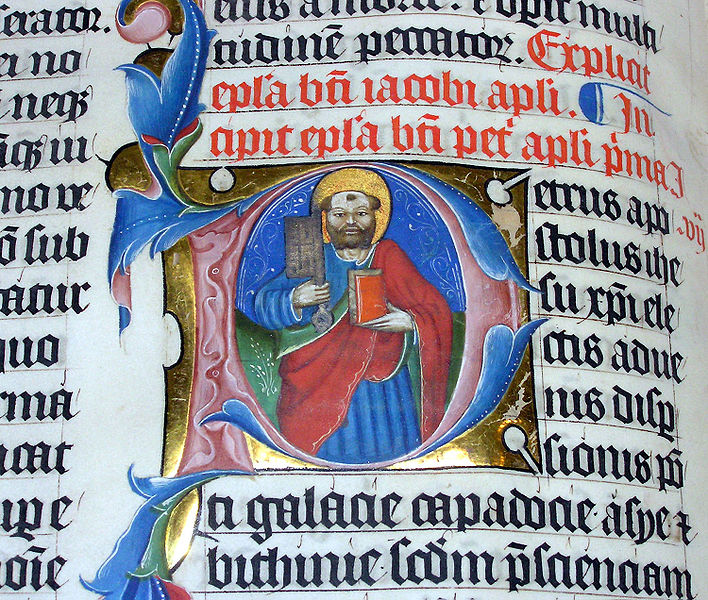
The image above is an illuminated “P” which begins the name Petrus (Peter). The manuscript is displayed in Malmesbury Abbey in England, but was originally transcribed in Belgium circa 1400.

Martian Tribute to C.S. Lewis

Malacandra CraterMere Inkling recently named a crater on Mars, in honor of C.S. Lewis. The crater’s name is Malacandra, which was the name for the red planet in the first volume of Lewis’ Space Trilogy, Out of the Silent Planet.

The naming of Malacandra Crater was done through an organization preparing the map which will be used by the Mars One Mission. Mars One is the optimistic international effort to establish a permanent human settlement on the red planet, beginning in 2024.

The über-adventurous (or foolhardy) are able to apply today for consideration to become an astronaut.

The crater naming project is not sponsored by the International Astronomical Union (IAU). Instead, it is coordinated by Uwingu, a for profit company that has a goal of raising $10,000,000 for grants to scientists and educators promoting space exploration.

Due to its limited* budget, Mere Inkling was only able to name a small crater. However, it’s not the expense, it’s the thought that counts.

In addition to Malacandra Crater, I named the impact mark directly to its south in honor of my grandchildren. The process allows one to include a dedication for each named crater. For theirs, I wrote:

Stroud Crater is named in honor of the brilliant grandchildren of Rob & Delores Stroud. Andrew, Ariana, Dominic, Arabelle, Rachel, Rebecca, Kaelyn & Asher. Whether they grow up to be astrophysicists, veterinarians or educators, we know they will all make this world a better place. Soli Deo Gloria.

The tiny basins named above lie in Aurorae Chaos. It’s a rugged neighborhood, but there are surprisingly few craters in the immediate vicinity. I’m always seeking opportunities to encourage my grandchildren to study science, and I hope this will pique their interests, both now and in the years to come.

C.S. Lewis is not primarily known today as a writer of science fiction, but his series (also known as the Cosmic Trilogy, or the Ransom Trilogy, after its protagonist) is quite good. In fact, it was the very first of Lewis’ works I ever read. I was introduced to them by a Christian friend during my college years.

Several influences converged to move Lewis to venture into science fiction. In 1938, he thanked a friend for his praise of Out of the Silent Planet, and wrote:

You are obviously much better informed than I about this type of literature and the only one I can add to your list is Voyage to Arcturus by David Lyndsay (Methuen) which is out of print but a good bookseller will probably get you a copy for about 5 to 6 shillings. It is entirely on the imaginative and not at all on the scientific wing.

What immediately spurred me to write was Olaf Stapledon’s Last and First Men and an essay in J. B. S. Haldane’s Possible Worlds both of which seemed to take the idea of such travel seriously and to have the desperately immoral outlook which I try to pillory in Weston.

I like the whole interplanetary idea as a mythology and simply wished to conquer for my own (Christian) point of view what has always hitherto been used by the opposite side. I think Wells’ 1st Men in the Moon the best of the sort I have read.**

Lewis then appends a comment referring to the other planets in our solar system, but intriguing in light of the recent discovery of numerous planets throughout the galaxy. “The more astronomy we know the less likely it seems that other planets are inhabited: even Mars has practically no oxygen.”

One of Lewis often overlooked science fiction short stories, “Ministering Angels,” is set on Mars. It begins in the following way.

The Monk, as they called him, settled himself on the camp chair beside his bunk and stared through the window at the harsh sand and black-blue sky of Mars. He did not mean to begin his ‘work’ for ten minutes yet. Not, of course, the work he had been brought there to do. He was the meteorologist of the party, and his work in that capacity was largely done; he had found out whatever could be found out.

There was nothing more, within the limited radius he could investigate, to be observed for at least twenty-five days. And meteorology had not been his real motive. He had chosen three years on Mars as the nearest modern equivalent to a hermitage in the desert.

He had come there to meditate: to continue the slow, perpetual rebuilding of that inner structure which, in his view, it was the main purpose of life to rebuild. And now his ten minutes’ rest was over. He began with his well-used formula. ‘Gentle and patient Master, teach me to need men less and to love thee more.’ Then to it. There was no time to waste.

There were barely six months of this lifeless, sinless, unsuffering wilderness ahead of him. Three years were short . . . but when the shout came he rose out of his chair with the practised alertness of a sailor.

The Botanist in the next cabin responded to the same shout with a curse. His eye had been at the microscope when it came. It was maddening. Constant interruption. A man might as well try to work in the middle of Piccadilly as in this infernal camp. And his work was already a race against time. Six months more . . . and he had hardly begun.

The flora of Mars, these tiny, miraculously hardy organisms, the ingenuity of their contrivances to live under all but impossible conditions—it was a feast for a lifetime. He would ignore the shout. But then came the bell. All hands to the main room.
(“Ministering Angels,” Of Other Worlds: Essays and Stories).

Malacandra Crater may be a small feature on a vast and curious planet, but it is a tribute to an author of immense and lasting talent.

_____

* i.e. nonexistent

** The following titles mentioned by Lewis are available for free digital download:

Voyage to Arcturus

Last and First Men

The First Men in the Moon

Free Books

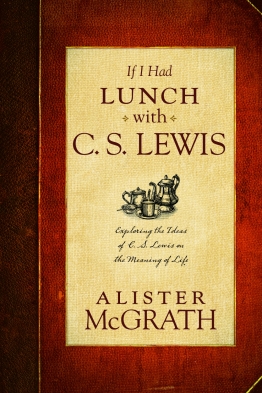
lunchIf you would like to pick up a free kindle copy of a very recent book on C.S. Lewis, you need to hurry. No telling how long the offer will last.

If I Had Lunch with C. S. Lewis by Alister McGrath has a normal (U.S.) price of $17.99, so it’s quite an offer.

But read on for another great deal. Ugh, that sounded like what a shill—which I am not—might say. Allow me to rephrase.

But keep reading. That’s not the only special offer for kindle readers right now. (And remember, even if you don’t own a kindle reader, Amazon offers a free program for use on your computer.)

I rarely look for free kindle titles, since it’s a genuine effort to sort through the chaff to find the grains of wheat. Today, however, I took a quick look, and I’m glad I did.

When this book was first released, just this year, I thought it looked interesting. Only last year, McGrath wrote the biography, C.S. Lewis A Life: Eccentric Genius, Reluctant Prophet.

The free title offers a thematic introduction to Lewis. It’s subtitle reads, Exploring the Ideas of C.S. Lewis on the Meaning of Life. It may be something you might want to suggest to your acquaintances unfamiliar with the Oxford Inkling.

Often, when items or services are offered without cost, it indicates a lack of value. This is why the maxim “you get what you pay for” arose.

However, the rapidly morphing publishing business contradicts the usual accuracy of that principle.

In order to promote their work, and expand their paying audience, a new distribution model has writers offering their books for free. And, alert readers can take advantage of the opportunities.

In light of that, allow me to share with you another time sensitive offer that I found as I browsed further. Right now you can purchase the kindle version of volume three of Lewis’ correspondence for a mere ninety-nine cents. I can’t recall now what I paid for my hardback and kindle copies of the volume, but trust me . . . this is an amazing deal.

Free Bonus Book

Students of C.S. Lewis will recall the significant impression that George MacDonald (1824-1905) made on his life. Right now you can download a collection of 365 quotations from MacDonald’s works for free.

365 Meditations from George MacDonald’s Fiction is edited by David Wilson-Okamura. This work, he writes, “was inspired by George MacDonald, An Anthology: 365 Readings, edited by C. S. Lewis (1946).”

Introducing Anatole France

papeThere’s always a new author to meet. Some are more worth meeting than others.

I was introduced to Anatole France (1844-1924) when I saw him listed on the “must read” list of F. Scott Fitzgerald.

I’m not a big Fitzgerald fan, but as an amateur literary historian, I was curious about how this particular list was recovered. Apparently, he had dictated it to one of his nurses, several years before his death. However, the list only turned up last year, having lain unnoticed in the nurse’s effects.

The France title that Fitzgerald deemed essential was The Revolt of the Angels. Its importance to him is highlighted by the fact that this relatively short list only included twenty-two titles. And one of that mere score of selections was The Revolt of the Angels.

The angelic dimension of the work is what intrigued me. Angels, of course, are real beings. They’re distinct from people (contrary to the pervasive contemporary notion that when people die they “become” angels).

There actually was an angelic revolt, and there are several references to it in the Scriptures. “How you are fallen from heaven,
O Day Star, son of Dawn!” (Isaiah 14:12).

I was curious whether France was writing about this ancient event. I was also intrigued by Fitzgerald’s interest in the volume, given its subject.

I was disappointed.

It turns out that, like Mark Twain, France was sympathetic to the Devil. I’m sure he thought himself quite the wit when he wrote, in reference to the Bible, “We have never heard the devil’s side of the story, God wrote the whole book.”

I don’t have time to read texts like this—when there is more than enough good literature to keep me occupied for several lifetimes. However, it appears to be based on Gnostic concepts with God (the Creator of this world) viewed as an imperfect demiurge. His incompetence, it seems, justifies the heavenly revolt.

Suffice it to say, the book is commended for reading by the Freedom From Religion Foundation. That sort of endorsement speaks volumes.

Here, however, is a random paragraph. It may be illustrative of the tone of the work, even though pulled from its context. The speaker is, I believe, one of the positive characters in the book. While France himself was an atheist, his sympathetic character summarizes a pagan cosmology quite elegantly.

Young Maurice’s guardian angel [said] “I argue, like you, in the language of human beings. And what is human language but the cry of the beasts of the forests or the mountains, complicated and corrupted by arrogant anthropoids. How then . . . can one be expected to argue well with a collection of angry or plaintive sounds like that?

Angels do not reason at all; men, being superior to the angels, reason imperfectly. I will not mention the professors who think to define the absolute with the aid of cries that they have inherited from the pithecanthropoid monkeys, marsupials, and reptiles, their ancestors! It is a colossal joke! How it would amuse the demiurge, if he had any brains!”

That is actually a rather provocative quote, and I’m sure it may lead some to explore the text even further. I certainly don’t object to that, and would be curious to hear back from anyone familiar with the book. I would especially like to see the reaction of Christians to The Revolt of the Angels.

If you are interested in a more creative fictional treatment of fallen angels, be sure to read C.S. Lewis’ The Screwtape Letters. While the presentation is truly groundbreaking, Lewis’ take on the motives and nature of these defeated beings is actually based on reality. Cast from the heavens they are consumed with rage and hatred of God.

A positive note about Anatole France

Whatever I think about the writer’s theology, I did read several wise quotations attributed to him. I’d like to close with these, as they may be more edifying than our discussion of Gnostic cosmology.

“Nine tenths of education is encouragement.”

“Some succeed because they are destined to; most succeed because they are determined to.”

“If 50 million people say a foolish thing, it is still a foolish thing.”

“When a thing has been said and well said, have no scruple; take it and copy it.”

And my favorite:

“Until one has loved an animal, a part of one’s soul remains unawakened.”

_____

The illustration above is the work of Frank C. Papé (1874-1972) an English book illustrator. It comes from another of France’s “religious” works.

Navy Nerds

nerdEvery once in a while, the military has a good idea. Sure, they have a knack for technological breakthroughs in warfare . . . but what about other fields? The NAVY NeRD answers that question in the affirmative.

NeRD stands for Navy eReader Device.

Well-informed readers of Mere Inkling are already aware of the growing intensity of international cyberwarfare. It is no joke, and lives are at stake.

Draconian policies are in place to avoid the contamination of the military computer system by innocently transferred viruses. Since virtually all digital platforms allow for the transfer of data, they are potentially dangerous.

Because of that, even ereaders have been off limits in certain environments. Now, however, someone has thought outside the proverbial box and come up with a solution to that problem.

The United States Navy has devised a novel ereader that comes loaded with 300 titles, but has no ports or wireless connectivity to allow for inadvertent viral transfers.

The selection of books sounds pretty well rounded. Some public domain classics, and a number of contemporary best sellers like A Game of Thrones. Fans of J.R.R. Tolkien will be delighted to know the readers also include The Lord of the Rings.

Reading is a productive way to spend one’s free time during a lengthy period at sea. Even for those not prone to opting for it when faced with all the distractions ashore.

During WWII, C.S. Lewis wrote a letter to a former student who was serving in the Navy, “out of reach of libraries.” It acknowledges the perennial problem of sailors—lack of space for personal property. The letter was written in response to a request from Michael Rayner Thwaites for reading recommendations. Thwaites was an Australian poet and military intelligence officer.

A man who has already your linguistic training might well, I think, begin the Anglo Saxon on his own. You will need E. Wardale Old English Grammar. . . . For texts, the ordinary beginning is first Sweet’s Anglo Saxon Primer and then his Old English Reader. But you, being a classic might well, after a dip in the Primer go on to King Alfred’s trans. of Boethius De Consolatione Philosophiae . . .

Whether you can begin O.E. poetry on your own I don’t know. But try getting . . . Beowulf: and with it Clark Hall’s trans. ed. by Wrenn with preface by Tolkien . . . This edition is essential for it is Tolkien’s part of metre wh. is essential. (O.E. verse uses both quality and accent, and your ear is prob. ruined, as mine was, by the false way they teach Latin metre at schools–drastic re-education is required. . . .

As to modern literature. You must not start out to study it ‘as it reveals man’s hesitant advance to the idea of a God-created world’. Don’t you see you are laying down in advance what a phenomenon is to reveal before you have examined the phenomenon? It may reveal that: it may not. You have to find out. I don’t think I can lay down any v. definite course of reading.

All I can point out is that while you are in the navy and out of reach of libraries and new publications, this is the proper time for solid reading through the big (i.e. long) authors, critical works and histories of lit. can come later. Now is the time for Chaucer, Malory, Spenser, Sidney, Shakespeare, Dryden, Pope, Swift, Johnson, Fielding, Richardson, Cowper, Scott, Wordsworth, Byron, Dickens etc etc.

If you usually keep two books of widely different period and type going together (e.g. Faerie Queene & Tom Jones) you won’t get bored. I myself always index a good book when I read it for the first time noting (a) Linguistic phenomena. (b) Good & bad passages. (c) Customs: meal times, social classes, what they read etc. (d) Moral ideas.

All this reading, tho’ dedicated ad Dei gloriam in the long run must not be infected by any immediate theological, ethical, or philosophic reference. Your first job is simply the reception of all this work with your imagination & emotions. Each book is to be read for the purpose the author meant it to be read for: the story as a story, the joke as a joke.

Back to the NeRD

The Navy is making 385 devices at first, with more to follow, with five being sent to each submarine in the Navy to be shared among the crew.

That’s only the start, of course. One would anticipate that even for a military crew (for example, 155 personnel on a Trident sub), a mere five mini-libraries would prove insufficient. (No offense intended; yours truly is a veteran himself.)

Harry Potter in the Bible

potterSo much for the effectiveness of “state churches.” The European ones appear to have become abject failures. There is ample evidence that the “establishment” of religions has rarely served either church or state very well.

Here’s the latest proof from the United Kingdom. The BBC recently reported a study that shows three in ten teenaged Brits don’t know the Nativity of Jesus came from the Bible. Similar numbers had never heard about the Crucifixion or Adam and Eve.

I imagine they’ll consider the new Noah film just another work of Hollywood fiction. (Actually, half of them didn’t know that very story comes from the Bible.)

What’s more—their parents are nearly as ignorant.

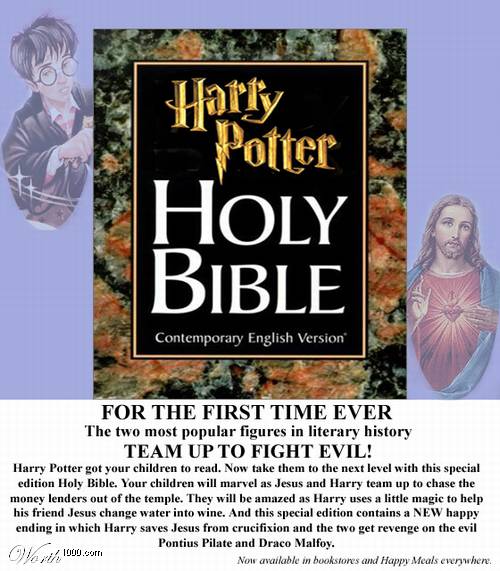
Many of the teens did, however, think that the plotlines from the Harry Potter series were based on Bible stories.

As a person who was genuinely inspired by England’s magnificent cathedrals while I lived there, it is painful to contemplate the terrible loss. The great-great-grandchildren of saints who suffered and sacrificed for the Gospel have disregarded the good news.

And, lest any readers think I’m pointing fingers as a “self-righteous” American, let me assure you I take no pride in my own nation’s slide into apostasy. The words of Micah’s prophecy seem closer to fulfillment each day. “The faithful have been swept from the land; not one upright person remains.”

C.S. Lewis saw this coming. Consider the following from his 1950 essay, “The Literary Impact of the Authorised Version.”

It may be asked whether now, when only a minority of Englishmen regard the Bible as a sacred book, we may anticipate an increase of its literary influence. I think we might if it continued to be widely read. But this is not very likely. Our age has, indeed, coined the expression “the Bible as literature.” It is very generally implied that those who have rejected its theological pretensions nevertheless continue to enjoy it as a treasure house of English prose.

It may be so. There may be people who, not having been forced upon familiarity with it by believing parents, have yet been drawn to it by its literary charms and remained as constant readers. But I never happen to meet them. Perhaps it is because I live in the provinces. But I cannot help suspecting, if I may make an Irish bull, that those who read the Bible as literature do not read the Bible.

Speaking of reading the Bible “as literature,” that’s not a bad thing. It informs so much Western literature, that an ignorance of the Scriptures is tantamount to possessing an inadequate education. An excellent online resource for exploring this truth can be found at the Bible Literacy Project.

The site includes a copy of a comprehensive 2006 study of English professors from America’s top-rated schools, including Yale, Harvard, Princeton, Stanford, Texas A&M, UC-Berkeley and others. In the study, not a single professor disagreed with the statement that: “Regardless of a person’s faith, an educated person needs to know the Bible.”

If some people could get past their prejudices against the Bible, they would recognize the truth of this statement. Everyone should be reading the Bible, even if only as a significant literary work.

Perhaps, if this widespread study comes to pass, one day people will be able to recognize the difference between the Scriptures and Harry Potter.

Discordant Dictionaries

dictionary 1Most “word people” like dictionaries. Some writers go so far as to love dictionaries, but I don’t wish to quibble about where one rests on the affection spectrum in terms of these repositories of words.

This guy, though, has to be pegged on the extreme (idolatry) end of the meter. Ammon Shea wrote Reading the OED: One Man, One Year, 21,730 Pages after having done just that. The Oxford English Dictionary, you may know, comprises 25 volumes, and Shea warns that reading it at such a rapid pace took a toll on his eyesight. It’s not surprising, that he admits he is not your typical reader.

One could say that I collect word books, since by last count I have about a thousand volumes of dictionaries, thesauri, and assorted glossaries. . . . I do not collect these words because I want to impress friends and colleagues with my erudition. . . .

My friends know that I read dictionaries for fun, and have come to accept this proclivity with relative good grace, but they are not terribly interested in or impressed by my word collection.

Pierre Jules Théophile Gautier advised his fellow poets to read the dictionary. No better way to enrich one’s language, he claimed, although he also read cook books, almanacs and the like. In fact, his biographer offered this fascinating observation.

He found pleasure in the most indifferent novels, as he did in books of the highest philosophical conceptions, and in works of pure science. He was devoured with the desire to learn, and said: “No conception is so poor, no twaddle so detestable that it cannot teach us something by which we may profit.”

C.S. Lewis indicated that so-called “definitions” offered outside the ordinances of the dictionary must be approached warily. “When we leave the dictionaries we must view all definitions with grave distrust” (Studies in Words). He offers a very sensible reason for such precautions.

It is the greatest simplicity in the world to suppose that when, say, Dryden defines wit or Arnold defines poetry, we can use their definition as evidence of what the word really meant when they wrote. The fact that they define it at all is itself a ground for scepticism.

Unless we are writing a dictionary, or a text-book of some technical subject, we define our words only because we are in some measure departing from their real current sense. Otherwise there would be no purpose in doing so (Studies in Words).

Dictionaries are, of course, their own genre. Lectionaries, collections of words and meanings, are different than any other type of written composition. For example, glossaries may draw together specialized vocabulary—say for medical or theological purposes—but by their very nature they are not intended to blaze any new literary pathways.

There is, invariably, an exception to this rule. Some “dictionaries” are creative exercises. They are works of fiction, and some are entertaining indeed.

The most famous of these satirical works is Ambrose Bierce’s Devil’s Dictionary (originally published as The Cynic’s Word Book). The volume is not expressly irreverent, although people of faith will encounter some offensive examples in its pages. However, a number of the entries are brilliant.

Kilt

  1. A costume sometimes worn by Scotchmen in America and Americans in Scotland.

Rank

  1. Relative elevation in the scale of human worth.

He held at court a rank so high

That other noblemen asked why.

“Because,” ’twas answered, “others lack

His skill to scratch the royal back.”

Emancipation

  1. A bondman’s change from the tyranny of another to the despotism of himself.

He was a slave: at word he went and came;

     His iron collar cut him to the bone.

Then Liberty erased his owner’s name,

     Tightened the rivets and inscribed his own.

Goose

  1. A bird that supplies quills for writing. These, by some occult process of nature, are penetrated and suffused with various degrees of the bird’s intellectual energies and emotional character, so that when inked and drawn mechanically across paper by a person called an “author,” there results a very fair and accurate transcript of the fowl’s thought and feeling. The difference in geese, as discovered by this ingenious method, is considerable: many are found to have only trivial and insignificant powers, but some are seen to be very great geese indeed.

Another Frenchman, Gustave Flaubert, composed his Dictionary of Received Ideas, which found humor in peculiarities of common understandings.

Absinthe

Extra-violent poison: one glass and you’re dead. Newspapermen drink it as they write their copy. Has killed more soldiers than the Bedouin.

Archimedes

On hearing his name, shout “Eureka!” Or else: “Give me a fulcrum and I will move the world.” There is also Archimedes’ screw, but you are not expected to know what it is.

Omega

Second letter of the Greek alphabet. [Note: this would only apply to biblically literate societies.]

The earliest such example of a satirical dictionary was that by the Persian writer Nezam od-Din Ubeydollah Zâkâni. I have not located a copy of his 14th century lexicon, but it apparently includes entries that are still understandable in our modern world.

Thought

What uselessly makes people ill.

Orator

A donkey.

Word lovers can easily get caught up in conversations like this. In fact, I’m certain more than one Mere Inkling reader has contemplated compiling their own creative dictionary! It’s not an insurmountable project, since it’s accomplished one word at a time.

_____

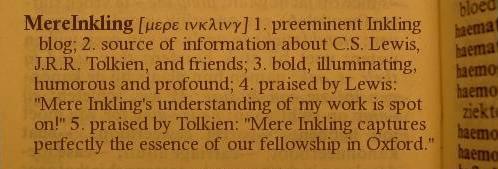
For those desiring to create their own dictionary “entries” such as the one that graces the top of this blog, there a free meme generator you can use online. Available here, it’s a fun little tool. It’s also suitable for creating a little self-deprecating humor.

dictionary 2

Having Our Writing Criticized

roeShould literary critics look down on authors whose work proves popular with “common” people? Is it appropriate for the literary elite to smirk dismissively whenever the prose of a writer outside their circle resonates with the masses?

These, my friends, are rhetorical questions. The answer to both is “no,” and if you believe otherwise, you probably won’t find yourself too comfortable with the opinions shared here at Mere Inkling.

I believe each piece of literature, regardless of its source, should be judged on its own merits. Not all genres appeal to all people. And not all writers compose their works with equal skill. Nevertheless, it is possible for even a poor miner to strike gold.

Likewise, an accomplished writer is not infallible. Even a master wildcatter can sink a dry well.

I’ve been writing an article about Civil War chaplain who became one of America’s most popular writers during the nineteenth century. In fact, many years his novels outsold the works of Samuel Clemens himself.

And yet, despite his success—or possibly, because average people enjoyed his stories—he received an extraordinary amount of criticism from the literary establishment.

I’m going to share his insights about writing in a moment, but  before doing so, I want to draw a parallel with one of the twentieth century’s most gifts authors. C.S. Lewis was loved by common women and men of Britain and other English-speaking countries. And yet, this very popularity undermined his standing in the world of academia and, I daresay, literary snobbery.

Lewis describes this condescending mindset in a 1939 essay entitled, “High Brows and Low Brows.”

The great authors of the past wrote to entertain the leisure of their adult contemporaries, and a man who cared for literature needed no spur and expected no good conduct marks for sitting down to the food provided for him.

Boys at school were taught to read Latin and Greek poetry by the birch, and discovered the English poets as accidentally and naturally as they now discover the local cinema. Most of my own generation, and many, I hope, of yours, tumbled into literature in that fashion.

Of each of us some great poet made a rape when we still wore Eton collars. Shall we be thought immodest if we claim that most of the books we loved from the first were good books and our earliest loves are still unrepented? If so, that very fact bears witness to the novelty of the modern situation; to us, the claim that we have always liked Keats is no prouder than the claim that we have always liked bacon and eggs. For there are changes afoot.

I foresee the growth of a new race of readers and critics to whom, from the very outset, good literature will be an accomplishment rather than a delight, and who will always feel, beneath the acquired taste, the backward tug of something else which they feel merit in resisting.

Such people will not be content to say that some books are bad or not very good; they will make a special class of “lowbrow” art which is to be vilified, mocked, quarantined, and sometimes (when they are sick or tired) enjoyed. They will be sure that what is popular must always be bad, thus assuming that human taste is naturally wrong, that it needs not only improvement and development but veritable conversion.

For them a good critic will be, as the theologians say, essentially a “twice-born” critic, one who is regenerate and washed from his Original Taste. They will have no conception, because they have had no experience, of spontaneous delight in excellence.

I confess I’ve sometimes felt slightly embarrassed when in the presence of a group of people singing the praises of authors of fiction popular among the well-educated. Sometimes I don’t even recognize their names, much less have an idea of what they have written.

Part of my “handicap” rises from the fact that I’m by and large a non-fiction sort of guy. As seminary I was less enraptured by abstract “systematic theology” than the time-proven lessons learned during the Church’s two millennia history. Likewise, I found “practical theology” far more beneficial. After all, I was being equipped not to be a theologian per se, but to become a shepherd entrusted with the cura animarum (the cure of souls).

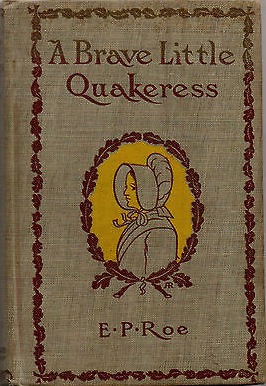
In that spirit, valuing history and lessons I could put into practice as a pastor and writer, I have been researching the legacy of Edward Payson Roe (1838-1888). He was a Presbyterian pastor who served as a chaplain in the Union cavalry, and later as a military hospital chaplain.

After the war, Roe served a congregation, and eventually turned his energies to writing wholesome fiction. He played a key role in helping many suspicious Protestants realize that, like manna, fiction was neither good nor bad. It’s effects depended on the use to which it was put. Roe proved quite popular with readers. Less so with the literary establishment.

The following account comes from an essay about his life solicited by one of the prominent magazines of his day. It is well worth reading, touching as it does on a broad range of subjects, including international copyrights and the vagaries of publishing in the late 1800s. Most precious, though, are the echoes of Roe’s humility and his realistic understanding of the vocation of writing.

“While writing my first story, I rarely thought of the public, the characters and their experiences absorbing me wholly. When my narrative was actually in print, there was wakened a very deep interest as to its reception. I had none of the confidence resulting from the gradual testing of one’s power or from association with literary people, and I also was aware that, when published, a book was far away from the still waters of which one’s friends are the protecting headlands.

“That I knew my work to be exceedingly faulty goes without saying; that it was utterly bad, I was scarcely ready to believe. Dr. Field, noted for his pure English diction and taste, would not publish an irredeemable story, and the constituency of the New York ‘Evangelist’ is well known to be one of the most intelligent in the country.

“Friendly opinions from serial readers were reassuring as far as they went, but of course the great majority of those who followed the story were silent. A writer cannot, like a speaker, look into the eyes of his audience and observe its mental attitude toward his thought. If my memory serves me, Mr. R.R. Bowker was the earliest critic to write some friendly words in the ‘Evening Mail;’ but at first my venture was very generally ignored.

Then some unknown friend marked an influential journal published in the interior of the State and mailed it so timely that it reached me on Christmas eve. I doubt if a book was ever more unsparingly condemned than mine in that review, whose final words were, ‘The story is absolutely nauseating.’ In this instance and in my salad days I took pains to find out who the writer was, for if his view was correct I certainly should not engage in further efforts to make the public ill.

“I discovered the reviewer to be a gentleman for whom I have ever had the highest respect as an editor, legislator, and honest thinker. My story made upon him just the impression he expressed, and it would be very stupid on my part to blink the fact. Meantime, the book was rapidly making for itself friends and passing into frequent new editions. Even the editor who condemned the work would not assert that those who bought it were an aggregation of asses. People cannot be found by thousands who will pay a dollar and seventy-five cents for a dime novel or a religious tract.

“I wished to learn the actual truth more sincerely than any critic to write it, and at last I ventured to take a copy to Mr. George Ripley, of the New York ‘Tribune.’ ‘Here is a man,’ I thought, ‘whose fame and position as a critic are recognized by all. If he deigns to notice the book, he will not only say what he thinks, but I shall have much reason to think as he does.’ Mr. Ripley met the diffident author kindly, asked a few questions, and took the volume. A few weeks later, to my great surprise, he gave over a column to a review of the story. Although not blind to its many faults, he wrote words far more friendly and inspiring than I ever hoped to see; it would seem that the public had sanctioned his verdict

“From that day to this these two instances have been types of my experience with many critics, one condemning, another commending. There is ever a third class who prove their superiority by sneering at or ignoring what is closely related to the people. Much thought over my experience led to a conclusion which the passing years confirm: the only thing for a writer is to be himself and take the consequences. Even those who regard me as a literary offender of the blackest dye have never named imitation among my sins.

“As successive books appeared, I began to recognize more and more clearly another phase of an author’s experience. A writer gradually forms a constituency, certain qualities in his book appealing to certain classes of minds. In my own case, I do not mean classes of people looked at from the social point of view. A writer who takes any hold on popular attention inevitably learns the character of his constituency. He appeals, and minds and temperaments in sympathy respond. Those he cannot touch go on their way indifferently; those he offends may often strike back. This is the natural result of any strong assertion of individuality.

“Certainly, if I had my choice, I would rather write a book interesting to the young and to the common people, whom Lincoln said ‘God must love, since He made so many of them.’ The former are open to influence; the latter can be quickened and prepared for something better. As a matter of fact, I find that there are those in all classes whom my books attract, others who are repelled, as I have said.

“It is perhaps one of the pleasantest experiences of an author’s life to learn from letters and in other ways that he is forming a circle of friends, none the less friendly because personally unknown. Their loyalty is both a safeguard and an inspiration. On one hand, the writer shrinks from abusing such regard by careless work; on the other, he is stimulated and encouraged by the feeling that there is a group in waiting who will appreciate his best endeavor.

“While I clearly recognize my limitations, and have no wish to emulate the frog in the fable, I can truthfully say that I take increasing pains with each story, aiming to verify every point by experience—my own or that of others. Not long since, a critic asserted that changes in one of my characters, resulting from total loss of memory, were preposterously impossible. If the critic had consulted Ribot’s ‘Diseases of Memory,’ or some experienced physician, he might have written more justly.

“I do not feel myself competent to form a valuable opinion as to good art in writing, and I cannot help observing that the art doctors disagree woefully among themselves. Truth to nature and the realities, and not the following of any school or fashion, has ever seemed the safest guide. I sometimes venture to think I know a little about human nature. My active life brought me in close contact with all kinds of people; there was no man in my regiment who hesitated to come to my tent or to talk confidentially by the campfire, while scores of dying men laid bare to me their hearts. I at least know the nature that exists in the human breast.

“It may be inartistic, or my use of it all wrong. That is a question which time will decide, and I shall accept the verdict. Over twelve years ago, certain oracles, with the voice of fate, predicted my speedy eclipse and disappearance. Are they right in their adverse judgment? I can truthfully say that now, as at the first, I wish to know the facts in the case. The moment an author is conceited about his work, he becomes absurd and is passing into a hopeless condition. If worthy to write at all, he knows that he falls far short of his ideals; if honest, he wishes to be estimated at his true worth, and to cast behind him the mean little Satan of vanity. If he walks under a conscious sense of greatness, he is a ridiculous figure, for beholders remember the literary giants of other days and of his own time, and smile at the airs of the comparatively little man. On the other hand, no self-respecting writer should ape the false deprecating ‘’umbleness’ of Uriah Heep. In short, he wishes to pass, like a coin, for just what he is worth.

“Mr. Matthew Arnold was ludicrously unjust to the West when he wrote, ‘The Western States are at this moment being nourished and formed, we hear, on the novels of a native author called Roe.’ Why could not Mr. Arnold have taken a few moments to look into the bookstores of the great cities of the West, in order to observe for himself how the demand of one of the largest and most intelligent reading publics in the world is supplied? He would have found that the works of Scott and Dickens were more liberally purchased and generally read than in his own land of ‘distinction.’ He should have discovered when in this country that American statesmen (?) are so solicitous about the intelligence of their constituents that they give publishers so disposed every opportunity to steal novels describing the nobility and English persons of distinction; that tons of such novels have been sold annually in the West, a thousand to one of the ‘author called Roe.’

“The simple truth in the case is that in spite of this immense and cheap competition, my novels have made their way and are being read among multitudes of others. No one buys or reads a book under compulsion; and if any one thinks that the poorer the book the better the chance of its being read by the American people, let him try the experiment. When a critic condemns my books, I accept that as his judgment; when another critic and scores of men and women, the peers of the first in cultivation and intelligence, commend the books, I do not charge them with gratuitous lying. My one aim has become to do my work conscientiously and leave the final verdict to time and the public. I wish no other estimate than a correct one; and when the public indicate that they have had enough of Roe, I shall neither whine nor write.”

_____

If you are interested in learning more about E.P. Roe, check out my article in the new issue (4.2) of Curtana: Sword of Mercy which was published online just last week.

Writing Life Scripts

ben hurI was shaped by the heroic religious films of the 1950s and 60s. The powerful messages of epic movies like Ben Hur, Quo Vadis and The Robe planted within my young Christian heart an awareness of nobility and radical self-sacrifice.

About twenty years ago, I spent a year doing graduate work in education. One of my Educational Psychology classes was taught by a professor who was a devotee of Transactional Analysis. I don’t recall too much about TA, aside from one of its principles that resonated with me.

It’s a concept called Life Scripts. Without going into great detail, it is an often subconscious notion of how we “think” our lives will or should play out. It’s adjusted throughout our lives, but the basic theme is established when we are quite young.*

A recent article says “script is broadly understood as a series of decisions, formed as coping strategies in childhood, which continue to shape the life course outside of awareness.”**

It was only as an adult that I realized just how significant an impression these virtuous stories made on me. I recalled the countless times I lay in bed at night rehearsing the story of The Robe. I was the unbelieving Roman soldier, converted by the gentle witness of the wrongfully persecuted Christians.*** Ultimately, I took my stand with them, defending them and voluntarily laying down my life for Christ.

That same plot line still echoes through my mind and soul.

I consider myself blessed to have been exposed to such positive influences while my self identity was being shaped. And I pray for children today whose parents allow them to be exposed (at terribly vulnerable ages!) to violent, fearful and morally ambiguous influences.

Those precious minds and hearts are scarred by the vulgarity and immorality that are endemic in modern cinema, television and music. May God have mercy on them.

C.S. Lewis lived during the era when the virtuous dramas such as those named above were at the peak of their influence.

In a diary entry from the mid-1920s, he mentions Quo Vadis in passing. He is describing his weekend schedule.

Saturday 22 April: Got up about 6.30 and did the same jobs as yesterday. Was settled to work by 9.5 o’clock and put in an excellent morning . . . Sheila Gonner—jolly child—came to tea. Dorothy is to come back tomorrow: so we shall no longer be servantless. At her request I lent her my crib to Tacitus’ History for her sister Rose— I wonder what makes her imagine that she would like it? Possibly early Christian novels of the Quo Vadis type. Worked again after tea, and from supper till ten o’clock, finishing Herodotus. The last few pages of the IXth Book I now read for the first time, having got tired of it on my first reading . . .

I find this diary passage intriguing, in the way that Lewis posits a reader’s potential interest in classical literature as arising from their exposure to ancient Rome via contemporary novels. That’s precisely where my own lifelong fascination with the Roman empire was born.

If you’ve never seen these three movies, I commend them to you. I would also encourage you to consider reading one or all of the novels. They are available for free download in various digital formats.

Quo Vadis

Ben Hur

The Robe

_____

* I’m a pastor and historian, not a psychologist, so I don’t pretend to understand all of the implications. Because of that, I don’t endorse TA as a fully valid theory. What’s more, in our fallen world it’s obvious that many early “life scripts” can be based on wounds inflicted on neglected or abused children. In such cases, particularly where the scripts are destructive, we are not “destined” to live out a tragedy. By the grace of God, even the saddest of stories can be redeemed and “rewritten” into tales of hope and wonder.

** From “Script or Scripture?” by Jo Stuthridge in Life Scripts edited by Richard Erskine (Karnac Books, 2010).

*** It didn’t hurt that the main Christian disciple in the film was the lovely and chaste Diana, played by the British actress Jean Simmons. But that’s another story, and it’s important to note that these life scripts are pre-pubescent creations, so they are motivated by much deeper impulses than hormones. As the previously footnoted quotation referred to them, they are fundamentally “coping strategies” for survival in the calm (or frequently turbulent) world in which children find themselves.

Shut Up He Explained

LardnerMy wife and I love that phrase, and we often recall it when we encounter particularly over-strained (or “broken”) grammar. When I encountered it as the title of a book, I was unaware of its original source.

This is where I reveal that I wasn’t an American Lit major in college. (Well, regular readers probably figured that out long ago.)

I had never heard of Ring Lardner until today. (If you don’t recognize his name either, you needn’t feel embarrassed . . . he died eighty years ago.)

Lardner was a well regarded humorist who considered himself a sports writer. One of his satires was entitled The Young Immigrunts. It was a parody of a popular English book, The Young Visitors, which was allegedly written by a young girl.

The Young Immigrunts is fictitiously ascribed to Lardner’s son, Ringgold Wilmer Lardner, Jr. His son was only four, at the time. Later he would become a successful screenwriter, winning an Academy Award for the film M*A*S*H. He also wrote prolifically for the television series.

Perhaps Lardner Junior is best remembered as one of the Communist writers blacklisted in Hollywood. But we need not go into that, since his father was merely using his young son as a surrogate author for the work.

The book takes the form of the ramblings of a child, and its quaintness will appeal to many readers. You can download a copy of it here.

It’s not my own preferred genre, so I won’t be reading it in its entirety, but in small doses, I find it rather entertaining.

A little later who should come out on the porch and set themselfs ner us but the bride and glum [pictured above].

Oh I said to myself I hope they will talk so as I can hear them as I have always wandered what newlyweds talk about on their way to Niagara Falls and soon my wishs was realized.

Some night said the young glum are you warm enough.

I am perfectly comfertible replid the fare bride tho her looks belid her words what time do we arrive in Buffalo.

9 oclock said the lordly glum are you warm enough.

I am perfectly comfertible replid the fare bride what time do we arive in Buffalo.

9 oclock said the lordly glum I am afrade it is too cold for you out here.

Well maybe it is replid the fare bride and without farther adieu they went in the spacius parlers.

I wander will he be arsking her 8 years from now is she warm enough said my mother with a faint grimace.

The weather may change before then replid my father.

Are you warm enough said my father after a slite pause.

No was my mothers catchy reply.

And now the phrase that always makes me smile.

The lease said about my and my fathers trip from the Bureau of Manhattan to our new home the soonest mended. In some way ether I or he got balled up on the grand concorpse and next thing you know we was thretning to swoop down on Pittsfield.

Are you lost daddy I arsked tenderly.

Shut up he explained.

I am curious as to whether or not C.S. Lewis was acquainted with Lardner’s work. It doesn’t quite conform to his literary tastes, but Lewis was so widely read that I think it’s possible he was at least acquainted with who he was.

My research on the matter did produce an interesting juxtaposition between the two authors. I discovered it in a book by Sherwood Wirt, perhaps the last reporter to interview C.S. Lewis (for Decision magazine, of which he was editor). I was privileged to know “Woody,” so I enjoyed finding that he mentioned both men in his book I Don’t Know what Old is, But Old is Older than Me.

With twentieth century fiction we have to be quite selective. In limiting my comments to the American scene, I will pass by many of the great names of fiction — Henry James, Stephen Crane, Edith Wharton, Jack London, Theodore Dreiser, Ring Lardner, William Faulkner, Sherwood Anderson, Sinclair Lewis, Scott Fitzgerald, Ernest Hemingway, James Baldwin, John Steinbeck, Vladimir Nabokov, Norman Mailer, and Truman Capote.

While most of these are excellent writers, I doubt whether they have much to say to today’s older readers that would make life more pleasant, more interesting, or more fruitful in the closing stretches of life’s journey. Nor do I think that these authors have anything worthwhile to say about what lies beyond death. We might better spend our reading hours riding off into the sunset with Louis L’Amour or Zane Grey, rather than punish ourselves with a ghastly tale like In Cold Blood.

We old boys and girls have been around a long time. We know what the world is like. We know sleaze when we see it, and we don’t need contemporary authors to embellish it or explain it to us.

The reading tastes of the American public have been corrupted almost beyond redemption by blasphemy, vulgarity, and scatology, all for the sake of increased book sales to prurient minds. There are, however, many twentieth-century American novels worth reading, such as Margaret Mitchell’s Gone With the Wind, Thornton Wilder’s The Bridge of San Luis Rey, Harper Lee’s To Kill a Mockingbird, Tom Clancy’s The Hunt for Red October, the Savannah quartet of Eugenia Price, and the Sebastian series of James L. Johnson, to name only a few.

Earlier in the century the Christian novels of Lloyd C. Douglas—The Magnificent Obsession, The Robe, and The Big Fisherman—inspired thousands of readers young and old, but no American has since matched his popular appeal.

The demand for detective fiction continues unabated, and no one needs my advice to read Agatha Christie. I would, therefore, limit my remarks to a reference to two British creations, G.K. Chesterton’s Father Brown and Dorothy Sayers’ Lord Peter Wimsey, since both are written from Christian backgrounds. My two favorite Wimsey stories are Busman’s Honeymoon and The Nine Tailors.

In contrast there is a wealth of devotional literature that makes wonderful reading for older people. One can start with the sermons of D.L. Moody, Charles Spurgeon, Samuel P. Jones, Joseph Parker, and T. DeWitt Talmage of the nineteenth century. The early twentieth century gave us Andrew Murray, Ole Hallesby, P.T. Forsyth, and Oswald Chambers, whose writings are hard to surpass. Amy Carmichael’s poetry and prose written in India, have blessed millions of readers. More contemporary are the writings of C.S. Lewis and A.W. Tozer, which carry seeds of greatness.

The passage above comes from the book’s chapter on “Reading.” If you would like to see more, the entire book (although published as recently as 1992) is legally available for your review online.

“Shut up he explained” may not be proper English, but literature doesn’t need to be proper to be entertaining. And even though Lardner is no longer a familiar name, perhaps his writings are worth visiting.

For the moment, knowing the context of this delightful phrase makes the words all the more entertaining to me. After all, like many others, my dad often “explained” the same thing to me!