Misspelling Jesus

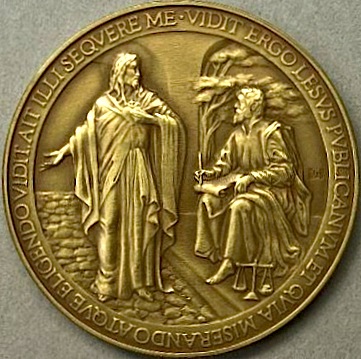
LesusTalk about embarrassing. In a nation that considers God to be its sovereign ruler, it seems rather inexcusable to misspell the name of Jesus.

And yet, that’s precisely what the Vatican has done.

Even more humbling, the error occurred on a very public medium—the principality’s coinage. And, if that was not enough to generate finger-pointing within the Curia, the coins bearing the defective spelling were minted to celebrate the first anniversary of Francis’ assumption of the papal throne.

Having collected coins since I was a young boy, I’m quite familiar with the frequency of minting errors. Typically they are caused by mistakes at the mint itself, where there is a mis-strike or a flaw in one of the dies. (I own a couple of ancient Roman “mules” where the mint workers accidentally used the mismatched obverses and reverses when they struck a particular piece.)

The legend (text) on the aforementioned medallions incorrectly reads “Lesus.” It seems to me that Western sources have mistakenly perceived this as the incorrect substitution of an “L” for the “J.”

The truth is . . . the inscription is in Latin, in which case it is actually an “I” that should appear in place of the “L.” If this is correct, Jesus’ name would be rendered IESUS.*

In actuality, the magnitude of this error was less significant than initially reported. It affected an anniversary medallion, rather than common, everyday coinage that would find its way into the hands of the masses. Also, the mistake was discovered early enough that only a handful of the medals were released; the “lucky” recipients are sure to see the worth of these treasures increase many times over, as their rarity causes the value of the medals to escalate.

Unlike Islam, which forbids images of Allah and Muhammad, Christianity has found iconography related to Jesus to be inspirational, throughout its two millennia history.

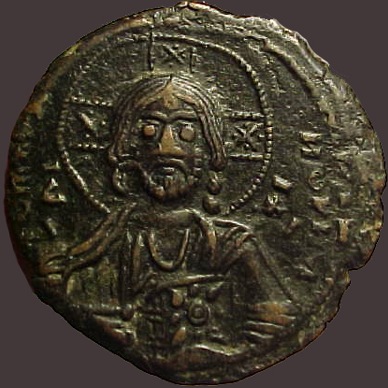
The Lord’s face has appeared on numerous coins throughout the years, and there is an entire series of Byzantine issues that cannot be specifically attributed to individual rulers because they did not include their own likeness or name, preferring to yield their place of honor to Christ.

In a 1942 letter to a nun with whom he corresponded, C.S. Lewis shared a poem he had written. I relate it here because of the exquisite reference to religious portraiture on coinage.

From all my lame defeats and oh! much more

From all the victories I have seemed to score;

From cleverness shot forth in Thy behalf,

At which, while angels weep, the audience laugh;

From all my proofs of Thy divinity,

Thou, who would’st give no sign, deliver me.

Thoughts are but coins. Let me not trust, instead

Of Thee, the thumb-worn image of Thy head;

From every thought, even from my thoughts of Thee,

Oh thou fair Silence! fall and set me free.

Lord of the straight way and the needle’s eye,

Take from me all my trumpery lest I die.

A Thought for Writers

Everyone who has ever written something read by others understands the importance of proofreading. This is true for digital media such as emails. It’s even more true for print publications that cannot be easily amended.

That said, we can consider ourselves fortunate that our typographical mistakes are not inscribed for all time on precious metals.

_____

* Iesus in the nominative case. It’s more commonly seen as Iesu, and my Latin is too rusty to know how it should correctly be rendered in this inscription.

Confusing Creeds

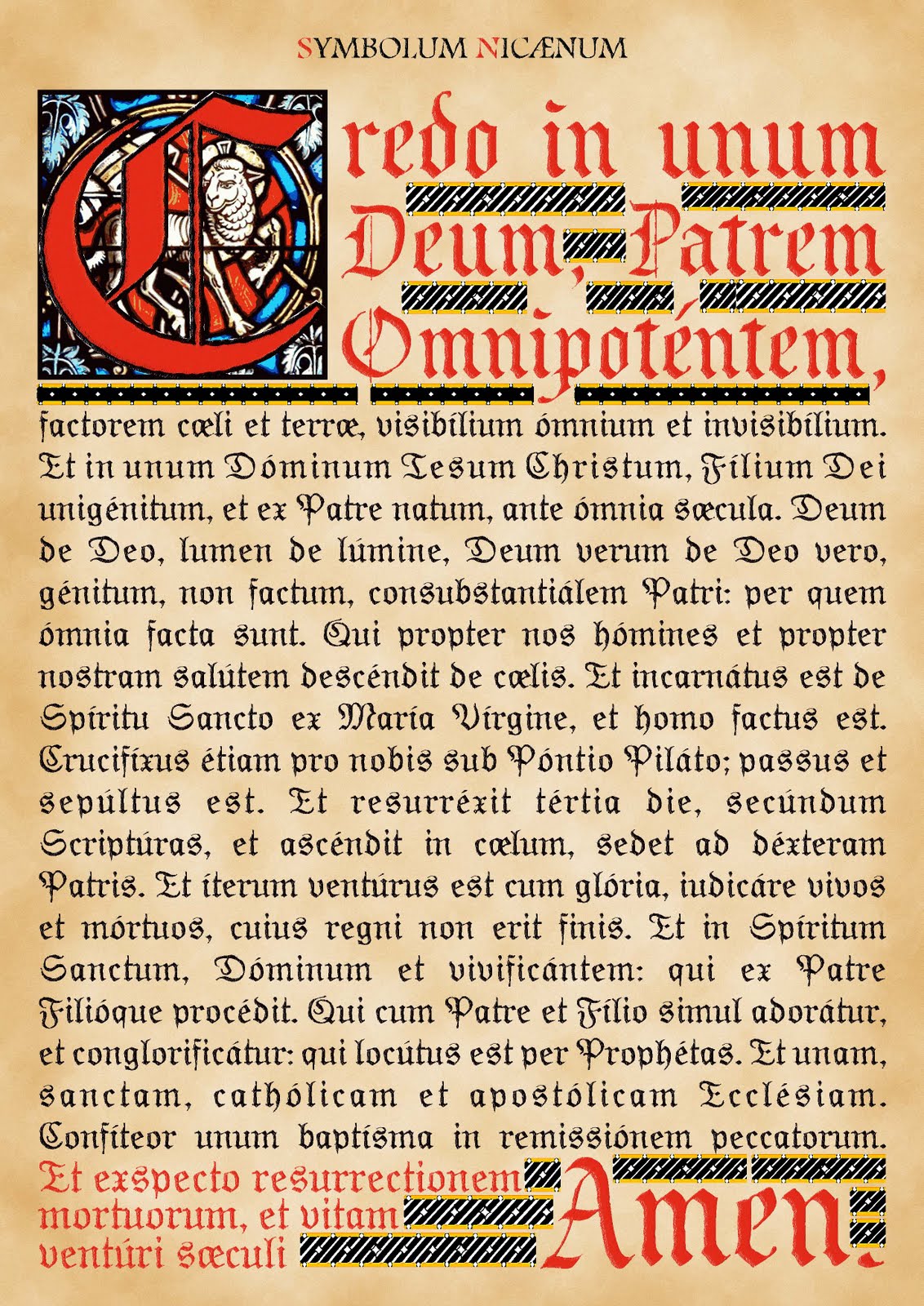
Nicene CreedThere are a couple of sentences in the traditional translation of the basic Christian creeds (statements of faith) that lead to confusion.

Due to the literary examples below, Christian readers may find the following discussion more interesting than non-Christians—but everyone interested in clarity versus confusion should find something intriguing.

The creeds offer a prime example of why it is absolutely crucial to ensure that gradual shifts in language do not undermine or blur the intended meaning of a given sentence. To illustrate, consider this line from the Nicene Creed.

. . . [Jesus] who for us men and for our salvation came down from heaven and was incarnate by the Holy Spirit of the virgin Mary and was made man. (1662, Anglican Book of Common Prayer).*

The potential confusion here lies in the archaic usage of the word “of.” Whose Holy Spirit are we referring to? Mary’s innate holiness and purity? The educated Christian may stumble over that dated phrase—which is still used in some denominations—but a person not acquainted with the doctrine of the Trinity might easily misinterpret it as a Maryological, rather than Christological, confession.

Let’s consider two more recent translations, and note how the first restores the intent of the original writers. The second of these commonly used translations reflects the hand(s) of “politically correct” revisers.

For us and for our salvation he [Jesus] came down from heaven: by the power of the Holy Spirit he became incarnate from the Virgin Mary, and was made man. (1975 International Consultation on English Texts version).

For us and for our salvation he came down from heaven, was incarnate of the Holy Spirit and the Virgin Mary and became truly human. (1988, English Language Liturgical Consultation version).

We will consider a second example momentarily, but let’s first look at something C.S. Lewis wrote about reflecting on the importance of the creeds. He noted that too often we rattle through the words without considering their significance. This is unfortunate.

In an essay entitle “On Forgiveness,” Lewis describes a personal epiphany and offers counsel to those tempted to take familiar words for granted.

We say a great many things in church (and out of church too) without thinking of what we are saying. For instance, we say in the Creed “I believe in the forgiveness of sins.” I had been saying it for several years before I asked myself why it was in the Creed. At first sight it seems hardly worth putting in. “If one is a Christian,” I thought “of course one believes in the forgiveness of sins. It goes without saying.”

But the people who compiled the Creed apparently thought that this was a part of our belief which we needed to be reminded of every time we went to church. And I have begun to see that, as far as I am concerned, they were right. To believe in the forgiveness of sins is not so easy as I thought. Real belief in it is the sort of thing that easily slips away if we don’t keep on polishing it up.

As usual, the Oxford don was correct. However, just as good translations possess the power to inspire, so too poor or antiquated translations exercise the ability to confuse.

Here is the promised second example.

And the third day he rose again according to the Scriptures . . . (1662).

Ah, I understand, think the uncatechized, the Bible teaches us that Jesus rose from the dead on Easter. Well, yes it does, but that is not the sense in which the second phrase is intended. Here, “according to the Scriptures,” means that Jesus’ life, death and resurrection were all accomplished in accordance with the promises of the Word of God.

In other words, “just as was promised in the Garden of Eden and foretold by the prophets, Jesus won victory when he rose from the grave in accordance with the loving plan of God the Father.” The newer versions make that fact only slightly clearer.

On the third day he rose again in accordance with the Scriptures . . . (1975 and 1988).

Perhaps a future revision will replace “in accordance with,” using something like “as foretold in” or “fulfilling the scriptural promises.”

Some of us worship in congregations using a variant of the seventeenth century creed, but at least we can take comfort in the fact that most of them have at least replaced “And he shall come again with glory to judge both the quick and the dead” with “both the living an the dead.” After all, we wouldn’t want people to think that one’s salvation is dependent upon their speed.

_____

* This slightly contemporized version of the creed has already remedied the terribly confusing term “Holy Ghost,” which evokes images of disembodied souls and hauntings.

Free C.S. Lewis Book

bookshelvesC.S. Lewis has encouraged innumerable prominent individuals in their own faith and writing journeys. I know of no others who offer at no cost a book about his influence.

John Piper is a pleasant exception to that. In a moment I’ll provide the link where you can download a free copy of Alive to Wonder: Celebrating the Influence of C.S. Lewis.

The volume includes a number of extended excerpts from Piper’s fifty-plus books . . . passages where Lewis’ imprint is particularly vivid. For example:

The synthesis of mind and heart was embodied in C.S. Lewis. Lewis became for me in my college days what Jonathan Edwards became in my seminary days. He was a “romantic rationalist”—that was the name of a small book about Lewis that got me very excited because it summed up what I thought I was (which may be very akin to “pastor-scholar”). Lewis has had a tremendous influence on me in several ways.

Lewis embodied the fact that rigorous, precise, penetrating logic is not inimical to deep, soul-stirring feeling and vivid, lively—even playful—imagination. He combined what almost everybody today assumes are mutually exclusive terms: rationalism and poetry, cool logic and warm feeling, disciplined prose and free imagination. In shattering these old stereotypes, he freed me to think hard and to write poetry, to argue for the resurrection and to compose hymns to Christ, to smash an argument and to hug a friend, to demand a definition and to use a metaphor.

The author is chancellor of Bethlehem College & Seminary. It was founded by Bethlehem Baptist Church in Minneapolis, where Piper served as pastor for several decades.

The writer’s desiringGod website actually offers free PDF copies of many of his books and articles, even though most remain in print and available for regular purchase.

As delightful as Alive to Wonder is, most students of Lewis will find the materials from the 2013 desiringGod National Conference even more welcome. This year’s theme was “The Romantic Rationalist: God, Life, and Imagination in the Work of C.S. Lewis.”

Piper’s website includes ten keynote presentations plus an informative panel discussion, all of which are available for download in audio files. Best of all, the lineup of speakers is first-class, featuring a number of familiar names.

And, since we’re on the subject of “free books,” allow me to share another interesting website.

Forgotten Books offers approximately a million volumes, to which “subscribers” have unlimited access. What sets them apart from other “public domain aggregates,” is that they (unlike books.google.com) provide a searchable text, in a variety of epub formats.

For those who are not interested in purchasing a subscription, they offer a Free Book of the Day option in which you receive the link to one of their texts which is good for twenty-four hours.

I recently used it to add Pure English: A Treatise on Words and Phrases, or Practical Lessons in the Use of Language to my kindle library. I find the reading of dated literary books to be:

Entertaining

Educational

and, occasionally, even

Inspiring

Here are a few sample passages from Pure English. The first sounds remarkably contemporary:

The abuse to which the English language is so generally subjected must be a source of sincere regret to all who appreciate its beauties. Ours is an age of progress and civilization, and it ought to be remembered that language, is also progressive.

In a section entitled “Objectionable and Obsolete Words” we read:

Banister is a common barbarism. The proper word is baluster, or balustrade.

— Noted. In the future I will alternate between baluster and balustrade.

“Disremember,” often employed in the sense of do not remember, although given in Webster, is condemned by the critics as a low vulgarism.

— Apparently so vulgar as to have fallen out of usage completely.

Hence, authoress and poetess are superfluous. So, also, are such words as conductress, directress, inspectress, waitress, etc., all of which have recently come into current use. Perhaps the next edition of our dictionaries will, if the custom continues, be enriched by the addition of such words as writeress, officeress, carpenteress, manageress, secretaryess, treasureress, singeress, walkeress, talkeress, etc.

— How did “waitress” survive, especially in the wake of such witty sarcasm?

It is questionable taste to call a coffin a casket. The pleasing name applicable to a case for jewels does not lessen the dread of death and burial.

— I hadn’t known before the sentiment behind the adoption of the word “casket,” since it’s become so thoroughly associated with this usage that was apparently at one time novel.

If you are interested in the books I’ve mentioned above, you You can download a free copy of Alive to Wonder here, and you can sign up for the free book of the day here.

Powerful Names

missilesIt’s all in the name. The person who succeeds in naming (or labeling) something wields great power.

Whether it be a concrete object, or an idea, the power to name carries the power to shape perceptions.

Philosophically, we might agree that:

“That which we call a rose by any other name would smell as sweet” (Juliet, Romeo and Juliet).

But, if we are perfectly honest, calling it “skunk cabbage” might affect our perception of its aroma.

A classic example of the power of naming comes from the era of Norse exploration. In the ninth century, Vikings began settling in the inhospitably named “Iceland.” The island was majestic, and its spectacular glaciers and volcanoes still allowed room for extremely fertile farmsteads.

Less than a century and a half later, Erik the Red was exiled from Iceland. He sailed west and established the first colony on a much larger island that he enticingly named Greenland. Erik’s brilliant advertising ploy was quite effective, and hundreds of settlers joined him in the much harsher climes to Iceland’s west.

The specific appellations which led me to ponder the power that resides in naming once again,* actually came from a much more modern source—weaponry.

Military leaders have a knack for generating striking names. Often they are brilliant; occasionally they completely miss the mark. In either case, it’s curious to note the message their choice of nomenclature seeks to emphasize. Consider for a moment two different American missiles.

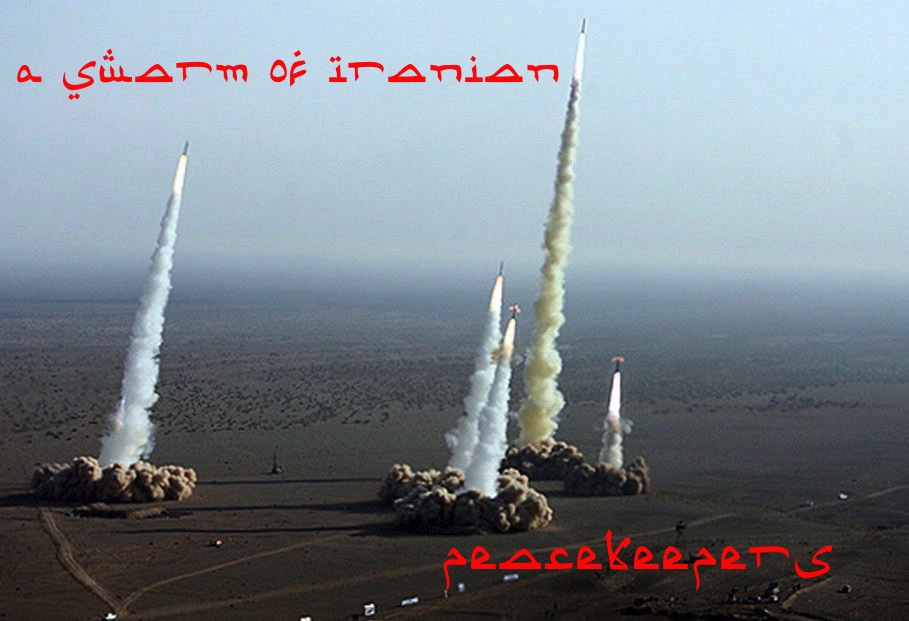
The AGM-114 Hellfire and the LGM-118A Peacekeeper

The reader naturally assumes the purpose of the former is to rain sulfur and brimstone down on the enemy, while the mission of the latter is to benignly maintain peace. One suspects, however, that being at the epicenter of either explosive device would be equally disastrous.

Another example we might consider is a bit more controversial, but fascinating nonetheless. Consider these labels for movements involved in the abortion debate.

Self-Preferred  ||  Used by Opponents  ||  Used by the Media

Pro-Choice  ||  Pro-Abortion  ||  Pro-Choice

Pro-Life  ||  Anti-Choice  ||  Anti-Abortion

It doesn’t require a brilliant intellect to comprehend the tone each of these labels evokes. Nor should it come as a surprise how the mainstream media tends to line up in the debate.

It’s all in the name. The person who succeeds in naming something wields great power.

C.S. Lewis was a master of language. He knew names exercise significant influence on how things are perceived. In the following passage from “The Humanitarian Theory of Punishment,” he describes how a powerful word—in this case “mercy”—can be dangerously misleading when applied to something inimical to itself.

Mercy, detached from Justice, grows unmerciful. That is the important paradox. As there are plants which will flourish only in mountain soil, so it appears that Mercy will flower only when it grows in the crannies of the rock of Justice: transplanted to the marshlands of mere Humanitarianism, it becomes a man-eating weed, all the more dangerous because it is still called by the same name as the mountain variety.

In another essay, “‘Bulverism:’ or, the Foundation of 20th Century Thought,” Lewis actually coins a word which has found favor with a literate subculture. The peculiar word he created conveys a sense of obtuse, opinionated self-smugness. (Yes, I may be reading just a little bit into “Bulverism,” but I really don’t think so. The aristocratic or remote sounding surname “Bulver,” the “ism” suffix and, of course, the “Bul” prefix all combine to engender an odd and unappealing impression.)

The subject Lewis addresses in this work is the unwillingness of disagreeing parties to honestly debate the merits of an issue. Instead, they rush to employ the invalid (and terribly effective) ad hominem approaches that characterize so much of modern politics.

C.S. Lewis is so talented (and ingenious) that he provides us with a biographical note on the fictional creator of the deficient form of “debate” prevalent in the modern era. “The modern method [of argument],” Lewis begins, “is to assume without discussion [your opponent] is wrong and then distract his attention from this (the only real issue) by busily explaining how he became so silly.”

In the course of the last fifteen years I have found this vice so common that I have had to invent a name for it. I call it “Bulverism.” Some day I am going the write the biography of its imaginary inventor, Ezekiel Bulver, whose destiny was determined at the age of five when he heard his mother say to his father—who had been maintaining that two sides of a triangle were together greater than the third—“Oh, you say that because you are a man.”

“At that moment,” E. Bulver assures us, “there flashed across my opening mind the great truth that refutation is no necessary part of argument. Assume your opponent is wrong, and then explain his error, and the world will be at your feet. Attempt to prove that he is wrong or (worse still) try to find out whether he is wrong or right, and the national dynamism of our age will thrust you to the wall.” That is how Bulver became one of the makers of the Twentieth Century.

. . . Bulverism is a truly democratic game in the sense that all can play it all day long, and that it gives no unfair privilege to the small and offensive minority who reason.

Sadly, Bulver’s disciples continue to increase, rather than diminish.

Since it was military missiles that initially got me thinking about the subject of the power of naming, it might be fitting to end with a few more evocative labels. They certainly elicit a wide range of impressions.

Condor: Argentina’s avian contribution

Piranha: Tiny but vicious and straight from Brazil’s Amazon

Velvet Glove: Canada’s mixed message

Sky Sword: China’s blending of the ancient and modern

Apache: French, which confuses this American veteran**

Meteor: A European offering sure to land hard if it doesn’t disappear in the atmosphere

Martel: Anglo-French venture they surely don’t want Islamists to think is a tribute to Charles Martel, Hero of the Battle of Tours***

V-1 Flying Bomb: Got to Hand it to the Germans for straight-forward labeling.

Rhinemaidens (Rheintöchter): There’s apparently Teutonic Poetry as well

Fateh: Iran’s “Conqueror”

Zelzal: Iran’s “Earthquake”

Sejjil: Iran’s “Baked Clay” (well we can’t expect all the Persian names to be winners)

Jericho: From Israel where we know whose walls tumbled down

Spike: Israeli and probably not a reference to Jael and the Book of Judges****

Hatf: Pakistani “Vengeance” (derived from the gentle sword of Muhammad)

Hyunmoo: Korea’s mythical “Guardian of the Northern Sky” (mayhap a reference to their aggressive northern neighbor)

Penguin: Those Norwegians really know how to frighten their enemies

Malakhit (Малахит): Just one of Russia’s curiously named explosives in their “mineral missile series”

Umkhonto: South African “Spear” from the Zulu tongue

The Brits are uniquely creative when it comes to naming missiles. They include: Blowpipe, Brimstone, Green Cheese, Rapier, Sea Skua and, of course, Fairey Fireflash and it’s less intimidating companion Fairey Stooge.

For some reason, I find a missile named “Green Cheese” particularly disconcerting. Whoever named that specific weapon was devilishly clever. If I were a world leader, I’d surrender immediately, rather than face a foe confident enough in their military prowess to use that sort of twisted culinary nomenclature for their armaments.

______

* I have written on the subject of personal names in the past.

** It just may translate as “Ruffian,” but I don’t think I want to go there, since it hints at political incorrectness.

*** It’s actually a combination of the missile’s guidance options: Missile, Anti-Radiation, Television. I’m sure the parallel with the Frankish defender of the Christian Church is a mere coincidence.

**** The fourth chapter of the Book of Judges.

Ending ALL CAPS

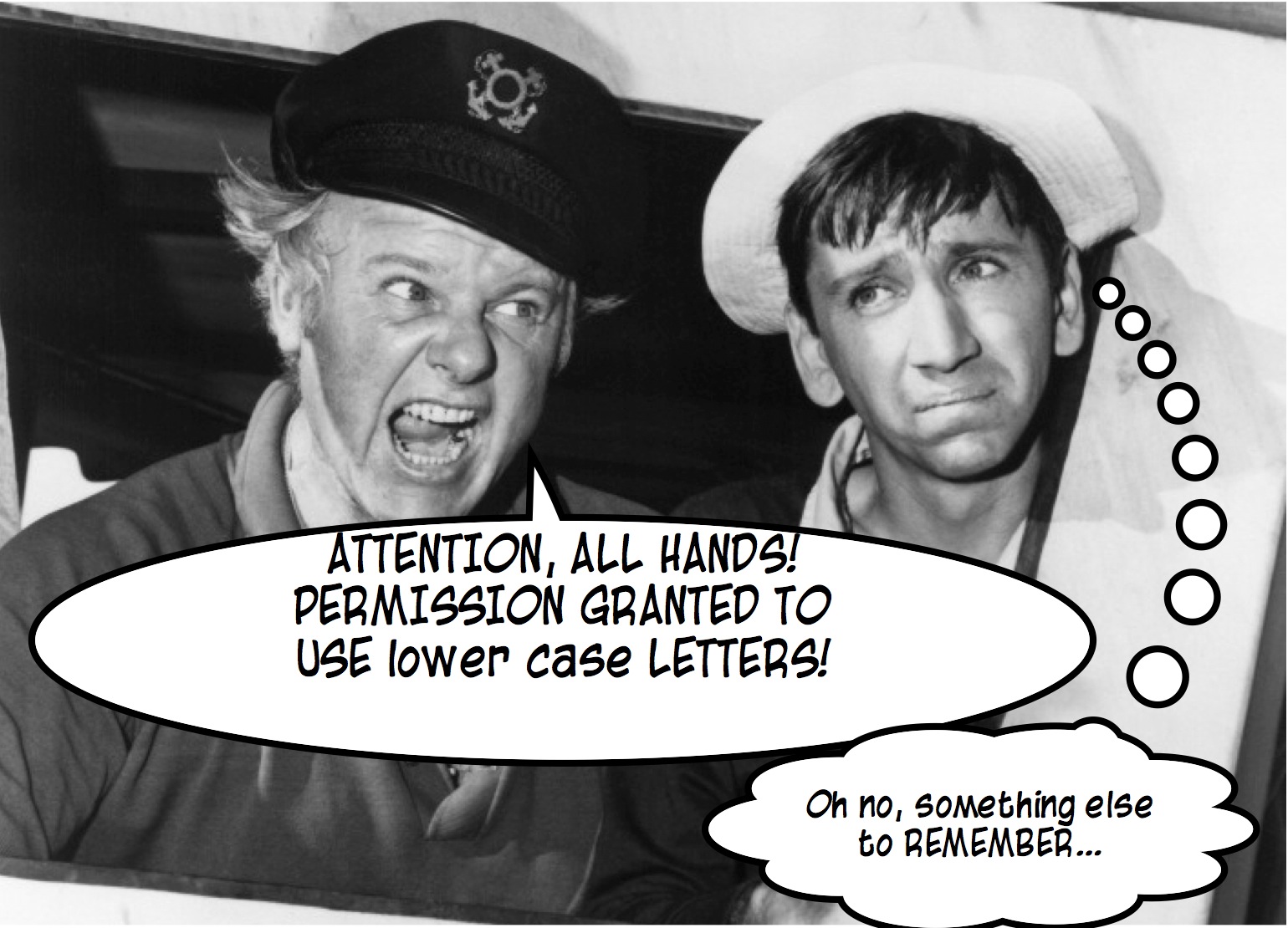
gilliganThe United States Navy finally realized what everyone else long ago recognized—writing in ALL CAPS is obsolete.

Only the most novice users of the internet type in all caps. After all, people quickly learn that it is tantamount to “shouting,” and considered rude behavior.

The occasional word or phrase may properly be rendered in CAPS, in order to emphasize it when italics are not available, BUT WRITING EVERYTHING IN CAPITAL LETTERS IS SURELY TO BE AVOIDED.

The advent of the computer has freed us from the limited conventions forced upon us by typewriters. For emphasis, we lacked boldface and italic fonts (unless one had access to an IBM Selectric or one of its clones).

Back in the “olden days,” we had to be satisfied with unsightly underlining. Surprisingly, many people today seem unaware that underlining is obsolete . . . but that’s a subject for another day.

Returning to the use of all capital letters. Earlier this year, the Navy caught up with the rest of the universe’s practice and changed their official policies which required CAPITALIZATION in internal, official messages.

It was wonderfully fitting that the official memorandum read:

AUTHORIZED TO USE STANDARD, MIXED-CASE CHARACTERS IN THE BODY OF ORGANIZATIONAL MESSAGES.

However, lest any sailors get carried away with this modern fad, the message continued:

RECOMMEND CONTINUE TO USE UPPER CASE IN LINES BEFORE REMARKS.

As a retired military chaplain I love the following (unattributed) quotation from an article on the subject.

“If an ancillary benefit is that sailors reading message traffic no longer feel they’re being screamed at . . . that is a good thing too,” said a Navy official. The official insisted the move was not an example of the service going soft.

Well, we certainly couldn’t have that!

I’m not aware of any places where C.S. Lewis resorts to the use of capital letters to emphasize anything. But in searching for just such a thing, I came across a fascinating passage in the introduction to his English Literature in the Sixteenth Century.

Lewis’ descriptions are always vivid and his description of “ruthless emphasis” does not disappoint.

The rough outline of our literary history in the sixteenth century is not very difficult to grasp. At the beginning we find a literature still medieval in form and spirit. . . . Their prose is clumsy, monotonous, garrulous; their verse either astonishingly tame and cold or, if it attempts to rise, the coarsest fustian. In both mediums we come to dread a certain ruthless emphasis; bludgeon-work. Nothing is light, or tender, or fresh. All the authors write like elderly men. The mid-century is an earnest, heavy-handed, commonplace age: a drab age.*

The use of all caps strikes me as akin to “bludgeon-work.” Not nearly so graceful as occasional italics or the even more skillful manipulation of the English language itself in order to emphasize its message.

At least we can take some small comfort in the fact that the Navy has joined the “mixed-case” twenty-first century. I assume there remain a handful of holdouts in the Admiralty, but eventually these old salts will retire, and the new day of “upper and lower case diversity” will have fully dawned.

_____

* If you are interested in seeing the rest of Lewis’ thoughts about “the rough outline of our literary history in the sixteenth century,” read on.

Then, in the last quarter of the century, the unpredictable happens. With startling suddenness we ascend. Fantasy, conceit, paradox, colour, incantation return. Youth returns. The fine frenzies of ideal love and ideal war are readmitted. Sidney, Spenser, Shakespeare, Hooker—even, in a way, Lyly—display what is almost a new culture: that culture which was to last through most of the seventeenth century and to enrich the very meanings of the words England and Aristocracy. Nothing in the earlier history of our period would have enabled the sharpest observer to foresee this transformation.

Claiming Divine Inspiration

inspirationSome Christian writers face a terrifying dilemma. They think God has inspired their work. That may be true. But then they proceed a step further and assume that “if God has given these words to me, they can’t be changed.”

The inference, of course, is that the message is essentially inspired in the same sense as Christians normally view the Holy Scriptures themselves. They become, in a word, inviolate.

It’s almost as though the author has appropriated the words of the Apostle John, who in his Revelation was inspired to write:

I warn everyone who hears the words of the prophecy of this book: if anyone adds to them, God will add to him the plagues described in this book, and if anyone takes away from the words of the book of this prophecy, God will take away his share in the tree of life and in the holy city, which are described in this book. (Revelation 22:18-19, ESV).

Naturally, this mindset can cause a bit of a problem when it rears its head in a writing critique group. I’ve witnessed it more times than I can recall, having been a member of such groups on several continents.

I’ve learned to be extremely cautious in how I attempt to explain to the person that while they may rightly feel that their work is inspired by their faith, it doesn’t necessarily follow that it remains in an unblemished condition . . . as it was received by our imperfect human senses, processed by our imperfect minds, and put into words via our imperfect skills and finite vocabulary.

No matter how gently this is said, most of these individuals don’t last long in writers groups. They drop out when others offer suggestions on how to improve their work, seemingly stunned that everyone else doesn’t simply fall prostrate in adoration at their words. It’s quite sad.

That’s why it was so refreshing to read the following in the preface to J. Budziszewski’s What We Can’t Not Know, which I highly recommend.

It seems to me that every writer should end with gratitude to the one who was in the beginning, and whose very name is Word. A reviewer—a friendly one—once remarked that it seemed strange to see that sort of thanks in a book, as though the author were claiming divine inspiration. Of course, for whatever is amiss in these pages (and there will be much), the blame is mine. But permit me to be grateful if anything in them is true.

I love this paragraph. In part, because I share his sentiments. It echoes my own words, spoken at my military retirement, “attribute to me all of the failings and disappointments in my work, and to God any positive or healing results that followed my ministry.”

This worldview proclaims Soli Deo Gloria,* and simultaneously acknowledges that I am not God. It is good for writers to occasionally be reminded of that fact.

It should come as no surprise that our friend C.S. Lewis offers worthwhile insight into inspiration. In his essay, “The Vision of John Bunyan,” he considers that writer’s comments about how the classic Pilgrim’s Progress came to be.

Lewis begins with a quotation, and offers his own wise insights, with which I will close.

For having now my Method by the end;

Still as I pull’d, it came.

It came. I doubt if we shall ever know more of the process called “inspiration” than those two monosyllables tell us.

Perhaps we may hazard a guess as to why it came at just that moment. My own guess is that the scheme of a journey with adventures suddenly reunited two things in Bunyan’s mind which had hitherto lain far apart.

One was his present and lifelong preoccupation with the spiritual life. The other, far further away and longer ago, left behind (he had supposed) in childhood, was his delight in old wives’ tales and such last remnants of chivalric romance as he had found in chap-books. The one fitted the other like a glove. Now, as never before, the whole man was engaged.

_____

* Glory to God alone or all glory be to God.

Is Slowing Down Possible?

snailEons ago, when I was attending college, I suffered from that common plague—a chronic lack of time.

Between my studies, my job and romancing my future wife, I never had enough hours in the day.

So I did what everyone in that situation does . . . I worked harder. It didn’t solve my dilemma and probably worsened my exhaustion.

During that indescribably busy season of my life God spoke to me through a song. It was recorded by an early “contemporary” Christian group called “Love Song.” At the end of this column you can listen to a recording of the song “Slow Down,” by Chuck Girard. (Don’t skip to it now though, since the link won’t work unless you read the entire post.)

It sounds a bit dated now, forty years after it was composed, but it still conveys a powerful calming message. I hadn’t heard it for years until I just uncovered it for this column, but listening to it today has stilled my sense of urgency as I rush to complete this post before our four grandkids arrive for a weekend visit, in just an hour.

The importance of slowing down and resting is never far from my consciousness, since I am always overextended. Like many of you, I find it extremely difficult to say “no,” so I end up committed to more things than I feel I’m able to do well.

This week I received word of another song, which is what actually inspired me to write on this subject. It’s by a delightful young artist and is much peppier than Girard’s more prayerful message. I believe you’ll enjoy watching the music video below (after you finish reading, of course).

In light of this human need for being reminded to rest, I wondered where C.S. Lewis lamented his own overburdened state. His courtesy in responding to all correspondence is legendary. In addition to teaching, writing, corresponding and (near the end of his life) husbanding, Lewis was far busier than I am.

So, I explored some of Lewis’ words. (That’s never “work,” by the way, since it never fails to reinvigorate me, just like physical rest.) I found the following passage delivers a brilliant insight into why many of us are so compelled to work—work—work.

In the following passage, from a 1930 letter, Lewis relates how our drive to succeed can be linked to our personal ambitions. He couches the discussion in the context of his own desire for renown as a writer. And, Lewis declares, it is only when those misdirected impulses are quelled that we can truly find rest and peace.

From the age of sixteen onwards I had one single ambition [to succeed as a writer], from which I never wavered, in the prosecution of which I spent every ounce I could, on which I really & deliberately staked my whole contentment: and I recognise myself as having unmistakably failed in it. . . .

The side of me which longs, not to write, for no one can stop us doing that, but to be approved as a writer, is not the side of us that is really worth much. And depend upon it, unless God has abandoned us, he will find means to cauterise that side somehow or other. If we can take the pain well and truly now, and by it forever get over the wish to be distinguished beyond our fellows, well: if not we shall get it again in some other form.

And honestly, the being cured, with all the pain, has pleasure too: one creeps home, tired and bruised, into a state of mind that is really restful, when all one’s ambitions have been given up. Then one can really
for the first time say “Thy Kingdom come:” for in that Kingdom there will be no pre-eminences and a man must have reached the stage of not caring two straws about his own status before he can enter it.

Think how difficult that would be if one succeeded as a writer: how bitter this necessary purgation at the age of sixty, when literary success had made your whole life and you had then got to begin to go through the stage of seeing it all as dust and ashes. Perhaps God has been specially kind to us in forcing us to get over it at the beginning.

At all events, whether we like it or not, we have got to take the shock. As you know so well, we have got to die. Cry, kick, swear, we may: only like Lilith to come in the end and die far more painfully and later. . . . I would have given almost anything—I shudder to think what I would have given if I had been allowed—to be a successful writer. . . . I am writing as I do simply & solely because I think the only thing for you to do is absolutely to kill the part of you that wants success.

Powerful words to ponder. Now, without further delay, the aforementioned songs. Profound lyrics in both. Listen to them in either order, keeping in mind that Myla Smith’s is energetic and Chuck Girard’s is meditative. Enjoy . . . and slow down!

“Slow Down” by Myla Smith

“Slow Down” by Chuck Girard

What Children Read

young readerI recently reread C.S. Lewis’ brief essay, “On Juvenile Tastes.” In it he ponders two basic questions.

First, what do children prefer to read? And second, why do they evidence that preference?

Lewis set the stage by discussing the state of children’s literature in 1958, which was of course, more than half a century ago. Nevertheless, like most of Lewis’ observations, there is much that is timeless about his argument.

Not long ago I saw in some periodical the statement that “Children are a distinct race”. Something like this seems to be assumed today by many who write, and still more who criticise, what are called children’s books or ‘juveniles’. Children are regarded as being at any rate a distinct literary species, and the production of books that cater for their supposedly odd and alien taste has become an industry; almost a heavy one.

It seems little has changed during the intervening decades. If anything, this concept has become much more deeply entrenched. No one can doubt that the publication of “juvenile” literature has expanded dramatically. (To maintain the entrenchment allusion, we might say it has “exploded.”)

Lewis, however, does not accept the notion that children have unique—in his picturesque words “odd and alien”—literary interests. His first argument is that their preferences are by no means monolithic.

This theory does not seem to me to be borne out by the facts. For one thing, there is no literary taste common to all children. We find among them all the same types as among ourselves. Many of them, like many of us, never read when they can find any other entertainment. Some of them choose quiet, realistic, “slice-of-life” books . . . Some like fantasies and marvels . . . Some care for little but books of information, and so do some adults. Some of them, like some of us, are omnivorous. Silly children prefer success stories about school life as silly adults like success stories about grown-up life.

So, in Lewis’ opinion, we witness great difference in the tastes of children, as well as adults. He attributes changing literary emphases to human nature, rather than chronological considerations. The difference enters with children’s focus on enjoying literature, which provides them immunity to literary fads.

Surely it would be less arrogant, and truer to the evidence, to say that the peculiarity of child readers is that they are not peculiar. It is we who are peculiar. Fashions in literary taste come and go among the adults, and every period has its own shibboleths. These, when good, do not improve the taste of children, and, when bad, do not corrupt it; for children read only to enjoy.

Of course their limited vocabulary and general ignorance make some books unintelligible to them. But apart from that, juvenile taste is simply human taste, going on from age to age, silly with a universal silliness or wise with a universal wisdom, regardless of modes, movements, and literary revolutions.

Lewis’ critique of the publishing arena follows. Since these literary phases fade in and out, it is here where contemporary literary critics may fairly evaluate things differently.

This has one curious result. When the literary Establishment—the approved canon of taste—is so extremely jejune and narrow as it is today, much has to be addressed in the first instance to children if it is to get printed at all. Those who have a story to tell must appeal to the audience that still cares for storytelling.

The literary world of today is little interested in the narrative art as such; it is preoccupied with technical novelties and with ‘ideas’, by which it means not literary, but social or psychological, ideas. The ideas (in the literary sense) on which Miss Norton’s The Borrowers or Mr. White’s Mistress Masham’s Repose are built would not need to be embodied in “juveniles” at most periods.

Lewis ends his essay by contrasting two disparate approaches to the production of so-called children’s literature. I suspect the two general categories still hold true for most. However, having only dabbled in writing for children, I’m by no means an authority on the subject. As for the creator of Narnia . . . I’m persuaded he possesses the credibility to speak with some modest influence.

It follows that there are now two very different sorts of “writers for children”. The wrong sort believe that children are “a distinct race”. They carefully “make up” the tastes of these odd creatures—like an anthropologist observing the habits of a savage tribe—or even the tastes of a clearly defined age-group within a particular social class within the “distinct race”. They dish up not what they like themselves but what that race is supposed to like. Educational and moral, as well as commercial, motives may come in.

The right sort work from the common, universally human, ground they share with the children, and indeed with countless adults. They label their books ‘For Children’ because children are the only market now recognised for the books they, anyway, want to write.

Right or wrong, like Lewis I cast my lot with those who write for children from their shared humanity with them. After all, they may be slightly less mature than most grown-ups, but they are not truly “alien” (even if they occasionally behave that way).

A Narnian Madlib

EVO-WWI-064-01060I got to savor one of the joys of being a grandpa today, watching over two of my five lovely granddaughters while their parents traveled to an important business meeting.

Naturally, we had fun playing, drawing, tossing a ball for their German shepherd, building things, cleaning up their room (not quite so “fun”) and—since it’s summer—playing with water balloons (extremely fun, even though I got drenched).

We also did a madlib, one of those “phrasal templates” popularized by Roger Price and Leonard Stern in the 1950s. These simple word games are entertaining and educational. And, even for novice writers, they’re not too challenging to compose. After all, the stories themselves are by nature brief and rather superficial.

Today I even set my granddaughters in front of an episode of The Powerpuff Girls so I could write a short scene from Narnia for them. You’ll find it below.

I had forgotten how much fun we had with madlibs when our own children were young. We made many up on the spur of the moment, and laughed at the silly combinations of word that resulted. The process, as most readers know, involves randomly selecting a series of words for inclusion in the narrative. With a lack of imagination, the readings can fall a bit flat, but typically you end up with some (accidentally) witty wordplay.

One of the benefits of madlibs is how they can be used more than once. While the outline of the story remains the same, of course, the choices made by readers generate amazing diversity.

Most madlibs are admittedly rather juvenile. That’s because they are written for juveniles. They rely on providing specific types of words, such as nouns or adjectives. Theoretically, you could devise a madlib as complex or sophisticated as you desire. For example, an entertaining tale certainly could doubtless be woven by including random selections for the following word choices.

____________ prime number

____________ copular verb

____________ Napoleonic regimental commander

____________ homograph

____________ life stage of a butterfly (other than larva or pupa)

____________ ditransitive verb

____________ type of psychosis

____________ infielder for 1874 Chicago White Stockings

____________ gerund

____________ rare earth mineral

____________ monotransitive verb

____________ early kabbalist (other than Bahye ben Asher ibn Halawa)

____________ type of arachnid with blue coloration

____________ free predictive

____________ reciprocal pronoun

____________ chemical process (other than esterification)

Unfortunately, I don’t have time to write the story accompanying this worthy list, but if you should write it, I’d love to read it.

There are a number of fan sites online that generate madlibs. I won’t recommend any since the ones I’ve glanced at today are merely advertising collections for sale. (I also found the examples I experimented with to be rather feeble . . . even weaker than the story I wrote today in a single hour.)

You will search in vain if you’re seeking a C.S. Lewis reference to madlibs. However, he was a master wordsmith, who recognized well their power, and greatly loved humor. The following passage, from “Prudery and Philology,”
refers to the versatility and weight of language, and includes a valuable caution.

We are sometimes told that everything in the world can come into literature. This is perhaps true in some sense. But it is a dangerous truth unless we balance it with the statement that nothing can go into literature except words, or (if you prefer) that nothing can go in except by becoming words. And words, like every other medium, have their own
proper powers and limitations.

The brief tale below is not pretentious, so you need not fear it exceeding its limitation. It simply is what it is . . . one grandfather’s passing literary adventure with his grandchildren.

It you like “Sharpbeak’s Narnian Adventure,” you’re welcome to download a PDF copy of the story I’ve appended to the end of the column. It’s 100% free, and I’m not trying to sell a collection of madlibs after hooking you. Besides, if I was trying to make a profit off of anything including the word “Narnian,” I have no doubt lawyers would be descending upon me in droves.

The Words You Will Need

____________ adjective

____________ animal

____________ adjective

____________ adjective

____________ something  you drink

____________ color

____________ adverb

____________ adjective

____________ adjective

____________ meal time

____________ adjective

____________ adjective

____________ adjective

____________ adjective

____________ plural noun

____________ plural noun

____________ adjective

____________ adjective

____________ adjective

____________ animal

____________ adjective

____________ food

____________ food

____________ food

____________ place

____________ adverb

____________ adjective

____________ place

____________ number

____________ plural relative

____________ verb

____________ adjective

____________ plural monster

The Story Into Which You Insert Your Words

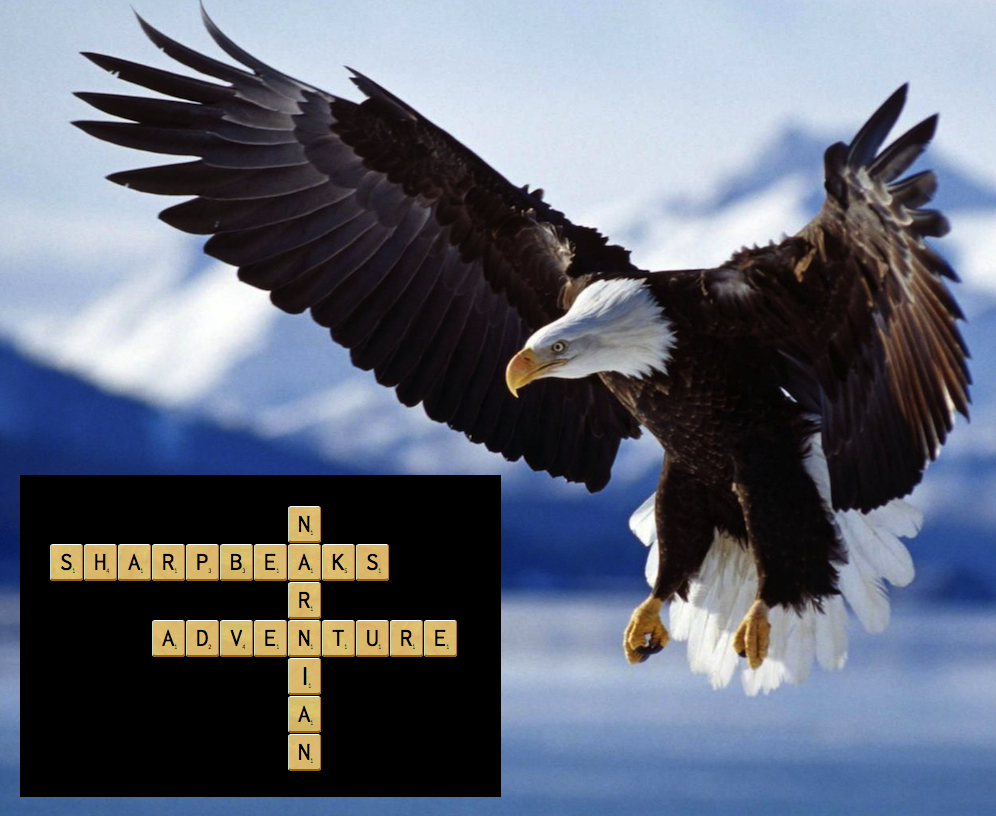
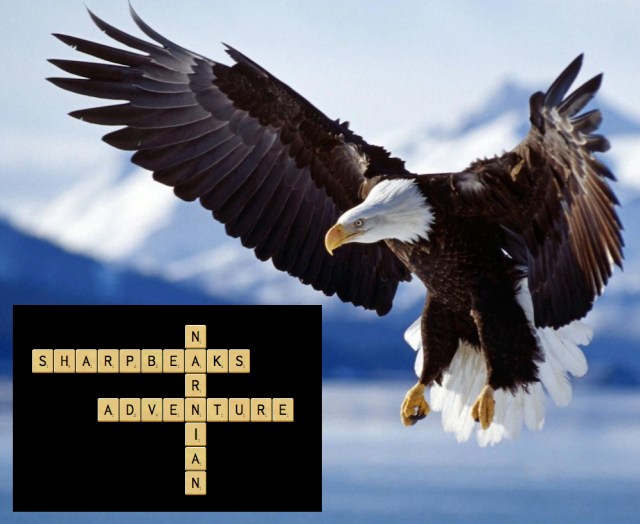
Once upon a time, when Narnia was still young, a/an ____________, young eagle named Sharpbeak decided to set out for an adventure. A wise ____________ climbed his ____________ tree to talk to him before he left. He crawled into the eagle’s ____________ nest and said, “That was a long climb. I’m thirsty. May I have a cup of ____________?”

As the two friends watched the sun set over the ____________ mountains, the eagle said ____________, “I wonder what’s on the other side of those mountains?”

His ____________ companion warned him, “Beware of the ____________ giants in the north. They like nothing better than to eat us Talking Animals for ____________ or even for a snack. Sharpbeak promised he would avoid the giants.

Then his friend said, “Don’t forget that there are also ____________ dragons living on some of the mountaintops. They don’t appreciate ____________ visitors. If you surprise them, they may blast you with a ____________ burst of their ___________ flames. And definitely don’t disturb their treasure of ____________ and ____________.”

The eagle said, “I’ll be sure to watch out for dragons when I go on my ____________ adventure.”

“Oh,” added Sharpbeak’s friend, “I wouldn’t advise you to fly over the ____________ ocean either. What if you flew as far as you could, and you didn’t find a/an ____________ island where you could land?” The eagle looked worried. His wise friend added, “If you ever find yourself in dangerous circumstances, remember that you can call on Aslan to protect you. I heard that once he once allowed a timid ____________ to walk safely across a stormy lake without sinking.”

“My,” said Sharpbeak, “that would be a terrible thing.” He looked up at the ____________ stars, twinkling in the sky. The two friends had spoken long into the night. “I didn’t realize it was so late,” he said. All I have to offer you to eat is ____________ and ____________.”

“That would be nice,” said his friend. He reached into his pocket and said, “and we could have this ____________ for dessert. But, after we eat I had better scurry home to my ____________, since I can’t imagine sleeping in a tree. I mean, if a storm comes up, you have the wind blowing ____________ and ___________ rain pouring down in torrents. I’m much happier living in a ____________ with my ____________ ____________. While you go on your journey, I will stay home and ____________.”

The two friends gave each other a big hug. The eagle’s feathers tickled his friend, who said, “May Aslan watch over you during your travels.”

The next morning the ____________ eagle soared off to begin his adventure. Sharpbeak would be sure to avoid all of the giants, dragons and ____________ along the way. But that’s a story for another day.

Epilogue

Those of you curious about how my granddaughters’ story turned out, should read on.

Once upon a time, when Narnia was still young, a big, young eagle decided to go off for an adventure. A wise deer climbed his pink tree to talk to him before he left. He crawled into the eagle’s fuzzy nest and said, “That was a long climb. I’m thirsty. May I have a cup of juice?

As the two friends watched the sun set over the blue mountains, the eagle said roughly, “I wonder what’s on the other side of those mountains?”

His wide companion warned him, “Beware of the cold giants in the north. They like nothing better than to eat us Talking Animals for breakfast or even for a snack.” Sharpbeak promised he would avoid the giants.

Then his friend said, “Don’t forget that there are also hairy dragons living on some of the mountaintops. They don’t appreciate old visitors. If you surprise them, they may blast you with a soft burst of their speedy flames. And definitely don’t disturb their treasure of trash cans and flowers.”

The eagle said, “I’ll be sure to watch out for dragons when I go on my fun adventure.”

“Oh,” added his friend, “and I wouldn’t advise you to fly out over the heavy ocean either. What if you flew as far as you could, and you didn’t find a dark island where you could land?” The eagle looked worried. His wise friend added, “If you ever find yourself in dangerous circumstances, remember that you can call on Aslan to protect you. I heard that once he once allowed a timid bunny to walk safely across a stormy lake without sinking.”

“My,” said the eagle, “that would be a terrible thing.” He looked up at the watery stars, twinkling in the sky. The two friends had spoken long into the night. “I didn’t realize it was so late,” he said. “All I have to offer you to eat is noodles and cheese.”

“That would be nice,” said his friend. He reached into his pocket and said, “and we could have this snack bar for dessert. But, after we eat I had better scurry home to my fairgrounds, since I can’t imagine sleeping in a tree. I mean, if a storm comes up, you have the wind blowing bravely and messy rain pouring down in torrents. I’m much happier living in a playground with my ten sisters. While you go on your journey, I will stay home and dance.”

The two friends gave each other a big hug. The eagle’s feathers tickled his friend, who said, “May Aslan watch over you during your travels.”

The next morning the brown eagle soared off to begin his adventure. He would be sure to avoid all of the giants, dragons and dinosaurs along the way. But that’s a story for another day.

Downloadable Version

Here’s the story. On the PDF, it is preceded by a list of the type of words required to fill in the various blanks.

Narnian Madlib

Dangerous Slang

toilet 2When we moved to Alabama, my wife innocently offended some of her young students by using a slang word that in our family simply meant “stuff,” but apparently is used elsewhere for more vulgar purposes.

In a reference to something such as things being in the way, she said the word “crap.” Obviously she was definitely not using it in the Thomas Crapper sense. But some of the Southern kids had never heard it applied in an innocent way, so they naturally assumed she was using it in a crasser sense.

She wasn’t. I grew up with the word meaning “junk, stuff or clutter” with the connotation that they were unwelcome, and “in the way.” My sainted mother—from whose lips I do not ever once recall hearing a vulgar word pass—used the word “crap” often.

And because the source of the word’s usage was so pure and unadulterated (my mom), I mistakenly assumed I fully understood the word’s meaning.

Still, old habits are hard to change, and I find myself occasionally using that very word. And, I must confess, I sometimes even use it as a minor expression of irritation. For example, I just used it in the subject line of an email I sent to some fellow students of ancient Roman history. “Crap, I Just Missed This” was the exact phrase, and the body of the message consisted only of a link to a fascinating conference held in Rome just a few days before I learned about it.

The link was to this site. . . and if you don’t have the time or inclination to check it out, allow me to share the fascinating subject it addressed:

It was sponsored by the Royal Netherlands Institute in Rome, quite a prestigious organization. No fewer than seven scholars who have been excavating Rome’s ancient latrines were slated to speak—I’m eager to learn whether or not their presentations will be published for the benefit of those of us unable to attend.* They generously offered “free seating” to members of the public desiring to attend the historic programme.**

C.S. Lewis apparently respected the Roman Empire enough to take the Roman name of an ancient Italian city for the name of fabled “Narnia.” While I’ve yet to find any references in Lewis’ corpus to Roman plumbing, I found this appraisal of a History of Rome which he noted in his diary (16 March 1924). During an extended country walk with two friends, he dined at an inn and browsed through its public library.

After some time we went on to Stanton Harcourt where we were to lunch. Before we reached it the sun suddenly disappeared and the sky got white and a cold wind sprang up. In the inn parlour we consumed large quantities of bread and cheese and draft cider. Harwood found a delightful book here—a History of Rome “related in conversations by a father to his children with instructive comments”. The children made such comments as “How pleasing is filial piety, Papa!” and “My dear Sir, surely you have been too indulgent in describing the vices of Honorius as weakness.”

One wonders what sort of refined comments the children would have made about the recent conference. Perhaps something like, “Most honored patriarch, it is enlightening to learn just how elaborate was the attention the Romans devoted to the facilities dedicated to their private bodily functions.”

Well, enough about such matters. We have terribly digressed in a post originally intended to serve as a warning about the dangers of using slang. I guess I am just so disappointed about missing the conference that I needed to vent that here.

_____

* One wonders how they were able to adequately address this complex subject in a one-day seminar.

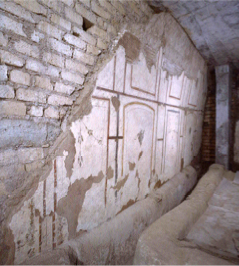
toilet 1** The invitation does not expressly say whether it would consist of individual seats, or in a bench design, similar to that pictured below, from the workshop’s brochure. Speaking of pictures, the one at the top of the column, also from the promotional publication, is a fresco from the ceiling of a toilet on the Palatine. (And we think our bathrooms are fancy!)